Skip to content
  • Home
  • Subscribe / donate
  • Events calendar
  • News
    • Local
    • National
    • Israel
    • World
    • עניין בחדשות
      A roundup of news in Canada and further afield, in Hebrew.
  • Opinion
    • From the JI
    • Op-Ed
  • Arts & Culture
    • Performing Arts
    • Music
    • Books
    • Visual Arts
    • TV & Film
  • Life
    • Celebrating the Holidays
    • Travel
    • The Daily Snooze
      Cartoons by Jacob Samuel
    • Mystery Photo
      Help the JI and JMABC fill in the gaps in our archives.
  • Community Links
    • Organizations, Etc.
    • Other News Sources & Blogs
    • Business Directory
  • FAQ
  • JI Chai Celebration
  • JI@88! video

Recent Posts

  • Eby touts government record
  • Keep lighting candles
  • Facing a complex situation
  • Unique interview show a hit
  • See Annie at Gateway
  • Explorations of light
  • Help with the legal aspects
  • Stories create impact
  • Different faiths gather
  • Advocating for girls’ rights
  • An oral song tradition
  • Genealogy tools and tips
  • Jew-hatred is centuries old
  • Aiding medical research
  • Connecting Jews to Judaism
  • Beacon of light in heart of city
  • Drag & Dreidel: A Queer Jewish Hanukkah Celebration
  • An emotional reunion
  • Post-tumble, lights still shine
  • Visit to cradle of Ashkenaz
  • Unique, memorable travels
  • Family memoir a work of art
  • A little holiday romance
  • The Maccabees, old and new
  • My Hanukkah miracle
  • After the rededication … a Hanukkah cartoon
  • Improving the holiday table
  • Vive la différence!
  • Fresh, healthy comfort foods
  • From the archives … Hanukkah
  • תגובתי לכתבה על ישראלים שרצו להגר לקנדה ולא קיבלו אותם עם שטיח אדום
  • Lessons in Mamdani’s win
  • West Van Story at the York
  • Words hold much power
  • Plenty of hopefulness
  • Lessons from past for today

Archives

Follow @JewishIndie
image - The CJN - Visit Us Banner - 300x600 - 101625

Tag: Richmond Jewish Day School

New school lunch pilot

New school lunch pilot

Food insecurity by province or territory, using data from Statistics Canada’s Canadian Community Health Survey, 2017-18. (image from proof.utoronto.ca/food-insecurity)

Jewish Family Services Vancouver (JFS), Richmond Jewish Day School (RJDS) and Kehila Society of Richmond are piloting a new food program to enhance students’ access to healthy and nutritious food in a way that promotes privacy, availability and inclusiveness.

When RJDS needed support with their school lunch program after a contract with a former caterer ended, Kehila Society saw an opportunity to work with JFS and create a food program that benefits all families throughout the week, regardless of income.

With start-up funds provided by Jewish Federation of Greater Vancouver, once a week, JFS delivers hot meals to RJDS at no cost to the students or their families. These meals are healthy, plant-based, and available to all students. In addition, a community fridge and pantry program is in operation throughout the week. The start-up funds provided to the Kehila Society enabled the purchase of a fridge and pantry cupboard, which JFS, the Kehila Society and Richmond Food Bank keep stocked. Students and their families can access healthy snacks, dry goods, fresh produce and meals during school hours.

“The students at Richmond Jewish Day School have absolutely loved the weekly hot lunches sponsored through JFS and the Kehila Society,” said Sabrina Bhojani, principal of RJDS. “Our parents have also expressed their delight with this program, knowing that their children are receiving a warm, healthy and nutritious meal at school. The research is clear – good nutrition helps our children to focus, concentrate and self-regulate, which, in turn, results in improved learning and student performance.”

Proper nutrition plays a central part in learning, yet one in eight households in Canada struggle to access nutritious food, according to PROOF, a research program investigating household food insecurity – defined as “the inadequate or insecure access to food due to financial constraints” – across the country (proof.utoronto.ca). That amounts to “4.4 million people, including more than 1.2 million children living in food-insecure households.”

Healthy, universal school meal programs play an important role in giving children and families access to nutritious and safe food in a non-stigmatizing manner when they need the support.

“School meal programs can play a crucial role in ensuring that all children … can eat healthy and nutritious foods – which, in turn, supports their ability to learn,” said Lynne Fader, co-director of the Kehila Society. “School meal programs are uniquely placed to address under-nutrition, by promoting healthy diets. Serving a free school meal increases children’s intake of healthy foods, especially among children with lower socioeconomic status.”

“All students deserve access to healthy, safe, nutritious and easily accessible food,” said Ilana Labow, director of food security, JFS Vancouver. “We are inspired by this vision and are committed to helping uplift students’ lives through delicious, good food. We look forward to nourishing this program together and watching it thrive and grow.”

– Courtesy JFS Vancouver

Format ImagePosted on March 11, 2022March 10, 2022Author JFS VancouverCategories LocalTags education, food security, health, Ilana Labow, Kehila Society, Lynne Fader, Richmond Jewish Day School, RJDS, Sabrina Bhojani
Accessibility seems improved

Accessibility seems improved

(image from flickr / Province of British Columbia)

Last November, the American advocacy organization Respect Ability announced some good news. New research it had conducted in 2021 suggested that disability awareness and inclusion was improving in Jewish communities across North America and Israel. According to its most recent survey, more synagogues, Jewish community centres, schools and private institutions are designing programs that consider the needs of people with disabilities. And more individuals are able to find Jewish organizations that support individuals with invisible disabilities like autism and attention-deficit/hyperactivity disorders.

Respect Ability’s goal for the survey was to determine the health of disability rights in diverse Jewish communities, particularly in countries where there were laws against employment and housing discrimination. Its last survey had been in 2018, and researchers wanted to know whether accessibility and acceptance had improved in the past three years.

There were just over 2,000 respondents in total, primarily from Canada, the United States and Israel. The overall message was that inclusion and accommodation was expanding. Accessibility for wheelchairs and improved opportunities for individuals with sight or hearing challenges were on the rise, as were outreach efforts for individuals with disabilities in general.

What is more, the number of faith organizations hiring rabbis and staff who had disabilities and, therefore, understood firsthand the challenges of a physical or cognitive disability, had increased by more than 73%. More than half (57%) of the survey-takers also said that the organizations had made public commitments to support diversity.

But the survey also identified a key obstacle: many community leaders wanted to help expand opportunities for inclusion, but “didn’t know how.” Roughly one-fifth of all respondents said that expanding opportunities in their faith communities was limited by leaders’ lack of knowledge or experience in making settings more accessible. This meant, in some cases, that members with invisible disabilities like autism or ADHD didn’t have access to resources or were turned away from programs and activities.

Most of the responses to the survey came from Respect Ability’s home base: U.S. states like California and New York, where laws and advocacy initiatives are different from those in Canada. Only about 7% of the responses came from Canada, where disability rights are protected by the federal Charter of Rights and Freedoms. The survey also did not reveal how much, or if any, of the Canadian data came from the Vancouver area. So, are the survey’s findings reflective of diversity inclusion here?

The last three years have been challenging for many, but particularly for organizations that rely on in-person community participation. The 2020 shutdown of schools, synagogues and community centres due to COVID forced many organizations in the Vancouver area to suspend programs that offered disability-inclusive services. Still, the Jewish Independent found that a number of organizations were able to develop creative ways to maintain their inclusive classes and programs.

Trying to inspire inclusion

In 2018, the Jewish Federation of Greater Vancouver launched its Inspiring Inclusion grant program to assist community organizations in designing or improving inclusive programs. The grant competition was created as part of its 2020 Strategic Priorities, and it offered up to $2,500 to organizations that developed a new program or idea that would expand disability inclusion.

Four one-year grants, which were awarded in 2020, went to Vancouver and Richmond applicants. Each offered a unique way for engagement, ranging from new educational strategies that catered to individual learning approaches to special equipment that helped expand creative participation in the classroom.

The Jewish Community Centre of Greater Vancouver’s Family Yoga Fundamentals program was designed to appeal to a variety of abilities and offered options for in-person family participation. It later gave rise to a virtual format that attendees could link up with from home. According to the JCC’s adult programs coordinator, Lisa Cohen Quay, Family Yoga Fundamentals integrates adaptable exercises that are non-stigmatizing and fit a variety of abilities. Quay said the program has also been shown to help with pandemic stress and loneliness.

Richmond Jewish Day School turned to music as a way to inspire inclusion. According to principal Sabrina Bhojani, the grant provided funding for specially adapted Orff percussion instruments, or xylophones that could be used by students with special needs. “Music education is an integral component of both our B.C. and Hebrew curriculum at RJDS,” Bhojani said. “Weaving music into [the] curriculum is a meaningful way to help our students develop their Jewish identity and better understand their culture.”

Congregation Beth Tikvah used the funding to help develop Kavod. According to Rabbi Susan Tendler, the program aims to ensure that the synagogue’s services and activities are open to everyone, “regardless of personal physical, financial, or accessibility limitations.” Kavod’s development is ongoing.

Congregation Beth Israel received a grant to create new Hebrew school programming. Beth Israel’s director of youth engagement, Rabbi David Bluman, said the funding helped make the Hebrew reading program more inclusive to children with learning challenges. “We always strive to be [as inclusive] as we can,” he said, adding that many of Beth Israel’s youth programs are adaptable to students’ abilities, such as the use of “shadow” companions who function as a “big brother or big sister” for a child during activities and lessons. The shadow program can be used for age levels. “We want our teens to be as independent as possible,” Bluman said.

B’nai mitzvah programs

Both Beth Israel and Temple Sholom tailor their b’nai mitzvah programs to meet the specific abilities of the child. Temple Sholom School’s principal, Jen Jaffe, said about 10% of the student body have varying needs.

“All b’nai mitzvah-aged children are given the opportunity to have a b’nai mitzvah, and the clergy works with each family to make sure expectations and goals are feasible and met. Each child is given the chance to shine regardless of any disabilities,” Jaffe said. The school also trains madrachim, or helper students, to support students with invisible disabilities.

Beth Israel is also known for its inclusive b’nai mitzvah program, which is led by ba’allat tefilla Debby Fenson. She said the program is designed to ensure that a child, irrespective of ability, can participate in the service: “I think that the expectation is that every child should be called up to [the bimah]. It’s not about how well they read the Torah, it’s about welcoming them into the community.”

Fenson said the community has celebrated more than one b’nai mitzvah in which a child’s medical challenges needed to be considered. In one case, the child, who was nonverbal, was aided by his mother in saying the Shema. “There was clear understanding on his part,” Fenson said. “His mother helped him in forming the words and saying along with him. He was welcomed into the community.”

Leadership by inclusion

Respect Ability’s survey of North American and Israeli Jewish communities highlighted two factors that are often important to creating inclusiveness: the top-down commitment to diversity and a leader’s personal experience. All of the above synagogues, schools and community services – as well as others – benefit from clear initiatives that attract families with accessibility needs and see inclusion as an expanding mission. In some cases, they also benefit from leadership that is open about their own health challenges as well.

Beth Israel Rabbi Jonathan Infeld said he is aware that his willingness to talk openly about his own challenges can help create a supportive environment for others. Infeld was born with a congenital heart defect.

“Unfortunately, I have firsthand experience with health issues that I am happy to share with people about, certainly because I want to be transparent about who I am as a human being…. I would hope, had I been born with a whole heart and not a hole in it, that I would still have a whole heart,” he said, noting that when we’re forced to reflect on our own abilities and limitations, it can inspire empathy for others faced with similar challenges.

One area that was not addressed in the survey was accessible housing, which helps expand disability inclusion. Tikva Housing Society’s very first housing project in 2008 contained accessible units. The organization’s third inclusive property, Dogwood Gardens, opens this year in the West End. This will be the subject of a future story in the Jewish Independent.

Jan Lee is an award-winning editorial writer whose articles and op-eds have been published in B’nai B’rith Magazine, Voices of Conservative and Masorti Judaism and Baltimore Jewish Times, as well as a number of business, environmental and travel publications. Her blog can be found at multiculturaljew.polestarpassages.com.


Format ImagePosted on February 25, 2022February 23, 2022Author Jan LeeCategories LocalTags b'nai mitzvah, Beth Israel, Beth Tikvah, Debby Fenson, disability awareness, health, inclusion, JCC, JDAIM, Jen Jaffe, Jewish Community Centre of Greater Vancouver, Jewish Federation, Jonathan Infeld, Lisa Cohen Quay, music, Respect Ability, Richmond Jewish Day School, RJDS, Sabrina Bhojani, survey, Susan Tendler, Temple Sholom, Tikva Housing
Fostering nature’s care

Fostering nature’s care

Richmond Jewish Day School held a week of activities revolving around Tu b’Shevat. (photo from RJDS)

Richmond Jewish Day School held a weeklong event celebrating the holiday of Tu b’Shevat, which fell this year on Jan. 17. Tu b’Shevat has developed into an ecological holiday that reminds us of humanity’s connection to the earth and to our role as caretakers of the environment.

photo - Students assisted in planting several fruit trees in the school garden, sponsored by the Jewish National Fund
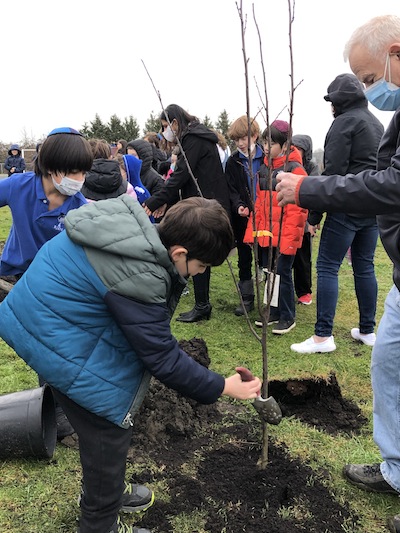
Students assisted in planting several fruit trees in the school garden, sponsored by the Jewish National Fund. (photo from RJDS)

On the holiday Monday, each classroom performed a model Tu b’Shevat seder, a meal that partly mirrors the Passover seder and involves eating biblical foods native to the Holy Land and drinking four cups of wine or, in the students’ case, grape juice. Additionally, all of the students assisted in planting several fruit trees in the school garden, sponsored by the Jewish National Fund.

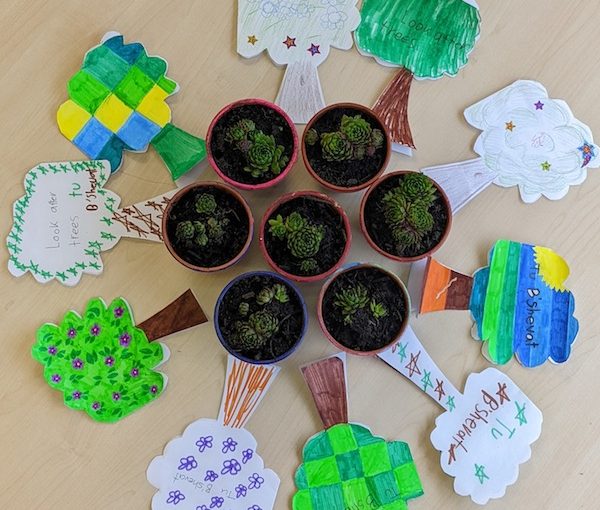
On the Tuesday of that week, students potted succulents from the garden to give away to seniors in the Richmond community. And, in the remainder of the week, classes planted parsley and other herbs for Passover, and assisted in a large-scale, school-wide garden clean-up.

When students are able to see the effort and care needed to grow plants, they develop a sense of ownership for these living organisms. Developing this awareness of how precious nature is can help children become better connected to their environment, learning to be strong community ambassadors and advocates in protecting the planet.

Judaism is not alone in advocating for environmental protection. From Buddhism to Christianity to Hinduism to Islam, various faiths acknowledge the need for environmental stewardship and their scriptures urge followers to be caretakers of the planet, looking after the natural earth and the organisms that live in it.

– Courtesy Richmond Jewish Day School

Format ImagePosted on January 28, 2022January 27, 2022Author Richmond Jewish Day SchoolCategories Celebrating the Holidays, LocalTags education, environment, Jewish National Fund, JNF, Judaism, Richmond Jewish Day School, RJDS, trees, Tu b'Shevat

Back to school, safely

Cautious optimism. That seems to be the consensus among Jewish school administrators as students and teachers prepare to return to classes in September.

One of the key lessons of the past year-and-a-half has been that things can change swiftly and the pandemic response requires resilience and adaptiveness.

“We’ve all learned that whatever is final is only final until it changes,” joked Russ Klein, King David High School’s head of school. Despite the circumstances, he said, the last academic year was a good one. He credits students, parents and teachers for working together, being flexible and making the best of the situation.

“It sounds strange to say, but, in terms of the context, we had a really good year,” he said. “People were incredibly positive, even with a few COVID cases here and there.”

The biggest challenges were wearing masks, cancelling extracurricular activities, including inter-school sports, and the cancellation of all school trips. Grade-specific cohorts were instituted, with staggered schedules to avoid interactions between groups.

As it stands now – unless changes are announced before classes starts Sept. 13 – cohorts will no longer be required. Klein hopes that some competitive sports will also be possible.

While hoping for a school year that is as normal as can be, Klein is also confident that the experience of last year has made the entire school community more sanguine about changes to routines.

Like Klein, Emily Greenberg, head of school at Vancouver Talmud Torah, gives kudos to students, parents and teachers.

“I would say the last year was all about being flexible and understanding that we couldn’t anticipate for sure how things were going to go,” she said. “It was really a team effort. We were really appreciative of our parents and staff and everybody as regulations shifted…. This was the ultimate team effort because it would not have gone as well as it had had we not all rolled up our sleeves and done the work we had to do to get through to where we are today.”

A big remaining question is how kids under 12, who have not yet been cleared for vaccinations, will be required to behave at school.

Some people use the term “new normal,” but Greenberg prefers “near-normal.”

“I am hopeful that our near-normal will be one that we can all live with and still appreciate the liberties that we are starting to gain back,” she said.

With about 500 students set to converge on the school this year, Greenberg is confident that students, parents and staff will step up again to do whatever it takes to learn safely.

“I think the most important piece is just understanding the team mentality,” she said. “The school can’t do it alone. No business can do it alone. Everybody has to play their role.”

Shalhevet Girls High School had a different experience than most. Because of its small student body – this year 11 students will be starting classes – there was no need to form cohorts. However, Ian Mills, incoming principal at Shalhevet, noted that the confluence of Jewish holidays coinciding with the start of the school year raises concerns about kids spreading the virus to siblings, parents and grandparents.

“We are going to encourage mask use, I think, no matter what happens,” said Mills. They will also continue to have the sanitization stations to which everyone has become accustomed and disinfecting protocols will also proceed.

“We’re just really excited,” he said of the new school year. “But, also, things can change. I’m not letting my guard off.”

Vancouver Hebrew Academy also benefited last year from its relatively smaller size, being able to accommodate more of its student body within the capacity limits that were set by the government. Outgoing head of school Rabbi Don Pacht told the Independent in a June interview, “I think schools have been doing a phenomenal job overall, but it’s easier when you only have two cohorts instead of eight cohorts.”

By the time of that interview, basically all of the VHA students had returned to the classroom. Unfortunately, the JI was unable to reach VHA’s new head of school, Rabbi Barak Cohen, for an update before we went to press.

Like all administrators, Sabrina Bhojani, the new principal at Richmond Jewish Day School, will be closely watching the edicts coming from the province’s ministry of education and public health officials.

“Until we have that information, we are hoping things are going to be normal,” she said. “Right now, it’s a waiting game and things are changing minute by minute.”

“I think people are hopeful,” she said. “There is always a little bit of anxiety as well. I think it’s mixed emotions [but] I think people are optimistic for a back-to-normal start.”

Posted on August 20, 2021August 19, 2021Author Pat JohnsonCategories LocalTags coronavirus, COVID-19, Don Pacht, education, Emily Greenberg, Ian Mills, KDHS, King David High School, Richmond Jewish Day School, RJDS, Russ Klein, Sabrina Bhojani, school, Shalhevet Girls High School, Vancouver Hebrew Academy, Vancouver Talmud Torah, VHA, VTT
Three new heads of school

Three new heads of school

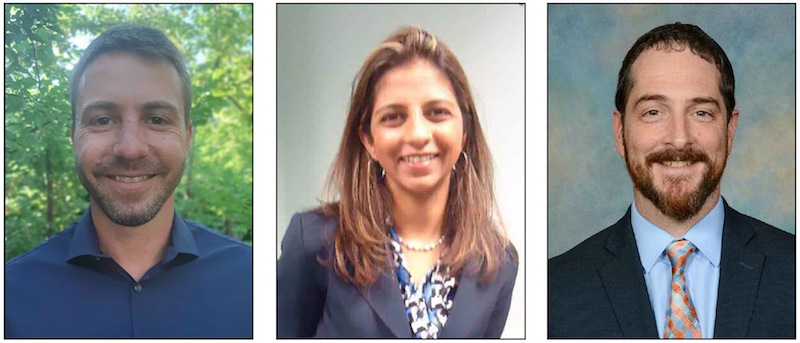
Left to right are new heads of school Ian Mills (Shalhevet Girls High School), Sabrina Bhojani (Richmond Jewish Day School) and Rabbi Barak Cohen (Vancouver Hebrew Academy). (photos from interviewees)

Three new principals will be joining the Metro Vancouver network of Jewish day schools this fall. Richmond Jewish Day School, Shalhevet Girls High School and Vancouver Hebrew Academy will all be under the helm of new administrators who bring decades of varied experience to the community.

Ian Mills, who has served as Shalhevet’s social studies teacher for the past six years, is taking over from Meira Federgrun, who has led the school for the past four years. RJDS’s new principal, Sabrina Bhojani, steps into the shoes of outgoing principal Ronit Amihude, who was at the helm for three years. And Rabbi Barak Cohen will be VHA’s new head of school this fall, replacing Rabbi Don Pacht, who served as the school’s head for 17 years.

* * *

Mills, who was born and raised in Dundas, Ont., received his bachelor of arts from McMaster University and his bachelor in education from the University of British Columbia. This past spring, he was accepted into a two-year master’s program at Simon Fraser University.

He also has a broad teaching background, having served as a substitute teacher in Melbourne, Australia, as well as at King David High School. Even when he was studying at UBC, Mills said teaching wasn’t far from his life. He supported himself as a ski and snowboard instructor at Grouse Mountain, garnering both awards and promotions for his work.

“I want students to be true to themselves and recognize what is special about who they are and what they bring to the table,” Mills told the Independent. “Sometimes in education, the grade you receive on a project or test becomes the measuring stick of who you are as a student. Instead, I want students to realize that skill sets come in a wide variety of forms.”

He said the recent updates to the provincial curriculum will help teachers lend support to students’ individual strengths, including “interpersonal skills, social/personal responsibility, leadership, and a host of other ways people are valued – I applaud the fact teachers now have more opportunity to foster these aspects of students.”

* * *

Bhojani, who was born in Ontario, grew up in Metro Vancouver and considers it her home. She received a bachelor of science and a bachelor of education from UBC, as well as a master’s in educational leadership and training from SFU. She served as faculty in the teacher education programs of both SFU and UBC, and worked for the B.C. Ministry of Education, where she developed curriculum and testing methodologies. As a school-based educator for the B.C. Agriculture in the Classroom Foundation, she taught teachers about the importance of agricultural and food knowledge.

“I believe learning about agriculture is an essential component of being a global citizen in the 21st century,” Bhojani said.

She has also worked as an educational consultant for Canadian School Bahrain, a nonprofit whose mandate is to empower children with confidence and the “moral values of integrity, responsibility, respect and courage,” in addition to academic excellence.

“Character education is an important part in developing the whole child and is essential in helping all members of the school community to learn, understand and practise behaviours that reflect universal ethical values,” said Bhojani. “It is essentially what guides us to do the right thing, even when it’s difficult to do so. I believe this is true of all faith-based education, and these kinds of enriching values certainly apply to Jewish education today and tomorrow.”

* * *

Cohen was born in Davenport, Iowa, and studied at Ohr Somayach and the Mir Yeshiva in Jerusalem while completing his smichah (rabbinic ordination). He holds a bachelor’s in behavioural science and a master’s in educational leadership from Bellevue University in Nebraska.

Cohen is no stranger to British Columbia’s Jewish community. He served as rabbi for Aish Hatorah in Victoria before taking a rabbinical position in St. Ives, a suburb of Sydney, Australia. As rabbi for the local Masada College, he launched an enriched Jewish studies program called Torah Stream that became fundamental to teaching elementary school children Hebrew and giving them the building blocks and confidence to study Torah.

“The curriculum was based on standard religious studies programs and outcomes found in religious schools worldwide, and accompanied Masada College’s outstanding general studies offering,” Cohen explained. The program meant that congregants no longer had to bus their elementary school-aged children an hour each way to Sydney to attend Hebrew classes. Cohen was later appointed head of Masada’s elementary school.

“I would define my outlook in Jewish education as one of looking at our incredible history of Jewish scholarship and recognizing that we don’t need to reinvent the wheel,” Cohen told the Independent. “At the same time, there’s always room to better our practice.”

For Cohen, that means “finding ways to more fully engage our students in the depth and breadth of Jewish wisdom, translating that wisdom into 21st-century know-how and building strong foundations in meaningful and relevant knowledge and practice.”

Jan Lee’s articles, op-eds and blog posts have been published in B’nai B’rith Magazine, Voices of Conservative and Masorti Judaism, Times of Israel and Baltimore Jewish Times, as well as a number of business, environmental and travel publications. Her blog can be found at multiculturaljew.polestarpassages.com.

Format ImagePosted on August 20, 2021August 19, 2021Author Jan LeeCategories LocalTags Barak Cohen, education, Ian Mills, principal, Richmond Jewish Day School, RJDS, Sabrina Bhojani, Shalhevet Girls High School, Vancouver Hebrew Academy, VHA
Angels deliver despite COVID

Angels deliver despite COVID

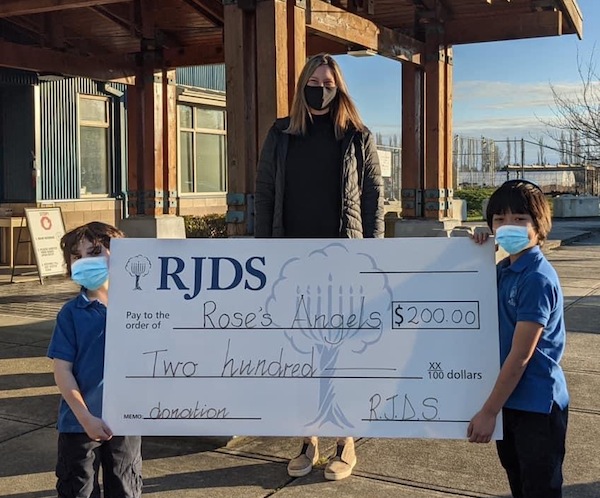
Outside Richmond Jewish Day School, Courtney Cohen accepts a donation to Rose’s Angels, which was collected by RJDS students and staff. (photo from Rose’s Angels)

This past February, the eighth annual Rose’s Angels event took place, although it looked very different from that of previous years, due to COVID-19.

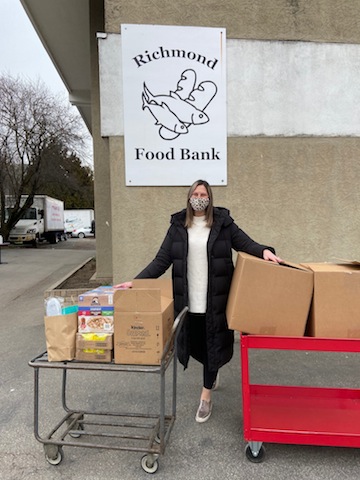
photo - Courtney Cohen outside the Richmond Food Bank, delivering donations
Courtney Cohen outside the Richmond Food Bank, delivering donations. (photo from Rose’s Angels)

Rose’s Angels, which is under the umbrella of the Kehila Society of Richmond, was founded in memory of Courtney Cohen’s grandmothers, Rose Lewin and Babs Cohen. It was established after Courtney Cohen and family friend Lynne Fader came together to discuss how to best honour the grandmothers, while giving back to the community – Rose Lewin and Babs Cohen were both very philanthropic and instilled this value in their families. Since its inception in 2013, Rose’s Angels has donated more than 6,000 care packages to not-for-profit organizations within the City of Richmond.

With the pandemic impacting not-for-profits around the city, Cohen and Fader knew it was essential to push forward and fundraise for donation items and monetary gifts for recipient agencies. Gift cards, slippers, non-perishables, toiletries and feminine hygiene products were among the donations received from the community.

“We adapted and innovated this February’s event to allow for volunteers to still play an integral role,” said Cohen. “Volunteers assisted with pickup and delivery of the bulk donation items to our recipient agencies. Volunteers are an essential part of Rose’s Angels and we truly appreciate their support and dedication year after year.”

photo - A donation of hygiene products
A donation of hygiene products. (photo from Rose’s Angels)

Rose’s Angels donated to 12 Richmond not-for-profit agencies servicing those most vulnerable. Among these agencies were Turning Point Recovery Society, Light of Shabbat (Chabad of Richmond), Richmond Family Place, Tikva Housing, Richmond Food Bank, Pathways Clubhouse, and Nova Transition House (Chimo Community Services).

“Although we were unable to host our large community care-package event in person this February, our community came together in another wonderful way,” said Cohen. “People donated generously and this allowed us to purchase specific items that were both needed and wanted by our recipient agencies.”

She added, “We look forward to 2022, when we can have our amazing volunteers together again to safely assemble the Rose’s Angels care packages.”

For more information about Rose’s Angels, or to make a donation, contact Cohen or Fader at the Kehila Society of Richmond, 604-241-9270, [email protected] or via kehilasociety.org.

Format ImagePosted on March 19, 2021March 18, 2021Author Rose’s AngelsCategories LocalTags coronavirus, Courtney Cohen, COVID-19, Kehila Society, Lynne Fader, philanthropy, Richmond Jewish Day School, RJDS, Rose’s Angels, tikkun olam, volunteerism
Riders raise funds for STEM

Riders raise funds for STEM

In back, left to right, are Marshal Stern and Mel Moss. In the front are, left to right, some members of the ORT committee: Marie Doduck, Mary Tobin, Bess Hirsch, Lane Stein and Beverly Pinsky. (photo from ORT Vancouver)

photo - Left to right, event co-chairs Mel Moss, representing ORT, and Jeff Topp, representing Richmond Jewish Day School
Left to right, event co-chairs Mel Moss, representing ORT, and Jeff Topp, representing Richmond Jewish Day School. (photo from ORT Vancouver)

ORT Vancouver and Richmond Jewish Day School co-sponsored the Aug. 23 Ride for STEM (science, technology, engineering, math). They are the first Vancouver Jewish organizations to hold such an event and the donated funds are designated to students so that they have the opportunities that arise from the knowledge and skills that STEM education can provide.

ORT’s goal is to bridge the gap between ability and opportunity by providing state-of-the-art education both locally and around the world. World ORT reaches 300,000 children who benefit from STEM education in 37 countries, including here in Canada.

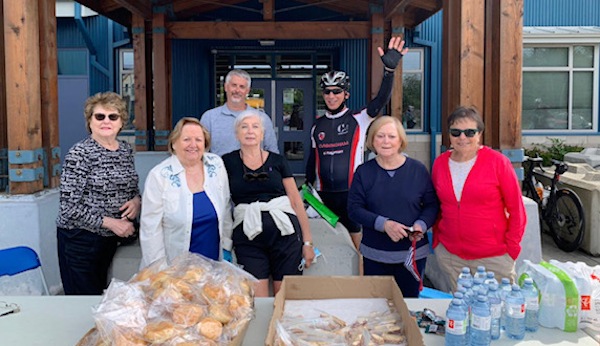
photo - Riders prepare to head out
Riders prepare to head out. (photo from ORT Vancouver)


Format ImagePosted on September 25, 2020September 23, 2020Author ORT VancouverCategories LocalTags education, kids, ORT, philanthropy, Richmond Jewish Day School, RJDS, STEM
Filming faith on No. 5 Road

Filming faith on No. 5 Road

Stills from the NFB’s Highway to Heaven: A Mosaic in One Mile. Richmond Jewish Day School is one of the institutions featured in the short film, which screens at this year’s Vancouver International Film Festival.

The National Film Board short Highway to Heaven: A Mosaic in One Mile, written and directed by Sandra Ignagni, is visually striking. For the most part, it lets the images do the talking, communicating more about cultural diversity than words could.

Part of this year’s Vancouver International Film Festival, Highway to Heaven introduces viewers to the multiple faith groups and institutions along a mile-long section of No. 5 Road in Richmond, which includes Richmond Jewish Day School. In the 17-minute documentary, this strip of road – which has been called “Highway to Heaven” – appears both full of colour and action, as well as remote and removed, not just geographically but with chain link fencing and other security measures.

“We share a world grappling with ethnic and racial tensions, religious xenophobia and violence,” writes Ignagni in her director’s notes. “Such realities are not limited to the world’s conflict zones – they are a part of everyday life, even in the most advanced democracies such as Canada. It was in this context that I was drawn to the peculiar landscape of No. 5 Road … where multiple cultural and religious groups share a short stretch of suburban road. I was curious about how groups pitted against each other in so many corners of the world appeared to be living relatively peacefully with one another, and in very close proximity, in an ordinary Canadian suburb.”

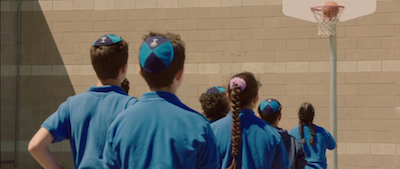
image - Still from the NFB’s Highway to Heaven: A Mosaic in One Mile: classroomIn showing the beauty of the area – both in landscape and in cultural acceptance – Ignagni also captures some of the tensions that exist. The camera jumps from a lush orchard to a mansion mid-construction to a for-sale sign in front of what seems to be part of a forest. In one scene, which looks like it was filmed at RJDS, police in full gear – bulletproof vest and holstered weapons – address RJDS and Az-Zahraa Islamic Academy students, introducing themselves so that the kids should feel comfortable going to the police if they have a problem. The police then referee the kids in a game of ball hockey – boys against the boys, girls against the girls – throwing in questions about boundaries and other issues for the kids to consider.

Referring to the police presence on the road, Ignagni writes that it could “be variously interpreted as bridge-building, protection or surveillance. I learned that, for more than one decade, the Richmond Jewish Day School did not have an exterior sign for fear of antisemitic attacks against its schoolchildren. And, in recent years, the secular residential community that surrounds No. 5 Road launched a major campaign opposing the proposed expansion of a Pure Land Buddhist temple, using the pejorative moniker ‘Buddha Disneyland’ to describe the proposed building in local media and public debates. The mere fact that zoning by-laws have ordered these communities – the majority of which play a critical role in new immigrant and refugee resettlement – to the fringe of suburban land is also ripe for reflection.”

The minimal use of narration or interviews in the film was a deliberate choice. To do otherwise, Ignagni notes, “would be an exercise in public relations, reducing complex issues to soundbites and polemics. Instead, I wanted to make a film that would at once capture the remarkable – because it is truly remarkable – diversity on No. 5 Road, as it actually exists, while gesturing to some of the unresolved issues that underlie Canadian multiculturalism. The film is, therefore, constructed as a ‘mosaic’ – defined by writer and activist Terry Williams as ‘a conversation between what is broken.’”

image - Still from the NFB’s Highway to Heaven: A Mosaic in One Mile: classroomWhile she doesn’t rely on words to tell this story, sound plays an integral role in the film: calls to prayer, monks chanting, different languages being spoken (and not translated), kids playing, school bells ringing.

“My film invites audiences to sit with what is unknown, different, raw or only partially visible,” says Ignagni. “To me, a mosaic captures perfectly the subtle tensions one finds on No. 5 Road, where custom and ritual, language and cultural diversity are practised under surveillance cameras and behind locked doors and gates. In making this film, I am asking audiences to look with open eyes and hearts – with a spirit of curiosity – at themselves and their neighbours, and simply reflect on multiculturalism as an unfinished project in need of attention in Canada and around the world.”

In addition to RJDS and Az-Zahraa, the list of participating neighbours includes the Evangelical Formosan Church of Greater Vancouver, India Cultural Centre of Canada/Gurdwara Nanak Niwas, Kingswood Pub, Lingyen Mountain Temple, Mylora Executive Golf Course, Royal Canadian Mounted Police (Richmond detachment), Thrangu Tibetan Buddhist Monastery, Trinity Pacific Church, and Vedic Centre.

At VIFF, Ignagni will participate in one of a series of panel discussions presented by Storyhive on Totally Indie Day, Sept. 28, at Vancity Theatre. She will be on the hour-long panel called Not Short on Talent: The Rise of the Short Form Documentary, which starts at 3:45 p.m. For the full film festival lineup, including, eventually, the not-yet-listed screening time of Highway to Heaven – which was an Official Selection at this year’s Toronto International Film Festival – visit viff.org.

Format ImagePosted on September 6, 2019September 4, 2019Author Cynthia RamsayCategories TV & FilmTags interfaith, National Film Board, NFB, Richmond Jewish Day School, RJDS, Sandra Ignagni, Vancouver International Film Festival, VIFF
Community milestones – Silber Theatre, RJDS-Pawer tzedakah, Rudolph wedding, Pawer and Baitelman grads

Community milestones – Silber Theatre, RJDS-Pawer tzedakah, Rudolph wedding, Pawer and Baitelman grads

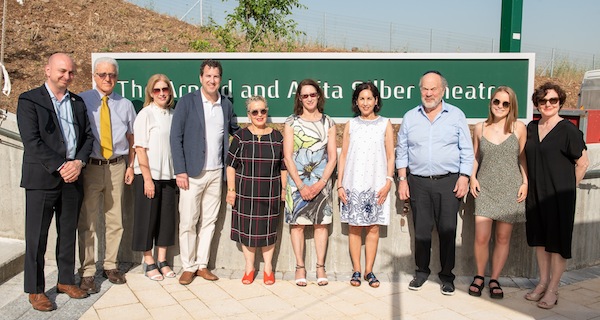
The Arnold and Anita Silber Theatre at Tel-Hai College officially opened last month. (photo from Jewish Federation of Greater Vancouver)

Last month, Jewish Federation of Greater Vancouver chief executive officer Ezra Shanken, as well as board members Karen James, Alex Cristall and Candace Kwinter, and Jewish Community Foundation executive director Marcie Flom were in Israel for the official opening of the Arnold and Anita Silber Theatre at Tel-Hai College. This new 1,200-seat outdoor theatre will be a hub of activity for the university and surrounding area. The theatre is located at the centre of the Tel-Hai campus, and is a key component in the college’s long-term development plan.

The Silbers have long supported Federation’s partnership region of the Galilee Panhandle, and its work there. They have supported a number of projects and established the Friends of Beit Vancouver, a donor-recognition program for supporters of Beit Vancouver. Anita Silber serves on Federation’s Israel and overseas affairs committee, and has for several years. Recognizing that Tel-Hai is a significant economic driver in the region led the Silbers to fund this legacy project and lend their name to it.

The official opening of the theatre began with a welcome reception with Tel-Hai’s board of trustees, followed by a ribbon cutting. The Silbers were joined by their granddaughter, Samantha Addison, and family members from Israel. In reply to the address honouring them that was delivered by Tel-Hai’s president, Prof. Yossi Mekori, Arnold Silber stressed that the students were the primary motivation for this investment. They are the ones to whom the future of the region is entrusted, and it is they who will take it to the next level.

A number of families and individuals from our community agree, and they are funding scholarships, which were awarded to students at the ceremony by James and Cristall: the Coleman Family Scholarships, the Krell Family Scholarships, the Evelynne Loomer z”l Scholarships, the Bernard Lotzkar Scholarships and the Zalkow Family Scholarships.

* * *

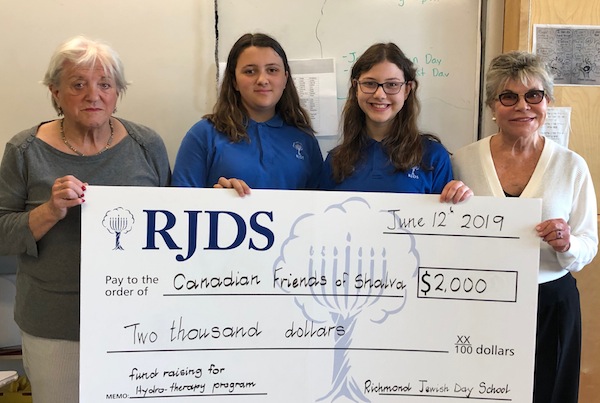
photo - Left to right are Lola Pawer, RJDS students Maya Bernal and Penina Berger, and Leslie Diamond
Left to right are Lola Pawer, RJDS students Maya Bernal and Penina Berger, and Leslie Diamond.

Over the course of the 2018/2019 school year, the Student Council Committee of Richmond Jewish Day School took it upon themselves to raise money for the Shalva Centre Hydrotherapy Program in Israel.

With the support of families, the school raised $1,000, which was generously matched by Lola Pawer. Pawer and Leslie Diamond, who is a board member of the Shalva Centre, came to RJDS to teach students about the work Shalva provides for children with disabilities.

The students presented a cheque to Diamond in the amount of $2,000. For anyone wanting to learn more about Shalva or make a donation, visit shalva.org.

* * *

photo - Brett and Caro Rudolph
Brett and Caro Rudolph

Brett and Caro Rudolph have fun at their wedding in Syracuse, Sicily. Brett is the son of Les and Anita Rudolph of Vancouver (previously from South Africa) and Caro is the daughter of André and Svetli Wanne of Vienna. The wedding was officiated by Rabbi Paul Chaim Eisenberg of Vienna and was thoroughly enjoyed by family and friends. Brett and Caro live in Israel.

* * *

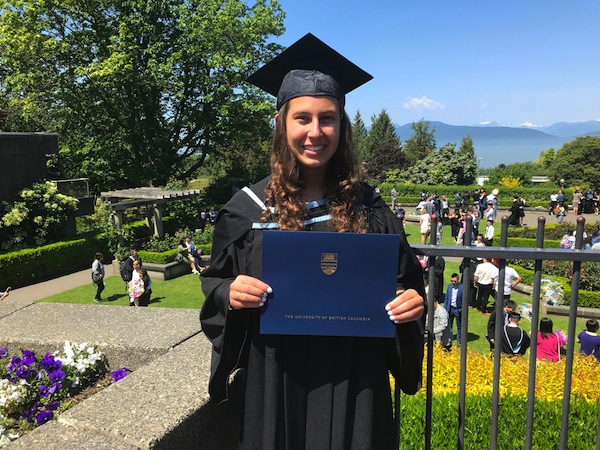
photo - Samantha Pawer
Samantha Pawer

On May 25, 2019, Samantha Pawer was conferred the degree of bachelor of science honours in integrated sciences with distinction from the University of British Columbia. Samantha is an alumna of Richmond Jewish Day School and Hugh Boyd Secondary School. Proud are parents Jeff Pawer and Beverly Pawer and big brother Brayden Pawer.

* * *

Moshe Baitelman decided to become a doctor when he took his first biology class in high school. On May 26, 2019, the Vancouverite graduated as valedictorian at Touro’s Lander College of Arts and Sciences in Flatbush, Brooklyn, N.Y. He will begin medical school in the fall.

photo - Moshe Baitelman
Moshe Baitelman

Baitelman chose Touro because it offered a strong Jewish environment as well as academic rigour. He majored in honours biology and minored in computer science. Along the way, he built strong relationships with his professors. “They all pushed me to be my best,” he said.

Living in Brooklyn, Baitelman found support for his career goals via the Gedaliah Society, a local network of Chabad men and women in the healthcare profession who offered advice and shared their own experiences in preparing for medical school. He also served as executive editor of Touro’s science journal and president of the Touro Science Society.

“Moshe has distinguished himself as a gifted, multitalented student with outstanding leadership skills. We are confident that he will become a respected physician, who will create a Kiddush Hashem in all his patient and professional interactions,” said Dr. Robert Goldschmidt, vice-president and executive dean of the Lander College.

Prior to Touro, Baitelman attended Vancouver Hebrew Academy for elementary and then the Pacific Torah Institute. Both schools imparted a strong Torah education with Jewish morals and values, and a first-class education. Baitelman’s education in Vancouver was the solid foundation for a life of strong Jewish identity and commitment to Jewish observance and learning, as well as enabling him to pursue further career education.

Baitelman credits his parents for his drive; they instilled a strong work ethic and have continued to encourage him. He offers similar advice to students getting ready to start college: “Be proactive. It will be the difference between just passing through and actually gaining from college. Find activities that will be conducive to your professional and educational growth – use your network of professors, advisors and other students.”

Format ImagePosted on June 28, 2019July 3, 2019Author Community members/organizationsCategories LocalTags Anita Silber, Arnold Silber, Baitelman, education, graduations, Israel, Jewish Federation, Lander College, Leslie Diamond, Lola Pawer, Pawer, philanthropy, Richmond Jewish Day School, RJDS, Rudolph, Shalva Centre, Tel-Hai College, tikkun olam, Touro, UBC, weddings
Good neighbours, good work

Good neighbours, good work

Students in grades 6 and 7 hand out sandwiches on the Downtown Eastside Nov. 15. (photo from RJDS)

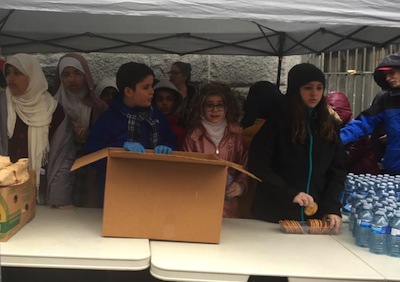
On Nov. 15, 60 students from Richmond Jewish Day School and Az-Zahraa Islamic Academy went to the Downtown Eastside to meet the people in the neighbourhood and hand out food that had been prepared earlier.

photo - Students in grades 6 and 7 hand out sandwiches on the Downtown Eastside Nov. 15
Students in grades 6 and 7 hand out sandwiches on the Downtown Eastside Nov. 15. (photo from RJDS)

“The students, staff and administration of Richmond Jewish Day School have always been committed to doing what we can to improve the lives of those less fortunate among us,” said Reesa Pawer, student life coordinator at RJDS. “One of the ways we have done this is by actively participating in a week of Random Acts of Chesed.”

As part of Random Acts of Chesed Week, Grade 6 and Grade 7 RJDS students worked together with their neighbour school, Az-Zahraa, to put together 700 bags of food and more than 500 sandwiches.


Format ImagePosted on November 30, 2018November 29, 2018Author Richmond Jewish Day SchoolCategories LocalTags Az-Zahraa Islamic Academy, education, interfaith, multiculturalism, RDJS, Richmond Jewish Day School, tikkun olam

Posts pagination

Previous page Page 1 Page 2 Page 3 Page 4 Next page
Proudly powered by WordPress