Skip to content
  • Home
  • Subscribe / donate
  • Events calendar
  • News
    • Local
    • National
    • Israel
    • World
    • עניין בחדשות
      A roundup of news in Canada and further afield, in Hebrew.
  • Opinion
    • From the JI
    • Op-Ed
  • Arts & Culture
    • Performing Arts
    • Music
    • Books
    • Visual Arts
    • TV & Film
  • Life
    • Celebrating the Holidays
    • Travel
    • The Daily Snooze
      Cartoons by Jacob Samuel
    • Mystery Photo
      Help the JI and JMABC fill in the gaps in our archives.
  • Community Links
    • Organizations, Etc.
    • Other News Sources & Blogs
    • Business Directory
  • FAQ
  • JI Chai Celebration
  • JI@88! video

Recent Posts

  • Sharing her testimony
  • Fall fight takes leap forward
  • The balancing of rights
  • Multiple Tony n’ Tina roles
  • Stories of trauma, resilience
  • Celebrate our culture
  • A responsibility to help
  • What wellness means at JCC
  • Together in mourning
  • Downhill after Trump?
  • Birth control even easier now
  • Eco-Sisters mentorship
  • Unexpected discoveries
  • Study’s results hopeful
  • Bad behaviour affects us all
  • Thankful for the police
  • UBC needs a wake-up call
  • Recalling a shining star
  • Sleep well …
  • BGU fosters startup culture
  • Photography and glass
  • Is it the end of an era?
  • Taking life a step at a time
  • Nakba exhibit biased
  • Film festival starts next week
  • Musical with heart and soul
  • Rabbi marks 13 years
  • Keeper of VTT’s history
  • Gala fêtes Infeld’s 20th
  • Building JWest together
  • Challah Mom comes to Vancouver
  • What to do about media bias
  • Education offers hope
  • Remembrance – a moral act
  • What makes us human
  • המלחמות של נתניהו וטראמפ

Archives

Follow @JewishIndie
image - The CJN - Visit Us Banner - 300x600 - 101625

Tag: poetry

Salomé’s rightful place

Salomé’s rightful place

Salomé: Woman of Valor will have its world première at the Chutzpah! Festival March 8-10. (image by Anya Ross, graphics by John Greenaway)

There have been many interpretations of Salomé – thought to be the woman whose alluring dance persuaded King Herod to honour her request that he have John the Baptist beheaded – but none quite like that of Salomé: Woman of Valor, which has its world première at Chutzpah! March 8-10.

The creation of this complex, multilayered work that combines poetry, music, dance and film was led by composer and trumpeter Frank London and poet and performer Adeena Karasick. It features live music by London, percussionist Deep Singh and keyboard player Shai Bachar. The poetry is written and performed by Karasick, the dance choreographed and performed by Rebecca Margolick and Jessie Zaritt, and the video analyzing Charles Bryant’s 1923 silent film Salomé was made by Elizabeth Mak. The whole production is directed by Alex Aron.

“Frank was intrigued by the Salomé story due to the visual cornucopia of the Bryant film, and because it is a story where dance was at the centre, motivating the complex chain of events, and thus ripe for reinvention as a contemporary dance-theatre piece incorporating Bryant’s imagery,” Karasick told the Independent about why the work focuses on Salomé and not another Jewish historical or literary woman. “However, he was only aware of the [Oscar] Wilde retelling of the Salomé story and thus not really interested in her narrative. He came to me to see if I could reenvision her story in a more compelling way.”

It has always bothered her, said Karasick, how, within Christian mythology and entrenched in history by writers like Wilde, Gustave Flaubert and Stéphane Mallarmé and artists such as Gustav Klimt, Gustave Moreau and Aubrey Beardsley, “Salomé was seen as yet another Jewish temptress/Christian killer – but, in fact, there isn’t any evidence to substantiate this claim. According to apocrypha and Josephus’s Antiquities, she came from Jewish royalty and there is no evidence she murdered John the Baptist or even danced for Herod,” said Karasick.

“The only historical reference that [Herod’s wife] Herodias’s daughter’s name was Salomé is from Flavius Josephus, who makes no other claims about her – not that she danced for Herod, not that she demanded John’s head, but only that she went on to marry twice and live peacefully. The other apocryphal reference is that a daughter danced for Herod, which caused him to lose his mind and kill John the Baptist. Thus, the conflagrated Salomé that appears in the Wilde play, [Richard] Strauss opera and all subsequent productions, is an amalgamated construct, so we felt it was our duty to set the record straight.”

In fact, added Karasick, there are three women named Salomé in Jewish history: Salomé, daughter of Herodias and Herod II (circa 14-71 CE); Queen Salomé, her great-aunt (65 BCE-10 CE); and Salomé Alexandra (139-67 BCE).

“Her great-aunt, Salomé I, was the powerful sister and force behind Herod the Great, king of Judea and Second Temple rebuilder,” said Karasick, while Salomé Alexandra (also known as Shelomtzion) was one of only two women who reigned over Judea.

“I wanted my Salomé, Salomé of Valor, to carry the weight of both her genetic lineage and the cultural heredity of her name, embodying the legacy and power of the women that came before her,” said Karasick.

Karasick, who was born in Winnipeg, grew up in Vancouver, earning her bachelor’s from the University of British Columbia. She did her master’s at York University and her PhD at Concordia University. Among other things, she teaches literature and critical theory at Pratt Institute in New York, is co-founding artistic director of KlezKanada and performs her work around the world. The author of nine books – with a 10th, Checking In, published by Talonbooks, on the way – she has been awarded for her contributions to feminist thinking and, last year, the Adeena Karasick Archive was established at Special Collections, Simon Fraser University.

London – a member of the Klezmatics and the group Hasidic New Wave, who has performed with countless musicians and made numerous recordings of his own – saw Karasick perform in New York in 2011. He then hired her, she said, “along with Jake Marmer to design and lead the poetry retreat at KlezKanada…. We hadn’t yet collaborated before this, but I was always compelled by his music and the breadth of all he created as a masterful revolutionary himself, not only as a spectacularly fierce trumpet player but virtuosic composer, reinvigorating klezmer music, transcendentally intermixing it with aspects of world music, jazz, Chassidic new wave, punk – and always felt it would be a thrilling and highly symbiotic artistic match.”

When Frank approached her about the Salomé project, said Karasick, they both “fell in love with the Bryant film but were so perplexed” about Salomé’s “reputation in cultural history.”

So, Karasick started researching, “poring through the multiple and conflict[ing] narratives – through Josephus and the apocrypha, locating the many discrepancies between Christian and Jewish mythologies, speaking with specialists in the field, and became fascinated with how there are so many ‘truths,’ stories, misreadings, and how imperative it is to question these grand narratives, problematize traditional cultural, moral and religious perspectives.

“For millennia,” she said, “Jews have been portrayed as the murderers of gods and prophets in other people’s mythologies, so Salomé: Woman of Valor deconstructs this mythology, exposing how she was not a demonic murderess, and opens up the possibilities for infinite retelling and how truth itself is always a construct of veiling and unveiling.”

About the magnitude of the project, Karasick said, “As the author of nine books invested in issues of ethnicity, gender and ways to construct meaning, as professor of poetry and critical theory, gender images in the media, and poetics and performance, Salomé: Woman of Valor is a logical progression in my 30-year career, and has allowed me to integrate my experiences in one work – something that I have never done before.

“Due to the scope of this show,” she said, “I’m able to weave together the multiple styles of writing that I’ve experimented with over the years – sound poetry, homophonic translations, post-language conceptualism, kabbalistic and feminist revisionist practices, all syntactically playful, polyphonic, ironic and rhythmically complex – a fusion of my esthetic passions and expertise; opening a space of female empowerment.”

While London has been involved in many projects, Karasick said Salomé might be the first for him with performance poetry at the centre.

“We created Salomé: Woman of Valor as an integration of performance poetry, dance, music and video exploring the dialectic between narrative and abstraction – it is a quantum leap forward in collaborative artistic development, challenging my conceptual processes of making an artwork,” she said. “I couldn’t be more excited.”

Salomé: Woman of Valor is already being presented in an array of venues and contexts, said Karasick. “Its form and content make it appropriate to be presented at jazz, dance, poetry, new theatre, literary and electronic literature festivals; in performing arts centres, universities, avant garde text-based multimedia events, as well as events focusing on new media and cross arts,” she said.

“With its feminist and mystical kabbalistic take on Jewish historical subject matter and a live score which draws from East European Jewish music (klezmer) with jazz, Arabic and Indian musics, our Salomé is especially attractive to Jewish culture festivals and to presenters of Jewish music, language, dance and art.”

The libretto has been published in Italian and in English, and selections of it have been published in Bengali, Arabic, Yiddish and German. It is “being taught in universities worldwide in departments of global literature, Jewish studies and humanities and media studies,” she said.

The artists bringing Salomé: Woman of Valor to Vancouver are all “at the forefront of their respective fields,” said Karasick, “and so I feel so fortunate to be working with such powerful creators, all revolutionaries in their own ways. Frank works with Shai Bachar and Deep Singh on a number of musical projects – Deep and Frank started the internationally acclaimed bhangra-klezmer fusion band Sharabi; and [Frank] co-developed Night in the Old Marketplace with Alex Aron, so bringing her on board as a director seemed a natural fit.

“Over the five years of envisioning the piece, we tried on a number of dance styles, ranging from tribal belly dance to sword dance/swallowers, and, with the advice of (Merce Cunningham protégé) Gus Solomons, Jr., settled on the avant garde modern dance of Israeli superstar Jesse Zarrit and the stunningly poetic Rebecca Margolick, with a shout-out to the Dadaist Loïe Fuller stylings by Jodi Sperling.”

Mak’s video on Bryant’s silent film, notes the project’s promotional material, is “punctuated with Jim Andrews’ stunning vispo [visual poetry], with special video appearances by … Tony Torn as Herod, lit by Nicole Lang.”

“Together,” said Karasick, “we’re expanding our work in ways only dreamed possible; have created an intellectually provocative, audio-visual sensorium, informed by our (Frank’s and my) ongoing obsession with excess, desire and pushing boundaries.”

And it’s an interest, if not obsession, with many others, as well. The Kickstarter campaign for Salomé surpassed its goal of $20,000, about half of the project’s budget.

“The show has been garnering a lot of love and support from colleagues and patrons,” said Karasick, “perhaps due to ways that it addresses the social and political necessity to speak the unspoken, resist stereotypes, misrepresentation and outdated myths, and fosters a thinking that leads to a hybridized syncretic culture, one that honours the intermixing of blood, belief, rhythm, texture and being. Content-wise, it addresses outdated notions of identity and ethnicity, and carves out a space where difference and otherness can be celebrated. We feel incredibly grateful, and hope that we can keep growing it. Broadway, here we come!”

But, first, the Chutzpah! Festival. They have also been invited to Toronto’s Ashkenaz Festival and the Boston Jewish Music Festival, said Karasick, who will continue to tour with the Salomé books. “Frank,” she said, “will record and release the music as a CD. We hope to see it at major festivals and venues worldwide.”

The presentations of Salomé at Chutzpah! are presented in association with the Dance Centre, where the performances will take place. For tickets and the full festival lineup, visit chutzpahfestival.com.
Format ImagePosted on February 16, 2018February 14, 2018Author Cynthia RamsayCategories Performing ArtsTags Adeena Karasick, Charles Bryant, Chutzpah! Festival, dance, film, Frank London, music, Oscar Wilde, poetry, Salomé, spoken word, vispo, women
Poetry inspired by abstract art

Poetry inspired by abstract art

On Sept. 25, a group of writers gathered to write and share poems sparked by the paintings of Waldemar Smolarek, now on display at Zack Gallery. (photo by Olga Livshin)

Poetry events at the Sidney and Gertrude Zack Gallery have become a regular feature in the last few years. Every couple of months, writers of Pandora’s Collective meet at the gallery to read their poems inspired by the art. They held their latest gathering on Sept. 25.

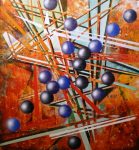
The abstract paintings currently on display at the Zack seem to have been created to inspire poetry. Waldemar Smolarek’s work is known to gallery patrons. Smolarek’s first show at the Zack, in 2012, was posthumous – he died in 2010 – but his art is alive, infused with vibrant colours and the artist’s unique frenetic energy.

Smolarek, a proponent of purely abstract compositions, filled his canvasses with dynamic currents. His lines, in every imaginable hue, fly like arrows. His multicoloured balls dance like polka dots. His vivid splashes of blue and peach flow into each other, seemingly at random, but there is logic in the twists and turns of the artist’s brush. His art invites people to delve into their own psyche, and the poets of the evening responded to the paintings’ visual challenge with a wide variety of works: long and short, light-hearted and lamenting. Some poems were inspired by one specific painting, while other rhyming flights of fancy encompassed the entire gallery.

As the event was a collaboration between the Zack Gallery and the Isaac Waldman Jewish Public Library, Helen Pinsky, the head librarian, gave a short introduction before passing the microphone to Leanne Boschman, the host of the evening.

Although it was her first time as host, Boschman has participated in the Zack Gallery poetry evenings twice before. “The first time, the exhibition included the artist’s journal and sketches, and I found it fascinating to see the artistic journey in progress,” she told the Independent. “The second time, it was a show of abstract photographs…. I like abstract art in connection to my poetry. I can play loosely with colours and shapes and words. It’s harder when the art shows specific people or places. With abstract art, the poet is free to follow her own associations. Sometimes, it’s a story; sometimes, a feeling or a question.”

Most of the participating poets agreed with her assessment, and Smolarek’s art was a rich source for many pieces. The audience, although not large, was extremely generous in support of anyone at the mic, both the listed readers and the brave volunteers who took part in the open mic portion of the event. The friendly atmosphere, combined with the bright paintings and Boschman’s humorous but factual introductions of every reader, made the evening a joyful celebration of colours and words.

The first poet who read, Suzy Malcolm, has been writing poetry since she was a teenager. “It’s my fifth time at the Zack,” she said. “I prefer abstract art for my poetry. It feels like a gift to write about colours and shapes.” She writes poetry for children as well as adults, and her poems at this event reflected both sides of her poetic endeavours.

Eva Waldauf, the next reader, started writing poetry when she was around 40. “I’m a visual artist,” she said. “Once, I had to write a poem for a class, and I liked it. I thought it was fun; thought, ‘I could do it,’ so I began writing poetry.” Her poems were not written on the spot. “I visited the gallery last week to see the paintings, so I would have time to write and edit my poems. I like to come prepared.” Although she admitted to always being nervous before reading her poems, one wouldn’t have guessed it from her performance. Her reading, relaxed and expressive, enhanced by expansive gestures, revealed a good actress as well as an original poet.

The next presenter, David Geary, staged his poems as letters to Smolarek. His presentation was comical. As if playing a game, he strode around the gallery and enrolled everyone in the audience and all the paintings as his willing and laughing playmates.

As a counterpoint to his irreverent show, Sita Carboni’s poetry resonated with mournful tunes. One of the co-founders of Pandora’s Collective, Carboni noted that, with art like Smolarek’s, a poet is free to explore in any direction. Her poetry, contemplative and deep, included a goodbye to someone she lost recently, and she couldn’t finish her reading because of the tears that choked her.

Warren Dean Fulton also prefers abstract art for his poetry. “Abstract art allows you to project your own feeling and emotions. It is speaking to your subconscious. The poet is much less free with portraits or landscape.”

Fulton has participated in the poetry readings at the Zack before. “It is interesting to hear how the same paintings could inspire such different interpretations,” he mused. As he likes to improvise with his poetry, he hadn’t seen Smolarek’s work before that evening.

The last poet of the night, Amanda Wardrop, is also an experienced writer and reader. A schoolteacher, Wardrop said she finds poetry everywhere: in her interactions with students, in figurative art and in abstract art. “Different poetry, that’s all,” she said. “Figurative art often results in a narrative, while abstract art pushes one to a more emotional response.” She did her research before coming to the reading that night, and her poetry touched on the artist’s technique: layers and textures, as they related to our lives.

The night concluded with a lively musical performance by Kempton Dexter, who played his guitar, sang and joked to the delight of the audience.

Olga Livshin is a Vancouver freelance writer. She can be reached at [email protected].

***

Balls collide and come apart,
Lines zigzag and soar,
Feeding moxie to my heart
Fields awash with colour.

Reds and blues and greens explode
Shards and doodles frolic,
Polka dots in quirky mode,
Joyful and symbolic.

– Olga Livshin, inspired by the artwork of Waldemar Smolarek


Format ImagePosted on October 6, 2017October 5, 2017Author Olga LivshinCategories Performing Arts, Visual ArtsTags abstract art, Pandora's Collective, poetry, Waldemar Smolarek, Zack Gallery
Writers inspire, support

Writers inspire, support

Carol Weinstock (photo by Olga Livshin)

Carol Weinstock only started delving into poetry a few years ago, around the time she joined a writing group. “I was a journalist before I retired,” she told the Independent. The group has motivated her try other forms of writing.

“The core is about five or six people,” Weinstock explained. “They come to almost every meeting. Others come and go. There are men and women, mostly retired. They write in different genres. Some write poetry, like me. Others write memoirs or short stories. One is writing a novel. One woman is a professional artist, but she wants to expand her creative output, to add writing to her range of expressions.”

Diane Darch, another member, recalled how it all started. “Sometime in 2012, people in the programming committee of False Creek Community Centre discussed the need for more programs for seniors, the 55+ group. Several possible programs were considered, including bowling and mahjong, but they finally settled on a writing group, a self-directed program. It officially began in January 2014 with a handful of enthusiastic people, each with an interest in writing for fun, for growth and for sharing a part of themselves.”

Darch has been with the group from the beginning. “I personally joined because I was interested in writing,” she said. “I learned from others’ types of writing and from critiques. It did put some pressure to write either at home or during the sessions. Sometimes, we arranged our own sessions, when the community centre was not available. Friendships were formed because we shared our personal writings. It is a fun group, non-threatening, and gives lots of encouragement to all levels. The group validated my writing.”

A year ago, she moved to Victoria. “I saw the group grow to a healthy dozen, change because of various commitments, then sadly go back to too few,” said Darch. “I’m no longer a regular member and I miss it. I do drop in when I’m back in Vancouver.”

Weinstock is one of the group’s first members, joining in its first year, and she’s been a steady participant since. “Our meetings usually have a structure. It’s flexible, not rigid, but it forces us all to write. First, we talk, share what’s happening in our lives, the books we read. Then someone brings a prompt, and we write for about an hour. Then anyone who wants can share their writing, and we all discuss it. It’s a very supportive environment.”

Weinstock attributes her writing of poetry to the group’s influence. “Poetry is a new form for me,” she said. “Before I retired, I worked as a freelance journalist for various California papers. I also taught journalism at a community college. I never wrote poetry or fiction. After I retired, I returned home to Canada. Then I joined this writing group and I wanted to try something different. And the group helps. It provides me with a scheduled time and place to write and the prompts. I might not have written so much if not for the group. I’m not sure.”

She doesn’t only write to the group prompts. “Sometimes, I would read a news article and a political or social problem would catch my attention. I would write a poem,” said Weinstock, whose journalistic inclinations frequently push her towards controversial or humanitarian issues, concerning some obscure corners of the world. She recalled one such occasion: “I read this story about the plight of the shrimp farms in Asia, and it touched me deeply. I wrote a poem. Other times, I would write something more personal but, in general, I don’t like writing about my personal stuff.”

Poetry is a way for Weinstock to express herself, her thoughts, emotions and ideas in a concise and organized way. A few months ago, the writing group came up with the prompt to write about what Canada means to each of the members, in celebration of Canada’s 150th birthday.

“I started with something different, but it didn’t work,” said Weinstock of the poem she wrote for the occasion. “Then I decided to go with concrete things: what we eat, what we wear, where we live, and the poem unfolded…. I showed it to my friends, and they liked it. One of my friends, Debby Altow, is active in the Jewish community in Vancouver. She regularly reads the Jewish Independent, and she asked if I would mind sending my poem to the paper. I read the paper sometimes, too. Of course, I said yes.”

Each group member participated in the exercise. Some wrote poetry. Others wrote essays. Now, all those pieces of Canada-inspired writing are on display at False Creek Community Centre. Everyone coming into the centre passes by them as they walk down the hallway leading to the reception desk. Some people even stop and read a few.

Olga Livshin is a Vancouver freelance writer. She can be reached at [email protected].


We are Canadian

Beret, turban, skullcap,
Babushka, hijab, headband.
No matter what hat we wear,
We are Canadian.

Fry bread, falafel, poutine,
Pizza, curry, Kraft dinner.
No matter what food we eat,
We are Canadian.

France, Britain, India,
Ukraine, China, Jamaica.
No matter where we come from
We are Canadian.

Ucluelet, Cape Breton, Moose Jaw,
Attawapiskat, Yellowknife, Flin Flon.
No matter where we live,
We are Canadian.

Teacher, nurse, farmer,
Reporter, welder, programmer.
No matter what work we do,
We are Canadian.

Blending, fusing,
Reconciling, adapting.
We work, sweat, dream together
To create one Canada.

– Carol Weinstock, June 2017

Format ImagePosted on September 15, 2017September 14, 2017Author Olga LivshinCategories Arts & CultureTags Carol Weinstock, poetry, seniors, writing
History, literature vital

History, literature vital

Rachel Seelig, author of Strangers in Berlin: Modern Jewish Literature Between East and West, 1919-1933. (photo by Lauren Kurc)

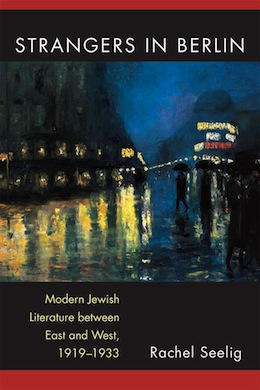
Rachel Seelig’s Strangers in Berlin: Modern Jewish Literature Between East and West, 1919-1933 (University of Michigan Press, 2016) encompasses so many ideas – some very nuanced, others technical – that a reader will enjoy it on their own, but will learn much more if they can discuss and analyze it with others.

Strangers in Berlin uses the example of four poets – Ludwig Strauss, Moyshe Kulbak, Uri Zvi Greenberg and Gertrud Kolmar – to examine the influence that Berlin during the Weimar Republic had on Jewish literature.

“The relationship between German Jews and East European Jews in Germany typically has been depicted in terms of … German Jews figuring as reluctant hosts, cultural insiders who viewed the so-called Ostjuden as outsiders or even infiltrators,” writes Seelig. “Strangers in Berlin is aimed at destabilizing these designations by presenting Berlin as a border traversable in both directions…. Foreigners arriving from abroad availed themselves of artistic inspiration and anonymity in order to cultivate new forms of culture, while those native to Germany ascertained their increasing estrangement from the fatherland, which they similarly channeled into artistic production. Whether they were coming or going, exiled in Germany or soon-to-be-exiled from Germany, these writers experienced Berlin as a transitional site between a moribund pre-World War I political order and an increasingly divided, nationalistic European reality.”

Seelig told the Independent that she “chose to focus on four poets who are not necessarily remembered as key figures in Weimar culture but who had considerable influence in their own day.”

She explained, “One of the reasons that these poets are relatively neglected is that they are not easily categorized according to national literary boundaries. Two of them, Strauss and Greenberg, immigrated from Europe to Palestine and wrote in more than one language (Strauss in German and Hebrew and Greenberg in Yiddish and Hebrew) and the other two, Kulbak and Kolmar, produced highly diverse, avant-garde bodies of work that do not align with what we tend to see as the dominant literary trends of their day. So, these writers weren’t just ‘strangers in Berlin’ – that is, writers who are located on the margins of the cultural milieu in which they had either permanently or provisionally settled – but also strangers to us as readers in the 21st century.

“I suppose I made it my mission to bring their extraordinary writing to light, and the best way to do so was to group them together within this context of intense transition and transformation,” she said. “For all four, the experience of living in Weimar Berlin – even if only briefly – left a profound imprint on their work and on their national identity. For all four, Berlin was a place in which they were forced to renegotiate identity. Taken together, I think their works provide a fascinating glimpse into the multiplicity of images of Jewish homeland that emerged during this very fruitful yet volatile period in history.”

Weimar Berlin brought together German, Hebrew and Yiddish literature and Strangers in Berlin examines “the impact of migration – of individuals, languages and cultural concepts – on Jewish national consciousness between the world wars,” writes Seelig. She chose to focus on poets, in part, “because establishing an autonomous and multifaceted poetic tradition was a crucial component of modern national movements.”

Whereas both the Westjuden and Ostjuden “initially viewed Germany as the wellspring of liberal, Western values, by World War I, they had begun to ‘re-orient’ their gaze toward the ‘East,’ extending temporally and geographically from the ancient Near East to contemporary Eastern Europe,” writes Seelig. “Plagued by the uncertainty of national homelessness and the terror of rising antisemitism, both groups looked eastward with a combination of nostalgia, hope and despair in a effort to come to terms with the failure of the West to fulfil the promise of coexistence predicated on the liberal principles of Enlightment. Indeed, melancholic longing for the ‘East’ betrayed profound dislocation in the ‘West,’ which in turn fueled the search for a new national homeland, whether real or imagined.”

Vancouver-born and -raised, Seelig received her undergraduate degree in comparative literature at Stanford University, then worked for a time in New York. She earned her master’s and PhD in Jewish studies at the University of Chicago, spending her last couple years of graduate school in Tel Aviv. She received the Ray D. Wolfe Postdoctoral Fellowship in Jewish Studies at the University of Toronto and then, after that, returned to Israel, where she was a Mandel Postdoctoral Fellow at the Hebrew University of Jerusalem. Currently, she is a fellow at the University of Michigan’s Frankel Institute for Advanced Judaic Studies. She speaks English, Hebrew, German and Yiddish. From even this brief bio, it is no wonder that Seelig is interested in borders and thresholds.

“We live in a world today that is both utterly divided and, in a sense, borderless,” she told the Independent. “The phenomena of globalization and mass migration have made us keenly aware of the ways in which borders are, on the one hand, more easily traversed, and, on the other hand, rigourously enforced and policed. Borders have always been sites of contestation and conflict, but a border can also be seen as a threshold that one crosses from one reality to another and a productive site of transfer and transformation.

“I myself migrated across several borders as this book came into being. It started to develop as a doctoral dissertation in Chicago, which I finished writing in Tel Aviv. It became a book – one that changed shape continuously – in Toronto, Berlin and Jerusalem, and was ultimately published in Ann Arbor, Mich. My own nomadic experience as an academic (and I realize, of course, that mine is a kind of privileged nomadism) made me particularly attentive to the impact of changing surroundings and of transitions on one’s thinking, work and identity.”

While accessible, Strangers in Berlin’s dissertation origins are evident, and there are some sentences people will have to read more than once for understanding.

“Strangers in Berlin is first and foremost an academic book, which grew out of my doctoral dissertation, acknowledged Seelig. “But, in the process of transforming the dissertation into a book – and I should point out that the book departs fairly dramatically in terms of content and argument from the dissertation – I made a concerted effort to make the text engaging and highly readable by simplifying the language and peppering every chapter with interesting anecdotes. It will be used by researchers and teachers within the academic context, but I also very much hope that it will be read by lay readers who are interested in modern Jewish culture and the history of the Weimar Republic, which is such a vibrant and captivating time period. I also think that the themes of homeland and migration, which are at the centre of the book, are extraordinarily relevant today, and I hope that readers will find this glimpse into Weimar culture and history resonates with our own political reality today.”

book cover - Strangers in BerlinCertain parts of Strangers in Berlin will make readers shiver with a sense of déjà vu. In the chapter on Kolmar, for instance, Seelig writes that, in the poet’s one novel, Die jüdische Mutter (The Jewish Mother), “Kolmar offers a pained reflection on the impossibility of salvaging a viable German-Jewish female identity in an era when both Jewishness and femininity were under siege.” Seelig notes, “Conservatives seeking to safeguard their middle-class privileges and to rebuild a healthy Germany Volkskörper (national body) regarded independent women and integrated Jews as similarly ‘decadent’ social elements…. The result of this campaign was a new form of male repression, which was often shrouded in xenophobic sentiments.”
Readers will see similarities between the Weimar period and what is currently happening in some European countries and in the United States. As it happens, Strangers in Berlin’s launch took place the day after the U.S. presidential election.

“A few hours before the event,” she said, “I was reading an article by Chemi Shalev in the Israeli newspaper Haaretz, in which he commented that many millions of Muslims, Mexicans and Jews now feel like ‘strangers in the country they call home.’ Obviously, his statement resonated very strongly with me and with my book.

“The book deals with a historical moment, nearly a century ago, when Berlin emerged as a major metropolis that attracted large swaths of immigrants, who were often seen as unwelcome infiltrators. In this respect, 1920s Berlin isn’t such a far cry from Berlin or Toronto or New York City of today. The book really does resonate with what’s going on in the U.S. and in so much of the world.… We are witnessing the rise of nativist sentiments and attendant xenophobia and bigotry that are oh so reminiscent of interwar Europe. And we’re seeing the way in which various forms of bigotry (anti-immigration, antisemitism and misogyny, all addressed in the book) have a tendency to intersect and even merge when these nativist sentiments are bolstered by political power. I realize it’s a cliché, but it really is remarkable to see how history repeats itself. It’s such a shame that the humanities, specifically history and literature, are under attack today (Trump just eliminated funding for the National Endowment for the Humanities from his proposed budget) at a time when we so desperately need them.”

Strangers in Berlin’s four poets struggle, as we all do, with the impossibility of being one thing – a German (or any other nationality), a Jew (or any other religion), for example. Not to mention the different conceptions of what comprises a “real” German (Canadian, American, etc.) or an “authentic” Jew (within the ranges of observance, belief). From all the research Seelig has done – her work, travel, ability to speak multiple languages and negotiate various cultures – has she any theories as to why humans have such trouble, in general, with multiplicity, ambiguity, a lack of borders?

“I wish I knew why we as humans have such a hard time with ambiguity,” she said. “This is something that affects our lives not only in terms of cultural, national or political identity but also in terms of relationships, career paths, place of residence, etc. On the one hand, we have more freedom than ever before to dwell ‘between’ identities, or to inhabit more than one identity, and yet that’s somehow deeply unsettling to us as creatures that crave order, certainty and security.

“I think there’s so much to be learned by the figures in my book, who didn’t have the luxury to choose where they would live or which system of beliefs to subscribe to (at least not without the risk of persecution), and who were profoundly shaped by the contingencies and vicissitudes of life. Each of the four main writers in the book represents more than one identity and, for each one, this was certainly a source of anxiety but also a source of profound inspiration and enrichment.”

Format ImagePosted on March 31, 2017March 31, 2017Author Cynthia RamsayCategories BooksTags history, poetry, Rahel Seelig, Wiemar Republic
Karasick gives to SFU library

Karasick gives to SFU library

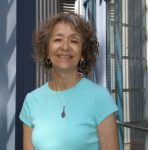
Adeena Karasick has donated her archive to the Collection of Contemporary Literature at Simon Fraser University’s Bennett Library. (photo from Adeena Karasick)

Critically acclaimed poet and Vancouver native Adeena Karasick was in her hometown last month to celebrate the donation of her archive to Simon Fraser University.

The Collection of Contemporary Literature at SFU’s Bennett Library contains one of the biggest selections of avant-garde poetry in North America. “The collection has been building since 1965,” said Tony Power, the librarian-curator who oversaw the addition of Karasick’s works. “The collection features many of the poets whose tradition Karasick is associated with, such as Michael McClure and Robin Blaser. Karasick was influenced by her teacher, Warren Tallman, who also influenced, for example, Fred Wah, George Bowering and Daphne Marlatt. These are all poets who are featured in the Bennett Library collection.

“Karasick has a very high profile for a poet,” Powers added, “and a certain amount of notoriety for her more daring works.”

Karasick told the Jewish Independent that the Feb. 23 event, in which her personal notebooks became, in effect, public artifacts, was “surreal.”

“I was honoured to be included in this collection, one of the greatest collections in North America of contemporary poets and avant-garde renegades, provocateurs and risk-taking challengers of esthetics,” she said.

Karasick, whose work has been called “beautiful linguistic carnage” by Word Magazine, specializes in non-narrative, intimate works that are most concerned with the play of language itself.

“I am interested in using language to create different effects of meaning production, highlighting language as a physical, material, construct. Play, jouissance [delight], as Jew-essence,” she explained with a smile.

Karasick regularly plays with Jewish themes in her work, whether it’s the invocation of the Kotel (a wall made of words in more ways than one) at the heart of Dyssemia Sleaze, or the Hebrew letter mem, which inspires Mêmewars.

“In the kabbalah, the world is created through language,” she said. “That’s also the way I view things.”

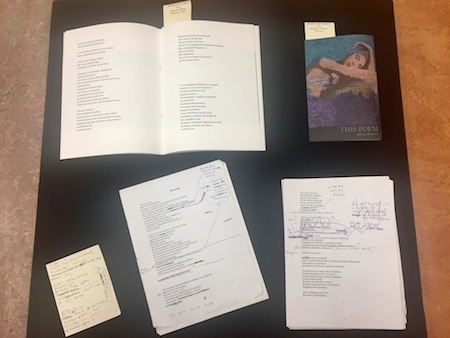
photo - Among Adeena Karasick’s donations to the Collection of Contemporary Literature at SFU’s Bennett Library were books and personal notes
Among Adeena Karasick’s donations to the Collection of Contemporary Literature at SFU’s Bennett Library were books and personal notes. (photo from Adeena Karasick)

Karasick’s speech is peppered with words like “intervention,” “transgression,” “disruption,” “nomadicism” and “vagrancy.” She aims, she explained, to “destabilize and subvert linguistic power structures with the hope of instigating new ways of seeing. My poetry uses playfulness and celebrates a sense of creative homelessness, a mashing up of poetry, critical theory and visuality.”

Asked how she felt about being a postmodern artist whose work has been called “an impressive deconstruction of language and meaning” by Canadian Literature, in an age where the American president, it could be said, was much maligned for engaging in similar activity, she pointed to Jewish postmodern philosopher Emanuel Levinas (1906-1995).

“I’m not saying there’s no truth. There is truth. There is what happened,” she said. “The search for the truth cannot be solitary or uniperspectival though, and cannot be an imposition of ‘the truth’ on others in a totalitarian way. Levinas said that truth itself arises out of discourse … it rests in the ethical relation between people, where a search for the truth can take place. Truth requires humility and multiplicity.”

Born in Winnipeg, Karasick’s family moved to Vancouver when she was six months old, and she grew up here. She had her bat mitzvah at Congregation Beth Israel and was very much a part of the local Jewish community. She went to the University of British Columbia for her undergraduate degree, did her master’s at York in Toronto and her doctorate at Concordia, in Montreal, in “French feminist post-structural theory and kabbalistic hermeneutics.”

Karasick now teaches at Pratt Institute in New York and is enjoying a growing distinction as one of the premier avant-garde poets of her generation. She is becoming known for her innovative use of video as well as the printed page.

In 2018, Karasick will release a new book, Alephville, a poem composed of faux Facebook updates. “I was un-nerved by the timing,” she said, referencing the administration of U.S. President Donald Trump, “by the fact that it is basically a poem composed of ‘alternative facts.’”

Also next year, Karasick will debut her “spoken-word opera” Salomé: Woman of Valour, a feminist reinterpretation of the biblical character. She co-wrote the piece with Grammy Award-winning musician Frank London of the Klezmatics. They met through KlezKanada, an annual klezmer camp that has been meeting in the Laurentians for 20 years, the poetry division of which Karasick has been director for the last six years.

Karasick wrote the libretto for Salomé: Woman of Valour and London composed the music, an original score that blends Arabic, klezmer, jazz and bhangra. The nomadic and subversive piece will première at next year’s Chutzpah! Festival.

Matthew Gindin is a freelance journalist, writer and lecturer. He writes regularly for the Forward and All That Is Interesting, and has been published in Religion Dispatches, Situate Magazine, Tikkun and elsewhere. He can be found on Medium and Twitter.

Format ImagePosted on March 17, 2017March 14, 2017Author Matthew GindinCategories LocalTags Adeena Karasick, literature, poetry, SFU

For the love of G-d and man

Our Bible, according to my estimation, tells us repetitively to love G-d. How can we comply with this mandate? I love my wife, kids, a few highly select friends who owe me money, even the cat. And I love lamb chops with garlic and lemon. But my Creator and Judge? There’s an inter-dimensional enigma here. An emotional warp. How can it be?

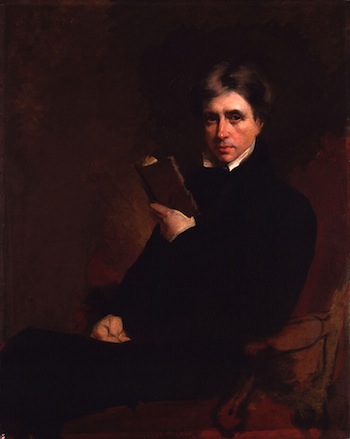
photo - James Henry Leigh Hunt by Samuel Laurence (1817–1884)
James Henry Leigh Hunt by Samuel Laurence (1817–1884). (photo from National Portrait Gallery NPG 2508 via Wikimedia Commons)

Strangely, Leigh Hunt, an English poet who probably never met a Jew, answered the question with a Jewish slant. He was a Londoner who lived 2,000 miles west of Chassidism’s headquarters in Poland. He was an aristocratic Englishman who, unlike his Polish contemporaries, wore a frock coat and did his best work on the Sabbath. He was a good Episcopalian, but somehow saw the world through Jewish eyes. The poet, in an inspired mood, wrote a work of 18 short lines, singing the same love-thy-neighbor theme that’s in our prayer book. Unintentionally, it is a very Jewish poem: an angel alights in the room of Abou Ben Adhem, an exemplary soul who:

“… saw within the moonlight in his room
making it rich like a lily in bloom.
An angel writing in a book of gold
the names of those who love the Lord.”

Abou Ben Adhem, in a flash, sits up in his bed only half-awake, but alert enough to know that his visitor is not his cousin from Cincinnati. Am I in your golden book, he wants to know. (“Exceeding peace had made Ben Adhem bold.”) The angel sadly shakes his head.

But the man with a heart for humanity is not disheartened. “Well,” he says, “put me down as one who loves his fellow man.”

The angel notes the words of Abou Ben Adhem and disappears. Next night, he’s back in the dim bedroom “with a great wakening light” and his fateful list of those who love the Lord. “And lo, Ben Adhem’s name led all the rest.”

Loving your fellow man is like loving G-d, an insight initially proclaimed by our Tanach.

I’ve heard it said that the hardest part of being a good Jew is loving your fellow man. Now I didn’t originate that – it’s probably in the Talmud or maybe in the Tanach from some bitter prophet like Jeremiah. But, sadly, it’s true. Didn’t G-d Himself tell us we’re a stiff-necked people? Easy-going, sweet, lovable people don’t cure polio, don’t split the atom and don’t win Nobel prizes. They’re too busy displaying their love. There’s some furnace running in the core of great people that keeps them from election as most popular kid in school or fraternity/sorority presidency. You wouldn’t have enjoyed a beer and a bowl of pretzels with Einstein. Your Uncle Louie was probably much better at small talk.

In all the English vocabulary, the hardest word to define is love. It has no synonym, only antonyms. It thinly communicates when it describes our relationship with our fellow creatures, even the four-legged ones. But it miserably fails to describe our feeling to our Creator, even though I count the mandate more than 150 times in the Tanach.

In nature, love flows down, not up. A river originating in a mountain peak flows down to water the animal and plant life at its base. I’m convinced that parents, especially mothers, love their children more than kids love their parents. Survival of the species demands it. Our limited human understanding comes closest to defining divine love by loving our fellow human creatures. And, while we’re talking about love and G-d and man and English poets, let me remind you of Alexander Pope, another famous English Bard. He’s clearly on my side: “The proper study of mankind is man,” he says. “Presume not G-d to scan,” which to my understanding says the Creator lies beyond our telescopes.

What is love? We understand friendship. We know all about lust. We understand why your heart glows when your wife makes kreplach in chicken soup, your favorite. And even closer to your emotional warmth is the sensation of holding in your arms your newborn child. But words fail when we try to cozy up to the Lord. There is awe, respect and reverence, but love?

I’ve never met anyone who loved G-d and could explain that exotic emotion. It cannot be expressed any more than a fish expresses his love for water, his medium. Maybe the prophets and Leigh Hunt were on to something. Love thy fellow man. That, itself, is an awesome challenge. But may be the only road to the celestial palace.

Ted Roberts is a freelance writer and humorist living in Huntsville, Ala. His website is wonderwordworks.com.

Posted on December 16, 2016December 14, 2016Author Ted RobertsCategories Op-EdTags Judaism, poetry, spirituality

A fine collection of poems

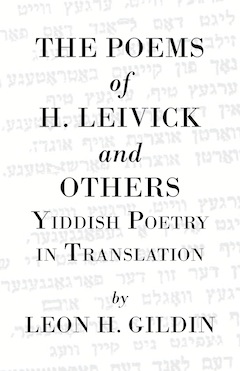
When I saw the table of contents of The Poems of H. Leivick and Others: Yiddish Poetry in Translation by Leon H. Gildin (Finishing Line Press), a lovely little book of translated Yiddish poems by Leivick and other noted poets, two images came immediately to mind. One was a scene with Leivick, a slight figure with a beautiful etched face and a halo of white hair, sitting alone on a circular stone ledge in front of the Hebrew University library, in Jerusalem, seemingly lost in thought. The other, and this goes back decades, is a gathering of Yiddish poets, including almost all the ones collected in this book, in a meeting hall in New York. What a thrill it was for a college boy to be at such a meeting and seeing face-to-face the famous poets he had known before only by name.

book cover - The Poems of H. Leivick and OthersThe poems of Leivick (1886-1962) range in subject matter: a poem about a very small poem “no longer than an epitaph”; the recollection of a birch rod beating given by his father; a prisoner in a cell at night “swallowing as if it were wine the moon’s bright light”; a man looking for work without success. Leivick was a paperhanger when he came to the United States. He was also a noted playwright; his most famous is The Golem, originally produced by Habima Theatre when it was still in Moscow, and later translated into other languages.
Here, too, admirably rendered into English by Gildin, are the voices of other famous American Yiddish poets – all born in Eastern Europe – singing songs of longing, love and the Sabbath. About half the poems are by Leivick: the rest are by luminaries like Chaim Grade, Yakov Glatstein, Avraham Reisen, Itzik Manger, A. Leyeles, Mani Leib and Avraham Sutzkever. Most of the poems here have a modernist lilt regarding imagery and tone, yet all have traditional rhymes.

My only caveat with this fine ingathering of poems is that too much space is devoted to a relatively minor but good poet, Anna Margolin. Where Grade has only one, why six for Margolin? Additional poems by the other poets would have been welcome.

My favorite poems here are those that have a Jewish core. Hence, Grade’s loving poem “The Sabbath,” recalling his war- and postwar-years wanderings in Russia and Europe, resonates, as does Ephraim Auerbach’s prayer-poem “God of Abraham,” which begins with the opening lines of Havdalah – the prayer for the departing of the Sabbath – and takes wing from there.

In his short introduction, Gildin accents the secular aspects of Yiddish poetry but, by so doing, he puts an artificial divide between religiosity and secularism. He says that, while Yiddish was the street language of the Orthodox, the secular Yiddish created a culture. But Gildin neglects to note that Yiddish was used far beyond the street for Orthodox Jews. Religious Jews also used Yiddish in shul, in studying and in translating Chumash and Talmud, and in creating commentaries and translations of the siddur and the machzor, the daily and the holiday prayer books, respectively. Women created their own prayers in Yiddish, which were collected into separate volumes. This same “street language” was used by the secular poet Yehoash in creating his masterpiece: his magnificent translation of the entire Bible into Yiddish.

In Grade’s “The Sabbath” and Auerbach’s “God of Abraham,” the boundaries between piety and secularity are blurred. The distinctions are not as separate as they appear to be. In a classic photo of Yiddish poets sitting at a long dinner table at a wedding, one can see secular poets like Leivick, Grade, Glatstein, Reisen and noted critic Shmuel Niger, all wearing either fedoras or yarmulkes.

Sholom Aleichem was thoroughly secular. He was not observant and did not keep a kosher home. In fact, he spoke Russian, not Yiddish, to his family. Yet, when his son died in Denmark, he went to shul to say Kaddish every day in New York. And, in his will, he asked those who are willing, to say Kaddish for him, too.

Most significantly, the obviously secular translator of this volume, Gildin, along with his brother, founded a university Yiddish department, not in the secular Hebrew University, Haifa University or Tel Aviv University, but at Bar-Ilan University, the only religious-sponsored university in Israel.

For those who know Yiddish poetry, The Poems of H. Leivick and Others revisits old friends; for newcomers, it is a cogent introduction.

Curt Leviant’s most recent books are the novels King of Yiddish and Kafka’s Son.

Posted on November 4, 2016November 3, 2016Author Curt LeviantCategories BooksTags Leivick, poetry, Yiddish

Poet chooses politics over love?

In times of protracted conflict, can matters of the heart exist apart from politics? An award-winning documentary from Israeli filmmaker Ibtisam Mara’ana Menuhin left me at once spellbound, uplifted, sad and restless, as I found myself wrestling with this question.

Write Down, I am an Arab depicts the life of Palestinian national poet Mahmoud Darwish. The politics is important – more on that below – but what makes the film especially gripping is the story of Darwish’s catapult to national and international fame against the backdrop of his private longings for a woman on the other side of the Palestinian-Jewish divide.

Darwish met Tamar Ben Ami in the early 1960s at a political rally – this one for the Communist party in Israel. Frequently separated geographically – he under military administration (as all Arab citizens were until 1966) in Haifa, she studying in Jerusalem – Darwish documented his feelings for her in a series of letters.

I spoke with Tamar – by phone, Facebook and email – over the course of a few days. A dancer and choreographer (the film chronicles her stint in the Israeli navy’s performing troupe), Tamar divides her time between Tel Aviv and Berlin. She describes her art – and really her entire personal life – as being shaped by her time with Darwish. Her love for him is palpable, still.

Caught up as I am as a political scientist and columnist in contemplating political arrangements – refugees, Jerusalem, borders, one-state, two-state, federation or separation – Tamar operates differently.

“It’s cliché, and maybe I sound naive, but I believe in unconditional love,” Tamar tells me when I ask her what kind of political future she envisions. She is disturbed by what she sees as the artificial divisions of nations, races, ethnicities and religions, including what she sees as a dangerous interpretation of Jewish chosenness. “On this, the occupation has been nurtured.”

And, while it’s hard to disagree, I find myself confounded. Is the Palestinian national struggle one over occupation? Is it about the West Bank settlements, the land appropriation, the checkpoints and night raids and administrative detention? Or is it about the stones and earth of Palestinian towns and villages within Israel itself to which many Palestinians long to return? And, if it is the latter, how can the two national dreams ever be squared?

In the film, we see video footage of Darwish meeting a resident of Kibbutz Yas’ur, which was founded on the ruins of Darwish’s childhood village, al-Birwa. “It’s a moment of sadness and hope,” Darwish says to the man. “The sadness is that I’m not allowed to go back to that place and you have the right to go back there. But if we have the ability to be friends and we are friends, then peace is still possible.”

On one hand, it’s a wholly human encounter. On the other hand, once we put the subject of Israeli towns, cities and kibbutzim within pre-1967 Israel on the table, we are talking about the core of Israel’s identity, one which Israelis – and most Jews worldwide – are loathe to give up. And, if I’m really honest with myself, as a (liberal) Zionist who shares the Jewish national dream of those kibbutzniks, then perhaps the pain is also mine.

Nowhere was the tension between resisting occupation and demanding more fundamental claims more evident than in Darwish’s highly controversial 1988 poem called “Passers Between the Passing Words.” There, Darwish wrote: “It is time for you to be gone. Live wherever you like, but do not live among us…. For we have work to do in our land. So leave our country, our land, our sea, our wheat, our salt, our wounds, everything; and leave.”

With the first intifada raging at the time, Tamar is certain that the poem is about the occupation, not about Israel itself. “What can the occupied do?” Tamar recalls Darwish saying. The irony is that Darwish didn’t even think it was a good poem, Tamar says. To be judged by that poem pained him, and more than anything he longed to be considered a universal poet, Tamar adds.

After the 1988 poem controversy, Tamar found herself in Paris, trying to reconnect with Darwish, who was now at the centre of Palestinian politics. While she was sitting with him, Darwish took a call from Yasser Arafat. They spoke in Arabic. She could not make out what they were saying. The next day, when she called him again, Darwish rebuffed her: “You are not my girlfriend.”

We can never know whether Darwish, who died in 2008, chose politics over matters of the heart, or whether this unkind ending was just like so many ruptures between once-lovers: prosaic and universal.

But Darwish and Tamar did have contact again. After Prime Minister Yitzhak Rabin’s assassination, Darwish reached out to her in compassion. And, in 2000, Education Minister Yossi Sarid attempted to introduce two Darwish poems to the Israeli (Jewish) national curriculum. Stormy Knesset debate ensued, and the government narrowly survived a no-confidence vote. Darwish called Tamar. “My poetry is so important that over it the government nearly fell?” he mused.

Though their romance had ended, they clearly shared a sense of absurdity in how the universal language of poetry can be thrust into the forefront of the ugly struggles over land, narratives, history and invisibility. It’s a story that continues to be told, even as Tamar will always think in terms of interpersonal love as much as in terms of borders and territory.

Mira Sucharov is an associate professor of political science at Carleton University. She blogs at Haaretz and the Jewish Daily Forward. A version of this article was originally published on haartez.com.


Posted on July 31, 2015July 28, 2015Author Mira SucharovCategories Op-EdTags Ibtisam Mara’ana Menuhin, Israel, Israeli-Palestinian conflict, Mahmoud Darwish, peace, poetry, politics, Tamar Ben Ami

Israeli poet talks to JI

photo - Erez Biton
Erez Biton

After years of writing poems that blend his Algerian/Arabic background and his Ashkenazi-influenced schooling, Israeli poet Erez Biton, 73, this year received the Israel Prize for Hebrew literature and poetry. Born to Moroccan parents in Oran, Algeria, in 1942, he is the first Israeli of Mizrahi descent to win the country’s top literary honor, though he is no stranger to awards for his work.

“Poetry is like a tale of an elusive dream, but one must not give up,” Biton told the Independent. “One must, to a certain extent, pursue this elusiveness and try to catch it and change it into the poetic expression. The coping is with the controlling, the conscious, the immediate, which prevents an encounter with the twilight sensation that enables the poem to dawn.”

Biton envisions poetry as an independent, physical sense. “The poem is a continuation of you, added to you by the poetic ability,” he explained. “Just as it is difficult to catch the tale of a dream, so does the poem impose, sometimes for the good, sometimes for the bad.”

By internalizing the poetry of such writers as Hayyim Nahman Bialik, Nathan Alterman, Yehuda Amichai, Zelda Schneurson Mishkovsky, Amir Gilboa, Dahlia Ravikovitch and Avot Yeshurun, Biton said he developed a poetic stance of his own. “If, at first, I wrote love poems of a boy seeking his path to the world of poems, which were defined as universal existential with no description of time and place, then, in my additional poetry, I had become totally concrete, and thus saw myself as different from others.”

Biton started on his artistic journey with the help of Elisheva Kaplan, a piano teacher at Biton’s school who stopped teaching in order to dedicate her life to translating written books into Braille. This was essential for Biton, as he lost his sight at the age of 10.

Kaplan brought some of Biton’s poems to Shimon Halkin, an Israeli poet, novelist, teacher and translator (who passed away in 1987). Upon reading Biton’s work, “Halkin suggested that I send my poetry to [the now defunct literary magazine] Keshet,” said Biton. “I received an enthusiastic letter from the editor of Keshet, Aharon Amir, in response to reading my poems ‘Jaffa Street,’ ‘Variations on One Subject of Bach,’ and more.”

When Biton lost his sight and left hand to an explosive device he found while playing, he recalled, “This was a type of loss, a death of an intimate entity, which until the age of 10 and a half, was a part of me. And, to lose that, [it’s as though] something dies in you. With this death, I am in negotiation.”

Biton decided to become a social worker instead of a writer. “There was no one I could show my poems to,” he said. However, he added, “as a result of my encounter with human suffering as a social worker, I acquired compassion, sensitivity to others, which were later absorbed into my poems.”

Biton immigrated to Israel in 1948 with his family. The year after he lost his sight, he went to school at Jerusalem’s Institute for the Blind. He received his bachelor’s in social work from the Hebrew University, his master’s in psychology from Bar-Ilan University, then worked as a social worker for many years. He also worked as a journalist and was a columnist for Maariv. His first book, Mincha Marokait (Moroccan Gift), was published in 1976.

Biton’s decision to become a social worker stemmed from his identification with the hardships involved with making aliya. His experiences have also contributed to his poetry.

“The process of my growth ripened in me foundations of lyric sensitivity that came to expression in the poetic writing,” he said. “A writing of truth can grow through a deep encounter with different life situations and I say that all human suffering is not foreign to me. Therefore, I find in myself a space of accommodation and also of the unusual and the different.”

Biton expressed gratitude for the recognition he has attained, saying if he is to be considered part of the chain of poets that includes writers such as Bialik, “a great grace will be done with me. And grace will be done with me also by those who will see me as someone who opened a certain door, because it took time until people started to talk my language.”

Biton does not see himself as a man of religion, but said, “Moroccan associations echo in me, biblical associations echo in me. All the materials I treasured, which I internalized – poems of Bialik – all the materials that I absorbed, especially the Moroccan language, it was an immense joy to me to give an echo to something from an entirely different me.

“One of the unique components in the writing of my poems is the use of expressions in Arabic…. During the healing of the internal tears, I found myself writing poems that embed in the Hebrew syntax expressions in Moroccan Arabic, which was my childhood language.”

His work has paved the way for others. “I used in my poetry groundbreaking Moroccan expressions and, eventually, other poets used the expression ‘Moroccan’ as a title to the names of their creations,” he said.

“I’m in a battle of two phases. One says blindness is a great lacking, an endless depravation of encountering the world…. On the other hand, when I am a bit more reconciled with myself, there are also the possibilities of hearing, touching and listening to the speaking of people, as a type of melody.”

Of course, not only his cultural background has influenced his writing. “On the sensory level,” he said, “I’m in a battle of two phases. One says blindness is a great lacking, an endless depravation of encountering the world … emphasized by the recognition of the memory of seeing until the age of 11.

“On the other hand, when I am a bit more reconciled with myself, there are also the possibilities of hearing, touching and listening to the speaking of people, as a type of melody. The sensation, the touch of a woman, the face of a woman, the lips of a woman – all of these are at the other side of the scale of what there is.”

Integral to his success has been his wife. “In my attempt to understand the proceeds that happened in my work, I cannot ignore the significance of my marriage to Rachel in the year 1982,” he said.

Biton’s wife, Rachel Calahorra, is an architect and graduate of the Technion in Haifa. She was born in Israel to parents who emigrated from Athens. The couple met in early 1980.

“What was special in our relationship was we believed in each other, in the intellectual capability and the emotional side of deep love,” said Biton. “Our connection as a couple led also to a mutual intellectual cultural search toward an integration … between East and West.

“The marriage, the starting of the family, and its expansion in the birth of our children, Asaf and Shlomit, sharpened in me the question of blindness and my place as a blind person in the family, as a father and a husband.”

Biton found himself writing poems like, “The Joy of Your Eyes” and “Arrangement with a Firstborn.”

“Without a doubt,” he said, “my marriage to Rachel was a very significant turnaround, not only in the course of my life, but also in my writing, with the complexity of her life with me as a blind person, in her endless support of my overall actions.”

While Biton has won other awards for his work, with the receipt of the Israel Prize this year, as well as the Bialik Prize for lifetime achievement and the Yehuda Amichai Prize last year, he said he now feels more accepted.

The Israel Prize committee described his poems as, “The epitome of courageous dealings, sensitive and deep with a wide range of personal and collective experiences centred around the pain of migration, planting roots in the country and the reestablishment of the Mizrahi identity as an integral part of the overall Israeli portrait.”

In his speech at the prize ceremony, Biton said, “My parents were like an open book to me. My mother was a collection of poetry in Arabic, carrying an ancient Jewish legacy. And, indeed, so I have become an accumulation of childhood experiences, experiences of lively observation, of freedom of movement in spaces, climbing on trees and on fences, and a lot of running.

“I was an accumulation of sounds, of dialects, or poetry, from my father’s home. Eleven years of freedom of movement and seeing … sensory treasures were collected in me … of which I make use still today.”

Rebeca Kuropatwa is a Winnipeg freelance writer.

Posted on June 5, 2015June 3, 2015Author Rebeca KuropatwaCategories IsraelTags Erez Biton, Israel Prize, poetry

Poet’s passion shines

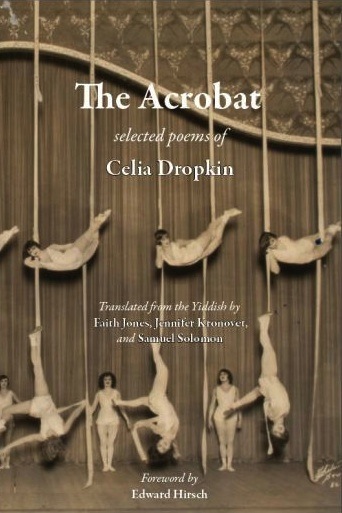
From the moment I read Pat Johnson’s interview with Faith Jones prior to last year’s Limmud, I knew I wanted to read The Acrobat: Selected Poems of Celia Dropkin (Tebot Bach, 2014).

image - The Acrobat book coverThe title of the collection wasn’t mentioned but the topic was: “erotic Yiddish poetry.” Jones, who translated Dropkin’s work into English with Jennifer Kronovet and Samuel Solomon, gave an overview of the poet’s background, which is explained in more detail in The Acrobat. That Dropkin writes with and about such passion is notable given her life’s circumstances. Born in Belarus in 1887, she and her family had to rely on the charity of relatives after her father died. While difficult, it meant that she could receive an education, and she became a writer. In 1909, she married Shmaye Dropkin, a Bund activist whose political activities forced him to flee czarist Russia, and, in 1912, Dropkin (and their son) joined him in New York.

“There,” reads the Translators’ Note, “inspired by the foment of Yiddish culture she found, Dropkin shifted from writing in Russian to writing in Yiddish…. She became a part of the thriving Yiddish literary scene, publishing widely in Yiddish newspapers and literary journals. Yet, she was publicly criticized by her male contemporaries for the perceived extremity of her work. All this time, Dropkin raised five children; a sixth died in infancy. She occasionally wrote stories and novellas in serialization for money, especially during the Depression when her family needed the income. Although the bulk of her oeuvre dates from the 1920s and ’30s, Dropkin never stopped writing poems. She wrote almost until her death in 1956.”

The Acrobat is not a comprehensive collection, but rather, as Jones explained in an interview with Leah Falk at yivo.org, the translators “chose the ones that we thought we could make into good poems in English…. The poems, even some of her quite important poems, that we did not think we knew how to work with, or that lost something in the translation that we didn’t think would be regained, we didn’t keep…. We weren’t able to capture them in the way that we felt really did them justice.”

A page-facing translation – i.e. the Yiddish poem is on the page facing the English version – those who understand Yiddish can not only engage in discussions about a poem’s meanings, but its translation. For example, the title poem, which is generally translated as “The Circus Lady,” gives an idea of the complexity of language, and the different images that are conjured by words that basically mean the same thing.

Dropkin’s poems more than withstand the test of time. Eighty-plus years later, they retain their immediacy. As Edward Hirsch writes in the foreword, Dropkin’s “lyrics come fully loaded. They are erotically frank and emotionally unabashed, deeply engendered, relentlessly truthful. They are terse and musical, like songs, and carefully constructed to explode with maximum impact.”

More than a decade in the making, The Acrobat is, remarkably, the first collection of Dropkin’s work in English, and she could not have gotten a better group of translators. Their love of the poetry comes through, as does their skill. One could almost be forgiven for thinking that Dropkin wrote in English. The Acrobat is truly an inspiring – and sometimes challenging – read. But it is more than that.

In speaking to Johnson, Jones admitted another objective. “I would like people to think about re-envisioning our forbearers as people who were more like us,” she said. “We need to really explore the people in our past and, as a historian, this is what I hope for most: that people will explore the past, understanding that these people were not like us, but in other ways were very much like us.”

In this, she and her colleagues also succeed. This is your bubbe’s poetry, as much as it is yours. And, while thought may be a little unsettling, given some of the subject matter, it is also very cool.

 ***

He and She
by Celia Dropkin (from The Acrobat)

He is a branch;
she – the green leaves on the branch.
From him to her flows
dark power, thick fertile sap.
She shudders with each touch of wind,
whispers and laughs,
turns the silver
of delighted eyes.
He is simple, mute.
Autumn dyes her deep
colors. The cold wind cruelly
exiles her from the branch,
while he remains the same, simple,
robust, mute.


Posted on February 27, 2015February 26, 2015Author Cynthia RamsayCategories BooksTags Celia Dropkin, Faith Jones, Jennifer Kronovet, poetry, Samuel Solomon, Yiddish

Posts pagination

Previous page Page 1 … Page 3 Page 4 Page 5 Next page
Proudly powered by WordPress