Thought-provoking speakers

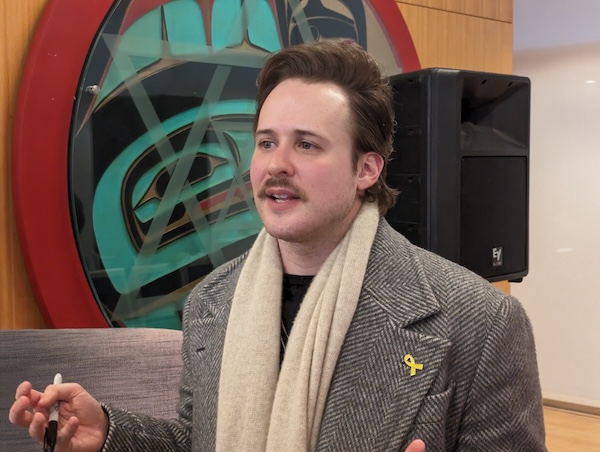
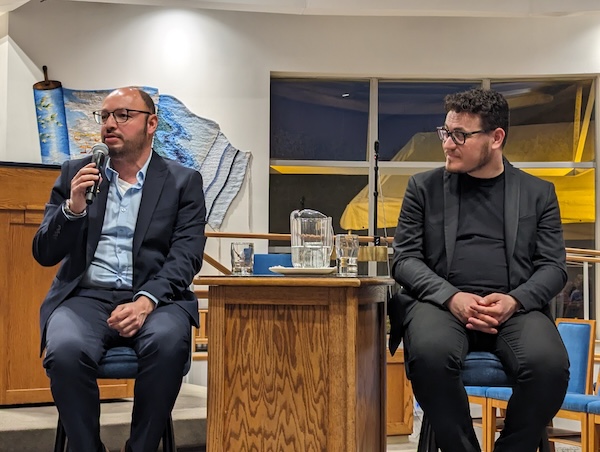
Dr. Gil Murciano of Mitvim, the Israeli Institute for Regional Foreign Policies, and Uri Weltmann of Standing Together, spoke April 17 at Temple Sholom. (photo by Pat Johnson)

For months, weekly rallies across Israel after Shabbat have demanded the return of the hostages from Gaza. These rallies have often coincided with separate protests, which have been going on much longer, against the government of Prime Minister Binyamin Netanyahu generally and its proposed judicial reforms specifically. These two streams of protesters have coalesced in recent weeks, according to an Israeli activist leader who spoke in Vancouver last week, because, he said, many Israelis are convinced that Netanyahu is not advancing freedom for the hostages, but hindering it, for his own political advantage.

Uri Weltmann, field organizer of Standing Together, made the claim April 17 during an event at Temple Sholom organized by New Israel Fund Canada. 

“What happened three weeks ago is that it stopped being two different protest movements,” said Weltmann. “They are basically changing their strategy. They are calling for early elections and for [Netanyahu’s] government to be removed and replaced with a different government. [Activists are] pointing their finger at him as the obstruction, as the obstacle toward advancing to a ceasefire agreement.”

Weltmann argues that Netanyahu is concerned not only for his political survival, but for his freedom.

“For Netanyahu, the protraction of this war, the continuation of this war, is in his political interest,” said Weltmann. “He knows that a temporary ceasefire might lead to a permanent ceasefire. A permanent ceasefire would mean an end to the war. An end to this war would bring an end to this coalition government because the extremists he huddled with have already said publicly that, if they will end the war before total victory, they will topple the government.”

The end of the current government and the ousting of Netanyahu, he said, would have more than just political ramifications for the prime minister, who opinion polls suggest would be soundly routed if an election were held now.

“New elections mean him losing the majority and him losing the majority is not only Netanyahu the politician being ousted from office. It’s also Netanyahu facing corruption charges, having his trial resume, [and he] might lose his personal liberty. For him, it’s intimately linked to the continuation of the war.”

The consensus among these activists is that Netanyahu is seeking to prolong the war and the captivity of the hostages to protect his political and personal interests, said Weltmann.

“It’s an incredibly important political development within Israel that a broad movement around the families and friends of the hostages have made this link,” he said.

Weltmann’s group, Standing Together (known in Hebrew and Arabic as Omdim Beyachad-Naqif Ma’an), was founded in 2015 and is one of the on-the-ground groups New Israel Fund supports.

Among the goals of the group is to build a grassroots movement for peace and progressive politics in Israel, including in rural and peripheral areas of the country. Making such a movement successful beyond the activist hub in Tel Aviv is the only way to advance Standing Together’s goals, Weltmann said. Even a more centrist or progressive government, if elected tomorrow, would not necessarily advance meaningful steps to peace and coexistence if there is not a broad popular movement in support of such a policy shift, he said.

Without a national movement for peace, he said, a new prime minister, however well-intentioned, would not feel the pressure to abandon the status quo and take steps for a changed future. 

“We must, as a strategic starting point in our process of progressive transformation of Israeli society, be present in the Negev, be present in the Galilee, be present in those parts of Israeli society that for too long have been the playing ground of the right-wing with left-wing actors completely non-present,” he said. “We must be there organizing local communities.”

Jewish citizens cannot do it by themselves, said Weltmann, and neither can Arab citizens. 

“We must have Jewish-Palestinian unity and cooperation within Israel for this change to be effective,” he said. An example of this strategy was a slogan adopted by a joint Jewish-Arab slate in Haifa during the recent municipal elections. The far-right Otzma Yehudit (Jewish Power) party of Itamar Ben-Gvir ran slates across the country trying to solidify the party’s roots at the civic level. The joint slate in Haifa played off Otzma Yehudit’s xenophobia with the slogan “Jewish Arab Power.”

“We are at a crossroads,” said Weltmann. “Every Israeli should choose which side am I on: the side that leads to a continuation of the status quo, a continuation of the state of affairs in which the Palestinians live in the occupied territories under military rule devoid of citizenship, devoid of rights, a situation that can lead to Oct. 7 one after another unless we put an end to it, or the reality of an Israeli-Palestinian peace that will guarantee both people safety, security and an imaginable, livable future?”

Weltmann spoke alongside Dr. Gil Murciano, an Iran expert and chief executive officer of the think-tank Mitvim, the Israeli Institute for Regional Foreign Policies, which one journalist has called “the diplomatic wing of the protest movement.”

Like Weltmann, Murciano longs for a “new majority” in Israel’s body politic. “A new majority that will allow us to advance toward a state where we live in peace, we live in dignity, we live in equality, without the occupation, without the injustices, throughout our society,” he said.

A fundamental shift in perspective is needed, argued Murciano.

“We used to speak about ‘wars of no choice’ in Israel,” he said. “We need to start thinking in terms of ‘peace of no choice.’”

On the one side, he said, the extreme right has a plan of annexation, with Bezalel Smotrich, Israel’s minister of finance and head of the far-right National Religious Party, calling for the government to “encourage” migration from Gaza to Egypt. On the other side, he said, since Oct. 7, people on the left have been motivated to seek an alternative to the status quo.

Dr. Maayan Kreitzman, a local food systems researcher and activist who moderated the event, challenged Murciano on this point. Rather than progressive voices calling for more coexistence, she said, she has heard the opposite. People that are “quite dovish” have had second thoughts about their worldview and transformed into a more hawkish, securitized attitude, she suggested.

Murciano acknowledged that all Israelis share one overriding priority. “For Israelis, it’s pretty clear,” he said. “The first, second and third priority of Israelis right now is security.”

That is a prerequisite to any advancement, he said.

Murciano proposes something he acknowledges to be “a little bit symbolic,” an international peace conference to kick off a new process between moderate Israelis and moderate Palestinians. This could be a first step to breaking an impasse that has existed in recent years, he said.

“Some people have described the last decade as the lost decade of Israeli diplomacy,” he said, a period where “conflict management” has been the priority; effectively, a maintenance of the status quo.

“I think that’s the right description, actually. It’s a strategy of not having a strategy,” said Murciano. “Coming to terms with the fact that there is no political way out and basically every couple of years we’re going to have a bit of violence.”

This approach sees Israelis forfeiting the initiative to Hezbollah and Hamas, he said, “Basically setting yourself in a situation where you only respond to a reality that is forced upon you.”

Oct. 7, he said, destroyed this conceptual framing.

Part of any future needs to include a multilateral project to “rebuild life-sustaining systems” in Gaza, he said, not a “peace-keeping force” but a “multinational force” that will be an on-the-ground part of a larger process toward peace and coexistence.

Ben Murane, executive director of New Israel Fund Canada, spoke of the emotional impacts of recent months.

“If you’re like me, what has been excruciating the past six months has been not just holding my pain, our Jewish pain, the pain of my Israeli coworkers, my family, my friends there, the pain of the Israeli people, but also, in my heart, holding the pain of the Palestinian people too,” he said.

Since the earliest days of the current war, Murane said, there have been countless glimmers of hope in the form of cross-cultural dialogue.

“In the first few months, we were astounded to see, across Israel, dozens of gatherings, conferences, events with hundreds of Jews and Palestinians standing together holding up those now-iconic purple signs saying ‘Jews and Arabs refuse to be enemies,’ ‘Jews and Arabs stand together’ or just simply ‘B’Yachad,’ together,” said Murane. “We were astounded to see Jewish citizens of Israel respond to the needs of the Palestinian citizens of Israel, Palestinian citizens of Israel making calls to families of the hostages, joint Jewish-Arab humanitarian aid missions to the south and to the north. As the war in Gaza accelerated, those Israeli voices also said, ‘We do have choices, even now. We have lots of choices with how we execute a just war justly.’”

Any long-term solution to the decades-long conflict must bring safety and dignity to both peoples, said Murane, “and anything else, anything short of fairness to both sides, will perpetuate this for another generation.”

New Israel Fund partners with and supports, according to its website, “organizations in Israel that fight for socioeconomic equality, religious freedom, civil and human rights, shared society and anti-racism, Palestinian citizens, and democracy itself.”

The April 17 event was hosted by Temple Sholom and co-sponsored by JSpaceCanada, which calls itself the advocacy voice of Liberal Zionism, Ameinu Canada, described as the voice of labour Zionism in Canada, and Canadian Friends of Peace Now, as well as the speakers’ organizations.

Rabbi Dan Moskovitz, senior rabbi at Temple Sholom, said he had received emails expressing concerns about hosting a perceived left-wing event. 

“I get the same emails when we host people to the right of centre,” he said. 

One of the purposes of a synagogue, he said, is to engage with ideas that “comfort the afflicted and afflict the comfortable.

“You may find your truth by agreeing with what you here tonight,” he said. “You may find your truth by disagreeing with what you hear tonight. The important part is to engage with it.”

Vancouver activist David Berson promoted the opportunity to listen to the Israeli guests as a chance to gain a perspective apart from the most common refrain he hears on social media and WhatsApp threads. 

“There’s another way you can look at what’s going on,” he told the Independent after the event. “Come out and hear a different perspective. I invited people to come tonight and listen to a different narrative.”

The 200 to 300 people at the event was about double what organizers had earlier expected, he said. 
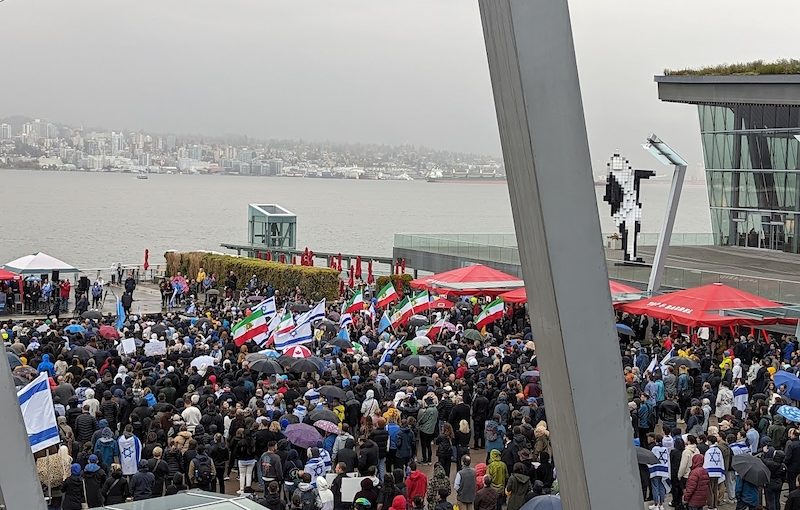
יוצאי איראן בטורונטו ארגנו כנס נגד אנטישמיות

גם יוצאי איראנים בוונקובר תומכים בקריאה לחמאס לשחרר את בני הערובה (רוני רחמני)

 המועצה של מוסלמים נגד אנטישמיות ארגנה במרכז טורונטו כנס מיוחד לאור העליה בגל האנטישמיות נגד יהודים. באירוע של הארגון הבינלאומי שמושבו בטורונטו השתתפו למעלה מארבע מאות איש. הארגון מחויב להיאבק בטרור בקיצוניות, כולל אנטישמיות נגד יהודים

המשתתפים הביעו את תמיכתם ביהודים במלחמה נגד תופעת האנטישמיות שהולכת ומתגברת בעת הזו, לאור המלחמה של צה”ל בעזה מול ארגון הטרור של החמאס. באירוע דנו בדרכים השונות להילחם באנטישמיות בתוך הקהילות השונות. בין המשתתפים היו חברת הפרלמנט מטעם המפלגה השמרנית של קנדה, מליסה לנצמן, הפרשן בנושאים הפוליטיים זוהדי ג’אסר, הסופר רהיל ראזה, חבר מועצת עיריית טורונטו גולדי ג’מארי ומנכ”לית המועצה של המוסלמים שריל סאפריה. מרבית הפעילים במועצה של המוסלמים נגד אנטישמיות הם יוצאי איראן שעזבו את המדינה עם עלייתו לשלטון של חומייני

חברי המועצה והאורחים בכינוס ציינו שיש לבצע תוכנית פעולה מהותית הכוללת שישה חלקים. ובהם: דרישה מהחמאס לשחרר את כל בני הערובה שהוא מחזיק בעזה מאז השבעה באוקטובר, להסיר את המימון של ממשלת קנדה לסוכנות הסעד של האו”ם – אונר”א. וכן להכריז על חייל משמרות המהפכה האסלאמית האיראנית כישות טרור. עוד הוזכר בכינוס כי יש להרים את הקול ולבקר את אלה המשבחים את האנטישמיות, הג’נוסייד של החאמס והזוועות המיניות שביצע ארגון הטרור בשבעה באוקטובר בישראל. אורחי הכנס הזכירו כי על המוסדות השונים ברחבי העולם ובהם האו”ם לנקוט עמדה חד משמעית נגד האלימות המינית הבלתי ניתנת לערעור שנעשתה לנשים, ילדים וגברים על ידי מחבלי החמאס – בשבעה באוקטובר. זו בעייה חמורה בחברה האנושית שלנו שיש הרואים בפעולות אלו של החאמס כהתנגדות לכיבוש. עוד הוזכר כי האשמה לאירועי השבעה באוקטובר מוטלת בעיקר על שלטון האייתולות באיראן ועל קהילות מוסלמיות במדינות שונות שמעודדות אנטישמיות ללא הפסק

ארגון מועצת המוסלמים נגד אנטישמיות מציין כי האנטישמיות היא תופעה ייחודית נפוצה, שינאה מתמשכת וקטלנית שנכנסה למסגרות תרבותיות, דתיות ופוליטיות שונות ומרובות בכל רחבי העולם. לפי סקרים אחרונים, רעיונות ותחושות אנטישמיות מאומצים כיום בדרגות שונות על ידי כרבע מאוכלוסיית העולם

ארגון מועצת המוסלמים מכיר באיום המיוחד הנשקף מן העליה המטאורית של האנטישמיות העולמית במאה העשרים ואחת. לעתים קרובות רצח או חיסול בכוונה תחילה או בביטוי, הוא מייצג שילוב חסר תקדים של הזנים המוכרים יותר של אנטישמיות המקודמים באידיאולוגיות ימין קיצוני, שמאל איסלאמיסטיות. האנטישמיות נחשבת על ידי מומחים לרעילה הרבה יותר מסך חלקיה, התפשטות האנטישמיות העכשווית הואצה על ידי הגלובליזציה והופעת הטכנולוגיות של המאה העשרים ואחת

ארגון מועצת המוסלמים תומך בהגדרה הבינלאומית לזכר השואה של האנטישמיות. הגדרה זו היא המקובלת ביותר בעולם לאנטישמיות והיא אומצה ואושרה על ידי ארבעים ושלוש מדינות כולל קנדה

מועצת המוסלמים מחויבת לפעול עם קבוצות דומות כדי לאתגר את האנטישמיות בכל מקום שבו היא עלולה להופיע. הארגון ימשיך ביוזמות חינוכיות, חקיקתיות, ומדיניות להשיג את המטרות שלו. כמוסלמים מכל הקשת המוסלמית והפוליטית, הארגון יהווה, יגייס ויזרז קול מוסלמי מובהק להתמודד עם האנטישמיות, שהשתרשה עמוקות ונותרה    אתגר קשה בעולם המוסלמי הרחב. הארגון יתמוך במאמצים של ארגונים מוסלמים במדינות בעלות רוב מוסלמי ובמקהלה הולכות וגוברת של מנהיגים, סופרים ותיאולוגים מוסלמים אשר נטלו על עצמם יוזמות להתעמת עם האנטישמיות, שהורשתה לחגוג בקהילות. אנו כמוסלמים נתעמת עם התופעה וקידום המערכתי של האנטישמיות על ידי קיצונים איסלאמיסטים מכל הסוגים, שעבורם הדמוניזציה ושנאת היהודים הם עמוד מרכזי באמונתם

The strength of community

Shai DeLuca and Alexandra Smith flew in Sunday from Toronto to address Vancouver’s weekly vigil for Israeli hostages on the six-month anniversary of the atrocities committed on Oct. 7. (photo by Pat Johnson)

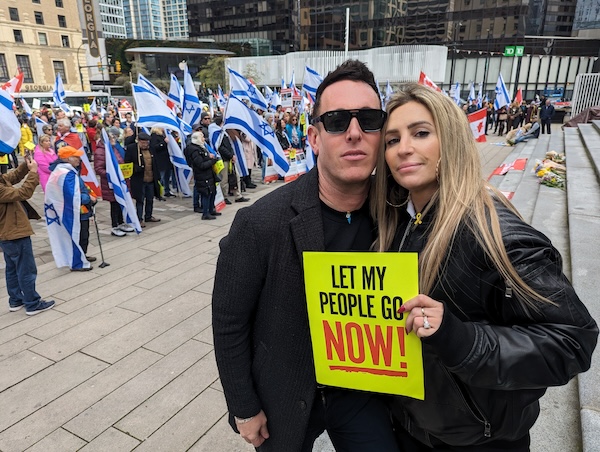
Unity, defiance and determination were the overriding messages at the community rally Sunday, April 7, marking six months since the atrocities of Oct. 7.

“Our hearts are heavy with the weight of loss and sorrow,” said Michael Sachs, regional director of the Jewish National Fund of Canada. As Israelis were called up for service at the start of that war, another battle began in the diaspora, he said.

“Jews worldwide were drafted for a different, yet related, war,” said Sachs. “In the wake of Oct. 7, we witnessed a disturbing and radical rise in antisemitism and Jew-hatred right here in Canada.”

Canada today does not resemble the Canada of Oct. 6, he said, as anti-Jewish ideas and actions have “emerged from the alley and are now openly displayed on our streets and threatening the very fabric of our society.

“We should always draw strength from the resilience and courage of the survivors,” Sachs said. The souls of those murdered that day, he said, live on “in our commitment to build a world with compassion, justice, that will triumph over the cruelty and ignorance that we are seeing.

“The brave soldiers, of all faiths, who have made the ultimate sacrifice in defence of Israel – we mourn you and we will never forget you,” said Sachs.

The Jewish response to evil is goodness, he said.

“In the face of their darkness, let us shine our light on them by rejecting forces of division, and continue to embrace the power of the unity of our community and our amazing allies,” he said. “Let us stand together, hand in hand, to be the hope and strength to the families of those held hostage. Let us show the world that our Zionism – not the Zionism that they have created – our Zionism, our love of Israel, is stronger than any hate they can throw at us.”

Aron Csaplaros, BC regional manager of B’nai Brith Canada, recalled his own family’s history.

“For hundreds of years, we have overcome expulsions, pogroms, massacres,” he said. “During the Holocaust, my grandmother spent months hidden in a dark basement, constantly hearing the footsteps of Nazi officers walking above her head, knowing that she could be found and murdered at any minute. But she, like Jews have done throughout our history, survived. She is here today standing in the crowd and we, the Jewish people, are still here, stronger and more united in our resolve than ever.”

He reiterated the demand of the weekly events, that the hostages be released, and added that Hamas should accept its defeat and unconditionally surrender to facilitate a new era of peace between the Palestinian and Israeli people.

“We will never stop fighting those who wish to destroy us,” Csaplaros said. “And we will not stop fighting to defend our indigenous homeland, the land of Israel.”

Until the hostages are released, he said, “We will not stop rallying. We will not stop marching. We will not stop advocating and we will not stop calling on our elected leaders in government to act until every single one of our brothers and sisters held hostage is safely returned.”

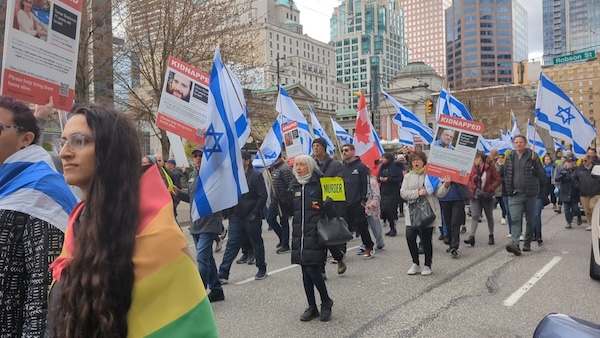
photo - Calls for the return of the hostages being held by Hamas rang through the streets of Vancouver Sunday
Calls for the return of the hostages being held by Hamas rang through the streets of Vancouver Sunday. (photo by Pat Johnson)

Shai DeLuca, an interior designer who lives in Toronto and Israel, is a familiar face to audiences of Toronto’s CityTV and Global television. During the Hamas war in 2014, he pivoted to being a voice for Israel and has led battles against anti-Zionist campaigns in Toronto. He said he was nonchalant when he awoke to alerts on Oct. 7. But, as he and his husband took refuge in a shelter, he realized this was not routine.

“I have lived through enough attacks, hundreds upon hundreds of Hamas rocket attacks throughout my life, to know that this felt different,” said DeLuca.

Soon, Israeli phones were lighting up with push notifications, videos and images showing murder, rape and other atrocities. 

“It was from numbers we did not recognize,” he said. “Only later did we find out that these were targeted push notifications from Hamas.”

Last week, DeLuca was back in Israel and visited the site of the Nova music festival, where hundreds were murdered. The site is about 15 minutes from his family home.

He spoke with Rotem, a young woman who had been a vocal advocate for reconciliation between Israelis and Palestinians. She had spent 30 hours in a safe room with her children before the terrorists gave up and sought out easier prey.

That day, Rotem told DeLuca, was “the day that I realized they really don’t care who we are.”

“A Jew is a Jew,” she told him. “They want us all dead.”

Many of Israel’s most avid peace activists lived on the kibbutzim that were attacked.

“The belief that one day we would have peace with our neighbours wasn’t something she could foresee anymore and that was heartbreaking to see,” said DeLuca. “She had strived to work toward a better tomorrow for all and was met with the worst massacre of the Jewish people since the Holocaust, on her community specifically…. A community that employed Gaza workers and worked daily to build bridges. That bridge no longer exists, she said, they torched it.”

Now, in the diaspora, Jews are faced with what DeLuca equates to the antisemitic marches of the 1930s and ’40s.

“We have never been able to depend on others,” he said. “Our history has proven that.… The difference today, unlike times past, is that we have our home to go to. While the hate marches we see repeatedly across cities and across countries call to deny the existence of the only indigenous home the Jewish people have ever known, they continue to prove why its existence is so very important.”

Alexandra Smith, director of End Jew Hatred Canada, came with DeLuca from Toronto on a delayed flight, arriving just in time for the event. 

“Today, we are called upon not only to demand the immediate and unconditional release of those unjustly held, but to reaffirm our commitment to each other as members of a shared community, a shared nation, a shared destiny and, indeed, a shared humanity,” said Smith.

“Starting on Oct. 8, for many in the Jewish community, the open, brazen, unashamed Jew-hatred exhibited on college campuses and on our streets came as a terrible shock and a deep sense of betrayal,” she said. “But, for those of us who have been working in this space for a length of time, it came as no surprise. Antisemitism has always been there, only hidden under wraps. It took a war in the Middle East for it to rear its ugly head. It’s not an exaggeration to call this a profound crisis. In moments of crisis, however, the strength of a community is seen not only in its leaders but in the spirit of its people. Unity is our beacon of hope. Shoulder to shoulder, regardless of backgrounds, beliefs and life experiences, we embody the resilience that has helped communities throughout history overcome adversity.”

Rabbi Andrew Rosenblatt of Congregation Schara Tzedeck chanted El Moleh Rachamim, invoking the name of Elad Katzir, a hostage whose body was recovered by Israeli soldiers the day before the rally. Rabbi Susie Tendler of Beth Tikvah in Richmond said the prayer for the hostages. 

Dance as an act of solidarity

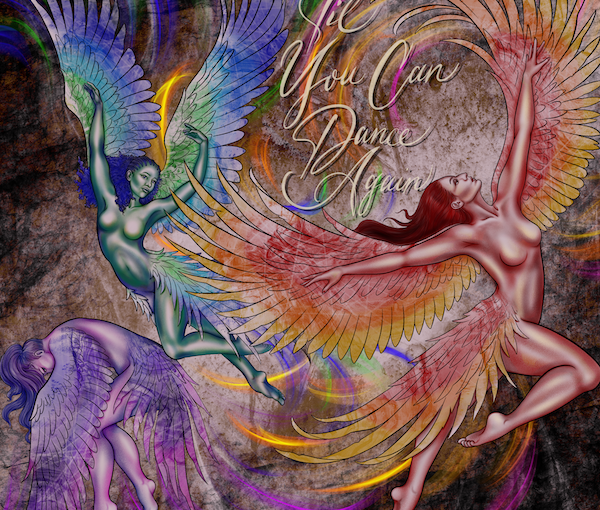
Iraqis in Pajamas’ new album is a tribute to the victims of the Oct. 7 massacre.

In the wake of the Oct. 7 massacre of Israelis…. And the celebrations that followed worldwide – glorifying the raping, burning and decapitating of my people…. 

And the subsequent mass destruction of posters raising awareness of Israeli hostages being tortured in captivity by Hamas…. 

And the simultaneous call for a violent uprising against Jews worldwide…. 

And the astronomical spike in hate crimes against Jews – among other things, leading to incessant harassment, assaults and death threats of students at my alma mater, Columbia University, and additionally leading to the murder of a kind Jewish man I knew in Los Angeles….

And the international mob chants of “From the river to the sea,” harkening back to the harrowing cries my father heard on Arabic radio stations as a child in Iraq, “We will throw the Jews into the sea.”…

And the palpable terror I then felt as a Jew, whose family had seen this before, had fled this before, in a pro-Nazi uprising in Baghdad, where a similar massacre had taken place during my father’s childhood….

And the deafening silence in the wake of all this – not even one word of care or kindness from the vast majority of non-Jewish people I had loved, had lived with, had broken bread with….

And I felt as if I had died.

I stopped journaling, stopped writing poetry, stopped writing music, stopped singing, stopped playing bass, stopped dancing. I got sick repeatedly and continuously over the course of two months, even ended up in the emergency room with symptoms of a possible stroke at 2 a.m. one night – this, after years and years of never getting sick, not once, not even when my ex got COVID and I nursed him back to health. 

I couldn’t sleep, had nightmares, woke up in the middle of the night, lying awake for hours, my mind circling around and around, imagining the horror and terror the hostages must be suffering through. I was haunted by the video image I accidentally had seen of a young Jewish woman who was naked and chained, publicly being dragged around by Hamas, as they filmed her – one of the many Jewish women they gang raped and mutilated that day, often next to the dead bodies of these women’s friends – filming that violence, too, in something akin to snuff porn. 

I could feel it in my body.

I couldn’t breathe.

I couldn’t move.

Despite the impact on me, I felt that, somehow, by energetically experiencing and, by extension, by physically experiencing the pain that my people were enduring, I was communicating a telepathic message to them: I will not forsake you, I will not forget you. 

No, I will not frolic on the beach beneath the misty grey soothing skies. No, I will not enjoy the quiet, peace and comfort of the vast rainforest just outside my door. No, I will not detach myself from something “happening on the other side of the world,” as a non-

Jewish acquaintance kindly advised, because there is no “other side of the world” when it comes to Jews. You are me, and I am you, and we are connected. I cannot control the world’s response, but I can control mine. I will face, see, hear and feel your pain, until it is gone.

But wait…. That’s exactly what Hamas wants, isn’t it? To demoralize and destroy Jews. To suffocate us, hijack our imagination. To strip us of our dignity, safety, peace and, perhaps most of all, joy.

So, to reclaim my joy is, in fact, a radical act of Jewish power and solidarity. To flip imagination on its head – instead of visualizing all the horrors and shrinking in my body, to instead expand in my body and visualize all the hostages, injured people and 

grieving families as resilient, grounded, surrounded by love, and the dead as soaring freely and peacefully, wrapping their loved ones in comfort.

Nothing is black and white, but this is an article, not a book, so I’m trying to keep it short and sweet. Suffice it to say, I actively and repeatedly attempted to turn the images around over the course of two months – to send white light, to bless the hostages, to emit some kind of protective energetic shield, but it kept seeming silly, foolish, without actual impact, perhaps just making myself feel better, like a hollow New Ager. My prayers would not stop a psychopathic Hamas gunman with absolute control over a hostage, I reasoned, because G-d gave humans both the gift and curse of free will. 

But then….

But then I went to a concert of Yemen Blues, which was more of a primal howl of freedom than a “performance,” and which featured an Israeli woman dancing with a defiant, raw ferocity that brought back to life the sanctity, dignity and power of the Jewish female body – and, with that, permission to dance.

And, after that, I started dancing again. And, after that, I started singing again. And, after that, I started frolicking with my beautiful dog beneath the misty grey, soothing skies on the beach, and through the vast rainforest just outside my door.

And I came back to life.

In this very difficult but transformative journey, I learned that life begets life begets life, and artistic self-expression is not an indulgence, but rather, a superpower. 

As I danced on the beach with my dog over a couple of days, a vision emerged – a global movement of Jews and our allies taking videos of ourselves dancing joyfully, and sending those videos to the people wounded in the Oct. 7 massacre, the families of those who died, the families of those taken hostage, and the young women and men on the frontlines defending Israel from further attack – turning “we will dance again” into “we will dance for you until you can dance again” – sharing whatever strength, freedom and joy we have to uplift those who are in the thick of it, struggling and suffering.

Having snapped out of an emotional coma of sorts, I then picked up my bass, and out poured both the melody and lyrics of a new song, “’Til You Can Dance Again.” That same day, I finally finished the song I had started a few weeks after Oct. 7, “Dear Hostages.” Not having touched my bass for the better part of three months, I played until my fingers were blistered and almost bleeding. Over the next 24 hours, I wrote two additional songs, and then worked with my band on developing a full album, ’Til You Can Dance Again, offering both my journey and my joy as a catalyst for healing and transformation.

It is through song, dance, story, prayer and food that Jews historically have not only overcome tragedy, but have taken that very experience and transmuted it into an vehicle for joy – the ultimate “f*** you” to those who have tried to destroy us. For this reason, my band released our new album on March 23, at the start of Purim, a holiday marking one of many historical traumas that the Jewish people have turned on its head and morphed into a cause for celebration. My heartfelt prayer for this album is that, as broken as we may feel right now, we shall once again rise up, sing and dance ourselves back to wholeness, and honour the victims of Oct. 7 not only through our grief and pain, but also through our fierce and irrepressible Jewish joy – emerging, once again, like that unstoppable phoenix, soaring up and out from the ashes. 

Loolwa Khazzoom (khazzoom.com) is the frontwoman for the band Iraqis in Pajamas and editor of The Flying Camel: Essays on Identity by Women of North African and Middle Eastern Jewish Heritage (theflyingcamelbook.com). She has been a pioneering Jewish multicultural educator since 1990, and her writing has been featured in the Washington Post, Marie Claire, Rolling Stone and other top media worldwide. This article was originally published in the Times of Israel.

More about the album

On March 23, Iraqis in Pajamas released the album ‘Til You Can Dance Again, as a tribute to the victims of the Oct. 7 massacre.

Its creation served as a vehicle for Khazzoom’s processing and healing, and the tone of the songs evolved as Khazzoom herself evolved from feeling despair to outrage to core power.

“Dear Hostages” is a love song to those held in captivity, in which Khazzoom pledges, I will not forsake you, I will not forget you, as she explores what it means to act in solidarity from afar. 

“’Til You Can Dance Again” is a spin on the Israeli promise, “We will dance again” – vowing to spread the life energy of dance, to help uplift the spirits of those who were shattered by the massacre. 

“Bataween” draws from a conversation with an Iraqi Muslim friend, exemplifying the healing imperative of Arab Muslims recognizing and caring about the history of indigenous Middle Eastern Jews, including the experience of Arab Muslim oppression. 

“Kids from the Sandbox” builds on that imperative, holding out a vision for Arabs and Jews to embrace the complexity of shared history, using art to express love and hate in healthy ways, effectively co-creating a new reality. 

“I’m a F***-You Jew” fuses ancient and contemporary stories of Jewish defiance and soul power in an unabashed expression of Jewish pride and strength amid an onslaught of global accusation and condemnation. 

“These Boots” is a campy spin on “never again,” calling out the left’s hypocrisy and betrayal in the wake of Oct. 7, and refusing to contribute Jewish energy and resources to those who do not offer the same in turn. 

“Bloody Cross” is a scathing critique of the Red Cross’s racism and hypocrisy in its failure and refusal to properly care for the Israeli hostages in Gaza.

For the full press release, and to listen to the recordings, visit khazzoom.com/blog and click on ’Til You Can Dance Again – New Album Release.

– Courtesy Iraqis in Pajamas

Mitzvah to return lost items

During the winter and spring in Winnipeg, sometimes one sees a child’s toy or a colourful mitten attached to a tree or hedge along a sidewalk. These are lost items. The neighbourly thing to do when you see something in a snowbank or on the packed snowy sidewalk is to pick it up and prop it up at adult eye level. It helps others. Maybe it will stop toddlers’ tears. 

Our household found somebody’s bike lock key last fall. This was harder to post. We took a piece of paper and wrote “Is this your key?” on it in large capital letters. Using clear tape, we attached the key and the sign to a powerline pole. A long time passed. One day, someone finally found their key. Relieved, we took down the sign.

I’ve been studying the Babylonian talmudic tractate of Baba Metzia, which covers civil law, including the rules around how to deal with lost items. It examines details that I often ponder. For instance, if a person finds an inanimate object, it has different obligations attached than if one finds an animal. We must return lost animals. If we don’t know how to return them, the finder must care for the animal, including feeding and watering the animal. If the animal’s upkeep is a burden, provisions exist for selling the animal and keeping the money to compensate the person who lost their animal. The particulars can be complex.

I became interested in a category that isn’t easy to describe – an object that isn’t alive or animate but still needs care. Things like books, which, in the days of the Talmud, were scrolls made of parchment made from animals. The finder had to rotate the scrolls occasionally to maintain them until they could return them. The finder couldn’t use the scrolls for study in a way that might cause undue wear on these hand-scribed texts. 

Another thing in this category, in Bava Metzia 29b, says: “If one found a garment, he shakes it once in thirty days and he spreads it out for its sake, to ventilate it, but he may not use it as a decoration for his own prestige.” As someone who makes and cares for natural fibre textiles (handspun and knit sweaters, for instance), I understood this immediately. Clothing wasn’t mass produced then. There were no factories. Everyone used spindles and spun and wove clothing. It wasn’t fast fashion. Clothes took skill and a lot of time to make. So, if someone found a garment, he knew its value. It wasn’t disposable. He must keep it well-aired, to be sure it was clean and cared for, and not attracting destructive pests like moths. Since he didn’t own or make it, he also couldn’t use the garment himself. 

Bava Metzia also explores when someone loses a garment and “despairs” of its return. That is, when one gives up entirely on getting it back.

For anyone who has seen images of the destroyed cars, homes and belongings left after Oct. 7 on the kibbutzim in southern Israel or from the Nova festival, these details hit hard. Some Israelis from these areas escaped with their lives but have “despaired” of ever getting back what they lost, they don’t want to return and try to reclaim things. Others asked for help or sifted through the remains of their homes to find precious items. Still others have managed to return home to their belongings and restart their lives.

This despair and reclamation reminded me of my in-laws and their stories of displacement after the Second World War. Their possessions, buried or left behind years earlier in Poland, were impossible to claim. Non-Jews had moved into their homes and taken their things. After four years in five different displaced persons’ camps, my father-in-law, his sisters and parents moved to the United States. Decades later, my husband’s grandmother would describe her family’s bakery in Mezritch and what they lost. Even in her despair, there was an acknowledgement that she worked daily to let go of that loss, and be grateful for a new, rich life for her family. 

This family refugee story, of loss and rebuilding, contrasts sharply with the UNRWA concept of intergenerational Palestinian refugee status. As Jewish communities have been forced to move over thousands of years, we have, perhaps, been lucky to have these talmudic guidelines, now 1,500 to 2,000 years old, on how we can claim lost items and how we can accept loss and move on. As we tell the Passover story, we remind ourselves of the many times our people have had to leave everything behind and start again. 

Teaching how to navigate lost items starts young. A PJ Library book sent to our children, called Sara Finds a Mitzva, helped us with this. Sara, the protagonist, follows through with the mitzvah (commandment) to return lost items when she finds a toy duck. She tours her Orthodox New York City neighbourhood to find the duck’s owner. My kids loved this book and its beautiful illustrations, which offered glimpses of my mother’s childhood, as well as taught a valuable lesson.

We also work with our children to help them understand that sometimes things go missing, and how to move on. After all, we say, it’s just a thing. People matter more than things. With war on our minds, we must focus on what counts most. I am praying for the safe return of the Israeli hostages. We cannot fall prey to despair – our tradition teaches that, when we despair, we have given up hope of an eventual return. Further, we must make sense of a situation where thousands of Israelis have lost their physical belongings but must now make a new life for themselves. Across the border, there are civilians in Gaza who must also rebuild their homes and lives after the war.

It’s one thing to study the rabbis’ ancient debates as an intellectual exercise. It’s another thing altogether to return pets and livestock, find belongings, and make new households amid this destruction. We have a history of past loss that offers guidance, as those affected by war are physically finding their way through this difficult experience. 

We must work together to find new paths after loss. Even if it’s familiar territory, as Jews, it doesn’t mean it’s easy. Perhaps each of us, like Sara in the children’s book, can be lucky and find something – whether it’s physical or intangible. Then we, too, can do the mitzvah of returning lost things, and observe Passover, too. Creating a joyful holiday after trauma also offers a third mitzvah, that of tikkun olam, or “repairing the world” – bringing a bit of joy back to someone who needs it. 

Joanne Seiff has written regularly for the Winnipeg Free Press and various Jewish publications. She is the author of three books, including From the Outside In: Jewish Post Columns 2015-2016, a collection of essays available for digital download or as a paperback from Amazon. Check her out on Instagram @yrnspinner or at joanneseiff.blogspot.com.

Selina Robinson’s full speech – rally for Israeli hostages March 17/24

My friends,

I am sorry that I could not join you in person for safety reasons, but I thank the organizers for sharing a few words on my behalf.

My heart has been with all of you these past five months. I join you in seeking release of the hostages now. I join you in seeking peace – peace for the Palestinians – peace for Israelis – peace for us all.

I am told the theme for this week is resilience and so I have spent the last few days reflecting on my own resilience – as the lone voice in government speaking up for the Jewish community and how difficult it had become while others remained silent. I also focused on how much more difficult it became after I was forced to resign, feeling punished for speaking up about Jew-hatred.

I reflected on where the strength, the koach came from to persist, when it would have been so much easier to be silent, to fade into the background, to go along with the others and to pretend that everything was okay.

So, from where do I draw the strength?

It comes from different places:

  • A husband outraged that his wife is poorly treated by her colleagues, forced from a role she loves and who now keeps a baseball bat in the bedroom because others are threatening her life.
  • A son who stopped going to his gym shortly after the massacre on Oct. 7 because the Port Moody gym owner and city councillor decided that putting up a large Palestinian flag in her gym demonstrating to the world that she suddenly cares so deeply about a complex geopolitical conflict thousands of miles away is more important than the hurt this causes friends, colleagues, and customers.
  • A daughter who now must find significant financial resources to make sure the Jewish children in her care are safe this summer.

My strength has also come from:

  • The two Jewish professional women who, as a requirement of their jobs, came to hear the Throne Speech at the Legislature in February. They were forced to find a safe route into the building as there were dozens of protesters aggressively calling for a unilateral ceasefire and the destruction of Jews.
  • The physicians who refuse to train Jew-hating UBC medical students.
  • The teachers who organize to push back on the Jew-hatred we are seeing in the [BC Teachers’ Federation].
  • The people working in the public service who are telling their stories of intimidation like being told that their Jewish star necklace is a symbol of genocide.

Resilience for me comes from the countless stories from people who talk about being fearful at work, from Holocaust survivors who say, “It’s happening again.”

Resilience comes from Jewish community leaders and volunteers who are doing everything they can to keep programs running, to push government to do the right thing, to care for their congregants who are scared and worried, and who lead by example.

Resilience comes from the emails and letters from hundreds of people, Jewish and non-Jewish alike, who remind me that even though I felt alone in my caucus and in government, I was not alone. I am not alone. We are not alone. Many were seeing what I was seeing, what we are seeing and are prepared to stand up to Jew-hatred.

Resilience comes from reaching out to others who are hurting too and finding out that they want to help heal our wounds together.

Resilience comes from seeing the Oct. 7 survivors of rape and torture pick up the pieces of their lives. It comes from seeing Israelis gather once again to protest their government. It comes from so many of you who have reached out with words of support, encouragement, and love.

Resilience comes from us gathering our collective strength as we lift each other up and remind ourselves that we are not alone – that together we will find the strength – the strength to bring peace.

Songs released since Oct. 7 

At Beth Tikvah Synagogue on April 2, Israeli music expert and radio personality Josh Shron will present A Musical Hug from Israel. (photo from Josh Shron)

Beth Tikvah Synagogue in Richmond welcomes Israeli music expert and radio personality Josh Shron on April 2. Shron, longtime host of the radio show and podcast Israel Hour Radio, will be in Calgary and Vancouver as part of a North American tour. He will present A Musical Hug from Israel, which explores songs that have been released in Israel since Oct. 7.

For Shron, Israeli music has always meant more than just nice tunes in Hebrew. It’s been a window into Israeli society, providing a meaningful glimpse into the heart and soul of the Jewish state. “I’ve long believed that Israeli music has the power to connect us to our homeland unlike anything else,” Shron said. “The songs are great, but the stories behind them often teach us a great deal about the amazing spirit of Israel.”

It’s that amazing spirit that has enabled Israelis to cope with the horrific events of Oct.7.  Music has been a large part of the healing process.

“The music that’s emerged from this tragedy has been nothing short of inspirational,” said Shron. “It makes us cry, makes us sigh and makes us proud to be supporters of Israel – sometimes all in the same song.”

The presentation will feature a selection of Israeli songs, seen on video with English subtitles. The music will highlight the unity, optimism and determination that have characterized the Israeli people throughout this challenging period, showcasing the resilience and strength that unite them in the face of adversity. The repertoire will include songs that touch on themes of sadness and death. Other songs will shed light on the plight of Israeli hostages in Gaza, serving as a reminder of the desperation felt around the world to bring them all home.

Several Vancouverites have previewed Shron’s presentation and agree that it is a powerful and unique way for the local community to understand the rollercoaster of emotions that Israelis and other Jews around the world have been experiencing.

A former resident of New Jersey, Shron recently fulfilled a lifelong dream by making aliyah with his wife and four of his five children, moving to Modi’in in August 2023.

“I’ve immersed myself in Israeli music for more than 25 years,” he said, “and the more I listened, the more I felt like I belonged there. We put it off for years, but, with our kids getting older, we realized it’s now or never – and we weren’t prepared to say never. Obviously, we wish the circumstances were different, but, during this challenging time, it just feels right to be there. It’s only been a few months, but we can’t imagine living anywhere else.”

Thanks to sponsor support from the Kehila Society, Richmond Jewish Day School and the Vancouver Israeli Folkdance Society, tickets to A Musical Hug at Beth Tikvah April 2, 7 p.m., are only $10 each. As part of the event, Hadas Klinger will lead an Israeli dance session immediately following Shron’s presentation.

The event is for adults 19+ and registration is recommended, as space is limited. Visit tinyurl.com/28anpjab. 

– Courtesy Beth Tikvah

Pride despite facing hatred

Ben Freeman (photo by Pat Johnson)

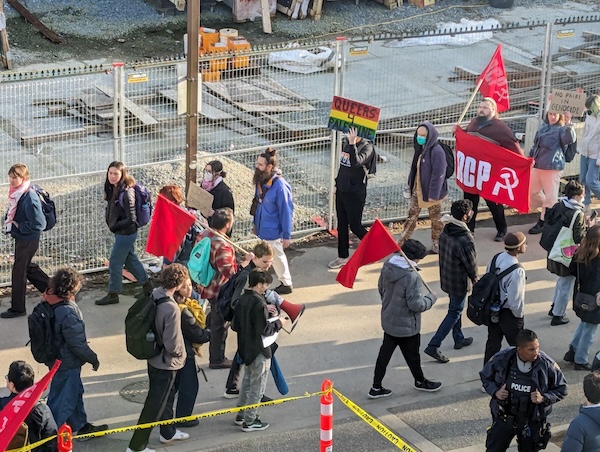
A couple of dozen loud and aggressive protesters accosted people arriving to an event at Hillel House at the University of British Columbia March 13. One masked woman raced up and screamed into the faces of those arriving. Another shoved her phone, presumably filming, into the faces of those trying to enter. Marchers, carrying communist banners and flags, screamed “You are on the wrong side of history!”

Inside, a packed audience listened to gay, Jewish, Scottish writer and activist Ben Freeman contextualize the state of world Jewry since Oct. 7. The author of Jewish Pride: Rebuilding a People and Reclaiming our Story: The Pursuit of Jewish Pride, in conversation with Vancouver media personality Shane Foxman, spoke while, throughout the entire presentation, the dull roar of protesters screaming provided background.

“We need to understand very, very clearly that we have done nothing to deserve that rabble outside,” Freeman said. “It is not our fault. This is their problem and not ours. Jew-hatred is a non-Jewish problem. We need our non-Jewish friends and allies to set up on the task of dismantling it. We have other work to do.”

Jews, of course, fight antisemitism, he said, but it is up to non-Jews to defeat it.

“This [protest] is not a commentary on Israel or Zionism,” he said. “This is an expression of Jew-hatred. We need to understand that.”

It is not only Jew-haters who try to separate diaspora Jews from Israel, said Freeman. Many Jews fall into the trap as well. The accusation of dual loyalty is a tool to dissuade Jews from expressing their natural connection to the land of Israel, he said.

“The canard of dual loyalty has led some Jews to say, ‘No, no, no, no, I’m not connected to Israel. I’m an American or I’m British or I’m Canadian’ or whatever the case may be,” Freeman said. “The reality is we are the diaspora. That word gives us a really incredible clue to the aspects of our identity. If we are in the diaspora, Israel is our home. You can be Canadian and Jewish, you don’t need to choose. That is what the non-Jewish world tries to make us do. They try to make us choose. Are you Canadian or are you Jewish? That’s the message that we get, you have to choose. But you don’t.”

He recounted a conversation with his dermatologist, a Briton of Pakistani descent, who said he was “going home” to Pakistan on vacation. 

“I said, oh, wonderful, were you born there? And he said, no, I was born here,” recalled Freeman. “And I thought, yes! You get it. And he’s allowed [to visit what he calls home], but somehow we are told we are not allowed.”

Freeman argued succinctly that it’s time Jews stopped fearing accusations of divided loyalties.

“I do have dual loyalty,” he said. “Suck it.”

In addition to refusing to succumb to false accusations, Freeman argued that Jews need to set boundaries on personal and professional relationships. 

“After Oct. 7, I spoke to Jewish friends who were in relationships with non-Jewish people and they said, oh, it’s hard, because my partner isn’t sure how they feel about Israel,” Freeman said. “My jaw kind of hit the floor. We have to have bottom lines. We have to have boundaries. There should be conversations we are willing to have and conversations we refuse to have. Each of us will make those ourselves but recognizing that Israel has a right to exist, Israel has a right to defend itself, that should be a bottom line. And I think I would encourage all Jews, whether it’s in romantic relationships, whether it’s in friendships, to be able to prioritize yourself, to be able to centre yourself and create those boundaries. We are not accepting half-assed empathy or friendship.” 

Probably all Jews have had difficult conversations with friends and others in recent months, he said, and Freeman urges a little more resistance.

“I say to my friends in those situations – it’s a little bit arsey, to be honest, but I am so done with being a nice Jew – I say to them, let’s be really clear before we have a conversation about Israel: I know more about this than you do, so don’t come for me. Have some respect. Not only is this my work, but I’m a Jew. That should be respected. And then, I care more about this. My friends are people in the world who might see a headline, they might see a tweet by those bozos outside, and they get enraged and inflamed. They can’t point out which river or which sea. We care deeply, we think about it.”

photo - As author Ben Freeman spoke at Hillel House at the University of British Columbia, the dull roar of protesters provided background
As author Ben Freeman spoke at Hillel House at the University of British Columbia, the dull roar of protesters provided background. (photo by Pat Johnson)

Ignorance should be challenged and invitations to learn extended, he said. “But there will be those who are malicious,” he added. “There will be those who think that we are bad, evil Zionists, we’re colonizers, we’re white oppressors and we are murdering the Indigenous people, we are committing genocide. There are people who believe those things and, if they do, those people are not interested in a conversation, so we block them…. They’re not worth our time. They’re not worth our energy. We’re not dealing with those people.” 

He admits, though, this can be easier said than done. All the hatred can get into one’s psyche.

“I’m the author of books about Jewish pride. I’m very proud to be Jewish. I love Israel,” said Freeman. “And there have been flickers of weakness in the past five months, when I have been weighed down by what is happening in the diaspora, what happened in Israel and what is said to me online and you do think, Are we the bad guys? What is happening? No. We are not. We have a right to be in that land. We have a right to defend ourselves. We need to make the world understand crystal clearly that you do not get to murder Jews and get away with it. Jewish blood is not cheap. We will defend ourselves and we have a country to do that. We lost our sovereignty.… We are not losing it again.”

Tight security ushered attendees out a back door and away from the still-chanting protesters circling the front of the building. 

Making meaning in diaspora

“We’re planning a family event in June.” That’s how I start nearly every contact with vendors while trying to arrange it. Sometimes, I say a “party with family and friends.” I avoid saying b’nai mitzvah. It’s just easier and safer.

One of my twins has a locker at junior high near a student who uses her body as a sign of protest. “Free Palestine” is written on her cheek. Other days, messages are emblazoned on a sweatshirt. My kid says she seems to stare at him, but I recommended he just stay away, don’t stare back, and don’t cause any kind of confrontation. “Do you know this person?” I ask him. “No,” he says, “she doesn’t know us.” What he meant is perhaps more obvious to us now – he doesn’t think she knows we are Jewish.

The transition from a bilingual Hebrew/English public elementary school to a junior high where Jewish kids are few and far between has been a big one. To my surprise, it went smoothly, but, over time, the ramifications have become clear. We knew our kids would figure out that we were, in fact, a small minority in Canadian culture. In elementary school, they would choose surprising moments to discuss Jewish things or use words in Hebrew with people at the dentist’s office or on public transportation. At first, our explanations about how people were different, with various religions and backgrounds were confusing. In their minds, they still believed everyone was Jewish.

On one hand, I loved that they didn’t have to learn to code-switch as early as I did. Code-switching is a way to describe how we switch between dialects, languages or personae in different settings. That is, a person might speak one language at home and another at work. In Jewish settings, one might use what linguists call “Jewish English,” English interspersed with Yiddish or Hebrew or other Jewish languages. At home, we might be encouraging someone to “daven at shul” with friends. We might shout “Dai, maspik!” (“Stop, enough!”) when someone misbehaves. In public, we might say “go to services” or “Behave yourself!”

Some people say that learning this kind of nuance takes maturity, but that doesn’t always ring true. I knew, by age 5 or 6 when my ethno-religious identity needed to be kept to myself. During times of extreme antisemitism, children were forced to keep this hidden, or even not told they were Jewish until old enough to manage the information. Giving my kids this extended time of safety felt like offering them a special oasis, a honeymoon that I missed.

Years ago, I worked with an editor and writer who shared with me that she had a Jewish background, although she was adamantly secular. I often felt the need to code-switch with her, as something made me feel like I was “too Jewish” for her comfort level. Since Oct.7, things have changed. She has become public in her Jewish identity, speaking out against antisemitism. Recently, she has been reading history and research for a book-length project. Today, she said, reflecting on an historic “golden age” for Jews in Polish history: “There is no safety in America now just because it’s been a golden age for my lifetime.” Yeah, I responded. I know.

Everyone copes differently. On social media and among friends, some dig into their Jewish identities. They’re consistently posting about their Jewish pride or activities and asking others to do so as well. One local friend who regularly attends synagogue told me that, if anything, this war has made her want to “do Jewish” even more, so she’s physically attending more services and gatherings than she had previously. Others decide to keep their kids home from school on days where there might be safety issues or have stopped attending anything at all connected with the Jewish community. They keep a low profile. Being loud and proud isn’t their way.

I have seen all these approaches (and many variations) from the Jewish people I know. And there are the minority Jewish viewpoints, too, on the political right and left. Those who claim more of an affinity with their progressive causes than with Jewish ones are often vocal on social media and at pro-Palestinian protests, either finding ways to disown their background or use their Judaism to explain their activism. Some particularly outspoken ones demonstrate, at least to me, that they don’t have a solid grounding in Jewish history and tradition, particularly as it relates to Israel, but instead embrace narratives around colonialism and apartheid instead.

Lately, I have been longing to ask where these “land back” Canadian Jewish activists live, if not in homes on occupied land taken from Indigenous communities. If homes here are on occupied ground, where do they believe it would be acceptable for Jews to live? I wonder how they mesh these theories with their everyday lives, or the archeological, historical and literary references to the Jewish past.

Living in grey areas of nuance is exhausting. There are so many references in Jewish texts to back this up. We have, after all, been struggling with these identity issues for millennia. We’re the ethnic group for whom the Greek word of “diaspora” was invented. Yet, this is one time where more evidence seems pointless. For those of us who feel this discord and disconnect, it’s not news. For others, who either manage to live wholly in the Jewish world or outside of it, these retellings of history aren’t useful. So many people have made their place, and it’s not in the margins of subtlety.

There’s no one response that suits. For me, I understand the value of having a rich interior and family life. The moment I’m absorbed in braiding challah and reciting the blessing blocks out some of this noise. Although I’m alone, it’s meaningful spending that small moment to send love and prayers for the hostages, the Jewish community and my family. I knit sweaters for ever-growing twins, anticipating their big birthday ahead this spring. I fall deep into intellectual arguments online, or into gazing at a pileated woodpecker whose rat-a-tat vibrates throughout the neighbourhood.

Finding one’s authentic self, the comfort zone where all the discord falls away, offers a brief respite. As we meet this complex moment in time, finding small outlets of escape can enable us to keep on going. Perhaps this is about good mental health or, as generations before us have explained, it’s nothing new. It’s about making a meaningful life in a diaspora, amid struggle. 

Joanne Seiff has written regularly for the Winnipeg Free Press and various Jewish publications. She is the author of three books, including From the Outside In: Jewish Post Columns 2015-2016, a collection of essays available for digital download or as a paperback from Amazon. Check her out on Instagram @yrnspinner or at joanneseiff.blogspot.com.

Hearing from Nova survivor

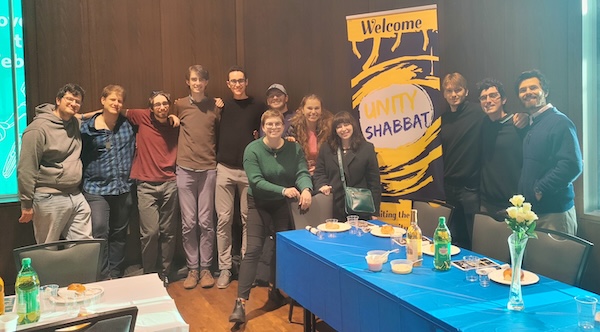
Volunteers and organizers of Unity Shabbat, which this year took place on March 1. (photo from Chabad UBC)

On March 1, more than 100 Jewish students and faculty came together for a Shabbat dinner on the University of British Columbia campus. The annual event, called Unity Shabbat, was organized by Chabad Jewish Student Centre-Vancouver in partnership with Hillel BC, Israel on Campus Club, Jewish Student Association, Jewish Law Student Association and the local chapter of the AEPi fraternity. It was co-sponsored by the Jewish Federation of Greater Vancouver.

The guest speaker was Shalev Biton, a 25-year-old man from Israel who survived the Nova festival terrorist attack on Oct. 7, 2023. You could hear a pin drop as Biton told the sequence of events, which included him running from the Hamas terrorists for hours and hiding in fields and then under a building while the terrorists searched the area. The building was on the property of an Israeli Arab who subsequently saved Biton’s life – and the lives of Biton’s friends – by telling the terrorists that there was no one there.

During those hours, Biton was sure he was about to die, and repeated the Shema Yisrael prayer over and over. He told of his gratefulness to be alive and his decision to follow his passion of pursuing a career in music. Those gathered on Shabbat were inspired by his message of hope and resilience despite everything that he has been through.

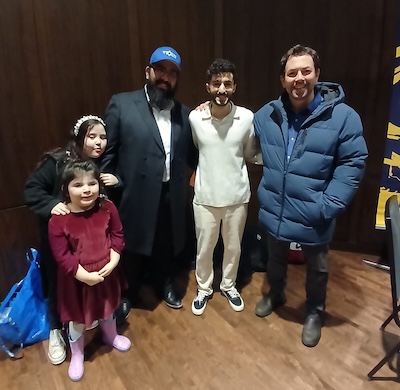
photo - Left to right: Chaya and Dassie Loeub; Rabbi Chalom Loeub of Chabad UBC; Shalev Biton, a survivor of the Oct. 7 terror attacks; and Ohad Gavrieli of Hillel BC
Left to right: Chaya and Dassie Loeub; Rabbi Chalom Loeub of Chabad UBC; Shalev Biton, a survivor of the Oct. 7 terror attacks; and Ohad Gavrieli of Hillel BC. (photo from Chabad UBC)

“These past few weeks have been a very difficult time for Jewish students at UBC,” said Rabbi Chalom Loeub, co-director of Chabad Jewish Student Centre. “Unity Shabbat could not have come at a better time. It was a chance for Jewish students and faculty members to get together in a safe, inclusive atmosphere and enjoy a traditional three-course dinner. It reminds us that, despite our external differences, we are one people and we need to stick together.”

To learn more about Chabad Jewish Student Centre-Vancouver visit chabadubc.com or follow them on social media. 

Courtesy Chabad Jewish Student Centre-Vancouver