Skip to content
  • Home
  • Subscribe / donate
  • Events calendar
  • News
    • Local
    • National
    • Israel
    • World
    • עניין בחדשות
      A roundup of news in Canada and further afield, in Hebrew.
  • Opinion
    • From the JI
    • Op-Ed
  • Arts & Culture
    • Performing Arts
    • Music
    • Books
    • Visual Arts
    • TV & Film
  • Life
    • Celebrating the Holidays
    • Travel
    • The Daily Snooze
      Cartoons by Jacob Samuel
    • Mystery Photo
      Help the JI and JMABC fill in the gaps in our archives.
  • Community Links
    • Organizations, Etc.
    • Other News Sources & Blogs
    • Business Directory
  • FAQ
  • JI Chai Celebration
  • JI@88! video

Recent Posts

  • Sharing her testimony
  • Fall fight takes leap forward
  • The balancing of rights
  • Multiple Tony n’ Tina roles
  • Stories of trauma, resilience
  • Celebrate our culture
  • A responsibility to help
  • What wellness means at JCC
  • Together in mourning
  • Downhill after Trump?
  • Birth control even easier now
  • Eco-Sisters mentorship
  • Unexpected discoveries
  • Study’s results hopeful
  • Bad behaviour affects us all
  • Thankful for the police
  • UBC needs a wake-up call
  • Recalling a shining star
  • Sleep well …
  • BGU fosters startup culture
  • Photography and glass
  • Is it the end of an era?
  • Taking life a step at a time
  • Nakba exhibit biased
  • Film festival starts next week
  • Musical with heart and soul
  • Rabbi marks 13 years
  • Keeper of VTT’s history
  • Gala fêtes Infeld’s 20th
  • Building JWest together
  • Challah Mom comes to Vancouver
  • What to do about media bias
  • Education offers hope
  • Remembrance – a moral act
  • What makes us human
  • המלחמות של נתניהו וטראמפ

Archives

Follow @JewishIndie
image - The CJN - Visit Us Banner - 300x600 - 101625

Tag: Israeli-Palestinian conflict

Poet chooses politics over love?

In times of protracted conflict, can matters of the heart exist apart from politics? An award-winning documentary from Israeli filmmaker Ibtisam Mara’ana Menuhin left me at once spellbound, uplifted, sad and restless, as I found myself wrestling with this question.

Write Down, I am an Arab depicts the life of Palestinian national poet Mahmoud Darwish. The politics is important – more on that below – but what makes the film especially gripping is the story of Darwish’s catapult to national and international fame against the backdrop of his private longings for a woman on the other side of the Palestinian-Jewish divide.

Darwish met Tamar Ben Ami in the early 1960s at a political rally – this one for the Communist party in Israel. Frequently separated geographically – he under military administration (as all Arab citizens were until 1966) in Haifa, she studying in Jerusalem – Darwish documented his feelings for her in a series of letters.

I spoke with Tamar – by phone, Facebook and email – over the course of a few days. A dancer and choreographer (the film chronicles her stint in the Israeli navy’s performing troupe), Tamar divides her time between Tel Aviv and Berlin. She describes her art – and really her entire personal life – as being shaped by her time with Darwish. Her love for him is palpable, still.

Caught up as I am as a political scientist and columnist in contemplating political arrangements – refugees, Jerusalem, borders, one-state, two-state, federation or separation – Tamar operates differently.

“It’s cliché, and maybe I sound naive, but I believe in unconditional love,” Tamar tells me when I ask her what kind of political future she envisions. She is disturbed by what she sees as the artificial divisions of nations, races, ethnicities and religions, including what she sees as a dangerous interpretation of Jewish chosenness. “On this, the occupation has been nurtured.”

And, while it’s hard to disagree, I find myself confounded. Is the Palestinian national struggle one over occupation? Is it about the West Bank settlements, the land appropriation, the checkpoints and night raids and administrative detention? Or is it about the stones and earth of Palestinian towns and villages within Israel itself to which many Palestinians long to return? And, if it is the latter, how can the two national dreams ever be squared?

In the film, we see video footage of Darwish meeting a resident of Kibbutz Yas’ur, which was founded on the ruins of Darwish’s childhood village, al-Birwa. “It’s a moment of sadness and hope,” Darwish says to the man. “The sadness is that I’m not allowed to go back to that place and you have the right to go back there. But if we have the ability to be friends and we are friends, then peace is still possible.”

On one hand, it’s a wholly human encounter. On the other hand, once we put the subject of Israeli towns, cities and kibbutzim within pre-1967 Israel on the table, we are talking about the core of Israel’s identity, one which Israelis – and most Jews worldwide – are loathe to give up. And, if I’m really honest with myself, as a (liberal) Zionist who shares the Jewish national dream of those kibbutzniks, then perhaps the pain is also mine.

Nowhere was the tension between resisting occupation and demanding more fundamental claims more evident than in Darwish’s highly controversial 1988 poem called “Passers Between the Passing Words.” There, Darwish wrote: “It is time for you to be gone. Live wherever you like, but do not live among us…. For we have work to do in our land. So leave our country, our land, our sea, our wheat, our salt, our wounds, everything; and leave.”

With the first intifada raging at the time, Tamar is certain that the poem is about the occupation, not about Israel itself. “What can the occupied do?” Tamar recalls Darwish saying. The irony is that Darwish didn’t even think it was a good poem, Tamar says. To be judged by that poem pained him, and more than anything he longed to be considered a universal poet, Tamar adds.

After the 1988 poem controversy, Tamar found herself in Paris, trying to reconnect with Darwish, who was now at the centre of Palestinian politics. While she was sitting with him, Darwish took a call from Yasser Arafat. They spoke in Arabic. She could not make out what they were saying. The next day, when she called him again, Darwish rebuffed her: “You are not my girlfriend.”

We can never know whether Darwish, who died in 2008, chose politics over matters of the heart, or whether this unkind ending was just like so many ruptures between once-lovers: prosaic and universal.

But Darwish and Tamar did have contact again. After Prime Minister Yitzhak Rabin’s assassination, Darwish reached out to her in compassion. And, in 2000, Education Minister Yossi Sarid attempted to introduce two Darwish poems to the Israeli (Jewish) national curriculum. Stormy Knesset debate ensued, and the government narrowly survived a no-confidence vote. Darwish called Tamar. “My poetry is so important that over it the government nearly fell?” he mused.

Though their romance had ended, they clearly shared a sense of absurdity in how the universal language of poetry can be thrust into the forefront of the ugly struggles over land, narratives, history and invisibility. It’s a story that continues to be told, even as Tamar will always think in terms of interpersonal love as much as in terms of borders and territory.

Mira Sucharov is an associate professor of political science at Carleton University. She blogs at Haaretz and the Jewish Daily Forward. A version of this article was originally published on haartez.com.


Posted on July 31, 2015July 28, 2015Author Mira SucharovCategories Op-EdTags Ibtisam Mara’ana Menuhin, Israel, Israeli-Palestinian conflict, Mahmoud Darwish, peace, poetry, politics, Tamar Ben Ami

Choosing the side of hope

When focusing on Israeli-Palestinian relations, as I do for a living, it’s nice to have a good news story to relay once in awhile. On June 22, the annual Victor J. Goldberg Prize for Peace in the Middle East (run by the New York-based Institute of International Education) was awarded to Yehuda Stolov and Salah Aladdin, two leaders of the Interfaith Encounter Association (IEA). To many outsiders, inter-ethnic encounter experiences seem a no-brainer when it comes to grassroots, peace-building efforts. But not everyone is so convinced, particularly the “anti-normalization” faction of the Palestine solidarity movement.

The Goldberg Prize recognizes “outstanding work being conducted jointly by two individuals, one Arab and one Israeli, working together to advance the cause of peace in the Middle East … [by] bringing people together and breaking down the barriers of hatred toward ‘the other.’” It comes with $10,000 US.

IEA brings together Israelis and West Bank Palestinians to engage with one another in an “interactive, interfaith encounter” context. The organization has run 1,900 programs over 13 years, with 4,000 individuals participating in 2014 alone. Stolov is executive director of IEA, and Aladdin has taken on various leadership roles in the organization, most recently as assistant director.

The so-called “anti-normalization” movement is amplified by elements of the Palestine solidarity movement who associate with BDS (boycott, divestment and sanctions). For example, the Palestinian Campaign for the Academic and Cultural Boycott of Israel guidelines urge that Israeli-Palestinian encounter-type initiatives be boycotted under the rubric of “anti-normalization.” The guidelines go on to suggest that “events, projects, publications, films or exhibitions that are designed to bring together Palestinians/Arabs and Israelis so they can present their respective narratives or perspectives, or to work toward reconciliation, ‘overcoming barriers,’ etc., without addressing the root causes of injustice and the requirements of justice” be boycotted.

The anti-normalization tendency may be understandable as a philosophical commitment, particularly if one believes – as those BDS activists do – that justice points to the amelioration of only one side’s lot. But even if one believes that the only justice to be served is that of the Palestinians, the anti-normalization tendency is a misguided way to hope to achieve it.

Psychologists have long shown the importance of the “contact hypothesis” for reducing intergroup prejudice. Recent studies have even shown that even “imagining a positive interaction” with an outgroup member can be just as powerful in reducing prejudice as face-to-face encounters can be. And the first step in getting Israelis to realize the power their country wields over Palestinian life and dignity is to render the Palestinian experience visible.

Stolov agrees. The only way to end the occupation, Stolov explained when I reached him by phone in Israel, is to increase the sense of human connection between Israelis and Palestinians. Aware of the anti-normalization pressures some participants may feel, participation in IEA is kept “under the radar,” press access is restricted and meeting spots are chosen so the events can appear as inconspicuous as possible.

As the lead Palestinian drafter of the 2003 Geneva initiative, which sought to lay out a two-state plan for Israeli-Palestinian peace, Ghaith al-Omari has every reason to be jaded. And having advised the Palestinian negotiating team from 1999 to 2001, al-Omari knows firsthand how little has emerged from the halting peace process. Still, he has recently declared his opposition to the anti-normalization movement in a moving essay in Fikra Forum, reprinted on the Third Narrative website (thirdnarrative.org/israel-palestine-articles/ills-of-anti-normalization), where I serve as co-director of its scholars for Israel and Palestine affiliate group. People like al-Omari and the founders of IEA and even the Goldberg peace prize visionaries realize the possibilities inherent in hope rather than cynicism. And if you have to choose among them – as it seems you do these days – I’d rather be on the side of hope.

Mira Sucharov is an associate professor of political science at Carleton University. She blogs at Haaretz and the Jewish Daily Forward. This article was originally published in the Canadian Jewish News.

Posted on July 3, 2015July 3, 2015Author Mira SucharovCategories Op-EdTags anti-normalization, BDS, Ghaith al-Omari, Goldberg Prize, Israeli-Palestinian conflict, peace, Salah Aladdin, Yehuda Stolov1 Comment on Choosing the side of hope

Envisioning a peaceful future

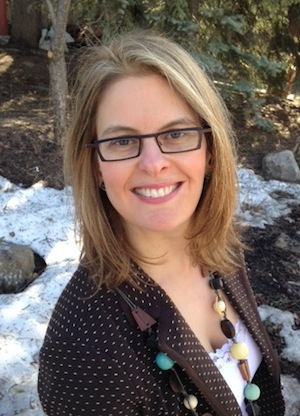
photo - Mira Sucharov spoke on March 2 as part of the University of Winnipeg’s Middle East Week
Mira Sucharov spoke on March 2 as part of the University of Winnipeg’s Middle East Week. (photo from Mira Sucharov)

As part of Middle East Week at the University of Winnipeg, Mira Sucharov, associate professor of political science at Carleton University in Ottawa, spoke on the topic of Power and Identity Across the Israeli-Palestinian Divide.

About 60 people came out March 2 to the university’s Convocation Hall to hear Sucharov, who is currently the country analyst for Israel and the Palestinian territories for Freedom House, as well as a blogger and writer whose work appears regularly in several publications around the world, including the Jewish Independent.

Sucharov sees relations between Palestinians and Israelis as more polarized now than at any other time since the peace process that began two decades ago. She said she was pleased to be part of U of W’s Middle East Week, as it promotes dialogue, in contrast to the situation on many North American campuses, where hardened opposing camps are choosing shouting over listening.

Describing herself as a liberal Zionist, Sucharov explained the term as referring to someone who “believes that there is legitimacy to Israel’s existence, and that nations deserve a state.” However, “liberal Zionists not only acknowledge the existence of Israel and support its existence, they are deeply troubled by its occupation.”

Sucharov said that, while some Israelis and Israel supporters prefer the term “disputed land” to the term “occupation,” Sucharov views “occupation” as “an important word.” She explained, “We’re not just talking about a geographic swap of land. We’re talking about a population of Palestinians who are not citizens of any country.

“The IDF, on a macro level and often on a micro level, is in charge of the area and the daily lives of Palestinians who have to pass through checkpoints to get to work, to farm their land…. We know about the Israeli security barrier or separation wall that has served to disrupt daily lives in many ways in the West Bank.

“So, liberal Zionists are troubled by this idea of occupation and seek to do what they can to end it. As a Canadian from Winnipeg, I feel that by engaging in constructive discussion, constantly being educated, I can help people at a global level think more deeply, critically, and in a more engaged way about issues of global concern.”

Sucharov said that there are financial incentives, as well as ideological motivations, for living in the West Bank. “There are many who’ve moved to the West Bank because it’s cheaper,” she noted. “Part of it, no doubt, was wanting to return to biblical Israel, a sense of having a greater Israel, of being/having religious/national identity fulfilled. There’s another important motivating factor, and that was the idea of Israel having a wider girth, more strategic depth.”

In Sucharov’s view, “the occupation” should not be permanent, and dialogue is needed to get governments together for peace talks. “The only way to end the occupation is if Israelis and Palestinians come together to discuss and negotiate an agreement,” she said.

As for what such an agreement may look like, Sucharov imagines “a city with two capitals: Jerusalem, a holy place for all religions to pray at their own places of worship. Refugees will probably be returned, free return to a Palestinian state. There will probably be some compensation package, [on a] humanitarian basis for some refugees … based on historical agreements.”

If the Geneva initiative does take place, said Sucharov, “Can Israel feel safe with such an agreement?

“It used to be called, ‘give an inch, they’ll take a mile,’” she continued. “Now, there is a concern about the fact that Palestinians in a recent poll have indicated that they would want to use a two-state agreement as the beginnings of full takeover.

“Palestinians, no doubt, would want all of Israel … many of them … and Israelis, no doubt, would want all of Palestine … many of them. The question is, even if some Palestinians were desirous of acquiring or launching terrorist missions with or without the consent of its governing authority, could Israel defend itself?”

If/when Israelis and Palestinians reach an agreement, she said, they would have to make sure that there were “security guarantees from the United States … [that] the U.S. will guarantee the security of Israel.

“Palestine would have to agree to be a de-militarized state. So, both sides will not have to necessarily trust each other … [they] would have to understand that there is a security guarantee in the form of a major global superpower.

“That’s the two-state solution. But, there certainly are those in the military establishment of any state who could stand to gain from an ongoing conflict…. We have to … make peace seem more attractive.”

As things stand, Sucharov said, “Palestinians and Israelis are almost mutually fearful of one another.… I think the biggest obstacle is the culture of mutual fear.”

And then there is the question of whether or not Iran, if there is the possibility of peace between Israelis and Palestinians, will “behave in a suicidal fashion,” said Sucharov. “That’s what, in international relations, [they] call the … idea of nuclear deterrence – the idea that more nukes make the world safer. I’d prefer less nukes, less proliferation, but there is a logic to the idea of stability of nuclear weapons.

“Once peace is achieved by the government, ideally, the next generation grows up in a culture in which the status quo exists.

“Regional threats would be diffused to make peace,” she continued. However, “the Israeli-Palestinian conflict is not the only conflict in the region and we’re not going to see peace on earth, but Iran and other enemies of Israel … Hamas … would have less wind in their sails. The status quo would be peace, so there would hopefully be less local support for their belligerent postures.”

Rebeca Kuropatwa is a Winnipeg freelance writer.

Posted on April 17, 2015April 16, 2015Author Rebeca KuropatwaCategories NationalTags Israeli-Palestinian conflict, Israelis, Mira Sucharov, Palestinians, peace, two-state solution

Biggest improbability?

In September of 1978, U.S. president Jimmy Carter was at his wit’s end after 12 days of face-to-face negotiations between himself, Egyptian president Anwar Sadat and Israeli prime minister Menachem Begin.

Neither party was at all inclined to make peace, both had legitimate grievances with the other nation, advisors were telling them peace was not possible and that the leader and the nation each man represented could not be trusted. Things got so heated that all three parties had packed their bags and prepared statements that the talks had failed. Cars were idling in the Camp David driveway and Marine One, the presidential helicopter, was being readied to return Carter to Washington empty-handed.

Failure then, in the midst of the Cold War, would have meant an opening for the further arming of Egypt by the USSR and the nuclearization of the Middle East, where ultimately the fanatical forces that were then lurking in the shadows could very well force the Superpowers into a feared nuclear standoff. This was much like what was happening in East and West Germany at the time, only in the hot desert sands of the Middle East, it was far more likely that tempers would boil over.

These were the stakes at Camp David. The proposition was that Israel give back the Sinai Desert, land it had captured in the Six Day War, land that served as their saving buffer zone in the Yom Kippur War just five years earlier. Land that contained settlements of Israeli citizens that Begin had pledged on his life never to abandon. To do all of that in exchange for a piece of paper that promised peace, signed by three men who did not trust each other.

No one thought it probable or possible, not between these three men, Begin and Sadat, who had spent a lifetime fighting each other, and Carter, who lacked power at home and credibility abroad.

And, yet, they signed a lasting peace treaty. Israel had been at war with Egypt in one form or another for literally millennia, since the days of Pharaoh. They have not been at war since and, next to Jordan, Egypt is Israel’s closest ally in the region today.

Mark Twain said, “History doesn’t repeat itself but it often rhymes.” No two eras or events are the same, but many if not all have similarities.

Three years before Camp David, president Gerald Ford had announced that the United States would be reevaluating its relationship with Israel because of Israel’s power play, along with France, in the Suez Canal. A crisis, if you recall, that nearly, like the Cuban Missile Crisis, was only a series of missteps away from another nuclear confrontation between the United States and the USSR.

You could not have had Camp David if you had not also had the sobering realization of the Suez Canal Crisis. Carter could not have pressured Begin to do the good and hard thing for the future of Israel if Ford had not created enough daylight between the United States and Israel for Begin to see the light at the end of the endless wars with Egypt tunnel.

“History doesn’t repeat itself but it often rhymes.” I am neither a politician, nor a political scientist – though in truth I have a degree in the latter and every rabbi must ultimately learn the skills of the former. I am a student and teacher of history, the history of our people both in the land and yearning for the Land of Israel – and in all that has happened in these past many years, really since the assassination of Yitzhak Rabin (alav ha’shalom), I hear the rhyme of history.

Call it “darkest before the dawn,” but while I am filled with worry, the seriousness of the matter gives me hope that it can no longer be ignored or put off. That the pressure of absolutes that made Camp David possible has returned to make peace between the Israelis and Palestinians possible, though still improbable once again.

The region and its people are under near-bursting pressure. But pressure such as faces Israel also clarifies priorities. The greatest achievements of diplomacy have often come in the face of the most extreme pressure or, as Carl von Clausewitz wrote, “War is diplomacy by other means.”

Let’s examine the pressures in play.

In Israel, the status quo between Israelis and Palestinians is set to devolve into a third intifada. Meanwhile, there is a seismic schism between the Jews in Tel Aviv who voted overwhelmingly for the left and the Jews in Jerusalem who voted overwhelmingly for the right. Israelis on left and right are living two different realities, and they want two different futures for themselves and for the Palestinians.

In the Arab world, the forces of fundamentalism have shaken what little remains of the nation-states from their complacency with and tolerance for radicalization. Arab armies are mobilized against radicalism and terror. Yes, there is a vacuum of leadership throughout the Arab world, including among the Palestinians – but that also creates space for a leader to emerge.

Outside of the Middle East there is a fundamental disagreement between Western democracies that want Israel to act more like them, and Israel that wants the West to see that the terrorist threat confronting its democracy today is coming to their shores tomorrow. And for much of Europe tomorrow is today.

Jews are under attack around the globe. Antisemitism has come out of hiding once again. Much of antisemitism is ignorance and, yet, where do we find it? Most shockingly in our institutions of higher learning, where, in the most distorted and twisted forms, they equate Jews with Nazis. We see this happening particularly in the BDS campaigns that are sweeping across North American university campuses and right here at the University of British Columbia. These same antisemites defend terrorists as “heroes,” inviting them as speakers on campus. The Talmud says, “olam hafouch,” the world is upside down. Indeed, bigotry masquerades as fairness.

The pressure is not only external; it is internal, as well. The relationship between Jews in the Diaspora and Jews in Israel is becoming a dysfunctional marriage. It’s not headed for divorce but maybe separate bedrooms, as each tries to focus on things they love about the other, even when they are disappointed in the other.

It seems hopeless, I know, this election result whether you are left or right – the winner of the election was “hopelessness” itself. As Binyamin Netanyahu declared, in his view, there will never be a Palestinian state while he is prime minister. Those who voted for him believe that to be true and those who voted against him believe that to be true. That is the very definition of being without hope.

There is no solution to this conflict in this neighborhood, in this region, in this time. And, with no Palestinian leader who can do the same, it’s just not possible.

And, yet, we said the same before Camp David. We never thought Rabin would shake Arafat’s hand or make peace with Jordan. That Sharon, who built the settlements in Gaza would dismantle them, and that it didn’t lead to civil war.

Begin, Rabin, Sharon. These were not peace seekers, these were warriors, evolved Hawks.

We are not ready for another Camp David today; Netanyahu is not anywhere near ready, and there is no leader on the other side who can be a Sadat or a King Hussein of Jordan, a warrior who has the credibility to make peace.

By the same token, the only one in Israel right now who has the credibility to make peace with the Palestinians is Netanyahu. If he signs off on it, the people will believe it.

We are in a dark period and it may get darker. The pressure on Israel will only increase. The choices the country will have to make are impossible to understand right now. Our own solidarity both with Israel and with each other as fellow Jews will be tested, and there will be cracks. But that is nothing new for us, or for Israel. We don’t always agree, as Jews here or there, past or present, we seldom agree. In the end, however, what we have always done is survive. There’s the biggest improbability of all: that we are still here.

Israel is 67 years old. By comparison, it took the United States 150 years to reconcile slavery, a process that included a civil war, incomprehensible social disorder and civil unrest. And the United States, which is almost 200 years older than Israel, is still not yet resolved on the issue of race, as Ferguson – among many other events – reminds us.

Canada could say some of the same about true reconciliation with First Nations. We are not yet there.

This election was part of the growing pains of a nation and, in the age of nations, Israel is barely a teenager. Israel is the bat mitzvah girl who stands proudly, if not ironically, before the congregation and declares, “Today, I am a woman!” And we all smile and say to ourselves, “Not yet, but today you gave us a glimpse of the woman you will one day be. It would be more accurate to proclaim, “Today, I will no longer act like a child.”

“The arc of history is long,” Martin Luther King Jr. preached, “but it bends toward justice.” That’s the history of the world and it’s the story of our people, a story we are telling again around our seder tables this week.

What do you take away from the seder? That Pharaoh was cruel? That slavery was terrible? Yes, but also that we were redeemed; that the pressure on Pharaoh ultimately helped him see the light.

“La’yehudim hayta orah” we sang just recently on Purim and every week, as we end Shabbat with Havdalah. “The Jews enjoyed light and gladness, honor and joy. May we, too, experience these same blessings.” In another dark time, when all hope appeared lost, there was light. Let there be light once again!

Dan Moskovitz is senior rabbi of Temple Sholom in Vancouver.

Posted on April 3, 2015April 1, 2015Author Rabbi Dan MoskovitzCategories Op-EdTags Anwar Sadat, Binyamin Netanyahu, Camp David Accords, Israel, Israeli-Palestinian conflict, Jimmy Carter, Menachem Begin, Middle East, peace
Halper talks across Canada

Halper talks across Canada

Dr. Jeff Halper speaks at the University of Manitoba on Feb. 9. (photo by Rebeca Kuropatwa)

Dr. Jeff Halper, an Israeli anthropologist and Nobel Peace Prize nominee, spoke on four different occasions in Winnipeg over two days, Feb. 8 and 9, as part of a cross-Canada speaking tour, which also brought him to Vancouver Feb. 10-12. He is the head of the Israeli Committee Against House Demolitions (ICAHD), an organization self-described as “dedicated to ending the Israeli occupation and [that] advocates for a just peace between Israel and the Palestinian people.”

The first of Halper’s Winnipeg talks was An Israeli in Palestine, and it was held at Crescent Fort Rouge United Church. He then spoke at the University of Manitoba on Academic Freedom and the Israeli-Palestinian Conflict, reprised An Israeli in Palestine at the University of Winnipeg and, finally, did an interview with Jewish Post & News editor Bernie Bellan at the Free Press News Café (which can be found at icahd.org/node/568).

The U of M lecture on Feb. 9 was sponsored by the department of history, the Centre for Professional and Applied Ethics, and the Global Political Economy program. Halper began this talk by saying that “the side” most people are aware of is the one that “only demolishes houses of terrorists and that is trying really hard to make a fair peace with the Palestinians.” But, he said, people are not very aware of the side that is “building settlements in the West Bank and refusing to issue building permits to Palestinians in the West Bank.”

According to Halper, Israel has been working for years to physically eliminate the proposition of a two-state solution by creating in the West Bank a Palestinian territory that is so fragmented with Israeli settlements that such an option is no longer viable. “A solution that the Israeli peace camp, including myself, supported for many years … the solution accepted by the international community … U.S., Canada, the UN, the Palestinians and every Arab country, is gone,” he said.

Halper believes that the two-state solution is “tremendously pro-Israeli.” He said, “If Israel in fact wants peace and security, it could have had that 27 years ago. And, it could have kept 78 percent of the country. This two-state solution was adopted unanimously by the Arab League. Every Arab country said that if Israel relinquishes the occupation, we will not only make peace with Israel, we’ll integrate Israel into the region. There was even talk of Israel joining the Arab League.”

In Halper’s view, “Israel has always said no and never seriously considered a two-state solution…. In 1993, there were 200,000 settlers. By the year 2000, after seven years of negotiation, there were 400,000 settlers. Today, there are 600,000 settlers. In four years from now, there will be a million Israelis living in the occupied territory.

“What Israel has done to ensure its permanent control, to ensure that the Palestinians are imprisoned in areas, is not a bi-national state … heaven forbid, because it has to be a Jewish state…. There’s no chance Israel will be forced out of the occupied territory. Israel has laid over the West Bank what I call ‘a matrix of control.’”

Halper argued, “There is no more West Bank: it’s gone. There are today more Israelis living in east Jerusalem than there are Palestinians. And whether it’s east Jerusalem or the West Bank, Palestinian territory is completely fragmented.

“Also, out of the 600 checkpoints in the West Bank, only 17 are actually between the West Bank and Israel. All the others are inside the West Bank, preventing Palestinian movement, confining them to these islands.

“How will a Palestinian state emerge from this?” he asked. “The whole idea of the two-state solution was based on a north/south axis, here’s Israel and, alongside, it’s a Palestinian state.”

Halper sees Israel as “working to force Palestinians out of homes located in the ‘wrong’ place, largely through house demolition. None of those homes had anything to do with security.”

As an example, Halper used the house of ICAHD member Salim Shawamreh. To date, said Halper, that home has been demolished and rebuilt by the ICAHD six times. “They bought a small plot of land in the town of Anata, which is right next to Jerusalem,” said Halper. “The land is registered. When they went to apply for a building permit, the answer was ‘no.’ Israel has zoned the entire West Bank as agricultural land so, when a Palestinian comes to build a home on land he owns, the answer is ‘Sorry, but this is agricultural land.’ It applies to Jews and Arabs.”

Beside Anata is the Israeli town of Ma’ale Adumim, which, Halper said, is built on the same agricultural land with a permit. “You have 50,000 Israelis living in government-built cities on the same land,” said Halper. “If you want to rezone from agricultural to residential, it takes a second.”

Many families build without a permit, said Halper, and Shawamreh “decided to build his house without a permit and the Israeli authority sent a demolition order with a dozen solders. They aren’t coming to arrest him. They’re coming to demolish his home…. Salim resisted and was taken out by force. His wife, Arabiya, managed to lock the door and stayed inside with the children. So, the soldiers broke the windows and threw in tear gas to flush the family out. Arabiya was taken out unconscious, the kids running and screaming in every direction. We get into the act if we can. She managed to call us … [and] we resist the demolition of homes.

“We rebuild homes as political acts of resistance,” he continued. “We’ve rebuilt 587 homes over the last 14 years or so … 587 joint acts of resistance. We refuse to be enemies. That’s one of our slogans.”

Halper’s tour, organized by United Network for Justice and Peace in Palestine/Israel and Independent Jewish Voices-Canada, as well as various local groups, fundraised for ICAHD’s building of a house for a Palestinian family whose home was demolished. Admission to events was free, though donations were welcomed.

Rebeca Kuropatwa is a Winnipeg freelance writer.

Format ImagePosted on February 27, 2015February 26, 2015Author Rebeca KuropatwaCategories NationalTags ICAHD, Israel, Israeli-Palestinian conflict, Jeff Halper, Palestinians, Salim Shawamreh
Friendships via music

Friendships via music

The YMCA Jerusalem Youth Chorus prior to their 10-day tour of Japan in August 2014. (photo from Micah Hendler)

There are many creative ways to bring about a peaceful dialogue between Israelis and Palestinians. In one particular case, an American Jew by the name of Micah Hendler combined choral singing and dialogue to help bring Palestinian and Israeli teens to a place of trust in Jerusalem.

Hendler, originally from Bethesda, Md., has been singing for as long as he can remember.

“For me, singing is a very powerful way of connecting to other people and creating communities, a sense of common identities, all the things that make people feel close to one another,” he said.

photo - YMCA Jerusalem Youth Chorus founder and conductor Micah Hendler
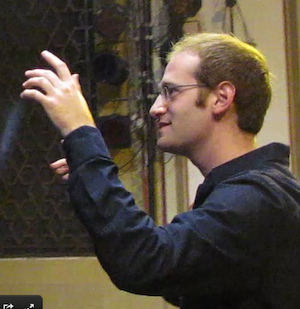
YMCA Jerusalem Youth Chorus founder and conductor Micah Hendler. (photo from Micah Hendler)

In his high school years, Hendler participated in Seeds of Peace, a program for teens from conflict regions around the world. For the first time, he had the opportunity to hear the stories of both Palestinians and Israelis.

“It made me realize the power of talking to others who are different, the power of showing people there are other ways to see things, more complete ways to see things,” he said of Seeds of Peace. “That’s what really got me interested in the Israeli-Palestinian conflict. In many ways, this was in contrast to the education I’d received.”

Over the years that followed, as Hendler continued his involvement with Seeds of Peace, he thought about ways in which he could create a new community, and decided on a singing group.

“I thought that would be really cool,” said Hendler, now in his 30s. “I could empower people and show them that they could sing and be part of something like this. For me, I thought … this is a way I can do things I really love to do in the context of needing ways for people to come together.”

When Hendler was ready to kick things off, he had just graduated from Yale. “I thought, if I’m ever going to do this, now’s the time.”

With degrees in music and international studies, and a host of other experience, both in music and in conflict transformation, Hendler moved to Jerusalem. He spent the first couple of months having coffee with anyone and everyone. He also spent a lot of time at high schools, sharing information about the choir, the YMCA Jerusalem Youth Chorus. Eighty youth auditioned, with the majority coming from East Jerusalem.

“There were so few extracurricular options in East Jerusalem at all, let alone singing options,” said Hendler. “For kids that liked to sing, I was one of the very few possibilities around.”

Hendler accepted 30 kids (ages 14-18), an even split of Israelis and Palestinians.

A friend connected Hendler with Israeli singer/songwriter David Broza, who was working on the album East Jerusalem/West Jerusalem at the time. Broza invited the chorus to be part of it. “It’s pretty amazing – that was three months into the choir, and we were recording with David Broza in the studio,” said Hendler.

The YMCA Jerusalem Youth Chorus program begins and ends with singing, with dialogue embedded in the middle. It does not take long for the kids to mingle. “They were in a completely unstructured context, already hanging out across linguistic and national lines,” said Hendler. “A lot of girls were singing pop songs on the piano and the guys were doing their thing, and different people were talking.”

The cost for the program is covered by the Jerusalem Foundation and private donors in and outside of Israel; the kids pay a symbolic fee to attend, as long as they are able.

Hendler’s main focus now is on ensuring that the kids feel part of a group, which is a moving target as the chorus grows. Currently, there are 44 kids divided into three dialogue groups, but Hendler is looking at other options. “There’s a limit of how big the choir could be in terms of what is manageable,” he said. “But, it would be possible to have multiple ensembles at different levels.”

When selecting kids for the chorus, Hendler looked for kids who wanted to meet new people and experience new things. As well, potential members needed both to be able to express any opinions they may have, as well as listen to those of others. “We also, of course, wanted people suited for singing,” he added.

Rehearsals are 3.5 hours and take place once a week. From as early as the second rehearsal, he said, “it was amazing that the kids were so open to one another. Obviously, with the linguistic and social challenges, the group had gone through a lot, but fundamentally there’s this openness and a joy that’s pretty inspiring.”

The dialogue is run by professional facilitators, “but I still have a good sense of what goes on,” said Hendler. “And, it’s actually really beyond inspiring, the way they listen to each other and create a space. The kids are real with each other, sharing their fears and hopes … but what’s really been amazing is that even outside the choir, the kids have started to speak up in their communities.”

Israeli high schooler Avital said of the program, “You get to know the other side, you get to be together, to see what it’s like being with kids different than you.” Shifra, another Israeli participant, said, “[Before] I only knew Israelis, I had never met any Arabs before I came here. I didn’t know what I was going to see … I wasn’t sure what I expected, but what I realized was that we’re all the same.”

Palestinian high schooler Alaa commented, “I learned from the sessions how not to stay silent, to express myself.” And Ameer, another Palestinian participant, said, “The choir is beautiful and we enjoy it, because we are Arabs and Jews, together at the same time.”

Rebeca Kuropatwa is a Winnipeg freelance writer.


Format ImagePosted on January 30, 2015January 29, 2015Author Rebeca KuropatwaCategories IsraelTags David Broza, dialogue, Israeli-Palestinian conflict, Micah Hendler, music, YMCA Jerusalem Youth Chorus

Why is media Israel obsessed?

More senseless violence has hit Jerusalem in recent months, with the brutal murder of four worshippers at a synagogue in the Har Nof neighborhood late last year and multiple stabbings and car attacks. Some folks, while on the one hand wanting to ensure the world learns of these heinous acts, will, on the other hand, continue to ask why the media is so obsessed with Israel.

I was reminded of this question not too long ago via a short CNN video clip with journalist Matti Friedman in which he discusses an article he wrote for Tablet last summer that’s taken on a new life online. To make his case that the media is unfairly biased against Israel, Friedman cites the 2013 death toll in Jerusalem compared to Portland (more deaths in Portland), and the century-long Arab-Israeli conflict toll compared to the ongoing carnage in Syria (more lives lost in Syria). He adds that, in the overall reporting on the Israeli-Palestinian saga, Israel is unfairly portrayed as the aggressor while the Palestinians are cast as victims rather than as agents of their own fate.

The question of presumed agency is a key one in the conflict: how the conflict actors themselves see it, and how others can serve to reinforce these roles. It’s a fair point.

However, to truly understand why individuals, media markets, foreign policy actors and international organizations devote so much time and energy to the Israeli-Palestinian nexus, we’d need some in-depth research to really understand their motivations. For now, here are several plausible reasons that seek to raise the discussion beyond the reductionist assumption that there is a “media bias against Israel” and the related, if unspoken, accusation that the world simply hates the Jewish state.

Perhaps most importantly, American taxpayers provide a significant annual sum of money to Israel, via the $3 billion in annual U.S. aid granted to Israel. It’s natural that the government and the voters in that country at least would disproportionately concern themselves with the region.

Second, the Israel-Palestine core is the heartland of the three main monotheistic religions. The role of religious symbolism in Western art, literature, film and culture in general is significant. The region, in short, has long captured the imagination of many.

Third, Israel – unlike Syria – is a democracy. Citizens of democracies tend to hold other democracies to democratic standards. That means that violence committed in the name of democratic values – for better or worse – sometimes gets more airtime.

Fourth, as others have written before, Israel is seen by many as a colonial transplant. There are very good arguments against a simplistic understanding of Israel as a colonial project. (There is no core state to which settlers send extracted resources, for example.) But there is no getting around the fact that Israel’s birth was precipitated in part by Europe’s carving up of the region into mandate territories after the First World War. The shred of the colonial shadow succeeds in galvanizing a certain political consciousness that other conflicts, especially civil ones within non-democracies, simply don’t, unfortunately perhaps.

Fifth, once Israel came into existence, it was seen by many as a plucky state surviving against all odds. It’s a narrative that Israel and the engines of Diaspora Jewry have themselves succeeded in promoting. That the world continues its fascination with Arab-Israeli geopolitics, played out now partly through the Palestinians, is, therefore, not surprising.

Sixth, Jews tend to punch above their collective weight in many aspects of popular culture: entertainment, the arts, literature and so on. That the Jewish state and its goings-on figure so prominently in the media can be seen as a benign extension of this. Add to this the fact that some of the players in the contemporary Israeli-Palestinian saga also hold American citizenship (three of the victims of the Har Nof synagogue attack held dual Israeli-U.S. citizenship, while the fourth was British Israeli) and the effect is magnified.

Finally, as for Friedman’s comparison between the disproportionate attention given to death and destruction in Israel compared to, say, in Portland, one could say that political violence naturally garners more international concern – again, sadly for those who are ignored – than death caused by typical urban ills such as poverty, petty crime, drugs or traffic accidents.

In sum, I’ve suggested seven plausible reasons why the world might be “obsessed” with Israel, none of them having to do with base hatred of the country or of Jews. Of course, there’s nothing saying that any of these possible reasons obviate the need to look antisemitism in the eye wherever it genuinely appears, or to spend more time analyzing the Palestinian part of the equation. But let’s at least consider the array of possibilities out there before we assume that the world is against us.

Mira Sucharov is an associate professor of political science at Carleton University. She blogs at Haaretz and the Jewish Daily Forward. A version of this article was originally published on haartez.com.


Posted on January 30, 2015January 29, 2015Author Mira SucharovCategories Op-EdTags antisemitism, Israel, Israeli-Palestinian conflict, Palestine
Israel launches campaign to discredit inquiry

Israel launches campaign to discredit inquiry

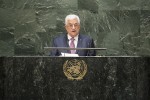
Palestinian Authority President Mahmoud Abbas at the United Nations General Assembly in September 2014. (photo from UN photo/Amanda Voisard)

The Israeli government has launched a public diplomacy campaign to discredit the legitimacy of the International Criminal Court’s recent decision to start an inquiry into what the Palestinians call Israeli “war crimes” in the disputed territories.

According to ICC prosecutor Fatou Bensouda, the inquiry – which was initiated after a request by the Palestinian Authority – is not a formal investigation, but rather “a process of examining the information available in order to reach a fully informed determination on whether there is a reasonable basis to proceed with an investigation pursuant to the criteria established by the [ICC’s] Rome Statute.”

Palestinian Authority President Mahmoud Abbas recently signed the Rome Statute in order to join the ICC after failing to get a UN Security Council resolution passed that called for Israel’s withdrawal from the disputed territories by 2017.

Israel’s campaign against the ICC inquiry will focus on the fact that the because the charges were filed by the PA, which is not a state, the court has no authority to act. In addition, the campaign will point out the court’s bias against Israel – a country on the frontline of the war against terrorism that makes sure to abide by international law by way of an independent legal system.

The Israeli government decided to launch the public diplomacy campaign at an emergency meeting in response to the ICC decision that was convened by Prime Minister Binyamin Netanyahu. The meeting, which took place at Netanyahu’s office, was attended by Israeli security, legal and diplomatic officials.

The ICC’s decision to launch the inquiry into Israeli actions is “the height of hypocrisy and the opposite of justice,” Netanyahu said on Sunday at the start of this week’s cabinet meeting, two days after the court announced the inquiry.

“During my years of public service, both as UN ambassador and as prime minister, I encountered these kinds of events, but this decision by the [ICC] prosecutor is in a league of its own,” Netanyahu said. “It gives international legitimacy to international terrorism.”

The prime minister said Israel would fight the ICC’s decision with every means it has available, including the enlistment of its allies. Along those lines, Israel is lobbying member states of the ICC to cut funding for the tribunal, Israeli Foreign Minister Avigdor Lieberman said on Sunday. Israel, which like the United States does not belong to the ICC, hopes to dent funding for the court that is drawn from its 122 member states in accordance with the size of member states’ economies, said Lieberman.

“We will demand of our friends in Canada, in Australia and in Germany simply to stop funding it,” Lieberman told Israel Radio.

Read more at jns.org.

Format ImagePosted on January 23, 2015January 23, 2015Author Shlomo Cesana ISRAEL HAYOM/JNS.ORGCategories IsraelTags Binyamin Netanyahu, Fatou Bensouda, ICC, International Criminal Court, Israel, Israeli-Palestinian conflict, Mahmoud Abbas, Palestine

The word “Palestine”

Does Palestine exist? A blogger on the often-provocative website JewsNews doesn’t think so. A package of dates marked “Palestine” must be “magic,” he says, since there’s no such country. And this echoes Moshe Arens’ trotting out of the old canard that Palestine doesn’t exist, but Jordan – the real Palestinian state – already does.

There are at least two issues at stake for Israelis: legitimacy and security. Yet a closer look reveals that neither concern is quite what it seems.

Part of the reason that many Jews have been allergic to the word Palestine is that it has long been used to negate the legitimacy of Israel. In this view, the land between the Mediterranean Sea and the Jordan River (or west of that, to the Green Line, depending on one’s view) is like a blue and white transparent film revealing a red, white and green film, containing a different narrative beneath. Since time is linear and space is finite, there seems to be room for only one people and one narrative on that tiny slice of Middle East territory. One cannot reverse the flow of the sands of time. Israel exists, so Palestine, the logic goes, cannot.

But, surprise! Those who would wish to roll back history and replace Israel with Palestine, as the Palestinian national movement claimed to want to do for decades, have now indicated – at least via their official leaders – that they will be satisfied with a mere 22 percent of the land they originally claimed as theirs. A state of Palestine, in other words, need no longer negate the symbolic right of Israel to exist.

Complicating all of this, though, is the one little word one often hears from Israeli officials, and which every state and all people deserve: security. For example, Bibi Netanyahu, in a video posted Dec. 27 to the Prime Minister of Israel’s Facebook page, contained an address to an enthusiastically nodding U.S. Senator Lindsey Graham.

In the span of a few seconds, Bibi managed to call out Palestinian negotiator Saeb Erekat’s rhetorical hyperbole (Erekat’s comparison of ISIS’s Islamic state desires with Bibi’s Jewish state utterances), while associating the Palestinian negotiator’s “incitement” with the throwing of a firebomb on an Israeli girl in the West Bank. The kicker: the folly of the Palestinians seeking to bring to the United Nations Security Council a proposal – a “diktat” Bibi calls it – containing provisions that “seek to undermine our security.”

The trouble with the security discourse is that, just as stating “there is no Palestine” (or “there is, but it’s in Jordan”), it tends to serve as a rhetorical trump card. We all deserve security but we also know that full and total security is ultimately elusive. Where security threats were traditionally measured solely in terms of territory, now security experts also think in terms of environmental safety, immigration and contagious diseases. There are always new threats on the horizon. All the while, we must recall that conventional security threats never really disappear – for anyone.

On top of all this we must ask whether the little girl who was tragically burned by the act of terrorism in the West Bank was in fact more secure by Israel holding onto that territory and moving its population there. Counterfactual reasoning is never foolproof, but one could certainly make the argument that occupying a hostile population for decades on end is itself a security liability, rather than a security guarantee.

Many have indeed made this argument. More than 100 retired Israeli generals, other high-ranking officers, Mossad officers and police chiefs have even told their prime minister as much, writing a letter last November urging him to “adopt the political-regional approach and begin negotiations with moderate Arab states and with the Palestinians (in the West Bank and in Gaza, too), based on the Saudi-Arab Peace Initiative.”

Obviously Israel wants security. So do the Palestinians. When it comes to the nasty world of international politics, there are no absolute security guarantees – but there are calculable risks. For starters, peace treaties tend to hold better than wishing that an occupied people will sit on their hands for decades. With 59 internal checkpoints in the West Bank, not counting the 40 near the entry to Israel at B’Tselem’s last count, I would even suggest that hoping that your own civilian population can move freely and safely within the occupied territory where an enemy population resides is where the magical thinking really lies.

So, as for that blogger and those dates, I would advise him to take a bite out of the dried fruit. I doubt that those dates are magical, but there is indeed a sweet spot that reveals the best chance for peace between two peoples vying for security and independence. And it doesn’t involve keeping the status quo going, unhappily ever after.

Mira Sucharov is an associate professor of political science at Carleton University. She blogs at Haaretz and the Jewish Daily Forward. A version of this article was originally published on haartez.com.


Posted on January 23, 2015January 21, 2015Author Mira SucharovCategories Op-EdTags Israel, Israeli-Palestinian conflict, JewsNews, Lindsey Graham, Middle East, Moshe Arens, Netanyahu, Palestine, peace, Saeb Erekat, security

Time for dynamic on-campus discourse on Israel/Palestine

With September upon us and the Gaza war behind us, university students may be facing Israel-on-campus discourse this semester with some extra trepidation. I often hear Jewish parents wondering about how we can best prepare our kids to “face” Israel opponents on campus. As a past active Jewish undergraduate student myself and now as a professor who specializes in the topic of Israel/Palestine, here are some of my thoughts about the best way to approach the topic of Israel on campus.

Critical thinking above all else. In today’s political climate, no one is served by advancing talking points rather than asking tough questions and truly listening. Jewish students should not have to see themselves as ambassadors of the Jewish state. Israel has its own cadre of hasbarah professionals. As a place to create intelligent and productive global citizens, the role of university is to help students absorb information and apply conceptual reasoning in a critically engaged way. Jewish students should not have to leave their critical faculties at the door on the subject of Israel, nor should they have to consider the classroom environment – with its natural predilection for analyzing multiple sides of a problem – as hermetically sealed from the rest of the campus, where more informal discussion and occasional activism takes place.

Put aside the labels. Students would be forgiven for believing that they must adopt a label like “pro-Israel” or “pro-Palestine” either before arriving on campus or while there. But, as I consistently try to show my students, those terms mean little. To some, being pro-Israel means supporting the settler enterprise. To others, it means spurring Israel to make peace with the Palestinian Authority. Similarly, being pro-Palestine may mean supporting Hamas’ war effort, just as it might mean supporting Mahmoud Abbas’ attempt to reach a peace agreement with the Israeli government. By assuming a monolithic stance, students mentally close out possibilities. Students who care about the region must take time to consider what is best for the individuals and nations living there.

Focus on the “why” questions. While the out-of-classroom campus climate can unfortunately tend towards the “blame game,” where activists point fingers at one side or another, students would be best served by focusing on the “why” questions. Analyzing why each set of political actors takes the actions they do is ultimately the best thing students can do to deepen their understanding of the region and perhaps to ultimately be in a position to help bring about desired outcomes. Importantly, addressing the “why” questions is not the same as providing moral justifications. “Why does Hamas shoot rockets?” could be addressed by an array of possible answers, all of which should be put on the table and evaluated using the best knowledge we have, before making gut assumptions. Focusing on these explanatory questions can also help to further dialogue with people whose instinctual political allegiances may be different.

Practice empathy. Moving from the “why” questions to the “what should be” questions is best done through a position of empathy. Understanding the narratives, experiences, and emotional and material reality of each “side” is essential to prescribing political outcomes that will stick. Just as demanding that Israel give up its Jewish identity is going to be a non-starter, so too is not recognizing that no people is going to accept living under occupation in perpetuity.

Start early. Finally, it’s all good and fine to hope that our community’s Jewish students are primed for Israel engagement on campus, but the kind of critical engagement that enables students to deploy all their intellectual and cultural tools must start early. Our community needs to ensure that spoken Hebrew instruction in our day and supplementary schools is a priority, thus paving the way for our students to engage with Israel and Israelis in a more intimate and nuanced way whether via social media or, ideally, in person. Similarly, our elementary and high schools should ensure that wide-ranging discussion on Israel and the Israeli-Palestinian relationship is encouraged, and that groupthink is avoided. An informed and critically engaged citizen will be one who can contribute most potently – and that is ultimately good for Jewish continuity, to boot.

Mira Sucharov is an associate professor of political science at Carleton University. She blogs at Haaretz and the Jewish Daily Forward. This article was originally published in the Ottawa Jewish Bulletin.

Posted on September 26, 2014September 25, 2014Author Mira SucharovCategories Op-EdTags Hamas, Israel, Israeli-Palestinian conflict, Palestine

Posts pagination

Previous page Page 1 … Page 8 Page 9 Page 10 Next page
Proudly powered by WordPress