Skip to content
  • Home
  • Subscribe / donate
  • Events calendar
  • News
    • Local
    • National
    • Israel
    • World
    • עניין בחדשות
      A roundup of news in Canada and further afield, in Hebrew.
  • Opinion
    • From the JI
    • Op-Ed
  • Arts & Culture
    • Performing Arts
    • Music
    • Books
    • Visual Arts
    • TV & Film
  • Life
    • Celebrating the Holidays
    • Travel
    • The Daily Snooze
      Cartoons by Jacob Samuel
    • Mystery Photo
      Help the JI and JMABC fill in the gaps in our archives.
  • Community Links
    • Organizations, Etc.
    • Other News Sources & Blogs
    • Business Directory
  • FAQ
  • JI Chai Celebration
  • JI@88! video

Recent Posts

  • Sharing her testimony
  • Fall fight takes leap forward
  • The balancing of rights
  • Multiple Tony n’ Tina roles
  • Stories of trauma, resilience
  • Celebrate our culture
  • A responsibility to help
  • What wellness means at JCC
  • Together in mourning
  • Downhill after Trump?
  • Birth control even easier now
  • Eco-Sisters mentorship
  • Unexpected discoveries
  • Study’s results hopeful
  • Bad behaviour affects us all
  • Thankful for the police
  • UBC needs a wake-up call
  • Recalling a shining star
  • Sleep well …
  • BGU fosters startup culture
  • Photography and glass
  • Is it the end of an era?
  • Taking life a step at a time
  • Nakba exhibit biased
  • Film festival starts next week
  • Musical with heart and soul
  • Rabbi marks 13 years
  • Keeper of VTT’s history
  • Gala fêtes Infeld’s 20th
  • Building JWest together
  • Challah Mom comes to Vancouver
  • What to do about media bias
  • Education offers hope
  • Remembrance – a moral act
  • What makes us human
  • המלחמות של נתניהו וטראמפ

Archives

Follow @JewishIndie
image - The CJN - Visit Us Banner - 300x600 - 101625

Tag: Israeli-Palestinian conflict

Kashua talks at U of W event

Kashua talks at U of W event

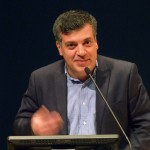
Sayed Kashua spoke in Winnipeg as part of the University of Winnipeg’s annual Middle East Week. (photo by Rebeca Kuropatwa)

On Feb. 25, as part of the University of Winnipeg’s annual Middle East Week, about 75 people came out to hear what guest speaker Sayed Kashua had to say on the topic The Arabs in Israel: The Inaudible Cry for Full Citizenship.

Born and raised in Tira, Israel, Kashua is an author and journalist. His three novels – Dancing Arabs, Let it Be Morning and Second Person Singular – have been translated into English, with the stories of his first and third novels being combined to become the film Dancing Arabs. Among other things, he is the creator of the Israeli TV show Arab Labor and the subject of the documentary Forever Scared. His 2013 talk in Vancouver sold out.

At the recent Winnipeg event, Global College executive director Dean Peachey and U of W president Dr. Annette Trimbee welcomed Kashua and the audience to the U of W’s Eckhardt-Gramatté Hall.

Kashua moved with his family to Champaign, Ill., a year and a half ago, finding the “noise” in Israel too distracting.

“When we arrived,” he said, “I taught my kids two things: that people here stand in line and that, if you’re asked where you’re from, just say you’re from Jerusalem … and, according to their response, you’ll decide if it’s east or west.”

When Kashua enrolled his kids at school, he found himself stumped by the forms when he came to the question about race, as Arab was not listed.

“I almost checked off ‘other,’ but I was so worried about losing my visa within three days of landing in the States…. I almost signed my kids as Asians, because I can easily prove that Jerusalem is part of Asia…. I didn’t know what to do. I raised my hand and the nice lady asked how she could help. I said I don’t know what my race is. She asked where I was from. I said Jerusalem. So, she said that I’m from the Middle East … so, I’m ‘white.’ That was the point that I knew I loved Champaign.”

For the first time, Kashua was part of the majority.

It was not until he went to the United States that he was asked about Islamophobia. As a secular Muslim, he had to think about the question, and he decided that the more important aspect to him was his nationality.

However, he recently found out at a parent-teacher meeting that his son was going to prayer. Kashua asked the teacher which religion or faith his son was following.

“The teacher said, ‘What do you mean? [He prays] with the Muslims. You are Muslims?’

“I said, ‘Yes, but I had no idea that my son prays.’ It was shocking for us, how the majority defines you, and how my son who is only 10 already realized he belongs to the group of Muslim kids in their school.”

Kashua then spoke of his greatest influence in becoming a writer – his illiterate grandmother who had lost her husband in the Israeli War of Independence.

“She was illiterate, but she was intelligent and sharp,” said Kashua. “She always told me bedtime stories. Maybe writing for me is just [a way] to keep telling myself bedtime stories. She told me wonderful stories, sometimes fairy tales. A huge part of her stories were about the war.”

According to Kashua, most Palestinians who became citizens of Israel after the war – farmers and those who remained in their villages – were or are illiterate.

“In 1948, most Palestinian villages, especially on the shore, were demolished,” he said. His grandmother had stories about her husband, “who was shot in the war, killed in 1948.” Kashua’s father was born in 1947, “so he was less than 1-year-old when his father was killed.

“She told stories about how she was trying to protect her son, sometimes running in the wheat fields, trying to cover him, when the bullets were whistling around her … escaping to the mountains,” said Kashua. These were, he added, “my childhood stories, and, to me, it’s history. It was never part of our education system, we belong to the Israeli education system. We are Palestinians, but also Israelis … became Israelis after the war of 1948. The war is never mentioned in our history books.”

It was not until after the war that Kashua’s grandmother learned that she no longer had land. To his family, he said, that was a bigger loss than losing their house.

“My grandmother, who used to have a lot of land, became a worker, picking fruit for Jewish bosses, sometimes in her own private land, picking fruit in fields she planted herself,” said Kashua. “That’s a very strong feeling I received as a boy, about being a refugee.”

When Tira became part of Israel people received Israeli citizenship. They lived under a military regime he said, until 1966, just a few months before what he described as “the occupation of the West Bank,” noting that “the military regime meant you couldn’t leave your village without permission from the military officer in charge.

“My father was telling us [that] only on Israeli Independence Day, you didn’t need a permit. Kids would jump onto trucks to go to another town, just to see, for a chance to go out. Of course, they were forced in their schools to celebrate Independence Day with Israeli flags.”

Even today, according to Kashua, conditions are different in east Jerusalem than in west Jerusalem. He said that Palestinian Israelis do not have equal rights, and are discriminated against in all aspects of life.

With Tira’s population at 25,000 now – growing from 1,500 in 1948 – Kashua said that poverty and crime there is hard to control.

“Maybe, at the beginning, people wanted to defend our identity, language, culture and tradition, but that’s no longer the case. We are trying to escape the ghetto, but there are so many laws that forbid us to do so. That’s the situation, you are completely segregated.”

Kashua described Israel as an “ethnocracy.”

“It’s democratic only if you’re Jewish,” he said. “If democracy is judged by how it treats minorities, Israeli democracy is facing a very big problem with the Arab minority…. We are still considered a national threat, a demographic problem.

“If you look at the history, you will see that, since 1948 until now, it was very rare that Arab citizens of Israel were activist against or being a real threat to the security of Israel. All Israelis know that reality and they know we are completely discriminated against when it comes to all aspects you can think of – land, the ability to move from your village. The sad thing is, sometimes the slave feels like he needs the master more than the master needs the slave. You have no idea how strong of a feeling it is when you don’t have even the ability to dream.”

Kashua was fortunate to find a Jew willing to sell him an apartment in west Jerusalem. They were the only Arab family living there and this was one of the reasons they moved to the United States.

Kashua believes that Palestinians want to be citizens of Israel and that they do not want to destroy the state, but they do want equal rights, as well as acknowledgement for the suffering they feel they have endured since 1948. This is something Kashua does not see as possible with the current leadership in Israel.

Rebeca Kuropatwa is a Winnipeg freelance writer.

Format ImagePosted on March 18, 2016March 16, 2016Author Rebeca KuropatwaCategories IsraelTags Israel, Israeli-Palestinian conflict, Middle East Week, peace, Sayed Kashua, University of Winnipeg
Paint away complexity

Paint away complexity

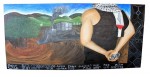
“Palestinian Roots” by Ahmad Al Abid. (photo from cjnews.com)

Anyone visiting the student centre at York University in Toronto has been confronted since 2013 with a mural that some say incites violence and makes York a less welcoming place for Jewish students. The piece features a young man, pictured from behind, wearing a keffiyah with a map that includes an undivided Israel and Palestine and holding two rocks. Below him is a bulldozer, presumably Israeli and presumably preparing to overturn a farmer’s tree.

Recently, the mural has led one philanthropist to pull his support for the university and it has been taken up as a cause by Jewish and Zionist organizations.

The mural makes a not very subtle point. Israel is an aggressor, wantonly destroying Palestinian livelihoods for no reason. Palestinians are helpless Davids in the face of this Goliath, reduced to that most primitive of weapons, the stone. Beneath the image are the words “Peace” and “Justice” in several languages.

A picture, they say, is worth a thousand words and this is probably why the mural upsets so many people. With one glance, the viewer understands the anti-Israel narrative in all its simplicity. Israel is powerful; Palestinians are weak. Israel is aggressive; Palestinians are defensive. The map on the keffiyah, which erases Israel, is understood as a statement that the Jews stole this land from indigenous Arabs, whereas the same map, if employed for Zionist ends, would elicit cries of racism and genocide. Even the symbol of violence – the stones – can somehow be perceived as tools for “peace” and “justice,” given the nature of the enemy.

Since the mural was painted, the weapon of choice for the Palestinian lone wolf – if we can call someone incited to murder by their government and official media a lone wolf – has morphed from stones to knives. Videos and infographics teach Palestinians how to stab Jews most effectively.

Never mind all that. The world has an idée fixe, an unshakeable certainty, that Jews are powerful and, therefore, the Palestinians must be victims; they cannot be perpetrators or instigators. A new poll of French people says nearly 60% blame Jews to some extent for antisemitism. Antisemitism is uniquely identified as brought about by its victims, not its perpetrators. We wouldn’t have to be antisemitic, it seems, if only you would be less Jewish. Even the secretary-general of the United Nations is standing by his statement that Palestinians stabbing Jews is simple “human nature” in response to “occupation.”

The same poll also affirmed the view of Jews as powerful – and the attitudes of the French in this regard are probably not substantively different from those of other Europeans and some North Americans, varying more by degrees than by kind perhaps. Today, that power is measured in perceived wealth and access to political and cultural elites. When Jews were historically powerless in those conventional senses, they were attributed with supernatural abilities. Antisemitism adapts magnificently as required.

The perception of Jews as powerful is not only at the root of antisemitism but doubles as an impervious shield against challenging it. Consider: if Jews are powerful, then coming to their aid is an act of siding with the powerful against the oppressed. This belief is, at root, the very essence of the anti-Israel narrative now dominating much of the West, especially on the political left.

As always, this incarnation of antisemitism is a form of scapegoating, the projection of sins onto an empty vessel. As we are now almost congenitally conditioned to do, we acknowledge that Israel is not above criticism. No country is. Yet the proportion of global attention, the level of vitriol and the hyperbolic accusations against Israel are clear to anyone with a sense of proportion that this has limited relation to Israeli policies or anything else rational. The nature of the beast is that there have always been “good” reasons to attack Jews. Today’s reason is Israel.

Israel, of course, is a very powerful state, with a massive military for a population its size. If it wasn’t, its population would be dead or dispersed. Yet this still feeds the narrative of Jewish power and Palestinian weakness. If this is a battle between rocks and bulldozers, well, then, who wouldn’t side with the folks holding the rocks? This, in the end, is what the mural at York is telling its viewers. It is, actually, a magnificent synopsis of the mindlessness of the anti-Israel narrative, which strips all context from the conflict and ignores the fact that the perpetuation of violence is mainly a product of Arab maximalism and refusal to live in peace with a Jewish state. That’s a picture that is a little more complicated to paint.

Format ImagePosted on February 12, 2016February 11, 2016Author The Editorial BoardCategories From the JITags Ahmad Al Abid, Israeli-Palestinian conflict, terrorism, York University
Duo’s message is “laughter heals”

Duo’s message is “laughter heals”

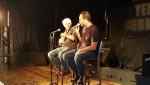
The comedy team of Rabbi Bob Alpert and Ahmed Ahmed on their August 2015 Laugh in Peace Tour. (photo from Laugh in Peace)

“Both Jews and Muslims have a lot in common. What are we fighting over? Jews and Muslims don’t eat pork, we don’t celebrate Christmas, we both use ‘ch’ in our pronunciation, and we are both hairy creatures of God,” says comedian Ahmed Ahmed. “The only real difference between Jews and Muslims is that Jews never like to spend any money and Muslims never have any money to spend.”

So goes one of the dozens of jokes featured in the Laugh in Peace comedy routine of Ahmed and Rabbi Bob Alper. It’s one Arab, one Jew, one stage. The unlikely duo’s show was in Israel (Jerusalem, Tel Aviv and Haifa) and the Palestinian territories (Ramallah) for the first time from Aug. 12-17. Together, Ahmed and Alper have performed more than 150 times during the last 14 years – throughout the United States, Canada and England – at synagogues, churches, mosques, theatres and college campuses.

Their story began as a gimmick by a savvy publicist, said Alper, a Reform rabbi who spent more than a decade at pulpits in New York and Philadelphia – or, as he calls it, “14 years of performing in front of a hostile audience.”

Alper admits he was at first resistant to the idea of the combined show. “My publicist calls me one day and says, ‘Bob, why don’t you do a show with an Arab comedian?’ I said, ‘Do you have any other ideas?’”

Ahmed was skeptical, too. “I got this call, ‘My name is Bob Alper and I am a Reform rabbi.’… He says, ‘I have an idea. I thought it would be great to do a show together.’… Well, I said, ‘That sounds good, where do you perform?’ He says, ‘Well, I perform in synagogues.’ … I thought someone was playing a joke on me.”

But the timing was right. In 2001, at the height of the terrorism of the second Palestinian intifada (uprising) in Israel, people were primed for comic relief. Alper says, when people are tense or sad, “comedy is even more important.”

Over time, the two have been more than just a successful and sought-after show. They’ve become good friends. The women in Alper’s small Vermont town fell in love with Ahmed through his visits and regularly inquire about his well-being. Alper has eaten in Ahmed’s parents’ California home.

“Ahmed’s dad asked about my family,” Alper recalled. “When I told him my wife would be having shoulder surgery the following month, he looked gravely at me and ordered, ‘You must stop twisting her arm.’”

They also believe they have played a role in breaking down barriers between Muslims and Jews. On college campuses, where Jewish-Muslim tension and antisemitism run rampant over the issue of Israel, Ahmed and Alper perform for mixed audiences. Jewish males wearing yarmulkes and females in hijabs sit side-by-side, smiling and laughing.

“When people laugh together, it is hard to hate each other,” said Alper, recounting how at the University of Arkansas it occurred to him that they were guests of the Razorbacks – a Muslim and a Jew performing at a school whose mascot is a pig.

They keep their shows apolitical, though they do touch on their personal religious experiences in the 90-minute performances, which generally are divided between solo acts of 30-35 minutes and a joint opening and closing. The closing includes stories from their travels.


Read more at jns.org.

Among the 2016 shows listed on Bob Alper’s website (bobalper.com) is only one in Canada, and it just so happens to be at Congregation Beth Israel on March 23.

Format ImagePosted on December 4, 2015December 3, 2015Author Maayan Jaffe JNS.ORGCategories Performing ArtsTags Ahmed Ahmed, Beth Israel, Bob Alper, Israeli-Palestinian conflict, Jews, Muslims

Co-opting history

Tonight, the Canada Palestine Association, BDS Vancouver, Canadian Boat to Gaza, Independent Jewish Voices and a few other groups will come together to address the topic Stolen Land: First Nations and Palestinians at the Frontline of Resistance. The obvious intention is to equate the history of colonial settlement in North America, Canada in particular, with the actions of Israel toward Palestinians.

The concept is flawed at its core, of course, because, as the Palestinian narrative often does, it portrays the Jews as colonial occupiers of Arab land, while denying the legitimacy of ancient and modern claims to the Jewish homeland. The logical failure here is that such a narrative recognizes the legitimacy of a 200-year-old land claim, but not a 2,000-year-old land claim, which seems like an arbitrary position.

Nevertheless, there is a larger issue here. The anti-Israel movement insists on appropriating the historical experience of other people and using it in an attempt to fortify their narrative. The most obvious example is the apartheid libel, which tries to paint Israel as the ideological descendant of South African racism. This is offensive not only to Israelis. It debases the experience of black South Africans who suffered from genuine apartheid.

Even more egregiously, the anti-Israel movement routinely uses the imagery of Nazism and the Holocaust against Israel, attempting to equate the victims of the Third Reich with its perpetrators. This deliberate rubbing of salt in Jewish historical wounds is common and, as we discussed in this space last week, the objective is clearly to inflict pain rather than to resolve grievances.

This is a deliberate strategy of the anti-Israel movement, which apparently finds its difficult to make a legitimate case of their own and, therefore, co-opts the historical experiences of others. As another example, last summer, when people in Ferguson, Mo., and elsewhere in the United States were protesting police shootings of young African-Americans, the “pro-Palestinian” movement attempted to infiltrate that movement as well, trying to portray Israeli soldiers and police in the same light as American killer cops.

The event this week has a similar purpose. Not satisfied to let Canada’s First Nations people tell their stories and have their experiences validated, the “pro-Palestinian” activists want to elbow their way in and demand that Palestine get equal time (at least).

An infinitely more constructive approach can be seen in the remarkable story of a Jewish survivor of the Holocaust who traveled across Canada as part of the Truth and Reconciliation Commission, sharing his story of survival and accomplishment after tragedy. (See the story “Survivors helps others.”)

There are ways to positively advance First Nations experiences, the Palestinian experience and the Jewish experience in order to create a more understanding and tolerant world. The organizers of this week’s event – and the anti-Israel movement more broadly – do not seem interested in that sort of progress, in that sort of world.

Posted on November 27, 2015November 24, 2015Author The Editorial BoardCategories From the JITags apartheid, First Nations, Holocaust, Israeli-Palestinian conflict, Robbie Waisman, Truth and Reconciliation Commission
Panelists talk about BDS movement

Panelists talk about BDS movement

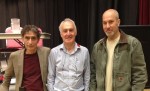
Left to right, panelists Gabor Maté, Michael Barkusky and Yonatan Shapira. (photo by Zach Sagorin)

Independent Jewish Voices-Vancouver hosted A Conversation About BDS (boycott, divestment and sanction) on Nov. 8. IJV’s Martha Roth, moderator of the event, told the Jewish Independent, “The Israeli government propaganda has been so strongly anti-BDS and people are terrified of it.… We wanted to make a safe space for discussion.”

In order of presentation, the four panelists were columnist Dr. Mira Sucharov, an associate professor of political science at Carleton University, who joined the discussion via FaceTime; Yonatan Shapira, a former Israeli rescue helicopter pilot who has become a Palestinian solidarity activist; Michael Barkusky of the Pacific Institute for Ecological Economics, who was born in South Africa and was an anti-apartheid activist during university; and author and speaker Dr. Gabor Maté, a former Zionist youth leader.

The BDS movement (bdsmovement.net) calls for Israel to end “its occupation and colonization of all Arab lands occupied in June 1967 and dismantl[e] the [security] wall”; recognize “the fundamental rights of the Arab-Palestinian citizens of Israel to full equality”; and support “the rights of Palestinian refugees to return to their homes and properties as stipulated in UN Resolution 194.”

Shapira told the crowd: “The BDS movement is a human rights-based initiative calling for equality … end of occupation, end of apartheid situation and to promote the right of return. It is not saying that Israel is the most devilish thing in the world. It doesn’t say what is happening in Syria is better.… It is just a nonviolent practical tool to change the power balance in the situation.”

Maté based his view on the actions carried out in 1947/48, which, he said, “involved massacres … expulsions of large numbers of people from their homeland … demolition of hundreds of villages, the bulldozing of gravestones. Going to Palestine-Israel today is like going to Europe today and looking for a trace of Jewish life.”

He continued, “On top of that now, you have this occupation, this totally illegal occupation… Even if you assume Israel has a right to conquer those lands in 1967…. They never had the right under international law to enter these demographic changes, that’s against the law. To build businesses and economy, that’s against the law. It’s not even controversial.”

The only panelist against BDS, Sucharov said, “I have spoken out, mostly through writing, against BDS … for the reason, I think the end-game is confused.”

While portions of Sucharov’s arguments were inaudible due to technical difficulties, she did make her main points heard. She referenced Prof. Rex Brynen of McGill University, in saying, about the right of return, “repatriation in that case would refer to Palestinians who are still stateless being able and encouraged to return to a Palestinian state, but, in order for that to happen, a Palestinian state needs to come about. So the question is, How to change this tired and bloody status quo that we see right now in order to see a Palestinian state?”

She added, “Instead of boycott, I call for wrestling, grappling and engagement. Instead of shunning, I call for dialogue. Both sides want, if you want to use the binary construct of sides, to play their own game of boycott and shunning and narrowing of the discourse…. The most egregious expression of that has been the academic boycott that has been used to cut off the kind of debate and dialogue we are having today.”

She said, for example, that philosopher and law professor Moshe Halbertal was blocked from speaking at the University of Minnesota on Nov. 3 for 30 minutes by BDS supporters, and that she has witnessed the same shunning of dialogue “within the mainstream Jewish community.”

Shapira later responded to the notion of academic boycott: “Only if the professor is connected and representing an official institution in Israel, then it’s a target for the boycott.… All Israeli universities are connected to the occupation … therefore, if someone is representing them, it’s a target for the boycott.”

About the debate over SodaStream, which was located in the West Bank and employed 500 Palestinians, Sucharov said, “One could certainly view that as a way of propping up the settler project, and we know the settlements are illegal under international law. What was key and what the boycott movement got wrong [is], the owner had stated that if and when there would be a Palestinian state, tomorrow he would seek to keep the plant there and simply pay taxes to the new Palestinian state.” She later added, “This is an example of direct investment that will be essential to help the Palestinian economy in its sovereign incarnation.”

Maté countered, “When you are taking people’s lands, when you build a wall that separates them from their fields, when you make life impossible, when you destroy their economy, when you practise environmental degradation on their whole country, guess what, they are going to be desperate for jobs.” He said SodaStream’s “giving 500 jobs to the Palestinians” was “not an argument against boycott, not an argument against economic pressure.”

Sucharov argued that BDS works against a two-state solution: “Scores of Palestinian, Israeli and joint Palestinian-Israeli NGOs are doing work in the West Bank and Israel. There are many groups seeking to engage the situation. With boycott, one has cut off one’s ability to connect with those activists who seek to engage, to visit Israel, visit the West Bank and try to change status quo.”

Shapira said, “Wake up from this old dream of a two-state solution…. We are intertwined together with the Palestinians whether we want it or not. We have to move on from a conflict between two sides … an occupier force and an occupied, an oppressor and oppressed, a colonizer and native. This is the context and we have to change the mindset.

“It is not, let’s go for a dialogue meeting with Israeli and Palestinian kids. I am not saying I am against dialogue,” but dialogue “will not be what brings the solution … the solution will come when we change the power dynamic.” He said, looking at the audience, that they “were probably a part of struggle to end apartheid…. If you supported boycott back then, you should support boycott now.”

About the use of BDS to end apartheid, Barkusky said, “About 25% of South African civil society wanted the end of apartheid … and my worry is that I don’t think that 25% of Jewish Israelis today are ready for a two-state solution, or certainly not a one-state solution.” Barkusky warned that “any BDS strategy, to be effective, needs to avoid sweeping the centrist majority in Israel into the hands of the right-wing.”

Barkusky was “ambiguous” about BDS. “There are certain, obviously attractive features of BDS. It is accessible when other strategies seem futile and it appears to be nonviolent,” he said. However, he added, BDS “is a collective punishment strategy,” akin to an aerial bombing: “hard to target and collateral damage.” BDS can be “damaging and [destroy] people’s livelihoods,” he said, and it “is not exactly nonviolent: it can crush peoples’ hopes, it can lead to suicide, it can lead to domestic violence.”

Maté said it is a “pipedream to shift Israeli policy by being really nice about it.” When it came to boycott specificities, he said, “If you are only willing to boycott stuff from the occupied territories, boycott stuff from the occupied territories. If you want to boycott everything, boycott everything…. If you want to boycott academia as well, go ahead, I don’t care. Because it doesn’t matter what small, little arguments or details we want to engage in because the overall reality for everybody who has been there … is so horrible and is getting daily more horrible that the insanity is out of control now and only external pressure will do anything about it.”

Shapira said, “You cannot live in peace and security if you are superior over other people in that country. You cannot have the oxymoron of a Jewish democracy. We have to give up this idea, it is not possible.”

Around 80 people attended the event, which was held at the Peretz Centre for Secular Jewish Culture, including professor Rabbi Dr. Laura Duhan Kaplan, interim director of Iona Pacific Inter-Religious Centre at the Vancouver School of Theology. She told the Independent, “There was a significant amount of agreement in the audience and so the questions were not as provocative as they would have been if … most people weren’t left-leaning.”

Zach Sagorin is a Vancouver freelance writer.

Format ImagePosted on November 20, 2015November 17, 2015Author Zach SagorinCategories LocalTags BDS, boycott, Gabor Maté, IJV, Independent Jewish Voices, Israeli-Palestinian conflict, Michael Barkusky, Mira Sucharov, Yonatan Shapira

Spreading pain, not peace

A member of Israel’s Knesset spoke at a Kristallnacht commemoration event this week and equated Israel’s actions to the events of Nov. 9-10, 1938.

Hanin Zoabi, an Arab-Israeli member of the Knesset, spoke at a Kristallnacht “memorial” in Amsterdam that was organized by a group known for its antipathy to Israel and its sympathies for Hamas. It appears the event was not meant to sincerely mark the solemn anniversary but rather, as is so often a tactic among the most extreme anti-Israel hate groups, to rub salt in the wounds of Jewish history.

“Kristallnacht didn’t suddenly fall from the sky, come out of nowhere,” Zoabi said Sunday. “It was the result of a development over time. We can see a similar development happening in Israel over the last several years.”

She acknowledged that, during Kristallnacht, thousands of businesses and hundreds of synagogues were attacked and destroyed.

“Perhaps the majority of Germans did not approve, but they kept quiet,” she said. “When in Israel two churches and tens of mosques are burned; and hundreds of Israeli supporters of Beitar shout ‘death to the Arabs’ after each soccer match; when a family is burned to death; when a 15-year-old boy is burned to death, the majority keeps quiet, although they are perhaps shocked.”

Of course, Zoabi is wrong. When these tragic and despicable incidents have happened, they have been condemned from the highest offices, by the most respected voices and across the political spectrum of Israeli society. When the far more frequent incitements to kill Jews occur, and when terrorists stab or drive over Israelis, these acts are lauded by Palestinian political and religious leaders and are cause for celebration among Palestinian civilians. That’s a big difference.

Zoabi is a member of the Arab Israeli party Balad, which calls for a binational state between the Jordan River and the Mediterranean – in other words, the effective end of the world’s only Jewish-majority nation. She is an elected official in the parliament of a country she does not believe should exist. Fine. That’s a fact of democracy. We have such a phenomenon in our own federal parliament.

Zoabi is not only a citizen of a democratic state, but one who was democratically elected by other citizens to represent them in the Knesset, which, in itself, goes some distance in undermining her hyperbolic claims.

Zoabi, because she is a citizen of a free country, has the right to say what she wants, short of the sort of incitement banned by law in every democratic society. (Although she has crossed that line, with minimal repercussions, in calls for “popular resistance” and justifying the kidnapping of three Israeli teens last year who were later found murdered.)

How ironic that a person in her position could invoke such vicious, ahistorical imagery and do it at a time and place that should call for the barest sense of human compassion and decency – and get away with it. Because, despite a few outraged comments from politicians and media, she will get away with it. There will be no legal or parliamentary repercussions for her words. She is a free person – one of the freest and most powerful Arab individuals in the Middle East, when you come down to it. Were her political agenda to be realized and the land in which she lives to come under the governance of Hamas or Fatah or any other political entity currently on the scene or even on the horizon, and she were to use her words to attack her country in this manner, the outcome would almost certainly be far more grievous for her.

Beyond this individual case, though, this kind of language is a treasured tactic of the anti-Israel movement. Clearly it is a strategy of the Amsterdam group that invited her to speak and we have seen it even on campuses and at rallies here in Vancouver: anything that can be done to cause pain to Jewish people is not only acceptable, it is a legitimate tactic.

Whether it is literally a knife in the neck of a Jew in Jerusalem or the inhuman exploitation of Jewish history against the Jewish people themselves in Amsterdam or the exploitation of Holocaust imagery and language against the state of Israel at rallies worldwide, including here in Vancouver, there is a streak in the anti-Israel movement that is more concerned with inflicting pain than finding solutions.

Posted on November 13, 2015November 11, 2015Author The Editorial BoardCategories From the JITags antisemitism, Hanin Zoabi, Israeli-Palestinian conflict, Kristallnacht, terrorism

Kohelet and Kristallnacht

“Vanity of vanities. All is vanity.” The day of remembrance for Kristallnacht was this week. Looking at what’s happening in Israel and globally, I’m reminded of the Preacher. By the Preacher, I mean Kohelet, traditionally thought to be King Solomon, whose writings in the Tanakh are known in English as Ecclesiastes. The first line, in Hebrew, reads: “Havel havalim. Hakol Havel.”

Everything is havel, which, better than vanity, is translated “vaporous, breathlike, fleeting.” Everything is vapor. Like Abel, whose Hebrew name is Havel, and whose life was like vapor, blown apart by Cain. Like what we thought we had gained in Israel, once upon a time: a state of our own that had mostly won the world’s respect and affirmation through blood, sweat and tears. A refuge. We thought we had pushed back the red sea of ancient, irrational hatred. The world had, to an amazing degree, recognized our right to a homeland in our homeland. The horrors of the Holocaust were understood and widely contemplated.

Yet, in the past months, much of what has happened has the character of a bad dream. The New York Times writes that the Temple Mount may not have been where the Jewish Temple was after all (later retracted under pressure). The United Nations declares ancient Jewish holy sites to be under the rightful control of a future Palestinian state, even as Palestinian Arab terrorists torch Jewish holy sites. In Europe, organizers of a Kristallnacht commemoration declare their plans to turn it into a commemoration of the Palestinian suffering for which Israel bears responsibility.

And the stabbings. The Palestinian leadership put the word out that Jews planned to change the “status quo” on the Temple Mount, where Al-Aqsa Mosque also stands. Currently, only Muslims have free access to the site, with everyone else having very limited or no access to this sacred space, revered by Jews especially but also Christians and Baha’is. “Changing the status quo,” according to Palestinian fears, would entail increasing access for non-Muslims (at least) or tearing down al-Aqsa and replacing it with a synagogue (at most). Israel has no intention of either: not of expanding access (although surely that would be a step forward for human rights and decency were that to happen) and certainly not of razing Islam’s third holiest site. Yet the claim enflames the Palestinian street, as it did at the start of the 2000 Intifada. Mothers begin celebrating the deaths of their children who died to “defend Al-Aqsa,” even giving out candy on TV. A Palestinian Arab mother names her newborn baby “Knife of Jerusalem” after the attacks. Mahmoud Abbas, who Western media falsely portray as a moderate, calls for the shedding of Jewish blood and declares that the “filthy feet” of Jews will not besmirch Al-Aqsa.

Mainstream Israel wants to negotiate an independent state for Palestinian Arabs yet a majority of Palestinian Arabs believes Israel wants to take their land and evict them. Tellingly, this is in fact what the Palestinian Arab leadership wants – to take back all Israeli land and eliminate Israeli Jews, as the Hamas charter and popular Palestinian songs, media and school textbooks demonstrate. In a classic psychological move, the Palestinian Arab imagination projects onto Israel its own desires: what is within is used to interpret what is without. This narrative has spread beyond the borders of Israel and the disputed territories to capture the imaginations of people all around the world. So, our refuge has begun to feel, increasingly, like a new ghetto, where we can be once again easily separated out and demonized.

Havel havalim. Hakol havel.

After experiencing years of checkpoints, poverty, “collateral damage,” the Gaza wars and more, it is certainly understandable that Palestinian Arabs feel sorrow and rage. It is even understandable that they hate the Israeli government. But to blame Israel and all Jews for their suffering, and not the racist, Israel-negating, violence-inciting, kleptocratic Palestinian leadership?

Israeli self-defence is viewed as aggression; the most enlightened state in the Middle East is slandered as an “apartheid state”; Zionism is viewed as racism by people whose denial of Zionism is in fact rooted in racism. Havel havalim.

Where do we look for something solid to hang on to? The opinions of the world, the justice of its courts and institutions, are failing us. And we ourselves are not immune to being blown apart by this hurricane wind on the inside and losing anything worth fighting for. In Israel, Jewish mobs have formed to attack “enemies” internal and external. Hatred and anger against the Palestinian Arabs grows. We are in danger of forgetting their humanity and their pain. We are in danger of losing our ability to think rationally, to think long term. We cannot and will not find security in the courts of the world. We must make our own reality, one that reflects what we know to be true. And we must hold to that reality with strength and with love. That is what we are already doing in our best moments:

  • A Jewish restaurant gives a 50% discount to Jews and Arabs who eat together.
  • There are peace rallies in Tel Aviv and Jerusalem.
  • Israelis find a variety of ways to laugh through what is happening and share them online.
  • Doctors in Israeli hospitals treat Palestinian terrorists alongside their victims.

We know that Israelis want peace, and that Jewish values in no way mandate injustice or aggression towards Palestinians or anyone else. We must make our own peace and our own future, through clinging to our own highest values like a rudder in the storm. And, as we find a way to a just divorce with the Palestinian Arabs, as Amos Oz so rightly said we need to do, both for their sake and for our own, we must at no time forget the humanity of each Palestinian Arab. We must not demonize them, must not forget that every Palestinian Arab is made in the image of God. Our own spiritual tradition, the beating heart of our highest values, mandates that we do not return hatred for hatred. At no time may we forget to fear the loss of our own humanity under the impact of their knife blades and bombs and stones. That is the way to commemorate Kristallnacht.

Matthew Gindin is a writer, lecturer and holistic therapist. As well as teaching holistic medicine, Gindin regularly lectures on topics in Jewish and world spirituality, and has a particular passion for making ancient wisdom traditions relevant in the modern world. His work has been featured on Elephant Journal, the Zen Site and Wisdom Pills, and he blogs at Talis in Wonderland (mgindin.wordpress.com) and Voices (hashkata.com).

Posted on November 13, 2015November 11, 2015Author Matthew GindinCategories Op-EdTags Al-Aqsa, Ecclesiastes, Intifada, Israel, Israeli-Palestinian conflict, Kohelet, Kristallnacht, peace, terrorism
More than Slim Peace

More than Slim Peace

Filmmaker Yael Luttwak spoke at Choices Nov. 1. (photo from jewishvancouver.com)

A film that brings Palestinian and Israeli women together in a weight-loss group. Who would have thought that was possible? American-Israeli Yael Luttwak did, and she made it happen. Luttwak, the keynote speaker at Choices, Jewish Federation of Greater Vancouver’s annual women in philanthropy event, held on Nov. 1 at Congregation Beth Israel, captivated the audience with her story.

“The idea came to me at a time when

I was attending Weight Watchers in Tel Aviv,” said Luttwak. “The peace process had broken down and Ariel Sharon had been hospitalized and I had this image of Sharon and [Yasser] Arafat jogging together on the beach and working it all out. It struck me, as I listened to women in my group who were uninhibited in sharing their struggles with health and weight and body image, that there was so much humanity in that room. What if we could capture this humanity and bring together women who otherwise would never have an opportunity to meet?”

She set out to find women who would be willing to participate in this social experiment. She approached Orthodox women, West Bank Muslims, American-born settlers and Bedouins. Fourteen women agreed to get involved. The Jerusalem Cinémathèque in East Jerusalem became the meeting place. Filming took six weeks.

The women metamorphosed during the process, as they started to come to the meetings in nicer clothes and make-up, and they began to share their thoughts (and recipes). “This was the first opportunity for Arab women to meet Jewish women that were not soldiers, and for Israeli women to meet Arabs that did not want to kill them. At the beginning, everyone was nervous, but very polite (unusual for the Middle East) but, within a few hours, they were all talking and sharing stories.”

The women found common ground on many issues that emphasized their similarities. Even when there was political turbulence, violence on the streets of Jerusalem and curfews, the Arab women would cross the checkpoints to attend the meetings. When Luttwak asked what it was about the group that kept them coming, they answered that it was their only opportunity for hope. And so, the 2007 documentary A Slim Peace came to be. It premièred at the Tribeca Film Festival in New York and screened in the United States on Sundance Channel.

While promoting the film, Luttwak was approached by English philanthropist Dame Hilary Blume, who offered to seed fund more women’s groups. She told Luttwak, “Don’t waste your talent on films. You have hit on something. You are building bridges. This is your destiny.” As a result, the nonprofit Slim Peace developed and, over the past eight years, it has opened 33 groups in six cities and two countries. Luttwak said, “It’s a train I cannot stop.” She has also been able to keep making films about contemporary issues. Her final messages – we all have to do our part for tikkun olam (repair of the world) and to never give up hope.

Prior to Luttwak’s talk, Ricki Thal addressed the audience: “My name is Esther Zuckerman Kaufman and I was born in Warsaw, Poland, on Oct. 11, 1920. I was one of the Jews on Schindler’s List.” Everyone’s attention caught, Thal then told the story of her grandmother and grandfather, Leon, both saved by Oskar Schindler. They never spoke about their wartime experiences and the family had no idea that they were Schindler Jews until they all went to see Steven Spielberg’s movie. That moment changed Thal’s life. It led her to explore her family’s history, to participate in March of the Living on two occasions, as a student and as a chaperone, and to become involved in the Jewish community. Kaufman died in 1999 but not before she appeared in New York on The Phil Donahue Show to tell her story to television audiences. Thal finished almost as she began: “My name is Ricki Thal and I was born in Vancouver in 1979 and I am proud to be the granddaughter of Esther and Leon Kaufman.”

CBC television personality Belle Puri emceed the night, co-chair Debbie Jeroff gave opening remarks and Stephen Gaerber brought greetings from Federation. Two video presentations, a raffle and a meal catered by Susy Siegel completed the night, and then 500 Jewish women went out into the rain inspired, full of good food and hope.

To donate to Federation’s annual campaign, visit jewishvancouver.com.

Tova Kornfeld is a Vancouver freelance writer and lawyer.

Format ImagePosted on November 13, 2015November 11, 2015Author Tova KornfeldCategories LocalTags A Slim Peace, campaign, Israeli-Palestinian conflict, Jewish Federation of Greater Vancouver, JFGV, tikkun olam, Yael Luttwak
Eatery’s unique offer

Eatery’s unique offer

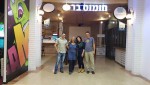
Recent visitors to the Hummus Bar at the M Mall in Kfar Vitkin, near Netanya. The eatery is offering a 50% deal on its hummus for Jews and Arabs who share a table and eat together. (photo from facebook.com/Mhumusbar)

An Israeli eatery is making headlines across the globe for its latest menu deal: 50% off any hummus dishes served to tables seating Jews and Arabs together.

Breaking bread together throughout history has always been an act of sharing and reconciliation. So, in response to the latest wave of terror attacks and incitement in Israel, Hummus Bar at the M Mall in Kfar Vitkin, near the coastal city of Netanya, posted a Facebook call for customers to share pita and hummus together – and pay less if they do.

The Oct. 13 post reads: “Scared of Arabs? Scared of Jews? At our place, we don’t have Arabs! But we also don’t have Jews … we’ve got human beings! And genuine, excellent Arab hummus! And great Jewish falafel! And a free refill for every serving of hummus, whether you’re Arab, Jewish, Christian, Indian, etc.”

Speaking to local media, manager Kobi Tzafrir said there were a number of people taking up the offer from his restaurant, which is famous for its chickpea spread. But, he added, the short post also fueled interest from around Israel and the world.

Hummus eateries are countless in Israel, yet Tzafrir reported that visitors have come from around the country to show support for the Hummus Bar’s message of tolerance and camaraderie.

“If there’s anything that can bring together these peoples, it’s hummus,” Tzafrir told the Times of Israel.

Hummus Bar’s Facebook page continues to garner positive posts from abroad, as well.

“Love the idea of bringing people together with food! Love and food conquers all!!” writes Urbian Fitz-James from the Netherlands.

“I think it is amazing what you guys are doing to unite people!” posts Josh Friesen from Canada.

“Thank you. This is marvelous,” writes Samir Kanoun from Turkey.

There are other messages of support – including from the United Kingdom, the United States and Japan – on the eatery’s Facebook page.

Hummus, of course, is a national dish in Israel, from the point of view of both Muslim and Jewish communities in the country. The International Day of Hummus even began here.

And it’s not just hummus that brings tolerance and coexistence. There are also Arab-Jewish owned eateries serving up coexistence, including Maxim restaurant in Haifa and Bouza ice cream in Tarshiha.

Viva Sarah Press reports on the creativity, innovation and ingenuity taking place in Israel. Her work has been published by international media outlets including Israel Television, CNN, Reuters, Time Out and the Jerusalem Post. Israel21C is a nonprofit educational foundation with a mission to focus media and public attention on the 21st-century Israel that exists beyond the conflict. For more, or to donate, visit israel21c.org.

Format ImagePosted on October 23, 2015October 22, 2015Author Viva Sarah Press ISRAEL21CCategories IsraelTags Arab-Israeli conflct, hummus, Israel, Israeli-Palestinian conflict, Kobi Tzafrir, peace

Pledge reflects motives

In June, the Spanish government passed a law granting descendants of Sephardi Jews forced from that country in the 15th century the right to dual Spanish citizenship.

Only someone unfamiliar with the toing and froing of Jewish migrations and expulsions could be blind to the magnificence with which this move dovetails with history. For millennia, princes and fiefs, kings and counts expelled the Jews from their realms in one generation and then enticed them back in successive ones, when their perceived value rebounded or when the duchy or kingdom was in financial peril. Sometimes it took a generation, sometimes it took 600 years, as in the case of Spain, which, it should be noted, is now just a few notches above Greece on the financial solvency scale.

But Jews who consider taking up Spain’s generous offer will be taking a sober second look after recent events. OK, the events were a relatively small-scale tempest – a reggae festival in Valencia – but the lessons are wide-ranging and deeply telling.

Matisyahu, the once Chassidic, now just Jewish, reggae rapper, was disinvited from the Rototom Sunsplash Festival after he refused to sign a pledge in support of a Palestinian state. The boycott, divestment and sanctions movement had convinced the festival organizers that participants should be forced to commit to the Palestinian cause.

The quality of the performers or the wishes of the audience were secondary to the political positions of the musicians, apparently. Why this obscure music festival should become a flashpoint for a kerfuffle over the Middle East may seem baffling, but the strategy of the movement has been to demand loyalty oaths from anyone at any time in any place. Canadian film festivals, including the Toronto International Film Festival and the Vancouver Queer Film Festival, have been roiled over the topic in the past. These efforts at a “cultural boycott” are atrocious enough, but the worst tactics of the movement promote an academic boycott, which is as close as we can come to literal book-burning.

Is it additionally appalling that Matisyahu is not Israeli, but American? Sort of. The boycotters have attacked Israelis for the most part, but now they are turning their cannons on anyone who might think that Israel has a right to exist alongside a Palestinian state. (Note that the oath did not address a two-state solution. Coexistence is not top of the agenda for BDSers.)

Not all Jews are Zionists and, indeed, some Jews support the BDS movement. However, if you believe in the right of self-determination for the Palestinian people, but not for the Jewish people, then you are at the least a hypocrite.

The BDS movement, while a relatively new phenomenon, has its historical antecedents in the people who would paint Stars of David on Jewish shop windows. It is a mob of bullies for the most part, which calls itself pro-Palestinian, but exhibits nothing positive, only hatred and vilification of Israel.

Although a reggae festival might seem an odd place to start, the BDSers and the larger “pro-Palestinian” contingent could buy themselves some legitimacy by taking an oath themselves: to work together with all people to find a peaceful resolution so that two peoples can live in coexistence in Jewish and Palestinian states. It’s a pledge the Jewish people accepted in 1947-48 and have reiterated throughout the ensuing seven decades. The Matisyahu brouhaha is an example of the answer the Jewish people have received to that olive branch.

Posted on August 21, 2015August 19, 2015Author The Editorial BoardCategories From the JITags antisemitism, BDS, boycott, Israeli-Palestinian conflict, Matisyahu, Rototom Sunsplash Festival, Sephardi, Spain, two-state solution

Posts pagination

Previous page Page 1 … Page 7 Page 8 Page 9 Page 10 Next page
Proudly powered by WordPress