Israeli Prime Minister Binyamin Netanyahu addressed a special meeting of the Israeli cabinet in Independence Hall in Tel Aviv on April 20 in honour of the 70th anniversary of the proclamation of the modern state by Israel’s first prime minister, David Ben-Gurion. Plans are to restore Independence Hall and turn it into a museum, where the Declaration of Independence will be displayed publicly for the first time. The document is currently stored at the State Archive in Jerusalem.
שיתוף הפעולה הטכנולוגי בין קנדה לישראל מתרחב משמעותית. (צילום: tec_estromberg)
מועצת המנהלים של קרן קנדה-ישראל תממן שמונה פרוייקטים חדשים בסכום כולל של כחמישה עשר מליון שקל (שהם כמישה מיליון ושלוש מאות אלף דולר קנדי). הפרוייקטים יבוצעו בשיתוף פעולה עם חברות בתחומים הבאים: חקלאות, רובטיקה, תקשורת לווינים, טכנולוגיות, מזון וטכנולוגיה נקייה (קלינטק). רשימת שמונה החברות שזכו בתקציבים של קרן קנדה-ישראל כוללת את: פלורה-פוטוניקה – בתחומי החקלאות, אינובופרו – בתחומי החקלאות, סי-נייצ’ר – בתחומי החקלאות, אף.אף.אר רובוטקס – בתחומי הרובוטים לחקלאות, גילת רשתות לווינים – בתחומי תקשורת לווינים, קנופי מדיה – בתחומי הטכנולגיות לאינפורמציה ותקשורת, אטלנטיום טכנולוגיות – בתחומי המזון והטכנולוגיה הנקייה (קלינטק) ואפקון בקרה ואוטומציה – בתחומי הטכנולוגיה הנקייה (קלינטק).
יצויין שקנדה כיום היא אחת השותפות המשמעותיות של ישראל, בתחום החדשנות. בנוסף לשיתוף הפעולה עם קרן קנדה-ישראל, מתבצעים שיתופי פעולה נוספים עם ממשלת מחוז קוויבק, ממשלת מחוז אונטריו וגורמים נוספים, בתחומי בריאות, תחבורה חכמה ועוד. התקציב הכולל של מחקר ופיתוח הכולל של פרוייקטים בין קנדה וישראל שאושרו בשנה האחרונה, עומד על לא פחות מכארבעים ושניים מיליון שקל (שהם כחמישה עשר מיליון דולר קנדי).
אומר שר הכלכלה של ממשלת ישראל, אלי כהן: “קשרי החדשנות בין ישראל לקנדה קיימים כבר יותר מארבעים שנה. מדובר במנוף כלכלי בילטרלי חשוב מאין כמוהו, המחבר בין חברות, חוקרים, ויזמים ישראלים וקנדים. שיתוף הפעולה הטכנולוגי שלנו עם קנדה, על מגוון ערוציו הוא נכס אסטרטגי חשוב למדינת ישראל ולאקוסיסטם הטכנולוגי שלנו”.
מנכ”ל רשות החדשנות ,אהרון אהרון, מוסיף: “קנדה מפעילה מערכות חדשנות מתקדמות ומפותחות מאד, הן ברמה הפדרלית והן ברמה המקומית. רשות החדשנות מפעילה מגוון תכניות ברמות שונות שמאפשרות לחברות טכנולוגיה ישראליות בתחומים שונים ליהנות ממערכות חדשנות אלה, ולשתף פעולה עם חברות וגופים קנדיים”.
הקרן הדו-לאומית קנדה-ישראל שמופעלת על ידי רשות החדשנות הוקמה לפני כעשרים וארבע שנים (ב-1994). מאז היא עוסקת בחיבור שבין חברות טכנולוגיה בין שתי המדינות. וזאת במימון של פרוייקטים של מחקר ופיתוח משותפים. בנוסף לקרן הדו-לאומית, רשות החדשנות מפעילה מספר הסכמי שיתוף פעולה עם גורמים נוספים בקנדה. כאמור בהם בין היתר ממשלת מחוז אונטריו. במסגרת זו אושרו בחודש פברואר שנה זו ארבעה פרוייקטים חדשים בתחומי: החקלאות, טכנולוגיה נקייה (קלינטק), תעופה, חלל וטכנולוגיות לאינפורמציה ותקשורת. ההיקף הכספי של פרוייקטים אלה עומד על כארבעה מיליון שקל (שהם כמיליון וחצי דולר קנדי). גם עם ממשלת קוויבק נחתמו (בשנה שעברה) הסכמים ליישום ארבעה פרוייקטים חדשים, בסכום של כעשרה מיליון שקל (שהם כשלושה וחצי מיליון דולר קנדי). הרשות לחדשנות מפעילה בנוסף תוכנית ייעודית של אימות פתרונות בריאות לקשישים בבתי חולים בכל רחבי קנדה. ובמקביל הרשות לחדשנות מפעילה תוכנית חדשה בתחומי התחבורה החכמה בקנדה.
המפלגה השמרנית תכיר בירושלים כבירת ישראל
מפלגת השמרנים הקנדית בראשות אנדרו שייר, תכיר בירושלים כבירת ישראל כפי שארה”ב עשתה. ארה”ב הבטיחה להעביר את שגרירותה מתל אביב לירושלים בקרוב. כך הכריז שייר אם מפלגתו תנצח בבחירות 2019 את מפלגת השלטון הליבראלית בראשות ג’סטין טרודו. בהודעה רשמית של השמרנים נאמר בין היתר כי: “המפלגה מכירה בעובדה כי ישראל, כמו לכל מדינה ריבונית אחרת, שמורה הזכות לקבוע היכן תמצא בירתה”.
יש לזכור שהמפלגה השמרנית בראשות סטיבן הרפר, החזיקה בשלטון במשך קרוב לעשר שנים. דווקא הרפר שהיה מקורב מאוד לישראל, לא חשב להכיר בירושלים כבירת ישראל. שייר חושב אחרת.
Children follow the new Independence Trail in Tel Aviv. (photo by Ricky Rachman)
In honour of Israel’s 70th Independence Day, the city of Tel Aviv has introduced a new interactive walking route that takes visitors past 10 of the city’s heritage sites. All of the sites are connected in some way with the Declaration of Independence and the beginnings of Tel Aviv itself.
The trail is just under a kilometre long and features a golden track that illuminates at night. The route begins at the first kiosk of Tel Aviv, at the intersection of Rothschild Boulevard and Herzl Street. The walking route brings two stories to life that are central to the story of modern Israel: the birth of Tel Aviv, the first Jewish, self-governed, Hebrew-speaking city, in 1909; and how, in 1948, Tel Aviv would make way for the birth of the state of Israel, fulfilling a millennia-old dream.
Visitors can follow the route with a mobile app, or can guide themselves using a map that features information in eight different languages.
The building of the trail demanded extensive infrastructure work, including the implementation of a unique lighting system that allows visitors to walk along the trail at night. The Independence Trail was inspired by the Freedom Trail in Boston, one of the most popular heritage sites in the United States.
The Independence Trail’s 10 sites are:
The first kiosk was established in 1910, and quickly became a central meeting place. During the 1920s, about 100 kiosks operated in the city under the Association of the Kiosk and Soft Drink Store Owners.
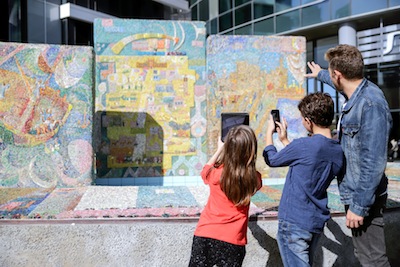
The mosaics at Nahum Gutman Fountain. (photo by Ricky Rachman)
Nahum Gutman Fountain: Nahum Gutman was an Israeli artist who grew up in Tel Aviv along with the new city, and whose work reflected the simplicity of the early days of “the First Hebrew City.” An illustrator, photographer and writer, Gutman was awarded the Israel Prize in 1978. His mosaics around the fountain tell us the history of Jaffa, the ancient port city from which Tel Aviv was born.
Akiva Aryeh Weiss’s house: Weiss was the founder of the Ahuzat Bayit neighbourhood, which evolved into Tel Aviv. As president of the then newly established building society, Weiss presided over the 1909 lottery in which 66 Jewish families drew numbers written on seashells to determine the allocation of lots in the about-to-be established city.
Shalom Meir Tower: former site of the Herzliya Hebrew Gymnasium, the first Hebrew-language high school. The building on Herzl Street was a major Tel Aviv landmark until 1962, when it was razed for the construction of the tower. Its destruction sparked widespread recognition of the importance of conserving historical landmarks. Today, Shalom Meir Tower is home to a visitors centre about the history of Tel Aviv, which is open, free to the public, on weekdays.
The Great Synagogue was the spiritual centre of Tel Aviv, located in the heart of the city’s business centre. The building features a huge dome, elaborate lighting fixtures and magnificent stained glass windows.
The Haganah Museum is located in what was the home of Eliyahu Golomb, the founder and de facto commander of the Haganah. From 1930 to 1945, the Haganah’s secret headquarters were located in this house. Golomb’s residential room, his office on the ground floor, as well as the exterior of the house, were fully preserved. The museum will be open to the public free of charge during 2018, to mark Israel’s 70th anniversary.
Bank of Israel’s Visitors Centre, at the historical headquarters of Israel’s national bank, presents the history of the financial system in Israel. It features an extensive exhibit of banknotes and coins issued from pre-state days to the present. The centre also will be open to the public free of charge until the end of the year.
Tel Aviv Founders Monument is dedicated to the men and women who established Tel Aviv in the first half of the 19th century. It is a quiet spot, dotted with benches and centred around a small pool and fountain.
Statue of Meir Dizengoff, honouring the first mayor of Tel Aviv, who was known for riding his horse from his home – which is now Independence Hall – to City Hall, which was then located on Bialik Street. The statue of Dizengoff on his horse was created by artist David Zondolovitz.
Independence Hall: Dizengoff dedicated his home for the establishment of the Tel Aviv Museum of Art. In the home, on May 14, 1948, the ceremony of the Declaration of Independence took place.
In addition to the Independence Trail, visitors will be able to enjoy, until the end of December, the Israeli Democracy Pavilion, which features a presentation about the story of the Declaration of Independence. The project, which is a collaboration between the Israel Democracy Institute and the Tel Aviv-Yafo Municipality, takes place in a majestic pavilion on Rothschild Boulevard, in which visitors are shown a film in 360 degrees, highlighting important moments of Israeli democracy. The pavilion is surrounded by arcades reflecting the diversity of Israeli society. Selected quotes from the Declaration of Independence are showcased on the pavilion’s arches and visitors are invited to sign a pledge to uphold the core values of the declaration. Entry to the film is free of charge, and the pavilion is expected to travel to other cities in Israel next year.
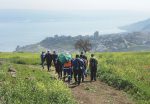
The trail crosses the Galilee from Beit She’arim to Tiberias. (photo by Israel Antiquities Authority from Ashernet)
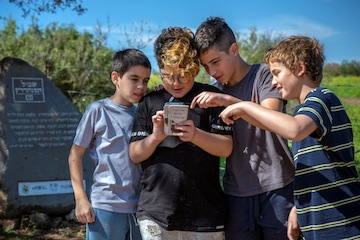
Dozens of stone relay stations along the path transmit information and activities to hikers’ mobile telephones. (photo by IAA from Ashernet)
This year in the Galilee, thousands of students have been excavating and organizing the first “smart trail,” in which dozens of stone relay stations along the path transmit information and activities to hikers’ mobile telephones. The trail comprises part of the celebration of Israel’s 70th year of independence, and just opened. It extends 70 kilometres and is divided into sections, tracing the movements of the country’s greatest figures, the Sanhedrin sages, who rehabilitated the Jewish people following the Bar Kokhba Revolt. As did the Sanhedrin, the trail crosses the Galilee from Beit She’arim to Tiberias, passing through magnificent landscape, such as Nahal Zippori, Yodfat, Mount Arbel and Mount Atzmon.
When A.J. Edelman was training in Whistler, he was the guest cantor for Chabad of the North Shore’s Yom Kippur services. (photo from A.J. Edelman)
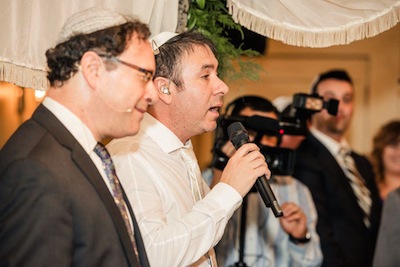
Chabad of the North Shore community members had a more personal reason to cheer on A.J. Edelman at the 2018 Winter Olympics in PyeongChang, South Korea. Israel’s only skeleton athlete to have made it to the Games, Edelman was training in Whistler around the High Holidays last year. While there, he participated in community life, stepping in as guest cantor on Yom Kippur.
“Although he [Edelman] could have attended services at a larger synagogue in Vancouver, he was committed to spending Yom Kippur where he could be useful and have an impact,” said Rabbi Mendy Mochkin, spiritual leader of Chabad of the North Shore. “We had a cantor during Rosh Hashanah, but not for Yom Kippur.
“It worked out great. Our community was very excited to learn that a skeleton athlete representing Israel was training locally and was very touched that he chose to join us. They were very moved by his … melodies and heartfelt prayers. We all prayed together with him that he should attain his dream to be an ambassador for Am Yisrael. Our prayers were answered!”
Edelman was born and raised in Boston, in a Modern Orthodox, Zionist family, and he attended an Orthodox Jewish day school. When he was 2, his parents strapped a pair of skates onto his feet. By 22, he was a good hockey player, but not good enough to become a professional.
“I decided that, if I wanted to continue doing sports, it had to be on a high, elite level that could really give a platform to whatever I would choose to do afterward,” Edelman told the Independent. “So, I decided to represent Israel, because it was going to be the only way I was going to do it. As it happened, as I was thinking about this, skeleton appeared on the TV for the team trials for the United States for Sochi. And I thought it looked like a terrific sport – eye-catching.”
For some athletes, they become good at a sport and then look for a country that will let them compete under its flag. In Edelman’s case, he was mainly spurred by the idea of representing Israel. Then, he began searching for a sport.
“It could certainly help me achieve my goal of inspiriting people,” said Edelman. “I didn’t know how difficult it was or how painful it was. I didn’t know how bad, at first, I would be at it. But, I did dive full on into it.”
Edelman had to go from zero to 100, so to speak, in less than four years. While many along the way tried to tell him his goal was unattainable, the naysayers only fueled his resolve to succeed.
“It’s not like swimming or other sports where you have to hit a time relative to previous Olympics times, you have to hit an absolute performance standard of world ranking in that specific year. It’s a quota system,” explained Edelman of skeleton.
Edelman had to become one of the top 30 skeleton athletes in the world in about 48 months. His last year of training was focused – with help from the other athletes on the Israeli skeleton team – on maximizing his point collection at competitions.
“Positioning Israel to be the beneficiary of one of 10 single-sled nations through points I accumulated through specifics results and races was important – and it involved a lot of mathematical calculation,” said Edelman.
Edelman finished 28 out of 30 at the Winter Olympics.
A.J. Edelman was Israel’s only skeleton athlete to make it to the 2018 Winter Olympics in PyeongChang, South Korea. (photo by Joern Rohde)
“Making the Games was an insane accomplishment in that we were the only ones who did it without any coaching,” said Edelman. “We had absolute zero coaching for the first two years of my journey…. It took a huge physical toll and mental toll, and a massive financial toll. So, yes, 28 out of 30, I was very pleased.”
Edelman learned the sport from YouTube videos, and fundraised the money he needed to participate in competitions, buy equipment, and cover hotel stays and training facility fees. As far as trying to compete at the next Olympics, Edelman said, while he’d like to do that, it’s just not feasible.
“The financial strain is insane – $40,000 a year,” he said. “And only about 40% of it was covered from over the last four years by sponsors, family, friends – and complete random strangers. Doing it for another cycle would be too much of a financial strain. And I think I’ve accomplished what I was looking to accomplish, and am able to remain involved in Israel’s sports and help the next generation achieve their goals. I now have that platform.”
Although Edelman was at the Games – or maybe because he was at the Games – he said he felt disconnected from the Olympics as a whole.
“I only saw my own thing,” he said. “Otherwise, the experience at the end, or during the competition, of representing Israel, it was an honour unparalleled to anything in my life. There were a few moments I felt like I could cherish forever – the thoughts and feeling that this is what it’s like to represent a country and how it feels to be that individual. It was absolutely terrific.”
Edelman said he is not sure about what might come next for him, but that he is aiming big. For now, he is focused on transitioning from being a full-time athlete back into normal life. But life will never be the same for him, now that he has proven his potential to himself.
“If you apply yourself so completely and fully, and you just dedicate yourself the most you can, a lot can be accomplished,” he said. “But, not everything … I am never going to be able to make the NBA.
“I don’t usually tell people anything is possible. I tell them what I learned in the streets – that no one can tell you what you can’t do, and that you shouldn’t let others’ opinions dictate what you can do.”
As far as his experience with the Jewish community while training in Whistler, Edelman said, “My Jewish heritage is everything to me. It’s the entire reason why I did this. This journey was terribly difficult – it was the Jewish heritage aspect of it that kept me going.
“I cannot tell you how many times I wanted to give up, quit or just take days off,” he admitted. “But, then I’d remember I was representing the entire Jewish and Israeli community. Every night before I went to bed, I’d thank God for allowing me to be what’s called a Kiddush Hashem [sanctifying God’s name by living by example, in a holy way]. This means being a positive role model for my community and that means everything to me.”
Edelman connects with Jewish communities wherever he goes, seeing himself as an ambassador of the Jewish state. So, for him, joining the North Shore Jewish community when he was training in Whistler was a foregone conclusion.
The 2019 World Championship will be held in Whistler and, although Edelman has retired from athletic life, he wants to attend.
“When I tried out,” recalled Edelman of his first skeleton trial, “the Israel scouting report said that if I could just get down the track, that would be it … that I wouldn’t make it to the Games no matter how hard I tried. I think everybody can have that kind of moment … when they think they can’t do something or are told they can’t do something – but they should absolutely try and expect success.”
The Russia- and Iran-backed Assad regime in Syria employed chemical weapons against its own citizens again last week. It’s hard to imagine that the atrocities in Syria could be any worse. Indeed, it is chilling to imagine what Syrian forces would be doing right now had Israel not neutralized that country’s nuclear capabilities in 2007.
Despite the horrific images coming out of Syria, much of the world’s attention, including that of the United Nations, was focused on Israel’s response to rallies on the Gaza border. It was striking to hear the outrage about Israel’s reaction to the Gaza events while a few hundred kilometres away the most atrocious acts were being perpetrated on a people by their own government. That said, the loss of life in Gaza is startling and we hope that the Israel Defence Forces can find non-lethal ways to defend against the protesters.
At the same time, it has been difficult not to be frustrated about the placement of blame. Portrayed by apologists as a peaceful rally – the so-called March for Return – the Friday events, for the second consecutive week, were a violent assault on the Israeli border. The planned action featured Gazans burning hundreds of tires in order to obscure the visibility of IDF soldiers. While tallying up the number of dead – 26 have been killed, according to the Associated Press Monday – it’s clear that the associations of some of the dead have been lost on most audiences, as at least 10 have been reported to be known combatants in the al-Aqsa Martyrs’ Brigade, Islamic Jihad and Hamas’ terrorist wings.
On Friday, the leader of Hamas in the Gaza Strip, Yehya Al-Sinwar, was employing what outside observers will likely dismiss as flowery rhetoric for domestic audiences when he exclaimed on Al-Jazeera that “We will take down the border [with Israel] and tear out their hearts from their bodies.”
Whether the actions of the IDF are deemed justified, the Diaspora community must continue to press for a non-military solution where possible and demand that the IDF remain restrained when demonstrators are unarmed. With a video surfacing that allegedly shows an IDF sniper shooting an unarmed Palestinian man while other soldiers cheer, there are calls for an investigation within Israel from across the political spectrum. As one Israeli politician said in the Times of Israel, “The battle isn’t just between us and Hamas; it is also for ourselves, for our values and for the identity of Israel society.”
It was, however, a leading figure in the Fatah government of Mahmoud Abbas, which runs the West Bank, who pointed out what should be obvious to the world. Dr. Mahmoud Habbash, a supreme judge in the Palestinian Authority Islamic court and Abbas’s adviser on religious and Islamic affairs, accused Hamas of “trading in suffering and blood, trading in victims” to get sympathetic headlines worldwide.
It seems to be working. “Solidarity” marches around the world included chants of “From the river to the sea, Palestine will soon be free.”
Against this backdrop, it may seem odd to raise the issue of Israel’s treatment of African refugees. As a Jewish newspaper, we feel it is our obligation to defend Israel from unjust accusations and attacks, and it is our duty also to condemn actions by Israeli governments or others that betray what we believe to be the just course.
Last week’s flip-flop by Prime Minister Binyamin Netanyahu was a disgrace and an insult to the values on which Israel prides itself.
A week ago Monday, Netanyahu announced an agreement with a United Nations refugee agency to alleviate a conflict about what to do with 38,000 African asylum-seekers currently in legal limbo in Israel by relocating about half of them to Western countries, including Canada. The next day, after getting pushback from right-wing members of his coalition and some aggressive residents of south Tel Aviv (where most of the migrants live) who want few or no migrants to remain in Israel, the prime minister reneged on the deal, seeking again to eject all 38,000.
As we have said in this space previously, it is ludicrous to suggest that 38,000 Africans – or half that – threaten the Jewish nature of the state. Neither, contrary to Netanyahu’s allegations, would the acceptance of these refugees – who fled violence and war – create a precedent.
If Israel wants to create a situation where it can avoid unwanted refugees while ensuring that it meets the obligations of a democratic state, it must develop the systems to appropriately adjudicate refugee claims. At present, situations like this – affecting the lives of 38,000 individuals – are being addressed arbitrarily and inappropriately. Israel, like Canada, Germany and other democracies, needs to have a standard by which the world’s homeless, who happen to find temporary refuge within its borders, are assessed and treated fairly within clearly defined legal parameters that recognize both the rights of individual non-citizens and the necessities of Israel, from the perspective of both the security of its citizens and the Jewish nature of the state. These are not incompatible objectives.
There is no shortage of challenges facing the Middle East. The situations in Gaza and Syria seem intractable. The fate of 38,000 migrants should not be so difficult to resolve.
Ariella Kimmel, left, and Sophie Hershfield at last summer’s Winnipeg Pride Parade. Hershfield has been on CIJA’s LGBTQ+ Advisory Council since its inception. In that capacity, she is trying to break down barriers and clear up misconceptions about Israel within the LGBTQ community. (photo from Sophie Hershfield)
As part of the Limmud festival that took place in Winnipeg March 18-19, LGBTQ activist Sophie Hershfield gave a presentation.
A student at the University of Winnipeg, studying English and philosophy, Hershfield became active in the LGBTQ community when she was at Gray Academy of Jewish Education. She has been on the Centre for Israel and Jewish Affairs’ LGBTQ+ national advisory council since its inception last year.
“The talk I gave at Limmud was largely on advocacy within LGBTQ communities, because a lot of them are hostile towards Israel,” Hershfield told the Independent. “Last year, for example, at the Chicago Dyke March and the fallout from that … it was apparent that the LGBTQ community was hostile toward Israel and often to Jewish Zionists within their organizations. At the Chicago Dyke March, people who were on the Pride side were actually told to put their flags away, because of their connection to Israel.”
Hershfield is trying to break down barriers and clear up misconceptions about Israel within the LGBTQ community.
“One of the most successful things I think we did last year was we had an Israel-themed float in the Pride Parade,” said Hershfield. “And we had Jewish people and Israeli people on this float. We actually won best float in the entire parade. People were associating Israel with fun and happiness and being inclusive, those positive connections. There were definitely some positive responses. There were people saying, it was so cool, that Israel is so fun. I didn’t see any negative pushback, just positivity.”
Hershfield is already working with a planning committee on next year’s parade in Winnipeg.
Through CIJA, Hershfield plans to continue her efforts to improve inclusiveness within Jewish communities across Canada and to do Israel advocacy in LGBTQ communities.
“Halifax’s Pride board was incredibly hostile toward Jewish people and toward pro-Israel people – to the point where there were death threats to people who were involved,” said Hershfield. “I wanted to be more preventative, by building positive connections instead of negative ones.”
Jonathan Lerner favours a similar approach. He is assistant director of the Vancouver Holocaust Education Centre, and is also on CIJA’s LGBTQ+ Advisory Council.
Vancouver’s Jonathan Lerner, a member of CIJA’s LGBTQ+ Advisory Council, finds that many LGBTQ Jews “choose one or the other – either they’re involved in the Jewish community or the LGBTQ community, but not necessarily both.” (photo from Jonathan Lerner)
“Vancouver is a very welcoming place for LGBTQ people, with a society that is very diverse and welcoming,” he said. “The annual Pride Parade draws 600,000 people or more, and there is a month-long celebration. The municipal government is very supportive of these events and, while discrimination still exists, Vancouver as a whole is very welcoming.
“I’ve had great experiences with Vancouver synagogues, including the Reform and Reconstructionist movements,” he added. “I can say that even the Conservative synagogue in Vancouver has sponsored our booth at the Pride festival.”
Still, Lerner feels there remains a disconnect between the Jewish and LGBTQ communities.
“There are plenty of LGBTQ Jews and they’re often involved in Jewish or LGBTQ communities,” he said. “However, I find that most choose one or the other – either they’re involved in the Jewish community or the LGBTQ community, but not necessarily both. Sometimes, one may feel a necessity to choose an identity. For example, if one is associated with LGBTQ organizations, they may be anti-Israel … and so, one may choose to hide one’s Zionism or even Judaism.”
Lerner said that, while CIJA and the Jewish Federation of Greater Vancouver have worked hard at increasing collaboration and sharing between the communities – with recent workshops, training and outreach – more is always welcome.
“It has been challenging at times for LGBTQ people to be out in the Jewish community, and also for Jews to be open about their religion and Zionism in the LGBTQ community,” he said. “I’d like to see that change.”
Meanwhile, in Winnipeg, there have been other initiatives to increase awareness and inclusivity. On Feb. 21, Shaarey Zedek Synagogue hosted at the Jewish deli Desserts Plus an event called LGBTQ Jews: Sexuality, Gender Identity and Judaism, with some 20 attendees. It was led by the synagogue’s Rabbi Anibal Mass.
“Our vision is an inclusive space, a nonjudgmental environment, where you can express your Judaism pretty much your way,” Mass told the Independent.
Spiritual leaders of Winnipeg’s Shaarey Zedek Synagogue, Rabbi Alan Green, left, and Rabbi Anibal Mass. The synagogue is working to become more inclusive. (photo from Shaarey Zedek Synagogue)
An LGBTQ group had approached the synagogue, said Mass. Some people from the group attend Shaarey Zedek and were concerned about the level of acceptance at the shul.
“I don’t blame them,” said Mass. “We’ve been changing … the last few years, and some people are unaware of all the changes we went through. We thought that it would be a good time to share with this specific group of people our vision and our values, for them to have it clear. If they have any doubts or questions, they can ask a member of our clergy – what we stand for, what we’re willing to do or not do, etc.”
Mass sees rabbis of the Talmud as examples to follow in regards to being nonjudgmental and inclusive. “They speak about compassion, about loving your fellow human beings,” said the rabbi. “We feel empowered by the works of the rabbis to embrace all these people in our synagogue and make Shaarey Zedek their home.
“I was expecting to have lots of questions [at the event]. I didn’t have too many. I guess maybe they weren’t expecting me to say how open we are. Maybe people thought I would come there and preach … and to say, ‘Yeah, we accept you, but….’ But there was never a ‘but.’ We do accept you, period. So it was a great event.”
At that information event, a gay male couple from the synagogue shared their story with the group, about how they were turned down for a wedding from pretty much every synagogue in town – until they arrived at Shaarey Zedek. The couple said they could not believe how welcoming the congregation was.
“We ended up celebrating their wedding,” said Mass. “Many times, people complain that synagogues don’t offer the answers. The problem is, sometimes we don’t have the questions. We want to know what people in the LGBTQ group actually want, and to make that part of our vision.
“We also detect there will be some challenges for the future that we don’t know how to handle,” he admitted. “For example, how do you serve people who define themselves as non-binary? Do they have a bar or bat mitzvah? Both terms are appropriate.”
To keep things moving forward, Mass plans to start by hosting a group at his house. He understands that it might take awhile for some people to feel comfortable coming to a synagogue. “But, that’s OK,” he said. “If they don’t come to the synagogue, the synagogue will come to them. That’s my philosophy.”
Itay Asaf, far left, with a group he led on a tour of Jaffa, where they visited the areas in which his dad grew up. This particular group was in Israel for eight days. (photo from Itay Asaf)
Esperanso is a recently established, socially responsible tourism company based in the United States that offers private tours to Israel. Created by Itay Asaf and his brother, Eyal, who are both are former kibbutzniks, the tours include a volunteering component.
“I led Birthright trips to Israel,” Itay Asaf told the Independent. “And I realized the trips are really nice and very fun for the students, but there was something missing for me, as an educator. I felt like the students are not really getting the true face of Israel, and they’re not really given the chance to give back.
“I wanted them to be very involved socially and to see sites they don’t usually get to see on trips. I found a social justice extension trip where I took the students, and I used tourism as a tool to empower local communities in south Tel Aviv, refugees and LGBTQ [for example]. And then I saw the impact and what it does for the students. Some even came back to Israel, and some are considering making aliyah.”
At that point, Eyal had a tourism company in Israel, so, together, the brothers built the concept for Esperanso. The name of the company reflects their family heritage – coming from Turkey and having a Spanish name – and it is a play on the word esperanza, meaning hope.
“One of the reasons I wanted to combine social work and social justice in everything I did, is my aunt,” said Itay. “She grew up in a village for people with special needs, Kfar Tikva. My brother and I wanted to take the experience we had with tourism and growing up with my aunt, and I saw the potential of the tourists that already come to Israel. We approach [them] and we say, ‘We welcome everyone. We accept groups. We accept youth. We invite people to celebrate bar mitzvahs.’ But, what we add is, ‘When you travel with us, you are actually empowering communities.’
“We took social organizations that we were personally connected to and we combined them into the itineraries with each of our trips,” he explained. “Not only do you support them by the activities during your trip, we also promise the organizations that five percent of the cost of your trip will go to one of them; that we will donate, based on your choice. This way, we ensure those organizations are empowered, socially and economically. We can take any trip you desire to do in Israel and make it into a socially responsible one.”
Esperanso connects with the various organizations ahead of time, with the goal of having participants get an inside view. The Asafs’ hope is that some visitors will make a deeper connection with the organizations and create partnerships, or set up longer-term volunteering with them.
“There are a variety of organizations just waiting for tourists to come and see what they do and support them,” said Itay. “That’s our pleasure – connecting and introducing you to those organizations.
“When I started,” he said, “I had a student who, two months after the trip, came to me and said she is going back to Israel to volunteer for a year. I almost cried I was so happy. This is what I wanted. It’s amazing to see. She was attached to it and she saw what she could do.”
The groups Esperanso leads vary in size, but, most important for Itay is connecting with interesting people and finding ways to create the trip they want together. So far, he has been on all the trips as the guide, but that might change. Depending on volume and availability, his brother might step in and guide some tours. As his brother lives in Israel, Eyal is the one taking care of everything on the ground until Itay lands with the group.
“We are very competitive cost-wise in the market,” said Itay. “We are aware that part of what we are making is going to these organizations, and we are completely, honestly, OK with that, happy with that.
“I’d say, if someone wants to go to Israel and do the journey with the hotels, the bus and everything, I think we are offering a very competitive package. They can just contact us, come to Israel and have everything ready for them in a socially responsible approach.”
The Asafs see Esperanso as something more than just a tourism company. For them, it is part of the future, of the new economy.
“I think we should support companies and organizations that care about the surroundings,” said Itay. “I think that, if everyone would care a little bit more, we could find ways to also profit the communities around us. If we make the right connections, we can change the world…. I urge everyone to look for ways to direct your money just a little bit to help people in need.”
Akiva Gersh teaching a group in Israel. Gersh is the editor of, and a contributing writer to, the book Becoming Israeli: The Hysterical, Inspiring and Challenging Sides of Making Aliyah. (photo from Akiva Gersh)
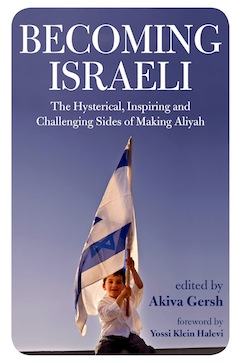
If you or someone you know is considering making aliyah, there is a book that offers a glimpse of the experience. Becoming Israeli: The Hysterical, Inspiring and Challenging Sides of Making Aliyah (Rimonim Press) is a compilation of blogs and essays written by 40 olim (immigrants), including the editor, Akiva Gersh.
“The book speaks about the various sides of aliyah, from the hysterical, to the challenging, to the frustrating, to the emotional,” Gersh told the Independent.
Gersh grew up in the New York area. He and his Philadelphia-born wife, Tamar, made aliyah about 13 years ago. As they were going through the process, Gersh wrote about it in a blog. When he realized others were doing the same thing, he was spurred to collect as much information as he could for publication in book form.
“I kept thinking, someone must have done this,” said Gersh. “People had written about their own aliyah experiences, but not a broad compilation of experiences … and that is what I wanted to do, what I wanted to share. I worked on it for about two years – finding the blogs, talking to the bloggers, telling them what I’m doing, and getting permission to use their posts in the book. And, after about two years doing all this compiling and editing, the book was born.”
In Becoming Israeli, said Gersh, there are the insights of (English-speaking) Jews who have made aliyah, as well as those who have been to Israel, but haven’t yet made the move. “In the book,” he said, “you can really sense the things they love about Israel. Above and beyond that, there is the general world … and much of that includes the Christian world who loves coming to Israel.”
The feedback has been good, especially from olim who have read the book and can relate to their fellow travelers. “They went, ‘Wow! Amazing!’” said Gersh. “Every page, they’re like, ‘This is my story!’ They’re laughing, they’re crying.
“I’ve read the book multiple times and I still laugh at the jokes and cry at the same emotional places,” he added. “It’s a really powerful book and I’ve had really positive feedback from olim who say ‘thank you’ and feel it is awesome … [and] exactly what they’ve been going through and experiencing.”
Gersh is a teacher by training and works in a private English-language school in Israel. He also connects with people using music, through a program he started in 2007 called The Holy Land Spirit.
As a musician and teacher, Gersh offers groups – mainly Christians – who visit Israel an evening program of music, prayer and spirituality from a Jewish perspective. “They love it,” he said. “We pray together, dance together, speak together.”
Gersh teaches at Alexander Muss High School, a study-abroad institution near Tel Aviv. There, kids from 45 different countries come to learn for a few weeks or up to a few months at a time, about Jewish history and Israel. They spend half their time in the classroom and half their time traveling around the country.
“So, it’s academic and hands on,” said Gersh. “It’s awesome. I’ve been there about 10 years now. The language of instruction is English and, for those who want to improve their Hebrew, there are opportunities.
“We have young Israelis who are fresh out of the army. And, for those who want the Hebrew experience, they can get it from them and also from being out and about in Israel.
“The kids are inspired, enlightened, pumped up about Israel,” he continued. “We’re not a religious program. We’re not a church denomination. We’re pluralistic. We have Jews on staff, but we don’t push Judaism. We just open up a space for kids to explore connections to Judaism.”
According to Gersh, many of the students are experiencing certain aspects of Judaism for the first time. This is something especially meaningful for him, he said, noting, “I had no connection to Israel growing up at all. I never thought about it, nor talked about it. It just wasn’t a thing in my community. I heard about it a couple times in Hebrew school, but it wasn’t on the radar at all. By the time I was done with high school, going into college, I was really done with anything Jewish…. In college, I began searching for something more cultural, meaningful, spiritual in my life.
“That journey, which was a three-year journey, took me to many different places, meeting different people, reading different books. At the end of the journey,” he said, “it brought me full circle to Judaism. But, I found a new side and a new expression of Judaism that I hadn’t seen before.”
Among the places Gersh traveled after college was West Africa, where he spent two months learning more about the drumming he studied in school.
“After traveling around there,” he said, “I went to Israel for the first time. I was about 22 years old at that point. I traveled around Israel for two months, backpacking and enjoying, taking a class here, a class there, doing a Shabbat and just really getting into it. After those two months, I realized I wanted to really explore my roots and see what Judaism was about. Still, at that point, I did not want to become religious.”
Eventually, Gersh did become religious. He spent some time in a yeshivah, both in Israel and in the United States, before making aliyah with his wife in 2004.
The foreword of Becoming Israeli was written by Yossi Klein Halevi, an Israeli author Gersh looks up to as a Jew, as someone who made aliyah and as a writer.
“We had a book launch at the beginning of the summer and we had a panel of me and a bunch of other bloggers from the book, and he was one of the panelists,” said Gersh. “It was amazing to have his voice and his perspective.”
Becoming Israeli is available on Amazon, and Gersh also has a website, becomingisraeli.com.
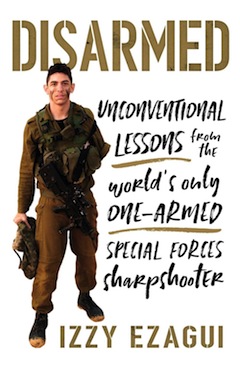
Disarmed: Unconventional Lessons from the World’s Only One-Armed Special Forces Sharpshooter by Izzy Ezagui (Prometheus Books) is confusing, puerile, uneven, exaggerated, chutzpadik and strident – I loved it. I enjoyed every blessed moment involved in reading this extraordinary Proust-like jumble of words and ideas by an Israeli soldier who lost his left arm in a Hamas mortar shelling a decade ago when he was on duty near Gaza.
The unlikely protagonist of this memorable saga is a Sephardi Jew raised in Florida and Crown Heights (New York), and educated first in the public school system and, afterward, in a Lubavitch yeshivah, before making aliyah. His father and mother, whom he idolizes in this book, were complex parents who decided, while Ezagui was still very young, to become more serious about their Judaism.
This autobiography is among the few books available on the intricacies of the Israeli army’s training procedures for inductees into elite units – which Ezagui experienced not once but twice – and, as such, it provides an introduction to what it really means to become a member of Zahal, the Israel Defence Forces. The rigours of IDF training are equal or superior to American, British and Canadian special forces cadres.
When Ezagui’s tent was destroyed by the mortar blast that hit his unit bivouacked near Gaza, the young soldier did not at first realize what had happened to him, so great was the shock to his nervous system. The graphic description he provides of the wreckage to his left arm is not easy reading because it lies outside our normal anatomical parameters but Ezagui conveys quite adequately the physical and psychic damage he endured. It took hours before the extent of his personal catastrophe was fully known.
Ezagui’s comrades were able, once the dust had cleared, to transport him to an Israeli medical facility, where doctors stabilized the young soldier, along with others who had been injured by enemy fire. One of the most poignant parts of this journal is Ezagui’s attempt to speak to his mother on the telephone to impart the news about the loss of his left arm without provoking hysteria on her part.
Part of the treatment the author received from Israel’s medical cadres were heavy doses of very powerful drugs, including fentanyl, a narcotic, he notes, which is a hundred times more potent than morphine; it was the first drug administered to him when the severity of his injury was recognized. This is a relevant observation because, when Ezagui began to recover his sensibilities, he immediately declared that he intended to return to his combat unit. But he soon realized that he would have to go “cold turkey” before he could even think of rejoining his comrades. This he did by dint of unbelievable discipline in the face of incredible suffering from withdrawal.
During this crisis period in his slow recovery, Ezagui was confronted with the negative responses of army doctors, one of whom bluntly told him that his condition precluded the kind of camaraderie and fraternity among soldiers who depend on their peers to help them. That kind of subtle yet direct rejection ironically made Ezagui more determined in his pursuit of his former status as a soldier-sharpshooter. It did not help that he was continually hounded by his “phantom,” the curious physiological phenomenon when a severed limb asserts its presence despite its absence.
In his narrative, Ezagui gives us all the excruciating details of his retraining in the army – this time, with a limb missing. One of the greatest obstacles he encountered was mounting a wall with a rope anchored to it. In his previous incarnation, he had no problem, but one arm wasn’t enough to execute the onerous task. He finally realized that a contortionist’s skill was required to perform the feat and, through the use of his legs and other body parts, he was able to get over the wall.
Ezagui encountered a similar problem with his rifle. It jammed regularly when he tried to insert the shells into it. He overcame his frustration only when he realized that he had to dig his weapon into the ground, anchor it solidly and, then, with his one arm, load the instrument.
Ezagui passed all his retraining requirements and it was the doctor who had initially rejected his attempt to rejoin his unit who certified his reentry into the army.
Disarmed is a testimony to the resilience of one human being who beat the odds and conquered a disability, and Ezagui has become a symbol of what the human spirit is capable of accomplishing.
Arnold Agesis Distinguished Emeritus Professor at University of Waterloo, in Ontario.