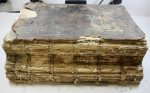
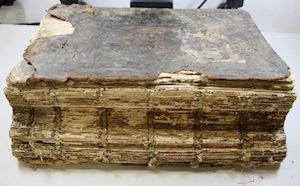
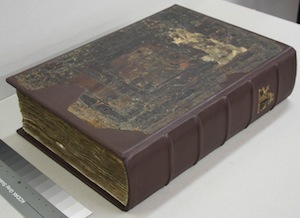
Pinkas Kehillat Frankfurt am Main contains records of the membership dues and other payments made by the members of the Frankfurt community between 1729 and 1739. It also contains copies of records from the 17th century. The pinkas contains 384 leaves and is written in German in Hebrew letters. (photo from National Library of Israel)
Many know that Shavuot, which we just marked, commemorates the receiving of the Ten Commandments. Less well appreciated, however, is that this holiday is the Jewish people’s beginning as the People of the Book. In this regard, it should come as no surprise that, within two weeks of Shavuot, throughout Israel, we celebrate Book Week, Shavuah Hasefer. But enough about new books.
Since the 1970s, in a tucked-away corner of the National Library of Israel, a small, skilled team conserves and restores the books and documents, not just of the Jewish people’s long and complicated heritage, but those of Muslims and Christians.
Timna Elper heads this department, which currently comprises four full-time and one part-time staff. Until I visited them, I did not understand how challenging it is to physically preserve a written legacy – archival materials face a battery of foes, such as fungus, insects and rodents.
So, here is an admission: I naively believed the term bookworm just meant someone who loves to read books. While this does describe a certain kind of person, bookworms are actually an enemy of old books. Moreover, bookworms aren’t even worms – they’re the larvae of several species of beetles. And they have their preferences; that is, they generally leave newer books alone. If unchecked, they start their voracious dining on the spines of older books, moving on to feast on the pages. The sad result leaves books riddled with small holes and badly frayed covers and edges.
Pinkas Kehillat Frankfurt am Main before conservation efforts at the National Library of Israel. (photo from National Library of Israel)
The repair work carried out in Elper’s department is, in a number of ways, similar to work done in hospitals. As in a medical facility, staff members must be highly trained in a number of fields. In the case of the library, we are talking about knowledge of fibres and textiles, entomology, chemistry, etc. To avoid contagion, sanitation is constantly checked: the library, for instance, closes during Passover and Sukkot in order to carry out fumigation of the entire facility. Tests are routinely carried out for fungal and insect damage. Temperature and humidity are monitored. Special care is taken to avoid stacking books too tightly, as this could endanger their physical stability when removed from their shelves. Attention is also paid to lighting (and not just sunlight), as improper or excessive lighting likewise harms books.
As for surgical procedures, library staff members carefully choose the materials for the restoration process, so that the book will accept, rather than reject, the repairs. The staff has to match the materials composing the old texts, be they parchment, animal skin or paper. However, no staff person is engaged as a scribe, as the department does not deal with restoring the text, no matter how faded or distorted it may be.
Along the way, the staff learns a lot about the old books. They learn about the community from which a text originated. They learn about the building of a book and what might have been involved in producing it. They explore questions that deal with the book’s content, as well as its cover. Was the book covered immediately or later in its life? Was the cover added where the book was written or was it put on in another country? And, if it was added in another country, what does this tell us about cooperation between historic Jewish communities?
Sometimes, to complete the restoration process and return the book for use, the staff employs specially developed machines, such as the Leafcaster, a machine that was developed by the department’s first director, Esther Alkalai. The Leafcaster helps strengthen a page by adding pulp to it.
Once the restoration is complete, the materials are available for study or for exhibition. To a degree, this action puts the texts at risk for contamination or physical damage. Thus, when the National Library loans rare items for temporary display, the restoration and conservation lab goes into full swing with a complicated process of ensuring the articles travel safely. The condition of the items is meticulously inventoried before they leave the library and when they are returned. In addition, a staff person from the lab accompanies the items in order to review the state of the pieces with the receiving institution and to help make sure that the loaned materials are being shown in a way that will not cause harm. When the exhibit closes, a staff person returns to the hosting facility to safely bring the valuable books and manuscripts back to the library. The library also makes special security and customs arrangements. An agreement is signed stating that the loaned articles will all be returned to Israel.
Pinkas Kehillat Frankfurt am Main after conservation efforts at the National Library of Israel. (photo from National Library of Israel)
The restoration process is expensive, and the waiting list for repairing these treasures is in the thousands. While there are donors willing to underwrite the cost of digitizing archival material, few people are willing to contribute to the cost of the restoration.
Elper would love to have people adopt archival material, so that it could undergo restoration at the National Library of Israel. Such a program, she said, has been instituted at the British Library and other institutions. Reportedly, at the British Library, the funds raised through its Adopt a Book program have supported the conservation of thousands of items – books, manuscripts, maps, photographs, stamps and works of art on paper. The possibilities are numerous; one of Elper’s suggestions is to approach different ethnic communities or individuals to adopt or sponsor the repairs needed on an article from their community of origin.
Asked what was the library’s most difficult project to date, Elper said all projects have their challenges. While difficult was not her choice of word, she admitted that preparing for the arrival of a large external (out-of-the-library) archival collection required painstaking attention to removing any known contaminants and, stage-by-stage, safely transporting these acquisitions to the National Library’s archives.
Among the most satisfying projects for the team, Elper said when asked, was the preparation for the recent exhibit at New York University’s Institute for the Study of the Ancient World, called Romance and Reason: Islamic Transformations of the Classical Past. The library lent the institute exquisitely scripted and illustrated manuscripts dealing with the story of Alexander the Great.
The repair of items (donated and purchased) creates a living testimony of history. It is the hope of the National Library of Israel that these rare and cherished books will receive even more attention when the library moves to its new facility in 2020.
As a closing note: if you have old books you love, keep them away from direct light and, to protect them from dust and other grime, store them in archival-quality, acid-free envelopes. Don’t do as yours truly had been doing, keeping them in various Ziploc bags. In closed plastic bags, the books have limited ability to breathe.
Deborah Rubin Fieldsis an Israel-based features writer. She is also the author of Take a Peek Inside: A Child’s Guide to Radiology Exams, published in English, Hebrew and Arabic.
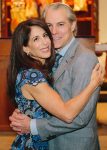
This year’s Jewish National Fund, Pacific Region, Negev Dinner honourees are Michelle and Neil Pollock. (photo from Pollock family)
For their contributions to a diverse range of philanthropic causes, Neil and Michelle Pollock are being honoured at this year’s Negev Dinner.
“Jewish National Fund of Canada, Pacific Region, is proud to have Dr. Neil and Michelle Pollock as our 2018 Negev Dinner honourees on the occasion of the 70th anniversary of the state of Israel,” said Ilan Pilo, shaliach and executive director of JNF Pacific Region. “Their longtime contribution to the community and their leadership are widely recognized, as they are inspirational philanthropists who go above and beyond to involve the community in creative ways to fund critically important projects. We are very pleased they have chosen to work with JNF and ALEH Jerusalem on the Outdoor Terrace Project and the Hydrotherapy Pool, which will benefit seriously disabled children and youth in Israel.”
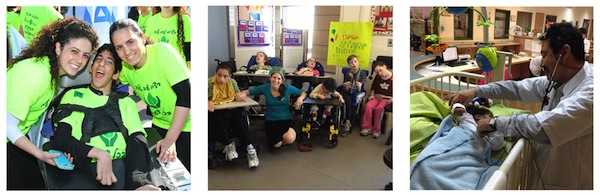
ALEH Jerusalem provides 82 children and young adults with comprehensive professional care, including special education, as well as medical, supportive and therapeutic care.
“I’m honoured, as I know Michelle is, for us to have been recognized and included in this legacy of community leaders and builders, a few of whom I have been privileged to meet, and who have been mentors and role models for myself and others in our community,” said Neil Pollock. “I look forward to having the opportunity to contribute to the cultivation of future leadership in our community in a similar way.”
The Jewish National Fund is important to the family, said Michelle Pollock, because the projects it supports focus on infrastructure in Israel.
“They’re all reflective of Jewish values and helping with the viability and integrity of the Jewish state,” she said.
Michelle Pollock is a lawyer who practised litigation in Vancouver before devoting herself full-time to their family. She is the immediate past president of the board of the Jewish Community Centre of Greater Vancouver, and has co-chaired the Jewish Federation of Greater Vancouver annual campaign’s women’s division Lion of Judah category for six years. She has been involved with Jewish education and a host of other causes.
Dr. Neil Pollock is chief surgeon and medical director of Pollock Clinics. Over more than 20 years, he has developed minimally invasive techniques for vasectomy, circumcision and frenulectomy procedures. The Pollock Technique has a greater than 99.9% success rate and results in decreased risk of post-vasectomy pain. He has undertaken teaching missions to Rwanda, Congo and Haiti, where he trains local doctors in circumcision, and said the work he has done in Africa and Haiti is among the most meaningful contributions he could make to humanity.
“Our team successfully gave our surgical colleagues in those countries the surgical training, as well as the equipment and supplies, to safely carry out surgical procedures that will save, over the years to come, thousands of lives by reducing HIV transmission,” he said. “Circumcision has been scientifically shown to reduce HIV transmission by 60%. It has been equated to providing protection equivalent to a vaccine against the disease. Sharing my technique provided the mechanism to offer in those countries, for the first time, a safe, quick, painless approach for circumcision that families would happily and readily accept. I continue to search out places around the globe where myself and my team could have similar impact for communities at risk. God willing, there will be more surgical missions in our future.”
Pollock has also developed a unique surgical training program for mohelim, who perform brit milot. He is a mohel himself and, in lieu of accepting fees for his work, advises families to donate to the
Pollock Family Philanthropy Fund at the Vancouver Foundation in honour of the lifecycle event and to support those in need in the community. The philanthropy fund supports the surgical teaching missions to the developing world, as well as organizations including the Arthritis Society, B.C. Cancer Foundation, schools, social service and community agencies.
Pollock’s involvement with the Jewish Federation of Greater Vancouver includes four years as head of the major gifts division and, in 2015, he served as chair of the general campaign, which raised $8.3 million.
“Michelle and Neil Pollock are among the most committed volunteers in our community,” said Karen James, chair of the board of Jewish Federation. “When asked to help, they step up. The Pollocks have been involved with countless initiatives we’ve undertaken at Jewish Federation to address vital community needs…. In response to his work, Neil has been recognized by Jewish Federation’s board with the Woogman Award, for his consistent and conscientious leadership by example. The Pollocks truly help to make our community stronger.”
In addition to their shared involvement with Jewish Federation, the Pollocks support Jewish Family Services. Neil Pollock has served as a board and executive member and is a Friend for Life, a category of donors with lifetime giving of $100,000 or more. The couple also provide an annual matching gift for the Innovators Lunch to inspire philanthropy; these funds are dedicated to the Jewish Food Bank.
They additionally support the Ohel Ya’akov Community Kollel, where Neil Pollock is a member of the board of governors and of the fundraising and building committee. He described the Kollel as one of the “less visible but most critical, vibrant and productive organizations in our community today, providing inspirational and educational programming through lectures, social events connecting Jewish youth, hosting Shabbat and Jewish holiday celebrations, all in a safe and accepting environment where everyone can feel comfortable – from Reform to Orthodox.
“I personally am deeply grateful to the founder of the Kollel, Rabbi [Avraham] Feigelstock, for the many hours of teaching, counseling and support that he has quietly provided for me and so many others I know,” said Pollock. “He has sought to help us develop the leadership skills and sound judgment, through both his core Jewish teachings and by cultivating menshlichkeit values, that he hopes we can be guided by in our personal, business and community work, in turn, helping us to be better equipped to meaningfully give back to our community for the years to come.”
Rabbi Shmulik Yeshayahu, director of the Kollel, said Michelle and Neil Pollock have truly embraced the concept of tikkun olam.
“They both contribute meaningfully; not only financially, but also give time, expertise and insight,” said Yeshayahu. “Their personal involvement in the Jewish community is priceless. We so appreciate their community involvement and care, vision and leadership, and wish them continued success in all that they undertake.”
“It was through the JNF, in my elementary school years, that I was given my earliest opportunities to participate in and contribute directly to the growth and well-being of the state of Israel,” said Neil Pollock. “This helped me to appreciate the importance for Jews to be interested in and responsible for doing our part for our homeland, which has remained with me to this day. And now, again through the JNF, we have been given this very gratifying opportunity to personally identify and support a phenomenal project – ALEH Jerusalem – to again help the state and its people in need, in a very meaningful way.”
ALEH Jerusalem provides 82 children and young adults with comprehensive professional care, including special education, as well as medical, supportive and therapeutic care. (photos from JNF Pacific Region)
Michelle Pollock’s connection to JNF and Israel stem from her family’s history. Her mother’s father was sent from Poland to Canada, alone, at the age of 14, to make enough money to send for the rest of the family.
“It took him too long,” she said, “and his family was wiped out.”
Pollock’s mother, as a result, was raised in a home clouded by survivor’s guilt and where the past was not discussed. But Zionism was at its core.
“Support and survival of the Jewish state was a complete, tangible imperative because of her father’s experience,” said Pollock. “I see this now, reflecting back.”
The lessons of Jewish statelessness are embedded in her family.
“I can’t separate my Jewish sense of self from my support of Israel,” she said. “It’s all tied together. It’s one and the same.”
Neil Pollock’s philanthropic vision is both local and global.
“I have seen firsthand through my many years of volunteering with Federation, culminating in chairing the 2015 annual campaign, how critical the JFGV is for our community,” he said. “It is so important to have an organization to canvass so effectively the support of our community while carefully researching and assessing the needs of our community and its constituent organizations and thoughtfully allocating our resources in a balanced way, ensuring all facets of our diverse community needs are supported.”
Supporting JFS, and specifically the Jewish Food Bank, he added, “aligns with our core values regarding our responsibility to support those less fortunate and in need of the essentials, like food, shelter, medical care…. There is so much affluence in our community that, in our minds, there cannot and will never be, any justification for leaving anyone, any vulnerable individuals, behind.”
Most of the honourees at the Negev Dinner over the years have been older than the Pollocks, who have three children in high school. Far from approaching the end of their philanthropic endeavours, both talk enthusiastically about future plans.
Michelle Pollock has been very committed to Jewish education, originally when her kids were at Vancouver Talmud Torah and, more recently, supporting King David High School.
“The kids that go there and come out of there are so proud of their cultural heritage,” she said. “It’s an interesting thing to see in teenagers. It moves me greatly.”
Now she is turning more of her focus to Holocaust education and Israel advocacy, which her family history has taught her are closely interrelated. She plans to deepen her involvement with the Vancouver Holocaust Education Centre.
“I think Holocaust education is important. But, at this critical point, where we still have survivors, it’s imperative. Every single non-Jew that you touch with the story of a survivor, that is an invaluable experience. I think we all have a duty to do whatever we can to support Holocaust education.”
“The VHEC … all I can say is wow. For the past few years, I’ve been going to their symposium at UBC. It’s really unbelievable … being at UBC and being in this very secular place and looking at all these kids that have traveled by bus all day from all over the Lower Mainland, and watching them hear the stories of survivors and ask their questions. I think Holocaust education is important,” she said. “But, at this critical point, where we still have survivors, it’s imperative. Every single non-Jew that you touch with the story of a survivor, that is an invaluable experience. I think we all have a duty to do whatever we can to support Holocaust education. And I’m a huge fan of the [Holocaust] centre.”
She also recently joined the Israel and overseas affairs committee of Federation and hopes to advocate for Israel through that and other avenues.
“I see my focus for the next long while in those two areas because I really see them tied together,” she said. “Holocaust education and Israel advocacy. I think it will grow and change. I’ll just keep finding ways to contribute.”
As immediate past president of the JCC, she is continuing a commitment that began 14 years ago, when she first joined the board. Part of her motivation is that, coming originally from Montreal, she finds it can be more difficult to stay Jewishly connected in places like Vancouver, where the community is not as deeply rooted.
“I definitely think it’s easier in some of the older, more established Jewish communities and I think my personal passion is to do whatever we can to make it easier to be Jewish and live Jewish,” she said. “I think the JCC has all the programming and all the events that help you touch on Judaism in your daily life. But, even more than that, just walking in that building makes you smile in a uniquely Jewish way.”
Also from away, in his case, Winnipeg, Neil Pollock said he is grateful for being “so graciously welcomed and accepted in this community, and for the wonderful network of friends that we are lucky enough to be surrounded by.”
He is philosophical about his plans, hoping, he said with a laugh, to get better with age, “like the great wines in my cellar.”
“Every day we wake up, we are slightly different people, remolded and growing with all-new experiences,” he said. “Hopefully, we capture and deploy the insights we gain to allow us to be more mature and effective leaders.”
He continued: “While my kids are young and at home, they will continue to be my top priority. My business has now moved to a global level, so … I am more engaged, involved and excited now about future potential than ever.
“Often, I feel over-committed with my career, family and other things that happen in my life, but, at these moments, I try to remember that I also have a greater purpose and a greater responsibility and that is the one to my community,” he said. “I believe we all have an obligation to care for others and help those who are in need. We also must ensure that our Jewish traditions and values are maintained for generations that will follow, through our support of Jewish education and local Jewish institutions.”
He wants his experience to demonstrate that anyone can have an impact on the community.
“I hope that the great diversity of backgrounds amongst our community leaders serves as an example and inspiration to the many truly talented members of our community who may have ever questioned their ability to get involved and make a difference.”
“Some community members may believe that, in order to be an influential leader and have a meaningful impact, one must come from a family with a strong history of leadership and/or affluence,” he said. “This is not the case in our community. And I hope that the great diversity of backgrounds amongst our community leaders serves as an example and inspiration to the many truly talented members of our community who may have ever questioned their ability to get involved and make a difference.”
He added: “I want to thank all the community organizations that have welcomed us and provided us with the opportunity to become involved and give back.”
Asked about how he would like people to think of him in future, Pollock said, “I would like to be thought of and remembered in a similar way, I’m sure, to [how] most people would: as an individual concerned with things other than those that are immediately self-gratifying, and who is interested and active in doing his small part to ensure that opportunities to help others were not missed, and that meaningful efforts were undertaken to ensure the Jewish community and broader community in which we lived thrived.”
The JNF’s Negev Dinner takes place June 3. Honourary chairs of the event are Alex and Jodi Cristall and Harvey and Jody Dales. For tickets and more information, visit jnf.ca/index.php/vancouver.
In Jerusalem on Sunday, May 13, which was Jerusalem Day, there was a strong feeling of anticipation, as Israelis waited for Monday’s opening in the city of the new American embassy. Other countries are expected to follow the United States’ lead, starting with Guatemala, which opened its embassy in Jerusalem two days later, and Paraguay.
Twenty-three students from Metro Vancouver joined more than 10,000 other students in this year’s March of the Living. They are pictured here with Jewish Federation of Greater Vancouver board chair Karen James, far left, and trip chaperones Susan Siklos, standing to James’ left, and Charlotte Katzen, standing fourth from the right. (photo by Jennifer Freedman)
Twenty-three Grade 11 and 12 students from Metro Vancouver headed to Poland and Israel on the annual March of the Living last month, and nine of those were students from public schools. In the past, Vancouver has sent about 14 students every couple of years. The increased numbers this year were the result of outreach by a volunteer committee headed by Charlotte Katzen.
“March of the Living is a life transforming experience,” she told the Independent. “Every participant will tell you that. It strengthens students’ Jewish identity, their understanding of who they are as Jews in the world today and their commitment to Israel.”
Katzen helped assemble a video in which march alumni, their parents and Holocaust survivors talked about their experience, the impact of the journey on young people and how important it is for them to become a witness. The committee showed the video in open houses at King David High School and at Jewish afterschool programs and other Jewish venues.
“When march alumni tell their friends, ‘You have no idea how impactful this journey is,’ it’s a powerful message and they want to join,” said Katzen about the video.
March of the Living is not an inexpensive venture, so Katzen worked with Jewish Federation of Greater Vancouver to help secure funding for students who couldn’t afford the trip.
“Federation really came through,” she said. “We’ve not yet reached the point of having sufficient funding, but, this year, Federation made a commitment that no child would be turned away. That commitment enabled us to say, during our outreach, ‘Don’t worry about your financial situation. If you want to go, you will go.’”
Federation offset the cost of the trip by $2,000 for each participant using funds raised by the annual campaign. Scholarships were also offered to families that needed them.
Noa Platner, a Grade 12 student at King David, was one of the participants. She described her time in Poland as “very hard, intense in a way I didn’t expect. We’d go to the camps and hear the story of a specific family, which helped us feel really connected,” she reflected. “But it was very hard, and it crushes you on the inside. I realized all the people who went through the Holocaust had their own individual stories. You always hear the number of people, but you don’t think of the emotions they felt.”
For Trevin Kiel, a Grade 11 student at Hugh Boyd Secondary School in Richmond, the march, which was attended by more than 10,000 Jewish students worldwide this year, was an opportunity to get a sense of the scale of the Holocaust. “I wanted to see what 10,000 Jews looked like, to compare it to six million,” he said. The stories of Nazi brutality were hard to absorb, he admitted, “but we debriefed every night as a group, and it felt reassuring to share our feelings with others and know they were feeling the same way.”
Kiel had visited Israel previously with his family, but said this time was much different. “It was the best trip I’ve ever been on, it was just so much fun and such an eye-opening experience.”
The group was in Israel for Yom Hazikaron and Yom Ha’atzmaut.
“I didn’t expect it would be an emotional time but I was more emotional in Israel than at the camps in Poland,” Platner said. “After all we Jews have been through already, to realize we’re still fighting and innocent people are dying was very crushing. But one of our guides told us we should feel proud that we’re still standing, strong enough to fight this time and do the best we can.”
Katzen helped prepare the students before they left Vancouver and participated in the march as well, co-chaperoning this year’s trip with Susan Siklos; Federation board chair Karen James was also part of the group.
“The students bond with each other and become so close by the end of the trip,” Katzen observed. “We grieve and celebrate collectively and we become one big, beautiful, coherent family. This trip changes them profoundly and makes them stronger, more tolerant of others and of each other.”
Being in Israel for Yom Hazikaron was no minor detail of the itinerary. “They realize, on Yom Hazikaron, that having a homeland comes at a very high cost,” said Katzen. “We can celebrate but we have to be aware that our homeland also has very tragic stories.”
A guide on the trip shared with Vancouver students the story of a friend who was ambushed and killed while serving in the military. “It’s one story of thousands,” Katzen said, “but the kids understood how difficult it is for families to put their own children’s lives at such high risk in order for the country to exist. They got it.”
Kiel and Platner both agreed that their participation in March of the Living has changed them in ways they’re only beginning to understand.
“My Jewish identity has changed,” Platner said. “I feel a stronger sense of purpose to follow the traditions and be a part of my community in honour of those who died and are still dying for our nation.”
Kiel said, prior to the march, if non-Jewish friends at school made jokes about Jews or about the Holocaust he would get angry or frustrated. “Now I feel like I can educate people on why it’s wrong to make jokes like that, and make sure they never tell a joke like that again,” he said. “If they knew the scale of the Holocaust, they wouldn’t make jokes.”
He’s returned with a stronger Jewish identity, he added. “I’ve started to wrap tefillin two to three times a week now. It reminds me of the trip and the memories I made there.”
He said, “I know there are lots of other trips that go to Poland, but not like this one.”
Platner agreed. “March of the Living gave me a sense of hope, pride and belonging.”
For information on joining a future March of the Living trip, contact Federation or visit marchoftheliving.org.
Lauren Kramer, an award-winning writer and editor, lives in Richmond. To read her work online, visit laurenkramer.net.
In a speech to the governing body of the Palestine Liberation Organization last week, Palestinian President Mahmoud Abbas rambled off a host of textbook antisemitic myths. He reiterated the refrain that Jews have no historical connection to the land of Israel, unearthed a legendary trope about Ashkenazi Jews actually being descended from Khazars and accused European Zionists of collaborating with the Nazis.
Abbas went on to say that the tragedies of Jewish history were not a result of antisemitism, but of Jews’ own behaviours. “The Jewish question that was widespread throughout Europe was not against their religion,” he said, “but against their social function, which relates to usury and banking and such.”
One of the things Abbas has in common with other elected leaders is the willingness to try to get away with something and then to apologize when called out. Though his wasn’t much of an apology: “If people were offended by my statement … especially people of the Jewish faith, I apologize to them.”
The speech gave Israeli and other commentators the opportunity to once again insist that the Palestinian leader is no partner for peace, something that is no more or less true today than it was last month. Abbas has been saying things like this most of his adult life. His doctoral dissertation, which was later published as a book, quibbled over the number of Jewish victims of the Shoah and advanced the perverse conspiracy theory he returned to last week: that Zionists were Nazi collaborators for whom six million (or, on Abbas’s abacus, fewer) Jewish lives were a small price to pay for advancing the Zionist cause.
Inherent to most antisemitic suppositions is the defence that Jewish particularities, habits, traditions, identities – in other words, whatever stereotypes the purveyor is advancing – are the legitimate causes of Jewish woes. In Abbas’s telling, all European Jews were usurers and bankers. (Consider the corollary: That, if true, being bankers and usurers would seemingly justify genocide.)
It is appalling that a man who is accepted as a legitimate figure on the international stage can claim, with minimal consequence, that Jews brought the Holocaust upon themselves. So, the most salient point from this terrible incident may be what it says about his audience.
Consider this in the context of the widespread global interpretation of the Arab-Israeli conflict. One can disagree with the policies or approaches of an Israeli government or any number of historical and contemporary developments. But, by no fair reading of history can the full blame for 70 years of conflict be laid at the feet of Israelis. Yet, at almost every point in history – when a pizzeria blows up in Tel Aviv or Jews are stabbed walking down the street in Jerusalem or when Hamas sends thousands to the Israeli border and floats firebombs that set the Israeli landscape aflame – there will be a sizable number of people who will conclude that Jews brought it on themselves.
Whatever else his speech may have accomplished, and despite his apology, Abbas has succeeded in bolstering the stereotype that cunning Jews will sacrifice whatever is necessary to reach their devious aims, and that any horrors that befall them are their own fault. That suits the contemporary popular narrative neatly.
Jerusalem has been reunited now for 50 years. For five decades, we have had the privilege of praying at the Kotel, the Western Wall. On Jerusalem Day, 28 Iyar, which falls this year on May 13, thousands of worshippers will flock to the city, many before sunrise.
Nothing has ever come easily to the Jewish people. For 19 years, from 1948 to 1967, Jerusalem was cut in half and, at the Mandelbaum Gate, outside the Old City, there were signs: “Danger. Frontier ahead. Snipers nearby … stay out of the middle of the street!” Neighbourhoods and streets were split down the middle. Jews were evicted from their homes and synagogues in the Old City, and the Western Wall was out of bounds. Across the dividing line, Jordanian troops stood with rifles at the ready.
Jerusalem’s story covers thousands of years, but this segment began in 1948. Before the ceasefire was signed on Nov. 30 that year, Moshe Dayan, the commander of Israel’s forces in Jerusalem, met with his Jordanian counterpart, Abdullah El-Tel. In a deserted house in Musrara, they marked out their respective positions. These rough, indistinct marks expanded from the heat and blurred over time, yet they were accepted as the borders between Jordan and Israel in Jerusalem. The map was locked up at Government House and referred to in all disputes.
On June 5, 1967, while Israel was still warning King Hussein of Jordan to stay out of the impending war, a foreign radio station announced the conquest of Mount Scopus by Jordanian troops. It was a mistake, but it confirmed Israel’s suspicions of Jordan’s intentions, and that Mount Scopus, with its Hebrew University and Hadassah Hospital, was in danger. The Jordanians believed that Israeli troops would come from east to west, but instead the Jerusalem Brigade attacked from the opposite direction, taking Armon HaNetziv, three Jordanian positions, the Arab village of Sur Baher and Mutzav HaPaamon, before several Arab troops came out of hiding and killed six Israeli soldiers.
Below, on the road to Bethlehem, stands Kibbutz Ramat Rachel. Jordanians and Egyptians fought Israelis on the southernmost part of the dividing line and the kibbutz changed hands three times. However, the Israelis eventually held it, which helped stop the Arab invasion of southern Jerusalem.
Soldiers of the Jordanian legion conquered the British High Commissioner’s residence, but were driven back by the Israeli Defence Forces, who moved towards the City of David. At dawn on Tuesday, 27 Iyar, a unit of paratroopers advanced, taking the police school, the district of Sheikh Jarrah, the American Colony and the area of the Rockefeller Museum. After a bloody battle at Ammunition Hill, the paratroopers reached Mount Scopus.
Jerusalem’s great day was 28 Iyar. With a daring thrust, Israeli soldiers scaled Mount of Olives, advancing beyond the village of Al-Azariya. Armoured vehicles burst through the Lions’ Gate towards the Temple Mount. At 10 a.m. came the announcement: “The Temple Mount is ours. It is in our hands!” Soldiers, even secular ones, ran towards the Western Wall, caressing its stones, their eyes full of tears and with a prayer on their lips, even if they didn’t know the words. A few minutes later, Rabbi Shlomo Goren, then IDF chaplain, blew the shofar at the holy site. David Rubinger, a military photographer, took the now-famous photo that has been reproduced around the world, of a soldier named Yitzhak Yifat (who is now a gynecologist living in Rishon lesion), removing his helmet and looking up at the wall in awe.
One of the first to reach the Kotel was a former Australian, Mordecai (Mark) Rechtschafner, from my hometown of Melbourne. He told me that, although he was overwhelmed by the sense of history at that moment, he was far from euphoric. Heavy losses had been sustained and he had lost many comrades. “I was exhausted, filled with sadness at the unbearable death of so many of my friends,” he said. “The Six Day War ended swiftly, but we paid a heavy price.” Every year, on Jerusalem Day, he comes to the city from Kibbutz Ein Zurim, where he lives, for the memorial service, to pay tribute to the many friends he lost in the battle.
Until the First Intifada and its ongoing aftermath, the hope of peaceful coexistence between Jews and Arabs seemed a possibility and some believe it still is. Thousands of Arabs used to pour into Western Jerusalem each morning to work. On weekends, the narrow lanes of the Old City’s Arab shuk (market) would be packed with Israeli shoppers, but, today, it is mostly tourists who fill the market. The future is a question mark, as ongoing violence brings renewed tears to families throughout the land.
But the city of Jerusalem remains unforgettable and heartbreakingly beautiful. To me, it is a poem. One night, as darkness descended, I was moved to write these lines:
Black velvet spangled with stars Is night in Jerusalem. Splashes of silver, The sob of the wind, An ancient perfume, A taste of nectar. Skyline of turrets and domes Is night in Jerusalem. Pine trees are sighing. Through a tracery of leaves Golden lights dot A midnight canvas. Landscape of enchantment Is night in Jerusalem.
Dvora Waysmanis a Jerusalem-based author. She has written 14 books, including The Pomegranate Pendant, which was made into a movie, and her latest novella, Searching for Sarah. She can be contacted at dwaysman@gmail.com or through her blog dvorawaysman.com.
Yikealo Beyene, left, and Oded Oron. (photos courtesy of the speakers)
Yikealo Beyene was among the first wave of African asylum-seekers to arrive in Israel. He left his home in Eritrea in 2005, at the age of 21. The political situation in the country had deteriorated since 2001 and, after Beyene penned an article critical of the authoritarian regime, he was arrested twice. He walked under cover of darkness to the Ethiopian border and spent more than three years in a refugee camp, where he earned a stipend as a teacher and running a makeshift library.
“I did not complain,” Beyene told the Independent. “Life was extremely difficult [but] I felt safe.”
That changed when hostilities reignited between Eritrea and Ethiopia. The camp’s proximity to the Eritrean border made Beyene and others worried. Military service is mandatory in Eritrea, so every emigrant is a de facto deserter. With a group of fellow refugees, he traveled to Sudan, and to another refugee camp.
Beyene, who will speak in Vancouver this month at an event co-presented by the Independent and Temple Sholom, stresses that he is not a typical refugee. Unlike many, he had a small nest egg that allowed him to buy tickets to move between places and, as his story proceeds, crucial supports from family, nongovernmental organizations (NGOs) and generous strangers overseas. Most are not so fortunate.
Life in Sudan felt no safer. Eritrean security forces would sometimes cross into Sudan and abduct people.
“It was terrible,” he said. “It felt even more dangerous than my life in Ethiopia. I decided to leave. I ended up in Egypt.”
In Cairo, he lived in an apartment with about 30 other refugees. By this point, the Egyptian government (as well as that of Libya) had an agreement with the Eritrean government to repatriate citizens of that country. Concurrently, Libya had signed an agreement with Italy preventing people from migrating across the Mediterranean. Egypt’s comparative stability would soon be upended by the Arab Spring and its aftermath. Escape routes were closing.
In Cairo, word spread that smugglers were willing to help people cross the Sinai to Israel. Employing Bedouins, Beyene made it to the Israeli border in February 2008. He thinks he paid about $600 US to the smugglers. As migrants flowed toward Israel in later years, that number would skyrocket to as much as $50,000, Beyene said, and lead to a horrific trade founded on kidnapping, ransoms and organ harvesting.
Once inside Israel, Beyene and the two dozen or so other asylum-seekers he traveled with were transferred to successive military camps and, eventually, bused to Be’er Sheva, where they were left to their own devices in the cold midnight air. With three others and pooled cash, he made his way to Tel Aviv and, after connecting with Eritreans there, immediately found jobs in Jerusalem, doing construction and custodial work.
Beyene, again unlike most asylum-seekers, obtained an education, entering the Interdisciplinary Centre in Herzliya, where he received a bachelor’s and a master’s in psychology, thanks to part-time jobs, scholarships, help from NGOs and an American Jewish benefactor.
A woman who was his girlfriend in the first refugee camp had been accepted to the United States in 2009 and, in 2012, she came to Israel and they were married. He moved to Seattle on a family reunification visa.
Beyene will share more of his story at the event May 19, where he will be accompanied by Oded Oron, an Israeli and a PhD candidate at the University of Washington, whose dissertation deals with African asylum-seekers in Israel.
For Sudanese migrants, Oron said, repatriation was potentially deadly because many, especially Darfuris, were fleeing the deadly persecution of Janjaweed militias or had been part of rebel groups opposing the tyranny of Omar al-Bashir. For all refugees, the crisis was exacerbated by the smugglers’ greed.
“Entire communities would sell everything they had or work an extra shift just to make sure that they can release people,” said Oron. “Unfortunately, many people were tortured and killed in the Sinai. Some of them were killed because they couldn’t raise the funds and others were harvested for their organs.”
In all, about 64,000 asylum-seekers entered Israel, of which 37,000 remain. Most of those who left migrated to Europe or North America. A much smaller number accepted an offer of resettlement to Uganda or Rwanda, though, of these, many found themselves still lacking in rights or opportunity and returned to the migration route, some dying on the way.
As the numbers of asylum-seekers skyrocketed, detention facilities that were never meant for illegal border-crossers, became overcrowded. The prison authority gave inmates one-way bus tickets to Tel Aviv. At times, there were 3,000 Africans sleeping under the stars in Levinsky Park, outside Tel Aviv’s main bus station.
In 2014, the government opened the Holot Detention Centre, a prison in the Israeli desert. After several NGO appeals, the Israeli Supreme Court determined that detention of asylum-seekers must be limited to one year and there has been a rotation of people serving their one-year term of detention and then returning to the legal limbo of life as an African asylum-seeker in Israel.
NGOs asked the Supreme Court to interpret the status of the migrants. The government maintained that it would neither process their asylum requests nor give them work permits. However, under pressure, the government told the court that it would not enforce the ban on working. The government did, however, require employers to collect deductions for taxes, as well as for social services for which the migrants are not eligible, and to withhold 20% of their income, to be released only on their exit from the country.
In November 2017, the government declared its plan to offer asylum-seekers two choices: accept $3,500 US and a plane ticket to Rwanda or Uganda, or face indefinite detention.
In March 2018, following public pressure, Rwanda backed out of the deal. The government then suggested a resolution that would see about half the 37,000 offered a temporary residency short of citizenship, while 16,000 would be resettled in Western countries, through a deal brokered by the United Nations High Commission for Refugees.
Even so, right-wing members of the governing coalition balked. The “solution,” announced in the morning, was annulled in the afternoon.
Then, late last month after Uganda, too, backed out of the agreement with Israel following public pressure, the Israeli government told the court that it would not proceed with the deportation plan for now.
The Jewish Independent and Temple Sholom invite readers to join us at the event Let My People Stay: Seeking Asylum in the Jewish State. In the spirit of learning on Shavuot, it will take place on May 19 at Temple Sholom. Shavuot services will start at 7:30 p.m., followed by Havdalah and an ice cream oneg at 8:30 p.m., and the program at 9 p.m. Everyone is welcome to all or part of the evening. RSVP to templesholom.ca/erev-shavuot or 604-266-7190, so that there will be enough ice cream for everyone.
***
Number of African* migrants entering Israel by year.
2006 – 2,758
2007 – 5,132
2008 – 8,886
2009 – 5,261 (decline possibly attributable to war with Gaza)
2010 – 14,715
2011 – 17,272
2012 – 10,421 (barrier completed along Sinai border)
2013 – 49
2014 – 21
2015 – 220
2016 – 18
2017 – 0
* Approximately 70% Eritrean, 20% Sudanese and 10% from other African countries.
Last week, I participated in a survey on Canadian Jews done by the Environics Institute for Survey Research, in partnership with Prof. Robert Brym of the University of Toronto and Prof. Rhonda Lenton of York University. It’s considered a “landmark national survey of Jews in Canada in 2018.”
The phone call came at 5 p.m. This time coincides with making dinner, school lunches for my kids, feeding our dogs, and keeping the twins and dogs from roughhousing too much in the meanwhile. (Did I mention my biologist husband was away, doing field work?)
However, I knew this was important. This was a situation where my opinions and experiences mattered. I needed to contribute despite being the only adult present to address the chaos at my house.
Often, we think of politics, religion and money as things to avoid. They’re too emotionally laden to make good dinner conversation. Still, we need to talk and think about this to figure out where we stand. If one looks only at the Torah portion of the week, you might see it as black and white pronouncements about how one should behave or observe the commandments. Yet Oral Law is also part of Judaism. We care what the rabbis thought and discussed. Over thousands of years, our ideas developed, changed and grew. Those talmudic discussions include majority and minority opinions, as well as stories and sayings.
In our tradition, subtle differences matter. Opinions matter. According to the joke, if you ask two Jews, you’ll get three opinions.
That’s why I was stunned by the reaction to actress Natalie Portman’s choice to decline the Genesis Prize. In her statement, she lovingly celebrated her Israeli identity, her friends and family and her citizenship. She also explained that she felt uncomfortable with the current government, specifically, Prime Minister Binyamin Netanyahu’s choices, and its “violence, corruption, inequality and abuse of power.”
A torrent of media and political reaction followed, some of it hysterical in tone. The president of the Zionist Organization of America, Mort Klein, was downright misogynistic. He called the Harvard-educated actor and director “beautiful, but not too bright.”
Portman carries two passports as a dual American-Israeli citizen. Some called for her to be stripped of her Israeli citizenship. Since when is it OK to tell someone they can no longer be a citizen of a democratic country because she spoke out on political issues that concern her?
I’m a dual American-Canadian citizen. If I speak out on a political issue, I am within my rights as a citizen of (either) democratic society. I hear comments on Prime Minister Justin Trudeau’s government or U.S. President Donald Trump’s latest tweets wherever I go. All that said, some of those survey questions made me realize – I no longer feel comfortable publicly writing about or speaking either in support of Israel or criticizing Israel’s policies. Why?
All subtlety has dropped out of the conversation.
Old guard, right-wing Zionists who say “I stand with Israel” bristle whenever anyone says something critical of the current Israeli government’s policies. Meanwhile, anyone with liberal or left-wing politics feels uncomfortable with the notion that Israel would deport asylum-seekers, never mind the current violence with Palestinians or the reactions to their using the word “occupied.”
Many have given up even trying to discuss the issues. They don’t want to be attacked. Getting vitriolic responses from friends, acquaintances and family members, or a stream of emails about those “antisemites,” or worse, seems par for the course now.
A New York magazine article online, “Natalie Portman and the crisis of liberal Zionism,” helps explain the dilemma. Many younger North American Jews embrace liberal North American politics about equality and human rights, and feel disconnected from Israel. The old notion of a liberal Zionist or progressive supporter is no longer courted by Israel, either. The support of Christian evangelicals and a growing block of Orthodox, conservative voters might mean that some in Israel believe they no longer need the support of those liberal Zionists of old.
You may wonder why my columns don’t discuss Israel much. I’d respond with what Israelis told me as a teenager, living on an Israeli kibbutz. “If you want to weigh in on Israeli politics? Move to Israel and vote. Otherwise? We’ve heard enough from you North Americans.”
I tend my garden, as Voltaire says – I write about Judaism, religion, family and about where we stand as Canadian Jews. Our religion teaches us to learn, analyze and form opinions, like the rabbis do. As a citizen of both the United States and Canada, I defend wholeheartedly Portman’s right to speak out on politics and human rights issues that matter to her. It’s an essential part of free speech and the democratic ideal. One has to wonder whether the virulent reaction to her statement says more about Portman, or about the people who have responded so negatively.
In a democracy, we should be able to express well-considered opinions and disagree about things in a civil way, without fear of threats. Why would anyone consider it acceptable (Jewish) behaviour to threaten, embarrass or demean someone else? Many rabbis taught us: threats, embarrassment or denigrating others are just not Jewish things to do.
Joanne Seiffwrites regularly for CBC Manitoba and various Jewish publications. She is the author of three books, including From the Outside In: Jewish Post Columns 2015-2016, a collection of essays available for digital download or as a paperback from Amazon. See more about her at joanneseiff.blogspot.com.
For weeks since March, each Friday, thousands of Gazans have rallied at the border with Israel, leading to violent confrontations with the Israeli military. The objective is to build up to an incursion of such proportion that Israel’s military is unable to prevent an invasion into Israeli territory. The stated goal of the so-called March of Return is to catalyze the movement toward a “right of return,” which would have the not coincidental consequence of demographically threatening the Jewish nature of Israel.
Of course, even tens of thousands of Palestinians trying to breech the border will not result in this goal. Instead, there is an unstated goal: Hamas seeks to turn global opinion (further) against Israel. Shamefully, it seems that a few dozen Palestinian lives is a small price to pay, in Hamas’s worldview, for the PR benefits they deliver. As the New York Times reported Sunday, at least some of the protesters believe that they have nothing to lose. “It doesn’t matter to me if they shoot me or not,” said a 22-year-old protester interviewed by the paper. “Death or life – it’s the same thing.” That attitude will suit Hamas just fine.
To overseas audiences, march proponents depict it as an unarmed, peaceful, civilian-led mass action – and a peaceful protest is something we could accept, if not agree with. However, evidence shows that it is stage-managed by Hamas and anything but peaceful. Flying swastika-festooned kites with petrol bombs are sent over the border, massive tire fires are set to obscure the view of Israeli soldiers and tug-of-war lines are formed to pull down the border barrier, while crowds simultaneously hurl projectiles. At this past weekend’s action, there were reports of a few protesters armed with pistols.
Writing in the Times two days earlier, Fadi Abu Shammalah, executive director of the General Union of Cultural Centres in Gaza and a documentary film producer, insisted that he loves life, but that he is prepared to risk it to give his children a future with dignity.
A more effective means to ensure that Palestinian children live a life of dignity would be for Shammalah and others like him to write opinion pieces in the New York Times and to agitate elsewhere for the Hamas leadership to abandon both violence and their refusal to live in coexistence with the Jewish state. These are the two prerequisites to Palestinian self-determination. But such actions could well get Shammalah and others killed faster than marching against the border with Israel.
A sovereign country has the fundamental right to protect its borders from invasion. Ideally, this could be achieved without the use of live ammunition, and should minimize casualties as much as possible. Killing unarmed protesters is not acceptable.
Exclusively blaming Israel, however, is unjust. But this is more than misplaced blame: it has the precise consequence of rewarding Hamas’s strategy of sacrificing its own citizens. The more world media and activists condemn Israel and reward Hamas, the more Palestinians will be pushed toward the border. In such a scenario, the blame lies not solely with Israel or even with Hamas. The blame must be shared by these overseas enablers who, by rewarding Hamas, truly deserve part of the responsibility for the deaths and injuries.
Ballet BC artists perform Bill, by Israeli choreographers Sharon Eyal and Gai Behar, with musician Ori Lichtik. The company premièred the work in Vancouver 2016 and is bringing it back as part of Program 3 May 10-12 at Queen Elizabeth Theatre. (photo by Chris Randle)
What’s coming out of Israel is some of the “most exciting” dance, Ballet BC artistic director Emily Molnar told the Independent in a phone interview last week about the company’s upcoming program May 10-12, which includes the return of Bill, by Israeli choreographers Sharon Eyal and Gai Behar, with musician Ori Lichtik.
“It’s moved around the world in different generations, where the leading focus is coming from in dance,” said Molnar, “and I think that Israel is, right now, very much one of the major centres…. There is something about the way that the body is being spoken through the dance that’s coming out of Israel that is very relevant right now … it’s exploring more the sophistication and the rawness and the curiosity and the aliveness of using the body in dance.”
Ballet BC performed the Canadian première of Bill in 2016 and have since toured nationally and internationally with it, as part of an evening of female choreographers, along with Crystal Pite’s Solo Echo and Molnar’s 16 + a room. Given the response to Bill after its première here, Molnar said, “It was just one of those things that, to me, was obvious – this needed to come back to Vancouver audiences.”
And it will be a somewhat different performance than it was two years ago. “It’s more in the skin of the performers,” said Molnar. She explained that, having toured with it, the piece is “more familiar” to the dancers, “so they can take different forms of risk than they did before, when they first learnt it. And, each year, we’ve been bringing someone who is familiar with the work and close to Sharon’s work to come and work with us on it, so we keep tuning it each time we do it.”
Ballet BC has only recently returned from six weeks in Europe. The company toured the United Kingdom with the Dance Consortium, which works with their network of presenters to put together a touring circuit for international companies. “They only do two a year, and we were one of them,” said Molnar. “Then we attached that to two weeks in Germany.” In Germany, Ballet BC was the first Canadian company to be invited to perform in Wolfsburg, for the Movimentos Festival, she said.
“There are really a few festivals in Europe that really are landmarks or venues,” she explained, saying that Sadler’s Wells in London, England, where Ballet BC also performed, and Wolfsburg were two of them. “And, next year, we’re going to Luxembourg, so that’s another big one. And then we’re going to Madrid, and also to Tel Aviv, hopefully. More and more touring is coming up for the company, which is really great for us. We love being here at home, for sure, but to be able to have more shows and to diversify audiences, we get more information about what works … we learn more about what we’re trying to do.”
Touring is a relatively new phenomenon, said Molnar. When she danced with the company, they may have toured a week and, when she started as artistic director almost 10 years ago, they weren’t touring at all, she said. “Then we started touring maybe two weeks of the year, and now, this year, we’re out about six or seven, and next year could be even more. There will be a limit, because we have to build a certain amount of work in order to do each season, so we’re not going to be a company that’s constantly on tour because we have a subscription series and we love being three times a year here in Vancouver.”
In many Ballet BC programs, audiences can expect to see a piece choreographed by Molnar.
“I work very closely with the dancers, with the company,” she said of her creative process. “I will often start with proposing ideas or text or ‘what if you tried this’ … and then we start to build some vocabulary. From that vocabulary, I start to compound it and build a dictionary and, from that, I start to place it into some form of a world…. I’m not someone who goes in and shows every step; I definitely cultivate a conversation or way of thinking about a theme or a topic … and then we start to see what comes out of it. I work a lot with improvisation before I get to things that are often scored. But, when I do score something – in other words, when I set it choreographically – I do often still try to keep some things that might be improvisational, but that’s not always the case.”
She said, “It’s more about finding unusual timings, unusual possibilities in the movement. I think that, although I’m very attracted to the expression of the body … there is usually always a concept for me of what I’m working with in the way that I grid, the way that I compose.”
Where the music comes in depends on the work. Sometimes it comes first, and that is the case with the work she has created for this season’s Program 3 with Graeme Langager, conductor of the Phoenix Chamber Choir.
Molnar said that she and Langager had been looking for awhile at how they could bring Ballet BC and the choir together in a performance. “We have a lot of shared philosophy,” said Molnar, so it was a case of “when can we make this happen, and this program seemed like the right one.”
Langager proposed a few compositions, and Molnar was drawn to one by Peteris Vasks called Plainscapes. But it’s a short piece, so that has been part of the challenge of choreographing it – “it’s only 15 minutes,” she said, “and I’m working with the full company, as opposed to a duet or something like that.”
As well, she said, there are 30 voices in the choir, a cello and a violin. “It’s this very beautiful, very intimate, but driving piece of music that has a mysterious urgency to it and I took it as a reflection of a landscape of memory, this desire to want to hold on to remembering something…. The more we lose memory of something, the more we want it to exist.” In her choreography, she tries to communicate that feeling – the desire to hold on to life, on to our memories.
When putting together a triple bill, Molnar said she looks first for diversity “that will take the audience, as a full evening, on a certain type of journey, as opposed to the same tone.
“It is always a risk when we’re doing new work,” she said, “but we don’t always have new work on the program. So, for instance, in this program, I knew mine would be new, so that’s an unknown, but I knew what Bill was and I knew what Beginning After was, which is the first work of the evening, which is a piece by our resident choreographer Cayetano Soto … to the music of [George Frideric] Handel, a beautiful aria. So, all of the pieces have a certain vocal aspect to them…. That wasn’t what drew me to say, oh, this evening is about the voice, but there is a certain type of humanity because the voice is involved in the musical aspect of the show. But there are things that are very different within each of the pieces, and then there is this real attention to the individual but also to the collective throughout each of the pieces.”
Next year will be Molnar’s 10th as artistic director of Ballet BC. Even before she got the job, she said, she had hoped that “its presence as a contemporary dance company, which was very clear before I ever joined as a dancer or as artistic director, would get, not just recognition but that it would have life outside of its own city and be an ambassador for all the new work” it was creating.
“It was not as known within the community as I thought it could be,” she said, noting that, for it to become known, some barriers had to be broken down about “what it meant to walk into a theatre under the banner of a ballet company.
“There are so many ways that can be,” she said, “and I’ve been really trying to work on that, that it’s really about having a conversation and it’s about sharing and it’s about understanding what dance can be, and it’s not about ballet, it’s about dance, it’s about art, it’s about community – and these are not meant to be catchphrases. Seriously, when you bring people together in a live performance and you have a conversation that’s been meaningful for a group of artists and you try to meaningfully extend that over to an audience and they care about it, then there are a lot of really exciting things that can happen.”
And one such exciting thing will be announced at Program 3. Ballet BC will be one of the first companies to commission the work of an emerging female Israeli choreographer so that, next season, Ballet BC will be performing three Israeli works. “We have Ohad [Naharin] coming back,” said Molnar. “We have another work of Sharon’s, a new work for us, and then….” (The JI is not one to ruin a surprise.)
Program 3 runs May 10-12, 8 p.m., at Queen Elizabeth Theatre. Tickets run from $35 to $100 and can be purchased from ticketmaster.ca or 1-855-985-2787.