Fast-paced spiritual trip

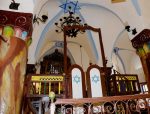
The bimah of Ari Ashkenazi Synagogue in Tzfat (Safed) was part of the Land and the Spirit tour, which is organized by the Rohr Jewish Learning Institute. (photo by Roy Lindman)

My husband and I excitedly counted down the days until the Land and the Spirit Israel experience in March. Having met with Chabad Richmond’s Rabbi Yechiel Baitelman and his wife Chanie, who accompanied our group on this trip, we learned that the touring days would be long, but that the sights we’d see and the people we’d meet would more than offset the intensity factor. The Land and the Spirit tour is organized by the Rohr Jewish Learning Institute, the adult educational arm of Chabad.

The tour took place March 4-13 and drew approximately 800 Jews (and a handful of non-Jews) from across North America. Knowing that we’d hit the ground running, my husband and I decided to arrive in Israel a few days ahead of the tour, to get acclimated. We also spent an additional two weeks after the tour exploring Israel on our own. This was my sixth trip to Israel and my husband Harvey’s third.

The tour was, in some ways, like an Israel 101 course, supplemented by in-person meet-and-greets with high-level people from all walks of life – we had special access to soldiers, politicians, religious leaders and other VIPs. On some levels, it was geared to people who’ve never been to Israel before, and they got an overview of the highlights Israel has to offer. Yet, even for those of us who had been to Israel, it was a chance to discover places we’d never seen.

Participants had the freedom to choose from a variety of “tracks,” including: “In the Footsteps of the Bible,” “Classic,” “Borders and Security,” “Israel Encounters,” “Israel in Depth” and “Food and Wine.” Presumably, participants would get a glimpse of Israel that sparked their desire to return again. The flip side of this is that there was not a lot of in-depth learning, and we didn’t get a chance to spend a great deal of time in any one place. It was primarily surface introductions and more of a visit-the-sights kind of trip, rather than an intense learning experience, like the National Jewish Retreat.

There were way more things to see and do than each of us had time for, hence the need to choose “tracks” each day. Highlights for my husband and me included Caesarea, with its fascinating historical ruins and stunning location, overlooking the Mediterranean. We also found Silicon Wadi fascinating. It’s the area in Israel where scientists, techies and businesspeople work in shared spaces to develop groundbreaking technologies. When we were there, we toured a WeWork site, where young technology whizzes were producing 3D and other objects inspired by their sky’s-the-limit imagination.

Kfar Chabad was another high point of our trip. This Chabad-Lubavitch village is not far from Lod, and has a life-size replica of 770 Eastern Parkway, Chabad’s Brooklyn headquarters. More than 6,000 Chabad live in the village, and the site is home to an etrog orchard. Our tour included a shmurah matzah bakery, where they make Passover matzah by hand.

The highlight by far, though, was the Ohr Simcha Children’s Home, where 300 high-risk boys from troubled environments live with their adoptive Chabad families. Ohr Simcha was established in partnership with the Israeli government, to help some of the most socially challenged children gain a sense of security. Seeing the kind of patient, loving care it takes to sustain these kids, to give them a real home of their own, was inspiring and emotional. True chesed in action.

The ancient mystical city of Tzfat (Safed), “the City of Kabbalah,” with its narrow streets and beautiful tiny synagogues, was magnificent. We went to Ari Sephardic Synagogue, where the famous Jewish mystic Rabbi Yitzchak Luria (known as the Ari) prayed. We also went to the Ari Ashkenazic Synagogue. Guest speakers explained the detailed history and designs of the synagogues. Unfortunately, we didn’t squeeze as much spirituality out of Tzfat as we would have liked, because time was limited. But it left a lasting impression.

It bears mentioning that all the tour guides on our buses were incredibly knowledgeable and made the places we visited come to life.

The Latrun Tank Museum was yet another highlight on the tour. There, we got to meet Israel Defence Forces soldiers and hear firsthand their inspiring personal stories. Live music, dancing and delicious food topped off the evening.

We spent a moving Kabbalat Shabbat at the Kotel (Western Wall). Having never visited the Kotel at night, much less experienced Shabbat at that holy site, we felt like Israel had wrapped its arms around us. Shabbat day was quiet and gave us the opportunity to walk the empty streets of Jerusalem in peace.

The second to last day of the tour was super-charged, and saw us traveling from Jerusalem to Masada, to the Dead Sea, where we schmeared mud on ourselves and bobbed around like human corks in the salt-laden water. After a long day, we showered off the Dead Sea water, got dressed in our finest and went to a gala banquet, where music, speakers and other entertainment were on the menu.

The final day was spectacular. First, we boarded a bulletproof bus that took us to our Matriarch Rachel’s Tomb, in Bethlehem. This was a particularly emotional experience, to see so many people praying so fervently. But it only got better, as we got on the bus and traveled to historic Hebron, where we visited the Cave of the Patriarchs (the Cave of Machpelah), one of the holiest places for the Jewish people. There, all 800 of us walked through Hebron carrying a Torah scroll that had been saved from the Nazis. This was followed by a spectacular light show, fireworks and a lively dinner.

On the whole, the tour was phenomenal, albeit arduous, especially for those of us in our 60s and older. Early morning starts, long stretches on the bus, shlepping and climbing, eating and touring. Repeat. For eight days. Was it worth it? You bet! The entire trip was spiritually nourishing, and fed our desire to start planning when we would next return to our home away from home.

Shelley Civkin is a happily retired librarian and communications officer. For 17 years, she wrote a weekly book review column for the Richmond Review, and currently writes a bi-weekly column about retirement for the Richmond News.


Mobileye’s self-driving tech

A total of 12 cameras offer a 360-degree configuration for long-range surround view and parking in the Intel Mobileye autonomous car. (photo from Intel Corp.)

Jerusalem-based Intel subsidiary Mobileye reportedly has struck a deal to supply its future EyeQ5 chips for integration in eight million partially automated cars to be manufactured by an unidentified European automaker in 2021.

Partial automation, a step toward the eventual goal of fully self-driving vehicles, requires the driver to remain alert to road conditions. Mobileye is a world leader in advanced driver-assistance technology, dominating about 70% of the current market.

Intel acquired Mobileye in March 2017 for $15.3 billion, the largest-ever acquisition of an Israeli high-tech company.

“By the end of 2019, we expect over 100,000 Level 3 cars with Mobileye installed,” said Amnon Shashua, chief executive officer and chief technology officer, referring to self-driving cars in which the driver has about 10 seconds to take over if the system fails.

Shashua announced last month that Intel and Mobileye are starting to test their responsibility-sensitive safety (RSS) model in a 100-car autonomous vehicle (AV) fleet – each equipped with 12 cameras for 360-degree visibility – on the notoriously difficult-to-navigate streets of Jerusalem.

“In the coming months, the fleet will expand to the U.S. and other regions,” he said in a May 17 statement. “While our AV fleet is not the first on the road, it represents a novel approach that challenges conventional wisdom in multiple areas. Leveraging over 20 years of experience in computer vision and artificial intelligence, our vehicles are proving the Mobileye-Intel solution is the most efficient and effective.”

Shashua said a radar/lidar layer will be added to the cars in the second phase of development.

Regarding the next-gen EyeQ5-based compute system due out in early 2019, he added, “the current system on roads today includes approximately one-tenth of the computing power we will have available [then].”

Israel21c is a nonprofit educational foundation with a mission to focus media and public attention on the 21st-century Israel that exists beyond the conflict. For more, or to donate, visit israel21c.org.

Voice will have control

One day, your car might be able to sense your mood and, if you’re agitated, send soothing music. (photo from autospies.com)

Back in 1995, Shlomo Peller founded Rubidium in the visionary belief that voice user interface (VUI) could be embedded in anything from a TV remote to a microwave oven, if only the technology were sufficiently small, powerful, inexpensive and reliable.

“This was way before IoT [the Internet of Things], when voice recognition was done by computers the size of a room,” Peller told Israel21c. “Our first product was a board that cost $1,000. Four years later, we deployed our technology in a single-chip solution at the cost of $1. That’s how fast technology moves.”

But consumers’ trust moved more slowly. Although Rubidium’s VUI technology was gradually deployed in tens of millions of products, people didn’t consider voice-recognition technology truly reliable until Apple’s virtual personal assistant, Siri, came on the scene in 2011.

“Siri made the market soar. It was the first technology with a strong market presence that people felt they could count on,” said Peller, whose Ra’anana-based company’s voice-trigger technology now is built into Jabra wireless sports earbuds and 66 Audio PRO Voice’s smart wireless headphones.

“People see that VUI is now something you can put anywhere in your house,” said Peller. “You just talk to it and it talks back and it makes sense. All the giants are suddenly playing in this playground and voice recognition is everywhere. Voice is becoming the most desirable user interface.”

Still, the technology is not yet as fast, fluent and reliable as it could be. VUI depends on good internet connectivity and can be battery-draining.

Peller said, in five years’ time, voice user interface will be part of everything we do, from turning on lights, to doing laundry, to driving.

“I met with a big automaker to discuss voice interface in cars, and their working assumption is that, within a couple of years, all cars will be continuously connected to the internet, and that connection will include voice interface,” he said.

As voice user interface moves to the cloud, privacy concerns will have to be dealt with, he added. “We see that there has to be a seamless integration of local (embedded) technology and technology in the cloud. The first part of what you say, your greeting or ‘wakeup phrase,’ is recognized locally and the second part (like, ‘What’s the weather tomorrow?’) is sent to the cloud. It already works like that on Alexa but it’s not efficient. Eventually, we’ll see it on smartwatches and sports devices.”


Diagnosing illness

Tel Aviv-based Beyond Verbal analyzes emotions from vocal intonations. Its Moodies app is used in 174 countries to help gauge what speakers’ voices (in any language) reveal about their emotional status. Moodies is used by employers for job interviewees, retailers for customers, and in many other scenarios.

The company’s direction is shifting to health, as the voice-analysis platform has been found to hold clues to well-being and medical conditions, said Yoram Levanon, Beyond Verbal’s chief scientist. “There are distortions in the voice if somebody is ill and, if we can correlate the source of the distortions to the illness we can get a lot of information about the illness,” he told Israel21c. “We worked with the Mayo Clinic for two years confirming that our technology can detect the presence or absence of a cardio disorder in a 90-second voice clip.

“We are also working with other hospitals in the world on finding verbal links to ADHD, Parkinson’s, dyslexia and mental diseases. We’re developing products and licensing the platform, and also looking to do joint ventures with AI companies to combine their products with ours.”

Levanon said that, in five years, healthcare expenses will rise dramatically and many countries will experience a severe shortage of physicians. He envisions Beyond Verbal’s technology as a low-cost decision-support system for doctors.

“The population is aging and living longer, so the period of time we have to monitor, from age 60 to 110, takes a lot of money and health professionals. Recording a voice costs nearly nothing and we can find a vocal biomarker for a problem before it gets serious,” said Levanon.

Beyond Verbal could synch with the AI (artificial intelligence) elements in phones, smart home devices or other IoT devices to understand the user’s health situation and deliver alerts.


Sensing your mood

Banks use voice-analysis technology from Herzliya-based VoiceSense to determine potential customers’ likelihood of defaulting on a loan. Pilot projects with banks and insurance companies in the United States, Australia and Europe are helping to improve sales, loyalty and risk assessment regardless of the language spoken.

“We were founded more than a decade ago with speech analytics for call centres to monitor customer dissatisfaction in real time,” said chief executive officer Yoav Degani. “We noticed some of the speech patterns reflected current state of mind but others tended to reflect ongoing personality aspects, and our research linked speech patterns to particular behaviour tendencies. Now we can offer a full personality profile in real time for many different use cases such as medical and financial.”

Degani said the future of voice-recognition tech is about integrating data from multiple sensors for enhanced predictive analytics of intonation and content. “Also of interest,” he said, “is the level of analysis that could be achieved by integrating current state of mind with overall personal tendencies, since both contribute to a person’s behaviour. You could be dissatisfied at the moment and won’t purchase something but perhaps you tend to buy online in general, and you tend to buy these types of products.”

In connected cars, automakers will use voice analysis to adjust the web content sent to each passenger in the vehicle. “If the person is feeling agitated, they could send soothing music,” said Degani.

Personal robots, he predicted, will advance from understanding the content of the user’s speech to understanding the user’s state of mind. “Once they can do that, they can respond more intelligently and even pick up on depression and illness,” he said.

Degani predicted that, in five years’ time, people will routinely provide voice samples to healthcare providers for analytics, and human resources professionals will be able to judge a job applicant’s suitability for a specific position on the basis of recorded voice analysis using a job-matching score.

Israel21c is a nonprofit educational foundation with a mission to focus media and public attention on the 21st-century Israel that exists beyond the conflict. For more, or to donate, visit israel21c.org.

New Yad Vashem exhibit

The new exhibit at Yad Vashem features artworks, artifacts, diaries, letters and testimonies that illustrate how Jews yearned for Eretz Israel during and immediately following the Shoah, from 1933-1948. (photo from Ashernet)

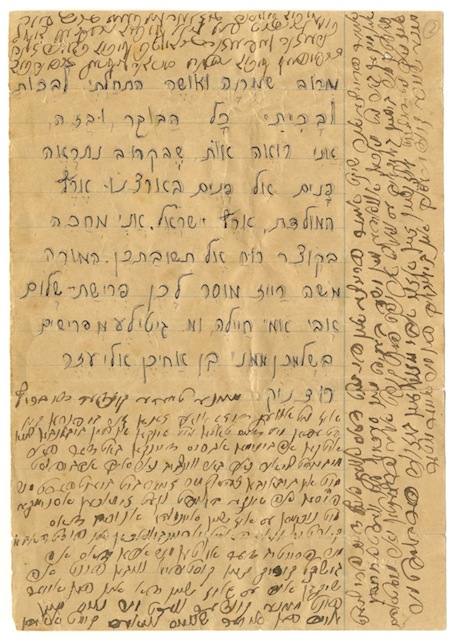
“I see a sign that we will meet each other face-to-face in our land, our homeland, Eretz Israel,” wrote 10-year-old Eliezer Rudnik in 1937 to his aunts who had immigrated to Palestine.

The letter, written in Hebrew, is surrounded by his parents’ writing, in Yiddish, as there was a lack of paper. Aryeh and Sarah Rudnik and their son, Eliezer, were the only Jews living in the Ukrainian village of Kosmaczow – they were shot and killed by Nazis in 1942. Eliezer’s letter is just one of the hundreds of items now on display at Yad Vashem, the World Holocaust Remembrance Centre, in a new exhibition, They Say There is a Land: Longing for Eretz Israel during the Holocaust.

photo - Eliezer’s letter is just one of the hundreds of items now on display at Yad Vashem, the World Holocaust Remembrance Centre, in a new exhibition, They Say There is a Land: Longing for Eretz Israel during the Holocaust
Eliezer’s letter is just one of the hundreds of items now on display at Yad Vashem, the World Holocaust Remembrance Centre, in a new exhibition, They Say There is a Land: Longing for Eretz Israel during the Holocaust. (photo from Ashernet)

The exhibit, which opened May 30 in the Auditorium Exhibitions Hall of Yad Vashem’s Museums Complex, features artworks, artifacts, diaries, letters and testimonies collected by Yad Vashem over the years, all of which illustrate how Jews yearned for Eretz Israel during and immediately following the Shoah, from 1933-1948. It is divided into three sections.

The first section presents how Jews viewed their connection to and longing for the Land of Israel during the rise of the Nazi party to power in Germany, until the outbreak of the Second World War. It was during this period that Jews searched for asylum in various countries, including Eretz Israel.

The second section focuses on the years 1940-1944, from the period of the ghettos to extermination. During this stage, Jewish communities in Europe dwindled and, under their daily struggle for survival, many Jews found themselves distanced from Eretz Israel to the point of disengagement; however, their hearts’ yearning for the land remained.

The third and final section focuses on the period immediately after the Holocaust – the displaced persons camps in Europe and the detention camps in Cyprus, and the establishment of the state of Israel. At this time, many survivors felt that only in Israel would they be able to regain their stature and build a full Jewish communal and personal life.

“The longing for Zion and the Land of Israel has been a cornerstone of Jewish identity for generations, manifested in many different forms,” Yad Vashem chairman Avner Shalev said at the exhibition’s opening. “While the Zionist movement was not embraced by the majority of Jews in Europe during the Nazi rise to power, through the course of the Holocaust and in its aftermath, it became increasingly popular. This exhibition portrays the ways in which Jews before, during and after the Shoah expressed their dreams for a brighter future in the Land of Israel, and their fervent hope to rebuild their lives here.”

The exhibition’s title is that of a well-known poem written by Hebrew poet Shaul Tchernichovsky in 1923 in Berlin. The poem brings up existential questions that characterized the Jewish people’s struggle in the interwar period, as well as the forces of dream versus reality, and hope versus despair.

Poll exposes confusion

A poll undertaken by the Union of Jewish Students in France returned some bizarre and seemingly contradictory ideas among the French public about Zionism, Israel and Jews.

More than half of the 1,007 respondents to the poll – 53% – viewed Zionism as a Jewish conspiracy aimed at manipulating the world to benefit Jews. Likewise, half of respondents said Zionism is a racist ideology.

Thirty-eight percent said Israel’s existence “feeds antisemitism” and 26% said that boycotting Israel is justified. Asked if Israel was a “threat to regional stability,” 57% said yes. More than half – 51% – called Israel a “theocracy.”

These are disturbing findings. Some of these are not matters of opinion – Israel is not a theocracy, no matter how many French people say it is. Other responses are deeply distressing. The assertions that Israel is a threat to regional stability – rather than being seen as a stabilizing force in a region roiling with instability – or that Israel’s very existence makes people hate Jews indicate a pattern of opinion that is seriously disordered.

But here’s where it gets really weird: 46% of respondents acknowledged that Israel is a democracy and 48% see it as a “normal country like all others.” A remarkable 54% of respondents view anti-Zionism as a form of antisemitism and 59% correctly identify Zionism as a “movement of liberation and emancipation for the Jewish people.”

Together, these responses paint a picture of French confusion and contradiction – a picture that would probably be replicated to a degree in other European and North American polls, were we to undertake them. One might be tempted to critique the pollster and their methodology. After all, polling is suffering a crisis of credibility these days and this particular poll is so confounding in its contradictions that it simply can’t be right.

Or can it? Is it possible that the French (and others) are so baffled by the truths and fictions floating around that they could, as a community or as individuals, hold such cognitively dissonant ideas such as the acceptance that Zionism is a movement for the liberation and emancipation of the Jewish people and that it is a Jewish conspiracy to manipulate the world and that its fulfilment creates antisemitism? Could people believe both that Israel is a democracy and Israel is a theocracy? One could argue that different individuals responded differently to the questions, but with affirmative responses to all these questions ranging near or above majority levels, it is almost certain that some people responded affirmatively to contradictory positions.

In fact, this makes as much sense as any other explanation. The poll seems to suggest that the French (and we would extrapolate to most Western countries) hold very confused, bizarre and inconsistent views about Jews and Israel.

For all the work Zionists have done explaining ourselves for the past seven decades, we seem to have a long way to go.

A paper covers events

Last week, we published a story about a group of people gathering outside the Jewish Community Centre of Greater Vancouver to hold a Yizkor service for Palestinians who died during the March of Return actions at the Gaza-Israel border.

We are not surprised by the reaction from readers, but we are disappointed in some of it. We have been criticized for covering the event. One commenter on Facebook accused us of supporting Hamas.

We are a newspaper. The fact that a group of Jews – it doesn’t matter how many or how few – organized an event like this is newsworthy. We covered it. It is what any newspaper worth the paper it’s printed on would have done. To accuse the Independent of endorsing the event – or Hamas – because we ran a story about it demonstrates a stunning lack of understanding about the basics of journalism. When a newspaper covers a flood, it is not endorsing the river.

At least one critic suggested our approach should have been to publish a raving tirade against those saying Kaddish. Our approach, generally, is to report events in an unbiased fashion and leave the raving tirades to others.

Just one question, really, for those who didn’t like the inclusion of that story in last week’s issue: Would you rather not know what’s happening in your community?

Ancient donkey leads to new discoveries

In the ancient city of Gath, now Tell es-Safi, an international team of archeologists has uncovered the earliest example of the use of a bridle bit with an equid in the Near East. (photo from Ashernet)

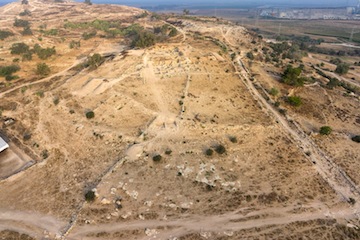
photo - An aerial view of Tell es-Safi
An aerial view of Tell es-Safi. (photo from Ashernet)

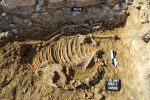
“The use of a bridle bit on a donkey during this period is surprising, since it was commonly assumed that donkeys were controlled with nose rings, as depicted in Mesopotamian art,” said Bar-Ilan University’s Prof. Aren Maeir, who has led the Tell es-Safi/Gath Archeological Project since its inception more than 20 years ago. Evidence of the bit was derived from the skeleton of an ancient donkey dating to the Early Bronze Age III (approximately 2700 BCE). The donkey is one of four that were found buried under neighbourhood houses, indicating the importance of the donkey in this society. Studies of the dental isotopes from this particular donkey (with the bit) demonstrate that it was born and raised in Egypt and brought to the site only in the last few months of its life, before it was sacrificed and buried beneath the floor of the house as it was being rebuilt. The research has been funded by the Canadian Social Science and Humanities Research Council, with additional funds from BIU and the University of Manitoba; the researchers come from BIU, U of M, University of Saskatchewan, Ariel University and Grand Valley State University; their findings were published in the May 16 edition of the journal PLOS ONE.

Human life v. politics

A dozen or so people gathered outside the Jewish Community Centre of Greater Vancouver Monday in a makeshift Yizkor service to commemorate the deaths of Palestinians killed by the Israel Defence Forces in recent weeks. (Click here for story.)

Each one of the people killed was, indeed, a full human being, with a full life, as Rabbi David Mivasair said of the Palestinian dead. And the loss of life is tragic. That is not something we will debate.

However, reports indicate that, of the 60 Gazans killed on May 14, for example, 53 were claimed as members by Hamas and Islamic Jihad. Given the IDF’s strategy of deterrence, which includes graduated steps from warning shots, to shooting to injure and, as a last resort, shooting to kill, it is likely that those who died were among the most aggressive and dangerous among the protesters, some of whom were armed with pistols, firebombs and other weapons.

While there were peaceful protesters among the thousands who marched on the Israeli border, depictions of the rally as a primarily peaceful protest are wrong. In some interpretations, unarmed protesters were there merely as human shields for the violent participants, whose aim, in the words of a Hamas leader, was to infiltrate Israel and tear the hearts out of the Jews. Hamas social media channels presented maps to guide people from the border to adjacent Israeli towns, encouraging those who might break through the frontier to head for civilian locations and presumably fulfil the orders of Hamas.

The deliberate strategy of the Gazan leaders, it seems, is to sacrifice their own people’s lives for their PR value. Col. Richard Kemp, a British military official who has become a vocal defender of IDF strategies, said of Hamas: “This is the first government in history that has deliberately sought to compel its enemy to kill its own people.”

In a Daily Telegraph article re-printed in the National Post, he went on to state that, had the thousands of protesters breached the border and headed for those Israeli towns, the bloodshed would have been exponentially worse.

There is no question that the entire situation is a tragedy. And there is blame to go around. The narrative purveyed outside the JCC Monday and in much of the media commentary – that the Israeli military wantonly kills human beings – is as unfair and inhumane an assessment as the alternative extreme, which finds satisfaction in the loss of life.

As for Monday’s gathering, the combination of a Jewish religious ritual with a political agenda that arguably makes common cause with those seeking the destruction of the Jewish state is a dubious choice, but this is a free country and Judaism is a big tent.

To be clear, the people of Gaza are suffering, due in part to the Israeli blockade, in part due to the repressive kleptocracy of Hamas and in part to their own self-defeating actions, like burning down the main border entry point for supplies.

Palestinians receive more humanitarian aid per capita than any other people in the world. Where much of that money ends up, sadly, is in the mansions of Hamas and Fatah leaders and in pensions and rewards to terrorists and their families. This fact, of course, does not bring the dead back to life.

Palestinians, Jews and everyone who cares about human life are struggling with recent events. Each of us is confronting the multiple dimensions of the violence, which seems to be a repetition of seven decades (or more) of recurrent conflict. Respect for human life – on all sides – should be what we seek. Tallying up the dead like they are goals in a sports match does not demonstrate respect. Indeed, it may be precisely what Hamas wants us to do and, as such, may encourage them to put at risk even more Palestinian lives.

Prayer, protest at JCC

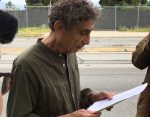
Gabor Maté reads the names of Palestinians killed by the Israel Defence Forces during the Great March of Return protests in Gaza. (photo by Matthew Gindin)

“Each one of them was a full human being, with a full life,” said Rabbi David Mivasair, addressing a dozen or so people, most of whom were Jews, outside of the Jewish Community Centre of Greater Vancouver on May 21, the second day of Shavuot, for Yizkor, the traditional memorial service for the dead.

Organized by Independent Jewish Voices, the group gathered to commemorate the Palestinian protesters who had been killed by the Israel Defence Forces during the Great March of Return protests in Gaza, which began on March 31 and ended May 15 (which Palestinians observe as Nakba Day). They gathered, according to the event’s Facebook page, for another reason, as well: “We will also publicly denounce the Centre for Israel and Jewish Affairs for its continual dishonest manipulation of Canadian political leaders and media sources to silence and minimize Israel’s brutality toward Palestinians and, in this case, shift the blame for the killings to the very people who were killed.”

Those present included Gabor Maté, a physician, author and member of the Jewish community. He and others took turns reading the names of Palestinians who had been killed. Afterwards, he told a story from an article that Uri Avnery, an Israeli peace activist, had written days before. In the article, Avnery described how he, as a teenage member of the Irgun, had done similar things to those of the Palestinian protesters when demonstrating against the then-occupying British forces for Israel’s independence, but the British shot over their heads, not at them. Maté also criticized the JCC for not being inclusive enough of all Jewish voices, saying that, in practice, it was more like “the Zionist community centre.”

“The confusion between Zionism and Judaism is a tragedy,” said Maté. “I’m just glad to be here to bear witness along with the rest of you.”

Shawkat Hasan, a member of the Palestinian community and the B.C. Muslim Association, whose family lost their home in the war of 1948, also spoke, emphasizing that the conflict was not between Jews and Muslims but between Zionism and its “victims,” and calling for widespread resistance to violence against Palestinians.

The group carried out their service peacefully. The idea for it came about only days before, and the organizing of it was rushed to coincide with Shavuot. One sign read, “Murdering innocents is not a Jewish value.” Some passersby stopped to join or listen, as members of the group chanted the names and recited Kaddish, and some to express their opposition.

Mivasair told those assembled that the location had been chosen to protest CIJA, who have their offices inside the JCC. CIJA had launched a campaign calling for Prime Minister Justin Trudeau to apologize for remarks Trudeau had made that the “reported use of excessive force and live ammunition is inexcusable” and his call for “an immediate independent investigation” after a Canadian doctor was shot by the IDF while treating protesters.

“Hamas has left Israel no choice but to use force to protect the tens of thousands of Israelis who live close to Gaza,” said Shimon Koffler Fogel, CIJA’s chief executive officer, in a statement May 16. “We are outraged and saddened that Hamas is again using civilian human shields. For Israelis and the Jewish community, Palestinian casualties are painful tragedies. For Hamas, Palestinian casualties are sickening public relations achievements.”

“Everything that CIJA says is contestable,” Mivasair told the Jewish Independent following the service. “The situation in Gaza is desperate enough, due to the policies of the Israeli government, to explain the actions of the Palestinian protesters without imagining that they were primarily orchestrated by Hamas, which they were not. Why are organizations that purport to speak for the Jewish community suppressing discussion in Canada about what is really going on?”

The Yizkor service at the JCC followed weeks of protests by Palestinian solidarity groups outside of federal Justice Minister Jody Wilson-Raybould’s Vancouver constituency office.

In the conflict at Israel’s border with Gaza, the IDF faced some 50,000 protesters. More than 100 Palestinians were killed and between 8,700 and 13,000 wounded, depending on the source of the data. The IDF’s actions, in particular the use of live ammunition, has been condemned by organizations including B’Tselem, Human Rights Watch and Amnesty International. According to Israel, most of those killed were members of the terrorist group Hamas, which, the Israeli government says, organized the protests.

Matthew Gindin is a freelance journalist, writer and lecturer. He is Pacific correspondent for the CJN, writes regularly for the Forward, Tricycle and the Wisdom Daily, and has been published in Sojourners, Religion Dispatches and elsewhere. He can be found on Medium and Twitter.

JNF of Canada honours Isaac Messinger

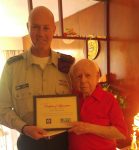
Isaac Messinger being presented with a certificate of appreciation last year for his contributions to the Jewish National Fund of Canada and Beit Halochem. (photo from JNF Pacific Region)

Isaac Messinger was born in Poland in 1929 and spent some of his early years in Siberia. Although his family tried to flee back to Poland when he was 12 years old, he ended up alone and orphaned in Russia and has spent the years since then living a very colourful life.

Among the notable moments, Messinger worked as a cowboy on horseback, chauffeur to a Polish officer, in a garage, as a prizefighter, a soccer player, a tinsmith and a traveling carnie with a roulette wheel. And he still had time to open a steakhouse and deal in diamonds, while lending money to some of the original landowners along the Las Vegas Strip.

Messinger has long been a strong supporter of Israel and he is currently focused on funding a project of JNF Canada that works with Israeli veterans, a special fitness centre at Beit Halochem Ashdod.

At first glance, the fitness centre at Beit Halochem looks like any other fitness club. There are lots of people working out on the equipment, weight training and stretching. Upon closer examination though, the difference is quite clear. Not only is much of the equipment and machinery slightly different, but the members are as well. Here, veterans young and old, with a wide spectrum of disabilities, come to improve their strength, flexibility and cardiovascular health. They exercise side by side, some on special equipment designed for wheelchair access or amputee-specific machines, and there are trainers on hand to explain and assist the veterans.

The physical rehabilitation aspects of working out in the fitness centre are clear to all. Less obvious is the psychological benefit that the disabled vets get from taking an active role in their rehabilitation.