Celebrating our history

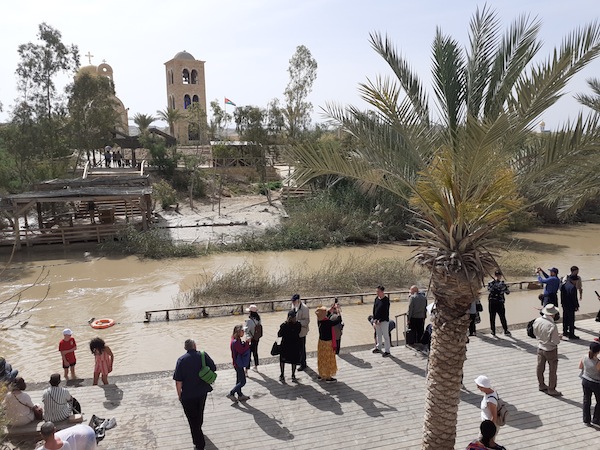
An April 15 press tour took journalists to the Israeli side of the Jordan River. Joshua and the Israelites made their crossing here. (photo by Gil Zohar)

Seventeen bulletproof buses of pilgrims, plus one carrying journalists, spilled their contents April 15 at Qasr al-Yahud (Arabic for the Jews’ Castle) on the muddy banks of the not-so-mighty Jordan River, 10 kilometres east of Jericho. The buses were provided by the Government Press Office in Jerusalem.

The holy site is also called the Land of Monasteries because of the seven Catholic, Greek Orthodox and Ethiopian churches there. Until 2011, it was a fenced-off, closed military zone ringed by minefields. Qasr al-Yahud is revered by Christians as the place where John the Baptist immersed his second cousin, Jesus of Nazareth.

For Jews, the shrine marks where, on Nissan 10, circa 1290 BCE, Joshua bin Nun led the Children of Israel to ford the Jordan River and begin their conquest of the Promised Land. But, with the cold peace prevailing between Israel and Jordan, soldiers of the Hashemite Kingdom’s Arab Legion warily monitored the crowds, making sure that no brave souls crossed to the polluted stream’s east bank to reenact Joshua’s miraculous crossing on dry land.

As Joshua and the 12 tribes approached the river, they were met by the kohanim (priests) carrying the Ark of the Covenant. The Jordan then miraculously split for them – perhaps caused by a landslide in the earthquake-prone region that temporarily blocked the river’s flow – allowing them to cross. After fording the Jordan, Joshua erected 12 stones taken from the river at Gilgal, whose location today is disputed by historians and archeologists.

Symbolizing that the process of the Israelites conquering the Promised Land some 3,289 years ago is still underway, Palestinian teenagers in Jericho pelted the armoured bus in which the journalists were riding, smashing one of the shatterproof windows. No one was injured in the attack.

For this writer, the explosive sound of the thump of the rock on glass brought to mind Joshua’s advice when the Israelites marched on ancient Jericho to begin their conquest: “Be strong and of good courage.” (Joshua 1:9)

Qasr al-Yahud is a corruption of “the Jews’ break,” traditionally the place where the Israelites crossed over, that is, “broke” the Jordan River after their 40 years of wandering in the Sinai Desert: “When the soles of the feet of the priests who bear the ark of the Lord, the Lord of all the earth, shall rest in the waters of the Jordan, that the waters of the Jordan shall be cut off, even the waters that come down from above, and they shall stand in one heap.” (Joshua 3:13)

It was here, too, that Elijah the Prophet ascended to heaven in a fiery chariot after he and Elisha crossed the Jordan: “And Elijah took his mantle, and wrapped it together, and smote the waters; and they were divided hither and thither, so that they two went over on dry ground.” (2 Kings 2:8)

The strategic and diplomatic significance of the Jordan Valley were spoken about by retired Israel Defence Force (IDF) deputy chief-of-staff major general Uzi Dayan, who was elected to Israel’s Knesset (parliament) in the country’s April 9 general election.

Rabbi Yisrael Meir Lau, the chief rabbi of Tel Aviv, and previously Ashkenazi chief rabbi of Israel, spoke of the Land of Israel’s long centuries of foreign occupation, from the Romans to the British.

From 1948 until 1967, Qasr al-Yahud was under Jordanian control, and was a popular destination for tourists and pilgrims. In 1968, following the Six Day War, access to the site was prohibited by the IDF because of its location beyond the border fence in a closed military zone. In recent years, the Israeli Civil Administration – with the assistance of the tourism and regional development ministries – carried out infrastructure and development work at the site, including the clearing of mines. In 2011, the site was opened to visitors on a permanent basis without the need for prior security coordination.

Entering ancient Jericho, with its 8,000-year-old remains at Tel as-Sultan and two Byzantine-era synagogues, is another matter. Large signs at the entrance to the city proclaim in Hebrew and English that entry is prohibited to Israelis. In honour of the Nissan 10 celebration, however, Israelis were allowed to enter the city in Area A, the Palestinian self-rule section of the West Bank, which is off limits the rest of year.

And what of the minefields? One million square metres of land are currently being cleared of approximately 3,000 anti-personnel mines, antitank mines and other unexploded ordinance. The project is being carried out by Israel’s National Mine Action Authority under the direction of the Defence Ministry, together with HALO Trust, an international mine-clearance charity.

Gil Zohar is a journalist based in Jerusalem.

[For more on this press trip to the Jordan River and Jericho, see Traveling into our past.”]

Traveling into our past

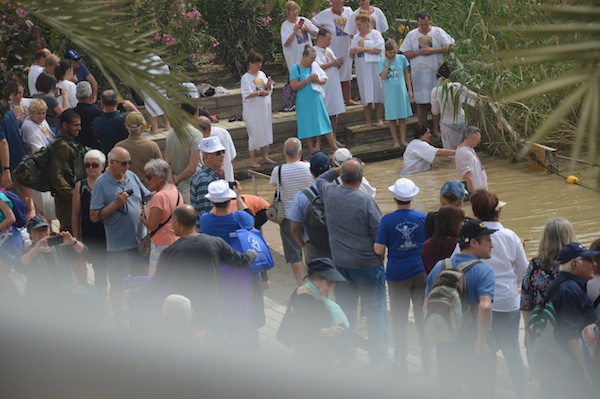
Christians preparing to be baptized in the Jordan River. (photo by Barry Kaplan)

A few days prior to Passover, the Israeli Government Press Office organized a special field trip to the Jordan River and Jericho. The bus with 40 journalists left the GPO office parking lot at 8:30 a.m. and traveled on Highway #1 to the southern part of the Jordan Valley with a guide. We passed Maale Adumim, now a city with 45,000 residents, and headed through the desert area.

We began the ascent to Jericho, passing the Inn of the Good Samaritan, the sea-level sign and the barren hills. A strip of restaurants and souvenir places seemed to appear out of nowhere. We heard about the history of Kibbutz Bet Arevo, situated in this area from 1939 to 1948, passed a veritable forest of palm trees and, by 9:20 a.m., we were at Qasr al-Yahud, where John the Baptist is said to have baptized Jesus. After it passed through the security fence, the bus parked and we walked down to the Jordan River.

Until 1967, this site was under Jordanian control and, in 1968, access was prohibited. In recent years, the tourism and regional development ministries have carried out various projects, including the clearing of mines, and, in 2011, the site was opened to visitors. The site and facilities are overseen by the Israeli Civil Administration and the Israeli Ministry of Tourism as part of a national park.

Running down the middle of the Jordan River is a metal divider. On the other side of it is Jordan. There were people standing around the river and, behind them, churches were visible on the Jordanian side. On the Israeli side, down more steps, people were wearing white cover-ups and going into the river, presumably to be baptized.

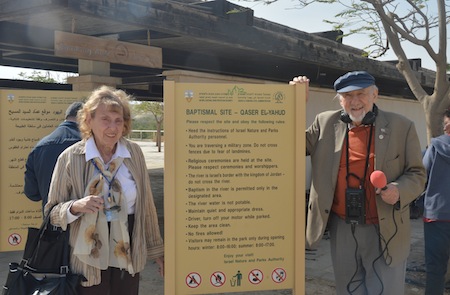
photo - Writer Sybil Kaplan with friend Walter Bingham, who, in his 90s, is the oldest working journalist in Israel
Writer Sybil Kaplan with friend Walter Bingham, who, in his 90s, is the oldest working journalist in Israel. (photo by Barry Kaplan)

In addition to its significance to Christians, two Jewish events took place at this spot.

In the Book of Joshua, we read how the Israelites, after 40 years of wandering in the desert, led by Joshua, crossed the Jordan River as the river became a stream. Supposedly this happened on the 10th of Nissan, this year April 15. Our guide says this could have taken place 4,440 years ago.

The passage in the Book of Joshua reads: “When the soles of the feet of the priests who bear the ark of the Lord, the Lord of all the earth, shall rest in the waters of the Jordan, that the waters of the Jordan shall be cut off, even the waters that come down from above, and they shall stand in one heap.” (Joshua 3:13)

At this point in our trip, we were joined by Uzi Dayan, former major general, national security adviser and Israel Defence Forces deputy chief of staff. According to Dayan, this passage from Joshua describes “the first aliyah to Israel.”

Another biblical text (2 Kings 2:1-2) says Elijah struck the Jordan River water with his cloak. The water parted so that he and Elisha could cross. After Elijah ascended, Elisha again parted the waters with Elijah’s cloak so he could return to Israel. This occurred before Elijah ascended to heaven in a fiery chariot.

Dayan noted that, on the day of our visit, there would be 17 other busloads of people coming to commemorate what has happened here, and that a ceremony would be held that afternoon. We would return for it, but not stay (as I will explain later).

* * *

At 11:10 a.m., we reboarded the bus and became part of a convoy, with IDF soldiers and jeeps leading us and several soldiers inside each bus. On one side of the road are mine fields, still being cleared.

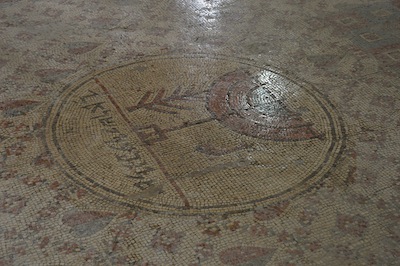
Our next stop was the sixth- or seventh-century CE Shalom Al Yisrael Synagogue. Down some steps, we walked around the 10-by-13-metre mosaic floor that featured a menorah in its centre. It was identified as being the floor of a synagogue because of the images of the menorah, as well as an ark, shofar and lulav. The name stems from a mosaic inscription with the Hebrew words Shalom Al Yisrael.

photo - Shalom Al Yisrael Synagogue mosaic in Jericho
Shalom Al Yisrael Synagogue mosaic in Jericho. (photo by Barry Kaplan)

The synagogue was probably used for hundreds of years, but then the Jericho Jewish community dissipated, and the synagogue was forgotten. It was revealed in excavations conducted in 1936 by Dimitri Baramki of the department of antiquities under the British Mandate.

After the 1967 Six Day War, the site came under Israeli military control and remained under the administrative responsibility of the Arab owners – the Shahwan family, who had built a house over the mosaic floor and charged admission to visit it. Tourists and Jews began visiting the site regularly for prayers. In 1987, the Israeli authorities confiscated the mosaic, the house and a small part of the farm around it. They offered compensation to the Shahwan family, but it was rejected.

After the 1995 Oslo Accords, control of the site was given to the Palestinian Authority. It was agreed that free access to it would continue, and that it would be adequately protected.

There have been some incidents. For example, on the night of Oct. 12, 2000, the synagogue was vandalized by Palestinians who torched and destroyed most of the building, burned holy books and relics, and damaged the mosaic. For more than eight years, no Jews were permitted in Shalom Al Yisrael Synagogue, but, during that time, it was restored by the Municipality of Jericho. Since 2007, prayer services have been allowed once a week.

* * *

By 12:15 p.m., we were at the tel (hill, or mound), which some journalists climbed. Opposite is a building with restaurants, snacks and a kind of enclosed mall. Israeli soldiers patrol the entire area. Outside, a man was giving rides to people atop a camel, and soldiers sat around and chatted.

The archeological site is about 2.5 kilometres north of modern-day Jericho, on the site of the ancient city, 258 metres below sea level. It was inhabited from the 10th century BCE. Excavations began in 1868 and settlements are known to date from 10000 BCE.

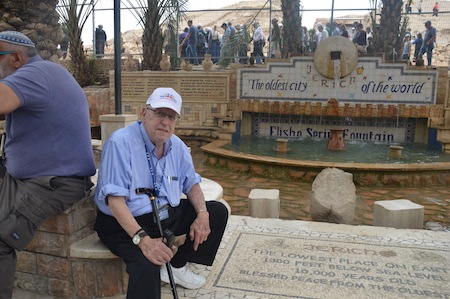
photo - Photographer Barry Kaplan rests by Jericho’s oldest city wall. Tel Jericho can be seen in the background
Photographer Barry Kaplan rests by Jericho’s oldest city wall. Tel Jericho can be seen in the background. (photo by Barry Kaplan)

The story in the Book of Joshua relates that, when the Israelites were encamped in the Jordan Valley, ready to cross the river, Joshua, as a final preparation, sent out two spies to investigate the military strength of Jericho. The spies stayed in Rahab’s house, which was built into the city wall. The soldiers sent to capture the spies asked Rahab to bring out the spies; instead, she hid them.

After escaping, the spies promised to spare Rahab and her family after taking the city, if she would mark her house by hanging a red cord out the window. When Jericho fell, Rahab and her whole family were saved, becoming part of the Jewish people.

The biblical battle of Jericho was the first battle that was fought by the Israelites. According to Joshua 6:1-27, the walls of Jericho fell after Joshua’s army marched around the city and blew their trumpets.

* * *

Our second-last stop was Moshav Naama, which is about 45 minutes from the centre of Jerusalem and one-and-a-half hours from Tel Aviv. About 50 families live there. We arrived at 2 p.m.

On the moshav, they grow grapes, dates and organic vegetables. Inon, one of the farmers, grows herbs in greenhouses. In the warehouse, sweet basil and tarragon are packaged for shipping all over the world to supermarkets.

Inon said 95% of the dates grown there are Medjoul and 5% are other kinds. Medjoul dates originated in the Middle East and North Africa, and are one of the most famous varieties. They are well-known for their large size and delicious flavour. The dates from the moshav will be harvested in September and October.

* * *

At 4:30 p.m., above Qasr al-Yahud, the baptismal site, chairs have been set up for the approximately 900 people who will listen to speeches commemorating the Israelites arrival in the Promised Land. However, since most of the journalists do not understand the Hebrew, the GPO bus boards at 5:20 p.m. and travels back to the GPO offices, arriving just over an hour later. Even though we didn’t stay for the whole proceedings, I am still excited to have been a witness to the ceremony.

Sybil Kaplan is a journalist, lecturer, book reviewer and food writer in Jerusalem. She created and leads the weekly English-language Shuk Walks in Machane Yehuda, she has compiled and edited nine kosher cookbooks, and is the author of Witness to History: Ten Years as a Woman Journalist in Israel.

[For more on this press trip to the Jordan River and Jericho, see “Celebrating our history.”]

A miracle in Beit Shemesh?

(photo by Davidbena)

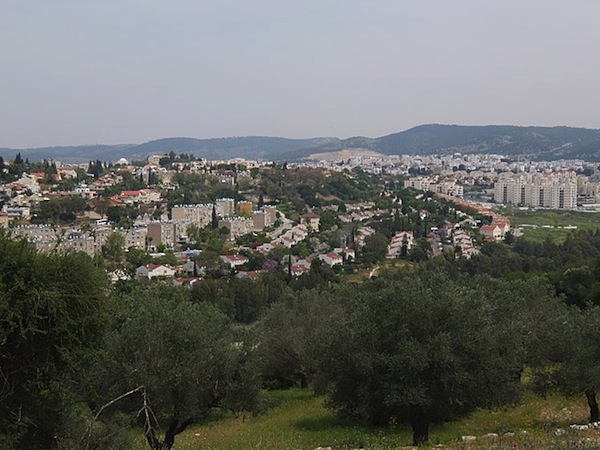
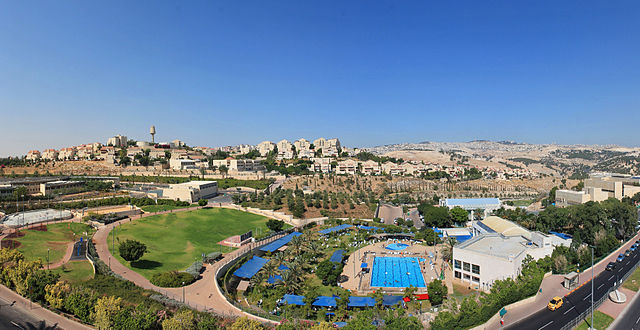
Beit Shemesh is centrally located, halfway between Jerusalem and Tel Aviv. Many Moroccan immigrants were settled here in tent camps in the 1950s, followed by many subsequent immigrants,

including from Ethiopia, the former Soviet Union, North America, South Africa and England. For the last decade, the city has been known as a hotbed of protests instigated by religious extremists – a symptom of an Israeli political culture moving toward greater religious segregation and intolerance.

Miraculously, though, the tides are turning, bringing with it hope and optimism. For the past decade, Moshe Abutbul, who is ultra-Orthodox, was the local mayor, and he marketed new homes to this community. Before the elections last November, popular opinion was that he would win again. His only challenger was Dr. Aliza Bloch. Though she was well-known and popular as an educator and community leader, Bloch is a woman and not ultra-Orthodox in a city that has been attracting more ultra-Orthodox residents while others have been slowly moving away.

But the miracle is that Beit Shemesh residents of all stripes and styles collectively understood that our beautiful city had deteriorated into one of the poorest in Israel. Everybody wants a nice, clean place to live and raise their families – whatever their religious observance. So, in what is probably a rare occurrence in the history of Israeli municipal politics, the residents of Beit Shemesh decided it was time for a change. They broke away from traditional voting patterns and voted for Bloch, who ran as an independent, under the banner of professionalism and transparency.

Bloch made no deals or promises as part of her campaign. She promised the people cleanliness, law and order, good education and the establishment of a youth department – 50% of the 122,000 residents are under the age of 18.

Bloch spent her first day in office getting to know every single employee on a personal basis. In her first month, she met weekly with the sanitation department, including personal tours of their routes to help improve morale and services to the entire city. She organized a municipal clean-up day for volunteers of all ages in every neighbourhood. She has already replaced many department heads, and the youth groups are finally getting facilities for their weekly meetings and programs, after 20 years of meeting outdoors on the streets, regardless of weather conditions.

Even more exciting are the “town hall” meetings with every neighbourhood that are open to the public, and her efforts to bring national ministers and other influencers to Beit Shemesh to help dig this fast-growing city out of its deficit and help it flourish.

The new administration works from early morning to late at night to improve the city services. But it’s the human factor that is most interesting. Bloch has a doctorate in education. She is literally educating an entire city to respect one another and cooperate for the greater good. And that is the true Israeli miracle of her first several months in office. A diverse and highly opinionated population is learning to live and work side-by-side with mutual respect and understanding. A city that was known for anger and intolerance is turning into a beacon of understanding and mutual respect.

Mimi Estrin Kamilar is a former Vancouverite who made aliyah and is a philanthropy consultant. She is a 25-year resident and community activist in Beit Shemesh. While she has known Dr. Aliza Bloch for a long time and became active in her campaign, she is not an employee of the mayor or the municipality.

קנדה תמשיך לתמוך בפתרון שתי המדינות

מעלה אדומים, ישראל (David Mosberg)

“עמדתה של קנדה נותרה ללא שינוי ואנו נמשיך לתמוך בפתרון של שתי המדינות במזרח התיכון”. כך אמר בפרלמנט, ראש ממשלת קנדה, ג’סטין טרודו. דבריו נאמרו על רקע תוצאות הבחירות בישראל, שעל פי הן שוב נבחר לרשות הממשלה, בנימין נתניהו. ראש ממשלת ישראל החדש-ישן הודיע ערב הבחירות, כדי לרכוש לעצמו עוד קולות מהימין, כי ממשלתו החדשה תכריז של סיפוח שטחים באזורי יהודה ושומרון. נתניהו אמר: “אנו דנים בהחלת הריבונות על מעלה אדומים וגם בדברים אחרים. לאחר ההכרה האמריקנית בריבונות ישראל ברמת הגולן, קיימים גם דיונים על סיפוח אזורים ביהודה ושומרון. אני הולך להכיל ריבונות אבל אני לא מבדיל בין גושי ההתיישבות לנקודות היישוב הבודדות. כל נקודת ישוב כזאת היא ישראלית ויש לנו אחריות כממשלת ישראל. כל אחד מבין שהקדנציה הבאה שלנו תהיה גורלית לשני הכיוונים – האם נוכל להבטיח את הביטחון שלנו ועל השטח החיוני של יהודה ושומרון שהוא פי עשרים גדול מעזה”.

לאור תוצאות הבחירות בישראל שאל חבר הפרלמנט הקנדי מטעם המפלגה הדמוקרטית החדשה, גיא קארון, את ראש הממשלה טרודו: “בינימין נתניהו ימשיך בתפקידו כראש הממשלה. בהבטחה של הרגע האחרון הוא הודיע כי יספח התנחלויות בגדה המערבית. אם ממשלת ישראל תעמוד בהבטחתה זו, עשויות להיות לכך משמעויות חמורות על היציבות באזור. עמדתה של קנדה עד היום היתה ברורה שאין ההתנחלויות חוקיות. ומועצת הביטחון של האומות המאוחדות מסכימה עם כך. האם ראש הממשלה יאשר כי קנדה תתייחס לסיפוחם של שטחים אלה כבלתי חוקיים ותפעל בהתאם בנושא?”

טרודו אמר בתגובה לשאלתו של קראון: “עמדתנו נותרה ללא שינוי. אנו תומכים בפתרון שתי המדינות ישראל לצד פלסטין במזרח התיכון. הפתרון הזה אמור להיות מושג באמצעות משא ומתן בין שני הצדדים. פעולות חד צדדיות כגון התנחלויות, אינן לגטימיות ואינן מסייעות בפתרון המצב במזרח התיכון”.

פרופסור קורן שהסתבך בקנדה קיבל תפקיד בכיר בקופת מכבי

פרופסורר גידי קורן, שניהל מעבדה לגילוי שימוש בסמים ובאלכוהול בבית החולים “סיק קידס” בטורונטו והסתבך, מונה לתפקיד מדען בכיר במכון המחקר של קופת החולים “מכבי”. יש שלא מבינים מדוע.

פרופסור קורן נחשב למומחה בעל שם עולמי בפרמקולוגיה, אך הוא הסתבך בפרשייה שהסעירה את קנדה, והובילה לבחינה מחודשת של כמה ממחקריו. וכן לוויתור על רישיון הרפואה שלו במחוז אונטריו. קורן החליט להסביר ראשונה את גרסתו למקרים החמורים ששמו נקשר בהם.

הפרופסור הפך לאחד החוקרים הבולטים בתחום בדיקת שיער לגילוי שימוש בסמים או באלכוהול. הוא הקים את מעבדת “מאת’ריסק” בבית החולים, שהייתה היחידה שהשתמשה בטכניקה הזו. שׁירותי הרווחה הקנדיים נעזרו בבדיקות שלה במשך כמעט שלושה עשורים. שנים עברו עד שוועדות חקירה קבעו כי ערכות הבדיקה שבהן השתמשו במעבדה היו לא תקינות. באותה עת בתי המשפט הסתמכו על הבדיקות שאמורות היו לספק מידע ראשוני – כקביעה חד-משמעית, על מנת להפריד ילדים ממשפחותיהם.

קורן טוען להגנתו: “הבדיקות שעשינו במעבדה לא גרמו לאף ילד לעזוב את ביתו. התפקיד שלי היה לבדוק שהילדים האלה נמצאים באזור בטוח. זאת הייתה מטרת העבודה. יש טעויות בכל מערכת והטיעון שילדים הורחקו מבתיהם זו עלילת דם. בישראל התחילו אותה קבוצה מאוד שמאלנית של רופאים לזכויות אזרח. ובעקבות כך הגשתי קובלנה פלילית. בית המשפט שעסק בסוגיה מצא בין השאר שבשום מקרה לא קרה שילד ניזוק מבדיקה זו או אחרת”.

Israeli music icon sings here

Yoni Rechter will be in Vancouver to perform for Yom Hazikaron and Yom Ha’atzmaut. (photo from Jewish Federation of Greater Vancouver)

“I love to know the world through music, and music has brought me to many places …. When I come and play and then I also make connection with the place, I prefer it to being the usual tourist. So, I’m glad I have the opportunity to come back to Canada after so many years … especially to Vancouver, that I heard so much about it,” Yoni Rechter told the Jewish Independent in a phone interview.

Rechter headlines the community Yom Ha’atzmaut celebration May 8 at the Chan Centre for the Performing Arts. While he has toured around the world, he hasn’t ever performed outside of Israel on Israel’s Independence Day. So, why now?

“There are two artists,” he said, “who were previously in this concert – Nurit Galron [2013] and Shlomi Shaban [2018] – they are both friends of mine, I work with them. Each one of them told me how nice it was to be there at the Yom Ha’atzmaut event, so I got good recommendations.”

Since he wrote his first song more than 50 years ago, Rechter has become a virtual icon of Israeli music. The composer, pianist, singer and arranger has created music for solo performances, bands, theatre, film, symphony, dance and opera. He has more than a dozen albums and has collaborated with a large portion of the who’s who of the Israeli cultural arts scene. Yet, he remains humble.

“I worked with the right people. I mean, people that I had the opportunity to learn from them, from the beginning of my musical career,” he said of his success. “I was first in the group Kaveret – you know, Poogy? By the way, we performed in Canada in ’76. We were in Montreal and Toronto and Winnipeg, and I still remember the temperature in Winnipeg. I think it was in winter; it really was the lowest temperature I ever felt. Anyway, then I worked with Arik Einstein, then I worked with Yossi Banai … and then I had the opportunity to work with very important theatre directors, like Hanoch Levin, Nissim Aloni and Miki Gurevich, and, also in movies. Because this is a small country, if you are willing to work, you can do various musical activities…. I had a lot of people to learn from, and really great, great artists.”

He said Israel is different than the United States or Canada with regard to the concept of celebrity. In Israel, he said, “We grew up very simply, and I go every day to swim. It’s not that I live in a protected house and I have bodyguards. It’s not this type of culture in Israel, first of all, but still there are people in Israel who might use their publicity for power or this kind of thing, but my character, I feel that I’m a musician, it’s the music and not me…. I feel that I have what to say in my music, but I never speak about myself; nobody knows about my wife, about my children, my private life. I’m really not into doing something with it, and it’s many years like this, but, I must confess, that I’m also not required by people or by journalists to speak about my personal life. Really, people accept me as I am.”

Rechter almost didn’t become a musician. When he was about to go into the army, at age 18, his father had what was probably the biggest architecture firm in Israel at the time. Even though his parents separated when Rechter was very young and he didn’t live with his father, he said it was a big decision as to whether to follow in his father’s footsteps. But, also, he said, music came easily to him.

“You know, I was just sitting at the piano and I composed, everything flowed, so I thought maybe life should be more difficult, and I should go to places that are more requiring of effort,” he said. “And this feeling I had, I was sure I was going to be an architect, but, in the army, I played in a military group of the artillery … and, when I finished the army, I thought to go to study architecture but then I got a telephone call from the members of what was going to be Kaveret group (Poogy group), and they called me for an audition. I heard the music and I fell in love. In the end, it came out to be [that I became] pianist of this group and a member of this group that changed … my career…. I have a brother who continues my father’s legacy.”

As to music and the projects he takes on, Rechter said there are a couple of factors he considers, notably the seriousness of the request and whether he has something to contribute musically. He gave the example of the Israeli Opera, who asked him to create a work for them, which will play again next year. He based the opera, Schitz, on the play by Levin.

“To write an opera,” he said, “it’s a year of 12-hours-a-day work; it’s really very [intensive]. It was an 80-minute opera, symphonic – I made all the arrangements and orchestration and I worked with the singers; it’s a huge work. It takes one year to do it, so, the first condition is that I know the project is serious.

“I have to find the right text,” he added, “because I really connect it to lyrics, to text, and I feel I have something to say in this. It’s a process. So, I start to improvise on this and I see if I have something to say musically. And, when I feel it’s all connected, I start to work on it. For example, the other [opera] … it was by David Grossman. Itamar Pogesh Arnav, it’s called, Itamar Meets a Rabbit. It’s a for-children opera, we made it with the Israeli Philharmonic. Of course, David Grossman, I knew he’s a very interesting man and I can find a way to connect with him, to communicate.”

Rechter said it is hard to define “Israeli music.” From the state’s inception through the 1970s, he said, “before the great internet and … we became one global ‘forum’ … [Israel] developed its own voice, which was, I would say, influenced by Russian music, from the immigrants that came, and also by music from the east, from Sinai, from Jordan, from all our neighbours. I think I grew up with influences of this spirit – sometimes I liked it, sometimes I didn’t like it. It depends on the people; for example, there was Sasha Argov, who was a very famous composer, and I really liked his music, which was very rich harmonically. Today, I think, after this explosion of communication, I don’t think it’s different from other places.”

That said, Rechter singled out some Israeli jazz performers, like Avishai Cohen, who is now based in New York, and others. “So, there is something here,” he said. “I think that living under pressure all the time [has something to do with it] … your life, all the time, is in danger because you don’t know when the next missile will fall in Tel Aviv. In my life, it has happened already two or three times…. Last week, there was one missile or two that fell near Tel Aviv. So, our life is, all the time, not protected, in a way. I believe it influences in a positive way our art, because we make art – all the Israeli artists – like you must survive. It gives us some very different energy than Europe, that used to be very calm.” He said, “The good artists that are serious become very known in the world [outside of] Israel.”

Music is important, said Rechter, “because it, especially in this time, I think that music should be a messenger. It has a task, and the task is to bring people back to real feeling, to themselves, to touch their souls, their energy, their spirit. Music is a force of nature, something that comes out of real creativity, at its best. Sometimes, I go to a concert and I cry from the music, it touches me so deeply. And that’s what I want to make. I don’t want to be somebody who’s going there to make lots of money; it doesn’t interest me. I want to touch people and, when it happens, for me, it’s the best prize.”

Rechter is coming to Vancouver with a band, “all of them Israeli, who live in New York” – singer Tammy Scheffer, saxophonist and player of multiple woodwinds Eitan Goffman, guitarist Shahar Mintz, bassist Uri Kleinman and drummer Shay Wetzler. “I sent them all the notes and the recordings of what I plan to play in Vancouver,” he said. “They’ll practise and we’ll meet at the beginning of May for two rehearsals n Manhattan.”

The audience at the Chan Centre can expect some of their favourites, said Rechter.

“I started to write songs when I was like 14, because of the Beatles,” he said. “I fell in love with the Beatles…. The first songs [of mine] were written in this age. I think the most famous song was – there is a song called ‘Dma’ot Shel Mal’achim,’ ‘Angels’ Tears.’ It became a song of memorial, and I wrote it in high school … with my friend who was sitting near me, his name is Danny Minster, he wrote the lyrics and I wrote the music. I tell this to you because I will sing it in Vancouver at the Yom Hazikaron memorial.”

Rechter will perform just the one song at the memorial May 7, 7:30 p.m., at the Jewish Community Centre of Greater Vancouver. On Yom Ha’atzmaut, May 8, 7:30 p.m., at the Chan Centre, he will perform more than 20.

Presented by Jewish Federation of Greater Vancouver, Yom Ha’atzmaut is supported by 46 community partners, with the Jewish Independent as the media sponsor and Georgian Court Hotel as the hotel sponsor. For the first time, there will be a party after the concert, though there is limited space available and only guests who attend the Yom Ha’atzmaut celebration may purchase tickets to the party. Visit jewishvancouver.com/yh2019.

Tapestry up for raffle

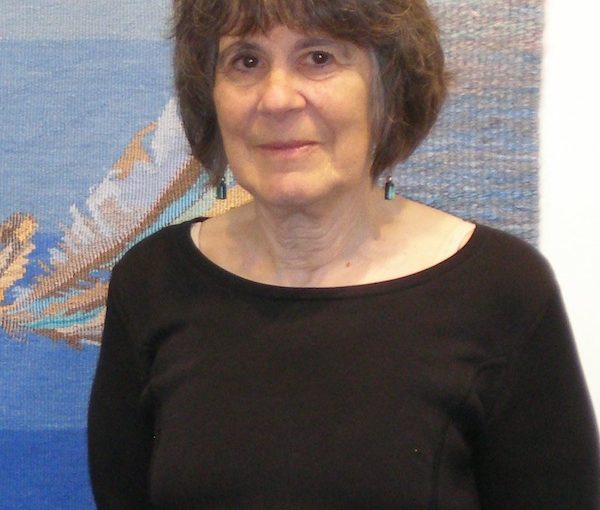
Barbara Heller (photo by Olga Livshin)

Temple Sholom’s Dreamers and Builders gala is not only a time to celebrate, but to raise funds for the synagogue. In addition to honouring Jack Lutsky and Susan Mendelson, this year’s sold-out event on May 5 will include a silent art auction at the dinner and a raffle, the bidding for which has already started.

“We have art donations for the silent auction from members of the synagogue, Ian Penn and Ivan Gasoi, as well as from Dina Goldstein and Gordon Smith, and a tapestry by Barbara Heller for the raffle,” said Karen Gelmon, gala co-chair, in an interview with the Independent. “Barbara is a member of Temple Sholom and an internationally known tapestry artist. Her works are very valuable, unique and truly remarkable.”

Gelmon noted that the synagogue has several tapestries by Heller on its walls. “There are two magnificent pieces that are on either side of the ark at the front of the sanctuary,” she said. “They are wonderful and loved by the congregation. She has donated two other works that are in another room and are also very appreciated. All these pieces have been there for more than 20 years and are fixtures at the synagogue.”

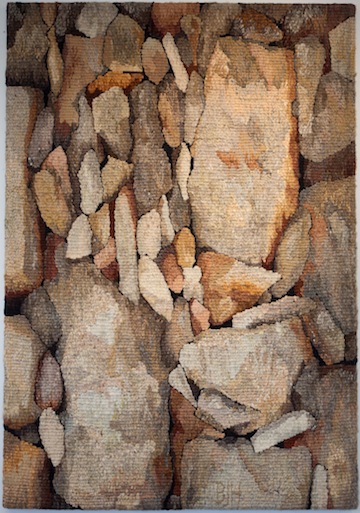
The raffle features the tapestry “Stones 22 – Stonefall,” the 22nd in Heller’s Stonefall series.

“I have been weaving these tapestries of stone walls and stones on the ground every few years for decades, between more difficult pieces,” Heller told the Independent. “I love these stone walls, built by man without mortar or cutting the stones to fit. If these walls fell down, the stones would return to the earth and no one would be the wiser. Yet, I see the spirits of the people who built the walls. Their energy remains in the stones.”

Heller also likes that the tapestries are abstract. “I get to immerse myself in the act of weaving as I transform them from stone into wool,” she explained. “I play with the handspun and hand-dyed yarns, the textures and the colours, without worrying about the underlying message.”

photo - Fabric artist Barbara Heller has donated her work “Stones 22 – Stonefall” to Temple Sholom’s Dreamers and Builders fundraiser
Fabric artist Barbara Heller has donated her work “Stones 22 – Stonefall” to Temple Sholom’s Dreamers and Builders fundraiser.

“Stones 22” was woven in 2013. “It was based on the photos I took in Caesarea on the Mediterranean in Israel,” said Heller. “The site has been home to invader after invader for millennia. It has been an archeological dig since a farmer plowing the meagre soil first uncovered a large stone block and called the scientists. Here, there are definitely ghosts of the people who came before.”

About why she chose to offer one of her artworks for the raffle, she said, “When I was asked to donate a tapestry by Susan [Mendelson] and the organizing committee for Dreamers and Builders, I was happy to say yes. Susan and Jack have supported my art and own a few tapestries. Temple Sholom is my synagogue and has also supported me. It has several of my tapestries, some as donations and two on loan. The bimah is flanked by two of my tapestries that were commissioned at the time of my son’s bar mitzvah, and the library has a tapestry that my mother willed to the Temple on her death. Now, it was my turn to support them.”

The decision of which tapestry to donate was a practical one. “I felt it had to be mid-size, large enough to have a presence but not so large that it would not find a new home in a modern condo,” she said. “And the reference to Israel was also important to me.”

As an artist who makes a living by her art, Heller has given much thought over the years to the concept of donating work.

“It has been awhile since I donated artwork,” she shared. “There was a time a few years ago when art auctions were all the rage for fundraising, to the detriment of the artists. The fundraisers always stressed that the auctions would be good publicity for the artists, but I don’t think so. People always wanted a bargain when they bid at auctions, and I don’t think that the fundraisers were aware of the lost income for the artists.”

An artist must look at a donation as just that, said Heller, as a donation to raise funds for a charity they believe in. “I now do it only on occasion. I am reminded of what my friend, a pianist, does. When approached to play for free, she says, ‘You pay me what my normal fee would be, and then I will decide how much to give back to you as my donation.’ This makes the fundraisers aware of what they are actually asking.”

Gelmon and the organizing committee were well aware of what they were asking. “I think different artists may have different motivations to donate their art,” said Gelmon. “For Barbara, I think she saw this as a worthy cause. It is raising money for her synagogue, where she and her family have been members for years, and it probably gives her great pleasure to contribute.”

To take part in the raffle, visit templesholom.ca/dreamers-builders-2019-raffle.

Olga Livshin is a Vancouver freelance writer. She can be reached at olgagodim@gmail.com.

Strongmen bromance

Binyamin Netanyahu appears comfortably ensconced in the Israeli prime minister’s office after last week’s elections. While his Likud bloc effectively tied for seats with the upstart Blue and White party, the smattering of smaller parties are mostly of the nationalist, religious and right-wing bent, meaning Netanyahu will have a fifth term as leader. If he hangs on until July, he will surpass David Ben-Gurion as Israel’s longest-serving prime minister.

The likelihood that he will reach that mark seems good. He faces probable criminal charges but that does not necessarily mean the end of his career. Rumours are rife that he is considering a legal escape hatch that would permit him to remain in office even if indicted or, more likely, make it illegal to indict a sitting prime minister. In most democracies, at most times in recent history, such a move would be seen as intolerably corrupt. Times change.

The leaders of democracies today are blazing new trails. The words and actions of the U.S. president confound our capacity for incredulity. Jaw-dropping statements of contempt, bigotry, juvenile pique and lies emanate from his mouth (and Twitter fingers) faster than the outrage can follow. Across Europe, far-right extremist parties are rising, as they did in elections in Finland on the weekend. In Britain, which is convulsing from self-induced Brexit trauma, the leftist Labour party is engulfed in an antisemitism crisis. Positions and statements that would have been unthinkable in the civil discourse of recent decades are suddenly at the centre of public discourse in democracies everywhere.

Israel is no exception. During the recent election campaign, candidates expressed erstwhile unspeakable ideas, including a scheme to ethnically cleanse the West Bank of Arabs and annex the land to Israel. The advocate of that idea was soundly defeated – the Knesset democratically cleansed of his ideology when the party failed to reach the 3.25% minimum vote to enter parliament.

But Netanyahu himself floated some astonishing trial balloons during the campaign. He mooted annexing West Bank settlement blocs into Israel – a concept that is not ludicrously beyond the pale since, if a negotiated settlement ever emerges, it will likely include such a move in exchange for traded land. But he also suggested annexing settlements that are not adjacent to or contiguous with Israel’s recognized boundaries. Such an idea would create a patchwork in the West Bank along the lines that would make an independent Palestine unworkable. The fact that the incumbent prime minister opened this political Pandora’s box is evidence of a new willingness to play with potential fire.

That foot play with extremists is not limited to domestic affairs. If an Israeli Rip Van Winkle fell asleep a couple of decades ago and woke up to Israel’s current diplomatic situation, he would be confused and possibly delighted. If that Van Winkle shared our worldview – an apparently old-fashioned belief in pluralistic, inclusive, universal humanitarian values – he would quickly conclude that the prima facie bonanza of goodwill has a rotting core.

As former Israeli ambassador to the United Nations Ron Prosor said Sunday night (see cover story), Israel has open lines of communication with countries that for decades steadfastly rejected its very existence. Likewise, Israel has excellent relations with some of the most populous and powerful countries in the world – India, China, Russia, Brazil and, in different but important ways, a refreshed, familial relationship with the current U.S. administration.

Israel has superb relations with these countries, and with the Philippines, as well as with Hungary and other eastern European states that have traditionally been problematic for the Jewish state. That seemingly good news is tempered by the fact that these good relations are not based on conventional diplomatic alliances. To a large extent – especially in the cases of Hungary, the Philippines, Brazil, Russia and the reinvigorated bonhomie between the leaders of Israel and the United States – these close relations are based on a shared strain of politics that fill us with more nervousness than naches.

These relationships are less between Israel and Brazil or the Philippines or Hungary or Russia than a bromance between Netanyahu and Jair Bolsonaro, Rodrigo Duterte, Viktor Orban and Vladimir Putin, to say nothing of the continuing lovefest between Bibi and Donald Trump. Each of these figures is a strongman who is, to varying degrees, pushing the limits of their democracies to see how far they can stretch rule of law and diminish respect for human rights. With this in mind, the diplomatic warmth seems less about traditional bilateral relations than about a fraternity of nationalist, populist and authoritarian men leading the world down a path unimagined a decade ago.

With that background, Israel’s unprecedentedly improved relations with so many countries seems less positive a development. Our proverbial sleeper might pull the covers back over his head and hope for better in the decades to come.

Spring cleaning

Crews from the office of the Rabbi of the Western Wall remove tens of thousands of written prayers from the Western Wall. (photo by Gil Zohar)

On April 10, equipped with long sticks, crews from the office of the Rabbi of the Western Wall removed tens of thousands of written prayers, which worshippers had wedged into crevices at the holy site over the previous half year. The painstaking work is done twice annually, in advance of Passover in April and Rosh Hashanah in September, to ensure space for new prayers. The notes that are removed are buried in Mount of Olives Cemetery.

The origin of the practice of placing small folded sheets of paper between the cracks of the 2,000-year-old ashlars is unclear. According to tradition, God’s female presence (Shechinah), has never left the holy site.

A retaining wall of the Temple Mount, built by King Solomon circa 960 BCE and destroyed by the Romans in 70 CE, the Kotel Maaravi (Western Wall) stands today beneath a religious plaza known in Arabic to Muslims as al-Haram ash-Sharif (the Noble Sanctuary). Jews believe the holy hill marks the navel of the world from where God began his creation 5779 years ago; the site also marks where Abraham brought his son Isaac to offer him up as a sacrifice. Muslims consider the Western Wall to be where Muhammad tethered his winged steed al-Burak when he ascended to the Seventh Heaven. And Christians believe Jesus was one of the millions of Jewish pilgrims in antiquity who came here during the festivals of Passover, Tabernacles and Pentecost.

From 1948 until 1967, when East Jerusalem was under the control of Jordan, Israelis were prohibited from visiting the site.

Gil Zohar is a journalist based in Jerusalem.

נשיאה של ישראל ביקור בקנדה

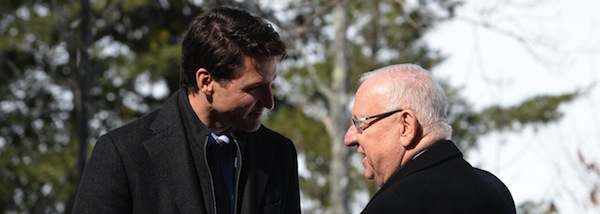
נשיא המדינה, ראובן ריבלין, קיים לאחרונה ביקור רשמי בקנדה, שכלל פגישת עבודה עם ראש הממשלה, גסטין טרודו. (Mark Neiman GPO)

נשיא המדינה, ראובן ריבלין, קיים לאחרונה ביקור רשמי בקנדה, שכלל פגישת עבודה עם ראש הממשלה, ג’סטין טרודו. טרודו אמר לריבלין בפגישה ביניהם: “אנו מציינים שבעים שנה לכינון היחסים הדיפלומטיים בין שתי המדינות. יש לנו הרבה על מה לדבר כמו חידוש הסכם הסחר שלנו, ולדבר על פלורליזם ועל סובלנות ומאבק נגד שנאה וחוסר סובלנות. אני יודע שאתה מחזיק בדעות חזקות בנושא הזה. תענוג גדול לשבת איתך בזמן שבו ישראל וקנדה חברות נהדרות”. ריבלין הישיב לטרודו: “תענוג להיות איתך ולהכיר חבר כל כך טוב. אנחנו חולקים ערכים ואידיאלים. יהודים באו לקנדה כבר לפני מאה וחמישים שנה. אני גאה מאד להיות כאן ולהחליף ידע ורעיונות איתך. אנחנו חווים ימים קשים במרחב, ואתם עושים המון עבורנו במטרה לשמור על המרחב העדין ועל הקיום שלנו. אתם עושים זאת בסוריה, בלבנון ובסיני”. הנשיא הודה לטרודו על תמיכתה של קנדה בישראל בזירה הבינלאומית ועל התמיכה נגד הפעילות האנטישמית של תנועת הבי.די.אס. ריבלין מקווה שקנדה תביע עמדה נגד מהלכים חד-צדדיים של הפלסטינים נגד ישראל. וכנגד היחס המפלה כלפי המדינה במוסדות הבינלאומיים.

השניים דנו בסוגיה האיראנית והנשיא ציין לטובה את החלטת הפרלמנט הקנדי על הקפאת היחסים עם איראן, ואת ההכרזה כי משמרות המהפכה האיראניים הם ארגון טרור. בנושא זה אמר ריבלין: “איראן מובילה את התבססות הציר השיעי בעיראק, סוריה, לבנון ותימן. ובפעולותיה היא מחריפה את המתח הסוני-שיעי, העלול להביא להסלמה אזורית ולאיים על העולם כולו”. הנשיא הדגיש כי: “אסור לעולם לאפשר התבססות איראנית. בלימת ההתבססות האיראנית תושג רק באמצעות לחץ בינלאומי מתואם ופעולות צבאיות נקודתיות בכל עת שנדרשת”.

לפני הפגישה עם טרודו, נפגש הנשיא עם המושלת הכללית של קנדה, ז’ולי פאייט. השניים קיימו פגישת עבודה מדינית. הנשיא העניק למושלת (שהייתה בעבר אסטרונאוטית והיו לה שתי משימות בחלל), דגם מוקטן של החללית “בראשית”. החללית הישראלית הראשונה עתידה הייתה לנחות על הירח וכידוע התרסקה וגרמה לעוגמת נפש גדולה בישראל. פאייט אמרה דברים מרגשים לזכרו של האסטרונאוט הישראלי, אילן רמון ז”ל, שעימו הייתה ביחסי ידידות. ריבלין מצידו הזכיר את מותה של אשתו, רונה רמון, ופאייט אמרה שהדבר מאוד העציב אותה.

טרודו וראש עיריית טורונטו, ג’ון טורי, השתתפו באירוע מיוחד: שבעים שנה לידידות בין קנדה וישראל. האירוע נערך בטורונטו בהשתתפות כאלפיים איש. הוא אורגן על ידי מגבית היהודית קנדה והבונדס, בשיתוף פעולה עם ארגון הגג של הפדרציות היהודיות בקנדה.

טרודו נשא באירוע נאום פרו-ישראלי יהודי יוצא דופן, גינה את האנטישמיות ואמר כי בניגוד אליה, הערכים היהודיים של נתינה וקהילה הם ערכים קנדיים. טרודו: “האנטישמיות בעולם מרימה ראש. התקפות אנטישמיות מתרחשות נגד ילדים שהלכו עם כיפות בקנדה, ההתקפה נגד בית הכנסת בפיטסבורג, ההתקפות בפריז, בירושלים ובכל העולם. אנטישמיות נמצאת במגמת בעלייה והיא מפיצה שנאה”. טרודו הוסיף עוד כי האנטישמיות החדשה כוללת גם את הדמוניזציה של ישראל. לדבריו אין מקום לתנועת האפרטהייד נגד ישראל בקנדה. ראש ממשלת קנדה הדגיש: “אני יכול להבטיח לכם שקנדה תמיד תגנה כל שנאה נגד כל קהילה, ותזכיר את המסר שוב ושוב כי אנטישמיות היא התקפה על קנדה. ישראל היא לא רק בת ברית, אלא שותפה אמינה שאפשר לסמוך עליה והיא יכולה לסמוך עלינו”.

טרודו אפוא מנסה להתקרב לישראל ואל היהודים בקנדה לקראת הבחירות הכלליות שיערכו כאן בחודש אוקטובר.

Politicians speak at AIPAC

Clockwise, from top left: U.S. Vice-President Mike Pence, Joe Lieberman, Senator Marco Rubio and Senator Cory Booker address attendees of last month’s AIPAC Policy Conference. (photos by Dave Gordon)

U.S. Vice-President Mike Pence, in addition to other ranking American politicians, spoke of their unwavering support for the Jewish state to 18,000 people at the American Israel Public Affairs Committee (AIPAC) Policy Conference, in Washington, D.C., March 24-26.

Speech themes revolved around recent rocket attacks against Israeli civilians, the Golan Heights being recognized as Israeli sovereign territory by the United States, and sanctions against Iran. Every official who mentioned BDS, the boycott, divestment and sanctions movement against Israel, condemned it.

Much was said about the Democratic congresswoman from Minnesota, Ilhan Abdullahi Omar. Her statements – including “Israel has hypnotized the world” and that AIPAC has influenced U.S. policy through money – have been interpreted as antisemitic by some Jewish leaders.

Pence said, “History has already proven [Donald Trump] to be the greatest friend of the Jewish people and the state of Israel ever to sit in the Oval Office of the White House.”

Among the pro-Israel bona fides of Trump, Pence said the United States shut down the Washington branch of the Palestinian Authority as a consequence for funding terror; ended tax dollar funding for United Nations-funded Palestinian schools; moved the U.S. embassy to Jerusalem; and recognized the Golan Heights as Israeli territory.

“We stand with Israel because her cause is our cause, her values are our values,” he said.

In addition, Pence talked about the end of the “disastrous nuclear deal with Iran” that has been replaced with “a maximum-pressure campaign” of sanctions, thereby causing Iran’s economy to dip.

“There’ll be no more pallets of cash to the mullahs in Iran,” he said.

In a swipe across the political aisle, Pence said, “It’s astonishing to think that the party of Harry Truman, which did so much to help create the state of Israel, has been co-opted by people who promote rank antisemitic rhetoric and work to undermine the broad American consensus of support for Israel.”

Without mentioning her name, he referred to Omar as “a freshman Democrat in Congress” who “trafficked in repeated antisemitic tropes.”

Former U.S. ambassador to the UN Nikki Haley’s first comments were about what she believes is the UN’s hypocrisy.

“You know, what’s interesting is, at the UN, I can guarantee you this morning it is radio silent,” she said, in reference to the rocket attacks from Gaza into Israel. “They are not saying anything about Hamas, they’re not saying anything about the lives lost, they’re not saying anything. But, if it was any [other] countr[y], they’d be calling an emergency Security Council meeting.”

David Friedman, U.S. ambassador to Israel, claimed that Trump is “Israel’s greatest ally ever to reside in the White House” and, to those who think otherwise, “please, take a deep breath and think about it some more.”

How America is now sanctioning Iran was one example of an Israel-friendly policy. Friedman criticized the previous administration for paying the Islamic Republic $100 billion in the hopes that country would “self-correct.”

“What did Iran do with all its newly found treasure?” he asked. “Did it build up its civilian institutions? Did it improve the quality of life of its citizens?” Instead, he said, it “doubled down on terrorist activity in Yemen, in Iraq and in Lebanon. It increased its stock of ballistic missiles and it invested in military bases in Syria, on Israel’s northern border.”

photo - Protesters at this year’s AIPAC Policy Conference, in Washington, D.C., last month
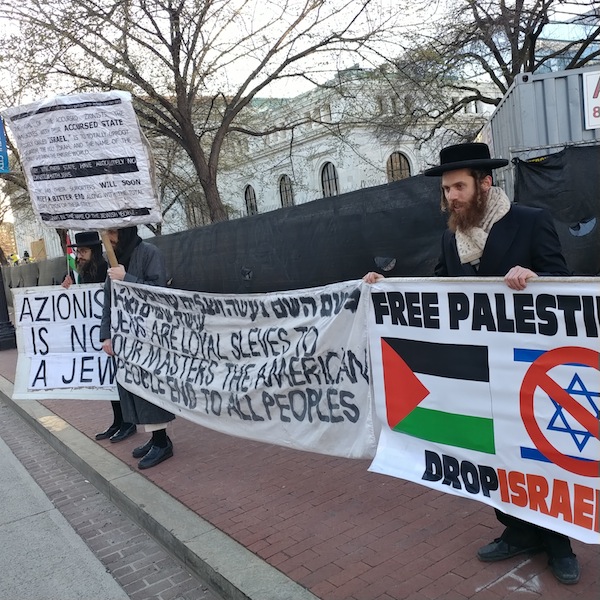
Protesters at this year’s AIPAC Policy Conference, in Washington, D.C., last month. (photo by Dave Gordon)

Israeli Prime Minister Binyamin Netanyahu delivered an address via satellite, initially planning to take the podium in person, but returning to Israel to deal with the rocket attacks.

“The Golan Heights is indispensable for our defence,” he said of the recognition by the United States of the northern land seized by Israel in the Six Day War, in 1967. “It’s part of our history. When you put a shovel in the ground there, what you discover are the ruins of ancient synagogues. Jews lived there for thousands of years and the people of Israel have come back to the Golan.”

Netanyahu said he thought comments like Omar’s are antisemitic.

“Again, the Jews are cast as a force for evil,” he said. “Again, the Jews are charged with disloyalty. Again, the Jews are said to have too much influence, too much power, too much money. Take it from this Benjamin, it’s not about the Benjamins.”

In the session Canada’s Relationship with Israel, the panel included Liberal member of Parliament Anthony Housefather, Conservative MP Erin O’Toole and former Conservative foreign minister John Baird.

Housefather said he believes Israelis do not think there’s a negotiating partner for peace, but they share some blame in the conflict: “The more they create settlements, the less likely there will be peace … they should think carefully before expanding settlements.”

A questioner asked him when the Canadian prime minister would do something “real” for Israel and Housefather noted that, in recent weeks, Prime Minister Justin Trudeau forcefully condemned the BDS movement in a town hall meeting.

Another audience member asked why the Trudeau government continues to fund the United Nations Relief and Works Agency. While acknowledging that UNRWA has “curricula problems” that involve “anti-Jewish, anti-Israel comments, misogynistic comments and anti-gay comments,” he said that the $50 million in funding was just.

Housefather said he had spoken with the head of UNRWA and voiced his “concerns at the slow pace they are making changes in the curricula,” but added that their schools make children “a lot less likely to become terrorists against Israel.”

“Yes to helping them with UN aid programs; no to funding their schools,” said O’Toole. And Baird agreed.

On the topic of a peace plan, O’Toole said he “kept hearing from Palestinians their want for a ‘one-state solution,’” while their government “exerts violence, and does not take care of the needs of their people.”

“I think you’ll see from Israeli leaders that they’re prepared to experience real pain [in concessions],” Baird said, but “Palestinians have to stop the incitement” and the “hate-mongering.”

While several candidates for the Democratic party’s 2020 presidential nomination skipped the conference, leading Democratic figures were prominent at AIPAC, including House Speaker Nancy Pelosi, who insisted no one will be permitted to make Israel a partisan wedge issue.

Dave Gordon is a Toronto-based freelance writer whose work has appeared in more than 100 publications around the world.