נתוני הלשכה המרכזית לסטטיסטיקה בישראל: 14.4 מיליון יהודים חיים בעולם ומהם כארבע מאות אלף נמצאים בקנדה. (צילום: Cynthia Ramsay)
הלשכה המרכזית לסטטיסטיקה בישראל פירסמה בימים האחרונים דוח על מספר היהודים החיים כיום בעולם. הנתונים בנויים על הערכות בלבד של המדור לדמוגרפיה וסטטיסטיקה של היהודים באוניברסיטה העברית בירושלים, מתבססים על שנת 2015, ומתפרסמים כרגיל לרגל יום הזיכרון לשואה ולגבורה.
אם כן כיום לפי הערכה של המדור לדמוגרפיה וסטטיסטיקה באוניברסיטה העברית, חיים בעולם כ-14.4 מיליון יהודים. זאת לעומת 16.6 מיליון יהודים שהיו בעולם ערב מלחמת העולם השנייה ומאורעות השואה הקשים. לפיכך העם היהודי למרות השנים שעברו שבעים ושתיים שנים, לא הצליח לחזור לגודלו לפני אירועי השואה, שהביאו להשמדת שישה מליון יהודים. יצויין כי גם בשנות העשרים של המאה הקודמת חיו בעולם כמו כיום כ-14.4 מיליון יהודים.
מטבע הדברים ריכוז היהודים הגדול בעולם (44 אחוז) נמצא בישראל ועומד על 6.33 מיליון. אחריה המדינה השנייה עם מספר היהודים הגדול ביותר כרגיל היא ארצות הברית, שבה גרים עם 5.7 מיליון יהודים. המדינות הנוספות בעולם בהן יש את הריכוז הגבוה ביותר של יהודים אחרי ארה”ב הן: במקום השלישי צרפת עם כ-460 אלף יהודים, במקום הרביעי קנדה עם כ-388 אלף יהודים, במקום החמישי בריטניה עם כ-290 אלף יהודים, במקום השישי ארגנטינה עם כ-181 אלף יהודים, במקום השביעי רוסיה עם כ-180 אלף יהודים, במקום השמיני ברזיל עם כ-120 אלף יהודים, במקום התשיעי גרמניה עם כ-117 אלף יהודים, במקום העשירי אוסטרליה עם כ-113 אלף יהודים. לפי הערכות לא מבוססות במקום האחד עשר נמצאת דרום אפריקה ובה חיים כ-80 אלף יהודים.
והיכן קיימות הקהילות הקטנות של יהודים בעולם: באיראן למשל חיים כעשרת אלפים יהודים, בבירוביג’ן חיים רק כחמשת אלפים יהודים, ביפאן חיים כאלף יהודים בלבד, בבהאמס חיים רק כשלוש מאות יהודים ואילו בקוריאה הדרומית יש כמאה יהודים בלבד.
על פי סקר של ההסתדרות הציונית העולמית שנעשה לאחרונה יש גידול משמעותי ביותר באנטישמיות ברחבי העולם, ואחד מכל שלושה יהודים חש את הצורך להסתיר את יהדותו. ועוד ממצאי הסקר: 85 אחוז מהיהודים היו עדים לאנטישמיות במהלך חייהם, 50 אחוז מיהודי המערב (מדובר על מדינות אירופה וצפון אמריקה) חוו אירוע אנטישמי במהלך השנה האחרונה, 73 אחוז היו עדים לאלימות פיזית ו-70 אחוז מיהודי אירופה חגגו לבד את החגים בשל הפחד מפעילות אנטישמית.
יש לזכור שיש גם כיום בישראל המפוצלת מאוד מבחינה חברתית כיום יהודים שונאים יהודים ובצורה גלויה. להלן סיפור מזעזע: יהודי תושב ירושלים בן 55 נחקר החודש במשטרת ירושלים לאחר שהביעה תמיכה ברורה בהשמדת יהודים אשכנזים. אותו ישראלי נחמד כתב בין היתר בדף הפייסבוק שלו: “אני מדמיין שיש לי את הכוח של היטלר, יושב על כסא עם בקבוק יין ומכניס אותם אחד אחד לתנור של אלף מעלות, ודואג שייצאו אפר. כמה שאני שונא אותם אלוהים”. האזרח הירושלמי לא התבייש להוסיף עוד מילות חמות על היהודים האשכנזים: “היטלר צדק שעשה מאימא שלכם סבון, והוא צדק שחיסל אתכם זבלים בני זבלים”. חברת פייסבוק חסמה מייד את הפרופיל של האזרח היקר. המשטרה המשיכה לחקור אותו והודיעה כי יוגש כתב אישום חמור נגדו.
ומהן תגובות הגולשים לאור הנתונים על מספר היהודים בעולם?: “הדת היהודית מזמן סיימה את דרכה. זה רק שאריות”. “בגלל ההתבוללות של היהודי בעולם. לולא זאת היה מספר היהודים כפול! ההתבוללות הגדולה ביותר באמריקה!”
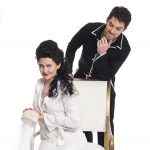
Caitlin Wood and Alex Lawrence star in Vancouver Opera’s The Marriage of Figaro. Jewish community member Leah Giselle Field performs the role of Marcellina in the production. (Emily Cooper Photography)
I am thrilled and honoured to have been chosen to lead Vancouver Opera into a new era,” said Jewish community member Kim Gaynor when her appointment as general director was announced prior to the start of this season. “Vancouver Opera already has a long history of excellent productions and a well-deserved reputation for innovation under Jim Wright’s exemplary leadership.”
As part of its vision for the future, Vancouver Opera is holding an inaugural opera festival April 28 to May 13. The event features a variety of vocal offerings for audiences, as well as workshops and other activities.
“Opera seasons are planned years in advance, so this festival was planned long before I joined VO,” Gaynor told the Independent. “However, I have brought 10 years’ experience managing the Verbier Festival in Switzerland and I am using this experience to shape the festival-going experience here. For example, we will have lots of opportunities to follow the development of young singers, and for audience participation, two things which were very popular in Verbier.”
Her resumé prior to managing the Verbier Festival includes managing director and co-founder of Austria’s Festival Retz, administrator of London, England’s Yehudi Menuhin International Violin Competition and head of marketing administration at London’s Royal Opera House. She has worked at Les Grands Ballets Canadiens de Montréal, the National Arts Centre Orchestra in Ottawa, L’Opéra de Montréal and Canada Council for the Arts.
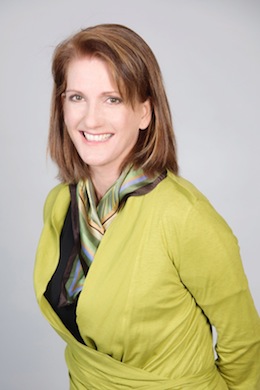
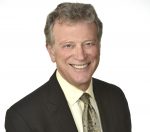
Vancouver Opera general director Kim Gaynor. (photo from VO)
Gaynor, who was born and raised in Ontario, returned to Canada from Switzerland last year, arriving in Vancouver in September. She was here in time for another recent Vancouver Opera innovation – the smaller-venue, family-friendly production of Hansel and Gretel in November.
“Hansel and Gretel was a huge success with people of all ages,” said Gaynor. “The whimsical, enthusiastic performances from our young artists and the wonderful puppets charmed everyone who came. I heard so many stories about young people being literally on the edge of their seats throughout the whole performance, and this could lead to a lifelong love of opera. One thing I learned was that the intimacy of the smaller Playhouse theatre really appeals to audiences. They want to be nose-to-nose with the performers – up close to the action.”
The upcoming festival will offer more opportunities to get up close to the action, including a performance at Vancouver Public Library – called Opera Tales – featuring singers from VO’s Yulanda M. Faris Young Artists Program, who the audience will have a chance to meet after the show. One of these singers is Jewish community member Leah Giselle Field, who also will be performing the role of Marcellina in The Marriage of Figaro. (For more on Field, see jewishindependent.ca/fairy-tale-reimagined.)
Among the other festival offerings are a video installation by artist Paul Wong, performances by vocal stylist Ute Lemper and Inuit throat singer Tanya Tagaq, an evening sing-along with the Vancouver Bach Choir, a film night, master classes for young singers, forums and discussions, preview talks and happy hours.
“We believe that the festival format will attract a new and younger audience who likes fast and furious action, because there will be something going on all the time during the 16 days of the festival,” said Gaynor. “At the same time, we are convinced that our main-stage operas, Otello, Dead Man Walking and The Marriage of Figaro, will appeal to our traditional audiences, who may only want to attend for an evening or two. In our next season, 2017/2018, which has just been announced, we are offering a season and a festival, starting with the ever-popular Turandot in the fall and closing the season with a spring festival.”
Further explaining why the festival concept is being embraced by VO, she said, “Festivals are, by definition, a celebration and people, in general, love to celebrate. We will not only be celebrating opera, but the human voice and all of its expression, from throat singing to choral. Festivals offer the chance to mingle and meet lots of other people who share the same passion. This chance to come together with like-minded people creates an atmosphere which is hard to create in a normal season. But I don’t think festivals are a more attractive model, just a different model, and VO is in the mood for change.”
One of the attractions of moving back to Canada was that Gaynor would be closer to her mom, who lives in Oakville, Ont. One of the appeals of moving to Vancouver was the opportunity to be outside. While circumstances have made that difficult so far, she has found other fun things to do around town.
“Honestly,” she said, “it seems like it has either rained or snowed every day since I arrived (until about two days ago)! I am normally a person who loves the outdoors, so my highlights have been discovering the North Shore mountains and walks along the Seawall with my dog (a 3-year-old border collie). That was before I broke my leg badly at the end of January falling off my horse! I am also finding some great spots for brunch in my neighbourhood around Main and 12th, and have been discovering all of the fantastic cultural organizations in town.”
Gaynor was born in Hamilton, Ont., but the family moved to nearby Burlington when she was six months old.
“We lived almost in the country in Burlington, in a house with a big yard with a small forest behind. More importantly, we were less than a kilometre from a horse farm, where I discovered my passion for riding. My father was a passionate amateur pianist and we had a baby grand piano at home. I got my love of classical music from him.”
Gaynor’s father was a Holocaust survivor.
“My father was one of the 10,000 Jewish children who escaped from Western Europe to England on the Kindertransport,” she said. “He lived in London from 1938 until 1954, when he emigrated to Canada and met my mother, who is not Jewish. He even changed his family name, which was Geier, but sounded too German in postwar Canada and that, combined with his accent, was a handicap. So, he took the last name of his movie star idol – Mitzi Gaynor. Unfortunately, he died quite young, only 53 years of age.
“I know my father’s life was in every way coloured by having lost his family in this way but, like many Kindertransport children, he spoke very little about it to his children. I learned much later, after his death, that a part of his family escaped Austria and made it to Palestine. I was able to find them and went to meet them in 1996. I have often wondered how life would have been different if I had been born and raised in a Jewish family in Austria, or in London. But I have close ties still to the family who adopted my father in London, and to his relatives in Israel and this has enriched my life immensely.”
While she doesn’t “practise any religious traditions in a formal way,” Gaynor said, “I feel quite close to Jewish culture and traditions because of my family and friends, but also I have participated many times in Jewish celebrations, weddings, a few bar mitzvahs and even a bat mitzvah. I also remember some very poignant things from my childhood, such as my father criticizing my mother for not being able to make good matzah ball soup. Clearly, he had some things he missed from home!”
Director Ferne Pearlstein with Mel Brooks. (photo from Tangerine Entertainment)
Woody Allen’s Crimes and Misdemeanours marked the first time that many people heard the philosophical proposition, expressed by Alan Alda’s character, that “comedy is tragedy plus time.”
I’ve always cited “the Woodman” as the source of the insight, probably because it’s consistent with a Jewish worldview. In fact, another Allen, the late, great comedian, composer and TV host Steve Allen, described the phenomenon in a 1957 magazine interview. Maybe he picked it up from somebody else; in any event, this is what he had to say: “When I explained to a friend recently that the subject matter of most comedy is tragic (drunkenness, overweight, financial problems, accidents, etc.), he said, ‘Do you mean to tell me that the dreadful events of the day are a fit subject for humorous comment?’ The answer is ‘No, but they will be pretty soon.’”
Ferne Pearlstein’s wonderfully entertaining and provocative documentary The Last Laugh asks a gaggle of comedians, as well as the viewer, if there might be one subject that defies Allen’s thesis. Seventy years on, is the Holocaust still off limits for purveyors of punchlines? Are there subjects that cannot and should not be the subject of jokes? Or are some of the functions of humour – healing, confronting uncomfortable truths from oblique angles, challenging stereotypes – applicable even in the case of targeted genocide? Finally, as the great wit Hillel famously asked his students at a late-night yeshivah improv set, “If not now, when?”
Pearlstein puts the question to a group of sharp Jewish humourists, interspersing their incisive comments with a parade of clips from films and TV shows that comprise a kind of Rorschach test for the viewer. The expert witnesses include Rob Reiner, Harry Shearer, Gilbert Gottfried and Larry Charles, who grapple with the topic with both hilarious and discomfiting results. As you’d imagine, given their ethnic backgrounds and line of work, they’ve given the matter considerable thought over the years.
Mel Brooks, who displayed unimaginable chutzpah and courage in conceiving and producing The Producers 50 years ago, cites Charlie Chaplin’s brilliant The Great Dictator to illustrate the power of mockery and ridicule to cut the Nazis down to size. Another interviewee provides a reminder that humour played an important role in the camps, providing a brief escape from bleak reality and a way of maintaining one’s humanity and dignity.
But it’s another matter altogether to mine the camps or victims for laughs. (Here’s where the late Joan Rivers makes an appearance with a jaw-dropping one-liner from some archived late-night show.)
Of course, one of the jobs of comedians is to step over the line, in order to impel us to consider where the line is. (Come on down, Sarah Silverman.) And, given the prominence of the Holocaust in shaping the identity of at least two generations of American Jews, it is a taboo that needs to be examined.
Too soon (to use the catchphrase du jour)? About time, I’d say.
Pearlstein implicitly acknowledges two important caveats, however. The reality of the Holocaust can’t be ignored or subsumed in a theoretical discussion of contemporary attitudes, and those who endured the camps should be allowed to comment on what’s funny.
Stalwart survivor Renee Firestone acts as a thread and guidepost throughout The Last Laugh, reminding us of the deadly toll of the Holocaust as well as the determination and, yes, good humour required to create a satisfying life after the darkness of Europe.
Firestone inspires us to consider the highest and best use of memory and, in the context of the film, to see humour as a constructive way of remembering and revisiting tragedy that instils strength. Over and over, The Last Laugh eschews glib analysis in pursuit of deeper truths. And those are always the best punchlines.
The Last Laugh airs on PBS April 24 (check local listings).
Michael Foxis a writer and film critic living in San Francisco.
The concept of intersectionality recognizes that multiple forms of oppression and discrimination can impact individuals at the same time. For example, African-Americans experience systemically and socially both economic disadvantage and racial discrimination. Black women face an addition layer of intersectional oppression and black LGBTQ people add homophobia to the mix.
Intersectionality can be problematic for the Jewish community. As we have discussed in this space previously and will again, despite historical realities, Jewish people are often perceived by others as an advantaged, rather than a disadvantaged, minority. It does not take long on the sort of online forums where the term intersectionality is commonly used before stereotypes of Jewish power show up. Similarly, Zionism is seen by some not as the realization of an indigenous rights movement for self-determination that it is, but rather as a form of colonialism.
In one of the most self-evident examples of intersectionality’s potential blind spots, the intersection of Palestinian rights and gay rights begets ludicrousness like Queers Against Israeli Apartheid, which makes common cause with extremists who throw homosexuals off roofs in order to condemn the perceived colonialism and myriad other “sins” of Zionism. Very frequently, in the discourse found in some far-left circles, antisemitism is dismissed because it does not fit the ideology of those who determine where the intersections are. Or, rather, it is made to not fit.
This is too bad, because selecting which humans are eligible for inclusion in a human rights movement based on immutable characteristic is, by definition, a human rights movement founded on false premises.
Of course, social theory and the real world are disparate points on a spectrum. A beautiful real-world example of something we might term intersectionality took place last week here in Vancouver.
Bernard Richard, British Columbia’s Representative for Children and Youth, spoke at the ceremony for the awarding of this year’s Janusz Korczak Medal for Children’s Rights Advocacy. He observed that it might be difficult for some people to see the parallels between a Jewish Pole who died in the Holocaust and a social worker and activist who is a Canadian First Nations woman. But the inspiring intersection of these two lives makes eminent sense.
Dr. Janusz Korczak, as regular readers know, was a hero of the Holocaust who chose to accompany the 200 children in the care of his orphanage to their deaths in Treblinka, despite the Nazis offering him a reprieve. But he is a hero not only for the way he died, but for the work of his life. Seen as the originator of the children’s rights movement, Korczak insisted on the recognition of children’s innate humanity – rather than merely their potential – and insisted on seeing children as individuals fully deserving of respect and self-determination.
Far away in time and place, Dr. Cindy Blackstock insisted on the rights of indigenous Canadian children. A human rights complaint she initiated, which took nine years to wend its way through the byzantine structures of federal institutions, resulted in a January 2016 decision that Canada has consistently discriminated against the 165,000 aboriginal children who live on reserves, and their families, by systemically underfunding services to those children and youth based solely on their identities.
Blackstock was awarded the annual Korczak medal for exemplifying the values of Korczak in advancing children’s rights.
In her acceptance speech, Blackstock spoke of walking in the footsteps of ancestors and others who came before. Korczak and Blackstock are both models for all who seek to advance the condition of children in the world. It is impossible to imagine what future greatness may be inspired by their examples. A Polish Jewish man, Korczak effectively invented a concept that is now entrenched in United Nations testaments to the rights of the child, affecting the lives of potentially every child on earth. An indigenous Canadian woman, Blackstock shepherded a human rights challenge that will improve the lives of every child living on reserves in Canada, and their families.
Someday, who knows when or where, these two examples will inspire some other individual to stand up where injustice and inequality intersect with some other group of people. Then that individual will themselves become a model for others.
Claude Romney will give the keynote address on April 23. (photo from Vancouver Holocaust Education Centre)
Jacques Lewin, a Jewish physician in Paris, was arrested at the end of 1941 and was sent to Auschwitz on the very first convoy from Western Europe to that notorious death camp. His profession almost certainly saved his life, as he performed a role that the Nazis deemed useful: that of a prisoner-doctor.
Lewin’s daughter, Claude Romney, has studied the Holocaust experiences of prisoner-doctors like her father and has a forthcoming book on the subject. She will share her family’s story, and illustrate aspects of the experience of prisoner-doctors, as the keynote speaker at this year’s Yom Hashoah Holocaust Commemorative Evening, which takes place April 23, 7 p.m., at the Jewish Community Centre of Greater Vancouver.
Lewin’s arrest took place two weeks after Romney’s third birthday. She and her mother, Saya, survived the war in Bagnères-de-Bigorre, a small town near the Spanish border that was occupied by the Germans less than three months after they arrived.
Romney’s presentation will begin with some context about the state of French Jewry in the early part of the war, something she said is not as well known as it could be. She will share a bit about her and her mother’s experiences during the war, then turn attention to her father’s story.
That story is something that Romney has pieced together mostly after her father’s death in 1968. “I remember when he died, thinking that so much had remained untold,” Romney said. “He never talked about it.”
Years after her father passed away, Romney’s mother gave her a file containing documents from her father’s past, including a few articles he had written immediately after he returned to France after the war. These had been published in a newsletter distributed by the French resistance and never reached a wide audience.
Romney has obtained the transcript of the testimony her father gave at the 1947 trial of the Auschwitz commandant Rudolf Höss, but it is not comprehensive.
“The transcript of his testimony looks as though he was so frustrated that he wasn’t given more time to talk about it,” said Romney. “I don’t know if it was 10 minutes or what, but it looks as if he was really frustrated because at one point he enumerates a number of atrocities that he saw and he said, ‘it could take me days and days to tell you about them.’ I think that’s why he never wrote any more. I don’t know whether he was approached to testify anywhere else, but he never did.”
However, other prisoner-doctors did write and testify. Romney’s forthcoming book, Saving Lives in Auschwitz: The Written Testimonies of Prisoner-Doctors, is based on the experiences of 60 individuals who survived and told what they witnessed.
When Lewin first arrived at Auschwitz, he and the others in his transport were put to work constructing a new section of the camp – to be known as Birkenau.
Lewin was one of only a few from this group that survived the war, Romney said, because he was a medical doctor. The Nazis decided around the end of 1942 that they could use prisoner-doctors to treat ill and wounded inmates who were doing forced labour. Prisoner-doctors tried their best to help other inmates, but routinely confronted horrific ethical dilemmas. They were faced, Romney said, with what the Holocaust scholar Lawrence Langer called “choiceless choices.”
“If they had refused to obey orders outright, they would have sent them to the gas chambers too,” she said.
After the war, Romney studied at the Sorbonne and became a professor of French linguistics and literature, first in Toronto, then Sudbury and finally Calgary, before retiring to Vancouver. She and her husband, also an academic, thought Canada seemed an ideal place since he was English and she was French.
The annual Yom Hashoah evening is presented by the Vancouver Holocaust Education Centre (VHEC). It is supported by the Gail Feldman Heller Endowment and the Sarah Rozenberg-Warm Memorial Endowment Funds of the VHEC, and funded through the Jewish Federation of Greater Vancouver annual campaign.
In addition to Romney’s keynote address, the evening will feature cellist Eric Wilson, Yiddish singer Myrna Rabinowitz, Cantor Yaacov Orzech and the Kol Simcha Singers. Artistic producers are Wendy Bross Stuart and Ron Stuart of WRS Productions. Holocaust survivors are invited to participate in candlelighting.
Pat Johnsonis a communications and development consultant to the Vancouver Holocaust Education Centre.
George Heyman is the member of the B.C. legislative assembly for Vancouver-Fairview. (photo from George Heyman)
George Heyman is one of numerous British Columbia residents who owe their lives to the Japanese diplomat Chiune Sugihara. Though born after the Second World War, Heyman is the son of a Polish Jewish couple who were among the estimated 6,000 Jews aided in fleeing Nazi Europe by the acts of Sugihara, who was the vice-consul for the Empire of Japan in Lithuania.
“That’s a story my parents didn’t spend a lot of time telling me about, which I’ve since found out is actually very common – parents don’t tell their story,” Heyman told the Independent. “But I learned much about it in recent years and it has been well-documented with a number of exhibits telling the story in Vancouver and the United States and other parts of Canada and in Japan.”
Sugihara risked his career – and his life – issuing transit visas to Jews. An estimated 40,000 descendants of “Sugihara Jews” are alive today because of his actions.
Once they had escaped Europe, Heyman’s parents were sponsored by family in Vancouver.
“Canada was certainly not falling over to welcome Jewish refugees,” said Heyman. “But they had distant relatives who were from Austria, who had already established here before the war started, seeing the writing on the wall. They sponsored them. My dad enlisted in the reserves, worked as a machinist in a boiler factory – even though he had an engineering degree – until he could get his credentials recognized in Canada, and eventually went on to work in the profession in which he had been trained.”
Heyman was born at Vancouver General Hospital, in the riding he now represents in the B.C. legislature, Vancouver-Fairview. The New Democrat says his family’s experience – and his own experience with casual antisemitism – helped shape his approach to the world and politics.
“I think, as a young child growing up in Canada, I just wanted to be what most children wanted, which was to be accepted,” he said. “I remember the normalization of what we would now recognize as clearly antisemitic jokes or comments or generalizations or characterizations. As a young boy, I had a hard time speaking up against it. It took a lot of courage to say, ‘you can’t talk about Jews that way’ or ‘why are you using the term Jew, my religion, in that way that is clearly not a good one?’”
These experiences, Heyman said, helped him recognize injustice and learn to value other people regardless of their economic class, ethnicity or religion, “to embrace people, not categorize them or shun them.”
“As part of that, I was also learning to stand up for who I was,” he said. “Like many young Jews, I was torn between looking for my identity and wanting to fit in. It’s been a lifelong journey.”
These experiences also helped lead him to careers in the labour movement and public office. Heyman served as head of the B.C. Government and Service Employees Union, then executive director of the Sierra Club of British Columbia, before being elected to the B.C. legislature in the 2013 election.
One of the reasons he has taken the opportunity over the years to speak up about his own experiences, Heyman said, has been “to try to deepen understanding and let people know what casual and thoughtless racist comments do to people who are the recipients of them.”
Antisemitic rhetoric and threats in North America and the murder of six Muslims in a Quebec mosque have had a range of unintended consequences, he said. They have ensured that people do not take security for granted and they have caused a coming together of disparate religious and ethnic groups.
“When Muslims at prayer in a mosque in Quebec are murdered, members of the Jewish community stood with Vancouver Muslims at the mosque and expressed their own solidarity as well as horror at the actions,” he said. “And Muslims have come to the [Vancouver Jewish Community] Centre for peace circles, to express their solidarity.… What makes us strong is when we work together, understand each other, support each other, build institutions together; not when we live in isolation or fear, because then we just give encouragement to those people who thrive on creating fear and hatred because it’s the only answer they have for what’s missing in their lives. I’d rather find a positive, constructive answer to those things that are missing in people’s lives, whether it’s spirituality, faith or some measure of economic equality, and build community solidarity that way.”
Heyman said he and the rest of the NDP caucus want to see the recommendations of the Truth and Reconciliation Commission report implemented, including educational components about the history of First Nations.
“The commission talked about ensuring that there is a healthy education component in schools, right from the earliest stages, about the history, what was wrong with it, how we can grow beyond it and heal,” he said. “The same is true of the racist laws that existed in Canada that impacted Chinese, South Asian, Japanese and other immigrants, who actually did the hard labour, in many cases, of building this country that other people weren’t willing to do. The same is true of understanding the history of the Holocaust that happened in Europe, which obviously was overwhelmingly targeted to Jews, but not only. How that connects to other aspects of racism, hatred and genocide, [and to] recognize the genocides that have happened in other parts of the world, as Jewish speakers at Holocaust memorials in the legislature have consistently done.
“We need to educate young people, both about the horror of the past and what it leads to, about the impact of thoughtless words or actions that promote or embody racist thought, but also about the benefits to us all when we live and work together and appreciate each other and embrace each other.… Government has the resources and the authority to both legislate against hatred and racism, but also to animate the actions that can ultimately, if not wipe it out, shrink it to the minimum amount that we would hope.”
On the Israel-Palestinian conflict, Heyman said he supports a two-state solution and does not support the boycott, divestment and sanctions (BDS) movement.
“I’ve never chosen to personally support or even quietly implement on my own behalf a boycott of Israeli products,” he said. “I also think it’s important in this context that we distinguish between tactics that some people choose to make a political point and whether or not that tactic is synonymous with antisemitism. I think, for instance, there are antisemites who express their views through a variety of mechanisms, and I also think there are Jews and other people who are legitimately concerned about government actions and want to find a two-state solution and peace that brings an end to the conflict and brings security to both Palestinians and Israelis who may support that tactic without being antisemitic. Personally, while I support a two-state solution, I very much want to see the hatred and conflict in the Middle East solved and that means, for me, opposing terrorism as well as opposing actions that block the road to peace.”
He added: “I think it’s important for people to recognize that those who call for a just peace and a two-state solution may be calling for justice for Palestinians and justice for Jews and Israelis, and they are not incompatible.”
As voters prepare for the May 9 election, Heyman said there are plenty of topics on the agenda.
“There are issues of affordability, issues of fairness and services for communities, for people needing healthcare, for seniors, for children, for working families, issues of housing and very important issues of, how do we build a modern, diversified economy that doesn’t threaten our children and grandchildren with an unliveable future due to climate change?” he said. “We can’t put off the choices of transitioning to a supportive society, a society that takes care of seniors and kids, as well as a society and economy that employs people productively while respecting and protecting the environment – those are the choices we need to make today.”
The Jewish Independent’s provincial election coverage continues with interviews with other candidates in future issues.
Vancouver-born writer and comedian Nathan Fielder has donated more than $150,000 US to the Vancouver Holocaust Education Centre (VHEC). The funds represent the profits of the Summit Ice outdoor apparel line, founded by Fielder to raise awareness of the Holocaust and to support the education and remembrance mandate of the VHEC.
“We are honoured to be the recipient agency for Nathan Fielder’s Summit Ice initiative,” said Nina Krieger, executive director of the VHEC. “It is especially meaningful that Nathan appreciates the work our centre does to advance anti-racism education in his hometown.”
This significant contribution will help the VHEC deliver more programs to more people at a time when the centre’s work is as relevant as ever. This gift will strengthen the VHEC’s outreach programs, educational resources and exhibitions that engage students, teachers and the general public in British Columbia and beyond.
“We receive countless letters from students affirming that participating in a VHEC program, particularly when this features a Holocaust survivor speaker, is among the most meaningful and memorable experience of their school years,” said Phil Levinson, president of the VHEC board. “Nathan Fielder’s generosity will help advance the Vancouver Holocaust Education Centre’s vision of a world free of antisemitism, discrimination and genocide, with social justice and human rights for all.”
The VHEC relies on the support of members of the community to fund education and remembrance programs.
This is the third of a three-part series on Writing Lives, a two-semester project at Langara College, coordinated by instructor Dr. Rachel Mines, in which second-year students are teamed up with local Holocaust survivors to interview them and write memoirs of their experiences before, during and after the Holocaust. The course is a partnership between Langara, the Vancouver Holocaust Education Centre and the Azrieli Foundation. As part of their course work, students are keeping journals of their personal reflections on their experiences as Writing Lives participants. This week’s journal is entitled “The Importance of Memoir.” Here are some excerpts.
Our survivor has repeatedly stated that he and his peers greatly fear that, once they are gone, no one will remember what they went through. Survivors worry that, once they are no longer here as living testaments, their suffering and the people they lost will be forgotten. Our class, and other projects like it, is working to ensure that does not happen.
We must preserve the experiences of Holocaust survivors in written form so that, once they are no longer physically here, their story will be. We are not only archiving personal anecdotes, we are putting a human face on history. Facts are important for historical validity, but personal perspectives are essential in creating empathy. This program is chronicling history in such a way as to touch people and make them care about what happened to the Jewish people (and others) during the Holocaust. Empathy is one of the greatest tools in breaking down intolerance. Once we see the humanity in others, it becomes harder to hold onto prejudice and hatred.
Now, more than ever, it is vital to create this historic empathy. Prejudice and persecution are becoming ever more prevalent in our society, and it is up to us as a nation to halt such hatred. It is essential to remind the world what can happen when hatred is met with social apathy. These memoirs are a documentation of the horrors that unchecked hatred can lead to. I believe in the power of memoirs, the power of living history. I am honoured to be a part of such an important project at such a crucial time.
– Frieda Krickan
***
The first time I interviewed a Holocaust survivor, I was nervous, and rightfully so. My interview partner and I had been preparing for months before our first meeting but, nonetheless, when our interviewee arrived, I was so star-struck that I briefly lost my aptitude with the English language altogether. All I could manage to say was multiple renditions of the same sentence, thanking him again and again for his time and for agreeing to meet us.
Our interviewee, R., was gracious and didn’t miss a beat. He chimed in every time by thanking us in return just for listening and told us on multiple occasions, “I am so grateful for what you are doing. This is very important to make sure that the Holocaust never happens again.” His response surprised me but, the more I listened, the more I realized that this project meant more to him than just sharing his story; it was his personal call to tikkun olam, to repair the world the best that he can.
I learned that every Holocaust survivor’s greatest fear is not what you would expect. It is not death camps or gas chambers – instead, R. told us that their greatest fear is that no one will remember their stories when they are no longer alive to tell them. They are afraid that, with today’s ugly resurgence of antisemitism, everything they endured will be meaningless in the face of a society that cannot wait to forget. In a world that wants us to keep silent, it is every survivor’s hope that we raise our voices – that we proclaim the truth until our breath runs out. Our sacred duty is to empower the ones who can no longer empower themselves, and the key to making sure history never repeats itself is to tell their stories.
– Zoe Mandell
***
During this course, my group members and I spent a concentrated amount of time with a child survivor of the Holocaust. Time and time again, he narrowly escaped falling into the hands of the Nazi regime…. His story is inspiring, heroic, terrifying at times, and very emotional. He tells his story with such grace, in such detail, that we could clearly visualize in our minds what he had experienced.
I have heard many stories of those who survived, and the stories they tell of those they lost. I have learned what it was like for a child survivor from Paris, a teenage survivor from Amsterdam and an adult survivor from Warsaw. I have heard the stories of their mothers, fathers, brothers and sisters: how they watched their father get shot, or saw their mother walk toward her certain death, or said goodbye to a brother they knew they’d never see again. Telling their stories, writing their stories, is not only a therapeutic technique, but a preventative one. It is important for those who survived to tell as many stories as they can, not to let the memory of their loved ones perish like they did during that awful time in history. It is important to tell the story of their loved ones to keep their memory alive in as many beating hearts as possible. And it is important to tell the stories of the Holocaust, for both survivors and those who perished, to stand up and say, “We survived. We won’t forget. Never forget. And never let it happen again.”
– Marni Weinstein
***
During and after each interview my group conducted with R., he thanked us multiple times. He thanked us for taking the time to listen to his story, for writing his memoir, and even for sharing parts of our lives with him. Every time he thanked us I was taken aback: why was he thanking us for listening to him, when we were the lucky ones? We were being given the opportunity not only to listen to a Holocaust survivor speak but to write a memoir that would continue his legacy throughout time. At first, I struggled with his gratitude; I was almost uncomfortable with how genuinely thankful he was that we were spending time with him and listening to his story. Yet no matter what I said, he was grateful.
It took me quite awhile to grasp exactly why R. felt the need to continually express his gratitude. In fact, R. did not grow up in a world that accepted the events of the Holocaust as facts and wanted to learn more about it. He grew up in a world where no one wished to speak about the Holocaust and its events were contested. He did not conceal his experiences only because they were too painful to revisit, but also because no one wanted to listen.
Not only did those affected by the Holocaust lose their families, their homes, their childhoods and years of their lives, but in many cases they lost their voices. For years, the world refused to listen and, because of that, we lost many valuable stories. Memoirs are important not only because they give survivors the opportunity to share their stories, but because, on a very small level, they begin to give a voice back to the voiceless. Although we can’t bring those survivors back and prove to them there are people who care and will listen, we can make sure the survivors who are still alive do not go unheard.
Elizabeth Cady Stanton – suffragist, social activist, abolitionist. Susan B. Anthony – social reformer, women’s rights activist. Ernestine Rose – who?
Bonnie Anderson taught history and women’s studies for 30 years at Brooklyn College and at the Graduate Centre of City University of New York. She has written three books on women’s history, the latest being The Rabbi’s Atheist Daughter (Oxford University Press, 2017).
When Anderson wrote Joyous Greetings: The First International Women’s Movement, 1830-1860, she learned about Rose, who was born in 1810 in Poland to an Orthodox rabbi and his wife. Her father taught her Hebrew and Torah but, by age 14, she had rejected Jewish beliefs and identified as an atheist. Betrothed at 15, she broke her engagement but her fiancé would not agree – he wanted her inheritance and brought a suit against her. At age 17, Rose went to the district court 65 miles away and presented her case personally, arguing that “she should not lose her property because of an engagement she did not want.” She won.
Moving to Berlin, Rose lived there two years before heading to Paris and then to London, where she embraced the belief system of Robert Owen, who had a utopian socialist vision; she became a disciple. Also in London, she met William Rose, a free-thinking atheist, jeweler and silversmith. They married when she was 20 and he was 23 and emigrated to the United States.
Rose became a pioneer for women’s equality and an accomplished lecturer, speaking to the public for the free-thought and the women’s rights movements.
“A good delivery, forcible voice, the most uncommon good sense, a delightful terseness of style and a rare talent for humour are the qualifications which so well fit this lady for a public speaker,” wrote a reporter in Ohio in 1852.
She lectured extensively, including against slavery, during her years in the United States, from 1836 to 1869, and became a U.S. citizen. She went back and forth to England between 1871 and 1874.
“She embodied female equality in both her everyday life and her political activism,” writes Anderson. “She was a true pioneer, working for the ideals of racial equality, feminism, free thought and internationalism.”
The book concludes with 44 pages of notes and eight pages of bibliography. Readers should find this biography of an “international feminist pioneer” a fascinating reading experience about an amazing woman.
***
In 2005, the movie Woman in Gold portrayed the story of a painting of Adele Bloch-Bauer I that was painted by Gustav Klimt in 1907 and owned by her and her husband. She died in 1925 and her husband fled Austria in 1938, ultimately dying in 1945. During the war, the Nazis seized the painting, which had ended up in a Vienna palace. The will of her husband designated Maria Altmann, niece, as heir and Altmann sued the Austrian government for the painting, and won the court battle. The painting was subsequently bought by Ronald Lauder and is now in the Neue Galerie in New York.
The novel The Fortunate Ones by Ellen Umansky (William Morrow/HarperCollins, 2017) alternates between Vienna in the 1930s and England in the 1940s, as well as Los Angeles in 2005 and 2006 and New York in 2006.
Rose Zimmer, her older brother Gerhard and her parents, Charlotte and Wolfe, live in Vienna in 1938. Unable to escape, they send Rose and her brother on the Kindertransport to England. Rose, 12, lives with a childless Orthodox Jewish couple; her brother lives elsewhere. By the time the war is over, Rose is living with a girlfriend and working; her brother is in the service and their parents’ whereabouts are unknown. Rose goes to college, is supported by her brother and his wife, meets a young man, marries and moves to Los Angeles, where she teaches.
In the background is Rose’s quest for a Chaim Soutine painting that was important to her mother.
Alternating with this story is that of Lizzie, a 37-year-old lawyer whose sisters live in Los Angeles, where their father lived and died. She meets Rose at her father’s funeral and learns of the Soutine painting. The work had been bought by her father and had hung in their home when she was a teenager, until it was stolen during a party.
A friendship blooms between the two women and Lizzie learns Rose’s background, that her parents were sent to a concentration camp and their home, along with the painting, seized. The “fortunate ones” are the ones who survived the war, but at what cost?
Lizzie’s story is far less interesting. She grew up in Los Angeles, her mother died when she was 13. She became lawyer, lives in New York, then moves back to Los Angeles after her father dies, and starts the search for the painting.
Both women have issues with loss and forgiveness. The novel is emotional, sentimental and suspenseful, and engaging enough not to want to put it down and to keep reading.
As to whether Umansky was influenced by The Woman in Gold in writing this book, she said she had not read the story or seen the movie, “although I was certainly aware of them and interested in the true events that inspired them.”
As to why she wrote the novel, she said, “That’s a hard one to answer in a few sentences! The contemporary story of Lizzie has its roots in something that happened when I was growing up in Los Angeles: my family was friendly with an ophthalmologist who lived lavishly and had a prized art collection, the crown jewels of which were two paintings, a Picasso and a Monet. In the early 1990s, those canvases disappeared without a trace. I was fascinated by the incident and, later, when the stories of Nazi-pilfered art came into the news, I began to imagine a storyline that brought both of these threads together.”
Sybil Kaplanis a journalist, lecturer, book reviewer and food writer in Jerusalem. She created and leads the weekly English-language Shuk Walks in Machaneh Yehudah, she has compiled and edited nine kosher cookbooks, and is the author of Witness to History: Ten Years as a Woman Journalist in Israel.
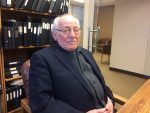
In February, the Louis Brier Jewish Aged Foundation and Louis Brier Home and Hospital honoured Chaim Kornfeld. And they did so in the place he has especially dedicated his time over the last four decades: the Louis Brier synagogue.
Chaim was born in Hungary in 1926. His upbringing and education were Orthodox and, for the first part of the Second World War, his family were untouched. From the start of his education at Yiddish cheder, at age 3, he was a good student. Community life continued much as it had for centuries.
Outside the home, Chaim’s memories describe a tense separation between Jew and non-Jew. “My father always used to say, ‘When you see a Shaygetz, cross the street. Go on the other side.’”
Needless to say, young Chaim did not always do as he was told. “I took the beating instead – but I fought back, too.” He adds, “Especially at Easter time, they’d call you dirty Jew.”
It’s not hard to imagine a young Chaim’s spirited response. Even at 90, he is energetic and expressive in conversation. “I was a tough kid,” he says. His daughter Tova adds with pride, “He gave as good as he got!”
In 1944, Chaim was preparing to go to Franz Josef National Rabbinical Seminary of Hungary in Budapest. Then, not long before his 17th birthday, his family was moved to a ghetto with the other Jews of their town. Then came the trains.
Chaim, his parents and one of his sisters were sent to Auschwitz. On the journey, Chaim was permitted to fill a bucket of water for the passengers to have occasional drinks. He also took the dead out of the car.
On arriving at the concentration camp, Chaim jumped out. Greeted with ordinary scenes – “children playing, laundry drying” – Chaim’s mother figured she could work in the camp laundry.
Chaim relates how “an old man came up and asked, ‘Do you speak Yiddish?’ I said, ‘Yes, of course.’” The man pointed to a German official. “He’s going to ask you two questions. When he asks how old you are, you say you’re 18. When he asks you what you do, say you’re a farmer.”
Young Chaim approached the man with his usual confidence. Josef Mengele asked him his age and profession. Chaim answered as he’d been told. Mengele told him to go to the right. His parents were sent to the left. Before they were separated, Chaim’s father made a final request: “Bleib a Yid.” (“Remain a Jew.”) Afterwards, Chaim heard others say, “You see that smoke? That’s your parents.”
At Auschwitz, the Nazis stripped the prisoners of their belongings and identity, shaving off Chaim’s hair. He smiles ruefully. “I had lovely peyis, nice and curly.” Having only spent two weeks in Auschwitz before being transferred to Mauthausen in Austria, Chaim wasn’t at the camp long enough to get a number tattooed on his arm. He has not forgotten his number, though, and barks out “67655!” at an impressive volume, but not in English, or even Yiddish. It’s in Polish, as he heard it at Auschwitz.
Asked how he managed to maintain his sanity while facing death every day, he quotes Robert Frost: “I had promises to keep and many miles to go before I sleep.” But there’s more to it. Chaim describes how he kept his promise to his father, in spite of malnutrition and brutal treatment. “I always said, I’ll get out of here.”
He speaks with gritted teeth. “I never gave up. Even when I worked in a tunnel underground, I was mumbling a prayer. I prayed all the time to make time go faster. I knew the prayers by heart from a very young age. All kinds.”
Chaim describes a life of hard labour, misery and oppression. There were about 600 steps up the quarry. We “carried rocks on our shoulders, every day. There were dogs barking, soldiers pointing guns at us.” There was a pond at the bottom. If a prisoner fell down, he says, they would be pushed in.
Chaim found that he was the only one who remembered long tracts of the Torah. He led Kol Nidre in the camp, “all the others stood around me. I knew it by heart. I got a good education.” To lead a service in such appalling circumstances takes more than just education, however. It speaks to a capacity for leadership and clarity in a situation that is baffling in its cruelty.
When the prisoners were forced on a death march, Chaim was recuperating from an abscessed ankle. Although barely able to stand, he followed the advice of a fellow prisoner, who told him that if he didn’t leave the camp upright, he’d never leave at all. Limping in extreme pain, Chaim made it out but collapsed afterwards. When an SS officer raised his gun to shoot him, Chaim spoke up with his characteristic blend of optimism and boldness. Having been reminded of what a good worker this young Jew was, the officer permitted Chaim to hitch a ride on a passing wagon.
Until this year, Chaim was active in Holocaust education. In spite of the many letters from kids, thanking him for his work, these letters can be “painful,” he says. “The reminder is not always pleasant.” One might think that even a “tough kid” could tire of telling this harrowing story again and again, but Chaim isn’t flagging. “As long as there’s someone to listen, I’ll tell.”
After liberation, Chaim lived at the “internat” (boarding school) maintained by the rabbinical college in Budapest. Completing two years of high school in one under the instruction of one Dr. Kolben, Chaim still speaks admiringly of his teacher. “She was quite a lady. Very smart,” he says.
Kolben also taught them about the culture of Budapest. It gave the boys a chance to revive their appreciation of the arts, to leave them with images of beauty, after the horrors of the war. These included trips to the theatre in Budapest, to see Shakespeare’s plays. Their influence lives on today in Chaim’s memory. “To be or not to be, that is the question, whether it is nobler.…” He pauses to let me finish the quote. After staring, dazed, for an instant, I am relieved to find “the slings and arrows of outrageous fortune” bubble up in my mind.
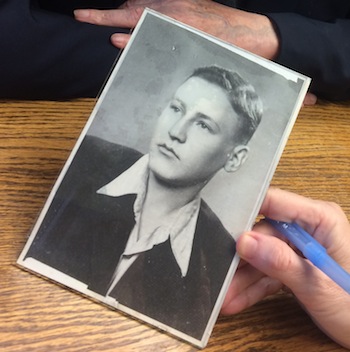
Chaim Kornfeld in his younger days. (photo by Shula Klinger)
Chaim ended up in a displaced persons camp, in Bari, Italy. The hungry residents were frustrated to find that the food stores were locked away. “He led an uprising and they opened the locker,” Tova says. “He gave an impassioned speech.”
After the DP camp came aliyah. “Someone came from the JDC [Joint Distribution Committee] to take people to Palestine.” Chaim arrived in 1949, right after independence, and joined the air force immediately. “I was in charge of a platoon of women. That was fun,” he laughs. “I told them, during the day, I am in charge. In the evening, you are in charge!”
Asked about his career, he describes being “a lawyer for 55 years; prosecuting, judging, the lot!” Indeed, Chaim was appointed to the bench. Having developed a habit of quoting the Talmud in his judgments, he earned the nickname “The Bible Judge.” He would make “off the bench decisions,” which were popular with the courts, Tova recalls.
Chaim had originally planned to go to engineering school but his English was not fluent enough. “It was so hard, so technical,” he says. At the end of his first year, his essay about George Bernard Shaw’s Candida got him a C-. “People who were born and raised in Canada failed that exam!” he says proudly of his grade.
His optimistic attitude was evident in his approach to work as well. As a lawyer, he was known for handing out treats at the courthouse. Known as “Candy Man,” he would move up lines of people waiting for their paperwork, greeted by out-stretched hands.
At the Feb. 25 Louis Brier tribute, Chaim was honoured with a special Shabbat service in his name. With more than 150 people in attendance, Chaim read Haftorah. As Tova, says, “like a bar mitzvah boy, beautiful.” Thanked by many for his work, he was given a Torah cover for one of Louis Brier’s volumes. Says Tova, “It was really lovely.”
Reflecting back on his survival, Chaim credits his Judaism for keeping him afloat. This is living proof of Viktor Frankl’s assertion that, to survive, one needed to seek a meaning to one’s existence, even in the camps. “I didn’t feel that G-d abandoned me,” says Chaim. “I never lost my faith.”
Indeed, he has kept a kosher home for all of his adult life. But survival takes resilience and a good deal of ingenuity, as well as faith. “We took empty burlap bags and stuffed them into our pyjamas, to stay warm,” he says. When he was starving, he ate coal. “I was my own doctor,” he says.
One might think these experiences would define him, but, when presented with the term “survivor,” he shrugs and grimaces. “Rachmanut saneiti,” he adds. “I hate pity.”
One cannot help but see the sense in Chaim’s attitude. Simply referring to this man as a Holocaust survivor would be reductive. He recently celebrated six decades of marriage to his wife, Aliza, and their four adult children all have successful careers. Still active at 90, he has built a reputation as a mensch: generous, respectful, with a buoyant spirit and a talent for relationship-building. And, even now, one sees the tough kid – the keeper of promises, the kid who took a beating rather than tolerate bigotry. And, the same kid who jumped off the train in 1944, ready to meet the eye of the man who held – and toyed with, tortured and destroyed – the lives of his contemporaries.
Chaim has only just retired. He still reads the Tanach in his office and attends shul on Saturdays and Sundays. He talks of keeping up with his hobbies: “Swimming at the JCC every day. Making my wife happy.”
Shula Klingeris an author, illustrator and journalist living in North Vancouver. Find out more at niftyscissors.com.