Skip to content
  • Home
  • Subscribe / donate
  • Events calendar
  • News
    • Local
    • National
    • Israel
    • World
    • עניין בחדשות
      A roundup of news in Canada and further afield, in Hebrew.
  • Opinion
    • From the JI
    • Op-Ed
  • Arts & Culture
    • Performing Arts
    • Music
    • Books
    • Visual Arts
    • TV & Film
  • Life
    • Celebrating the Holidays
    • Travel
    • The Daily Snooze
      Cartoons by Jacob Samuel
    • Mystery Photo
      Help the JI and JMABC fill in the gaps in our archives.
  • Community Links
    • Organizations, Etc.
    • Other News Sources & Blogs
    • Business Directory
  • FAQ
  • JI Chai Celebration
  • JI@88! video

Recent Posts

  • Sharing her testimony
  • Fall fight takes leap forward
  • The balancing of rights
  • Multiple Tony n’ Tina roles
  • Stories of trauma, resilience
  • Celebrate our culture
  • A responsibility to help
  • What wellness means at JCC
  • Together in mourning
  • Downhill after Trump?
  • Birth control even easier now
  • Eco-Sisters mentorship
  • Unexpected discoveries
  • Study’s results hopeful
  • Bad behaviour affects us all
  • Thankful for the police
  • UBC needs a wake-up call
  • Recalling a shining star
  • Sleep well …
  • BGU fosters startup culture
  • Photography and glass
  • Is it the end of an era?
  • Taking life a step at a time
  • Nakba exhibit biased
  • Film festival starts next week
  • Musical with heart and soul
  • Rabbi marks 13 years
  • Keeper of VTT’s history
  • Gala fêtes Infeld’s 20th
  • Building JWest together
  • Challah Mom comes to Vancouver
  • What to do about media bias
  • Education offers hope
  • Remembrance – a moral act
  • What makes us human
  • המלחמות של נתניהו וטראמפ

Archives

Follow @JewishIndie
image - The CJN - Visit Us Banner - 300x600 - 101625

Tag: Holocaust

Grodzka Gate Lublin reunion

Grodzka Gate Lublin reunion

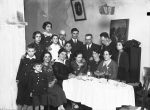
A photo from Lublin: Faces of a Nonexistent City, likely taken by taken by Abram Zylberberg. (photo from Grodzka Gate – NN Theatre Centre)

From July 3-7, the Grodzka Gate – NN Theatre Centre in Lublin (Osrodek Brama Grodzka – Teatr NN), Poland, will host the Lubliner Reunion – the first international meeting of Jewish inhabitants of the city and their descendants in 70 years.

Grodzka Gate – NN Theatre Centre is an organization run by non-Jews dedicated to preserving Jewish memory. It has been actively pursuing this mission for 25 years, and its program includes meetings, discussions, sightseeing tours, commemorations and artistic events. The reunion will constitute an important element of the celebrations, which mark 700 years since the founding of the city of Lublin, and is designed to emphasize the significance of the Jewish community for the history of the city.

The history of Jews has been intertwined with that of Lublin for several hundred years, and has helped shape its identity. The story of Lublin has been enriched with, among other things, the presence of a well-known yeshivah (Yeshivat Chachmei Lublin), the meetings of the Council of Four Lands (Vaad Arba Aratzot), the activities of local rabbis and social organizations and the work of writer and Nobel-laureate Isaac Bashevis Singer.

Just before the Second World War broke out, the 43,000 Jewish citizens of Lublin constituted one-third of the city’s population. The majority of Lublin’s Jewish inhabitants were murdered during the Holocaust and one of the German death camps, Majdanek, was located on the outskirts of Lublin. The story of Lublin cannot be told without the stories of its Jewish inhabitants, which is why, during the festivities organized to celebrate the 700-year-long history of the city in 2017, the presence of their descendants is vital and symbolic.

“The Lubliner Reunion is a way to build a bridge across time,” said Tomasz Pietrasiewicz, founder and director of Grodzka Gate. “It’s meant as a meeting in which both the people and their stories are important. Grodzka Gate is engaged in protecting the ‘memory of the place.’ We want to preserve what is left of Lublin’s Jewish community. The Lubliner Reunion will allow us to share knowledge and fill the blank spaces in the stories about Lublin and its inhabitants.”

photo - Grodzka Gate in Lublin, Poland
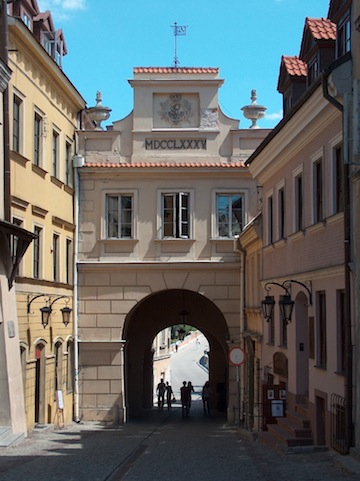
Grodzka Gate in Lublin, Poland. (photo from Grodzka Gate – NN Theatre Centre )

The program of the reunion covers meetings devoted to the history and culture of Jewish Lublin, workshops in genealogy, walks along tourist trails, commemorations and a variety of artistic events. One of the central features of the reunion will be presentations of Lubliner family stories. Guests will have a chance to get to know both historical and contemporary Lublin, visit the former Jewish district and meet non-Jews working to preserve the memory of the Jews of Lublin for generations to come.

Apart from sightseeing within Lublin, Grodzka Gate is also planning tours of the region – Zamosc, Kazimierz Dolny, Belzec and Wlodawa, among other places. Apart from these excursions, all events are free of charge for participants. The inauguration of the reunion will take place on July 3 in the Museum at the Lublin Castle.

“We want to get in touch with and invite all those whose families come from Lublin,” underlined reunion coordinator Monika Tarajko. “We already have participants coming from Israel, the United States, France, Belgium and Great Britain. However, we are still striving to reach as many prospective participants as possible and inform them about the reunion. We are expecting more than 100 people to visit Lublin as part of this special event. Feel welcome to join us!”

For reunion registration and information, visit lubliners2017.teatrnn.pl or contact Tarajko (48-606-687-367, [email protected]) or the American ambassador to Grodzka Gate, Leora Tec (1-781-862-4976, [email protected]).

Grodzka Gate’s other projects include Lublin: Memory of the Holocaust, a trail commemorating the Jewish inhabitants of Lublin who perished in the Holocaust; The Mysteries of Memory, an artistic happening involving a piece of the city with its specific topography, history and technical infrastructure; and Henio Zytomirski: The “Letters to Henio” Project, where, on April 19 (Holocaust Remembrance Day in Poland) every year, citizens of Lublin send letters to Henio Zytomirski, a Jewish boy who was born in 1933 in Lublin and was murdered by the Nazis in a gas chamber, probably in November 1942.

Grodzka Gate’s Lublin: Memory of the Place Exhibition is dedicated to Lublin before the war. A considerable part of the former Jewish district today has been covered with concrete, under which the foundations of Jewish buildings and the memory of those who once lived there are buried. Over the years, Grodzka Gate has become a place where old photographs, documents and testimonies can be preserved for posterity.

As well, there is Lublin: Faces of a Nonexistent City. In May 2012, Grodzka Gate received a collection of 2,700 glass plate negatives found in the attic of the house at Rynek 4 by workmen doing repairs. The photographs were taken between 1914 and 1939 and were, based on Grodzka Gate’s research and recent findings, taken by Abram Zylberberg.

Grodzka Gate’s website is teatrnn.pl/en.

Format ImagePosted on June 9, 2017June 7, 2017Author Grodzka Gate – NN TheatreCategories WorldTags continuity, Grodzka Gate, Holocaust, Lublin, memory, Poland
Making Canada home

Making Canada home

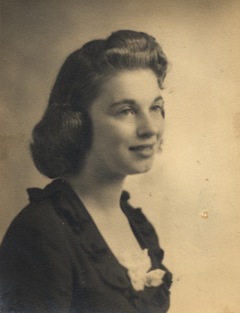
Marianne, left, with her father, Otto Echt, and sister Brigitte. (photo from Canadian Museum of Immigration [CMI] at Pier 21)

Marianne Ferguson’s family missed the train that was supposed to take them to Montreal from Halifax. Just 13 at the time, she and her sister were mostly excited at the prospect of something new, although they were sorry to leave friends and family behind in Europe. Their parents, however, were apprehensive, worried about starting a new life in a foreign country. And that was before they got stuck in Halifax – where, almost eight decades later, Ferguson, née Echt, still calls home.

In Europe, the Echts had lived in a little resort town called Brosen, just outside of the Free City of Danzig, which is today the Polish city of Gdansk. Ferguson’s father, Otto, was a pharmacist and a hobby farmer, and they lived well. Her mother, Meta, had multiple maids; the children – Marianne, Brigitte and Reni – had a nanny, and every spring and autumn a dressmaker would come into their home for a week to create new wardrobes for the upcoming season. When Adolf Hitler came to power, Ferguson’s family was relatively unaffected in the beginning. Even so, her parents saw what was coming and began making contingency plans.

Ferguson’s father kept homing pigeons on his farm. He would go to Poland to deposit money, and send the pigeons back home with coloured ribbons tied to them for Ferguson’s mother to decipher. A yellow ribbon meant he had arrived, for example, while a red ribbon meant he had deposited the money. He was able to get away with this scheme because the guards at the Polish border assumed he was entering his pigeons into competitions.

The Echts continued living in Brosen as the situation deteriorated for Jewish families. When the fair-haired Ferguson traveled to Hebrew school in Danzig with her sister, Hitler Youth would yell at her to ‘Stop walking with that Jew!’ When the Jewish children in the region were no longer allowed to attend school with their peers, the Jews of Brosen opened their own school on a local estate. The estate was at the end of a long street inhabited by Nazis, and it was understood the Jewish children all had to be in school and off the street by 8 a.m.

One day, when Ferguson was about 11 or 12, her streetcar to school was late. As she was walking alone down the long street to her school, a man sent his police dog after her. The dog attacked her, biting her on the elbow.

“And all of a sudden, somebody raised me up. Must have been an angel, really,” said Ferguson in a recent interview with the Independent from her nursing home in Halifax.

It was the milkman. He put Ferguson in his wagon, drove her to school and deposited her inside the gate. Ferguson said that man saved her life.

For her parents, it was the last straw. They decided they had to get out. A member of the Canadian consulate informed them that the country was not accepting pharmacists. Fortunately, though, the consulate worker saw their little farm and suggested sending them as farmers. And so it was that the Echts found themselves coming through Pier 21 in Halifax on March 7, 1939.

When they arrived at the pier, someone called their names and frightened Ferguson’s father. How did people here know who they were? But the woman calling them was Sadie Fineberg, from Jewish Immigrant Aid Services (JIAS). When the Echts missed their train, Fineberg put them up in a boarding house run by a Yiddish-speaking woman, and many Jewish families came to visit them.

photo - Marianne Ferguson
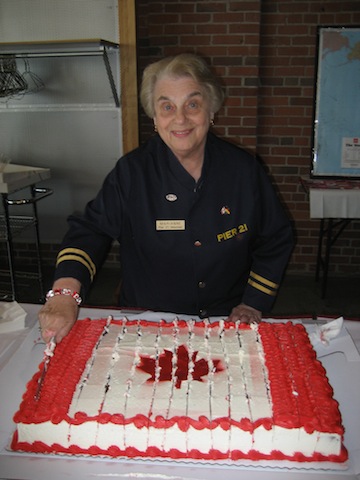
Marianne Ferguson (photo from CMI at Pier 21)

“My parents said, ‘The people were so nice to us, and how do we know what it’s going to be like in Montreal? Maybe we should stay in Nova Scotia.’ And then they helped us with finding the farm, they drove us out … and we moved over there,” said Ferguson.

The farm was in nearby Milford, about a 45-minute drive from downtown Halifax. The Echts had to stay and work the farm for seven years as a condition of their immigration and, after their term ended, they moved to Halifax. Fineberg became a close family friend, and her nephew Lawrence became Ferguson’s husband.

Ferguson’s extended family was not so lucky. Her parents had applied to bring 11 of them over to Canada, and they were supposed to arrive later in the year. Cutting through all the red tape took time, but the process seemed to be progressing. Ferguson’s 11 family members went to meet their boat in Hamburg – but it wasn’t there. That day was Sept. 1, 1939, and the Second World War had just broken out.

“My father had bought a second farm. We were so lucky, it was right next to our farm. We thought we would all be together in the two farms. But it wasn’t meant to be. They were all killed,” said Ferguson.

When the war ended, Ferguson began volunteering with JIAS, helping Jewish refugees find their way in Canada. Many of the displaced persons were children traveling alone. Ferguson remembers one 17-year-old boy in particular who came through Pier 21 in 1948 and needed money to get to Montreal. Ferguson and her mother gave him $20 and some food. They also told him that he would become a good citizen, and he should work hard and make something of himself. Meanwhile, Ferguson continued to volunteer at Pier 21 until it closed in 1971. She began volunteering there again when it reopened as a museum in 1999.

Unbeknownst to Ferguson, the boy listened to her. His name was Nathan Wasser, and he had survived multiple camps in the Holocaust, including Auschwitz. He was trained as an electrician in Munich after the war, so that’s the work he first did after arriving in Montreal. In 1952, he met his wife-to-be, Shirley, at a parade for Queen Elizabeth, who was still a princess at the time. Together, they started a family, having a daughter and a son, and he ventured into the business world. Wasser eventually came to own his own shopping centre.

photo - Marianne Ferguson volunteered at Pier 21 when it was an immigration facility and again when it reopened as a museum
Marianne Ferguson volunteered at Pier 21 when it was an immigration facility and again when it reopened as a museum. (photo from CMI at Pier 21)

Through it all, Wasser – who passed away in 2015 – kept in mind the two women who had helped him when he first came to Canada as a scared and overwhelmed teenager.

“So I said to him, ‘You know, you have this vision of two volunteers. Would you like to go back to Pier 21?’” said his wife Shirley Wasser in a phone interview with the Independent. “And he said, ‘Well, I’ll never find anything.’”

Despite his doubts, Wasser contacted the Atlantic Jewish Council in 2003. The council connected him to Ferguson (her mother had already passed away), and they arranged to meet when the Wassers visited Halifax later that year.

On the appointed day, Ferguson and her granddaughter waited in the lobby of Pier 21 for a man with a blue shirt. Unfortunately, it seemed as if every man was wearing a blue shirt that day. Finally, a couple entered. The man was wearing a blue shirt and carrying flowers.

“My granddaughter said, ‘I think that’s for you.’ And, you know, he recognized me,” Ferguson recounted as she started to tear up.

Ferguson and Wasser stayed in touch until Wasser’s death, and she is still in contact with his wife. Whenever the Wassers came to Halifax, the Fergusons would have them over for Shabbat dinner on the Friday, then the Wassers would take out the Fergusons for dinner on the Saturday. Every birthday and holiday, Nathan Wasser would send a bouquet of flowers to Ferguson.

“He had no words for her, how grateful and how appreciative he was to the pier and the volunteers,” said Shirley Wasser. “I think [Ferguson] was one of the finest ladies I’ve ever encountered.”

“He did save his money and he listened to what we were saying. He said he owed it to us to do well. He was so grateful,” said Ferguson, speaking of her late friend somewhere between laughter and tears.

Alex Rose is a master’s student in journalism at the University of King’s College in Halifax. He graduated from the same school in 2016 with a double major in creative writing and religious studies, and loves all things basketball. He wrote this article as part of an internship with the Jewish Independent.

Format ImagePosted on June 2, 2017May 31, 2017Author Alex RoseCategories NationalTags Canada, Halifax, Holocaust, immigration, Marianne Ferguson, Pier 21, tikkun olam
Yom Hashoah at KDHS

Yom Hashoah at KDHS

The Sir Charles Tupper Secondary School Grade 11 history class for which King David High School teacher Anna-Mae Wiesenthal (middle row, second from the right), did a presentation on the Holocaust. Their teacher, Bonnie Burnell, is to Wiesenthal’s left. (photo from Anna-Mae Wiesenthal)

“They were in awe of the Holocaust survivor,” said Bonnie Burnell, a teacher at Sir Charles Tupper Secondary, describing the reaction of her students to survivor Robbie Waisman’s talk at a Yom Hashoah assembly at King David High School (KDHS) on April 24. “Looking at him as he spoke at the podium, they could scarcely imagine him on the inside of a Nazi concentration camp.”

Students from Prince of Wales Secondary School and, of course, from KDHS also joined the assembly, which was organized by KDHS teachers Anna-Mae Wiesenthal and Aron Rosenberg, and included Cantor Yaakov Orzech chanting El Malei Rachamim.

The multi-school initiative was led by Wiesenthal, who is currently pursuing a master’s degree in Holocaust and genocide studies. Last year, she went to Austria and Poland with the Sarah and Chaim Neuberger Holocaust Education Centre of Toronto. In addition to teaching about the Holocaust at KDHS, she has been giving presentations at various public schools. She told the Jewish Independent that students have been very engaged and have asked many questions. This outreach led to the recent assembly at KDHS, where other schools’ students were invited to attend.

photo - Holocaust survivor Robbie Waisman addresses the assembly for Yom Hashoah at King David High School on April 24
Holocaust survivor Robbie Waisman addresses the assembly for Yom Hashoah at King David High School on April 24. (photo from Anna-Mae Wiesenthal)

“My students, in general, were impressed with the ceremony and glad that they had made the decision to come,” Burnell said. “We have had a real focus on racism in our curriculum this year, and this visit definitely adds something of central importance to that subject.”

Wiesenthal, who has taught at KDHS since 2006, became interested in focusing more on Holocaust education after attending an educators seminar at Yad Vashem in 2012.

“I feel Holocaust education is about giving voice to the millions of victims who were murdered simply because of who they were, and honouring their legacy and our history,” explained Wiesenthal. “It is about remembering the vibrancy of Jewish life both before and after the war. It is about preserving memory for future generations and across cultures. It is about taking the knowledge of unprecedented horrors, and keeping them in front of us so that we remain vigilant about our humanity in the face of genocides today.”

Wiesenthal also admitted to being inspired by a possible kinship with renowned Nazi hunter Simon Wiesenthal. Her great-grandfather, Mattityahu Wiesenthal, was a Russian boy saved from forced conscription in the Russian army by being “thrown across the river” from Russia into the town of Skala in Austria-Hungary, as many boys were at that time. As an orphan in Skala, he was taken in by Moshe Efroyim Wiesenthal, who supported many such refugee orphans, and the young boy took the family name Wiesenthal to honour his patron. Wiesenthal does not know if Moshe Efroyim was directly related to Simon Wiesenthal, but the latter remains one of her heroes, and she has been in touch with his granddaughter, Racheli Kreisberg.

Wiesenthal also recently initiated a pilot project at the Vancouver Holocaust Education Centre (VHEC), in which KDHS students trained as docents (museum guides) lead other students through the exhibit.

Another project was an art exhibit at KDHS, where her Jewish History 11 class viewed a video of a Holocaust survivor’s testimony, chose an aspect of the testimony that stood out for them and then created a work of art based on that aspect. Each work was accompanied by an artist’s statement, a picture of the survivor and why the student chose the testimony they did. Contributions included painting, sculpture, writing and music. “The quality of expression was very moving,” said Wiesenthal.

Rabbi Stephen Berger, head of Judaic studies at KDHS, said he is thrilled with the work Wiesenthal has been doing.

“She shares her passion with her students and fulfils the talmudic dictum, ‘Words that leave from the heart, penetrate the heart,’” he said. “Our school and students benefit immeasurably by having her as a teacher of history and Holocaust studies.”

Matthew Gindin is a freelance journalist, writer and lecturer. He writes regularly for the Forward and All That Is Interesting, and has been published in Religion Dispatches, Situate Magazine, Tikkun and elsewhere. He can be found on Medium and Twitter.

Format ImagePosted on May 19, 2017May 17, 2017Author Matthew GindinCategories Celebrating the Holidays, LocalTags Anna-Mae Wiesenthal, Bonnie Burnell, education, Holocaust, KDHS, Robbie Waisman, Yom Hashoah
Books for people with dementia

Books for people with dementia

Eliezer Sobel created L’Chaim: Pictures to Evoke Memories of Jewish Life with his parents in mind. (photo from Shutterstock)

Eliezer Sobel’s new book, L’Chaim: Pictures to Evoke Memories of Jewish Life, was born from personal experience.

Sobel is an artist at heart and has spent his life finding ways to interact with people – through writing, facilitating workshops and running retreats over the past three decades. Three years ago, on his parents’ 67th anniversary, things took a turn for the worse.

“My mother is in her 17th year of Alzheimer’s and is 93,” Sobel told the Independent. “My dad was fine and taking care of her at home until he was 90. On their 67th wedding anniversary, he fell down the stairs. He fell on his head and almost died. Overnight, there were two dementia patients in the house.

“Prior to that, he was driving, cooking and shopping, as well as hiring and handling the payroll for a team of seven aides. He was amazing with it. Suddenly, overnight, I had a brain-damaged dad at 90 years old.”

Sobel and his wife lived in Virginia at the time, which is seven to eight hours away from New Jersey, where his parents lived. After the accident, however, they moved into his parents’ home.

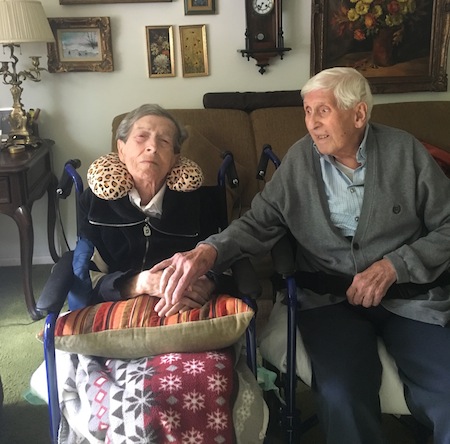
photo - Writer Eliezer Sobel’s parents, Manya and Max, in 2016. They were the inspiration for Sobel’s series of picture books for readers with dementia
Writer Eliezer Sobel’s parents, Manya and Max, in 2016. They were the inspiration for Sobel’s series of picture books for readers with dementia. (photo by Eliezer Sobel)

“We stayed in the house for 10 months, taking care of my parents and trying to get the right kind of help in the house that would enable us to eventually move out,” explained Sobel. “But we stayed nearby so we could monitor and manage the scene.”

His dad recovered a substantial amount of his cognitive and physical ability, but passed away this past November.

The work on the book goes back to 2011. “She didn’t speak English words anymore,” said Sobel of his mother at the time. “She would sometimes make up her own language and sounds. She stopped reading, as far as we knew.

“One day, I came upon her accidentally…. She was flipping through a magazine and I overheard her reading the big print headlines out loud, in English, correctly. I was totally floored. Mom can still read, even if it’s just a three-word phrase.”

Sobel wanted to run out and buy his mom a picture book, one designed for Alzheimer’s and dementia sufferers, but he couldn’t find one anywhere. His next thought was to use a children’s picture book, but he was unsure whether his mother could negotiate a book with a storyline. He wanted each page to stand on its own, so it would not require the reader to recall what had happened on a previous page.

“I called up the national Alzheimer’s association and spoke with their chief librarian for the whole U.S. and her response to me was to say that there were 20,000 books for caregivers of those with memory loss,” said Sobel. “I said, ‘I am not looking for [a book for] the caregiver, I’m looking for my mother, the patient. There was dead silence on the other end of the line. She couldn’t think of any such book. Eventually, she did mention one other author who has since become an acquaintance of mine who had a few books, but they weren’t really what I wanted, so I realized I had to do this myself.

“I first did a book that wasn’t just for Jews. It was for anyone with memory loss. It was called Blue Sky, White Clouds, and came out in 2012.”

Sobel – who has also written a novel and a memoir – received such a positive response to this first picture book that he decided to make it into a series.

“My mother got to enjoy the first book a lot,” said Sobel. “Her aides would use it with her almost daily. We would observe that she would zero in on particular photos, ignore certain pages, find a photo – particularly one of a married elderly couple – and contemplate it for 20 minutes and caress the faces.

“These books are for a particular stage of dementia,” he said. “They’re appropriate for someone who’s got enough memory loss and dementia that they won’t be offended or have awareness that this is kind of a simplistic picture book, they’ll just be interested. But they can’t be too far gone, like my mother now, who can’t even look at my face, let alone my book.”

Caregivers often struggle with how to engage people with Alzheimer’s.

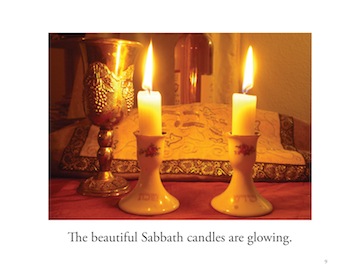
photo - A page from L’Chaim: Pictures to Evoke Memories of Jewish Life
A page from L’Chaim: Pictures to Evoke Memories of Jewish Life. (photo by Olaf Herfurth)

“It’s very hard to find activities to do with someone in that condition,” said Sobel. “So, what I was trying to accomplish was to give caregivers something they could share with the patient … or give patients something they could use on their own…. It was an opportunity for sharing to occur, an activity of quality time. For certain pages, in the earlier stages [of dementia], it stimulates memories, conversations, reminiscences or free association.

“I’m from the creative right brain of things, so I could find things to do with my mother, like empty a box of coins on the table and we’d spend an hour playing with them – pennies over here, stacking the quarters, making a picture of a house with the dimes. Then, I’d say to my dad, ‘See, Dad! There are lots of things you can do with Mom. You could put these coins away and do the same thing tomorrow. She won’t remember.’

“He would call me the next day, and say, ‘Ah, it didn’t work. She didn’t know the difference between a penny and a nickel.’ That was the point. He’s a mathematician and very linear … [he] could not break into the play mode. If you’re someone who’s good with little kids, you can do that with someone like my mom.”

In some ways, Sobel often finds himself feeling grateful to Alzheimer’s, because it made it possible for him and his mother to grow closer – at least for the first 10 years of her disease.

At the beginning, Sobel saw her become more available. As a Holocaust refugee, she had always been very insulated, private and afraid of others. Sobel said he went to a psychic early on in her disease, worried that his mother was losing her memories, and the psychic thought she’d be happier without them.

“It was true,” Sobel reflected. “She transformed from that scared refugee into an open, childlike, loving, laughing angel. People would feel blessed to be around her. She was delightful – greeting strangers and striking up conversations that made no sense. She and I laughed about who knows what. She and my father would dance to music. A lot of things were happy about her Alzheimer’s experience.

“I’m not saying there weren’t nightmarish times. We had our share of those as well,” he added. “She went through a violent period where she was chasing people with steak knives. We had to put her into a psych ward for 10 days.”

That was the exception, though, and Sobel said, “I had an opportunity to finally heal my relationship with her.”

Rebeca Kuropatwa is a Winnipeg freelance writer.

Format ImagePosted on May 19, 2017May 17, 2017Author Rebeca KuropatwaCategories BooksTags Alzheimer's, dementia, Eliezer Sobel, health care, Holocaust, Judaism
Students pen survivors’ memoirs

Students pen survivors’ memoirs

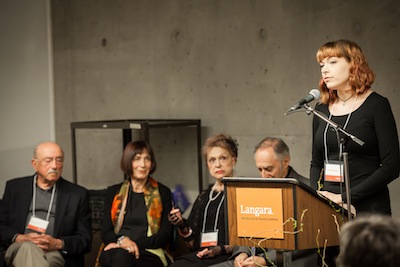
Dr. Peter Suedfeld, professor emeritus of psychology at the University of British Columbia, spoke on behalf of the survivors who participated. (photo by Jennifer Oehler)

Emotions were high at a graduation event where survivors of the Holocaust and Langara College students who wrote their memoirs shared their reflections on the experience.

Writing Lives was a two-semester course and a partnership between Langara College, the Vancouver Holocaust Education Centre (VHEC) and the Azrieli Foundation. In the first semester, students learned about the history of European Jewish culture and the Holocaust. In the second term, groups of three students were teamed with a Holocaust survivor. Students interviewed the survivor, transcribed their recollections and wrote their memoirs, which were presented at the closing event April 20.

“These memoirs will be given to the survivors as gifts for themselves and their families, but they will also be archived and they may possibly be published, and they will also serve as legacies for the survivors, their families and perhaps the research community in general,” said Dr. Rachel Mines, an English instructor at Langara and coordinator of the Writing Lives project. “I’m also the daughter of survivors, so I know how important it is that the stories get told and kept as a legacy for the families and the children and the grandchildren and great-grandchildren and also for the community at large, which I think is something that this particular program has succeeded in very well.”

Dr. Peter Suedfeld, professor emeritus of psychology at the University of British Columbia, spoke on behalf of the survivors who participated.

“I have been interviewed a number of times by different people, of different levels of experience. So, when I was asked if I was willing to be interviewed by some students from Langara, I thought, ‘Oh well,’” Suedfeld said to laughter. “It’s not going to be very interesting. They are probably amateurs who don’t really know what they’re doing.”

He was pleasantly surprised, he said.

“My expectations were not fulfilled at all,” he said. “They had fresh points of view, they had interesting ideas about the Holocaust, they had interesting questions – not the kind of routine things that I’ve gone through before with more professional interviewers who tend to ask the same questions the same ways. Some of the questions made me think about my own experiences in ways that I never had before…. The interviews were always interesting and lively, occasionally funny, sometimes a bit frustrating and rarely, but once in awhile, irritating. But, all in all, a very positive experience and I expect that most of my cohort probably had similar experiences, and I certainly hope that the students did as well.”

Frieda Krickan, speaking on behalf of the students in the program, saw Writing Lives as an opportunity to honour the survivors, deepen her knowledge of Holocaust history and serve her Jewish community.

“This class has been so much more than that in so many ways,” she said. “It’s been a life-changing experience and I feel incredibly lucky to be a part of it. This class has taught me the importance of personal perspectives and historical documentation. Memoirs put a more human face on history and they memorialize what our survivors have been through and create empathy that historical facts and figures just cannot…. These survivors represent living history. These memoirs are a way of honouring survivors and making sure that history will never forget them…. You cannot get that sort of visceral emotion and intense human connection from a book or documentary. This is a living, breathing human being in front of you opening up about their most intimate and painful memories. It is an experience I will never forget.”

photo - Frieda Krickan, speaking on behalf of the students in the program, saw Writing Lives as an opportunity to honour the survivors, deepen her knowledge of Holocaust history and serve her Jewish community
Frieda Krickan, speaking on behalf of the students in the program, saw Writing Lives as an opportunity to honour the survivors, deepen her knowledge of Holocaust history and serve her Jewish community. (photo by Jennifer Oehler)

She added: “I came out of this class with something I did not expect: hope. Amidst all their personal accounts of suffering and loss, our survivors still managed to impart upon us the importance of hope. I don’t know if I’ve ever had such a life-affirming experience as talking to these survivors.”

Gene Homel, an instructor in liberal studies at the B.C. Institute of Technology who taught part of the Writing Lives course, said evidence-based and factual history are important at a time when the veracity of events past and present are being called into question.

The collection and preservation of eyewitness accounts is what makes the Writing Lives project so valuable, said Ilona Shulman Spaar, education director at the VHEC.

“Some students told me that they would never forget the personal encounters that they had with their interviewees and that they will always carry them close to their hearts. Some even mentioned that this program was life-changing for them,” she said. “Some of the survivors shared with me that they greatly appreciated being part of this program. For them, too, it was a unique experience, as most of them never gave interviews to this extent or in such depth.”

Robbie Waisman, one of the survivor participants, said the greatest fear that Holocaust survivors have is what’s going to happen after they are gone.

“What you are doing gives us hope that it’s going to be remembered, to make this a better world,” he said. “So thank you.”

Serge Vanry, another survivor participant, said it was an experience that he hadn’t expected.

“I started out wanting to do this, but feeling uneasy about somehow getting involved in the past, a past that has been put away quite a bit,” he told the audience. “I was talking about events that I had forgotten, things that were difficult, things that were hard to live with and things that can haunt you. As I was looking back at the past, I started to discover a lot of things that I had forgotten – events, situations that really had disappeared for me.”

Turning to the students, he said: “You did extremely well and I am really thankful and I’ve really appreciated what you’ve done for me, for the things that I don’t want to forget, the things that need to be told again for me and for my family.”

Other survivors who participated in Writing Lives were Alex Buckman, Amalia Boe-Fishman, Jannushka Jakobouvitch and Mark Elster. Excerpts from student-participants’ journals have run in previous issues of the Independent (search “Writing Lives” at jewishindependent.ca).

Mines thanked the Azrieli Foundation, for expertise and materials that made Writing Lives possible, and the VHEC, “which has been crucial, essential, absolutely indispensable in supporting Writing Lives … through liaising with survivors, making their library available for research and as an interview room and, generally, just being generous in terms of their time, their advice, expertise and not to mention moral support.”

Mines added that she hoped this pilot project of Writing Lives would become an ongoing program and, in the days following the closing ceremony, she received the news that Writing Lives will indeed run again, starting in the fall semester.

Pat Johnson is a communications and development consultant to the Vancouver Holocaust Education Centre.

Format ImagePosted on May 5, 2017May 3, 2017Author Pat JohnsonCategories LocalTags Azrieli Foundation, Holocaust, Langara College, memoir, survivors, VHEC
Ring to fund students

Ring to fund students

Olga Ornstein, the mother of Frank Ornstein. Frank gave his friend, George Szasz, his mother’s ring, which George is hoping to sell to fund a scholarship in the Ornstein family’s name. (photo from Jewish Federation of Greater Vancouver)

Last summer, community member George Szasz approached the Jewish Community Foundation, hoping to establish a scholarship endowment fund to honour a dear friend’s memory. The friend, Frank Ornstein, z”l, survived the Holocaust and eventually immigrated to Vancouver. With no children or living family members to speak of, Frank bequeathed a family ring saved from the Holocaust to George, which George is hoping to sell to fund a scholarship in the Ornstein family’s name.

Lipot and Olga Ornstein, both of blessed memory, were an affluent couple in the Hungarian city of Szeged and doted on their only son, Frank. Born in 1924, Frank grew from a skilled boy scout to a star athlete with a wide range of friends. They lived peacefully with their non-Jewish neighbours, and Frank began dating a non-Jewish girl.

Even as anti-Jewish sentiment grew around them, the city’s residents lived amiably together. It was a shock when laws mandated division by 1943. Jews, including the Ornsteins, were evicted from their homes, stripped of their property and segregated in ghettos. As a fit 19-year-old, Frank was sent away to a labour camp. Lipot and Olga were forced onto an overcrowded cattle car without food or water for a three-day journey to a concentration camp in Austria.

Life in the camp was grim. Lipot and Olga wrote Frank postcards, holding onto hope that, after the war, the family would be reunited and return to their life in Szeged. In March 1945, the camp buzzed with news that Russian soldiers were near and the captives desperately hoped for liberation. The day before the soldiers arrived, however, German guards marched the camp’s prisoners, including Lipot and Olga, to a local gym and blew them up.

Frank was liberated from the labour camp and, in late 1945, returned to Szeged, sick but alive. There, he found out that his parents, and most of the city’s Jewish residents, would never return. Frank’s girlfriend’s family had secretly stored some of his parents’ valuables, including his mother’s diamond ring, and returned them to him: memories of a life that had vanished.

Realizing life in Szeged would never be the same, Frank took his few possessions and family mementoes and immigrated to Israel. In Israel, he trained as an airplane mechanic and found both a love and an affinity for the trade. He worked for Israel’s El Al Airlines and immigrated to Vancouver in the late 1950s, as a chief mechanic for Canadian Pacific Airlines and, later, Air Canada.

After Frank’s death in 2006, George was bequeathed the Ornstein family’s mementoes. Frank’s life was marked by trials and resilience, and George is determined to honour the Ornstein family’s history and heritage. Of the Ornstein family keepsakes, Frank’s mother’s ring is of particular value, appraised at between $30,000 and $50,000, and George is determined to sell the ring to establish a yearly scholarship for deserving Israeli students studying Frank’s life passion: airplane mechanics.

If you are interested in assisting George to create the Ornstein family legacy, contact Marcie Flom, director of the Jewish Community Foundation, at [email protected].

This article was originally published by Jewish Federation of Greater Vancouver in e-Yachad and is reprinted with permission.

Format ImagePosted on May 5, 2017May 3, 2017Author Jewish Federation of Greater VancouverCategories LocalTags fundraising, Holocaust, Israel, Jewish Community Foundation, Ornstein, Szasz
מספר היהודים החיים כיום בעולם

מספר היהודים החיים כיום בעולם

נתוני הלשכה המרכזית לסטטיסטיקה בישראל: 14.4 מיליון יהודים חיים בעולם ומהם כארבע מאות אלף נמצאים בקנדה. (צילום: Cynthia Ramsay)

הלשכה המרכזית לסטטיסטיקה בישראל פירסמה בימים האחרונים דוח על מספר היהודים החיים כיום בעולם. הנתונים בנויים על הערכות בלבד של המדור לדמוגרפיה וסטטיסטיקה של היהודים באוניברסיטה העברית בירושלים, מתבססים על שנת 2015, ומתפרסמים כרגיל לרגל יום הזיכרון לשואה ולגבורה.

אם כן כיום לפי הערכה של המדור לדמוגרפיה וסטטיסטיקה באוניברסיטה העברית, חיים בעולם כ-14.4 מיליון יהודים. זאת לעומת 16.6 מיליון יהודים שהיו בעולם ערב מלחמת העולם השנייה ומאורעות השואה הקשים. לפיכך העם היהודי למרות השנים שעברו שבעים ושתיים שנים, לא הצליח לחזור לגודלו לפני אירועי השואה, שהביאו להשמדת שישה מליון יהודים. יצויין כי גם בשנות העשרים של המאה הקודמת חיו בעולם כמו כיום כ-14.4 מיליון יהודים.

מטבע הדברים ריכוז היהודים הגדול בעולם (44 אחוז) נמצא בישראל ועומד על 6.33 מיליון. אחריה המדינה השנייה עם מספר היהודים הגדול ביותר כרגיל היא ארצות הברית, שבה גרים עם 5.7 מיליון יהודים. המדינות הנוספות בעולם בהן יש את הריכוז הגבוה ביותר של יהודים אחרי ארה”ב הן: במקום השלישי צרפת עם כ-460 אלף יהודים, במקום הרביעי קנדה עם כ-388 אלף יהודים, במקום החמישי בריטניה עם כ-290 אלף יהודים, במקום השישי ארגנטינה עם כ-181 אלף יהודים, במקום השביעי רוסיה עם כ-180 אלף יהודים, במקום השמיני ברזיל עם כ-120 אלף יהודים, במקום התשיעי גרמניה עם כ-117 אלף יהודים, במקום העשירי אוסטרליה עם כ-113 אלף יהודים. לפי הערכות לא מבוססות במקום האחד עשר נמצאת דרום אפריקה ובה חיים כ-80 אלף יהודים.

והיכן קיימות הקהילות הקטנות של יהודים בעולם: באיראן למשל חיים כעשרת אלפים יהודים, בבירוביג’ן חיים רק כחמשת אלפים יהודים, ביפאן חיים כאלף יהודים בלבד, בבהאמס חיים רק כשלוש מאות יהודים ואילו בקוריאה הדרומית יש כמאה יהודים בלבד.

על פי סקר של ההסתדרות הציונית העולמית שנעשה לאחרונה יש גידול משמעותי ביותר באנטישמיות ברחבי העולם, ואחד מכל שלושה יהודים חש את הצורך להסתיר את יהדותו. ועוד ממצאי הסקר: 85 אחוז מהיהודים היו עדים לאנטישמיות במהלך חייהם, 50 אחוז מיהודי המערב (מדובר על מדינות אירופה וצפון אמריקה) חוו אירוע אנטישמי במהלך השנה האחרונה, 73 אחוז היו עדים לאלימות פיזית ו-70 אחוז מיהודי אירופה חגגו לבד את החגים בשל הפחד מפעילות אנטישמית.

יש לזכור שיש גם כיום בישראל המפוצלת מאוד מבחינה חברתית כיום יהודים שונאים יהודים ובצורה גלויה. להלן סיפור מזעזע: יהודי תושב ירושלים בן 55 נחקר החודש במשטרת ירושלים לאחר שהביעה תמיכה ברורה בהשמדת יהודים אשכנזים. אותו ישראלי נחמד כתב בין היתר בדף הפייסבוק שלו: “אני מדמיין שיש לי את הכוח של היטלר, יושב על כסא עם בקבוק יין ומכניס אותם אחד אחד לתנור של אלף מעלות, ודואג שייצאו אפר. כמה שאני שונא אותם אלוהים”. האזרח הירושלמי לא התבייש להוסיף עוד מילות חמות על היהודים האשכנזים: “היטלר צדק שעשה מאימא שלכם סבון, והוא צדק שחיסל אתכם זבלים בני זבלים”. חברת פייסבוק חסמה מייד את הפרופיל של האזרח היקר. המשטרה המשיכה לחקור אותו והודיעה כי יוגש כתב אישום חמור נגדו.

ומהן תגובות הגולשים לאור הנתונים על מספר היהודים בעולם?: “הדת היהודית מזמן סיימה את דרכה. זה רק שאריות”. “בגלל ההתבוללות של היהודי בעולם. לולא זאת היה מספר היהודים כפול! ההתבוללות הגדולה ביותר באמריקה!”

Format ImagePosted on April 26, 2017April 26, 2017Author Roni RachmaniCategories עניין בחדשותTags antisemitism, Holocaust, Jewish population, World Zionist Organization, אנטישמיות, ההסתדרות הציונית העולמית, העם היהודי, שואה
First Vancouver Opera Festival

First Vancouver Opera Festival

Caitlin Wood and Alex Lawrence star in Vancouver Opera’s The Marriage of Figaro. Jewish community member Leah Giselle Field performs the role of Marcellina in the production. (Emily Cooper Photography)

I am thrilled and honoured to have been chosen to lead Vancouver Opera into a new era,” said Jewish community member Kim Gaynor when her appointment as general director was announced prior to the start of this season. “Vancouver Opera already has a long history of excellent productions and a well-deserved reputation for innovation under Jim Wright’s exemplary leadership.”

As part of its vision for the future, Vancouver Opera is holding an inaugural opera festival April 28 to May 13. The event features a variety of vocal offerings for audiences, as well as workshops and other activities.

“Opera seasons are planned years in advance, so this festival was planned long before I joined VO,” Gaynor told the Independent. “However, I have brought 10 years’ experience managing the Verbier Festival in Switzerland and I am using this experience to shape the festival-going experience here. For example, we will have lots of opportunities to follow the development of young singers, and for audience participation, two things which were very popular in Verbier.”

Her resumé prior to managing the Verbier Festival includes managing director and co-founder of Austria’s Festival Retz, administrator of London, England’s Yehudi Menuhin International Violin Competition and head of marketing administration at London’s Royal Opera House. She has worked at Les Grands Ballets Canadiens de Montréal, the National Arts Centre Orchestra in Ottawa, L’Opéra de Montréal and Canada Council for the Arts.

photo - Vancouver Opera general director Kim Gaynor
Vancouver Opera general director Kim Gaynor. (photo from VO)

Gaynor, who was born and raised in Ontario, returned to Canada from Switzerland last year, arriving in Vancouver in September. She was here in time for another recent Vancouver Opera innovation – the smaller-venue, family-friendly production of Hansel and Gretel in November.

“Hansel and Gretel was a huge success with people of all ages,” said Gaynor. “The whimsical, enthusiastic performances from our young artists and the wonderful puppets charmed everyone who came. I heard so many stories about young people being literally on the edge of their seats throughout the whole performance, and this could lead to a lifelong love of opera. One thing I learned was that the intimacy of the smaller Playhouse theatre really appeals to audiences. They want to be nose-to-nose with the performers – up close to the action.”

The upcoming festival will offer more opportunities to get up close to the action, including a performance at Vancouver Public Library – called Opera Tales – featuring singers from VO’s Yulanda M. Faris Young Artists Program, who the audience will have a chance to meet after the show. One of these singers is Jewish community member Leah Giselle Field, who also will be performing the role of Marcellina in The Marriage of Figaro. (For more on Field, see jewishindependent.ca/fairy-tale-reimagined.)

Among the other festival offerings are a video installation by artist Paul Wong, performances by vocal stylist Ute Lemper and Inuit throat singer Tanya Tagaq, an evening sing-along with the Vancouver Bach Choir, a film night, master classes for young singers, forums and discussions, preview talks and happy hours.

“We believe that the festival format will attract a new and younger audience who likes fast and furious action, because there will be something going on all the time during the 16 days of the festival,” said Gaynor. “At the same time, we are convinced that our main-stage operas, Otello, Dead Man Walking and The Marriage of Figaro, will appeal to our traditional audiences, who may only want to attend for an evening or two. In our next season, 2017/2018, which has just been announced, we are offering a season and a festival, starting with the ever-popular Turandot in the fall and closing the season with a spring festival.”

Further explaining why the festival concept is being embraced by VO, she said, “Festivals are, by definition, a celebration and people, in general, love to celebrate. We will not only be celebrating opera, but the human voice and all of its expression, from throat singing to choral. Festivals offer the chance to mingle and meet lots of other people who share the same passion. This chance to come together with like-minded people creates an atmosphere which is hard to create in a normal season. But I don’t think festivals are a more attractive model, just a different model, and VO is in the mood for change.”

One of the attractions of moving back to Canada was that Gaynor would be closer to her mom, who lives in Oakville, Ont. One of the appeals of moving to Vancouver was the opportunity to be outside. While circumstances have made that difficult so far, she has found other fun things to do around town.

“Honestly,” she said, “it seems like it has either rained or snowed every day since I arrived (until about two days ago)! I am normally a person who loves the outdoors, so my highlights have been discovering the North Shore mountains and walks along the Seawall with my dog (a 3-year-old border collie). That was before I broke my leg badly at the end of January falling off my horse! I am also finding some great spots for brunch in my neighbourhood around Main and 12th, and have been discovering all of the fantastic cultural organizations in town.”

Gaynor was born in Hamilton, Ont., but the family moved to nearby Burlington when she was six months old.

“We lived almost in the country in Burlington, in a house with a big yard with a small forest behind. More importantly, we were less than a kilometre from a horse farm, where I discovered my passion for riding. My father was a passionate amateur pianist and we had a baby grand piano at home. I got my love of classical music from him.”

Gaynor’s father was a Holocaust survivor.

“My father was one of the 10,000 Jewish children who escaped from Western Europe to England on the Kindertransport,” she said. “He lived in London from 1938 until 1954, when he emigrated to Canada and met my mother, who is not Jewish. He even changed his family name, which was Geier, but sounded too German in postwar Canada and that, combined with his accent, was a handicap. So, he took the last name of his movie star idol – Mitzi Gaynor. Unfortunately, he died quite young, only 53 years of age.

“I know my father’s life was in every way coloured by having lost his family in this way but, like many Kindertransport children, he spoke very little about it to his children. I learned much later, after his death, that a part of his family escaped Austria and made it to Palestine. I was able to find them and went to meet them in 1996. I have often wondered how life would have been different if I had been born and raised in a Jewish family in Austria, or in London. But I have close ties still to the family who adopted my father in London, and to his relatives in Israel and this has enriched my life immensely.”

While she doesn’t “practise any religious traditions in a formal way,” Gaynor said, “I feel quite close to Jewish culture and traditions because of my family and friends, but also I have participated many times in Jewish celebrations, weddings, a few bar mitzvahs and even a bat mitzvah. I also remember some very poignant things from my childhood, such as my father criticizing my mother for not being able to make good matzah ball soup. Clearly, he had some things he missed from home!”

For festival tickets, call 604-683-0222 or visit vancouveropera.ca. For Tanya Tagaq tickets, contact Ticketfly at 1-888-732-1682 or ticketfly.com/purchase/event/1412206.

Format ImagePosted on April 21, 2017April 20, 2017Author Cynthia RamsayCategories Performing ArtsTags Holocaust, Kim Gaynor, music, opera
The reach of humour

The reach of humour

Director Ferne Pearlstein with Mel Brooks. (photo from Tangerine Entertainment)

Woody Allen’s Crimes and Misdemeanours marked the first time that many people heard the philosophical proposition, expressed by Alan Alda’s character, that “comedy is tragedy plus time.”

I’ve always cited “the Woodman” as the source of the insight, probably because it’s consistent with a Jewish worldview. In fact, another Allen, the late, great comedian, composer and TV host Steve Allen, described the phenomenon in a 1957 magazine interview. Maybe he picked it up from somebody else; in any event, this is what he had to say: “When I explained to a friend recently that the subject matter of most comedy is tragic (drunkenness, overweight, financial problems, accidents, etc.), he said, ‘Do you mean to tell me that the dreadful events of the day are a fit subject for humorous comment?’ The answer is ‘No, but they will be pretty soon.’”

Ferne Pearlstein’s wonderfully entertaining and provocative documentary The Last Laugh asks a gaggle of comedians, as well as the viewer, if there might be one subject that defies Allen’s thesis. Seventy years on, is the Holocaust still off limits for purveyors of punchlines? Are there subjects that cannot and should not be the subject of jokes? Or are some of the functions of humour – healing, confronting uncomfortable truths from oblique angles, challenging stereotypes – applicable even in the case of targeted genocide? Finally, as the great wit Hillel famously asked his students at a late-night yeshivah improv set, “If not now, when?”

Pearlstein puts the question to a group of sharp Jewish humourists, interspersing their incisive comments with a parade of clips from films and TV shows that comprise a kind of Rorschach test for the viewer. The expert witnesses include Rob Reiner, Harry Shearer, Gilbert Gottfried and Larry Charles, who grapple with the topic with both hilarious and discomfiting results. As you’d imagine, given their ethnic backgrounds and line of work, they’ve given the matter considerable thought over the years.

Mel Brooks, who displayed unimaginable chutzpah and courage in conceiving and producing The Producers 50 years ago, cites Charlie Chaplin’s brilliant The Great Dictator to illustrate the power of mockery and ridicule to cut the Nazis down to size. Another interviewee provides a reminder that humour played an important role in the camps, providing a brief escape from bleak reality and a way of maintaining one’s humanity and dignity.

But it’s another matter altogether to mine the camps or victims for laughs. (Here’s where the late Joan Rivers makes an appearance with a jaw-dropping one-liner from some archived late-night show.)

Of course, one of the jobs of comedians is to step over the line, in order to impel us to consider where the line is. (Come on down, Sarah Silverman.) And, given the prominence of the Holocaust in shaping the identity of at least two generations of American Jews, it is a taboo that needs to be examined.

Too soon (to use the catchphrase du jour)? About time, I’d say.

Pearlstein implicitly acknowledges two important caveats, however. The reality of the Holocaust can’t be ignored or subsumed in a theoretical discussion of contemporary attitudes, and those who endured the camps should be allowed to comment on what’s funny.

Stalwart survivor Renee Firestone acts as a thread and guidepost throughout The Last Laugh, reminding us of the deadly toll of the Holocaust as well as the determination and, yes, good humour required to create a satisfying life after the darkness of Europe.

Firestone inspires us to consider the highest and best use of memory and, in the context of the film, to see humour as a constructive way of remembering and revisiting tragedy that instils strength. Over and over, The Last Laugh eschews glib analysis in pursuit of deeper truths. And those are always the best punchlines.

The Last Laugh airs on PBS April 24 (check local listings).

Michael Fox is a writer and film critic living in San Francisco.

Format ImagePosted on April 21, 2017April 20, 2017Author Michael FoxCategories TV & FilmTags comedy, Ferne Pearlstein, Holocaust

Beyond the binaries

The concept of intersectionality recognizes that multiple forms of oppression and discrimination can impact individuals at the same time. For example, African-Americans experience systemically and socially both economic disadvantage and racial discrimination. Black women face an addition layer of intersectional oppression and black LGBTQ people add homophobia to the mix.

Intersectionality can be problematic for the Jewish community. As we have discussed in this space previously and will again, despite historical realities, Jewish people are often perceived by others as an advantaged, rather than a disadvantaged, minority. It does not take long on the sort of online forums where the term intersectionality is commonly used before stereotypes of Jewish power show up. Similarly, Zionism is seen by some not as the realization of an indigenous rights movement for self-determination that it is, but rather as a form of colonialism.

In one of the most self-evident examples of intersectionality’s potential blind spots, the intersection of Palestinian rights and gay rights begets ludicrousness like Queers Against Israeli Apartheid, which makes common cause with extremists who throw homosexuals off roofs in order to condemn the perceived colonialism and myriad other “sins” of Zionism. Very frequently, in the discourse found in some far-left circles, antisemitism is dismissed because it does not fit the ideology of those who determine where the intersections are. Or, rather, it is made to not fit.

This is too bad, because selecting which humans are eligible for inclusion in a human rights movement based on immutable characteristic is, by definition, a human rights movement founded on false premises.

Of course, social theory and the real world are disparate points on a spectrum. A beautiful real-world example of something we might term intersectionality took place last week here in Vancouver.

Bernard Richard, British Columbia’s Representative for Children and Youth, spoke at the ceremony for the awarding of this year’s Janusz Korczak Medal for Children’s Rights Advocacy. He observed that it might be difficult for some people to see the parallels between a Jewish Pole who died in the Holocaust and a social worker and activist who is a Canadian First Nations woman. But the inspiring intersection of these two lives makes eminent sense.

Dr. Janusz Korczak, as regular readers know, was a hero of the Holocaust who chose to accompany the 200 children in the care of his orphanage to their deaths in Treblinka, despite the Nazis offering him a reprieve. But he is a hero not only for the way he died, but for the work of his life. Seen as the originator of the children’s rights movement, Korczak insisted on the recognition of children’s innate humanity – rather than merely their potential – and insisted on seeing children as individuals fully deserving of respect and self-determination.

Far away in time and place, Dr. Cindy Blackstock insisted on the rights of indigenous Canadian children. A human rights complaint she initiated, which took nine years to wend its way through the byzantine structures of federal institutions, resulted in a January 2016 decision that Canada has consistently discriminated against the 165,000 aboriginal children who live on reserves, and their families, by systemically underfunding services to those children and youth based solely on their identities.

Blackstock was awarded the annual Korczak medal for exemplifying the values of Korczak in advancing children’s rights.

In her acceptance speech, Blackstock spoke of walking in the footsteps of ancestors and others who came before. Korczak and Blackstock are both models for all who seek to advance the condition of children in the world. It is impossible to imagine what future greatness may be inspired by their examples. A Polish Jewish man, Korczak effectively invented a concept that is now entrenched in United Nations testaments to the rights of the child, affecting the lives of potentially every child on earth. An indigenous Canadian woman, Blackstock shepherded a human rights challenge that will improve the lives of every child living on reserves in Canada, and their families.

Someday, who knows when or where, these two examples will inspire some other individual to stand up where injustice and inequality intersect with some other group of people. Then that individual will themselves become a model for others.

Posted on April 21, 2017April 20, 2017Author The Editorial BoardCategories From the JITags antisemitism, children's rights, First Nations, Holocaust, intersectionality, Janusz Korczak

Posts pagination

Previous page Page 1 … Page 29 Page 30 Page 31 … Page 43 Next page
Proudly powered by WordPress