Journey of memory and loss

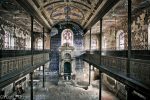
Yuri Dojc and Katya Krausova found classrooms, textbooks, a synagogue, prayer books, clothing and ritual ornaments, all lovingly cared for, undisturbed, unmolested and somehow cherished since the scooping up of three-quarters of the Jews in the towns of Slovakia in 1942. (photo by Yuri Dojc)

Fascination, horror, admiration, exaltation are the words that come to mind when I search to describe the emotions I felt reading Michael Posner’s book review of Last Folio: A Photographic Memory by Yuri Dojc and Katya Krausova (Indiana University Press, 2011) in Queen’s Quarterly (Winter 2016). The personal saga of Krausova, a cinematographer, and Dojc, a photographer, the horror of the Holocaust in Slovakia and the discovery of remnants of the vibrant Jewish communities stripped of their Jews, their culture and their religion, provoked my curiosity and my imagination.

Dojc and Krausova found classrooms, textbooks, a synagogue, prayer books, clothing and ritual ornaments, all lovingly cared for, undisturbed, unmolested and somehow cherished since the scooping up of three-quarters of the Jews in the towns of Slovakia in 1942.

“It was as if he were entering a time capsule, classrooms frozen at almost the precise moment that Nazi transports had taken the students to the concentration camps – and almost certain death,” writes Posner. “Except for the mould and the yellowed, tattered pages, everything was exactly as they had left it: a bowl of sugar on the shelf, books inscribed with childhood signatures, notebooks filled with essays on their aborted life ambitions.”
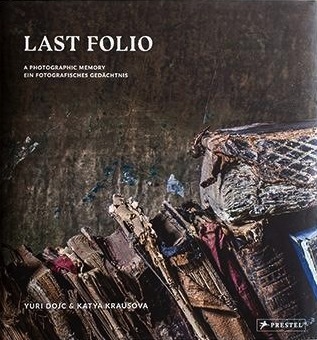
book cover - Last FolioYet, for me, there was something more than photographs and meetings with Holocaust survivors that were being revealed. I rushed to buy the book. It is a work of art filled with dramatic testimony and the saga of an epic journey of chance meetings and breathtaking discoveries resulting in exquisite photographs, as well as a documentary film – labours of love and devotion by Dojc and Krausova.

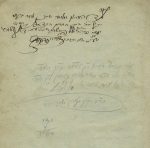
After reading the text and examining the photographs – the most beautiful I have ever seen – I began to meditate on the fact that all these images were found in places abandoned in 1942; their Jewish owners and community members wiped out by the Nazis. Strange place names like Bratislava, Bardejov, Sastin, Michalovce and Kosice became familiar to me, as the tallit, tefillin, prayer books, mikvah and Torah fragments came alive in my eyes. One of the most haunting images is that of a book fragment with the Hebrew word הנשאר, “that which remains,” clearly legible on the delicate paper.

The essays that follow by Azar Nafisi and Steven Uhly commemorate and honour the murdered Slovak Jews and their collective memory. Yet, there was still something that I was missing. I reread the text by Krausova and stopped on the following lines:

“Mr. Bogol’ tells us that he is the warden of the Protestant church, that he and his wife have lived in the same block with the Simonovics for more than 40 years and that following the death of Mrs. Simonovic’s brother, he became the keeper of the keys of a building in the town…. Time stopped still in this building, which housed a Jewish school a long time ago, almost certainly in 1942, the day when Bardejov Jews vanished forever. Mr. Bogol’ proudly shows us how he and his wife have been painstakingly cleaning each bench, each light, each seat, finding – and preserving – every object, religious or otherwise.”

And, they find another building filled with books, also preserved and protected; waiting for Dojc and Krausova to discover them.

photo - Last Folio is a work of art filled with dramatic testimony and the saga of an epic journey of chance meetings and breathtaking discoveries resulting in exquisite photographs
Last Folio is a work of art filled with dramatic testimony and the saga of an epic journey of chance meetings and breathtaking discoveries resulting in exquisite photographs. (photo by Yuri Dojc)

Here was my phantom question, here was the missing link! How is it that these empty, cold, barren places were taken care of for more than 70 years? Who would do such a thing? Why would they do it? Were the guardians of these precious objects waiting for someone? Why didn’t the municipality tear down the buildings or strip them of everything and renovate them? Who paid for the maintenance and taxes on the buildings?

The guardians and the keepers of the keys took these responsibilities upon themselves, year after year, until they bumped into Dojc and Krausova, convincing the harried and exhausted researchers to take a look.

Embossed on the inside cloth cover of the book we read: “Last Folio Charts a Personal Journey in Cultural Memory / A Reflection on Universal Loss as a Part of European Remembrance.”

These unheralded, unacknowledged guardians were the protectors and defenders of the memory of the Jews of Slovakia and their Jewish community. To them, we owe enormous gratitude.

To see an extended trailer of the 81-minute documentary about Krausova and Dojc’s research and the making of the book and photo exhibition, visit youtube.com/watch?v=0vZeL63l1ok.

Dolores Luber, a retired psychotherapist and psychology teacher, is editor of Jewish Seniors Alliance’s Senior Line magazine and website (jsalliance.org). She blogs for yossilinks.com and writes movies reviews for the Isaac Waldman Jewish Public Library website.
Writing Lives journals


Writing Lives is a two-semester project at Langara College, coordinated by instructor Dr. Rachel Mines, in which second-year students are connected with local Holocaust survivors to interview them and write memoirs of their lives before, during and after the Holocaust. The project is a partnership between Langara, the Vancouver Holocaust Education Centre and the Azrieli Foundation. In the first semester, students learned about the Holocaust through reading literary and historical texts, and wrote a research paper on prewar European Jewish communities using the resources of the VHEC and Waldman libraries. This semester, students studied practical strategies for interviewing survivors and have conducted and transcribed their interviews. They are now in the process of writing the memoirs, which, when complete, will be presented to interviewees at a closing ceremony to be held at Langara later this spring. As part of their course work, students are keeping journals of their personal reflections on their experiences as Writing Lives participants. A recent journal entry was on the theme of multicultural relationships, and here are excerpts from three student journals.

One of my older relatives knew how to count in Japanese. She was not Japanese. My family is predominantly of Filipino descent. She only learned how to count in Japanese because she was forced to learn as a child, during the Japanese occupation of the Philippines. I learned this pretty late in her life.

I wanted to ask my relative questions, and I assumed I would get the chance at some point, but I was never sure if it was appropriate to bring it up. Two or three years after I learned that she could count in Japanese, she passed away. I never got to ask my questions.

When I decided to take part in the Writing Lives project, I was thinking of my relative. I have learned that having unanswered questions about someone you care for can lead to painful regret. Because of my own family’s unknown history during the Second World War, I wanted to help another family learn theirs.

– Jonathan Pineda

“Some”

Some feel sad when they see pain,
Some feel fascinated when they see pain.
Some feel broken
Once they see a broken heart.
Some feel fire
And mock that broken heart.

Some reach out a hand
Only to say “got you man.”
Some reach out a hand
Only to say “let me help you man.”
Some are inwards
Some are outwards.

Some love to inflict pain.
Some love to inflict love.
Some grab a gun.
Some grab a seed.
Some ignite a fire.
Some extinguish the fire.
There are always two sides to a story,
Whether good or bad it has a history.

Where do these people come from?
I used to ask.
They come from us,
They used to answer back.
Now I stand with a shattered heart.
Now I stand with a broken back.

Seeing is something.
Hearing is intriguing,
Both are fascinating,
The hearts are something.

– Mojtaba Arvin

I have listened to survivors tell their stories a few times before. Two survivors visited my school when I was in high school, and we had a couple of survivors come to our Writing Lives class last semester. Those were really the only encounters I had with the stories of Holocaust survivors. My family is not Jewish, and were not persecuted during the Holocaust.

My paternal grandfather and his father emigrated from southern Russia in 1925 to

escape the persecution and violence they were facing because they were Mennonites, but we have no personal family experience of the Holocaust or anything that the Jewish people endured. Because I could not bring my own perspective to this course, I am lucky that I had an amazing partner who was able to bring insight into many things because of her Jewish background. Overall, this project has been really incredible. My two partners are so supportive, and I have had the most amazing experience interviewing alongside them and writing the draft memoir with them. This is a project that I will remember my entire life.

– Caylie Warkentin

Return of looted art

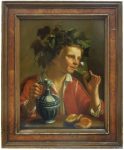
“Young Man as Bacchus” by Jan Franse Verzijl was among about 400 works owned by Max Stern that were forcibly sold by the Nazis in the 1930s. (photo from Max and Iris Stern Foundation)

When the painting “Young Man as Bacchus” by Dutch master Jan Franse Verzijl (1599-1647) went on display in New York City two years ago, the FBI moved in and seized the work. In the possession of an art gallery in Turin, Italy, the painting was among about 400 works owned by Max Stern that were forcibly sold by the Nazis in the 1930s.

In 1935, Stern was a successful gallery owner in Düsseldorf, Germany, but because he was Jewish, his collections were confiscated and sold by the Nazis. Stern would later move to Montreal, where he became a leading figure in the Canadian art world. After Stern died, in 1987, the beneficiaries of his estate learned of Stern’s Düsseldorf gallery and an extraordinary project began to seek restitution for the confiscated artworks.

Dr. Clarence Epstein, director of the Max Stern Art Restitution Project and senior director of urban and cultural affairs for Concordia University, will speak in Vancouver March 23 about the successes and challenges of the project.

The beneficiaries of Stern’s will are Concordia University, McGill University and the Hebrew University of Jerusalem. As a result, the art restitution project may be the only program of its type with three academic institutions working collegially to a common goal, said Epstein. His visit here is presented by the Canadian Friends of the Hebrew University, the Vancouver Holocaust Education Centre and Congregation Schara Tzedeck and is sponsored by Heffel Gallery and the estate of Frank and Rosie Nelson.

The Dominion Gallery, Stern’s Montreal business, remained in operation for more than a decade after his death. During this time, the beneficiary universities became aware of Stern’s prewar history.

“There was an entirely additional gallery business in Düsseldorf that his family had run before the war but had been closed by force as a result of Nazi persecution,” Epstein told the Independent in a telephone interview. “It wasn’t public knowledge. I think some people were aware of Dr. Stern’s past, but it coincided with the time when the issue of restitution was just starting to gain a little bit of traction in the art world and so it merited questioning. We just didn’t know how far to take it.”

The Max Stern Art Restitution Project has become a significant entity, with staff in Montreal, Ottawa, Washington and New York, as well as researchers in Europe. In addition to the obligation Epstein has to maximize the financial outcome for the beneficiaries of Stern’s will, there are other factors driving the project.

“There were fiduciary obligations, which is part of estate management,” he said. “There were moral implications, because this was something that was right for the universities to do on behalf of their great benefactor Max Stern. And then there were educational opportunities that this could open up in the fields of art history, of social justice, of art and law, the mechanics of the art market – and this enticed all kinds of academics to get involved in the project.”

The return of “Young Man as Bacchus” is among 16 successes the project has seen so far. While the restitution of that piece involved law enforcement, it also exemplified the good faith response of the gallery into whose possession the painting had fallen.

Every country has different rules and statutes of limitations around the return of art that has been stolen or forcibly sold, and the Stern project navigates the law as well as less litigious means of restitution. Through the recommendation of the German Friends of Hebrew University, the German government recently announced tax receipts for the owners of returned artworks. In the cases of galleries or museums, the reputation of the institution could suffer if they are known to be in possession of a work of dubious provenance, so this encourages cooperation. Individual collectors may not have the same impetus for preserving a reputation, but once a piece of art is identified as coming from Stern’s Düsseldorf collection, it bears a figurative black mark that makes it valueless on the open art market. Even so, Epstein said, the project does not seek to punish anyone for unwittingly possessing such a work.

“We don’t intend to be the bearers of bad news about the state of the work that is in their possession,” he said, “so if there’s any way that we could alleviate that kind of misfortune with some kind of tax relief, we would do so. But it hasn’t been tested yet.”

One example of an innovative solution found is the case of a work that was discovered in a Düsseldorf gallery. While the ownership was transferred to the Max and Iris Stern Trust, the universities agreed to lend it back to the gallery for long-term display.

“In their case, everybody kind of got their cake and ate it, too,” said Epstein. “It is owned by the Stern Foundation but it is lent to the Düsseldorf Museum.”

While Canada does not have the sort of art sector that New York or the capitals of Europe have, Epstein credited the federal government, specifically Minister of Canadian Heritage Mélanie Joly, for expressing the Canadian government’s commitment to restitution.

What happens to the artworks when they are returned varies. In the Düsseldorf case, the gallery in possession maintained custody. In some instances, the pieces have been sold to fund additional work of the project. (Once returned, the black mark is eliminated and the piece can be exchanged in the legitimate art market.) Others are loaned to museums and public institutions.

Next year, an exhibition of works from Stern’s collections will open in Düsseldorf, later traveling to Haifa, Israel, then Montreal.

Popular culture has taken on the topic of art restitution, Epstein said, and this is a good thing. For example, Monuments Men is about Allied soldiers charged with rescuing cultural artifacts before the Nazis destroyed or hid them, and Woman in Gold focuses on an American woman’s legal fight with the government of Austria to return a painting by Gustav Klimt that was stolen from her family by the Nazis. There have also been documentaries on different aspects of pillaging during the war. Epstein credited Helen Mirren, the star of Woman in Gold, for personally taking up the cause of restitution and making it more public.

“Any way we can make more public the challenges of the recovery of these kinds of objects, and the more we keep it in the spotlight, the more I think we’re going to be able to generate sympathy and attention from the groups that are in possession of those works,” he said.

While the Stern project has seen the return of 16 works and has located several more that are the subject of negotiation, it is impossible to know precisely how many cultural artifacts were stolen and remain unidentified.

“There is a number circulating on the internet in the hundreds of thousands in terms of objects that remain unrecovered,” said Epstein. “I don’t think it’s ever going to be possible to nail down that number … because we are talking about an historic loss that is multiplied over millions of people’s losses, that is also somewhat effaced as a result of time and lack of memory and archives. But that’s really the tip of the iceberg in terms of losses because in terms of material losses, everything that was in the possession of a Jewish family that was oppressed could still be in circulation now – musical instruments, jewelry, the list goes on. But those items were a lot harder to trace in terms of ownership and attribution than a painting has been. Works of art that are under a certain value and have not been researched historically are probably still circulating in the tens of thousands.”

Epstein added that Stern also had significant B.C. connections. His gallery represented E.J. Hughes and Emily Carr, two of this province’s most noted artists.

Admission to the March 23, 7:30 p.m., talk at Schara Tzedeck is free but an RSVP is requested to vanc@cfhu.org.

Pat Johnson is a communications and development consultant to the Vancouver Holocaust Education Centre.

MLA’s father hid past

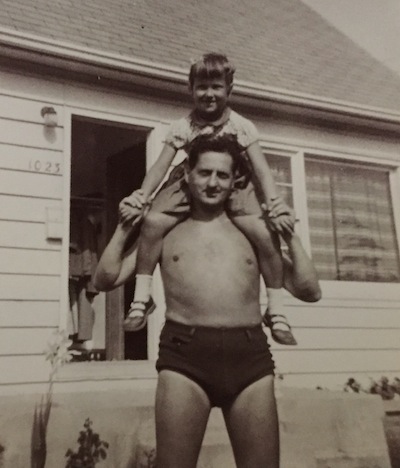
Judy Darcy with her father, Youli. (photo from Judy Darcy)

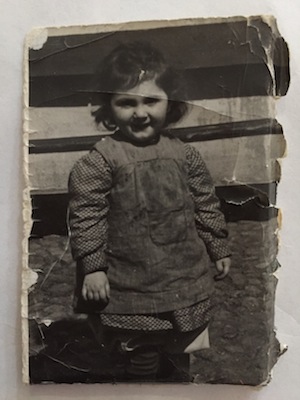
For years, Judy Darcy’s father carried in his wallet a photo of a little girl. It was one of very few mementoes of the man’s past – a murky history that Darcy and her siblings have only partially reconstructed.

Darcy, the member of the Legislative Assembly for New Westminster, went public with her father’s story on International Holocaust Remembrance Day, tweeting: “… my heart is with my dad who lost family members & kept his Jewishness secret from us to keep us safe.”

The Darcy family had a lot of secrets. Her father had no living relatives and he never spoke of what had happened to them.

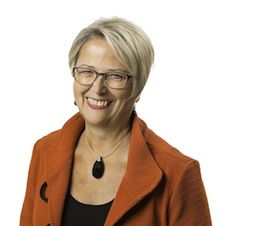
photo - MLA Judy Darcy
MLA Judy Darcy (photo from Judy Darcy)

“My father’s history was very murky,” she recently told the Independent. “Everything about his family and his relatives was murky and he explained it by saying that he fought in the war and there was a lot of bombing and that he suffered amnesia. I knew he had siblings; I didn’t know any details. I didn’t know how they died. I knew he’d lost track of them. And that he’d lost his memory. It was just grey and murky.”

When Darcy was an infant, the family moved from Europe to Sarnia, Ont., where her father worked in the petrochemical industry. With his wife, he raised a family and progressed in his career. Late in life, after he had retired and been widowed, he moved to Toronto, where his grown children had settled.

“And not long after he moved to Toronto,” Darcy said, “he went to Holy Blossom synagogue and met with Rabbi Gunter Plaut, because he wanted to atone for having abandoned his community.”

Darcy knows nothing of what the conversations between her father and the late, legendary rabbi involved, or whether there was one meeting or a series, but she believes her father took great strength and relief from whatever it was Plaut told him.

Her father began attending the Bernard Betel Centre for Creative Living, a Jewish seniors facility, and formed a companionship with a Jewish woman. But stories of the past came slowly, and not expansively.

“He didn’t sit us down,” Darcy recalled, “it just became part of what he talked about.”

Through snippets of their father’s recollections, shards of history they already knew and the discovery of a recording he made shortly before he died for Steven Spielberg’s Shoah Foundation, the siblings pieced together as complete a story of their family’s past as they are likely to assemble.

Jules (Youli) Simonovich Borunsky was born in 1904 in Lithuania to a Russian-Jewish family. He grew up mostly in Moscow but, in the early 1920s, the family moved to France.

“He always said it was because of the revolution,” Darcy said, “which was partly true, I’m sure, because they owned a factory.” She wonders whether antisemitism also propelled them.

Youli served in the French army, was taken prisoner during the Battle of Dunkirk, in the spring of 1940, and was imprisoned in northern Germany.

“He managed to stay alive in the prisoner-of-war camp because they didn’t find out that he was Jewish,” Darcy said. While a prisoner-of-war, Youli regularly received letters from his wife, Jeanne-Helene, a Catholic Parisienne he had wed before the war.

“She sent him letters every day loaded with Catholicisms,” said Darcy. “And sometimes with little Catholic medals, in order to try to pretend that he was Catholic, not Jewish. Again, I only find all of this out much, much later.”

Through some sort of arrangement facilitated by the International Red Cross (one of many aspects of the story still cloaked in mystery), he was released and made his way back, mostly on foot, to Paris. There, he was reunited with Jeanne-Helene, as well as with his widowed father, Simeon.

Paris was under Nazi occupation and Youli convinced his father that he would be safer going to live with Youli’s sister Rosa, his brother-in-law and their toddler daughter, in Kovno, Lithuania.

photo - Judy Darcy’s father, Youli, kept a photo of his sister Rosa’s daughter in his wallet. His niece and her parents were killed in the Holocaust
Judy Darcy’s father, Youli, kept a photo of his sister Rosa’s daughter in his wallet. His niece and her parents were killed in the Holocaust. (photo from Judy Darcy)

Simeon took Youli’s advice. The timing, though, was catastrophic. According to what her father told her, four days after Simeon arrived in Kovno, the Nazis invaded. Pro-Nazi Lithuanians launched pogroms that, later combined with Einsatzgruppen (mobile killing units), murdered almost all of Kovno’s substantial Jewish population. Youli assumed the victims included his father, sister, brother-in-law and the little girl whose photo he would carry in his wallet for years.

Youli had other siblings, Darcy discovered – a sister and brother-in-law who he believed had fled, or were relocated, to Siberia, and another sister about whose fate he had no inkling at all.

“He carried tremendous guilt,” Darcy said of her father. “The guilt of having survived when others died and the guilt of having sent his father to his death.”

Adding to his grief, Jeanne-Helene died of an illness sometime around the end of the war, leaving Youli to care for their son Pierre, Darcy’s half-brother.

After the war, Youli went to extraordinary lengths to hide his Jewish identity from everyone except his wife.

“None of my mother’s relatives knew that he was Jewish,” said Darcy. “Only my mother knew after the war.”

Youli found work as deputy director of a United Nations Refugee Agency displaced persons camp in Germany. There, he met Else Margrethe Rich, a veteran of the Danish resistance who was also working at the camp, and who would become his wife.

They had their children christened in the Russian Orthodox Church in Copenhagen. Their first daughter, Anne Helene, was followed by Judy before the family migrated to Ontario in 1951. Darcy was christened Ida Maria Judith Borunsky – “he threw in a Maria,” Darcy noted wryly – and her younger brother, who was born in Canada, was named George Christian Simeon Borunsky. The obviously Christian names were an active part of the father’s determination to erase his past.

There were the common struggles that immigrant families experience, as well as particular idiosyncrasies. The family home was filled with art and music and books. The family always had enough to eat, but costly red meat wasn’t on the table. Darcy recalled her father’s philosophy: “For the price of a few roast beefs, Judith, you can buy a good painting. For the price of a few steaks, Judith, you can buy a good book.”

photo - Judy Darcy with her father, Youli
Judy Darcy with her father, Youli. (photo from Judy Darcy)

When Darcy was 7, Youli took the family to the Lambton county courthouse and changed their surname to Darcy. He wanted something French-sounding, he told them.

What made her father finally open up – to an extent, at least – Darcy can’t be certain. But, in retrospect, there were a couple of hints that only made sense later. A family friend in New York City, who had known Youli in childhood, made a comment to Darcy and her sister during a visit that implied their father was Jewish, then quickly changed the subject when confronted with blank stares.

In Grade 11, when Darcy had an option of studying German or geography, she chose German because, like her parents, she has a facility with languages. Her father hit the ceiling, for reasons she didn’t fathom.

Despite christening his children and giving two of them ostentatiously Christian names, he husbanded a rage at organized religion.

“He would sometimes shake his fist at the sky and say in his heavy Russian accent, ‘If there were a God in heaven, he would not allow the things that happen on this earth,’” Darcy said.

When she moved to Toronto to attend York University, Darcy started hanging out with students who were Jewish.

“When I would go home and I would use some Jewish expressions, my father would completely freak out,” she said, although she knows this only because her mother conveyed the news.

Her father always said that he brought the family to Canada to be safe because there might be another war.

“But, in hindsight,” Darcy speculated, “he did it because he was Jewish and, even though my mother wasn’t Jewish, he wanted to protect us and that’s why he never told us.”

After Youli died in 1997, at age 93, his children found the Shoah Foundation video. The quality of the recording was poor and he was very shaky by then, his memories fading. It contained a few details they hadn’t yet known.

In addition to the video, Darcy and her siblings took notes and recorded parts of their father’s story, but he never shared it from beginning to end. Many pieces remain lost.

“It’s little glimmers of that entire history,” she said.

The photo that Youli carried in his wallet those many years is now framed and sits on Darcy’s shelf at home.

“I don’t know her name,” she says of the cousin she never met, “but her cheeks are like mine and she’s about 4 years old.”

Student’s first meeting with survivor

Writing Lives is an initiative at Langara College, coordinated by instructor Dr. Rachel Mines, in which second-year students are teamed up with local Holocaust survivors to interview them and write memoirs of their lives before, during and after the Holocaust. Langara students earn English or history credits towards a diploma or degree, but, more importantly, they get the opportunity to learn outside of the classroom setting, in the community. The course is a partnership between Langara, the Vancouver Holocaust Education Centre and the Azrieli Foundation.

In the first term, students learned about the Holocaust through examining literary and historical texts. They wrote a research project on prewar Jewish communities, using resources from the VHEC and Waldman libraries, and they had the opportunity to meet with and learn from two of the VHEC’s outreach speakers, Alex Buckman and Lillian Boraks-Nemetz. This term, with guidance from Kit Krieger and other guest speakers, students have learned strategies for planning and conducting interviews with Holocaust survivors and, in mid-January, they began to record survivors’ testimonies. The following is an essay by one of the students.

I found a quiet corner of the library and took a deep breath. This was the moment; it was all happening now. I was about to call my survivor, code name “Chester.” I say “my survivor” as if he were a possession. I don’t “own”’ him … and yet, in a very short period of time, I will have to “own” his story. I will be responsible for taking his experiences and shaping them into a lasting memoir.

This was the moment of truth: the first phone call. It was now or never. I slowly dialed and had a look around – no one within earshot. I put my cellphone up to my ear, my palm sweaty with nervousness. It began to ring. I gulped. It rang again. “Oh no,” I thought. “It would be just my luck that he’s not home and I have to leave an awkward message, and what sort of first impression will that be?…”

“Hello?”

“Hi, uh, hello. Hi. Um, my name is Ashley and I’m calling from Langara College about the Writing Lives project. May I speak to Chester?”

“Oh, sorry dear, Chester’s not here right now. Why don’t you text him?”

“OK, sure,” I said with a smile. I was expecting a hard-of-hearing senior citizen and, in true 2017 style, I was being instructed to text instead. I took down the phone number and finished the call.

Gulp. Another deep breath. Time to text.

I punched in the number and wrote an introductory message to “my survivor.” I said that I’d call in the morning for a formal introduction. I nervously hit send.

I then spent the next 74 minutes checking my phone to see if I’d received a response. Eventually, it did come: “We will talk then.”

Relief. It had begun. This journey, this process.

The next morning, Chester and I spoke briefly. I told him a bit about the program and asked if he had any questions. The phone call went well. Chester seemed to have a comfortable style, a compassion and understanding that put me at ease; there were sprinkles of humour amid logistical details. Though the call was short, I immediately felt better about what lay ahead.

The following Saturday was our first meeting in person. My group and I met up early so that we were all on the same page and fully prepared for what was about to transpire. We sat across from each other in a small meeting room on the main floor of the school’s library. We were excited, nervous, tense, curious. We were all in agreement that we didn’t really know what to expect and that we’d do our best to tackle things as they came and we’d support each other as much as possible. I felt lucky to have such encouragement.

The time came; it was 10 minutes to the scheduled interview. I grabbed my phone and headed out of the library and down the hall. Chester and I had decided to meet by the Starbucks, which is close to the library entrance. Even though I was early, I wasn’t surprised when I saw a person with a head of greyish-white hair seated near the coffee shop. “That has to be him,” I thought to myself. As I approached, he turned around and I was greeted by the welcoming face of Chester.

We exchanged pleasantries and made our way to the meeting room in the library. I think we both may have been a little nervous, but there was also a sense of mutual understanding – a consensus that we were about to do something important: something private and meaningful, potentially for both of us, particularly for the survivor.

“First off, do you have any questions?” I began once we were all settled. One of my group members sat to my right, ready to take notes and provide support. Chester sat across from the two of us, but diagonally across the square table, so we were all huddled around its corner, quite close to each other.

“Well …” and we were off! The next hour flew by. The purpose of the first meeting was for introductions and initial questions to be sorted. We also asked for a brief overview of Chester’s story, a sort of condensed version of his life. In learning the scope of his journey, we’d be able to better shape questions and structure further interviews. Chester was incredibly giving and kind. And what a storyteller! Sure, we bounced around a little, as memories and stories came to mind, but the next interviews could be more structured, more chronologically accurate. This was our introduction, our chance to get a sense of “our survivor,” to learn what he’d been through and how his experiences had shaped him.

I must admit, I was particularly moved by stories regarding Chester’s family. The way he spoke of his mother, in particular, and his children: it was just lovely.

There were a few difficult moments, and that is to be expected. In future interviews, when we will go into greater detail regarding Chester’s life and journey, we now know when certain difficult experiences occurred and will be prepared. Well, as prepared we can be, I suppose, for the emotional moments that are to come.

At the end of our meeting, Chester mentioned that we may not have enough material for a memoir. Such a sweet, humble comment. I couldn’t help but smile.

“I don’t think so,” I said. “I believe that we definitely have enough for a book here. You have some wonderful stories.”

And it’s true. The stories of love, survival, adventure, family, travel, loss, connection…. We’ve only begun the interview process, and I’m already moved by the trust that’s been shown. Our survivor is being so generous with his time and his story. I only hope that I can do this project justice.

Meaning of liberation

The Canadian military helped liberate Bergen-Belsen and other Nazi concentration camps near the end of the Second World War, a fact that was omitted for decades from recorded history.

The experiences of Canadian liberators – and the meaning of the term “liberation” itself – were the subject of the keynote address at the International Holocaust Remembrance Day observance in Vancouver last week.

Prof. Mark Celinscak, a Canadian who teaches at the University of Nebraska Omaha, delivered the address Jan. 18, at a commemoration presented by the Vancouver Holocaust Education Centre (VHEC) in partnership with the Norman and Annette Rothstein Theatre.

photo - Prof. Mark Celinscak
Prof. Mark Celinscak (photo from unomaha.edu)

Celinscak’s book, Distance from the Belsen Heap: Allied Forces and the Liberation of a Nazi Concentration Camp, was recognized as the best nonfiction book of 2016 by the Vine Awards for Canadian Jewish Literature. In his lecture, he explained how he stumbled upon the facts of Canadian involvement in the liberation of Nazi camps.

Researching the liberation of Bergen-Belsen, he encountered multiple conflicting narratives, but none involved Canadians, he said. In archival research, he found references to Canadians encountering Nazi camps and so he consulted leading Canadian military historians, but all assured him there was no Canadian role in the liberation of concentration camps.

Through further research, Celinscak identified a few soldiers who confirmed the Canadian military’s involvement. These connections led to more and, eventually, he had identified 1,000 individual cases of Canadian military personnel who participated in the liberation of Nazi camps. Seven decades after the end of the war, this aspect of history is only now coming to light. The oversight, said Celinscak, was likely due to the general sense of chaos in Europe at the end of the war.

In introducing Celinscak, VHEC executive director Nina Krieger said: “Were it not for the tenacious scholarship of this evening’s presenter, future generations might never have known of the Canadian role in this aspect of the Second World War.”

Celinscak believes his research helps right an omission in the record. He reflected on an incident from 1997, when plans for a new Canadian War Museum included a Holocaust memorial gallery. Controversy ensued, and Senate hearings were held on the appropriateness of including the Holocaust in a museum devoted to Canadian military history.

“Upon conclusion of the hearings, the plan for a Holocaust memorial gallery was promptly abandoned,” Celinscak said. “In the view of many who testified, the Holocaust either had no place in the country’s war museum or it held no direct connection to Canada and its military.”

His research, however, indicates that the Canadian military did indeed have a connection to the Holocaust, as liberating forces.

Celinscak’s local address was related to the exhibition currently being presented at the VHEC, called Canada Responds to the Holocaust, 1944–45. The exhibition, Celinscak said, reflects “a recent growing body of research that explores how the Canadian government, Canadian organizations and average Canadians responded to the Holocaust.” Celinscak wrote the exhibition’s panels related to Bergen-Belsen, while the overall exhibition was developed by Prof. Richard Menkis and Ronnie Tessler.

Canadians helped liberate camps in the Netherlands and in northern Germany, Celinscak said, though Bergen-Belsen was not taken by military force.

“Simply put, the Allies became involved in Bergen-Belsen because the Germans turned it over to them,” he said. Recognizing that the war was all but lost and that the disease-ridden camp presented a public health hazard to the surrounding German population, a representative from the German army crossed British lines and said that inmates in a nearby concentration camp were ill. The Allies entered Bergen-Belsen on April 15, 1945.

“In the ensuing days, weeks and months, British and Canadian forces from the surrounding area arrived at Bergen-Belsen to assist, to witness and to document,” said Celinscak. “Clearly, military personnel were unprepared for what they were to find in the camp.”

The “liberation” removed the Nazis from the scene, but life improved slowly for the survivors of the camp.

“The war, of course, still continued,” he said. “As a consequence of that, supplies were limited, personnel were largely unavailable and many resources were occupied elsewhere. Those who remained to work in the camp were left with monumental tasks.”

The victims of Bergen-Belsen continued to die. In the two weeks after the Allies took over, 9,000 people died of disease. The next month, 4,500 inmates succumbed, and another 400 perished the following month.

“In total, approximately 14,000 people died in the camp after its transfer to Allied control,” said Celinscak. “In other words, nearly a quarter of the total number of prisoners still alive when the British and Canadian forces first arrived in the camp ultimately met their demise.… While the situation slowly improved, the conditions in the camp remained grim even weeks after its surrender.”

This reality is partly why Celinscak’s research also focuses on the meaning of the term liberation.

“Liberation was an experience that transformed the lives of both liberators and survivors,” he said, noting that this is another newly emerging field of academic inquiry.

“What does that word mean in relation to the Holocaust?” he asked. “If we consider some popular representations of the liberation of Nazi concentration camps, we often see it framed as a jubilant event, one that brought to an end the suffering of the victims of the Holocaust. In films such as Roberto Benigni’s Life is Beautiful, in history books and in some museum exhibits, liberation is frequently depicted as a homogenous, joyful moment in time. But how accurate is this portrayal?”

Liberator narratives, he said, “are overflowing with shock, grief, confusion, disgust and rage.” For survivors, life did not turn for the better instantly. Public health considerations meant the camp inmates were effectively quarantined.

“The prisoners remained behind barbed wire,” he said. “Initially, the survivors were not given autonomy to leave the camp whenever they saw fit. Instead, in the weeks – and, for some, in the months and even years that followed – they continued to live behind the barbed wire of these camps. Places like Bergen-Belsen became displaced persons camps. The survivors were still guarded, only by men in different uniforms.”

In extensive interviews with many survivors, Celinscak came to realize the nuance in the concept of liberation.

“Liberation was a highly ambivalent experience,” he said. “They understood that they were no longer prisoners of Nazi Germany, but many would remain in displaced persons camps long after the war, learning that many of their friends and family had not survived what we now refer to as the Holocaust. For both survivor and liberator, they would contend with these experiences for the rest of their lives.”

Phil Levinson, president of the board of the VHEC, welcomed visitors and introduced a procession of Holocaust survivors carrying Yahrzeit candles. David Schaffer led the Mourners’ Kaddish. Councilor Raymond Louie read the proclamation from the City of Vancouver.

International Holocaust Remembrance Day, which was designated by the United Nations in 2005, is officially on Jan. 27, the anniversary of the liberation of Auschwitz-Birkenau.

Pat Johnson is a communications and development consultant to the Vancouver Holocaust Education Centre.

New discoveries at Sobibor

The remains of the Sobibór extermination camp. (photo from Israel Antiquities Authority via Ashernet)

In a recent discovery made at the site of former Nazi extermination camp Sobibór – where more than 250,000 Jews were killed – remains were uncovered in what is believed to be the location where victims undressed and their heads were shaved before being sent into the gas chambers. The findings were discovered by Polish archeologist Wojciech Mazurek and Israel Antiquities Authority archeologist Yoram Haimi with their Dutch associate, archeologist Ivar Schute.

The archeological excavations, underway since 2007, are underwritten by the steering committee for the international project to establish a new museum and memorial site in the former German Nazi extermination camp, in coordination with Yad Vashem’s International Institute for Holocaust Research. The extermination camp was located near the village and railway station of Sobibór, in the eastern part of the Lublin district in Poland.

photo - A pendant with the Hebrew words “mazal tov” and the date July 3, 1929, and its opposite side (below)
A pendant with the Hebrew words “mazal tov” and the date July 3, 1929. (photo from IAA via Ashernet)

The remains of the building unearthed by the archeologists are located on the “Pathway to Heaven,” the path along which Jewish victims were forced to tread to the gas chambers. The personal items found in the foundations of the building probably fell through the floorboards and remained buried in the ground until they were discovered this past fall.

Among the personal items found in the area were a Star of David necklace, a woman’s watch and a metal charm covered in glass with an etching of the image of Moses holding the Ten Commandments; on the reverse side of the charm is the inscription of the essential Jewish prayer, Shema. Also found was a unique pendant, probably belonging to a child from Frankfurt who was born on July 3, 1929, which bears the words “mazal tov” written in Hebrew on one side and, on the other side, the Hebrew letter hey (God’s name), as well three Stars of David.

photo - The opposite side of the pendant, with the Hebrew letter hey (God's name), as well three Stars of David
The opposite side of the pendant, with the Hebrew letter hey (God’s name), as well three Stars of David. (photo from IAA via Ashernet)

Leading experts at Yad Vashem, the World Holocaust Remembrance Centre, together with Haimi, revealed in an announcement on Jan. 15 that the pendant discovered in Sobibór bears close resemblance to one owned by Anne Frank, who was murdered in the Holocaust and is well known for the diary she wrote while in hiding in Amsterdam. Through the use of Yad Vashem’s online pan-European deportation database, Transports to Extinction, they were able to ascertain that the pendant might have belonged to a girl by the name of Karoline Cohn. Dr. Joel Zissenwein, director of the Deportations Database Project, found that Cohn, born on July 3, 1929, was deported from Frankfurt to Minsk on Nov. 11, 1941. While it is not known if Cohn survived the harsh conditions in the Minsk ghetto, her pendant reached Sobibór sometime between November 1941 and September 1943, when the ghetto was liquidated and the 2,000 Jewish prisoners interned there were deported to the death camp. There, along the path to the gas chambers of Sobibór, the pendant belonging to 14-year-old Cohn was taken, dropped and remained buried in the ground for more than 70 years.

photo - A metal locket covered by glass with the image of Moses holding the Ten Commandments painted on it. (photos from IAA via Ashernet)
A metal locket covered by glass with the image of Moses holding the Ten Commandments painted on it. (photo from IAA via Ashernet)

Additional research reveals that, aside from similarities between the pendants, both Frank and Cohn were born in Frankfurt, suggesting a possible familial connection between them. Researchers are currently trying to locate relatives of the two families to further explore this avenue.

Over the past decade, the archeological excavations at Sobibór under the guidance of Yad Vashem have made several important discoveries, including the foundations of the gas chambers, the original train platform and a large number of personal artifacts belonging to victims. Among the unique items are metal discs attached to charm bracelets typically worn by children. Engraved on the discs was contact information in case the child went missing.

The most recent excavations have uncovered the remains of the building where victims undressed and their heads were shaved, as well as other areas bearing signs of the use of mechanical equipment to dismantle the camp. In one specific location are imprints left in the ground where trees were planted in order to conceal evidence of the camp.

photo - The locket’s opposite side has the Shema printed on it
The locket’s opposite side has the Shema printed on it. (photo from IAA via Ashernet)

Prof. Havi Dreifuss, head of the Centre for Research on the Holocaust in Poland at Yad Vashem’s International Institute for Holocaust Research, said, “These recent findings from the excavations at Sobibór constitute an important contribution to the documentation and commemoration of the Holocaust, and help us to better understand what happened at Sobibór, both in terms of the camp’s function and also from the point of view of the victims.”

photo - The face of a woman's watch
The face of a woman’s watch. (photo from IAA via Ashernet)

According to Haimi, “The significance of the research and findings at Sobibór grows with every passing season of excavation. Every time we dig,” he said, “we reveal another part of the camp, find more personal items and expand our knowledge about the camp. In spite of attempts by the Nazis and their collaborators to erase traces of their crimes, as well as the effects of forestation and time, we enhance our understanding of the history previously known to us only through survivor testimonies. In this way, we ensure that the memory of the people killed there will never be forgotten.

“This pendant,” he continued, “demonstrates once again the importance of archeological research of former Nazi death camp sites. The moving story of Karoline Cohn is symbolic of the shared fate of the Jews murdered in the camp. It is important to tell the story, so that we never forget. I wish to thank my Polish partner Wojciech Mazurek and the researchers at Yad Vashem for their dedication to the project, as well as Tel Aviv University for supporting the project, and the Polish-German Foundation who made the excavations possible.”

Relatives of Karoline Cohn, or any member of the public who can assist with details regarding her family or Sophie Kollmann, who filled out Pages of Testimony in April 1978 for Richard Else Cohn and Karoline Cohn, are requested to contact Haimi via email yoramhi@israntique.org.il.


Connecting to a legacy

The inscription in the Tosher Rebbe’s first copy of Kehilat Ya’akov, which recently sold at auction for $4,920 US. (photo from IMP Media Group Ltd.)

Even with the passing of the fourth Tosh Rebbe, Rabbi Meshulam Feish Segal-Lowy II, in 2015, Tosh Chassidut still exists in rural Quebec. The Tosh dynasty was founded in the 1800s and has roots in the Chassidic tradition, tracing their tradition back to the Ba’al Shem Tov.

Last month offered a unique opportunity to connect to the legacy of the Tosher Chassidut. The copy of Kehillat Ya’akov owned and used by the first Tosh Rebbe, Rabbi Meshulam Feish Segal-Lowy I, was available for auction at Kedem Auction House in Jerusalem. It was passed down within his family, and made it to the United States when his great-grandson fled Hungary. At the Nov. 15 auction, the item sold for $4,920 US.

The first Tosher Rebbe was a leading rabbi in the greater Jewish community in Hungary due to his standing in Torah and commitment to helping Jews. A 1966 article in the Canadian Jewish News by Norman Abrahams described the Tosher Rebbe’s dedication to his followers, many of whom were Holocaust survivors who turned to him for guidance: “This great man stays up most of the night fulfiling the many requests for advice and prayer and it is not uncommon to see him eating breakfast, his first meal of the day at five o’clock in the afternoon.”

Born in 1811 in Moravia (part of modern-day Czech Republic), Lowy I gained a reputation for his holiness and ability to perform miracles and became the first Tosh Rebbe, as well as a leading rabbi in Hungary. He received rabbinic ordination from Rebbe David (Spira) of Dynow, one of the leading rabbis of his time.

Although he passed away at 62, the first Tosher Rebbe had enormous impact on Torah Judaism. Lowy I served as rabbi and av beit din (literally, father of the court) of the city of Nyirtass, Hungary, and was known for his commitment to Torah. People came from all over to receive his blessings.

In 1873, a cholera epidemic broke out and killed almost 200,000 people in Hungary alone. The rebbe prayed to be an atonement for the Jews and, after his death, the epidemic did indeed come to an end.

The Tosh dynasty continued after Lowy I’s death, but was almost completely destroyed during the Holocaust. His namesake and great-grandson, Lowy II, was appointed rebbe by the few surviving Chassidim of his father, Rebbe Mordechai Marton Lowy, who was murdered in Auschwitz with most of his extended family.

Lowy II was born in Nyirtass in 1921, managed to survive the Holocaust in the Hungarian Labor Service and was liberated by the Red Army from a camp outside Marghita in October 1944. In 1946, he married Chava Weingarten, a direct descendant of the Noam Elimelech (Rebbe Elimelech Weisblum of Lizhensk). After being appointed rebbe, he set up court in Nyiregyhaza, but, in 1951, fearing the communist government, he ordered his followers to leave Hungary and immigrated to Canada, settling in Montreal.

Committed to maintaining the integrity of the Chassidut that his great-grandfather had started, and concerned about outside influence, in 1963, he decided to move his Chassidim to Boisbriand, Que., a small rural area now known as Kiryas Tosh.

After his death in 2015, Lowy II’s son, Rabbi Elimelech Segal-Lowy, became the next Tosher Rebbe.

The piece of Tosh history that was for sale is also inscribed by the first Tosh Rebbe’s grandson, Rabbi Moshe Shmuel Rottenberg, who received it from his father, Rabbi Yehosef HaLevi, author of Bnei Shileshim.

Writing Lives project

This fall, a select number of Langara College students embarked on a project to write the memoirs of local Holocaust survivors, capturing personal stories from the Second World War. The project is called Writing Lives: the Holocaust Survivor Memoir Project.

Writing Lives is an eight-month collaboration between Langara’s English and history departments, the Vancouver Holocaust Education Centre (VHEC) and the Azrieli Foundation. In the first half, students learn about the history and impact of the Holocaust. In the second half, students are paired with local Holocaust survivors associated with the VHEC.

“Writing Lives provides an opportunity for students to immerse themselves in the history of the Holocaust beyond physical textbooks,” said Rachel Mines, Langara English instructor, and project coordinator. For example, on Nov. 9, students commemorated Kristallnacht (The Night of Broken Glass) by lighting candles in memory of the violent anti-Jewish events that took place on Nov. 9 and 10, 1938. The course also regularly features a series of guest speakers from different organizations giving their perspective on the events surrounding the Holocaust.

“I feel grateful for the opportunity to investigate the events and prejudices that served as a catalyst for the Holocaust. With the help of survivors, professors, librarians and fellow students, I am learning that individuals, communities and organizations all have agency when it comes to fighting racism, and how we can work together to prevent such tragedies in the future,” said Lucille Welburn, a peace and conflict studies student who is taking the course.

Robin Macqueen, a Langara instructor and chair of the health sciences division, is auditing the course out of personal interest. He said: “This is a fantastic opportunity to engage with and honor people who survived a time of unimaginable prejudice. I’m getting a lot out of the course, and enjoy being a student again.”

For the VHEC, survivor testimonies are seen as a useful and powerful method for teaching about the Holocaust.

“Holocaust testimony provides a connection with people, culture, persecution and survival,” said Ilona Shulman Sparr, education director for the VHEC. “Eyewitness testimonies have proven to be a powerful and effective teaching tool, which affords a personal connection to the events of the Holocaust as we hear survivors’ accounts of their experiences. Testimonies provide a way for students to connect with survivors’ stories and gain an understanding of events that other sources can’t give them.”

This spring, students will be matched with Holocaust survivors to write their memoirs. The memoirs will be archived at the Azrieli Foundation and the VHEC, with a possibility of being published for public awareness.

Mourning Mom and inherited scars

Marta Fuchs, right, with Ilona Fuchs, 1968, Pasadena, Calif. (photo from Marta Fuchs)

My 98-year-old mother died recently and I’m waiting to feel something. I watched family and friends cry at her funeral and I listened to their outpouring of love and accolades for the remarkable woman my mother was. To a person, they spoke of how loving and generous and talented she was – and yes, that she was also forceful and insistent – how much of an impact she made on them, how they remain in awe of how she survived Auschwitz at great odds, and how she rebuilt her life multiple times with flair, energy and optimism.

I sat there quietly, gripped by cognitive dissonance. The woman everyone knew was all those things they described. She was a resilient survivor, a gifted dressmaker and teacher, a devoted friend, but, with me, her other side overshadowed it all. Early on, as a Jewish child in postwar Hungary, I knew my job was to take care of her emotionally, to mitigate the suffering that happened to her before I was born. I spent a lifetime doing that while also being the brunt of her relentless criticism and control. It often felt as if nothing I did was ever enough, or good enough, though I do recall seeing her happy at times with my outfits and she took pride in my accomplishments. But, regrettably, I am now hard-pressed to recall more than a few positive moments together over the more than six decades of my life with her.

photo - Ilona Engel Fuchs, circa 1950-51, Tokaj, Hungary
Ilona Engel Fuchs, circa 1950-51, Tokaj, Hungary. (photo from Marta Fuchs)

I rarely cried when she would mercilessly pick on me. Depression was more my style. I knew she had to win and I had to surrender in what always felt like a life-and-death struggle for her no matter the issue. From my room, I heard my father echo what I had been pleading with her, “Ilona! She’s almost 50 years old! When are you going to stop dictating what she should do?!” “I am so sorry she treats you like this” he came in to comfort me, adding his perpetual advice, “Don’t pay attention to her and do what you think is best.”

Shortly after Dad passed away, Mom and I came to blows again, and she retorted accusingly, “Your father said I should be nice to you since you are so sensitive.”

Being sensitive was not a value for her, and I understand why. Being sensitive was a luxury she could not afford if she was to survive as a young woman in Auschwitz. In fact, once when we were talking about Auschwitz, she looked at me and stated matter-of-factly, “You would never survive.” Perhaps she’s right, yet we don’t really know until we’re tested. And, at least I can say that, thus far, I have survived her, albeit with scars.

There was a period of two blessed weeks, six years ago, the summer I turned 60, when I had the mother I wished for: kind, calm, appreciative, going with the flow. She had fallen in her doctor’s office after getting a clean bill of health and broke her hip, then suffered a cascade of near-fatal medical complications. My brother and I took turns staying around the clock with her in the hospital and then in rehab, to be her advocate and translator, as she often reverted to her native Hungarian. It was painful to watch her suffer and I did everything I could to alleviate it. But it was also a period of relief, for she was too sick to do battle with me. Once she started recovering, she was back to her true self with me, which for all of us was ironically a good sign.

I did learn a lot from my mother and inherited her creativity and resourcefulness, for which I’m grateful. I do feel good about having been the consummate dutiful daughter despite her wrath, and perhaps I did a public service being her emotional caretaker, which may have enabled her to be shining in the world, making such a positive impact on others. Whatever I inherit from her will, though, mostly feels like reparation payments, for I, like many children of Holocaust survivors, remain collateral damage.

Remarkably, despite our battles, my mother and I never stopped loving each other and, fortunately, I could always summon enough amnesia to begin each visit anew. As I stare at the dwindling light in the tall, blue shiva candle graced with a simple Star of David, I am coming to accept that it’s OK that I am not filled with the same sorrow and boundless reservoir of love I felt when my father passed. I felt sorry for Mom, I loved her, I admired her, I wrote books and articles about her, and I did as much as I could for her. And, what I am most grateful for is that with my own kids I have the kind of warm and supportive relationship I wish I could have had with her. May she rest in peace and may her memory be for a blessing.

Marta Fuchs, MLS, MFT, is a professional speaker, psychotherapist and author of Legacy of Rescue: A Daughter’s Tribute. She was born in Hungary to Holocaust survivor parents and escaped with her family in the wake of the 1956 Hungarian Revolution. Her website is martafuchs.com.