Managing our potable water

Seth Siegel’s latest book is Troubled Water: What’s Wrong with What We Drink. (photo from Seth Siegel)

With approximately seven percent of the world’s renewable water resources within Canada’s borders, it would seem that we should have little to worry about when it comes to agriculture and potable needs. But our drinking water is at risk, said Seth Siegel, author of Troubled Water: What’s Wrong with What We Drink.

Siegel has spent the last half-decade studying the quality of drinking water. While his book focuses specifically on U.S. water sources, he said water quality is also a concern for Canadians and he worries that neither country is really prepared to address the threat of contaminants from our technological age: plastics, undetected chemicals and aging, inadequate infrastructure.

All of the issues that Siegel examines in his book regarding U.S. drinking water have been raised in recent years in Canada-based research. In many ways, Siegel’s exposé on the environmental impacts of toxic substances, chemicals and medication in the United States is a mirror into our own environmental dilemmas, as Canada is home to many of the same industries and technological challenges. It’s also home to its own significant problems with water purification in rural indigenous communities.

Lead in drinking water

The Flint, Mich., lead water crisis of 2014 may have faded from newspaper headlines, but researchers are still warning about the levels of lead in American and Canadian drinking water. While we are exposed to lead daily in minuscule amounts from the environment, both countries’ federal governments publish guidelines to stringently limit exposure – because lead is a neurotoxin. In Canada, old (pre-1970s or so) water pipes or solder were made with lead, while more recently made pipes do not contain the substance.

In March 2019, Health Canada tightened the guidelines for lead in potable water from a maximum of .01 micrograms (mcg) per litre to .0005 mcg/litre. The decision coincided with a yearlong investigation by Canadian journalists to determine how prevalent lead was in tap water. Some 300 homes in 11 cities were tested and, as expected, newer homes connected with updated water systems had acceptable readings but neighbourhoods with lead service lines or antiquated interior pipes had excessive lead in tap water. One older home in Whistler produced readings more than 12 times the maximum limit, and some 20 communities in Montreal were found to still have lead service lines.

What often makes things worse, Siegel told the Independent, is that updating service lines and interior water lines aren’t inexpensive undertakings and homeowners, who may not have the expertise to weigh the urgency of those changes, often have to bear the cost of upgrades.

Microplastics and more

Lead isn’t the only health risk homeowners face. Microplastic contamination, which has been traced, in part, to the use of plastic bottles, is a growing concern in Canada, home to a robust bottled water industry. Researchers at McGill University, the University of Toronto and several institutions in the United States are currently undertaking studies to determine the prevalence and effect of microplastics in the environment, including on local marine life.

While the World Health Organization states there isn’t enough evidence to confirm that ingesting microplastics is harmful to humans, Siegel and other researchers disagree. As he details in his book, there is now compelling research to suggest microplastics can actually “disrupt the human body’s hormone-related activity,” especially in children.

Becoming advocates

Still, Siegel cautions that his book isn’t an appeal to simply throw out the technology we use. “None of this is a call to ban plastic,” he said, noting that, “just more than 100 years since its first commercial use, plastic is the dominant material of our times. If one wanted to do so, it would be nearly impossible to go even a day without contact with it in some form.”

image - Troubled Water book coverThe answer, he said, is advocacy: educating ourselves and taking proactive approaches that steer both companies we invest in and the experts that oversee their products’ safety, so that materials are exhaustively tested and verified as safe for dependent, long-term use.

“Because your health and the health of your family rely upon your drinking water being of good quality, it’s important for you to get this right,” said Siegel, who said he hopes the data he has provided will help inspire a “citizen’s movement” to change the way drinking water is tested, approved and protected in the United States and elsewhere.

Troubled Water is Siegel’s second book on drinking water management. His New York Times bestseller, Let There Be Water: Israel’s Solution for a Water Starved World, published in 2015, delved deeply into Israel’s national water management system and the mechanisms that have made the country a sought-after resource on drought management in an era of climate change.

A graduate of the Hebrew University of Jerusalem and a successful entrepreneur and expert in patent law, Siegel said the book’s concept has been licensed in his name, but he is not charging royalties for its use. He said he wants to encourage other countries to use it as a template to inspire environmental change in their communities.

“[Every] country in the world is dealing with the same contaminants,” said Siegel. “They may have a different regulatory regime. Obviously, not everybody has the U.S. [Environmental Protection Agency] … but, whatever the local problems are, they are more similar than different.”

Both of Siegel’s books, as well as other resources, are available through his website, sethmsiegel.com.

Jan Lee’s articles and blog posts have been published in B’nai B’rith Magazine, Voices of Conservative and Masorti Judaism, Times of Israel, as well as a number of business, environmental and travel publications. Her blog can be found at multiculturaljew.polestarpassages.com.
Addiction a risk for all

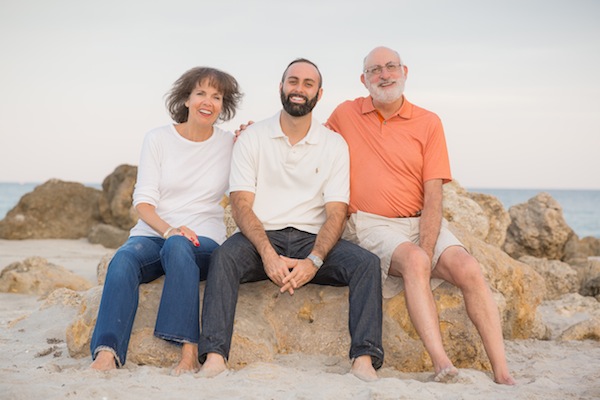
Left to right: Lisa, Jacob and Richard Hillman. (photo from Lisa Hillman)

“I had a fairly demanding and public position in the health system. I was president of our hospital foundation, had a very large board of about 25 people and a staff of about a dozen people. We were raising a lot of money to build a new hospital campus at the time, and so I was very public and very out and about. And, my fear was, as sick as it is to say today, that, if somebody would find out that my son had a drug problem, what would that say about me? What kind of mother could I be? What kind of person was I if I had a son who was using illicit drugs?” Lisa Hillman, author of Secret No More: A True Story of Hope for Parents with an Addicted Child, told the Independent.

“That was my feeling at the time,” she said. “I was not at all prepared to have addiction in my household. I was both ashamed and terrified at the same time.”

Hillman and her now-sober son, Jacob, shared their story at a Jewish Child and Family Service (JCFS) event at Congregation Shaarey Zedek in Winnipeg late last year.

Lisa and Richard raised their family in Annapolis, Md. Jacob was in high school when they found out he was using drugs. With almost 40 years of experience in the healthcare industry and being the healthcare decision-maker for the family, Lisa was determined to help Jacob overcome his addiction, while also keeping it a secret.

Like many others, however, she learned the hard way, after a couple of years, that this was not something she could fix. Although she held out hope that Jacob’s use of drugs was just a normal coming-of-age rite of passage, like trying cigarettes or alcohol, and that he would return to being the high-achieving person she knew him to be, that is not what happened.

“At first, we had him evaluated,” said Hillman. “I asked him if he would see a psychologist. He said ‘yes.’ He had bi-weekly meetings with a psychologist. At one point, my son gave me permission to talk to him – Jacob asked me, ‘If he tells you I’m alright, will you get off my back?’ And, I said, ‘sure.’

“This was when he was still in his senior year of high school. I visited with the psychologist, who said to me, ‘I told your son to smoke a little less.’”

Jacob was arrested during a holiday week after graduation, and the situation became more serious. As the family worked to get Jacob help, he resisted it, as addicts often do.

“The question I always get is, ‘How do you get them to accept treatment if they don’t want it?’” said Hillman. “I wish I had an answer for that. What we did with our son is finally say to him, ‘Jacob, you have a choice. You can continue to use, but you can’t live under our roof, or Dad and I will pay for inpatient treatment.’ Fortunately, he accepted inpatient treatment.

“Keep in mind, I’m very blessed,” she added. “I had some insurance and other resources. We were able to afford to send him someplace, which I know a lot of families can’t afford to do. I’m very, very lucky.”

The Hillmans found a place in Maryland, because Jacob did not want to leave the state. The place seemed to be very lovely and spiritual. They were hopeful he would get better there. But, after 12 days, the Hillmans visited their son and Lisa knew he had been using. Sure enough, the next day, Jacob’s counselor asked them to come pick Jacob up, that Jacob could no longer stay there.

“We brought him home to Annapolis,” Lisa Hillman said. “He entered the addiction treatment centre inpatient [program] that is part of my health system, where I was then and am still today, on the board. So, my drive for anonymity in this situation was about to crumble. The counselor my son was seeing said to me, ‘You have to tell somebody at work.’ So, I told my boss, the CEO of the hospital, and he was very empathetic and extremely understanding.”

Jacob went in for two weeks, after which the counselors suggested the Hillmans allow him to go to Florida for continued treatment, where he could live in a sober living house and continue to get outpatient treatment.

“The day he left, the counselor said to me, ‘Your son is going to have his program. What are you going to do for yourself?’” said Hillman. “My immediate reaction was that the counselor must have had 10 hits too many, because I didn’t have an addiction. I wasn’t the sick one, my son was the sick one. And yet, I realized I was crying all the time, I was obsessed with where he was and I couldn’t go to sleep at night until I knew he was home.

“I was isolated, I was depressed,” she said. “I wasn’t sharing anything with family and friends. So, I tried Al-Anon. And, from my very first time, I realized I’d [found] a home. These people understood me and were going through the same thing. I wasn’t alone anymore. I had people around me who got it and who were going through the same thing. Meanwhile, my son was in Florida and was getting better.”

Midway through that first year, Jacob had a minor relapse and told his parents about it over the phone. In that conversation, his mother said to him, “Jacob, we love you. Thank you for being honest and telling us. Please take care of yourself. You’re the only one who can.’ And Jacob replied, “Mom, thank you. That’s exactly what I needed to hear.”

Hillman recalled, “Pre-Al-Anon, I would have been on the phone screaming at him, angry. Fast-forward another six months, and he has another much more serious situation. We were told, ‘Your son needs detox.’ He was using heroin IV, a horrible scenario. So, we were asked to pay for a third inpatient treatment centre.

“I remember clearly asking the counselor, ‘How many times do we have to pay for this?’ And he said, ‘Tell your son that this is the last time.’ So, we did and, at the time, we did mean it, really. This was the last time we’d pay for him to have inpatient treatment.”

Although Hillman cannot say for sure that this ultimatum is what did it, Jacob stayed there for 100 days. After that, he moved, got a job and stayed for six months in a sober house. He kept the job for several years and eventually moved into an apartment. He has been active in AA ever since and has been clean for almost eight years.

Hillman has continued going to Al-Anon. She asked her husband to come with her and try it out at least once. They went to a different meeting than she had been going to. “We walked into the room and there were two couples who we know really well,” she said. “Both of them had children with similar problems and we had no idea. We’ve been going to that same meeting now for almost nine years, every Thursday night.

“That first meeting was a huge relief,” she said. “I couldn’t speak at the first meeting. I couldn’t open my mouth, with lips quivering as I cried. They let me cry. Other people at that meeting cried. And I heard a phrase that night, that I think really guided me: ‘Detach with love’ – meaning you have permission to detach from your loved one’s problems, that you’re not responsible for them, that you can’t fix their problems, but that you still love them.”

Hillman realized, over time, that Jacob would have to find his own way and that she couldn’t enable him by sending money or paying for things for him. “But, we never stopped loving him the whole way, the whole time,” she said.

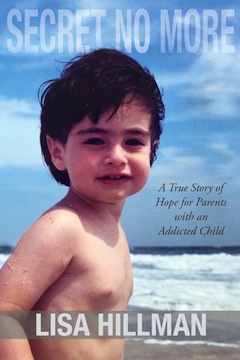
image - Secret No More book coverAs she healed, Hillman felt the desire to write a book about her experiences. She asked her son for permission to publish it.

“The reason for writing it was, I knew there were other families in hiding and ashamed, and that shame and fear just makes it worse,” she said. “It makes it worse for you if you love someone in addiction, and it doesn’t help the person with addiction. The whole purpose in writing this was to help particularly other moms and dads and sisters and brothers and boyfriends and aunts and uncles and grandfathers who I knew were sort of in hiding and had secrets and weren’t sharing – giving them hope that they can do it, too.

“Don’t hide,” she stressed. “Find professional help for yourself. My message is not to those with addiction, it’s to those who love people with addiction. My son says, ‘Mom, remind people that this is your story. Not mine.’

“If you have somebody in your life that is using or drinking, please go get help for yourself,” she said. “If one person in the family can get healthy and understand addiction, boundaries, and how to take care of themselves, then it will affect the rest of the family.

“That’s what happened in our family. I got stronger, my husband got stronger. Jacob saw that we were trying to understand him, that we were trying to get ourselves right again. He was getting better and we had a common language.”

Hillman said, “I think people who recover from an addiction and somehow live every day clean and healthy, year after year after year, to me, they are the most amazing, profound people. My son has become just an astonishingly profound young man and I’m very, very proud of him.

“I think that Judaism hasn’t helped us here today,” she added. “I think it’s getting better, but, looking back on it, part of my shame was that this doesn’t happen to Jews. We’re smart, educated, driven, are achievers, we don’t have addiction – but that’s not true.”

The Nov. 25 event with the Hillmans was sponsored by the JCFS and Gray Academy of Jewish Education. Panelists included an addictions physician, a therapist and an Addictions Foundation of Manitoba consultant on youth.

“Recovery is individual. There is no single treatment that works for everyone. There is no easy fix, like there is no single cause. It’s a combination of factors,” said Ivy Kopstein of the JCFS. “As a community, we need to end stigma and judgment, and replace it with compassion and understanding so we have no need for secrets anymore.”

Rebeca Kuropatwa is a Winnipeg freelance writer.

BRCAinBC’s inaugural event

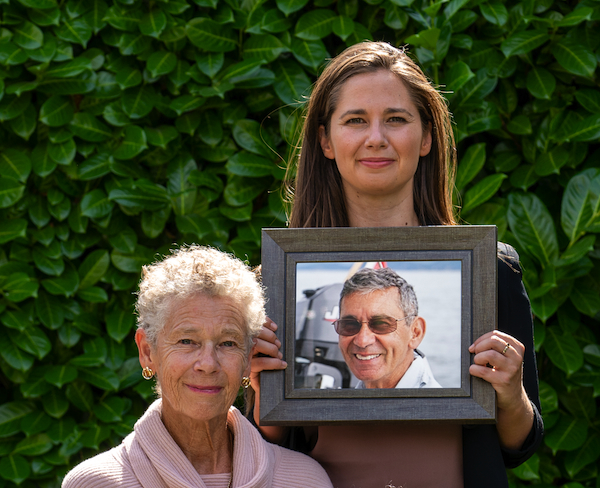
Jane Remocker and her daughter, Catriona, holding a photo of Geoff Remocker, who passed away in 2016 from pancreatic cancer. (photo from BRCAinBC Committee)

Education is a key goal of the upcoming One in 40: From Awareness to Empowerment event being held at Congregation Beth Israel on Jan. 8.

“BRCA 1 and 2 is the code for variant mutations of two genes known to increase the lifetime risk of several serious cancers, including breast and ovarian cancers and other cancers linked to reproduction in women and prostate cancers in men, as well as pancreatic cancers and melanoma in all genders,” explains the BRCAinBC Committee’s project primer. One in 40 is the probability of carrying the genes among Ashkenazi Jews – compared to a risk of 1/500 to 1/1000 in the general population.

The BRCAinBC Committee, organizer of the One in 40 event, describes itself as “a group of concerned members of the Jewish community in British Columbia, many of whom have been affected personally or in our families by the BRCA 1 or BRCA 2 genes and genetically linked cancers.”

The committee’s work is supported by Beth Israel, which is its home, as well as many other community members, organizations and institutions, including the B.C. Cancer Agency, the Centre for Israel and Jewish Affairs, the Jewish Federation of Greater Vancouver and the Diamond Family Philanthropic Fund.

“There are currently no efforts being made in British Columbia to create awareness or cover general genetic testing for people of Ashkenazi Jewish heritage – in the past, this was due to the prohibitive expense of testing,” notes the primer.

“There have been significant recent gains in the medical community around improving the affordability of testing for genetic mutations,” it continues, “however, awareness of risk is still low amongst members of the Jewish community and, currently, holding a risk profile of being of Ashkenazi Jewish descent is not sufficient to be covered for genetic testing under B.C.’s Medical Services Plan (MSP).”

The impetus for the committee and the One in 40 event was the death of Geoff Remocker of aggressive prostate cancer in 2016. After he died, his wife, Jane Remocker, and the family met with Beth Israel’s Rabbi Jonathan Infeld. She explained to the Jewish Independent in a phone interview that, as members of the congregation, there were donations being made to the synagogue in her husband’s honour, and the rabbi wanted to know where the family wanted to direct the funds. The couple’s youngest daughter, Catriona, who works in the healthcare field, suggested they do something with respect to BRCA genes. Since they weren’t quite sure what they wanted to do on the topic, the donations were held in a discretionary fund until Jane Remocker scheduled a meeting with the rabbi and her daughter two years later, in June 2018.

“By then, she and I had ideas and came up with our three basic goals,” Jane Remocker told the Independent. The three short-term goals of the committee were education and awareness within the Jewish community, and easier access to information about the BRCA genes; advocacy, which involves providing information about and access to screening options, both private and public; and fundraising to cover what has become the One in 40 community-wide education event and the BRCAinBC.ca website, which will be launched in January.

Since Geoff Remocker didn’t meet the criteria for B.C. Cancer Agency’s Hereditary Cancer Program, which offers genetic counseling and testing for “residents who may have inherited an increased risk for specific types of cancer,” he signed up for a B.C. Cancer study of drugs that treat prostate cancer, which included gene testing.

Remocker said he signed up for the study because, “as he said to me, ‘I don’t think the drugs will help me, I think it’s too late. But, if there’s a gene that’s driving this cancer to be aggressive and resistant to treatment needed, that knowledge will help other people.’” It was discovered that he was indeed a BRCA carrier.

Part of the issue, said Remocker about why her husband wasn’t eligible for the Hereditary Cancer Program, was that, while they knew some of her mother-in-law’s medical history, they knew nothing about her father-in-law’s side of the family, who came from Poland and Russia.

“And this is not uncommon,” she said. In addition to this generation not talking about health issues, in general, there wasn’t so much knowledge about health back then.

While a lack of family medical history can be one obstacle in getting genetic testing, she said, another is that many people don’t realize that men can be carriers of the BRCA mutant genes.

“They thought it was only a gene that affected women as breast cancer,” said Remocker. It is important, therefore, and a goal of the committee’s educational program, to make sure that Jewish men – especially if they have roots in Europe – know that they are possible carriers and, therefore, consider getting screening.

photo - Libby Znaimer, national spokesperson for Pancreatic Cancer Canada, will be the keynote speaker at One in 40: From Awareness to Empowerment, which takes place Jan. 8 at Congregation Beth Israel
Libby Znaimer, national spokesperson for Pancreatic Cancer Canada, will be the keynote speaker at One in 40: From Awareness to Empowerment, which takes place Jan. 8 at Congregation Beth Israel. (photo from BRCAinBC Committee)

Confirmed panelists for the One in 40 event are Dr. Rona Cheifetz, medical lead of the Hereditary High Risk Clinic, B.C. Cancer Agency; and Dr. Intan Shrader, who, along with Dr. Sophie Sun, is co-medical director of the B.C. Cancer Hereditary Cancer Program. The panel will also feature medical oncologist Dr. Daniel Khalaf of the B.C. Cancer Agency and Jewish community member Tovah Carr, a BRCA carrier. There will be a chance for audience members to ask questions.

Keynote speaker Libby Znaimer of Zoom Media is national spokesperson for Pancreatic Cancer Canada; she is a cancer survivor and a BRCA gene carrier. Her personal fight against breast and pancreatic cancer is the subject of the 60-minute documentary Cancer Saved My Life, which discusses “the BRCA 1 and BRCA 2 gene mutations that predispose people to pancreatic cancer, and the connection between BRCA and breast and ovarian cancer,” as well as the “groundbreaking research going on in Canada and Israel, where there is a BRCA-rich population.”

The BRCAinBC.ca website will be “a one-stop place for people to go to get information about the genes and the mutations that indicate the cancer risk and where they can go for private screening if they don’t meet Hereditary Cancer’s criteria or they don’t want to wait,” said Remocker.

Hereditary Cancer has a long wait list, she said, so the website will have some options for private screening. “We’ve researched and found a number of accredited medical genetic labs that do specific inherited Jewish genes screening and we know that, [for] at least two of them, the results are accept[ed] by the Hereditary Cancer Program.”

Currently, the cost for private testing is about $250 US, said Remocker. This alternative means that, “instead of waiting six to 12 months to get your first interview with the Hereditary Cancer Program, you get a saliva test, you apply. They send the package to you, you send it back and you get your results anywhere from two to six weeks.”

A person can then take those results to their family doctor, she said, as a referral is needed for the HCP.

The website will also feature personal stories of those who have been affected by the BRCA 1 and BRCA 2 genes, as well as links to current research and resources.

Michelle Capobianco, the executive director of Pancreatic Cancer Canada, will be in attendance at One in 40, Catriona Remocker told the Independent. “[T]hey are considering working with us to roll out similar events to Jewish communities across Canada to improve awareness,” she said.

To register for the event, which runs 7-9 p.m., visit bethisraelvan.ca/ event/one-in-forty.

Providing care and support

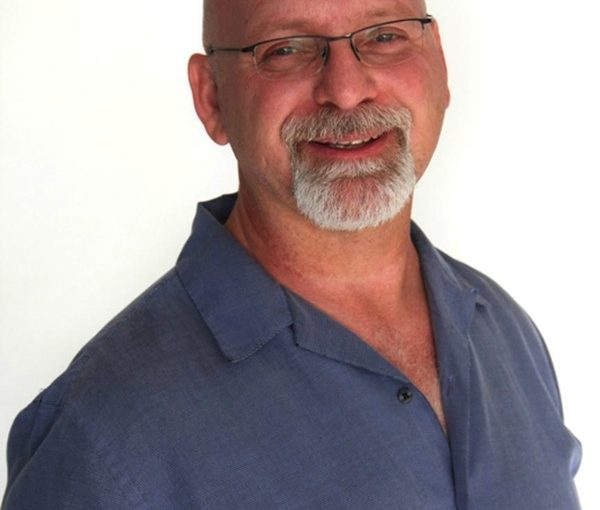
Jamie Kinaschuk helps caregivers in various ways. (photo from Jamie Kinaschuk)

“When somebody faces a situation of becoming a caregiver, they can embrace it and see it as a sense of purpose for the person they’re caring for, or they can resent having to do it,” Jamie Kinaschuk, a social worker with A & O (Age and Opportunity) Inc. in Winnipeg, told the Independent.

“When you embrace it, you can feel that the tables have turned – from the time my parents looked after me to, now, me looking after them – and you can see this as something you want to do, are proud to do. That makes it easier.

“On the other hand, you can have a child or a spouse who’s just not ready and doesn’t want that responsibility. They may have been designated by other family members.”

In some situations, said Kinaschuk, the ultimate caregiver is the closest in physical proximity to the family member needing care and, as such, other family members expect them to carry the load of caring, not taking into account that the caregiver has their own life, family, job and/or other commitments.

Being a caregiver takes a toll in many ways, including that their life has to be put on hold to a certain extent.

“Somebody might become a caregiver with some resentment … or, maybe, the relationship between the caregiver and the recipient hasn’t been the greatest and it just happens that they live together,” said Kinaschuk. Regardless of the circumstances, “there is an impact on you physically, mentally, emotionally and financially.”

The care given varies by recipient. For some people, minimal help is needed – things like cooking, house cleaning or doing laundry and shopping. For others, assistance could be needed in bathing or grooming, getting dressed or using the toilet. Often, needs change over time and a caregiver is left to find ways to fill the new requirements of the person for whom they are caring. As a caregiver, one must learn to adapt.

“Maybe they have to locate a different doctor for a different health issue that has arisen,” said Kinaschuk. “Maybe they have to apply for home care, to locate medical supplies or transportation. Maybe it’s come to a point where they can no longer transport them, so they need something like Handy Transit.

“Sometimes what adds to the difficulty of being a caregiver is, if you’re a male caregiver, having to do the personal care if you’re caring for your mom. That could be a struggle – dressing, bathing and toileting.”

Ideally, caregivers will have their own support system, people who can provide some relief. Staying healthy is the most important thing a caregiver can do, not just for themselves but also to not become a further burden on the family.

Kinaschuk, who started his career with Winnipeg’s Jewish Child and Family Service in 2000, runs a caregivers support group.

“In my group,” he said, “we see a lot of caregivers struggling to access resources or, because they don’t have any other supports, they’re really struggling with the situation. There are times where, I’ll give you an example, a caregiver is struggling because their sibling doesn’t understand what they’re going through; they don’t know how difficult it is. That other sibling may say, ‘You can deal with it’ and ‘That’s not a problem.’”

Kinaschuk recommends having a heart-to-heart conversation with the other siblings or relatives to inform them about what’s going on. If a conversation is not an option, a letter can work wonders in getting the message across. “This way, they can read it and hopefully not rip it up, and then read it again,” said Kinaschuk. “And maybe they’ll realize that, ‘Yeah, my brother or sister is going through a lot. I better start supporting them.’”

One of the concerns is that a caregiver may take their frustrations out on the care recipient. Good communication with other family members and their support diminishes this risk, as does attending a caregiver support group. When possible, a talk about boundaries could be beneficial for all involved.

“Both the caregiver and the recipient need to realize that there are boundaries,” said Kinaschuk. “They both have boundaries.” Caregivers, he said, have to be honest with themselves and the recipient – be up front about the fact that they can only do so much.

“The recipient needs to realize that the caregiver needs time. They can’t be demanding 24/7 care,” he said. “They have to be respectful, to respect each other. If the recipient is too over-demanding, it drains the caregiver.”

If all involved can embrace the situation and find the positives, such as having an increased sense of purpose, then, being a caregiver can be an uplifting, life-changing experience.

“From the support group perspective, it’s all about empowering,” said Kinaschuk. “When people attend the support group, first of all, that’s where you see that you’re not alone – you see that other people are experiencing similar emotional, physical and mental situations.”

In his sessions, Kinaschuk asks that people not give advice, but rather share their experiences, in the hope that others can take what information they need to find a solution that fits them. At some meetings, he invites professionals – from the regional health authority and groups specializing in Alzheimer’s and palliative care, among others – to teach the group about different aspects of providing care.

Rebeca Kuropatwa is a Winnipeg freelance writer.

Ride to help Israeli veterans

Beit Halochem Canada’s Courage in Motion saw many riders return to do the five-day annual cycle in Israel again. (photo from Beit Halochem Canada)

The 12th annual Courage in Motion, an initiative of Beit Halochem Canada, Aid to Disabled Veterans of Israel, welcomed cyclists from across Canada, joined by some Americans and Israelis. From Oct. 27-31, these international cyclists rode alongside Israel’s disabled veterans on five fully supported routes through northern Israel’s archeological sites and landscapes.

Fundraising is open until Dec. 31, and it is expected that the ride will raise approximately $750,000 Cdn. Sponsors’ support and cyclists’ fundraising facilitated the participation of more than 100 injured Beit Halochem Israel members this year. Money raised also funds programming at Beit Halochem centres in Israel. Thanks to the ongoing success of the ride, cycling has steadily grown in popularity at the state-of-art centres.

Lisa Levy, national executive director of Beit Halochem Canada, is the ride’s founder. An avid cyclist herself, she said, “Cycling in Courage in Motion means visiting Israel, supporting an incredible cause, and connecting directly with our members. Beyond the ride’s huge fundraising component, I never fail to be excited by witnessing lifelong friendships taking shape. It is truly a life-altering experience that you never forget and one that participants want to repeat!”

photo - 3 cyclists
(photo from Beit Halochem Canada)

Annually, the ride welcomes both new and repeat participants. This year, returning cyclists included Toronto-born Keith Primeau, who rode in last year’s CIM for the first time. Primeau enjoyed the experience so much that his daughter Kylie accompanied him this time.

Primeau played 15 seasons in the National Hockey League, most notably with the Philadelphia Flyers, prior to his career being cut short due to multiple concussions. He co-wrote the book Concussed! Sports-Related Head Injuries: Prevention, Coping and Real Stories (2012), detailing life after concussion.

Other international returnees included former cycling champion Eon D’Ornellas, who competed throughout the 1970s and 1980s on behalf of both Canada and his native Guyana. The proprietor of Toronto’s D’Ornellas Bike Shop, he started a cycling club more than 25 years ago. In 2011, D’Ornellas, then 59-years old, suffered a stroke during a training ride.

Among the Beit Halochem members participating in Courage in Motion 2019 was Asi Mekonen. In 2012, just prior to his release from the Givati Brigade, Mekonen suffered severe head injuries, with resulting brain damage, vision and hearing impairment, and memory loss. Following five years of physical and cognitive rehabilitation at Beit Halochem, he is now a Jerusalem-based musician. Besides experiencing several Courage in Motion rides, he has completed two marathons. Mekonen was already known to many of the ride’s Canadian participants through his on-stage appearances in this year’s Beit Halochem Canada Celebration of Life concerts.

This year, cyclists may have ridden alongside a future Paralympics hand-bike medallist. Critically wounded in 2002 in a military operation while serving in the artillery corps, Amit Hasdai was left with paralysis on the right side of his body. During rehabilitation, he benefited from equestrian therapy, later competing internationally. Since turning to hand-bike racing at Beit Halochem Tel Aviv, Hasdai has enjoyed participating in Courage in Motion. Hasdai’s natural talent, enhanced by Beit Halochem’s support of his training and coaching, has resulted in his current ranking of eighth in the world. He is training to qualify for the 2020 Paralympics in Tokyo.

Courage in Motion’s participants enjoyed group activities, including a cycling tour of the agriculture region of the Hula Valley and an evening with Israel’s heroes – all Beit Halochem members – who shared their personal stories of tragedy and resilience.

The next Courage in Motion takes place in Israel from Oct. 18-22, 2020. Registration is expected to open in March 2020. See courageinmotion.ca.

Making death a friend

I used to wake up each morning wondering if I had Alzheimer’s yet. I dreaded the thought. Who wouldn’t? I used to imagine the torment of dealing with cancer; the diagnosis, the surgery, the chemotherapy, the radiation, losing my hair! I no longer think that way. I am no longer holding my breath waiting for the diagnosis that will lead me to my imminent death. What happened? I am now a cancer survivor; that is, after two years, my gynaecologist told me that I can now come in for a checkup once a year, rather than every six months.

Let me backtrack. I was diagnosed with endometrial cancer in October 2017. After denying the symptoms for three months, I finally went to my family doctor, then to the gynaecologist, then for an ultrasound examination, then a biopsy. The diagnosis: endometrial cancer, stage 2. I asked the medical students who board with me while doing their electives at Vancouver General Hospital about the cancer, the treatment and the prognosis. The most encouraging of their comments was, “Well, if you have to have cancer, that is the best kind to have.” Really?

My son came from Ontario to be with me for the surgery, a hysterectomy. My gynaecologist was excellent. I experienced one bad night in the hospital. I wanted to get out of the hospital so badly that my blood pressure went sky high (white-coat syndrome). I had to sign several waivers in order to march out of the hospital – against their advice. I never looked back.

That was on a Wednesday. On Thursday morning, a friend picked me up and we attended the advanced Hebrew class at the Jewish Community Centre of Greater Vancouver, as usual. On Saturday, I drove to the supermarket. On the way to the cashier, I bumped into my gynaecologist, Nancy Mitenko. She had a surprised look on her face, so I said, “Hi, it’s Dolores, your patient.” “Oh,” she said, “I know who you are, what are you doing here?” We both laughed. I felt great.

My physical trainers and my family knew of my situation but I did not tell my friends and associates about the diagnosis, the surgery or the radiation until it was almost over. I discovered that the reactions of most people to the situation is fear, for themselves, as they empathize with me. I read the look on their faces as panic and dread. It made me want to comfort them. At that point, I did not have the patience to tend to their anxiety. I knew exactly what they were feeling because I used to experience that dread when I thought about cancer.

Several months later, February 2018, I began radiation therapy at the cancer centre at VGH – 25 sessions, convenient parking in the building, pleasant technicians who, generally, were on time with their appointments; the hardest part was drinking the four glasses of water before the procedure. The treatments were painless, but, they did cause some side-effects, which were manageable. This month, at my two-year checkup, Dr. Mitenko told me that I am clear. “See you next year,” she said.

I have been on an intense learning curve, researching cancer treatments, analyzing my feelings about what had happened, dissecting my behaviours and my capacity to proceed under duress and, especially, I have given much thought to dying and death. The idea of dying does not frighten me anymore. We all will die, it is just a matter of when and how we will approach the process. I now assume that cancer may eventually reappear in my body, why not? The denial I experienced has been banished. I accept my death as inevitable – but I have taken control of the process.

I have given instructions to my sons to donate my body to the University of British Columbia Medical School’s body donation program, having completed all the forms necessary for that to happen. I have joined the organization Death With Dignity, which has a chapter here in Vancouver. I attended a meeting of DWD and was informed of the MAiD program, Medical Assistance in Dying. I have read about the requirements of the MAiD program and now know of several doctors who participate in it. I made an appointment with my lawyer in order to update my will and the various documents related to my requests for treatment and care if I should become incapacitated. My four sons have been advised of all these procedures and have the most up-to-date documents.

I am not in the least bit sad, or anxious or depressed. Rather, I am proceeding to do exactly what I wish to do with my life. I have a plan. I feel that I now have some control of my life and my dying and my ultimate death. This is empowering.

I recently celebrated my 80th birthday with a large, extended-weekend celebration including dinners, a party and a brunch. Three of my four sons were there, as well as my daughters-in-law, and five of my nine grandchildren. The most important element of that weekend for me was to watch the relationships between them deepen and become more meaningful. I am grateful to have lived this long. Anything more will be a bonus. I have accepted my mortality, I do not feel greedy, I do not ask for more. I am happy to welcome each day, to contribute to my family, to volunteer for the causes that I feel are important, to make a difference wherever and whenever I can. Death is my friend, and accepting the inevitable has freed me to be the most that I can be.

Dolores Luber, a retired psychotherapist and psychology teacher, is editor of Jewish Seniors Alliance’s Senior Line magazine and website (jsalliance.org). She blogs for yossilinks.com and writes movie reviews for the Isaac Waldman Jewish Public Library website.


Complexities of autism

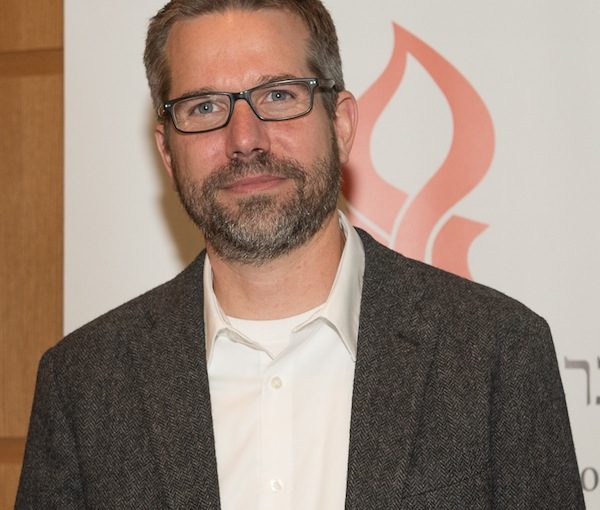
Israeli neuroscientist Dr. Ilan Dinstein was in Vancouver last month to talk about autism research. (photo by Adele Lewin)

Neuroscientist Dr. Ilan Dinstein was in Vancouver last month to share research and expand knowledge on best practices internationally. An associate professor of psychology and cognitive and brain sciences at Ben-Gurion University of the Negev (BGU), Dinstein is the director of the new National Autism Research Centre (NAC) in Israel.

David Berson, executive director of the Canadian Associates of BGU for British Columbia and Alberta, told the Independent: “CABGU was delighted to be a part of hosting Dr Ilan Dinstein in Metro Vancouver. This visit was spearheaded by Dr. Grace Iarocci, Dr. Elina Birmingham and Dr. Sam Doesburg from SFU [Simon Fraser University] and Dr. Tim Oberlander from B.C. Children’s Hospital.

“Ilan Dinstein is a true reflection of the pioneering spirit that is unique to the Negev region of Israel, where, over the past five years, clinicians from Soroka University Medical Centre and researchers from Ben-Gurion University of the Negev have organically come together to collaborate for the betterment of all of the residents with ASD [autism spectrum disorder] in the region.”

Dinstein spoke with the Independent about the new centre and the purpose of his visit to Canada.

“We started the centre five years ago, to try to understand different causes of autism,” he said. “Autism is not one disorder. There are different sub-types of autism, with different possible roots and risk factors. Some of those factors are biological or genetic; others might be environmental. For example, a premature birth might be a risk factor in the child developing autism. Or the age of the parents – a child of older parents might have a higher risk of autism diagnosis than if the same parents were younger. We at the centre are trying to discover how the combination of genetic and environmental issues affects autism development.”

According to Dinstein, one of the reasons for the creation of the centre was the way science is funded in Israel. “The funding usually comes for one specific question,” he explained, “but autism is a complex, systematic disorder and it needs many facets of study, measurement and research; it needs collaboration and sharing of information. At the centre, we are able to combine different fields of study with the clinical applications, as we work together with the Soroka medical centre.”

The scientists of the NAC study autistic patients from different multidisciplinary angles: neuroscience and cellular biology, language pathology and motor tracking, even facial features.

“The truly unique thing is that we do all our studies inside the hospital,” Dinstein said. “Parents come in with their children, usually when the children are about 3 years old and the parents and the children’s teachers notice the kids’ uncommon behavioural patterns. The diagnosis of autism usually takes four visits. During those visits, we work in collaboration with the doctors, measuring various characteristics of the child’s development to arrive at the right diagnosis.

“We also started a database of all our patients, so we have a centralized well of knowledge about how various biological, cultural and social factors might contribute to autism development.”

Of course, not all of the parents agree to have their child added to the database, but Dinstein said that their recruitment rate is about 80%.

After the diagnosis, the scientists participate in determining a personalized treatment program, based on their research. “Such a program might include teaching the children useful behavioural habits, helping them with language acquisition or providing occupational therapy,” explained Dinstein. “Some autistic kids are very agitated and certain motions, like spinning, might calm them down. Sometimes, autistic children need to learn basic skills: how to dress themselves or brush their teeth.”

Pharmaceuticals can also help children cope with autism, but Dinstein said that only about 10% of patients use medications.

At the NAC, the scientists don’t treat patients, but rather study and make recommendations, develop new technologies and new methods of dealing with the disorder. Working together with clinical professionals, they hope to contribute to a higher rate of success in treatment.

One of the most important aspects of Dinstein’s and his colleagues’ work is an annual follow-up on the patients in the database. Families are required to come back once a year after the initial diagnosis, so the service providers can see their progress, determine what worked and what didn’t, and adjust their recommendations accordingly.

“We are still in the process of enlarging this project,” said Dinstein. “We want to open other locations in Israel, make our database to cover the entire state of Israel.”

The centre’s autism research, in particular its database of patients with autism, inspired interest locally, from scientists and clinicians to families and service providers. The invitation for Dinstein to visit Vancouver came from a range of people.

“Your researchers want to create a similar database to ours, Canada-wide,” said Dinstein about his presentation at the Children’s Hospital. “I met with scientists from UBC [University of British Columbia] and SFU, even some from Victoria. I also met medical professionals, parents, some service providers and stakeholders. I see these meetings as the beginning of a close relationship between autism research in Israel and in Canada. There are similarities there, but there are differences, too. Both countries have different ethnic maps, cultural traditions and genetic variations. We all want to know how such diversity affects autism.”

Olga Livshin is a Vancouver freelance writer. She can be reached at olgagodim@gmail.com.

Looking for a family doctor?

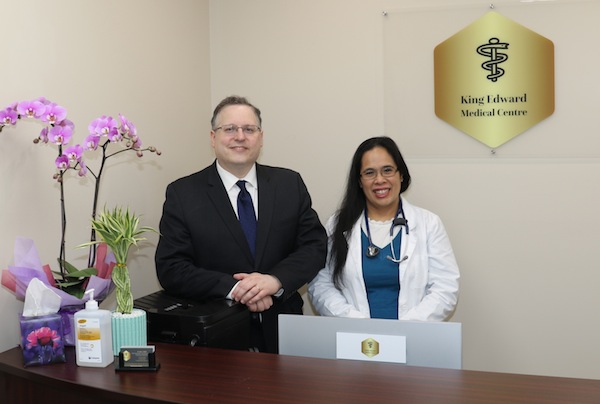
Arthur and Anna Wolak opened King Edward Medical Centre on Sept. 16. (photo from KEMC)

The King Edward Medical Centre, a full-service family practice in Vancouver offering comprehensive primary care, officially opened its doors on Sept. 16.

Located in King Edward Mall (at Oak Street), the centre was launched by physician Dr. Anna Wolak and her husband Arthur Wolak, PhD. It is open to individuals and families throughout the Greater Vancouver area.

Longstanding and active participants in the community, the Wolaks believe this is an opportune time to help those lacking a doctor.

“Given there are so many people without family doctors – and there will be more soon, as there is a slate of family doctors who will be retiring within the next few months – people will be looking for a family physician,” said Arthur Wolak, executive director of the medical centre.

Anna Wolak is a family physician and clinical assistant professor of family medicine at the University of British Columbia. Fluent in English and Filipino, her practice focuses on all ages.

She studied medicine at the University of the Philippines in Manila, the University of Texas MD Anderson Cancer Centre in Houston and the University of Adelaide in Australia. In 2007, upon completing her training in family medicine at the Royal Adelaide Hospital and the Modbury Public Hospital, also in Australia, she moved to Canada.

Before practising in Vancouver in 2009, Wolak had a large family practice in Osoyoos, and was an emergency room doctor at the South Okanagan General Hospital in Oliver.

She also has been active in medical education, having served on the planning committees of major medical conferences and programs. She spent many years as an active parent class representative at both the Jewish Community Centre of Greater Vancouver preschool and in various grades at Vancouver Talmud Torah.

In 2014, RBC selected her as one of the top 25 immigrants to the country for demonstrating “strong leadership within the medical community.”

“Despite my extensive medical background, I needed the support of an experienced businessperson to pursue this endeavour, as medical training doesn’t include business training,” she told the Independent. “My husband has the skills that I lack. Together, we decided that we could establish a medical centre in the heart of the local community that would fill a great need, as Vancouver is desperate for primary care physicians.”

An entrepreneur and writer who holds several university degrees, including a master’s in business administration, a doctorate in management and a master’s in Jewish studies, Arthur Wolak is the author of numerous articles and books on a wide range of issues, the most recent being The Development of Managerial Culture (Palgrave Macmillan) and Religion and Contemporary Management (Anthem Press).

Born and raised in Vancouver, he is also the president of CMI Chat Media, a marketing company he co-founded with his brother, Richard Wolak.

For his part, Wolak is very excited to serve as the executive director of King Edward Medical Centre, managing the many administrative aspects of the growing office. He had the idea for several years and, with their three children now all in school at Vancouver Talmud Torah, he convinced his wife that this was the time to create a place that would benefit the community.

“My father, Dr. Edward Wolak, was a physician and I was brought up with an understanding of the importance of helping people. It was a natural fit for me, even though my academic and professional background, though very broad, was not medical. Anna has the medical skills. I bring other skills to the centre,” he said.

His mother, Elizabeth Wolak, was renowned as both a music teacher and choral conductor, having established and led Jewish choirs in Vancouver for nearly 50 years. She was awarded the B.C. Community Achievement Award and the Queen Elizabeth II Diamond Jubilee Medal for her Jewish choral work in Canada.

Both his parents were Holocaust survivors from Poland.

Over the years, Arthur Wolak has been active in various Jewish organizations. He was treasurer of the Western Association of Holocaust Survivors – Families and Friends, on the advisory board of Vancouver’s Melton School of Adult Jewish Learning (an initiative of the Hebrew University) and on the planning committee of the Vancouver Jewish Film Festival. He is presently a member of the board of governors of Gratz College, the oldest independent and pluralistic college for Jewish studies in North America, situated in suburban Philadelphia.

King Edward Medical Centre is currently accepting new patients. The website is kemedical.ca.

Sam Margolis has written for the Globe and Mail, the National Post, UPI and MSNBC.

Wonderful night of honours

Jewish Seniors Alliance’s first silent auction, which offered a selection of close to 30 items, from gift certificates from local businesses to paintings and prints. (photo by Susan Curtis)

How do you say thank you to individuals who strive to better the lives of people in the community? Jewish Seniors Alliance’s answer is an appreciation dinner, part of its annual general meeting, which comprises a tribute to three conscientious community personalities. As well, at this year’s AGM on Sept. 19, thanks were given to outgoing JSA president Ken Levitt and new co-presidents Gyda Chud and Larry Shapiro were welcomed.

Levitt’s leadership was praised by Shapiro, who noted the outgoing president’s “ever-present love of life, which inspires everyone and brings out the best in each person whom he meets.”

Chud read a poem, “Captain Ken,” written by JSA honourary life member Binny Goldman. It noted: “You listened with your ear and understood with your heart. Your experience, knowledge and judgment always saw us through successfully – you are a leader, a man above most men.”

Anne Kang, MLA for Burnaby-Deer Lake, spoke about the ongoing efforts of the B.C. government on seniors’ issues, including improved long-term care assistance and training of care workers, and the overseeing of buildings and streets, to ensure that they are accessible and safer for seniors.

Emcee Jack Altman began the honouree ceremony with a tribute to Tzvia Estrin, who was nominated by Yaffa House.

Estrin’s son Avie, who is the current president of Yaffa House, recounted the efforts of his mother and late father Aaron, who worked for 10 years to establish Yaffa House. It opened in 2001 as Western Canada’s first home dedicated to housing community members with mental illness in the context of a Jewish living environment, including kosher food. He said his mother continues full-throttle, being at Yaffa House every day, usually at 6:30 a.m. And he emphasized that “nobody could have achieved what Tzvia has attained and continues to do for the most vulnerable segment of our own community.”

Yaffa House presently oversees four homes across the city, including a newly opened women’s facility. Its mandate is to provide permanent non-transitional housing and has in-house support. It takes people off the streets and tries to keep them off the streets.

Tzvia Estrin thanked everyone and read the poem “Don’t Turn Your Back,” which emphasizes the importance of taking the time to compassionately listen to others’ needs and to help them as lovingly as one is able.

Cindy Charkow, a director of Yaffa House, noted the outstanding, much-needed service that the facility provides and stressed that, “without Tzvia, there wouldn’t be a Yaffa House.”

The second honouree, Jack Wizenberg, was recognized for his work with Tikva Housing Society, which helps lower-income Jewish people find affordable housing. He said, “Seeing Jewish individuals and families who are alone, struggling and having to rely on social insurance and the food bank to survive, touches my heart.”

Wizenberg served on the Tikva board for six years, bringing to the position his 41 years’ experience in property management, as well as a lifelong involvement in a range of Jewish organizations and causes in Calgary, Edmonton and Vancouver.

He said he felt “extremely moved” when reading a Jewish Federation of Greater Vancouver housing needs study indicating that, in 2015, 16% of the Jewish population in Greater Vancouver were living below the poverty line “and, in all likelihood, those numbers have increased over the last four years.” He emphasized that things beyond their control prevented these people from working and, in a blink of an eye, they found themselves in need and relying on social assistance to survive.

Wizenberg began his service at Tikva helping with maintenance and tenant issues at Dany Guincher House. Since the first 11-suite apartment building in Marpole was purchased in 2008, he said, Tikva has made available 18 units of mixed single and family housing in the Diamond Residences in Richmond and another 32 family townhouses will be available in the Ben and Esther Dayson Residences in Vancouver’s Fraserview area. Last year, 100 individuals were helped by the Esther Dayson Subsidy Program, which provided those in need with adequate funds to allow them to continue living in their current accommodations.

Tikva president Shelley Karrel said Wizenberg seemed to have a passion for property management and often joined the property management and/or fire-safety group when doing walkthroughs to evaluate building conditions and the need for repairs. His positions have included treasurer, building committee head and acquisitions committee head.

“He was always seeking to ensure the best for Tikva, the buildings and its tenants,” said Karrel. “He is a person who respects others, is very organized and is a great team player. We are blessed to have Jack as a board member and friend.”

Evening honouree , whose tenor singing voice has brought joy to countless individuals and organizations throughout the Jewish and general communities for more than six decades, was introduced by JSA president emeritus Serge Haber.

“We’re honouring people who love community,” said Haber. “Maurice has helped seniors so very much by enthusiastically and nobly giving his special talents, his outstanding voice to the community, and particularly to seniors. Your father, George Moses, a celebrated rabbi/cantor in Bangalore, India, would have been most proud of you. Without question, you are most deserving of this honour.”

Moses spoke of the pleasure he receives by entertaining, and especially in doing so for senior citizens, emphasizing that “our precious seniors should not be ignored and they should be entertained and respected for their countless contributions to life in the community. The only way that I can thank seniors for all they have done is through my singing. It gives me great satisfaction to see their smiling faces, their faces lighting up when I see them react to a song familiar to them.”

Moses shared some of his many religious/concert participations for seniors, including singing for 17 years at Shabbat services at Louis Brier Home and Hospital. He has sung with the Jewish Community Centre Choir, the Shiron Singers, with Elizabeth Wolak and Muriel Morris, and the Rinat Ensemble, all of which performed for seniors. He also has produced a Vision TV show, Let’s Sing Again, which featured a popular tunes sing-along aiming to revive seniors’ nostalgic memories.

He has sung and danced for the past 10 years with the seniors’ concert group Showtime, which is produced by Beryl Israel, as well as with the Vancouver Jewish Men’s Choir (VJMC), the Kol Simcha Choir (composed of members from all synagogues), at Temple Sholom services with Cantor Emeritus Arthur Guttman, at Beth Hamidrash, at Beth Tikvah Synagogue and at Chabad Richmond with Cantor Steve Levin. He is an active participant with the Choir of the Performing Arts Lodge (PAL), which stages a variety of special shows for community seniors.

Moses said his enduring love for seniors was developed by his interactions with the late Beth Israel Cantor Murray Nixon, who constantly stressed the importance of treating older people with respect.

“I am so pleased,” said Moses, “that this evening is taking place at Beth Israel, truly ‘my home away from home,’ where I served in the synagogue’s choir for 66 years under seven different cantors and six different rabbis – and with Pucky Pelman, my mentor for 45 years.”

Moses expressed appreciation to his “guest of honour,” his daughter Melissa, “who has been by my side through three bouts of cancer, making me drink lots of water, eat healthy foods, and go on long walks at the Southlands.”

He gave “a most sincere thank you” to a number of people: Arnold Selwyn, his “35-year wonderful partner in song”; Morris, a pianist with whom he has performed for 55 years; Miriam Breitman, with the Rinat Ensemble and now the PAL chorus, and PAL co-founder Bill Harvey; Binny Goldman, for her help at Louis Brier services; Stan Shear, VJMC musical director; Cantor Yaacov Orzech with the Kol Simcha Choir; and Jonathan Berkowitz of BI’s Purim Shpiel.”

He ended by singing “Let’s Sing Again” and, with Selwyn, Adon Olam.

A video on JSA’s outreach and peer support activities, produced by Cory Bretz of Heirloom Films, was screened, followed by the JSA’s first silent auction, which offered a selection of close to 30 items, from gift certificates from local businesses to paintings and prints.

The event was co-chaired by Tammi Belfer and Larry Shapiro, with committee members Tamara Frankel, Helene Rosen, Marshall and Marilyn Berger, and JSA staff Elizabeth Azeroual and Rita Propp. Catering was provided by Nava Creative Cuisine; the photographer was Susan Curtis.


Bob Markin is a longtime Jewish Seniors Alliance supporter.

Billinkoff runs in record time

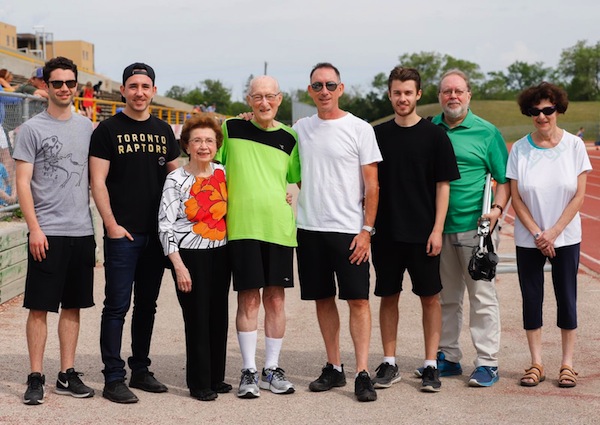
With Lou Billinkoff, fourth from the left, are, from left to right, his grandson Asher, grandson Jordan, wife Ruth, son Errol, grandson Mitchell, son Lorne and daughter-in-law Marilyn. (photo from Lou Billinkoff)

Growing up in Winnipeg’s North End, Lou Billinkoff, 96, was never into sports, though, in his 20s, he did enjoy going for a jog once in awhile. Today, he is one of the fastest short-distance runners in his age group.

“I used to do some running but I never thought of it as competitive,” Billinkoff told the Independent. “I just ran for the pleasure of it when I was younger.”

Billinkoff worked as an engineer with Winnipeg Hydro (now called Manitoba Hydro) for 40 years, designing power lines. When he was well into retirement, at the age of 89, he had a heart attack.

“When I was recovering, the doctor suggested I take some rehab physical therapy at a centre they have here, a program specially suited for people recovering from heart attacks,” said Billinkoff. “Part of the program is to walk on a track. I did that for maybe a year and, when I recalled how much pleasure I got when I ran earlier in life, I thought I’d just try it out and see what I still could do.”

The first time Billinkoff tried, he could only run 40 metres but, more importantly, he liked it. Two days later, he ran 45 metres, and kept on adding distance with each try. Eventually, he was running well over 100 metres and loving it. So, he decided to set up a training program and reached the point at which he could run 100 metres 10 times in one session – a feat he refers to as “running a kilometre.”

“I did that for about two years,” said Billinkoff. “After that, I found it was getting too hard, so I went down to five times 100. Gradually, I found this too was getting too hard, so this past year or two, I’ve been running 50 metres.

“When I was running the 100 metres, my son, Errol, clocked me and said, ‘You know, you’re running in championship speed rankings?’ This was a surprise to me. Errol suggested I get into competition. I wasn’t really interested to pursue it, but Errol entered me into a competition here and, the first time I ran, I ran quite well.”

Nowadays, Billinkoff runs 50 metres three times per workout session at the Reh-Fit Centre, where he goes three times a week. While he ran outdoors when he was younger, he feels that, at his age, it is wiser to run at the centre.

“Going outside has limitations,” he said. “The weather is not always good. You can fall and break your neck and nobody would see you. It’s not a good idea to be running outside.”

Once Billinkoff hit the competitive circuit, he began sending his running times to Athletics Canada.

“The way the rankings work is that age groups go in five-year periods,” he explained. “So, when I started out, I was in the age group of 90-94. They call that the M90. Now that I’m 96, for the last year and this year, I’m in the M95 group, which is 95 to 99.

“In the M90 group, I had the fastest time in Canada, at 29.73 seconds. And, in the M95 group, in the 50-metre record, my time indoors was 14.58 seconds; a good speed. Later, I ran the outdoor in 15.68 seconds, and I had strong wind against me. It took me a second longer and I attribute that to the wind.”

In most races, Billinkoff has been the only runner in his age category, often running with people half his age.

“There are so few people my age running that you very seldom – unless you live in New York or Chicago – get more than three or four people running in my age group,” said Billinkoff. “I don’t think it’s worth the effort for me to spend several days of discomfort and hardship [traveling] to run for a couple of seconds. They have a Canadian registry where all the Canadians who are competitors send in their results and they set up their rankings. Then, they send it to a world organization that sets up the rankings throughout the world.”

A few years ago, Billinkoff hired a coach for a few months. “He gave me some tips about getting away fast from the start,” said Billinkoff. “And he explained that running is just as much psychological as it is physical. He helped me, psychologically, to have confidence, and that’s very important.”

For now, Billinkoff is keeping up with his training, hoping to compete again next summer. He will continue to do so, he said, “as long as I’m able, and I get pleasure out of it.”

Rebeca Kuropatwa is a Winnipeg freelance writer.