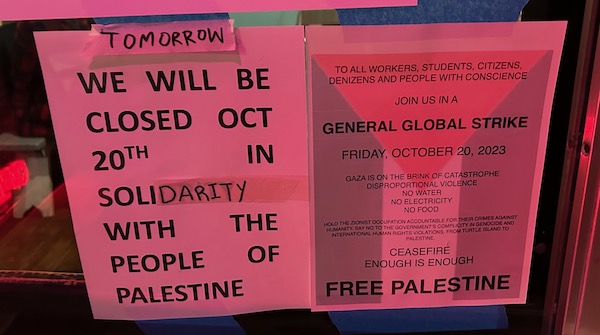
A restaurant in Vancouver closed for a day, calling for people “to hold the Zionist occupation accountable” for the war in Gaza. Writer Loolwa Khazzoom notes, “When terrorists blow up Israelis, there is often an undertone of accusation: it’s Israel’s fault, the narrative goes, that these tragedies happen…. But who truly was responsible for creating Palestinian desperation, and who is accountable for remedying it?” (photo by Larry Barzelai)
On 9/11, I was 20 blocks away from Ground Zero, sleeping in the living room of a friend when she woke me up, screaming hysterically – something about terrorists and an airplane crashing into one of the Twin Towers. As I tried to comprehend what was happening, my friend turned on the television and, right then, the second plane crashed into the second tower, as we watched in horror.
My thoughts came in this order: Now they’ll understand what it feels like to live in Israel. Watch them blame this on Israel. OMG we’re going to die.
Two decades later, on the morning of Oct. 7 – in the wake of what some are calling Israel’s equivalent of 9/11 – I felt the pain of collective Jewish agony, and promptly reached out to my friends and family in Israel, including those living close to the Gaza border.
Unbeknownst to many, those in the border towns, such as Sderot, are predominantly working-class Mizrahim and Sephardim – children and grandchildren of the 900,000 Jewish refugees from throughout the Middle East and North Africa. They are the ones predominantly getting pummeled by Hamas rocket fire, as the world yells about “white European colonist settler Israelis.”
So, it’s no surprise that, after the initial feelings of shock and outrage, grief and concern, I once again thought, “Watch them blame this on Israel.” And they did, within hours – with a BBC News interview going so far as to compare the Hamas attack to the Warsaw Ghetto Uprising.
It’s nothing new, of course. When terrorists blow up Israelis, there is often an undertone of accusation: it’s Israel’s fault, the narrative goes, that these tragedies happen. By creating Palestinian desperation, Israel has created Palestinian terrorism. But who truly was responsible for creating Palestinian desperation, and who is accountable for remedying it?
The Arab world is called just that for a reason. Beginning in the Arabian Peninsula about 1,300 years ago, Arab Muslims launched a brutal campaign of invasion and conquest, taking over lands across the Middle East and North Africa. Throughout the region, Kurds, Persians, Berbers, Copts and Jews were forced to convert to Islam under the threat of death and in the name of Allah.
Jews were one of the few indigenous Middle Eastern peoples to resist conversion to Islam, the result being they were given the status of dhimmi – legally second-class, inferior people. Jews were spared death, but forced to endure an onslaught of humiliating legal restrictions – forced into ghettos, prohibited from owning land, prevented from entering numerous professions and forbidden from doing anything to physically or symbolically demonstrate equality with Arab Muslims.
When dhimmi laws were lax and Jews were allowed to participate to a greater degree in their society, the Jewish community would flourish, both socially and economically. On numerous occasions, however, the response to that success was a wave of harassment or massacre of Jews instigated by the government or the masses. This dynamic meant that the Jews lived in a basic state of subservience: they could participate in the society around them; they could enjoy a certain degree of wealth and status; and they could befriend their Arab Muslim neighbors. But they always had to know their place.
The Arab-Israel relationship and the current crisis occur in the greater context of a history in which Arab Muslims have oppressed Jews for 1,300 years. Most recently, anti-Jewish riots erupted throughout the Arab world in the 1930s and 1940s. Jews were assaulted, tortured, murdered and forced to flee from their homes of thousands of years. Throughout the region, Jewish property was confiscated and nationalized, collectively worth hundreds of millions of dollars at the time.
Yet the world has never witnessed Middle Eastern and North African Jews blowing themselves up and taking scores of Arab innocents with them out of anger or desperation for what Arab states did to the Jewish people. Despite the fact that there were 900,000 Jewish refugees from throughout the Middle East and North Africa, we do not even hear about a Middle Eastern/North African Jewish refugee problem today, because Israel absorbed most of the refugees. For decades, they and their children have been the majority of Israel’s Jewish population, with numbers as high as 70%.
To the contrary, Arab states did not absorb refugees from the war against Israel in 1948. Instead, they built squalid camps in the West Bank and Gaza – at the time controlled by Jordan and Egypt – and dumped the refugees in them, Arabs doomed to become pawns in a political war against Israel. Countries such as Syria, Iraq, Saudi Arabia, Libya and Lebanon funded assaults against Israeli citizens instead of funding basic medical, educational and housing needs of Palestinian refugee families.
In 1967, Israel inherited the Palestinian refugee problem through a defensive war. When Israel tried to build housing for the refugees in Gaza, Arab states led votes against it in United Nations resolutions, because absorption would change the status of the refugees. But wasn’t that the moral objective?
Israel went on to give more money to the Palestinian refugees than all but three of the Arab states combined, prior to transferring responsibility of the territories to the Palestinian Authority in the mid-1990s. Israel built hospitals and educational institutions for Palestinians in the territories. Israel trained the Palestinian police force. And yet, the 22 Arab states dominate both the land and the wealth of the region. So, who is responsible for creating Palestinian desperation?
Tragically, the Arab propaganda war against Israel has been a brilliant success, laying on Israel all the blame for the Palestinian refugee problem. By refusing to hold Arab states accountable for their own actions, by feeling sympathy for Palestinian terrorists instead of outrage at the Arab propaganda creating this phenomenon, the so-called “progressive” movement continues to feed the never-ending cycle of violence in the Middle East.
Loolwa Khazzoom (khazzoom.com) is the frontwoman for the band Iraqis in Pajamas (iraqisinpajamas.com) and editor of The Flying Camel: Essays on Identity by Women of North African and Middle Eastern Jewish Heritage (theflyingcamelbook.com). She has been a pioneering Jewish multicultural educator since 1990, and her writing has been featured in the Washington Post, Marie Claire, Rolling Stone and other top media worldwide. This article was originally published in the Times of Israel.
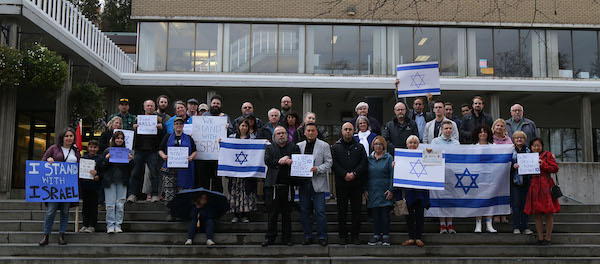
Members of the North Central BC Jewish community were joined by supportive residents from all backgrounds, local print and broadcast media were in attendance, and a segment of the gathering was broadcast live on local Global news. Many local dignitaries attended as well, including Todd Doherty, member of Parliament, Cariboo-Prince George; Shirley Bond, member of the Legislative Assembly, Prince George-Valemount; Simon Yu, mayor of Prince George; Trudy Klassen and Garth Frizzell, councilors, City of Prince George.
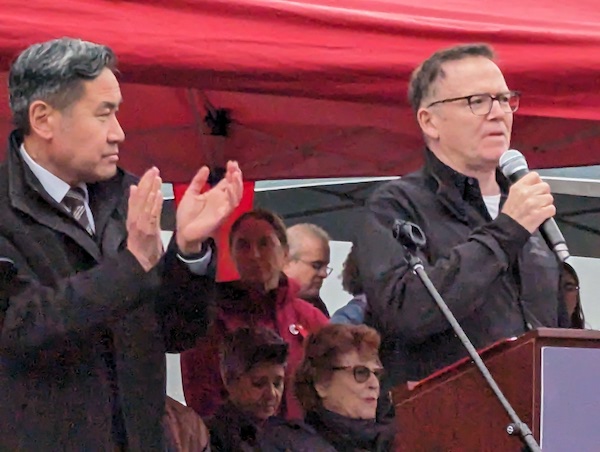
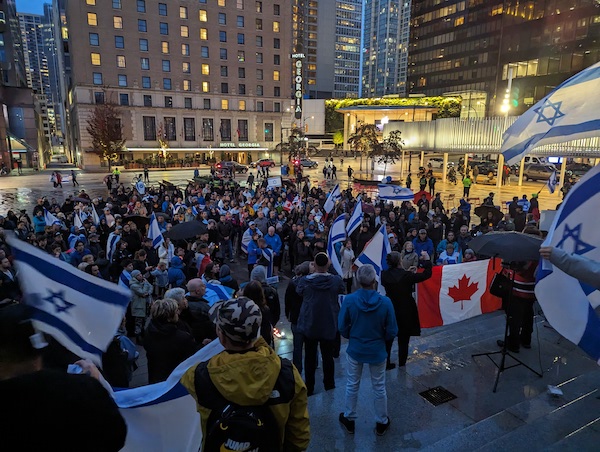
Several hundred people gathered for a second night of vigils, as elected officials, diplomats and allies convened in support of Israel and Jewish community. (photo by Pat Johnson)
For the second night in a row, Jewish Vancouverites and allies came together Tuesday for a vigil to mourn those murdered in the worst terror attacks in Israeli history, and to demonstrate solidarity with survivors, families of the victims, and all the people of Israel. The grief that was inevitable at the powerfully emotional event was made additionally anguished by the news several hours earlier that Ben Mizrachi, a young Vancouver man, was confirmed dead, one of about 260 victims murdered at a concert for peace in southern Israel Saturday morning.
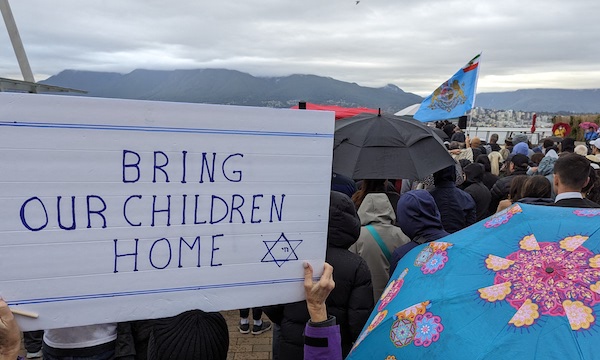
In moderate rain at Jack Poole Plaza on Vancouver’s Coal Harbour waterfront, several hundred people gathered to hear from friends of Mizrachi, as well as from elected officials of all government levels, rabbis, a Holocaust survivors, and others.
Ben Mizrachi remembered in friends’ emotional testimony
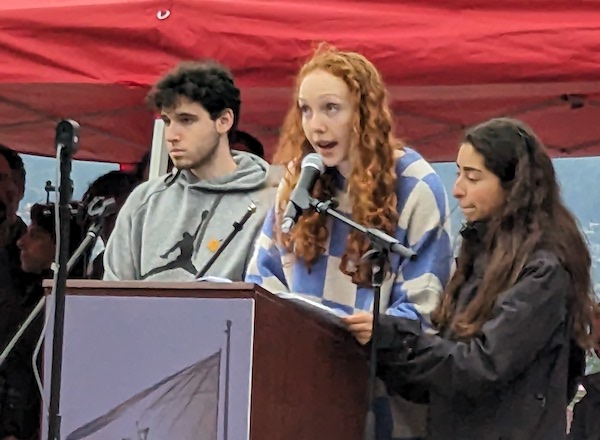
Maytar and Rachel, who graduated alongside Mizrachi in 2018 from King David High School, shared memories of the young man they called “the life of the party” and “a true hero,” who died helping an injured friend at the scene of the attack.
Mizrachi had served as a medic in the Israel Defence Forces, having volunteered as a lone soldier.
“We understand that, during the attack, Ben stayed back with a wounded friend, keeping himself in danger to care for another,” said Maytar. “He used the training that he learned from his time as a medic with the IDF to tend to wounded people at the festival before he died. That was who Ben was. He was a true hero.”
She spoke of Mizrachi’s contributions to the King David community, to his friends and family.
“He was adored by everyone and known to students much younger and older than he was,” she said. “Everyone knew and loved Ben Mizrachi. Ben was a role model to his three younger siblings and valued his close and loving relationship with his family.”
She shared the memories of a fellow student, Eduardo, for whom young Ben became his first friend after moving here from Mexico City.
“Ben welcomed him, befriended him and taught him how to speak English,” Maytar said. “He told us that ‘Ben was much more than a friend, he was my brother and the type of personality that will cheer you up and make you smile.’ He had such a huge heart and you knew you could always count on Ben.”
She continued: “In school, Ben was always the first one dancing at any assembly and the last one cleaning up at the end, even when he cooked — and he loved to cook.”
He could be found in the kitchen at Beth Hamidrash on Shabbat helping to prepare the kiddush, Maytar said. “His kindness extended to every part of his life from such a young age. We all remember that, if we ever had a gathering on Saturday, the party wouldn’t really start until after Shabbat, when Ben would arrive. He was always the life of the party. This past weekend, that’s what he was doing. He was at a party with his friends. He was doing nothing wrong.”
Friends of terror victim Ben Mizrachi remember “true hero.” (photo by Pat Johnson)
Their friend Rachel spoke of Mizrachi’s commitment to his identity.
“Ben was always extremely proud of his Jewish identity and of being an Israeli citizen,” she said. “He loved to share his love of Judaism and he often invited friends to join him and his family for Shabbat services and meals. As a teammate of Ben, we played on multiple sports teams together and he proudly wore his kippah at every game. In Grade 12, Ben was the president of our NCSY [the youth wing of the Orthodox Union] chapter. He was involved in student council, he led weekly prayer services at our school. After high school, he was proud to join the IDF as a lone soldier. He was so proud to be a soldier in the army and to continue living in Israel after his service.”
Rachel then read a message from one of Mizrachi’s teachers at King David, Irit Uzan.
“Ben always stood out from the crowd,” Uzan wrote. “His happy disposition was infectious. He lit up a room with his positive energy and amazing sense of humour. When things got hard for the students, he always found a way to lighten the mood. He encouraged his peers by sharing his own struggles, but it was what he did beyond his studies that always impressed me. He reached out and offered a helping hand wherever it was needed, be it with a peer, a teacher, a staff member or his own family. He wasn’t asked, he just always knew what to do. Ben’s visits to school to catch me up on his life events were visits I always looked forward to. On his last visit, he seemed more eager than usual and I learned this was because he wanted me to know that he had decided to study engineering in Israel. He was so proud of this.”
In tears, Rachel concluded: “Ben, we are so proud of you and we will always miss you. Please pray for Ben’s family, for all the families who have lost their loved ones, as well as those wounded. Keep believing in the state of Israel and continue to be proud of our Judaism, like Ben always was. May Ben’s memory be a blessing.”
Rabbi Shlomo Gabay, spiritual leader of Mizrachi’s shul, Beth Hamidrash, led the vigil in El Maleh Rachamim, the prayer for the soul of the departed.
Reflections from a survivor
Marie Doduck, a child survivor of the Holocaust who was born in Brussels and came to Canada as a war orphan in 1947, reflected on the terrible echoes of the past the current news brings. She and 30 other Vancouverites who survived as Jewish children during the Second World War gather and, Doduck said, speak about their pasts and the present.
Holocaust survivor Marie Doduck spoke of historical trauma. (photo by Pat Johnson)
“For all the years we have been sharing our stories, for all the years we’ve been teaching tolerance, we know the worst that can happen,” she said. “But it always seems to happen to us. I spend my life as an educator, I share my story and the stories of the Holocaust so that people know and so that the world will remember, so that never again will children lose their childhood to hatred and to violence. And now, this week, I see children being taken from their parents in Israel. I’m reliving what I experienced as a child and it is horrible. I’m watching the news and hearing the sounds that were so terrifying when I was young, the sirens, the bombs falling. I’m seeing warplanes and bomb shelters and I cannot sleep at night.
“I’m seeing it all happen again,” Doduck said. “I see people who do not want peace treating us as if we are not human. I see the children captured. I cannot understand how they use children, how they use women and men like we are nothing. It is unthinkable. It is impossible to believe that humans can do this to other humans. The one place where we are safe they want to destroy. They want to do what the Gestapo did to us in the Second World War.”
With emotion, Doduck posed the question, “Does the world stand for us?”
“I don’t see them standing for us,” she said. “I see it happening again. I am reliving what I went through as a child and all we want, and all we have ever wanted, was peace.”
Support from Ottawa
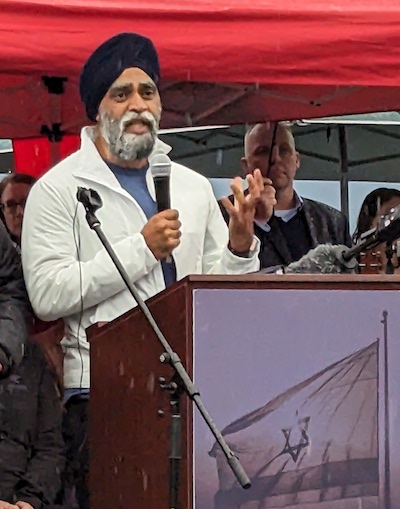
Harjit Sajjan, president of the privy council and minister of emergency preparedness, spoke on behalf of the federal government.
“I know that everyone’s heart is broken because of this brutal terrorist attack, a targeted attack on the Israeli people,” said Sajjan, who is member of Parliament for Vancouver South. “All of you have witnessed and have seen the news and the atrocity that has taken place. Myself and my colleagues here … stand here with you. But I don’t speak here just as a minister but [I am] also speaking to you as a Canadian, as a human being. It hurts so much when we see images from what has just taken place. Your community has gone through this far too often. When we say enough is enough, sometimes those words seem like they have no meaning. But when we come together like this, it gives me hope that we can get through this.”
Harjit Sajjan promised Canada’s government “is with you.” (photo by Pat Johnson)
Across Canada and elsewhere, rallies, public statements and social media comments have celebrated the terror attacks, some, like the president of the Ontario wing of the Canadian Union of Public Employees, lauding them as “the power of resistance around the globe.” Hours before a Jewish community vigil Monday, a rally celebrating the violence was held in the same Vancouver Art Gallery location. Along with many speakers at the Tuesday event, Sajjan condemned the expressions of support for the terror attacks.
“Anybody who glorifies what has just taken place, the atrocities that Hamas has committed, I’m here to say that we denounce you and I denounce you,” he said.
Sajjan referenced his military career, from which he retired with the rank of lieutenant-colonel.
“Over the last two decades, whether in politics or even before, [in] my other job in the military, I’ve seen atrocities committed all over the world,” he said. “And your heart breaks every single time. And you think, what can we do? One thing that always gives me hope is that I look back and remember where I live, in Canada, that we come together, we support one another. That’s how we get through this.
“I remember visiting Entebbe [Uganda] where, you know all too well, when Israeli citizens were taken captive and they were rescued at that time, I went to go pay my respects and remember what took place then. To see the atrocities committed over and over again is something that we all feel today. One thing I’m here to tell you: that we stand by you, we call for the captives to be released, we want humanitarian aid to be flown into all those people who are caught in the middle. But one thing is for sure: our government is with you.”
Other federal officials present were Joyce Murray, member of Parliament for Vancouver Quadra, and Parm Bains, member of Parliament for Steveston-Richmond East.
Message from the province
Selena Robinson, British Columbia’s minister of post-secondary education and future skills, brought greetings from Premier David Eby and the provincial government. She also emphasized the presence of officials from both sides of the legislature.
Selina Robinson, one of BC’s few Jewish elected officials, spoke emotionally of living in a frightening time. (photo by Pat Johnson)
“All of government and all members of the Legislative Assembly stand with me, they stand with all of you, against the horrific violence that was perpetrated by Hamas, a terrorist organization, an organization committed to indiscriminately killing and indiscriminately wiping out the Jewish people,” she said. “As a Jew, I have never in my life experienced a more frightening time. To see and bear witness to the carnage, to the babies, to the children, to young people at a concert.
“The stories that Jewish families have been telling for generations all come swarming back,” Robinson continued, her voice breaking. “The stories of pogroms in Russia and Poland at the turn of the 20th century, the Einsatzgruppen, the Nazi mobile death squads, going house to house killing everyone in their sights during the Holocaust. That is what happened this weekend. This is not a path to peace and it’s not the path to freedom. The Palestinians and the Israelis deserve to raise their families without fear, to grow old with dignity, but this vicious depravity is not the answer. It is not a path for peace for anyone. These last days have been so difficult and there are more hard days to come. So, we ask all of you to please be kind, be thoughtful, be supportive and to take care of each other.”
Opposition leader stands with community
Kevin Falcon, BC United party leader and the province’s leader of the opposition, was scheduled to hold a townhall in Kamloops Tuesday night but he cancelled the event and drove to Vancouver to be present for the solidarity gathering, he said, “Because I think it is important that all public officials stand united in saying … without equivocation, without moral equivocation, to be very, very clear, that we stand with you.”
Provincial opposition leader Kevin Falcon, with MLA Michael Lee. (photo by Pat Johnson)
Condemning terrorist brutality is “something that ought to be really easy,” he told the crowd. “But, unfortunately, in this day and age, it doesn’t seem to be easy for some people to come together and denounce unequivocally the violence and slaughter of innocent civilians in Israel, and to remember the right of that country and those individuals to defend themselves as a fundamental right because we cannot forget.
“We stand with the community and we want you to know that,” he said.
In addition to the government cabinet minister and opposition leader, other provincial officials present were cabinet ministers Brenda Bailey, Murray Rankin, Sheila Malcolmson and George Chow, parliamentary secretaries Mable Elmore and Susie Chant and members of the Legislative Assembly Henry Yao and Michael Lee.
Mayor condemns antisemitism
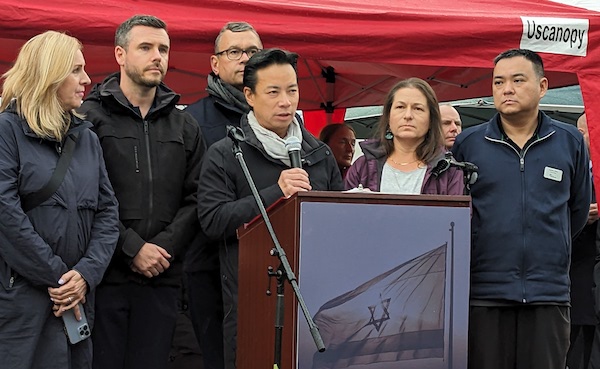
Vancouver Mayor Ken Sim was flanked by city councilors Sarah Kirby-Yung, Peter Meisner, Lisa Dominato, Mike Klassen and Rebecca Bligh as he expressed solidarity with the Jewish community and promised zero-tolerance for antisemitism.
Vancouver mayor Ken Sim, flanked by councillors, committed to fight antisemitism. (photo by Pat Johnson)
“What happened this weekend in Israel was absolutely horrific,” said Sim. “Our hearts are broken, just like yours…. Vancouver is a city of love, Vancouver is a city of peace, Vancouver is a city of inclusion. This is a place where we celebrate our differences in culture and religion. So, it’s absolutely disturbing and incredibly disgusting, in the city that we live in, the city that we are so proud of, that people were actually celebrating what happened. They are celebrating Hamas. That’s not right. Israel has a right to exist. Israel has a right to protect itself. At the City of Vancouver, we stand for all communities, including the Jewish community — especially the Jewish community, during this incredibly brutal time. You are our brothers and sisters, you are our neighbours, you are our friends, you are our family. Let me be very clear — let us be very, very clear — we will not stand for any antisemitic acts or acts of hatred in the city of Vancouver. We mourn with you, we stand with you, we love you and we will always be here for you.”
Dylan Kruger, a Delta city councilor was also present.
Gathered together as one
Tuesday’s vigil was organized by the Rabbinical Assembly of Vancouver, the Jewish Federation of Greater Vancouver and the Centre for Israel and Jewish Affairs.
Rabbi Jonathan Infeld of Congregation Beth Israel, and the head of the rabbinical assembly, spoke of the relentlessness of antisemitism.
“I am standing here as a neighbour of Ben Mizrachi and his family, in sadness and in grief,” said Infeld. “I am standing here today as the father of a young man who is currently in Jerusalem. I am standing here today as the child of Holocaust survivors who never met his grandparents or aunts or uncles because they were murdered as children because of antisemitism. Never would I have imagined again in my life that we would see 40 children, 40 babies in one day, discovered, who were murdered in cold blood because of antisemitism. Never would I have imagined in my life that we would see almost a thousand Jews in one day murdered because of antisemitism. Throughout the day, I’ve been asked, what is this moment about? This moment today, together, as one people, one community, Jews and non-Jews gathered together for solidarity, gathered together to mourn and gathered together to give strength to one another. We are so grateful to our politicians and to our leaders who really, truly, are leaders. All of you sitting here today, you are the leaders. You are sending the message that there is no similarity in morality, there is no equivalence in morality, between those who celebrate murder and those who are gathered together for peace.”
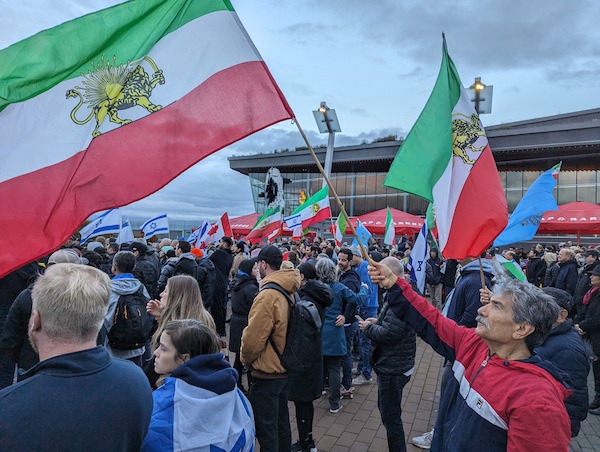
Iranian community members showed solidarity. (photo by Pat Johnson)
Federation leader sends message from Egypt
Jason Murray, vice-chair of the board of the Jewish Federation of Greater Vancouver, read a message from the board’s chair, Lana Marks Pulver, who, with her husband Doug, is in Egypt, leading a group of almost 100 Canadian business leaders in a mission that was slated to travel to Israel in the coming days.
“I share this with you so you know how close I am to the situation both physically and emotionally,” wrote Marks Pulver. “There were two Israeli tourists murdered by a police officer in Alexandria [Egypt]. We continued on with our tour of Egypt much to the chagrin of family and friends. We continued because we will not allow them to win. Never again.
“As for emotion, our 21-year-old niece and 19-year-old nephew are serving in the IDF and are stationed near Gaza. We are feeling sick about what’s happening in Israel and we are feeling sick about the celebratory rallies happening in Canada, rubbing salt in our fresh wounds. How can Canadian citizens possibly justify the celebration of rape, killing and kidnapping of innocent Jews, online and in public rallies? It’s both horrifying and heartbreaking that this is happening in our own backyard. Jews throughout history have consistently proven that we are resilient. This time is no different. Israel will prevail. We as a people will not allow evil to win. Despite thousands of years of antisemitism and countless attempts to annihilate our people, we always come back stronger and more unified as a community.
“I am confident that this time is no different,” she continued. “Let us pray this all ends soon, that Israelis move forward with their lives in safety and that we as a Jewish people proudly stand in our fight against hatred and our desire to live in peace. Am Yisrael chai.”
Gratitude for allies
Ezra Shanken, chief executive officer of the Jewish Federation of Greater Vancouver, praised the elected officials who attended and the police who provided security at the event.
“Often, we see public officials at our events and it’s special then,” he said. “But it’s even more special now. To have this incredible representation of folks behind us and around us in this moment is not something that I take for granted, not these days.”
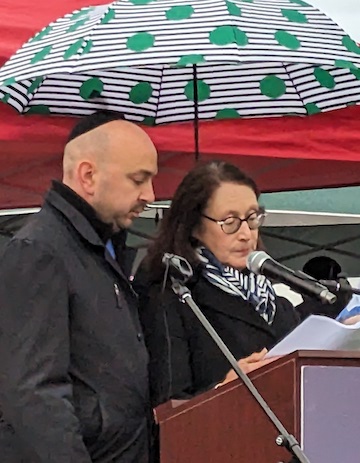
Ezra Shanken and Karen James (photo by Pat Johnson)
In addition to elected officials, Shanken noted the presence of consuls general from France, Germany and Italy, as well as representation from the consulate of the United States.
Karen James, chair of the local partnership council for the Centre for Israel and Jewish affairs, Pacific region, lauded the unity of the Jewish community.
“I have always known that we are family, but I’ve never felt it so strongly as I do now,” she said. “Tonight, we are hurting. Our hearts are broken but our resolve has never been stronger.”
Severe audio problems plagued the event, which came a night after an earlier vigil, at the Vancouver Art Gallery, planned by Daphna Kedem, who is the lead organizer of UnXeptable Vancouver, though the event was not affiliated with any group. ( To read more about the Monday night vigil, click here.) At that event, a small group of provocateurs were kept apart from the main vigil by a phalanx of police. Police were also omnipresent at the Tuesday event, while protesters were nowhere to be seen.
Speakers at the event urged people to contribute to the emergency fund for victims and to access available mental health supports as needed. Federation’s website, jewishvancouver.com, is the access point for all relevant local resources.
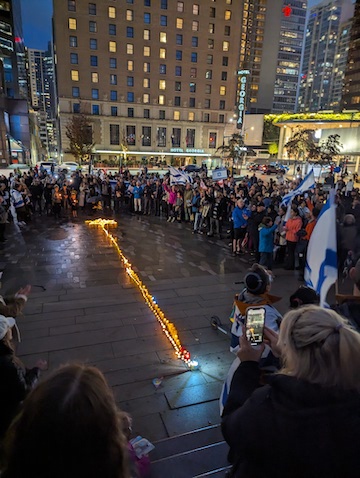
Jewish Vancouverites and allies came together in grief and determination in a community vigil Monday night, Oct. 9, outside the Vancouver Art Gallery. (photo by Pat Johnson)
Several hundred Jewish Vancouverites and allies came together in grief and determination in a community vigil Monday night outside the Vancouver Art Gallery. The unprecedented terror attacks in Israel that began Saturday brought a large crowd to the public venue in light rain for an emotionally charged hour of prayers, songs and shared stories of tragedy and resolve. The uncertain fate of a young Vancouver man who had not been heard from since Saturday brought the immediacy of the tragedy home. Hours after the vigil, it was announced that the body of Ben Mizrachi had been identified.
“A piece of this community is missing,” said an audience member who addressed the crowd and identified himself as Adam. “His name is Ben Mizrachi.”
Mizrachi, who graduated from King David High School in 2018, was attending a music festival in Re’im, in southern Israel near the Gaza border. An estimated 260 people were murdered as terrorists invaded the event around 7 a.m. Saturday. Mizrachi had not been in contact with family or friends since, according to news reports and messages from Vancouver friends. Late Monday Vancouver time, it was announced that he had been murdered.
The Monday night vigil was organized by UnXeptable Vancouver. (photo by Pat Johnson)
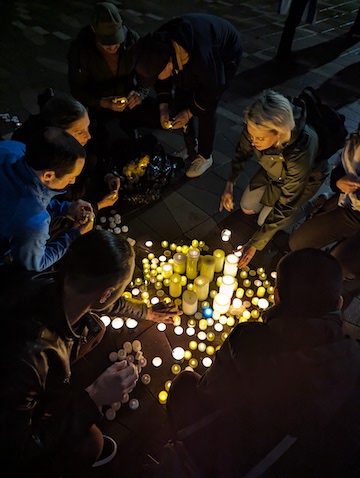
“Every one of us here is feeling grief, is feeling loss,” said Adam. “We are all individuals here, but we are one nation and our nation has one heart. We will look at these candles, we will look at the light, we will look at all the universes they stole from us and we will say, this light will drown out that darkness.”
Leslie Benisz, who spent his first 10 years in Israel, spoke of his own family’s tragedy.
“I have a cousin and her husband who, unfortunately, were killed,” he said, “and, still, at this moment, we do not know the whereabouts of her four children. They were living on a kibbutz near the Gaza area.”
Benisz said his mother, who passed away in March, had advice for times like these.
“My mother used to say, ‘We have to be better than those people who hurt us. Just because they hurt us, don’t do the same thing to them. Maybe even show a level of tolerance and compassion they failed to show us, because there is a fine line sometimes between becoming a human being and becoming an animal and we have to show that we are better than that.’”
A small group of provocateurs carrying Palestinian flags, kept away from the vigil by police, screamed and taunted attendees throughout the event, including during two moments of silence, and vehicles repeatedly circled the venue, their occupants waving Palestinian flags and honking horns. A rally – ostensibly in support of Palestinians – was held several hours earlier at the same location as the vigil.
Monday’s event was organized by Daphna Kedem, who is the lead organizer of UnXeptable Vancouver, though the event was not affiliated with any group. The ad hoc vigil was organized before the Jewish Federation of Greater Vancouver scheduled a community solidarity event for the following evening, Oct. 10. Coverage of Tuesday’s event, which took place after the Independent went to press, is now online at jewishindependent.ca.
Daphna Kedem, one of the organizers, told the Independent that bringing the community together as soon as possible for mutual support was their priority. While awaiting notification of an event by community leaders, Kedem said, her group decided to schedule a gathering with haste.
“We are not waiting around for the community,” she said. “This is urgent and time-sensitive.”
“We are in the west, but our hearts very much are in the east,” said Rabbi Dan Moskovitz, senior rabbi at Temple Sholom. “We hold our loved ones and our families in those hearts and we come together as a community to pray and to mourn but also with resolve and resilience.”
Speaking above taunts and screaming from protesters on the sidelines, Moskovitz continued: “That’s what we want: to live in peace, to live in our native land in peace, to be together as human beings. Too often, the world ignores us. Too often, the silence is deafening. We who stand here today, we make our presence to call the world to conscience and to see us, to see how once again our people are in danger, our people are being killed and murdered and the world must not be silent again. We will not be silent. We are strong, we are a people with a nation now for the first time in 2,000 years and it will not slip from our grasp, it will not slip from our hearts or our minds or our prayers.”
Ofra Sixto, chef-owner of the Denman Street Israeli restaurant Ofra’s Kitchen, recounted her story of being harassed and of having her life threatened three years ago during a different time of conflict between Israel and Hamas. Then she made a prayer for those missing and for the survivors of those murdered.
“Please God, make them all come back home soon,” she said. “Please God, put solace in the hearts of the people who lost their loved ones.”
Another speaker recalled a year living near the Gaza Strip and hearing the endless sounds of explosions.
Memorial candles were placed in the shape of a Magen David. (photo by Pat Johnson)
“We are here tonight to remind ourselves and our people back in Israel that we are all one country, we are all one family, we are all together in this, united,” said another speaker. “Despite the tough year it’s been, with different opinions, we are all sticking together, especially when it gets tough. That’s our biggest strength.”
She then led the vigil in the song “Am Yisrael Chai.”
“My sister was sitting 13 hours in a shelter room and the terrorists roaming her kibbutz didn’t touch their home,” another speaker from the audience recounted. “It was a miracle.”
He added: “The one thing that our enemies cannot do is put a divider between the Jewish people and eretz Israel. Please remember that. There is no Jewish people without Israel and there is no Israel without the Jewish people.”
“This horrific attack was an attack on Israel,” said another member of the audience who spoke. “Moreover, it was an attack on all of those who value human life. I know that some people are of the belief that you are left to fight this battle alone. I’m neither Jewish nor Israeli and I’d like to tell you that there are millions of people around the world standing together with you. This includes me and many, many, many others.”
“We have a very simple message to the world today,” said Rabbi Shmulik Yeshayahu of the Ohel Ya’akov Community Kollel. “When we see those guys on the other side, and we see our crowd tonight, state proudly … we are human beings. We treat people fairly. We love Israel, we love humanity, we love the civil world.… We will never let terrorism take over. This is the message of Canada and all the Western world today.”
Yeshayahu lamented the hostages taken.
“We are talking about over 100 people, many of them little kids who were kidnapped, old people who survived the Holocaust and came to the holy land of Israel to live in a free country,” he said. “We are here for them.… No human being can stand by and see those bastards take little kids and kidnap 3-year-old kids and put them in a cage. This is not acceptable in 2023 and we are not going to be quiet about it. The eternal nation is not afraid of a long journey. We will defeat them.”
Rabbi Carey Brown, associate rabbi at Temple Sholom, said the prayer for Israeli soldiers in Hebrew, while a lone soldier who had served in the Israel Defence Forces a decade ago, shared the prayer in English. Rabbi Jonathan Infeld of Congregation Beth Israel led El Maleh Rachamim, the prayer for the souls of the departed.
After the main vigil, the Independent spoke with a number of attendees.
“With the horrors that happened in Israel, and all the innocents killed, bodies desecrated, kids getting kidnapped, I just had to come and show support,” said Adar Bronstein, who moved to Canada from Israel a decade ago. “I think local Jews and Israelis don’t really protest much. We’re actually quite a quiet society overall, so, when something as big as this happens, we have to make some sort of a stand. All my friends over there have been drafted and my Facebook page is full of my friends posting about their killed loved ones. My family is there and they are terrified. It’s been very, very difficult.”
“What brought me out tonight was seeing things that I didn’t think I would ever see in my life,” said Alex Greenberg. “This is my family, this is my people. I came just to show that people in Israel have support.”
Jillian Marks was huddled in a group of young women, some hugging and wiping away tears. The alumna of Vancouver Talmud Torah and King David is now a University of British Columbia student and president of the Israel on Campus club.
“We need to show that we are together, that we support each other in these times,” said Marks. “Just being here is a mitzvah and a blessing. I think it’s quite surreal. I have people fighting on the front lines. I have people missing. I have friends missing and friends hiding in bomb shelters. I’m just sad. But I’m grateful for the community here in Canada. I’m grateful we are all together tonight.”
A small group of Iranian Canadians waved the national flag of Iran – not the flag of the Islamic revolutionary government.
Dr. Masood Masjoody, a mathematician and activist against the Iranian regime, said he came “to show support for Israel and the Israeli people.”
He said he was surprised that anyone would be surprised to see him there.
“We’ve been dealing with the regime that has been behind these heinous attacks for more than 40 years – 44 years – so we know this regime more than any other nation in the world,” he said, referring to the Iranian regime’s support for anti-Israel terrorism.
There are many organizations through which people can donate to help Israel, including the Jewish Federation of Greater Vancouver’s Israel Emergency Campaign, at jewishvancouver.com/israel-fund.
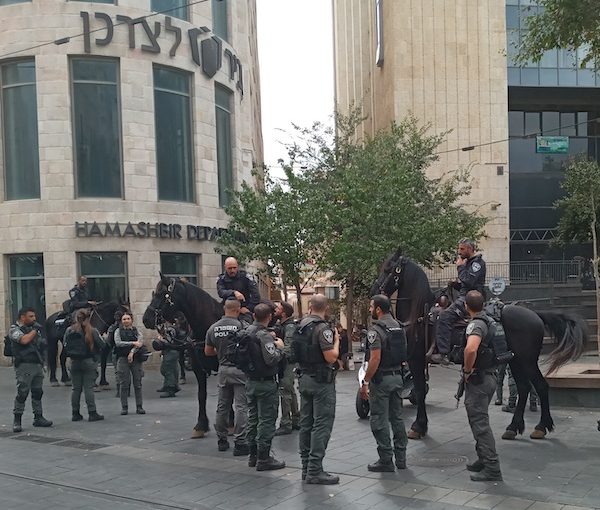
Downtown Jerusalem is deserted apart from Israel Border Police deployed in Zion Square. (photo by Gil Zohar)
It is Oct. 9. My wife Randi calls me while I am riding Jerusalem’s all-but-empty light rail, returning from a bat mitzvah celebration of a forlorn family of tourists from Arizona who are stuck in Israel. We simultaneously hear the air-raid siren blaring as we talk. Fighter jets are screaming overhead. With an edge of panic in her voice, Randi asks me what she should do. I calmly instruct here to follow the Home Front Command orders for civilians, which we have repeatedly reviewed. I’ve downloaded the app on my cellphone.
Our beautiful stone home in downtown Jerusalem, built in 1886, lacks a reinforced steel and concrete bomb shelter, known by the Hebrew acronym MaMaD (Makom Mugan l’Diyur), a protected residential place.
I remind Randi go to the neighbour’s basement apartment quickly but without running, and to wait there. Grabbing Bella our dog, she leaves the apartment door and windows open so that a blast from an explosion will not result in the windows being shattered and glass debris obliterating our house.
Below-grade structures make for poor bomb shelters since poison gas is heavier than air, I think. But there is no alternative. Nine Bedouin children were killed by Hamas rocket fire in the Western Negev. Their village lacked a MaMaD.
We hear the twin boom of Israel’s air defence system, the Iron Dome, intercepting a rocket barrage fired from the Gaza Strip. The strike lights up the sky. The threat is over until the next alert. The media reports that seven civilians living in towns in the periphery of Jerusalem were wounded in the barrage.
At the time of this writing, nearly 1,000 Israeli civilians have been killed, including 260 massacred at the Nova festival near Kibbutz Re’im – an all-night party in the desert. More than 130 civilians and soldiers have been taken hostage and dragged back to Gaza. Apart from 35 Israel Defence Force soldiers who fell in the line of duty, the names of the deceased have not been released.
It remains unclear if Hezbollah will open a full-scale second front from Lebanon. Israel has threatened to destroy Damascus, the capital of Syria, which backs the Shi’ite terror group, should the war broaden to the north.
Families of the kidnapped, missing and 2,200 wounded civilians are begging for news. Israel remains shrouded by military censorship. Nor is the news from the 2.3 million people in Gaza any clearer. Al-Jazeera lists long-out-of-date statistics. Based on data reported by the Palestinian Health Ministry, the Palestine Red Crescent Society and Israeli Medical Services, 560 Gazans have been killed. That number is likely to rise substantially.
More than 48 hours from when Hamas attacked and war broke out at 6:30 a.m. on Saturday, the IDF spokesperson announces that the army has neutralized the terrorists who overcame 22 cities and villages near Gaza. Israelis are being evacuated from the border area in anticipation of a ground invasion. Some are being housed in empty hotels near the Dead Sea.
I’ve offered our adjoining apartment. All our Airbnb guests have canceled. Apart from El Al, airlines have stopped flying to Ben-Gurion Airport.
The number of the dead, missing and wounded is surreal. The IDF has called up 300,000 reservists in the last 48 hours for what it has termed “Operation Swords of Iron.” Among them is my nephew Guy Carmeli, a Canadian-Israeli dual citizen and veteran tank gunner who lives in Herzliya with his wife Yael and 2-year-old son Oz. Randi doesn’t know of his callup. Maybe she’ll read it here. My wife doesn’t do well with stress.
A press release from Prime Minister Benjamin Netanyahu denies Egypt is trying to broker a ceasefire. The statement reads: “No message has arrived from Egypt and the prime minister has neither spoken, nor met, with the head of Egyptian intelligence since the formation of the government, neither directly nor indirectly. This is totally fake news.”
The implication? Israelis must gird themselves itself for a “long and difficult war ahead,” according to Netanyahu.
The electronic tom-tom drums uniting immigrant Israelis have been busy. As I write this, nine Americans have been confirmed dead, and 10 Brits are assumed to have been killed.
Adi Vital-Kaploun, the adult daughter of Ottawa native Jacqui Vital and her husband Yaron who live in Jerusalem, was kidnapped from her home by the Gaza Strip. Adi’s two infant children, aged 1 and 3, were also taken hostage but were abandoned at the border by their captors who felt the children would slow down the gunmen’s retreat. [On Oct. 11, after the Independent went to press, it was announced that Vital-Kaploun had been murdered by Hamas terrorists.]
There are other Canadians missing, including former Winnipegger Vivian Silver. And there are Canadians who were killed by the terrorists: Alexandre Look, who grew up in Montreal, and Vancouverite Ben Mizrachi; both young men were among those killed at the music festival near Kibbutz Re’im.
Canadian-Israeli Shye Weinstein, who was at the festival, too, documented how he and his friends fled. He described their nail-biting escape to Tel Aviv: “We only slowed down for checkpoints and bodies.”
Nuseir Yassin, who writes the blog @nasdaily, described his conflict as an Arab citizen of Israel: “Personal Thoughts: (not for everyone, feel free to skip) For the longest time, I struggled with my identity. A Palestinian kid born inside Israel. Like … wtf. Many of my friends refuse to this day to say the word ‘Israel’ and call themselves ‘Palestinian’ only. But since I was 12, that did not make sense to me. So I decided to mix the two and become a ‘Palestinian-Israeli.’ I thought this term reflected who I was. Palestinian first. Israeli second. But after recent events, I started to think. And think. And think. And then my thoughts turned to anger. I realized that if Israel were to be ‘invaded’ like that again, we would not be safe. To a terrorist invading Israel, all citizens are targets. 900 Israelis died so far.
“More than 40 of them are Arabs. Killed by other Arabs. And even 2 Thai people died too. And I do not want to live under a Palestinian government. Which means I only have one home, even if I’m not Jewish: Israel. That’s where all my family lives. That’s where I grew up. That’s the country I want to see continue to exist so I can exist. Palestine should exist too as an independent state. And I hope to see the country thrive and become less extreme and more prosperous. I love Palestine and have invested in Palestine. But it’s not my home. So from today forward, I view myself as an ‘Israeli-Palestinian.’ Israeli first. Palestinian second.”
Gil Zohar is a writer and tour guide in Jerusalem.
The Jewish community worldwide is experiencing pain and despair. Feelings of grief for the murdered, empathy for the injured, rage at the perpetrators and anguish and terror for the kidnapped are overwhelming. The deep heartbreak is palpable.
While events in the past have harmed Israelis’ sense of security and hopes for peace, these attacks seem to have shattered them. The invasion of Jewish homes, the seizing of Jewish people, young and old, reaching for their loves ones as they are dragged away – these are images hauntingly redolent of a stateless past, without a government capable of preventing large-scale, coordinated assaults on the dignity, human rights, freedom and lives of Jews. The magnitude of this terror, with the heart-rending images and videos that illustrate the dehumanization in a way impossible until recent technological advances, means this moment is uniquely affecting.
Israeli politicians and military strategists have largely aimed to “manage” the conflict. Now, there will be calls for a lasting resolution. Israelis will not tolerate a second experience like this. After a decade and a half of successive skirmishes and wars with Hamas, many, including top military officials, are warning this will be the last.
A resolution to the status quo is something everyone – even Hamas terrorists – agree on. What that resolution will look like is where differences emerge. The approach Israel takes will affect not only the reality there but, secondarily, the world’s attitudes and approaches to Israel … and to Jews, as is often the case. There is fear and anger and understandable calls for retribution – actions that, at press time, were partly being tempered by the presence in Gaza of an estimated hundred-plus hostages from Israeli villages and towns.
History has shown one thing to be sure of, and to brace for – the window of empathy for Israeli victims will inevitably close. The author Dara Horn wrote that “people love dead Jews.” What the world seems to welcome far less enthusiastically are Jews, and a Jewish state, that are very much alive, with agency in the world. As Israel’s response rolls out, we can expect much of the nascent public sympathy to evaporate.
We cannot predict the mayhem and pain that seems imminent for both Israelis and Palestinians in the coming days, weeks, months and possibly years as a result of this radically changed circumstance. However, the temptation to assert that “this changes everything” is almost certainly false. Some things will remain the same.
There is a core of intolerance and hatred at the heart of opposition to the Jewish presence in the region and to Jewish national self-determination. Peace has rarely seemed further away.
Not incidentally, some of the central values of Israeli society – providing affected individuals and families with support and resources in times of crisis – have been left to individuals and various networks of mutual aid. The governmental and political failure goes beyond not having been prepared for the terrorist attacks but extends to the aftermath. Families have been left by their government with little communication or intelligence on their lost, possibly dead, loved ones. Among all the sacred things left in ruins today, this may prove to be one of the most shattering remnants from this time. That, at least, was something that Israelis could rely on – and even that has been ripped away.
For Jewish Canadians, this conflict is at once so far away and so close and, for some of us – like the family and friends of Ben Mizrachi, the young Vancouver man murdered Saturday – so very close. Wherever we are, we must be there for one another, across all lines of geography, affiliation, background and, yes, politics. Right now, a resolution forced by military might be the preference of the most vocal people. The middle of a war can be a hard time to talk about peace. A moment of agony and outrage is a difficult moment to encourage reflection and restraint. And yet, lasting peace and justice depends on what happens next and how our institutions react. We cannot control the actions of others, as psychiatrist and Holocaust survivor Viktor Frankel suggested, we can only control our responses to these events. This is the choice each of us makes as we assimilate the inhumanity around us and reflect on our deeply held values.
The interview was a moment of clarity and despondency. A cable news anchor asked an Afghan-Canadian activist what the West should do to save the Afghan people, especially women and girls, from the Taliban.
The hesitation by the interviewee probably conveyed the hopelessness so many feel in direct proportion to their geographic or familial proximity to the crisis. The most powerful, heavily resourced military the world has ever known left Afghanistan this month after almost 20 years. Instantaneously, it seems, all the work of nation-building, developing security capacity and attempting to instil the structures of civil society, evaporated. If that force, backed by other Western powers, including Canada until 2014, could not hold back the tide of the Taliban, what can ordinary Canadians possibly do?
Based on the lessons of history, and the comparatively recent invention of the concept of “responsibility to protect,” the world, by any measure, should be coming to the aid of the Afghan people. But U.S. President Joe Biden is also correct, declaring, “American troops cannot and should not be fighting in a war and dying in a war that Afghan forces are not willing to fight for themselves.” U.S. leaders faced an impossible choice, probably with no possible good outcome.
It is unquestionably inhumane for the world to leave the Afghan people to the whims of tyrants. But the American people, particularly military families, have understandably had enough of “endless wars.” Who will step up to fill that vacuum? The United Nations was created, in part, for precisely this sort of moment but it has been, in many ways, corrupted and deracinated from the humanitarian foundations on which it was created.
If there were an easy solution to this quagmire, you wouldn’t be reading it in the pages of a small Jewish newspaper on the Pacific fringe of the continent. We have little beyond hopes and prayers to offer the Afghan people.
The fall of Kabul almost certainly represents something enormous, although we may not understand yet the full implications.
The beginnings and ends of historical eras are not always visible to those who live through them. Our current era, which began almost exactly 20 years ago, on Sept. 11, 2001, in some respects, came to an end this month with the U.S. pullout from Afghanistan.
Many observers have compared the chaos at Kabul airport with the Saigon airlift in 1975, when America fled, as some put it, with its tail between its legs. Forty-five years later, America remains a force not to be trifled with. But neither is it the undisputed powerhouse it was since the Second World War. Whether it remains a recognized (and feared and respected) superpower – or whether the fall of Kabul is a bookend to the fall of Saigon in the longer fall of America – remains to be seen. Whatever eventuality, America is no doubt diminished.
This comes, not coincidentally, as central Asia and the Middle East roil with instability and the broader troubles of that part of the world will certainly present problems for Israel. But Israel has faced existential threats throughout its history and will most likely adapt to the new reality.
The events of recent weeks will have many consequences we cannot yet foresee. One thing is particularly notable, however. Hamas, who control Gaza, sent a message of congratulations to the Taliban for “defeating” the United States.
With thankfully few exceptions, no one believes the Taliban to be a force for any sort of good. When people who for decades have defended or apologized for Hamas violence against Israel are faced with the realization that Hamas and the Taliban are ideologically adjacent, will that alter the attitudes to the Israeli-Palestinian conflict?
The latest explosion of terrorism from Gaza, the reaction from Israel, the violence in and around Jerusalem and the international response to these events continues to reverberate. Things have calmed somewhat in Israel, although violence continues, but a second, related front continues to rage in the public dialogue.
Anti-Israel rallies worldwide have seen explicit antisemitic imagery and threats openly and prominently exhibited. Such expressions are now commonplace at protests, in online spaces and in public squares. Anyone who insists there is some sort of hermetically sealed wall between anti-Zionism and antisemitism needs to explain why bands of thugs in London drove through Jewish neighbourhoods screaming “F**k the Jews, rape their daughters.” Social media has logged millions of overtly Jew-hating statements and images, including thousands of instances of the phrase #Hitlerwasright.
These examples are obviously extreme. Far more common, even from ostensibly mainstream voices, including elected officials in Canada, the United States and Europe, is language employing the apartheid libel or that Israel is a “settler-colonial” regime.
The settler-colonial motif is particularly effective in the Americas because we, unlike Israel, are actual settler-colonial societies. The assertion that Jews are, basically, an invasive species in the Land of Israel meets fertile soil just as global attention again focuses on the situation of Palestinians.
While the antisemitic language and violence is deeply worrisome, it raises a secondary issue about the motivations of anti-Israel voices. Villainizing, isolating and denouncing Israel seems to fulfil some primal urge in a great number of people. What it does not do is hasten Palestinian self-determination.
Any resolution to the conflict and, therefore, Palestinian statelessness, will come from the rejection of this approach. Put plainly: one cannot be pro-Palestinian and anti-Israel at the same time. If you seek the destruction of Israel, you reject compromise, coexistence and peace – the only things that will ever bring about an independent Palestine.
The binary that defines the Israeli-Palestinian situation is a false one. Being pro-Israel demands being pro-Palestinian – seeking a compromise in which both peoples live in peaceful coexistence. Being pro-Palestinian requires being pro-Israeli because only when the Palestinians, the region and the world accept Israel’s right to exist will we have a scenario where coexistence and a Palestinian state will emerge.
People overseas, many with no personal stakes in the conflict, prolong the problem. Among self-defined “pro-Palestinians” are many who seem content to fight for Palestine to the last Palestinian. Evidence of this macabre attitude can be seen every time overseas “allies” revel in the supposed moral victory of Palestinian victims exceeding Jewish victims when conflict erupts.
Similarly, too common among our own folks are rantings on social media along the lines that “there is no such thing as a Palestinian people.” Call them what you will (decent people refer to others by the terms they prefer), there are people who call themselves Palestinians and semantic arguments will not change that. We win no awards or disagreements by proving that the people who call themselves Palestinian are something other than what they say – just as those who subscribe to the kooky Khazar conspiracy of Jewish origin to refute Jewish indigeneity to the Holy Land deflect from the issue at hand. In both cases, it does not negate the core issue: both peoples – and many more whose identity gets short shrift in the binary – exist and live there now. That will not change.
Israel is not going anywhere and Israelis are not going, as the late American political reporter Helen Thomas suggested, “back to Poland.” Neither are Palestinians. The first step – it seems ludicrous that it needs to be said – is acknowledging that both peoples (and others!) are there now and deserve to be.
There are countless complexities in the Israeli-Palestinian mess. But there is one certainty that is not the least bit complicated: Palestinian self-determination will come and Israel’s right to exist will be secured because of coexistence and compromise. Neither side’s extremists will ever win.
The last three weeks or so have been a trying time for the Jewish community both in and out of Israel.
An 11-day onslaught of terrorist missiles sent thousands to bomb shelters or to their building stairways while the Iron Dome took down 90% of the missiles from the sky. Some got past, however, and 11 Israelis, Jewish and not, died. The loss of innocent life – both Palestinian and Israeli – is heartbreaking.
In the Diaspora, we hoped that a tense political situation would not turn into something worse. When it did, we watched the videos of missiles launched, of buildings hit, of funerals held – and of a country protecting itself and its people.
We then braced for the public opinion backlash. While Israel defended itself from more than 4,000 missiles fired from civilian neighbourhoods into civilian neighbourhoods, we were told by news outlets and celebrities on talk shows and social media that Israel’s actions – in which it went to extreme lengths to target only terrorist assets – were unjust.
I believe that Israel has a right to defend itself. I believe that Israel has a place in the Middle East, and I see it increasingly accepted by its neighbours. I believe Israel has much to offer the world.
Zionist is not a dirty word. I am an unapologetic Zionist. I stand with Israel. I believe in our people’s history, collectivity, peoplehood and right to self-determination.
Grievances with government policy do not give licence to question Israel’s right to exist. I do not believe that anti-Israel equals pro-Palestinian; if it did, then those burning Israeli flags in the streets would be calling for peace, or for a two-state solution, not to “globalize the intifada.”
In Gaza, Hamas – a listed terrorist entity in Canada, the United Kingdom, the United States and the European Union – remains a barrier to peace. I believe Palestinians deserve better. I believe that Palestinians are entitled to equal rights and to self-determination. This is not at odds with my Zionism.
I believe that anti-Zionism, as defined by the International Legal Forum as “the prejudice against the Jewish movement for self-determination and the right of the Jewish people to a homeland in the state of Israel,” can itself be antisemitic and create a climate that allows antisemitism to fester.
Across the world, we are witnessing a horrific surge in antisemitism in connection with the conflict. In the United States, Jews have been chased down and beaten. In the United Kingdom, there were chants to “rape their [Jewish] daughters” and antisemitic incidents have risen almost 500%.
Canada is not immune. Recently, in Montreal, peaceful pro-Israel demonstrators were pelted with rocks. In May, Toronto experienced a 500% spike in antisemitic incidents compared to last year. Nazi symbols were spotted at anti-Israel demonstrations across the country, including in
aOttawa and London. In Vancouver, we saw a Jewish business owner being harassed and threatened, and an increase in hateful posters and graffiti. The recent spate of antisemitism has also spread online. There are numerous incidents of Jewish students bullied, businesses targeted, and many others harassed.
While my phone explodes with messages from family and friends asking how to respond to hateful social media posts and vicious videos and memes, it is easy to feel cornered. It is easy to assume that public opinion equals the right opinion, but a simple understanding of history reminds us that it does not.
We must speak out and push back against this rising tide of antisemitism.
We know that what starts with the Jews never ends with Jews. Combating antisemitism is not only about protecting Jews but also about protecting the very fabric of Canadian society. Thousands across Canada are joining the Centre for Israel and Jewish Affairs (CIJA) in calling for the federal government to convene an emergency summit on antisemitism – a forum to discuss enhancements to community security, education for youth about Jewish history, suffering and triumphs, and a Canada-wide campaign for social media literacy. Join our call to action at fightit.ca.
Neither Israel nor its supporters are perfect. Nobody is. The disproportionate criticism toward the Jewish state is unwarranted. Israel must, and will, stand by its principles, which are – not coincidentally – those same principles that gave rise to Western societies. As long as it does, I will stand with Israel, and you should, too.
Judy Zelikovitz is vice-president, university and local partner services, Centre for Israel and Jewish Affairs (CIJA).
Between May 13 and May 21, Adina Horwich, who made aliyah from Montreal in 1975, kept a blog of what was happening recently in Israel during Operation Guardian of the Walls, or Shomer HaChomot. Below are excerpts from her blog, which can be read in its entirety, along with more recent entries about everyday life in Israel, at jewishpostandnews.ca.
May 13
I write from my humble apartment in Jerusalem’s East Talpiot (Armon Hanatziv) neighbourhood. We sure have had our share of troubles, some stabbings and terror attacks in recent years, which have resulted in a number of fatalities. Surrounding us are three not-exactly-friendly Arab villages: Jabel el Mukaber, Tzur Baher and Um Lissun. My place is a mere five minutes’ walk from them.
Late Monday afternoon, I heard a siren wailing. As that’s a regular occurrence around here, I didn’t pay it any mind. Police frequently patrol the area, so I wasn’t alarmed. After it persisted … I decided to sneak a quick peek at the TV. On the upper right corner of the screen, Home Front Command ran a list of cities, warning residents that they were at that very moment being fired upon. Jerusalem appeared.
My building, built in the ’70s, has no proper communal bomb shelter. From my experiences in 2014 with Tzuk Eitan (Operation Protective Edge), while my son was doing reserve duty in Gaza, I knew to calmly open my door and join other neighbours in the stairwell.
I spent the rest of the evening glued to the news of much of the rest of Israel being relentlessly bombarded, including Jaffa, where my daughter resides, and Acco (Acre), where my son-in-law works.
Next morning (Tuesday), I woke to more bad news of overnight shooting and the firing of hundreds of rockets, inflicting great panic, shock, fear, injuries, extensive emotional and material damage on hundreds of innocent civilians, old and young, Arabs and Jews alike.
This whole week I sit comfortably, in surreal, fantasyland silence, yet less than two hours away, my fellow Israelis are running in and out of bomb shelters. Some of the casualties didn’t make it in time, including a female elderly caregiver from India. The TV flashes, blares eyewitness accounts, some with bloodied bodies, of sleepless nights, ambulances unloading the injured, hospital staff describing the nature and seriousness of the victims’ conditions. Sombre announcements of victims’ names.
I want to hear and see everything. The endless analysis offered by a slew of commentators and reporters (including a married couple, parents of an infant), all of whom themselves are in the line of fire and haven’t slept in their own beds for days.
Minute-by-minute dramatic reports, progressively worse and horrific by the hour and day, are too much to process. Graphic images of the riots and vandalism that erupted in the so-called mixed cities, pogrom scenes of burned shuls and their desecrated contents, of the unraveling of the hard-won, good working relations (some even social) woven between the Arab and Jewish sectors are devastating. Invasive footage of shattered and scarred dwellings, peoples’ entire homes in disarray with their owners milling about, lost and disoriented.
The very least I can do is stay tuned and attuned to the plight of thousands around Israel, try to feel their fear, anxiety, pain. The rehabilitation they’ll need to undergo, the post-trauma symptoms that will surely ensue. The stamina and perseverance they’ll need to muster, to brace themselves for chasing the authorities to grant compensation, be it to assess their homes or to evaluate their mental or physical state…. It might take years to even have their claims heard, let alone see any money. Where will they live in the meantime, how do they replace their possessions, clothing, furniture, appliances? How will shopkeepers rebuild their businesses, earn their livings?
I hope they have strong support systems and get all the help they need. I wish them a hefty dose of resilience, of faith and confidence to overcome this tragedy.
May 16
In five hours, we’ll begin the Shavuot holiday…. Advance plans for a long weekend to join my daughter housesitting at a desirable Tel Aviv location were scrapped last Thursday. This daughter is scrounging around for a night or two’s lodging, making the rounds, as she can’t go back to the Jaffa apartment she moved into, just six weeks ago, just yet. I popped out to the local supermarket, in my car, now stripped bare of the Israeli flags that have adorned it since Holocaust Memorial Day…. I was advised to take them off, which I did, reluctantly.
On the car radio, I hear how residents of Ashkelon send their praise, cheer on, salute the Israeli Defence Forces and whoever else in the city is doing their utmost to protect them.
On TV, a reporter visits the maternity ward at Ashkelon’s Barzilai hospital, interviews a woman awaiting the birth of her baby. Will it be amidst rocket fire? The normally high level of anxiety at such a time, absolutely “skyrockets.”
Mass demonstrations against Israel are happening across the globe. Who are these people? Have they any intelligent, informed opinion about this crisis?…
May 20
Talk and more talk of a ceasefire. My foot, in a pig’s eye, fat chance!! So much for the 6 a.m. deadline. That’s been postponed until tomorrow, maybe…. Polls of Ashkelon, Ashdod, Sderot residents show that the majority want this to go on until it’s well and truly over…. Similar findings are reflected among the general Israeli public, who, for a change, have just finally begun to realize, once and for all, how it feels to be under siege, how people of the south have been feeling for 20 years.
The electric company’s workers decide not to enter Gaza to repair damaged or fallen electric lines until, unless the bodies of Shaul Oron and Hadar Goldin are returned….
Vital organs from the Jewish man killed in the Lod lynch are transplanted to four or five recipients; one’s an Arab. The Arab man who rescued a Jewish one being beaten by Arabs visits him in the hospital.
Families band together to cook. Armed with steaming, overflowing pots, they head out to makeshift bases to feed troops in the south. Singers, entertainers visit people huddled in bomb shelters. Morale is, as in hockey terms, “gathering speed.” Things are looking up, even as throughout the day rockets continue to pummel down [from every direction].
May 21
My sleep was disturbed by what sounded like gunfire, but was probably fireworks, set off by “celebrants” of the ceasefire they consider a victory…. How many rockets should be tolerated? It’s a given there will be more…. Hamas is not a sovereign nation, nor a nation at all, but a recognized terror organization that represents nothing and no one, but its own barbaric agenda. Yet, it has garnered so much support from “civilized,” “enlightened” countries, that shower Hamas with financial and moral resources. They’ve engaged us in this savage war on a civilian population for years. Nowhere else in the Western world would this ever be remotely tolerated….