Skip to content
  • Home
  • Subscribe / donate
  • Events calendar
  • Business Directory
  • FAQ
  • News
    • Local
    • National
    • Israel
    • World
    • עניין בחדשות
      A roundup of news in Canada and further afield, in Hebrew.
  • Opinion
    • From the JI
    • Op-Ed
  • Arts & Culture
    • Performing Arts
    • Music
    • Books
    • Visual Arts
    • TV & Film
  • Life
    • Celebrating the Holidays
    • Travel
    • The Daily Snooze
      Cartoons by Jacob Samuel
    • Mystery Photo
      Help the JI and JMABC fill in the gaps in our archives.
  • Community Links
    • Organizations, Etc.
    • Other News Sources & Blogs
  • JI Chai Celebration
  • JI@88! video

Recent Posts

  • Or Shalom reopens its doors
  • JFS from past to future
  • Need holistic approach
  • Sharing stories, advice
  • Journalist shares fears
  • Skills to live together
  • Road to independence
  • Cutting grass with scissors
  • Zionism as a solution
  • Deceit, desire & the divine
  • Reclaiming sacredness
  • Creative project ideas
  • Summer squares and cobbler
  • Thou shalt … summer commandments
  • Legal help for students
  • Revisiting myth of Lilith
  • Wrong person rebuked
  • Canada’s mixed messages
  • Questions for museum
  • Symposium on antizionism
  • Making soccer political
  • CJPAC lauds Pulver’s impact
  • City recognizes Vrba’s legacy  
  • Organ donation saves lives
  • Theodore’s March premiere
  • A healing Shabbaton
  • Supplying healthy food
  • A chime of metal tags
  • Yellowknife seder a first
  • Ishai energizes, unifies
  • A Lag b’Omer to remember
  • Expanding the healing
  • Hannah Senesh – a unique hero
  • Community milestones … May 2026
  • Sharing her testimony
  • Fall fight takes leap forward

Archives

Follow @JewishIndie
image - The CJN - Visit Us Banner - 300x600 - 101625

Tag: elections

Election date remains

Election date remains

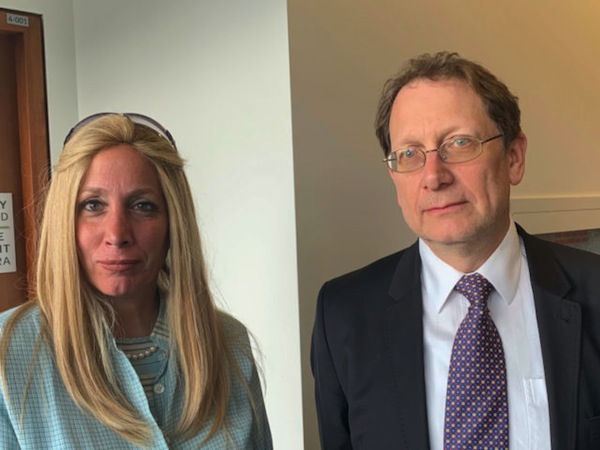
Conservative candidate Chani Aryeh-Bain, left, and activist Ira Walfish at Federal Court in Toronto on July 16. (photo by Ron Csillag/CJN)

Last month, Elections Canada announced that it will not recommend that the date of the next federal election be changed, despite pressure to do so because it clashes with the Jewish holiday of Shemini Atzeret.

Moving the date “is not in the public interest,” Chief Electoral Officer Stéphane Perrault said in a statement on July 29. Only a few days earlier, the Federal Court of Canada ordered Perrault to reconsider his earlier refusal to move the date of the election – Oct. 21 – after it heard from observant Jews who pointed out that they cannot drive, campaign or vote on a holy day.

Lawyers for Chani Aryeh-Bain, the Conservative candidate in the Toronto riding of Eglinton-Lawrence, and Ira Walfish, an activist and voter who lives in the York Centre riding, had argued before the court that Perrault’s refusal to move the date to Oct. 28 was unreasonable and that they, along with 75,000 other Orthodox Jews in Canada, faced discrimination under the Charter of Rights and Freedoms. The court gave Perrault a deadline of Aug. 1 to strike a balance between election laws and the rights of Orthodox Jews to vote and campaign. He was not empowered to move the date himself, but could recommend that cabinet do so.

However, “after having carefully considered the impact of holding the election on Oct. 21 on the ability of observant Jews to participate in the electoral process, and having balanced that with my mandate to ensure accessible voting opportunities for all Canadians, I conclude that it would not be advisable to change the date of the election at this late stage,” Perrault stated. It was “not a decision that I make lightly, but with a view to providing the broadest possible range of accessible voting services to the population at large.”

In a written statement to the CJN, Aryeh-Bain, who had argued that, as an observant candidate she was prevented from getting out the vote on election day, said she was “extremely disappointed” with Perrault’s decision.

“We do not believe he balanced the democratic and religious rights of Jewish voters and candidates,” she said. “He has 85 days to prepare for this election – almost triple the amount of time than he has to prepare for a snap election. Why Perrault has dug his heels in is mystifying to me.”

Perrault acknowledged that, in the case of Aryeh-Bain, the effect of not moving the election date “is very significant.” He conceded that “no arrangement can be made that would truly allow her to meet her religious obligations and compete on equal terms with non-observant candidates.”

At a press conference at B’nai Brith Canada’s offices on the day of the decision, Walfish said, “We are obviously very disappointed. We do not agree that the [chief electoral officer] balanced the relevant interests in his further decision to not move the election.”

Walfish said that Orthodox Jewish-Canadians “will not participate in this election on an equal footing with other Canadians, not by design or choice, but because their conscience prevents them from doing so.”

Aryeh-Bain and David Tordjman, an observant Conservative candidate in Montreal, “are both seriously disadvantaged with an election on Oct. 21,” said Walfish.

In an 11-page statement, Perrault referenced a detailed “action plan for observant Jewish community voting,” which was launched in April. The statement noted that the Orthodox Jewish population is primarily located in urban areas in 36 of the 338 federal ridings. It said that those ridings range from one to 13.4% Jewish, according to the 2016 census, “which makes it possible to design local solutions … to ensure that Elections Canada’s services are targeted and responsive to local needs.”

Perrault took note of the argument presented in court that the four days of advance polls, from Oct. 12-15, reduce the ability of religiously observant Jews to cast ballots because they coincide with Shabbat and Sukkot. However, Perrault pointed out that there are many days during the election period in which observant Jews can vote, including by mail-in ballot, at an Elections Canada kiosk, or at one of roughly 115 post-secondary campuses from Oct. 5-9.

Moving the election date “will not remove all of the barriers that Jewish electors face in voting this election cycle,” Perrault stated. And if the date were moved, “the new dates for the advanced polls will also overlap with Jewish holidays,” he said. “There is no such thing as a perfect election day, especially in a country as diverse as Canada.”

Michael Mostyn, B’nai Brith’s chief executive officer, said Perrault’s decision was “just as wrong” as his initial refusal to move the date. He said Perrault’s admission that observant candidates cannot compete equally with non-observant ones is “a red line” for B’nai Brith. But Elections Canada has “run out the clock” because of the Aug. 1 deadline for setting an election date, he noted.

Mostyn called on “every Canadian Jew who is capable of doing so [to] cast a ballot via advanced polls or special ballots” and on Jewish voters to ask candidates whether they support changes to elections laws, to ensure that voting does not fall on a Jewish holiday again.

The Centre for Israel and Jewish Affairs (CIJA), on the other hand, said it “respects” Perrault’s decision.

“While mindful of the inconvenience that some will experience and the clear disadvantages faced by a religiously observant candidate, we trust that those challenges can and will be mitigated by the measures put into place by Elections Canada,” said CIJA chief executive officer Shimon Koffler Fogel in a statement.

CIJA said it, too, will focus on changing election dates, which have been fixed since 2007, so they no longer clash with Jewish holidays.

Perrault said he is “committed to continuing to work with the Jewish community to maximize voting options within the existing calendar in ways that are convenient and consistent with their religious beliefs.”

– For more national Jewish news, visit cjnews.com

Format ImagePosted on August 23, 2019August 22, 2019Author Ron Csillag CJNCategories NationalTags Chani Aryeh-Bain, democracy, elections, Ira Walfish, Judaism, politics, voting

We are one people, one heart

As a teenager in the United States, I was in a public high school marching band. My parents worked to make sure our family was together for an early Friday night Shabbat dinner, even when football games were on Friday night. We did a careful balancing act of observance and negotiation. I wanted to play in the jazz ensemble – and I did – but, in order to do that, I also had to commit to marching band. Sometimes, during the High Holidays, it was a precarious compromise.

One week, there was a Friday night without a football game. My parents planned to have a “normal” Shabbat dinner and attend services as a family. My band director had us all in a line formation on the field. He asked if we could substitute a practice during that time. He said, if you had a conflict, to step out of line and explain.

In front of the whole marching band, I had to step out of line. I spoke as loudly as I could (just short of shouting) so that the director and his assistants could hear me in the stands. I said my parents expected me at Friday night dinner at home, and to attend services. I needed to go. This was a religious obligation I’d been skipping for band. In true teenage bluntness, I noted that he wasn’t proposing an alternate rehearsal on Sunday morning instead, was he?

There was silence, and the band director nodded and said, “Right, no rehearsal Friday night.” While I recovered, shaking, I was set upon by other band members. A couple of non-Jewish friends supported me and mentioned how brave I’d been. To my surprise, the few other Jewish members – all slightly less observant than my family – weren’t so kind. They were angry at me for being “too Jewish” and drawing attention to them, too.

This experience came to mind when I read the news last month. The Canadian federal election is scheduled for Oct. 21 and this date conflicts with Shemini Atzeret. An Orthodox Jewish candidate in Ontario, Chani Aryeh-Bain, and another Orthodox activist, Ira Walfish, brought up this concern a year ago – in August 2018. It was ignored.

The advance polling dates are also problematic because they fall on Shabbat and Sukkot. Yes, there are ways for observant Jews to vote, despite these scheduling conflicts. However, this schedule interferes with the Orthodox candidate’s ability to campaign, as well as affecting her entire community in Toronto’s Eglinton-Lawrence riding.

Shemini Atzeret is not a big deal observance for many of us, and one news article demonstrates this by proclaiming it is the “Orthodox” Jewish community that has an issue. However, I was first struck by this candidate’s bravery in confronting this issue. That admiration was reinforced by the thousands of comments at the bottom of the article.

Some would say these comments are downright antisemitic, but I saw the majority of them as ignorant. There were many who derided religion, commented specifically on Judaism, and even one believing Christian who bemoaned how Canada had become a heathen country. (Say what?!)

In some ways, we are lucky in Canada. Our children can go to public or private schools in which they can experience Jewish community, culture and religious practices. We can relish the rich diversity of our particular community, as well as maintain our citizenship on equal footing with other Canadians. However, this opportunity to isolate ourselves comes at a cost.

When we separate ourselves, we lose the opportunity for everyday interactions with non-Jewish Canadians. The informal education that comes from attending school, sports, work and social activities with all kinds of people is invaluable. While I found it a burden to be the token Jew in my school classroom, it gave me a great chance to educate myself and explain our holidays and our traditions. Most of my classmates and bandmates knew about Judaism because they knew me.

Many get upset about ignorance or intolerance. That’s understandable, but I was taught that basic education makes a big difference. When a church or organization asked for someone to speak about Passover or Chanukah or Jewish practice, my family stepped up. I was the kid explaining the seder to the Methodists, or the sole Jewish teenager who invited all her friends to Shabbat dinner each week. My parents had an open door policy and a lot of extra dessert for whomever came over on a Friday night.

We’re lucky to live in a country that celebrates diversity. However, we should offer educational outreach whenever it’s helpful, so that we can live in peace with our neighbours. We can explain why there are obstacles to voting or campaigning in the middle of the fall holiday season, and why this is an issue. Also, instead of forcing some of us to feel uncomfortable and “too Jewish,” we can embrace each other as “Am Echad,” “One People.”

Even though the election date will not change, the situation is a learning moment for us as Jews and Canadians.

Reggae may not be everyone’s cup of tea, but I end this as I began it, with music. If we’re truly one people, with “one love, one heart,’” we should love all of our Jewish community. We stand up for what we need both to practise Judaism and our voting rights, as each of us sees fit. In Bob Marley’s religious (but not Jewish) words, “Let’s get together, and feel all right.”

Joanne Seiff has written regularly for CBC Manitoba and various Jewish publications. She is the author of three books, including From the Outside In: Jewish Post Columns 2015-2016, a collection of essays available for digital download or as a paperback from Amazon. See more about her at joanneseiff.blogspot.com.


Posted on August 23, 2019August 22, 2019Author Joanne SeiffCategories Op-EdTags Chani Aryeh-Bain, diversity, elections, Ira Walfish, Judaism, politics, Toronto, voting

Israel is not a political toy

The U.S. president accused Representative Rashida Tlaib of a political stunt when the American politician of Palestinian descent rejected Israel’s offer of permission to visit the West Bank on humanitarian grounds.

Israel’s government had first announced that it would permit visits to Palestine by Tlaib and fellow congresswoman Ilhan Omar, another of the four members of the “squad” of progressive women of colour elected to Congress as Democrats in last November’s U.S. midterm elections. Then, apparently after Donald Trump intervened with his continued vendetta against the women, the government of Prime Minister Binyamin Netanyahu changed their minds and declared that the congresswomen would not be permitted to go to Palestine. Then, in another twist, Israel decided to allow Tlaib admission based on “humanitarian” grounds to visit her grandmother and other relatives in the West Bank. Tlaib rejected the offer.

“Silencing me & treating me like a criminal is not what she wants for me,” Tlaib tweeted about her grandmother. “It would kill a piece of me. I have decided that visiting my grandmother under these oppressive conditions stands against everything I believe in – fighting against racism, oppression & injustice.”

Putting ideology over seeing a nonagenarian grandparent seems a tad distorted, but she’s probably correct that Israel’s actions were over-the-top.

The idea that Israel should ban members of the United States Congress from entering the country (en route to the West Bank, which is occupied by Israeli forces, which means Israel controls who can enter and move around there) is a highly dubious move. Given Tlaib’s and Omar’s unrelenting condemnation of Israel and its policies, including support for the BDS movement, some people argued that Israel should ban them. But almost every mainstream Jewish and Zionist organization in the United States that spoke up argued that they should be permitted to go.

In fact, it would have been smart to invite the two as guests of the Israeli government and give them the VIP tour of Israel. Then, they would have at least have heard the Israeli side of the story, take it or leave it. More to the point, had they refused the invitation to see the modern miracle that is the Jewish state, they might have looked closed-minded.

Instead, the two Democrats have come out of it looking righteous, while Netanyahu looks like Trump’s puppet and Trump looks like, well, like he usually does. Especially when he tweeted that the only winner in the scenario is Tlaib’s grandmother because “She doesn’t have to see her now!” One wonders about what goes through the minds Trump’s grandchildren when he blusters into the room.

On the one hand, the recent vote in Congress to criticize the BDS movement was massively lopsided and indicates that Israel’s special relationship with the United States remains steadfast. But among grassroots Democratic voters and some other Americans, the Netanyahu-Trump bromance is repellent and makes some people naturally less amenable to the bilateral relationship – specifically because it has been so spectacularly and cynically politicized by both leaders.

There are serious and legitimate fears that the solid bipartisanship that has defined this relationship for 71 years is fraying, possibly irrevocably.

It doesn’t matter what one thinks of Trump. It doesn’t matter if you agree with the board member of the Republican Jewish Coalition who told the New York Times, “When I look at what he’s done for Israel, I’m not going to take issue with anything he’s said or done.” The day-to-day cut-and-thrust of politics means we will agree and disagree with our leaders in Canada, or those in the United States or Israel or elsewhere. But the deterioration of the nonpartisanship around the foundational importance of the bilateral relationship between Israel and its most significant ally is a grave concern.

We have an election campaign about to launch here in Canada. There will be moments when Middle East policy comes up and we will disagree. What we should strive to ensure is that, regardless of our opinions about Israel’s leader – and what position he may hold after next month’s Israeli elections – or our thoughts about our own political leaders, one thing we should avoid at all cost is turning Israel into a partisan tool. Let’s just not. And let’s not reward politicians who try.

Format ImagePosted on August 23, 2019August 22, 2019Author The Editorial BoardCategories From the JITags BDS, elections, Israel, Israeli-Palestinian conflict, Netanyahu, politics, Rashida Tlaib, Trump
Segal aims for Ottawa

Segal aims for Ottawa

Zach Segal will represent the Conservative party in the Oct. 21 federal election in the riding of Vancouver Granville. (photo from Zach Segal)

While Conservatives across Canada will spend the weeks leading up to the federal election reminding voters of Jody Wilson-Raybould’s excoriating of her former leader, Prime Minister Justin Trudeau, one Tory candidate will likely be downplaying the Vancouver MP’s star turn before a parliamentary committee.

In July, Zach Segal won the nomination to represent the Conservative party in the Oct. 21 federal election in the riding of Vancouver Granville. The incumbent, Wilson-Raybould, was elected there in 2015 and immediately was appointed minister of justice and the attorney general of Canada. In January of this year, she was shuffled to minister of veterans affairs and, less than a month later, resigned from cabinet.

Wilson-Raybould was thrown out of the Liberal caucus after testifying before the House of Commons justice committee about pressure she said she experienced from the prime minister’s office over an ongoing investigation into Quebec-based SNC-Lavalin, the largest construction company by revenue in Canada. The resulting scandal sent the governing Liberals tumbling in opinion polls, and they are now generally neck-and-neck with the Conservatives in most surveys. Wilson-Raybould is seeking reelection as an independent.

Segal said that a vote for the incumbent is a protest vote, but that a vote for him offers the chance to change the government.

“If you are upset with Justin Trudeau and you want to kick the Liberals out of Ottawa, the only way to do that is to vote for Andrew Scheer and, if you live in Vancouver Granville, to vote for Zach Segal,” he told the Independent.

The riding cuts a swath through the city, from the Fraser River almost to False Creek and roughly from West Boulevard to Cambie, also encompassing the area north of 41st Avenue west of Main Street and west of Ontario Street to 2nd Avenue. Almost all of the city’s Jewish communal organizations are located in the riding and many of the city’s Jewish residents live there.

Segal graduated from the University of British Columbia in 2011, with a major in political science and a minor in history. He went to Ottawa on an internship arranged through the Centre for Israel and Jewish Affairs.

“At the time, I was conservative-leaning, but I wasn’t partisan,” he said. “I was certainly conservative but I wasn’t affiliated like other young folks are at university.”

After the internship, Segal continued working with Manitoba Conservative MP James Bezan, who was parliamentary secretary to the minister of defence. He later became spokesperson for then-transport minister Lisa Raitt.

When the Conservatives lost the 2015 election, Segal opted to return to Vancouver. He got a job with the Canada Mortgage and Housing Corporation, which has a mandate to help Canadians access affordable housing options.

“I was very interested in housing but still interested in the government and policy world,” Segal said. “I wanted to learn more about housing so I thought a job at the Canada Mortgage and Housing Corporation would be a good opportunity because it was a Crown corporation – it wasn’t part of the federal public service, it was separate – so I thought that would be a good opportunity to get into the housing world and learn more.”

On leave since he announced his candidacy for the nomination in the spring, Segal is part of the CMHC marketing team, publicizing programs and opportunities for nonprofits, the private sector, developers and others, such as low-interest loans.

Faced with a splintered group of candidates in what will probably be one of the most closely watched races in the country, Segal is confident he can win.

“I really think I can actually win and I think that’s the most important thing,” he said, adding that the agenda in the city has largely been dominated by the left.

“I want to show that maybe we have some conservative solutions to some of these big problems that Vancouver is facing,” he said. “My big issues are all packaged into one. I think they all go together. I think everyone’s very interested in housing, in transportation, affordability and the economy. If we can solve transportation infrastructure, maybe it could help reduce pressure on housing because we could build further out and, if we could grow our economy and have better opportunities, people here could make more money and that would solve some of the issues around affordability. Certainly housing, I think we need to look at different ways of solving this, rather than the current proposals. Vancouver’s average wages are some of the lowest in Canada but we have some of the highest average home prices in Canada. I think that’s where one of the problems lies. We need to start looking at how we can grow our whole economy, and Vancouver subsequently, with better jobs and higher wages.”

He said his four years in Ottawa equip him to be an effective MP.

“A lot of people have this idea that, if you’re on the backbench, you can’t do anything, but the MP I worked for was so diligent and committed to issues that he was able to bring them to the floor of the House of Commons,” said Segal. “He was constantly tabling motions, private member’s bills, he was constantly getting his foot in the door of the prime minister’s office and he made sure that, even though he was a backbencher, he got all these prominent issues to the forefront of public policy. That was very inspiring. It’s a good message that you can accomplish things as a member of Parliament.”

As a Jewish candidate, Segal has been hearing from voters that they respected former prime minister Stephen Harper’s approach to Israel.

“Jews and non-Jews alike tell me that they deeply respected how Stephen Harper and the Conservative government stood up for Israel on the world stage,” he said. “They just liked seeing a politician stand on principle and not be bullied and stand up – quite frankly – stand up to the world, stand up to the UN. People really liked seeing that and I think they like leaders who show their true colours, and want to see that back in Ottawa.”

Segal, who attended Richmond Jewish Day School and graduated from Steveston High, went to Israel on a Birthright trip in 2008.

“You always know Israel is small but, until you’re there and you travel the country in a short period of time, you don’t realize how small it is,” he said. “When people talk about Israel’s security concerns, it’s not just a platitude. It’s a tiny country. When you visit Israel, you take tours of the Golan Heights. You can see Hezbollah outposts. Now, if you are there, you can see maybe even ISIS outposts in Syria. It’s this remarkable, tiny country, this outpost of vibrancy and Western democracy that somehow is bordering some of the most extreme elements of the world right there on its border and you really appreciate its security concerns being there.”

Back on local doorsteps, Segal said voters are asking whether they can trust their leaders.

“They see Justin Trudeau taking care of his friends. He had this big gift to Loblaws for retrofitting some fridges and they’re taking care of Irving and SNC, but, if you’re a small business owner, you’re left to fend for yourself,” said Segal.

In addition to Segal and Wilson-Raybould, Vancouver Granville voters will consider the Liberal candidate, tech entrepreneur and investor Teleeb Noormohamed, the NDP’s Yvonne Hanson, a climate activist, and Green candidate Louise Boutin, a realtor. The fledgling People’s Party of Canada has nominated Naomi Chocyk, who, at one point, was employed as a constituency assistant in Wilson-Raybould’s office. More candidates could enter the race before the close of the writ period.

Format ImagePosted on August 23, 2019August 22, 2019Author Pat JohnsonCategories LocalTags Canada, Conservative Party, elections, Vancouver Granville, Zach Segal

Historic next election

For the first time in its history, Israel will go to the polls because the Knesset Israelis elected in April could not form a government.

Prime Minister Binyamin Netanyahu crowed after the election results came in that his Likud had defied critics and won a comparatively easy reelection. The number of small right-wing parties in the Knesset made it impossible for the opposition Blue and White bloc to assemble the 61 seats needed for a bare minimum majority coalition, leaving Netanyahu a free hand to form another government. Or so it seemed to everyone.

But there’s right-wing and then there’s right-wing. As in any country, a range of issues and interests combine to make up political parties and movements. While they may be in sync on a whole range of economic, social, internal and foreign policy issues, the one thing that unified Likud and its ostensible allies among the smaller right-wing parties was animosity toward the left, which Netanyahu demonized during the campaign – even accusing the veteran military figures who lead Blue and White of being too far left. The leftist bogeyman Netanyahu was conjuring is, at this point in Israeli history, largely fictitious. The Labour party, once the dominant force in the country, suffered its worst showing ever, finishing with less than 5% of the vote.

What divides the right-wing parties are a few issues of core principle. The ultra-Orthodox parties are right-wing and prefer Netanyahu as prime minister. But they want special considerations for religious institutions maintained and strengthened. Nationalist parties, like Avigdor Lieberman’s Yisrael Beiteinu party, are right-wing, but secular, and Lieberman would not budge on his assertion that there should be no compromise on a new law – promulgated under his watch as Netanyahu’s minister of defence – that yeshivah men not be automatically excused from conscription. The five seats Lieberman’s party won in April were the lynchpin for a fifth Netanyahu government – and the notoriously combustible Lieberman ultimately kiboshed the government and the 21st Knesset.

Some commentators suggest principle was less a factor in Lieberman’s choice than personal pique. The two men were once the closest of allies – and nothing is more bitter than a family fight. A number of policy issues have frayed the relationship. For example, as defence minister, Lieberman publicly excoriated his boss for what he characterized as letting Hamas off the hook too easily in the most recent flare-up of cross-border violence from Gaza. Lieberman, it appears, would have preferred a far more punishing response, though he has a history of making dire threats on which he does not follow up. He once brazenly gave Hamas leader Ismail Haniyeh 48 hours to live if he did not return an Israeli hostage and the bodies of dead Israeli soldiers. The gambit failed. The millionaire Haniyah remains very much alive, luxuriating in a waterfront palace he built with a 20% tax on all goods traveling through the tunnels between Egypt and Gaza. Lieberman meanwhile continues with similar bellicosity to stoke his base, primarily older Israelis with roots in the Soviet Union.

Whether Lieberman’s dashing of Netanyahu’s plans was an ego issue or a strategy to improve his party’s weak showing in April, or whether it was, in fact, a matter of principle, doesn’t matter much now that new elections have been slated for September.

Most of Israel’s 2019 will have been eaten up by election campaigns and, unless the electorate has a swift change of heart – or the criminal charges hanging over Netanyahu’s head shift the discourse – the results in September may be very similar to those of April. Then what?

Ehud Barak, a former prime minister who has been both ally and opponent to Netanyahu, posited last week that, whatever the outcome in September, Netanyahu is finished. While there are anonymous sources inside Likud suggesting the leader may be ousted after the next election, the fact is that Netanyahu’s career has been declared dead several times before, but he has defied prognosticators and triumphed. Not for nothing is his nickname “the Magician.”

Posted on June 7, 2019June 5, 2019Author The Editorial BoardCategories IsraelTags Avigdor Lieberman, Binyamin Netanyahu, democracy, elections, Israel, politics

Harbingers of future?

In 2015, the federal New Democratic Party nixed Paul Manly’s hopes to run for Parliament, barring his candidacy because his anti-Israel politics were deemed too extreme. Manly joined the Green party and, this month, won a federal by-election in Nanaimo-Ladysmith. As only the second Green federally elected, Manly now makes up 50% of the federal Green party caucus.

By-elections are notoriously poor predictors of voter intentions in general elections. Manly’s win could go down as a footnote in history – or it could be a harbinger of tectonic change in Canadian politics. Little should be extrapolated from a single by-election outcome, but neither should we ignore the fact that the by-election win by Deborah Grey of the Reform Party, in 1989, represented the beginning of a new epoch in Canadian politics. The Reform party in the West and the Bloc Québecois in Québec gobbled up the Progressive Conservative party – and the New Democrats’ share of the vote.

Just days before the Nanaimo by-election, the Green party also made inroads in the Prince Edward Island provincial election, forming the official opposition. Just as a by-election is not a good measure of federal voters’ intentions, neither is a modest success in the micro-province of P.E.I. What both these outcomes do suggest is that a larger number of Canadians than ever before are considering casting a ballot for the Greens.

The outcome in Nanaimo-Ladysmith should send chills down the spines of Liberal and NDP organizers. Both parties saw their vote share collapse while the Greens leapfrogged and the Conservatives held their own.

Conventional wisdom says that the Green party should take more votes away from the NDP than from any other party. However, many 2015 Liberal voters are over their Trudeaumania and millions of Canadians are looking for a place to park their votes. The party would get a significant boost if Jody Wilson-Raybould and Jane Philpott, two women who embody the country’s disappointment in Prime Minister Justin Trudeau and his sunny ways, opt to run under the Green banner, as has been rumoured.

Jagmeet Singh, who managed to win his own by-election last year, can hardly find any silver lining in recent results. With the Liberals, who arguably ran to the left of the NDP last time, hemorrhaging support, the NDP should be sitting pretty. They are not.

Six months out from the general election, Conservative leader Andrew Scheer is the only party leader who should be pleased with the current landscape.

What this all means is not completely clear. Under Thomas Mulcair’s leadership, the NDP was dragged back to a more moderate middle after a period when it had seemed to go a bit off the rails, notably on the issue of Israel and Palestine. How the party addresses that and other contentious issues in the coming years will be determined significantly by the makeup of their caucus after the October elections. It was after their last terrible drubbing, in 1993, that the NDP fell under the sway of anti-Israel extremists. With just nine seats in parliament, and Svend Robinson as the most vocal and visible MP, the party became a hotbed of anti-Zionist activism. (Robinson is seeking a comeback in the riding of Burnaby North-Seymour.)

Under Mulcair’s leadership, a number of former New Democrats, like Manly, shifted over to the Green party. Elizabeth May, the party leader, and, until this month its only MP, doesn’t seem certain of where she stands on the issue. When her party’s convention passed a wildly unbalanced attack on Israel, she threatened to resign unless it was rescinded or watered down. Since then, she herself has made some contentious comments about Israel.

In the NDP and in the Green party, there are a small number of courageous Jewish and non-Jewish Zionists trying to lead their parties to a common-sense position on Middle East matters. Too often, these individuals are ridiculed in our own community when they should be commended for promoting a balanced, reasonable approach to the issue regardless of political persuasion.

Nevertheless, given the emerging landscape, if the Greens and New Democrats do not form some kind of electoral alliance – and if the Liberals do not pull themselves out of their largely self-inflicted pit of unpopularity – Canada is likely to be in for a long run of Conservative government. In that case, the nuance of Israel-Palestine policy on the left will be a moot point.

Posted on May 17, 2019May 16, 2019Author The Editorial BoardCategories From the JITags Canada, elections, politics
קנדה נאבקת בענקיות התקשורת

קנדה נאבקת בענקיות התקשורת

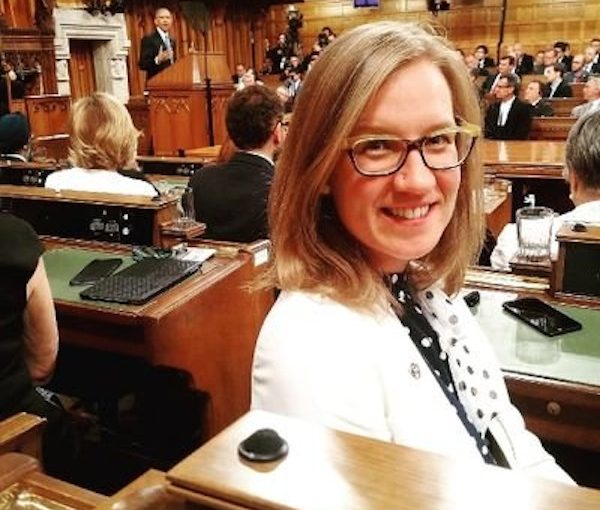
השרה קרינה גולד. (Twitter)

ממשלת קנדה מתכוננת במלוא המרץ לבחירות הכלליות שייערכו בחודש אוקטובר הקרוב. הממשלה מעוניינת למנוע מעורבות חיצונית כפי שקרתה במערכת הבחירות האחרונות בארה”ב. הממשלה בוחנת את האפשרויות שונות בהן: חקיקה חדשה שתחזק את הפיקוח על הרשתות החברתיות המובילות.

הממשלה הקנדית צופה שקרוב לוודאי יהיה ניסיון של התערבות חיצונית בבחירות הפדרליות שייערכו באוקטובר. ולכן היא שוקלת להגביר את הרגולציה כדי לפקח משמעותית על חברות הרשתות החברתיות. זאת כדי להבטיח חסימה עד כמה שאפשר של התערבות גורמים זרים שמחוץ למדינה, בהליך הצבעה. כך מסרה לאחרונה השרה אחראית על טוהר הבחירות של קנדה, קרינה גולד.

השרה גולד אמרה את הדברים לאחר פרסום דוח מיוחד של סוכנויות ביטחון הקנדיות השונות על פעילות של מדינות אחרות, ברשתות אינטרנט, כדי להתערב בהליך הבחירות במדינה. “להערכתנו יש סיכוי גבוה שהמצביע הקנדי ייתקל במעורבות של גורמים זרים שונים ברשתות האינטרנט, בהקשר של הבחירות הפדרליות באוקטובר השנה”, כך נכתב בדוח של סוכנויות הביטחון. “עם זאת המעורבות בבחירות כאן צפויה להיות בהיקף קטן יותר, לעומת המעורבות הרוסית בבחירות לנשיאות בארצות הברית לפני כשנתיים וחצי”. אגב הדוח לא ציין מי הן המדינות שעשויות לנסות ולהתערב בבחירות של קנדה.

השרה גולד ציינה במסיבת עיתונאים שקיימה באוטווה הבירה: “הבחירות בקנדה הן מטרה לאלו שמעוניינים לערער את יסודות הדמוקרטיה שלנו”. גולד יצאה בדברי ביקורת ישירים נגד ענקי התקשורת השולטים במדיה החברתית: גוגל, טוויטר ופייסבוק. וזאת על כך שהם לא מספקים מידע לממשלת קנדה, כפי שהם סיפקו לממשלות אירופה השונות בחודשים הארונים, על מאמציהם לעצור התערבות זרה בבחירות. “אין לנו שום התקדמות עם גוגל, טוויטר ופייסבוק בנושא זה. החברות מסרבות לעדכן באופן סדיר את הרגולטורים בקנדה, על הפעילות שלהן למניעת התערבות זרה בבחירות הקרובות. שיהיה ברור: החברות צריכות לקחת את הנושא ביותר רצינות”, הוסיפה עוד השרה גולד.

ראש מחלקת המדיניות הציבורית של פייסבוק בקנדה, קווין צ’אם, אמר לאמצעי תקשורת המקומית את הדברים הבאים: “פייסבוק מתכננת להציג חוקים חדשים עבור פרסומות פוליטיות בתשלום”. הוא הדגיש כי פייסבוק עושה כל מאמץ לחסום התערבות זרה בבחירות הקרובות בקנדה. ראש מחלקת המדיניות הממשלתית של גוגל בקנדה, קולין מקיי, אמר את הדברים הבאים: “נציגי גוגל מיוזמתם נפגשו כבר מספר פעמים עם מספר רשויות ממשלתיות כדי לדון בשקיפות, אבטחת מידע וכן אבטחת סייבר”.

השרה גולד מסרה עוד כי ממשלת קנדה בוחנת כיום את שלל החוקים שלה כדי לראות כיצד ניתן להשתמש בהם, כדי לנקוט בכל האמצעים נגד חברות הרשתות החברתיות, כדי למנוע התערבות זרה בבחירות כאן. הממשלה שוקלת אף להתקין חקיקה חדשה בנושא. בנוסף קנדה בוחנת את הצעדים שנוקטות מדינות אחרות בעולם כלפי הרשתות החברתיות. למשל בריטניה שהכריזה על הקמת גוף רגולטורי טשר מפקח על הרשתות החברתיות. ואילו אוסטרליה עומת זאת שינתה את החוקים במדינה כך שבין היתר, מנהלים של רשתות חברתיות עשויים להישלח לכלא, אם הם לא יסירו תוכן אלים מהרשתות החברתיות עליהם הם אחראים.

לסיכום הנושא אמרה השרה הקנדית גולד: “הרשתות החברתיות הצליחו עד כה להימנע מלשאת באחריות לגבי מה שמתרחש בפלטפורמות שלהם. זאת כידוע כבר זמן רב מדי. הממשלה הליברלית הקנדית החליטה כעת לשנות את הגישה כלפי חברות הרשתות החברתיות. בעבר חזרנו אחריהן ומשכנו אותן לכאן כדי לפתוח מרכזי הנדסה ומסחר, ובייחוד בתחום הבינה המלאכותית”.

Format ImagePosted on May 8, 2019May 1, 2019Author Roni RachmaniCategories עניין בחדשותTags Canada, democracy, elections, Facebook, Google, Karina Gould, Twitter, בחירות, גוגל, דמוקרטיה, טוויטר, פייסבוק, קנדה, קרינה גולד
קנדה תמשיך לתמוך בפתרון שתי המדינות

קנדה תמשיך לתמוך בפתרון שתי המדינות

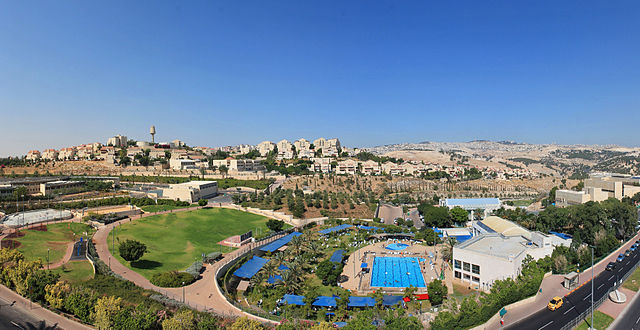
מעלה אדומים, ישראל (David Mosberg)

“עמדתה של קנדה נותרה ללא שינוי ואנו נמשיך לתמוך בפתרון של שתי המדינות במזרח התיכון”. כך אמר בפרלמנט, ראש ממשלת קנדה, ג’סטין טרודו. דבריו נאמרו על רקע תוצאות הבחירות בישראל, שעל פי הן שוב נבחר לרשות הממשלה, בנימין נתניהו. ראש ממשלת ישראל החדש-ישן הודיע ערב הבחירות, כדי לרכוש לעצמו עוד קולות מהימין, כי ממשלתו החדשה תכריז של סיפוח שטחים באזורי יהודה ושומרון. נתניהו אמר: “אנו דנים בהחלת הריבונות על מעלה אדומים וגם בדברים אחרים. לאחר ההכרה האמריקנית בריבונות ישראל ברמת הגולן, קיימים גם דיונים על סיפוח אזורים ביהודה ושומרון. אני הולך להכיל ריבונות אבל אני לא מבדיל בין גושי ההתיישבות לנקודות היישוב הבודדות. כל נקודת ישוב כזאת היא ישראלית ויש לנו אחריות כממשלת ישראל. כל אחד מבין שהקדנציה הבאה שלנו תהיה גורלית לשני הכיוונים – האם נוכל להבטיח את הביטחון שלנו ועל השטח החיוני של יהודה ושומרון שהוא פי עשרים גדול מעזה”.

לאור תוצאות הבחירות בישראל שאל חבר הפרלמנט הקנדי מטעם המפלגה הדמוקרטית החדשה, גיא קארון, את ראש הממשלה טרודו: “בינימין נתניהו ימשיך בתפקידו כראש הממשלה. בהבטחה של הרגע האחרון הוא הודיע כי יספח התנחלויות בגדה המערבית. אם ממשלת ישראל תעמוד בהבטחתה זו, עשויות להיות לכך משמעויות חמורות על היציבות באזור. עמדתה של קנדה עד היום היתה ברורה שאין ההתנחלויות חוקיות. ומועצת הביטחון של האומות המאוחדות מסכימה עם כך. האם ראש הממשלה יאשר כי קנדה תתייחס לסיפוחם של שטחים אלה כבלתי חוקיים ותפעל בהתאם בנושא?”

טרודו אמר בתגובה לשאלתו של קראון: “עמדתנו נותרה ללא שינוי. אנו תומכים בפתרון שתי המדינות ישראל לצד פלסטין במזרח התיכון. הפתרון הזה אמור להיות מושג באמצעות משא ומתן בין שני הצדדים. פעולות חד צדדיות כגון התנחלויות, אינן לגטימיות ואינן מסייעות בפתרון המצב במזרח התיכון”.

פרופסור קורן שהסתבך בקנדה קיבל תפקיד בכיר בקופת מכבי

פרופסורר גידי קורן, שניהל מעבדה לגילוי שימוש בסמים ובאלכוהול בבית החולים “סיק קידס” בטורונטו והסתבך, מונה לתפקיד מדען בכיר במכון המחקר של קופת החולים “מכבי”. יש שלא מבינים מדוע.

פרופסור קורן נחשב למומחה בעל שם עולמי בפרמקולוגיה, אך הוא הסתבך בפרשייה שהסעירה את קנדה, והובילה לבחינה מחודשת של כמה ממחקריו. וכן לוויתור על רישיון הרפואה שלו במחוז אונטריו. קורן החליט להסביר ראשונה את גרסתו למקרים החמורים ששמו נקשר בהם.

הפרופסור הפך לאחד החוקרים הבולטים בתחום בדיקת שיער לגילוי שימוש בסמים או באלכוהול. הוא הקים את מעבדת “מאת’ריסק” בבית החולים, שהייתה היחידה שהשתמשה בטכניקה הזו. שׁירותי הרווחה הקנדיים נעזרו בבדיקות שלה במשך כמעט שלושה עשורים. שנים עברו עד שוועדות חקירה קבעו כי ערכות הבדיקה שבהן השתמשו במעבדה היו לא תקינות. באותה עת בתי המשפט הסתמכו על הבדיקות שאמורות היו לספק מידע ראשוני – כקביעה חד-משמעית, על מנת להפריד ילדים ממשפחותיהם.

קורן טוען להגנתו: “הבדיקות שעשינו במעבדה לא גרמו לאף ילד לעזוב את ביתו. התפקיד שלי היה לבדוק שהילדים האלה נמצאים באזור בטוח. זאת הייתה מטרת העבודה. יש טעויות בכל מערכת והטיעון שילדים הורחקו מבתיהם זו עלילת דם. בישראל התחילו אותה קבוצה מאוד שמאלנית של רופאים לזכויות אזרח. ובעקבות כך הגשתי קובלנה פלילית. בית המשפט שעסק בסוגיה מצא בין השאר שבשום מקרה לא קרה שילד ניזוק מבדיקה זו או אחרת”.

Format ImagePosted on April 24, 2019April 14, 2019Author Roni RachmaniCategories עניין בחדשותTags "מאת'ריסק", Canada, elections, Gideon Koren, Hospital for Sick Children, Israel, Maccabi Healthcare Services, Middle East, Motherisk, Netanyahu, Trudeau, two-state solution, בחירות, בית החולים "סיק קידס", בנימין נתניהו, ג'סטין טרודו, גידי קורן, מזרח התיכון, פתרון שתי המדינות, קופת החולים "מכבי", קנדה

Strongmen bromance

Binyamin Netanyahu appears comfortably ensconced in the Israeli prime minister’s office after last week’s elections. While his Likud bloc effectively tied for seats with the upstart Blue and White party, the smattering of smaller parties are mostly of the nationalist, religious and right-wing bent, meaning Netanyahu will have a fifth term as leader. If he hangs on until July, he will surpass David Ben-Gurion as Israel’s longest-serving prime minister.

The likelihood that he will reach that mark seems good. He faces probable criminal charges but that does not necessarily mean the end of his career. Rumours are rife that he is considering a legal escape hatch that would permit him to remain in office even if indicted or, more likely, make it illegal to indict a sitting prime minister. In most democracies, at most times in recent history, such a move would be seen as intolerably corrupt. Times change.

The leaders of democracies today are blazing new trails. The words and actions of the U.S. president confound our capacity for incredulity. Jaw-dropping statements of contempt, bigotry, juvenile pique and lies emanate from his mouth (and Twitter fingers) faster than the outrage can follow. Across Europe, far-right extremist parties are rising, as they did in elections in Finland on the weekend. In Britain, which is convulsing from self-induced Brexit trauma, the leftist Labour party is engulfed in an antisemitism crisis. Positions and statements that would have been unthinkable in the civil discourse of recent decades are suddenly at the centre of public discourse in democracies everywhere.

Israel is no exception. During the recent election campaign, candidates expressed erstwhile unspeakable ideas, including a scheme to ethnically cleanse the West Bank of Arabs and annex the land to Israel. The advocate of that idea was soundly defeated – the Knesset democratically cleansed of his ideology when the party failed to reach the 3.25% minimum vote to enter parliament.

But Netanyahu himself floated some astonishing trial balloons during the campaign. He mooted annexing West Bank settlement blocs into Israel – a concept that is not ludicrously beyond the pale since, if a negotiated settlement ever emerges, it will likely include such a move in exchange for traded land. But he also suggested annexing settlements that are not adjacent to or contiguous with Israel’s recognized boundaries. Such an idea would create a patchwork in the West Bank along the lines that would make an independent Palestine unworkable. The fact that the incumbent prime minister opened this political Pandora’s box is evidence of a new willingness to play with potential fire.

That foot play with extremists is not limited to domestic affairs. If an Israeli Rip Van Winkle fell asleep a couple of decades ago and woke up to Israel’s current diplomatic situation, he would be confused and possibly delighted. If that Van Winkle shared our worldview – an apparently old-fashioned belief in pluralistic, inclusive, universal humanitarian values – he would quickly conclude that the prima facie bonanza of goodwill has a rotting core.

As former Israeli ambassador to the United Nations Ron Prosor said Sunday night (see cover story), Israel has open lines of communication with countries that for decades steadfastly rejected its very existence. Likewise, Israel has excellent relations with some of the most populous and powerful countries in the world – India, China, Russia, Brazil and, in different but important ways, a refreshed, familial relationship with the current U.S. administration.

Israel has superb relations with these countries, and with the Philippines, as well as with Hungary and other eastern European states that have traditionally been problematic for the Jewish state. That seemingly good news is tempered by the fact that these good relations are not based on conventional diplomatic alliances. To a large extent – especially in the cases of Hungary, the Philippines, Brazil, Russia and the reinvigorated bonhomie between the leaders of Israel and the United States – these close relations are based on a shared strain of politics that fill us with more nervousness than naches.

These relationships are less between Israel and Brazil or the Philippines or Hungary or Russia than a bromance between Netanyahu and Jair Bolsonaro, Rodrigo Duterte, Viktor Orban and Vladimir Putin, to say nothing of the continuing lovefest between Bibi and Donald Trump. Each of these figures is a strongman who is, to varying degrees, pushing the limits of their democracies to see how far they can stretch rule of law and diminish respect for human rights. With this in mind, the diplomatic warmth seems less about traditional bilateral relations than about a fraternity of nationalist, populist and authoritarian men leading the world down a path unimagined a decade ago.

With that background, Israel’s unprecedentedly improved relations with so many countries seems less positive a development. Our proverbial sleeper might pull the covers back over his head and hope for better in the decades to come.

Posted on April 19, 2019April 17, 2019Author The Editorial BoardCategories From the JITags Binyamin Netanyahu, democracy, elections, human rights, Israel, politics
Mayor debate all over map

Mayor debate all over map

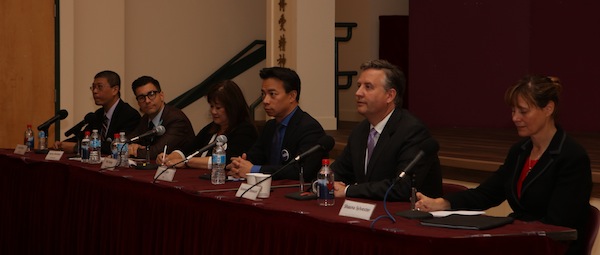
A full house came out to the CIJA-SUCCESS townhall Sept. 23, which featured six Vancouver mayoral candidates. (photo from CIJA)

The refracted nature of Vancouver’s civic politics was on full display at a candidates meeting featuring six of the perceived front-running candidates for mayor. The near-implosion of the governing Vision Vancouver party, combined with divisions among erstwhile Non-Partisan Association members, has led to a race with both the left and right sides of the political spectrum divided and struggling to gain traction in a campaign with 21 contenders.

The afternoon event Sept. 23 was co-sponsored by the Centre for Israel and Jewish Affairs and the multicultural organization SUCCESS, which is rooted in the Chinese-Canadian community. Veteran Vancouver broadcaster Jody Vance handily moderated the occasionally raucous meeting.

Housing affordability topped the list of issues, with Kennedy Stewart, a former NDP member of Parliament for Burnaby-South who resigned that seat to run for Vancouver mayor as an independent, said his plan to attack unaffordability calls for building 85,000 new homes over the next 10 years, including affordable and market rentals.

Ken Sim, an entrepreneur who founded Nurse Next Door and Rosemary Rocksalt Bagels and who is the candidate for the centre-right Non-Partisan Association (NPA), responded by claiming that the construction industry does not have the capacity to meet Stewart’s construction schedule.

Wai Young, a former Conservative member of Parliament for Vancouver South, is running with a new party, called Coalition Vancouver, which was originated by a group of former NPA members who felt betrayed by what they call a lack of democracy in that party.

“Vancouver does not have a supply issue,” Young said about the housing situation. “There are no millionaires wandering around Vancouver that are unable to buy a house or a luxury condo. The issue is that we are not able to keep our young people, our young families, here because they can’t afford to buy a house. We have an affordability issue in Vancouver.”

“If I am mayor, we will have a three percent vacancy rate,” said Shawna Sylvester, who is running as an independent but has roots in Vision Vancouver. The rate today is about zero. She supports more co-ops, cohousing and what she called “gentle densification,” as well as addressing how the housing situation has particular impacts for women, who experience poverty in greater proportions than men.

photo - Left to right are David Chen, Hector Bremner, Wai Young, Ken Sim, Kennedy Stewart and Shauna Sylvester
Left to right are David Chen, Hector Bremner, Wai Young, Ken Sim, Kennedy Stewart and Shauna Sylvester. (photo from CIJA)

Partly related to the affordability issue is the topic of Vancouver’s reputation as a place that is welcoming of people from diverse backgrounds.

David Chen, who is running with another new party, ProVancouver, noted that racism is alive and well in the city.

“My parents were first-generation Taiwanese [Canadian],” said Chen. “I was born in St. Paul’s [Hospital] because, at that time, it was the only hospital they were allowed to go to. During this campaign, I heard somebody say to me, ‘Go home.’ Well, I am home.” He added: “We haven’t progressed as much as we should or could.”

The NPA’s Sim echoed the experience and extrapolated it to the Jewish community.

“I’m 47 right now,” said Sim, “and I still remember the hurtful comments that I faced when I was 5 years old. It was tough. I think of what’s going on to our Jewish community right now. We still have a lot of issues. I’m acutely aware of what our Jewish community goes through because, when something happens halfway around the world, our friends in the Jewish community have to worry about their physical safety. That’s terrible. We will have zero tolerance for that, as mayor of Vancouver. We’re going to work with community groups, work with the Jewish community, work with all communities identifying threats to our communities and working on solutions to protect us, to protect our communities, and we will monitor our results.”

Hector Bremner, another former NPA member now leading another new party, YES Vancouver, is the only candidate for mayor currently sitting on Vancouver city council.

“Racism is a symptom, it’s not the disease,” Bremner said. “When do racial tensions flare up, when do they happen? They happen in a time when the people feel that resources are scarce and they feel pressure economically. It’s really a function of tribalism and nativism that occurs when people feel that it’s hard for them to make it. We look for scapegoats.”

Sylvester, who among many other roles is director of the Morris J. Wosk Centre for Dialogue at Simon Fraser University, said people need to stand up to extremist voices and actions.

“There are forces in our communities, whether we want to acknowledge them or not, that are trying to divide us,” she said. “What we need to do [is] not be tolerant of any kind of hate crime, not be tolerant of antisemitism.”

Stewart said those who don’t subscribe to Canadian ideas of tolerance should be helped to change their minds.

“Immigration is really one of the best things about being Canadian,” he said. “We travel around the world and we brag about it. Multiculturalism is a Canadian word and it’s something we’ve exported. It’s something we should embrace, and most of us do. Those that don’t, we have to help them understand, change their opinions.”

Accusations of intolerance and implications of racism emerged in the debate.

Young, who had originally sought the NPA mayoral nomination, implied that her supporters, many of whom were from the Chinese community, weren’t welcome in the NPA. This brought a sharp rebuke from Sim.

“Guess what, I’m Chinese,” he said. “Here’s the real issue. When you [say] inflammatory statements like that to win a political agenda, you create divisions in our communities. People don’t like that. You put a wedge. That is a problem and you’ve got to knock it off.”

Sim went on to accuse politicians of stoking already existing embers of intolerance around foreign purchasers of Vancouver real estate.

“For political expediency, what politicians are doing is pointing at groups and blaming groups for problems,” he said. “We have a lot of issues with affordability and there are a lot of things that affect affordability and housing. I’m not saying foreign purchases do not affect housing. But, when we point to it and we blame a group, that starts a slippery slope. That’s what’s dividing our city, our province and our country. I call on everyone here to knock it off, because there are a lot of things that affect affordability – permitting delays, interest rates, the economy – but to point to something for political expediency because it wins votes is dividing people and it’s hurtful.”

The meeting took place in a SUCCESS building in Chinatown, close to the Downtown Eastside. Candidates agreed that more needs to be done to confront the seemingly intractable challenges facing that area of the city.

Young said she had visited a seniors home in Chinatown earlier in the day and was told residents are afraid to go outside.

“They can no longer walk outside of their building,” she said. “That should not happen in our beautiful city. There was a time I remember coming down here to Chinatown when it was vibrant, when it was safe, when you didn’t feel like you couldn’t be on the wrong side of the street here.… This city has gotten dirtier and grittier…. There are needles everywhere, there is defecation everywhere. We are one of the top 10 cities in the world and yet, currently, it’s embarrassing to have your friends come visit.”

She promised to be “John Horgan’s worst enemy,” referring to the B.C. premier, in demanding provincial help to address the issues in the area.

Stewart touted his connections with former NDP member of Parliament Libby Davies, who previously represented the area in Ottawa.

“Last week, I was very proud to stand with Libby Davies in the Downtown Eastside and announce that, as mayor, I would immediately strike an emergency task force to deal with the opioid epidemic and homelessness,” Stewart said. “We cannot have the number of deaths that are happening and the number of overdoses. We can’t have the impacts on the people that are suffering through illness and addiction problems.”

Another perennial issue candidates addressed was transportation and congestion.

“Vancouverites spend 88 hours of your life every year sitting in congestion,” said Young. “That’s like a two-week holiday.”

Sim promised an independent review of congestion in the city.

“The number of cars has not increased in the city in the last 20 years but congestion has,” he said. He blamed a range of factors, including bike lanes, left-hand turns, people running yellow lights and getting stopped by police, pedestrians crossing after the indicator says “don’t walk,” and roads that are closed for construction longer than necessary.

Chen said getting people to switch from cars to transit requires improving the system.

“If you use negative reinforcement, you’re not going to get people to switch,” he said. “It’s not reliable, it’s not convenient, it’s not cheaper, it’s not faster. You [improve] those four items and suddenly people may just switch.”

The would-be mayors mooted the availability of culturally appropriate services, such as seniors care, community security for institutions like synagogues and the Jewish Community Centre of Greater Vancouver, and unisex washrooms.

During the debate, Stewart repeatedly emphasized that he, Bremner and Young were the only ones with elective experience, a tack that may be motivated by the few polls on the race, which have indicated that Stewart’s toughest opponent is Sim.

Format ImagePosted on October 12, 2018October 9, 2018Author Pat JohnsonCategories LocalTags CIJA, CJPAC, elections, politics, Vancouver

Posts pagination

Previous page Page 1 … Page 6 Page 7 Page 8 … Page 10 Next page
Proudly powered by WordPress