Campaign wraps up

“We’re making our final push toward another record-breaking campaign,” Jonathon Leipsic, chair of Jewish Federation of Greater Vancouver’s annual campaign, said when the Independent caught up with him last month, as the 2019 fundraising drive was entering the home stretch.

The campaign’s goals for the year are “to continue to grow to meet the ongoing needs around security, education, affordability and beyond.” The distinguishing message of the 2019 campaign, when it kicked off on Sept. 1, was to amplify the impact of donors’ giving and to “create a ripple effect.”

That amplification can be seen on several fronts, such as affordable housing, the most pressing concern of Lower Mainland residents. In 2007, long before real estate prices reached the levels of the late 2010s, Jewish Federation helped establish the Tikva Housing Society. Tikva serves all those who have been impacted by the high costs of rent – families, young individuals and seniors. The society now manages 98 affordable housing units, 37 of which came about in late September through a joint project with the YWCA – awarded by the City of Vancouver – for rentals at the new Arbutus Centre at 4188 Yew St.

Jewish Federation’s work encompasses all phases of a person’s life by providing community planning expertise, developing partnerships and raising funding for critical programs and services throughout the region. These are delivered through its many partner agencies, including programs that support seniors, Jewish education, arts and culture, and services for youth and young adults.

By 2031, it is predicted that the number of Jewish seniors in Greater Vancouver will double to 6,200. With this comes the challenge of helping them keep living independently and stay engaged within the Jewish community. As part of its strategic planning process, Jewish Federation co-hosted the second annual Changing Landscapes Forum on Nov. 26, which focused on three areas to address the high-priority needs of elderly community members: aging in place, caregiver support and social connection.

As for Jewish education and educational programs, Jewish Federation currently partners with Jewish day schools, summer camps and supplementary school programs across the region. As well, its vision reaches beyond the metropolitan area, to Israel. More than a decade ago, it identified at-risk youth in its partnership region of the Upper Galilee as a group in urgent need. It then invested in tech education, which has allowed other organizations to build on its success. The Israeli government recently selected an international consortium of venture capital groups to develop a food-tech centre in Kiryat Shmona, the Upper Galilee’s largest city. The centre will benefit residents of the region and position the area as a global hub of innovation.

Jewish Federation’s work also extends to eastern Russia, home to some of the most impoverished Jews in the world. Through its partnership with the Joint Distribution Committee, an international rescue and relief organization, Federation provides needed services to 27,000 Jewish children and their families and more than 165,000 elderly Jews. As the nearest federated community to these Jews, Federation’s efforts help bring humanitarian aid in the form of food packages, medicine, heating fuel and home-care visits, among other things.

For his part, Leipsic said, “I am always humbled by the generosity of our Jewish community and the incredible volunteerism exhibited by the army of volunteers and canvassers that give their time in support of Am Yisrael.

“It is a privilege and honour to serve,” he added, in explaining why he took on the role as campaign chair, on top of having a full schedule as a physician, radiologist and professor of radiology. “I try to live my life in accordance with the talmudic saying klal Yisrael arevim zeh bazeh – all of Israel is a guarantor for each other.”

Sam Margolis has written for the Globe and Mail, the National Post, UPI and MSNBC.

Israel comes to the city

From Feb. 6 to 9, Vancouver will host the Beit Ha’am Community Seminar, which includes 12 different workshops, films, lectures and events, led by a team of senior shlichim (emissaries) from the World Zionist Organization’s department for Diaspora affairs (WZO-DDA), and co-sponsored by the Canadian Zionist Federation (CZF).

The different topics that will be addressed include the upcoming field of social export from Israel, the growing cultural Judaism movements and the feminist side of Zionism. There also will be two interactive Israeli cooking workshops, one on its vegan trend and the other on its culinary evolution, both followed by textual discussions. The seminar’s main event is a TLV (Tel Aviv)-themed party for young adults, celebrating the diverse aspects of the first Hebrew city.

“We will be showcasing our most popular programs so that the Jewish community in Vancouver will literally and figuratively get a taste of Israel,” said Lior Sagi, Canada’s regional director on behalf of WZO-DDA. “Our programs will enable participants to truly experience Israel, its society and the role of Zionism today. There will be something for everyone.”

“I am excited and grateful to all the organizations of the Metro Vancouver Zionist Roundtable for making this opportunity become a reality,” said David Berson, the Western Region vice-president of the CZF.

“This type of a seminar has been carried out in 18 cities in the United States and Canada with tremendous success and with a long-lasting impact on the communities,” added Roey Yamin, head of the North American delegation for WZO-DDA. “Led from Jerusalem by Gusti Yehoshua-Braverman, in collaboration with the president of the CZF, Les Rothschild, the WZO-DDA operates in more than 36 countries, engaging Jews in an open-minded and honest dialogue about Israel.”

For the full schedule of the seminar, whose events take place at various locations in Metro Vancouver, visit Temple Sholom’s website, templesholom.ca/beit-haam-weekend-seminar. Other synagogues and Jewish organizations are also posting the schedule.

Judaism’s gifts to world

This winter, the Rohr Jewish Learning Institute six-session course Judaism’s Gifts to the World: How Major Jewish Ideas Evolved into Universal Values comes to three B.C. Chabad centres: Chabad Richmond, Lubavitch BC and Chabad of Nanaimo.

Participants will learn how personal responsibility, the inherent sanctity of human life, universal education, human equality, the dignity of a day of rest, devotion to family, and a sense of purpose have their origins in ancient Judaism. Judaism’s Gifts to the World is designed to appeal to people at all levels of knowledge, including those without any prior experience or background in Jewish learning. This course is open to the public.

“At a moment in which we are witnessing a rise in antisemitism, it is important to explore what has been the true impact of Jews and Judaism on civilization,” said Rabbi Yechiel Baitelman, director of Chabad Richmond and the JLI instructor in Richmond. “Understanding Judaism’s historical contribution gives us a deeper appreciation for its continuing relevance and a better understanding of how the moral and ethical institutions we take for granted came into being.”

Baitelman added that Judaism’s Gifts to the World explores the tension between social and individual responsibility, the implications of monotheism, the meaning of social equality, how Sabbath observance has laid the groundwork for the modern weekend, and the underpinnings of our morality.

Rabbi Mordechai Dinerman, director of curriculum at JLI’s New York headquarters, said, “It is widely known that Judaism gifted monotheism to the world, but, for many, that’s where the Jewish contribution ends. Even this contribution is often viewed rather narrowly, as a religious contribution … but, as this course demonstrates, the universal change effected by the Torah is much broader.”

Dr. Darrin M. McMahon, professor of history at Dartmouth College, has praised Judaism’s Gifts to the World. “There can be no doubt that the Jewish contribution to the civilizations of the West and the world is immense,” he said. “At a time when noxious critics would doubt that contribution or deny it altogether, the Jewish Learning Institute has offered a timely reminder of the many gifts the Jewish tradition has bestowed. Judaism’s Gifts to the World … provides a scintillating course in the history of ideas and culture by leading experts from around the globe.”

Judaism’s Gifts to the World starts Wednesday, Jan. 29, 7:30 p.m., at Chabad Richmond ($95, 604-277-6427) and Vancouver Lubavitch Centre ($90, 604-266-1313) and runs for six weeks; and the six Tuesday sessions at Chabad of Nanaimo ($95, 250-797-7877) start Jan. 28, 7 p.m. Register at the local Chabad centres or via myjli.com.

Two new scholarships

In an effort to lighten the financial challenges presented by the growing costs of higher education, Hillel International announced in November that it is launching two annual scholarships for students attending college anywhere in the United States and Canada. The two merit-based scholarships will total $4,000 US (roughly $5,200 Cdn) each and are available to any student who identifies as Jewish. The deadline for applications is March 15.

The Handeli First-Year Scholarship will be awarded annually to graduating high school students who demonstrate a record of leadership and volunteerism and are preparing to enter a four-year college or university. Students currently on a gap-year program are also eligible to apply.

The Hillel Campus Leadership Award, meanwhile, will be presented to full-time college students in their freshmen, sophomore or junior year who exhibit exceptional leadership skills and are pursuing a degree at an accredited school.

“Thanks to the estate of a wonderful donor, David Handeli, we were able to create the two new scholarship opportunities. Four students will receive awards this year, and we’ve already received more than 200 applications since the application went live in November and more than 1,000 applications have been started. Our hope is to expand these scholarships down the road, since we will have way more demand than supply,” Etan Harmalech, Hillel International’s vice-president of marketing, told the Independent.

For both scholarships, applicants must have a grade point average (GPA) of 2.5 or above to be considered. A full list of eligibility requirements can be found on the Hillel International website, hillel.org/college-guide/hillel-scholarships/eligibility-requirements-and-faqs. The applications for the respective scholarships can be also be found on the site, at hillel.org/college-guide/hillel-scholarships.

Like their counterparts throughout North America, Jewish college students and their families have had to contend with ever-mounting educational expenses, the increase in which over the past 20 years has exceeded the rise in household income.

The daunting cost in the United States, for example, was cited in a recent report by the College Board, an American nonprofit whose goal is to expand access to higher education. The report noted that the annual tuition for a college student had increased by more than 25% in the past decade for both private and public institutions. In several states, the cost for a year’s tuition competes with average income.

The average Canadian undergraduate pays close to $7,000 a year in tuition. Surveys conducted by Macleans in 2017 and 2018, however, found that the average cost of post-secondary education – with all of its expenses, such as rent, tuition and food, included – came in at just under $20,000 per year, with the commensurate level of debt rising with each additional year of study.

In British Columbia, students are confronted with one more challenge: finding affordable lodging near campus in an overheated housing market, an obstacle that is further exacerbated by the scarcity of available units, often leading to crowded living conditions or dwellings located far from the schools students attend.

“I am happy to see that these scholarships incentivize student involvement in Jewish life on campus. Hillels are a hub for Jewish life and often act as the last gas station before students head off into the working world,” said Sam Heller, the executive director of Hillel BC. “If we don’t get to them in college, there are fewer opportunities for Jewish young adults to engage with the community in an easy way and we may not see them until they start to have families and so on.”

Founded in 1923 at the University of Illinois Urbana-Champaign, Hillel is the largest international Jewish student organization, with representation at more than 550 colleges and universities around the world. In British Columbia, a Hillel presence can be found at University of British Columbia, Simon Fraser University, University of Victoria, Langara College, Quest University Canada, Kwantlen Polytechnic University and Emily Carr University of Art and Design.

All applications will be reviewed by Hillel’s scholarship committee following the March 15 deadline. The recipients of the scholarships will be chosen and announced on May 1.

Students looking for more scholarship opportunities should visit Hillel’s Jewish Scholarship Portal (hillel.org/college-guide/hillel-scholarships/jewish-scholarships), which contains information on several hundred scholarships available to Jewish students.

Sam Margolis has written for the Globe and Mail, the National Post, UPI and MSNBC.
Colleagues visit Chabad UBC

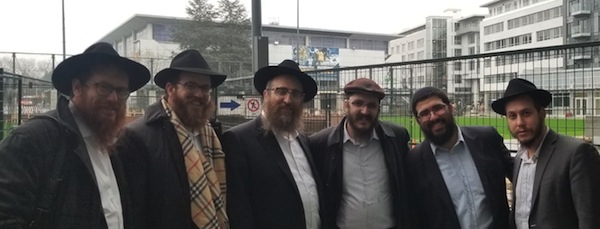
Left to right: Rabbis Chaim Boyarsky, Moshe Goldman, Mordechai Silberberg, Chanoch Rosenfeld, Chalom Loeub and Zalman Zaltzman. (photo from Chabad UBC)

A delegation of rabbis who direct Chabad centres across Canada came to Vancouver last month, on Dec. 10. The purpose of the visit was to get a firsthand understanding of the day-to-day operations of the Chabad Jewish Student Centre at the University of British Columbia, which was established in 2013 by Rabbi Chalom and Esti Loeub.

The delegation included Rabbi Mordechai Silberberg, director of Chabad at University of Western Ontario; Rabbi Chanoch Rosenfeld, director of Chabad at McMaster University; Rabbi Moshe Goldman, director of Chabad of Wilfrid Laurier University and University of Waterloo; Rabbi Zalman Zaltzman, director of Chabad at Brock University; and Rabbi Chaim Boyarsky, director of the Chabad Student Network, which caters to Carleton University and University of Ottawa.

The rabbis direct their respective Chabad centres together with their wives, who are equally responsible for all of their operations. While each Chabad centre caters to the needs of its specific university students, there are some signature programs that all of them run. Weekly home-cooked Shabbat dinners free of charge, the Sinai Scholars Society, and holiday meals and services are some examples. Chabad of Western University, which was established in 1999, hosts hundreds of students every Friday night for Shabbat dinners, many of them Vancouver natives.

The rabbis began their visit at Café FortyOne, where they met with Rabbi Yitzchak Wineberg, executive director of Chabad Lubavitch of British Columbia. Wineberg briefed them on the history of Chabad Lubavitch of Western Canada and his early days in Vancouver.

The group then headed to the AMS Student Nest at UBC, where they met and had lunch with the UBC Chabad student board, and heard about some of the activities that have been taking place on campus. At the Chabad Jewish Student Centre, they met with the Loeubs to discuss the operations and offer feedback. The day concluded with dinner at the Maple Grill followed by a farbrengen (Chassidic gathering).

“It meant a lot to us to have our colleagues fly across the country to visit us,” said Rabbi Loeub. “As we are one of the more recent Chabad on Campus centres to open in Canada, it was very helpful to hear words of advice and inspiration from these veteran directors.”

For more information about the programs offered at Chabad Jewish Student Centre-Vancouver, visit chabadubc.com or call Rabbi Loeub at 778-712-7703. For information on Chabad centres on national campuses and worldwide, visit chabadoncampus.org/directory.

Sue Silverman is a volunteer with Chabad Jewish Student Centre-Vancouver.

A page of Talmud each day

Jan. 5, 2020, was a momentous day in the Jewish world. It was the start of another cycle of daf yomi. What’s daf yomi? It’s the tradition, about a hundred years old, of studying a page of Talmud a day. It takes more than seven years to read it all. At the end of the cycle, after reading the entire Talmud, there’s a siyum hashas, a celebration of learning. The last one was held Jan. 1, in the MetLife Stadium in New Jersey, to a sold-out crowd.

There are also smaller siyums (celebrations) to commemorate finishing a talmudic tractate. Being invited to a siyum was likely the first time I ever learned about this kind of study. Sure, I learned snippets of Talmud in religious school or when I heard sermons at Temple. When I got to Cornell University as an undergraduate though, I met a small but thriving group of Orthodox Jewish students who lived together while attending school. One of those students had a siyum, and invited other Jewish students. I had no idea what was going on.

I was reminded of this when I read an article by Rabbi David Bashevkin on the JTA website online. It was about what it was like to take a bunch of teenagers, doing a weeklong NCSY Torah learning program (run by the youth movement of the Orthodox Union), to the enormous siyum in MetLife Stadium. He defined the teens as “not attending Jewish day school” and explained that the Yinglish at the event and the Talmud study process were all foreign to these teens, but that they understood the deep meaning of the gathering.

I struggled with the article’s headline – it called the teens “secular.” Any kid who attends a weeklong event run by the Orthodox Union is choosing a Jewish lifestyle, even if it isn’t the same as those who attend Jewish day schools or yeshivot.

Beyond this headline definition of “secular,” I saw the great divide not mentioned. This chasm – of being a liberal Jewish woman – caused me to feel, for years, that I was not capable or worthy of studying Talmud in depth, never mind daf yomi.

I wasn’t taught the skills to study Rabbinic Hebrew or Aramaic in my Reform congregation’s religious school. I learned basic prayers, Hebrew and knowledge of Jewish holidays and customs. When I lived in Israel on a kibbutz for a year in high school, I immersed myself in Modern Hebrew every day – but I never saw anyone studying Talmud!

At Cornell, I took Modern Hebrew classes and one Biblical Hebrew literature course. I met the students who lived in the Cornell Centre for Jewish Living. I got “closer” to knowing Orthodox people than I’d ever experienced growing up in Virginia. When I returned to graduate school in religious studies, I began learning basic talmudic terminology. Slowly, painfully, I made my way through the text with lots of dictionaries and help.

About 20 years ago, you could get a CD-ROM with the whole Talmud on it, and some of it had stilted English translation available, but not all of it. Otherwise, one had to have access to a whole set of Talmud or a good library and be conversant in Rabbinic or Modern Hebrew (Adin Steinsaltz was slowly creating translations of Talmud for those who spoke Modern Hebrew) to make it through the text.

Over the years, I had occasional study partners. We worked our way through a few pages of Talmud. In every situation, my partners were unconventional. They had to be willing to study with a woman, willing to study in a slow mishmash of what we understood in Hebrew/Aramaic and English – and, further, willing to make the modern, 21st-century connections offered by my academic (not yeshivah) training.

This fell by the wayside when I had twins. Study time was nonexistent, although writing this column let me study the Torah portions as they seemed relevant. To learn more about Talmud, I signed up to get Ilana Kurshan’s memoir, If All the Seas Were Ink – it was an adult selection from the kids’ PJ Library book program.

I never finished the book. I felt ashamed instead. Here was Kurshan, an author and translator with several kids, including twins, and she had time to study daf yomi. I ignored the fact that she lived in Israel, where access to both Talmud study and childcare was much easier to find. I reminded myself that everyone is different. Our challenges might not be the same, and I returned to working as a freelancer, looking after twins, and running our household.

Then something miraculous happened. My Jewish Learning, a Jewish online resource, started a new daf yomi program. I signed up for my email a day. A friend of mine, a rabbi who is also a knitter, is chatting with me online about the new cycle of study, as a kind of study partner. And, through the miracle of technology, I have managed – so far – to keep up with my page a day. Through sefaria.org, we now have free access online to both the original and (a mostly decent) English translation of these texts.

It’s early days yet. However, today’s page, Berachot 5a and 5b, touches on twins, health troubles, commitment to learning, and, for me, it’s relatable. Most important, it teaches that, in our rich Jewish tradition, it’s never too late to commit to learning more, no matter when one begins. I started on Jan. 5. It’s never too late to start!

Joanne Seiff has written regularly for CBC Manitoba and various Jewish publications. She is the author of three books, including From the Outside In: Jewish Post Columns 2015-2016, a collection of essays available for digital download or as a paperback from Amazon. Check her out on Instagram @yrnspinner or at joanneseiff.blogspot.com.


Not just in summer

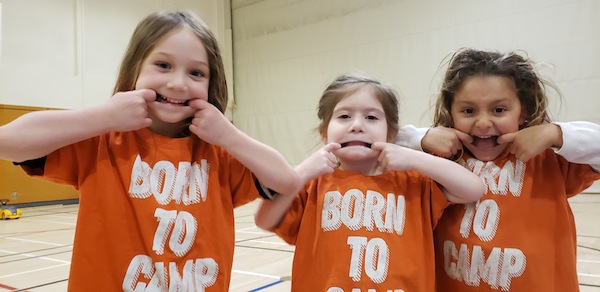
(photo from Camp Shalom)

A couple of years ago, the Jewish Community Centre of Greater Vancouver’s Camp Shalom made a new commitment to families: “When they need us, we will be there!”

Camp staff decided on this motto when they noticed that their current families needed an increased amount of care. As a result, in addition to the existing summer and mid-year school-break camps, Camp Shalom started offering care for children from Vancouver Talmud Torah, Vancouver School Board, Vancouver Hebrew Academy and Richmond Jewish Day School on professional development days. Camp Shalom offers programs for children ages 3 to 15 for an average of 40 weeks out of the year, and is accessible to children who might have mental or physical disabilities.

“We want camp to be an inclusive environment for everyone. We want all campers to feel like they can participate in any of the activities,” said Marina Cindrich, Camp Shalom assistant director.

Supporting families and treating all campers as individuals has always been important to the Camp Shalom team. They recognize that they are a steppingstone into the Jewish camping world for many children in the city.

Director Ben Horev has committed the camp to providing a personalized experience for each family – whether it’s their first time at camp or their 10th, they will receive personal attention. This includes family meetings, scholarships and any other support a family might need for their child to attend camp. In the past, Camp Shalom has partnered with families from the Tri-Cities to bring them camp. This past summer, they introduced Kaitana Shalom, an ulpan-like day camp with Hebrew-speaking counselors and all activities in Hebrew, to help Israeli families integrate into Canada.

Camp Shalom will be kicking off 2020 summer camp registration with a Family Day concert and camp event (in partnership with PJ Library), which will feature Music with Marnie, as well as activities for the whole family. The event will take place on Feb. 17, 10 a.m.-2 p.m.

New this year, Camp Shalom is introducing a major change to their enrolment. They will be retiring the two-week sessions and replacing them with week-to-week registration instead. This will allow families to design a better fitting schedule for their needs.

For more information about Camp Shalom, contact Horev at 604-638-7282 or ben@jccgv.bc.ca.

A counselor’s import

At sleep-away camp, the camp counselor is the person your child is going to turn to as a replacement for you. Even if it’s a day camp, it is the counselor who will be there to comfort, encourage, discipline and befriend your child. Therefore, you need to understand the counselor’s role before you drive away, looking in the rearview mirror at the teary-eyed or over-excited son or daughter you are leaving behind – especially if it’s their first experience of going to camp.

While it can be wonderfully rewarding, camp counseling is a 24-hour-a-day commitment and the job requires a lot of skills. Most camps have training sessions, sometimes very intensive ones, before the start of the summer sessions, and only the most qualified are chosen, as they can make or ruin kids’ experiences.

New counselors who think that camp will be a long, outdoor holiday for themselves are mistaken – they are being paid to work. Theirs is a leadership role, and having fun is only part of the equation. They may have to deal with all kinds of personal problems, such as homesickness, or a child who feel inadequate at or left out of various activities.

The most dedicated counselors make time to get to know their campers. They explore why the kids came to camp and what they are looking forward to doing. They need to keep up with their charges’ accomplishments and help them get involved in whatever activities are being programmed. The object is to spend quality time with each child so that, in the new world they are in, the campers feel that there is at least one person on their side and available to help them if the need arises.

Parents should make sure to inform the camp of any special occasions or events in their child’s life that will take place while the child is at camp, such as a birthday.

A counselor has many roles to fulfil. Sometimes, if a child is homesick, for example, a counselor will need to remind them of the reasons they came to camp, get them enthused about the good times they will have once they settle in, and the great friends they will make. It’s often a good idea for counselors to discuss their own experiences when they were young campers, such as funny incidents, exciting adventures, or pranks that were played on them.

In talking to camp counselors, some of the adjectives they used about the experience were “exciting,” “rewarding,” “memorable,” “fun.” They also said, “I hated leaving my new friends”; “I felt so proud of the kids”; “it was a fantastic time.”

Most of these counselors lived in a cabin or tent with three to eight kids for whom they had full responsibility over the camp sessions. Sometimes, they had to be referee or an impartial adviser, if any disputes arose between the children.

For kids, camp is about trying new things, becoming independent and widening their horizons. Try and confirm that the counselors responsible for your child are sympathetic, conscientious, have a sense of humour and are concerned with security and safety before you wave goodbye to your child.

Dvora Waysman is a Jerusalem-based author. She has written 14 books, including The Pomegranate Pendant, which was made into a movie, and her latest novella, Searching for Sarah. She can be contacted at dwaysman@gmail.com or through her blog dvorawaysman.com.


Opera urges “never forget”

The ship’s cabin in Pasazerka (The Passenger), as envisioned by UBC Opera’s creative team. The opera is part of a series of events at the University of British Columbia marking the 75th anniversary of the liberation of Auschwitz. (photo from UBC Opera)

UBC Opera presents the Canadian première of Mieczyslaw Weinberg’s Pasazerka (The Passenger). Opening Jan. 30 at the Chan Centre for the Performing Arts on the University of British Columbia campus, this will be the first time the work has been presented on any university stage in the world.

The Passenger opens on a luxury liner bound for Brazil. A newly married German woman, Lisa, who, earlier in life, had been an aufseherin, camp guard, at Auschwitz, thinks she recognizes a fellow passenger. The passenger is Martha, a Polish Auschwitz prisoner who was thought to have died at the camp. The effect that their meeting (either actual or imaginary – it’s never made clear) has on the two women, and on Lisa’s marriage to the German ambassador to Brazil, is the subject of this dramatic and powerful opera.

UBC Opera’s production is being created from scratch. The opera has proven so popular no sets or costumes are available for rent; consequently, new sets are being constructed and, at this writing, the students were sewing together dozens of striped prison pajamas for the Auschwitz prisoners’ chorus.

After receiving its world première in 2010 at the Bregenzer Festspiele in Austria, The Passenger has seen frequent performances in various German venues, a highly acclaimed production at the English National Opera in 2011 and, more recently, it has been performed successfully in the United States at the Houston Grand Opera and at the Lyric Opera of Chicago. In spring of last year, it was performed at the new Tel Aviv Performing Arts Centre, and it will be performed in Spain later this year.

The UBC production has received funding from various sources, including the Adam Mickiewicz Institute, which promotes Polish culture around the world, and the Consulate General of the Republic of Poland, as well as Poland’s Department of Public and Cultural Diplomacy and Ministry of Foreign Affairs.

When the president of UBC, Dr. Santa Ono, heard about the project, he committed further funding for the production. Other funding has come from UBC’s dean of arts, Gage Averill, and the David Spencer Endowment Encouragement Fund. The production also has received support from the Vancouver Holocaust Education Centre, Temple Sholom and UBC Hillel House.

“In our time, antisemitism and neo-Nazism has become shockingly prevalent again. Even our own neighbour to the south has witnessed a growing social and political climate which has encouraged disrespect for other human beings and blatant racism,” said Prof. Nancy Hermiston, head of the Voice and Opera divisions at UBC and the director of this production of The Passenger, in a recent interview with the Independent. “In my opinion,” she said, “this has, in part, been released as a result of the behaviour and actions of President Trump. His attitude has given those elements of the world’s population promoting discrimination, hatred, antisemitism and neo-Nazism, a sense that they have a licence to do so. Our opera highlights the consequences of this hatred and racism. Now is the time to remind ourselves of respect and tolerance for others and of our humanity. It is the exact time to remind ourselves of the horror of the systematic extermination of millions of innocent people. Genocides continue to plague our world. Have we learned nothing from the past?

“We can never forget the tragic deaths of those millions of innocent souls nor can we forget those who survived that crime against humanity,” she said. “We cannot let another Holocaust occur.”

The Passenger is sung in Polish, Russian, Czech, French, Yiddish, German and English, which offers a particular challenge to the young singers at UBC. Equally challenging for the singers, according to Hermiston, is the difficulty of dealing emotionally with the subject matter, which, in rehearsal, has led to periods of weeping and feelings of deep sorrow, both for the singers and “even for me,” admitted Hermiston, “especially at the end, when the chorus of prisoners comes downstage and challenges the audience to ‘never forget, never forget.’” (Hermiston has engaged a counseling team to help the singers through their own trauma as they reenact this emotional narrative.)

Performances of The Passenger are set for Jan. 30 and 31 and Feb. 1 at 7:30 pm, and Feb. 2 at 2 p.m. Tickets are available online at music.ubc.ca/opera-pasazerka-the-passenger.

The opera is part of a larger commemoration of the 75th anniversary of the liberation of Auschwitz that is being undertaken by UBC Opera; the UBC Modern European Studies program; the UBC department of Central, Eastern and Northern European studies; the UBC Witnessing Auschwitz International Seminar; and UBC Go Global. During a symposium that runs Jan. 27-30, there will be various symposia and exhibits, and school-outreach programs featuring local survivors and UBC professors and students, as well as the opera The Passenger.

Guest speakers for the symposium include Dr. Michael Berenbaum, Dr. Bozena Karwowska, Dr. Piotr Setkiewicz, Dr. Chris Friedrichs, Aleksander Laskowski, Dr. Richard Menkis, Dr. Dorota Glowacka, Dr. Rima Wilkes, Dr. Anja Nowak, Dr. Peter Suedfeld, Dr. Tricia Logan, Dr. Ilona Shulman Spaar, Janos Benisz, Amalia Boe-Fishman and David Ehrlich, among others. For more information, visit auschwitz75.arts.ubc.ca.

Graham Forst, PhD, taught literature and philosophy at Capilano University until his retirement and now teaches in the continuing education department at Simon Fraser University. From 1975 to 2010, he co-chaired the symposium committee of the Vancouver Holocaust Education Centre.

A time to learn who we are

For many kids, camp is the only time they find themselves in a less structured environment. (photo from pixabay.com)

I remember the days when going to camp was the annual ritual, part of the summer holiday agenda. In our Winnipeg Jewish community, camps were standard practice. It seemed to me that all of my friends were going to be there, but there were always new faces. Some of them would prove to be the companions of my growing up.

Camp was there to free us from the constraints of everyday life, school and parental supervision. For some of us, being out there, in a natural setting, was the only time we ever found ourselves in a less structured environment, as most of us were city-dwellers. And there were always elements of Jewish culture to be shared.

But what I remember most of all was the consciousness that I was alone in a way different from the ordinary. I was in a cabin or a tent where most of my companions were strangers, at least at the start of the summer. Parents were far away. There was a counselor, but he or she was more like a referee than a parent. Whatever issues might arise between my companions and me, resolution would require direct negotiation without intervenors.

Here was an opportunity to test out our interpersonal skills and discover whether we would be leaders or followers, and in what areas did we have knowledge we could share. Here we could discover what issues might be important to us in person-to-person relationships. It had a different feel than our relations with siblings but with the intimacy of living together. We might even have to get into a physical fight if a conflict were grave enough. Would we allow someone to bully us? I certainly had to develop my capacities in these areas in my home environment.

In my case, I went the whole route: camper, counselor, program director. I can honestly say that the camping experience was my personal proving ground for skills I would hone and embellish throughout my life. In retrospect, I realize how important these occasions were for me.

I had the good fortune to attend a camp in my teen years that included subsisting for a few days in a wilderness environment. We hiked. We canoed. We even spent some time in a lake waiting for rescue when our canoe foundered in a sudden storm. I actually have started a fire by rubbing two sticks together. I have slept several nights in a forest with my companions listening to all the mysterious night sounds. We never saw a wolf or a bear, but we got to use copious amounts of mosquito repellent. I have lugged in the groceries and I have cooked food over an open fire. Potatoes are easy, but eggs are more difficult. The experiences were unforgettable.

Max Roytenberg is a Vancouver-based poet, writer and blogger. His book Hero in My Own Eyes: Tripping a Life Fantastic is available from Amazon and other online booksellers.