We cannot walk away

George Floyd’s name may be the best known, but police in the United States (and Canada and elsewhere) have assaulted and killed too many racialized individuals to recount here. While we might hope that the current focus on these needless and unlawful deaths will bring a sea-change in police training and behaviours, the truth is we have seen uprisings of outrage multiple times this century resulting in apparently minimal structural correction. Will this time be different? We can hope so – and act in ways that advance positive outcomes – but one trend is absolutely not helping.

Amid the weeks of protests and riots, the ceaseless attention on this issue has brought to light some factors that are less than encouraging. A backlash to the protests and their sometimes-violent flare-ups unsurprisingly take racist overtones. The mantra “all lives matter,” for example, is a tone deaf and offensive rejoinder to the Black Lives Matter movement. Acts of antisemitism – the spray-painting of a Los Angeles synagogue and a litany of other acts and statements from members of or those supporting a disparate movement – may give perceived consent to some Jews to turn away from the campaign for human equality. But BLM is not an organization; it is a movement. It is made up of scores or hundreds of independent groups and millions of supporters. Some of those individuals are Jews, Black and non-Black. We should be grown-up enough (and sufficiently world-weary) to know that, among any such agglomeration of people, some will express antisemitic ideas. If we are so troubled by this that we throw the baby of racial equality out with the bathwater of fringe extremism, we would be wise to look inward. If we refuse to stand with BLM because of a proportion of bigots in its ranks, take a good hard look at the company we keep by standing with its opponents.

The upshot is that BLM and the larger fight for equality – indeed, the fight to simply keep police from killing African-American and individuals from other identifiable minority communities – is too important to step away from even if we ourselves are targeted by some in the ranks. This should not be about Jews – though, while this should be a given, the world does not work this way. One element that has the potential to strain this alliance is those who have tried to make the relationship between police brutality and racial injustice about Jews: Israelis, specifically.

A tactic has been to focus on training that a comparatively small number of American law enforcement officials have received in Israel. Some voices have made direct parallels between these law enforcement exchanges and police violence in the United States. Some even falsely claim that the knee-on-the-neck move that killed George Floyd is an Israeli invention.

Steven L. Pomerantz, a former assistant director of the FBI and now director of the Homeland Security Program at the Jewish Institute for National Security of America, is an architect of one of the earliest such exchanges, which emerged shortly after the 9/11 terror attacks.

“Despite suggestions to the contrary, there is no field training involved in either the conferences or trips, and no training on holds or arrest mechanics,” he wrote recently. “Participants learn how Israeli law enforcement deters, disrupts and responds to terrorist attacks. They explore the ideology of suicide bombers and other attackers, ways to de-escalate an ongoing incident, and the intelligence-gathering and -sharing process.… Trip participants have discussed efforts to build trust with minority communities, visited hospital trauma units and crime scenes, and spoken with terrorists serving life sentences for murder. One year, JINSA organized a specialized trip for American bomb squad commanders, which focused on topics such as post-blast forensics and the materials used in explosive devices.”

There is a probably no democratic country in the world more experienced in counterterrorism operations than Israel. In today’s world, it would be foolish not to learn from this tragically hard-earned understanding. Like Canada and the United States, Israeli police and military personnel operate with civilian oversight. As Pomerantz writes, it is deceptive to pin on Israel the actions of rogue bad cops in the United States. And, even Jewish Voice for Peace, in their campaign against these law enforcement exchanges, explicitly calls out those who would strip the American context of repressive policing and shift the blame to Israel, as that could be reasonably interpreted as antisemitism and, therefore, harm the movement for solidarity.

It may be that these law enforcement exchanges worldwide – not just those concerning Israel – contribute to the militarization of policing, a trend that is worrying, to say the least. As part of a larger network of exchanges of security forces across the world, it may be that they need to be reassessed. However, to misplace responsibility for police violence – and to choose that scapegoat of ages, Jews – undermines the credibility and the effectiveness of the anti-racist enterprise, and it is disadvantageous to the larger movement for equality.

Good people in the anti-racism movement have and must condemn the targeting of Israel and Jews. Likewise, Jewish people who care about human equality must not step away from this fight, but rather fight on two fronts: against racism and antisemitism. For a better future for ourselves and for other minorities and marginalized peoples, we cannot walk away.
Family history informs his art

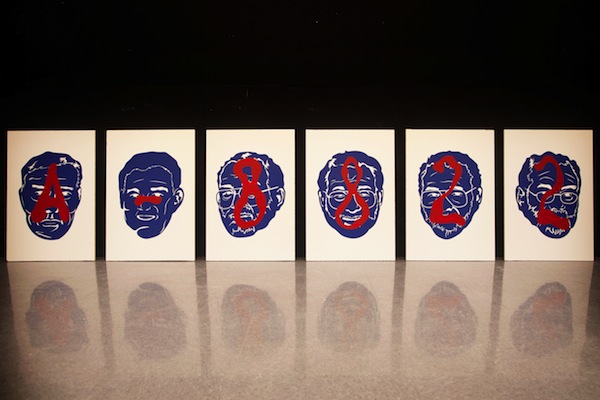
Much of artist Seth Book’s work has been influenced by his maternal grandfather, who was a Holocaust survivor, including “A Series I Don’t Want to Continue” – “One work to symbolize each character tattooed on his arm, and each million Jewish people that were massacred,” explained Book. (photo from Seth Book)

“My art began as solely for the enjoyment of creating work that was esthetically pleasing, but it has since changed to serve a didactic purpose and to provide awareness to social issues and histories that are important to me and my family,” Seth Book told the Independent. “A significant part of my work is to keep the legacy of my grandfather, survivors, and Jewish history alive.”

Book is a member of the third generation. “My mother’s father was a Holocaust survivor, originally from Romania. He went through a few camps, Auschwitz being one of them. Since seventh grade, I have completed a significant amount of research on his story, directly with him while he was alive, as well as after his passing, and, like many other survivors, he had an unbelievable journey,” explained Book, whose work will be on display at Art Vancouver April 16-19, in the unlikely event that the spread of COVID-19 is under control by then and the fair is allowed to take place.

“His presence in my early life has been extremely impactful on the way I live and see the world,” said Book of his grandfather, “and this is what has influenced my art. I truly believe that, in school, work and life in general, I have gotten my tenacity, conscientiousness and resilience from my zaide. As I learned more about his life and what he fought so hard to build for my family, he became a strong source of motivation and drive to succeed in my life. I still uncover bits and pieces about his life after the Holocaust.”

While his art for the past few years has been primarily concerned with his grandfather, the Holocaust, survivors in general, and present-day antisemitism, Book said the past year has been “transformational.”

“My connection to my grandfather allowed me to begin my work at this starting point relative to my own history,” he said, “but it has since expanded to include broader focuses, such as the current generation living on the legacies of survivors, as well as generational trauma and current events affecting the global Jewish community.”

Book, who works at a branding agency doing graphic design and writing copy for clients, is set to finish his bachelor of fine arts degree at the University of British Columbia. His coursework has allowed him to learn about and use many different mediums, he said, “including drawing, digital media, photography, painting and metalwork.”

Born in Vancouver, Book has lived in the Dunbar area his entire life. He attended Vancouver Talmud Torah from preschool to Grade 7, and then went to St. George’s School for his secondary education. He continued his involvement in the Jewish community via Temple Sholom, he said, “where I participated in the confirmation class in 10th grade and then taught at the Sunday school in 11th and 12th grade. I was also lucky enough to travel to Israel with my family on the Temple Sholom trip after my bar mitzvah.”

He was well-versed in diverse media long before his university years.

“Growing up, I was always interested in creativity: building structures, doing crafts, colouring, and especially playing with LEGO,” he said. “I recall being hilariously picky with colours and colouring inside the lines when drawing with other kids as early as preschool; I always find it funny to this day how much it bothered me as a toddler to see other toddlers using odd colour combinations or messy drawing.

“This interest in art was then supplemented by Colette Leisen’s art class all throughout VTT – it was probably my favourite in elementary school. This carried on into various art classes in high school, including drawing, animation, graphic design, ceramics and painting.”

photo - Seth Book
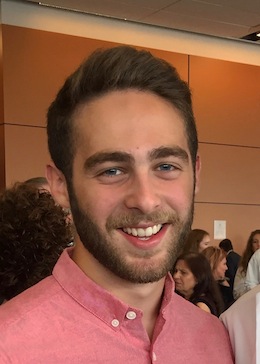
Seth Book (photo from Seth Book)

Book said it is hard to define his artistic style because he has always been interested in finding new mediums and approaches. But he has less need for such definition since he began university. Since then, he said, “I have been able to let go of that and continue exploring what interests me rather than being labeled as a ‘painter’ or a ‘photographer.’ I always find that different mediums have such an incredibly unique ability to succeed in accomplishing a piece better than others. In other words, certain mediums are more effective than others in conveying certain ideas or concepts for varying projects. That being said, I try to use the best option I can for each work, trying not to limit myself in expertise. I can always try and learn! I did not work with metal until late 2019, and have already created two works using it, and I am very satisfied with how they turned out.”

Book, who has a background in business management in addition to his art training, said he first heard about Art Vancouver through a summer internship program he took part in a couple years ago, and has kept in close contact with the team there since. “I have loved working with the organizers and enjoyed attending the event every year,” he said. “I quite like the efforts they make to advance the art scene in my hometown and can’t wait to be a part of it as an artist this time.”

Hopefully, he will get that chance, but, even if Art Vancouver is canceled or postponed because of COVID-19, Book is an emerging artist whose works will available at other venues at other times.

He was able to tell the Independent about two pieces he was planning on bringing to the art fair. While he had not firmly decided on all the pieces yet, he said, “I selected the works from my portfolio which I have found to be the most striking, the works that I have received most compliments about, as well as the works which I feel represent my wide practice the best when shown together.”

One of those creations is called “A Series I Don’t Want to Continue,” which comprises six digitally rendered vinyl decals adhered to six two-foot-by-three-foot melamine sheets.

“A series opens an idea and simultaneously closes it,” reads the work’s description. “The values in between the first and last work tell a story or convey some sort of meaning through the relationships formed with the works in between.”

It continues, “A series of works in any media all relate to one another through consecutive nature. Labeling a group of entities as part of a series can bind them together, locking them out from further creation or reproduction. This is where the concept of my work integrates itself reflexively within the format of a series work. Through this work, I explore the contained value of past events, and particularly the Holocaust, in relation to my grandfather’s story.

“When he passed away, the evaluation of his extreme tenacity and hard work to establish our family and provide futures for generations to come was recognized more than ever. ‘Never again,’ the words that often cross our mind, could not be stronger upon recounting the horrors he endured. Never again, but also never forget. These events happened. They must be taught and preserved, but they are contained, and must never grow…. One work to symbolize each character tattooed on his arm, and each million Jewish people that were massacred. There will not be a seventh work in this series.”

The other piece that Book wanted to bring for sure to Art Vancouver is called “Untitled Crowd (The Stars, The Blues, The Ashes).” The 22-inch-by-30-inch ink-on-paper work is also related to the Holocaust. The description reads, in part, that the Nazis’ attention to detail was “dual-edged.”

“On one hand,” it notes, “they kept extremely particular and accurate data records of the prisoners murdered. Ironically, on the other hand, the attention to human detail was nonexistent. When Jewish people were funneled through various camps, they were stripped of their belongings and identities. They were nothing but a number.”

In “Untitled Crowd,” Book writes, “I attempt to discuss this specific lack of attention and elimination of one’s person. Each work is a recreation of real people who either survived or perished during the Holocaust. In order to illustrate the lack of respect and attention given to these unfortunately abused people, I spent a specifically short time on depicting them in the piece. Each face was dedicated about six minutes, to correspond with the six million lives lost. The faces are all overlapping with one another to represent not only the crowds of people who were murdered and their brutal living conditions, but also the morphing of individuals into a mess of numbers and bodies rather than human beings.”

The piece’s three parts carry added symbolism. “The first work is done with shades of mustard yellow to signify the yellow stars Jewish people were forced to use as identification, and the shades are more distinct in overlapping to show not all identity had yet been lost,” writes Book. “The second work is completed with shades of blues to represent the blue-striped pyjamas prisoners wore, and the difference in tone decreases to create a more homogenized look as they lost identity. The final work uses the greyscale to convey the ashes of those perished, and the gaining age of survivors around the world.”

For more on Book, visit his website, sethbook.ca. For more on Art Vancouver, see artvancouver.net.

Antisemitism, Part 2 of 2

Last week in this space, we addressed some of the challenges facing the Jewish people globally, which were put into stark relief by the latest edition of an Anti-Defamation League report titled Global 100. The most recent annual review of antisemitic attitudes worldwide paints a disheartening picture.

There are (at least) two inferences to draw from the report: that what we’ve been doing to confront antisemitism isn’t working or, perhaps more disturbing, they are working and, without them, the situation would be much worse.

First, a point that deserves repeating. Antisemitic ideas are most rampant in places where there are few or no Jews, because antisemitism is far less about Jews than about the antisemites and their need for scapegoating or other psychosocial outlets. But that fact is of limited comfort for the Jewish woman attacked on the subway or the hundreds of people evacuated from Jewish community centres around New York state last Sunday due to bomb threats.

We who are writing these words and you who are reading them can, for the most part, do little about the global situation, but the familiar saying, “Think globally, act locally,” rings as true as ever. While there are myriad organizations working nationally and internationally in the interests of the Jewish community and Israel – and we would like to see more of that, as well as some means of quantifying their results – the greatest impacts most of us can have are probably right here in our own neighbourhoods.

Again, advertising the great achievements of Jews and Israel may not be the best strategy. There is no need for, or value in, diminishing Jewish achievement and pride, but there is value in simultaneously reinforcing the universal humanity of Jewish people.

Without reopening that can of worms about whether Trump (or Bolsinaro or Orban or Modi or Mohammad bin Salman) is bad for the Jews – because we have national and international organizations operating on those macro-diplomatic fronts – what can ordinary folks like us, who feel afraid, helpless and perhaps disenfranchised, do to have an impact and, no less crucially, feel less isolated and disempowered?

As individuals, we can engage with others in our midst: with the church down the street, the service clubs in our communities, the ethnocultural groups that abound in Vancouver and across Canada, and the pet parents we meet at the dog park. The objective, we think, should not be a full court press to persuade these people that Jews are awesome. The point should be to rebuild the relationships that Jewish communities and individuals have enjoyed with the broader Canadian mosaic; not to advocate for these other groups and individuals to stand with us, but to stand with them so that, together, we form bonds of mutual understanding and care.

It is sometimes noted, especially on social media and in conversations among friends – you’ve certainly heard it – that some of the most concerning voices today are not coming from far-right radicals (though these are troubling) but from ostensibly reasonable people on the left. Ameliorating this challenge is not going to come from declaring them the enemy and polarizing our voices with their opposite – which is what is happening quite frequently in a perilous form of the-enemy-of-my-enemy-is-my-friend construction (see Trump/Bolsinaro/Orban/Modi/MBS above). The challenge will be addressed by rebuilding or strengthening the bridges between our communities and causes – not because it is the expedient thing to do, but because it is the right thing to do.

Last week on the front page, we featured two (of many) individuals in our community who are leading local voices in the movement against climate change, each using different strategies toward the same goal. They are not doing this as ambassadors of the Jewish people, of course, but they are doing so as Jews, motivated by their values and urgent commitment to saving the planet. They are Jewish allies in a diverse mix of dedicated activists.

Countless other Jewish community members are working across faiths and cultures to advance all the communities they encounter. Holocaust survivors are partnering with indigenous residential schools survivors in joint educational initiatives, and there are Jews who are actively supporting the Japanese community’s call for redress from the B.C. government for its role in the grave mistreatment of Japanese-Canadians during the Second World War. Local Jewish groups and individuals are doing everything from working to stop human trafficking to sponsoring Syrian refugees to participating in interfaith activities to making food for the homeless.

The pages of this paper are filled regularly with stories that are not, let’s say, Jewish-specific, but of Jewish people making positive contributions to the world. Motivated by a vast range of factors, often by their Jewish values, these points of light in the world are acting on issues important to them and building interpersonal and cross-community bridges in the process.

When we began this two-part conversation last week, we pointed out that, if we had the solution to antisemitism, you would have heard it. We don’t. It seems nobody does. The work being done at the national and international levels by the vast network of Jewish and Zionist organizations is mostly admirable and should be supported. But each of us also needs to look closer to home and remember that, as Margaret Mead said, a small group of thoughtful, committed citizens can change the world – and perhaps make some friends along the way.

While celebrating and preserving what is unique in our Jewishness, we should also enhance what was successful in parts of the 20th century: allying with the diversity of individuals and groups in our multicultural society to remind them – and ourselves – that we are not alone, but part of a larger human enterprise.

Antisemitism, Part 1 of 2

The recently released 2019 version of an ongoing Anti-Defamation League survey on global antisemitism, titled Global 100, contains predictable but still depressing confirmation of anecdotal evidence that antisemitism is growing, not receding, almost everywhere on the planet.

At a time of economic and social change and upheaval, people search for explanations and scapegoats. While so much can change, while we witness so many reversals and inversions, plus ça change, plus c’est la meme chose. The unified theory of the root of the world’s problems, for so many across continents and centuries, remains some variation of blaming the Jewish people.

If we had a solution to the challenge of antisemitism, you would have heard it. It’s easy to cite failures, noting that whatever we’ve been doing obviously isn’t working. The approach commonly used to fight both antisemitism and anti-Zionism – “Look at the great things we contribute to the world! Please like us!” – is almost certainly barking up the wrong tree, given that antisemites and anti-Zionists are driven, to a large degree, precisely by an envy of Jewish and/or Israeli success and achievement. Bigots never have doubted that Jews are clever; that’s exactly what they hate.

But overt bigots are not really our greatest threat. The sensibilities highlighted in the Global 100 report are slightly more oblique, evincing a complex of presumptions about Jewish character, power, influence, intentions and untrustworthiness. It is not so much discrimination of the we-hate-Jews variety, but a (slightly) more subtle bias that is extrapolated to conclude this or that about Jewish people. And these biases are held, as the report illustrates alarmingly, not by a small fringe group of violent haters, but by large minorities – and, in some societies, large majorities – of ordinary people. These are people who, on a wide range of human affairs, behave rationally and humanely, but not when it comes to Jews.

It also deserves to be noted that the statistics on anti-Jewish bias are almost directly inversely proportionate to the presence of Jews in a society; that is, anti-Jewish sentiment is strongest in places where there are few or no Jews. Because, to a large extent, antisemitism is not about Jews at all, but is a projection of the fears, animosities or ignorance of the carrier.

The wild-eyed Jew-haters who occasionally emerge are comparatively few, although the damage they can wreak, of course, is enormous. Their ideas and their actions are condemned by all good people. The broader swath of ideas Global 100 identifies as indicative of antisemitism in a society are more instinctual and less overt. The people who carry them are probably inclined to deny any conscious negativity toward Jews and would recoil from being called antisemitic. In many cases, they might be amenable to self-assessing and unlearning these attitudes, if approached appropriately and educated.

This is the hopeful part. These alarming numbers may not represent entrenched antisemitic ideas that are growing and cannot be effectively challenged. The majority of people who harbour such ideas, in Canadian and other Western societies we know best, are probably receptive to reason. So, why have we not succeeded?

Our likeliest allies – indeed, the people and groups with which Jewish people have consistently marched, organized and made common cause for a century or more: progressives, anti-racism advocates, social activists – have lately turned against us, either openly or more quietly, because they have decided that Israel represents an embodiment of antithetical values and that Jews, by extension, are inclined to have some degree of association with Zionism and are, therefore, either unwelcome in these movements or required to repudiate Israel.

There are other complexities that go beyond Israel. Certainly the antisemitism that permeates the British Labour party and some other parts of the Western left goes far beyond anti-Zionism and often echoes the basest medieval bigotry.

Nonetheless, these movements and the individuals who comprise them should be engaged, not cast away and dismissed. In many cases, they are ignorant or have not thought deeply about these topics, or they have not been confronted about the problems in their worldview. Since they are, in theory, our natural allies, we should be investing more effort and goodwill in building bridges, not blowing them up.

Antisemitism is distinct in many ways, but it must be viewed alongside the panoply of prejudices and bigotries being contested by progressive people and others of goodwill. By giving up on our natural allies – even if some of them don’t seem like allies right now – we risk the longer-term dangers of isolation or, possibly worse, befriending people who really are not our natural allies.

On the global stage, look at how Israel’s lack of friends has driven its leaders and diplomats into the arms of fascist-adjacent governments in Hungary, Poland, Brazil and elsewhere. Abandoned by its natural allies in the liberal democracies, Israel has been embraced by – and has embraced – those who should be its natural enemies. This is the potential for Jews in North America and Europe if we fail to protect and fortify the alliances previous generations have built with trade unions, progressive political parties, anti-racism activists and the broader pluralist societies we inhabit.

In next week’s issue, we will look at some approaches that are bearing fruit and other ideas we could consider in response to the challenges in the world generally and those presented in the Global 100 report specifically.

When is never again?

Monday was International Holocaust Remembrance Day. Scrolling through social media, it was jarring to see the juxtaposition of images and ideas reflecting on that terrible history intermingled with the mundane and fantastical miscellany of everyday 21st-century life. This is the reality of our world: the grave realities of yesterday and today poking through the onslaught of witty memes, outrage over a vast range of real and imagined evils, cute kittens and the panorama of detritus and riches available to, and bombarding us, at every moment.

This is how it is. Even as we recommit ourselves to the promise of “never again,” still we carry on with our daily lives. Yet these realities are not, and should not be, disconnected from one another. The memory of the Holocaust and its victims, and the importance of listening to and learning from its survivors and its messages, are sacred obligations. But their lessons and meanings can and should be applied to the more commonplace events we experience. History is a prism through which we should view the present and the future.

Like the jarring extremes that can be found scrolling social media on Holocaust Remembrance Day, this collision of gravity and triviality is problematic. We recoil from inappropriate comparisons. Yet, in a world where legitimate causes struggle to be heard above the competing din, we often fall back on the most incendiary formulations, so every injustice becomes “fascism,” every leader we dislike a “Nazi.” This dilutes the seriousness of the history it invokes – and it also makes it more difficult to identify and draw attention to genuinely grave dangers, including literal fascism or fascist-adjacent ideas and actions emerging in Europe and closer to home.

The number of lessons to be drawn from the Holocaust are as innumerable as there are human behaviours. A relevant one for our time is the fragility of democracy and civil order. The actions of Raoul Wallenberg and Chiune Sugihara (click here to read story) are examples of a dystopic situation where good people are driven to break laws and norms promulgated by evil forces. In situations where democracy and social order are upended, goodness is criminalized and malevolence is institutionalized.

Democracy is under threat in much of the world right now. Human nature is such that we take for granted once-unimaginable wonders – gadgets in our pockets containing the breadth of human knowledge, the perceived right of every individual to live free from fear of tyranny – almost as soon as we access them. We forget that democracy is barely two centuries old and that it is not only imperfect but tenuous. With extraordinary ease, individuals of various stripes have managed to smother or at least severely disfigure nascent democracies in Russia, Poland, Hungary and elsewhere in Eastern Europe. A more established democracy in Turkey has been twisted away from its secularist, pluralist roots. The world’s largest democracy, India, is engaged in serious religious-based oppression.

In Israel, there are social forces and political parties pushing the extremes, as well. The Kahanist party, Otzma Yehudit, is aiming to again contest the March elections and has been rooting around the emerging electoral alliances for a slot. To his credit, Naftali Bennett, head of the New Right bloc and no raging moderate himself, rejects being in a tent with Otzma Yehudit and rightly warns other parties to steer clear.

And, in ways whose significance we may not yet be able to judge, the fabric of American democracy – checks and balances between branches of government – is being threatened. The president, indicted for attempting to extort our ally Ukraine to participate in political dirty tricks in exchange for desperately needed military funding to defend itself against the encroaching Russian military, seems destined to be exonerated by a Senate more concerned with party discipline than the rule of law, the constitution or human decency. If the probable outcome is realized, it will represent a blow to the grand ideals of the world’s oldest contemporary democracy.

Is raising this example itself a symptom of the problem we are discussing? Is it relevant and proper to discuss the American or Israeli situation in the same context as Russia, Poland or Hungary? Do we diminish the memory of the Holocaust by raising this topic in this perspective? Is it equally specious to assert that we won’t know, perhaps until it is too late, whether we should have been more or less vigilant when a man with little or no respect for norms of nicety or constitutionality ascended to the highest office in the democratic world?

This is the line we walk when we say “never again.” The magnitude of the history underpinning this promise is so enormous that we risk lessening it through invocation. Yet, if we isolate that history and its lessons, like good china saved only for the most special occasions, are we not conversely risking the very promise we undertake?

Auschwitz 75 years on

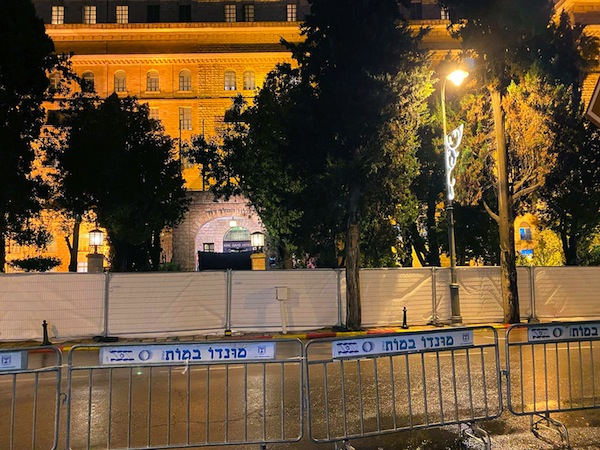
The King David Hotel was partially obscured by a temporary security barrier as part of the preparations that were carried out in Jerusalem for the arrival of leaders from more than 45 countries for in the Fifth World Holocaust Forum, which took place at Yad Vashem this week, and marked the 75th anniversary of the liberation of Auschwitz-Birkenau in Poland. (photo from Ashernet)

Monday marks the 75th anniversary of the liberation of Auschwitz-Birkenau. That date, Jan. 27, has been set aside annually to mark International Holocaust Remembrance Day.

Scores of officials from around the world were to descend on Jerusalem this week to attend a ceremony at Yad Vashem and a forum on the Holocaust. Expected guests include Canada’s Governor-General Julie Payette, Prince Charles, Russian President Vladimir Putin, French President Emanuel Macron, U.S. Vice-President Mike Pence and a long list of royalty, heads of government and others from around the world, especially from Europe.

Among the more attention-grabbing guests is Volodymyr Zelensky, president of Ukraine. Zelensky is a particularly interesting man in a particular role at an interesting time. He will be in Jerusalem alongside Pence and other world leaders at the very moments when the U.S. president is undergoing an impeachment trial initiated as a result of a phone call with Zelensky, probably the only reason most North Americans know his name. But that is among the least remarkable things about the leader.

A political neophyte (aside from playing the Ukrainian president in a satirical TV series), Zelensky was elected on an anti-corruption platform. In advance of his visit to Israel for the commemoration events this week, he engaged in a lengthy and witty interview with the Times of Israel about his family’s history – some relatives live in Israel and he has visited and performed comedy there many times – and his reflections on Jewishness, Israel and contemporary politics.

It caused some curiosity when Zelensky was elected because he has, in his words, “Jewish blood.” It is a common term, perhaps especially in formerly Soviet societies where religion was officially negated and so identities are defined obliquely, but the phrase “Jewish blood” is unfortunate in the context of Ukrainian history.

Among the considerations facing the country at present is the complicity of its citizens in the Holocaust, including in the massacres at Babi Yar, a ravine in the capital of Kyiv, where an estimated 100,000 to 150,000 individuals were murdered during the Nazi occupation, including more than 33,000 Jews on one day in September 1941.

In 1976, Soviet officials erected a monument marking the site and the cataclysm – ignoring the Jewish particularity of the mass murder and lamenting the deaths of Soviet victims of Nazism. It is undeniably true that victims at Babi Yar also included Roma, communists, Ukrainian nationalists and prisoners of war, all of whom deserve to be commemorated and mourned. But the omission of the Jewish identities of most of the victims at the site has been a point of pain and conflict for decades.

Zelensky’s government is remedying this. Begun by civic officials and Jewish leaders and endorsed by Zelensky’s predecessors, a Babi Yar Holocaust Memorial Centre is being constructed, with anticipated completion in 2023. The government is also undertaking a more transparent assessment of the country’s role and its citizens’ collaboration during the Second World War, outpacing most of their eastern European neighbours in addressing this dark past.

Still, some red flags remain. Zelensky claims that there is no antisemitism in Ukraine, an unequivocal statement that bewilders. It would be careless for any leader to ascribe complete innocence of bigotry to their entire citizenry, more so the leader of a country with a history like Ukraine’s.

He is, in some ways, between a rock and a hard place. While making blanket denials of Ukrainian antisemitism, he is also attempting to move his society away from the glorification of nationalist – meaning, among other things, inevitably antisemitic – historical figures. He points to the fact that he, a novice politician with “Jewish blood,” was elected to the country’s top post as evidence of tolerance in Ukrainian society. It does seem encouraging.

Also encouraging is the extensive list of world leaders arriving at Yad Vashem not only for a commemoration but for an educational forum, titled Remembering the Holocaust: Fighting Antisemitism. Israel’s President Reuven Rivlin has said the purpose of the meeting is “to think about how to pass on Holocaust remembrance to generations who will live in a world without survivors, and what steps we must take to ensure the safety and security of Jews, all around the world.”

Seventy-five years after that terrible epoch, the topic remains timely.


Let’s be more Jewish

It’s an inflammatory question. When attacks against Jews occur, as they are in increasing and alarming numbers in North America – including an incident of hateful graffiti at Camp Miriam on Gabriola Island recently – people ask why. Why Jews?

The problem with the formulation is that it suggests there is a justifiable answer to that question. It would be akin to asking, upon seeing statistics of domestic violence, why women?

Throughout the ages, scholars, pundits and philosophers have listed factors in Jewish theology and culture that confound, scare or irk others and contribute to antisemitic ideas and acts. The steadfast refusal to accept more dominant “successor” religions invites theological reactions. Adherence to cultural practices make Jews outsiders, to varying degrees, in every society. Jewish success in a range of fields invites envy.

But these explanations are all largely nonsense when it comes to the sorts of antisemitic acts we are seeing today. The primary explanation why, for so many people, it is all about Jews is counterintuitive – it is not about Jews at all.

For the most part, probably, the core motivation for engaging in racist and antisemitic acts has less to do with the victims than it does with the perpetrators. The definition of scapegoating is the assignment of sin or guilt onto an empty vessel that is then sacrificed. The hate and violence we are witnessing are almost certainly acts of scapegoating that reflect something amiss in the worldview of the perpetrators. These are people who identify problems in their lives or their world and seek an external entity to blame. Jews are history’s greatest scapegoat, regardless of our actual presence in any particular place. Notably, studies indicate that antisemitism is greatest in places where there are no Jews and it has perhaps always been thus. Shakespeare created the character Shylock hundreds of years after Jews were expelled from England, for example.

This is not comforting. If there were something more discrete motivating these incidents, perhaps they could be rationally contested. That the motivations are based on irrational projections makes them difficult to fight.

It is routinely said that Jews are the canaries in the coal mine of a society. The dehumanizing imagery this employs aside, it is undeniable that Western society today is experiencing some deeply troubling trends, from the emergence of “illiberal democracy” in the erstwhile democracies of Eastern Europe and Turkey to the stark chasms between partisans in still-healthy democracies. Rapid economic changes spark social and political reactions. The greatest migration of people on the planet in generations causes real or perceived threats to the status quo in the countries where these migrants are headed. And this is to leave aside the geopolitical dangers we face in relations with Iran, North Korea and many other flashpoints, as well as from decentralized terror groups that defy international boundaries. We are perhaps more surprised than we should be that, in the face of these developments and uncertainties, a number of people seek out that scapegoat of first resort: Jews.

As a result, stories are emerging of Jews going “undercover,” of being less inclined to be identified as Jewish in places like New York. There are other stories of Jews increasingly learning self-defence skills. Self-protection is primary in any situation and no one should be condemned for taking short-term measures in the midst of danger.

In the longer-term, though, there is an alternative to being (or appearing) “less Jewish.” If the root of this problem is not Jews, but disordered responses to a troubled world, then the answer, while not easy and most certainly idealistic, would be to be more Jewish, to embrace even more energetically a Jewish way of being and doing. We may not be able to change the distorted perspective of an antisemitic individual. But if, through our agency, we can promote fairness, tzedek (justice) and chesed (lovingkindness), we will advance a world in which people will not need to seek scapegoats.

Is it a fair burden that this labour should fall to Jews? Perhaps not. But maybe this is what we have been chosen to do in this moment in history.

Artistic responses

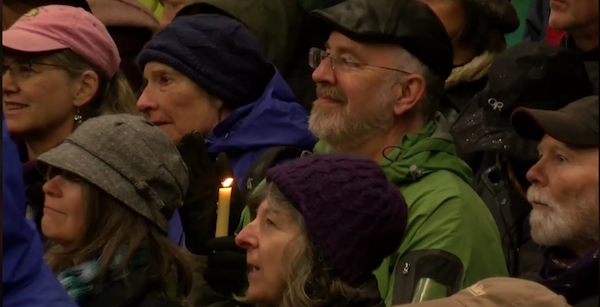
Gabriolans held a candlelight vigil after antisemitic graffiti was found at Camp Miriam. An arts festival will take place Feb. 7-9. (photo from You’ve Got a Friend)

Since Camp Miriam on Gabriola Island was defaced with antisemitic graffiti in December, Gabriolans have shown support for the Jewish community, including a candlelight vigil on Jan. 2. Next month, island artists, musicians and writers will gather together to present You’ve Got a Friend: A Festival of Jewish and Gabriolish Art, Words and Music. The Feb. 7-9 festival will feature Jewish-themed visual art, music and writing, all created by residents of Gabriola, among them Juno nominees and literary prizewinners.

“When people heard about the vandalism at Camp Miriam,” said Sima Elizabeth Shefrin, one of the festival’s organizers, “many said, ‘What can I do to help? How can I show my support?’ The festival is a chance to celebrate our friendship and solidarity with each other and to move things on in a positive way. We took the title, You’ve Got a Friend, from Carole King’s old song.”

The festival program includes visual art by Shefrin, Heather Cameron and others at the Gabriola Arts and Heritage Centre. The opening reception will take place Feb. 7, 6-9 p.m., and the gallery will be open Feb. 8, 10 a.m. to 4 p.m., and Feb. 9, 10 a.m. to 1 p.m.

The concert Oy! will feature Bob Bossin, Paul Gellman, Dinah D, the Today Only Klezmer Band and others. It will take place Feb. 8, 7:30 p.m., at the Roxy Lounge and Cultural Club, with tickets available at North Road Sports. Admission is a suggested donation of $15.

Earlier on the Saturday, at 3 p.m., Amy Block will lead a celebration for Tu b’Shevat, the Jewish new year of the trees, at the arts and heritage centre.

Finally, Nu? – poetry and memoir by Janet Vickers, Naomi Wakan, Lisa Webster, Shayna Lindfield, Gloria Levi, Lawrence Feuchtwanger, George Szanto and Bossin – will be held at the arts and heritage centre Feb. 9, 1-3 p.m.

You’ve Got a Friend is supported by Camp Miriam, the Gabriola Arts Council and Anne Landry. For more information, contact Cameron at true_stitches@yahoo.ca.

Extremes and elections

Drawing parallels between political events in disparate countries may be folly, but it’s the season for frivolity, so why not. As British Conservative Prime Minister Boris Johnson was piling up an historically massive majority government, Canada’s Conservative leader Andrew Scheer was giving in to an apparently inevitable whimpering end to his leadership.

For most British Jews and many other observers, Johnson’s victory elicited something between relief and elation. While the Labour party has been the traditional home for many or most of that kingdom’s Jewish voters for generations, it is estimated that just six percent of British Jews voted to elect Labour leader Jeremy Corbyn prime minister this year. Corbyn has alienated Jewish voters and aligned with the most extreme elements in British society; his party is demonstrably rife with antisemitic people and ideas, as evidenced in a years-long probe first by the party and now by the country’s human rights watchdog. Under Corbyn, it seemed, there were two things the party would not tolerate: racism and Jews.

Of course, the election was not a litmus test on Corbyn’s antisemitism. Few non-Jewish voters probably made their decision based on that concern. Rather, his position on the ballot question – Brexit – was confused and inarticulate. Still, it was with a sense of justice, if not schadenfreude, that many Jewish observers watched Corbyn’s career collapse last week. Even so, the horse they bet on isn’t without serious flaws: Johnson is well known for his racism, xenophobia and Islamophobia, and his hard-right agenda is antithetical in other ways to many Jewish voters who may have found themselves between a rock and a hard place.

Hours earlier, Canada’s Scheer dropped the bomb that he would resign as party leader. The wagons had been circling since his defeat in the federal election in October. His Achilles heel, it is widely accepted, was his ambiguity around socially conservative policy issues.

During the campaign, opponents suggested that Scheer had concealed plans to threaten marriage equality and reproductive rights. However, the law permitting gay marriage and the absence of a law around abortion are both consequences of Supreme Court decisions, not of Parliament acting of its own volition. Barring a revolutionary shift at the Supreme Court, the status quo constitutionally could not be undone. More practically, there is very little political will to alter the status quo on these and a host of other litmus test issues. Not only are Canadians at large mostly in agreement with the way things stand, the critical mass of voters who swing elections are overwhelmingly centrist.

On the face of it, Scheer’s argument – that he has specific personal views that he would not manifest into legislation or policy; indeed, Justin Trudeau effectively and successfully made the same case four years earlier – is a morally valid one. Scheer’s problems on this front were twofold. He expressed his position poorly, failing to articulate either his deeply held values or his endorsement of the people’s consensus in a way that resonated with voters, and he misread the depth of investment many or most Canadians now have on these topics. He bet that Canadians might be satisfied with and respect the idea that he believes particular things but would not legislate on the basis of these faith-based positions. While this left many of his core supporters unenthused, it also misread the enthusiasm of the very voters he was trying to capture. Scheer’s refusal to participate in Pride parades became symbolic. A proportion of Canadians – the proportion that could swing elections – no longer wants a leader who will merely not interfere with an individual’s right to marry or to control their reproductive system, they want leaders who will unambiguously champion these rights.

There was plenty else wrong with the Conservative party’s campaign but, as Scheer tried to remind rogue members of his own party in the weeks following the results, they kept the Trudeau Liberals to a minority and, indeed, created a genuine threat of defeating them at points in the campaign, something few Conservatives thought was a reasonable possibility when Scheer was first elected party leader two years ago. Alas for him, the party smells blood and seems to want someone who can go in for the kill when this minority Parliament dissolves.

Even with the Conservative party in transition, Canadians might have to head to the ballot box before Trudeau’s four years are up. For the British, this month’s election was their third in less than five years. Meanwhile, Israel is gearing up for its third election in a year and the United States, too, is tumbling towards a fraught election.

We are in the midst, it seems, of a continuing test as to how well democracy can negotiate political extremism. At least for now, in Canada, the socially conservative “private” views of Scheer are political losers, but election results in other democracies prove that complacency can’t be an option.

A call to join Maspik!

No external threat worries Canadian Jewry more than the rising tide of antisemitism. For years, in grassroots consultations hosted by the Centre for Israel and Jewish Affairs (CIJA), community members have unanimously and consistently said antisemitism is their primary concern.

Pay attention to any conversation on the steps of your nearest synagogue or community centre and you’ll likely hear concerned community members say that Jewish organizations of all stripes should be doing more to combat the scourge of Jew-hatred. To paraphrase the words of an emphatic member of the community in Montreal: “Get together already! Enough is enough! Maspik!”

That passionate individual faithfully represented the perspectives of many in our community. To combat antisemitism, we must work together. We are stronger when we are united, and we must unite on this issue now.

No country in 2019 is free of antisemitism, no political orientation is insulated against Jew-hatred and no movement is entirely immune from discrimination against our people.

Contemporary antisemitism wears many faces and threatens our community on multiple fronts – from the extreme right to the extreme left and, increasingly, from segments within the Muslim community. Some antisemites operate in broad daylight in the public square and on social media. Others lurk in the obscurest corners of the dark web. What unites them is their hatred of Jews. And that should unite us.

Canada may be the best place in the world in which to be Jewish but, make no mistake, this country is not immune from antisemitism and the threat it poses to our safety and well-being.

For years, CIJA has worked to keep antisemitism at the margins. In recent months, these efforts have resulted in two important developments: Canada’s adoption of the International Holocaust Remembrance Alliance’s (IHRA) definition of antisemitism as part of the government’s anti-racism strategy and, secondly, the incorporation of many of CIJA’s policy positions in the study by the House of Commons Justice Committee, including our call for the creation of a national strategy to combat online hate and radicalization.

While these are important steps, in these challenging times, they are not enough. The enormity of the danger demands a unified approach. This is why we are calling on other organizations and individuals to join CIJA and a broad alliance of Jewish and non-Jewish groups in Canada from all sectors in establishing Maspik! A Coalition to Combat Antisemitism.

Thanks to support drawn from the proceeds of the recent Jewish National Fund Negev Dinner in Toronto, honouring Wendy Eisen and Carole Zucker, we now have the initial seed funds to launch this coalition, which we will expand and sustain over the longer term by establishing a fundraising program to ensure sufficient resources to create real impact.

In the coming weeks, CIJA and our federation partners across the country will establish an independent committee of lay leaders to oversee the grants and applications process. Once established, coalition members will be invited to apply for funding for action-oriented initiatives that advance our overarching objective of confronting and combating antisemitism in Canada.

It is time to act together. With your help, this coalition will provide support for individual organizational efforts, diminish the distracting noise of institutional egos, and give expression to a resounding sense of unity, as we join forces to combat a blight that is as old as the Jewish people.

Join CIJA, your local federation and other organizations representing tens of thousands of Jewish Canadians in saying enough is enough. Maspik!

Shimon Koffler Fogel is president and chief executive officer of the Centre for Israel and Jewish Affairs (CIJA). To learn more about Maspik! A Coalition to Combat Antisemitism, visit maspik.ca.