At first listen for a non-aficionado, Beyond the Pale’s Ruckus may sound like a klezmer CD. An excellently executed and enjoyable one, with maybe a little more swing than you’ve heard before, but klezmer – Southeastern European Jewish music, the accordion, violin and clarinet prominent. On second play, however, is that a reggae beat? Did that piece sound like a French folk song in parts? Is that a mandolin?
Beyond the Pale is known for their fusion of klezmer with jazz, bluegrass, reggae and even classical music. Ruckus is the Toronto-based group’s fourth CD. They debuted with Routes in 2001. Their live recording, Consensus (2004), won three awards and Postcards (2009) also won a bunch of awards. While too early to predict, as Ruckus was just released in June, it would not be surprising if more awards were on the way.
Ruckus isn’t a wedding dance soundtrack. Though it has upbeat pieces that make you want to whirl around your kitchen as you cook dinner – “Ispravnost Licne Vizue” and “Batuta,” for example – it evokes a range of emotions. “Moldavsky” has a stately feel, like one of those ballroom waltzes Jane Austen writes about, while “Ruckus in Ralia” has a driving beat and a sense of urgency. “Andale” slows things down and has a contemplative feel, while listening to “Shutka” will take your imagination to the patio of a Parisian café, with its mournful clarinet and accordion, delicately plucked and wavering mandolin strings, and rich violin tones – a tune resembling “My Funny Valentine” seems to make its way into this eclectic composition.
“Oltenilor” sounds like it’d be at home at a hoedown and “Batuta” has a swinging jazz feel to it for the most part, but sounds like a Chassidic niggun at times and morphs into a kind of fast-paced square dance. Both of these songs feature some wicked plucking of the mandolin.
In Eric Stein’s hands, it’s hard to believe that the mandolin is not a traditional klezmer instrument. His original contribution composition-wise on Ruckus is “The Whole Thing,” the idea for which, he told the CJN, he came up with while playing with whole-tone scales. “It’s got tonality that reflects klezmer and Eastern European folk influences, but it’s also got a funky kind of groove.” And it is definitely based on whole-tone scales.
Six of the 12 songs on Ruckus are originals, while the others are arrangements of traditional melodies. All of the musicians – Bret Higgins (bass), Milos Popovic (accordion), Martin van de Ven (clarinet) and Aleksandar Gajic (violin) – either composed an original piece or participated in the arranging. They are a tight ensemble who play around with tempo and style with such ease that the complexity of what they’ve created isn’t what you’ll first notice. And that’s what makes their music so good.
Red Shoes for Rachel: Three Novellas, and its author, Boris Sandler. (photo from Syracuse University Press)
When I read and valued the unique style and flavour of Boris Sandler’s story “Studies in Solfege,” in Ezra Glinter’s anthology of short stories, Have I Got a Story for You, gathered from the Yiddish Forward, I wondered if there were any other fictions available in English by this talented, inventive writer. It was heartening and encouraging to see that, in the parentheses where age is given, there was no other number besides his year of birth. To my delight, I soon learned that Syracuse University Press was planning to issue Red Shoes for Rachel.
In talking about Yiddish writers, we usually are dealing with those long gone, like Sholem Aleichem, I.L. Peretz, Avraham Reisen or Chaim Grade – it is a distinct pleasure to review a book by a living Yiddish writer.
In Red Shoes for Rachel, we meet Sandler’s fellow Jews from Bessarabia. During the Second World War, the Jews there suffered under the Germans and the pro-German Romanian fascists. But then, soon after being liberated by the Red Army, they fell under the rule of rigorous Soviet dictatorship. In these three novellas, we meet perceptively drawn men, women and children as they live their bumpy lives and dream their hopes in the Soviet Union, in Israel and in the goldeneh medineh (golden land), Brooklyn, more specifically, Brighton Beach.
Sandler’s style, unlike that of most other writers in the Yiddish literary canon – almost all of whom write in the late 19th-, early-20th-century realistic style – hovers between realism and magic realism (think of writers like Jorge Luis Borges, Italo Calvino and Mario Vargas Llosa) with surprising effect. Time zones elide. Scenes shift, via recall, from years past to the present. Arching over this are believable, vibrant human beings who are vivified through description, dialogue and interior monologue.
From the first line of “Karolina-Bugaz” – “Bella woke from sleep as if she had been driven out of it” – one sees at once a writer who uses his tools – words – with verve and imagination. On the 30th anniversary of her marriage, Bella goes to a bakery to pick up a special cake she has ordered. But she comes home to find a note that her husband, Mark, has left her. He is now on a cruise, alone, and, on an island near where the ship has docked, he meets a young woman who has the same name as his wife.
In realism, a reader knows where he is, and which character is breathing in his presence. In magic realism, the borders between true and make believe are blurred and the reader is never really sure. Reality in such fiction is a slippery slope.
In the beginning of “Halfway Down the Road Back to You,” we see an 80-year-old woman in Israel preparing dozens of slices of dried white bread, which are scattered all over her apartment – she considers this an obligatory present when visiting.
The woman had spent 73 of her years in Beltsy, Bessarabia. For the past seven, she has lived in her small apartment in Nazareth, where there is a windowless security room stored with food, “just in case.” Both her children are abroad; there is no indication she has any friends, except for a twice-a-week aide. Via memories, we relive her days in the Romanian ghetto during the Second World War, where she risked being shot by slipping out once in awhile to beg for food for her family. It is only toward the end of the tale that we suspect she might be bringing all those crusts she has prepared into that security room, though we can’t be sure.
Red Shoes for Rachel contains one of the most beautiful and moving stories of middle-aged love I’ve ever read. Rachel, the only American-born protagonist in the collection, lives near the Coney Island boardwalk and selflessly tends to her wheelchair-bound mother. One day, when she bumps into Yasha, a divorced immigrant from Moldavia, her life turns around and achieves a spark. In separate chapters, we learn of Yasha’s Holocaust experiences and also those of Rachel’s parents. With delicacy and warmth, the relationship develops. By the end, the two lonely souls have formed a bond.
Occasionally, in translations of Yiddish literature, there is a wide gap between knowledge of Yiddish and knowledge of Yiddishkeit (Judaism), with errors regarding some obvious points in the latter. One story depicts “a Sabbath lunch with songs and putting on of phylacteries” (tefillin), which is done during morning prayers on weekdays and certainly not during lunch. Another has a mistranslation of the Hebrew/Yiddish exclamation, “Borukh Hashem,” which does not mean, “blessed be His name,” but “blessed be God” or, actually, “thank God.” Elsewhere, a woman “blesses the Sabbath candles.” Jewish women do not bless objects and, in this case, would recite a blessing to God over the candles. These comments aside, Barnet Zumoff’s translation is splendid, natural and effortless. It meets the gold standard of translation – reading this book one assumes the stories in it were written in English.
Read Red Shoes for Rachel and you will discover a superb storyteller, a modern master of prose.
Curt Leviant’s most recent books are the critically acclaimed novels King of Yiddish and Kafka’s Son.
Cardiologist Gil Bolotin checks patient Robert MacLachlan, the first in the world to receive the CORolla implant, at Rambam hospital. (photo by Pioter Fliter/RHCC)
A 72-year-old Canadian man has become the world’s first recipient of an Israeli-developed implant to treat diastolic heart failure, a fairly common condition for which there is no effective long-term treatment.
The minimally invasive surgery was performed on July 26 at Rambam Health Care Campus, a medical centre in Haifa, by a multidisciplinary team led by cardiologists Gil Bolotin, director of cardiac surgery, and Arthur Kerner, senior physician in the interventional cardiology unit.
The implant, called CORolla, was developed by Israeli startup CorAssist Cardiovascular of Haifa. The elastic device is implanted inside the left ventricle of the heart and can improve cardiac diastolic function by applying direct expansion force on the ventricle wall to help the heart fill with blood. The CorAssist technology was invented by Dr. Yair Feld, a Rambam cardiologist, with doctors Yotam Reisner and Shay Dubi.
The patient, Robert MacLachlan, explained that he had run out of treatment options in Canada for his diastolic heart failure. His wife had read about the CORolla implant on the internet and contacted Dr. Karen Bitton Worms, head of research in the department of cardiac surgery at Rambam. MacLachlan’s cardiologist encouraged him to apply to have the experimental procedure in Israel.
Bolotin said that, while many potential applicants were interested in the procedure, no one wanted to be first until MacLachlan came along.
“I am proud that Rambam offers treatments to patients not available anywhere else in the world,” said Dr. Rafi Beyar, director and chief executive officer of Rambam.
The hospital did not comment on the condition of the patient, but, in a video released a month after the procedure, MacLachlan said he already feels better and has noticed that his skin colour looks healthy for the first time in a long time.
The Israel Ministry of Health has authorized up to 10 clinical trials at Rambam to test the efficacy of cardiac catheterization for placement of the CORolla implant. The potential market for the device is large. It is estimated that more than 23 million people worldwide suffer from heart failure, a condition in which the heart fails to pump sufficient oxygenated blood to meet the body’s needs. Approximately half of heart failure patients suffer from diastolic heart failure, in which the left ventricle fails to relax and adequately refill with blood, resulting in a high filling pressure, congestion and shortness of breath. This is the condition for which the CORolla device was invented.
Israel21c is a nonprofit educational foundation with a mission to focus media and public attention on the 21st-century Israel that exists beyond the conflict. For more, or to donate, visit israel21c.org.
The black dial phone in the Jerusalem residence of former prime minister Levi Eshkol. (photo by Sharon Altshul)
Around Rosh Hashanah, some of us do this back-and-forth dance, reflecting on things past while looking ahead. As I live in Israel, I am going “to dance” to what I believe is the most pervasive part of our daily existence – our (some would say obsessive) phone use.
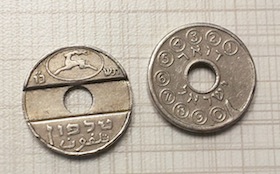
In the days prior to Israel’s becoming a “start-up nation,” telephone service was in pretty sad shape. For many years, most Israelis did not have phones in their homes. So, in the evening, you would wash up, dress up and go outside to use a public telephone. To make your call, you would load your pockets with asimonim, round, grooved, metal tokens. If you were calling someone outside your area code, you would hope that the weight of all the necessary asimonim would not tear your pockets.
In the old days, Israelis would need to gather up their asimonim and head to the public payphone to make a call. (photo by Hidro for Creative Commons)
Talking on payphones was fraught with problems. For starters, how would the person at the other end know you wanted to chat? Answer: the call had to be carefully arranged in advance, with both sides knowing the time, location and telephone numbers of the public telephones that were to be used.
It was an event requiring lots of patience. You had to stand in line with your neighbours, who also wanted to use the phone. You had to ignore the pressure from those behind you, telling you to hurry up and let someone else have a turn. Loud “discussions” occasionally broke out. People claimed they had a dahuf (urgent) call to make or receive. (In Israel, the term dahuf is thrown around a lot.) Thus, the beginning of the Israeli telecommunication era is essentially a study in how people function in groups.
Moreover, Israeli payphones seemed to have a mind of their own. You would be talking when, suddenly, in one big gulp, the telephone cruelly swallowed all your tokens. No amount of whacking the sides of the phone box or banging the receiver in its cradle would return the tokens. You were simply finished for the night. Talking on a payphone was such a tricky business, people would resort to sending postcards, as it was an easier way to relay a message.
By and large, Israeli households did not have telephones until the 1960s – as late as 1964, 55,800 Israeli homes were waiting for phones. If someone had acquired a telephone before the sixties, the person was either suspected of, or envied for, his or her protectzia, the fact that s/he “knew” somebody.
After a long wait – possibly for years – the phone company gave a household a black stationary phone with a short cord. Meaning that, to talk, you had to stay in one place. If you were lucky, nobody’s line would cross yours. If it did, you were stuck listening to their private affairs. People didn’t hang up right away because they didn’t know how long it would take to reconnect with friends. And, while on the subject of talking on the phone, to counter the high cost of doing so, employers with chatty employees or families with talkative children (or adult family members) went to the extreme of putting a lock on their dial phone.
After the implementation of the black telephones, changes came faster. Although the colour choice remained limited, Israelis could choose something other than a phone. They could also order a long phone cord or a press-button phone. Likewise, people could have phones in more than one room. Some advances have gone smoother than others. For example, fax installation and transmission continues to gravely challenge Bezek (the Israeli telephone company, established in 1984) and Bezek users.
In the international sphere, things also changed, albeit unevenly. In the late 1950s, Israel got hooked up to five continents. To place or receive an overseas call, you had to go to the central post office. You sat in a special glassed-in wooden booth while a special operator made the connection.
After a period of time, there were telecartim, or insertable phone cards for public phones. These cards became quite popular and many Israelis became phone card collectors and traders. I remember attending a telecart exhibit in Tel Aviv.
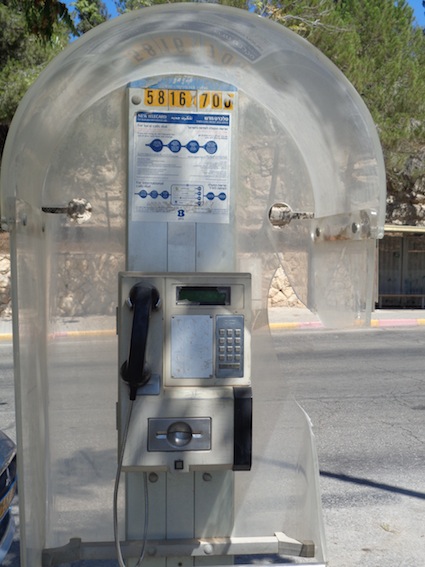
There are a few remaining payphones in Israel. (photo by Deborah Rubin Fields)
What feels like light years later, Israelis started equipping themselves with cellphones and, not long after that, with ear sets. Suddenly, it seemed that many people were experiencing severe mental health problems. In public, flaying arms and shouting at invisible people became rampant. I remember the first time I spotted a person exhibiting this behaviour. Only when he drew near did I see a thin black wire around his jaw and ear. I sighed, “another cellphone casualty.”
Israelis are apparently now making up for lost time by being glued to their mobile phones. They converse everywhere (on dates, in toilets, on trains and buses) about everything.
Some of the usage issues are (pretty close to being) unique to Israel. If you were under the impression that kashrut (kosher) is a food-related concept, think again. In Israel, as well as in a few Western countries, there are kosher cellphones. While they are not edible, they have been a boon to Israel’s ultra-Orthodox community. According to Cellular Israel, “a kosher phone is any phone that is approved and certified by vaad harabonim” (the rabbinic committee for matters of communications).
A kosher phone can only make and receive voice calls. Text messaging and emails will not work on a kosher phone. Moreover, for health, security, public services, water and electricity personnel, there is even a kosher phone designed to avoid breaking the laws of Shabbat. Technically, this mobile device may be dialed without connecting. There is even a kosher de-smarted (meaning that it has no web-browsing capability) smartphone.
Not all the changes appear to be positive. While more studies need to be done, Israeli researchers are beginning to think there is a real downside to cellphone use – it might even interfere with the biblical injunction to “be fruitful and multiply.”
As reported in Reproductive BioMedicine Online, there appears to be an association between higher rates of abnormal semen concentration and talking on cellphones for an hour or more a day, and talking on the devices as they are being charged. Among men who reported holding their phones within 50 centimetres of their groin, a higher rate of abnormal sperm concentration was found. Semen concentration was abnormal among 47% of those who stored their phone in their pants pockets, while it was abnormal in only 11% of the general male population. In brief, Israeli men might need to curb their cellphone use.
There might be another advantage to having an alternative to cellphones. Several years ago, when there was a wave of terrorism, having old-fashioned payphones around turned out to be beneficial. When an attack occurred, Jerusalemites whipped out their cellphones “to report in” with their families. With so many people simultaneously calling, the system crashed. It was the city’s remaining public phones that allowed people to reassure worried loved ones.
Admittedly, many of the above changes likewise happened elsewhere in the Western world; the telecommunication revolution has been a global revolution, after all. But, for many in Israel, each change or step of the way was met with a kind of curiosity or wonder that may have been singular to Israel. Today, that innocence has disappeared. For better or for worse, I’m not sure.
Deborah Rubin Fieldsis an Israel-based features writer. She is also the author of Take a Peek Inside: A Child’s Guide to Radiology Exams, published in English, Hebrew and Arabic.
Biofeed’s Nimrod Israely, top centre, with mango growers in Karnataka, India. (photo from Biofeed via Israel21c)
Shortly before Indian Prime Minister Narendra Modi’s visit to Israel in early July, Indian diplomats in Israel heard about a revolutionary no-spray, environmentally friendly solution against the Oriental fruit fly (Bactrocera dorsalis) made by Biofeed, a 10-employee ag-tech company. They invited Biofeed to be one of six innovative Israeli companies meeting with Modi and Israeli Prime Minister Binyamin Netanyahu.
The company’s founder and chief executive officer, Nimrod Israely, who has a PhD in fruit-fly ecology, told the two leaders that Biofeed’s product can protect Indian farmers against fruit flies like the Iron Dome system protects the people of Israel against missiles. The Oriental fruit fly has been decimating 300 fruit species in India and in 65 other countries in Asia, Africa and the Americas and is considered to be the most destructive, invasive and widespread of all fruit flies.
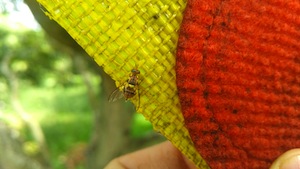
Biofeed’s lures, hung on trees, contain an organic customized mix of food, feeding stimulants and control or therapeutic agents delivered by a patented gravity-controlled fluid release platform. Attracted by the odour, the fly takes a sip and soon dies – without any chemicals reaching the fruit, air or soil.
The launch of Biofeed’s first-in-class attractant for female Oriental fruit flies results from 15 years of development of the core platform and more than a year of development and testing in Israel and Karnataka, India. Mango farmers on four Indian orchards saw an overall decrease of fruit-fly infestation from 95% to less than five percent.
“We were hoping to bring a solution that will replace spraying and increase productivity by 50%,” Israely told Israel21c. “I am excited by the results, demonstrating the future potential for some farmers to bring about 900 times more marketable produce to market.”
A fruit fly feeding in a Biofeed lure. (photo from Biofeed via Israel21c)
One farmer in the Biofeed pilot explained that previously he had used a trap that attracted only male fruit flies, with limited success. “If you cut 25 fruits, we were getting only one good fruit; 24 were infected,” he said.
K. Srinivas Gowda, president of the 70,000-farmer Karnataka Mango Growers Association, wrote in a letter presented to Modi and Netanyahu that he “would like to have this [Biofeed] technology implemented to all the mango farmers through the government of India. This technology can be used to develop pest-free zones in the mango-growing belts in India.”
The pilot project started after Biofeed won a Grand Challenges Israel grant last year from the Israel Innovation Authority and the Foreign Ministry’s international development agency, Mashav.
“We don’t have the Oriental fruit fly in Israel. However, until now there was no solution for this problem. So, we took the challenge and chose to focus on India,” Israely said. The company worked with Kempmann Bioorganics in Bangalore to carry out the trial.
Biofeed’s products are used in many Israeli fruit orchards against the Mediterranean fruit fly and other common pests, including the olive fruit fly and the peach fruit fly (Bactrocera zonata).
“Bactrocera zonata is the number two pest in India. There are three main pests in India, so now we’ve given, within two years, a solution for the two most devastating fruit flies in India and in other parts of the world,” said Israely.
“We are the only company in the world with a solution for those two pests and both solutions are harmless to the environment,” he added. “We estimate the annual market potential of these two pest segments to be well over $1 billion.”
The Biofeed platform is effective with as few as 10 units per hectare and for a period of nearly a year before the dispenser needs replacing.
Biofeed, founded in 2005, also has a formula targeting mosquitoes that bear viruses such as Zika.
“Evolution has given insects an elaborate sense of smell, which they utilize to find mates, food, egg-laying sites and more,” Israely told Israel21c last year. “The company has developed a liquid formula that ‘knows’ how to tie different kinds of smells to other materials, as the need arises. The result is a special ‘decoy’ that draws the target insect through smell. The decoy is slow-released from a device over the course of a year. The insect is drawn to the decoy, feeds off it and dies shortly after.”
Headquartered in Kfar Truman, Biofeed sees the future of agriculture in developing countries such as India and China.
“We want to bring something that is extremely easy to use: you don’t need tractors, you don’t need to remember to spray once a week, you don’t need to put yourself in danger with sprays, there’s no safety equipment. This is something that can make a dramatic change in agriculture and human health,” said Israely.
Israel21cis a nonprofit educational foundation with a mission to focus media and public attention on the 21st-century Israel that exists beyond the conflict. For more, or to donate, visit israel21c.org.
When it comes to Rosh Hashanah, I’m a big fan. It’s hard not to love a Jewish holiday that’s all about spiritual renewal, deep reflection and heartfelt promises to work harder to present our “better selves” to those around us. But, as I move into my mid-40s, I’m realizing there’s more than that to the Jewish New Year – more than those deep brown challahs filled with sweet raisins, more than the novelty of dipping apples in golden honey and dripping them all over the tablecloth before a great meal. Rosh Hashanah is also a profound vessel of memory and, as I defrost my brisket, hunt for the best-yet new quinoa recipe and knead and shape my challahs, I’ll be thinking of the past.
I don’t realize, until Rosh Hashanah rolls around, how vividly that past is available. I yank those memories from the recesses of my mind and daydream my way back to a 14-year-old self growing up in Cape Town, South Africa. Back then, Rosh Hashanah meant receiving a batch of my grandmother’s taiglach, a recipe I’m still determined to tackle and one that will take me, in spirit, immediately and joyfully, into her tiny kitchen. It meant hours in synagogue, listening to the deep baritone voices of the Rondebosch shul choir, and the wonderful melodies of the cantor, who we imported from Israel for that time of year.
It meant family discussions on who to invite to our Rosh Hashanah table, and long debates about whether we could tolerate, for another year, the uncle who arrived in his farm-stained overalls and fell asleep on the sofa before the meal was over. Or the aunt who was always asking for recipes (and never using them) and used fingers, rather than salad servers, to select the leafy greens she wanted on her plate.
There were wild cousins whose antics my parents weren’t certain they wanted unleashed in the house. And friends whose children my sister and I wanted nothing to do with and campaigned loudly for their removal from the guest list.
With hours before the festival’s arrival, as my mother’s culinary activities sent rich aromas wafting over the house, we kids were in charge of setting the table and removing from the dusty cabinet the exquisite glasses my parents had bought while on a Venice honeymoon 15 years earlier. We’d craft name tags and carefully position them around the table, ensuring we occupied the best seats in the house. And we’d decant the wine an elderly relative had made, pouring it carefully into the crystal decanter only used on such occasions.
At the time, I rolled my eyes at the list of chores, grateful for the reprieve from school but unappreciative, as only a teenager with little worldly experience can be, of the treasures at that table. The family members we’d lose as age and cancer robbed them of more time with us. The recipes I’d never have the foresight to record and the hugs and kisses I never cherished long enough.
What I did bring with me over the decades, that would follow me into married life with children, was an unbridled love for Rosh Hashanah and a determination to make it as memory-laden, meaningful and delicious as possible in my home. It’s why, this year and in the years ahead, I’ll spend hours on dishes I’d never normally prepare: sodium-filled chicken soup with kneidlach, tender brisket that will tempt even the avowed vegetarians among my kids and wafer-thin kichel biscuits, perfect with chopped herring. Maybe I’ll even summon the courage to attempt baking sweet, sticky taiglach, a recipe that requires copious amounts of syrup and hours of careful babysitting.
I’ll do all this and more in the name of memory, because it will conjure my own past, a continent and lifetime away, so vividly. And I’ll hug my kids extra-tight, subdued in the knowledge that, one day, they, too, will celebrate this holiday with their own families after I’m six feet under, hopefully cherishing the food and love-laden Rosh Hashanah memories of their own long-gone childhoods.
Lauren Kramer, an award-winning writer and editor, lives in Richmond. To read her work online, visit laurenkramer.net.
Why is it so hard for many of us to shake off the past and begin anew? My Bride often tells me she finds it amazing how easily I forgive myself for my errors. She holds her misgivings about past actions to her breast for eternity. For me, when I forgive myself, I find it much easier to strike off in another direction, one which may, or may not, lead to a better result.
Maybe it has something to do with my background. As an adherent to Judaism, I have always been much taken by the ideas associated with the Jewish New Year. Rosh Hashanah, occurring in the autumn, as determined by the lunar calendar, is one of our major holidays. It is a happy holiday, a time of feasting and family gatherings, celebrating that we managed to get safely through another year. And there are lots of wishes expressed that we might do the same again next year, even marking it in our spiritual birthplace, Jerusalem.
But there is a serious side to the holiday as well. The New Year will be followed closely by the Day of Atonement, Yom Kippur, when all Jews are assessed and judged as to what their fate will be in the year to come. So, the New Year is a time when all Jews are expected to examine their behaviours and make resolutions that, hopefully, will guide their actions more positively in the coming year.
To do so, one has to search one’s conscience, one has to admit to oneself all those things that we have done wrong, that only we know about. We have to admit to ourselves remorse for our actions that we know have not been correct in the light of our values. Then we have to decide that we will not do those things again. We have to forgive ourselves and resolve to do differently. Indeed, during this season, many individuals go out of their way to visit antagonists and others to whom they may have done wrong to beg pardon for any perceived excesses to which they may have been a party.
So, you can see that I come by my approach rightly. It was imbibed with my mother’s milk. Judaism is not unique in including this concept within its construct. It seems to be an important element within many religious and philosophical approaches as to how humans should live. The key thing to me is that we have to be able to forgive ourselves so that our contrition can motivate actions toward a new start.
I must admit I always feel refreshed when I am in the position of having cast off the constrictions imposed by ideas I have been forced to abandon. Ahead of me lie whole new worlds of possibilities. That old stuff didn’t work. What did I learn? Where can I go from here?
What about that idea that we discarded before as impractical, impossible? Could there be something in it? What about what Joe suggested, which we shouted down? Maybe we should ask him to explain it more fully. Could there be something in it that we missed? He has had good ideas before. What if we put that idea together with the one we had? Could that give us a better result? Anybody who has spent a part of his or her life confronting problems, and problem-solving, in concert with other people, will know that of which I speak.
Don’t we feel better after we have cleared the decks with an old adversary? Now maybe we can make a fresh start and work together to accomplish common goals that we share. Isn’t it great when the difference you have had with your spouse has been resolved and you have returned together to the zone of loving and sharing that you were in danger of losing? Isn’t that more important than things that may have divided you? Aren’t so many long-term relationships built by making new starts over and over again?
The Jewish New Year ethic is a part of how we can live our lives each day. Making a fresh start is what we can do every day we wake up. We all know there are things percolating on the back burner. We may not want to think about some of these things. We may push them off to the back of our minds because of their unpleasantness. But they don’t go away. They are the things we will have to tackle if we want to make a fresh start in some important area of our lives.
Max Roytenberg is a Vancouver-based poet, writer and blogger. His recently published Hero in My Own Eyes: Tripping a Life Fantastic is available from Amazon and other online booksellers.
Rosh Hashanah is a time to take stock of the previous year and prepare yourself spiritually for the year ahead. But for those of us with busy families, it can be hard to squeeze time for reflection into the round of Yom Tov preparations. It seems that, once you have children, the holiday focus goes from attending shul to tending to your children and, as rewarding as parenting can be, it leaves little time for focusing on spiritual growth. Yet, one of our most important jobs as parents is to teach our children the concepts of teshuvah (repentance), tefilah (prayer) and tzedakah (charity/justice). How are you supposed to teach these values to your children when you may not have time to connect to them yourself?
Child education expert Moshe Beller has found that the answer lies within the very task at hand – by watching your children.
As director of Beit Metzudot School at Seeach Sod, an Israeli organization for kids and adults with special needs, Beller must often answer tough questions about how to teach children these important values. His answer – emunah (faith/belief) – in them, yourself and, ultimately, in Hashem.
“Here at Seeach Sod, we work with children of all ages and abilities. When we approach educating a child, we look at every detail, from the diagnosis, available therapies and interventions, family circumstances and more. Then we calculate it all to find a solution that best serves the individual child. Though I cannot tell you one therapy that works for every situation, I can say that, at the core of every treatment, is believing that your child can succeed – there is no greater intervention than that!”
Sounds good, but how can we tap into that elusive ideal? If you haven’t guessed it already, it’s our children who can teach us that as well.
Children have a profound ability to trust their parents to lead them. Even if they don’t always follow what you say, they trust you with their life essentials. They trust you will keep them safe, fed, clothed, etc. This level of emunah is one we should allow ourselves to tap into when it comes to grappling with G-d. Mirror what your child displays regularly – let go of the worries that hold you back and know that everything is being taken care of for your benefit.
As for teshuvah, an essential element of teshuvah is believing you can start anew, that you can learn from your mistakes without your ego holding you back. Children display this to us with their ability to live in the moment. They don’t condemn their past actions or the past actions of others like adults do. They’re excited to learn and grow without fear of admitting they don’t know it all.
With respect to tefilah, a key to heartful prayer is awe. A sense of G-d’s greatness and the miracles that surround us each day opens possibilities to so much more. Children have the ability to be wowed by things we take for granted. As adults, we become jaded and forget that the simple pleasures surrounding us are in fact miraculous. Learn from your children and find wonder in the simple creations.
Finally, tzedakah. Have you ever seen how a child lights up when you tell them you need their help? At the core of generosity is the understanding that, no matter what your financial situation is, we all have something we can offer to another. Children take much pride in being able to help, whether or not being of genuine assistance is within their capabilities. We, too, can take the same joy in giving tzedakah and doing acts of chesed (loving-kindness).
This year, instead of seeing your children as a distraction from the path to spiritual preparation for the High Holidays, look to them to guide you towards a year of growth.
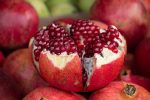
Pomegranates are referred to in the Bible in many various ways. In the sensual poetry of Song of Songs, we read, “I went down into the garden of nuts … to see whether the vine budded and the pomegranates were in flower.” In another passage, the poet writes, “I would cause thee to drink of spiced wine, of the juice of my pomegranate.” Song of Songs has four additional mentions of pomegranates, and there are also references in Joel, Haggai and I Kings.
For many Jews, pomegranates are traditional for Rosh Hashanah. Some believe the dull and leathery skinned, crimson fruit may have really been the tapuach, apple, of the Garden of Eden. According to Forward “Food Maven” Matthew Goodman, the pomegranate originated in Persia and is one of the world’s oldest cultivated fruits, having been domesticated around 4000 BCE. The Egyptians imported pomegranates from the Holy Land in 1150 BCE and natural pomegranate juice, made into spiced wine, was a favourite of Hebrews living in Egypt. Pomegranate wood could also be carved into skewers on which to roast the lamb for Passover.
The word pomegranate means “grained apple.” In Hebrew, it is called rimon, which is also the word for hand grenade! In fact, the English term “hand grenade” is said to come from this and that both the town of Granada in Spain and the stone garnet come from the name and colour of the pomegranate. The juice can also be made into grenadine.
The Hebrews yearned for the pomegranates they left behind in Egypt while wandering in the desert – “And wherefore have ye made us to come up out of Egypt, to bring us in unto this evil place? It is no place of seed, or of figs, or of vines, or of pomegranates.” (Numbers 20:5) And the spies reported their findings in Canaan to Moses: “And they came unto the valley Eshkol and cut down from thence a branch with one cluster of grapes, and they bore it upon a pole between two; they took also of the pomegranates and of the figs.” (Numbers 13:23)
Pomegranates were also used on the faces of the shekel in the second century BCE. King Solomon had an orchard of pomegranates, and pomegranates of brass were part of the pillars of his great Temple in Jerusalem. Throughout the Bible, pomegranates are referred to as a symbol of fertility. As well, in the Jewish mystical tradition of kabbalah, it is said there are 613 seeds in each pomegranate, equaling the number of mitzvot commanded by God.
On the second night of Rosh Hashanah, when it is customary to eat a “new” fruit, one that celebrants have not eaten during the year, many Sephardi Jews choose the pomegranate. They recite the prayer “ken yehi ratzon, may it be thy will, O Creator, that our year be rich and replete with blessings, as the pomegranate is rich and replete with seeds.”
In modern days, a study at the Technion in Haifa a few years ago showed the power of the fruit. The cholesterol oxidation process, which creates lesions that narrow arteries and result in heart disease, was slowed by as much as 40% when subjects drank two to three ounces of pomegranate juice a day for two weeks. The juice reduced the retention of LDL, the “bad” cholesterol that aggregates and forms lesions. When subjects stopped drinking the juice, the beneficial effects lasted about a month. Other studies have shown that pomegranates fight inflammation and cancer, and slow cellular aging. Pomegranates are a good source of potassium, low in calories and low in sodium.
When choosing a pomegranate, look for one that is large, brightly coloured and has a shiny skin. You should store a pomegranate in a plastic bag in the refrigerator, and it can keep up to 10 weeks. To open a pomegranate, score the outside skin into four pieces, then break the fruit apart with your hands following the divisions of the membranes. Pull off the membranes then scrape the seeds into your mouth or lift them out with a spoon. Here are some recipes for those seeds.
POMEGRANATE SYRUP
6 pomegranates 1/3 cup white sugar 1/3 cup brown sugar 1 cinnamon stick 1/8 tsp nutmeg 1/8 tsp allspice
Puree seeds from pomegranates in blender or food processor and strain. Place in saucepan.
Add white sugar, brown sugar and cinnamon stick. Bring to a boil. Reduce heat and simmer about 10 minutes. Add nutmeg and allspice and cook one minute.
Remove from heat, discard cinnamon stick and strain.
BAKED APPLES IN POMEGRANATE SYRUP 6-8 servings
4 slightly tart apples 1 halved pomegranate apple juice 1/3 cup preserves of your choice 1/2 tsp cinnamon
Cut each apple into four wedges. Place in microwavable dish.
Squeeze juice from half the pomegranate into a measuring cup. Add enough apple juice to make half a cup. Add preserves and cinnamon and mix well. Pour over apples to coat them.
Cover with plastic wrap and microwave for two minutes. Stir and microwave two more minutes. Place apple wedges in serving dishes.
Remove seeds from other half of pomegranate and garnish apples.
POMEGRANATE FRUIT SOUFFLE
3 eggs 1 cup + 3 tbsp confectioners’ sugar 1 tbsp unflavoured gelatin 1/2 cup hot water 1/2 cup cold water 7 tbsp orange juice 2 1/2 tbsp lemon juice pulp and seeds of 6 pomegranates
Place yolks and sugar in a saucepan over a second saucepan filled with water (double boiler-style). Cook, stirring, until thick and creamy.
Dissolve gelatin in a bowl of hot water. Then stir in cold water.
Add orange juice, lemon juice, pomegranate pulp and seeds and mix.
Add juice mixture to egg yolk mixture.
Beat egg whites until stiff. Fold into pomegranate mixture. Pour into a soufflé dish or casserole with height built up of three to four inches with a double thickness of wax paper or aluminum foil, stapled or held in place with a paper clip.
Chill in refrigerator until set. Remove band of paper. Decorate with whipped cream.
Sybil Kaplan is a journalist, lecturer, book reviewer and food writer in Jerusalem. She created and leads the weekly English-language Shuk Walks in Machane Yehuda, she has compiled and edited nine kosher cookbooks, and is the author of Witness to History: Ten Years as a Woman Journalist in Israel.
One of the most well-known customs of Rosh Hashanah is the dipping of apple pieces in honey but what is its origin?
In the time of King David, we know he had a “cake made in a pan and a sweet cake” (II Samuel 6: 15, 19) given to everyone. Hosea 3:1 identifies the “sweet cake” as a raisin cake.
The Torah also describes Israel as eretz zvat chalav u’dvash, the land flowing with milk and honey, although the honey was more than likely date honey, a custom retained by many Sephardi Jews to this day.
While honey may have been used in King David’s cake, the honey of ancient Eretz Yisrael was made from dates, grapes, figs or raisins because there were no domestic bees in the land. At that time, only the Syrian bees were there and, to extract honey from their combs, it had to be smoked. Still, honey was of importance in biblical times, as there was no sugar then.
During the Roman period, Italian bees were introduced to the Middle East, and bee honey became more common. Today, Israel has roughly 500 beekeepers who have some 90,000 beehives, which produce more than 3,500 tons of honey annually. Kibbutz Yad Mordechai is the largest producer of honey – 10,000 bottles a day.
Among Ashkenazi Jews, challah is dipped in honey on Rosh Hashanah, instead of having the usual salt sprinkled on it. The blessing over the apple is, “May it be Your will to renew for us a good and sweet year,” before it is dipped in honey.
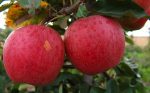
Dipping the apple in honey on Rosh Hashanah is said to symbolize the desire for a sweet new year. Why an apple? In Bereishit, Isaac compares the fragrance of his son, Jacob (who he thinks is his son Esau), to a field, and Rashi says it is sadeh shel tapuchim, a field of apple trees.
Scholars tell us that mystical powers were ascribed to the apple, and people believed it provided good health and personal well-being.
Some attribute the using of an apple at Rosh Hashanah to the translation of the story of Adam and Eve and the forbidden fruit, which caused the expulsion from paradise. The Garden of Eden is also called Chakal Tapuchim, “Garden (or field) of Apple Trees.”
According to Gil Marks (z”l) in Encyclopedia of Jewish Food, “the first recorded association of apples with Rosh Hashanah was in Machzor Vitry, a siddur compiled around 1100, which included this explanation: ‘The residents of France have the custom to eat on Rosh Hashanah red apples….’ Future generations of Ashkenazim adopted the French custom … leading to the most popular and widespread Ashkenazi Rosh Hashanah tradition.”
Rabbi Jacob ben Asher, born around 1269, who fled with his family to Spain in 1303, was the first to mention the custom of apples dipped in honey in his legal compendium Arbah Turim, circa 1310, citing it as a German tradition.
Rabbi Alexander Susslein of Frankfurt, Germany, a 14th-century rabbinic authority, revealed it had become a widespread practice in Germany.
A few years ago, an article revealed that the average Israeli eats 125 apples and 750 grams of honey a year, mostly around the High Holy Days. Israel is very self-sufficient with regard to apples, with around 9,900 acres cultivated yearly, grown in the north, the Galilee hills and the Golan Heights. The most popular types of apples grown are Golden Delicious, Starking, Granny Smith, Jonathan, Gala and Pink Lady.
Honey in Hebrew, dvash, has the same numerical value as the words Av Harachamim, Father of Mercy. We hope that G-d will be merciful on Rosh Hashanah as He judges us for our year’s deeds.
Moroccans dip apples in honey and serve cooked quince, which is an apple-like fruit, symbolizing a sweet future. Other Moroccans dip dates in sesame and anise seeds and powdered sugar in addition to dipping apples in honey. Among some Jews from Egypt, a sweet jelly made of gourds or coconut is used to ensure a sweet year and apples are dipped in sugar water instead of in honey.
Honey is also used by Jews around the world not only for dipping apples but in desserts. Some believe in the phrase, “go your way, eat the fat, drink the sweet,” the sweet referring to apples and honey. Here are some recipes using honey for your Rosh Hashanah eating.
TISHPISHTI: MIDDLE EASTERN HONEY-NUT CAKE
Honey syrup: 1 1/2 cups honey 2/3 cup water 1/3 cup sugar 1/4 cup lemon juice
Cake: 2 cups finely ground almonds, hazelnuts, pistachios or walnuts 1 cup cake meal 2 tsp orange juice 1 tsp ground cinnamon 1/2 tsp allspice or ground cloves 6 eggs 1 cup sugar 1/2 cup vegetable oil 1 tbsp grated orange or lemon zest
Stir honey, water, sugar and lemon juice in a saucepan over low heat until the sugar dissolves, about five minutes. Increase heat to medium, bring to a boil and boil for one minute. Let cool.
Preheat oven to 350°F. Grease a 13-by-nine-inch baking pan.
Combine nuts, cake meal, cinnamon and cloves in a mixing bowl.
In another bowl, beat egg yolks with sugar. Add to nut mixture with orange juice. Add oil and orange or lemon zest.
In a third bowl, beat egg whites until stiff but not dry. Fold into batter. Pour batter into baking pan and bake for 45 minutes. Cool.
Cut cake into one- to two-inch squares or diamonds. Drizzle cooled syrup over the warm cake. Serve at warm or room temperature.
MY GRANDMA SADE’S TEIGLACH Though my grandmother was born in New Jersey, her mother came to the United States as a young girl from Russia, so she probably learned this dish from her mother. Teiglach means “little dough pieces,” and it was originally for family celebrations and various holidays. Today, it is made primarily for Rosh Hashanah as a symbol for a sweet new year. According to my favourite reference book for any food, Marks’ Encyclopedia of Jewish Food, Teiglach was brought to the United States by Eastern Europeans in the early 1900s, and nuts were not part of the recipe in the old country.
2 1/2 cups flour 1 tsp baking powder 4 tbsp oil 4 eggs 1/8 tsp salt 3/4 cup brown sugar 1 1/3 cups honey 1 tsp ground ginger 1/2 tsp ground nutmeg 1 cup finely chopped pecans
In a mixing bowl, combine flour, baking powder, oil, eggs and salt. Stir until dough is formed.
In a saucepan, boil sugar, honey, ginger and nutmeg for 15 minutes.
Wet a board with cold water.
Pinch pieces of dough and drop them into the boiling honey mixture. Cook until very thick. Add nuts and stir. Pour honeyed pieces onto the wet board and cool slightly.
With wet hands, shape dough into two-inch balls or squares. Let cool. Store in an airtight container.
Sybil Kaplan is a journalist, lecturer, book reviewer and food writer in Jerusalem. She created and leads the weekly English-language Shuk Walks in Machane Yehuda, she has compiled and edited nine kosher cookbooks, and is the author of Witness to History: Ten Years as a Woman Journalist in Israel.