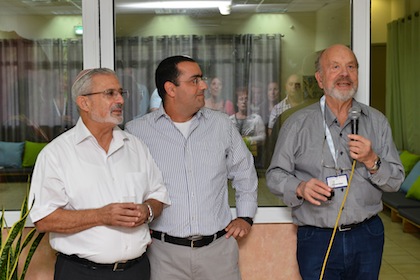
Jonathan Kallner, event speaker and managing partner, KPMG, talks with Eli Joseph, senior account manager, business and personal, RBC Royal Bank, at Schara Tzedeck’s LinkYid networking event June 3. (photo by Baila Lazarus)
There is a theory that you are the average of the five people you hang around with the most. Thus, creating and interacting with a successful network of businesspeople should, over time, increase your own level of success.
With this in mind, Jonathan Kallner, managing partner, KPMG Vancouver, opened LinkYid’s first complimentary career networking breakfast with the topic, How to Unleash the Power of Your Network.
LinkYid is a Congregation Schara Tzedeck program that connects immigrants, professionals and entrepreneurs with mentors, employment and business opportunities that match their potential. They held their first event at KPMG on June 3.
“This topic ties into a core pillar in our strategy [at KPMG], which is community,” said Kallner. “We believe in building networks and helping networks succeed.”
Talking about his own experiences in school, in his job and the industry, Kallner admitted that, when he needed to make major decisions, he turned to his contacts.
“If you nurture the networks, they become your supporters,” he said. But, he added, “I didn’t appreciate how important that was until later in my career. I never realized what a difference there could have been in my life.”
Using Blockbuster as an example of failed relationship-building, Kallner pointed out how successful the video rental company had been, with an outlet in every neighborhood and relationships with everyone in the local community.
“If you wanted to watch a movie, you went to Blockbuster and, in four years, they destroyed it,” said Kallner. “Because they did not maintain the relationships with their customers, they allowed someone else to come in and own that relationship.
“It’s no different in our everyday lives,” he said. “The world can change around you but your relationships can stay constant.”
Kallner outlined four key points in building networks and relationships:
1. Know your goals. Each person needs to establish their own personal plan for their business, looking forward one, two and five years. Focus on the skills you have that you can capitalize on and what you need to develop. Use your networking connections to seek advice and consider it.
“When you’re looking at strengths and weaknesses, be very honest,” said Kallner. People looking to hire want to know that candidates have a good understanding of this, he said.
2. Consider getting a coach or mentor. Many of those who have gone before you in the industry will be willing to share their experiences with you, said Kallner. “They can challenge you to think differently and push your boundaries. They can act as a connector, help you develop your personal goals and work with you to define the next steps in your career.” Mentors will also be candid with you to encourage your business and personal growth.
“I still seek the guidance of mentors,” said Kallner, adding that the mentor or coach will also get value out of the relationship.
3. Build and work your network. Any search for business groups on Meetup will yield dozens of groups you can connect with in the Lower Mainland in any given week, but there are more and less effective ways of working your networks. Talk to new people at each event, said Kallner.
Respect their time and don’t be a salesperson, he added, as the key to networking is building relationships. “Don’t overlook how networks build naturally and don’t rush it,” he advised.
4. Take advantage of social media. While online presence is essential, especially when building your digital networks, there are things to look out for, said Kallner. Select the right platform. LinkedIn is considered the best platform for business operators. Others can be beneficial but you have to manage your brand closely, keep active on the site on a regular basis and make sure your profile is professional.
“Facebook can kill a brand if you’re not careful to be professional with your posts,” he said.
The LinkYid networking session drew students, entrepreneurs and professionals seeking work, looking for new hires or simply to start their relationship-building.
Erez Iancu Ben Haim, an MBA student at Sauder School of Business, was there to start building his connections and discuss his goals with people in the room. Eli Joseph, a senior account manager with RBC Royal Bank, wanted to meet some new people and find new businesses that might be looking for government loans.
“Being in the business world, people come to me if they’re looking for connections, as well,” said Joseph.
In closing his talk, Kallner reminded people of two key takeaways:
Follow up after meeting with someone at an event with a personalized invitation to connect.
Networking doesn’t only happen at events. It can happen anywhere.
To find out more about LinkYid, visit linkyid.net, email Rachael Lewinski at [email protected] or call 604-736-7607.
Baila Lazarusis a freelance writer and media trainer in Vancouver. Her consulting work can be seen at phase2coaching.com.
The cover of Outlook magazine’s final issue features a painting by Lithuanian artist Yehuda Pen (1854-1937). The newspaper in the image, explains the caption, is Der fraynd (The Friend), which, “founded in 1903, was one of the major Yiddish newspapers of its day before it was closed down in 1913 by czarist censors.” For Outlook – “Canada’s only progressive Jewish periodical” – it wasn’t censors that caused its demise, but the economy, one that has seen many print publications close their doors.
“We have struggled uphill for quite awhile with the difficulties and expenses of sustaining a print publication with a small and specialized – although devoted – readership, and we must finally let go,” writes editor Carl Rosenberg in the magazine’s final issue, the Spring 2016 edition.
“Looking back, we are proud of having given a home to diverse voices in the left and Jewish communities: liberal Zionist, non- and anti-Zionist, Yiddishist, Marxist, feminist, anarchist, environmentalist, social democratic,” he continues. “We have covered and reflected the Canadian and international scene, including labor struggles, environmental issues, women’s issues, issues of sexuality, gender, human rights and civil liberties. We have hosted lively, often impassioned, debates on many issues, and we hope they have usually been respectful as well.
“We have upheld a cultural heritage dear to most secular Jews – that of Yiddish language and literature. We have published works by and about a wide variety of Yiddish writers, men and women, and recounted the rich and dynamic history of the secular Yiddish culture that emerged in Eastern Europe a century and a half ago and has played such a large part in modern Jewish history and culture.
“We have remembered one of the greatest crimes in recorded history – the Nazi Holocaust or Shoah against the Jews of Europe, paying tribute to those who resisted against impossible odds. We have tried to draw universal lessons from this monstrosity, speaking out against racism, chauvinism and fanaticism of all kinds. On the Israeli-Palestinian conflict, we have supported the rights of both peoples to exist in peace and equality, while opposing violence on all sides, and we have opposed the decades-long Israeli occupation of the West Bank and Gaza and the systematic Israeli violation of Palestinian human and national rights.”
In an article by Leslie Dyson, managing editor Sylvia Friedman – whose involvement with Outlook goes back 43 years – explains a bit of the publication’s history. While she connected with the magazine in Toronto in 1973, it started in 1963, evolving, writes Dyson, “from an English-language insert in the Vochenblatt (Weekly Paper),” which closed its doors in 1978, “due to the ill-health of its editor, Joshua Gershman, who was also for a time the de facto editor of Outlook, where [Friedman] worked with him.
“In 1979, Friedman announced that she was moving with her family to Vancouver. It seemed that Outlook (known then as Canadian Jewish Outlook) would have to fold. Ben Chud and Hank Rosenthal, progressive Jewish activists in Vancouver, asked if they could jointly take over the role of editor and have Friedman manage the magazine in Vancouver – an arrangement that was accepted.”
The magazine describes itself as “an independent, secular Jewish publication with a socialist-humanist perspective.” Published six times a year, it had collectives in Ottawa, Toronto, Winnipeg and Vancouver. It has had an office in the Peretz Centre for Secular Culture (which used to be called the Vancouver Peretz Institute) since the late 1980s. Rosenberg became assistant editor in 1993 and editor in 1998.
“We didn’t follow a particular policy,” Friedman told Dyson, “but we have been critical of what’s happening in Israel, the States, Canada and B.C. I guess the focus has been on equality and principles of socialism. But even left-leaning governments never received blind support.”
Financed by fundraisers held in Vancouver, Winnipeg and Toronto; subscriptions; and funds bequeathed by “Joseph Zuken (a long-time openly communist city council member in Winnipeg) and Ben Shek (a professor, social justice activist, active member of the Toronto Jewish Folk Choir and regular contributor to Outlook),” making ends meet has always been challenging for Outlook. At its highest, circulation was 3,000 copies in the 1990s.
With older readers literally dying off and younger readers getting their information from the internet, plus constantly increasing printing and mailing costs, publishing the magazine just became too expensive.
The final issue features many comments from readers about what Outlook has meant to them, essays on such topics as the future of the NDP and the state of public broadcasting, and several book reviews.
A new handbook published by T’ruah: The Rabbinic Call for Human Rights provides a resource for the Jewish community to press for change around the problem of mass incarceration in the United States.
“We are here to uphold ideas of redemption and mercy,” said T’ruah director of programs Rabbi Rachel Kahn-Troster, citing a colleague who described America’s prisons as having a “mercy deficit.”
The handbook is available for free download at truah.org/incarceration. It provides background and resources – steeped in Jewish texts and teachings – for Jewish communities to take action around these issues. Leading a network of 1,800 rabbis across North America, T’ruah aims to bring attention to an array of domestic social justice issues, as well as human rights for Israelis and Palestinians.
When it comes to mass incarceration, Canada doesn’t have the same problem, but we have similar societal ills when it comes to race, ethnicity and imprisonment – as well as problematic prison conditions themselves – that call out for redress.
The handbook initiative came out of T’ruah’s earlier work on ending solitary confinement. Over the last couple of years, Kahn-Troster has found the Jewish community to be increasingly receptive to grappling with issues around incarceration. Michelle Alexander’s book The New Jim Crow: Mass Incarceration in the Age of Colorblindness, which details the effect that mass incarceration – and the subsequent denial of civil rights for convicted felons – has had on the African American community, really opened people’s eyes, she told the Independent.
Why the term mass incarceration? Compared to other countries, the United States imprisons its population at alarmingly high rates: 698 out of every 100,000 citizens are behind bars. For comparative purposes, Canada’s per capita rate is 141 out of 100,000, according to Statistics Canada.
And then there is the problem of race. African Americans are six times more likely to be jailed than their white counterparts, yet crime rates are not necessarily different. According to American Civil Liberties Union data cited in the T’ruah report, despite equal rates of actual usage, a black person in America is 3.73 times more likely as a white person to be arrested for drug use.
In Canada, blacks are incarcerated at three times their rate in society, according to the Office of Correctional the Investigator of Canada (OCIC). And, while only four percent of the population of Canada is aboriginal, 25% of the prison population is aboriginal. Among the female prison population, fully 36% are aboriginal, and these percentages are only increasing, according to CBC News reporting from January of this year. For aboriginal adults in Canada, the incarceration rate is 10 times higher than for non-aboriginal adults, says OCIC. Maclean’s, in February, quoted criminologists describing Canadian prisons as the country’s new “residential schools.”
In addition, a report from Saskatoon and Regina, cited in the Saskatoon StarPhoenix, revealed that indigenous students are 1.6 times more likely to be stopped on the street than non-indigenous students. A Toronto Star analysis revealed that, in Toronto, blacks are three times more likely to be stopped by police than non-blacks.
As the Supreme Court of Canada has noted, “courts must take judicial notice of such matters as the history of colonialism, displacement and residential schools and how that history continues to translate into lower educational attainment, lower incomes, higher unemployment, higher rates of substance abuse and suicide and, of course, higher levels of incarceration for aboriginal peoples.”
The legacy of slavery in America looms large, and racial bias in the criminal justice system continues to haunt society. “People of color are more likely to be pulled over,” Kahn-Troster said. “The War on Drugs enables cops to search them. There’s a higher level of policing in black areas; there’s racial bias in jury selection; it’s easier to strike black people from juries; the sentencing is harsher if there’s a black perpetrator and a white victim than the other way around.”
In Canada, solitary confinement is an ongoing issue, as is overcrowding, concern over mental and physical health and rehabilitation, and an overall troubling rise in incarceration rates just as the crime rate lessens. Reporting in the Toronto Star puts the figure at a 17% increase in the federal prison population over the last decade.
With t’shuvah (repentance), cheshbon hanefesh (personal accounting), a questioning spirit and the search for social justice all core Jewish values, T’ruah’s initiative is laudable. It’s easy to look away – and harder to do the tough work of asking how we can both prevent harm to victims while improving our nation’s justice system to avoid discrimination and to shelter the most vulnerable.
Mira Sucharovis an associate professor of political science at Carleton University. She is a columnist for Canadian Jewish News and contributes to Haaretz and the Jewish Daily Forward, among other publications.
A concert at Deer Lake Park gets Matty Flader thinking about social media. (photo from deerlakepark.org)
King David High School’s creative writing course, taught by Aron Rosenberg, partnered with the Jewish Independent for their final unit of the school year. Students were challenged to write articles reflecting on their identity as young Vancouverites in the Jewish community. After brainstorming topics, the students agreed to focus an article on technology or print media, and how these things are changing and will continue to transform in the future. Here are some of their thoughts.
Phone-y confidence by Matty Flader
Last night, I went to a concert in Deer Lake Park, an outdoor venue, with my sister. We went to see the Lumineers, a folk band that has become fairly popular since their debut album in 2013. I was rather excited to see the show, as I am a big fan of the band’s music and unique style.
It rained throughout the concert, which was a major annoyance. Getting soaked and standing in the mud for a few hours is not everyone’s ideal evening, but it was worth it for the music. The band was excellent at performing live and it was an amazing show. One thing that almost did ruin my experience, however, was the sea of cellphones raised above people’s heads filming the concert. Almost everyone at some point had their phones out to film the concert to share with their friends over social media.
One thing I think our parents do not understand about our generation is that social media is a competition. We constantly compete by sharing statuses, photos and videos of anything significant we do. The goal is simple acknowledgement or validation from our peers; we want them to be jealous of how amazing our lives are. The most famous of our friends – the one with the most likes and shares – is the most successful among us, though we wouldn’t admit that aloud. Our generation lives in constant fear of being forgotten or ignored, and we use social media as a way to remind our friends of how exciting we are.
It is no longer innate to live in the moment. Now that everything is expected to be documented, we live our best moments through the small screens of our phones. Concerts are just the tip of the iceberg. I have encountered this issue at graduations, parties, hanging out with friends, and even spending time with one’s parents. Although I love modern technology, sometimes I wish I could exist without the ominous anxiety of social media.
Technology today by Eli Friedland
We live in a world where technology is the new alcohol. Rather than face reality, people stare at their screens, lost in the lives of others. Picture perfect images captured for eternity. Model-worthy smiles lighting up the screen. Are they real? That is the question most people fail to ask themselves when they zealously peruse the photos that flood their news feeds.
Eli Friedland is happy to have one day a week to power off. (photo from pexels.com)
We live in a world where, rather than make conversation with those in front of us, we choose to talk to an online persona. We have closed the gap from those distant to us, yet we have distanced the gap from those closest to us. We ride the bus in silence, the only sound, fingers tapping away at screens. We receive validation from ambiguous “likes” and take pride in meaningless comments. We allow the world to pass us by as we scroll through the news in far off lands. We only see the perfect that happens to others, that which is posted online. Tired eyes scroll through vast oceans of pictures that have no end.
Constant alertness and comparisons are our 10 plagues. We need redemption from technology. I cannot bear to imagine a world in which people cannot talk, for technology has robbed us of our voices. I fear this more than anything and I know that G-d gave us a day of rest to prevent this plague from growing too large.
Every Friday at sundown, I power down. I turn my phone off, I put my laptop away and I put all electronics out of sight and out of mind. All week, I long for Friday, when I have a valid excuse to disconnect from technology. Rather than staring anxiously at my smartphone, I make myself smart. I read books, I learn from my family, friends and the rabbi’s lectures. I spend all week learning hacks for my phone but, come the weekend, I learn about people. Instead of awaiting a text or phone call that might never come, I knock on my friends’ doors and we go to the park, we walk, we talk. I play Bananagrams with my parents, I soak up the sun with my brother, I interact with humanity in a way unparalleled when phones are out. On the Jewish day of rest, I receive people’s undivided attention and they receive mine.
Death of print media by Noah Hayes
In Canada, print media’s roots go back to the Halifax Gazette, started in 1752. Since then, print media has reigned as the dominant form of news media all over the world. But it’s no secret that digital streams of information are pushing aside the morning paper. The reality is that your kids will likely wake up in the morning and go on their electronic devices to see the latest happenings, rather than wake up to a freshly printed newspaper, waiting to be read and, eventually, discarded.
As a high school student who values media but rarely in print, I am often confronted with the question of why we don’t really need print media anymore. If you need a plumber, a painter, a lawyer or a car, you’re likely not looking in your newspaper these days. It’s not like word of mouth is a modern concept but, with the internet as a platform to share recommendations and spread ideas, newspaper advertisements are less relevant.
Noah Hayes predicts the demise of print media, as younger people get all their information electronically.
Some may suggest that print ads – and not just in newspapers – can be more effective because they target specific geographic regions or interest groups. For instance, if I know of a wealthier area in the city that has lots of nice cars and is mostly made up of younger people, I can advertise a more expensive car that younger people would be more interested in on a bus stop, or even on the side of a bus that goes through there. In a rougher area of the city, I can advertise an entry-level car because more people might be willing to buy it.
What’s becoming more and more the reality, however, is that the internet can do the same thing, with even greater accuracy and efficiency; data tracking in this day and age is limitless. If you’ve been searching for a new pair of shoes on a website, ads for that website can appear on the next site you’re on, even if it’s totally unrelated to shoes. You’re being tracked on most sites that you go on. It’s 2016 and, even with Edward Snowden’s notoriety, people are still unaware of the trail they create just by going on their computer. And this trail is analyzed for more than just advertising.
What about entertainment? Many read print media to stay up to date or see an interesting piece from their favorite columnist in the morning. These newspapers or magazines now almost always have websites where you can also read your favorite columnists. If you go on Twitter, you can get live updates from your favorite journalist or news source, along with a link to articles they publish. Your dearest sports team probably has a website, along with sites dedicated to covering it, and their beat writer likely has a sturdy online presence, too. If you just want a gob of information to delve into, try going on Reddit or Buzzfeed. Some sites go well beyond the impersonal newspaper and literally let you customize your own homepage to only get info on the things you’re interested in. Want pictures? Check. Want funny pictures? Check. Want funny pictures of cats doing awkward, cute poses? Check.
The biggest reason why people seem to be migrating away from print media towards the internet is cost. Though newspaper and magazine companies can still charge you for reading their websites, most digital media is free. For these companies, why produce a print version if they’re also going to put their content online? Perhaps the sense of familiarity and comfort that comes with print media is its most effective selling point. The digital world hasn’t hit its peak yet because the older generation still values the routine and ritual of the morning paper or magazines.
As morbid as it sounds, the only part of print media that doesn’t seem easily replaceable is the “In Memoriam” section of the newspaper. There are few ways to find out about lost loved ones in the community, or the anniversaries of their passing. However, the community of the internet is much larger than the local communities that find solace in the local newspaper’s “In Memoriam” section and, one day, the internet will provide this service, too.
Digital media is simply too powerful. It’s a tool that can be used in dozens of different ways, an unstoppable machine that will eventually show print media the door, and make sure that door hits its tuchus on the way out.
Print’s ironic future by Leora Schertzer
Every day, more than two million news articles are published online. Millennials subscribe to a fast-paced lifestyle, making the internet a popular platform to read the news mere minutes after the fact. People share news and magazine articles with their friends and followers over Facebook, Snapchat, Twitter and beyond. If you were to ask the average young adult where she or he reads about the latest happenings, the answer would most likely be through the shared articles of her or his online peers. Perhaps a more cultured individual would name a specific news source that she or he frequents to maintain a sharp awareness of the world, which would also be online.
Leora Schertzer thinks that print media might become cool again … 40 years from now.
Though the future of print media seems dire, I would argue that not all hope is lost. Many people still prefer paper copies of newspapers, magazines and books. Some claim that a good old physical copy feels more personal and less distracting. With access to literally millions of other articles online, users could feel rushed or anxious, knowing that there are so many more articles to be read. A real newspaper feels like your own and, with one’s options limited to one paper, consumers could feel satisfied with the articles they have read, rather than feeling they have merely grazed the tip of the iceberg of daily news.
Another reason print media may live on is for the sake of esthetic and irony, similarly to vinyl records. People still love their vinyl record collections, even though far more practical and efficient ways of listening to music are out there. Some may hang on to print newspapers and magazines for the novelty, or because they believe the “original way” is the “best way.” For this reason, print media may make a comeback within the next 40 years. Though print media will become more of a niche market in the near future, as it becomes less common or mainstream, it may ironically become more highly regarded – what becomes less viable, becomes more valuable.
During the seven weeks of the counting of the Omer to Shavuot, Temple Sholom’s religious school students bring donations of cereal for the Jewish Food Bank. (photo from Sara Ciacci)
For a number of years, during the seven weeks of the counting of the Omer to Shavuot, Temple Sholom’s religious school students have brought donations of cereal for the Jewish Food Bank. The young students are proud and excited to share with those in need and their parents and teachers help instil in them the meaning of tzedakah.
Although everyone agrees that the food of choice for Shavuot is cheese, and especially cheesecake, there are differences of opinion (some quite charming) as to why it is a custom. One explanation is that, at Sinai, the Israelites were considered to be as innocent as newborns, whose food is milk. Others connect the practice directly to scripture, saying we eat dairy to symbolize the “land flowing with milk and honey” promised to the Israelites.
Today, for more than 400 Jewish members of the Metro Vancouver community, Shavuot is not a day spent recalling a land flowing with milk and honey. Rather, Shavuot is a day like any other. A day when their below-the-poverty-line means do not allow them to celebrate with even a few of the traditional food items. Having been a recipient of help myself from the Jewish community as a child during the Depression years has influenced my lifelong understanding of how much of a difference it makes to the well-being of an individual to be able to mark the Jewish holidays, and to not worry for at least one day how they will sustain themselves (and their family).
Religious school is out for the summer and Shavuot has passed. However, the need to share with those less fortunate does not take a holiday. Your sharing and caring is needed throughout the year. Food donations can be dropped off at Temple Sholom, other synagogues and the Jewish Community Centre of Greater Vancouver. Donations earmarked for the Jewish Food Bank can be mailed to Temple Sholom at 7190 Oak St., Vancouver, B.C., V6P 3Z9.
Sara Ciacciis past president and longtime member of Temple Sholom Sisterhood board. She has been involved with the Jewish Food Bank since its inception and is the recipient of the Jewish Family Service Agency’s 2015 Paula Lenga Award.
Linda Frimer was honored earlier this month by the University of the Fraser Valley for her artistic, humanitarian and philanthropic contributions and accomplishments. (photo from UFV)
For Linda Frimer, art is a form of reconciliation, and creativity a means of expressing the love within us all. The Vancouver artist has been sharing her art to heal, help worthy causes, and reconcile nature and culture for more than 35 years. In recognition of her artistic, humanitarian and philanthropic contributions and accomplishments, Frimer received an honorary doctor of letters degree from the University of the Fraser Valley at its June 2 afternoon convocation ceremony at the Abbotsford Centre.
Born in Wells, B.C., and raised in Prince George, Frimer connected with nature early on, and it informed her artistic development from the start. “I always had a pencil in hand and was allowed to roam the forest freely as a young girl,” she recalled.
Born a few years after the Second World War ended, she heard the adults in her family whispering about the devastation of the Holocaust. Even decades before the war, her family faced hatred and expulsion. Her grandfather fled Romania during the pogroms in the late 19th century, becoming one of the “footwalkers” roaming Europe, then following the Grand Trunk Railroad in Canada to its terminus in Prince George, where he became a merchant.
“I was too young to understand it all, but I knew something very bad had happened,” said Frimer. “I was a highly sensitive child, and absorbed the pain and anguish that others were carrying. I turned to nature for healing and reconciliation. I would enter the forest with a sense of awe and wonder. It’s what unites all people. When we suddenly see a magical tree or a sunset that leaves us breathless, that wonder belongs to everyone. I’ve always wanted to bring together the worlds of nature and culture. They are all connected, and recognizing that interconnectedness facilitates healing.”
Compelled by a desire to reflect the pain of her community and work towards healing, she created many works of art examining this theme. She co-founded the Gesher (Hebrew for Bridge) Project, a multidisciplinary group that helped Holocaust survivors and their children express their traumatic experiences through art, words and therapy.
Reflecting on the project during a talk she gave to the Canadian Counseling and Psychotherapy Association, she noted that creative expression is a critical component to healing. “I’ve done work that reflects my culture and my people and their plight, but I don’t want to get caught in the dark places. I want to share reverence between all cultures. I want to bring light and love to the forefront.”
From an early age, Frimer felt an affinity for the aboriginal people she grew up near in rural British Columbia. Her connection became more formalized when she befriended Cree artist George Littlechild (also a UFV honorary degree recipient). The two felt an immediate connection through their interest in incorporating family and history into their art and their use of vibrant colors. They have collaborated to produce art shows presented in venues such as the Canadian consulate in Los Angeles, and produced a book titled In Honor of Our Grandmothers.
“Both of our peoples have been through so much that we felt a real connection,” explained Frimer. “Growing up, I felt a real sense of ‘otherness’ and not fitting in. Many aboriginal people can relate to that, too.”
Frimer’s affinity to nature has led to her supporting many environmental causes. Her paintings for the Wilderness Committee, the Trans-Canada Trail, the Raincoast Environmental Foundation and other groups have raised funds for wilderness preservation, and also raised awareness of threatened forests and ecosystems.
“I love my environmental work because I know that’s where I can make a difference,” she said. “I am committed to helping to preserve endangered species and ecosystems, as well as helping people at risk or in crisis.”
Frimer spent her 20s raising her children and developing her artistic skills by finding mentors with whom to study. She didn’t begin her formal training until she was 33, when her last child started school. She then finished a four-year degree at Emily Carr in three years, receiving credit for her prior learning and artistic work.
More than three decades into her career, Frimer’s paintings and murals can be found in galleries, synagogues, churches, retirement centres, hospitals, hospices, schools, transition houses, corporate offices, and public and private collections. She has been very prolific but says it’s been easy to create so much art because she feels she is merely a vessel for a strong creative force. “It’s like joy coming through me, rather than me making it happen,” she said.
Frimer has received many accolades, honors and titles, but said her favorite title is “Grandma.” She and her husband Michael raised their blended family of eight children and now enjoy the company of nine grandchildren. “It’s profoundly important, especially for the Jewish people, who have lost so much, to rebuild the family we’ve lost and share reverence with others who have had similar losses,” she said.
Still, receiving an honorary doctorate is a special distinction for her. “My parents would have been extremely proud, and I know that my husband and children will be too,” she said before the convocation. “You can’t really declare yourself a successful artist – you need affirmation from the outside. I’m so grateful that my messages have been heard, and that the care that I’ve put into bringing more culture, nature, creativity, expression, healing and light into the world through the gift of art is being honored.”
For more about Frimer and her art, visit lindafrimer.ca.
Aaron Friedland’s Walking School Bus garnered the Canadian Friends of the Hebrew University of Jerusalem’s 2016 Next Einstein award. (photo from Aaron Friedland)
When Vancouverite Aaron Friedland, 23, heard his Walking School Bus digital reading program was the recipient of the Canadian Friends of the Hebrew University of Jerusalem’s 2016 Next Einstein competition, he was surprised to say the least. Studying for his master’s dissertation on applied economics at the University of British Columbia, he’d entered it into the contest without ever thinking his would be the $10,000 grand prize winner out of 1,400 submissions.
Friedland was born in South Africa and immigrated to Vancouver with his family in 1993, when he was a year old. In 2011, while he was attending King David High School, he and his family visited Uganda’s Abayudaya community on a “voluntourism” project that would change his life and inspire the Walking School Bus.
“Three things left an impression on me during that trip,” he reflected. “One was the distance Ugandan students were walking to school, with many traveling five to eight kilometres each way. They needed a school bus. Then, I noticed their daily nutrition of maize meal and wondered, what’s the point in bringing them to school when they haven’t eaten anything for breakfast? And when the curriculum at the school is almost nonexistent?”
Back in Vancouver, Friedland had two goals: to raise awareness of the plight of Uganda’s students by publishing a book, The Walking School Bus, and to use the money from book sales to buy a school bus. An Indiegogo campaign raised $12,000 and Friedland is negotiating publication of the book with a major publisher. “But I received so much interest in what I was doing that I realized the efforts should end with an organization, not a book.”
He learned the tools of creating such an organization at McGill, where he studied economics and economic development, and, later, as an analyst in a fellow position at United Nations Watch in Geneva. It was in Geneva that he became determined to form an organization around The Walking School Bus that might accomplish all three of his goals: not just the school bus, but agricultural training that would enable locals to grow more nutritious food and an enhanced school curriculum that would engage students better in learning.
The Walking School Bus was incorporated into a nonprofit foundation in 2015 and is presently in the throes of conducting economic research. “We’ve raised $25,000 to buy our first school bus, developed the models we need to ensure that bus can be sustained in the community and raised awareness in Vancouver, North America and parts of Australia about what it is to access education,” he said. He will soon lead a group of 18 economists, professors, educators and volunteers to Uganda to deliver the school bus.
In the Walking School Bus’ digital reading program, volunteers create audiobooks that are shared with partnering schools in Uganda, Canada and the United States – a total of 40 schools to date. Friedland has also created a Hebrew textbook, read by students at KDHS, that will help Ugandan Jewish students learn Hebrew. “We’re looking for students to help us create more books,” he said, and encouraged Canadian teachers to learn more about helping out with the reading program online at thewalkingschoolbus.com.
The prize money from the Next Einstein competition is being used to create a downloadable app that will allow people anywhere in the world to read books and poems from their cellphones. “They will be able to see text and even record themselves and send it in to our servers. Our team will engineer those recordings and send them on to empower literacy for students.”
Far from limiting his sights to Uganda, Friedland’s vision for the Walking School Bus is global. When he delivered a TEDx talk in India in recent months, he toured the Dharavi slum in Mumbai and noticed again the distance children were walking to school. He immediately assembled a team, comprised mostly of students from the Delhi Technological University, to investigate the possibility of building a suspension bridge. With a bridge across the river, students could walk 100 metres instead of the five-kilometre route around it. “We’re doing our due diligence right now, scoping out project locations and conducting cost-benefit analyses,” he said.
Friedland said his parents, Phillipa and Des, laid the foundations for his work by teaching their children “how everyone was equal, regardless of what the media said or what the social norms of the time were.”
He said, “My entire life I’ve watched my incredible parents do good things, whether it was my dad picking up earthworms so they wouldn’t be crushed by traffic, or my mom giving money to every single homeless person she saw. I saw how they were able to positively impact people, and how good it made them feel. That motivated me to apply those same principles as an adult.”
Lauren Kramer, an award-winning writer and editor, lives in Richmond. To read her work online, visit laurenkramer.net. A version of this article was originally published in the Canadian Jewish News.
Lana Shahar-Kulik (back right) with some of her skating students. (photo from Lana Shahar-Kulik)
Lana Shahar-Kulik approaches life creatively. “In any situation, I like to imagine, What else could I do? How could I make it more interesting? And then I make my imagination a reality,” she said in an interview with the Independent.
Since she was 6 years old, she wanted to be a teacher, and she became one. She taught elementary school for several years in her native Riga, Latvia, before immigrating to Israel in 1998. Her professional life took an unexpected detour there, as she explored a different facet of her exuberant personality.
“I could become a teacher again but I wanted to try something different. I took classes in accounting but, after a couple weeks, I was so bored I wanted to scream. Numbers all day long. Then, our instructor introduced us to new software and told us to create an image with it. Most of my classmates drew some tools; I drew a dog. I enjoyed tinkering with the program. My instructor looked at my dog and said, ‘What are you doing here? You should study art.’”
That was the end of her accounting career. She enrolled in design college in Tel Aviv and spent four intensive years studying graphic design and visual communications.
“I always drew when I was young, but my parents – they were engineers – and I considered it a hobby. Only in Israel art became my profession. I loved it. It was what I wanted to do. I felt almost ecstatic with happiness. I could talk to people who thought like I did, who loved and understood art the way I did. I found my niche.”
Her teacher’s training helped her – she taught art at community centres to pay her college tuition. Afterward, she tried different areas of graphic design. She worked for the fashion industry and in marketing. “But I always wanted to create a book,” she recalled.
That dream didn’t materialize until she moved to Canada with her husband and baby daughter. In 2008, they settled in Vancouver.
“My husband went to work right away – he is a computer guy – but I stayed at home. My daughter was only months old, so we walked outside a lot. That was when I wrote a picture book about a young girl having adventures in Vancouver.”
Her picture book, Curly Orli Goes to Vancouver, by Lana Lagoonca, Shahar-Kulik’s pen name, was published in 2011. She subtitled the book “Plasticine Adventures,” because she originally created all the illustrations as colorful plasticine sculptures. Later, she hired a photographer to photograph her tiny sculptures and used those photos as the book’s images. (For more on Curly Orli and Lagoonca, click here.)
The book opened up a new and fascinating avenue for Shahar-Kulik: brand merchandising. Key chains, jigsaw puzzles, greeting cards, T-shirts and other objects featuring the images from her book are available at curlyorli.com and at several gift shops in Vancouver. She also offers workshops in plasticine and Play-Doh for children of different ages. “I plan to write more books about the same girl, Curly Orli, traveling to different cities, if only I had more time,” she said.
Shahar-Kulik’s love for Vancouver also motivated her to create an adult equivalent of the book – a blog about Vancouver in Russian for tourists and newcomers (lagoonca.livejournal.com).
“I haven’t updated this blog in years, no time, but people still write to me and ask me questions. I always reply, always try to help,” she said.
Helping clients with their graphic design needs, from websites to fashion catalogues, is what Shahar-Kulik’s company, Lunart (lunart.ca), does in four languages: English, Russian, Hebrew and Latvian.
Despite a very busy schedule, Shahar-Kulik recently added another activity to her portfolio. She has started teaching again – roller skating, where the skates have two rows of wheels (quads), and inline skating, where the skates have one set of wheels.
“I loved ice skating as a kid,” she said. “We had a big puddle in our yard and, in winter, it iced over. That’s where I learned to skate. When we came to Tel Aviv, there is no ice there, but there is a large and free outdoor rink for inline skating. I loved it. I learned to do tricks, danced on skates, even had a partner. It is another outlet for my creativity. Skating is like art on wheels. You create beauty with your feet.”
Shahar-Kulik started skating here when her daughter started day care.
“I discovered that Vancouver had no special rinks for roller and inline skating; not many lessons either, and most of them just technical. Nobody offered lessons in creative skating.”
She persevered, met other skating enthusiasts and learned about quad skating. When, in 2015, American skating firm Skate Journeys brought their summer camp to Vancouver, she enrolled and received a licence to be a skating instructor. She also participated in the American 2015 national championship for inline and roller skaters and finished fifth overall.
“I was ready to teach skating,” she said. “Of course, I taught it before, gave private and group lessons, but now I opened a school at Richmond Sports and Fitness. It is called Roller Dance Owl. We teach group dancing, slalom, pair dancing, technical elements and, of course, safe street skating. We play on wheels, have field trips, and the children love it.”
(photo by Israel Antiquities Authority via Ashernet)
Inspectors of the Israel Antiquities Authority’s Unit for the Prevention of Antiquities Robbery during a June 14 raid on a store in Jerusalem’s Mamilla Mall. Bronze arrowheads, coins bearing the names of the Hasmonean rulers, vessels for storing perfumes and hundreds of items that are thousands of years old were being offered for sale by the store, which was not licensed to trade antiquities. New regulations have been in force since March requiring that antiquities dealers manage their commercial inventory using a computerized system developed by the IAA. The system, which allows the tracking of items, aims to prevent antiquities dealers from selling artifacts that are the product of robbery, namely the illicit excavation of archeological sites.
suleiThe above display at the Tower of David Museum shows a variety of characters typical of Jerusalem in the 19th century in front of a fountain. Jerusalem’s water system was restored during the rule of Sultan Suleiman the Magnificent; fountains (sabils) were built throughout the city, providing water to its residents and to visitors for generations. (photo by Hamutal Wachtel courtesy of Tower of David Museum Jerusalem)
Running water is still a luxury. For most of history – and still in many parts of the world – there has been a constant struggle to locate and maintain water resources. Certainly, this has been the history of inland Jerusalem, which, for thousands of years, has been important to merchants, travelers, pilgrims, politicos and residents alike.
When the Egyptian Mamluks came to Jerusalem in the middle of the 13th century, they found the public water system in need of rehabilitation. To relieve the weary and the thirsty, Mamluk rulers constructed a series of sabils, or free public drinking fountains.
Perhaps the Mamluks repaired or built these esthetically pleasing drinking and washing (i.e. Muslim ablution) facilities out of a heightened sensitivity to the under-privileged. The Mamluks themselves apparently began as young captured or bought slaves, forced to fight, especially in Egypt. While they did not establish social welfare ministries, the Mamluks nevertheless gave alms to ensure water, food, medical care and even (madrasa) education for the poverty-stricken.
The Sabil al-Shurbaji demonstrates this charitable approach. Abed al-Karim al-Shurbaji, the sabil’s endower, was an apparently wealthy Jerusalem resident who lived at the end of the 17th century. In 1686, he had the following welcoming, non-denominational inscription installed on his fountain: “Abed al-Karim al-Shurbaji built the sabil so that thirsty people might drink, hoping through this deed for reward, blessing and charity from Allah the Glorious. Beloved respectful one, set out to date it, and say [it is] a drink from Paradise or a spring.”
In addition to providing regular water flow for his sabil, al-Shurbaji built a cistern nearby in order to have water during droughts. The commissioned sabil was actually a single room with a double window on the northern side, covered by a shallow pointed dome. Compared to the ornate designs ordered by earlier Mamluk rulers, Sabil al-Shurbaji’s architecture is simple.
According to Dr. Avi Sasson, Jerusalem had some 30 sabils, from the nucleus of the Temple Mount to the surrounding city and beyond. Suleiman the Magnificent – sultan from 1520 to 1566 – built all his sabils at street intersections and at central sites around Haram esh-Sharif, the Temple Mount. Medieval sabils were built on the Temple Mount. Starting in the early Ottoman period, sabils began to spread into the city, following housing development outside the Old City walls.
Sabils appeared in three forms: built into a wall; free-standing, sometimes looking like a kiosk; and stylized tanks that required refilling, as they had no constant source of water. In the first two types of sabils, the drinking water came from reservoirs, cisterns or aqueducts. Exquisitely chiseled, these stone fountains sometimes incorporated carved items from other sites, such as the Roman – Prof. Dan Bahat says Crusader – sarcophagus or stone coffin used as a trough at Sabil Bab al-Silsila (Fountain of the Chain Gate), or the Crusader door frame on the Harem’s (1482 CE restored) Sabil Qaitbay (Fountain of Qayt Bay).
The Mamluks’ Sabil Qaitbay (Fountain of Qayt Bay), located on the Temple Mount, was built in the 15th century. Note the contrast between the modern metal trough and the ornate Crusader stone door fixture used as a step. (photos by Deborah Rubin Fields)
While researchers know of the existence of 10 sabils on the Temple Mount, Sabil Qaitbay is one of two sabils on the Temple Mount noted for its unique shape. The 1482 CE fountain – which is actually the rebuilding of an earlier sabil of Mamluk Sultan Saif al-Din Inal – has an ornately carved stone dome. Highly stylized Quranic inscriptions run along the top of the structure. Lacking its own water source, the fountain required refilling. The entrance to the fountain structure was from a set of rounded stone stairs on the east side.
The eight-sided Sabil Qasim Pasha originally got its water from an aqueduct. Water streamed from openings in the marble slabs. Today, the sabil gets its water piped in from the al-Aqsa Mosque water system.
Suleiman the Magnificent’s sabils are probably the best known. In the past year, the Jerusalem Municipality has restored Suleiman’s Sabil Birkat al-Sultan. The sabil’s stones are now clean and there are spouts for drinking fresh water. Runners in Jerusalem’s Marathon this year could stop at this 480-year-old fountain to quench their thirst.
According to a 2009 article in Sustainability by Jamal Barghouth and Rashed Al-Sa’ed, documents show that early in the Mamluk period, Baibars (in 1267 CE) and Mohammad Ibn Qalawun (in 1327 CE) conducted water restoration projects. Rulers, however, soon discovered that keeping Jerusalem water flowing was a demanding job.
Upset over their lost income, private water carriers not infrequently sabotaged the aqueduct along its Judean Desert edge. In addition, south of Jerusalem, farmers diverted the water flow to irrigate their fields. To protect the water, rulers stationed guards and soldiers along the line, but that did not totally stop daring water thieves. Even the severe punishments for those caught tampering with the water system did not completely deter people. Eventually, the Ottomans proposed a different tack: in exchange for leaving the line alone, farmers and towns were given tax breaks.
Accumulated waste material in the open-air aqueduct eventually caused complete blockage. Suleiman the Magnificent reportedly cleaned the aqueduct and undertook many other restoration activities. Later Ottoman rulers were left to instal a closed line.
Eventually, however, the Ottomans abandoned the whole system, forcing Jerusalemites to draw water from wells and local pools until the eventual British Mandate installation of a modern water system. While the Gihon Water Company, established in 1996, lacks the artistic and charitable sense of early sabil builders, it nevertheless reliably supplies fresh water, as well as sewage and drainage services, to about a million people, including Jerusalem residents and those living in Abu Ghosh and Mevaseret Yerushalayim.
Deborah Rubin Fieldsis an Israel-based features writer. She is also the author of Take a Peek Inside: A Child’s Guide to Radiology Exams, published in English, Hebrew and Arabic.
Sources (further reading)
Poverty and Charity in Medieval Islam: Mamluk Egypt, 1250–1517 by Adam Sabra (2006), part of Cambridge Studies in Islamic Civilization
“Sabils (Water Fountains) of Jerusalem from the Medieval Period to the Twentieth Century” by Avraham Sasson in Water Fountains in the Worldscape (2012), edited by Ari J. Hynynen, Petri S. Juuti and Tapio S. Katko, published by International Water History Association and KehräMedia Inc.
“Sustainability of Ancient Water Supply Facilities in Jerusalem,” by Jamal M. Barghouth and Rashed M.Y. Al-Sa’ed in Sustainability 1(4) (2009)
Jerusalem of Water: The Supplying of Water to Jerusalem from Ancient Times until Today by Yad Ben Zvi for HaGihon Water Company Ltd. (in Hebrew)