Skip to content
  • Home
  • Subscribe / donate
  • Events calendar
  • News
    • Local
    • National
    • Israel
    • World
    • עניין בחדשות
      A roundup of news in Canada and further afield, in Hebrew.
  • Opinion
    • From the JI
    • Op-Ed
  • Arts & Culture
    • Performing Arts
    • Music
    • Books
    • Visual Arts
    • TV & Film
  • Life
    • Celebrating the Holidays
    • Travel
    • The Daily Snooze
      Cartoons by Jacob Samuel
    • Mystery Photo
      Help the JI and JMABC fill in the gaps in our archives.
  • Community Links
    • Organizations, Etc.
    • Other News Sources & Blogs
    • Business Directory
  • FAQ
  • JI Chai Celebration
  • JI@88! video

Recent Posts

  • Story of Israel’s north
  • Sheltering in train stations
  • Teach critical thinking
  • Learning to bridge divides
  • Supporting Iranian community
  • Art dismantles systems
  • Beth Tikvah celebrates 50th
  • What is Jewish music?
  • Celebrate joy of music
  • Women share experiences 
  • Raising funds for Survivors
  • Call for digital literacy
  • The hidden hand of hate
  • Tarot as spiritual ritual
  • Students create fancy meal
  • Encouraging young voices
  • Rose’s Angels delivers
  • Living life to its fullest
  • Drawing on his roots
  • Panama City welcoming
  • Pesach cleaning
  • On the wings of griffon vultures
  • Vast recipe & story collection
  • A word, please …
  • מארק קרני לא ממתין לטראמפ
  • On war and antisemitism
  • Jews shine in Canucks colours
  • Moment of opportunity
  • Shooting response
  • BC budget fails seniors
  • Ritual is what makes life holy
  • Dogs help war veterans live again
  • Remain vital and outspoken
  • An urgent play to see
  • Pop-up exhibit popular
  • An invite to join JWest

Archives

Follow @JewishIndie
image - The CJN - Visit Us Banner - 300x600 - 101625

Category: News

Jewish values in Trump era

Jewish values in Trump era

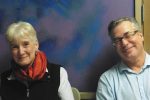
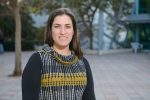
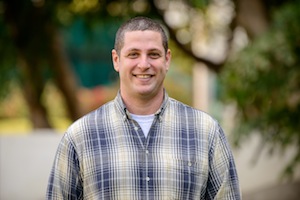
The April 9 panel discussion Israel, Canada and Me in the Age of Trump will feature, clockwise from top left, Dr. Shayna Plaut (photo from Shayna Plaut), Ofira Roll (photo from Ofira Roll), Rabbi Susan Shamash (photo by Robert Albanese) and Eviatar Bach (photo from Eviatar Bach).

Israel, Canada and Me in the Age of Trump will be the topic discussed by a panel of four Jewish speakers on April 9 at the Peretz Centre for Secular Jewish Culture.

“Trump’s election in the U.S. has shifted the relationship that Diaspora Jews in general, and progressive Jews in particular, have with Israel,” Yom-Tov Shamash, one of the organizers, told the Independent. “I believe that most Jews in Vancouver, young and old, Zionist or not, affiliated, religious or secular, feel uncomfortable with the Israel-Trump alliance. Bringing four progressive Jewish leaders from different walks of life provides an opportunity for all Jews supporting values of social justice to hear different points of view, to find common ground, to develop relationships and hopefully to get involved in common causes.”

One the participants, Dr. Shayna Plaut, is research manager of the Global Reporting Centre. She is currently teaching courses on migration and social inequalities at the University of British Columbia and is adjunct professor in international studies, Simon Fraser University.

“Ashkenazi Jews in Canada and the U.S. are in greater positions of safety than we have ever been,” two or three generations removed from the Holocaust, said Plaut. “Ashkenazi Jews can pass for white. We have a responsibility to do something with this privilege, [to uphold] the tradition of tikkun olam.

“As a descendant of refugees, I have always felt connected to refugees,” she continued. “I work to make my ancestors proud and, right now, that means standing in solidarity with this generation of refugees.

“We all have different strengths. And we have a responsibility to see, and use our strengths. My strengths are in education and connection.”

Plaut said, “The level of intolerance in Canada and the U.S. has increased. I was born and raised in the U.S. I became a Canadian because I was having a hard time recognizing my own country. It’s not like racism didn’t exist before – we are a country built on colonization and slavery – but we are also a country built on ideals and resistance. I have always worked in this positive vein of how to make things better. I view patriotism as a commitment to make my country better. It’s easier to talk about what’s wrong than to present alternatives to make things better and work together. It was in December 2015 when I [began to feel] that perhaps I was able to do this better from Canada … as a Jew, as a dual citizen of the U.S. and Canada, and as an educator and worker for human rights and social justice.”

Ofira Roll, another of the panelists, is a PhD candidate in education at UBC. Born and raised in Israel, she reflected on what is involved in activism in Israel as opposed to Canada or the United States.

“Our activism here has productive aspects. However, it feels as if we do it by remote control,” said Roll. “I truly miss the messiness in Israel – the messiness of communication, liveliness and opinions, of cultures and interests. People have opinions and they share them and embody them. I know the darker sides of living there – it’s a nationalistic state, undemocratic, racist, capitalist and anti-human rights – but it feels more real to me, where I feel pushed to the edge in all aspects of life. I am asked to speak up for what I truly care about and act on it. For me, being ‘pro-Israel’ means criticizing what’s wrong.”

Roll is critical of recent Israeli legislation excluding supporters of boycotts from entering Israel. “Personally, I don’t believe in boycotting countries. Still, I can’t accept the idea that if I came to Israel and had decided to boycott, I’m on this list. Friends of mine would be on this list. I don’t understand how a democratic country can pass such an undemocratic law. It’s not just stopping people who don’t support Israel – it stops more Palestinians than anyone else so, in a way, it really is a racist law.

“As several philosophers I am influenced by – Martin Buber, Hannah Arendt – say, engaging in dialogue doesn’t mean that we are in agreement. Dialogue is more about the process we go through in the search for new understandings. Now, when I see everyone coming together, it’s a strong moment for me. In the time of Trump, that’s what I’m happy about. People start understanding that all these divisions are fake. We are not different at the core. The women’s marches we had all over the world – for women’s rights, which are human rights – ironically, thanks to Trump.

“It’s not about convincing, but about sharing. It’s an invitation to talk, first of all, as humans. I don’t believe in all these divisions and borders. I have a hard time with flags, anthems. I think home is within you. Home is not something defined by others. It doesn’t need always to be in the name of a country.”

Roll has found the atmosphere in Vancouver’s Jewish community fairly open. “When [Israeli singer] Ahinoam Nini came here,” she noted, “people fought to bring her, with the support of the Jewish Federation, against groups who did not believe she should be invited because she supports Palestinians’ causes. I wrote a collective letter [to the Federation] on behalf of my Hebrew-speaking community theatre group. They read our letter at a Federation meeting, and they were brave enough to take a stand, and Nini was invited. In the end, they made an extra effort to bring us all together to meet Nini after the show. The Jewish community here includes many other voices, even among synagogues. There are many small groups, which don’t follow one way.”

Panelist Eviatar Bach is graduating from UBC in physics and computer science. He is involved with the Social Justice Centre at UBC, is a co-founder of the UBC Progressive Jewish Alliance and a founding editor of the Talon, a progressive online student magazine.

“With the Trump administration, it appears that the U.S. has abandoned the pretense of an ongoing ‘peace process,’ with Trump expressing indifference at the choice between a one-state and a two-state solution, and the appointment of settlement backer David Friedman as ambassador to Israel,” said Eviatar.

“At the same time,” he continued, “there is perhaps more disagreement between mainstream Jewish organizations, which tend to uncritically support Israeli actions, and young Jews in North America, than ever before. New groups such as IfNotNow, predominantly composed of young Jews, emerged during Operation Protective Edge in 2014, and have taken more confrontational stances than, say, J Street, by protesting Jewish organizations that defend occupation and killings directly.

“On university campuses, the Open Hillel movement has sought to challenge Hillel International’s guidelines, which narrowly constrain the range of views that speakers at Hillels around the world are allowed to express. Several Independent Jewish Voices chapters have started at university campuses in Canada, and the Progressive Jewish Alliance was started at the University of British Columbia.”

Rounding out the panelists is Rabbi Susan Shamash, who was recently ordained by ALEPH: Alliance for Jewish Renewal. She is a retired lawyer and an active member of Congregation Or Shalom.

“As a recently ordained, progressive rabbi, my focus is always on the Jewish values that propel me towards acts of social justice, including engagement in interfaith dialogue and commitment to family and community, which includes my Jewish family and my Jewish community.

“As a born and bred Canadian (like both my parents), my relationship with Canada is foundational to my identity,” she said. “I have a deep and abiding faith in our legal and judicial systems and in our system of government which, though imperfect, is based on values of inclusion, social welfare and multiculturalism.

“As a religious Jew, my relationship with the Jewish community in general and Israel in particular is complicated, varied and nuanced. I often find myself interceding on behalf of a different perspective, of more open thinking and understanding. There is much more to Israel than the occupation and conflict with the Palestinians, but, unfortunately, that is what defines its current reputation in the world community.

“We live in troubled and troubling times,” said Shamash. “U.S. President Trump has already changed the world order in unprecedented ways. More worrisome is that he has a lot of support both within and without the United States. This is not just an American phenomenon.

“How do my Jewish values help me to live, survive and even thrive in this new world order? There are many that we repeat over and over again: seek peace, pursue justice, love your neighbour, welcome the stranger, be a holy people, steward the earth, perform acts of loving-kindness, repair the world.”

The April 9 event is sponsored by Independent Jewish Voices, Vancouver. It begins at 1 p.m. and the suggested donation is $10.

Carl Rosenberg is a member of the United Jewish People’s Order and Independent Jewish Voices Canada. For many years, he edited Outlook: Canada’s Progressive Jewish Magazine.

 

Format ImagePosted on March 24, 2017March 23, 2017Author Carl RosenbergCategories LocalTags IJV, Independent Jewish Voices, Israel, Judaism, multiculturalism, Trump
A pre-election townhall

A pre-election townhall

Queenie Choo, chief executive officer of SUCCESS (photo from SUCCESS), and Jacob Switzer, member of CIJA’s Local Partners Council (photo from CIJA Pacific Region), spoke with the Independent about the upcoming townhall April 2.

Immigration, security, inclusivity and affordability are among the subjects to be addressed at the April 2 Provincial Pre-election Townhall.

The townhall is being presented by SUCCESS and the Centre for Israel and Jewish Affairs (CIJA). SUCCESS chief executive officer Queenie Choo told the Independent, “The topics were determined based on … dialogue between the two organizations.”

“We wanted to find topics that were of relevance and concern for both sets of constituents, as well as current,” said Jacob Switzer, a lay leader involved in planning the event, as a member of CIJA’s Local Partners Council. Culturally sensitive care for seniors, and accessibility and transportation will also be covered.

Scheduled to participate in the discussion as of press time were Michael Lee, B.C. Liberals candidate, Vancouver-Langara; George Chow, B.C. NDP candidate, Vancouver-Fraserview; and Michael Markwick, Green Party candidate, West Vancouver-Capilano. The townhall will take place at Choi Hall, SUCCESS Social Service Centre, 28 West Pender St.

“The event will allow our community to hear from its potential political leaders and learn about their views, as well as engage politically,” said Switzer. “It also lets us tailor questions to issues that are of specific importance to our respective communities, which often overlap and which may not be as central a concern in other forums.”

About SUCCESS, he added, “we have very much enjoyed cooperating with them, both on this event and in the past.”

“It has always been our mandate to support integration of newcomers to our Canadian communities, as well as helping them to understand the rights and responsibilities of being a Canadian citizen, particularly in the civic responsibility,” said Choo. “As such, SUCCESS and CIJA have taken a leadership role to host this pre-election townhall to ensure we have an opportunity for the community to understand the positions each political party holds on the key areas of our interest. This will help voters in making an informed decision on May 9.”

“One of the key discussion points for the event will be community security and the apparent rise in bigotry and hate crimes, which is a highly current issue,” said Switzer. “We expect that both of our communities will want to hear about what policies are being considered to improve these issues and we anticipate questions from the floor around security (particularly in light of the recent bomb threats to the Vancouver Jewish Community Centre).”

With respect to the seeming rise in expressions of bigotry and hatred, Choo said, “Through the townhall, I am sure this issue will surface. It is important for the community to hear what are the directions or policies in addressing discrimination and racism from each political party. We would also like to hear how our future government will uphold our shared values of inclusion and diversity.”

The format of the event will be that of “a non-debate-style townhall,” said Switzer. “Each participant will be given a brief period for initial remarks (order is set by draw) and then will have the opportunity to answer the questions that we are already receiving via email or phone call. All will be given time to answer the same question so they can present their party’s perspectives. They will have another period to share any final comments with the audience.

“We have found that this format works well with the candidates and allows for a respectful and organized interaction among themselves and the public.”

The pre-submitted questions will be facilitated by a moderator at the townhall, noted Choo.

“This event is open to the public and free of charge,” she added. And the hope, she said, is “to engage as many people as possible, as it is important to understand what are the directions the next government will hold, especially on our important topics.”

“We are co-hosting this event with our friends at SUCCESS because we believe that joining forces with partners in other communities can only strengthen us,” said Switzer. “We are looking forward to a well-attended and meaningful event.”

The townhall will run 2:30-4:30 p.m. on April 2. To submit questions on the aforementioned topics for any party candidate, email [email protected] with the subject line “Provincial Pre-election Townhall Question.”

Format ImagePosted on March 24, 2017March 23, 2017Author Cynthia RamsayCategories LocalTags CIJA, Election, Jacob Switzer, politics, Queenie Choo, SUCCESS

A “slap on the wrist”

At a sentencing on March 13, Arthur Topham, the man convicted of deliberately promoting hatred against Jewish people on his now-defunct website radicalpress.com, was given a ban on public online activity and a six-month curfew.

B.C. Supreme Court Judge Bruce Butler said Topham, 70, did “not call for violence; his views were political satire,” and said it was not Topham’s “intent to indirectly incite violence.”

On the racist, antisemitic website he founded and on which he posted vitriol until removing the site just prior to the sentencing, Topham wrote that Jews should be forcibly sterilized. He described Canada as being “controlled by the Zionist lobby” and Jewish places of worship as “synagogues of Satan.” He could have faced a sentence of up to two years in prison.

Unrepentant, Topham told the Quesnel courthouse he felt it was his “duty to alert the … public to the imminent threat …. [of] the Jewish lobby.”

In Feb. 27 posts on anti-racistcanada.blogspot.ca, Topham informed his followers that his Facebook presence and website would be removed from the web within two weeks and said he would be unable to publish “anything on ANY website that has my name attached to it. To do so would mean immediate jail for breaking whatever probationary restrictions that will be imposed on me.” He said his “immediate concerns are personal family issues and health challenges” and added he was “not planning on doing any interviews in the immediate future.” On March 8, he exhorted his followers to download any and all items from radicalpress.com for free.

B’nai Brith Canada, which had alerted the RCMP to Topham’s activities back in 2007, said it was “strongly disappointed” with the sentencing. In a statement, chief executive officer Michael Mostyn described the sentence as “a mere slap on the wrist which will do little to protect Canadian Jews or preserve the multicultural mosaic of our society.”

Mostyn continued, “Mr. Topham is a committed and unrepentant Jew-hater, who persisted in publishing lurid antisemitic content on his website throughout this legal process. Canada’s laissez-fair approach to hate crimes continues to fail minority groups and puts them at increased risk of attacks against their lives or property.”

Mostyn said the timing of the lax sentence was especially disturbing, “as Canada’s Jewish community reels from a series of bomb threats against our community centres, inspired by the same hateful ideology that drives Mr. Topham.”

Harry Abrams, who was the representative for the B’nai Brith Canada’s League for Human Rights in 2007, when he was first to raise the alarm about Topham’s antisemitic writing, described the sentencing as “a rope around [Topham’s] balls.”

“Somewhere in all this, the judge took pity on an old man with a sick wife and bought this thing that Topham and his friends were trying hard to sell: that all this was a parody, a satire,” Abrams said. “Sure, I’m disappointed with the sentence, but we have to look at the sum total of this thing. Topham has been exposed as a sick, crazy old man, his stuff is down from the internet and he’s restricted from posting online. This is what we’ve got to work with, and he’s not just given free rein to go back to beating on us Jews.”

Ryan Bellerose, advocacy coordinator for B’nai Brith Canada’s League of Human Rights for Western Canada, described the sentence as “a little ridiculous.”

“He was convicted of hate speech and he’s got a curfew? This almost sends a message that you can pick on Jews and it’s totally OK, you won’t have an existential payment for it,” he said. “We finally managed to get someone charged and convicted on a hate crime in Canada and the message they send with the sentencing is that it’s not taken very seriously.

“Everyone is talking about antisemitism right now, and the bomb threats to Jewish communities in Canada, which, of course, needs to be dealt with. But no one is even talking about this [Topham’s sentencing]. That’s an especially bad message to send in today’s climate,” said Bellerose.

Lauren Kramer, an award-winning writer and editor, lives in Richmond. To read her work online, visit laurenkramer.net. This article was originally published by CJN.


Posted on March 24, 2017March 23, 2017Author Lauren KramerCategories LocalTags antisemitism, Arthur Topham, B'nai B'rith, hate crimes

Writing Lives journals


Writing Lives is a two-semester project at Langara College, coordinated by instructor Dr. Rachel Mines, in which second-year students are connected with local Holocaust survivors to interview them and write memoirs of their lives before, during and after the Holocaust. The project is a partnership between Langara, the Vancouver Holocaust Education Centre and the Azrieli Foundation. In the first semester, students learned about the Holocaust through reading literary and historical texts, and wrote a research paper on prewar European Jewish communities using the resources of the VHEC and Waldman libraries. This semester, students studied practical strategies for interviewing survivors and have conducted and transcribed their interviews. They are now in the process of writing the memoirs, which, when complete, will be presented to interviewees at a closing ceremony to be held at Langara later this spring. As part of their course work, students are keeping journals of their personal reflections on their experiences as Writing Lives participants. A recent journal entry was on the theme of multicultural relationships, and here are excerpts from three student journals.

One of my older relatives knew how to count in Japanese. She was not Japanese. My family is predominantly of Filipino descent. She only learned how to count in Japanese because she was forced to learn as a child, during the Japanese occupation of the Philippines. I learned this pretty late in her life.

I wanted to ask my relative questions, and I assumed I would get the chance at some point, but I was never sure if it was appropriate to bring it up. Two or three years after I learned that she could count in Japanese, she passed away. I never got to ask my questions.

When I decided to take part in the Writing Lives project, I was thinking of my relative. I have learned that having unanswered questions about someone you care for can lead to painful regret. Because of my own family’s unknown history during the Second World War, I wanted to help another family learn theirs.

– Jonathan Pineda

“Some”

Some feel sad when they see pain,
Some feel fascinated when they see pain.
Some feel broken
Once they see a broken heart.
Some feel fire
And mock that broken heart.

Some reach out a hand
Only to say “got you man.”
Some reach out a hand
Only to say “let me help you man.”
Some are inwards
Some are outwards.

Some love to inflict pain.
Some love to inflict love.
Some grab a gun.
Some grab a seed.
Some ignite a fire.
Some extinguish the fire.
There are always two sides to a story,
Whether good or bad it has a history.

Where do these people come from?
I used to ask.
They come from us,
They used to answer back.
Now I stand with a shattered heart.
Now I stand with a broken back.

Seeing is something.
Hearing is intriguing,
Both are fascinating,
The hearts are something.

– Mojtaba Arvin

I have listened to survivors tell their stories a few times before. Two survivors visited my school when I was in high school, and we had a couple of survivors come to our Writing Lives class last semester. Those were really the only encounters I had with the stories of Holocaust survivors. My family is not Jewish, and were not persecuted during the Holocaust.

My paternal grandfather and his father emigrated from southern Russia in 1925 to

escape the persecution and violence they were facing because they were Mennonites, but we have no personal family experience of the Holocaust or anything that the Jewish people endured. Because I could not bring my own perspective to this course, I am lucky that I had an amazing partner who was able to bring insight into many things because of her Jewish background. Overall, this project has been really incredible. My two partners are so supportive, and I have had the most amazing experience interviewing alongside them and writing the draft memoir with them. This is a project that I will remember my entire life.

– Caylie Warkentin

Posted on March 24, 2017March 23, 2017Author Jonathan Pineda & Mojtaba Arvin & Caylie WarkentinCategories LocalTags Azrieli Foundation, Holocaust, Langara, survivors, VHEC, Writing Lives
Faiths come together

Faiths come together

David Coskun dances as Seemi Ghazi speaks. (photo by Matthew Gindin)

On March 9, Congregation Or Shalom, in collaboration with the Anglican Diocese of New Westminster, hosted United in Compassion, an interfaith solidarity event featuring 15 different religious leaders from diverse communities of faith.

The packed synagogue was addressed by faith leaders in clerical collars, kippot, dervish dress, imam robes and even a Zen rakusu (ceremonial garment worn around the neck). During the hour-long devotional service, each leader offered brief words and contemplations on interfaith harmony and peace.

“God created a universe filled with diversity. Every human is free to choose their own beliefs. There is no compulsion in religion,” said Imam Mohammad Shujaath Ali, a Sunni Muslim of Masjid-Ul Haqq mosque, quoting the Quran. “For society to flourish,” he said, “we need these three qualities: compassion for others, collaboration among all, and toleration of views we disagree with. All creatures are God’s family, and God loves those who treat his family well.”

The imam was followed by David Coskun and Seemi Ghazi of the Rifa’i Marufi Sufi order. Coskun, dressed in a long, white, flowing robe and tall hat, performed a hypnotizing, meditative dervish twirl, while Ghazi spoke. “The path of the Sufi, it is all about tawhid (unity),” she explained. “Because of knowing the oneness of all things, we are unafraid to turn in all directions.”

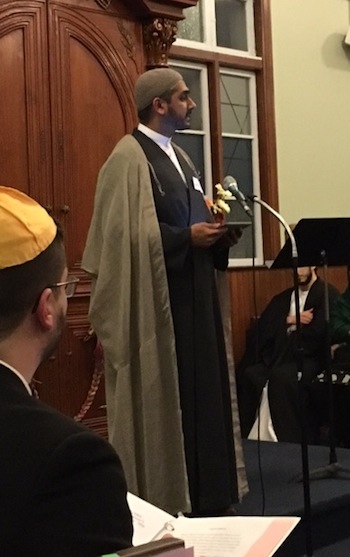
photo - Sheikh Murtaza Bachoo speaks about compassion at the March 9 gathering of faith leaders at Or Shalom
Sheikh Murtaza Bachoo speaks about compassion at the March 9 gathering of faith leaders at Or Shalom. (photo by Matthew Gindin)

Ghazi sang a haunting rendition of the Sufi song “I Desire Nothing But You,” commenting, “This is a love song to my brothers and sisters here in this synagogue and down south, that you flourish and are safe and protected.”

Sheikh Murtaza Bachoo of the Shia Muslim Community of British Columbia spoke about ar-rahma, compassion in Arabic, echoing the word for compassion in Hebrew, rachamim. “Compassion,” he said, “is the attribute of God we need to manifest in these times of racism, antisemitism, Islamophobia and xenophobia. God’s compassion is boundless and overflowing, and knows no boundaries among creatures.”

Rabbi Laura Duhan Kaplan, former spiritual leader of Or Shalom and current director of Inter-Religious Studies at Vancouver School of Theology, chanted verses from Genesis describing the creation of human beings in the divine image. She cited a midrash explaining that, when God says “in our image,” it is a reference to all of the different creatures, all of whom are spiritually interconnected. God blessed us, saying, “May you become diverse, may you take good care of each other, and of all creation.”

Bishop Reverend Dr. Gregory Mohr of the B.C. Synod of the Evangelical Lutheran Church in Canada read some of the official pronouncements of his order on the subject of “welcoming the stranger,” stressing that “the stranger” refers not only to newcomers to Canada but to “people already here, people maybe right next door, who we have overlooked and do not know.”

Some of the presenters offered brief devotions or meditations. Eric Kristensen of the Religious Society of Friends (Quakers) invited audience members to consider some leading thoughts from Quakers of the past into silent questioning.

Linda Mackintosh of the Sathya Sai community offered some thoughts of her guru on world peace, and Sandra Leigh of Give Peace a Chant Kirtan shared the musical chanting of the ancient Gayatri Mantra. Parvin Manshadi of the local spiritual assembly of the Baha’is of Vancouver recited a prayer for peace written by Baha’ullah, and Firdosh Mehta of the Zoroastrian Society of British Columbia shared teachings of the Zoroastrian scriptures on universal ethical values and peace. Michael Newton of the Mountain Rain Zen Community led the congregation in meditation on loving-kindness for ourselves and one another.

Bishop Melissa Skelton of the Anglican Diocese of New Westminster read two poems by secular poets – Israeli Yehuda Amichai and Palestinian-American Naomi Shihab Nye – to express the need for Israelis and Palestinians to embrace one another.

“Then it is only kindness that makes sense anymore,” concluded the poem by Shihab Nye. “Only kindness that ties your shoes and sends you out into the day to gaze at bread / only kindness that raises its head / from the crowd of the world to say / It is I you have been looking for / and then goes with you / everywhere / like a shadow or a friend.”

“In the parashah for this week,” said Rabbi Adam Stein of Congregation Beth Israel, “it says, ‘Build Me a sanctuary, and I will dwell among them.’ It does not say God will dwell in the sanctuary, but rather ‘among them.’ Tonight, I feel we have made a sanctuary for God and brought out the godliness that dwells among us.”

Or Shalom’s Rabbi Hannah Dresner closed the evening, leading the audience in a niggun, a sacred, wordless melody. She chose the Rav’s Niggun, composed by Rabbi Schneur Zalman of Liadi, the first Lubavitcher Rebbe, symbolizing the soul’s ascent to God, which is commonly sung at Lubavitcher weddings. “The melody brings out the solemnity and the beauty of when souls come together to truly connect with each other,” said Dresner. “This is what I feel we have done tonight.”

After the service, people met downstairs for food and drinks, having conversations together facilitated by a set of posted questions at each table on hope, inter-communal tolerance and peace.

Matthew Gindin is a freelance journalist, writer and lecturer. He writes regularly for the Forward and All That Is Interesting, and has been published in Religion Dispatches, Situate Magazine, Tikkun and elsewhere. He can be found on Medium and Twitter.

Format ImagePosted on March 24, 2017March 23, 2017Author Matthew GindinCategories LocalTags interfaith, Or Shalom
Baking bread together

Baking bread together

Grace Haan, JSA Peer Support trainer and supervisor, and Charles Liebovitch, JSA Peer Support coordinator, at the March 8 Food and Film Empowerment session. (photo by Binny Goldman)

The screening of Dough at the March 8 Food and Film session of the JSA Snider Foundation Empowerment Series continued the 2016-17 series’ theme of “Eating our way through Jewish history: Food, the doorway to our culture.”

Presented in partnership by the Jewish Seniors Alliance and the Jewish Museum and Archives of British Columbia, this latest session took place at the Unitarian Centre.

JSA president Ken Levitt greeted those gathered, taking the opportunity to introduce the alliance’s new motto – “Seniors, stronger together.” He emphasized the comma in the phrase, as it had been the topic of much discussion. He also credited me for the motto’s origin.

Gyda Chud, convener of this third session of the food-related Empowerment Series, said she was happy to see so many women in the audience as the event took place on International Women’s Day. Chud was wearing a scarf commemorating the World March of Women that took place in Montreal in 2000.

Michael Schwartz, JMABC coordinator of programs and development, noted how women were responsible for the existence of many organizations in the province. He stressed the importance of families contributing their own pieces of history to the museum to help future generations know the community’s origins and its past. And he asked audience members to become members of the museum, the benefits of which include receiving The Chronicle, which will keep them up-to-date on the museum’s events and research. One upcoming event, he said, is the Supper Club, which will take place at the Peretz Centre for Secular Jewish Culture, where the museum is housed. He concluded, “Without further a dough we hope you enjoy the movie Dough.”

Dough depicts the desperation that sometimes drives people together. Widowed and finding it hard to manage, Nat Dayan is desperate to save his London bake shop from closing – his grandfather had opened Dayan and Son 60 years ago. Customers are getting scarce, moving away or dying, and Nat’s son, a lawyer, is not interested in continuing the family business or helping it survive. In addition, competition is becoming a concern, with a shop next door that is selling baked goods, as well as groceries, and Nat’s apprentice has left to work for them.

Struggling to keep his kosher bakery open, Nat hires Ayyash, the teenage son of his cleaning lady. Ayyash has been selling drugs to help support his mother and himself and, when Ayyash accidentally drops cannabis into the challah dough mix, sales at Dayan and Son soar. Long lines appear and the closing of the shop seems far off.

A warm and special friendship develops between the Muslim boy and the Jewish baker, as Ayyash and his mother go to live at Nat’s when their home floods. A line in the film – Fiddler on the Roof meets West Side Story – helps describe what we see developing.

Tragedy is averted when a fire set by a competitor, instead of destroying the shop as well as Nat’s dream forever, serves to bring them closer together with mutual aspirations of continuing to exist. Dayan and Son survives with the “son” being Ayyash. The theme is an especially moving one – overcoming racial prejudice and bringing about closeness through the will for openness, acceptance and understanding, which can be found in unexpected places.

Chud thanked the delighted audience and invited all to enjoy baked goods – though not the cannabis-filled ones in the movie. The JSA staff worked hard to bring this event to the public, and Stan Shear was invaluable for all his technical work.

May we “break bread” together in the future. B’tayavon, b’shalom.

Binny Goldman is a member of the Jewish Seniors Alliance of Greater Vancouver board.


Format ImagePosted on March 24, 2017March 23, 2017Author Binny GoldmanCategories LocalTags film, food, Jewish museum, JMABC, JSA, seniors
Meet scientists of tomorrow

Meet scientists of tomorrow

Feinberg Graduate School-Weizmann Institute student Vered Shacham-Silverberg is coming to Vancouver with two of her peers. (photo from Weizmann Canada)

Cliché as it may sound, the future is almost here. On March 29, three PhD students from the Feinberg Graduate School at Weizmann Institute of Science (WIS) in Rehovot will arrive in Vancouver. As part of a North American speaking tour called Scientists of Tomorrow, Vered Shacham-Silverberg, Adi Goldenzweig and Uri Weill will share not only details of their research but also their passion for the Weizmann Institute.

Rather than highlighting established scientists, this tour focuses on the experience of students who are performing the experiments being conducted in the labs.

“I believe that we, as students, enjoy many of the benefits the WIS provides and we can shed more light on those benefits,” said Shacham-Silverberg about why she believes she and her colleagues are well-suited to spread the word about what’s happening at the institute.

photo - Uri Weill
Uri Weill (photo from Weizmann Canada)

“We know firsthand how important it is to have a supporting and nurturing environment in research,” said Weill. “We can also bring stories from the working bench of live research that is happening now.”

WIS focuses exclusively on basic science research, the kind of investigation and experimentation that answers big questions. Its students are given the opportunity to have some of the brightest minds in the world as their supervisors and to use some of the best equipment in their research. WIS scientists are uncovering mysteries such as how the body works on the molecular level, and are translating their findings into ways to improve the world in which we live.

For example, Weill is creating a living catalogue of more than 6,000 yeast strains, so scientists can study how certain proteins function both as healthy organisms and diseased ones. His research in the department of molecular genetics could have far-reaching applications to finding cures for many illnesses.

Goldenzweig’s study of how proteins work with molecules has led to the discovery of a way to stabilize proteins that are usually structurally fragile when created in large quantities in a lab. The algorithm she has developed was recently successfully applied to a protein to combat malaria. This could be the key to developing an effective malaria vaccine.

And Shacham-Silverberg is working to discover how to improve the way the body gets rid of unproductive neurons in order to make room for the ones that will lead to best function. Her research will lead to discoveries in neurodegenerative diseases such as Alzheimer’s, ALS and Parkinson’s.

Having these students visit Vancouver is a unique chance for the local Jewish community. The students will not only share some of their research but also their perspectives on being students in Israel.

photo - Adi Goldenzweig
Adi Goldenzweig (photo from Weizmann Canada)

“Although there are many women in the life science faculties,” said Goldenzweig, “unfortunately … their number decreases dramatically in established positions. But this keeps changing and we’ll hopefully be closer to 50% within a few decades.”

WIS is also interested in promoting benefits for Canadian students interested in science. Every year, two Canadian second-year undergraduate students receive a fully paid two-month supervised internship over the summer in a lab at the institute. Two years ago, one of the recipients of this scholarship was a University of British Columbia student whose experience was so positive, he was asked to return the following summer.

The other program is the Kupcinet-Getz International Summer School, a four-week internship with funding currently for six Canadian students. The program brings together 80 pre-university students interested in research in physics, math, chemistry and the life sciences from a total of 17 countries. Many of these students are experiencing Israel for the first time, and form lasting impressions of and connections to the country. As well, they are introduced to some of the possibilities for their future in science.

The immersive scientific experience is what makes these summer programs so exciting for students, and is part of what drew Shacham-Silverberg, Goldenzweig and Weill to study at WIS.

Weill said he chose the institute because of the access to cutting-edge research tools, which enable him to ask and find the answers to new questions. He added, “At the WIS, we have collaborations with labs from around the world. It makes for the perfect conditions for scientific discovery.”

On March 29, all are welcome to come and learn more about scientific innovation in Israel. At the end of the students’ presentations, a dessert reception will provide a chance to meet the speakers, as well as the Feinberg Graduate School academic secretary, Dr. Ami Shalit. The event is being held in a private home, so if you would like to attend or are looking for more information, contact the WIS Western Canadian development associate, Camille Wenner, at 604-260-8506 or [email protected].

Michelle Dodek is a freelance writer living in Vancouver.

Format ImagePosted on March 24, 2017March 23, 2017Author Michelle DodekCategories LocalTags Israel, science, Weizmann
Global Jewish cuisine

Global Jewish cuisine

Jewish Museum and Archives of British Columbia hosts a new supper club and a podcast. (photo from JMABC)

The Jewish Museum and Archives of British Columbia is launching two new programs celebrating the diversity of food traditions represented within the B.C. Jewish community. From all corners of the world, from Baghdad to Bangalore, Kiev to Cape Town, Jewish families have made a new home here, bringing with them a wealth of culinary traditions.

One of the programs, the Chosen Food Supper Club, will give guests the opportunity to try these foods and hear the stories behind them. Why do Syrian Jews eat leeks, Swiss chard and gourds on Rosh Hashanah? What are boerewors and bobotie? How do you prepare the ultimate chicken tagine? These mysteries and more will be solved (deliciously) at the supper club, which will take place over 10 evenings between April and September. Each dining experience will run from 5-8 p.m. on a Sunday evening. Guests will enjoy a complete dinner while hearing firsthand stories from members of the Jewish community. All meals are kosher-style, not certified kosher. Tickets are $40 per person per meal, and are available at jewishmuseum.ca/programs/the-chosen-food; they must be purchased in advance.

The JMABC’s other new program is The Kitchen Stories podcast.

When we talk about food, we often end up talking about so much more. Family traditions, patterns of migration, gender dynamics, our relationship to the land. More than just a source of nourishment, food is a means of communication. And, in The Kitchen Stories series, listeners will hear what it was like to be a Jewish family living in far-flung places such as Eritrea, Chile and India. They will hear about the pressures to fit in or stand out, and how food was often a means of doing both. They will hear about the difficulty of maintaining family culinary traditions after migrating to a new country.

Podcast episodes will include community members developing new traditions or reviving long-forgotten ones, a Jew by choice who is learning to cook Jewish cuisine while not wanting to forget her own family’s food traditions, and families adopting new traditions to strengthen their relationship to the land.

The 12-episode series will be available for download on the iTunes store, Google Play, Soundcloud and at jewishmuseum.ca.

Format ImagePosted on March 24, 2017March 23, 2017Author JMABCCategories LocalTags food, history, Jewish museum, Kitchen Stories, podcasts
“Settlement” versus “Ariel”

“Settlement” versus “Ariel”

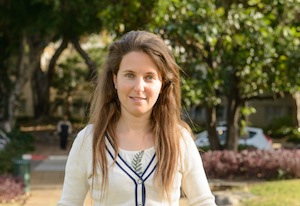
Avi Zimmerman chose for Talk17 a format that would allow a speaker to share their stories and views uninterrupted. (photo from Avi Zimmerman)

There is a range of strong opinions when it comes to Jewish community development east of the Green Line. Many around the world refer to these Israeli communities as “settlements.” But, to Avi Zimmerman of the Ariel Foundation and many Israelis, Ariel is something else.

Zimmerman was born and raised in West Orange, N.J. He made aliyah in 1995 and served in the Israel Defence Forces. After earning a degree in occupational therapy at the Hebrew University and then working in the field for four years, he and his wife decided to move to Ariel. There, Zimmerman started up an aliyah program.

“I was then asked to run the Ariel Foundation, which is what I’ve been doing for the last eight years or so,” Zimmerman told the Independent. “The foundation is not only for raising funds for city projects, it also provides accurate information about the city of Ariel to an international public.”

Ariel will celebrate its 40th anniversary in 2018. Established on Aug. 17, 1978, with 40 families, it is now a city of close to 20,000 residents, plus an additional 15,000 students studying at Ariel University.

Geographically, Ariel is east of Tel Aviv, past the Green Line. Given what he – and others – see as misinformation being spread about Jewish communities east of the Green Line, Zimmerman decided to share stories from the people actually living in the area and how local people feel about various issues.

To do this, Zimmerman copied a format that has worked very well for TED Talks on YouTube, and created Talk17.

“Our lives are not lived through a conflict lens, fortunately, nor are those of our Palestinian neighbours,” he explained. “Those elements possibly do exist. It’s not that they don’t exist. But, they are not the primary theme of the way life is lived here.

“If people are interested in what goes on here, I think it’s only fair to the international community to provide more accurate information – not in terms of stats or facts, although that’s part of it … [but] beyond that, in terms of the voices from the region.

“The concept is, instead of talking about us in a well-intentioned yet disenfranchising way, just listen to us and hear what we have to say.”

Zimmerman chose the TED Talk format because it is not confrontational, as are debates and as can be panel discussions. The format allows a presenter to tell their whole story without interruption.

“We want to give authentic voices an opportunity and a fair platform, so there’s no debate, no winners and losers, no questions and answers,” he explained. “There’s no objective right or wrong to that. It’s authentic…. I think, ultimately, people are interested in the breadth and depth of the story.

“There are a lot of people who like to live in what they are calling echo chambers … in a world where everybody says what they like to hear, and they de-friend you if you say something else. A lot of the world is just moving in that direction. But they are not our target audience. If you already know everything, we can’t convince you otherwise. You’re going to turn off the video when you hear something you don’t like and that will be the end of it. My target audience is authentic people. They actually care and are willing to listen to new ideas they’re not familiar with.”

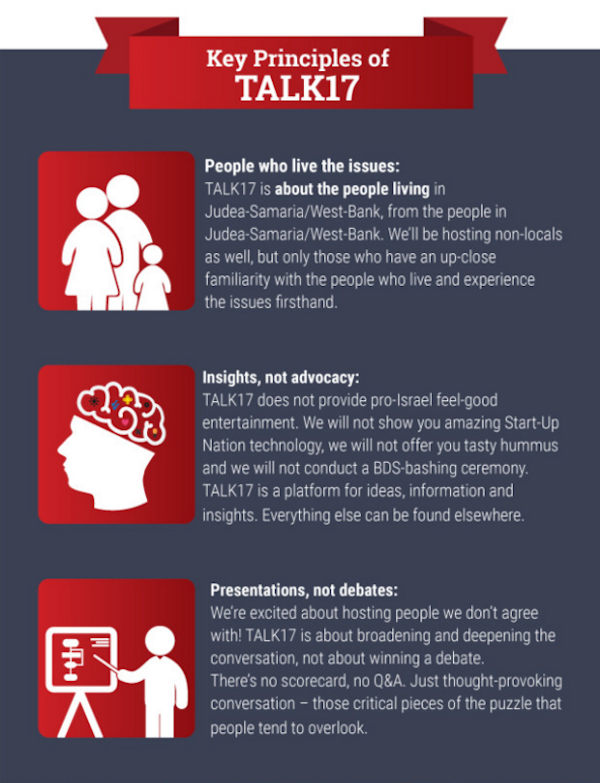
image - The crowdfunding page clearly lays out the principles behind Talk17
The crowdfunding page clearly lays out the principles behind Talk17. (image from generosity.com)

While an 18-minute video is hard for some people to get through, Zimmerman has been finding that, organically, Talk17 has been successful by having speakers who are on the frontlines of change-making. He gave as an example an exchange he’d had just before his interview with the Jewish Independent – an artist had happened upon Talk17’s Facebook page and was very excited about the concept. The artist runs an organization that uses the arts as a form of intercultural dialogue and they and Zimmerman are now working on plans for an arts-themed program, including an exhibition, at the end of April.

“It was just a preliminary conversation today,” said Zimmerman. “But, the thing is, these are the kinds of people who can help us open new doors.”

Since starting Talk17, 90% of the views, as it happens, have been from Arab-speaking, self-identified Palestinians, said Zimmerman. “We’re reaching across the aisle,” he said. “There’s something very real to this.”

While Palestinians, Israelis and Canadians are open to listening to talks in languages other than English, Zimmerman has found that Americans are less willing to do so. Because of this, he has decided to stick with English for Talk17.

“We automatically limit ourselves to English-speakers,” he said. “They don’t have to be native English-speakers. We try to get a fair balance of Arab and Palestinian voices among the Jewish and Israeli voices. We try to get a fair balance of women and men.

“We try to find people that have a unique story … so, it’s not just a personal story, but there’s a new concept to it. If you follow the first videos we’ve been launching, you’ll see each story is very different. We’re also trying to work on themes, events with themes.”

He said an upcoming theme will be diplomatic options for the future. “For 50 years,” he said, “we’ve heard about the two-state solution, we’ve heard about it since the 1947 Partition Plan. But, the point is, it’s not going anywhere. So, people are saying that, if not that, then what? So, we want to examine that.”

Zimmerman hopes that, by the end of the process, he will have been able to create a video archive that people can access to deepen and broaden the conversation about the region, so they can realize there is more to the story than they thought from just reading a short article or hearing a news clip.

Zimmerman also hopes that, in the future, visitors to Israel will be more willing to venture out of Tel Aviv and Jerusalem, and will come visit Ariel to experience firsthand the beauty of the region and its people.

“We all need to remember that, regardless of the terms of the deal that one day will hopefully be reached between Israel and the Palestinians, and regardless of where the lines will be drawn, Jews and Arabs will be neighbours forever,” said Zimmerman. “With that in mind, we need to figure out how to work with them directly, and we’d appreciate it if the world would allow us to do so, by appreciating the dynamics between us … by having this window into our interactions.

“However, the objective of Talk17 is not for me to have a better relationship with my Palestinian neighbour. That’s an added value … something we do anyway. We don’t need Talk17 for me to meet with my friend on Wednesday. We need Talk17 for the relationship between the Israelis and the international community, and the Palestinians and the international community.”

In addition to the Talk17 YouTube channel, there is a crowdfunding effort in progress for the talks, at generosity.com/community-fundraising/talk17-change-the-israel-conversation–2.

Rebeca Kuropatwa is a Winnipeg freelance writer.


Format ImagePosted on March 24, 2017March 23, 2017Author Rebeca KuropatwaCategories IsraelTags Ariel, Avi Zimmerman, Israelis, Palestinians, settlements, Talk17
Ma’agan Michael sets sail

Ma’agan Michael sets sail

(photo from Haifa University via Ashernet)

The replica of the Ma’agan Michael ship took its first voyage on March 17, near where the original vessel was discovered in 1985 by Ami Eshel, a member of Kibbutz Ma’agan Michael, some 70 metres from the kibbutz. Organized by the University of Haifa and the Israel Antiquities Authority, the replica has been built over the past two years, using the same materials and methods as 2,500 years ago. The ship was removed from the water in 1988, and is on display at the university’s Hecht Museum. Most of it had been covered in sand, so the keel, numerous wooden plates, 14 crossbars and the base of the mast were all preserved, offering researchers rare insight into the method used to construct the ship. In addition, a carpenter’s toolbox was found, which sparked the dream of building a replica using the same methods as the original shipwrights. After two year’s work, the project was completed and the replica was taken to Israel Shipyards and then to Kishon Harbour. Prof. Yaacov Kahanov, the leading spirit behind the project, passed away just before the work was finished. (Edgar Asher)

Format ImagePosted on March 24, 2017March 23, 2017Author Edgar AsherCategories IsraelTags archeology, Haifa, Ma’agan Michael

Posts pagination

Previous page Page 1 … Page 224 Page 225 Page 226 … Page 322 Next page
Proudly powered by WordPress