Skip to content
  • Home
  • Subscribe / donate
  • Events calendar
  • News
    • Local
    • National
    • Israel
    • World
    • עניין בחדשות
      A roundup of news in Canada and further afield, in Hebrew.
  • Opinion
    • From the JI
    • Op-Ed
  • Arts & Culture
    • Performing Arts
    • Music
    • Books
    • Visual Arts
    • TV & Film
  • Life
    • Celebrating the Holidays
    • Travel
    • The Daily Snooze
      Cartoons by Jacob Samuel
    • Mystery Photo
      Help the JI and JMABC fill in the gaps in our archives.
  • Community Links
    • Organizations, Etc.
    • Other News Sources & Blogs
    • Business Directory
  • FAQ
  • JI Chai Celebration
  • JI@88! video

Recent Posts

  • Story of Israel’s north
  • Sheltering in train stations
  • Teach critical thinking
  • Learning to bridge divides
  • Supporting Iranian community
  • Art dismantles systems
  • Beth Tikvah celebrates 50th
  • What is Jewish music?
  • Celebrate joy of music
  • Women share experiences 
  • Raising funds for Survivors
  • Call for digital literacy
  • The hidden hand of hate
  • Tarot as spiritual ritual
  • Students create fancy meal
  • Encouraging young voices
  • Rose’s Angels delivers
  • Living life to its fullest
  • Drawing on his roots
  • Panama City welcoming
  • Pesach cleaning
  • On the wings of griffon vultures
  • Vast recipe & story collection
  • A word, please …
  • מארק קרני לא ממתין לטראמפ
  • On war and antisemitism
  • Jews shine in Canucks colours
  • Moment of opportunity
  • Shooting response
  • BC budget fails seniors
  • Ritual is what makes life holy
  • Dogs help war veterans live again
  • Remain vital and outspoken
  • An urgent play to see
  • Pop-up exhibit popular
  • An invite to join JWest

Archives

Follow @JewishIndie
image - The CJN - Visit Us Banner - 300x600 - 101625

Category: News

Medication alert innovation

Medication alert innovation

The system concept for CuePath’s sensor-monitored blister packaging for dispensing medications. (photo from CuePath)

When blister pack medication dispensing came onto the market years ago, it was hoped that it would solve the issue of people not taking their medication on time. However, while this plastic packaging method has become commonplace, people are still forgetting to take their medicine.

One Vancouver-based start-up has come up with a solution. CuePath Innovation is creating a sensor that monitors when each blister pack is opened – connecting the sensor to care providers wirelessly. CuePath’s Jeff Nider is charged with marketing the concept.

Nider grew up primarily in Richmond. “My late father, who passed away in 2014, was a pharmacist and he had a number of different pharmacies in the Vancouver area over the years,” he told the Independent. “I grew up in and out of the pharmacy – working with my bubbie, manning the cash register, or pre-packaging medications for nursing home customers. That’s where I spent most of my summers, working in the pharmacy with my father.”

Nider earned his degree in biology at the University of British Columbia, and then his father asked him to manage one of the pharmacy locations. When they came across the blister pack technology, which makes the administering of medications more safe, they jumped at the chance.

“At the time, we had one nursing home client, and so we saw a future for the technology and decided to purchase the machine required to package it,” said Nider. “At this point, I started my sales career, going and selling … to basically convince … nursing homes to allow us to be their pharmacy provider.

“Each nursing home needs to have a single pharmacy provider for all of their residents. So, we had this technology along with some other software…. We were able to grow the business from one nursing home client to over 40, representing 1,700 residents.”

In 2012, they sold their business to a Toronto-based company and Nider stayed on as the business development manager for Western Canada. Last summer, Nider left that role after having been introduced to CuePath Innovation.

“It’s a start-up for monitoring medication for seniors living at home and in retirement communities,” he said about CuePath. “Based on the expertise I had in the pharmacy and geriatrics business, it made sense to me to get involved. So, I was approached to be essentially the third employee of the company, aside from the two co-founders, who have no pharmacy backgrounds … to take it from an idea and approve the concept through pilots and its commercial launch, which will happen in the second quarter of this year.”

CuePath’s sensor monitors each individual cell of the pack and indicates whether or not a person has broken the seal.
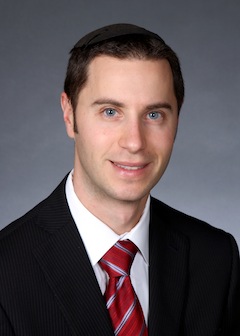
photo - CuePath’s Jeff Nider grew up in and around his father’s pharmacy
CuePath’s Jeff Nider grew up in and around his father’s pharmacy. (photo from CuePath)

“We also provide an alert for seniors at home, when it’s time to take their medications,” said Nider. “If they don’t take them by the appropriate time, a text message will be sent to [a] family member, so they can call and remind the family member to take them.

“If you’re an 85-year-old woman living alone, your daughter might be in Toronto or Winnipeg and have no idea what’s happening – worrying about whether or not you’re taking your meds on time, because there’s a bunch of stats on our website in respect of medication adherence: less than 50% of medications are taken as prescribed, and 22% of nursing home admissions are a result of non-adherence to medication. So, it’s very important that people take their medications the way they’re prescribed and at the right time.”

According to Nider, in some cases, just before care providers come each week, seniors will punch out all the medication in the blister pack that they have forgotten to take during the week. Therefore, everything might appear to be fine when, in actuality, it is not.

“This happens because they know you come every Sunday,” said Nider. “So, on Saturday, they go and punch out the whole card. When you come, everything looks like it’s been taken – but, it’s been taken out the day before and flushed down the toilet.”

Nider pointed out that the CuePath sensor monitors the punching of the plastic only – it does not monitor whether or not the medication was ingested. Though that addition is on the horizon.

The CuePath technology is a clip on a Bluetooth transmitter connected to the back of the blister pack. “Basically, it’s a label that the pharmacist applies to the back, which has some conductive materials in it to send the transmission as to whether or not those have been opened,” said Nider.

The service has a monthly fee and an initial hardware cost but, considering the alternative – paying a care provider to administer the medication – it is much more affordable, according to Nider.

“It runs around $30 a month; $200 for the initial gateway hardware cost,” he said. “There’s a bunch of different models right now. We are still in pilot stages, running various pilots in various forms in different retirement communities.

“In a lot of ways, this will help you avoid needing to get a caregiver and finding a time when a caregiver is necessary. We’ve seen that medications are indicators of other things as well. So, if people are taking their medications on time, they’re probably able to manage many of the other tasks, too. But, as soon as they start to slip with taking them on time, it’s usually a good indication that they may not be able to manage their cooking, they may not be doing their laundry…. It also puts them at a higher risk for falls and other issues if they aren’t taking their medications properly. It’s a good indication that now’s the time to hire a caregiver. It gives you data to what is actually going on with the senior.”

The CuePath gateway unit does not need an internet connection, as it connects to the cellular network. Each gateway comes with three Bluetooth clip transmitters that will be rotated with the pharmacy. The app that accompanies the device allows caregivers access to statistics in terms of percentage of medications taken on time and other data.

“You can see how this month compares to last month,” said Nider. “Then, this information can be printed out and brought to the physician’s office … shared with the pharmacy … so they have the information.”

Rebeca Kuropatwa is a Winnipeg freelance writer.
Format ImagePosted on March 31, 2017March 31, 2017Author Rebeca KuropatwaCategories LocalTags CuePath, health, Jeff Nider, seniors
Taking on the Regal mantle

Taking on the Regal mantle

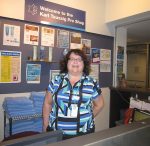
Mimi Grad at the Jewish Community Centre of Greater Vancouver’s pro-shop. (photo by Cynthia Ramsay)

As an independent sales ambassador for Regal Home and Gifts Inc., Mimi Grad told the Independent, “I don’t sell anything. I educate people on what is available and what the items can be used for.”

Grad was born and raised in Vancouver, as were her four siblings. They are third-generation Jewish Vancouverites – both of their parents were born in Vancouver and their maternal grandmother was born at Vancouver General Hospital in 1899.

“My parents were heavily involved in the local Jewish community, as my maternal grandfather was instrumental in the building of the Beth Israel Synagogue,” said Grad.

This is what led to Grad’s involvement in United Synagogue Youth as a teen and her going on the USY Pilgrimage to Israel in 1973.

“As an older teen,” she said, “I went back to Israel in 1976 for a six-month kibbutz-ulpan program and, as an adult, I was part of Canadian Hadassah-WIZO in Vancouver. The local Hadassah Bazaar never ran without Mimi in the Food Building … as the supplies assistant, beginning at the age of 12, or as the food chair.”

Grad and her partner, Gordon Jay, have been together for 21 years, and live in Burnaby. She has held several jobs over the years, including being a swimming instructor and a lifeguard at the Jewish Community Centre of Greater Vancouver.

Currently, Grad is the pro-shop coordinator at the JCCGV, a position she has held since September 2015, and also works as a cashier at the Real Canadian Superstore. Both jobs satiate Grad’s need to interact with different people.

“It was many years ago when I walked into a Regal warehouse on Prince Edward Street, just south of Southeast Marine Drive,” recalled Grad. “I was looking for plastic hole protectors for my shower curtain, as I had one hole that was ripped and I really liked that particular shower curtain.

“At that time, you could just walk in off the street and purchase goods there. The cashier told me that I could save 15% if I registered as a sales rep for Regal. What the heck, why not? And, it was free to do. Then, they started sending me catalogues, and I could buy more of them to share with people.”

Grad was not yet ready to be a sales representative at that point but reencountered the idea about 10 years ago.

Her mom was looking for another source of income in her senior years. “She figured she’d try Regal,” said Grad. “However, she wasn’t getting out much by then, nor was she (or my dad) driving at night. She even asked me to sign up and help her.

“Unfortunately, I was too busy with work, the hubby and life in general to be of much help. And then, dad stopped driving. When mom and dad moved into care, they couldn’t do business there. And then, Regal went bankrupt.

“Another company purchased it in 2005 and, lo and behold, that company went into receivership in August 2016.”

By November 2016, the Regal name was purchased and a new company – Regal Home and Gifts Inc. – started building a catalogue. It was up and running with its first catalogue just under two months ago.

The company behind Regal Home and Gifts has another online business and put many of their products into the first Regal catalogue.

“Regal started in Canada in 1928 as a stationery company. The Regal name has been associated with retailing and direct sales ever since,” said Grad. “Regal Home and Gifts is a newly formed corporation that returns the Regal brand to Canadian ownership, offering Canadian consumers functional and attractive houseware products and gifts through a network of dedicated ambassadors (independent sales representatives), a tradition of the Regal brand.

“They’ve been known over the years for selling kitschy items and plan to have more items like that with their next few catalogues. Like any new business, they’re experiencing growing pains and feeling out the consumers.”

As Grad is almost 60 and eyeing retirement, she felt that her savings needed a boost and decided to be proactive, finding a job she could do from home on her own time. “Honestly, Regal is my retirement plan,” she said.

“I’ve organized my schedule, so, between the JCC and Superstore, I’m generally off work by 2:30 p.m., leaving me with lots of time for my honey and for Regal.”

Grad is excited to spend her days meeting with people – helping them find what they are looking for, placing orders, and even doing evening deliveries. With Regal’s four to six catalogues per year, Grad is looking forward to being out and about most of the time, introducing new people to the products and the company.

“It is then their choice if they want to buy something or not, filling their need for an item,” said Grad.

“I’ve always felt that women made the best car salespeople, because I believe we’re more consultative … not just asking questions like, ‘Which car do you want to buy?’ but ‘Why do you need a car?’

“And, as always, all commissions are made from catalogue sales. Nothing is paid for introducing someone to this business.”

One can buy from the Regal catalogue almost anywhere in Canada. The company is still waiting for direct sales licensing in a couple of provinces, but has completed that process here.

“The first thing I’m always asked is, ‘Can I have a catalogue?’” said Grad. “Everyone wants to see what’s new.”

Anyone interested can peruse the online catalogue and purchase from Grad’s personal Regal website at regal.ca/?amb=9742420.

Rebeca Kuropatwa is a Winnipeg freelance writer.

Format ImagePosted on March 31, 2017March 31, 2017Author Rebeca KuropatwaCategories LocalTags catalogue sales, Mimi Grad, Regal Home and Gifts
Pioneering mutism solutions

Pioneering mutism solutions

The Bayit joined forces with Chabad of Richmond in an emoji-themed Purim celebration held at Richmond’s City Centre Community Centre March 12. Pictured here, left to right, are Chabad of Richmond’s Rabbi Yechiel Baitelman, Bayit president Mike Sachs, Yoav Rokach-Penn and the Bayit’s Rabbi Levi Varnai. (photo by Lauren Kramer)

In every community, and ours is no exception, there are folks who frequently capture the spotlight for their work while others quietly get things done behind the scenes, flying below the media radar. In our new Kibitz & Schmooze profile, we’ll try to highlight members of Greater Vancouver’s Jewish community who are doing outstanding, admirable and mention-worthy work out of view of the general public. If you know of profile subjects who fit this description, please email [email protected].

Kids and anxiety go hand-in-hand, but, when kids’ anxiety gets out of control, many parents turn to Annie Simpson.

The 39-year-old Vancouver Talmud Torah mom boasts a PhD in psychology and 10 years’ experience in pediatric psychology. She founded the Cornerstone Child and Family Psychology Clinic in Vancouver in January, where she works with nine other psychologists. But Simpson’s focus is on young patients with anxiety disorders, including obsessive-compulsive disorder, panic disorder, selective mutism and depression.

photo - Dr. Annie Simpson
Dr. Annie Simpson (photo from Annie Simpson)

Her interest in selective mutism, an impairment defined as an inability to speak in some social situations despite speaking perfectly fine in others, began six years ago. That’s when Simpson started getting referrals of children with the impairment and wanted to gain a better understanding of how to help them. She traveled to New York to confer with world-renowned expert Dr. Steve Kurtz, helped run one of his camps for selectively mute kids and came back enthusiastic about applying his cognitive behavioural therapy methods in Vancouver.

Within two years, Simpson ran the first camp of her own at the Jewish Community Centre of Greater Vancouver and soon started receiving calls from all over North America, from parents who wanted to enrol their children. Just under one percent of kids have selective mutism.

Simpson’s summer clubs are annual now, and in high demand. “I see a wide variety of impairment, from kids who only speak to one parent to kids who cannot speak at school,” she says. “At the camps, we develop a trusting relationship with the children and then expose them gradually to the feared situation, rewarding their success.”

Camp is Simpson’s favourite week of the year because the progress is so rapid. “The children are improving so quickly and they get so excited about their success,” she says. “With the right supports in place back home, the kids continue to thrive after the camp.”

For parents who don’t seek help for selectively mute kids, Simpson warns that the mutism gets more challenging to treat the older a child gets, and is particularly difficult when kids become teens and have had so many years of not talking.

When she’s not counseling patients, you’ll find this enterprising Vancouverite at B.C. Children’s Hospital, where she’s a staff psychologist in the pediatric OCD Program; at Simon Fraser University, where she’s a clinical associate in the department of psychology; or consulting for AnxietyBC.

*** 

photo - Café 41 put on a fabulous Argentine-style Purim dinner that was well-attended by members of the community March 12. Yamila Chikiar and Daniel Presman (pictured) own the café with Menajem Peretz
Café 41 put on a fabulous Argentine-style Purim dinner that was well-attended by members of the community March 12. Yamila Chikiar and Daniel Presman (pictured) own the café with Menajem Peretz. (photo by Lauren Kramer)


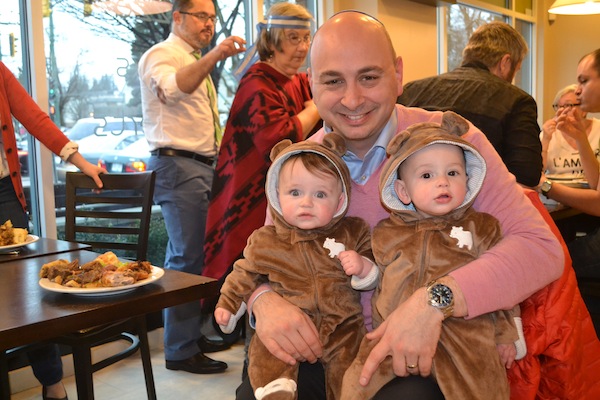
photo - Jewish Federation of Greater Vancouver chief executive officer Ezra Shanken with his nine-month-old twin boys at Café 41 for Purim
Jewish Federation of Greater Vancouver chief executive officer Ezra Shanken with his nine-month-old twin boys at Café 41 for Purim. (photo by Lauren Kramer)
Format ImagePosted on March 31, 2017March 31, 2017Author Lauren KramerCategories LocalTags Anne Simpson, Bayit, Café 41, Chabad of Richmond, Jewish Federation, mutism, Purim
The truest act of kindness

The truest act of kindness

Howard Jampolsky tells the story of how community members came together to support a family after the death of their husband, father. (photo from Schara Tzedeck Cemetery Board)

Taking care of the deceased is known as a chesed shel emet, or “the truest act of kindness.” The Schara Tzedeck Cemetery Board and Chevra Kadisha practise this every day.

We take care of our community’s deceased, and help their families from the time of death through the funeral service. Of course, because we have financial obligations like any other organization, we charge for our services. However, every family is charged the same price for burial plots and funeral services, and we only offer a traditional burial with all the proper rites. We treat every deceased person and their families equitably.

This practice varies only if a family is not in a financial position to pay the full costs. Sometimes, families simply need an extended period to pay for the funeral – for example, when funds are only available from the estate. Sometimes, families cannot pay the full amount, as this would cause a significant hardship. And then, there are times when a family is simply not able to pay anything at all. In all of these cases, we provide the same services as we provide everybody: it is our core belief and mission to provide a full and proper Jewish funeral according to all the customs and laws.

We carry out about 125 funerals each year and, while each is unique, there are some that truly stand out. This chronicles one such story.

On a cold and rainy day in October, I received a call from Rabbi Hillel Brody, who serves as the religious leader of the Louis Brier Home and Hospital. He told me there was a resident who was dying and his wife, who we will call “Margaret” (names have been changed in this story to protect privacy), was worried for a variety of reasons. Margaret and her husband “Shmuel” had moved to Vancouver about 10 years earlier and, because of Shmuel’s failing health, much of their time was spent visiting doctors and caring for him. They tried to connect with the community, but were unable and, earlier that year, Shmuel was moved into the Louis Brier. Margaret began to find some connection to people just by being in the more active setting of the home, but, still, her focus was almost entirely on caring for Shmuel. This devotion to her husband was admirable, but it came with a price – they did not have any close friends.

Margaret had no idea where to begin when it came to planning for Shmuel’s burial. To make matters worse, Margaret and Shmuel did not have the money to pay for a funeral or a burial plot. Rabbi Brody assured Margaret that the Schara Tzedeck Cemetery Board and Chevra Kadisha would take care of things. He told me that the only family was a daughter, who lived in Toronto, and he told me that she had decided to visit a few weeks earlier to see her father and say her goodbyes while he was still alive. As she could only make one trip, she had made this difficult choice, and was not going to be able to come for the funeral.

When Shmuel passed away, I called Margaret and arranged to meet her at her apartment to go over the details and get all the necessary paperwork signed. Margaret and Shmuel had been together for almost 50 years, and life had always been hard. They were both Holocaust survivors, both were born in Hungary. Shmuel had been held by the Nazis as a very young boy of less than 10 years old and, because of the conditions that he and other Jews were under, he became very ill from malnutrition and as a result of Nazi torture. He was fortunate to not have been murdered by the Nazis, as so many were, but though he survived and was rescued, he never truly recovered.

Margaret and I completed the paperwork required for registering Shmuel’s death, and talked about the funeral. She was shocked and humbled when I told her that we would provide Shmuel with a full and proper Jewish funeral and she would not have to pay anything. Her tears flowed again, but this time from relief.

Margaret told me she did not even know how she would be able to get to the cemetery. She had sold her car some years earlier, and would take the bus every day to be with Shmuel at Louis Brier. I told her that Rabbi Brody had offered to drive her to the cemetery. Again, she was surprised and grateful.

At this point, the funeral would be one of the smallest I had ever attended. It was looking like Margaret, Rabbi Brody and I would be the only people there. I knew that Margaret needed more help. The thought of her being dropped off at her small apartment to be alone after burying her husband was upsetting. She needed more support, and I asked Margaret if it would be OK if we purchased an airline ticket for her daughter, “Monica,” to come to Vancouver to be here for a few days, including for the funeral.

Margaret was at first confused by the question. I’m not sure she even comprehended what I was saying. But Monica accepted our offer and, later that day, an airline ticket was purchased for her.

With Monica in town, Margaret would be able to get to the cemetery, as Monica’s good friend, “Bill,” had agreed to drive them. Two more people would be there to help bury Shmuel.

I went home that evening feeling both exhausted and energized. I had worked hard that day to make sure everything would work for Margaret, but the weight of the day was offset by the buoyancy of the good deeds that were also done. Margaret was going to get through this a little easier now, and it felt good.

On arrival the next morning at shul, I saw Rabbi Brody. He told me he was inspired by what we had offered Margaret, and mentioned that he had advised Congregation Schara Tzedeck’s Rabbi Andrew Rosenblatt that the funeral was taking place the following morning. He said he had asked Rabbi Rosenblatt to announce the funeral to his congregation and, if anyone could attend, they should contact me.

I approached a congregant who is a wills and estates lawyer, and he offered to provide Margaret with legal help in dealing with her husband’s affairs, for no charge.

At the end of the service, another congregant approached me and asked me to contact Omnitsky Kosher and order food for the family to be sent over following the funeral, with the bill directed to her.

Neither of these people had ever heard of Margaret, or Shmuel, or Monica. They just were part of a community that was beginning to rally around a fellow community member to give her the support we would all need in such a situation.

The weather was forecast to be very windy and wet for the Sunday funeral, but we were lucky that it was still dry. Monica had told me she let a few people know about the funeral, and that they may come, so I was not surprised when I saw two people walking into the small cemetery. As they approached, I asked them if they were friends of Monica. They told me they did not know anyone by the name of Monica, but had heard there was funeral this morning for a Holocaust survivor, and that there would be only a few people here, and they wanted to come to support the family.

A few moments later, another car drove up – a man with his two sons arrived for “a funeral they had heard about.” Car after car arrived. More and more people gathered, some who had driven almost an hour to lend support to a total stranger and to participate in the mitzvah of laying Shmuel to rest.

When the funeral started at 11 a.m., there were close to 30 people there – none of whom had ever met Shmuel, Margaret or Monica.

The beauty of a chesed shel emet is that everyone gains. I know that everyone at the funeral, and everyone who helped in some way or another, benefited from this experience. But, most of all, Margaret benefited and will continue to benefit from a community that supported her in her darkest hour, and will continue to help her.

Margaret will mourn and grieve. She does not know how she will be able to live on without Shmuel, and cannot imagine ever recovering from this physical and emotional blow.

But she will.

Howard Jampolsky is executive director of Schara Tzedeck Cemetery Board.

Format ImagePosted on March 31, 2017March 31, 2017Author Howard JampolskyCategories LocalTags bereavement, chesed shel emet, death, Judaism, Schara Tzedeck
Teens enjoy N.Y. Shabbaton

Teens enjoy N.Y. Shabbaton

CTeen members with Rabbi Chalom Loeub. (photo from Chabad of Richmond)

Did you know that Richmond Jewish teens have a group of their own? It’s CTeen, which stands for Chabad Teen Network. CTeen Richmond, a program sponsored and hosted by Chabad of Richmond, is led by Rabbi Chalom Loeub.

“CTeen is open to all Jewish teens, regardless of their religious affiliation,” said Loeub. The international program run by Chabad Lubavitch is aimed at teens in grades 8 to 11. CTeen Richmond is currently comprised of a small group of teens, but wants to expand its numbers.

This unique program includes Sunday night learning, volunteering and socializing. Participants volunteer by cooking and baking for the Light of Shabbat meals, which are delivered to elderly Jews and those who have trouble cooking for themselves. The CTeens also cook and bake for the Smile on Seniors program at Chabad of Richmond.

Six CTeen youth from Richmond recently attended a CTeen Shabbaton in New York. This Shabbaton gathered 2,000 teens from around the world. It included Friday night programs, where they learned about Jewish history, as well as how Judaism relates to science. They also learned a bit about the Tanya, ate great food, met lots of other teens, sang, danced and had lots of fun. One of the Richmond CTeens described it as “inspirational.”

Friday afternoon, the teens got to explore New York in groups. Saturday evening, with stringent security, the CTeens took over Times Square for two hours, where they held Havdalah, sang and danced, and listened to motivational speakers on topics like Torah and the importance of doing mitzvot. Richmond teen Daniel Davydova, who went with his brother Itay, took from this experience the message that “together, we are the future.” He described the experience as “enlightening.” After the talks, the teens toured New York on buses.

The highlight of the Shabbaton for most of the Richmond group was visiting the Ohel, the holy site of the Lubavitcher Rebbe’s grave. The teens found it extremely spiritual, and got the chance to write letters asking G-d for blessings for themselves and others. It was here they also wrote their personal “resolutions,” and committed to carrying these out.

Dana Sander, a Richmond CTeen member, called the visit “amazing” and said she’d recommend the CTeen Shabbaton to everyone. Fellow member Aaron Benatar said he loved “connecting with other Jewish teens from around the world.” He said that “standing shoulder to shoulder as a group” was very powerful. He said it “rekindled his Jewish spirit, and made him feel even more committed to helping the Jewish community through doing mitzvahs.”

The Richmond CTeen program focuses on Torah study and the importance of helping others. Eyal Levy, who’s been part of the program for a few months, is very enthusiastic about it. “I love the cooking most of all,” he said. “We get to cook for seniors who need it. I also love the socializing and games. Plus, we get to talk to the rabbi about topics that interest us.”

According to Rabbi Yechiel Baitelman of Chabad of Richmond, “CTeen harnesses the incredible potential of teenagers by offering awesome programs that bring teens together to give back to their communities. CTeen welcomes every Jew and creates a sense of belonging.” The CTeen Network views the teenage years as a time not just for partying and frivolity, he added, but as a time of purpose and self-discovery. The goal is to connect participants to anything and everything Jewish.

For more information, contact Loeub at 778-712-7703 or email [email protected].


Format ImagePosted on March 31, 2017March 31, 2017Author Chabad of RichmondCategories LocalTags Chabad, Chalom Loeub, CTeen, Judaism, Richmond, youth
Water expertise helps

Water expertise helps

During an installation of a solar water pumping system at Nyanza Village, Uganda, Innovation: Africa’s engineer and project manager celebrate as clean water flows. (photo from Innovation: Africa via Israel21c.org)

Using ingenuity to overcome its serious water challenges, Israel has become the go-to expert for a world facing an impending water crisis. To celebrate World Water Day on March 22, Israel21c took a look at 10 of these innovative water projects, and Israel’s leadership role.

This year’s WATEC expo and conference, to be held in September in Tel Aviv, is expected to attract 10,000 stakeholders from 90 countries seeking Israeli solutions for water issues. Israel exports $2.2 billion annually in water technology and expertise. In addition, these commodities are shared on a humanitarian basis through training courses, consultations and projects. Keren Kayemeth L’Israel-Jewish National Fund (KKL-JNF) often hosts delegations from around the world – most recently, from California, Argentina and the European Policy Centre – to see how Israel’s system of treatment facilities and 230 reservoirs has achieved the world’s highest ratio of wastewater reuse. About 92% of Israeli wastewater gets treated and 75% is used for agricultural irrigation. Israel plans to recycle 95% of its wastewater for irrigation by the end of 2025.

“During the 1980s, recycling wastewater was a revolutionary concept and many people were skeptical. Today, nearly half of the irrigation in Israel comes from recycled wastewater,” said KKL-JNF development project director Yossi Schreiber.

Israeli water-tech companies are planning and building agricultural and municipal water infrastructure in countries including Angola, Ghana, Serbia, China, Spain and the United States. Here are 10 recent examples.
1. The nonprofit group Innovation: Africa won a United Nations award for transforming lives in seven African countries using Israeli technologies, such as Netafim irrigation systems, that enable farmers to grow more crops with less water; and solar energy systems that pump water from aquifers, saving villagers (mostly women and children) countless hours previously spent finding and fetching water.

2. IsraAID launched its WASH (Water, Sanitation and Hygiene) project about four years ago to tailor-make solutions for communities from Fiji to Haiti to Myanmar.

In the rain-dependent South Pacific island nation of Vanuatu, a March 2014 cyclone contaminated reservoirs and destroyed water-harvesting systems. Among other steps, IsraAID strategized the engineering of a low-tech gravity system, built and maintained by locals, to bring water from mountain springs down into two villages encompassing more than 600 people and one school. IsraAID is working with the World Bank to construct three more gravity systems.

In Kenya’s Kakuma Refugee Camp and Uganda’s Gulu township, which struggle with waterborne disease and water contamination, IsraAID trains unemployed or underemployed people to be water technicians. Graduates work with local nongovernmental organizations or water companies, or start their own businesses, to contribute their new expertise in anything from drilling wells and building latrines to teaching hygiene.

3. A massive landslide in September 2015 damaged a major irrigation canal partially built by Israeli NGO Tevel b’Tzedek in an impoverished Nepali village. Tevel staff repaired the damage with funding from the Rochlin Foundation and Jewish Coalition for Disaster Relief, and worked with the local water council to strengthen the canal walls, reestablishing and assuring water supply to 224 households (about 1,300 people) and subsistence farmers.

Also in Nepal, Tevel is fighting the effects of flash floods – which deplete water available for drinking and irrigation – by building irrigation pools and setting up zero-water-waste systems enabling villagers to conserve water through Israeli methods, including drip irrigation learned by Tevel’s native Nepal director at Ben-Gurion University of the Negev. Tevel also is teaching village farmers less water-intensive professions, such as beekeeping.

4. Israel’s Ministry of Foreign Affairs (MFA) has partnered with Caesarea-based GAL Water Technologies to provide free water-treatment products to African nations for more than 20 years. In 2016, MFA donated GAL mobile water purification, storage and distribution vehicles to drought-stricken Papua New Guinea and to the Pacific Marshall Islands.

5. Earlier this month, the MFA’s MASHAV-Israeli Agency for International Development Cooperation established the Kenya Israel Drought Resilience Agriculture Centre to help in capacity-building with the latest Israeli irrigation and water-resources management know-how.

6. MASHAV’s special envoy for water and food security went to Swaziland this month with the director of overseas training, programs and research at MASHAV-affiliated Centre for International Agricultural Development Cooperation to conduct a water survey by request of Swaziland’s prime minister. The experts are identifying possible areas of cooperation in combating drought and a shortage of water for agriculture.

7. Following a May 2016 earthquake in Ecuador, IsraAID brought a new Israeli water-purification technology from NUFiltration to several affected villages. Instead of having to buy bottled drinking water, residents can use the NUF system to turn washing water into purified drinking water without electricity. NUF was first piloted by the company in Ghana as a humanitarian project to prevent diseases from contaminated water.

8. The Tel Aviv University chapter of Engineers without Borders designed and built a rainwater collection and purification system in a Tanzanian village where the drinking water had dangerously high amounts of fluoride. Since the project was finished in 2014, it has been supplying safe drinking water to more than 400 children daily.

9. The Technion Engineers without Borders chapter designed and implemented a safe drinking-water system serving more than 600 Ethiopian schoolchildren in a rural village with no reliable source of water for drinking and handwashing. The Israelis taught the older children how to maintain the system and treat the water, and continue to provide support to assure a safe and sustainable water supply.

10. In June 2015, the Israeli Ministry of Economy committed $500,000 to the World Bank Group’s Water Global Practice to help developing countries overcome complex water security challenges. The agreement has included two years of study tours and other activities for World Bank staff and officials of various governments.

Israel21c is a nonprofit educational foundation with a mission to focus media and public attention on the 21st-century Israel that exists beyond the conflict. For more, or to donate, visit israel21c.org.

Format ImagePosted on March 31, 2017March 31, 2017Author Abigail Klein Leichman ISRAEL21CCategories WorldTags Israel, tikkun olam, water
Working to get to Olympics

Working to get to Olympics

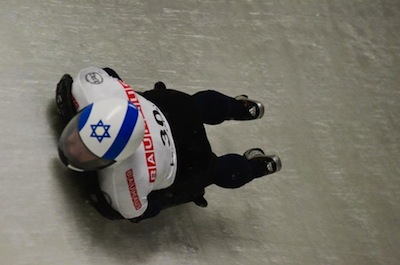
Joel Seligstein is one of four Israeli skeleton athletes aiming for the 2018 Olympic Games in PyeongChang, South Korea. (photo by Erin Murphy)

What began as a dream 15 years ago – when David Greaves helped establish an Israeli presence in the bobsled and skeleton world – finally received the approval, recognition and support of the Israeli Olympic Committee this past December.

Greaves was a member of the Israeli bobsled team that fell short of qualifying for the Olympics in 2006, although they did compete in two world championships.

“When I retired from the sport,

I felt I wanted to continue in some capacity,” Greaves told the Independent in an interview earlier this year. “So, I took over as head of the federation, of which I’m now the president. It’s called Bobsled Skeleton Israel, which is the Israeli bobsled skeleton federation.

“I wanted to stay involved in the sport and to try to provide an opportunity for other Jewish athletes to experience something of what I did – the pride of wearing the Magen David on your jacket and competing for Israel internationally.”

The experience changed the trajectory of Greaves’ life – he was working in the sales and high-tech industry. It also made him realize what was important for him as a Jew and an Israeli.

“I came back from that experience deciding I wanted to leave the world of high-tech and focus my efforts on Jewish community and working for Israel,” he said. “That led me to volunteering for the Jewish Federation of Winnipeg. This soon led to me working on a contract basis for them, which turned into a full-time role. I became a fundraiser for the Jewish community.”

Greaves spent 10 years fundraising for Winnipeg’s federation and then for the Jewish Foundation of Manitoba, before starting his own business in 2014. Called Protexia, it helps nonprofits and charitable organizations fundraise.

With the refocus in his professional life also came a refocus in his involvement with Bobsled Skeleton Israel. As the organization’s volunteer president, he is in regular contact with the Israeli Olympic Committee as they gear up for the Winter Olympics in PyeongChang, South Korea, in 2018.

“The challenge was finding an athlete interested, sometimes from another program … the American program, whatever it happened to be. Some of the bigger programs are so deep, you can be a great athlete … but may not have an opportunity to make the big leagues and would likely not ever get the opportunity that they have now … to compete at the highest level, for a smaller nation,” said Greaves. “But now, I have four athletes competing at different levels around the world … and that’s more than most small nations have.”

While many people compete for Israel from around the world, most are not directly connected to the Israeli Olympic Committee, but, with the completion of the process in December, Bobsled Skeleton Israel is now an official Olympic sport under its umbrella. Last September, the committee had accepted Greaves’ recommendation to recognize the criteria established by the International Bobsled and Skeleton Federation as the Israeli criteria.

“It was almost anticlimactic,” said Greaves. “I was working on this for 13 years and I’d never had the opportunity to present to the Israeli Olympic Committee before, with the opportunity of them possibly accepting our recommendation. Needless to say, I was over the moon and ecstatic.

“So, now, I feel confident talking about our future, because the only step left for us to be competing at the Olympics is for one of my athletes to qualify. If we have an athlete that qualifies, then we’ll be going to Korea for the Games, as he will have met the criteria.”

To get to the Olympics, the athletes will need to be in the top 60 internationally. For the current season, the goal is to get two athletes into the top 75 world ranking, which would position them for next year. They currently only have one.

All of the Israeli athletes in the federation are competing on their own in skeleton.

“It’s been easier for us to find skeleton athletes from a budgetary standpoint, because we don’t fund our athletes,” said Greaves. “We’d love to have a bobsled team, too, but it’s a bit more work for us to really develop that program. Given I’ve got a full-time day job and we don’t at the moment have any prospects for bobsled athletes, our efforts have solely focused on developing our skeleton program.”

Israeli skeleton athlete Bradley Chalupski in action
Israeli skeleton athlete Bradley Chalupski in action. (photo from Bradley Chalupski)

Bobsled Skeleton Israel is a nonprofit in the United States, enabling them to fundraise there for their athletes. These athletes can fundraise within their circles and the organization can provide a tax receipt to donors.

“We’ve been pretty successful in the last few years in raising more money than we have in the past,” said Greaves. “It’s been allocated out to the athletes based on need. Essentially, they get reimbursed, in very small part, for their costs. If we have $5,000 or $10,000 in the bank, so to speak, and an athlete has just come back from a week of training, then they can submit a portion of their expenses. But, it’s very modest.

“We’re looking to have a fundraiser this spring in Winnipeg. There’s also now – because we’re now officially a member within the Olympic movement in Israel – the possibility for funding from the state if an athlete qualifies for funding.”

In that case, the athlete will be eligible for a few Israeli shekels a month. Even so, about 95% of the money spent in this sport by Israeli athletes is money that they themselves have raised, either through their own personal supporters or their own savings. According to Greaves, his athletes have given up the last two or three years of their lives to compete and train.

Contributions are deductible in Israel and the United States, and there is an Indiegogo campaign currently underway. Greaves is in discussion with a few Jewish organizations with the hope that they may be able to assist in accepting Canadian donations.

“We want people to understand we’re in this because of a love for Israel and a love for sport,” he said. “Our ultimate dream is to walk into the Olympic stadium with the Israeli flag. There’s such a pride that’s hard to convey. We do this out of a sense of pride and love for Israel.

“I once was asked in an interview years ago, when I was competing, if I had a choice to compete for Canada or for Israel, who would I pick? I’m a dual citizen. I said, without a doubt, I’d want to do it for Israel. There’s a special connection between my Jewishness, my connection to Israel and my Zionism. The other guys on my team feel the same way as well. Am Yisrael might make this a different experience than other athletes might have … not to take away from how amazing it would be for any athlete to represent their country.”

For more information and to follow the athletes – Bradley Chalupski, Adam (A.J.) Edelman, Joel Seligstein and Larry Sidney – visit facebook.com/israelibobsledandskeletonfederation. To contact Greaves, email [email protected].

Rebeca Kuropatwa is a Winnipeg freelance writer.
 

Format ImagePosted on March 31, 2017March 31, 2017Author Rebeca KuropatwaCategories WorldTags David Greaves, Israel, Olympics, skeleton, sports
Ackerman keeps on winning

Ackerman keeps on winning

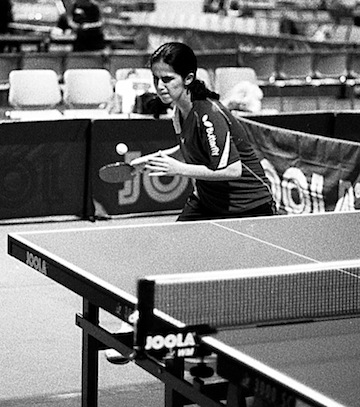
Estee Ackerman wins gold at the 2016 Junior Olympics in Houston. (photo from Estee Ackerman)

A Jewish Orthodox New Yorker is quickly becoming a legend – and she is not even 15 years old yet. Her name is Estee Ackerman and she is currently one of the hottest names in table tennis.

In 2013, Ackerman even beat one of the world’s greatest tennis players – Rafael Nadal – in an exhibition table tennis match during the American Open. Nadal went on to win the American Open that year. “So, I could say I was the only one who beat him in New York,” joked Ackerman.

A sophomore at Yeshivah University High School for Girls, also known as Central, Ackerman is a nationally and internationally ranked table tennis star.

Her passion for the sport began at a young age, as a fun way for her and her family to pass the time on Saturday afternoons in their basement.

“My dad wanted to do something fun with my brother, Akiva, and I that did not involve electronic gadgets,” Ackerman told the Independent. “He says everyone is looking down [at their gadgets] these days. We figured, what can we do? In the wintertime, we can’t go out so much and we were young kids at the time … we can’t do wrestling, we’re not tall enough for basketball.

“My dad started with my brother, Akiva, who is also now an amazing player. They really just had a fun family activity, as we had a table in our basement. One day, I went down and I said, ‘Let me give this a try.’ I was about 8 years old at the time and I was also so little that they just saw the racket going back and forth … I was under the table.

“Just playing with them about an hour each night was how it began. After doing this for a few months, a few days a week, we saw improvement. From there, we took it to the next level. We went to professional ping pong clubs. I compare it to how some people get piano lessons … I got the ping pong lessons, with top coaches from China.”

Ackerman recalls feeling “star struck” when she entered these clubs. “I was definitely at the bottom in the club leagues,” she said. “But, as the coaches said I had talent and that I should continue, I went to them a few times a week, and that’s how we saw much improvement to keep going.”

Balancing school and play is no easy feat, but, with Ackerman’s success, Central was willing to accommodate her traveling for tournaments, sometimes missing a week of school at a time.

“I would say that when I get back from these weekly tournaments, all the teachers are so happy … they’re so willing to sit down with me and catch me up on the notes I missed,” said Ackerman.

“Besides my friends wanting to know how I did in the tournaments, they’re eager to sit down with me, because they know that missing 11 classes a day for a week is not so easy to catch up on. But, I’m happy to say that Central is very supportive in all I do.”

Ackerman’s dad takes her to all the tournaments and practices, and ensures she has whatever she needs.

As for Ackerman’s fellow table tennis playing brother, he has put the sport on hold in order to continue his Torah studies in Israel. But, he may return to ping pong in the future, as he has plans to study at Yeshivah University after his time in Israel.

photo - Estee Ackerman in action
Estee Ackerman in action. (photo from Estee Ackerman)

In Ackerman’s professional career to date, she has already achieved successes that few even dare to dream about, including winning the Nationals in Las Vegas in 2015.

“This probably is one of my biggest accomplishments,” she said about those games, “as I was competing against 250 players in that event – transferring from the round robin group all the way to the single elimination matches.”

Last summer, Ackerman entered the U.S. Open playing hardbat. “That is like the old school way,” she explained. “If you know, a ping pong racket is usually made with smooth rubber, but a hardbat is usually made with pimples [an outer layer of rubber covered in dots]. I had never played in tournaments with hardbats [before that].

“Believe it or not, I did win the Women’s Open hardbat event. I came in second in the mixed doubles hardbat event. And, I won the gold medal in the women’s doubles hardbat event. So, I can definitely say that, in America, I’m the best female hardbat player.”

In February 2016, Ackerman was one of 16 women invited to the American Rio Olympics trials. But, as she could not play on Shabbat, she was not able to get enough wins to make the team.

“Being at the Olympic tryouts was already great enough to me,” she said. “Me being with the best players in our country – warming up with them, seeing them in the locker room – it doesn’t get better than that. I was playing on the biggest stage of my life.”

Now, Ackerman has her sights set on 2020 in Tokyo. But, in the meantime, she is busy accomplishing other feats, such as winning gold in the Junior Olympics, for girls under the age of 16 in singles and for girls under the age of 16 in doubles.

Ackerman is also thinking about whether or not she will go to the Maccabiah Games or stay in the local circuit for now. And, of course, she is focusing on graduating in 2019.

As it happens, Ackerman’s first trip out of the United States was in 2014 for a tournament in Markham, Ont. “I was representing the United States competing against Canada in the Junior Cadet Open,” she said. “As that was the first time I left the country, I was very excited, especially to be representing America.

“We did hear of a tournament taking place two weeks ago in Vancouver, but, as it was only a two-day event and one of the days was on Shabbat, we didn’t go. Other tournaments are four days or a week long, so just to compete for one day is a little much for the amount of travel.”

Asked if she has any advice for other young sport hopefuls, Ackerman said, “One should always dream big and just believe. I know that if one can put in countless hours and hard work, and they really love what they do, they can accomplish their goals. If they really want to be the best they can be, they have to put in the amount of hours that it takes.

“Although I love the sport of table tennis, I always say it’s my second priority. My religion, Judaism, is my first priority.”

As far as playing ping pong on Shabbat, Ackerman feels it is totally OK when her friends come over to have fun. But, when it comes to competing in a national tournament – with the uniform, with the media – she does not feel that it is right to participate on Shabbat.

Ackerman recently made it onto the world ranking. She is 466th in the world and 171st for her age group of under 18. To follow her career, visit teamusa.org/usa-table-tennis.

“I know to be really up there in the world rankings, you really have to travel worldwide – to France, Poland and Switzerland,” said Ackerman. “As I am in yeshivah, it’s a little tough. But, as I get any opportunity, I’d love to be there.”

Rebeca Kuropatwa is a Winnipeg freelance writer.
Format ImagePosted on March 31, 2017March 31, 2017Author Rebeca KuropatwaCategories WorldTags Estee Ackerman, ping pong, sports, table tennis
An artificial odour test

An artificial odour test

(image from wis-wander.weizmann.ac.il)

Say someone claims to have developed a system to “capture” any odour in the form of a digital code – one that could be transmitted online or uploaded to the internet and faithfully reproduced at the receiving end. How could we be sure that the system is valid? In other words, how can we know that, for any possible odour someone has captured digitally and transmitted, the smell we receive is indeed a recognizable, fair rendition of the original?

Prof. David Harel of the Weizmann Institute of Science’s computer science and applied mathematics department explains that, as opposed to video and audio, an odour reproduction system is still far from viable, although some of the components already exist.

“We still don’t understand the process by which the numerous combinations of odourants in our environment are identified and sensed as a particular smell in our brains after they enter our noses, attach to the several hundred kinds of odour receptors there and are transferred to the brain as signals,” he said. But he and his colleagues had, already 15 years ago, laid out the basic principles of such a digital smell system.

This system would need a “sniffer” – a sort of artificial nose – to take “snapshots” of the odourous substances in the air. It would also need a “whiffer” that, something like a colour printer, would be able to mix a fixed set of around 50 chemical odourants in precisely given proportions – something in the way a printer mixes a small number of inks – and release measured amounts of the resulting odour into the air accurately, in a controlled manner.

photo - Prof. David Harel of the Weizmann Institute of Science
Prof. David Harel of the Weizmann Institute of Science. (photo from wis-wander.weizmann.ac.il)

Harel believes that such systems will eventually exist, pointing out that research is continually improving our understanding of how smell is “encoded” and how we perceive it. Although reasonably good sniffers and whiffers exist, the tantalizing scientific challenge is to work out the algorithm for connecting the sniffer’s reading into the whiffer’s emission; that is, a method is needed for translating any given odour into precise instructions for the whiffer to follow. The output mixtures would have to be experienced by humans in the way that photos are today – as reproductions that our sense recognizes as faithfully capturing the original.

Despite the fact that this challenge appears to be extremely difficult, Harel recently devised a test that could be used to assess the validity of such a system, if and when one is proposed. One of his inspirations was the Turing test proposed by the British father of computer science, Alan Turing, to test claims of human-like intelligence in a machine. A tester sits in one room and holds conversations with entities in two other rooms – one a human and the other the candidate computer. Through questions, chitchat and serious discourse, the tester tries to identify which is which; if repeated tests cannot distinguish the computer from the human, it is said to possess artificial intelligence. “The problem with using such a test for artificial olfaction,” said Harel, “is that such blind comparisons are detached from the element of human recognizability; and there is no adequate language to describe smells in general, meaning verbal discussions would not work either.”

Harel devised a “lineup” test, whose key feature is the immersion of odours with their natural audio-visual references, thus eliminating the need for verbal description. A team of neutral testers is given several short video clips – for example, of a bakery, a zoo, a dusty attic, a flowering meadow, etc. – and is asked to match an odour emitted by the sniffer with its correct clip. The clips are prepared by a team of challengers, whose role is to try to disprove the claim that the proposed system is valid.

To make sure that the test is fair – for example, the subjects won’t be required to identify the odour of a damp cave hidden from view in the clip of a meadow scene – the group is divided into two. One half is exposed to the actual odours collected and preserved at the video sites, and the other to the artificial, chemically reproduced odour created by the sniffer-whiffer system. That way, the second team of participants – those smelling the whiffer output – are required only to correctly match the odour to its clip when the first team – those exposed to the real odour – succeeds. As in the Turing test, the artificial is pitted against the natural in a blinded experiment, but here the test uses odour immersion for recognizability, and the test is asymmetric, requiring from the artificial no more than is required from the real thing in order to be declared successful.

For more on the research being conducted at the Weizmann Institute, visit wis-wander.weizmann.ac.il.

Format ImagePosted on March 31, 2017March 31, 2017Author Weizmann InstituteCategories IsraelTags David Harel, science, Weizmann Institute
הערים היקרות בעולם

הערים היקרות בעולם

השבועון האנגלי לחדשות ואקטואליה ‘האקונומיסט’ פירסם את המדד השנתי שלו על הערים היקרות ביותר בעולם. קנדה מיוצגת בדוח על ידי שלוש ערים בלבד: ונקובר במקום ה-39, מונטריאול הרחק במקום ה-62, ואילו טורונטו במקום ה-86. (צילום: Cynthia Ramsay)

השבועון האנגלי לחדשות ואקטואליה ‘האקונומיסט’ פירסם את המדד השנתי שלו על הערים היקרות ביותר בעולם. הדוח לשנת 2017 כולל 133 ערים מרכזיות ובולטות, שיוקר המחייה בהן הוא הגבוה ביותר בעולם. הדוח מתבסס על 400 פרטי מחירים של 160 מוצרים ושירותים שונים. ובהם: אוכל, משקאות, ביגוד, תחבורה, שכירות, חשמל, בתי ספר פרטיים, פעילויות פנאי ועזרה ביתית.

קנדה מיוצגת בדוח על ידי שלוש ערים בלבד: ונקובר במקום ה-39 לעומת מקום 49 אשתקד, מונטריאול הרחק במקום ה-62 לעומת מקום 71 אשתקד, ואילו טורונטו רחוקה עוד יותר ונמצאת במקום ה-86 לעומת מקום 88 אשתקד.

העשירייה הראשונה בדוח: את רשימת הערים שיוקר המחייה בהן הוא הגבוה בעולם מובילה סינגפור (במקום ראשון אשתקד), הונג קונג במקום השני (במקום שני אשתקד), ציריך במקום השלישי (במקום שני אשתקד), טוקיו במקום הרביעי (במקום אחד עשר אשתקד), אוסקה במקום החמישי (במקום ארבעה עשר אשתקד), סיאול במקום השישי (במקום שמיני אשתקד), ג’נבה במקום השביעי (במקום רביעי אשתקד), פריז גם כן במקום השביעי (במקום החמישי אשתקד), ניו יורק במקום התשיעי (במקום שביעי אשתקד), קונפנהגן במקום העשירי (במקום שמיני אשתקד).

העשירייה השנייה: תל אביב נמצאת במקום האחד עשר (במקום ארבעה עשרה אשתקד), לוס אנג’לס גן כן במקום האחד עשר (במקום שמיני אשתקד), אוסלו גם כן במקום האחד עשר (במקום שלושה עשר אשתקד), סידני במקום הארבעה עשר (במקום עשרים אשתקד), מלבורן במקום החמישה עשר (במקום עשרים ואחד אשתקד), שנחאי במקום השישה עשר (במקום אחד עשר אשתקד), הלסיניקי גם כן במקום השישה עשר (במקום שבעה עשר אשתקד), אוקלנד גם כן במקום השישה עשר (במקום שלושים ושמונה אשתקד), וולינגטון גם כן במקום השישה עשר (במקום ארבעים ושתיים אשתקד).

העשירייה השלישית: שנג’ן במקום העשרים ואחד (במקום שישה עשר אשתקד), וינה גם כן במקום העשרים ואחד (במקום שמונה עשר אשתקד), פרנקפורט במקום העשרים ושלושה (במקום שמונה עשר אשתקד), לונדון במקום העשרים וארבעה (במקום שישי אשתקד), דבלין במקום העשרים וחמישה (במקום עשרים וארבעה אשתקד), מינאפוליס גם במקום העשרים וחמישה (במקום עשרים וארבעה אשתקד), שיקגו במקום העשרים ושבעה (במקום עשרים ואחד אשתקד), וושינגטון גם כן במקום העשרים ושבעה (במקום עשרים ושישה אשתקד), מילאנו במקום העשרים ותשעה (במקום עשרים ושמונה אשתקד), עמאן גם כן במקום העשרים ותשעה (במקום עשרים ותשעה אשתקד).

העשירייה הרביעית: בריזביין במקום השלושים ואחד (במקום ארבעים ותשעה אשתקד), דאליין במקום השלושים ושתיים (במקום עשרים ואחד אשתקד), המבורג גם כן במקום השלושים ושתיים (במקום שלושים וארבעה אשתקד), סן פרנסיסקו גם כן במקום השלושים (במקום שלושים וארבעה אשתקד), מינכן במקום השלושים וחמישה (במקום שלושים ואחד אשתקד), יוסטון גם כן במקום השלושים וחמישה (במקום שלושים ואחד אשתקד), רומא גם כן במקום השלושים וחמישה (במקום שלושים וארבעה אשתקד), אדלייד גם כן במקום השלושים וחמישה (במקום חמישים ושלושה אשתקד), דיסלדורף במקום השלושים ותשעה (במקום שלושים וארבעה אשתקד), ברצלונה גם כן במקום השלושים ותשעה (במקום שלושים ושמונה אשתקד), בריסל גם כן במקום השלושים ותשעה (במקום שלושים ושמונה אשתקד), נומאה גם כן במקום השלושים ותשעה (במקום ארבעים ושתיים אשתקד), ונקובר גם כן במקום השלושים ותשעה (במקום הארבעה ותשעה אשתקד).

אלמטי נחשבת לזולה ביותר בעולם מבחינת יותר המחייה והיא נמצאת במקום המאה שלושים ושלושה והאחרון (במקום מאה עשרים ושבעה אשתקד).

Format ImagePosted on March 29, 2017Author Roni RachmaniCategories עניין בחדשותTags Economist, most expensive cities in the world, האקונומיסט, הערים היקרות בעולם

Posts pagination

Previous page Page 1 … Page 223 Page 224 Page 225 … Page 322 Next page
Proudly powered by WordPress