
Skip to content
  • Home
  • Subscribe / donate
  • Events calendar
  • News
    • Local
    • National
    • Israel
    • World
    • עניין בחדשות
      A roundup of news in Canada and further afield, in Hebrew.
  • Opinion
    • From the JI
    • Op-Ed
  • Arts & Culture
    • Performing Arts
    • Music
    • Books
    • Visual Arts
    • TV & Film
  • Life
    • Celebrating the Holidays
    • Travel
    • The Daily Snooze
      Cartoons by Jacob Samuel
    • Mystery Photo
      Help the JI and JMABC fill in the gaps in our archives.
  • Community Links
    • Organizations, Etc.
    • Other News Sources & Blogs
    • Business Directory
  • FAQ
  • JI Chai Celebration
  • JI@88! video

Recent Posts

  • Story of Israel’s north
  • Sheltering in train stations
  • Teach critical thinking
  • Learning to bridge divides
  • Supporting Iranian community
  • Art dismantles systems
  • Beth Tikvah celebrates 50th
  • What is Jewish music?
  • Celebrate joy of music
  • Women share experiences 
  • Raising funds for Survivors
  • Call for digital literacy
  • The hidden hand of hate
  • Tarot as spiritual ritual
  • Students create fancy meal
  • Encouraging young voices
  • Rose’s Angels delivers
  • Living life to its fullest
  • Drawing on his roots
  • Panama City welcoming
  • Pesach cleaning
  • On the wings of griffon vultures
  • Vast recipe & story collection
  • A word, please …
  • מארק קרני לא ממתין לטראמפ
  • On war and antisemitism
  • Jews shine in Canucks colours
  • Moment of opportunity
  • Shooting response
  • BC budget fails seniors
  • Ritual is what makes life holy
  • Dogs help war veterans live again
  • Remain vital and outspoken
  • An urgent play to see
  • Pop-up exhibit popular
  • An invite to join JWest

Archives

Follow @JewishIndie
image - The CJN - Visit Us Banner - 300x600 - 101625

Byline: Shelley Civkin

Balabusta preps for Pesach

Harvey’s charoset pyramid. (photo by Shelley Civkin)

As the Torah commands us, we tell the story of Passover and the Israelites’ exodus from slavery in Egypt to our children and ourselves every year, by reading from the Haggadah. Coming from a secular home, I don’t recall our family owning a single Haggadah. Instead, my father had a little black notebook in which he wrote down the story of Passover and the Jews’ exodus from Egypt. It took about five minutes for Dad to read it, and then we had our seder. It wasn’t particularly traditional, but it was meaningful nonetheless.

On the all-encompassing journey called Yiddishkeit, preparing for Passover scores about an 18/10 on the commitment scale. Between the feathers and flashlights, flourless sponge cakes and briskets, a balabusta has her work cut out for her. And then some.

As an accidental balabusta and relative neophyte to traditional Passover preparations, I want to get with the program as much as possible. I scared myself the other day though, by reading articles about what goes into getting ready for this significant holiday. One such article – called “Cook your Pesach while you sleep” – was particularly troubling. It seems to me that a Pesadik balabusta requires at least 36 hours in every day to prepare her food for the seder, a month ahead of time. She might also require a housekeeper to do all the laundry and clean the house while she’s tethered to the kitchen, cutting, peeling, blanching, baking and roasting the eight-course meals she’ll serve to her 42 guests over the two nights of Passover. Oh, and did I mention the other two minor meals she needs to organize daily for her family during the eight days of the holiday? Holy flourless kugel, Batman!

And then there’s the issue of finding and removing all the chametz from your home. Let me confess something right from the get-go: I am not an observant Jew in the strict sense of the word. I do observe certain things, like going to synagogue every Shabbat, lighting Shabbat candles, doing the odd mitzvah, and studying a little Torah. That’s about the extent of it. I refrain from eating chametz during Pesach, but I have never actually removed all the chametz from my home before the holiday. And I don’t keep kosher. However, I do eat matzah religiously during Pesach. And I kind of have a crush on shmurah matzah.

As for that age-old shmurah versus Manischewitz matzah debate … I wholeheartedly throw my vote behind shmurah. Yes, it’s expensive, but it’s so worth it. Having visited Kfar Chabad on our trip to Israel last year, we went to their shmurah matzah factory and witnessed how the matzah is made by hand. Seeing the meticulous precision with which everything is measured, timed and baked, it was a fascinating and educational experience. And did I mention its unique flavour and round shape? Sure, parts of it can be burnt, but that just enhances the taste. Once you go shmurah, you’ll never go back.

I’m the kind of accidental balabusta that, instead of making matzah ball soup, brisket, tzimmes and macaroons for Pesach, I’m inclined to make hotel reservations in Whistler and call it a day. There’s no need for me to be Jewish Wonder Woman. Gal Godot has that covered. I know, not every woman who prepares for Pesach considers herself Wonder Woman. But, given the magnitude of preparation that must get done in advance – and done to rigorous standards – I’m pretty sure that devotedly observant women qualify for that title. As for me, I’ll do the best I can to honour the traditions, prepare a welcoming and tasty seder for my family, then enjoy a plotzfest.

Preparing for Pesach can be dangerous though. A couple of years ago, I decided to forgo the store-bought chrain (horseradish) and make my own. I found a recipe, then went out and bought the fresh horseradish root. It looked innocent enough. From a distance. Nobody told me that taking a close-up whiff of newly pulverized horseradish root is akin to inhaling mustard gas. I thought I’d burned my lungs. Sure, it produced that unrivaled heat I always admire in a memorable horseradish. However, it almost knocked me out. This Pesach, I plan to simplify the process by buying horseradish. And saving my lungs for more important things … like breathing.

On the topic of food … my husband Harvey makes the ultimate Passover crowd-pleaser: a visually stunning, delicious pyramid-shaped charoset. He got the recipe decades ago from the L.A. Times. It never fails to impress guests. Here’s the recipe.

HARVEY’S CHAROSET PYRAMID

1 unpeeled pear, cored and chopped roughly
1 unpeeled apple, cored and chopped roughly
1 cup chopped walnuts
1 cup chopped almonds
1 cup chopped hazelnuts
1 cup chopped pistachios
1 cup chopped pitted dates
1 cup chopped raisins
2 tsp ground cinnamon
2 tsp grated fresh ginger
1 tbsp apple cider vinegar
sweet wine, preferably Manischewitz (about 1/4 cup)
extra dates to decorate the plate

  1. Put all the nuts in food processor and chop, but not too finely. Place in a bowl.
  2. Put dates and raisins in food processor and chop, but not too finely. Place in separate bowl.
  3. Core and roughly chop apple and pear by hand, then put in the food processor, along with the nuts, and the raisin and date mixture. Add cinnamon, ginger, apple cider vinegar and wine. Chop till it’s all mixed together. Be careful not to overdo it – you don’t want it mushy.
  4. Remove it all from the food processor and shape it into a pyramid with a spatula. Then use a small, sharp knife to lightly make “brick” shapes in the pyramid. Refrigerate. Put whole dates around the outside before serving.

For another Passover culinary experience, check out Jamie Geller’s recipe for potato kugel cups at joyofkosher.com/recipes/potato-kugel-cups. You can YouTube it, too. If you’re not afraid of hot oil in a 425°F oven, this recipe will knock your Pesach socks off. Personally, scorching hot oil makes me a bit skittish. But the result is potato heaven.

As Pesach approaches, it’s a time to clean house, both literally and spiritually. It’s a time to remember how blessed we are in our freedom as Jews today. And it’s a time to hold close our traditions, pass along the story of our exodus from Egypt to the younger generation, and be thankful for where we are now.

So, eat the matzah and bitter herbs and drink those four cups of wine. Then go out and buy lots of Metamucil. Because you’re going to need it after eight days of matzah. But check with your rabbi first to make sure Metamucil is kosher for Pesach.

Wishing you all a meaningful and freilach Pesach.

Shelley Civkin, aka the Accidental Balabusta, is a happily retired librarian and communications officer. For 17 years, she wrote a weekly book review column for the Richmond Review, and currently writes a bi-weekly column about retirement for the Richmond News.
Format ImagePosted on April 12, 2019April 2, 2020Author Shelley CivkinCategories Celebrating the Holidays, LifeTags cooking, Judaism, lifestyle, Passover
Retirement offers new path – the Accidental Balabusta

Retirement offers new path – the Accidental Balabusta

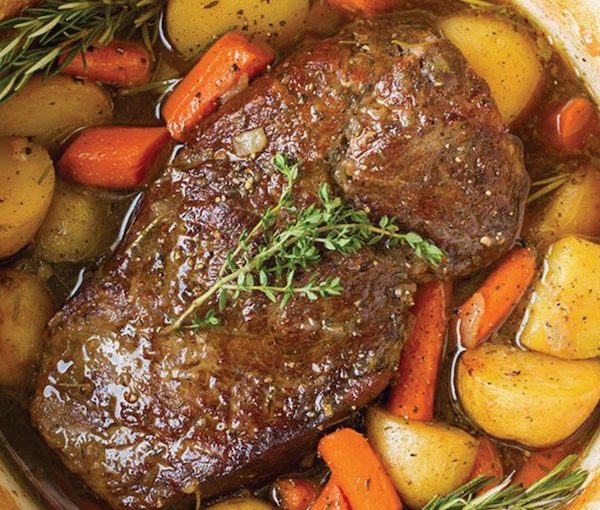
It was an uber-yummy pot roast that spawned the Accidental Balabusta. (photo by Shelley Civkin)

The definition of balabusta goes like this: 1) an impressively competent homemaker; 2) female head of household.

I recently saw balabusta used in a sentence: “She’s such a balabusta, she can make Shabbos for 20 in one afternoon.” Seriously? In which galaxy could anybody (never mind a balabusta) make any meal for 20 in one afternoon? I’m pretty sure that’s called hyperbole, or straight up bovine caca. Maybe I’m just not aware of the superpowers of real-life balabustas; the ones who sport red aprons and rule the domestic world. Personally, I couldn’t even make mac and cheese for 20 in one afternoon.

According to the Jewish Chronicle, “Balaboosters [sic] are rather out of fashion these days, victims of feminism and women’s magazines. Still, at least according to family myth, all of our grandmothers were balaboosters – heroic homemakers who raised large numbers of children in straitened circumstances and made real gefilte fish from a carp that swam about in the bathtub.” Not my Jewish grandmothers! Mine were neither spectacular cooks, nor did they have a bathtub filled with fish.

I don’t buy the idea that balabustas are out of fashion these days. I believe they’re just contemporary versions of the old-time balabustas. We hold down jobs, raise kids – well, not me, personally, but millions of other modern balabustas – and we’re active in our communities. And we just happen to bake, cook, do the laundry, clean the house and more. I, for one, am flattered to be called a balabusta. Even an accidental one. I feel like it puts me squarely in the category with other competent Jewish women, who juggle multiple tasks and are the glue that holds their families together.

So, how did I come to be crowned “the Accidental Balabusta”? It was the day I made a textbook perfect, uber-yummy pot roast. My husband Harvey took one bite and proclaimed me the Accidental Balabusta. Just like that! To substantiate his declaration, a week later I baked a batch of kalamata olive and rosemary challah buns (recipe from Rising: The Book of Challah by Rochie Pinson). They were exquisite. Or so I’m told. For the record, there was no bread machine or KitchenAid dough hook within 100 metres of my tiny galley kitchen. Just me, a 13-litre stainless steel bowl and enough flour to coat a bison.

For an encore, I made a handmade, painted challah cover. Next thing you know, I’ll be herding sheep. Anyway, that’s how the new moniker stuck.

Regarding the definition of balabusta, I might qualify as the “female head of household,” depending on whom you ask. As for being a remarkably skilled homemaker … well, the jury’s still out on that one. Way out. Truth to tell, most people I know would unequivocally classify me as the anti-balabusta. “That Shelley Civkin is a real balabusta!” Said nobody. Ever.

It’s not for lack of trying. OK, for about 50 years, it was. I simply wasn’t interested in cooking and cleaning. I was single and worked full-time. Since I only got married at age 53, the childbearing train had left the station. Empty. I was zero for three.

Then heaven happened: I retired three years ago. I took the advice of a wise rabbi, who told me that retirement doesn’t mean just sleeping in and doing nothing. It means helping others, doing mitzvot and finding your purpose in life. Did I mention I regularly volunteer to bake challah for seniors? I took the rabbi’s words to heart, and here I am today, the Accidental Balabusta. I’m sure my family and friends are laughing their tucheses off right now. “Shelley, a balabusta? You gotta be kidding?” For most of my life I was a water-burner.

If you ask Harvey, he’ll tell you I’m a great cook. To wit, he’ll eat anything. Exhibit A: the fish fiasco. A year or two into our relationship, I decided to make breaded snapper. So, I used my father’s recipe and coated the fish in flour, eggs and breadcrumbs. While it was frying, a tiny piece of breading came off, so I popped it my mouth. Something didn’t taste right. I checked the expiry date on the egg container – it was fine. Then I put my finger in the bread crumbs to taste them – they were good. Finally, I put my finger in the jar of flour. Only to realize that I’d just coated all my fish in icing sugar. Harvey, G-d bless him, ate the icing-sugar-coated fish. I went out for sushi.

Then there was the infamous lamb debacle. It was New Year’s Eve and I decided to go for broke, so I made a rack of lamb. I covered the lamb in my usual Dijon mustard, lemon and garlic mixture and put it in the oven. Our first bite in, both of us noted the unusually strong lemon flavour. But it was tasty.

An hour later, it wasn’t. Harvey ended up in the bathroom driving the big, white porcelain bus. Several hours later, I landed in the hospital emergency department having three bags of IV fluids pumped into me. Let’s just say I got very dehydrated, and leave it at that.

As for being a great homemaker, that’s not my strong suit. What I mean to say is this: I am not on a first-name basis with my vacuum cleaner. In fact, I couldn’t tell you the brand if my life depended on it. I am to housecleaning what porcupines are to Winnebagos. If tchotchkes aren’t screaming out to be dusted, leave well enough alone. Let me clarify: I’m not dirty. I’m just a little messy. I figure there are more important things to do than clean house. Like read. Or eat chips. When guests come over, though, I pull out all the stops. OK, I pull out the fancy hand towels. Actually, Harvey pulls them out. I watch.

The last time I did anything domestic was in Grade 3 Hebrew school, when our teacher had all the girls embroider kippot for the boys. The boys’ assignment – wait for it – was to wear the kippot. No sexism there. Of course, it was the early 1960s. So, you’re welcome, boys.

But back to the balabusta thing. It turns out that I actually enjoy cooking and baking. Who knew? With nothing but free time on my hands now (except for my volunteer activities), I can kick back, put my hair up and tie one on. An apron, that is.

Stay tuned for more Accidental Balabusta.

Shelley Civkin, aka the Accidental Balabusta, is a happily retired librarian and communications officer. For 17 years, she wrote a weekly book review column for the Richmond Review, and currently writes a bi-weekly column about retirement for the Richmond News.

Format ImagePosted on February 22, 2019April 2, 2020Author Shelley CivkinCategories LifeTags Accidental Balabusta, Judaism, lifestyle, memoir, retirement
Canada’s silver tsunami

Canada’s silver tsunami

Isobel Mackenzie, seniors advocate for the Province of British Columbia, was the keynote speaker at the Changing Landscape: Pathways Ahead forum Nov. 27. (photo from Jewish Federation)

“Plan for tomorrow!” That’s the message from Isobel Mackenzie, seniors advocate for the Province of British Columbia. With seniors living much longer, there are some urgent issues facing aging Canadians.

Mackenzie was speaking to a packed house at the Changing Landscape: Pathways Ahead forum on the growing population of older adults in the Jewish community. Hosted by Jewish Federation of Greater Vancouver with the Jewish Community Centre of Greater Vancouver, Jewish Family Services, Jewish Seniors Alliance, Kehila Society of Richmond, L’Chaim Adult Day Care, and Louis Brier Home and Hospital, the forum was held at Beth Israel Synagogue Nov. 27. Three key themes were the focus of the evening: caregiver support; aging in place; and social connections.

Sharing insights into best practices and new opportunities for the Jewish community were: on caregiver support, Dr. Beverley Pitman, regional planner, healthy aging, United Way of the Lower Mainland; on aging in place, Terry Robertson of Parkdale Manor; and, on social connections, Gyda Chud (Peretz Centre for Secular Jewish Culture), Ken Levitt (Jewish Seniors Alliance), Toby Rubin (Kehila Society of Richmond) and Lisa Cohen Quay (Jewish Community Centre of Greater Vancouver).

Referencing the United Way’s Better at Home program, which helps seniors live independently in their own homes while remaining connected to the community, Mackenzie emphasized, “We are under-subsidizing people who are aging at home.” She added that many seniors pay for their own care as they age, despite insufficient income. She highlighted the urgency for government and community agencies to increase their funding for seniors who choose to age in place.

Mackenzie told the capacity crowd that, right now, there are 920,000 seniors over the age of 65 living in British Columbia, which represents 19% of the total population. By 2031, there will be 1.38 million seniors in the province, which will represent 25% of the total population. Referring to “the silver tsunami,” she said we need to start planning for that change now.

Addressing financial issues, Mackenzie said many seniors have less disposable income than their younger counterparts. For example, she noted that, for seniors age 65 and older, the bottom 20% of that group have an annual average single income of $17,000, while the top 20% have an annual average single income of $80,000. For seniors 85 and older, she said, the bottom 20% have an income of $17,500 while the top 20% have an income of $73,000. These numbers have a significant impact on how and where those seniors live. “Disproportionately poorer people live in care facilities,” said Mackenzie.

She also commented that there is a disconnect in terms of public policy and the entitlements available to those 65 and older, when the government is giving the same amount of money to both the rich and the poor.

According to Mackenzie, 94% of all seniors who are 65 or older live independently, while 74% of all seniors who are 85 or older live independently. A full 80% of these seniors are homeowners, she said. However, the remaining 20% are renters who are disproportionately poorer than homeowners. Consequently, they often don’t have enough leftover income to buy necessities like glasses, hearing aids and mobility devices, she said.

On the topic of aging in place, Mackenzie pointed to family members’ overall reluctance to allow elderly relatives to “accept risk”; that is, to live independently. Given the dangers inherent in living at home (stairs, rugs, lack of bathtub rails, etc.), she said relatives sometimes try to “control the risks” by encouraging loved ones to move to a care facility, often against the older person’s wishes. “We have to accept the rights of the [cognitively able] elderly to live at risk,” she said. “They have the right to make their own decisions, even if it’s a risky decision.” The message was, while we want our elderly to be safe, it’s not our choice to make.

In terms of the social isolation of those aging in place, Mackenzie said this depends primarily on the senior’s level of engagement. If their interactions with others are limited, they may feel marginalized. However, feeling useful to themselves and others keeps seniors feeling engaged, which is why we see so many senior volunteers. “Everybody needs to feel useful and is useful, in their own way,” said Mackenzie. She encouraged people not to do things for seniors that they can do for themselves, because “everyone needs a sense of purpose and usefulness.” She stressed that not all seniors are frail and not all seniors need help. Rather than viewing seniors as a problem, she said, we should view them as “an active and valuable citizenry.”

On the issue of caregivers, Mackenzie said, “Not everyone comes to this role equally equipped. We need to give more support to caregivers for the frail elderly and those with dementia. It’s more stressful dealing with someone with dementia than with someone who has a physical disability or disease.”

With the possible exception of the workshop on social connections, whose speakers were from Jewish agencies, but whose workshop the Jewish Independent could not attend, none of the presenters addressed how the community could support Jewish seniors in connecting to their Judaism, culture and traditions as they age. Neither Mackenzie or Pitman, the presenter on caregiver support, differentiated between the needs of Jewish seniors and non-Jewish seniors; the workshop on aging in place also did not specifically address Jewish seniors.

Pitman, however, shared some eye-opening statistics in her workshop. According to the Office of the Seniors Advocate for British Columbia’s 2017 report Caregivers in Distress: A Growing Problem:

• Statistics Canada estimates that there are approximately one million caregivers in the province.

• The work of caregivers is a critical pillar in the healthcare system, allowing seniors to remain at home and delay, or even prevent, costly care options.

• Unpaid caregivers provide roughly three-quarters of care for people who receive care at home in Canada.

• Caregiver tasks range from taking over household duties to providing time-sensitive personal and medical care.

• Caregivers’ most common tasks fall into three broad categories: emotional support, assistance with health and daily living, and care management.

• Caregivers are often information and referral specialists and systems navigators dealing with the health system, the housing system and the legal system.

The 2017 report notes that, on average, unpaid caregivers provide 20 hours per week of informal care and that replacing the care they provide with care from paid caregivers would cost an estimated $3.5 billion in British Columbia. And the report warned that “31% of unpaid caregivers are experiencing symptoms of distress such as anger, depression, anxiety and sleep difficulties.” This number seemed low to audience members who are or were caregivers.

Pitman also shared a sample of the resources available for caregivers, including BC211, 8-1-1 HealthLinkBC, local Jewish and other community support agencies, information and referral services, and libraries. She encouraged caregivers to call the Family Caregivers of British Columbia Caregiver Support Line (1-877-520-3267) if in need and highlighted the United Way’s Better at Home, which can provide light housekeeping, minor house repair, yard work and friendly visits. She offered audience members the 2016 publication United Way of the Lower Mainland’s Family & Friend Caregivers Information and Resource Handbook. While acknowledging that it’s somewhat out-of-date, she said it still contains much valuable information.

Shelley Civkin is a happily retired librarian and communications officer. For 17 years, she wrote a weekly book review column for the Richmond Review, and currently writes a bi-weekly column about retirement for the Richmond News.
Posted on December 14, 2018December 12, 2018Author Shelley CivkinCategories LocalTags Aging in Place, Isobel Mackenzie, lifestyle, seniors
Mezuzah at legislature

Mezuzah at legislature

Selina Robinson, B.C. minister of municipal affairs and housing, admires the new mezuzah on her office door, while Rabbi Yechiel Baitelman looks on. (photo from Chabad Richmond)

Born and raised in Montreal before moving to British Columbia, Selina Robinson first lived in Richmond, then relocated to Coquitlam. She was elected as the member of the Legislative Assembly of British Columbia for Coquitlam-Maillardville in 2013 and again in 2017. Robinson is a member of the B.C. NDP.

When I learned that Rabbi Yechiel Baitelman of Chabad Richmond recently helped Robinson affix a mezuzah to her office door at the legislature, I was surprised. I called to ask her how she came to invite Baitelman to help her. “I didn’t,” she replied. “He just showed up with it!”

As it happens, Baitelman was in Victoria to fix a Torah scroll. While there, he reached out to Robinson, a longtime family friend, to see if they could meet briefly. She invited him to her office, where they talked about her portfolio and how they could work together to improve housing in Richmond. Never one to miss an opportunity, Baitelman asked Robinson whether she would like to put up a mezuzah. She loved the idea, but told the rabbi she didn’t have a hammer. Without skipping a beat, he said, “That’s OK, you don’t need one. This mezuzah has adhesive on the back.”

I guess that falls into the category of “I just happen to have a mezuzah on me.” I mean, don’t all rabbis carry them around?

Robinson has known the Baitelman family for decades, through her mother’s work at Chabad Lubavitch in Vancouver years ago. She told me that the Baitelman kids used to call her mother “Bubbe Rhoda.”

While she was a university student in the 1980s, Robinson helped run Camp Gan Israel of British Columbia day camp for two years. Later on, when she was living in Coquitlam, she helped build the Burquest Jewish Community Association. She also used to work at Jewish Family Services.

Robinson’s commitment to the ideals of Jewish life and culture is resolute, and she proudly refers to herself as a “Habonimer.” Yet, her affinity for Chabad is strong, especially their dedication to helping Jews at all levels of observance.

Robinson regularly shows her new mezuzah to colleagues, and takes the time to explain what it means.

Shelley Civkin is a happily retired librarian and communications officer. For 17 years, she wrote a weekly book review column for the Richmond Review, and currently writes a bi-weekly column about retirement for the Richmond News.
 

Format ImagePosted on October 26, 2018October 25, 2018Author Shelley CivkinCategories LocalTags British Columbia, Chabad Richmond, Judaism, Selina Robinson, Yechiel Baitelman
Attempting to keep Shabbos

Attempting to keep Shabbos

(photo by Olaf Herfurth)

In anticipation of the annual Shabbos Project – this year on Oct. 26-27 – where Jews from around the world, and from every level of observance, celebrate and experience Shabbos together, I decided I needed to get prepared.

On the continuum that is my journey to Yiddishkeit, I’m probably less than a third of the way there. I’ve chosen to take it one step at a time.

A few weeks ago, after a particularly inspiring Torah class, I broached the subject of Shabbos with my husband, Harvey. I asked him if he’d be on board with trying to observe it the following weekend. He tentatively agreed, knowing that, if he said no, I’d make his life a living hell. A smart man knows when to say yes.

A few days went by before I started planning in earnest for our Shabbos-ready tech shutdown. I confirmed with Harvey that we’d be powering off all our devices, taping the refrigerator and other light switches, using electric tealights to light the requisite rooms, and just generally relaxing for 24 hours. He agreed. All systems go. Or so I thought.

Shabbos candles – check. Tealights – check. Crock-Pot in which to make cholent – check. Beef, carrots, potatoes, etc., to cook the cholent – check. Challah – check. Wine – check. In my naiveté and enthusiasm to be shomer Shabbos, I hadn’t really considered everything that goes into preparing to do so. Not even close. And, of course, my lack of preparation came back to bite me in the proverbial tuchus.

Very early Friday morning, a note was slipped under our door, informing us that the water would be shut off from 9:30 a.m. to 1:30 p.m. that day. I was thrown headlong in a haze of cholent-making confusion. Instead of starting my cholent at 3 p.m. to be ready for lunch the next day, I panicked and started assembling it at 7:30 a.m. So, we had cholent for dinner Friday night, for lunch on Saturday and, yes, again for dinner Saturday night. You can see where this is headed: cholent overload.

A real Shabbos queen would have made an array of cold salads, had a back-up chicken for Friday night dinner and another main dish for Saturday dinner. I could find a thousand excuses for why I hadn’t thought this through, but none of it matters now. Luckily, I have a very easygoing husband, when it comes to food. Put it in his bowl or on his plate, he’ll eat it. Don’t get me wrong, Harvey is a real connoisseur when it comes to good food and wine. But he also knows when not to complain. So, he ate cholent three meals in a row. And it didn’t kill him. As for me, I was slightly embarrassed that I hadn’t planned more thoroughly for a beautifully scrumptious Shabbos experience. Food’s a big part of all this, right?

The lack of variety in food was accompanied by several, how shall I call them, Shabbos slips. Halfway through lighting the candles, I remembered that I hadn’t changed the Crock-Pot timer to 10 hours, so I did it. “Broke” Shabbos. But I carried on, certain that G-d would forgive my little error. And confident that there is more likelihood of us trying to keep Shabbos again if we don’t approach it with an all-or-nothing attitude. Baby steps will keep us on the right path, whereas a “let’s call the whole off” right now because I messed up with the Crock-Pot will turn us off forever. There were a few other Shabbos boo-boos, like writing something down on a piece of paper. And carrying my purse to shul. Oh, and that pesky little detail of not keeping kosher.

I’ve actually studied a bit about how to keep Shabbos. I just haven’t put it all into practice quite yet. Not even close. But the intention and desire is there. I have to admit, I have a small obsession with understanding new things fully before embracing them. Reading before doing. I guess that’s a residual habit from spending 34 years as a librarian. In case you weren’t aware, librarians can’t rest until they have all (or most) of the answers. So, the journey continues.

The best part of Shabbos for me, besides lighting the candles and eating the delicious challah I made, was having my husband’s undivided attention, and he, mine. The time we spent talking on that one Friday night is probably equal to the time we usually spend talking all week. After nearly 13 years together, I learned new things about Harvey that Shabbos. In an atmosphere of love and relaxation, with no distractions of any kind, we eased back into each other’s lives calmly and sweetly. It was wonderful.

On Saturday, in the late afternoon before Shabbos ended, I walked into the living room and sat down. Harvey looked at me with a touch of fear in his eyes and asked: “Does this mean we have to talk again?” I guess the feeling about the beauty of it all was slightly inequitable. But I’ll keep trying. There’s always next Shabbos.

Shelley Civkin is a happily retired librarian and communications officer. For 17 years, she wrote a weekly book review column for the Richmond Review, and currently writes a bi-weekly column about retirement for the Richmond News.

Format ImagePosted on October 19, 2018October 18, 2018Author Shelley CivkinCategories Celebrating the HolidaysTags Judaism, liefstyle, Shabbat
The mitzvah of challah

The mitzvah of challah

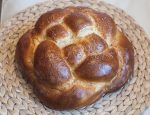
On Rosh Hashanah, the challah is round and sweet, symbolizing our collective wish for a good, sweet year. (photo by Przemyslaw Wierzbowski)

It was two years ago that I fell in love with challah. I attended a challah baking workshop at a Jewish retreat and, at that point, the extent of my challah knowledge was that it’s sold in delis, comes in a plastic bag with a twist tie and makes great French toast. I was a challah virgin. This was around the same time that I was test-driving a more observant Jewish life, and figured it behooved me to learn more about our people’s famous braided egg bread. Little did I know how profoundly the workshop would affect me.

There we were, 40 or so Jewish women, up to our elbows in yeast dough, patiently following the instructor’s directions. She explained what each ingredient symbolizes, and how making challah each week is an auspicious time for Jewish women to pray for what they want and need. I was hooked. When it came time to make the blessing over the challah, that’s when I lost it, and became emotional. Something about a sisterhood of Jewish women gathered around tables doing something their mothers and grandmothers had been doing for generations struck a chord deep within me.

As I said the blessing, with my eyes closed and my hands atop the soft dough – “Baruch atah Adonai, Eloheinu, melech ha’olam asher kidshanu b’mitzvotav v’tzivanu, l’hafrish challah” – tears poured down my cheeks like they would never stop. The woman sitting next to me (almost a complete stranger) heard my sniffling and put her arm around me. I’m sure she was puzzled by my tearful response and, truth to tell, I was embarrassed, but I was overcome and just couldn’t help myself. Somehow, the mitzvah of making challah, and all that it symbolizes in our collective identity as Jewish women, hit me.

It mattered, in a deep-seated way, that I was part of something much bigger than myself – something inextricably tied to my Jewish roots, something to which I had paid scant attention over the years. I knew this activity would become a meaningful part of my life from that moment on. Challah is far more than just a food to sustain my family and me physically. It fills us spiritually as well. And that’s the most beautiful taste in the world.

Long story short, I now bake challah on a regular basis, for others and myself. It reminds me of who I am at my core. It draws me closer to my community of Jewish friends and acquaintances, and places me smack in the middle of what is real and true – my Yiddishkeit. Who knew that combining a few essential ingredients could produce such an inexplicable gift in my life?

It’s no secret that every Jewish custom is significant on a spiritual level. With Rosh Hashanah approaching, I set out to learn how to make one of the many unique symbols of the Jewish New Year – the round challah. The rest of the year, we make braided challot and dip them in salt, but, on Rosh Hashanah, the challah is round and sweet, symbolizing our collective wish for a good, sweet year. Its circular shape, which represents the cycle of life, has no beginning and no end, thereby symbolizing the continuity of the Jewish people. You could also say it’s a metaphor for the endless blessings that God sends us. Another interpretation is that the round challah resembles a crown, symbolizing the supreme power and authority of God.

As Rosh Hashanah nears, it’s a time for personal introspection and the beginning of our individual and collective teshuvah (return or repentance). We get ready to reflect, repent and ask for forgiveness. It’s a time to elevate ourselves and direct our thoughts and deeds toward a higher, more purposeful end. At precisely this time, when our thoughts turn to repentance and resolutions for improvement, the round challah reminds us that the opportunity for teshuvah is never-ending. This Rosh Hashanah, may we all be successful in elevating ourselves from our current reality into a higher, more spiritual state of being, on both an individual and collective level.

For those of you who want to learn more about the significance of baking challah, there’s a fascinating book called The Mitzvah of Challah by Esther Rivka Toledano (ArtScroll Mesorah Publications, 2018). The author dives deep into what is undeniably a mitzvah granted especially to women. She shares the history, the halachic (Jewish legal) guidelines, several recipes and lots more. The book goes far beyond the basics for those who really want to understand and embrace the mitzvah of challah.

May we all have a sweet, happy, healthy and prosperous New Year. L’shana tova u’metuka!

Shelley Civkin is a happily retired librarian and communications officer. For 17 years, she wrote a weekly book review column for the Richmond Review, and currently writes a bi-weekly column about retirement for the Richmond News.

Format ImagePosted on September 7, 2018September 6, 2018Author Shelley CivkinCategories Celebrating the HolidaysTags baking, challah, history, Judaism, Rosh Hashanah, tradition, women
Fast-paced spiritual trip

Fast-paced spiritual trip

The bimah of Ari Ashkenazi Synagogue in Tzfat (Safed) was part of the Land and the Spirit tour, which is organized by the Rohr Jewish Learning Institute. (photo by Roy Lindman)

My husband and I excitedly counted down the days until the Land and the Spirit Israel experience in March. Having met with Chabad Richmond’s Rabbi Yechiel Baitelman and his wife Chanie, who accompanied our group on this trip, we learned that the touring days would be long, but that the sights we’d see and the people we’d meet would more than offset the intensity factor. The Land and the Spirit tour is organized by the Rohr Jewish Learning Institute, the adult educational arm of Chabad.

The tour took place March 4-13 and drew approximately 800 Jews (and a handful of non-Jews) from across North America. Knowing that we’d hit the ground running, my husband and I decided to arrive in Israel a few days ahead of the tour, to get acclimated. We also spent an additional two weeks after the tour exploring Israel on our own. This was my sixth trip to Israel and my husband Harvey’s third.

The tour was, in some ways, like an Israel 101 course, supplemented by in-person meet-and-greets with high-level people from all walks of life – we had special access to soldiers, politicians, religious leaders and other VIPs. On some levels, it was geared to people who’ve never been to Israel before, and they got an overview of the highlights Israel has to offer. Yet, even for those of us who had been to Israel, it was a chance to discover places we’d never seen.

Participants had the freedom to choose from a variety of “tracks,” including: “In the Footsteps of the Bible,” “Classic,” “Borders and Security,” “Israel Encounters,” “Israel in Depth” and “Food and Wine.” Presumably, participants would get a glimpse of Israel that sparked their desire to return again. The flip side of this is that there was not a lot of in-depth learning, and we didn’t get a chance to spend a great deal of time in any one place. It was primarily surface introductions and more of a visit-the-sights kind of trip, rather than an intense learning experience, like the National Jewish Retreat.

There were way more things to see and do than each of us had time for, hence the need to choose “tracks” each day. Highlights for my husband and me included Caesarea, with its fascinating historical ruins and stunning location, overlooking the Mediterranean. We also found Silicon Wadi fascinating. It’s the area in Israel where scientists, techies and businesspeople work in shared spaces to develop groundbreaking technologies. When we were there, we toured a WeWork site, where young technology whizzes were producing 3D and other objects inspired by their sky’s-the-limit imagination.

Kfar Chabad was another high point of our trip. This Chabad-Lubavitch village is not far from Lod, and has a life-size replica of 770 Eastern Parkway, Chabad’s Brooklyn headquarters. More than 6,000 Chabad live in the village, and the site is home to an etrog orchard. Our tour included a shmurah matzah bakery, where they make Passover matzah by hand.

The highlight by far, though, was the Ohr Simcha Children’s Home, where 300 high-risk boys from troubled environments live with their adoptive Chabad families. Ohr Simcha was established in partnership with the Israeli government, to help some of the most socially challenged children gain a sense of security. Seeing the kind of patient, loving care it takes to sustain these kids, to give them a real home of their own, was inspiring and emotional. True chesed in action.

The ancient mystical city of Tzfat (Safed), “the City of Kabbalah,” with its narrow streets and beautiful tiny synagogues, was magnificent. We went to Ari Sephardic Synagogue, where the famous Jewish mystic Rabbi Yitzchak Luria (known as the Ari) prayed. We also went to the Ari Ashkenazic Synagogue. Guest speakers explained the detailed history and designs of the synagogues. Unfortunately, we didn’t squeeze as much spirituality out of Tzfat as we would have liked, because time was limited. But it left a lasting impression.

It bears mentioning that all the tour guides on our buses were incredibly knowledgeable and made the places we visited come to life.

The Latrun Tank Museum was yet another highlight on the tour. There, we got to meet Israel Defence Forces soldiers and hear firsthand their inspiring personal stories. Live music, dancing and delicious food topped off the evening.

We spent a moving Kabbalat Shabbat at the Kotel (Western Wall). Having never visited the Kotel at night, much less experienced Shabbat at that holy site, we felt like Israel had wrapped its arms around us. Shabbat day was quiet and gave us the opportunity to walk the empty streets of Jerusalem in peace.

The second to last day of the tour was super-charged, and saw us traveling from Jerusalem to Masada, to the Dead Sea, where we schmeared mud on ourselves and bobbed around like human corks in the salt-laden water. After a long day, we showered off the Dead Sea water, got dressed in our finest and went to a gala banquet, where music, speakers and other entertainment were on the menu.

The final day was spectacular. First, we boarded a bulletproof bus that took us to our Matriarch Rachel’s Tomb, in Bethlehem. This was a particularly emotional experience, to see so many people praying so fervently. But it only got better, as we got on the bus and traveled to historic Hebron, where we visited the Cave of the Patriarchs (the Cave of Machpelah), one of the holiest places for the Jewish people. There, all 800 of us walked through Hebron carrying a Torah scroll that had been saved from the Nazis. This was followed by a spectacular light show, fireworks and a lively dinner.

On the whole, the tour was phenomenal, albeit arduous, especially for those of us in our 60s and older. Early morning starts, long stretches on the bus, shlepping and climbing, eating and touring. Repeat. For eight days. Was it worth it? You bet! The entire trip was spiritually nourishing, and fed our desire to start planning when we would next return to our home away from home.

Shelley Civkin is a happily retired librarian and communications officer. For 17 years, she wrote a weekly book review column for the Richmond Review, and currently writes a bi-weekly column about retirement for the Richmond News.

Format ImagePosted on June 15, 2018June 14, 2018Author Shelley CivkinCategories TravelTags Chabad, Israel, JLI, Judaism

Purpose is to help others

“It’s not for me.” “I’m too busy.” “I’ll volunteer when I’m retired.” All of these responses (excuses?) are familiar to me. Because, at one time or another, I hid behind each one of them.

I never felt I was good at time management, so how could I possibly take on volunteering when I was working full-time? Sure, I could multitask at work, because I had to. But did I enjoy working that way? Not even a little.

To me, time management meant working eight hours a day, worrying about work for the next eight hours, sleeping and dreaming about work for the following six hours, spending the next two hours showering, eating breakfast and reading the newspaper, then repeating the process. For decades, I functioned – notice I didn’t say lived – this way. I had tunnel vision of the worst variety.

Then I retired.

The novelty of not having to rise at a particular hour is intoxicating. Not that I indulge myself very often. After all, I had 34 years of 6 a.m. alarm clock reminders that had trained my body to get up with the sun. I confess that now, after two years of retirement, I occasionally sleep till 8:30 or even 9 a.m. But then, of course, I feel guilty. I’m Jewish after all.

Not long after I retired, I got an email from Rabbi Yechiel Baitelman of Chabad Richmond notifying me about an upcoming six-week Jewish Learning Institute course. I think it was called The Jewish Course of Why. Since I’m an inveterate question-asker and perpetually curious, I took the bait. And I was hooked.

Somewhere between the questions and the answers, the good rabbi saw an opportunity to recruit me for some volunteering. I may have casually mentioned that I’d just taught myself to bake challah using YouTube. Next thing I know, I get a call from Grace Jampolsky (“the Challah Whisperer,” as I call her), asking if I’d like to help bake challah for the bi-weekly Light of Shabbat meals that Chabad Richmond delivers to the elderly in Richmond. Sounded like a good thing to do. And who doesn’t love the smell of freshly baked bread?

From there, I volunteered to help pack the Light of Shabbat boxes and occasionally deliver them. This gave me the opportunity to visit and shmooze with some seniors, some of whom I already knew through my parents. We talked about family and books, everything and anything. It was a blessing for both of us.

About six months into retirement, I realized I still had way too much free time on my hands, and needed to do something useful. Something outside myself. So, I contacted B.C. Children’s Hospital, hoping to volunteer as a “baby cuddler,” not realizing that there’s a long waitlist to do that. But, as soon as the hospital’s volunteer coordinator saw my resumé, she offered me a volunteer position in the Family Support and Resource Centre. After all, what else would a librarian want to do in retirement, but jump right back into working in a library! Naively, I didn’t think to mention in my interview that I’d like anything but a library position. Nevertheless, I gave them the year’s commitment that they asked for and then resigned. Being an infrequently used part of the hospital, the centre didn’t provide the stimulation I was hoping for. I wanted to make more of an impact in my volunteering.

Soon after, Rabbi Baitelman asked if I’d be interested in volunteering with Chabad Richmond’s Israel Connect program, in which local retirees tutor Israeli high school students in English once a week, via Skype. It sounded like fun, so naturally I said yes. If memory serves me correctly, it was about two-and-a-half minutes later that he asked me if I would consider coordinating the Israel Connect program in Richmond. He had me at “Would you be interested….”

The rabbi knows that I have a background in writing and editing, so it wasn’t long before he asked for my help writing press releases and marketing pieces for Chabad Richmond. Writing is my happy place, so I was delighted to pitch in. It has only snowballed since then, and I’m thrilled to report that I love my volunteer activities, and I’m always open to considering new ones.

All of this is to say that there is life after retirement – volunteering has been enormously rewarding.

At its essence, volunteering is about saying yes to what you want to do, and saying no to the rest. And the yes, well, it’s just so darn sweet! Knowing that Jewish seniors are enjoying the challah I bake, and that the short visits we have might be the only human interaction they encounter in a week – that’s why my heart is drawn to do these things. Believe me, as a volunteer, working with people, you get way more than you give.

And Israel Connect? It’s the best spent 30 to 45 minutes of my week. Helping an Israeli teen improve their English so they can get into university or pursue a career that requires English proficiency – that makes my heart sing. And, we have fun. With each different student (all girls, so far), I’ve managed to make a connection and form a bond. After each week’s official tutoring is finished, we talk: about their hobbies, plans for the future, our families, travel, everything. From week to week, I notice not only improvements in their English, but a relaxation that comes from forming a real intergenerational friendship. I hope to visit my students when we travel to Israel soon.

I’d be remiss if I didn’t include the bits and pieces of volunteering I did while I was still working full-time as a librarian and communications officer at Richmond Public Library. I did manage to squeeze in some fundraising and communications work to help promote the Crohn’s and Colitis Foundation of Canada’s annual Gutsy Walk fundraiser.

In a much more humbling capacity, I was also part of a program about eight years ago, called Feed the Hungry, in which a bunch of volunteers from Ahavat Olam made and served lunch to Downtown Eastside (DTES) residents on a regular basis. And, for several years, I volunteered, along with my husband, brother-in-law and/or friends, serving Christmas lunch at the Salvation Army Harbour Light Mission in the DTES.

For a couple of years, I was a volunteer board member with the Isaac Waldman Jewish Public Library, as well as being the B.C. Library Association representative for the West Coast Book Award Prize Society. All of them together were growing and learning experiences of the highest order.

We guard our free time so rabidly, we forget that part of why we’re put on this earth is to help others. The satisfaction and joy that comes from doing something outside ourselves, something for a higher purpose, is indescribable. Believing is seeing. But don’t just take my word for it.

Shelley Civkin is a happily retired librarian and communications officer. For 17 years, she wrote a weekly book review column for the Richmond Review, and currently writes a bi-weekly column about retirement for the Richmond News.

Posted on March 16, 2018March 15, 2018Author Shelley CivkinCategories Op-EdTags Chabad Richmond, tikkun olam, volunteering

Yiddishkeit – a story of love

Dear Yiddishkeit, I’m home! Did you miss me? Sorry I was away for so long. I got kind of lost in the desert. But I’m finally back, and living happily in … well, different places: at Ohel Ya’akov Community Kollel, at Chabad of Richmond and, recently, at the National Jewish Retreat in Palm Desert, Calif. (Not that other desert.)

I met your family, Chabad Lubavitch, about 13 years ago. They seemed authentic and sincere, and welcomed me warmly. I got the sense that they live what they preach: that every Jew is important and has a unique mission in life. This really resonates with me and makes me want to search for the mission that drives my life. Even though I’m not a Torah-observant Jew, your family treats me like one of their own. I don’t dress all that modestly, but I never feel judged by them. It’s funny, I grew up living a fairly secular life, yet I’ve never been more certain about where I belong, and that’s Chabad.

Oh, Yiddishkeit, I’ve admired you from afar for years. I know we haven’t always seen eye to eye on everything – you know, that Shabbos thing, the kosher thing. But there’s always been a chemistry between us. Even if it was unspoken. I have to admit, I’m enthralled; I want to know everything about you. Your likes and dislikes, your temperament, what you look for in a partner. I do know you’re a veritable buffet of fascinating facts and your family’s unabashed optimism and positivity inspires me beyond words. You and your family are smart, solid, attractive and respectful. How could I not love you?

So, how come we’ve played a game of “come here, go-away” most of my adult life? You were shy, yet inviting, all at once. And me? I was just non-committal. You never pushed me into anything though. You just waited me out until the time was right.

I remember in 1997 when one of your family – Rabbi Avraham Feigelstock – called me in the hospital when he found out I was very sick and had been there for 43 days. I’d never even met the man, and here he was calling me: “How are you feeling? Do you want a visit? Can I bring you anything? Let me give you my home and office phone numbers, in case you feel like talking.” I will always be grateful for that. I knew that there was more to this than mere friendliness.

After I recovered, I began going to weekly Friday night dinners and Saturday Shabbat services at the Kollel, where I met Rabbi Shmulik Yeshayahu. His Shabbat sermons jumpstarted something inside me that made me want to know you better. The Kollel is also where I met my bashert, Harvey. I owe you a lot, Yiddishkeit.

Until recently, I wasn’t even sure where I stood with you, Yiddishkeit. But now I know for a fact that I’m smitten. You swept me off my feet. And it only took 61 years! The turning point for me was last year at my retirement party, where another of your family members – Rabbi Yechiel Baitelman – gave a beautiful speech. He said: “Retirement doesn’t mean retiring from life. It means going on to do mitzvahs, and study and do good things.” This fanned the fire inside, and now I enjoy weekly Torah study classes at Chabad of Richmond and volunteer with the Light of Shabbat and Israel Connect programs. I have even attended the Jewish Learning Institute’s National Jewish Retreat. Twice! Rabbi Baitelman’s enthusiasm, encouragement and positivity are infectious.

But let me back up a bit. Early last year, I had a personal issue that was troubling me deeply and I needed someone to talk to. So, I asked Rabbi Baitelman if he could spare the time to speak with me. Long story short, we met at a Starbucks in Richmond and, for the next one-and-a-half hours, he looked directly at me and focused like I was the only person in the world who mattered. That, Yiddishkeit, made a huge impression on me. It reinforced everything I’d heard and read about Chabad – that they consider every Jew important and indispensable.

I once heard someone say, “We don’t choose Judaism. Judaism chooses us.” I am unspeakably honoured that you chose me, Yiddishkeit. I’m sure there are others much prettier, smarter and more devoted than I. Why me? You must have your reasons. Never mind.

All I know for certain is that you have given my life meaning and purpose. I’m more committed than ever to doing mitzvahs, studying Torah and learning about all things Jewish. What started as curiosity has blossomed into commitment. I regularly listen to Jewish scholars like rebbetzins Rivkah Slonim and Menucha Schochet and rabbis Moshe Bryski, Yitzchak Schochet, Y.Y. Jacobson, Mendel Kalmenson and others on Torah Café; and watch Rabbi Simon Jacobson’s videos from his Meaningful Life Centre. Books like The Secret of Chabad, Toward a Meaningful Life, My Rebbe, The 613 Mitzvot, The Empty Chair, The Rebbe’s Army, and books on davening, healing, Tanya, Shabbat and Jewish grieving have enriched my life unimaginably. One of the most life-changing events, though, was the National Jewish Retreat.

As I do more Jewish reading, I come across Yiddish and English adages that impress me with their profundity. It’s what I try to live by now. Check them out:

“Tracht gut, vet zein gut,” “Think good, and it will be good.” (Rebbe Menachem Mendel Schneerson of Lubavitch)

“Who is wise? One who learns from every man.” (Ben Zoma from Pirkei Avot, Ethics of the Fathers)

“Always remember: you are never given an obstacle you cannot overcome.” (Rebbe Nachman of Breslov)

“Gam zu l’tovah,” “This, too, is for good.” (Nahum Ish Gamzu)

My Jewish learning is like a prospector who shuffles the rocks around on his sieve, hoping to find gold. The more I infuse my life with Yiddishkeit, the more gold I find.

Let me declare, Yiddishkeit, in front of heaven and earth, that I commit, forever more, to being faithful, trusting and open to the love you give me. I promise not to squander or minimize it. I promise to hold you close and be there for you, like you are for me.

Fast forward. Hashem and I are now on a first name basis. We live together blissfully and share the chores. We hold each other up, and we’re true partners. I admire and adore you, Hashem. There is You and only You. Always.

Did I come to this love story overnight? Heck, no! It’s taken me decades of searching, questioning, losing and then finding myself. Yet, here I am – home. Where I’m meant to be.

My husband Harvey says there’s nothing quite as cloying as a convert. Even if it’s a Jewish-to-Jewish convert, like me. I’ve become a cheerleader for Yiddishkeit. Everything excites me, because it’s all so new. Learning to read Hebrew – let’s celebrate! Torah study class – break open the Manischewitz! Trying to keep Shabbat – woo-hoo!

I’m taking it all with baby steps. Nothing too drastic or radical, even though there are days I want nothing more than to totally immerse myself in Yiddishkeit. I’ve learned there’s no speeding up a process that has its own timetable. For now, lighting Shabbos candles, saying certain blessings, going to Torah classes and giving up certain foods is where I’m at.

At this point, I’ll slow dance with Yiddishkeit, keeping a respectful distance. And I won’t let anyone cut in. It’s just the two of us. The perfect shidduch!

Shelley Civkin recently retired as librarian and communications officer at Richmond Public Library. For 17 years, she wrote a weekly book review column for the Richmond Review, and currently writes a bi-weekly column about retirement for the Richmond News.

Posted on September 29, 2017September 28, 2017Author Shelley CivkinCategories Op-EdTags Chabad, Community Kollel, Judaism, Yiddishkeit

Soul-opening retreat experience

Let me start by saying that I grew up a secular Jew. As I’ve gotten older, my desire for more Yiddishkeit has increased tenfold. Long story short, I went from being a “High Holidays-only Jew” to someone who lights candles every Friday night, attends shul every Shabbos and goes to Torah classes regularly.

My latest quest to embrace Judaism took the form of the 2016 National Jewish Retreat. Sponsored by the Rohr Jewish Learning Institute and Chabad, this six-day retreat took place in Palm Desert, Calif. More than 1,400 Jews from all over North America settled in to the enormously lavish JW Marriott for Jewish learning and fun.

I’m stopping here because I know that when I got to Chabad, many of you shut down and/or entertained a plethora of preconceived notions and stereotypes: black hats, long coats, lots of rocking and davening, strict Shabbos rules. Think again.

Even I was skeptical, wondering whether I’d be judged for my “immodest” clothing, my limited Jewish observance and my lack of Torah knowledge. But, no sooner did I get there, than a variety of religious and not-so-religious folks introduced themselves and welcomed me warmly. From that point on, I was hooked.

The programs comprised 150 lectures and 75 speakers. Keep in mind the retreat was only six days long, so I had to choose my topics wisely. All told, I attended 29 lectures. And I even had time to go the washroom once or twice. From 9 a.m. till late into the night, I had the honor of learning from world-renowned speakers, listening to radio talk-show host Dennis Prager, attending a Dudu Fisher concert, viewing the stunning art of Barbara Hines, and enjoying Jewish comedian Robert Cait.

The main event, the retreat sessions, covered a wide spectrum of topics including practical lessons from the Tanya; discovering purpose and mission in life; Jewish medical ethics; the pursuit of happiness and gratitude; the relevance of G-d in 2016; handling personal struggles, pain and suffering; a challah bake; a talk about why bad things happen to good people; Jewish law; living with faith; the legacy of the Lubavitcher Rebbe; Israel’s inclusive army; the miracle at Entebbe; wine tasting; the historical relationship between Jews and Muslims; antisemitism; how to pray with passion and purpose; the future of Israel and Zionism; Jewish history and mystical prophesies; the feminist challenge of 2017; a farbrengen for women; and leadership. And that’s just the tip of the iceberg.

Focusing on the personal more than the political, historical or global, the sessions I attended were nothing short of awe-inspiring. Never having experienced intense spiritual Jewish learning like this, I was a human sponge. It sparked something visceral in me and my emotions ran wild. (Read: I’m emotionally incontinent and my tears overflowed early and often.)

My favorite sessions included a class on the Tanya, which is an early work of Chassidic philosophy and a “one size fits all” life manual. It’s basically the “GPS for life” and encourages us all to live with purpose and meaning.

I also attended a couple of sessions on the Rebbe and the secret of Chabad. While some people consider Chabad a radical sect of Judaism, it has actually become the mainstream, because of the Rebbe’s focus on outreach to Jews around the world. He considered outreach the key to continuing Yiddishkeit. The Rebbe was without doubt the most influential rabbi in modern history. A revolutionary figure and an inspiration, he created an “army” of shluchim (emissaries), who set up Chabad houses around the world to inspire Jews in Jewish traditions and education. As a result, Chabad is considered a “vanguard of change” and leaders in the community.

A session called The Pursuit of Happiness reinforced the idea that happiness and blessings are directly correlated. And, since happiness is a choice, we should direct our emotions towards positive things. In essence, we’re really products of our choices, not our circumstances.

Pain and Suffering was a session about transforming pain into growth. The speaker made a poignant observation about grief having “energy.” He posited that, when a person can harness that energy, they can change the world. He also pointed out, from studies, that people with faith have more resilience and strength. In his words: “You don’t know the power of faith until you have nothing left but faith.”

There were lots of social events at the retreat, too. I got particularly emotional during the challah bake, while lighting Shabbat candles with 600 other women, and singing and dancing after Havdalah with more than 1,400 Jews from my new Jewish “family.”

And then there was the gourmet kosher food. When I heard about the 24/7 tea room, I expected a small room with maybe some Danish and coffee, then I saw the football-field-length foyer with fruit, candy, chips, cookies, sandwiches and various beverages. That was during the weekdays. On Saturday night, at around 11 p.m., I experienced my first melaveh malkah meal: a lavish buffet that symbolically escorts the departing Shabbat queen. Imagine vegetarian burger sliders, innumerable cheesecakes, pastries, a crepe station, a pasta station, lox and bagels, an ice cream station, and more. At midnight, I thought to myself, “Do I keep eating or do I sleep?”

I came back bubbling with enthusiasm, anxious to tell my husband Harvey all about it. When the descriptions and tears of joy were done, he said: “So, I guess you drank the chicken soup.” You bet I did. And boy was I thirsty!

A huge thank you goes to Rabbi Yechiel Baitelman of Chabad of Richmond for encouraging me to attend the retreat. I could never have imagined how it would alter how I think and feel about being Jewish. Truly, it was a soul-opening experience.

Every single day was a blessing of inspiration and spiritual holiness for me. Sharing my stories from the National Jewish Retreat is my way of sharing the blessings. I only hope that you get to experience it for yourself one day.

Shelley Civkin recently retired as librarian and communications officer at Richmond Public Library. For 17 years, she wrote a weekly book review column for the Richmond Review, and currently writes a bi-weekly column about retirement for the Richmond News. She’s also busy exploring her Yiddishkeit.

Posted on October 14, 2016October 13, 2016Author Shelley CivkinCategories Op-EdTags Chabad, JLI, Judaism, religion

Posts pagination

Previous page Page 1 … Page 6 Page 7
Proudly powered by WordPress