Skip to content
  • Home
  • Subscribe / donate
  • Events calendar
  • Business Directory
  • FAQ
  • News
    • Local
    • National
    • Israel
    • World
    • עניין בחדשות
      A roundup of news in Canada and further afield, in Hebrew.
  • Opinion
    • From the JI
    • Op-Ed
  • Arts & Culture
    • Performing Arts
    • Music
    • Books
    • Visual Arts
    • TV & Film
  • Life
    • Celebrating the Holidays
    • Travel
    • The Daily Snooze
      Cartoons by Jacob Samuel
    • Mystery Photo
      Help the JI and JMABC fill in the gaps in our archives.
  • Community Links
    • Organizations, Etc.
    • Other News Sources & Blogs
  • JI Chai Celebration
  • JI@88! video

Recent Posts

  • SFU honours Gloria Gutman
  • Lifting people’s spirits
  • Wedding a ray of light
  • Indigeneity and Zionism
  • Rule of law broken: councilor
  • Football and its roles
  • The burden of defence
  • Fish Café returns after fire
  • All right in what goes wrong
  • Nuns & mermaids at TUTS
  • Camp offers holiday retreat
  • Students and mentors inspire
  • Once-in-a-lifetime trip
  • 100 dancers, one heart
  • Money for the sciences
  • What “Jewish food” means
  • Have a cookie, schnitzel too
  • Federation now across BC
  • Israel fighting for its existence
  • Deal strengthens Iran
  • Patriotic belonging diminishes
  • A campaign to engage
  • Upstanders’ first live event
  • Responding to Carney
  • Having your own home
  • Music a family tradition
  • Musical to warm heart
  • Community milestones … June 2026
  • Sharing her passion for Israel
  • Or Shalom reopens its doors
  • JFS from past to future
  • Need holistic approach
  • Sharing stories, advice
  • Journalist shares fears
  • Skills to live together
  • Road to independence

Archives

Follow @JewishIndie
image - CJN box ad Rockowers 2026

Byline: Rebeca Kuropatwa

Making lasting connections

Making lasting connections

Salome Henry, second from the right, in Jerusalem on her Ambassadors to Poland trip with, left to right, Deborah Stein, Ashley Solomon and Zahava Rothschild. (photo from Salome Henry)

The Anne Samson Jerusalem Journey (TJJ) is trying to increase Jewish engagement among Conservative, Reform and non-denominational youth. A four-week summer program for public high school teens, TJJ takes participants on a Jewish heritage trip to historical and modern sites in Israel.

Participant Salome Henry, 16, was born in France and later made her way to Vancouver with her family, before recently moving again with her family to Boston. She went on TJJ – which is run by NCSY (National Conference of Synagogue Youth, the international youth movement of the Orthodox Union) – two years ago. She stayed involved with NCSY after the trip, which she took while she was still living in Vancouver.

“I’m hoping to stay connected to the organization,” Henry told the Independent. “I ended up going on a second summer program after TJJ. I went on the Ambassadors to Poland trip, which was spending one week in Poland learning about Jewish history, followed by three weeks in Israel, which was really intensive.”

While Henry goes to public school, her school has a Jewish students union, which she helped get started this past year. “This is one way that I stay connected to the Jewish community, because it’s rather hard if you go to public school.”

Henry said, “Most of the friends I have at school who are Jewish don’t really associate with Judaism, or they don’t consider themselves Jewish, or they celebrate things in different degrees…. I thought to myself that it would be great to have something like this. I know I definitely wanted to be able to talk about Jewish issues that I usually discuss at NCSY, but I feel like a lot of other kids can benefit from it, too.’”

Henry’s school has a large Jewish population from Israeli, Russian and American backgrounds. “It’s a very diverse community,” said Henry. “I remember when I came to the school, I realized there were so many people who are Jewish.”

The Jewish student group is looking at planning a trip next year to Israel or a one-week trip to Poland. At board meetings, they talk about upcoming holidays and there is a rabbi on hand if people have any religious or spiritual questions.

“We just received a lot of funding for next year, so what we are going to be doing is getting speakers to come and speak on important subjects and people will be able to come after school and listen to them,” said Henry.

In addition to putting together the speakers program for next year, Henry is finding places where students can volunteer in conjunction with the local synagogues. “I think it would be nice to add that aspect to our club,” she said.

“I’m going to delegate some work to some younger kids, because I want the club to be able to grow afterwards,” she added. “If all the seniors in the club graduate and no one can take over, that would be unfortunate.”

Another thing weighing on Henry is to find ways to support Israel in the larger community. “When I was in Israel last summer, we talked a lot about what it means to be a Jew on a college campus and how to speak up for Israel, especially in terms of media,” she said. “It’s hard to really talk to people who are so against it.

“A lot of kids have these ideas – they see it [Israel] in the media, which is captured very differently from what the reality is, so they immediately assume that what Israel is doing is wrong. If they took the time to analyze, they’d see what Israel is doing is logical and is what any other country would do.

“If they knew more about the IDF [Israel Defence Forces], they’d know it’s one of the most moral armies out there. So, I think that’s really something that we … today, as American Jewish youth, if we have the resources to learn about it … we really have the duty to tell others around us who don’t know about it, because it’s for the good of the Jewish community. It’s also our reputation that is at stake. Hopefully, we can focus on that next year.”

Being from France, Henry is keeping a close watch on what is unfolding there, as well – and more so as of late, as she will be there this summer. “I’m so concerned, because I know that things in Europe are so much worse for Jews,” said Henry. “With current events, people are starting to realize the intensity of the situation.”

From conversations with her family, Henry has become more aware that this current situation is not a new one for French Jews – something she feels people need to be educated about. “It’s horrifying to think the Holocaust has already happened, but people are still saying the same things that they were in the in 1940s. There’s still so much hate out there.”

Henry’s parents are very proud and happy with her involvement. “Both my parents love my NCSY friends and they are happy that I have that community near me,” she said. “They are thankful, because they know how much they mean to me.”

Seeing her go to Israel last summer with TJJ while Israel was in the midst of a conflict did not overly concern her parents, as they knew she was in good hands with a great group of kids, said Henry. And, indeed, everyone returned home safe.

Positive TJJ stats

According to a recent study commissioned by NCSY, 92% of the Jerusalem Journey “alumni feel emotionally attached or very attached to Israel.”

“The results suggest that TJJ – the trip, the subsequent educational activities and other consequences of participation – played a major role in generating increased Jewish engagement in these areas, and undoubtedly many others as well,” said the report, called The Jewish Impact of the Anne Samson Jerusalem Journey (TJJ): Increasing Jewish Engagement among Conservative, Reform and Non-Denominational Youth.

Conducted by Prof. Steven M. Cohen of Hebrew Union College-Jewish Institute of Religion and Ezra Kopelowitz, chief executive officer of Research Success Technologies in Israel, the internet survey portion of the study took place last spring. Non-Orthodox alumni who had participated in summer programs since 2007 were contacted. Of the 1,784 alumni surveyed, more than 20% provided responses that could be used in the analysis.

Questions focused “on behaviors and attitudes considered to be important to Jewish leaders across the denominational spectrum” in an attempt to answer the question, “Does the Jerusalem Journey help make non-Orthodox-raised Jewish youngsters ‘more Jewish’?” Responses from the TJJ survey were compared with the Pew Research Centre survey of Jewish Americans (2013), the Jewish Community Study of New York 2011 and the Birthright survey of applicants for 2001-05 but who never participated (2010).

According to the report summary, “86% of TJJ alumni said it was very important to raise children as Jewish, compared with 69% of Birthright applicants; 80% of TJJ alumni fasted for the whole of Yom Kippur, compared with only 48% of the 18-to-29-year-olds in the statistically adjusted Pew survey; 75% said it was ‘very important to marry a Jew,’ compared with 55% of Birthright applicants; and 73% of TJJ alumni usually attended a Shabbat meal, compared with only 34% of Birthright applicants.”

As well, “94% of TJJ alumni said they attended a Passover seder last year, 61% said they participate in Jewish learning on a weekly or more frequent basis and 41% said they returned to Israel after attending TJJ…. In general, the survey found that TJJ attracts significant Jewish engagement and identity among young people who were not raised in Orthodox homes.”

Rebeca Kuropatwa is a Winnipeg freelance writer.

Format ImagePosted on July 31, 2015July 28, 2015Author Rebeca KuropatwaCategories WorldTags Jerusalem Journey, NCSY, Orthodox Union, Salome Henry, TJJ
A solution for cyberbullying

A solution for cyberbullying

Alon Bar-David, co-founder and co-chief executive officer of Red Button. (photo from Red Button)

While cyberbullying is a relatively new phenomenon, bullying is as old as human history. From the playground to the office to cyberspace, it is remarkably transferable from one platform to another. But three young Israelis have developed a technology to reduce its progress on the latter front – the Red Button.

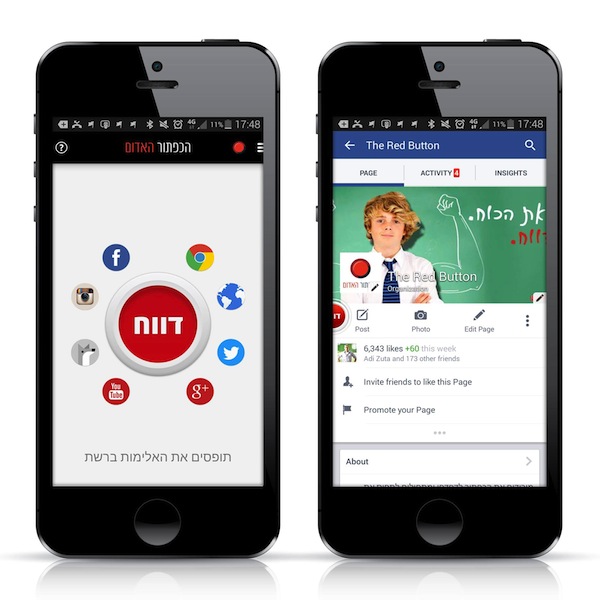
Winner of a “Stop Cyberbullying” competition held in Israel three years ago, the app’s red button, when pressed, sends a screen shot to one of the many volunteers who work with Red Button. If the content is deemed inappropriate, it is reported to the website – whether that is Facebook, YouTube, Google or JoeSchmoe.com – so that the content can be removed.

In some cases, the Red Button team has permission to remove the content; in other instances, the content is relayed to cyberbullying police, schools, business owners or even hospitals, if need be.

“When we published the Red Button and it went on air in December 2013, we saw for the first time just how cruel cyberbullying can be,” said Alon Bar-David, 27, co-founder and co-chief executive officer of the nonprofit.

In Boston, working with a business accelerator there to bring the app to North America, Bar-David told the Independent, “As soon as we published the Red Button, we received a lot of response, a lot of requests and we finally understood just how big the problem is and how big our solution needs to be.”

screen shot - The app’s red button, when pressed, sends a screen shot to one of the many volunteers who work with Red Button.
The app’s red button, when pressed, sends a screen shot to one of the many volunteers who work with Red Button.

When a user presses the button, an anonymous report is sent to the Red Button team. “They do not need to identify, they do not need to register,” explained Bar-David. “They only need to download it for free, press on the red button, and a screen print is sent to us.”

Currently, the app is available to Android users and it can be accessed via Google Chrome or Firefox. It can also be used as a web extension to the browsers. The company is working on an iPhone version.

Bar-David and the Red Button team receive hundreds of reports every day and there are dozens of volunteers who analyze them. When cyberbullying content is detected, the volunteers escalate the report to the appropriate place.

“Up until now, we’ve removed 95 percent of the [reported material] deemed to be cyberbullying,” said Bar-David. “We review the violence over the network in Israel. Before, no one was doing anything against the phenomena.

“We have access to many websites in Israel. We have a lot of power in our hands. We can really reduce cyberbullying.”

One of the most important ways Red Button is able to help is in suicide prevention. When the reports come in, they are directed to the suicide prevention police unit. “In 2014, we were able to help [prevent] more than 40 cases of attempted suicide and have a representative go to their home and save lives,” said Bar-David. “These are the only cases where an IP address is provided to police, so that they can get a location.”

Another big component is education. “We go to different schools every week and teach the kids what cyberbullying looks like, explaining what cyberbullying actually is,” said Bar-David. “Because most children, students, don’t know what cyberbullying is, they would not recognize it.”

The Red Button educators explain what it is. “More important than that,” he added, “they explain how to deal with the phenomena. They give them tools, the Red Button and a lot of other tools, and, every week, we go through different schools all over Israel.”

To find affordable, qualified staff, Red Button collaborates with Israeli universities. “The one that we have the biggest collaboration with is the Interdisciplinary Centre in Herzliya, Israel,” said Bar-David.

To generate interest from the general student population, the participating universities give school credits to the volunteers. There were more than 200 applicants last year to fill 50 spots.

“But the reason the students do it is because they think it’s important,” said Bar-David. “We only take students that really feel a connection to the issue we’re dealing with.”

As Red Button understands better than most, cyberbullying is a global problem. “We think that the Red Button should be all over the world because the cyberbullying phenomena isn’t just in Israel,” said Bar-David. “It’s a bigger issue all over the world, especially in the U.S. This is the reason we are here [in Boston]. We want to see the market here and see how to implement the Red Button here in the U.S.”

Bar-David is also interested in Red Button’s potential use in Canada. Noting that he just saw an article about cyberbullying on a Canadian news website, he said, “I understand if it gets to the news, that means the problem is very familiar in Canada. I hope we will be in Canada as soon as possible. Some people would like us there yesterday.”

For more information or to donate to Red Button, visit redbutton.org.il. While the site is only in Hebrew at the moment (the team is working on changing that), an English or Hebrew email can be sent to [email protected].

Rebeca Kuropatwa is a Winnipeg freelance writer.
Format ImagePosted on July 24, 2015July 22, 2015Author Rebeca KuropatwaCategories IsraelTags Alon Bar-David, bullying, cyberbullying, Red Button

Receptionist to owner

When Judy Spackman, 61, started working as a receptionist at Cando Rail Services Ltd. in Brandon 25 years ago, she felt it was a good starting place and the people were nice. Little did she know that, one day, she’d be an owner.

Born and raised in Neepawa, Man., Spackman moved to Brandon in 1987 to attend community college in the administrative accounting program. After graduating, she worked as an order operator at Richardson Greenshields for two years before coming on board with Cando.

photo - Judy Spackman
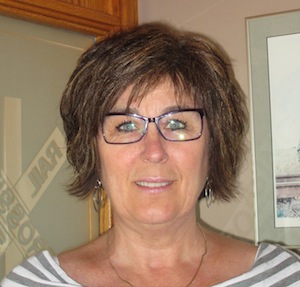
Judy Spackman (photo from Judy Spackman)

At Cando, she started out as a receptionist before moving into the accounts payable and receivables section. She later moved to the company’s offices in downtown Brandon. Today, she works for the abandonment department as their administrative assistant for trucking and rail logistics.

“Cando Rail is a railway associated company,” said Spackman. “Anything that they do has got to do with a railroad in one way or another, from tearing up abandoned tracks and building new tracks to selling components of the track.”

Seven years after she joined the company, Cando’s owner introduced Judy SpackmanJudy Spackmanan employee share ownership plan (ESOP). Unsure at first if she wanted to opt in, Spackman changed her mind when she saw the returns some of her colleagues were taking home.

“It happened in 1996,” said Spackman about the ESOP. “It was something that Gord Peters, the owner, knew about. He understood the process of employee ownership and thought it would be a good fit for Cando employees.”

Some employees went into it right away. “By year two, you could see what those people got, the share payout – putting their money into the company, they shared its profit,” she said. “That got me thinking that it was a good idea, so I started working the second year, trying to make sure I had enough matching funds to be able to participate in the program.”

In 1996, shares in Cando were worth $2.74. They are now worth more than $40.

The ESOP is set up as a retirement savings plan, wherein employees can make monthly contributions. “They helped us set something up within the company to be able to contribute to an RSP through payroll deduction,” explained Spackman.

Everybody qualifies to buy a block of shares, according to a formula based on a percentage of their T4 or total earnings. Also, employees are given a $100 bonus for every year they have been with the company. “Say they made $50,000, that’s times four percent, so they would get $2,000 of a match there,” she said. “And, for me, I’ve been with the company for 25 years, so I get $100 for every year I’ve worked. So, I get a $2,500 match…. I’d qualify for a $4,500 match.… If I bought $4,500 worth of Cando shares, they’ll match those funds and give me $4,500.

“So, now I have $9,000 worth of Cando shares…. The formula and the calculation is the fairest way to do it.

“You don’t have to do that match if you choose not to. You could only put in $2,000, then they will only match you the $2,000. If you don’t match your true potential, you don’t get that potential match. So, it gives you the initiative to make sure you put away enough to cover your match.”

Spackman’s first-year share block investment is now worth more than $25,000. She has created a spreadsheet to keep track of her shares and their growth and, as she is nearing retirement, she has made a second spreadsheet called, “Retirement.”

“Knowing the difference between RSP and non-RSP, and knowing the best way to have a mix of both and how to be diversified is key,” said Spackman. “You don’t want all eggs in one basket.

“It does make you learn a lot about finances and projections, and looking past today and into the future – doing calculations to make sure you have enough in your retirement fund.”

There is no pension offered at Cando. Instead, by creating this program, Peters gave his employees a way of creating their own pension plan.

“It’s an individual choice of how much you want to go in,” explained Spackman. “You can max everything into this and make it grow. Some are uncomfortable going in very much, [but] when they learn the system and see and do calculations, they realize the potential of growth is amazing.”

Peters’ philosophy is that employees work hard to make a company successful and that they should share in the success; shares in ownership give employees a more vested interest in the company.

“He takes great pride in people who learn the program and understand the financial and growth side of the program,” said Spackman of Peters. “I think it’s a viable program for any company and is feasible and acceptable for companies to run a program like this and be successful.”

The ESOP has helped Cando’s performance because employees who are also shareholders benefit directly when the company does well. There are “quarterly reports on how the company is doing, so we know throughout the year what’s going on and it tells us [about] new business, what’s coming up, giving us an idea of what the company is doing and how it is growing,” explained Spackman.

Every May, the projection/payout conversation starts, and the employees go back to work for another year. It’s like playing the lottery except in this case they are guaranteed to win as long as the company grows and they have some shares.

“There is a possibility that some years we may not get a payout or a big growth in the company, like this year,” said Spackman. “Worst-case scenario, it may stay the same one year. But, that’s OK, because we retain … our shares.

“You have to be in the real world. There is potential for this to go down. In 18 years, I haven’t seen it go down, but you have to keep that in mind. You have to have other investments.

“Being a Cando shareholder gives me pride, being an employee-owner. It’s an avenue for a comfortable retirement and a financial education that benefits my personal financial practices.”

Rebeca Kuropatwa is a Winnipeg freelance writer.
Posted on July 3, 2015July 3, 2015Author Rebeca KuropatwaCategories NationalTags Cando Rail, employee-share program, ESOP, Gord Peters, Judy Spackman

Human rights at fore

One would be hard-pressed to find anyone involved in human rights around the world who has not heard of David Matas.

A Winnipeg-based lawyer, Matas has helped countless victims of human rights violations, and written or co-written numerous books on various atrocities in an endeavor to shed light on them and educate the general public about them. In his latest publication, he aims to explain why he has chosen the work that he has, in the hope of motivating others to get involved in human rights advocacy and create change. Why Did You Do That? The Autobiography of a Human Rights Advocate (Seraphim Editions, June 2015) is his first autobiography.

photo - David Matas
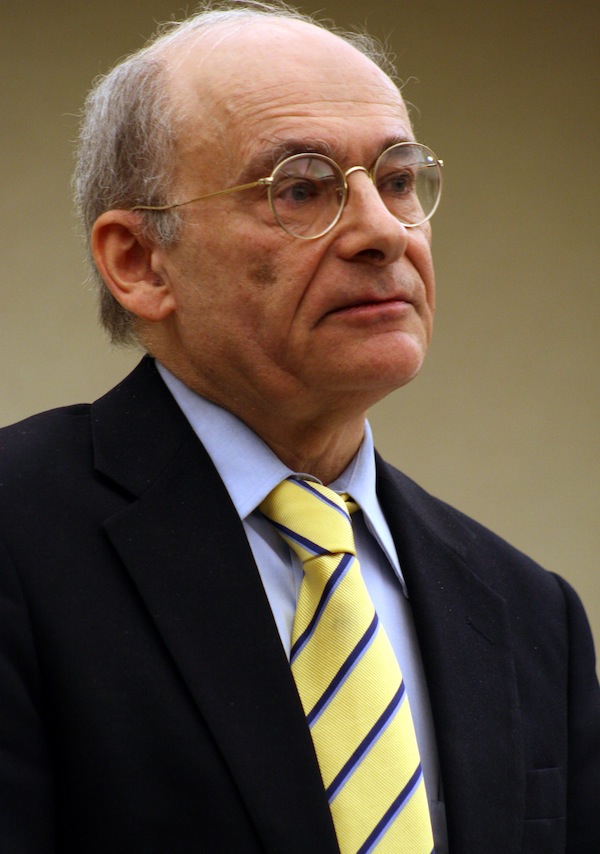
David Matas (photo from David Matas)

Matas was moved to pursue a career in refugee, immigration and international human rights law for a number of reasons.

“I started doing it because different people asked me to do it, including people at the law firm,” he explained in an interview. “It’s also something I’m interested in, because I’m interested in politics and human rights. So, I’d say, it was a coincidence of an opportunity to do the work and an interest in it that got me into it.”

Matas had refugees from around the world coming through his doors every day, seeking help. “My immediate effort was to try to get them protection, but the ultimate solution to their problems was the ending of the human rights violations that caused them to flee,” he said. “I felt trying to help them in some sort of systemic way, that I should be directed to that as well.”

Around this time, Matas also ran as a candidate in the federal election for the Liberal party (in 1979, 1980 and 1984) and B’nai Brith Canada approached him, requesting that he chair the local BBC League for Human Rights, largely because of the profile he had developed through his candidacies.

“But, again,” said Matas, “it’s something that, once I got into it, struck a chord of response in me. I got interested in it, involved much more, given the opportunity, because of the resonance it had with me.”

Also around that time, Kenneth Narvey – someone Matas knew from university – was scheduled for a speaking engagement in Manitoba on war-crime issues. Unsure if he would be able to make it, Narvey asked Matas if he would be willing to substitute for him, which Matas agreed to do. As it happened, Narvey ended up being able to attend the lecture, which gave him the opportunity to hear Matas speak and, Matas said, “He [Narvey] really liked it.

“At this time, Irwin Cotler had just become president of the Canadian Jewish Congress [CJC]. Irwin had appointed a chair for a war-crimes committee, as he wanted to do something about the issue himself, and the chair had resigned.”

Narvey lobbied Cotler to have Matas appointed as chair, and Cotler did just that. “So, I got involved in that issue, too, again sort of by coincidence or circumstance,” said Matas.

Another chance encounter was with Harry Schachter, a friend of Matas’ who was involved with Amnesty International, which had been holding meetings throughout the country. Through Schachter, Matas became involved with Amnesty International, which fit well with everything else he was doing.

“The combination of these events, more or less all at the same time, is what really got me into human rights in a very systemic and wholehearted way,” said Matas.

The Holocaust also influenced Matas’ life path. “I, personally, wasn’t affected by the Holocaust, my family wasn’t,” he said. “But, it just struck me. I thought, from an early age, that if the Axis rather than the Allied powers had won World War Two, I nor any other Jewish person would be alive today.”

He explained, “Generally, what I’ve been trying to do is learn the lessons of the Holocaust and act on them, which I saw as protecting refugees, bringing war criminals to justice, combating hate speech and protesting human rights violations around the world wherever one may find them. So, I’ve been trying to act on those four fronts simultaneously throughout my career.”

book cover - Why Did You Do That? The Autobiography of a Human Rights Advocate by David MatasIn his previous books, Matas has focused on specific atrocities or topics related to human rights – from hate speech, to trying to bring Nazi war criminals to justice, to humans rights violations, to refugees, to organ harvesting, and other topics. His autobiography was launched on June 9 at McNally Robinson Booksellers in Winnipeg.

“I go through the various issues I’ve been involved in and explain why I’ve been involved with them, issue by issue,” said Matas about Why Did You Do That? “There’s a chapter on refugees, so I explain what I did in terms of trying to help refugees. And then the rest is why people should help refugees, why everybody should do it. That’s the way it’s structured, chapter by chapter.”

For Matas, this book is a way for him to answer the most frequent question he is asked, “Why are you doing this?”

“I would say the 20th century was a century of genocide,” said Matas. “It wasn’t just the Holocaust. There was one genocide after another. My hope is we will be better, but I don’t think that it comes from hope. It comes from action. So, I’m trying to mobilize people to make things better, so we don’t repeat in the 21st century the vast array of tragedies we saw.”

In Matas’ view, people tend to focus on the problems immediately in front of them.

“People will get really worked up if their neighbor doesn’t mow their lawn, but they get less worked up if people in China are getting killed for their organs,” he explained. “I think there’s a real problem with distance, culture, language and geography, which really makes it difficult to mobilize concern for human rights violations – which is what the Jewish community faced with the Holocaust.”

Why Did You Do That? The Autobiography of a Human Rights Advocate can be purchased online from Seraphim Editions, Amazon and various other booksellers online and in bookstores.

Rebeca Kuropatwa is a Winnipeg freelance writer.
Format ImagePosted on June 26, 2015June 25, 2015Author Rebeca KuropatwaCategories BooksTags David Matas, human rights, immigration, refugees
A millennia-old relationship

A millennia-old relationship

Visitors at the opening of the traveling exhibition at the Schwartz/Reisman Centre in Toronto last month. (photo by Helena Yakovlev-Golani)

The exhibit A Journey Through the Ukrainian-Jewish Encounter: From Antiquity to 1914 opened last month in Toronto. It has since been held in Winnipeg (until June 27), will return to Toronto in July and then head to other cities.

The exhibit is being put on by the Ukrainian Jewish Encounter (UJE), which its website describes “as a collaborative project involving Ukrainians of Jewish and Christian heritages and others, in Ukraine and Israel, as well as in the diasporas. Its work engages scholars, civic leaders, artists, governments and the broader public in an effort to promote stronger and deeper relations between the two peoples.”

Prior to the exhibit’s opening in Winnipeg at the Oseredok Ukrainian Cultural Centre, one of its curators, Alti Rodal, an historian, writer, former professor of Jewish history, and former official and advisor to the Canadian government, spoke with the Jewish Independent.

Rodal was born in Chernivtsi (Czernowitz), Ukraine, and received her early schooling in Israel. Later, she was educated at McGill, Oxford and Hebrew universities in the fields of history and literature.

“UJE was established in 2008 by two people from Canada and the United States, both Jewish and non-Jewish Ukrainian background,” said Rodal. “It’s now a multinational organization with representatives in Ukraine, Israel, the U.S. and Canada.”

UJE’s purpose is to promote greater comprehension of the Ukrainian-Jewish relationship over the centuries, including an understanding of the co-experience of the two peoples and their interactions over the centuries, with a view to the future.

The organization has held many roundtables of scholars from Israel, Ukraine, Canada, the United States and much of Europe, each aimed at understanding a different period in history.

“To have a truthful account of the past, we’ve had a scholarly dimension unfold over the last few years in which we’ve brought together roundtable discussions among scholars of various backgrounds,” explained Rodal. “We’ve identified chunks of the history that need to be explored together and each of these roundtables addressed a different period.” The historical periods explored to date stop at the First World War.

“The exercise is one that leads to a shared historical narrative,” said Rodal. “With this we mean a single text on which the participants largely agree. If there are aspects they don’t agree on, it is stated in the single text, indicating what kind of research would be needed to advance knowledge on these issues.

“By looking to the past, we hope to obtain personal acknowledgement of what happened and to address stereotypes that both Jews and Ukrainians, at the popular level, have about each other. Some of these stereotypes are in the history books, so our aim is to produce more credible accounts and address stereotypes.”

UJE hopes that, with the help of other researchers, some of the information being taught in Ukrainian schools will be amended.

Three years ago, they entered into an agreement with the Government of Canada to do four main projects on the topic, including two publications, developing the content of their website, and the traveling exhibit, the research for which began seven years ago.

The exhibit’s first stop was in Toronto at the Schwartz/Reisman Centre and when it returns to that city, it will be to downtown’s St. Vladimir Institute, the Ukrainian cultural centre.

“These are community exhibits rather than museum exhibits, so we have them at the community centres and try to engage people from the community to participate,” said Rodal, noting that the exhibit will also go to Edmonton and Montreal.

“We’ve been approached by the Jewish community and the Ukrainian community in Ottawa and there’s been interest also from Vancouver,” she said. “We don’t have a commitment to do it, but we’ll consider it…. So, Vancouver and Ottawa are under consideration.”

The exhibit consists of text, images and video. “The first venue in Toronto consisted of 36 panels placed on moveable walls, and four videos that we created ourselves,” said Rodal. “I’m not telling you about the topics, just the physical [aspects] and the number of ethnographic maps.”

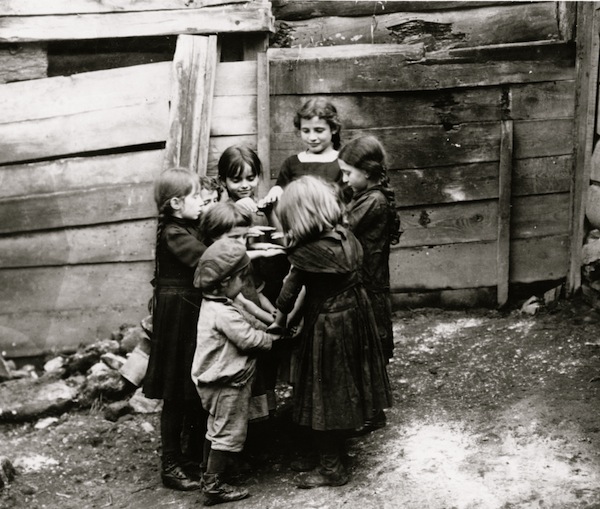
photo - One of the images displayed in the exhibit is this one of Jewish children playing in Kremenets, Ukraine, circa 1913. The photograph was taken during the ethnographic expedition led by S. Ansky in the Jewish Pale of Settlement in 1912-14
One of the images displayed in the exhibit is this one of Jewish children playing in Kremenets, Ukraine, circa 1913. The photograph was taken during the ethnographic expedition led by S. Ansky in the Jewish Pale of Settlement in 1912-14. (photo from YIVO Institute for Jewish Research (New York City) Photograph Collection)

The panels go through history, from antiquity to the First World War chronologically, but there is a segment that deals with the Chassidic movement on Ukrainian lands, one on Hebrew-Yiddish printing, and another on literature and how Jews are depicted in Ukrainian writing and how Ukrainians are depicted in Jewish writing.

The videos also deal with diverse topics. One is marketplaces and taverns, where Ukrainians and Jews encounter each other, and there is a video on Jewish artisans on Ukrainian lands. Another is on ethnographic photographs, largely taken between the 1880s and 1914 on S. Ansky’s expeditions.

“Ansky was an ethnographer who led expeditions around these times, visiting many communities accompanied by a musicologist/photographer, his own nephew,” explained Rodal. “They took pictures and collected folksongs and folklore and objects, which then they put in the museum in St. Petersburg.

“When the Soviets came, it was put in the warehouse and stayed in the warehouse in the 1990s, when the St. Petersburg Historical Centre made these photographs accessible. So, a selection of these photographs of Jewish life from the 1890s to 1914, and also a collection of similar ethnographic photographs of Ukrainian life in various regions, is one of the videos.”

The videos are comprised of photographs with effects accompanied by appropriate music, including a recording made more than 100 years ago on wax cylinders.

UJE’s first objective was to explain that the presence of Jews on Ukrainian land dates back to antiquity. “It didn’t just appear in the 18th century or even the 16th century, but was there in the very first centuries or even earlier, as merchants in colonies co-founded with Greeks,” said Rodal.

“There was also lots of significant cross-cultural interaction between the Jews and the Slavic peoples in the language, folklore, music and cuisine … so that what one thinks is Jewish cuisine, you delve a little and you see the Ukrainians are eating the same things with different names.

“The vast majority of Jews lived in areas where the vast majority of Ukrainians lived. They had more interactions with Ukrainians than with other Slavic peoples…. People who’ve come to North America from what they say [is] Russia, they mean czarist Russia, these places that are coming from Galicia … and the Ukrainian lands that were part of the czarist empire … are now Ukraine.

“Another important message, which is an offshoot of the other, is that the stories of these peoples are intertwined, that we have the motto that the history of one is incomplete without the history of the other. That is the goal – to treat this historical experience in all its complexity – including the periods of crisis and violence.

“We state very clearly that not addressed in this exhibition are the horrible events of the 20th century. And we may do more about this in a different format rather than a visual exhibition. We are certainly doing it in the form of the shared narrative exercise.”

For more information about UJE, visit ukrainianjewishencounter.org.

Rebeca Kuropatwa is a Winnipeg freelance writer.


Format ImagePosted on June 26, 2015June 25, 2015Author Rebeca KuropatwaCategories Arts & CultureTags Alti Rodal, UJE, Ukrainian Jewish Experience
Helping kids, entertaining

Helping kids, entertaining

Jerry Maslowsky, executive director of Variety, the Children’s Charity of Manitoba. (photo from Jerry Maslowsky)

Jerry Maslowsky, executive director of Variety, the Children’s Charity of Manitoba, has a long history with the organization.

Maslowsky, 57, started off in performing arts as a teenager, in Rainbow Stage productions. Coming from a musical family, the stage was where he felt most at home.

He later became a member of a band called Special Blend and, for 18-19 years, he was with them, playing for many weddings, bar mitzvahs and graduations. He came across Variety in his early 20s, singing on the charity’s telethon in the 1980s. However, his work with them was yet to come.

Maslowsky was approached by CJOB radio station to take on the role of marketing director, with a major aim being to bring the Winnipeg Blue Bombers and the Winnipeg Jets to the station. Then, in 1999, he was hired as director of sales by the Winnipeg Blue Bombers, becoming their vice-president of marketing and sales, and working with the team for 15 years.

A year ago, Maslowsky felt it was time to move on, as an opportunity with Variety came up. The organization’s previous executive director, who Maslowsky knew very well, was retiring.

Since Variety started as an entertainer’s charity, it was something in which Maslowsky was very interested – working with kids and giving back, as well as “ensuring that all kids are having a childhood just made sense,” he said.

The original chapter started in Pittsburgh in 1927 as an international children’s organization, the initiative of a group of 11 men involved in show business, who set up a social club, which they named the Variety Club.

Maslowsky explained, “On Christmas Eve 1928, a small baby was left on the steps of the Sheridan Square Film Theatre, with a note. The note read, ‘Please take care of my baby. Her name is Catherine. I can no longer take care of her. I have eight others. My husband is out of work. She was born on Thanksgiving Day. I have always heard of the goodness of show business people and pray to god that you will look after her.’ Signed, ‘A heartbroken mother.’

“Since efforts to trace the mother failed, the members of Variety Club named the child Catherine Variety Sheridan, after the club and the theatre on which steps she was found. They undertook to fund the child’s living expenses and education. Later, the club decided to raise funds for other disadvantaged children.”

Today, there are more than 44 Variety “tents” (described as “tents” for its circus component) throughout the world. Manitoba’s Variety started in 1978, and it has helped more than 800,000 children throughout the province, raising more than $30 million. The B.C. chapter celebrates its 50th anniversary this year; over that time, it has raised more than $170 million, every year assisting more than 1,200 children. There are other tents in Canada, with a new one slated to open in Montreal.

Maslowsky credited Gene Telpner with bringing a Variety tent to Winnipeg. He got the idea, “then called his good friend, Monty Hall of Let’s Make a Deal, and they were able to formulate a tent in Winnipeg that was really run by a lot of the people from the Jewish community in the entertainment and hotel industry – people like Mickey Levine from the International Inn and Harvey Nairn. A lot of people in the entertainment industry took a hold of this and created the organization and telethons.”

Variety’s mission is to meet the tangible needs of children with all abilities. “This means that every child does have an ability,” explained Maslowsky. “Some children’s abilities are different than others’. We basically look at every child, the abilities they have, and other abilities maybe they lack. That’s where Variety comes in, in how we can support the child as well as the family.

“When children belong here, we call them part of Variety family, because it’s just not always the immediate need we look after. We also look after ensuring the child’s and family’s needs throughout those years, before they come into 18 years old, that Variety stays a part of their life.”

Part of Maslowsky’s mandate at Variety is to reach out to alumni, “kids” who are now 36- and 37-years-old, to see how they are doing, and to bring them back as mentors for younger Variety children.

“One of the things we did that was important for me when I came back was going back to our roots of showbiz, circus and entertainment,” said Maslowsky.

He went to work, calling on his friends from his entertainment past. “So, we were able to plan a Come One, Come All – Under the Big Top event,” said Maslowsky. “I wanted it to be entertaining and I wanted people to come to an event where they could see it through the eyes of kids. And we’ve all grown up with the circus … we can relate to it. It was important to then get talent, not just dancers and speakers.” The event was held May 9.

Reflecting on his younger days, Maslowsky said, “My sister and I, we’ve always been teased as ‘the Jewish Donny and Marie.’ My sister does a lot of performing in the city and we did Folklorama [multicultural festival] for many, many years (at Shalom Square, the Israeli pavilion).”

He added, “Growing up in a Jewish family, knowing how to give and that you’re not always the best, that you just do what you can, you just be sure that you’re a giving person, that was certainly instilled into us by our parents.”

Rebeca Kuropatwa is a Winnipeg freelance writer.
Format ImagePosted on June 26, 2015June 25, 2015Author Rebeca KuropatwaCategories NationalTags children's charity, Gene Telpner, Jerry Maslowsky, Variety Manitoba
Walk Winnipeg’s North End

Walk Winnipeg’s North End

Walk participants explore the Ashkenazi synagogue, the oldest in Winnipeg, on a tour led and organized by Zach Fleisher. (photo from Zach Fleisher)

Not so long ago, Winnipeg’s Jewish community hub was the city’s North End. With Yiddish spoken on the street, Jewish businesses could be found on many corners, as could kosher butchers and synagogues. Since then, however, many Jews and Jewish-owned establishments have moved south or closed down entirely. Some of the North End buildings have been rebuilt or redesigned, while others have been preserved for various reasons. A recent walk – set up via Jane’s Walk – showcased the area’s history and current-day reality.

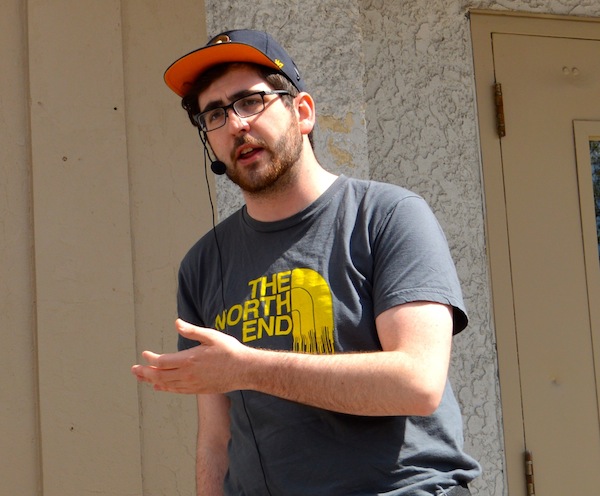
The early May tour was led by Zach Fleisher, 22. A history buff and University of Winnipeg student, he is chairperson of the Canadian Federation of Students Manitoba. In his spare time, he is involved with other projects, with the main goal of making Winnipeg a better place.

“I’ve always found myself enamored with the work of famous American-Canadian urbanist Jane Jacobs (for whom Jane’s Walks are named),” said Fleisher. “And, I’ve always been interested in how we build and define community. In that spirit, I’m quite interested in the history of Winnipeg and the Jewish population, especially the North End area.” He hopes people who took the tour will see the area differently now that they are aware of its history.

According to its website, “Jane’s Walk is a movement of free, citizen-led walking tours inspired by Jane Jacobs. The walks get people to tell stories about their communities, explore their cities, and connect with neighbors.” The free walks are held annually in more than 100 cities in 22 countries around the world on the first weekend of May each year, including in Vancouver.

Fleisher attended a few Jane’s Walks in Winnipeg last year and has informally given tours of different areas for a friend of his, Nicholas Audette, who suggested he get involved with the movement in a more formal way.

While some people RSVPed for his walk, there was no requirement to do so. “That’s what makes the Jane’s Walk so unique – the lack of commitment and organized structure that culminates in a strong sense of community,” he said.

Fleisher’s May 4 walk attracted more than 70 people. “I think a lot of people know that the North End carries a lot of history, but they are always interested in hearing a bit more about the area and its unique history,” he said.

The tour began from what used to be the old Canadian Pacific Railway station at 181 Higgins Ave. “The CPR station, where thousands of immigrants passed through, is now home to an aboriginal centre, housing a variety of offices,” explained Fleisher. “It was a place of great significance and a proper starting point, as almost every Jewish newcomer to the city would also have begun their story in Winnipeg at that same spot.

“This station was one of two major train stations in Winnipeg, the other being Union Station on Main Street.” The station fell out of use in the 1970s, he said.

Walking through Point Douglas on Austin Street, the tour headed toward Chesed Shel Emes funeral home. Along the way, Fleisher pointed out what was formerly the Sharon Home, which was originally established as a rehab centre, but became a personal care facility; it is today located in the city’s South End, and called the Saul and Claribel Simkin Centre.

Although the North End has not seen a significant Jewish population in two generations, the many buildings and sites that are historically relevant remain, along with a number of other key cultural institutions.

“At its peak, it’s believed that over 15,000 Jews – primarily from the Ukraine, Poland and Russia – called the North End home,” said Fleisher.

Once at Chesed Shel Emes, participants were given a brief history of the facility by Sharon Allentuck, who was representing the chapel because its executive director, Rena Boroditsky, was away. The funeral home was founded in 1930 by volunteers who wanted to ensure that every Jew had access to a proper Jewish burial and, in 1947, the chapel was built, she explained.

The walk then continued along Main Street to Burrows Avenue, to Congregation Ashkenazi. “The Ashkenazi is the oldest synagogue in Winnipeg and has a second floor only for women,” said Fleisher. “According to [its] tradition, non-married Jewish men don’t wear tallit, because the women on the second floor then got to pick their husband.”

Saul Spitz, who organizes the maintenance and care of the building, was on hand to give a talk and lead a tour of the synagogue.

“The North End has a rich tradition that continues today,” said Fleisher. “Along with the times, the type of community has changed. While the Jewish North End may be a memory of years past, it’s important to recognize the heritage of the area.”

photo - Zach Fleisher in front of what used to be the building housing the city’s Hebrew Sick Benefit Association
Zach Fleisher in front of what used to be the building housing the city’s Hebrew Sick Benefit Association (photo from Zach Fleisher)

After passing by the German Club at Flora and Charles streets, which was the home of the Talmud Torah at one time, the walk continued on to one of the few Jewish businesses still around in the North End – Gunn’s Bakery, which opened in 1937.

Fleisher noted that Gunn’s is located next to what was formerly the Hebrew Sick Benefit Hall, now home to a Christian worship group, though the building still retains the initials HSB.

Fleisher said he would love to organize another walk if there’s interest, and “to branch out a bit as well. So many of the folks who made it out had their own additions to the oral history of the walk and were able to contribute as necessary. I aimed to provide a basic framework for the walk and so many people were able to bring their own lived experience to the table.

“The walk was a great experience and it was great to see that I’m not the only one with a passion for the rich diversity of the area,” he continued. “The Jewish component is only one part of the rich diversity of the North End and I’d encourage everyone to read up a bit more on such a dynamic area.”

The next Jane’s Walk weekend is scheduled for May 6-8, 2016. To find out about walks in the various cities or to organize one of your own, visit janeswalk.org for more information.

Rebeca Kuropatwa is a Winnipeg freelance writer.
Format ImagePosted on June 26, 2015June 25, 2015Author Rebeca KuropatwaCategories NationalTags Chesed Shel Emes, Gunn’s Bakery, Jane Jacobs, Jane’s Walk, Jewish history, Winnipeg, Zach Fleisher
Reform has new prayer book

Reform has new prayer book

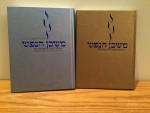
This month, the Reform movement’s new High Holiday prayer book, Mishkan HaNefesh, is being published. It replaces Gates of Repentance, which has served the movement since 1978, and is a companion to the movement’s siddur, Mishkan T’filah, which was published in 2007.

“It was an innovative siddur in a number of ways,” Rabbi Hara Person, publisher and director of CCAR Press, the Central Conference of American Rabbis’ publishing division, told the Independent. “It includes a lot of poetry and other kinds of readings that haven’t historically been in prayer books. It includes both the faithful translation of the text alongside, in some cases, alternative translations.

“The approach is multi-focal. It’s not an approach that says there is only one way to read our tradition or prayer. Instead, it opens up to people different ways of understanding, and struggling and grappling, with the text and tradition … and with theology.”

As an example of the new machzor’s increased accessibility, Person explained that, as does Mishkan T’filah (Sanctuary of Prayer), Mishkan HaNefesh (Sanctuary of the Soul) includes transliteration throughout for all of the prayers. “We wanted it to be open and welcoming to people, no matter what their background or how much or little a Jewish education they have,” she said.

About the diversity of the people sitting in the pews, she added, “Some may not be Jewish at all. They might be there with a Jewish spouse or partner. We don’t want to tell them that there’s nothing there for them. We want them to be able to learn and participate to the extent that they’re comfortable.”

Another significant aspect of the machzor is its inclusivity. “For over 25 years,” said Person, “we’ve been speaking up about inclusion of gay and lesbians in our communities on every level, so this is just another piece of that. That’s true for anybody who walks through our doors.”

This meant that the language of some of the prayers had to be updated.

At the heart of the prayers that talk about a bride and groom, for example, is the love between a couple. “So, we changed the language to reflect that and to not exclude gay and lesbian couples,” said Person. “Also, regarding being called to the Torah, we felt it should reflect the view and acceptance of all people, including those struggling with gender identity … calling people from the ‘house of’ as opposed to referring to them as ‘the son or daughter of.’…”

These most recent changes follow those that have come before regarding the increased participation and recognition of women.

“I think the Reform movement has a long history of egalitarianism, even from the very start,” said Person. “Even before women were rabbis, the Reform movement did away with separate seating in synagogues, so very early on in the history of the Reform movement, men and women were allowed to sit together in synagogues.

“So, these are just further steps in that progression of treating everybody with dignity and with a sense of equality and inclusiveness, and a way of saying we are all created in the image of God … women as well as men. It’s true for gay or straight or trans. Why would we exclude some but not others? It’s part of our value system to be inclusive.”

The new machzor has been in the works for a long time.

“We did a tremendous amount of piloting ahead of time,” said Person. “The book was in development for five or six years. Over those years, we had about 350 congregations across North America who piloted different sections of it.”

Some other interesting features of the new machzor are the poetry – from American and also Israeli writers – and art.

“We worked with an artist in New York named Joel Shapiro,” explained Person. “He created an opening piece of art for each of the services. They are woodblock cuts. He spent a huge amount of time studying the services and prayers and was inspired to create the art for the services.

“For me,” she continued, “it’s really exciting because some people love poetry and that’s going to … be a way into the prayer book and into the experience of worship for them. For others, it will be the commentary, and for others still, it will be the art…. Art may open the door for them and help them walk in. It’s really exciting that we were able to do all these things within the prayer book.”

A large-print version of Mishkan HaNefesh will also be available, as will an e-book version. “There is a percentage of people who actually use machzors before the holidays to do their own spiritual preparation,” said Person. “This book has so much in it for that. For a tablet, maybe they’d use it ahead of time, but not bring it to synagogue. I don’t know.”

For more information about the new machzor, visit ccarpress.org.

Rebeca Kuropatwa is a Winnipeg freelance writer.
Format ImagePosted on June 19, 2015June 17, 2015Author Rebeca KuropatwaCategories Celebrating the HolidaysTags CCAR Press, Hara Person, High Holidays, inclusivity, machzor, Mishkan HaNefesh, Reform Judaism

Israeli poet talks to JI

photo - Erez Biton
Erez Biton

After years of writing poems that blend his Algerian/Arabic background and his Ashkenazi-influenced schooling, Israeli poet Erez Biton, 73, this year received the Israel Prize for Hebrew literature and poetry. Born to Moroccan parents in Oran, Algeria, in 1942, he is the first Israeli of Mizrahi descent to win the country’s top literary honor, though he is no stranger to awards for his work.

“Poetry is like a tale of an elusive dream, but one must not give up,” Biton told the Independent. “One must, to a certain extent, pursue this elusiveness and try to catch it and change it into the poetic expression. The coping is with the controlling, the conscious, the immediate, which prevents an encounter with the twilight sensation that enables the poem to dawn.”

Biton envisions poetry as an independent, physical sense. “The poem is a continuation of you, added to you by the poetic ability,” he explained. “Just as it is difficult to catch the tale of a dream, so does the poem impose, sometimes for the good, sometimes for the bad.”

By internalizing the poetry of such writers as Hayyim Nahman Bialik, Nathan Alterman, Yehuda Amichai, Zelda Schneurson Mishkovsky, Amir Gilboa, Dahlia Ravikovitch and Avot Yeshurun, Biton said he developed a poetic stance of his own. “If, at first, I wrote love poems of a boy seeking his path to the world of poems, which were defined as universal existential with no description of time and place, then, in my additional poetry, I had become totally concrete, and thus saw myself as different from others.”

Biton started on his artistic journey with the help of Elisheva Kaplan, a piano teacher at Biton’s school who stopped teaching in order to dedicate her life to translating written books into Braille. This was essential for Biton, as he lost his sight at the age of 10.

Kaplan brought some of Biton’s poems to Shimon Halkin, an Israeli poet, novelist, teacher and translator (who passed away in 1987). Upon reading Biton’s work, “Halkin suggested that I send my poetry to [the now defunct literary magazine] Keshet,” said Biton. “I received an enthusiastic letter from the editor of Keshet, Aharon Amir, in response to reading my poems ‘Jaffa Street,’ ‘Variations on One Subject of Bach,’ and more.”

When Biton lost his sight and left hand to an explosive device he found while playing, he recalled, “This was a type of loss, a death of an intimate entity, which until the age of 10 and a half, was a part of me. And, to lose that, [it’s as though] something dies in you. With this death, I am in negotiation.”

Biton decided to become a social worker instead of a writer. “There was no one I could show my poems to,” he said. However, he added, “as a result of my encounter with human suffering as a social worker, I acquired compassion, sensitivity to others, which were later absorbed into my poems.”

Biton immigrated to Israel in 1948 with his family. The year after he lost his sight, he went to school at Jerusalem’s Institute for the Blind. He received his bachelor’s in social work from the Hebrew University, his master’s in psychology from Bar-Ilan University, then worked as a social worker for many years. He also worked as a journalist and was a columnist for Maariv. His first book, Mincha Marokait (Moroccan Gift), was published in 1976.

Biton’s decision to become a social worker stemmed from his identification with the hardships involved with making aliya. His experiences have also contributed to his poetry.

“The process of my growth ripened in me foundations of lyric sensitivity that came to expression in the poetic writing,” he said. “A writing of truth can grow through a deep encounter with different life situations and I say that all human suffering is not foreign to me. Therefore, I find in myself a space of accommodation and also of the unusual and the different.”

Biton expressed gratitude for the recognition he has attained, saying if he is to be considered part of the chain of poets that includes writers such as Bialik, “a great grace will be done with me. And grace will be done with me also by those who will see me as someone who opened a certain door, because it took time until people started to talk my language.”

Biton does not see himself as a man of religion, but said, “Moroccan associations echo in me, biblical associations echo in me. All the materials I treasured, which I internalized – poems of Bialik – all the materials that I absorbed, especially the Moroccan language, it was an immense joy to me to give an echo to something from an entirely different me.

“One of the unique components in the writing of my poems is the use of expressions in Arabic…. During the healing of the internal tears, I found myself writing poems that embed in the Hebrew syntax expressions in Moroccan Arabic, which was my childhood language.”

His work has paved the way for others. “I used in my poetry groundbreaking Moroccan expressions and, eventually, other poets used the expression ‘Moroccan’ as a title to the names of their creations,” he said.

“I’m in a battle of two phases. One says blindness is a great lacking, an endless depravation of encountering the world…. On the other hand, when I am a bit more reconciled with myself, there are also the possibilities of hearing, touching and listening to the speaking of people, as a type of melody.”

Of course, not only his cultural background has influenced his writing. “On the sensory level,” he said, “I’m in a battle of two phases. One says blindness is a great lacking, an endless depravation of encountering the world … emphasized by the recognition of the memory of seeing until the age of 11.

“On the other hand, when I am a bit more reconciled with myself, there are also the possibilities of hearing, touching and listening to the speaking of people, as a type of melody. The sensation, the touch of a woman, the face of a woman, the lips of a woman – all of these are at the other side of the scale of what there is.”

Integral to his success has been his wife. “In my attempt to understand the proceeds that happened in my work, I cannot ignore the significance of my marriage to Rachel in the year 1982,” he said.

Biton’s wife, Rachel Calahorra, is an architect and graduate of the Technion in Haifa. She was born in Israel to parents who emigrated from Athens. The couple met in early 1980.

“What was special in our relationship was we believed in each other, in the intellectual capability and the emotional side of deep love,” said Biton. “Our connection as a couple led also to a mutual intellectual cultural search toward an integration … between East and West.

“The marriage, the starting of the family, and its expansion in the birth of our children, Asaf and Shlomit, sharpened in me the question of blindness and my place as a blind person in the family, as a father and a husband.”

Biton found himself writing poems like, “The Joy of Your Eyes” and “Arrangement with a Firstborn.”

“Without a doubt,” he said, “my marriage to Rachel was a very significant turnaround, not only in the course of my life, but also in my writing, with the complexity of her life with me as a blind person, in her endless support of my overall actions.”

While Biton has won other awards for his work, with the receipt of the Israel Prize this year, as well as the Bialik Prize for lifetime achievement and the Yehuda Amichai Prize last year, he said he now feels more accepted.

The Israel Prize committee described his poems as, “The epitome of courageous dealings, sensitive and deep with a wide range of personal and collective experiences centred around the pain of migration, planting roots in the country and the reestablishment of the Mizrahi identity as an integral part of the overall Israeli portrait.”

In his speech at the prize ceremony, Biton said, “My parents were like an open book to me. My mother was a collection of poetry in Arabic, carrying an ancient Jewish legacy. And, indeed, so I have become an accumulation of childhood experiences, experiences of lively observation, of freedom of movement in spaces, climbing on trees and on fences, and a lot of running.

“I was an accumulation of sounds, of dialects, or poetry, from my father’s home. Eleven years of freedom of movement and seeing … sensory treasures were collected in me … of which I make use still today.”

Rebeca Kuropatwa is a Winnipeg freelance writer.
Posted on June 5, 2015June 3, 2015Author Rebeca KuropatwaCategories IsraelTags Erez Biton, Israel Prize, poetry

Young talent gives all

Growing up going to Hebrew school at a Conservative synagogue in Vancouver’s North Shore was a good start for Leo Robinovitch.

While Congregation Har El initiated his exploration into his Jewish identity and connection to Israel, it was a year after Robinovitch’s bar mitzvah that he really delved deeply into Judaism.

“It was then that I started attending Camp Miriam, a progressive, labor-Zionist summer camp affiliated with the youth movement Habonim Dror,” said Robinovitch, who will be returning to Israel this summer.

photo - Leo Robinovich
Leo Robinovitch will be joining Birthright Excel this summer. (photo from Leo Robinovitch)

“Habonim Dror machanot (summer camps) provide children ages 8-17 with a unique camping experience,” the movement’s description reads on its website. “Based on the model of a kibbutz, each machaneh (camp) creates a close-knit community based on Jewish ideals of collective responsibility, respect, equality and friendship…. Campers grow physically, emotionally and intellectually in a creative, open and caring environment. Habonim Dror has been providing a machaneh experience since 1932.”

In the summer of 2009, Robinovitch spent five weeks with Habonim Dror in Israel and later participated in Habonim Dror’s gap year program (from 2011 through to 2012), living in the north of Israel and teaching English in largely Arab cities in the region.

Camp Miriam and Habonim Dror personalized and solidified Robinovitch’s “connection to the Jewish people and our shared fate surrounding Israel, as well as prioritized the formation of a just, equitable, and democratic Israel over all else.”

Robinovitch has always been a technology and engineering enthusiast, an apple that definitely did not fall far from the tree with his father working as a biomedical engineering professor at the University of British Columbia.

“My sixth birthday party was engineering themed,” recalled Robinovitch. “My dad helped me set up a pulley and created a bunch of ping pong ball catapults, much to my own and my tiny friends’ delight.

“I’ve known that I would complete a degree in engineering from a very early age. And, now that I’m more than halfway through my mechanical engineering degree at UBC, I remain passionate about the future of technology and its connection to society, politics and the economy.”

On his most recent trip to Israel this past December, Robinovitch heard about a Birthright Israel Excel program through a few folks he met on the trip. “They were Excel alumni from a couple years ago,” said Robinovitch. “They were all extremely bright, motivated people who I shared many passions with.”

The alumni encouraged Robinovitch to apply for the program, as it had helped focus their careers and exposed them to a world of intelligent, hard-working people.

After looking further into the program, Robinovitch found it to be the perfect way to combine his commitment to Israel with his passion for technology, as well as gain necessary entrepreneurial skills for technology-related business endeavors he envisioned for himself in the future.

For 10 weeks this summer, Robinovitch will be working at a high-profile company in Tel Aviv, living with around 40 peers from across North America interested in commerce, finance, technology, medicine and venture capital (VC).

“I’ve spoken with the Excel staff extensively about my interests, and I’ll be finding out my placement in the coming weeks,” said Robinovitch. Possible internships include R&D for Microsoft, market analysis for General Motors, high-profile VC firms (such as Innovation Endeavors) and cyber-security firms.

During his stay in Israel, Robinovitch will also be traveling through the country and speaking with a number of prominent Israeli leaders over the summer, interacting with a number of Israeli peers with similar interests, and broadly experiencing Tel Aviv life.

Robinovitch is looking forward to further experiencing Israel and contributing to its affairs. “It’s very important for me to connect my passions for technology and Israel, and I look forward to doing so for the first time this summer,” he said.

Robinovitch anticipates that this Excel experience will help him decide which industry he wants to pursue, as well as build a diverse array of Israeli and North American partners with whom he will work well into the future.

While Robinovitch’s previous time in Israel was centred on social justice work and education, he is eager to play a larger role this time around in creating change.

“While this work [social justice and education] is still important to me – unquestionably some of the most important work to be done in Israel – I highly value this opportunity to experience Israel’s thriving tech and startup scene,” said Robinovitch. “It’s a side of Israel I’ve never been able to experience before and I believe that I will be able to tie in this summer’s experience with social justice projects in the future.”

As a student at UBC, Robinovitch has experienced some negative social justice campaigns aimed at Israel, like the recent BDS referendum (boycott, divest and sanction Israeli firms and products) and he is aware of how hot button an issue it has been this year at his university – in particular among the Jewish and Palestinian communities on campus.

“While I feel strongly that the Palestinian people deserve their own land in which to actualize themselves politically, culturally, religiously, etc., I cannot support the BDS movement because of its ultimate goal of the destruction of the Jewish state,” said Robinovitch. “Voting ‘no’ on the referendum, however, seems highly insubstantial compared to the work I will be doing this summer and in the future to contribute to a better Israel.”

Robinovitch encourages those invested in Israel at UBC and further afield “to take action beyond shooting down the BDS movement in order to strengthen Israel and create a more just reality for Palestinians.

“Additionally, I feel strongly that more Jewish youth should experience Israel and Judaism. I have been extremely lucky to be able to explore Jewish peoplehood through the opportunities that I’ve had the privilege of experiencing.”

For those in the community interested in discussing opportunities to experience Israel and Judaism through specialized programming, Robinovitch would be happy to help and can be contacted via e-mail at [email protected].

Rebeca Kuropatwa is a Winnipeg freelance writer.
Posted on May 29, 2015May 27, 2015Author Rebeca KuropatwaCategories LocalTags Birthright Excel, Israel, Leo Robinovitch

Posts pagination

Previous page Page 1 … Page 24 Page 25 Page 26 … Page 31 Next page
Proudly powered by WordPress