Skip to content
  • Home
  • Subscribe / donate
  • Events calendar
  • News
    • Local
    • National
    • Israel
    • World
    • עניין בחדשות
      A roundup of news in Canada and further afield, in Hebrew.
  • Opinion
    • From the JI
    • Op-Ed
  • Arts & Culture
    • Performing Arts
    • Music
    • Books
    • Visual Arts
    • TV & Film
  • Life
    • Celebrating the Holidays
    • Travel
    • The Daily Snooze
      Cartoons by Jacob Samuel
    • Mystery Photo
      Help the JI and JMABC fill in the gaps in our archives.
  • Community Links
    • Organizations, Etc.
    • Other News Sources & Blogs
    • Business Directory
  • FAQ
  • JI Chai Celebration
  • JI@88! video

Recent Posts

  • Story of Israel’s north
  • Sheltering in train stations
  • Teach critical thinking
  • Learning to bridge divides
  • Supporting Iranian community
  • Art dismantles systems
  • Beth Tikvah celebrates 50th
  • What is Jewish music?
  • Celebrate joy of music
  • Women share experiences 
  • Raising funds for Survivors
  • Call for digital literacy
  • The hidden hand of hate
  • Tarot as spiritual ritual
  • Students create fancy meal
  • Encouraging young voices
  • Rose’s Angels delivers
  • Living life to its fullest
  • Drawing on his roots
  • Panama City welcoming
  • Pesach cleaning
  • On the wings of griffon vultures
  • Vast recipe & story collection
  • A word, please …
  • מארק קרני לא ממתין לטראמפ
  • On war and antisemitism
  • Jews shine in Canucks colours
  • Moment of opportunity
  • Shooting response
  • BC budget fails seniors
  • Ritual is what makes life holy
  • Dogs help war veterans live again
  • Remain vital and outspoken
  • An urgent play to see
  • Pop-up exhibit popular
  • An invite to join JWest

Archives

Follow @JewishIndie
image - The CJN - Visit Us Banner - 300x600 - 101625

Author: Shula Klinger

Bringing our seniors home

Bringing our seniors home

The author and her youngest son, Joel, enjoy Purim at the Louis Brier Home and Hospital. Her eldest son, Benjamin, was the photographer. (all photos by Benjamin Harrington)

When the Hebrew Men’s Cultural Club met in 1945 to talk about starting a home for the elderly, their project began with 14 men, with $5 each. The first home opened in 1946 with 13 residents. Now home to more than 200 seniors, the Dr. Irving and Phyliss Snider Campus for Jewish Seniors includes the Louis Brier Home and Hospital, and the Weinberg Residence. With many new programs and services, the campus has formed powerful bonds with the surrounding community.

This spring sees the launch of a new fundraising campaign by the Louis Brier Jewish Aged Foundation, which provides financial support to the campus. To interview members of the foundation board and staff about the campaign, I made my visit to the Louis Brier Home with both of my children during their spring break. Benjamin, 8, and Joel, 5, are used to volunteering in a seniors home, and are quite comfortable coming to work with me. Without grandparents in the area, it was a blessing for us all to be able to visit the home.

photo - Music therapist Megan Goudreau provides holiday entertainment
Music therapist Megan Goudreau provides holiday entertainment.

Before even shaking any hands, the first thing we noticed was the art. There is art everywhere, and not mass-produced art but carefully curated, vibrant images, full of life, movement and different textures. According to foundation president Harry Lipetz, this is thanks to the organization’s art committee. Every piece is a donation.

We met first with Dr. Judith Globerman, interim chief executive officer of the Snider Campus. Asked to point to some of the home’s distinguishing features, she described an atmosphere that is “more personal than institutional. Our staff feels it’s their home, too, and they tend to stay with us a long time.”

Residents also have a sense of agency, so, for example, if the seniors want to suggest changes – even to the art hanging outside their room – these changes can be made quickly.

Describing her place of work, Globerman spoke about energy, love and understanding. “The energy is warm, celebrating life; people’s faces here light up, there’s always life going on around you, even if you’re not moving yourself.”

Lipetz joined the Brier Foundation for this very reason. “It is a happy place,” he said. “I saw the level of caring, from custodial staff right through to top management.”

Bernard Pinsky, chair of the current fundraising campaign, can attest to the heimish (comfortable, homey) quality of the Louis Brier Home.

“Both of my parents lived there, as well as my uncles and aunt,” he said. “For a period of 21 years, at least one of my relatives lived there. My mom was at Louis Brier for 13 years. I was there a lot and saw for myself the warmth, the quality of the care. The program director goes into residents’ rooms personally to check in, to encourage seniors to join activities. It makes such a difference to be invited personally, to keep you connected to community life.”

The Louis Brier is the only Jewish home for seniors in the province. As such, it carries a certain responsibility, said Pinsky. He speaks of the community’s pride in being able to offer a life with dignity in a warm and stimulating environment to our seniors.

“Donors’ contributions make it a Jewish home,” he said. “They allow us to offer the special things that help people to live more fulfilling lives: kosher food, a weekly minyan, festivities for every Jewish holiday.”

That said, nothing prepared us for our visit at Purim, where we were greeted by staff wearing rainbow tutus, feather boas, glittery glasses and spotted mouse ears. As we stood in the entrance hall among the balloons, an elderly resident wearing googly-eye glasses strolled through with some friends waving groggers. Needless to say, this was a little different from my sons’ previous experiences of seniors facilities.
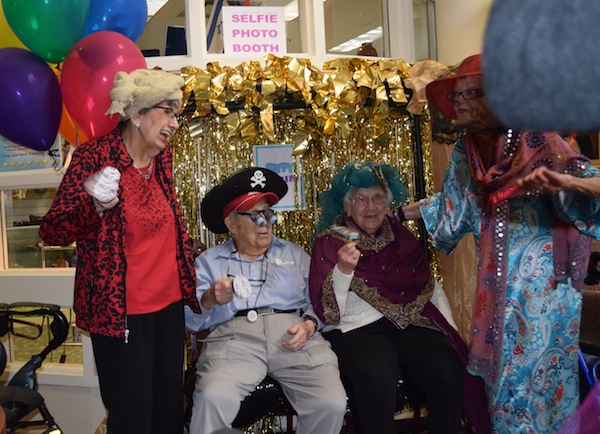
photo - Residents get into the spirit of Purim
Residents get into the spirit of Purim.

When I spoke with Pinsky, he talked at length about the Louis Brier’s music therapy program. Offered by a team of professionals, it is based on research that shows how music calls on a different part of the brain than speech. Pinsky observed, “People can sing songs they knew 60 or 70 years ago, when they can’t even speak.”

He added, “We have the best seniors music therapy in the province. There’s music every single day.”

The March calendar includes weekly Shabbat music, ukelele sing-alongs and jam sessions, as well as a concert of Russian music and a piano recital. We caught a flavor of this during our visit when music therapist Megan Goudreau played her guitar and sang one of the residents’ favorite songs, “Kol Ha’olam Kulo.”

photo - Even a friendly dog joins in the festivities
Even a friendly dog joins in the festivities.

The home was a hive of activity when we visited, with youngsters volunteering, residents – and a couple of friendly dogs! – milling about. Costumed kids came by with their families and sang on both floors of the home. Nothing beats the sight of a mini race-car driver delivering a “Chag Purim!” message with a huge smile to delighted seniors.

“The three things that concern residents the most – beyond housing – are food, music and companionship. The foundation provides that. It’s beyond public funding,” said Lipetz.

The seniors “are not coming here to be housed,” he added, “they are coming here to live.”

Pinsky agreed. “It’s amazing what we’re able to do. Loneliness is one of the biggest problems for seniors, so seniors with families who live out of town can be visited by special companions.”

Louis Brier residents have access to their own rabbi, Hillel Brody, spiritual leader of the Chava and Abrasha Wosk Synagogue. Located within the home, the synagogue is funded solely by the foundation. In other words, like the music, the companions and occupational therapy, it is a gift from the community.

The new campaign is a quest to raise $1 million. Pledges are for two years, so a $5,000 donation would be given in two portions of $2,500 each.

“These funds are essential to maintain continuity in the programming,” said Pinsky. “The home needs to budget 12 months ahead, for the next fiscal year. If we fall into deficit, these life-improving programs need to be cut.”

Added Lipetz, “For many residents, this is their last home. We want to make it their best home.”

Shula Klinger is an author, illustrator and journalist living in North Vancouver.

Format ImagePosted on April 8, 2016April 6, 2016Author Shula KlingerCategories LocalTags fundraising, Globerman, Lipetz, Louis Brier, music, Pinsky, Purim, seniors, Weinberg Residence
Jungle comes to the city

Jungle comes to the city

Luc Roderique as Shere Khan and Camille Legg as Mowgli in Carousel Theatre for Young People’s The Jungle Book. (photo by Tim Matheson)

This month, Carousel Theatre for Young People presents The Jungle Book, the musical adaptation of the classic story by Rudyard Kipling. For the production at Waterfront Theatre, which opens April 17, local Jewish community member Anton Lipovetsky takes on the role of sound designer and additional music.

The Studio 58 alumnus is no stranger to the Vancouver performing arts scene. Lipovetsky has worked as an actor for many local companies since graduating from the Studio 58 acting training program in 2011. “Now I spend about half my year working as an actor,” he said, noting that he’ll be joining the cast of Bard on the Beach again this summer, “and, roughly, the other half creating music and musical directing for local theatrical productions.”

He approaches each project in a different way.

“I try to be as prepared as possible for theatre gigs, but, especially if I’m in a designing role or leadership role like musical director, I have to make more decisions, and make them earlier, and those decisions will affect more people. I suppose there’s more pressure at the beginning. But then, unlike performing, as rehearsals get underway, I’ll become more and more hands-off, showing trust to the performers, creative team and crew,” he said.

Lipovetsky does not remember one exact moment when he realized he possessed a talent for composing and sound design. Rather, he noted that he has been playing the guitar and writing music his entire life, and music naturally worked its way into his career.

“I’ve been singing and writing songs for as long as I can remember,” he said. “I fell in love with theatre in high school (I had great teachers). Then, through my training at Studio 58, I learned how multi-disciplined a theatre artist can be. I’m always looking for new ways to challenge myself as a creator.”

Regarding his latest endeavor, The Jungle Book, Lipovetsky said there are inherent nuances when working on an adaptation, but there is always room for further expression.

“There’s always a degree of pressure when dealing with any story as beloved as The Jungle Book, but I think [director] Kayla Dunbar’s innovative concept will allow audiences to approach the show from a new angle.… The adaptation, written by Tracey Power, comes with some great tunes by Tracey and her collaborator Steve Charles, and encouragement to create jungle soundscapes and rhythms. I will be working with the fabulous percussionist Todd Biffard to devise a score played through traditional Indian instruments, like the tabla and dhol.”

Given that Carousel Theatre is geared towards youth – on, behind and in front of the stage – it is expected that much of the audience will be made up of children. Parents should note, however, that the theatre company recommends that viewers be 6 years old at least, as “[t]here are some intense moments and strong themes, with characters in the play dealing with topics that include hatred, prejudice, killing and death.”

Aware of who the audience will be, Lipovetsky said, “The most important value for me in this process is making sure the sound/music is clear for the youth and economical (not too long!). I do think the sound/music is going to elicit a big range of emotions from the youth … we will definitely mine the comedy, but we’ll search for dramatic depth, as well. Keeping the stakes high is important to a discerning young audience.”

The Jungle Book is, above all, a story of finding empathy and acceptance in the face of prejudice and intolerance.

“I think everybody feels like an outsider at some point in their childhood,” said Lipovetsky. “Jewish children may feel that especially because of how small the Jewish population is; they may feel underrepresented. Mowgli is treated like family by Baloo and the wolves, even though he is so different from them. Because of this kindness, Mowgli learns integrity, ultimately connecting with his roots and becoming a hero. I hope children root for him! And I also hope they want to be like Baloo in their own lives … compassionate and helpful to others.”

Lipovetsky believes that the story of The Jungle Book serves to emphasize that it is often through unlikely connections with those who may be different to us that we are able to become better ourselves.

With respect to how theatre can transmit values and offer guidance for how to approach life, Lipovetsky said, “What I have found is that art helps me to better understand others and better understand myself. I think understanding is more powerful than tolerance.”

The Carousel Theatre for Young People production opens April 17, just two days after Disney’s The Jungle Book remake hits movie theatres. Lipovetsky called it “the spring of The Jungle Book” and believes the movie will help the play’s success.

For tickets to The Jungle Book, which runs Saturdays and Sundays, 2 p.m., until May 1, visit carouseltheatre.ca.

Brittni Jacobson is a freelance writer living in Toronto.


Format ImagePosted on April 8, 2016April 6, 2016Author Brittni JacobsonCategories Performing ArtsTags Carousel Theatre, Jungle Book, Kipling, Lipovetsky, musical
A fresh look at Israel

A fresh look at Israel

David Decolongon participated in the first-ever mission organized by the Centre for Israel and Jewish Affairs designed exclusively for young people who originate, or whose families came from, East Asia. (photo from David Decolongon)

A Vancouver student who recently returned from Israel says he has a better understanding of the nuances of the Israeli-Palestinian conflict – and other realities of life in the region – after participating in a mission for young leaders of East Asian descent.

David Decolongon is a student at Regent College, on the University of British Columbia campus. He graduated from UBC last year in political science with a minor in philosophy, and is considering whether to pursue a full master’s degree or complete a graduate diploma in Christian studies.

He was chosen to participate in the first-ever mission organized by the Centre for Israel and Jewish

Affairs designed exclusively for young people who originate, or whose families came from, East Asia. Decolongon, who was born in Vancouver, is of Filipino heritage.

“I connected with this trip in three major ways,” he said. “Number one, religiously. I’m a practising Christian and so being able to go to a place where a lot of this history took place was big enough for me. But also, over the summer, I was involved in a startup and so being able to connect with Israel through a startup team was big with me. But also to connect with it politically was big for me because I’m involved in politics, I work and volunteer for a political party right now.”

Though he said it is a “cop-out” to say the entire trip was a highlight in itself, he does identify a number of instances that stand out when he recalls the trip, which took place in February.

“Being able to go over to Ramallah and meet the Canadian attaché to the Palestinian Authority and to be able to go up north to see the Lebanese border and to learn the history of that area and to go to a lot of those places that you hear about a lot in the news is probably the significant highlight for me in this trip,” said Decolongon.

Though he had been to Israel before, on a church-organized trip, the variety of perspectives he witnessed on this occasion, combined with the diversity of fellow participants from across Canada, opened his eyes and mind, he said.

“When it comes to thinking about a hot topic such as Israel, people tend to use a lot of political rhetoric and they tend to take very pro- and anti-, very extreme, stances. I think when you’re on the ground and you see how these things affect people on a daily basis, whether they be Jewish-Israeli, Arab-Israeli, Palestinian, it becomes more real and, once you’re on the ground, the solutions that you bring to the table tend to be a lot more common sense, a lot more feasible and a lot more geared toward achieving peace for all groups,” he said.

Being pro-Israel, he added, does not mean being anti-Palestinian.

“You can take a pro-Israeli stance while at the same time wanting to push the well-being of Palestinians. People think it’s an either-or answer but when you’re on the ground and you get to see what really happens, you’re more interested in pushing forth the betterment of life for both groups,” he said.

People everywhere have the same desires for their children, said Decolongon.

“They want to make sure that their children can grow up in safety, that their young people have jobs coming out of college and university,” he said. “We come at it recognizing that both sides have common interest and it’s going to be messy and it’s going to be complex, but I think the solutions are attainable once you realize that both sides are human and that both sides can come to the table and either side may not get 100% of what they want but we can certainly make it livable for both sides.”

Decolongon was the only British Columbian among the eight participants, though the mission was led by Sarina Rehal, an employee in CIJA’s Toronto office who is from here and who graduated from UBC. The group met with a wide range of people, including an Arab-Israeli journalist, a leader in the region’s vibrant startup sector who thinks economic opportunity is the antidote to Islamic extremism, as well as political, military and academic experts.

The newly established East Asian Student Leaders program was created by CIJA as an experiential learning initiative for students of East Asian heritage or origin who demonstrate leadership in the areas of politics, journalism or campus activism.

Nico Slobinsky, director for the Pacific region of CIJA, said it is important to engage young leaders.

“It’s an ongoing dialogue and opportunity we are forging with these young leaders as they continue to engage in their communities, with our community, with civil society in Canada, in the years ahead,” said Slobinsky. “As they progress in their leadership, in their careers, into their life, they will continue to engage and that’s why we do this.

“In the case of this mission in particular, we were looking at emerging leaders in the pan-Asian communities,” he said.

Format ImagePosted on April 8, 2016April 6, 2016Author Pat JohnsonCategories LocalTags advocacy, Centre for Israel and Jewish Affairs, CIJA, Decolongon, East Asian, Israel, mission
Is life all about luck?

Is life all about luck?

Colleen Wheeler and Scott Bellis in Good People. (photo by Emily Cooper)

It’s always a treat to see Colleen Wheeler on stage, as her performances never disappoint. And she keeps the track record going in Good People at the Arts Club. However, the overall feel I came away with after the play didn’t match the level of enjoyment I had for the acting.

Wheeler plays Margaret, a feisty, mile-a-minute talker who can finagle her way into anything, except work.

Living in South Boston, a dense, lower-class neighborhood, Marg blames her situation on bad luck – growing up without the guidance of parents, not being able to go to a better school or get a better job. She fears she will end up like former classmate Cookie McDermot, an alcoholic living on the street.

As the play opens, Marg is being fired from a cashier’s job at a dollar store after coming late several times. The single mother is often late because she has to tend to a daughter who has mental health issues – a daughter for whom she gets no child support and who may or may not be the child of a former high school flame.

She commiserates about life over McCafés in bingo parlors with her friend Jeanne (Jenn Griffin), former supervisor Stevie (Ben Elliott) and landlord Dottie (Patti Allan), who is supposed to watch Marg’s daughter but often forgets to show up. One day, Jeanne mentions that she ran into Mike, an old boyfriend of Marg’s who has become a doctor, so Marg sets out to talk her way into a job.

Within minutes of walking into Mike’s office, she profanely insults his secretary and comments on her physical appearance. She insults Mike himself, saying he’s not a “Southie” anymore, that he now lives “lace curtain.” And she passive-aggressively follows up every abuse with the disclaimer, “Awww, I’m just bustin’ your balls.”

Despite all of this, her mastery at twisting Mike’s words and actually making him feel guilty for the altercations get her invited to an upcoming party. When Mike calls her later that week to cancel because his daughter is sick, Marg begins to think he doesn’t want her to attend – and goes anyway. It is in this scene where Marg, Mike and his wife, Kate, face one another that the skeletons of the past are unleashed.

It starts out as a respectful interaction, with Kate being the gracious host, despite Marg’s rough demeanor and colorful language.

“How’s the wine?” Kate politely asks.

“How the f–– should I know?” Marg retorts, almost laughing at the ridiculousness of the question.

But the discussion deteriorates, as expected, as Mike tries desperately to get Marg to leave. When details of past affairs and questions of “Who’s the baby’s father?” come up, Marg pulls out the claws and tries to tear strips off Mike, lashing out at him for having had the luck he needed to rise out of the South End, the luck to have parents who pushed him, the luck never to have to really struggle.

In much of the play, we are listening to people arguing, complaining and name-calling, which gets tedious. At one level, Marg is a likeable, even inspirational, character. Consider how often we pretend to be aficionados of art or wine or food, just to be accepted. Marg makes no apologies for not knowing how wine should taste.

But, for most of the play, Marg is insufferable. Her constant stream of talking is exhausting. She resorts to, “I’m just bustin’ your balls,” to cover up insults based on her true feelings. And she is stuck blaming everyone and everything around her for her situation. We should be provoked into asking ourselves, how much does luck actually play in success in life? The problem was, I didn’t care by the end, and I think it’s because I just disliked Marg.

However, I did like the set. Wonderfully thought out and detailed, the modular rooms rotate into, out of and around the stage, with beautiful precision. You could hear the audience’s “oohs” and “aahs” as the curtain rose on the second act.

Good People was written by David Lindsay-Abaire and is directed by Rachel Ditor. It runs until April 24 at the Stanley (artsclub.com).

Baila Lazarus is a freelance writer and media trainer in Vancouver. Her consulting work can be seen at phase2coaching.com.


Format ImagePosted on April 8, 2016April 6, 2016Author Baila LazarusCategories Performing ArtsTags Arts Club, Bellis, Good People, Wheeler

Pragmatic, dirty choices

Franklin Roosevelt famously replied to his secretary of state’s assessment of the Nicaraguan strongman Anastasio Somoza Debayle – “Somoza’s a bastard!” – with the rejoinder “Yes, but he’s our bastard.”

Politics makes strange bedfellows. International relations perhaps even more so. The world today is an intricate puzzle of interlocking and disparate pieces. It was, frankly, cleaner and clearer in the days of FDR, when there was just “us” and “them.” Let it not be overlooked though, that when “them” meant the Nazis, Stalin was among those counted as “us.” Stalin was evil, but he helped defeat Nazism. Is the Western world soiled by our partnership with him? Certainly. Would we choose an alternative history had we the chance? What alternative?

The Liberal government of Prime Minister Justin Trudeau inherited from the Conservative government of Stephen Harper (among other things) a hot potato in the form of an arms deal with Saudi Arabia.

The previous Conservative government facilitated what is the largest single Canadian manufacturing-export deal ever. General Dynamics Land Systems of London, Ont., will provide light armored vehicles to the Saudi military – a military that helped crush Arab Spring-related uprisings in neighboring Bahrain and in the Shiite areas of eastern Saudi Arabia. The Saudis are also accused of indiscriminate killings in Yemen, where they are fighting Iran-backed Islamists.

It deserves to be said that Saudi Arabia relies on trade with customers like Canada because, despite being the world’s second largest oil-producing nation, the Saudis have failed to parlay that windfall into anything lasting. Canada still exports too many raw materials that could be processed at home and sold abroad at added value but, compared with Saudi Arabia, we are the model of a diversified economy. Since the Saudi oil boom began, the country has invested nearly nothing in anything else, unless exporting Wahhabism is a tertiary industry, which, actually, it seems to be.

Famous for publicly scything off the heads of political dissidents, adulterers and others who in the West would be described as next-door neighbors, Saudi Arabia is now pushing to step up executions of gay people because social media is “making too many homosexuals.”

Despite the cuckoo United Nations logic that says Israel is the world’s top human rights violator, Saudi Arabia is actually a perpetrator of some of the world’s most atrocious abuses of human rights, from the extreme (public beheadings) to the mundane (if you consider the right of women to drive cars or show their faces in public mundane).

Paraphrasing FDR, Saudi Arabia is a bastard.

This seems to be the general consensus and helps explain why the (comparatively) new Liberal government is awkward in its defence of the $15 billion arms deal.

Trudeau has said that annulling the deal would hurt Canada’s reputation and, indeed, a democratic government that reneges on the deals made by its predecessors is treading on ice. Future potential customers could well think twice if Canada had a reputation for backing out of major trade deals when the government changes.

On this side of the pragmatic divide, the deal also means about 3,000 jobs for 15 years in southwestern Ontario. So, the Liberal government has made little defence of its decision other than relying on economics and the decency of sticking with a signed deal.

In the National Post last week, Lawrence Solomon made a different case – a moral case – for sticking with the deal. He argues that Saudi Arabia, however repugnant its internal policies may be, is on the frontlines of combating terror in the form of ISIS, Iran and associated menaces and, therefore, deserves our support.

This is a comparatively novel idea. The Canadian government is taking refuge in excuses that the previous government made a deal, that Canadian jobs are at stake and that it has no option. A cartoon in the Toronto Star depicted Trudeau declaring, “My hands are tied” next to a blindfolded victim being led to his beheading, saying, “I know how you feel.”

Yet maybe Trudeau’s argument should have been more along the lines of Solomon’s. It is not impossible, using some creative logic as Solomon did, to make the case that selling military equipment to the Saudis is in our national interest. Do we wish it were not so? In an ideal world, all our allies would be righteous and all our enemies defeated. But, in a real world as fractured and dangerous as ours, choosing to support unsavory allies to defeat unsavory enemies may be something we need to learn to swallow.

The legendary FDR quote is held up as a model of foreign policy pragmatism, if not ruthlessness. Canadians – especially this lily-white new government – like to think of ourselves as above such sullying choices. If we want to have the impact in the world that Trudeau seemed to be referencing with his “Canada is back” sloganeering, he may have to admit that sometimes we need to get our hands dirty.

At the very least, tough choices should be confronted, not shirked. If it is immoral and wrong to sell military equipment to the Saudis, we shouldn’t do it, and damn the consequences. If it is justifiable on the grounds that the enemy of my enemy is my friend, then we should trade with the Saudis and make our moral case clearly. But we should not try to have it both ways, slapping down the Saudis with one hand while taking their money with the other.

Posted on April 8, 2016April 6, 2016Author The Editorial BoardCategories From the JITags arms deal, FDR, Lawrence Solomon, Roosevelt, Saudi Arabia, Trudeau

Is it time to end IJV herem?

When Vancouver-based songwriter and musician Daniel Maté wrote on his public Facebook page that he had declined an invitation from Jewish Federation of Greater Vancouver to accompany some singers on Yom Hazikaron, since he “couldn’t in conscience do that as long as we don’t honor the far more numerous victims of the terror ‘our’ side inflicts,” he received an invitation from an Independent Jewish Voices (IJV) member to get involved in their group.

Sarah Levine was that IJV member. “It’s important to me to stand with other Jews who are working for Palestinian human rights,” she told me. “I think we have a particular role as Jews to think critically about Zionism, since the state of Israel often claims that it does things ‘in our name’ and with our support.”

Along the political spectrum of Jewish groups in Canada devoted to matters pertaining to Israel and Palestine, IJV – which bills itself as a human rights organization – tries to carve out a space rejecting traditional Zionist principles. In an organized Jewish community where conservative positions on Israel prevail, this doesn’t make it many friends.

Writing in the Huffington Post, IJV campaigns coordinator Tyler Levitan cites the silent treatment he regularly receives from an array of Jewish institutions when he seeks to publicly debate issues including Jewish National Fund discriminatory land-lease policies and the boycott, divestment and sanction movement. IJV considers BDS “a last resort,” as the group’s website says, and, while most observers would characterize IJV as anti-Zionist, it says that it “does not define itself in terms of Zionism.”

I spoke with Levitan. “Eroding that support base [for political Zionism] would be weakening the glue that binds the community,” he said. “That’s the fear. But we at IJV feel that having difficult and honest conversations is what makes the community stronger.”

For several years, I’ve watched IJV operate from close quarters. As a self-defined progressive Zionist, I have not signed onto IJV’s platform. But, as someone who values serious debate within the Jewish community, I have twice participated in an IJV-hosted forum. Mostly, I find it a sign of community weakness that most of the engines of the Jewish community attempt to shut IJV out of the conversation entirely.

Some Jewish papers (namely this one and the Jewish Post & News in Winnipeg) are open to including IJV perspectives, but the Canadian Jewish News and the Ottawa Jewish Bulletin keep a wide berth around IJV. Yoni Goldstein, CJN’s editor, will not grant IJV editorial space. As Goldstein put it, “… even though we promote inclusion as a virtue, there are limits to how inclusive we’re willing to be. Abetting BDS and rejecting Israel’s future as a Jewish state crosses the line.” Goldstein added: “Independence has its benefits, but the comfort of community is not usually one of them.”

With the exception of the Peretz Centre in Vancouver and the Winchevsky Centre in Toronto, no Jewish community locale will host IJV events – or even rent space to them, according to Levitan. But they’re not giving up on trying to be heard within Jewish community walls. “We’re persistent,” he said.

To reject Zionism indeed does place IJV outside of the mainstream community tent. It is this way, but should it be?

Like all political “isms,” Zionism’s meaning comes from the effects of the policies with which it is associated. While the debate between statist Zionism and those who foresaw other possible arrangements for Jewish liberation in the early 20th century was robust and active, non-Zionist voices receded as Jewish statehood emerged. But now, almost seven decades later, Israel is in crisis. It may be time to ask whether Jewish privilege should be rolled back in favor of some more inclusive and democratic arrangement. A frightened community, however, may view this very question as akin to treason.

IJV’s adherence to the Palestinian right of return is the biggest stumbling block for those who support Israel’s identity as a Jewish and democratic state. But even here, consider the wording on IJV’s website: “Peace will only be possible when Israel acknowledges the Palestinian refugees’ right of return and negotiates a just and mutually agreed solution based on principles established in international law, including return, compensation and/or resettlement.”

Any solution – even a two-state one – will likely involve some return, some compensation and some resettlement. While IJV does speak in terms of “rights,” in practice we might see their call as somewhat more pragmatic than many assume.

The thing is, even reasoning out these complicated dilemmas as I’m trying to do here is well-nigh impossible as long as groups like IJV remain excluded by the sort of herem (excommunication) with which they’ve been saddled. One thing on which Levitan and mainstream Jewish community leaders seem to agree is that there’s a lot of fear. And, sadly, we know all too well the kinds of politics to which fear can give rise.

Mira Sucharov is an associate professor of political science at Carleton University. She is a columnist for Canadian Jewish News and contributes to Haaretz and the Jewish Daily Forward, among other publications.

Posted on April 8, 2016April 6, 2016Author Mira SucharovCategories Op-EdTags free speech, IJV, Levitan, Zionism

Our sons, daughters

What happened last month in Hebron is heartbreaking. A young soldier is being vilified for killing a terrorist who had come for the sole purpose of murdering Jews. He is now facing charges of manslaughter.

One of the most difficult things about our decision to make aliyah was knowing our four children would have to serve in the Israel Defence Forces. After all, it was our decision, not theirs, to leave the safety, security and comfort of their birthplace, Australia, to make a new life in Israel.

That was in 1971, two years before the Yom Kippur War erupted. But we stayed, and they grew up here knowing that it was a duty, even a privilege, to set aside their ambitions temporarily and devote a few years to serving their country. They became Israeli gradually and, by the time they were 18, regarded army service as a natural rite of passage.

Nevertheless, as a mother, I found it hard. I will never forget the trauma of standing on the beach at Palmachim (near Ashkelon) with the other parents and watching our younger son make his first parachute jump. Forty young paratroopers jumped that day. Because of the altitude of the planes, it was impossible to see our sons’ faces until they almost landed. We watched breathlessly to see the parachutes open, one by one. I thought each one was my son and, finally came to the realization that they were all my sons.

The years passed. Our sons and daughters enlisted, with one son fighting in Lebanon. They went to university, married, had children of their own. It was lovely to be grandparents of babies, toddlers and then young children. But now, most of them are grown up and following in their parents’ footsteps. Some have completed army service, some are currently serving and some will soon reach that significant age of 18.

We have attended numerous ceremonies where we have watched hundreds of boys take an oath of allegiance. We sang “Hatikvah” with that catch in the throat one gets at moments of high emotion. We laughed as they threw their caps in the air, signaling the end of the formal proceedings. We were so proud of them, and so afraid of what they might be called to do, what decisions they would have to make.

Just like the young soldier in Hebron.

To every parent whose children have served in the IDF, how can our hearts not go out to this young soldier’s family?

Every soldier is our son, our daughter.

Dvora Waysman is a Jerusalem-based author. She can be contacted at [email protected] or through her blog dvorawaysman.com.


Posted on April 8, 2016April 6, 2016Author Dvora WaysmanCategories IsraelTags Hebron, IDF, Israel, soldier, terrorism
Possibility of a better future

Possibility of a better future

Teens light candles on March of the Living. (photo from March of the Living Canada)

In April 2015, a group of 80 teens, under the guidance of three chaperones and a Holocaust survivor, arrived in Poland for a two-week journey exploring Poland’s tragic events and followed by the joy of celebrating the birth of the Jewish state on Yom Ha’atzmaut.

The mission of March of the Living is to pass the torch of Holocaust memory to new generations. The experience provides young people with an opportunity to bear witness to the Holocaust and to the stories of survivors, so that this important part of our collective history is never forgotten. It is also a unique opportunity to strengthen our children’s Jewish identity and to strengthen their connection to Israel.

The march itself took place on Yom Hashoah, and we marched from Auschwitz to Birkenau with nearly 10,000 other young people. The march commemorates the death marches that the last surviving prisoners were forced to take, where many perished, but a few survived thanks to the liberation by the Allies. It is the most powerful event imaginable, and one that unites all young Jewish and non-Jewish people across the world.

By the end of the trip, these beautiful young people were so open in their expression of their deepest and most profound insights and emotions. They were no longer afraid to show their vulnerability, because the support they received from each other throughout the trip was absolutely unconditional. It was a beautiful experience and a privilege to be a part of.

The commitment to Judaism and Israel that the participants acquire on this trip is so clearly represented in the following statements by March of the Living participant,

Barbie Clark:

“For me, March of the Living created an emotional connection to my tradition, enabling me to understand and appreciate the importance of remembering our history.

“During the trip, we witnessed firsthand the magnitude of mass destruction that occurred during the Holocaust. As we traveled around the country, we were constantly reminded of these horrors in every city, town and community that we visited. At the height of Auschwitz’s productivity, it was able to murder and cremate up to 12,000 Jews a day – a number greater than the mass of us who were able to complete the walk. To realize that every single one of us participating in the march could have been destroyed in the space of one day, defies understanding and description. Also, at Majdanek, we were witness to a horrifying monument containing ashes and bones of … 20,000 Jews killed in the Nazi’s Fall Festival of 1943. This monument is alarmingly large, reiterating the magnitude of what occurred. I found this terrifying and incomprehensible.

“The horrors witnessed in Poland are to be contrasted with what I experienced in Israel,” continued Clark. “While in Israel, I had the unique privilege to witness both Yom Hazikaron – Israel’s Remembrance Day for its soldiers – and Yom Ha’atzmaut, Israel’s birthday. On Yom Ha’atzmaut, the entire country is in celebration – the euphoria is palpable. Despite the sadness one is left with after [bearing] witness, I was left with contagious optimism and hope. Hope for a future without enemies; hope for the Jewish people and the Jewish nation surviving despite all previous oppression.

“The entire experience created for me a new sense of being connected to Judaism, in a way I never thought possible…. The trip symbolized for me all [the] adversity, intolerance and persecution of Jewish people, yet at the same time creating a sense of survival and the possibility of a better future, for not just the Jewish people, but for all mankind.”

Charlotte Katzen, co-chair, March of the Living committee, was a chaperone on the 2015 trip. This article was originally published in Jewish Federation of Greater Vancouver’s Yachad. More information about March of the Living, click here. For information on the adult program – which is new this year – click here.


Format ImagePosted on April 8, 2016April 6, 2016Author Charlotte KatzenCategories Op-EdTags Auschwitz-Birkenau, Holocaust, Israel, Majdanek, MOL
Expanding outreach to Island

Expanding outreach to Island

Left to right: Members of the Legislative Assembly of British Columbia Dr. Moira Stilwell (Liberal), George Heyman (NDP) and Selina Robinson (NDP). (photo from Canadian Jewish Political Affairs Committee)

Israeli wines met Canadian cheese on March 8, when more than 100 people came together for a CJPAC (Canadian Jewish Political Affairs Committee), CIJA (Centre for Israel and Jewish Affairs) and Jewish Federation of Victoria and Vancouver Island reception in Victoria.

Attendance included four provincial government ministers – the Hon. Norm Letnick (agriculture), the Hon. Steve Thomson (forests, lands and natural resource operations), the Hon. Naomi Yamamoto (minister of state for emergency preparedness) and the Hon. Amrik Virk (technology, innovation and citizens’ services) – 28 members of the Legislative Assembly of British Columbia, 39 staffers and many community members, some of whom came to the event from Vancouver. John Horgan, leader of the Official Opposition, attended as well.

Also present were Jason Murray (chair, Local Partner Council, CIJA Pacific Region), Gabe Garfinkel (CIJA Local Partner Council member and CJPAC Fellowship alumnus), Ed Fitch (CIJA national board member), Ezra Shanken (chief executive officer of Jewish Federation of Greater Vancouver), Stephen Gaerber (JFGV board chair) and Chabad of Vancouver Island Rabbi Meir Kaplan.

While an annual wine and cheese event is held at the federal level in Ottawa, this is the first year that CJPAC and CIJA have held the joint reception in British Columbia.

“It is critical that our community get involved in the Canadian political process, and events such as these help facilitate that engagement,” said Kara Mintzberg, CJPAC’s B.C. regional director.

CJPAC’s mandate is focused on getting the Jewish and pro-Israel community involved in the democratic process. As the advocacy agent of the Jewish Federations of Canada, CIJA’s mandate is to build and nurture relationships with leaders across the country, including in government, civil society and other faith and ethnic communities, in order to advance issues of common cause for the benefit of all Canadians.

“Events like the wine and cheese in Victoria allow us to bring members of our community together with provincial officials in order to deepen the excellent relationships our community has with our elected representatives,” said Nico Slobinsky, director of CIJA Pacific Region.

Guests at the reception sampled a range of Israeli wines and many B.C.-produced cheeses.

“I was delighted that a number of members of the board of the Jewish Federation of Victoria and Vancouver Island were able to be there,” said JFVVI president Dr. Aaron Devor. “Both CIJA and CJPAC do tremendous work and it’s exciting to see them focus their outreach on communities on the Island.”

Mintzberg said that B.C. community members can expect more CIJA/CJPAC events in the future.

“Although our organizations have different mandates, we are both working toward a common goal and we think these joint events are a great way to show the community what we have to offer,” she said.

For more information about CIJA or CJPAC in the province, contact Slobinsky ([email protected] or 604-340-2437) or Mintzberg ([email protected] or 604-343-4126), respectively.

Format ImagePosted on April 8, 2016April 6, 2016Author CJPACCategories LocalTags advocacy, CIJA, CJPAC, Devor, Mintzberg, Slobinsky
An update from Aleph

An update from Aleph

Among other activities, Aleph in the Tri-Cities Israeli culture club is getting ready for Passover. (photo from facebook.com)

Looking back at 2015, Aleph in the Tri-Cities Society reports that last year’s food bank donations amounted to approximately 2,000 kilograms (more than two tons) of food items for the SHARE Family and Community Services Society and other missions around the Lower Mainland.

For Purim this year, Aleph cooked and delivered mishloach manot directly to the homeless. Community members prepared 100 trays with pasta, rice, beans, tacos and organic orange juice and distributed the food at the corner of Main and Hastings streets.

“We care. We do. Community connections” is Aleph’s slogan. The nonprofit has been helping the larger community and its neighbors since 2010. It operates as an Israeli-Canadian culture club, welcoming more than 120 young families, including many newcomers and other local Jewish families mixed with Canadian friends, all celebrating life through Israeli culture.

Aleph programs include marking the Jewish holidays and educational programs, such as Hebrew lessons, computer classes, nature walks for families, as well as providing donations to the food bank, networking and supporting each other.

The society is self-supported, relying on volunteers and donations to sustain itself. The community is preparing for Passover and will be holding a seder on April 22, 6 p.m. Anyone interested in becoming involved in the seder and other activities can do so through Aleph’s Facebook page.


Format ImagePosted on April 8, 2016April 6, 2016Author Aleph in the Tri-Cities SocietyCategories LocalTags food bank, Passover, tikkun olam, Tri-Cities

Posts pagination

Previous page Page 1 … Page 517 Page 518 Page 519 … Page 661 Next page
Proudly powered by WordPress