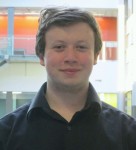
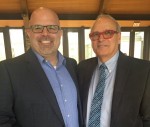
Daniel Doheny and Kerry Sandomirsky in The Valley, which tackles the subject of depression. (photo by Emily Cooper)
As The Valley opens, a young man addresses the audience with the words, “Encounters with the police No. 1.”
It’s a stark opening, as the character – Connor – stands in a spotlight on a circular stage, with the three other actors behind him in the shadows. The monologue represents both the beginning and end to the play. It establishes a sense of the past – about what brought the characters to their current situation – as well as the present, when they are revealing themselves in a healing circle. Each of the players eventually gets to speak directly to the audience in turn, and the drama of the performance unfolds between the monologues.
Essentially, the play is about the effect of depression in two different families – a police officer (Dan) and his wife (Janie), who has just given birth and has a history of depression; and a mother (Sharon) and son (Connor), who has an episode when he’s 18. Amazingly, all the action takes place within the circular stage – a relevant choice for the performance.
“The show is a very intimate show, though the Granville Island stage is not considered intimate,” set designer Amir Ofek explained. “We wanted it ‘in your face,’ not hiding behind a proscenium arch.”
When faced with the decision of whether to use a more literal interpretation of the play for the set design, Ofek said he wanted to avoid switching between the staging of homes of each family, the police station, the Skytrain and other locations in order to keep the intensity going.
“As a designer, I have to delve into the play to find a unique way of doing things,” he said, adding that he tried in the design to convey the protagonists’ characteristics of intensity and fragility by having part of the set jut out of the stage, as though it might fall on the audience any minute.
“There’s a sense of brutality in the play, as well,” Ofek said. “It’s reflected in the edginess of the material of the set.”
Intense, brutal and fragile are perfect words to describe the characters. When Connor quits university after wanting to go for so long, his mother Sharon is at a loss. She tries so hard to change his mind – pleading, cajoling, trying logic and guilt. She is helpless against an illness that has yet to even reveal itself. When an “incident at Joyce Station” takes place, her lament to the audience is heartwrenching: “What to expect at 18 years, three months – your child will break in two.”
In the other household, Dan struggles to be supportive of his wife when she is having depressive episodes, but he has his own demons to bear from being a police officer.
“Every holiday you’ve ever looked forward to – they’re all on our s–t list,” he says, referring to the increase in crime and misdemeanors around holiday time. “Hookers, jumpers, pushers, junkies, racers, strippers – hundreds of things you don’t want to hear about.”
Ironically, it was through his work that Dan met his wife, helping get her clean and off the street. Their struggle is particularly disquieting to watch as it’s so clear how much they love each other, but seem to be always living on the edge of a breakdown.
When Dan arrests Connor in the “incident at Joyce Station,” there’s a struggle that sends Connor to the hospital and results in months of being housebound in his depression, unable or unwilling to listen to his mother, who is constantly on him to do something.
Eventually, Dan and Janie get an invitation to a healing circle to help Connor deal with the aftermath of the incident. But, like his refusal to pay attention to his wife’s bouts of depression, Dan refuses to hear anything about a healing circle. Janie goes on her own and is able to connect with Connor because she shares his ailment and understands what he’s going through. Through Janie, Sharon finds out something that allows her to let go of her own anger.
This play is not easy to watch but it’s an important one to see, if only to get a bit more understanding of how people suffer with despair and hopelessness – sometimes for months or years at a time. It’s estimated that 10% of adults in Canada will experience a serious depressive episode in their lifetimes.
The Valley stars Daniel Doheny as Connor, Kerry Sandomirsky as Sharon, Pippa Mackie as Janie and Robert Salvador as Dan. It’s directed by Mindy Parfitt, with lighting by Itai Erdal, and runs at the Arts Club (artsclub.com) Granville Island stage until May 7.
Baila Lazarusis a freelance writer and media trainer in Vancouver. Her consulting work can be seen at phase2coaching.com.
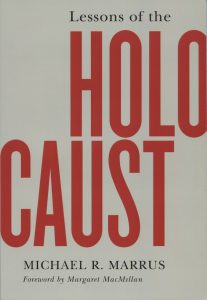
“My principal lesson of the Holocaust is … beware of lessons.” With this warning, renowned Canadian Holocaust scholar Michael R. Marrus, professor emeritus at the University of Toronto, has written an essential but also essentially frustrating book, claiming that there is nothing to be “learned” from the study of the Holocaust – Lessons of the Holocaust (University of Toronto Press, 2016).
All the mantras usually marshaled to justify Holocaust studies, such as “never again,” or “who does not learn from history is doomed to repeat it” or “evil will triumph when good people do nothing” are bogus, says Marrus. For “history does not speak to the present with … an admonitory voice”: historians are not moralists or mentors, and certainly not preceptors – their mandate is to “handle history with care” and to insist on “getting it right.”
But, if Holocaust studies have nothing to teach us, should we not ask to what end should Holocaust historians and educators “get it right”: and how does a Holocaust scholar’s commitment to “getting it right” differ from that of a botanist’s or a quantum physicist’s or, for that matter, an athlete’s or a bricklayer’s? It is the failure to answer this question that makes Marrus’ book so frustrating.
Marrus’ credentials in Holocaust studies are impeccable. His books on the Holocaust have received prestigious awards; he has served on some extremely important international committees designed to air out crucial Holocaust issues, and has met, and often argued publicly, with some of the world’s most prestigious Holocaust historians, including Raul Hilberg and Elie Wiesel, as well as Hannah Arendt, Emil Fackenheim and Daniel Jonah Goldhagen, all of whom he takes issue with in this book for suggesting that the Holocaust can offer lessons.
Marrus’ problem with regarding Holocaust history as a learning project is rooted in his historiography: what can one learn from history when history itself is so subjective? “If one looks hard enough at evidence,” says Marrus, “one can come up with the answer – or the lesson – that one wants.” And, again: history is “continually evolving,” its terrain endlessly “shifting,” exposing “new questions.” In other words, history is inevitably “a matter of interpretation.” (Marrus’ emphasis.) Thus, the lessons that one presumes to deduce from history will inevitably be the lessons that one preemptively wanted to find. As Marrus puts it, “lesson seeking often misshapes what we know about the event itself in order to fit particular causes or objectives.”
Fair enough, when it comes to comparing the Holocaust to “the rape of the environment [or] the harshness of bureaucracy,” but what about the larger, and more relevant, issues of social justice, of our moral duty to future generations, of our sacred duty to remember? Hitler saw carte blanche for his genocidal intentions by asking, “Who remembers the Armenians?” Surely it is crucial that no future Hitler be able to ask, “Who remembers the Jews?”
Marrus is on more solid, if more obvious, ground when he condemns the appropriating of Holocaust history by right-wing politicos in Israel, such as Menachem Begin and Binyamin Netanyahu, who he sees as using Holocaust references to manipulate opinion toward acceptance of their conservative policies. This political exploitation of Holocaust history has “crippled Israel’s capacities to respond imaginatively to questions of national identity and to seize new opportunities in a flawed global community.” Here, Marrus is probably right.
Marrus also condemns, again quite rightly, the enlisting of Holocaust precedents by special interest groups, such as advocates of gun control or those opposing bullying in schools, opponents of gay rights and animal abuse and so on – all anxious to further their causes by referencing the Holocaust and, in so doing, trivializing it.
Most pointedly, and again with some justification, Marrus attacks the thinking of those who would “universalize” the Holocaust, making Holocaust studies “a school for tolerance,” a warning against hate speech, against political apathy or against overly celebrating the actions of the pitifully few Nazi-fighting heroes, such as the leader of the Munich White Rose students,
Sophie Scholl, who was recently voted in Germany fourth among “the most important Germans of all time” – ahead of Bach, Goethe and Einstein. Again, this is an important point, and one that quite rightly occupies a lot of serious thinking in Holocaust studies.
Marrus’ final chapter, a brief 11 pages, is entitled “Lessons of the Holocaust,” and readers may be forgiven for thinking that Marrus is, finally, at the end of his book, going to take a stand.
Not at all. He says here, “we learn a great deal from the history of the Holocaust.” What, exactly? He doesn’t say. And, again, Holocaust studies are “intellectually enriching and facilitate our understanding of the world around us.” How so, and to what end? No answer. “We are wiser” for knowing Holocaust history. How so and, since there are no lessons in it, so what? In this final chapter, Marrus repeats over and over that Holocaust history “deepens appreciation of human reality” and “makes us more mature.” How so, since there’s nothing to be learned from it, on his own terms?
Holocaust educators will, I suspect, find Marrus’ position difficult to accept: they know exactly why they are teaching Holocaust studies – to impress upon (especially) young people the fragility of our human institutions and thereby to arm them against demagoguery. In other words, “never again.”
Demagoguery has been raising its head again in recent months in the United States. It would indeed be encouraging to all teachers of Holocaust studies if they could believe they’ve helped to effectively warn against it, a clear and inarguably important lesson to be learned from the dreadful past century.
Graham Forst, PhD, taught literature and philosophy at Capilano University until his retirement and now teaches in the continuing education department at Simon Fraser University. From 1975 to 2010, he co-chaired the symposium committee of the Vancouver Holocaust Education Centre.
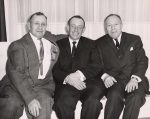
Schara Tzedeck dedication, circa 1965. (photo from JWB fonds, JMABC L.14350)
If you know someone in this photo, please help the JI fill the gaps of its predecessor’s (the Jewish Western Bulletin’s) collection at the Jewish Museum and Archives of B.C. by contacting [email protected] or 604-257-5199. To find out who has been identified in the photos, visit jewishmuseum.ca/blog.
מליסה אן שפרד נעצרה שוב לאחר הפרה את תנאי השחרור שלה מהכלא והשתמשה באינטרנט (צילום: CBC)
האלמנה השחורה של האינטרנט לא מרפה וחוזרת שוב לחדשות. האישה המסוכנת ביותר בתולדות קנדה, מליסה אן שפרד, בת השמונים מהליפקס נעצרה שוב על ידי המשטרה והועברה למעצר. זאת כיוון שהיא הפרה את תנאי השיחרור החמורים שלה מהכלא, ונתפסה בזמן שהשתמשה בשירותי האינטרנט של הספרייה הציבורית בהליפקס.
אחד מהשוטרים המקומיים של המשטרה האזורית של הליפקס תפס את שפרד, בזמן שהיא יושבת בספרייה מול אחד המחשבים וגולשת להנאתה באינטרנט. היא נעצרה מייד והובאה למעצר. בבדיקה ראשונה נמצא על גופה מכשיר שמאפשר לה גישה לאינטרנט. במשטרה לא מציינים בשלב זה מה חיפשה שפרד באינטרנט, אך לאור העבר הפלילי העשיר שלה הוחלט שלא לקחת סיכונים מיותרים. היא הואשמה בהפרת שלושה מתנאי השחרור שלה מהכלא לפני כחודש. שפרד תעמוד למשפט ב-24 במאי ובשלב זה עדיין לא ברור לאיזה עונש היא צפויה. עם זאת יש לציין שהיא נחשבת לעבריינית עם סיכון גבוה ולכן הפרת תנאי השחרור שלה נחשבת לעבירה חמורה ביותר. לכן אגב המשטרה עקבה אחריה מרגע שיחרורה מהכלא.
שפרד נולדה בעיר קטנה בניו ברנזוויק ב-1935, ישבה בכלא הנשים ‘טרורו’ שבהליפקס בשלוש השנים האחרונות, ושוחררה ממנו ב-18 במרץ. מייד עם שחרורה, המשטרה הוציאה הודעת אזהרה לציבור הרחב על כך שהעבריינית עם סיכון גבוהה שוחררה. המשטרה המליצה בעיקר לגברים מבוגרים ובודדים להיזהר מפניה ולא ליפול ברישתה. תנאי השיחרור הנוקשים שלה כללו: איסור מוחלט של גלישה באינטרנט, חובת דיווח למשטרה על כל מערכות יחסים שהיא תנהל עם גברים (כדי שהם יוזהרו מפניה) וכן עדכון המשטרה בכל פעם שיא תשנה את המראה החיצוני שלה.
שפרד ריצתה כבר עונשי מאסר בארה”ב ובקנדה לאור פעילותה הפלילית הרבה מאוד בארבעים השנים האחרונות, שכללה מעשי רמיה, התחזות, התעללות, הרעלה וגרימה למותם בדרכים שונות של חלק מבני זוגה, תוך שהיא גונבת את כספי חסכונותיהם. שפרד נחשבת לשקרנית פתולוגית, היא שינה את צורתה ושערה פעמים רבות בשנות חייה, החליפה את שמה (בין היתר למסילה אן וויקס, מליסה אן פרידריך, מליסה אן סטיוארט) וכן שינתה את מקום מגוריה פעמים רבות. היא אף פעם לא סיפרה לגברים שבחייה על עברה הפלילי העשיר. רק בעלה הראשון ראסל שפרד לא היה קורבן של מעשיה הפליליים. בסך הכל היא ישבה בבתי כלא שונים למעלה מעשר שנים על יותר משלושים עברות חמורות.
שפרד ריצתה עונש מאסר בן שלוש שנים בהליפקס לאחר שהורשעה בהרעלת בעלה הרביעי והאחרון, פרד וויקס (76). היא ביצעה את זממה בעת שהשניים היו כבר בירח דבש ובסופו של דבר הוא ניצל. היא נתפסה ב-2012 והועברה למעצר.
ב-1992 הורשעה שפרד ברצח בעלה השני גורדון סטיוארט (44) שגם אותו הרעילה ולאחר מכן היא אף דרסה אותו במכוניתה פעמיים. היא נכלאה לשש שנים בכלא ולאור התנהגות טובה שוחררה לאחר שנתיים. ב-2000 הרעילה שפרד את בעלה השלישי רוברט פרידריך (73) שנפטר, והיא נשארה עם סכומי כסף גדולים שלו. המשטרה התקשתה להוכיח את אשמתה במקרה זה.
ב-2005 עברה שפרד לגור בפלורידה. היא הכירה את אלכס סטרגטוס (84) והרעילה אותו, לאחר שהצליחה לרוקן את חשבון הבנק שלו. הוא ניצל ממוות והמשטרה לא הצליחה להרשיעה בנסיון להרעילו. אך היא כן הורשעה בגניבה וזיופים וריצתה עונש מאסר בן חמש שנים בכלא האמריקני.
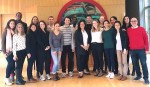
The Hon. Jody Wilson-Raybould, minister of justice and attorney general of Canada, centre, addressed Project Tikkun participants at Hillel BC on March 13. (photo from Hillel BC)
As the academic year winds down on university campuses across the province and students gear up for exams and summer jobs, 15 student leaders from the University of British Columbia and Simon Fraser University are also preparing for a totally different experience: a 16-day experiential learning and service trip to Rwanda and Israel.
Project Tikkun was developed by Hillel BC to challenge students to “understand the essence of hate by breaking down stereotypical thinking.” It is a yearlong program of learning that allows participants to explore the root causes of racism and antisemitism, culminating in a service trip to Rwanda and Israel between May 3 and 18.
The overseas component will enable participants to bear witness to how the diverse citizenry of two relatively young nation-states have grappled with a legacy of genocide. It will provide a firsthand examination of conflict resolution and reconciliation through the humanitarian work and activism pursued in each country to build durable and bonded communities.
According to its website, Project Tikkun brings together “undergraduate students of different ethnic backgrounds, religious practices, sexual orientation and personal beliefs to establish a caring and committed community of change-makers.”
Rebecca Recant, program director at Hillel BC, noted that the intent of the project is also to “build a local community of allies that can support each other when a [hateful] incident comes up, no matter which community.”
Student interest in the program exceeded the limited number of spaces and, last fall, a diverse group of 15 participants was selected. The group includes students of Chinese, Taiwanese, Indian, Korean, Persian and Rwandan backgrounds and a mix of the Jewish, Sikh, Baha’i and Christian faiths. The religious affiliation of the Jewish students varies – some come from secular homes whereas others were raised Orthodox; some have visited Israel and, for others, this will be their first trip to Eretz Yisrael.
Over the course of the year, the participants have been getting to know each other and examining their biases through intensive group learning sessions in which they have explored the history of Canada, Rwanda and Israel. A number of guest speakers, ranging from academics to community activists, have facilitated discussions. Of note, Dr. Andrew Baron, an assistant professor of psychology at UBC whose research examines the cultural and cognitive origins of unconscious bias, structured tests for Project Tikkun participants based on the Harvard Implicit Bias Test that he helped create. Jordana Shani, managing director of Hillel BC, explained that the testing of participants’ level of bias takes place at three different intervals: at the outset of the program, prior to departure and one to two months after return to Canada. The testing provides a way “to measure what we’ve done and how effective the program has been,” she said.
Certainly, much time, effort and money has been channeled into the program, especially the service trip. The journey begins in the capital city of Rwanda, Kigali, where local guides will accompany the students on a tour that will highlight the many landmarks and memorials of the 1994 genocide. The students will then travel to the Agahozo-Shalom Youth Village (ASYV), where they will spend the bulk of their time. Established in 2008 as a residential community-home to protect and nurture Rwandan children who were orphaned during and after the genocide, ASYV now cares for approximately 500 of Rwanda’s most vulnerable high school-aged students. It is modeled after Yemin Orde, an Israeli youth village founded in 1953 to care for orphans of the Holocaust, and it provides a family-like environment for at-risk youth.
The Rwandan students “grow up in this youth village hearing about the youth aliyah village in Israel that [ASYV] was based on,” said Recant. “It’s an Israeli model that is part of the connection between the two countries. They even know Hebrew words, like tikkun olam.”
At the youth village, Project Tikkun participants will learn and live side by side with the ASYV students and volunteer in the classrooms, on the farm and in the kitchen. They will accompany the ASYV students during their foray into town to fulfil a weekly community service commitment.
Libia Niyodusenga, a second-year UBC economics and geography student who was raised at the Agahozo-Shalom Youth Village, is looking forward to returning to Rwanda as part of Project Tikkun. “I think the country itself has the best ways and methods of teaching people through so many organizations that are based in Rwanda and so many history-based sites that you can learn from,” he said.
From Rwanda, Project Tikkun participants will travel to Israel, arriving on Yom Ha’atzmaut, where they will celebrate Israel’s independence in Jerusalem. Later, they will commemorate the victims of the Holocaust at Yad Vashem, tour the Old City and observe Shabbat before moving on to explore other parts of the country, including the Yemin Orde Youth Village. All the while, participants will learn from and volunteer with Israelis who are committed to combating intolerance and inequality – political, religious, ethno-cultural and socio-economic – to effect positive change within Israeli society.
The Israel portion of the trip will demonstrate that complex issues – both regional and domestic – defy the simplistic characterizations often portrayed by the media and that “you can love the country and be critical of it at the same time,” said Shani. The participants, she added, “will meet with people who believe in the right of Israel to exist and who are engaged to make it a better place.”
Jasmeet Khosa, a fourth-year student of international relations at UBC whose Sikh parents immigrated to Canada from Punjab, India, said: “I know that this project focuses on Rwanda and Israel as case studies [for conflict resolution and activism], but what I’ve learned so far is that this extends far beyond – [the message] is universal.”
By all accounts, Hillel BC is pleased with the results of the project thus far. Participants are inspired to help create positive change both at home and abroad and have developed a profound sense of strength through their diversity. As Khosa observed, “… the great thing is that we come from such different backgrounds – academically, culturally, religiously – that everyone brings their own perspective and we get a really great mix in that everyone has something unique to contribute to discussion and friendships, in general.” Niyodusenga added that the connections between program participants are already “deep and intimate.”
In reflecting on the many experiential learning and service trips that she participated in during university and how integral they were to forming her identity, Recant said, “Trips like this are life-changing.”
Shani and Recant are grateful for a grant from the Diamond Foundation that made Project Tikkun possible. While participants will pay a fee, the cost of the program is heavily subsidized to ensure that finances do not pose any obstacles. However, because of the decrease in the value of the Canadian dollar, Hillel BC is continuing to seek financial support for the program. For more information about Project Tikkun, visit projecttikkun.hillelbc.com; to make a donation, call 604-224-4748.
Alexis Pavlichis a Vancouver-based freelance reporter.
Raphael Hoult, winner of the inaugural Barry Rubin Prize Essay Competition. (photo from Raphael Hoult)
“A Game of Clocks: An Analysis of the Situation in the Middle East and Its Effects on Israel” by Winnipeg’s Raphael Hoult is the winner of the Centre for Israel and Jewish Affairs’ inaugural Barry Rubin Prize Essay Competition.
Hoult, a physics major at the University of Winnipeg in his second year of studies, conjured up a mind-bending theory about the stability of Middle East security and consulted expert sources for his essay.
In physics, Hoult’s interests lie in the field of quantum gravitation, which attempts to combine two major theories – those of general relativity and quantum mechanics.
“These two theories don’t play well together,” said Hoult. “They conflict in places. The biggest place they conflict is in that every force in the universe has been quantized, meaning that we’ve found a very small, discrete package of it in the universe. For example, electromagnetism is delivered by something called a photon. The other forces have something that delivers them, as well. But, with gravity, we’ve found no such thing yet. What we say is we haven’t been able to quantify it, though there are a lot of theories out there for how to solve that problem. There’s string theory. Another is loop quantum gravity, that attempts to bring some parts together.
“I want to help look for a theory of quantum gravity, so we can finally resolve this dilemma … combine the two theories into one bigger theory, a more complete theory. And, hopefully, that will give us a lot more insight into the way gravity works and allow us to do more with our understanding of gravity – to utilize it more, similar to the way our deeper understanding of electricity and magnetism has allowed us to do more intricate electronics in the past couple years.”
According to Hoult, this reconciliation of quantum mechanics and general relativity has been the Holy Grail of physics for the past 50-some years, and solving it will be huge for physicists and the world as we know it.
“The proposed theoretical messenger particle for gravity is the graviton, which is something we’ve not yet observed at all,” he said. “Quantum mechanics requires there to be a graviton…. General relativity in no way makes reference to a graviton.
“The main thing is quantum mechanics works really well with very small things, general relativity works really well for really big things. Things with a lot of mass are usually very large. The problem comes when you have things that are very massive and also very small, such as neutron stars or black holes. These are very dense, have a lot of mass and exert a lot of gravitational force, but they are also very small. In the case of a black hole, they are actually on the atomic level. So, quantum mechanics is very important to the way they work, but general relativity also is in play. When our two theories don’t work and they are supposed to be working at the same time, that’s a problem and something we want to fix.”
In addition to his knowledge of physics, Hoult is also well-versed in Israeli politics. “I’ve actually never taken a political science course at university,” he acknowledged, “but I went to Gray Academy [of Jewish Education in Winnipeg], so I had a very strong basis in knowledge about Israel. I had a good grounding there. I also read the Times of Israel and Haaretz every day.”
When Hoult saw an advertisement for the Barry Rubin Essay Competition on Facebook, it piqued his interest. The contest topic was, “What does the current regional turmoil in the Middle East mean for Israel?”
In his essay, Hoult said, “The three main critical points I talked about were the constancy of Hezbollah, Hamas and Daesh (the Islamic State in Iraq and Syria [ISIS]). I wrote about the fact that Hezbollah is involved in the war in Syria, specifically as affiliates of Bashar Al-Assad. They support him and are fighting on behalf of him. On the flipside, a branch of ISIS, called Al-Wilayat Sinai, is operating in the Sinai Peninsula desert against the Egyptians, making their lives very difficult. They’ve also struck up an alliance with Hamas.”
According to Hoult, the main three players in regards to Israel involve Hezbollah in the north, Hamas in Gaza and Al-Wilayat Sinai (Daesh) in the south. Hoult does not delve into the Iranian threat in his essay, apart from Iran’s role in supporting these groups.
“My hypothesis was that these three forces are connected to one another,” he said. “And, because of the ongoing campaign against ISIS, my hypothesis is that, as soon as that campaign succeeds and breaks down ISIS, all hell will break loose for Israel.”
Hoult explained that this theory takes into account Hezbollah’s huge military arsenal, which is estimated at around 100,000 rockets, and their ability to hit every point in Israel from Metula to Eilat, combined with the southern threat from Hamas and from the Al-Wilayat Sinai, which, so far, has been mainly fighting the Egyptians.
“Once ISIS collapses in the north, the Al-Wilayat Sinai … will suddenly be like a tentacle that has been cut off from the squid,” he said. “It will have no control and will be in desperate throes to stay alive, making it likely that it will involve at least a couple cross-border raids. If those involve any Israeli deaths, it will force Israel to respond, which is an issue, due to the fact that Israel can’t cross the border without Egyptian permission.
“There is also the fact that Hamas is having another military build-up,” he added.
Hoult predicts this will likely lead to another war in 2017 and, once that war is over, he said Hezbollah would have had ample time to gather its troops and possibly attack Israel from the north. “This is not a good thing for Israel, as Hezbollah is dead set on destroying Israel if they can,” he said.
As to why Hoult thinks his essay was selected as the winner, he said he is not sure, although he imagines it may have “had something to do with all the sources cited, creating a compelling likelihood of my hypotheses coming true.”
One of his many concerns is that “the primary backer of Hezbollah and Hamas is Iran. Iran has just had billions of dollars unlocked, due to the nuclear deal … which I’m not going to condemn or support, though I’m a little bit skeptical of whether or not unlocking those funds was a good thing.”
Artists Nancy Current, left, and Robin Atlas at Zack Gallery. (photo by Linda Lando)
Visual Midrash: Plagues and Visions, which opened at Zack Gallery on April 7, features the work of Seattleites Robin Atlas and Nancy Current, the only West Coast artists creating in the genre of visual midrash. The show is the culmination of a four-year collaboration that started in 2012.
“We met through the Jewish Art Salon in New York,” said Current. “Even though we both live in Seattle, we didn’t know each other at that point.”
Atlas elaborated: “The president of the Jewish Art Salon sent us both an introductory email. She said we probably knew each other already, but we didn’t – and we lived only 10 minutes apart.”
“Robin was about to open a new show in L.A. and she brought her works to my studio,” said Current. “I was amazed. There was so much beauty and thought behind it all. That’s what visual midrash is all about. It requires two elements: the clarity of story and the visual beauty of the artist’s interpretation. I looked at Robin’s art and I said to myself, I’m going to work with her forever.”
They started working together, but their chosen genre – interpreting Torah through visual art – is not widely known. “We didn’t have a ready audience in the West,” Current explained, “not like in New York. We needed to build it, so we started teaching adult classes two years ago. The classes include the texts from the Torah, introduced by a Torah instructor, and a visual component, taught by an art instructor.”
“We would do slide shows, video presentations, and the students would have a chance to create their own art,” Atlas said. “Linda Lando, the Zack Gallery director, facilitated the first class we did in Vancouver earlier this year.”
For the current show, the artists explored the theme of the 10 plagues. “We were drawn to the story,” said Current.
Although each artist works with different media – Atlas with textiles and Current with glass and paper – their creative vision is similar. Their symbolic abstracts mesh extremely well, as if the images belong together, buzzing with the same esthetic sense and the same muted elegance, complementing each other to tell the same tale.
While the Vancouver Jewish community was introduced to Atlas when she exhibited at the Zack in mid-2014, Current is a new name for most local art appreciators.
“I always drew and painted as a child but I can’t say that I had the conscious idea to be an artist,” Current recalled. “I grew up in Seattle, in an old house with stained-glass windows. That undoubtedly affected my later fascination with glass. I learned to blow glass when I was about 24, but gave that up in favor of painting on stained-glass.”
She explained, “Glass is different from other mediums because light passes through it (transmitted light) instead of bouncing off [of it], like with paper or canvas (reflected light). Transmitted light, especially through colored glass, connects to a person’s emotional centre more directly than reflected light. It also has a spiritual aspect. Think of all those stained-glass windows in churches and synagogues. That is important to my Jewish work.”
Although she has worked in other visual genres, Jewish themes absorb her artistic passion now.
“Jewish art has gradually replaced my other work, life drawing and landscape, because it is much more meaningful,” she said. “Visual midrash is the most meaningful Jewish art of all. It requires a lot of study and thought, and those are things I highly value about living a Jewish life.”
Current pointed to two particular influences on her development as an artist.
“The first was studying at Pilchuck Glass School,” she said. “The school attracted many artists early in the history of the American studio glass movement. I studied there with the amazing British glass painter Patrick Reyntiens. He is 90 years old now and still a good friend.
“The second was finding the Jewish Art Salon (JAS) in New York. Becoming a fellow in the JAS has led me to friendships with several Jewish artists who have been doing visual midrash for years. They have helped a lot.”
Current doesn’t concentrate on making a living with her art. Her main concern is to share it with as many people as possible. “Of course, eventually I want to sell my work,” she said, “but not until I’ve had a chance to show it in several exhibitions. The purpose of doing my work is to cause people to think about their Jewish heritage.”
Current and Atlas’ show runs until May 8.
Olga Livshinis a Vancouver freelance writer. She can be reached at [email protected].
During mock weddings, participants learn about Jewish and Sikh rituals. (photo from Shaul Osadchey)
While Judaism is the main focus of any synagogue, and many stop there, that is not the case with Calgary’s Beth Tzedec Congregation. They have decided to take their Jewish engagement into the wider world and have hired scholars from other faiths to teach them about those faiths.
“There are a great number of religious traditions that are present in the community,” said the synagogue’s Rabbi Shaul Osadchey. “How do we learn about other people? How do we engage in conversation and interfaith relationships with people unless we know something about them? That’s the challenge.
“In thinking about that, which is fundamentally an issue of how we make Jews more religiously literate about other religions, the challenge is to do that in a way that people will come out and actually participate in the learning.”
Osadchey knew that if he left it to others to start the process, he’d be able to count participants on one hand – out of the 600 families that are a part of the synagogue.
“People aren’t going to initiate that,” said Osadchey. “People are intimidated going into other people’s houses of worship. They don’t find the time to do this on their own. The thought was, then, sanction it and bring it into the synagogue … making it ‘kosher’ in the sense that it’s acceptable for us to do. Secondly, it will be much more effective, because people will be much more comfortable coming into a familiar environment to learn about others.”
Osadchey was able to find someone in his congregation willing to support the cause, leading to the creation of the Lil Faider Interfaith Scholar in Residence Program.
“The idea was to allocate $10,000 a year for five years and pick five religions we wanted to examine, and invite a scholar or religious leader from the chosen tradition to be on our staff and teach within the synagogue for about 10 months (not over the summer).
“The first year, 2013-2014, we selected Sikhs. I thought that would be a good starting point because we know very little about Sikhs. They have a fairly significant amount of people in the Calgary community. Approximately 20,000 Sikhs live here, which is at least twice the size of the Jewish community, and they are very visible and yet kind of mysterious to us, we don’t know much about them.”
In his High Holiday sermon that launched the program, Osadchey invited attendees to learn about Sikhism. “All we know about them is they work at the airport, they
drive taxis and they wear a turban,” said Osadchey to congregants. “People kind of chuckled, and said, ‘Yeah, yeah. I know that.’ The point was, what do you know beyond that? The answer was relatively nothing. That’s not enough to engage people in conversation let alone collaborate in community activities.”
The synagogue hired Dr. Harjot Singh, a medical doctor and leader in the Sikh community. She presented lectures, followed by some experiential activities. One program was called Turban and Tefillin.
“That was pretty amazing, because it was a way in which we explored what the meaning of religious apparel is in our respective traditions,” said Osadchey. “The fact that we both cover our heads and wear identifiable religious objects was a starting point. During this program, all the Jewish participants were shown how to put on a turban and each of us was wrapped in one.
“We see turbans, but we don’t see them unwrapped … and now [we] understand how complicated it is for the novice to actually do that. Even though it only takes them three to five minutes to do, it’s quite an art. It was really quite wonderful to be wearing this turban and get a feel for what it’s like. Then, we wrapped them in a tefillin and they got an idea of what that was as a religious object.”
The congregation was invited into a gurdwara, the Sikh house of worship, and experienced a service. Then, they joined everyone in the langar, or common kitchen, where people can eat for free. Lastly, they finished the year off with a mock Sikh wedding and a mock Jewish wedding, for which they put up a chuppah, and presented the wedding rituals, acting them out and taking note of the similar and different rituals.
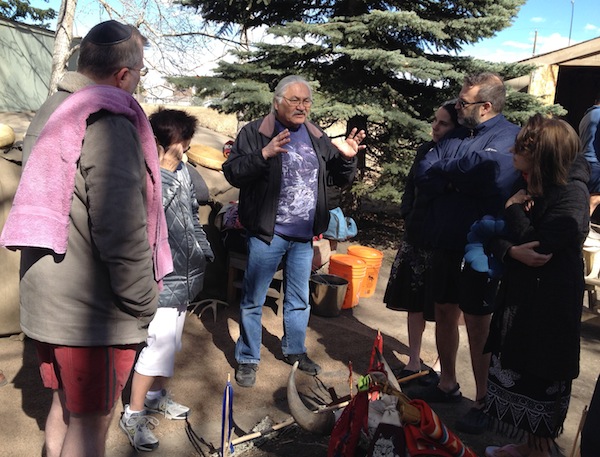
Casey Eagle Speaker welcomes Beth Tzedec’s interfaith learning group to a sweat lodge. (photo from Shaul Osadchey)
In 2014-2015, the synagogue focused on aspects of First Nations spirituality, inviting Casey Eagle Speaker and another teacher to give lessons on their culture.
“The year ended with a sweat lodge we went to, for us exclusively,” said Osadchey. “Afterwards, we sat around and passed the peace pipe together. People really learned a lot from that, as native spirituality is an oral tradition mainly. These are customs passed on and taught – sundance, sweat lodges and so forth – but they also have a very interesting perspective about the creator, nature and the role of people in terms of building community and families. That was quite eye-opening.”
This year, with all the new connections the synagogue has made with the Muslim community, they decided to focus on Islam.
“We didn’t start with Islam and we didn’t start with Christianity, because people probably would have said, ‘Oh, I know everything I need to know about Christianity, so I’m not going to show up,’” said Osadchey. But it was time to get to Islam, he said. “The next two years are going to be Hinduism and Buddhism.”
For Islam, the congregation selected Imam Syed Hadi Hasan of the Shia branch of Islam, who has a long history of interfaith work.
“What we did, however, was to respond to some of the naysayers and the skeptics by inviting a Jewish rabbi/scholar from L.A. after the imam had given about three lectures, and then we had Dr. Reuven Firestone come and speak,” said Osadchey. “He’s written books on Islam for Jews, about what Jews should know about Islam and what Muslims should know about Judaism. He’s very active in Muslim-Jewish dialogue. He came up and gave us a weekend of four lectures on different aspects of Islam and how we approach it. We invited our Islamic friends to come and many did. And, they were very impressed by his scholarship and knowledge of the Koran and so forth.”
At Chanukah time, the synagogue invited three imams to share their thoughts on religious freedom and join in the lighting of the chanukiyah, along with the rabbis. At the end, they all held up letters that spelled the phrase, “We refuse to be enemies.”
Osadchey said, “It was a powerful moment and brought Chanukah and the whole meaning of respect into a much different perspective.”
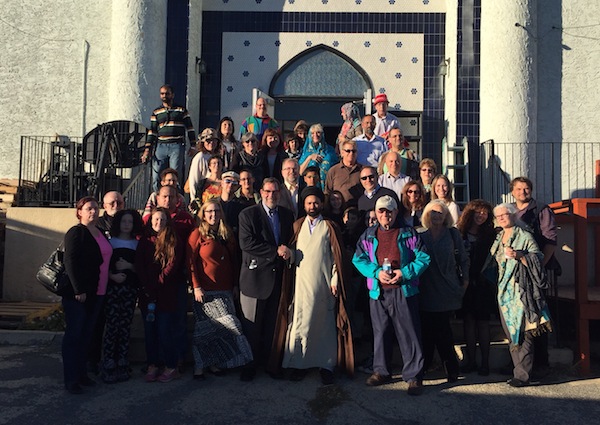
Imam Syed Hadi Hasan, right centre, takes Rabbi Shaul Osadchey, left centre, and some congregants on a tour of his mosque. (photo from Shaul Osadchey)
This March, the synagogue initiated the program Our House is Your House, which will be profiled in a future issue of the Independent.
Although Christianity is not one of the religions studied in the first five years of the program, the synagogue hopes to continue with a sixth year focused on Christianity. The program so far has been beneficial.
“It has given people permission to go out into the community and do things in a way they may have been hesitant to do before,” said Osadchey. “They have more confidence that they have the knowledge and the literacy to engage people.”
The scholars, too, gained much from the experience. “I was thrilled and amazed at that request and immediately accepted it,” said Hasan. “And I did my best to teach about Islam and answer all the questions from the participants of the five sessions I was part of.
“In the first session, participants were not very comfortable…. They were friendly, but they were a little bit formal in the beginning … but, gradually, we developed a friendship.”
Hasan is planning to bring Judaism into his mosque in a similar fashion, calling Beth Tzedec’s method “perfect and brilliant.”
He said, “We will be inviting Rabbi Osadchey for probably three to four sessions and he will be introducing Judaism…. When we are ignorant, when we don’t know each other, definitely, we have a lot of misconceptions. We are going to bring knowledge and awareness, and show that we are almost the same. We all work for the welfare of humanity and the universe. In this sense, we all are the same. In doing these programs, we are promoting peaceful coexistence and we are bringing harmony and unity within our communities.”
Speaker, who is a member of the Blood Tribe, which is part of the Blackfoot Confederacy in Alberta, echoed Hasan’s feelings, mentioning he found the experience very valuable.
“I enjoyed the hospitality and the openness that the people had,” said Speaker. “The congregation was very open in mind, body and spirit, very open to listening, to understanding who we are as a people, as indigenous people, and about the concerns or issues prevalent in society. They showed me a hunger to learn and to create an understanding, rather than just knowing.
“In our culture, we share openly to create an understanding and come together as human beings, rather than being separated by race, creed, color and religion. Those don’t work. We’ve seen the conflict that those create.
“They shared with me. They felt safe. They didn’t feel threatened. It felt more like family and how we do … the openness of sharing and expressing kindness, generosity and acceptance of each other was something they really came to be accustomed to. And, our style of ceremony, going into prayer and stuff like that, it’s so heart-warming.”
Simon Fraser University was among those targeted by a hacker spewing antisemitic hate. (photo from facebook.com/PeakSFU)
Simon Fraser University was among many universities targeted by a white supremacist computer hacker purveying antisemitic hate.
Andrew Auernheimer, an Arkansas native now living in Abkhazia, a secessionist region of the republic of Georgia, told the Washington Post that he was responsible for causing at least 20,000 printers and fax machines throughout North America to spew out copies of an anti-Jewish hate poster.
SFU was among the campuses whose fax machines were affected last month, according to Nancy Johnston, executive director of student affairs.
“They weren’t actually posted, they just arrived on people’s faxes,” Johnston said. “It was all just removed and trashed here.”
The sheet featured two swastikas and the words, “White man, are you sick and tired of the Jews destroying your country through mass immigration and degeneracy? Join us in the struggle for global white supremacy at the Daily Stormer,” followed by the web address for the neo-Nazi hate site.
The printer hacking affected administrative and departmental offices at campuses in many U.S. states, the Post reported, adding that an official for the Anti-Defamation League said his organization had received many reports from people concerned about the content emerging from their printers and fax machines.
“Any demonstration of anti-Jewish hostility is a cause of serious concern,” said Nico Slobinsky, director of the Centre for Israel and Jewish Affairs, Pacific region. “This flyer and its contents have no place on any campus in Canada.”
Rabbi Philip Bregman, executive director of Hillel BC, which serves SFU among other campuses, sent this statement to the Independent: “We at Hillel BC are extremely concerned about this latest example of antisemitism that is circulating throughout North American universities. It is our hope and dream that humanity will eventually find a way to live with each other with respect and loving kindness.”
Rabbi Dan Moskovitz, left, and Dr. Harold Troper. (photo by David Berson)
The current refugee crisis – and Canada’s responses to past crises – was the topic of an interfaith panel recently, which raised issues especially relevant as Passover approaches.
Our Home and Native Land? A Multi-Faith Symposium on Refugee Settlement featured a keynote presentation by Dr. Harold Troper, co-author of None is Too Many: Canada and the Jews of Europe, 1933-1948. The event, on March 18, also included a panel discussion that featured Rabbi Dan Moskovitz of Temple Sholom. Catalina Parra brought a First Nations perspective, Imam Balal Khokhar spoke from a Muslim point of view and Rev. Dr. Richard Topping spoke as a Christian.
Troper recalled being part of a Canadian group that traveled to eastern Germany two decades ago, after the Berlin Wall fell. States in the east of the newly reunified Germany were seeing an upsurge in migration from countries further to the east. A group of Canadians was invited to listen and give advice on Canada’s experience integrating newcomers. At one point, a local official thanked Troper for his comments, but asked, “What do you do with your foreigners?”
Troper expounded on the concept of “new Canadians,” a formulation perhaps unknown in any other country, in which people arriving with the intent of making Canada their home are acknowledged not as foreigners or as migrants, but as people becoming part of our polyglot population already on a path to inclusion.
Of course, Troper acknowledged, this was not always so. None is Too Many, published in 1983, was a seminal book that has had lasting impacts on Canadian views of migration and refugees. The title comes from a quote from an anonymous Canadian immigration official who responded with these words to the question of how many post-Holocaust refugees to admit. The words have been attributed, in some tellings, to F.C. Blair, Canada’s then-director of immigration. However, while this is not provable, Blair’s actions were in line with the words.
Recounting this country’s exclusionary policies toward the desperate Jewish populations of Europe in the prewar period, but also a similar disregard after the war, the book has been held up as an object lesson in how not to respond to people in crisis. Troper said he didn’t know until years later the impact the book had had on one very significant episode in Canadian history.
In 1979, Troper and Abella sent an academic paper that preceded the book to Ron Atkey, Canada’s immigration minister. Atkey was a member of Joe Clark’s cabinet and, though that Progressive Conservative government lasted only nine months, it was during Clark’s term as prime minister that the decision was made to welcome 60,000 Vietnamese refugees, known as “boat people.” Troper said he found out later that the manuscript they sent played a role in the decision.
“We hope Canada will not be found wanting in this refugee crisis the way it was in the previous one,” the authors wrote in a note accompanying the manuscript. They expected no response and they received none. But, several years later, Troper said, Atkey told him that he had read it.
“He told us he was shocked and dismayed when he saw the political parallels between the Vietnamese and Jewish refugee crises,” Troper recalled. “Then and there, Atkey told us, he decided he was not going to go down as the F.C. Blair of the boat people.”
Already predisposed to encourage his cabinet colleagues to take a generous approach, the article stiffened his resolve to stand firm against ministers who disagreed. The government initiated a joint federal-private sponsorship program.
“It today serves as the prototype for Canada’s Syrian refugee program,” said Troper.
Now, as refugees are coming from North Africa, Asia and, most notably, the Middle East, fleeing civil war and ruin in Syria and Iraq, Troper sees parallels between the fears expressed now and those of seven decades ago.
“The fears are not only around the expenses of accommodating these refugees, but that the intake of a population of different race, religion and cultural assumptions and social expectations will destabilize destination countries,” he said.
Not dissimilar, he said, were fears that European Jews might bring socialism, communism, anarchism – even Nazism – with them.
“Foreshadowing the kind of anti-refugee arguments commonly heard today,” Troper said, “reports of persecution were dismissed as exaggerated if not bogus, fabrications designed to justify an end-run around Canadian immigration restrictions. And who were these refugees anyway? Were they really innocent victims? Surely they must have done something to turn their fellow citizens against them. Why make Europe’s problem our problem? And weren’t Jews in Canada already a pesky problem? Do we want more? And who’s to say that communists or even Nazis would not pose as refugees to infiltrate as subversives into Canada? Keeping Canada strong and united meant keeping Jews out.”
Another haunting parallel was the galvanizing photo of the 3-year-old Kurdish child who washed up on a Turkish beach and a photo Troper came across decades ago in his research for None is Too Many while going through archival boxes in the Toronto office of the Jewish Immigrant Aid Society. The boxes were filled with prewar letters from European Jewish parents who, knowing that entire families were unlikely to be granted admission to Canada, begged that their children might be taken in by a Canadian family. In each case, a terse response told the desperate parents that Canada was not admitting any Jews but that the request would be held on file in case something changed.
“Going through these files, I came across a letter that impacted me the way I imagine the photo of 3-year-old Alan Kurdi lying facedown in the sand of a Turkish beach impacted on all of us,” he said. “The letter was from a father begging for some shelter for his two daughters. A picture of two smiling children was attached. As I read this letter, my eyes began to tear; you see, I am also the father of two girls. At the time they were 3 and 5 years old. For a split moment, it was as if I was that desperate father, his children were my children and his fears were my fears.”
As part of the panel that followed, Moskovitz spoke of the bread of affliction.
“How inappropriate it might seem to hold up a matzah when we sit around a seder table filled with food, and to think that we are supposed to connect with this when we have so much,” the rabbi told the Independent after the event. “The point is to remind us that there was a time in our lives when we didn’t have so much.
“Each of the faith traditions,” he said, “spoke about that lens of empathy, of remembering historically that we once ate the bread of affliction, that we once didn’t have much and so we have to share with those who do.”
Religious perspectives are critical in this discussion, he added.
“Left to our own devices, society will often do what they think is in [their] own immediate best interest, which is often isolationism – we’re seeing that in the U.S. elections today – and fear of the other,” he said. “The role of religion is to compel us to do what is morally right and good, what is spiritually elevated, what is holy. It’s a religious foundation that is compelling us to love the stranger, because our political reality, especially in the wake of the terrorist attack in Brussels, is telling us to fear the stranger.”
For Jews, he said, the plight of refugees is not a momentary news story.
“This is not just a headline that has come and gone,” said Moskovitz. “Our Passover Haggadah makes it a headline for Jews every year, that we are reminded to see the world through the lens of a refugee every single year. It’s the most observed Jewish holiday in the Jewish calendar – that says something about how important the status of a refugee is in Jewish tradition.”
The multi-faith symposium was organized by the Inter-Religious Studies program at Vancouver School of Theology and facilitated by Rabbi Laura Duhan Kaplan, the program’s director.