Skip to content
  • Home
  • Subscribe / donate
  • Events calendar
  • News
    • Local
    • National
    • Israel
    • World
    • עניין בחדשות
      A roundup of news in Canada and further afield, in Hebrew.
  • Opinion
    • From the JI
    • Op-Ed
  • Arts & Culture
    • Performing Arts
    • Music
    • Books
    • Visual Arts
    • TV & Film
  • Life
    • Celebrating the Holidays
    • Travel
    • The Daily Snooze
      Cartoons by Jacob Samuel
    • Mystery Photo
      Help the JI and JMABC fill in the gaps in our archives.
  • Community Links
    • Organizations, Etc.
    • Other News Sources & Blogs
    • Business Directory
  • FAQ
  • JI Chai Celebration
  • JI@88! video

Recent Posts

  • Eby touts government record
  • Keep lighting candles
  • Facing a complex situation
  • Unique interview show a hit
  • See Annie at Gateway
  • Explorations of light
  • Help with the legal aspects
  • Stories create impact
  • Different faiths gather
  • Advocating for girls’ rights
  • An oral song tradition
  • Genealogy tools and tips
  • Jew-hatred is centuries old
  • Aiding medical research
  • Connecting Jews to Judaism
  • Beacon of light in heart of city
  • Drag & Dreidel: A Queer Jewish Hanukkah Celebration
  • An emotional reunion
  • Post-tumble, lights still shine
  • Visit to cradle of Ashkenaz
  • Unique, memorable travels
  • Family memoir a work of art
  • A little holiday romance
  • The Maccabees, old and new
  • My Hanukkah miracle
  • After the rededication … a Hanukkah cartoon
  • Improving the holiday table
  • Vive la différence!
  • Fresh, healthy comfort foods
  • From the archives … Hanukkah
  • תגובתי לכתבה על ישראלים שרצו להגר לקנדה ולא קיבלו אותם עם שטיח אדום
  • Lessons in Mamdani’s win
  • West Van Story at the York
  • Words hold much power
  • Plenty of hopefulness
  • Lessons from past for today

Archives

Follow @JewishIndie
image - The CJN - Visit Us Banner - 300x600 - 101625

Tag: Robin Atlas

Interpreting Torah with art

Interpreting Torah with art

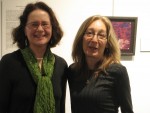
Artists Nancy Current, left, and Robin Atlas at Zack Gallery. (photo by Linda Lando)

Visual Midrash: Plagues and Visions, which opened at Zack Gallery on April 7, features the work of Seattleites Robin Atlas and Nancy Current, the only West Coast artists creating in the genre of visual midrash. The show is the culmination of a four-year collaboration that started in 2012.

“We met through the Jewish Art Salon in New York,” said Current. “Even though we both live in Seattle, we didn’t know each other at that point.”

Atlas elaborated: “The president of the Jewish Art Salon sent us both an introductory email. She said we probably knew each other already, but we didn’t – and we lived only 10 minutes apart.”

“Robin was about to open a new show in L.A. and she brought her works to my studio,” said Current. “I was amazed. There was so much beauty and thought behind it all. That’s what visual midrash is all about. It requires two elements: the clarity of story and the visual beauty of the artist’s interpretation. I looked at Robin’s art and I said to myself, I’m going to work with her forever.”

They started working together, but their chosen genre – interpreting Torah through visual art – is not widely known. “We didn’t have a ready audience in the West,” Current explained, “not like in New York. We needed to build it, so we started teaching adult classes two years ago. The classes include the texts from the Torah, introduced by a Torah instructor, and a visual component, taught by an art instructor.”

“We would do slide shows, video presentations, and the students would have a chance to create their own art,” Atlas said. “Linda Lando, the Zack Gallery director, facilitated the first class we did in Vancouver earlier this year.”

For the current show, the artists explored the theme of the 10 plagues. “We were drawn to the story,” said Current.

Although each artist works with different media – Atlas with textiles and Current with glass and paper – their creative vision is similar. Their symbolic abstracts mesh extremely well, as if the images belong together, buzzing with the same esthetic sense and the same muted elegance, complementing each other to tell the same tale.

While the Vancouver Jewish community was introduced to Atlas when she exhibited at the Zack in mid-2014, Current is a new name for most local art appreciators.

“I always drew and painted as a child but I can’t say that I had the conscious idea to be an artist,” Current recalled. “I grew up in Seattle, in an old house with stained-glass windows. That undoubtedly affected my later fascination with glass. I learned to blow glass when I was about 24, but gave that up in favor of painting on stained-glass.”

She explained, “Glass is different from other mediums because light passes through it (transmitted light) instead of bouncing off [of it], like with paper or canvas (reflected light). Transmitted light, especially through colored glass, connects to a person’s emotional centre more directly than reflected light. It also has a spiritual aspect. Think of all those stained-glass windows in churches and synagogues. That is important to my Jewish work.”

Although she has worked in other visual genres, Jewish themes absorb her artistic passion now.

“Jewish art has gradually replaced my other work, life drawing and landscape, because it is much more meaningful,” she said. “Visual midrash is the most meaningful Jewish art of all. It requires a lot of study and thought, and those are things I highly value about living a Jewish life.”

Current pointed to two particular influences on her development as an artist.

“The first was studying at Pilchuck Glass School,” she said. “The school attracted many artists early in the history of the American studio glass movement. I studied there with the amazing British glass painter Patrick Reyntiens. He is 90 years old now and still a good friend.

“The second was finding the Jewish Art Salon (JAS) in New York. Becoming a fellow in the JAS has led me to friendships with several Jewish artists who have been doing visual midrash for years. They have helped a lot.”

Current doesn’t concentrate on making a living with her art. Her main concern is to share it with as many people as possible. “Of course, eventually I want to sell my work,” she said, “but not until I’ve had a chance to show it in several exhibitions. The purpose of doing my work is to cause people to think about their Jewish heritage.”

Current and Atlas’ show runs until May 8.

Olga Livshin is a Vancouver freelance writer. She can be reached at [email protected].

Format ImagePosted on April 15, 2016April 13, 2016Author Olga LivshinCategories Visual ArtsTags Nancy Current, Robin Atlas, visual midrash, Zack Gallery
Robin Atlas’ Lashon Hara exhibit at the Zack offers artistic midrash

Robin Atlas’ Lashon Hara exhibit at the Zack offers artistic midrash

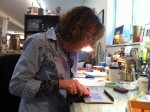
Artist Robin Atlas in studio. (photo from Robin Atlas)

Midrash has been an integral part of Jewish culture for centuries, mainly in literary form. It also branches into the visual arts, however, and there exists a vibrant, international alliance of artists investigating the sacred texts through their paintings and sculpture, fibre art and theatre. Robin Atlas, a Seattle-based mixed-media artist, is part of the movement, and she considers it a personal challenge to raise the awareness of visual midrash in the Jewish community and beyond.

Atlas has been exploring visual midrash for the past four years. Her new show at the Zack Gallery, Lashon Hara, A Narrative on the Consequences of Evil Speech, highlights some of the results of her exploration.

“I turned to this theme after I suffered from an evil tongue myself,” she shared in an interview with the Independent. “Someone gossiped about me. She said very unpleasant things behind my back and then to my face. I was very upset. I talked to my rabbi’s wife, and she sensed my disquiet. She asked me what happened. When I told her, she said, ‘What lashon hara!’ I asked her what that meant, and she told me. It means ‘evil speech’ or ‘evil tongue.’ I started thinking about it. I felt it was a powerful subject to explore through art. Lashon hara creates pain and darkness. How do we turn this darkness into light? What could I, as an artist, say about it? Our community needed such a conversation.”

The exhibition is Atlas’ contemplation on the topic, its different approaches and consequences. Through the use of textile art, she examines how lashon hara impacts the spiritual realm and the physical world. The show consists of 20 small, framed canvas squares decorated with various materials: beads, appliqués, strings, paint and so on. Each piece is imbued with its own symbolism, and the artist’s explanations of her vision are handwritten on the attached labels.

“I started this project by researching the subject for several months,” she said. “I began with seven titles and then created the pieces to match them. But I felt that seven wasn’t enough, so I thought of 13 more titles and the related art pieces.”

One piece in particular, “Feather Pillow,” encompasses the idea behind the show. It might be seen as an illustration to a story. “It’s a Jewish folk story. I heard it first when I was a young girl,” Atlas recalled. “I did something bad, gossiped about someone, and my grandmother told me that story. When I started investigating lashon hara, I remembered the story again, and it became the foundation for one of the pieces.”

A small panel with the full text of that story hangs next to the artwork. The story compares gossip to a feather. Once on the air, flying away, it can’t be caught and retracted, and those who spread the gossip commit three murders: they kill the souls of the speaker, the listener and the one about whom they gossip. “Three Murders,” another piece in the show, illustrates the point.

Several pieces reflect the artist’s personal way of dealing with gossip, converting its darkness into light. One is called “Bomb,” but Atlas’ depiction is not a weapon: the beautiful, sparkling-with-golden-beads image depicts an unusual bomb, a bomb of kindness. “It’s a retaliation of love,” Atlas said. “We have to stop the circle of evil speech. It’s about that woman who spoke evil of me.”

Although she used the vehicle of the Torah to convey her introspections, lashon hara is not confined to the Torah or the Jewish community, of course. There are examples of “evil tongue” everywhere, in our personal and work lives, in the public sphere. In this respect, the show is both timely and timeless, resonating with everyone of every nation or culture, and age.

The show also has an interactive aspect. “We invite the public to write down small notes: how lashon hara affected them, whether it was something they said or something said about them. The notes are anonymous,” Atlas explained. “Anyone can pin his or her note about their experience of lashon hara to a special board. We provide the papers, the pencils and the pins. At the end of the show, we’ll collect all the notes, shred them and turn them into mulch, to be used for a plant at the JCC. We will, this way, symbolically turn the darkness of lashon hara into light.”

During the opening reception on May 29, Rabbi Carey Brown of Temple Sholom joined Atlas for the Artist’s Beit Midrash, a discussion of lashon hara. The exhibit runs until June 22.

Olga Livshin is a Vancouver freelance writer. She can be reached at [email protected].

Format ImagePosted on June 6, 2014June 6, 2014Author Olga LivshinCategories Visual ArtsTags lashon hara, Robin Atlas, Zack Gallery
Proudly powered by WordPress