There are those who envision a future without Israel in it. No one knows what the future holds, yet there are some who, in their enthusiasm for a future without a Jewish state, are reinventing the past.
Last week, UNESCO, the United Nations Educational, Scientific and Cultural Organization, passed a resolution that effectively negates millennia of Jewish history at the Temple Mount in Jerusalem.
The holiest site in Judaism and the physical centre of the Jewish world, is the place where the first and second temples stood. The remnants of the Second Temple, the Western Wall, is the place on earth toward which Jews have prayed for 2,000 years when they have not been able to pray at the Wall itself.
The land is contested because, in the eighth century, Al-Aqsa Mosque was constructed on the site of the temples’ ruins. To be generous, the Jews may have been there first, but it is nevertheless a holy site for Muslims as well. Tell that to UNESCO. According to the wildly ahistorical resolution last week, Jewish claims of ancient connection to the place are bogus.
The resolution, which repeatedly refers to Israel as the “Occupying Power,” includes a litany of offenses allegedly perpetrated by Israel and Israelis, including “storming of Al-Aqsa Mosque/Al-Haram Al-Sharif by the Israeli right-wing extremists and uniformed forces,” and accuses Israel of “planting Jewish fake graves.”
In addition to pages of condemnations of Israel, the resolution repeats familiar accusations that deny any Jewish connection to Judaism’s holiest site.
The resolution was submitted by Algeria, Egypt, Lebanon, Morocco, Oman, Qatar and Sudan, countries that each have their own unique challenges that nevertheless do not detract from their obsession with imagined Jewish slights against Islam.
But the resolution was supported by numerous ostensible allies of Israel, including France, Spain and Sweden, as well as Russia. The United States, Estonia, Germany, Lithuania, the Netherlands and the United Kingdom voted against. (Canada is not on UNESCO’s executive board.)
This sort of nonsense spewed up from agencies of the UN, to say nothing of the General Assembly, further undermines the legitimacy of what could be the world’s most valuable international forum and makes a mockery of the vision of the UN’s founders. None of this matters, of course, to the inmates who are running the asylum.
As every year passes, more firsthand accounts of the Holocaust are lost. Carleton University has launched a new initiative to help preserve these important accounts for future generations.
Led by Mina Cohn, director of the Centre for Holocaust Education and Scholarship (CHES) within Carleton University’s Zelikovitz Centre for Jewish Studies, this initiative is hoping to raise $7,500 using Carleton’s Futurefunder crowdfunding platform to record and preserve the testimonies of Ottawa Holocaust survivors as oral histories.
The project will ensure the preservation of Ottawa Holocaust survivors’ accounts and their experiences before, during and after the Holocaust. These recorded testimonies will become a powerful pedagogical tool to be used in any educational institution or setting and will allow Carleton professors and students to explore online the unique power of survivors’ memoirs. The recordings and associated educational materials will form the basis of a special Ottawa-based Holocaust memorial project and will become a public resource freely accessible on the CHES website.
Each survivor has a unique and personal story to tell. These eyewitness accounts unite personal experience with the history of the period in a powerful way, creating a feeling of immediacy to the events, and there is an urgent need to record and preserve survivor accounts before it is too late. CHES is in contact with local Holocaust survivors and is already working with those interested in participating in this project.
The $7,500 to be raised will help cover the cost of producing, editing and arranging a public launch of the video testimonies of Ottawa Holocaust survivors. In the first round, CHES will record up to 10 different survivor testimonies, in a professional studio environment with the help of professional videographers. If sufficient funding is available, it will produce thematic videos on associated topics, such as life before the Holocaust in certain locations, camp experiences, child survivors, Jews in hiding, etc. Recording is scheduled to start in June 2016.
The unedited recording and videotapes will serve as resources for scholars, students, educators and the public, and provide glimpses into the individual lives during the Holocaust that cannot be obtained from documents or written records. Such testimonies are also an excellent resource for the development of anti-racism educational materials.
Last month, the Jewish Independent received an email from a reader concerned about a new group for Messianic Jews being organized via meetup.com.
While the organizer did not respond to requests for an interview, the Independent followed up on the issue of Messianic Jews with, among others, Daniel Nessim, whose father, Elie, is the leader of Kehillath Tsion, a now 30-year-old Messianic centre in East Vancouver. His father, who is 84, has been handing over more of the leadership responsibilities to Nessim, who recently returned from 10 years in the United Kingdom.
“Our community consists of about 100 people, and around 80 show up every Shabbat for services,” he told the Independent in a phone interview. “Our congregation consists of both Jews and gentile Christians who are seeking to connect with Yeshua’s [Jesus’] Jewish roots.”
Members of the community observe the Sabbath, keep kosher, wear tefillin and tzitizit, and observe Jewish holidays in their way. The younger Nessim seeks to make his congregation “a more welcoming place for Jews.” Asked about the Jewish community’s general aversion to evangelizing, he replied, “God created us as Jews and intended us to remain as Jews. If I’m correct that Jesus is the messiah sent by God, He would want us to acknowledge that, but not to leave our Jewishness or our communities or synagogues. I’m happy even if a Jewish person doesn’t believe in messiah as I do, but becomes a better Jew in their own community.”
Most Jews do not see Messianic Judaism as a reasonable Jewish option, however. Rabbi Laura Duhan Kaplan, director of Inter-Religious Studies at Vancouver School of Theology, explained that different Jewish communities have differing levels of comfort about welcoming Messianics as Jews in their synagogues. “There are also theological issues,” she said. “Someone who affirms Jesus as a teacher or a messianic figure might not be beyond the pale as a Jew, even though other Jews might disagree with them. If they affirm Jesus as divine, or God incarnate, however, then, for most Jews, they have crossed a line into unacceptable beliefs for a Jew.”
Most Orthodox Jews view Messianic Jews as retaining their Jewishness, but as apostates who have lost their right to synagogue membership or participation in other aspects of Jewish community and ritual practice. The Conservative Rabbinical Council has ruled that Messianic Jews are still Jews, but should be considered “apostate Jews” and denied synagogue membership, participation in Jewish ritual and burial in a Jewish cemetery. The Reform movement also considers Messianic Jews as apostates, not to be excluded from “services, classes or any other activity of the community, for we always hold the hope that they will return to Judaism and disassociate themselves from Christianity. But they should be seen as outsiders who have placed themselves outside the Jewish community…. Such individuals should not be accorded membership in the congregation or treated in any way which makes them appear as if they were affiliated with the Jewish community, for that poses a clear danger to the Jewish community and also to its relationships with the general community.”
Several Jewish organizations work to combat the evangelization of Jews, notably Jews for Judaism. Based in Toronto, its stated mission is to respond “to Christian missionaries, cults, eastern religions and many other challenges to Jewish continuity, and connecting Jews to the spiritual depth, wisdom, beauty and truth of Judaism.”
While a 2013 PEW study showed 34% of American Jews as accepting of Jews who believe in Jesus as the messiah – a large percentage but half that of those accepting of Jewish atheists – the struggle against Messianic Jews has sometimes become violent. In Israel, for example, according to the Messianic organization Anachnu Israel, Orthodox Jews have threatened and even assaulted Messianic Jews and their families. And, in Toronto, there have been incidents where Messianic Jews have faced protests, jeers and insults, thefts, vandalism, as well as bomb and death threats.
Rabbi Dan Cohn-Sherbok, a British Reform rabbi and Jewish theologian, recently wrote a book-length treatment of Messianic Judaism and its place in the Jewish community, called Messianic Judaism: A Critical Anthology. In it, Cohn-Sherbok explains that Messianic Jews are bewildered by their exclusion from much of the Jewish community: “If Conservative Jews deny the belief in Torah MiSinai [the divinely revealed nature of both written and oral law…], Reform Jews reject the authority of the law, Reconstructionist Jews adopt a non-theistic interpretation of the faith and humanistic Jews cease to use the word ‘God’ in their liturgy, why should Messianic Jews alone be universally vilified?”
Cohn-Sherbok argues for the inclusion of Messianic Judaism within the pluralistic Judaism of today, writing that the continued rejection of Messianics “makes little sense”: “Messianic Jews are regarded as having committed the ultimate ethnic and religious betrayal. Yet, we have seen, Messianic Jews do not see their acceptance of Yeshua as a form of treachery. They enthusiastically embrace Jewish identity, which they inculcate in their children at home and in synagogues. They remain loyal to the Jewish people, even though they are universally rejected and condemned. They are vociferous supporters of the state of Israel. By their very way of life, they continually challenge the claim that accepting Yeshua as messiah is equivalent to abandoning Jewishness.” Cohn-Sherbok claims that, “in many respects, Messianic Jews are more theistically oriented and more Torah-observant even than their counterparts within the Conservative and Reform movements.”
New York-based Jewish Renewal Rabbi David Evan Markus welcomes Jews who have joined other religions to worship and learn with his community. Asked about Messianic Jews, he said, “I haven’t had to deal with that question yet. I think that if they came to the synagogue to learn about Judaism, to worship Jewishly, they would be welcomed, just as all authentic and respectful seekers are welcome. It’s a core mission of [our] spiritual community, and our roles as Renewal rabbis, to encourage spiritual engagement from a place of authenticity and integrity for all. The essential factor would be that they be committed to not proselytizing in the community. They would have to come in good faith to learn and worship with us as a Jewish community.”
There is a range of views in the Messianic community about proselytization. Nessim said he would be “very pleased” if the Jewish community accepted Messianic Jews into community life on the condition of refraining from active, organized proselytization within the Jewish community. “I think it would be ideal to aim for an agreement like that, as the fruit of respectful dialogue,” he said.
Matthew Gindinis a Vancouver freelance writer and journalist. He blogs on spirituality and social justice at seeking her voice (hashkata.com) and has been published in the Forward, Tikkun, Elephant Journal and elsewhere.
Why are boys three to four times more likely to be diagnosed with attention deficit hyperactivity disorder (ADHD) than girls, when studies have repeatedly shown that girls are just as likely to have it? According to psychiatrist Dr. Doron Almagor, this may be due to how it manifests differently in girls than it does in boys.
Almagor treats ADHD throughout the lifespan. He is also the president of the Canadian ADHD Resource Alliance (CADDRA), which is a Canadian body of physicians that sets the standards for treatment of ADHD in the country.
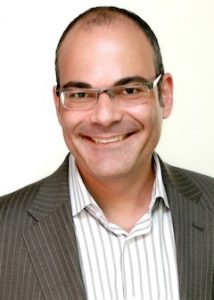
Dr. Doron Almagor (photo from Doron Almagor)
Originally from Israel, Almagor moved to Canada with his parents when he was 10 years old. During his training in child and adolescent psychiatry, Almagor became exposed to kids with ADHD.
“I found out, as I did my practice, that there was a really wide need for it,” he said. “It’s a very underserviced, under-recognized, underappreciated area within the Canadian health-care system and worldwide as well. I could see changes happening very quickly for people who may have been suffering for years and were then able to turn their lives around. So, that is something I became more involved in.
“I then became more involved with education over the years and really tried to promote the message that it’s something that’s under-recognized and easily addressed. Compared to other treatments in psychiatry, it tends to be much more effective, but underappreciated for being so.”
According to Almagor, one of the myths is that ADHD kids are hyperactive. The reality is that there are different types of ADHD, some of which have no hyperactivity associated with them at all. These used to be referred to as ADD (attention deficit disorder).
“When people hear ADHD, they may not identify themselves as having it or their children or family as having it, because they think hyperactivity has to be there,” said Almagor. “But, there are types of ADHD with no hyperactivity – that’s a more silent type and even more underappreciated.
“The problem with ADHD and all types of ADHD is that they’re defined by symptoms with attention, focus, and with the hyperactive-type problems, with hyperactivity and impulsivity. But these aren’t the real issues ADHD causes. The real issues are things like school failure, low self-esteem, social problems – things that evolve into other issues like depression and anxiety. It’s really the secondary effects of ADHD that are the real problems, rather than the pure attention or hyperactivity issues.
“If a child has ADHD and that causes self-esteem issues, they can’t focus, keep up with their peers, [they] have teachers who are negative about them, and people may say that they’re just being lazy and making careless mistakes. That’s going to be internalized into the child’s character. That will be part of their image of themselves. That’s going to affect how they relate to the rest of the world…. That’s going to be harder to fix as they get older. The earlier it can be addressed, the better.”
Learning disabilities often go together with ADHD. According to Almagor, when someone has been diagnosed with a learning disability, they should also be screened for ADHD, as 50% of those with a learning disability also have ADHD and vice versa.
If a parent is concerned about their child, his or her teachers are in a very good position to be able to gauge where the child is at, as they see them in a context of 30 other kids their age, he said.
“Often, parents may have a 7-year-old who can’t focus, but they may not know if that is the same as or similar to other 7-year-olds. Teachers are always consulted before making a diagnosis.
“Another good first step,” he continued, “is the child’s pediatrician, as many pediatricians are trained in the diagnosis and recognition of ADHD. Pediatricians may be able to diagnose it themselves or may have consultants they rely on, whether that is a child psychiatrist or specialist pediatricians (developmental pediatricians).”
Further testing may be needed to confirm an initial diagnosis, but this testing is covered by the public health-care system when prescribed by the child’s doctor. Psychiatric treatments may not be covered.
Another common misconception concerning ADHD is that medication is the only option, yet, that is only one of the potential treatments.
“Parents need to make sure the pediatrician is open and knowledgeable about ADHD,” said Almagor. “There are still some who don’t believe there is such a thing as ADHD or they’ll do a very quick assessment ruling ADHD out too soon without a full assessment.”
One of CADDRA’s missions is to educate physicians in making proper diagnoses, and providing proper treatment or referring people to the appropriate resources and experts.
CADDRA’s website provides a list of symptoms that people can access that might be helpful in trying to determine if you have a child with ADHD, but Almagor cautioned that these are all just initial screening tools that can only give an indication that further trained assessment may be needed.
“We can’t expect a 10-year-old to focus as well as a 19-year-old,” said Almagor. “Besides initial symptoms, like trouble focusing, secondary symptoms can include being very hesitant about being in school, being withdrawn about school and having low self-esteem about their abilities. These types of things are softer. They’d be good alerts that the child needs further assessment. Being behind in school is another one. But, it might not be ADHD. It might be a learning disability or something else, like depression.
“Girls tend to have the more silent type of ADHD – the inattentive type – so, not as visible. Inattention is internal – hesitancy, being withdrawn and being unsure of their abilities. These are often missed and that’s why girls are only diagnosed later in life.
“Often, when mothers bring in their daughters for assessment, they read about the diagnoses and they self-identify. I see a parent who will say, ‘Now that I’ve learned more about ADHD, my child has it and I realize I have it, too.’ It’s common as well because ADHD is about 80% genetic. So, often when there’s a child that has ADHD, one of the parents has it, too.
“I always ask and try to determine who else in the family might have ADHD and maybe encourage that they also seek out treatment, too. It’s important, as, if a parent is having ADHD symptoms themselves, it may make it harder for them to parent effectively and may make the child’s ADHD worse.
“Even when girls are hyperactive,” he continued, “they’re still often under-treated. They tend to be chatty girls in class and can’t sit still. Recent research from Denmark is showing that girls with ADHD have higher rates of effects of it than boys. So, they have higher rates of drug use and higher death rates, which may be because they’re not being treated.”
In early childhood, boys diagnosed with ADHD outnumber girls four to one, but the number of adult men and women are about equal. Overall, the number of people with ADHD has been steady for the past 30 years, according to Almagor, at around five percent. And, although Almagor said he sees many Jewish patients, he does not attribute this to there being higher percentages of Jews with ADHD as compared to the general population. Rather, he feels Jewish parents’ attentiveness to what is going on may be the cause of them bringing their kids in more often for treatment.
The way in which the condition and its treatment are perceived by the public, said Almagor, is one of the main problems, and it is a problem that may be causing harm to kids.
“I think people avoid treatment or avoid addressing it because of stigma, or they think the only option is medication,” he said. “They need to be aware that treatment for ADHD is what we call ‘integrated.’ We look at psychotherapy as well as medication choices. It can also be addressed without medication, which is often very helpful for the long-term well being of the child.”
Psychotherapy treatments may include a focus around self-regulation in cases with hyperactivity and impulsivity, or being able to learn to think before acting via exercises that include mindfulness and other ways to help children control their impulses. Other treatments for ADHD can include helping with executive functioning to improve organization, focus and the sequencing of tasks. For more information, visit caddra.ca.
Ballet BC dancer Gilbert Small is among those who will perform Program 3. (photo by Michael Slobodian)
Ballet BC finishes this season with Program 3, which features the remount of artistic director Emily Molnar’s 16+ a room and of Finnish-born choreographer Jorma Elo’s I and I am You – as well as the Canadian première of Israeli choreographer Sharon Eyal’s Bill.
Already in Vancouver setting Eyal’s work for Ballet BC is Osnat Kelner, who has been choreographing since 2001. In addition to her own creations, Kelner is an assistant choreographer for Eyal and American-Israel choreographer Barak Marshall.
“I met both Sharon and Barak for the first time when I was dancing in the ensemble Batsheva in 2000 and they created pieces for the company,” Kelner told the Independent.
“I started setting Sharon’s pieces in 2005 after working with her again, this time as the rehearsal director of ensemble Batsheva, where she created another piece.
“I started working with Barak as his assistant in 2008. A year earlier, I met him in Israel, after his long absence. He discussed the option of coming to create a new piece, said he still remembered how great it was to work with me, and that he’d like me on his team.”
Eyal, who is based in Tel Aviv, is former resident choreographer of the Batsheva Dance Company. She currently is artistic director of L-E-V, a company she and Gai Behar formed. For Bill, she again collaborated with Behar and musician, drummer and DJ Ori Lichtik. In the work, notes Ballet BC, “Eyal combines dance, music and design into an instantly recognizable whole of raw, unexpected beauty created with equal parts ebb and flow. Premièred by Batsheva Dance Company, Bill showcases Eyal’s trademark shifts from large group to smaller ensemble, which, in turn, morph into breathtaking solos.”
“In order to set another choreographer’s pieces,” explained Kelner about her role in the production, “you firstly need their trust, you need a really good memory, the ability to see the big picture and the smallest details, and a way with people. It means you are responsible for passing information to dancers who have never worked with this choreographer before, and you try to stay as honest to that person’s vision as you understand it.”
Kelner also has her creative vision, which she focuses on more than one artistic endeavor.
“As a freelancer,” she said, “I do many different things. I choreograph, I stage other choreographers’ pieces, I work as rehearsal director for independent projects, I make costumes for dance and theatre, I sometimes perform myself and I’m the mother of a 19-month-old boy. I can’t imagine it any other way. I love being involved in many different projects, in different roles, and sometimes at the same time. I only grow and learn from it, as an artist and a person.”
Audiences at Program 3 will also see Molnar’s 16+ a room, set to music by Dirk Haubrich and inspired by the work of writers Jeanette Winterson and Emily Dickinson. According to the press material, it “displays Molnar’s unique choreographic language through a complex study of time, transition and stillness, where the space between is as important as the space occupied, where one is left with the feeling of both liberty and disappearance.”
Finally, Elo’s I and I am You, first performed by Ballet BC in 2013, features “Elo’s signature virtuosic vocabulary and lightning-fast musicality interspersed with moments of enormous intimacy and tenderness.”
Program 3 is at Queen Elizabeth Theatre May 12-14, 8 p.m. Tickets, which range from $30 to $90, can be purchased at 1-855-985-2787 or ticketmaster.ca.
At the Jewish National Fund, Pacific Region, Negev Dinner on April 10, left to right, are Ruth Rasnic, dinner honoree Shirley Barnett and B.C. Premier Christy Clark. (photo from JNF Pacific Region)
When many people think of feminism, it’s likely they connect it with the second half of the last century – names like Germaine Greer and Betty Friedan, who garnered followers in the 1970s for their discussion of equality and freedom.
Some will think of the suffrage movement at the beginning of the past century, which struggled to get women the vote.
But feminism for Ruth Rasnic means safety from harm, respect at home.
Rasnic is a much-decorated social activist recognized in her home of Israel for the work she started in the 1970s creating the organization No to Violence Against Women. She was also a founding member of Ratz, a political party that focused on human and civil rights, and, in 2008, she was appointed by former prime minister Ehud Olmert to his advisory council for women’s stature. She was awarded the Israel Prize for lifetime achievement in 2009, joining the ranks of Golda Meir, Abba Eban and Amos Oz.
Established by Rasnic in 1978, No to Violence Against Women provides emergency housing for victims of physical or psychological abuse. It also runs a 24-hour hotline and advocates for women’s rights.
Rasnic was in Vancouver recently to promote the collaboration between No to Violence Against Women and the Jewish National Fund, Pacific Region (JNF) to raise funds to rebuild a shelter in Rishon Le Zion. The goal is $1.5 million Cdn.
“By building shelters like the Rishon Le Zion shelter, giving women and children a safe haven, support, empowerment, legal aid, we enable them to carve a different future for themselves and their children,” Rasnic said.
The shelters provide victims of domestic violence with a safe environment in which to get a fresh start. They are provided with clothing, access to therapy, employment and assistance in finding new housing. A 24-hour housemother ensures that someone is with the women all the time. To ensure security for the women and their children, they are housed in a shelter that is not within their own city.
“Most women are in shock when they come to the shelter,” said Rasnic. “They have nothing. They may be haggard, malnourished, suffering from PTSD. Within a week, they are physically changed.”
Israel particularly faces challenges servicing victims of domestic violence because many women are new immigrants from Ethiopia, Eritrea and Sudan, and don’t speak common languages. Many have no national status and are not medically insured.
“These are some of the harrowing things we have in the shelters,” she said. “Seven to eight percent of our residents are women, with children often, who are stateless and have no status in Israel. We are now working with the government to ensure that while these women are at the shelter, they can get medical aid.”
Rasnic said that legislation around this problem should be passed after Passover.
Rasnic was a guest of honor at the JNF Negev Dinner on April 10, and the next day visited King David High School to speak to the students. She is adamant that education has to be a key factor in making any difference in abuse toward women.
“No male baby is born a violent man. No female baby is born a victim,” she told the audience at the Negev Dinner. “These are societal norms learned in the home, school and army.”
She has even produced a book, The Shelter is My Home, which is written looking at life in a shelter through a child’s eyes.
“Nobody can take out an insurance policy for their daughters,” Rasnic said. “This is our joint responsibility.”
Beyond the issues for which she’s best known, Rasnic also feels strongly about other social issues in her hometown of Herzliya. She has worked on no-smoking campaigns, which included a free course for those wanting to quit; she has worked to get better access for people with disabilities to public areas in city; and she helped transform a kindergarten space into a drop-in health centre for teens.
At a national level, Rasnic is troubled by laws still on the books that require a woman to get her husband’s signed agreement in the case of abortion or a get (Jewish divorce document).
“Oh, talk about the get,” Rasnic said, her whole body seeming to stiffen at the thought. “Rabbis have to find a solution to the get. They must do it. My own daughter’s husband wouldn’t give her a get for three years.”
While in Vancouver, Rasnic remarked on the federal government’s new cabinet, which comprises 50% women, and Christy Clark being British Columbia’s premier.
“I think it’s wonderful,” she said. “I think it will make a better society. I don’t think women are cleverer than men – I think we’re sensitized to different issues that men have simply ignored.”
No to Violence Against Women has three shelters in Israel, in Hadera, Herzliya and Rishon Le Zion. The fundraising efforts spearheaded by Rasnic are to rebuild the shelter in Rishon Le Zion, to be renamed the Vancouver Shelter. The cause was chosen as the beneficiary of the Negev Dinner by this year’s honoree, Shirley Barnett. To donate to the campaign, visit jnf.ca/index.php/vancouver/campaigns/negev-campaign.
Baila Lazarusis a freelance writer and media trainer in Vancouver. Her consulting work can be seen at phase2coaching.com.
Students Tomer Berko Gabay (student council president), Liam Greenberg (secretary) and Nathan Tourvieille (treasurer) with Heartly, aka Karen Pasqua, senior events coordinator, Howard Blank, Reesa Pawer and Julie Kendell. Student Tal Pretli (vice-president) was absent when the photo was taken. (photo from Richmond Jewish Day School)
Until last year, Richmond Jewish Day School did not have a student council. That was when Reesa Pawer, education assistant at the school, decided it was time to make some changes and do something “for school spirit.”
Not only were students given an opportunity to vote in their council, but they cast their votes at the same time as their parents were participating in the federal election. Said an enthusiastic Pawer, “There were lineups to the ballot boxes! The votes were counted and the student council was elected, as they would be in a real election.”
Class representatives were then chosen by teachers and students. Since then, the council has gone from handing out hot chocolate at recess to coordinating an impressive fundraising program.
The students have targeted three charities to support, said Pawer. “They wanted a global charity, so they picked Variety Club. They wanted a local charity, so they chose the Richmond Animal Shelter, who received a cheque last term. And they wanted to support a Jewish charity, so they’re raising funds for the Jewish Food Bank.”
The project involved students from grades 1 through 7 and, said Pawer, the student council “did the legwork.”
To raise funds, students sold flowers, including gerbera daisies and roses, for local families’ Shabbat tables. They also sold cakes and contributed $2 on non-uniform days, which take place monthly on Rosh Chodesh, to raise funds for Variety.
On April 11, RJDS welcomed Howard Blank, president of Variety in British Columbia, to the school. After a short video presentation about the work of Variety, the students presented Blank with a donation. School council president Tomer Berko Gabay spoke at the assembly, saying that the student group felt “honored to give this $1,000 cheque to Variety – The Children’s Charity.”
The students had a chance to meet Heartly, Variety’s mascot, and were shown a video by Richard O’Shaughnessy, Variety’s events coordinator, about a young man who has benefited greatly from the generosity of Variety supporters. Born with only one hand, Drew now has a robotic hand, which allows him to complete even the most intricate tasks. His passion is making jewelry and, thanks to the robotic hand, he is now able to operate the tools required to do so. The RJDS kids watched the video in rapt attention, exclaiming “Cool!” when they heard about the “bionic” hand from Blank.
Blank praised the students for their community spirit and hard work. He described the “wonderful mitzvah” they had performed. “You’ve given a young boy or girl a new wheelchair or a special bicycle,” he said. “You guys really helped make sure that every kid gets a fair chance, and we think that’s right.”
RJDS principal Abba Brodt also applauded the students. “I am really proud of you,” he said. “You did something special – and so did your families.”
Asked how this fundraising program contributes to the students’ academic programs, Brodt described the integration of the school’s Jewish studies with the government-mandated B.C. curriculum.
“It was the perfect way to teach tikkun olam, to bring beauty to Shabbat tables and bring beauty to the wider world. It’s the perfect way to tie what’s out there in the world with what’s in here,” he said, putting his hand on his heart.
He added, “Reesa went above and beyond. This is a remarkable achievement for the student council. She gave the kids her full support.”
Blank took the time to answer questions from the group assembled, bringing the kids’ attention back to familiar experiences. He also reminded them to help kids in wheelchairs feel included when they meet them at playgrounds. “They don’t just want help, they’re just like you, they want friends,” he said.
RJDS students will present a cheque to the food bank in June, said Pawer. “This is the first year we’ve done such a big project,” she said. “We’re hoping to keep it going.”
Shula Klingeris an author, illustrator and journalist living in North Vancouver.
“Question Mark” by Sydney Freedman and Rachel Pekeles is among the works created by King David High School Grade 12 students. (photo by Nancy Current)
In conjunction with their current show at Zack Gallery, Visual Midrash, artists Robin Atlas and Nancy Current conducted a two-day workshop with the Grade 12 students of King David High School. Rabbi Stephen Berger, head of the school’s Judaic studies, and some of his more outgoing students talked to the Independent about the project.
“Every year, we do a project for Passover with our Grade 12 students,” said Berger. “The Haggadah is one of those Jewish texts that’s had the most number of interpretations throughout our history, as every generation and every family bring their own understanding. So, I ask the students every year to write their own versions, a short essay on one of the aspects of the Haggadah. This year, we decided to combine the writing with the visual component. The students pitched their ideas, which topic they wanted to explore. I tried to limit the same topics but I didn’t force anyone. They were free to choose. Now, after all the art is done, we’ll put the project online. We’re also going to publish a hardcopy as a pamphlet. One of our former students, Daniel Wiseman, is helping me with the particulars. We will distribute the copies at the JCC, at the synagogues and Jewish delis.”
The rabbi joined his students in creating his own interpretation of the Haggadah, using a sheet of matzah as the base for his artistic journey. “Matzah represents both our slavery and our freedom,” he said. His piece opens the pamphlet.
Like the rabbi, most of his students hadn’t done much visual art in years and were not going to pursue art as a career, but they enjoyed working on Visual Midrash for this assignment.
“They put so much thought into their pieces,” said Current. “Some of them first tried to come up with concrete images, but it’s hard without artistic training. Then Robin and I suggested they should think about some abstract interpretations. What ideas come to mind? What concepts are associated with those ideas? The results were amazing.”
One of the students, Izzy Khalifa, chose the most fun-filled tradition of Passover – the search for bread. “When I was a kid, it was a game in our home. I loved it,” she said. “Now that I’m older, I think it’s not simply a search for bread but it has a deeper meaning, like a search for yourself.”
“Judaism grows on you,” the rabbi remarked, and Khalifa agreed. She also liked working with the abstract concept. “People can take more from an abstract picture, interpret it in different ways,” she said.
“Blue Heart” by Adi Rosenkrantz and Ashley Morris (photo by Nancy Current)
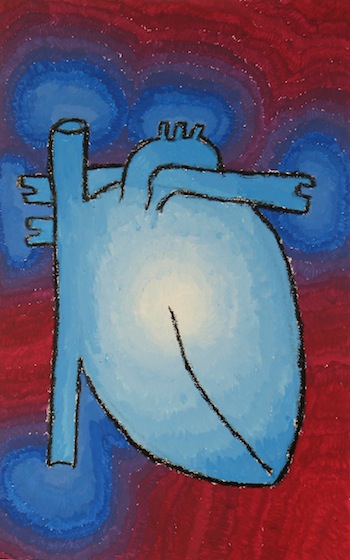
Classmates Adi Rosenkrantz and Ashley Morris decided on more concrete imagery. Their blue heart on a blood-red background symbolizes the first plague of Egypt – the plague of blood. “The blue heart is like the heart of the Nile,” said Rosenkrantz. “The abrupt color change, from blue to red, from water to blood, disrupted the Egyptian way of life.” Their heart is almost anatomically precise. “I just did a unit on cardiovascular system,” Rosenkrantz explained, “and it was fresh in my mind.”
Ma’ayan Fadida and Shmuel Hart’s illustration was more metaphorical. They selected a controversial theme for their work – the wicked son. In their artistic interpretation, the wicked son walks a black path, which winds its way across the pink and orange brightness of other family members.
“We wanted to do one of the sons,” Fadida said. “This one makes the decision to separate himself from the others; that’s why his path is black. And the abstract allowed us to show how he was thinking.”
One of the most powerful pieces is a mixed media collage: a large black question mark with the background of newspaper snippets. Created by Sydney Freedman and Rachel Pekeles, it also touches on the story of the four sons but focuses on the son who doesn’t know how to ask.
“We wanted to take a complicated topic and present it as a symbol. The black mark blocks our ability to ask,” explained Freedman.
“The information is all there. You just have to be willing to look for it,” Pekeles elaborated. “It is a challenge. Sometimes, we choose not to ask when we should.”
Olga Livshinis a Vancouver freelance writer. She can be reached at [email protected].
Ben Harrington churns the wheat while Joel Harrington and Sara Basya Mochkin look on. (photo from Chabad of East Vancouver)
On April 10, Chabad of East Vancouver hosted a packed Model Matzah Bakery at its Centre for Jewish Life on Fraser Street. Following a week of similar events at Chabad Lubavitch, children had an opportunity to make their own matzah from scratch. They began by winnowing the wheat kernels, then grinding and sifting them into fine flour. Water was then added to make dough. The kids rolled out the matzah, scoring it with dockers before handing it over to the grownups for baking.
The children managed to get the dough kneaded, shaped and into the oven in under 18 minutes to prevent the dough from rising. This would have made it chametz, a fermented grain, which is forbidden over Passover.
This process only began after a careful eye was cast over all of the ingredients and tools, from start to finish: whether keeping the grains and flour completely dry, to the meticulous cleaning of the tools used in the matzah production.
When 18 minutes were up, an egg timer went off, to cheers from the kids and applause from Rabbi Mendy Mochkin of Chabad North Shore.
The finished matzot were pulled from the oven by Rabbi Schneur Wineberg of Chabad East Van. After savoring the matzah with cries of “Mmm, delicious!” oranges were served, followed by knishes from Shuk restaurant.
Extra hands-on supervision was provided by Maggie Karpilovsky and the staff of North Shore Hebrew School.
Shula Klingeris an author, illustrator and journalist living in North Vancouver.
The Or Shalom board of directors with Rabbi Hannah Dresner, second from the left in the front row. (photo by David Kauffman)
Most Jews would agree that usually rabbis do the bulk of the talking and congregants the listening. That’s been reversed for the Listening Tour currently underway among rabbis of ALEPH: Alliance for Jewish Renewal. The tour is making 13 stops in North America, as well as listening via video and Skype to Renewal communities all around the world. On March 25, the tour stopped in Vancouver, where it was hosted by Or Shalom.
Rabbis Rachel Barenblat and David Markus, ALEPH co-chairs, have embarked on the tour to hear from the breadth and depth of the community, including those not technically affiliated with the Renewal community but “aligned in method, intention and heart.”
“Every stop on the ALEPH: Jewish Renewal Listening Tour is different, and every one has been amazing in its own way. But I suspect that our weekend in Vancouver may stand out in memory as one of the most memorable experiences in a year-plus of remarkable experiences,” wrote Barenblat on her blog, the Velveteen Rabbi.
“Maybe that’s in part because we traveled such a very long way to be there. Maybe it’s in part because we were visiting such a storied community, one of the largest and longest-standing Jewish Renewal communities in the world. Maybe that’s in part because the people at Or Shalom welcomed us with such open hearts.”
“When ALEPH decided to go on a listening tour, it initially was to take the pulse of the Jewish Renewal movement, but it has come to mean for us and for stakeholders in the broader renewing of Jewish life so much more than that,” said Markus. “There is a yearning in Jewish life today that reaches through all the denominations … we are seeing a global consciousness arise about the need to reconnect Jews with the heart and soul of tradition, to experience the riches of spiritual life, and to address emerging social and ecological challenges.”
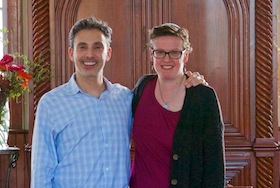
Rabbis David Evan Markus and Rachel Barenblat, co-chairs of ALEPH: Alliance for Jewish Renewal. (photo by David Kauffman)
Markus explained that Jewish Renewal has grown organically, and was not created on the basis of strategy or design. “The time has come,” he said, “to introduce an element of design.” How should the Renewal movement take its rightful place in ecosystem of Jewish life? What does Jewish life need now? How to meet the needs of millennials? Summing up, Markus said, “How are we relevant for the 21st century and beyond?”
Speaking of the tour in a recent Or Shalom newsletter, the congregation’s spiritual leader, Rabbi Hannah Dresner, wrote, “They were here to gather information for their own discernment as they shape the next iteration of the ALEPH: Alliance for Jewish Renewal. But we had a bit of our own agenda, and that was to speak and hear the stories, challenges and hopes of Or Shalomniks for the flourishing of our home community and for our collective and personal senses of belonging, contentment and inspiration…. I listened very carefully, and my heart ached with the poignancy and beauty of the nostalgia, the hurts, the longings and the aspiration I heard spoken.”
On the Friday evening, the visit commenced with davening, followed by dinner, after which those gathered heard some of the origin stories and histories from Or Shalom’s almost 40 years of existence, starting with the early years as a chavurah in Rabbi Daniel Siegel and Rebbetzin Hanna Tiferet Siegel’s living room.
On the Shabbat, there were diverse sessions of listening at which different segments of the community were invited to speak and be heard. Younger members of the community expressed their desire for open, free dialogue, deep ecumenicism and freedom from xenophobia; members of the community who felt marginalized had a chance to tell their stories; elder members spoke of their desire to keep the best of Or Shalom alive and their anxiety to pass the torch to the next generation. Many other voices were heard, and the rabbis listened. “By being listened to,” Markus told the Independent, “people feel empowered to do the work that this era demands.”
Dresner was particularly moved around finding solutions for those who feel marginalized. “What can we do to optimize a young mother’s spiritual experience when she comes to shul with very small children?” she asked. “And how can we create a cohort for her? How can we offer community to individuals who remain single as couples form and begin to have babies? What will it take to go beyond friendliness in developing a deeper queer consciousness?”
The weekend unfolded over what Barenblat called “meetings and meals and meetings over meals,” including a trip on Sunday to the Vancouver vegetarian institution that is the Naam restaurant.
The Vancouver leg of the tour wound down Sunday evening, and so came to an end the ninth stop the rabbis have made so far. “It’s an honor and a privilege,” wrote Barenblat on her blog, “to get to sit with people and hear their yearnings and hopes for what ALEPH and Jewish Renewal might become.”
Matthew Gindinis a Vancouver freelance writer and journalist. He blogs on spirituality and social justice at seeking her voice (hashkata.com)and has been published in the Forward, Tikkun, Elephant Journal and elsewhere.