

For more cartoons, visit thedailysnooze.com.
Author: Jacob Samuel

Check out JI calendar
It is not even officially summer yet but, because we like to stay ahead of the curve, welcome to our annual Summer Celebration issue (June 10)!
Also ahead of the curve is the weather, which has seemed like summer throughout much of the spring. This has been a glorious boon to we who enjoy the innumerable outdoor activities this region has to offer – even if your choice of outdoor activity is simply relaxing on a patio with a hot or cold beverage.
The mostly warm and dry weather, of course, brings challenges. The danger of wildfires has been horrifically demonstrated by the tragedy of Fort McMurray. We also each have a responsibility to do our part in preserving water resources. A brown lawn, nowadays, is a sign of pride and respect for the environment.
That aside, this summer’s calendar – June, July, August, even September – is choc-a-bloc with ideas for individuals and families of every age to enjoy.
Being the Jewish newspaper, as we are, we emphasize events and activities oriented specifically toward Jewish British Columbians or that are in some way connected with our community. There is a vast array of opportunities and we hope that you will keep jewishindependent.ca bookmarked for at least the next months so the first time a kid or teenager complains of boredom – or when it seems like they have spent time enough on electronic devices – the plethora of activities highlighted here will inspire a fun day. Or a welcome night out sans children.
Last week in this space, we discussed the challenges created by transportation and real estate prices in this region. Throughout the year, in these pages, in other media and in everyday conversations, Vancouverites have a habit of kvetching, particularly during those long wet, grey autumn and winter days. But summer is what really brings out the best in this city and province.
Take some time to put aside the daily worries and woes and throw yourself into some of the superb offerings the city and the region has. Let the Independent inspire you!

ווין ערכה ביקור בישראל
הפרמייר של מחוז אונטריו, קתלין ווין, ביקרה בין היתר ביד ושם. (צילום: הקונסוליה הישראלית)
הפריימר של אונטריו תומכת בחוק נגד אנטישמיות, אסלאמופוביה וגזענות
הפרמייר של מחוז אונטריו, קתלין ווין, הודיעה כי תתמוך בחוק חדש שנועד לגנות אנטישמיות, אסלאמופוביה וגזענות. דבריה של ווין נאמרו מסגרת דיון בפרלמנט של אונטריו בשבוע שעבר. ווין הציעה לפעול ביחד עם נציגי האופוזיציה לקדם את הצעת החוק החשובה.

ווין ערכה ביקור בישראל במהלך מאי עם משלחת גדולה בת מאה שלושים ואחד איש, בהם שרים, אנשי עסקים ונציגים של המוסדות האקדמיים. לווין נקבעו למעלה משמונים פגישות במהלך שבוע צפוף עם אירועים וטקסים. היא ניפגשה בין היתר עם ראש הממשלה, בנימין נתניהו, הנשיא לשעבר, שמעון פרס, נציגים בכירים של המוסדות הקדמיים, אנשי עסקים, בני נוער ונציגים של המגזר הערבי. ווין ביקרה בין היתר ביד ושם, בכותל המערבי ואפילו יצאה לריצת בוקר מוקדמת ומתוקשרת בטיילת של תל אביב. נציגי ממשלת אונטריו וחברי המשלחת חתמו על ארבעים וארבעה הסכמים לשיתוף פעולה, עם נציגי המגזר העסקי בישראל, בשווי שמונים ושבעה מיליון דולר. הסכמים אלה יביאו ליצירת מאתיים ושישה עשר מקומות עבודה חדשים במחוז אונטריו. במהלך הביקור אמרה ווין על ישראל: “ישראל היא היא יפה, מסובכת ומקום השראתי”.
מכת עורבים בוונקובר: הציפורים השחורות תוקפות ברוחובות הולכי רגל שנמלטים בבהלה
אימה נפלה על אזור ונקובר. עורבים תוקפים באגרסביות הולכי רגל בפינות שונות של העיר וסביבותיה, שנמלטים בבהלה ומחפשים מיסתור במפני הציפור הרעה. התופעה כאילו לקוחה מאחת הסצנות של סרט האימה מהידועים ביותר בתולדות הקולנוע ‘הציפורים’, של המאי אלפרד היצ’קוק (שהופק בשנת 1963). תופעת העורבים התוקפים מאוזכרת דחופות באמצעי חדשות השונים כאן וברשת אף הועלתה מפה בה מצויינים מוקדי הפורענות של הציפורים הגדולות. וכל זאת כדי להרתיע הולכים ושבים שינמעו מלצעוד ברחובות ובאזורים מסויימים.
כידוע העורבים שומרים על הביצים בקינים שלהם לקראת סוף חודש אפריל, והם הופכים לתקופניים מאוד בעיקר בסוף עונת האביב, עת הגוזלים הקטנים מתחילים לעוף, וכהורים טובים הם מנסים להגן עליהם בפני כל רע. מבחינת העורבים כל מי שעובר בסמוך לקן שנמצא באחד העצים הגבוהים מעל המדרכה, נחשב לסכנה ויש להרחיקו בכל מחיר. מבחינת תושבי אזור ונקובר מדובר בסיוט שלא נגמר ורבים רבים מרגישים חסרי אונים.
כמה מאות הולכי רגל הספיקו לדווח כבר על מקרי תקיפה מצד העורבים בשבועות האחרונים, לאתר (שמופעל על ידי הסטודנטים של הקולג’ לאנגרה) שמעדכן כל העת את המתרחש. כך שמצטיירת לה מפה עירונית שהולכת וגדלה מדי יום, בה מצויינים בהדגשה מוקדי הפורענות העיקריים מצד העורבים. ונקובר לא נמצאת לבד: גם בערים הסמוכות לה ובאזורים נוספים ברחבי מחוז בריטיש קולומביה הולכים ומתרבים מקרי תקיפות מצד הציפורים השחורות והגדולות, המקרקרות ללא הרף. אף אחד באמת לא אוהב את העורבים.
מומחים שמכירים היטב את התנהגות העורבים שנחשבים לציפורים “אינטלגנטיות” לא מתפלאים מהמהומה הרבה סביבם. הם מציעים להולכי הרגל שהותקפו כבר לחפש דרכים חילופיות, ולא לצעוד באותם אזורים שוב ושוב. עוד מוצע לצעוד עם מטריות שיש להן יכולות טובות להגן בפני העורבים הרעים. יש אזרחים שמציעים לתת דווקא אוכל לעורבים האויבים שלאחר מכן יזכרו לך חסד. מכל מקום מומלץ ביותר שלא לגעת בשום פנים ואופן בעורבים או בגוזלים, וודאי שלא להתקיף אותם. כי אז הם יזכרו זאת לנצח ומעשה הנקמה עוד בטוח יגיע . מחקרים מראים שלעורבים יש זיכרון מצויין והם משתפים את חבריהם במידע על מי שתוקף אותם. לא לשכוח.

Nina Simone screens
Jeff Lieberman with Sam Waymon, brother of Nina Simone and longtime band member. (photo from Re-Emerging Films)
It started as an accident,” said Vancouver-born, New York-based filmmaker Jeff Lieberman, describing the evolution of his second documentary film, The Amazing Nina Simone. The documentary has its Canadian première in Vancouver on June 16.
Speaking to the Independent from Fire Island, N.Y., Lieberman said he is a longtime aficionado of this famed American jazz singer, pianist, songwriter and civil rights activist, who passed away in 2003. He grew up listening to Nina Simone’s music and the idea of making a film about her had “always been rolling around in the back of my head, but I never really was quite sure that I could do it or was the right person to do it.”
He continued, “The bigger issue was that I didn’t really know or necessarily understand Nina Simone for a long time and it was only within the last five to eight years that I read both her autobiography and a detailed biography of Nina that helped me understand who she was – but also the amazing backstory of her classical music upbringing, her involvement in civil rights – and realize that there was a much bigger story to tell.”
The impetus for Lieberman to begin work on this passion project arose out of a visit to the southern United States a few years ago. Following a screening of his first documentary film, Re-Emerging: The Jews of Nigeria (which screened at the now-defunct Ridge Theatre in Vancouver in 2012), in Charleston, S.C., Lieberman traveled to Simone’s birth city of Tryon, N.C. He had tracked down a local Simone enthusiast committed to preserving the singer’s memory. He not only guided Lieberman to notable landmarks, such as Simone’s childhood home and a bronze sculpture, but also “basically set up all the interviews for me with people who grew up with Nina. And this was before I had committed to working on the project!”
But Lieberman did commit. He threw himself wholeheartedly into a labor of love, “focusing almost exclusively on [the film] over the last year and a half to two years,” he said.
Lieberman conducted more than 80 interviews, 50 of which are included in the film. “I spent a lot of time hunting people down all over the world and often I was fortunate and interviewed them; other times people had long passed,” he recalled. He described the process as “a lot of work, but it was fun work!”
Lieberman’s “fun work,” or research, led to the discovery that “so many different people had different visions of [Nina]. She wasn’t an easy person to sum up … she was so many different things to so many different people. She was soft and docile to some people, fiery and angry to other people, and she was brilliant to some, and crazy to others.”
He added, “Another thing that was fascinating to me was her struggle with civil rights, in terms of how much time and energy and personal safety to devote to the cause. She seemed quite torn in terms of really wanting to contribute to the movement, but … it was tough for her to reconcile where to be and where she was most effective.”
Simone’s impressive musical achievements are well known. Her music transcends genre, encompassing classical, jazz, gospel, pop, folk and spiritual sounds. The legendary musician recorded more than 25 albums; popular, soulful versions of “I Put a Spell on You” and “Don’t Let Me Be Misunderstood,” and a 1959 Top 20 hit with “I Loves You, Porgy” from George Gershwin’s 1935 opera Porgy and Bess. Moreover, her politically charged song, “Mississippi Goddam,” was revolutionary. Simone wrote and performed the piece in front of a mainly white audience at Carnegie Hall in 1964 – at the height of the struggle for civil rights in America.
Lieberman identifies “Mississippi Goddam” as one of his favorite Simone songs because she “took the entire United States of America to task on what was going on with segregation and racial injustice and, by name, she called out states and governors and groups of people for not doing enough.” However, he is quick to point out that he has many favorites because “there’s a whole other aspect of Nina Simone which is not controversial or as in your face – it’s beautiful love songs and ballads and haunting, lonely songs. And, lastly, she has songs that are stories that paint pictures of different characters, almost like a play.”
On hand at the Vancouver screening to speak from personal experience about Simone’s musical talent will be local jazz musician and Juno nominee Henry Young. Young met Simone during her three-week stint in 1968 performing at Vancouver’s old Marco Polo Supper Club, the first Chinese smorgasbord restaurant and nightclub in Vancouver’s Chinatown, which hosted the likes of Jimi Hendrix, Tommy Chong (of Cheech and Chong fame) and Frank Sinatra, Jr.
Young successfully convinced Simone that he should join her band as guitarist. He reunited with her in New York two months later, only days before Dr. Martin Luther King, Jr., was assassinated. Three days following that historic turning point, Young took the stage with Simone at the Westbury Festival and paid tribute to the civil rights hero with a song written to commemorate the fallen leader.
Young toured with Simone for a few years, performing across Europe and for the King of Morocco. Ultimately, he decided to return home to Vancouver. He will join Lieberman in a post-film Q & A session on June 16 and will perform a musical tribute to Simone with the Henry Young Quartet, featuring Vancouver vocalist Candus Churchill.
Since the release of The Amazing Nina Simone just under a year ago, the film has screened in more than 75 different venues: in France, Denmark, the Netherlands and across the United States in Chicago, Houston, New Orleans, Los Angeles, Berkeley and Philadelphia. Lieberman recalled a notable screening that occurred in Harlem: a free, outdoor, public screening that also included a performance by Nina’s musician brother, Sam Waymon, and a Nina Simone Dance Party.
Lieberman said there are upcoming screenings of the film in Korea and New Zealand, but he is particularly excited for the Canadian première of his latest film in his hometown. He credits his Jewish upbringing in Vancouver as inspiration for much of his work, commenting that it “has always given me a value of social justice and wanting to try and do something meaningful and impactful with my life.”
He said that his previous film “and this one both touch on diversity and racism, trying to create a more just world, and breaking down barriers to see people for who they really are. I think those are Jewish values that come right from the Torah, but also the community that I was brought up in. So, that always factors into my thought process.”
Re-Emerging Films’ The Amazing Nina Simone screens at Vancouver Playhouse at 7 p.m. on June 16. Tickets are available at amazingnina.com.
Alexis Pavlich is a Vancouver-based freelance writer.

Sisterhood winds up its 50th
The current Sisterhood of Temple Sholom board at its installation in June 2015. (photo from the Sisterhood)
The Sisterhood of Temple Sholom obtained its charter from the National Federation of Temple Sisterhoods, now Women of Reform Judaism (WRJ), in 1966. Since its inception, the Sisterhood has provided vital funding and services not only to its congregation and the broader Jewish community, but well beyond. It has had much to celebrate in its 50th year.
The group has held several events, some marking the anniversary specifically, others part of the normal course of business. It began last October with Her Story, A Celebration of Women and Culture. Among the many events since then was Sisterhood’s annual Autumn Fling fundraiser in November and its Sisterhood Service in December. There was the Women’s Passover Seder in April and the recent Golden Anniversary Tea on June 5. The closing event takes place June 21 and the entire community is invited to the catered dinner, installation of the board and special guest Sarah Charney, WRJ vice-president of programming and education; Temple Sholom Rabbi Dan Moskovitz will also attend.
And these only touch upon what Sisterhood has done this year. The 200-plus-member group also held a Shabbaton weekend, co-sponsored scholar-in-residence Anat Hoffman of the Israel Religious Action Centre, and extensively researched Sisterhood’s history. Seven articles on the latter can be found via templesholom.ca/programs/sisterhood.
Donna Ornstein, a past Sisterhood president and current co-vice-president of marketing and communications, with Annette Kozicki, highlighted one major undertaking.
“To celebrate our 50th anniversary, our Sisterhood has just created a new fund called Sisterhood Open Door Accessibility Project, which is to be used to improve accessibility to the Temple building for the benefit of the Temple and the congregation,” she told the Independent in an email interview. “We have set aside $10,000 from our 2015-2016 budget and the intention is to add more funds each financial year as determined by our board to continue this project.
“This initial $10,000 is directed towards upgrading the Temple’s handicap washroom, and other washrooms as funds permit. Future projects will be determined by the Sisterhood board in consultation with the Temple. In 2014, Sisterhood completed paying the Temple $20,000 towards the cost of the construction of the accessibility ramp to the bimah.”
The Sisterhood’s mission statement is: “We, the Sisterhood of Temple Sholom, are an organization rooted in Reform Judaism. Journeying together, we aspire to engage in the pursuit of gemilut hasadim (acts of kindness), tikkun olam (healing the world, and tzedakah (righteousness).” In every measure, and then some, the group has met this aspiration.
“We have been fortunate in having many of the Sisterhood leaders over the decades reach out to the women in the Temple, encourage their participation and mentor their leadership training, not only in-house, but by encouraging new women to attend the WRJ Pacific District conventions,” explained Ornstein about the keys to the group’s success. “There was only a period of three years in the 50 years where we could not find a member to step up as president and, in that case, there was a group who rotated.
“Strong friendships have been created among our Sisterhood members, which have lasted for decades,” she continued. “We offer many different types of activities, and the women participate in what interests them: for example, book club, WRJ Lilith discussion group, women’s knitting group, Rosh Chodesh study group, Sisterhood Choir, walking group, mah jongg, games days.
“We form committees for larger projects and portfolios, bringing new women onto the committees and encouraging them to move up onto the board, such as fundraising, membership and social action.
“Sisterhood,” she added, “has enjoyed and appreciated the support of the Temple clergy and the office staff for our many events and projects over the 50 years.”
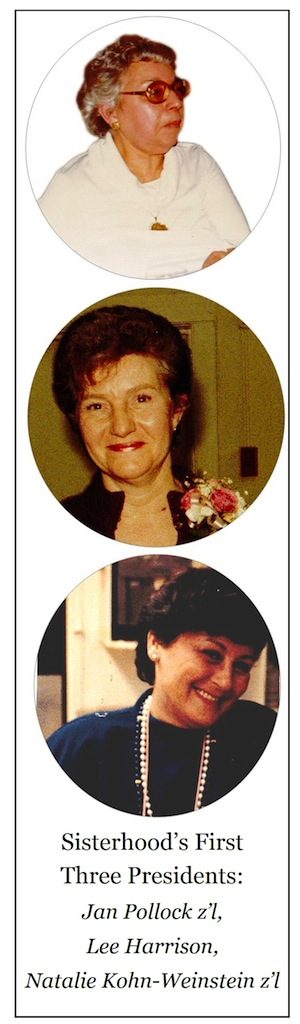 There have been almost 30 presidents of the Sisterhood, with the late Jan Pollack having been the founder and Reesa Devlin the current president.
“In the early years of Temple Sholom, Sisterhood’s social action adhered to charity begins at home, as it raised funds for items a new shul needs, such as libraries, kitchens, furnishings and office equipment,” write Sisterhood members Marie Henry and Joyce Cherry in their joint 50th-anniversary article. “As it became more established, Sisterhood helped those in the community around them and the world at large. In the late 1980s, Sisterhood contributed to the Armenian Earthquake Appeal and sponsored a Jewish camp for a youth group member. They participated in various community projects, such as the Jewish Food Bank and the Committee for Soviet Jewry.
“In the 1990s, Sisterhood sponsored a Russian family to come to Canada. A very special program saw a workshop on Understanding the Impact of AIDS in the Jewish Community that … led to the beginning of the Temple Sholom HIV AIDS committee. Funding also went to Emily Murphy Transition House, a vital resource for women fleeing violence in relationships. This involvement led to co-sponsoring Peace in the Home – Shalom Bayit – along with Jewish Women International, to address problem of domestic violence in the Jewish community.”
Sisterhood has sponsored teams in the annual Run for the Cure for Breast Cancer, has held sweater drives to collect winter clothing for those in need and has collected prescription glasses for developing countries.
“Another very important presentation program in 2009 brought addressing human trafficking in B.C. to everyone’s attention with the persistence of its originator, Marnie Besser,” note Henry and Cherry. “This program led to the spearheading of a successful lobby to the Canadian Senate for the passing of Bill C-268 regarding the minimum sentencing for the trafficking of minors.”
In the next decade, Sisterhood created “Bedtime Kits for Kids, filling backpacks with donated pyjamas, toiletries, underwear and some comfort items for children who arrive at a shelter with nothing but what they are wearing.” Sisterhood sponsors Tikun Olam Gogos, it collects clothing and toiletries for WISH (Women’s Information Safe Haven), a nonprofit operated by women to help women in Vancouver’s street-based sex trade, and also donates women’s business clothing and accessories to Dress for Success.
As well, it contributes to the World Union for Progressive Judaism and the ongoing WRJ initiative YES (Youth, Education and Special Projects) Fund, which, as one of the unbylined 50th-anniversary articles notes, “represents the collective financial efforts of individual donors and WRJ-affiliated Sisterhoods to strengthen the Reform Movement and ensure the future of Reform Judaism. YES Fund grants provide Reform Jewish institutions and individuals worldwide with the tools necessary for religious, social and educational growth, and enhance Jewish life by supporting clergy, cultivating women’s leadership, advocating for social justice, providing programming and offering support.”
In her 50th anniversary article, Bonnie Gertsman focuses on the history of the Sisterhood and food. “Preparing food has traditionally been the responsibility of women, to both nourish and nurture those they care about. And so it was at the beginning of Sisterhood 50 years ago,” she writes. “Although the group was small [at the beginning], the enthusiasm was keen. Refreshments for Oneg Shabbats were looked after by Sisterhood members, as was food for all special events.
“Over the years, the women’s skills increased and, when Bunny Rubens (rebbetzin of Rabbi Harold Rubens) became involved, Sisterhood took up catering. Regarded as a way to provide a service to members and at the same time raise money for the Temple, catering bar/bat mitzvahs and other events became a key component of Sisterhood life.”
Sisterhood started Temple Sholom’s first Second Seder, as well as the break fast following Yom Kippur. Rubens started the latter on her own, notes Gertsman, “and it morphed into a Sisterhood project, with members supplying the food. Sara Ciacci took it on many years ago, and continues to oversee it.”
In 1987, Sisterhood published Favorites from our Kitchen. “As the years passed,” writes Gertsman, “Sisterhood’s involvement with cooking for Temple has changed as the Temple grew and paid staff and caterers were hired for the kitchen and catering. Now, Sisterhood has Soup in the Kitchen and Soup Schvesters. These ‘soup sisters’ prepare soup to have on hand in the freezer, ready to be delivered to people in need of a helping hand.”
On the spiritual side, Sarah Richman writes in her 50th-anniversary essay on religious and educational programming that, as a member of WRJ, Temple Sholom Sisterhood “is committed to egalitarian participation, leadership and education.”
She notes, “The annual Sisterhood Service was one of the first and most enduring examples of this commitment. The first Sisterhood Service was conducted in the 1970s and was a Friday evening, erev Shabbat service that recognized the contributions of women to the congregation. The Sisterhood Service evolved over the years, affirming the right of women to participate and lead worship services. Over time, the service began including the Torah service … and also having a sisterhood member deliver the drash (sermon), demonstrating that women not only have the right to full participation in religious services, but also the knowledge and ability to do so.”
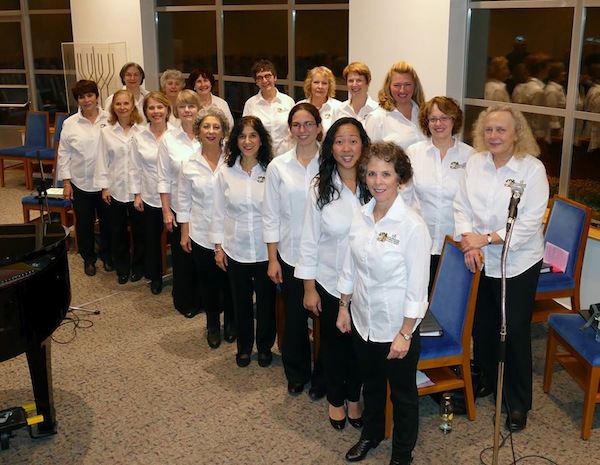
Richman highlights the Sisterhood Choir, the Rosh Chodesh Renewal program that “encourages women to explore and study our ancient texts together” and the purchase by Sisterhood of 126 copies of The Torah, A Women’s Commentary for the congregation. She also discusses Sisterhood-hosted Shabbat education seminars, which began in 2007, “motivated by the Shabbat initiative of Rabbi [Eric] Yoffie,” then president of the Union for Reform Judaism, and Sisterhood’s contribution to Temple Sholom’s scholars-in-residence program.
“The Blessings Wall Project,” she adds, “is an example of a program that blended each individual woman’s Shabbat candlelighting process (the spent matches), together with fabric, paper, photos and/or artwork that represent her personality or character. Each woman’s matches, paper/fabric and photos/artwork became an individual panel on the wall.”
WRJ is the organizational umbrella for hundreds of sisterhoods, and the North American (“national”) affiliates are divided into eight districts, with WRJ Pacific District representing 57 sisterhoods in the western United States and Canada. The Blessings Wall Project, Camp Kalsman Campership Fund/Fashion Show Project and A Community Conversation about Death and Dying are but a few of the Sisterhood programs and initiatives that have received recognition at both the district and national levels. Temple Sholom Sisterhood members have served on the district board, and member Alexis Rothschild has also served on the WRJ board.
Ornstein told the Independent that, in November, “we will send as many of our Sisterhood members as possible (hopefully about 10) to the Women of Reform Judaism Pacific District convention in Las Vegas where we will meet women from over 50 sisterhoods and participate in workshops on leadership training, spirituality, programming. We come home from these biennial conventions energized with lots of new ideas.”
And so begins the next 50 years.
Voices of Africa fundraiser
Left to right are Anne Andrew, Marie Henry, Stephen Lewis, Joyce Cherry, Darcy Billinkoff and Dawn Alfieri at the African Grandmothers Tribunal, which was held in 2013 at the Chan Centre. (photo from Stephen Lewis Foundation)
The Grandmothers to Grandmothers Campaign, in conjunction with the Stephen Lewis Foundation, is supporting grandmothers of sub-Saharan countries in their efforts to raise their orphaned grandchildren, whose parents died of the AIDS epidemic in Africa. Tikun Olam Gogos, one of the local groups participating in the campaign, is hosting the Voices for Africa fundraiser on June 15 at Temple Sholom that will feature the City Soul Choir and a marketplace.
Marie Henry, volunteer administrator of Tikun Olam Gogos, talked to the Jewish Independent about the Stephen Lewis Foundation, the Grandmothers Campaign and Tikun Olam Gogos’ place in it.
“Stephen Lewis Foundation was created 10 years ago,” she explained. “Before that, Mr. Lewis was an NDP politician. After he retired from the Canadian political scene, the United Nations appointed him to look at the AIDS epidemic in Africa. What he saw there was shocking: 18 million children had been orphaned in Africa because of AIDS. Their grandmothers had to step in to raise the children. After he returned to Canada, he was determined to help them. That’s how the foundation started in 2006, and Lewis applied to Canadian grandmothers to support it. He knew they could do it. They had resources, experience, determination and time.”
According to Henry, there are now more than 240 groups across Canada associated with the Grandmothers to Grandmothers Campaign. They all include in their name the word gogos, which is Zulu for grandmothers. “The movement’s already spread to the U.S., England and Australia,” she said.
The funds the campaign gathers go to the Stephen Lewis Foundation, which in turn supports the grassroot initiatives of the grandmothers of AIDS orphans in sub-Saharan countries.
Henry explained how it works. “The foundation can’t give enough money or food or shelter; the need is just too great,” she said. “Instead, the grandmothers have to come up with an initiative of their own that would improve their condition. It could be a small business that needs a startup loan. It could be a community garden to grow food for a number of families, and they need seeds. Or it could be an educational opportunity, to teach the children and their grandmothers how to prevent AIDS or how to access and administer medicines in case they are already infected. Many children are [infected]; they have been infected before they were born. Many grandmothers also need legal help and education to keep the roof over the children’s heads.”
The latter problem stems from the inheritance traditions in some countries where, after a husband dies, his widow doesn’t inherit property, the husband’s family does, explained Henry. Even if the law says otherwise, the husband’s family’s actions are not always lawful. Many of the grandmothers and their orphaned grandchildren live in small villages without access to legal or medical help, and could be kicked out of their homes by the deceased husband’s relatives. So, the grandmothers themselves have to come up with the programs, depending on what they need in their particular country, area or village. They then apply to the Stephen Lewis Foundation for funding.
“There are several regional directors in those countries, all local women,” Henry said. “They read the proposals, visit the people, assess the projects and decide if the money should go to this particular program. A year later, they would check if the program works, if it should be re-funded, or maybe not. The grassroot programs receive all the money – no government of any of the countries involved receives one dollar, no bureaucracy benefits. The foundation keeps its administrative cost to 10%, which is one of the lowest of all charities. The rest all goes to the people who need it.”
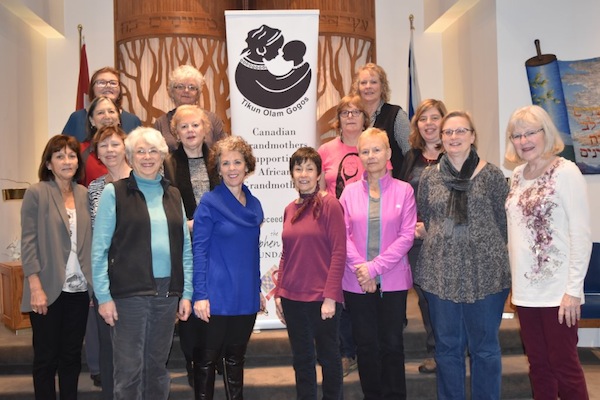
Henry herself got involved with the campaign almost by accident. “I was visiting my family in Kelowna,” she recalled. “We went to a farmers market and I saw those beautiful totes. The woman who sold them was a member of one of the Gogos groups. They made and sold tote bags to raise money for the foundation. I loved the idea. I found a group in Vancouver and joined it, but there was a problem. I was the only Jew in the group and, often, their meetings fell on the Jewish holidays, when I couldn’t attend. I decided to create my own Jewish group and, of course, I started with my synagogue, Temple Sholom. Everyone was very supportive. Our group, Tikun Olam Gogos, first met five years ago, in May 2011.”
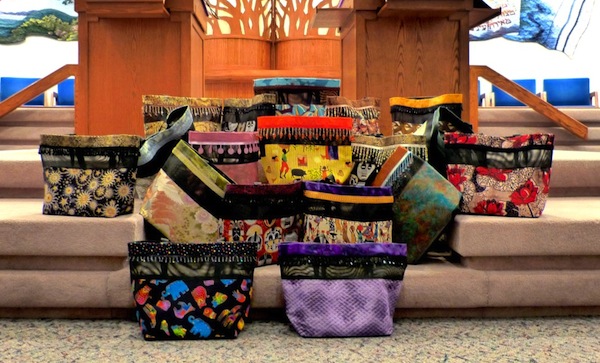
Currently, the group has 29 members, mostly retired women, some grandmothers themselves, others not. They meet once a month, discuss group business and create the kits for their totes. Several group members are experienced seamstresses who sew the totes of various sizes. Others apply their creativity to the trimmings and beads. Still others are good at sales. Everyone finds something to do that agrees with their personality and skill level.
The group’s tote bags are sold at craft fairs. To date, they have raised more than $120,000 for the Stephen Lewis Foundation. Many of their fundraisers include an entertainment program as well as a marketplace. The June 15 fundraiser is no different: it will feature the choir, under the direction of Brian Tate, and a marketplace of crafts by Tikun Olam Gogos, South Van Gogos, Welisa Gogos and Van Gogos, as well as a silent auction, wine bar and dessert. Tickets are available at eventbrite.ca.
Olga Livshin is a Vancouver freelance writer. She can be reached at [email protected].
Meeting new friends
It is hard to make new friends after you reach a certain age. Most people’s friendships date from childhood or college days, a work friend here and there. It is particularly difficult if tragedy strikes a family, but even when children leave home to start their adult lives, as they all must do, many women are left alone, unable to find a new niche. Circle of Friends, a relatively new program at the Jewish Community Centre of Greater Vancouver, addresses this problem.
Cori Friedman was instrumental in getting the program off the ground.
“In 2014, I was serving as the chairman of the [JCC] seniors committee. Being a widow myself, I recognized the need of single older women to combat loneliness,” she told the Independent. “There was a men’s group already established at the JCC with a much different format. With the cooperation of the committee, we were able to fulfil the need.”
According to Friedman, 14 women came to the first meeting, but attendance has grown significantly since then.
“The group started in September 2014,” recalled group facilitator Rebecca Porte. “The idea of forming such a group came from the knowledge that the transition following the loss of a spouse, whether by divorce or death, can be challenging. Often old friendships don’t fit as well, social engagements don’t carry the same meaning, and many aspects of life don’t have the same richness and fulfilment they once held. For women 55 and older, the question of where and how to foster their new meaningful social connections was a challenge.”
Circle of Friends became the answer to that challenge. “By now, I have about 75 people on our email list, those who have attended at least one of our meetings,” said Porte. “Since it is a drop-in program, the numbers that participate on any given week fluctuate, but generally it is between 15 and 30 at each meeting.”
She said there is a well-established Circle of Friends group in the Jewish community of Montreal. “They allowed us to use the same name,” said Porte, “and we have modeled much of what we do on their group.”
The JCC Circle of Friends meets every two weeks between September and June on Tuesdays, with the exception of Jewish holidays. The meetings start at 1 p.m. and last for about 90 minutes. “We usually have the first 15 minutes as social time: welcoming new members, introductions, announcements,” said Porte. “After that, there is about an hour of the main program – speakers, discussions, concerts by local artists, seminars, etc. Then another social time for 15 minutes before the meetings break up.”
The group is open to single women over 55, although some exceptions are made. “Most of us are not single by choice,” said Fran Goldberg, a member of Circle of Friends. “And a woman with a terminally ill husband could be very lonely sometimes. She often needs a place to relax, a time for herself.”
Every member of the group has a chance to suggest program themes and formats but, mostly, the programming is decided upon by the volunteer committee. “Six of our members serve on the committee,” said Porte. “They meet semi-regularly and put in some extra time and energy. They come up with ideas and we work together to create a balanced and interesting program. We want it to be relevant and have some level of opportunity for interaction.”
Circle member Cynthia Cherry said the programs include TED-type talks, movies and discussions, seminars on personal finances and nutrition, musical presentations, and more. “I joined the group at its start,” she said. “I had retired recently at the time and wanted to connect socially. I saw the ad at the JCC, dropped in, and liked it. I didn’t know anyone in the group then, but now some of us meet outside the Circle, [have] built new friendships.”
Another member, Lane Stein, said she came to the group after becoming a widow. “I enjoy the ladies and the programs. It’s something to do in the afternoon,” she said, mentioning that, since the beginning, several subgroups have branched out from the main one. There is a separate brunch group now, a travel group, and others in the works.
Porte has worked with the main group since its inception. “My role as facilitator is to help create the framework for each meeting and to facilitate the meetings to ensure that they are interactive, welcoming and run smoothly. In theory, the group could continue without a facilitator, but when I asked if they wanted me to stay, the group was quite adamant. They wanted me to keep doing it.”
The next meeting of the Circle of Friends will be held on June 14, 1 p.m. “We are going to visit the Queen Elizabeth [Park’s] Bloedel Conservatory,” said Porte. “We thought that an outing would be a great way to end our season. If the weather cooperates, we could make it a picnic. Then, we’ll pick up again in September.”
For more information, contact Porte at [email protected].
Olga Livshin is a Vancouver freelance writer. She can be reached at [email protected].
Connect yourself in
Are you Jewish and living outside of Vancouver? The Jewish Federation of Greater Vancouver wants to hear from you. Its Regional Communities Task Force has begun their work with a new survey to determine how best to engage Jews living beyond the borders of Vancouver, and they are asking you to respond.
From Whistler to Chilliwack, Federation wants to hear about the innovative and welcoming Jewish programs and services you – your friends and/or family – need close to your home.
The community is changing, with 46% of the Jewish community living beyond the borders of Vancouver, including many young families. They lack access to many Jewish community programs, services and institutions.
The fastest growing Jewish communities are Surrey/White Rock up 60%, Tri-Cities up 45%, Maple Ridge/Pitt Meadows/Langley up 23%.
Almost 25% of Jewish children live outside of Vancouver, and very few attend Jewish schools or camps.
A growing number of young families are intermarried and have limited or no connection to Jewish life.
Our strength as an entire community depends on our ability to embrace our diversity and to be flexible and innovative as we engage Jews in new and increasingly relevant ways. Take a moment to respond and to reach out to your friends, family and acquaintances for them to also take the survey at jewishvancouver.com/survey.

Following a noble pursuit
JustGreet allows customers to pick a greeting card online that will be mailed with a handwritten message of their composition. (photo by Sophia Hsin)
Vancouver-based JustGreet describes itself as “the cutest greeting card service on the internet.” The company’s model is unique in that it combines the convenience of online services with the meaningfulness of a handwritten and mailed greeting card. Founded just last year, the JustGreet team has already been nominated for a Small Business B.C. Award, being recognized in the best emerging entrepreneur category.
Creative director and Southern California native Lauren Berkman joined the startup after sensing its potential to fill a gap in the $30 billion greeting card industry.
“I really got my initial interest in startup life when I lived in Tel Aviv, Israel, an amazing hub of entrepreneurial ventures,” Berkman told the Independent. “While there, I worked for two tech startups, though after some time returned to the U.S. to work at an advertising agency, and then to Vancouver to complete my MBA at UBC. While at UBC, I completed an internship in market research, the main project of which was focused on JustGreet. While working on this research project, my interest was sparked by the simplicity of the service and the sentimental value greeting cards have held throughout my life.”
While people have come to rely on the ease that technology allows, Berkman said that JustGreet recognized that potential customers wanted something different from what existing online greeting card services were offering.
“The mainstream sentiment nowadays is that online communication is becoming increasingly noisy and impersonal – information fatigue is a mainstream sentiment,” she explained. “We realized that there was a big unaddressed opportunity to provide people and brands with a way to communicate that’s authentic and meaningful.”
Customers simply select a card from an online assortment and type a personalized message, then the JustGreet team takes care of the rest and the lucky recipient receives a handwritten card in their mailbox.
“That is the great thing about JustGreet. We are able to provide the best of both worlds – the convenience of technology in the ability to order a greeting card online but, ultimately, the same product ending up in the hands of the consumer had you gone to the store, picked the card out yourself, handwritten it, bought the stamps and put it in the mailbox,” said Berkman.
What sets JustGreet even further apart from many other companies is its commitment to ensuring its services are ethically and environmentally responsible. Each greeting card is printed on 100% recycled paper. Additionally, Berkman maintains that JustGreet would not exist without the community of independent artists who design the cards.
“Each artist is compensated directly with the sale of each card that features one of his or her designs. It is with this model that we have been able to attract such talented artists. We want to provide a platform in which we can help support our artists’ creative endeavors, and provide a mechanism to share their work with a larger audience. We are always welcoming new artists to the family, and love hearing from new ones who have interacted with our brand and want to get involved.”
As the company grows, JustGreet is working to allow its community of artists to grow as well. “We launched with 10 artists from the Vancouver area but just recently we had three join from the U.S. and one from South America,” said Berkman.
The addition of some artists from outside Vancouver is reflective of the company’s desire to reach customers beyond the city while maintaining a feeling of community.
“Greeting card tastes ultimately transcend borders and cities, so rather than view ourselves as a small local business, we would like to be seen as a community that supports its artists and consistently delights its customers, no matter how big it gets. As JustGreet expands, so does our community, and the variety of designs and inspiration we can offer to that community,” said Berkman.
Therefore, despite its potential for global growth, Berkman promises that JustGreet’s mission will always be “to help families, friends and loved ones stay connected in a way that gives people the personalization and sincerity they deserve.”
JustGreet’s initial local success was reflected in its 2015 Small Business B.C. Awards nomination. “We had only just launched when we were nominated for this award, so the fact that we were on anyone’s radar alone was very exciting,” said Berkman. “It’s a tremendous honor to be recognized amongst some of B.C.’s most promising new companies.”
She added, “In one year, we’d like to be able to say that we’re a fast-growing greeting card and stationery lifestyle brand with global online and wholesale operations. Our goals are pretty simple – create as many happy moments as we can and support the artists in our community. We think it’s a noble pursuit and our team is excited about it.”
Brittni Jacobson is a freelance writer living in Toronto.

Transit is a Jewish issue
For most Jewish-related services – cultural events, organizational meetings, day schools, high school, camps, Jewish social services – travel is required. (photo by Arnold C via commons.wikimedia.org)
Although there are multiple levels of government in Canada, it is often said, there is only one taxpayer. So it is frustrating to see necessary public policy delayed by intergovernmental squabbling.
This is what’s happening right now with plans for the future of transportation in Metro Vancouver. A year ago, area voters rejected a referendum proposal that would have seen increased taxes to fund better transit. Stagnation has been the status of transit policy since then.
In the budget tabled in March, the federal government ponied up $370 million for transit in the region.
Last week, the provincial government announced $246 million over a three-year period to improve bus and SeaBus service, purchase more SkyTrain cars and launch “initial work towards new major rapid transit in Vancouver and Surrey.”
The provincial minister in charge of TransLink, Peter Fassbender, said he expects Metro Vancouver municipalities to raise $124 million more, for a total of $740 million over three years.
Mayors of Metro municipalities have a grander scheme – to the tune of $7.5 billion over 10 years, which they would see funded through transit fare and property tax hikes, the sale of some TransLink property and more tolls on bridges and roads.
In this space, we are more accustomed to taking on manageable issues like Middle East peace rather than the seemingly intractable difficulties of moving residents of Metro Vancouver from one part of the region to another. But the issue of transportation is having serious ramification for Metro Vancouverites and things will only get worse if something nearly revolutionary doesn’t happen soon.
This has already had and will continue to have specific implications for ethnocultural communities, including the Jewish community. Real estate realities have driven successive generations of Jewish community members out of the erstwhile “Jewish neighborhood” of Oakridge, the heydays of which will be recalled in an upcoming exhibit of the Jewish Museum and Archives of British Columbia.
Reflecting trends that transcend cultural boundaries, home buyers have moved in concentric circles in recent decades, outward from the city proper, first across the bridges to Richmond and the North Shore, then further east and south. Nearly half – 46% – of Metro Vancouver’s Jews now live outside the city limits, with recent years having seen notable increases in the Jewish populations of Surrey/White Rock, the Tri-Cities and the areas of Maple Ridge, Pitt Meadows and Langley. While there are nodes of Jewish life in each of these locations, there is no doubt that, for most Jewish-related services – cultural events, organizational meetings, day schools, high school, camps, Jewish social services – travel is required.
The Jewish Federation of Greater Vancouver has long recognized the particular challenges of providing services to and maintaining cohesion among a community spread across a large geographic space. A recent effort, Connect Me In, is surveying Jewish British Columbians who live outside Vancouver and asking how the communal umbrella agency can serve their needs.
Federation is trying to provide services to people where they live so that it is less necessary to come “into the city.” Yet even the best laid plans well executed cannot erase the barriers of time and space between, say, Squamish and 41st and Oak. Moreover, the delivery of services where Jewish people live will still require some movement … from the core outward.
Maintaining cohesion within our community in such a situation depends both on the ability of our community agencies to respond to the needs, as well as the desire of suburbanites to maintain connection to the Jewish community. It also depends, in ways we should not underestimate, on the simple ability to move from Point A to Point B in the Lower Mainland. Transit is a Jewish issue.