Skip to content
  • Home
  • Subscribe / donate
  • Events calendar
  • News
    • Local
    • National
    • Israel
    • World
    • עניין בחדשות
      A roundup of news in Canada and further afield, in Hebrew.
  • Opinion
    • From the JI
    • Op-Ed
  • Arts & Culture
    • Performing Arts
    • Music
    • Books
    • Visual Arts
    • TV & Film
  • Life
    • Celebrating the Holidays
    • Travel
    • The Daily Snooze
      Cartoons by Jacob Samuel
    • Mystery Photo
      Help the JI and JMABC fill in the gaps in our archives.
  • Community Links
    • Organizations, Etc.
    • Other News Sources & Blogs
    • Business Directory
  • FAQ
  • JI Chai Celebration
  • JI@88! video

Recent Posts

  • Story of Israel’s north
  • Sheltering in train stations
  • Teach critical thinking
  • Learning to bridge divides
  • Supporting Iranian community
  • Art dismantles systems
  • Beth Tikvah celebrates 50th
  • What is Jewish music?
  • Celebrate joy of music
  • Women share experiences 
  • Raising funds for Survivors
  • Call for digital literacy
  • The hidden hand of hate
  • Tarot as spiritual ritual
  • Students create fancy meal
  • Encouraging young voices
  • Rose’s Angels delivers
  • Living life to its fullest
  • Drawing on his roots
  • Panama City welcoming
  • Pesach cleaning
  • On the wings of griffon vultures
  • Vast recipe & story collection
  • A word, please …
  • מארק קרני לא ממתין לטראמפ
  • On war and antisemitism
  • Jews shine in Canucks colours
  • Moment of opportunity
  • Shooting response
  • BC budget fails seniors
  • Ritual is what makes life holy
  • Dogs help war veterans live again
  • Remain vital and outspoken
  • An urgent play to see
  • Pop-up exhibit popular
  • An invite to join JWest

Archives

Follow @JewishIndie
image - The CJN - Visit Us Banner - 300x600 - 101625

Author: Rebecca Shapiro

Consider an African safari

Consider an African safari

In Livingstone, Zambia, visitors on the Jewish tour will see a church that used to be a synagogue. The Jewish population peaked in the late 1950s, to some 1,000 community members. (photo by Rebecca Shapiro)

“This guy came to stay, and asked to see the Jewish parts of town,” recounted Peter Jones, owner of the luxury Zambian hotel, the River Club. “I asked him to wait until the next day, then spent all evening swotting up on the area’s Jewish history.”
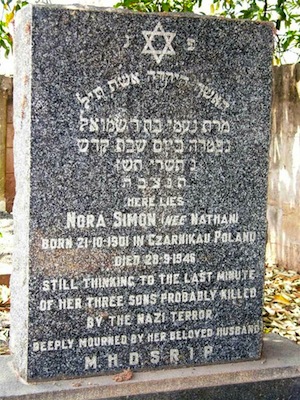
photo - The Jewish cemetery is on the Livingstone tour
The Jewish cemetery is on the Livingstone tour. (photo by Rebecca Shapiro)

Thus began Jones’ first Jewish tour of Livingstone, an historic town close to the mighty Victoria Falls. He led the guest around the country’s first synagogue (now a church), a small museum and the Jewish cemetery.

“He really took his time walking round,” Jones recalled. “I later found out he was a Holocaust survivor.”

That was 13 years ago, and Jones reckons he’s led about 100 Jewish tours since.

On a recent trip to the region, I was lucky enough to experience a tour for myself. Knowledgeable about all manner of local signs and monuments, Jones pointed out evidence of the town’s rich Jewish heritage that you’d never notice yourself – the faint outline of a Magen David beneath the old synagogue’s paintwork, the marks on a doorway where a mezuzah used to hang.

It seems appropriate, therefore, that his stunning riverside lodge is home to the first custom-built kosher kitchen in Livingstone’s tourism industry. The newly built facilities offer separate dishes for meat and milk, kosher food and customized meals for Orthodox guests. Jones pointed to an upsurge of Jewish tourists, particularly from North America, to explain why he sought mashgiach-approved status.

He’s not alone in noting the increased Jewish interest in the region: companies such as Sikeleli Africa Safaris have responded to it by creating luxury and bespoke “Jewish-friendly” itineraries.

This move made sense for the West Vancouver-based, family-run safari company, thanks to their longstanding Jewish ties to Southern Africa. I had the pleasure of spending time with the daughter, Danni, a Zimbabwean local whose Jewish grandfather held the esteemed position of mayor of Harare, the capital. She now works with many properties that cater to kosher tourists, including Zambia’s River Club, South African beachside hotel Prana Lodge and safari camp Makweti. These properties not only offer authentic safari experiences, but truly showcase the luxury available in all parts of Southern Africa.

For those who don’t keep kosher, the company’s options are, as you’d expect, more varied. This is partly because the safaris are fully customizable, but also because locations on offer include so much more than just South Africa’s renowned Kruger National Park.

photo - The sun sets on a safari in Zimbabwe’s Hwange National Park
The sun sets on a safari in Zimbabwe’s Hwange National Park. (photo by Rebecca Shapiro)

Safaris in Namibia can be unique. Very much off the beaten track, the arid country is home to two great deserts, the world’s tallest sand dunes and a fascinating multicultural character. A whole host of luxe camps have popped up there in recent years, and they’re the perfect place to both spot the black rhino on foot, and explore a country to which very few people venture.

So, why the increased Jewish interest in Zambia and Zimbabwe? After all, it’s obviously easier to be a Jewish traveler in South Africa than in the surrounding countries. Johannesburg boasts the largest Jewish population in the country, while Cape Town has an impressive range of kosher facilities. There are also Jewish communities to be explored in Durban, East London, Plettenberg Bay and Port Elizabeth. The Chabad presence throughout the area is as useful as it is widespread, but the cultural sights themselves form a real highlight. Don’t visit the country without visiting the Jewish Museum in Cape Town (it’s close to South Africa’s oldest, grandest synagogue), and do leave time for visiting Kleine Draken, the only winery in South Africa dedicated exclusively to kosher and mevushal wines.

From a personal and Jewish perspective, however, I found traveling to lesser-known countries to be infinitely more satisfying. This was thanks to the Jewish scene’s intimate feel there. Jews originally settled in Zambia and Zimbabwe from the late 1800s, as a result of pogroms in Russia, and later to flee persecution in Nazi Germany and antisemitism in South Africa. Numbers peaked in the late 1950s in Zambia and Zimbabwe, at 1,000 and 7,000, respectively. Since then, despite mass immigration to Israel and the West, Jewish life hearteningly continues. In Zimbabwe, for instance, Harare contains both a Sephardi and an Ashkenazi synagogue, but because the city now has fewer than 100 congregants, the prayers alternate between the two.

But, traveling in countries such as these is also more feel-good because of tourism’s boost to the economy. Many Zimbabwean camps have fantastic initiatives. Staying at a Wilderness Safari camp, for example, helps support nutrition programs for primary school children. At Miombo, a personal favorite, you can visit the Iganyana Arts Centre, where local artisans create gorgeous crafts out of recycled materials. Likewise, a trip to the River Club provides opportunities to contribute to social development projects in the village, including renovating water supplies and building libraries, as well as to take stunning river cruises, with hippo or crocodile sightings likely.

I should stress, however, that visiting Zambia or Zimbabwe doesn’t just benefit others – it provides you with the most exclusive, unparalleled safari experience. The game is abundant – Cecil the Lion’s pride strolled past my tent in Davison’s Camp – the scenery is phenomenal and the drivers are incredibly knowledgeable. There’s also a wealth of interesting attractions nearby, such as Great Zimbabwe, a former city that houses the largest collection of ruins in Africa south of the Sahara. Oh, and according to Sikeleli, a safari in Zimbabwe costs just one-sixth of the price of one in neighboring Botswana.

photo - A lion relaxes in Zimbabwe’s Hwange National Park
A lion relaxes in Zimbabwe’s Hwange National Park. (photo by Rebecca Shapiro)

On top of that, the countries offer such sincere hospitality that you can’t fail to be impressed – luxurious Linkwasha Camp provides kosher food on request in the middle of the bush, while Vintage, a back-to-basics Zimbabwean camp with no running water, still manages to cater to everything from vegan to gluten-free.

And did I mention that Victoria Falls, the waterfall that separates the two countries, is a UNESCO World Heritage Site and natural wonder of the world? You have to see its beauty and hear its roar to really understand just how magical it is. But, until then, just trust me that, from any perspective, but particularly a Jewish one, venturing to Zimbabwe or Zambia on a safari is unforgettable.

Sikeleli Safaris runs Jewish safaris for families, couples and congregations alike. Though fully customizable, accommodation tends to be in luxury lodges and hotels in Zambia and South Africa. Prices start from approximately $6,000, excluding commercial flights and dependent on season and group size. The itinerary can be amended and can start in either Lusaka, Zambia or Cape Town, South Africa. Danni at Sikeleli Safaris can be contacted at [email protected] or by phone at 26-378-279-9697.

Rebecca Shapiro is associate editor of vivalifestyleandtravel.com, a travel blogger at thethoughtfultraveller.com and a freelance journalist published in Elle Canada, the Guardian, the Huffington Post and more. A Londoner by birth, she’s lived in Shanghai and Toronto, but is currently (and happily) settled in Vancouver.
Format ImagePosted on September 23, 2016September 21, 2016Author Rebecca ShapiroCategories Travel, WorldTags Africa, safari, Zambia, Zimbabwe
Tower of David a must-see

Tower of David a must-see

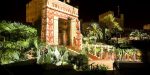
A scene from Migdal David’s The Night Spectacular: the Queen of Sheba with her entourage. (photo by Amit Geron)

While growing up in the United States, my friends and I never seemed to tire of asking each other, “Who is the Lincoln Memorial named after?” and “Who is buried in Grant’s Tomb?” The point of asking these silly questions seemed to be their obvious answers. When you grow up, however, you learn that the truth is not always so clear. Take, for example, Jerusalem’s Tower of David, also called David’s Citadel. King David, for whom it is apparently named, had nothing to do with the tower or any other part of this historic structure.

The tower is actually part of a medieval fortress that contains architectural additions from later periods. It is located near Jerusalem’s Jaffa Gate, which is the most trafficked entrance to the Old City. The tower is so well-recognized, it appears emblematically in countless Jerusalem paintings and photographs.

Early Byzantine Church fathers misinterpreted Josephus Flavius’ writings, ascribing the Tower of Phasael, from King Herod’s time, to King David. To further complicate the issue, Muslims also associated the Herodian tower with King David. They named their mihrab (prayer niche) Nabi Daud, David the Prophet. Later still, 19th-century Western Christians labeled the Turkish minaret added to the Mamluk mosque the Tower of David. This wrong name is what the tower is still called.

Tower of David Museum’s mission, in contrast, has evolved over time and various administrations. When the museum first opened in 1989, the aim was to present Jerusalem in all the years of its existence. Today, that is still a large part of the museum’s objective, but staff now creatively focus on familiarizing the public with the building complex’s amazing and lengthy physical presence. No easy job in an historic structure bound by preservation guidelines, in a city that has supreme importance to several of the world’s major religions and dates back to the second millennium BCE.

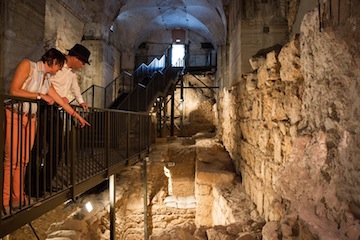
One of the new must-see additions is the Kishle. The discovery of the Kishle – when the Turkish Ottomans built a prison there in the mid-1800s, the Kishle referred to soldiers’ barracks – was accidental, but the follow-up to this archeological find has been careful and meticulous. What has recently been opened to the public is a continuous cut-away, or time line, of Jerusalem. The excavations reveal Jerusalem from as early as the sixth century BCE. It likewise shows walls from the time of King Herod – some of Herod’s huge building stones from the last quarter of the first century BCE are also still in place to the right of the museum’s main entrance by Omar Ibn El-Khattab Square – as well as evidence from the Middle Ages. Of particular importance is the discovery of a wall from the First Temple period, which adds to our knowledge about the city wall’s ancient route. Walking outdoors to the Kishle exhibit is an adventure in and of itself, as visitors traverse a dry moat that surrounds the Citadel. Also outdoors are finds going all the way back to the Second Temple period.

photo - Excavations of the Kishle
Excavations of the Kishle. (photo by Oded Antman)

The museum makes an effort to present Jerusalem from a variety of angles. Take, for example, the current temporary exhibit, Camera Man. In this wonderful photo display, we are able to see Jerusalem over 50 critical years of existence, a time in which its rulers switched hands three times, from Turkish rule to British rule to state of Israel rule. But the beauty of this show is that it zeroes in not on the wheeler-dealers of these various administrations, but rather on the daily life of the average Jerusalemite.

Relatedly, the museum seeks ongoing public involvement. Hence, it has taken two rather bold steps: it has taken part of the Camera Man exhibit out of the museum complex, mounting some of the photos in the centre of town, in close proximity to busy Machane Yehuda Market. A second significant step – that dynamically changes the exhibit, even as it is being shown – relates to the museum’s invitation to Jerusalem residents to send photos from their own family albums. Thus, with this participation, the exhibit is frequently being updated.

But the museum has not limited itself to just presenting Jerusalem’s history through photography. In the past year, it has gone digital in a big way. Families with elementary school-age children may now pay a small additional fee to tour the museum with enhanced iPad technology. In the Hebrew version of the award-winning Swipe the Citadel – an English version is in the pipeline – the family joins in the search for an archeologist’s young missing daughter. The virtual family and the real visiting family travel through the museum’s many old stone corridors looking for the girl. At the end of the adventure, virtual father and child are reunited, and visitors have been exposed to Jerusalem’s long and amazing history. There are currently six other apps for improving the on-the-grounds museum experience, including a digital detective game to discover who built the tower. A preview of what is available can be seen at tod.org.il/en/todigital.

The museum is always thinking of new ways to reach families. With this in mind, it has started hosting a new outreach program that allows families with children with special needs to participate as a family unit. The whole family attends and each member of the family engages to the extent to which he or she can. The museum already has a quiet room and a time-out room, and has been consulting with specialists to further develop meaningful family experiences.

While the Night Spectacular is an established program for Jerusalem tourists, readers might not know that there have been incredible outdoor evening concerts in the museum complex. These concerts have varied, from large events of hundreds of people listening to classical music, to smaller events of international liturgical music.

In the past, Tower of David Museum has hosted some incredible events for Jerusalem’s ethnically diverse population. For example, in 2000, Washington state artist and craftsman Dale Chihuly put this question to the people of Israel: “What’s incredibly hard to make, but all too easy to break?” Through his installation at the museum, Chihuly showed there is more than one way to solve this riddle, but his simple, yet thoughtful, answer was: “glass and peace.” The artist has donated some of his work to the museum.

While there may be a question about the museum’s name, there is no question you have to check it out the next time you are in Jerusalem.

Deborah Rubin Fields is an Israel-based features writer. She is also the author of Take a Peek Inside: A Child’s Guide to Radiology Exams, published in English, Hebrew and Arabic.

Format ImagePosted on September 23, 2016September 21, 2016Author Deborah Rubin FieldsCategories Israel, TravelTags Israel, museums, technology
Where David fought Goliath

Where David fought Goliath

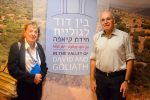
The author, Sybil Kaplan and Prof. Yosef Garfinkel at the opening of the exhibit In the Valley of David and Goliath, now at Bible Lands Museum in Jerusalem. (photo by Barry A. Kaplan)

“As the Philistine moved closer to attack him, David ran quickly toward the battle line to meet him. Reaching into his bag and taking out a stone, he slung it and struck the Philistine on the forehead; the stone sank into his forehead, and he fell face down on the ground. So, David triumphed over the Philistine with a sling and a stone; without a sword in his hand, he struck down the Philistine and killed him.” (1 Samuel 17:48-50)

Most of us have read or heard the story of David and Goliath, and some of us have even visited where the battle took place. But now we all have the chance to learn more. On Sept. 5, In the Valley of David and Goliath opened at Bible Lands Museum in Jerusalem. Presented to the public for the first time, the exhibit will be on display until September 2017.

Khirbet Qeiyafa (Fortress of Elah), 20 miles southwest of Jerusalem, on top of a hill overlooking the Valley Elah, was excavated by Prof. Yosef Garfinkel from 2007 to 2012. Garfinkel is the Yigael Yadin Chair in Archeology of Israel at Hebrew University and director of excavations at Khirbet Qeiyafa.

This fortified city was across from Gath, the Philistine city where Goliath lived when he came out to face the Israelites. The evidence indicates that the city was a military outpost for the House of David. In David’s day, the Valley of Elah served as a neutral zone between the Israelites and the Philistines. Excavators discovered a large cache of weapons in Qeiyafa, which Garfinkel identifies as “an area of conflict between two political units.”

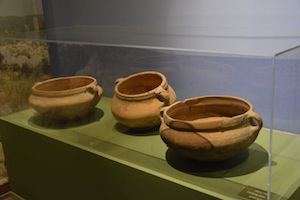
photo - Cooking pots were among the many items on display
Cooking pots were among the many items on display. (photo by Barry A. Kaplan)

Based on carbon-14 dating performed on 28 olive pits, archeologists believe the city lasted from 1020 to 980 BCE. Items found at the site strengthen the connection to King David and religious practices described in the Bible. As well, according to Garfinkel, this Iron Age town was described in the Bible as the location of the battle between David and Goliath 3,000 years ago.

In an interview with Erin Zimmerman for CBS News in 2013, Garfinkel maintained that Khirbet Qeiyafa was a Jewish city for four reasons.

“It has a big casement city wall and houses abutting the city wall,” he said. “This is known from four other sites, so now we have five sites. All these five cities are in Judah, none of them is in Philistia. This is really typical Judean urban planning.”

Second, the bones found in the city all come from kosher animals.

“We have sheep, goat, cattle, but we have no pigs and no dogs,” he said. “On the Philistine side, they consume pigs and also dogs. Up to 20% of the animal bones at Philistine sites are pigs, but here, nothing.”

And, according to Garfinkel, a found pottery shard, also known as an ostracon, is the earliest example of Hebrew writing ever unearthed. On it are written commandments to worship the Lord and to help widows, orphans and slaves.

“It started with the word ‘al ta’as,’ which means ‘don’t do,’ and ‘ta’as,’ ‘to do,’ is only in Hebrew. It’s not Canaanite and not Philistine,” he explained.

Finally, Garfinkel said the absence of idols – which would have been in abundance in other places – points to a Jewish city.

“If you go to Canaanite temples of the Late Bronze [Age], you will find a lot of human and animal figures, but not in Khirbet Qeiyafa. So, the people here really obeyed the biblical taboo on graven images,” he said.

Garfinkel pointed out that, “in the absence of idols, there were religious shrines, and the models predate Solomon’s Temple by about 40 years, yet they match the Bible’s description of the Temple, down to the triple-framed doors. They’re the first physical evidence of Jewish worship in the time of King David.”

Part of the exhibit at the Bible Lands Museum are the two inscriptions that were found – one on a jar and one inscribed with ink on a pottery shard – which contain the distinctly identifiable Hebrew words for “king,” “don’t do” and “judge.”

Among the other objects on display are storage jars, water basins, a model of a house, hundreds of pottery vessels, jar handles with finger impressions, cooking pots and jugs, and the bowl that contained the olive pits.

Most amazing is a stone model shrine, which reflects a Mesopotamian architectural-style before the era of King David, but which probably inspired the look of the palace built by Solomon, David’s son. Features of the model are mentioned in biblical references to King Solomon’s Temple, built decades later.

For Hebrew-speakers traveling to Israel in the near future, exhibit curators will be giving behind-the-scenes tours in Hebrew on Oct. 7, Nov. 11 and Dec. 16.

Sybil Kaplan is a journalist, foreign correspondent, lecturer, food writer and book reviewer who lives in Jerusalem. She also does the restaurant features for janglo.net and leads walks in English in Jerusalem’s market.

Format ImagePosted on September 23, 2016September 21, 2016Author Sybil KaplanCategories Israel, TravelTags archeology, Jerusalem, Khirbet Qeiyafa, museums
Jerusalem’s French aspects

Jerusalem’s French aspects

Salt print of Adolphe Crémieux, December 1856, by Nadar (1820-1910), from the J. Paul Getty Museum. (photo from Wikimedia Commons)

While Jerusalem’s French connection thankfully lacks the violence and crime of the 1971 movie by the same name, both the film and real-life “French” Jerusalem have one thing in common: both expose us to off-the-beaten-track sites. Take a look at what you’ll find in Jerusalem.

The Israel Museum (11 Ruppin Blvd.) has amazingly reassembled an original 18th-century French salon called the Rothschild Room. (All that’s missing is the fancily dressed smart-set listening to a book or music recital.) It also has an impressive collection of French impressionist and post- impressionist painters, such as Pierre-Auguste Renoir, Camille Pissarro, Edgar Degas,

Alfred Sisley, Claude Monet, Paul Cézanne, Paul Gauguin and Henri de Toulouse-Lautrec, as well as works by earlier French artists such as François Boucher.

Speaking of paintings, 120 years ago, Count Marie Paul Amédée de Piellat painted Crusader-related images on the wall of what is today known as Jerusalem’s French Hospice, a non-denominational facility for the terminally ill. Painted in fresco-style, they were recently uncovered during a routine repair.

First built some 130 years ago as St. Louis Hospital – after the same King Louis IX who was responsible for broadening the Inquisition and burning Talmuds – it stands at 2 Shivtei Yisrael St. Around the corner from the hospice is the Romain Gary French Institute of Jerusalem, which promotes French culture by means of French-language courses, a French-language library and a media and entertainment space.

Romain Gary was a Second World War pilot, French diplomat and filmmaker, but was best known for his prolific writing. He won literary prizes using various pen names. Born to Jewish parents, his mother had him baptized a Catholic. Oddly, he had a large menorah at the foot of his bed when he shot himself dead.

Jerusalem’s Ratisbonne Monastery – built in the late 1880s, in Rehavia, 26 Shmuel HaNagid St. – is named after two French Jewish brothers who converted to Catholicism and made it their mission to have Jewish children follow in their “way.” Just before Israel declared statehood, 60 children from Kfar Etzion were safely evacuated to the monastery before the kibbutz fell. Most of the kibbutz defenders, however, were killed in the fighting. During the period in which the Jordanians blocked Hebrew University’s Mt. Scopus campus, the Ratisbonne Monastery served as the school’s law faculty.

Today, the monastery is an international theological school for those studying for the Catholic priesthood.

Several Jerusalem streets are named after French personalities who were either themselves Jewish or had connections to Jews. Centrally located Emile Botta Street is named after the French consul in Jerusalem during the Ottoman rule. The 90-year-old Pontifical Biblical Institute stands on this street. This facility has been in the news lately, as an Egyptian mummy belonging to the institute is currently on exhibit at the Israel Museum.

Emile Zola Street in the German Colony honors the outspoken journalist who defended Captain Alfred Dreyfus’ innocence. In a Jan. 13, 1898, letter (J’accuse!) to the French president, Zola publicly charged the French government and army with suppressing the true story behind Dreyfus’ arrest. Zola himself paid a high price for his bravery; he fled to Britain to avoid prison, only to die there suddenly and suspiciously from carbon monoxide poisoning.

Located near Emile Zola Street is Adolphe Crémieux Street. Crémieux was a Jewish lawyer, statesman, staunch defender of human rights (both of Jews and slaves) and the founder, in 1860, of the Alliance Israélite Universelle; four years later, he served as its president. Unfortunately, the Alliance vocational school no longer stands, but you can still see approximately where the gate was on Jaffa Road, in front of the site’s successor, the Clal Building.

Crémieux did much to better the conditions of the Jews in France. In 1827, he advocated the repeal of the Oath More Judaico, a piece of stigmatizing legislation left over from pre-revolutionary France. Crémieux apparently brought about the abolition of the oath when he defended Rabbi Lazard Isidor. The rabbi – who went on to become France’s chief rabbi – had refused to take the antisemitic oath and was charged with contempt of court. Crémieux got him acquitted. On March 3, 1846, the French Supreme Court finally declared the oath illegal.

Crémieux was likewise involved in defending Saratov (Russia) Jews facing charges of blood libel. For his instrumental assistance in bringing about the end to slavery in the French colonies, Crémieux was nicknamed the “French Abraham Lincoln.”

In recent years, Crémieux Street drew significant attention when police investigated former prime minister Ehud Olmert for the suggested favorable terms he received on the purchase of a home on this street, in exchange for help rendered to the contractor who sold it to him. The National Fraud Unit ultimately advised that there was not enough evidence to proceed with criminal charges against Olmert in the “Crémieux Street affair.”

Frederic Chopin Street is named for the well-known, Polish-born, French composer and pianist. Probably not coincidentally, this Talbiya street is the site of the Jerusalem Centre for the Performing Arts. Six halls serve as regular venues for music and dance concerts, dramatic performances and films.

Located in an ultra-Orthodox neighborhood, Estori Haparhi Street is named after the first topographer of the land of Israel. Haparhi’s family lived in Provence, but was expelled from France, along with the rest of the medieval Jewish population. Following this expulsion, he made aliyah and frequently preached the necessity of settling in the Holy Land. While making his living as a doctor, he wrote a book citing the biblical and halachic borders of Israel. He claimed that the Arabic names of numerous towns and villages reflected their Jewish textual names.

Speaking of medieval France, the Jerusalem municipality named three Mekor Baruch neighborhood streets after medieval Jewish scholars, Rashi and his two grandsons, the Rashbam and Rabenu Tam.

Neve Yaakov’s Gamzon Street recognizes the French resistance work of Robert Gamzon. In wartorn France, he set up an underground for issuing false identities to children and young adults. With these papers, they were able to escape France. Gamzon went on to fight in Israel’s War of Independence and to do research at the Weizmann Institute.

Talpiot’s Marie-Pierre Koenig Street commemorates the bravery and leadership of the French general who headed the Free France forces in the Second World War and took part in the D-Day landing. During the war, Koenig let members of the Jewish Brigade fly the blue and white flag, in defiance of British orders banning such action. Even after becoming the French minister of defence, Koenig remained an advocate of the new state of Israel.

For a general understanding of how the Holocaust affected French Jewry – including the critical assistance provided by French Jewish underground workers – plan a physical, or at least a virtual, visit to Yad Vashem (yadvashem.org). France’s recognition of Jewish defence was short-lived, however. Following the Six Day War, France embargoed its Mirage fighter jet. This forced Israel to develop the Kfir jet, and a street named HaKfir reflects Israel’s decision to go blue and white.

Deborah Rubin Fields is an Israel-based features writer. She is also the author of Take a Peek Inside: A Child’s Guide to Radiology Exams, published in English, Hebrew and Arabic.

Format ImagePosted on September 23, 2016September 21, 2016Author Deborah Rubin FieldsCategories Israel, TravelTags France, Israel, Jerusalem, tourism
Saga of hunting Nazis

Saga of hunting Nazis

Andrew Nagorski will talk at the Vancouver Holocaust Education Centre on Nov. 29, as part of the Cherie Smith JCC Jewish Book Festival. (photo by Andrew Rudakov)

The night before the legendary operation that captured Adolf Eichmann, Isser Harel, the head of Mossad, Israel’s intelligence agency, told the small cadre of men set to accomplish one of the most storied espionage missions ever: “For the first time in history, the Jews would judge their assassins.”

Harel articulated the historical momentousness of what was, in reality, a surprisingly mundane capture. Eichmann, one of the foremost masterminds of the Holocaust, had been living in Argentina under an assumed name but, apparently confident of his security, had sloppily left breadcrumbs that allowed professional and avocational Nazi hunters to track him down. Eichmann was also a creature of habit, descending from the bus each evening near his suburban home reliably around the same time. For an action with such monumental consequences, the capture was barely more dramatic than a typical mugging.

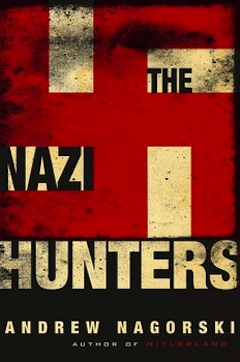
book cover - The Nazi HuntersThe story of Eichmann’s capture, extra-judicial extradition to Israel, trial and execution is retold in The Nazi Hunters, a book by author and former Newsweek journalist Andrew Nagroski, who will be in Vancouver this fall as part of the Cherie Smith JCC Jewish Book Festival.

Harel’s words to the agents who captured the SS leader apply not solely to the Nazi hunters’ greatest catch, but to the larger phenomenon of the quest to bring the perpetrators of the Shoah to justice. The concept of the Jewish people being in a position to judge those who perpetrate antisemitic terror is a uniquely post-Holocaust phenomenon, made possible because of the existence of the state of Israel and its judicial and intelligence mechanisms.

At the same time, hunting down Nazi war criminals was not a priority of the young state of Israel, as a senior Israeli official told Nagroski. Israel’s early governments had plenty on their plates coaxing a country from the desert and looking to the future without devoting resources to tracking down the Hamans of the recent past.

As a result, as Nagorski illustrates engagingly, pursuing the perpetrators fell to an assortment of figures, some official, others self-appointed, who made up a curious collection of personalities.

There were the government investigators and prosecutors, like Fritz Bauer, a German jurist whose attention to Nazi war crimes helped the German people confront and address their past. But others among the most famous Nazi hunters, including Simon Wiesenthal and Tuvia Friedman, were lone wolves (or, at least, started out that way before recruiting their teams) to do the job that governments did not.

The Nuremberg trials, Nagorski notes, were crucial not only for bringing Nazis to justice but in helping create the initial repository of eyewitness testimony and the first draft of what would become Holocaust history. Even so, after that major initiative, which captured the attention of the world and set the Holocaust apart as an event concurrent to but separate from the broader carnage of the Second World War, official interest in the subject waned.

Europe was rebuilding, Israel had plenty of challenges, the countries of the Soviet-dominated Eastern bloc were happy to distance themselves from the events of the Shoah by imagining their socialism as the diametrical ideological opposite of the fascism that had nearly erased Jewish civilization in Europe. Canada, the United States and other Allied countries began looking ahead to a cold peace and the economic prosperity of the 1950s, the sad past being something best left behind.

Thus, it fell to some self-appointed individuals to do the work. This book shares their often gripping, diverse and idiosyncratic stories.

A rise in Holocaust denial during the 1970s spurred a renewed attention to the facts of the Holocaust. A new urgency was driven both by the need to remind the world of the truth but also the reality that time was running out to bring the perpetrators to justice.

Posted on September 23, 2016September 21, 2016Author Pat JohnsonCategories BooksTags Holocaust, Mossad, Nazi hunters, Nazis
Should God be put second?

Should God be put second?

For Donniel Hartman, putting God second is a way of maintaining a religious life and faith in God, but without God undermining our responsibility to our fellow human beings. (photo from Donniel Hartman)

Donniel Hartman, an Orthodox rabbi and president of Jerusalem’s Shalom Hartman Institute, an educational powerhouse dedicated to invigorating Judaism, has recently published his second book. It is called Putting God Second: How to Save Religion from Itself (Beacon Press, 2016).

“Religious people very often argue that religion is fine and that the only problem is that religious people are flawed and are distorting our religious life,” Hartman told the Independent. “Yet, the people who harm, maim and hurt in the name of religion come armed with chapter and verse. They seem to be quite accurate about their religious life. And atheists make similar arguments. The only problem with atheists is they seem to get something wrong as well; they argue that there’s nothing valuable in religion.”

Hartman thinks there is something missing in this discourse, which he explores in this book: queries like, what about religion can be powerful, profound and constructive, and might the issue simply be that people are getting it wrong?

“The idea that I was testing for 10 years – that was researched, taught about and thought about – was that religion suffers from an internal autoimmune disease wherein it attacks its own goals,” said Hartman.

“Religion has noble goals,” he contends, and is not only a source for evil, as some atheists say. “I think religion is, in fact, trying to produce kind individuals. There’s something inherent within the system, which can cause it to underachieve and fail to meet its aspiration. In short, the cause of that autoimmune disease is God – in particular, when God is put first.

“The idea is that monotheism creates a being of such transcendence and scope that when God enters the room, it shifts the human consciousness away from their moral responsibility for other people.”

book cover - Putting God SecondFor Hartman, putting God second is a way of maintaining a religious life and faith in God, but without God undermining our responsibility to our fellow human beings.
“This one transcendent God is something that I feel human beings have great difficulty assimilating into their system, into their lives, and that God has a potential to warp our consciousness,” said Hartman. “I call it ‘God intoxication,’ wherein everything else becomes unimportant.

“It’s the encounter with God that can create this distortion. Who is more important, a human being or God? Human beings will again distort that message because, when it gets instilled into their minds, what can possibly be more important?

“We see religious people, in the name of faith, harming, judging and insulting people, showing a lack of tolerance, pluralism – the same people who could, in their everyday lives, act decently, kindly. The minute religion is in the equation, there’s potential for it to get distorted,” he said.

“God intoxication is not a flaw within religion, it’s embedded in the idea of monotheism. Some people argue we should get rid of God. My book tries to reestablish a life of faith. It doesn’t say to get rid of God or to put God 14th or 15th. At the end of the book is when you put God second, but you put God’s will first toward developing a religious life with God that immunizes us from this autoimmune disease.

“One of the essential concepts in the book,” he continued, “is how you treat other human beings – this being the core of how we assess the value of our lives. I think there is a very profound spreading of faithlessness precisely because of the consequences of what God seems to bring to humankind. My goal in putting God second is to help more people establish a deeper relationship with God, one with a God they can respect…. If God needs to be first, people feel it’s a God they don’t want to believe in. I believe that the language of putting God second is what will enable a language of faith to be far more pervasive within our modern community and the modern world.”

Hartman hopes that Putting God Second will reach a diverse readership. “The target audience,” he said, “is thoughtful people searching for a decent world and a meaningful religious life, and I hope this book will be conducive to moving us in the right direction. Most importantly, I like to help people and, if this book is too upsetting for you, just put this book second, it’s not meant for you…. I hope there’s a broad range of people that, through this book and this religious language, can try connecting with it, both with God and with their tradition.”

Hartman, who was born in the United States and spent 11 years in Montreal, is currently working on a Hebrew translation of the book.

Rebeca Kuropatwa is a Winnipeg freelance writer.

Format ImagePosted on September 23, 2016September 21, 2016Author Rebeca KuropatwaCategories BooksTags Judaism, religion
Did Franz Kafka have a son?

Did Franz Kafka have a son?

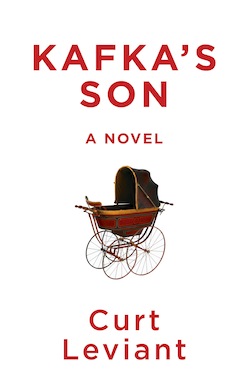
Before you begin reading Curt Leviant’s latest novel, Kafka’s Son (Dzanc Books, 2016), you are confronted with a curious bit of information. There are a dozen quotes from French reviews before the title page. Why? Because the book first appeared in French translation a few years ago before its publication earlier this year in the original English, and garnered incredible reviews. One reviewer on French national TV called Kafka’s Son “a work of genius.”

Kafka’s Son is a roller-coaster ride of a novel that is a mystery, travelogue, love story, literary analysis (Metamorphosis as comedy) and, most important, a challenge to our sense of historical timelines.

As our narrator meets one memorable character after another, the action rushes forward until the last page, which will astonish and surprise the narrator and delight the reader.

The big question is, did Franz Kafka have a son?

Leviant opens the novel with no fewer than seven beginnings, and concludes with an equal number of endings.

Beginning #1 is a nod to Herman Melville and Moby Dick: “Call me Amschl. All right, so don’t call me Amschl. Nobody does anyway. Except when I’m called up to the Torah by my Hebrew name: Amschl ben Moshe.” He is our narrator.

Beginning #2 tells readers they are entering a world where imagination and suspension of disbelief will launch them on a great adventure: “This is a true story. True story!? Humbug…. Either a narrative is true or it’s a story. It cannot be both. Period. End of story.”

Let me unfold the plot just enough to get you started. Giving you too many details will spoil the fun. You will want to be puzzled, startled and enlightened as you travel along with our questing narrator.

Amschl, a documentary filmmaker, is prompted by an elderly Czech Jew he meets in Eldridge Street Synagogue in New York to go to Prague and make a film about the true history of his idol, Kafka.

book cover - Kafka’s Son Everything seems possible in Prague, a mystical city. With camera in hand, he visits the oldest synagogue, Altneuschul, where the legendary Golem is said to be asleep in the attic. Another character says he survived the German invasion in that same attic.

Amschl’s other encounters include a man with a “golem’s” face; the old beadle of the synagogue who insists there never was an attic; Katya, the beautiful girl in the blue beret who knows more than she tells our narrator, agrees to go to a concert with him and then disappears for a spell; a man who swears he is Kafka’s son and then he too disappears; and the enigmatic Mr. Klein, who does not disappear.

Mr. Klein becomes a companion, but raises additional questions. His very high energy level and obvious old age is puzzling. Katya reappears and leads our narrator to a synagogue not listed in the Jewish sites brochure, where he spots Mr. Klein praying quietly. The plaster lions guarding the holy ark leap off and come alive. Amschl is both frightened and frustrated because he does not have his camera to record this fantastic scene. Katya and Mr. Klein share knowing glances and a few words to add to the puzzle.

“The whole thing didn’t make sense” to Amschl but he plods on hoping to clear up one implausible “fact” after another. At one point, the absurdities pile up and he thinks, “It reminded me of what I learned in geometry, maybe algebra: multiply two negative numbers and you get a positive…. You add up two absurds and get one truth.”

The puzzle is compounded by the fact that all of these characters are breathing, rational, real people. Along with our narrator, you want to believe them. You will also note that most of them have a “K” beginning their first or last name.

The narrator keeps moving forward, looking for the breakthrough, and takes the reader, who becomes a willing partner on this whirlwind journey, to the startling ending I promised in my third paragraph.

Kafka’s Son is a superb novel that can be enjoyed on many levels. It keeps you guessing and turning pages to uncover the truth, and I agree with the French reviewer from Lire, a leading literary journal, who is unequivocal in his praise: “As to whether Kafka had an heir, the answer is obvious. His name is Curt Leviant.”

End of story!

Sidney Kessler, z”l, was a freelance writer in Glen Allen, Va. His articles appeared in the Wall Street Journal and the Richmond Times-Dispatch, among other publications.

Format ImagePosted on September 23, 2016September 21, 2016Author Sidney KesslerCategories BooksTags fiction, Kafka, Leviant
From cardboard to folktales

From cardboard to folktales

Books can take you to the most captivating places. Not always happy places, but places worth exploring, places where the people, environment, challenges and culture are different. A place you can have adventures, learn from what has happened to others or just escape from your daily routine, all for the relatively low price of a book. Oh, and maybe a cardboard box.

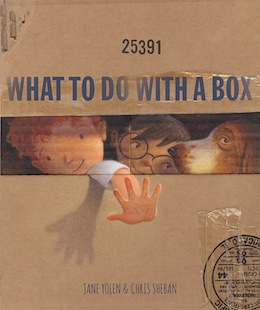
book cover - What to do with a BoxThe beautifully and creatively illustrated What to do with a Box (Creative Editions, 2016) features the rhythmic writing of Jane Yolen and the inspired art of Chris Sheban. The book is a tribute to the power of the imagination – a way to impart to the younger set that fun doesn’t necessarily need batteries. It’s also a reminder to parents that expensive toys aren’t at the root of what makes playtime enjoyable, and they may even be enticed to join their kids in a cardboard box adventure – if they’re invited to come along, that is.
The writing is simple, as it is for most picture books. That box, “can be a library, palace, or nook,” or a place you can “invite your dolls to come in for tea”; it can be a racecar, a ship, and so much more. And the art by Sheban looks as if he took Yolen’s advice: “You can paint a landscape with sun, sand and sky or crayon an egret that’s flying right by.” It is described as cardboardesque and, indeed, it looks as if he drew the illustrations on different types of boxes.

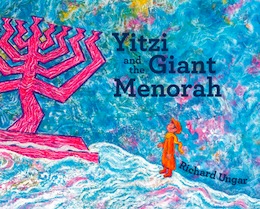
book cover - Yitzi and the Giant Menorah For slightly older readers (or listeners), Richard Unger has written and illustrated a more traditional story with Chagallesque art, Yitzi and the Giant Menorah (Penguin Random House, 2016). It is a picture book, but with a substantive amount of text on each page. It, too, is beautifully and creatively put together, with most of the text printed on a plain page that includes a black-and-white sketch that doesn’t overlap it in any way, making the reading easier. More importantly, it leaves most of the colorful, vibrant and expressive artwork on the opposite page free from writing. At the end of the book is the brief story of Chanukah.
While set on the eve of Chanukah in the shtetl of Chelm, this tale bears a similar message to What to do with a Box: money isn’t everything. It adds to that the lesson of gratitude.

In the story, the mayor of Lublin gives the people of the Chelm “the biggest menorah” Yitzi has ever seen and the villagers are so grateful, they want to thank the mayor in a way that matches the grandeur of his gift. This being Chelm, the solution doesn’t come easily but, after a few failed efforts, they succeed in a heartwarming way.

* * *

For young adult readers, the stories are much more serious in both subject matter and tone.

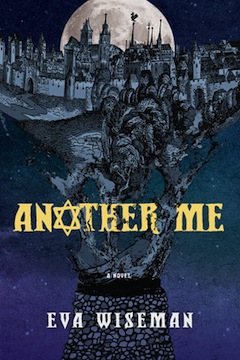
book cover - Another MeEva Wiseman’s Another Me (Tundra Books, 2016) is set in the mid-1300s in Strasbourg, France. It starts with the main character’s death at the hands of the men poisoning the town’s water – an act the Jews were accused of committing not only in Strasbourg, but other cities in Europe, as well. It was thought that poisoned water was causing the plague and, since fewer Jews were dying, the rumors began that they were causing the illness. In reality, Jews were also dying, but in fewer numbers because Jewish law required much more handwashing than was customary in medieval times.
Wiseman also elaborates upon less tangible Jewish beliefs in Another Me. When Natan, 17, dies, his story doesn’t end. He becomes an ibbur – his soul enters the body of another man; in this instance, that of Hans the draper.

Hans works for Wilhelm, with whose daughter, Elena, Natan has fallen in love. Natan has come to know all of these non-Jews from helping his father in the shmatte business. Wilhelm is one of the very few Strasbourgians who is not antisemitic. Hans is also a good person, though he is jealous of Elena’s affection for Natan. When Natan – to whom she’s attracted – becomes Hans – who she finds ugly – Elena struggles to see beyond the exterior.

While mostly told from Natan’s perspective, Wiseman also allows Elena to tell a substantial part of the story. It is sometimes hard as a reader to change gears, but the dual voices offer a deeper understanding of the situation of the Jews in the city (and beyond), and those who would help them. Being historical fiction, while Wiseman can play with magic, there is, sadly, no chance for a happy ending.

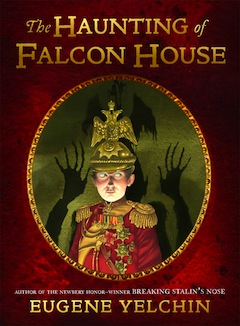
book cover - The Haunting of Falcon HouseMagic – or, at least, ghosts – also informs the storytelling in Eugene Yelchin’s The Haunting of Falcon House (Henry Holt and Co., 2016).

Ostensibly, this book is a translation Yelchin has made from a bundle of decaying pages bound with twine that he came across as a schoolboy in Russia. He brought them with him when he immigrated to the United States, but let them sit for years. Apparently written and illustrated by “a young Russian nobleman, Prince Lev Lvov,” who was born in 1879, there were many pages missing or unreadable.

“I managed to establish a chronological order of the events and then divided them into chapters, matched the drawings to the chapters, and discarded those I could not match,” writes Yelchin in the translator’s note that begins the book. So “inwardly connected to the young prince” did Yelchin become, he writes, “I can’t be certain, but as I typed Prince Lev’s inner thoughts, I felt cool fingers firmly guiding mine across the keys.”

In the story, 12-year-old Lev’s hands are similarly guided by a mysterious force when he is drawing. Arriving at Falcon House from St. Petersburg to take his place as heir to his family’s estate, Lev – who bears a striking resemblance to his grandfather – dreams of being a hero and nobleman like his grandfather and preceding ancestors. But, with some mystical guidance from Falcon House’s resident ghost, Lev begins to understand that being nobility doesn’t necessarily mean being noble, and his family’s secrets, which are slowly revealed, make him rethink his aspirations.

The ghost, a scary aunt and the disturbing illustrations combine to good effect in The Haunting of Falcon House, even though the story takes a little too long to unfold. The detailed notes at the book’s end provide valuable historical context and add greatly to the reading experience.

book cover - Briar Rose: A Novel of the Holocaust Jane Yolen’s Briar Rose: A Novel of the Holocaust (Tor Teen, 2016) is also a retelling – an adaptation of Sleeping Beauty. And, it is a reissue, having originally been published almost 15 years ago in a series created by Terri Windling, which comprised novels by various authors that reinterpreted classic fairy tales.

In Yolen’s reimagining, Briar Rose (aka Sleeping Beauty) is Gemma, Rebecca’s grandmother. Unlike her cynical and competitive older sisters, Rebecca never tires of listening to Gemma’s version of the tale, which doesn’t quite match up with the traditional folktale. When Gemma dies, leaving behind a box containing a few documents and photos that don’t quite match up with what she has told her family about her history, Becca sets off to find the truth.

Her search – done in the days before Google – starts slowly, with the help of her editor, Stan, on whom she has a crush. It takes them from their hometown of Holyoke, Mass., to Oswego, N.Y., where refugees were sheltered at Fort Oswego: “Roosevelt made it a camp and, in August 1944, some 1,000 people were brought over and interned [there]. From Naples, Italy. Mostly Jews and about 100 Christians,” explains the reporter at the Palladium Times to Becca.

What she learns at Oswego leads her on a journey to Poland and to Chelmno. Of the more than 152,000 killed by gas (or shooting) at the Nazi extermination camp that was there, only seven Jewish men are known to have escaped. This allows Yolen to imagine that one woman survived the killing centre, which was established on an old estate in a forest clearing that had a schloss (castle, or manor house).

In Gemma’s cryptic telling of her survival, she is saved from the castle by a “prince,” who we find out was himself saved by partisans after his escape from Sachsenhausen concentration camp and then joined the resistance; in her story, briars take the place of barbed wire, the wicked fairy the Nazis. As Becca discovers the reality of her grandmother’s past and finds her own voice and identity through the journey, we also witness Poles’ difficulties in dealing with what took place during the Holocaust and we meet others – including Gemma’s prince – who are still trying to heal from the destruction the Nazis’ wrought.

Interweaving the “real” story with Gemma’s fairy tale is very effective at building the anticipation and, once Becca arrives in Poland, Briar Rose is a page-turner. One almost doesn’t realize how much they’re learning while they’re reading. Almost.

Format ImagePosted on September 23, 2016September 21, 2016Author Cynthia RamsayCategories BooksTags Chanukah, children's books, fairy tales, fantasy, ghosts, Holocaust, picture books, plague, playtime, science fiction, Sleeping Beauty, young adults
Quirky fiction meets history

Quirky fiction meets history

Two quirky books. Both historically based, both written with humor, both dark and light. But there the similarities end.

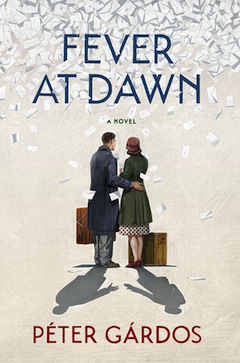
The quiet and quirky Fever at Dawn by Péter Gárdos is based on letters his parents sent to each other immediately following the Holocaust, as they recovered from their physical ailments in Sweden. The raucous and quirky Two-Gun & Sun by June Hutton takes its inspiration from Morris “Two-Gun” Cohen and Dr. Sun Yat-sen, who actually did know each other, and Puccini’s La Fanciulla del West, to tell the story of a young woman who heads to a northern B.C. mining town in 1922 to revitalize her uncle’s newspaper, which he left her in his will.

book cover - Fever at Dawn

Fever at Dawn (House of Anansi Press, 2016) begins with a note from Gárdos about the letters his parents – Miklós and Lili – sent to each other from September 1945 to February 1946. Until his father died, Gárdos had no idea of their existence, though his mother had told him, “Your father swept me off my feet with his letters.”

The main quirky thing about this story (there are others) is that Miklós tried to sweep no fewer than 117 women off their feet with his letters. Told by his doctor that he would not survive his tuberculosis, Miklós defiantly decides he wants to get married. He inquires for the names and addresses of all the women survivors being treated in Sweden, and sends all of them the exact same letter. He determines pretty quickly that Lili is “the one,” though 18 women respond.

The secondary characters are well-conceived and play important parts in Miklós and Lili’s developing relationship. It is a beautiful and uplifting story – love and hope from hatred and tragedy. It brings up many issues, in Lili’s wanting to renounce her faith and in how the survivors are treated, for example. The translation into English from Hungarian by Elizabeth Szász is a bit awkward in parts, but otherwise does justice to the work. And some of the awkwardness might be due to the fact that Gárdos, who is a filmmaker and theatre director, originally envisioned the story as a film – which was released last year – but also wrote it as a novel.

book cover - Two-Gun & SunTwo-Gun & Sun (Caitlin Press Inc., 2015) might also make a good film. It brings to mind Joss Whedon’s Firefly, mixing science fiction (specifically steampunk) with opera’s larger-than-life and often unbelievable drama with history. It’s a very stylized novel, which, more than other books, means that it will be loved by some readers, and not so much by others.

While loosely historical, it does strongly evoke the era and how hard it must have been to survive back then, especially in a remote town, especially if you were a minority, and very especially if you were a woman. The central character, Lila Sinclair, arrives in Black Mountain from Nelson, given by her uncle’s death a more adventuresome, “manly” economic opportunity than marriage, teaching or prostitution, which seem to have been women’s main choices at the time.

Some of the more fascinating aspects of this novel are the daily-life moments, what people ate, how they earned a living, the excitement a traveling troupe generated, the dangers posed by a lack of law. Anyone in the publishing industry will also appreciate Lila’s struggle to get the printing press up and running, and how newspapers once operated. As well, while her relationship with Vincent, a Chinese printer, runs a predictable course, it offers a chance for Hutton to address the racism of the day.

Two-Gun & Sun is a unique twist on the traditional western and, while the ending wasn’t quite satisfactory for this reader, its originality and oddness were entertaining and energizing.

Format ImagePosted on September 23, 2016September 21, 2016Author Cynthia RamsayCategories BooksTags fiction, Holocaust, science fiction, steampunk, Two-Gun Cohen
Some of the magic of Israel

Some of the magic of Israel

In writing Zahav: A World of Israeli Cooking (Houghton Mifflin Harcourt, 2015) with Steven Cook, Michael Solomonov hopes to share with other cooks “some of the magic” found in Israel.

Israeli-born Solomonov grew up from the age of 2 to 15 in Pittsburgh, then the family returned to Israel. After awhile, when his Bulgarian father and American mother divorced, he returned to the United States, eventually learning to be a chef, graduating from culinary school in 2001. He returned to Israel, where his brother had grown up and was on leave from the army; sadly, his brother was killed soon after, and Solomonov once again left the country.

Returning to Pittsburgh, Solomonov met Cook and, in 2005, became chef of their first restaurant, Marigold Kitchen. In 2008, Solomonov and Cook opened the restaurant Zahav in Philadelphia. They also co-own restaurants Percy Street Barbeque, Federal Donuts, Dizengoff and Abe Fisher, all in Philadelphia. In 2011, Solomonov was awarded the James Beard Award for best chef mid-Atlantic.

After the death of his brother, as he and Cook worked together at Marigold Kitchen, Solomonov writes, “I began to see cooking as a powerful way to honor David’s memory. I could expose people to a side of Israel that had nothing to do with politics and didn’t ever make the evening papers.”

This was the inspiration for Zahav, which opened in May 2008, as well as the cookbook Zahav, whose style is unique.

The nine chapters include one on tahini, which has 34 recipes, including seared chicken livers with caramelized onion tahini and tahini shortbread cookies. There are 20 salad recipes, showing that vegetables are everything, including Israeli pickles and spicy fennel salad. There is a chapter on smaller dishes, with recipes for items like fried cauliflower with herbed labneh. The soup chapter has 16 recipes from around the world, such as celery root soup. The next chapter – “Grandmother’s Borekas, Tradition Was My Teacher” – has 20 recipes, such as fried leek patties. “Live Fire, As Close to Magic as I’ll Come” has 16 recipes, like Bulgarian kebabs and pomegranate-glazed salmon, including mujadara. Then there’s the chapter called “Ben-Gurion’s Rice,” with 11 different recipes. “Mesibah, It’s Party Time” has seven recipes, such as whole fish in grape leaves, and “Milk & Honey is a Glimpse of the Divine” has 17 recipes, including konafi and carrot basboosa.

After an introductory essay in each chapter, there are the recipes, and each is also introduced, with casual (and fun-to-read) remarks and easy-to-follow instructions. There are also sidebars with fascinating information about such things as sumac, date molasses, freekah and rose water.

There is no doubt that this book has “a world of Israeli cooking,” and the recipes below reflect that idea.

CHICKPEA BRITTLE
makes three cups

2 cups cooked or canned chickpeas, rinsed
1 tbsp canola oil
3/4 cup packed light brown sugar
3 tbsp butter
3 tbsp heavy cream

Preheat the oven to 350˚F. Line a baking sheet with parchment paper and set aside.

Toss the chickpeas with the oil, transfer to another baking sheet, and roast until crisp, 25 to 30 minutes.

Combine the brown sugar, butter and cream in a saucepan over medium heat. Cook, stirring, until the mixture darkens in color slightly and large, lava-like bubbles cover the surface, about 10 minutes. Add the chickpeas and stir to combine.

Working quickly and using a rubber spatula, spread the mixture out in an even layer on the prepared baking sheet. Let cool to room temperature. Break into two-inch pieces to serve. The brittle will keep a week in a sealed container.

ROASTED OKRA
serves six

6 cups small whole okra
5 tbsp olive oil
1/3 cup basic tomato sauce
1 tbsp lemon juice
1/2 tsp grated dried lime
1/2 tsp kosher salt
handful cilantro leaves, chopped

Preheat the oven to 400˚F. Toss the okra with two tablespoons olive oil and arrange on a baking sheet. Bake until the okra turns brown, about 25 minutes. Transfer to a bowl and toss the okra with the remaining three tablespoons of olive oil and the tomato sauce, lemon juice, dried lime and salt. Top with the cilantro. Serve hot or chilled.

GLUTEN-FREE CHOCOLATE ALMOND SITUATION

8 tbsp (1 stick) unsalted butter, softened
1 cup sugar
big pinch salt
2 scant cups chopped dark chocolate (at least 60% cacao), melted and cooled slightly
4 large eggs, lightly beaten
1/2 cup almond flour

Preheat the oven to 375˚F, with a rack in the middle. Oil a nine-inch round or square cake pan. Line the bottom with a round of parchment paper, and oil the parchment.

Combine the butter, sugar and salt in a mixer or other bowl. Beat on medium high until pale and fluffy, about two minutes. Add melted chocolate and mix just until combined. Scrape down the sides and mix for another few seconds. With the mixer on low speed, add eggs, one at a time, beating until each one is incorporated before adding the next. Scrape down the sides of the bowl, then add almond flour. Mix on low until just incorporated, about 10 seconds.

Pour batter into prepared pan and smooth top with spatula. Bake until a toothpick inserted into the centre comes out clean, about 25 minutes. Let cool in pan for 10 minutes before turning out onto a rack to cool completely.

Sybil Kaplan is a journalist, foreign correspondent, lecturer, food writer and book reviewer who lives in Jerusalem. She also does the restaurant features for janglo.net and leads walks in English in Jerusalem’s market.

Format ImagePosted on September 23, 2016September 21, 2016Author Sybil KaplanCategories BooksTags cookbook, Israel, recipes, Zahav

Posts pagination

Previous page Page 1 … Page 486 Page 487 Page 488 … Page 661 Next page
Proudly powered by WordPress