Skip to content
  • Home
  • Subscribe / donate
  • Events calendar
  • News
    • Local
    • National
    • Israel
    • World
    • עניין בחדשות
      A roundup of news in Canada and further afield, in Hebrew.
  • Opinion
    • From the JI
    • Op-Ed
  • Arts & Culture
    • Performing Arts
    • Music
    • Books
    • Visual Arts
    • TV & Film
  • Life
    • Celebrating the Holidays
    • Travel
    • The Daily Snooze
      Cartoons by Jacob Samuel
    • Mystery Photo
      Help the JI and JMABC fill in the gaps in our archives.
  • Community Links
    • Organizations, Etc.
    • Other News Sources & Blogs
    • Business Directory
  • FAQ
  • JI Chai Celebration
  • JI@88! video

Recent Posts

  • Story of Israel’s north
  • Sheltering in train stations
  • Teach critical thinking
  • Learning to bridge divides
  • Supporting Iranian community
  • Art dismantles systems
  • Beth Tikvah celebrates 50th
  • What is Jewish music?
  • Celebrate joy of music
  • Women share experiences 
  • Raising funds for Survivors
  • Call for digital literacy
  • The hidden hand of hate
  • Tarot as spiritual ritual
  • Students create fancy meal
  • Encouraging young voices
  • Rose’s Angels delivers
  • Living life to its fullest
  • Drawing on his roots
  • Panama City welcoming
  • Pesach cleaning
  • On the wings of griffon vultures
  • Vast recipe & story collection
  • A word, please …
  • מארק קרני לא ממתין לטראמפ
  • On war and antisemitism
  • Jews shine in Canucks colours
  • Moment of opportunity
  • Shooting response
  • BC budget fails seniors
  • Ritual is what makes life holy
  • Dogs help war veterans live again
  • Remain vital and outspoken
  • An urgent play to see
  • Pop-up exhibit popular
  • An invite to join JWest

Archives

Follow @JewishIndie
image - The CJN - Visit Us Banner - 300x600 - 101625

Author: Sybil Kaplan

Her mother’s 100 favorites

Her mother’s 100 favorites

In my collection of cookbooks is The Complete International Jewish Cookbook by Evelyn Rose. For more than 30 years, she was food editor of the London Jewish Chronicle. When I received the press release that 100 Best Jewish Recipes (Interlink Books, 2016) by Rose with Judi Rose was being published, I was sure it would be as lovely as the earlier one and was saddened to learn that Evelyn Rose was no longer living – she died in 2003.

Judi Rose had quite a task when she began working on this book, as she narrowed down the thousands of recipes from her mother’s career into the ones their family loved best. She ultimately decided on 100 of her mother’s best-loved recipes – “some of her personal favorites, as well as those of her fans.”

Judi Rose is a food writer, consultant and culinary expert. She and her mother cooked together for more than 30 years and wrote two cookbooks together. The recipes she has chosen epitomize her mother’s principles of “incorporating thinking on health and nutrition, and using new technology to save time and effort.”

“My mother passionately believed that each dish must have ta’am – that extra something that makes it taste special and worth the effort for busy people to put on their table,” writes Rose.

There are 128 recipes in this new cookbook, enhanced by 38 color photographs. After a foreword, an introduction and an essay on festivals and food, the chapters are listed: small plates (10 recipes), soups (13 recipes), poultry (12 recipes), meat (16 recipes), fish (11 recipes), vegetables and side dishes (23 recipes), bread-bakes and desserts (21 recipes) and basics (22 recipes). A final essay is on adapting recipes for the kosher kitchen.

One thing missing from the recipes is whether they are meat, dairy or pareve. Other than that, each recipe has how many servings, how long it will keep in the refrigerator (a clever inclusion not generally listed with recipes), how long it can be frozen and a little introductory note.

Styles include Middle Eastern and Sephardi, and the places from where the recipes come include Austria, Lithuania, Syria, Russia, France, Hungary, Germany, Spain, Turkey, Persia, Morocco, China, Italy, Greece, Holland, Britain, Israel, Sicily, Egypt, Indonesia, Armenia and Denmark. As the publisher notes, these are traditional and contemporary recipes, for family meals and special occasions, for both novices and experienced cooks.

Here are a few of the traditional, classic recipes.

CHICKEN LIVER PATÉ

3 eggs
1 finely chopped onion
1 crushed garlic clove
4 tbsp soft margarine or rendered chicken fat
5-10 grinds sea salt
12 oz ready-koshered chicken livers
15 grinds of black pepper
1 good pinch of freshly grated nutmeg
warm French bread, crackers or sliced challah

Hard boil eggs for 10 minutes, drain, return to pan, cover with cold water and leave to cool.

Fry the onion and garlic gently in the margarine or fat until very soft and a rich brown. As the onion cooks, sprinkle it with sea salt.

Peel the eggs and cut in half. Put one aside.

Put the onion and garlic with cooking juices into a food processor, process until smooth. Add two eggs, livers, pepper and nutmeg. Process until smooth. Taste and add more seasoning if necessary.

Turn mixture into a terrine or oval gratin dish or divide between individual ramekins. Cover with plastic wrap and chill overnight. Refrigerate extra egg.

One hour before serving, remove paté from refrigerator to return to room temperature. Pass the remaining egg through a food mill or sieve to decorate the top of the paté.

Serves six as an appetizer, eight to 10 as a spread. Keeps five days in the fridge and freezes for one month.

TRADITIONAL CHICKEN SOUP

1 whole or half chicken with wings and giblets
7 1/2 cups water
2 tsp salt
1 pinch white pepper
2 halved, peeled carrots
leaves and top 2 inches of 2 celery ribs
1 sprig parsley
1 very ripe tomato

Put bird and pieces in a large pot with water, salt and pepper. Cover and bring to a boil. Remove foam with a large metal spoon.

Peel and halve onion and carrots, and add to pot with celery, parsley and tomato. Bring to a boil. Reduce heat, cover and continue to simmer three hours until chicken feels very tender when a leg is prodded.

Strain soup, reserving giblets and carrots in a separate container. Cover and refrigerate soup. Next day, remove congealed fat and return soup to the pot.

Cube giblets and carrots. Add to soup. Serve with matzah balls or noodles.

Serves four to six. Keeps three days in the refrigerator and three months in the freezer.

TRADITIONAL KICHELS

1 cup cake flour
1 to 1 1/2 cups all-purpose flour
3 tsp baking powder
2 large eggs
2/3 cup superfine sugar
1/2 cup sunflower or other flavorless oil
zest of 1 orange
1 tsp vanilla extract

Preheat oven to 350˚F and line two baking sheets with parchment paper.

Mix flours and baking powder. In a separate bowl, whisk the eggs until thick then gradually whisk in the sugar, followed by the oil, orange zest and vanilla.

Stir in enough of the flour to make a rollable, nonsticky dough. Knead until smooth then roll onto a floured board until a half-inch thick.

Sprinkle the dough with sugar, roll lightly to press it in. Cut into shapes with cookie cutters and arrange on prepared trays, leaving room for cookies to spread. Bake for 20-25 minutes or until pale gold in color. Leave on wire racks to cool.

Makes about 50. Will stay fresh two weeks in an airtight container and freezes for three months.

Sybil Kaplan is a journalist, foreign correspondent, lecturer, food writer and book reviewer who lives in Jerusalem. She also does the restaurant features for janglo.net and leads walks in English in Jerusalem’s market.
Format ImagePosted on September 23, 2016September 21, 2016Author Sybil KaplanCategories BooksTags cookbook, Jewish food, recipes
An apple-honey cake

An apple-honey cake

Add some apples to your honey cake this year. (photo by Barry A. Kaplan)

In the spirit of trying new things and as the New Year approaches, here is a recipe from my kosher kitchen, a slightly different take on the traditional honey cake. It’s a Rosh Hashanah favorite.

TWO-LAYER APPLE-HONEY CAKE

2 cups flour
2 tsp baking soda
2 tsp ground cinnamon
1/8 tsp ground nutmeg
1/4 tsp ground cloves
3/4 cup sugar or sugar substitute
1 1/2 tsp vanilla extract
2 large eggs
3/4 cup canola oil
1/3 cup non-dairy creamer
1/2 cup honey or honey substitute
3 cups grated apples

Frosting
2 cups tofu cream cheese
1/2 cup unsalted pareve margarine
1 tsp grated orange peel
1 cup confectioners sugar
2 tsp vanilla extract
1/2 cup honey or honey substitute

  1. Preheat oven to 325˚F.
  2. Put vegetable spray on two nine-inch cake pans.
  3. Place flour, baking soda, cinnamon, nutmeg, cloves and sugar or sugar substitute in a large bowl and mix.
  4. Add vanilla, eggs, oil, non-dairy creamer and honey. Mix, then add apples. Place half of the batter in each baking pan. Bake in the oven about 45 minutes or until a toothpick inserted into the centre comes out clean. Cool.
  5. Beat cream cheese and margarine in a bowl until fluffy.
  6. Add orange peel, confectioners sugar and vanilla and blend. Add honey. Chill until firm enough to spread.
  7. Place one cake on a serving dish. Spread with one cup of frosting. Top with the second cake and spread the remaining frosting on the top and sides.

Sybil Kaplan is a journalist, foreign correspondent, lecturer, food writer and book reviewer who lives in Jerusalem. She also does the restaurant features for janglo.net and leads walks in English in Jerusalem’s market.

Format ImagePosted on September 23, 2016September 21, 2016Author Sybil KaplanCategories Celebrating the HolidaysTags apples, kosher, recipes, Rosh Hashanah
Celebrate sweetness

Celebrate sweetness

The High Holidays are all about family and friends coming together and sharing a meal. Kosher Taste: Plan. Prepare. Plate (Feldheim, 2016) by Toronto-based Amy Stopnicki offers home cooks a new formula for kosher cooking, with more than 100 recipes and photos.

In Kosher Taste, Stopnicki has taken her best innovations from years of experience and combined them with her passion for creating balanced and beautiful meals.

book cover - Kosher Taste“I love to cook and I love to entertain. The warmth and beauty of sharing a beautifully set Shabbos or holiday table with friends and family is my passion and joy,” she explained. “The satisfaction I feel when family and guests dig in for seconds, or when kids enjoy a new dish, this makes all the effort of planning and preparing worthwhile. My goal with Kosher Taste is to share this joy, this passion, with home cooks who are looking to experience delicious new tastes and flavors to share with their families.”



Every recipe offers an easy-to-follow formula. Plan: tips for preparing ingredients ahead of time. Prepare: simple instructions and a step-by-step guide help any level of home cook recreate Stopnicki’s recipes. Plate: making what you have prepared look beautiful when served and what you can serve it with.

Recipes include squash zucchini soup, mango salad with raspberry vinaigrette, broccoli kugel, grilled fennel with balsamic reduction, stuffed mushrooms, salmon pad thai, wasabi tuna steaks, maple-glazed turkey breast, spinach pesto stuffed chicken, skirt steak in rum sauce, simple savory brisket, chocolate-dipped hamantashen and pumpkin pie brulée.

Here are some recipes to try for the New Year.

QUINOA SCHNITZEL
status: meat, serves 6-8

Plan: This recipe can also be baked on cookie sheets. Lightly cover the cookie sheet with oil and coat the top of each schnitzel with non-stick cooking spray. Bake at 350°F for approximately 10 minutes on each side. Quinoa flakes are a great gluten-free alternative. They are light and healthy and easy to work with and can be found in most health food stores.

8 chicken breasts
2-2 1/2 cups dried quinoa flakes
1 tsp salt
1/2 tsp paprika
1/2 tsp garlic powder
1/2 tsp pepper
2 eggs
1/2 cup cornstarch or potato starch
canola (or safflower) oil for frying

Prepare:
1. Slice chicken breasts horizontally and pound to flatten.
2. In a shallow bowl, combine quinoa flakes, salt, paprika, garlic powder and pepper.
3. In another shallow bowl, lightly beat eggs.
4. Pour the starch on a plate.
5. In a large skillet, heat oil over a high temperature for frying.
6. Lightly dip each piece of chicken in starch, egg, and finally the quinoa mixture.
7. Fry each piece of chicken, turning when necessary. You will know it’s cooked when all sides are golden.

Plate: There are endless debates on how one serves and eats schnitzel: with noodles, or salad, or even in a sandwich. Stopnicki’s favorite is Israeli-style with hummus, Israeli salad and basmati rice.

APPLE CINNAMON STREUSEL MUFFINS
status: pareve, makes 18 muffins

Plan: This sweet treat is a great muffin to have for the kids as an after-school snack. Double the recipe and freeze them so you can take them out as needed. They thaw in 10 minutes or so.

2 eggs
1 tbsp vanilla extract
1 cup sugar
1/2 cup canola oil
2 cups flour
1 tbsp cinnamon
2 tbsp baking powder
1/2 cup applesauce
1 cup water
2 gala apples, peeled and finely diced

Streusel topping
3 tbsp margarine
1 cup flour
1/2 cup brown sugar
1/2 tsp cinnamon

Prepare:
1. Preheat oven to 350°F.
2. In a large mixing bowl, cream eggs, vanilla, sugar and oil until mixture is light.
3. Add dry ingredients, applesauce, water and apples and combine well.
4. Pour batter into paper-lined muffin tins, filling them 2⁄3 of the way.
5. Meanwhile, combine all streusel ingredients until they achieve a sand-like consistency.
6.Pour one tablespoon of streusel mixture on top of each unbaked muffin.
7. Bake for 20-30 minutes or until the tops are slightly golden.

Plate: Enjoy these alone or with a hot cup of tea.

Format ImagePosted on September 23, 2016September 21, 2016Author Trina Kaye OrganizationCategories Celebrating the HolidaysTags cookbooks, kosher, Rosh Hashanah
Museums adapt using tech

Museums adapt using tech

Museloop’s app that it created for Israel Museum. (photo from Museloop via Times of Israel)

How do museums and other purveyors of history attract visitors and make the past relevant, especially as people come to expect more and more digital experiences?

Perhaps surprisingly, Werner W. Pommerehne and Bruno S. Frey recognized the problem more than 36 years ago. In their article “The museum from an economic perspective,” which was published in the International Social Science Journal in 1980, they stated:

“Museum exhibitions are generally poorly presented didactically. The history and nature of the artists’ work is rarely well explained, and little is offered to help the average, uninitiated viewer (i.e., the majority of actual and potential viewers) to understand and differentiate what is being presented, and why it has been singled out. Accompanying information sheets are often written in a language incomprehensible to those who are not already familiar with the subject. There is no clear guidance offered to the collections, and little or no effort is made to relate the exhibits to what the average viewer already knows about the history, political conditions, culture, famous people, etc., of the period in which the work of art was produced.”

Keren Berler, chief executive officer of Israeli start-up Museloop recently put the problem into current perspective. Younger visitors, she noted in an Israeli radio interview this past June, find museum visits passive and boring. She said, especially when seeing museum art exhibits, young people need something more to draw them into what they are seeing. So, her company has designed a museum-based application for iPhone and Android use. The application includes games, such as find-the-difference puzzles, plus information about the artist, all of which will hopefully make the visitor better remember the art and some facts about it.

Interestingly, in describing the games, two of the attributes she mentioned were competitiveness and the ability to take “selfies.” Children as young as 8 or 9 years old can use the app on their own, but younger children would need an adult to assist them.

Right now, the Museloop app focuses on Israel Museum’s under-appreciated (read: under-visited) permanent art collection. This exhibit includes the works of a number of “heavies,” such as Marc Chagall, Claude Monet, Pierre-Auguste Renoir, Paul Cézanne and Paul Gauguin. The goal is to make the experience so appealing that young visitors will then want to visit other museums. Since Israel Museum is paying the start-up for the development and use of the app, visitors benefit by having free use of it.

In contrast, Tower of David Museum has its own in-house digital department. This department has developed its own applications for heightened exhibit viewing.

photo - Virtual reality in the actual reality of Tower of David Museum
Virtual reality in the actual reality of Tower of David Museum. (photo from Tower of David Museum)

According to Eynat Sharon, the head of digital media, her department takes into consideration the visitor’s total museum experience. This experience consists of three overlapping circles: the pre-visit, in which a person visits either the museum’s website or mobile site; the actual physical visit; and the post-visit, in which the person digitally shares with friends and family on Facebook, Instagram and other social media what they encountered at the museum. The museum’s technical equipment and apps may be rented by museum visitors for a small fee.

Are these new applications then to be applauded? Some people still need convincing. Last year, art critic Ben Davis reflected on news.artnet.com, “For many, many viewers, interfacing with an artwork through their phone trumped reflecting on its themes. In effect, now every art show is by default a multimedia experience for a great portion of the audience, because interaction via phone is a default part of the way people look at the world.”

Dan Reich, who is the curator and director of education for the St. Louis Holocaust Museum and Learning Centre, said, “Personally, I am not big on technology. You end up with lots of button-pushing but not necessarily a lot of education. As a museum, we are pretty low-tech. We have an audio tour of the permanent exhibit, several stops in the museum where you can press buttons and hear testimony, an interactive map and – more recently – added an interactive screen entitled ‘Change Begins With Me,’ which deals with more recent or contemporary examples of hate crimes and genocide. We have been digitizing our collection of survivors’ testimonies. We have testimonies edited to different lengths. Generally, survivors like to be recorded, knowing their words are being preserved.”

And recent comments on TripAdvisor show that museums don’t necessarily have to be high-tech to succeed in their mission.

Visitors, for example, gave the St. Louis Holocaust Centre high marks.

Other Holocaust learning centres, however, have started taking current technology through uncharted waters. The USC Shoah Foundation now uses holographic oral history. According to Dr. Stephen Smith, the foundation’s executive director: “In the Dimensions in Testimony project, the content must be natural language video conversations rendered in true holographic display, without the 3-D glasses. What makes this so different is the nonlinear nature of the content. We have grown used to hearing life histories as a flow of consciousness in which the interviewee is in control of the narrative and the interviewer guides the interviewee through the stages of his or her story. [Now] with the … methodology, the interviewee is subject to a series of questions gleaned from students, teachers and public who have universal questions that could apply to any witness, or specific questions about the witness’ personal history. They are asked in sets around subject matter, each a slightly different spin on a related topic.” One educator confided that, while the technology is “creepy,” the public apparently likes it.

So, how do museums cope with the possibility that the medium in and of itself becomes the message? In other words, how do museums keep their audiences from being distracted by the technology? At the same time, how can museums survive financially if they follow goals that differ substantially from those of visitors, funders and other supporters?

A few months ago, Canadian entrepreneur Evan Carmichael offered guidelines at an Online Computer Library Centre conference. His suggestions seem applicable to museum administrators as well: express yourself, answer their questions, offer guidance, involve the crowd, “use your audience to create something amazing … create an emotional connection, get personal, and hold trending conversations, go to where things are happening, be there.

Time will tell whether the advent of museum-related high-tech will realize Don McLean’s 1971 tribute to Vincent Van Gogh’s art: “They would not listen, they did not know how. Perhaps they’ll listen now.”

Deborah Rubin Fields is an Israel-based features writer. She is also the author of Take a Peek Inside: A Child’s Guide to Radiology Exams, published in English, Hebrew and Arabic.

Format ImagePosted on September 23, 2016September 21, 2016Author Deborah Rubin FieldsCategories WorldTags art, history, Holocaust, museums, technology
Another planet earth?

Another planet earth?

An artist’s impression of the newly discovered planet, Proxima Centauri b. (photo from ESO/M. Kornmesser)

An international team announced recently that a planet with a mass similar to that of earth has been observed orbiting the star Proxima Centauri – the closest star to our sun, just over four light years (about 40 trillion kilometres) away.

The collaboration of scientists from nine countries, known as the “Pale Red Dot” and led by Dr. Guillem Anglada-Escudé of Queen Mary University of London, included Weizmann Institute of Science’s Dr. Aviv Ofir, who is in the group of Prof. Oded Aharonson of the earth and planetary sciences department.

Proxima Centauri is a red dwarf – a star with a diameter about one seventh that of our sun and far dimmer: it gives off only 1/600 the light of our sun. The team’s calculations show that the planet, known as Proxima Centauri b, has a mass of at least 1.3 times that of earth and its year – the time it takes to orbit its sun – is a little over 11 days. It orbits quite close to its sun – only five percent of the distance from earth to our sun; but, since its sun is so dim, the temperature on Proxima Centauri b may be relatively balmy and liquid water could theoretically exist on its surface.

The range of distances where the planet’s temperature permits liquid water is often referred to as “the habitable zone.” Although conditions on the planet’s surface are as yet unclear, the scientific team hopes to learn more about this planet in further research. Ofir said it is not at all clear whether life as we know it could have evolved on the planet, and the subject is already the focus of intense debate.

The planet was discovered through measurements of the radial velocity of the star. Such measurements rely on the Doppler effect, the shift in wavelength as an object moves closer to or away from the viewer. The star, according to the team’s highly accurate measurements, is moving at a speed of about a metre a second (or 3.6 kilometres an hour) towards and away from us.

Ofir explained that, when we speak of a planet orbiting a star, in reality they are both orbiting a shared centre of gravity. Since the mass of the star is naturally much greater than that of its planets, that centre of gravity is usually close to the centre of the star, and planets make the star’s motion appear as a “wobble.” And that wobble can be detected by today’s instruments: in the case of Proxima Centauri, the scientists observed periodic changes in the star’s velocity, the result of another body tugging at it. That body, according to the measurements, is a planet with a relatively small mass, just over that of earth.

Ofir pointed out that Proxima Centauri has been studied for the past century, but only now have observations – designed for this very purpose – become sensitive enough to decisively detect the presence of this small planet. He is continuing to work on this and other projects to identify and study planets around Proxima Centauri.

“We discovered the planet with an observatory in Chile. We can’t see Proxima Centauri from our observatories in Israel,” he explained. “It is well below the southern horizon, so it is unobservable from Israel all year round.”

For more information about Weizmann Institute research, visit wis-wander.weizmann.ac.il.

Format ImagePosted on September 23, 2016September 21, 2016Author Weizmann InstituteCategories WorldTags astronomy, earth-like planets, Proxima Centauri, science
Plight of bees is our plight

Plight of bees is our plight

A European honey bee extracts nectar from an aster flower. (photo by John Severns via Wikimedia Commons)

Around the world, bee populations have been decreasing in number, year by year, at an alarming rate. Such a tragedy isn’t just stinging the beekeepers, whose livelihoods depend on the honey-making insects, it’s affecting global agriculture.

And there’s more at stake than just honey production. Bees’ handiwork assists in the growth of myriad foodstuffs. In fact, millions of honey bees are depended upon to pollinate plants and crops, which produce a quarter of the food we consume.

According to Science Daily from May 2015, beekeepers across the United States lost more than 40% of their honey bee colonies from April 2014 to April 2015, compared to the previous year’s decrease of 34%.

This is determined from an annual cross-country survey that is funded by the U.S. Department of Agriculture and conducted by Bee Informed Partnership with the Apiary Inspectors of America.

The survey asked commercial and small-scale beekeepers to track the health and survival rates of their honey bee colonies, in an effort to understand how to manage the decreasing population. This is the ninth straight year of losses. It’s referred to as colony collapse disorder.

More than 6,000 beekeepers, who manage 400,000 colonies from all 50 U.S. states responded. All told, these beekeepers are responsible for nearly 15% of the nation’s estimated 2.74 million managed honey bee colonies. The total economic value of honey bee pollination is said to be more than $15 billion each year in the United States alone.

Among small beekeepers – those who manage fewer than 50 colonies – a problem area appears to be the varroa mite, a lethal parasite, able to spread between colonies.

Beekeepers, environmental groups and some scientists also suspect blame lies with an insecticide known as neonicotinoids, or neonics. It is used on crops, such as corn, and on plants found in lawns and gardens. Its toll has been taken seriously enough that the Environmental Protection Agency is examining a series of studies on the insecticide and its effects on bees. The investigation is expected to be completed by year’s end.

The issue has even caught the attention of administrators at the White House, who have formed a task force to study the problem.

In Canada, the problem is even worse.

In Ontario, bee losses have been severe over the last few winters, measuring a decline of 58% in 2013-2014, due to a combination of extreme cold, mites, disease and the types of pesticides used on crops.

While it has experts scrambling for a solution, some people and companies are taking matters into their own hands.

One hotel is doing its part to increase the bee population. On the roof of the downtown Fairmont Royal York in Toronto, about 300,000 bees perch in six hives that produce anywhere between 500 and 900 pounds of honey per year. The hotel offers it to guests, and uses it in recipes.

CBC also recently installed hives on its rooftops in Toronto and Montreal, while Vancouver Police will build two hives at its headquarters.

Meanwhile, across the pond in England, the BBC reported that, in January 2014, in more than half of European countries, there were not enough honey bees to pollinate crops. And more than 14% of England’s honey bee colonies died over the winter, according to the latest research from the British Beekeepers Association (BBKA).

In the United Kingdom alone, nearly 90% of the apple crop and 45% of the strawberry crop relies on wild bees and managed honey bees to grow. It is a billion dollar economy there.

The BBKA’s annual survey of beekeepers across Great Britain showed the losses were up from nine percent last year, but lower than the year before; normal losses are about 10%. It blames “poor and variable weather, pesticides, bee diseases and parasites such as the varroa mite and starvation.”

To make matters worse, demand for the little honey-making insects has grown, while their numbers shrink.

Europe is experiencing a boom in biofuels, which is the result of the “EU renewable fuel directive,” where 10% of transport fuel must come from renewable sources by 2020. What that means for farming is planting a third more “oil” crops, like soybeans, oil palm, oilseed rape, sunflowers – all of which require ramping up bee numbers, which simply aren’t there.

According to the journal Plos One, Great Britain has only a quarter of the bees they need – their deficit equaling seven billion honey bees.

In light of this, as we approach Rosh Hashanah, you may think more about that little jar of honey on the festive meal table – millions, or perhaps billions, of honey bees came together to create that sweet liquid.

We know that the symbolism of honey on Rosh Hashanah is to have a sweet New Year. But there’s more: bees and the Jewish people are alike in many ways.

There’s little we can accomplish if we are alone; much that we can accomplish if we combine our efforts towards our goals as a people. We are more productive when in a community; our “hives” are our communities and synagogues, where we are needed – in fact, required – to be drawn to the whole. The honey bee teaches us that we must come together and work towards a higher purpose.

May everything go well next year not only for ourselves, friends, family and others, but for our little busy bee friends, buzz’mun hazeh!

Dave Gordon is a Toronto-based freelance writer whose work has appeared in more than a hundred publications around the world.


Format ImagePosted on September 23, 2016September 21, 2016Author Dave GordonCategories WorldTags agriculture, bees, economics, honeybees, pollinators, Rosh Hashanah

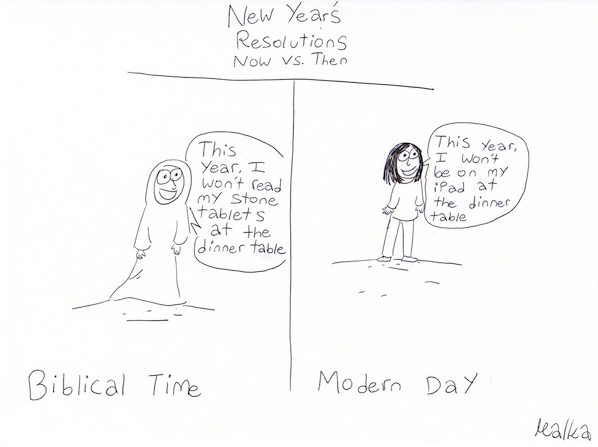
This week’s cartoon … Sept. 23/16

cartoon - New Year's Resolutions Now vs Then by Malka Martz-Oberlander

Format ImagePosted on September 23, 2016September 21, 2016Author Malka Martz-OberlanderCategories Celebrating the HolidaysTags High Holidays, Judaism, resolutions, technology
How we pray to G-d

How we pray to G-d

This year, Rosh Hashanah begins on the evening of Oct. 2. On the first day of the holiday, we read the Haftorah that tells us the story of Chana the prophetess, who prayed to G-d for a child. She prayed softly while whispering. Eli, the high priest and leader of the Jewish people, thought she was drunk, as this type of prayer was foreign to him.

She replied, “I’m not drunk, I’m praying for a child!”

Chana prayed to G-d and told Him, through her prophecy, that her child would be an important person in the Jewish nation. This, in fact, came true. Her wish was fulfilled, her son Samuel was born, and he became one of the greatest prophets of the Jewish people.

Chana’s method of prayer is used as the basis for all the Jewish laws of prayer. As well, the rabbis of the Great Assembly instituted the text of the prayers throughout the year based on Chana’s manner, specifically for the Amidah prayer of 18 blessings, called Shmona Esray, which is recited quietly while standing. This prayer is also said with deep concentration, as we are standing in G-d’s presence.

But there are also times when our hearts need to open up and scream out loud for what we need or want in our own words. G-d wants us to open our hearts to Him and give Him our emotions. Every day, all year long, each prayer we recite brings us closer to G-d. Every prayer we recite is immensely valuable if said with sincere feeling. When we need something and feel that only G-d can help us, we shout out to Him as we do when something hurts us physically.

Prayer is immensely powerful, especially when recited as a kindness for others. Our sages taught that if a person prays for a friend, they fulfil the biblical commandment (mitzvah) of performing kindness. If one is in the same situation as their friend and prays for their friend, they will be answered first.

There is the story of a farmer who went to his synagogue on Rosh Hashanah but couldn’t read at all. Being illiterate, he just wrapped himself in his tallit and stood shaking and screaming like a rooster, as that was the only way he knew how to express himself from the heart.

Our sages also taught that G-d receives more satisfaction from a single Jew praying than He does from the millions of heavenly angels who sing His praises day and night.

On Rosh Hashanah, there are many prayers we recite from the special prayer book, the Machzor. One of these is the Avinu Malkeinu prayer that means, “Our Father, our King.” This moving prayer lists our shortcomings and our needs as we plead for mercy from two perspectives. One is that G-d is our father who loves us and provides for us, so how could we be ungrateful to Him? The second one is that G-d is our king, who has absolute power over us and to whom we owe total allegiance, so how dare we challenge His authority?

Nevertheless, He always remains merciful. Therefore, we take the courage to approach Him from both aspects in our time of helplessness. If we deserve His mercy, let Him be tender as a parent and, if not, let Him judge us as necessary cogs in His empire. When the world sees G-d’s concern for His errant people, His glory becomes elevated and we become closer to Him.

We also listen to the shofar on Rosh Hashanah, which symbolizes the depth of our emotions that come out in a cry. It, too, is a form of prayer, an emotional outburst to G-d. There’s a simple message on Rosh Hashanah, that when we cry from the heart, someone listens! That’s the message of the shofar on Rosh Hashanah. When words end, the cry of the shofar begins. It is the sound of our tears. Tekiya: the call without words that surrounds all the shofar’s cries. Shevarim: a series of three sobs. Teruah: nine sighs, with which we ask G-d for His forgiveness.

May G-d hear all our prayers and supplications and grant us a healthy and prosperous year. May He hear all our prayers, silent and aloud, and fulfil them so that we will merit to hear the shofar of Moshiach imminently. Please G-d we will see real peace in Israel and all over the world.

Esther Tauby is a local educator, writer and counselor.

Format ImagePosted on September 23, 2016September 21, 2016Author Esther TaubyCategories Celebrating the HolidaysTags prayer, Rosh Hashanah
A Rosh Hashanah wakeup call

A Rosh Hashanah wakeup call

In just over a week, many of us will be in the synagogue. While listening to the sounds of the shofar, feel their power and reflect. (photo from Wikimedia Commons)

Close your eyes and imagine yourself in the synagogue listening to the blasting of the shofar, something many of us will be doing just over a week from now. Feel the power of the sound – the staccato notes, the longer notes, and the really, really long note – reverberate throughout the sanctuary.

The sounding of the shofar on Rosh Hashanah serves as a wakeup call for the Jewish people, a chance to start over with a clean slate. Maimonides describes the wakeup call in the Mishneh Torah, a code of Jewish religious law.

“Arise you who are fast asleep, and awaken you who slumber,” he writes. “Search your deeds, repent and be mindful of your Creator….”

Now close your eyes again and, this time, look back at the year behind you.

Did you live a year that mattered, and did you fill it with meaning? Did you laugh easily? Did you connect with someone new? Did you cultivate deeper connections with people you already knew? Did you chat with the barista at your coffee house? Did you smile at children?

Did you look up from toggling between apps on your phone to watch a setting sun or notice a full moon? Were you brave enough to take some risks and leap – even if you were scared? Did you dance? Did you say sorry, and mean it, to someone you hurt? Did you wander slowly through the rain? Did you notice ladybugs?

Did you honor your parents, your grandparents and other people who helped form you into the person you are today? Did you think about how your food gets from the land to your plate? Did you treat your body as a temple, at least some of the time? Did you stand up for the things that matter to you and stick up for people who needed it?

Were you sensitive to the pain and bloodshed of others that you heard about in the news – in your city, in Israel, and around the world? Were you present? Did you teach your children to be kind to people, to animals and to the earth? Did you give tzedakah? Did you give thanks each day for something in your life? When you spoke about other people, were you thoughtful about what you chose to say? Did you appreciate the fact that someone always has it worse than you do, and did you recognize that you’re luckier than most people in this world? Were you honest? Did you trust?

Did you give yourself a break about the things beyond your control? Did you value the sacrifices of your ancestors that made the world a better place? Were you a mentor to anyone? Did you open your mind and listen to people whose beliefs and ideas are different from your own? Did you let a baby’s tiny hand grasp your finger? Did you give big tips? Did you visit someone sick? Did you read and learn about something new? Did you do something you didn’t really feel like doing because you knew it would make someone else happy?

Did you stand and say the Mourner’s Kaddish for someone you loved and lost, or did you say it alongside someone else who lost a loved one? Did you learn a new skill? Did you smell rosemary, pinewood, vanilla or cinnamon? Did you invite a guest to come and share your Shabbat table? Did you dream big?

OK, now that you’ve looked back over the past year, close your eyes again – but this time look ahead to next year.

How will you fill your life and the lives of others with spirituality, meaning and love? Who will you surround yourself with?

We, Jews, are lucky for a chance to take stock – to awaken from our slumber – and then press reset for a new year.

Wishing you and your loved ones a year ahead filled with health, happiness, sweetness, fulfilment and peace. L’shanah tovah u’metukah!

Cindy Sher is the executive editor of Chicago’s JUF News. To read more from JNS.org, click here.

Format ImagePosted on September 23, 2016September 21, 2016Author Cindy Sher JNS.orgCategories Celebrating the HolidaysTags High Holidays, Rosh Hashanah, shofar
Yellow dates for New Year’s

Yellow dates for New Year’s

To make biblical date honey, Middle Eastern Jews boil and press dates that range in color from yellow to brown. (photo by Barry A. Kaplan)

The Torah describes Israel as eretz zvat chalav u’dvash, the land flowing with milk and honey, although the honey was more than likely date honey, since beekeeping is not mentioned in the Bible.

The word honey in Hebrew, dvash, has the same numerical value as the words Av Harachamim, Father of Mercy. We hope that G-d will be merciful on Rosh Hashanah as He judges us for our year’s deeds.

To make silan, or biblical date honey, Middle Eastern Jews boil and press dates that range in color from yellow to brown. Apples can be dipped into the date honey in the hope for a sweet new year. In the markets in Israel during this season, one finds strings of these dates.

In the 2011 article “Cooking class, it’s a date, honey,” cookbook author Faye Levy writes: “For many Jews, apples are the Rosh Hashanah fruit par excellence. For me, fresh dates are the fruit that herald the coming of the New Year. As soon as I see the bright yellow dates at the market, I begin to plan my menus.

“I’ve heard people say they’re not fond of fresh yellow dates. I have learned to enjoy them at their khalal [initial] stage, when they are crunchy and less sweet, but I prefer to wait until they become honey-brown, [the] stage called rutab.”

There are several kinds of dates grown in Israel, including Medjool, which Levy notes “are delicious and easier to find than perfectly ripened yellow dates.”

But, regardless of type, dates are a traditional Rosh Hashanah food, and form part of the Sephardi seder, which dates to the Babylonian Talmud.

“An elaborate Maghrebi [the region made up of Morocco, Algeria, Tunisia and Libya] specialty calls for nut-stuffed dates that are used to stuff a chicken or a large fish,” writes Levy. For Shabbat, she explains, dates might be added to dafina, which is a Sephardi meat stew cooked overnight to eat on Saturday lunch, or Moroccan hamin, another slow-cooked overnight stew for Saturday eating. The dates “contribute a subtle sweetness that mellows the flavor of the sauce. A dish from Baghdad from the Middle Ages calls for stewing lamb with dates and sweet spices.”

Silan, which Levy notes was brought to Israel by Iraqi Jews, is also known as date molasses or date syrup.

Varda Shilo, author of Kurdistani Cooking (in Hebrew), describes how to make it. Dried dates are simmered in water to porridge consistency, then the mixture is spooned into a cloth bag, moistened with more water and squeezed to remove the juice. This juice is simmered until thickened and is kept in jars.

Shilo explains that breakfast is the meal at which date honey is most often enjoyed in the Middle East, mixed with tahini (sesame seed paste) and served with bread.

Kinneret Farm silan makers suggest other ways of using date honey, such as adding it to stir-fried vegetables, as a sweetener for beverages, in sweet-potato pancakes, with an added dash of cinnamon.

“Dates are best known for their uses in sweets,” writes Shilo. “They are a favorite filling for the rich Middle Eastern cookies called ma’amoul and for rolled cookies resembling rugelach that are popular around the region.”

“In Persia,” write Reyna Simnegar, author of Persian Food from the Non-Persian Bride, “walnut-stuffed dates are a Rosh Hashanah treat. The stuffed dates are drizzled with a little syrup and sprinkled with cinnamon.

“Another popular way to serve dates is as a snack with tea.”

“Cooks in Egypt use the firm, fresh yellow dates to make jam,” says Levana Zamir in Cooking from the Nile’s Land (in Hebrew). “They also use them to make stuffed dates. First, they remove the dates’ very thin peel with a sharp knife and cook the dates in water until they are soft. Next, they pit the dates without cutting them in half.

Instead, they push the pit out with a hairpin so that each date can be stuffed with a blanched, peeled almond. Then they make a clove-and-lemon-flavored syrup from the dates’ cooking liquid. One by one, the stuffed dates are carefully added to the syrup, simmered and then cooled. The sweets are served with Turkish coffee and a glass of cold water. Making them is quite an undertaking but … these stuffed fresh dates are a delicacy fit for kings.”

Some Moroccans dip apples in honey and serve cooked quince, which is an apple-like fruit, symbolizing a sweet future. Other Moroccans dip dates in sesame and anise seeds and powdered sugar in addition to dipping apples in honey.

In her book The Foods of Israel Today, Joan Nathan writes about having lunch at Jerusalem restaurant Eucalyptus, when owner/chef Moshe Basson put a bowl of tahini “on the table and swirled in a date syrup called silan or halek, which he explained was a biblical ‘honey,’ one of the seven foods in the land of Canaan cited in the Book of Deuteronomy. Today, visitors can see a 2,000-year-old date-honey press, similar to an ancient wine press but smaller, near the Dead Sea at Qumran, the sites where, in 1947, a Bedouin youth found the Dead Sea Scrolls hidden in earthen jars.”

Nathan writes further that Ben-Zion Israeli, one of the founders of Kibbutz Kinneret, dressed as an Arab and, in 1933, went to Iraq and smuggled 900 date saplings back to Palestine. Over the years, with many trips, he brought back more than 7,000 saplings from Iraq, Iran and Kurdistan; about half took root. Shmuel Stoller later brought saplings from Egypt and Saudi Arabia. In the 1970s, Medjool and Deglet Noor varieties were introduced from the Coachella Valley in California.

If you are wondering about dates and your health, Judy Siegel-Itzkovich writes in the 2013 Jerusalem Post article “Local dates are best variety to fight disease”: “All nine varieties of dates grown in Israel and found on any supermarket shelf have characteristics that make them better than other varieties at helping protect those who consume them against cardiovascular diseases.

“This has just been demonstrated by Prof. Michael Aviram and colleagues from Haifa’s Rambam Medical Centre and Technion-Israel Institute of Technology. The research was published in the prestigious Journal of Agriculture Food Chemistry.”

The research team found that the most effective varieties for health are yellow, Barhi, Deri, Medjool and Halawi dates, and that, despite there being about 20 different types of dates growing around the world, those from the Jordan Valley and the Arava are the best.

Aviram warned Siegel-Itzkovich, however, that silan won’t help much. “As silan is a sweet concentrate that does not contain fibres, it is far from the real thing,” he said.

The article also noted, “A study the researchers published in the same journal four years ago showed that eating three dates a day does not raise blood sugar levels in healthy people, but it does reduce blood triglycerides and even ‘improves the quality’ of blood cholesterol by reducing its oxidation. These effects reduce the risk of heart disease, stroke and other vascular diseases, they said.”

Nonetheless, Aviram advised diabetics against eating a lot of dates, as they are high in sugar.

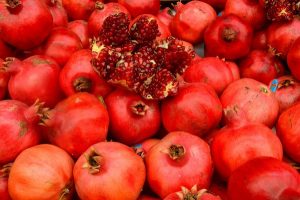
photo - Antioxidants from the group of polyphenols found in pomegranates, red wine and olive oil help remove plaque from inside the arteries
Antioxidants from the group of polyphenols found in pomegranates, red wine and olive oil help remove plaque from inside the arteries. (photo by Barry A. Kaplan)

In addition to the health benefits of dates, the Post article also highlighted 2009 research Aviram had led, showing that “antioxidants from the group of polyphenols found in pomegranates, red wine and olive oil help remove plaque from inside the arteries. In the new research, the team found that dates can bring about the slowing and even regression of atherosclerosis (accumulation of fatty plaque) in the coronary arteries, and that eating one of the three specific date varieties is most effective.

“The material in dates has the clear ability to speed up the removal of excess cholesterol from endothelial cells inside blood vessels, the team said.”

While dates have been grown for thousands of years and their health benefits have been cited since ancient times, it is only in relatively recent history that science is confirming many of the beliefs.

High in fibre and also containing many minerals, such as potassium, zinc, magnesium and calcium, Aviram and his team, writes Siegel-Itzkovich, “recommend following a Mediterranean diet – with its variety of vegetables and fruit (including dates), fish, whole grains and olive oil – rather than eating just one or two ingredients, so that a whole range of oxidative factors that cause atherosclerosis can be neutralized.”

Sybil Kaplan is a journalist, foreign correspondent, lecturer, food writer and book reviewer who lives in Jerusalem. She also does the restaurant features for janglo.net and leads walks in English in Jerusalem’s market.

Format ImagePosted on September 23, 2016September 21, 2016Author Sybil KaplanCategories Celebrating the HolidaysTags dates, health, pomegranates, Rosh Hashanah, Sephardi

Posts pagination

Previous page Page 1 … Page 487 Page 488 Page 489 … Page 661 Next page
Proudly powered by WordPress