Skip to content
  • Home
  • Subscribe / donate
  • Events calendar
  • News
    • Local
    • National
    • Israel
    • World
    • עניין בחדשות
      A roundup of news in Canada and further afield, in Hebrew.
  • Opinion
    • From the JI
    • Op-Ed
  • Arts & Culture
    • Performing Arts
    • Music
    • Books
    • Visual Arts
    • TV & Film
  • Life
    • Celebrating the Holidays
    • Travel
    • The Daily Snooze
      Cartoons by Jacob Samuel
    • Mystery Photo
      Help the JI and JMABC fill in the gaps in our archives.
  • Community Links
    • Organizations, Etc.
    • Other News Sources & Blogs
    • Business Directory
  • FAQ
  • JI Chai Celebration
  • JI@88! video

Recent Posts

  • Story of Israel’s north
  • Sheltering in train stations
  • Teach critical thinking
  • Learning to bridge divides
  • Supporting Iranian community
  • Art dismantles systems
  • Beth Tikvah celebrates 50th
  • What is Jewish music?
  • Celebrate joy of music
  • Women share experiences 
  • Raising funds for Survivors
  • Call for digital literacy
  • The hidden hand of hate
  • Tarot as spiritual ritual
  • Students create fancy meal
  • Encouraging young voices
  • Rose’s Angels delivers
  • Living life to its fullest
  • Drawing on his roots
  • Panama City welcoming
  • Pesach cleaning
  • On the wings of griffon vultures
  • Vast recipe & story collection
  • A word, please …
  • מארק קרני לא ממתין לטראמפ
  • On war and antisemitism
  • Jews shine in Canucks colours
  • Moment of opportunity
  • Shooting response
  • BC budget fails seniors
  • Ritual is what makes life holy
  • Dogs help war veterans live again
  • Remain vital and outspoken
  • An urgent play to see
  • Pop-up exhibit popular
  • An invite to join JWest

Archives

Follow @JewishIndie
image - The CJN - Visit Us Banner - 300x600 - 101625

Author: A 20th Century Passion

Help Passion to Israel

Help Passion to Israel

Dr. Peter Gary discusses A 20th Century Passion, which is set to première in Jerusalem Oct. 17, in a documentary-in-the-making by Hilary Pryor and David Malysheff. (screenshot from a20thcenturypassion.org/documentary)

For most of his life, Dr. Peter Gary never spoke of the three years he spent in Majdanek, Dachau and Bergen-Belsen from the ages of 17-21, or that he and his mother were shot and left for dead on Christmas Eve, 1941. Yet, in 1993, after immigrating to Canada and British Columbia, he founded the Victoria Holocaust Remembrance and Education Society and began to lecture in schools up and down Vancouver Island and in coastal British Columbia. Over the years, he has spoken to more than 65,000 children and youth, college and university students – imparting his message that you can’t live with hate, you can only die with hate.

A 20th Century Passion is an oratorio Gary has composed that depicts the story of the Holocaust and the years preceding and following it, from the end of the First World War through the Nuremburg trials. It is a huge piece – the score alone is 587 pages – that requires a full orchestra, an adult and a children’s choir as well as four soloists plus the conductor. That’s more than 100 people involved in the performance, which is set to première Oct. 17 in Jerusalem – if there is enough to finance the rehearsals, logistics and everything else needed to bring it to life.

Gary’s wife, Judy Estrin, talks about the fundraising project in a video at gofundme.com/20thcenturypassion. She and others involved in the project are asking that people give today. Instead of a latte, give to the music. Challenge your friends to give. If each of the 65,000-plus students who heard Gary’s message over the last 25 years gave $2 to $5, the concert would be funded, a documentary made – Hilary Pryor, executive producer, and David Malysheff, documentarian, have already more than 14 hours of film “in the can” – and there would be funds to donate to help the dwindling number of survivors left.

Gary, a classically trained composer, wrote both the score and the libretto of A 20th Century Passion in the 1970s as a remembrance of the children murdered by the Nazis. The piece has never been performed. (For more on the work and a planned concert in British Columbia that was canceled, see jewishindependent.ca/holocaust-survivor-peter-garys-oratorio.)

In his talks to high school students, Gary speaks about hate, about bullying, about the Holocaust. He leaves them with a message: stamp out hate. This message is more important than ever, as the horrors visited upon Gary and his family are being repeated.

Here is an excerpt from the libretto of A 20th Century Passion by Gary:

Why do you hate me so much?
What have I done to you? –
You really haven’t, but you are a Jew!
For this alone you have to hate….
Why don’t you see me as human, awake?
You must have some feeling,
So many of us, not knowing – just killing….
Whether it’s many that I kill or few
Matters so little, since you are a Jew!
Look at our women, they’re mothers like yours;
Our whimpering children, the frightened old….
Don’t you have young ones, or fathers who….
Oh yes we have them, but none of them Jew!
Our leader decided for all you to die!
We are the masters and do as told….
Being big, strong and hardened and bold….
Look how I’m smiling the same smile you have,
Whenever I’m bleeding my blood is the same red.
I’m speaking the same voice,
Our hands are the same….
I told you, you fool Jew, I told you in vain….
You are not worthy, not human, that’s that!
I pity you man –
When you finish killing – you too are dead.

For more details about the concert and documentary, visit a20thcenturypassion.org. To donate, visit gofundme.com/20thcenturypassion.


Format ImagePosted on September 23, 2016September 21, 2016Author A 20th Century PassionCategories MusicTags Holocaust, Israel, Peter Gary
Changing face of libraries

Changing face of libraries

Isaac Waldman Jewish Public Library librarian Helen Pinsky, left, and master’s student Alisa Lazear, who is working on the library’s audiobooks collection. (photo by Olga Livshin)

In past centuries, reading aloud was an integral part of family life. People gathered in their parlors to read books to friends and family. In the 20th century, the experience migrated towards radio. When favorite personalities read new novels or classics on the radio, it was a unique pleasure in many communities, especially where access to live entertainment was limited. Then came the TV and the internet. But reading aloud is seeing a comeback – with audiobooks.

The Wall Street Journal ran an article recently about how audiobooks are the fastest-growing sector in the book business today. In 2015, audiobook sales in the United States and Canada increased 21% from the previous year.

The Isaac Waldman Jewish Public Library has reacted to this latest development by expanding their audiobook stacks.

“The modern libraries have to change to keep up with the times,” said Helen Pinsky, Waldman’s head librarian, “but they also stay the same. As ever, they answer the patrons’ curiosity, provide access to information. They are the source of knowledge, whether on their shelves or through their computers. The changes come from different angles. For example, some libraries in the Greater Vancouver area explore novel ways of organizing books: by theme or by the time of publication instead of alphabetically by the author’s name. Such a method is especially convenient for teachers – who could find books on a particular theme grouped in one spot of the library – or for researchers.”

Pinsky also expressed concern about the negative impact of technology, however. With internet search engines, in particular Google, and sites like Wikipedia, people have stopped coming to libraries for information.

“They Google their questions and get a thousand websites as the answers,” she said. “But who could guarantee that the data they find in the first 37 hits is correct? Google is dangerous. It is destroying the value of encyclopedias, while librarians know where to find the right stuff. It is specifically true for the medical or legal areas.”

Of course, there are positive technical innovations, and Pinsky emphasized those, especially the digital formats. After ebooks became a huge segment of publishing in the last decade, and audiobooks followed a few years later, public libraries had to adapt to the new demands, although print books still dominate in the Waldman Library catalogue by a ratio of approximately 20 to one.

“It might be a different ratio for the city libraries,” Pinsky mused. “The exclusive supplier of digital books to Canadian libraries is Overdrive. There were a few smaller companies before but they’ve all gone out of business by now. Unfortunately, Overdrive doesn’t have much interest in the Jewish content, so their selection of Jewish-themed books in both epub format and audio format is rather narrow. They don’t have anything in Hebrew either. It might change in a few years, or publishers might start distributing digital content themselves.”

Still, there are some books available through Overdrive that are of specific interest to a Jewish readership, and the Waldman takes steps to broaden its digital choices.

“Audiobooks are trendy now,” said Alisa Lazear, who is working on the Waldman’s audiobook collection.

Lazear is studying for a master’s degree in library and information studies at the University of British Columbia.

“I need to do 120 hours of professional experience as part of my program. It’s an equivalent of one course,” she explained. “I approached Helen to do my professional experience at the Waldman because I love the library. It was Helen’s idea that my focus should be the audiobook collection. We already have some audiobook CDs, so I concentrated on the online streaming from Overdrive. I had to figure out how to download their books, choose which ones would interest our readers, and integrate them with the main catalogue. Then I had to design flyers to educate the patrons how to use such audiobooks.”

In Lazear’s opinion, the current popularity of audiobooks has to do with people’s chronic shortage of time.

“Audiobooks are great for multitasking,” she said. “You can drive, do chores, work out at a gym, and listen to an audiobook at the same time. A narrator also plays a huge role. He is part of the experience, almost like a friend reading to you. Some narrators have a huge following; people would listen to anything by them.”

Lazear thinks that the new digital formats are accessible across the generational spectrum.

“My young cousins enjoy listening to their favorite audiobooks before bed or in a car,” she said. “Some older people develop visual impairment, and audiobooks might be the only choice for them as a form of reading.”

Regarding this latter point, Lazear created an audiobook program, Coffee & Stories, for the Louis Brier Home and Hospital.

“We had our first meeting on Aug. 7,” she said. “Several people came to the activity room. I brought cookies and selected two different audiobooks. We listened to 10-minute clips from each and then discussed them. It was a very active discussion.”

Olga Livshin is a Vancouver freelance writer. She can be reached at [email protected].

Format ImagePosted on September 23, 2016September 21, 2016Author Olga LivshinCategories BooksTags audiobooks, ebooks, libaries, technology, Waldman Library
Moments with Elie Wiesel

Moments with Elie Wiesel

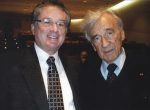
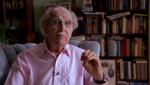
Robert Krell, left, and Elie Wiesel. (photo from Robert Krell)

I met Prof. Elie Wiesel in 1978. I was 38 years old. He was 49. Elie, as he insisted I call him, came to Vancouver to speak at a commemorative event. It was for Yom Hashoah, the day of Holocaust Remembrance.

He arrived Friday afternoon and I fetched him at the airport and brought him to our home for a few moments pre-Shabbat and then to his hotel. He had agreed to a press conference on Saturday morning stipulating only that no microphone be used. Elie was observant.

I moderated that morning. He was engaging, handled difficult and peculiar questions equally graciously, and made a deep and lasting impression on the journalists and religious leaders who attended. I learned that morning that his book, Night, a slim 120 pages, had once been nearly a thousand pages written in Yiddish and published in Argentina. How had he reduced it to its present size? By eliminating every paragraph without which the book would not lose its essence, and then by eliminating every sentence in those paragraphs that was not needed to sustain its narrative. Ever since, I have tried to practise that in my talks and writings.

Elie asked me to visit at the hotel on Sunday for breakfast and we ended up talking all day. That evening, he spoke to an audience of 500. I had the honor of introducing him. I used two minutes. How long does one need to introduce Wiesel? He was known to all, even though he had not yet received the Nobel Peace Prize; that was to come in 1986. His lecture that evening was astonishing. One could listen to him forever, one of the few speakers in the world who commands attention and seldom, if ever, loses his audience.

We remained friends. He was the kindest, gentlest, wisest person in my life. And he always made time for me although he was also the busiest and most prevailed upon person imaginable.

So, I took it upon myself to do two things. One was to call him from time to time and briefly visit when I was in New York. Famous people sometimes have no one who inquires as to their own lives. I did not ask him for anything unless the idea began with him. No demands, requests, or favors. The other was to assist wherever I could with whatever little I could do. For example, he asked whether I could arrange for him to be in touch with Rudolf Vrba, one of only four or five escapees from Auschwitz and the author of the Vrba-Wetzler Report (Auschwitz Protocols) warning of the imminent deportation of Hungarian Jews in 1944.

Vrba lived in Vancouver and I knew him well. Elie and Rudi subsequently corresponded for years and I can only guess that some of it concerned the fact that the Wiesel family was not informed by those who received the report in Hungary when there was still a chance to flee into the nearby Carpathian Mountains. Did they ever meet? I offered Elie the opportunity. His response, “I do not think I can look into his eyes.”

One time, when in New York, I received Elie’s return call. Yes, he had time for me to have a brief visit on Monday morning. I went to his home and we caught up for perhaps a half hour. During that time, he excused himself only once, to take a call from the White House. Presidents, secretaries of state, governors and senators, all sought his counsel. He often flew at short notice to speak, to warn, in the midst of various crises around the world.

It was close to Passover. He asked who was traveling with me and I told him, my wife Marilyn and our oldest daughter and granddaughter. Elie was upset not to greet them and he insisted we all visit the next Thursday so he could personally wish them a happy Pesach. How he made time in his wildly busy schedule, I will never understand.

I saw Elie speak in Israel at the 1981 World Gathering of Jewish Holocaust Survivors at Lohamei HaGeta’ot (the Kibbutz of the Ghetto Fighters) and at the closing ceremonies with then-prime minister Menachem Begin. While in Los

Angeles in 1982, I heard him speak at Cedars-Sinai Hospital on “the Holocaust patient” and on “talmudic tales” at UCLA Hillel House. Spellbinding.

For the very first International Conference of Child Survivors and Their Families – the 1991 Hidden Child Foundation/Anti-Defamation League conference – the New York-based committee asked if I could convince Elie to speak. Since Elie seldom said no if he was able to attend, wherever in the world he was needed, this request for my involvement was puzzling. After all, this was New York, his home and the site of the gathering. But he had declined. My guess is that the situation had become complicated by competing factions.

I called him and reminded him that this was “the gathering of the children.” Where else would he want to be? He graciously agreed to give the closing address. I introduced him on the closing night and wondered out loud how it was possible that I had heard him lecture at Yale, in Israel, New York and Los Angeles. Somehow, wherever he was, I found him. I must be his groupie! I certainly never missed an opportunity to hear him and to learn from him.

In 1998, in New York, Elie presented me with the Elie Wiesel Holocaust Remembrance Medal for my work in Holocaust education, my psychiatric contributions to the care of Holocaust survivors and the founding of the Vancouver Holocaust Education Centre. Elie had visited the VHEC and served on its international advisory council along with Irwin Cotler, Yaffa Eliach and Sir Martin Gilbert. My family was there and my children all came to know him better. His loving presence is seared into their memories. Children, for him, were like a magnet. All who wrote to him received a personal response. How he managed this, in between teaching at Boston University, speaking around the world and publishing at least one book every year, I do not understand. But that is what he did.

In 2008, I went to Boston to celebrate his 80th birthday, which consisted of a three-day Festschrift devoted to his scholarship and writings, as well as a tribute concert.

Although surrounded by his friends and fellow scholars, I found him sitting alone in the front row and joined him. At one point, I turned to him, “Elie, what is it like to hear all these scholars speak about your contributions all day long?” His response, “I am a good listener.” And, indeed, he was. He listened attentively, to individuals and to humanity.

I nominated Elie for an honorary doctorate from the University of British Columbia and, although he was still recovering from open heart surgery (and wrote a book Open Heart), he traveled to attend the 2012 ceremony and to participate in An Evening with Elie Wiesel, held at the Orpheum theatre, attended by some 3,000 people. Our cab driver said, “Oh, look, Elie Wiesel is speaking.”

As the interviewer for the evening’s proceedings, I asked questions, some “naïve,” as in “Why remember such awful events?” referring to the Shoah.

Elie’s response: “How can you not? Memory is part of who you are, your identity. I have so many wonderful memories of my family and being in shul and it’s all I have now of my family except my two surviving sisters, of whom one has since passed on. Without memory, who would I be? The moments are so important.”

“Elie,” I asked, “you were asked to be the president of Israel. Can you tell us about this?” He answered that the thought had tormented him. How could he turn down the highest honor that could ever be bestowed upon him? He felt he was letting down the state of Israel that wanted him and his leadership. But, he explained, he was without political experience and all he really has are words which, as a politician, would no longer be his. “And besides,” he joked, “my wife would have divorced me.”

“How do you choose the language in which you write?” (Elie speaks Hungarian, Romanian, Yiddish, Hebrew, French and English.) “I prefer the eloquence of French, which is the easiest for me. And, sometimes, my choice is determined by what I am writing about. And I like to write to classical music, preferably a quartet, as an orchestra is too distracting.”

“What message would you send to our young people here tonight?” His response, “Your life is not measured in time and years. It is a collection of moments. You will look back and have so many moments in time that remain fresh, memorable and meaningful. I would tell all of you young people in the audience to enjoy all these moments in time. Being here in Vancouver this weekend has been one of those moments for me.”

With his passing, I shall be without more such moments with him. His death leaves an enormous void, for his moral strength and inspiration will be missing from all who benefited. We must resolve to step up and commit to continuing to learn from and emulate this remarkable human being who returned from the depths of despair and loss to provide a measure of hope.

I urge you to read Night and Elie’s brilliant memoir in two parts All Rivers Run to the Sea and And the Sea is Never Full. Having absorbed at least these books, you may then reflect upon, and hopefully act upon, the lessons learned. They will last you a lifetime.

Dr. Robert Krell is professor emeritus, department of psychiatry, University of British Columbia, distinguished life fellow of the American Psychiatric Association and founding president of the Vancouver Holocaust Education Centre, in whose newsletter, Zachor, this article has also been published.

Format ImagePosted on September 23, 2016September 21, 2016Author Robert KrellCategories Op-EdTags Elie Wiesel, Holocaust, survivors

Concerns about the alt-right

There used to be just conservatives. Then there came the neo-conservatives, a largely American variation on the theme that venerates free markets, but marries it with an interventionist foreign policy. Neo-conservativism got a black eye after the interventionism its proponents advocate led to the quagmire in Iraq. In a resurgence of old-fashioned conservatism, stalwarts proudly adopted the self-deprecating paleo-conservative, a blatant rejection of the neo-conservative moniker.

In recent months, a new term has come into common usage in American politics: alt-right. The contraction of “alternative right” is a sort of whitewashing umbrella for a range of ideological streams that were, until recently, considered well outside the mainstream. White nationalism, itself a whitewashed term for white supremacy, is chief among these. While not precisely defined, alt-right has also been said to encompass the anti-immigration and xenophobic nativism that has been articulated by Donald Trump, the Republican candidate for U.S. president. Populism is a term also associated with the alt-right, although Bernie Sanders’ challenge to Hillary Clinton for the Democratic nomination was also defined as populist.

The banality of the term “alt-right” – it almost sounds like something you do with a computer keyboard – masks the mainstreaming of terrible ideas. Concurrent to, and not the least bit unrelated to, the rise of alt-right as a term is the rise of Trump as a political phenomenon. The Republican standard-bearer has said, on an almost daily basis, things that would eliminate any other candidate in history from contention. Yet his supporters dismiss (or embrace) his hateful, ignorant and, seemingly as often as not, outright false statements. The litany is endless. Last week, he suggested that Clinton’s secret service details should disarm and “see what happens to her.” This unsubtle allusion to violence is not at all uncommon in Trump’s rhetoric. That he remains a contender for the presidency is alarming. That he is rising in the polls, almost tying Clinton in aggregates and leading her in many polls, suggests that Americans are seriously considering taking a dangerous political turn.

Trump idolizes “strongmen.” He has reveled in the admiration of Vladimir Putin, the Russian leader who has undone that country’s nascent steps toward democracy. He is unequivocally a solo act, openly insisting that he will run roughshod over Congress and the judiciary, the institutions that the founders of the United States set up as checks and balances on the presidency. He has stated that the electoral system is rigged against him and predicted rioting in the country should he lose. The image he projects of America is of a third-world economy, and the vision of political violence he purveys is more suited to an unstable dictatorship than to the reality of American government.

It is in the nature of human beings to take for granted what we have the moment we possess it. Readers of a certain age remember The Jetsons, with its incredible futuristic gadgets, a cartoon we can now watch on a device we carry in our pocket that contains all the accumulated knowledge of humankind, and we have the ability to speak face-to-face with almost anyone in the world instantaneously, in real time. And yet, when this gadget alerts us that we have a message or a call, we are as likely to respond with a weary, “Oh, what is it now?”

Likewise, perhaps, with democracy. In its modern incarnation, democracy was born 240 years ago in what is now the United States of America. In the span of human history, this is the blink of an eye. About Trump, many commentators, most recently this week in the Washington Post, have said, “This is how fascism comes to America.”

On numerous occasions over the years, we have used this space to condemn flippant use of such terms as fascism, warning that overuse will dull sensitivity to the seriousness of the language and its threat. We are less reticent to condemn the use in this case. The rise of Trump and the “alt-right” ideologies he empowers are cause for very real concern.

Posted on September 23, 2016September 21, 2016Author The Editorial BoardCategories From the JITags alt-right, Clinton, nationalism, neo-conservative, paleo-conservative, presidential race, racism, Trump, white supremacism

Cancer makes me angry

Cancer. Now I’ve said it. Just saying it tightens up my gut. It makes me want to swallow. I look around to see if anyone can sense the anger, the blind rage that surges through me. I find myself breathing faster. The fight-or-flight chemicals prompted by fear are racing through my body. Mostly, I try not to think about it because of the instant effect it always has upon me. I don’t know about others, but I hate it. Just the thought of it makes me angry.

To me, the idea of cancer is like a living presence, dressed up in the image of death, stalking through our lives, the destroyer of health and happiness. It looks this way and that, it looks for those at whom it will swing its lethal scythe. I know it’s really like spores in the wind, poisons in the soil, air and water, or genetic predispositions hiding in our DNA, waiting for the merest provocation to flower like a deadly bloom of nightshade. I know it is like an evil charlatan that smilingly gives way to our defensive measures, only to strike back with deadly force when we have let down our guard. I know it has so many disguises and tricks that we have to learn the new ones every day that we are alive. It takes some of our best minds to keep us relevant in that battle.

I know about all the new promises, new hopes yet to be realized. We learn something new every day. But, so does cancer, reacting to counter every twist and turn we make. We are not there yet in spite of all the public promises that are made. It is not politically correct to say it, but the same promises were being made during the time cancer was a living presence in my home. So I retain the hate that I learned.

When it struck in our home, we reacted with shock. We marshaled our resources and radically changed our lifestyle. My late spouse gave up her stressful and demanding work. She was a simultaneous translation interpreter. She was the manager and creator of her own firm, one that was preeminent in Canada, but she delegated her work and ceased professional activity. She underwent a mastectomy, radiation and chemo. We changed our diet toward the completely macrobiotic and a shelf full of recommended natural products. The result – in six months all traces of the disease were eradicated! We declared victory. My spouse became a poster child, a survivor, to rally the spirits of all victims of the disease. After a year, we relaxed our guard and returned to our previous way of life.

Four or five years later, two cancer cells were discovered during the regular screening that had been maintained. The number of cells quickly multiplied and, after a time, a regular regime of chemotherapy was reintroduced, accompanied by multiple discomforts. This continued for years. No material effect on the disease’s progress was ever noted. Eventually, several metastases were discovered, until the cancer was generalized. None of the chemotherapy offered appeared to have had the least effect.

My role changed over time, as I became a full-time caregiver. Indeed, after years of feeling like a helpless bystander, there was great consolation in, at last, being able to play a useful role. I had the feeling I was witnessing hand-to-hand combat with the cancer, a living, breathing adversary. I hated the losses we were sustaining on a daily basis. The success of radiation sessions in fighting off the external manifestations of the cancer felt like victories.

At one point, the cancer prevented the kidneys from working. The doctors asked if we wanted them to intervene. Although my late wife declined, because she was suffering the effects of uremia, which impairs judgment, my resounding yes won the day. The intervention was successful. We went off on a two-week holiday in Italy. I treasure to this day the sight of her dancing to her own music on a sunny balcony in Tuscany.

The medical resort to radiation to eliminate ugly lesions that appeared, time after time, on various areas of the body, seemed like a blessing. But, the ultimate effect of these sessions was to destroy the ability of the body to produce the red and white blood cells we depend on for life. I did not understand that these were a signal that the medical profession had given up any hope of a remission, because the doctors continually talked to us of impending victory. I did not question it, full of continuing hope as I was. In effect, they were offering palliative care, while continuing to test drug combinations on my late wife.

Eventually, these blood cells could only be provided for her by external means. We learned, after a time, that these infusions of blood cells, enormously costly, were the only way to keep my late wife alive. I always assumed these would continue, but I marveled at the generosity of the system on which her life depended. The various chemotherapy combinations, with all their accompanying distress, continued to be presented by doctors as the answer and the cure. She followed every prescription faithfully in spite of the discomfort they engendered.

Suddenly, we were informed by the hospital administration that my late spouse was to be assigned to hospice care in our home. Calls to the doctors went unanswered. Any assistance I could provide was replaced by outside help. We were told that the life-giving infusions were being withdrawn. She expired after three weeks, 10 years after first contracting the disease.

I do not know if the doctors ever confided to my late wife the real state of the struggle in which we were engaged. If they did, she never shared the details with me. We never ever spoke of her impending demise.

I remain a survivor of the experience, full of anger at the caregivers, anger at my helplessness and ignorance, and full of rage against the inexorability, the implacability of the disease. Its overwhelming power in the face of our defences, even after once having been initially repulsed, gives me little faith in the happy claims of any early relief in our struggles against the disease.

I appreciate that there have been some small victories, that some conditions have become treatable instead of fatal. I am grateful for that. I appreciate that we must encourage those who are facing the challenge and the threat. I know that they, and we, have to continue fighting it like soldiers on the frontline, despite our many losses. Cancer, I hate it!

Max Roytenberg is a Vancouver-based poet, writer and blogger.

Posted on September 23, 2016September 21, 2016Author Max RoytenbergCategories Op-EdTags cancer, health, palliative care
Love your child as they are

Love your child as they are

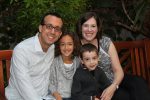
The Swirsky family. Jackie Swirsky has written a children’s book, Be Yourself, which features illustrations by her eldest child, Jacob, and her sister-in-law. (photo from Jackie Swirsky)

Maybe it’s because I’m an academic, but I tend to gravitate to categories, which is why the most current discourse on gender has made me feel challenged. I am, by now, very comfortable with the increasingly understood categories of transgender and cisgender (meaning that one’s body conforms to one’s gender identity). But what about cases of individuals who identify as neither transgender nor cisgender, but operate, instead, somewhere in the middle?

Jackie Swirsky, a speech-language pathologist based in Winnipeg, is the mother of two sons, one of whom (Jacob, age 8) Swirsky describes as “gender creative.”

Swirsky is my second cousin, but we only became acquainted after she published her children’s book, Be Yourself, which features a gender creative child and focuses on acceptance. We recently spoke by phone, where I admired her eloquence and compassion and, above all, her comfort with accepting the in-between.

When Jacob was 4, he said to his parents he felt it “wasn’t fair” that he was “a boy.” That’s when we opened up a dialogue, Swirsky said. Currently, he still identifies as a boy, “but his gender expression is very feminine,” she said.

There may have been a time when, faced with a son who prefers to dress in what are conventionally thought of as “girls” clothes, a parent may have tried to force the child to change. One can imagine the emotional pain that would have enveloped those households in those generations. Instead, Swirsky puts it plainly: Jacob “is perfect the way he is.” She sees it as her job not to change her child, but rather to “educate the world” in order to “make it a happier, safer place.”

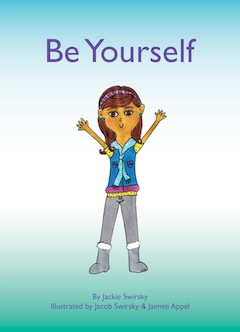
image - Be Yourself book coverEnter her book, Be Yourself, with illustrations by Jacob and Swirsky’s sister-in-law Jaimee Appel. It can be purchased at beyourselfbook.ca.

Swirsky took her message to Camp Massad at Winnipeg Beach before camp started, as Jacob would be a camper there over the summer. Leading a workshop for counselors on how to rethink gender norms, Swirsky’s goal was to help the staff “identify their own gender stereotypes,” while encouraging them to open a dialogue with the campers – rather than scold – if they happen to encounter issues of gender stereotyping or instances of gender mocking.

And, while some camps might think of themselves as progressive on the issue of gender, given the easy availability of costumes and the playful gender-crossing that may ensue, Swirsky is clear: for Jacob, this isn’t “dress up,” it’s who he is.

Camp Massad program director Sari Waldman shared with me that, in trying to make camp as “inclusive and accessible as possible,” they are rethinking some of what they realize are overly gender-binary practices. “Simple things,” Waldman said, like do we really need to divide the chadar ochel (dining hall) along gender lines?”

They are now more sensitive to gender stereotypes when writing cabin songs. Not every boy plays sports and longs to sneak into girls’ cabins, they now realize. Waldman added that they have installed gender-neutral washrooms in various spots around camp, and would include a gender-neutral stall in the refurbished bathrooms. This year, for the first time, boys’ and girls’ cabins would no longer be on opposite sides of the field.

Other camps have taken gender-awareness on board, too. As was reported in the Washington Post, Habonim Dror camps across North America, including Camp Miriam on Gabriola Island, have created a new, gender-neutral Hebrew word for camper (chanichol) for those who identify as neither male (chanich) or female (chanicha). And they have renamed each of their age-group names with a pan-gender neologism suffix (imot) rather than the male im or the female ot. It’s a mouthful (and not traditionally grammatical), but the move has created new awareness around gender identity and the categories into which we put each other.

No doubt, attending Jewish camp won’t be without its challenges for someone like Jacob. It’s hard to get around separate sleeping and showering arrangements, even if privacy is granted for changing. And, when it comes to ritual garb, Jacob doesn’t feel comfortable wearing a kippah, for example. Swirsky hoped that the staff would either let him choose whether or not to wear one, or else ask everyone – boys and girls – to cover their head.

As for school, Swirsky finds that the teachers at her son’s school are excellent in supporting Jacob where he is. She also has much praise for the Winnipeg One School Division, which recently issued a new “safe and caring policy on transgender and gender-diverse students.”

Occasionally, though, there are setbacks. One day, a substitute teacher asked the kids to divide up according to gender. Relaying the day’s events to Swirsky that evening, Jacob revealed that he didn’t know which side to stand on. “I just sort of wandered,” he said.

While Swirsky finds that some people she encounters lavish praise on her for her apparent open-mindedness, she insisted that this is basic to who she is as a parent.

“I love and accept my child for who they are; not who I expect them to be,” she said.

And, when talking with Jacob, Swirsky always makes sure to ask open-ended questions. “If you’re really listening to your kid,” Swirsky said, “you’re going to help support them to be on a path that makes them happy.”

It’s a wonderful message about love and acceptance, parenting our kids where they are, and helping society evolve to embrace diversity – even if that diversity is much more finely grained than we may have realized.

Mira Sucharov is an associate professor of political science at Carleton University. She is a columnist for Canadian Jewish News and contributes to Haaretz and the Jewish Daily Forward, among other publications.

Format ImagePosted on September 23, 2016September 28, 2016Author Mira SucharovCategories BooksTags camp, gender, school
Milken launches site

Milken launches site

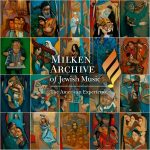
This two-album anthology was created to celebrate the launch of the Milken Archive’s new website. It features a sample track from each of the archive’s 20 thematic volumes.

The Milken Archive of Jewish Music: The American Experience has launched a new website (milkenarchive.org) that allows visitors to experience virtually every piece of music and every composer that the archive has recorded since its founding in 1990.

The extensive collection – which includes more than 600 works comprising 1,800 individual tracks, 200 composers and 800 hours of oral histories – is organized into webpages that contain links to all of the available related media content collected and created in the course of the archive’s historic work.

“This new site is a vast repository of a musical culture that has continually redefined and reinvented itself as it has responded to the opportunities and challenges of life in a land of freedom,” according to Milken Archive curator Jeff Janeczko.

The new mobile-friendly platform offers a rich experience on a variety of devices to accommodate the diverse needs of Milken Archive’s audiences. From documentary videos and photographs to extended oral histories and articles, each page exists within the context of the cultural and historical narratives that have defined Jewish life in America for the past three-and-a-half centuries.

In celebration of the new site, a digital anthology is available free to all individuals who sign up at the archive’s website. Ten winners will also receive five albums of their choice; five winners will choose 10 albums. A grand-prize winner, chosen at random, will have unprecedented access to all 1,800-plus tracks contained within the archive’s 20 thematic volumes. The deadline to sign up for the free album and contest is Sept. 26.

The Milken Archive repertoire on the free two-album anthology features one sample track from each of the archive’s 20 thematic volumes.

On Album 1, there is: 1. Ikh Bin a “Boarder” Bay Mayn Vayb (I’m a Boarder at My Wife’s) by Rubin Doctor; 2. Celestial Dialogues: IV, Adonai Melekh (The Lord is King) by Ofer Ben-Amots; 3. L’kha Dodi (Welcome, Sabbath Bride) by Aaron Bensoussan; 4. Eshet Hayil by Benzion Shenker (arranged by Stanley Sperber); 5. Hear O Israel: IV, Sh’ma, by Jonathan Klein; 6. Violin Concerto in C Minor, “Nushkaoth,” by Sholom Secunda; 7. Two Hannah Szenesh Poems: II, Ashrei Ha-garfur, by Max Helfman; 8. Amar Rabbi, Elazar, by Moishe Oysher; 9. Stempenyu Suite: III, Freilechs, by Joseph Achron; and 10. Di Naye Hagode: Riboyne-Sheloylem (The New Haggadah: Master of the Universe) by Max Helfman.

Album two comprises: 1. Mayn Rue Platz (My Resting Place), anonymous, arranged by R. Williams; 2. Canticles for Jerusalem by Vivian Fine; 3. Kol Nidrei, Op. 47, by Max Bruch; 4. Ki K’shimkha by Paul Discount; 5. Shofar Service: I, Malkhuyyot, by Herman Berlinski; 6. Genesis Suite: IV, Cain and Abel, by Darius Milhaud; 7. The Day of Rest by Sholom Kalib; 8. Aleikhem Eda K’dosha, traditional; 9. Akavya ben Mahal’el Omer by Lazar Weiner; 10. The Merchant and the Pauper, Act II, Scene 4 (excerpt) by Paul Schoenfield.

Since its creation by philanthropist-businessman Lowell Milken, the Milken Archive has achieved a reputation that extends internationally. The 50 CDs released by Naxos American Classics between 2003 and 2006 gained widespread recognition, including Grammy and ASCAP awards, and the nationally broadcast radio series hosted by Leonard Nimoy has introduced the archive to countless listeners.

“The Milken Archive of Jewish Music is a living project, one that we hope will cultivate and nourish musicians and enthusiasts of this richly varied musical genre,” said Milken. “The sacred and secular body of work that has developed over the centuries since Jews first arrived on these shores provides a powerful means of expressing the multi-layered saga of American Jewry.”

Format ImagePosted on September 23, 2016September 21, 2016Author Milken Archive of Jewish MusicCategories MusicTags Jewish music, Milken Archive
About the cover art

About the cover art

Shula Klinger creates her vibrant, whimsical designs with cut paper. The art is then scanned and reproduced as prints and greeting cards. Selections of her work can be purchased at Delish General Store (Granville Island) and Queensdale Market (North Vancouver). To see her full range of work, visit niftyscissors.myshopify.com or find her at the Artisan Fair, hosted by the North Shore Jewish Community at Congregation Har El in West Vancouver on Oct. 16, noon-4 p.m.

Format ImagePosted on September 23, 2016September 21, 2016Author The Editorial BoardCategories Celebrating the HolidaysTags art, gift cards, High Holidays, Rosh Hashanah
A physical, emotional hike

A physical, emotional hike

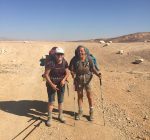
Arlene Doyle, right, was joined for part of her adventure by her friend, Jennifer Williamson. (photo from Arlene Doyle)

In early February, Arlene Doyle, a 53-year-old massage therapist and writer based in Ottawa and Perth, Ont., set off on the Israeli National Trail, the Shvil, as it is called in Hebrew. She shared some of the highlights of her at-times grueling 10-week hike at a Jewish National Fund of Ottawa-hosted event on July 14.

Beginning at the Gulf of Aqaba in Eilat, the Shvil runs northwardly through the length of Israel to Dan, near the Lebanese border. The trail, which is approximately 1,000 kilometres (620 miles), opened to hikers in 1995.

In the description of herself on her website, theflipsideoffifty.com, Arlene says she is someone who likes adventures. For those of us who have known her personally for nearly 30 years, that description is an enormous understatement. Arlene is an experienced hiker, with Kilimanjaro, Everest base camp, parts of the Peruvian Andes, several mountain ranges in Greece, Mount McKinley in Alaska and up and down the Grand Canyon to her credit. She has also biked from Vancouver to Mexico along the U.S. West Coast.

No stranger to challenges, the Shvil appealed to Arlene because it met four specific criteria: the trail was more than 500 miles, parts of it were remote, she could expect it to be warm most of the time, and Israel was a place to which she had not yet traveled.

It also obliged her one constraint. In addition to her work as a massage therapist, writer and mother of three young adults, Arlene is a fledgling blueberry farmer. She needed to be home by mid-April to nurture her hundreds of blueberry plants as they entered their second year of growth.

Arlene was joined for part of her adventure by a friend, Jennifer Williamson.

photo - Jennifer Williamson climbs up a ladder after she and hiking partner Arlene Doyle had to trek through a pool of water
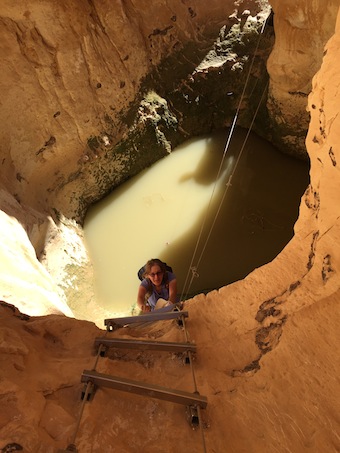
Jennifer Williamson climbs up a ladder after she and hiking partner Arlene Doyle had to trek through a pool of water. (photo from Arlene Doyle)

The Shvil was designed to be walked from the northern part of the country towards the south. Walking from the north, hikers have the opportunity to acclimatize to the trail and be in their best physical shape as they approach its most challenging parts. Since Arlene and Jen started their hike in early February, when northern Israel can be chilly, they decided to walk from the south to the north, in order to enjoy warmer temperatures at the outset of the hike. They paid a price for that decision.

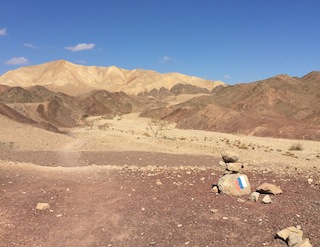
Carrying 45-pound backpacks with all of their camping and survival gear, they met windy, wet weather, cold evenings and mornings in the desert, difficulties caching water – which meant having to carry enough water and food for three days – steep ascents which, for hours, snaked up, down and around mountains, and difficulties even finding the trail markers – orange, blue and white stripes placed on rocks at varying frequencies. Their challenges also included literally having to swim across pools of water of unknown depth only to have a sheer vertical rock waiting on the other side. And then there was the isolation – they hiked for seven days from Eilat to beyond Timna Park and the Solomon Pillars without meeting another soul. In Arlene’s words, “it was strenuous, beautiful and sometimes treacherous, and the quiet solitude of the desert felt blissful.”

Once they reached Arad, a city located on the border of the Negev and Judean deserts, they were far enough north to start enjoying Israeli hospitality. There, Jen’s enflamed knees were diagnosed as acute tendinitis, no doubt brought on by the heft of her pack, and prescribed a 10-day rest, which she took at a guest house. Arlene continued north on her own and her blogs provide exquisite detail about her experiences in and around Arad, Masada, Meitar and Sansana.

photo - When Jennifer Williamson was diagnosed with acute tendinitis in her knees, she took her prescribed rest at a guest house in Arad
When Jennifer Williamson was diagnosed with acute tendinitis in her knees, she took her prescribed rest at a guest house in Arad. (photo from Arlene Doyle)

It was in Sansana where Arlene met her first “Trail Angel” – Israelis who feel passionately about their country and open their homes to hikers along the Shvil, providing beds, showers and other amenities out of pure generosity. After staying with several Trail Angel families, Arlene remarked, in her most diplomatic fashion, that she had gained an appreciation of the many complex issues around which Israelis have equally complex and diverse opinions.

After a few days of travel on her own, Arlene realized that she, too, had some bodily damage to repair. She had significantly strained both her Achilles tendons. Communicating via cellphones, she and Jen decided to nurse their mutual injuries with an unplanned three-day “spa retreat” at the Dead Sea, camping on an empty beach facing the Jordanian mountains. A lack of “sweet” water in which to bathe their salt-crusted bodies and clothing and the fact that their food supply had run out, put them back on the Shvil, hiking towards Jerusalem.

Their few days in Jerusalem proved to be one of the highlights of the trip. Arlene remarked on how deeply moved she was by all she experienced in the Old City. Having been raised in a religious milieu – her parents were Mormon missionaries – she had a deep appreciation for the various interpretations, traditions and teachings of the many unique stones, domes, walls and temples throughout Jerusalem.

The richness of this experience was much enhanced when she cashed in on a generous gift from one of her Ottawa clients – an overnight stay at the King David Hotel. She and Jen arrived looking like ragamuffins, and left feeling very pampered by the luxuries the gift afforded them and by how wonderfully they had been treated. When hotel staff heard that these women were walking the Shvil, Arlene feels that they were accorded an extra measure of respect and kindness.

After Jerusalem and before Jen returned to Canada, they rented a car to visit some of the key sites in Israel not on the Shvil. The added bonus was that being off their feet gave their knees and ankles more recovery time. They headed to the Golan Heights, passing the Mount of Beatitudes, Merlon Golan and, finally, the Nimrod fortresses, which date from 1270 CE.

With Jen in the air, Arlene returned to the Shvil. Her path took her through Caesarea, where she slept within the famous ruins. Workmen woke her with water and cookies and advice to be careful, as snakes would soon be coming out from under the rocks to sun themselves.

photo - One of the markers along the Israel National Trail
One of the markers along the Israel National Trail. (photo from Arlene Doyle)

In Zikhron Ya’acov, she enjoyed an impromptu concert in the park before heading to the home of another Trail Angel. After returning yet again to the Sea of Galilee, she made her way to the Nahal Me’arot Nature Reserve and to the one spot on earth where skeletons from both Neanderthal and Homo Sapiens have been found together.

It was during these solitary days on the trail that Arlene’s personal reflections on her experience came into focus. Her first reflection was around Trail Angels. “The degree of caring here for other people’s well-being feels unique,” she said. “The love of homeland feels unique. Hiking the trail is both praised and supported.”

A second reflection was around loss. One of the stopping points on the trail is a small house near Sansana, where a young Israeli died while hiking. The parents of the hiker created this house as a memorial to their son. Arlene talked about how significant a tribute that was and how it sharpened her own awareness of how, in life, “nothing stays the same; we all have to adapt to losses.”

At the end of her presentation, Arlene expressed very poignantly what many of us in the audience wanted to know.

“Solitary walking for days, you find out things about yourself,” she said. “We all have a load to carry. Walking alone, the weight and onus of your emotional cross rests squarely on your own shoulders. You come face-to-face with the sticks and bones of your personality and the measure of your mettle.”

Judging by the questions posed by her audience, Arlene’s experience whet the appetite of many to have the opportunity to measure their mettle.

Karen Ginsberg is an Ottawa-based travel writer who hopes to walk a flat part of the Shvil on an upcoming trip to Israel and meet a Trail Angel or two.

Format ImagePosted on September 23, 2016September 21, 2016Author Karen GinsbergCategories Israel, TravelTags Israel National Trail, Shvil, Trail Angel
Jewish tourists in Romania

Jewish tourists in Romania

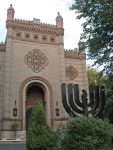
The Choral Temple in Bucharest. (photo from Wikimedia Commons)

We spent two weeks in Romania in the late summer of 2015, also visiting Bulgaria. We took this trip partly because it was an area of vibrant Jewish life from Roman days until the late 1930s. Romania also served as a commercial link between Europe and Asia, and was known for its café life. Its capital, Bucharest, was called the “Paris of the East.” Then came the Nazis and, after them, the Soviets. We wanted to see what remains in these two countries, primarily for Jews but also for the rest of the population.

We arranged a private tour with a knowledgeable guide that generally followed an itinerary designed as a Jewish heritage tour, supplemented by Ruth Ellen Gruber’s Jewish Heritage Travel: A Guide to Eastern Europe (2007). Local information on Jewish sites is surprisingly scant, nothing like what one finds in Lithuania and Latvia. However, the tour company had prearranged talks with people in the larger synagogues, museums and cemeteries, which helped to augment our own observations. There is a monthly Jewish newspaper in Romania, Realistatea Evreiasca, with one page in English and one in Hebrew. As mentioned, our tour in Romania was followed by a visit to Bulgaria, but space limitations permit only scattered references to our time in that country.

Romania and Bulgaria form the southern and eastern parts of the Balkan peninsula in Europe. Romania lies immediately to the north of Bulgaria, with the Danube River forming much of the border between the two before flowing into the Black Sea. Northern and central Romania is dominated by the Carpathian chain of mountains, and southern Romania by the plain of the Danube. Further south lie Greece and Turkey; to the west, various countries that used to be Yugoslavia; and to the east, Ukraine and the always menacing Russia.

Romania was a monarchy until the end of the Second World War. Supported by local antisemites, it fit rather comfortably under Hitler’s leadership and, then, under Nicolae Ceausescu, became one of the most harsh of all Soviet satellites. Today, Romania is best described by a guide at one synagogue who cautiously called it a “developing democracy.” (More on politics later.)

In contrast to the rest of Eastern Europe, Romanians speak a Romance language, which helps make many signs understandable to Anglos. Despite some bumps along the way, the economy in this proto-capitalist country seems to be improving year by year and, in 2007, it became a member of the European Union.

Almost everywhere one looks in Romania, there is an Orthodox church at the street corner. There are some Roman Catholic churches and a few mosques. The Jewish population is now only a few percent and heavily concentrated in Bucharest. Before the Second World War, large numbers of Jews lived in the northern and western parts of the country.

Romanian synagogues tend to have the plain exteriors but elaborate interiors that are common elsewhere in Eastern Europe and in Muslim countries. Romania was more Sephardi than Ashkenazi, but most synagogues now have the bimah at the eastern end rather than in the middle. In some cases, markings on the floor indicate that the bimah had been moved forward in the recent past. With some exceptions, the old Jewish quarter has been destroyed to make way for large, monotonous apartment buildings that are dubbed “Soviet Gothic.”

Restaurant food and wine was great everywhere we went, and available at modest prices – in contrast to what one hears, the white wine is just as good as the red (well, almost as good). Pork is the main meat, but chicken and veal are widely available, as are dairy products. The country is slowly returning to the café culture that was once so famous. The spirit is enhanced by wide avenues for pedestrians complete with street performers.

Some synagogues and Jewish community centres serve kosher meals, but otherwise we saw no kosher restaurants. And then there is rakija, or plum brandy, typically 60% alcohol; our advice is to sip slowly. David was delighted to see a few moderate-sized wind farms and some large solar electric farms. Less happily, there is a lot of smoking by people of all ages and in almost all places.

Our time in Romania began with a couple of days in Bucharest and then went from city to city elsewhere in Romania. Bucharest has two active congregations, one Chabad and the other in a 160-year-old Orthodox synagogue known as the Choral Temple. The adjective “choral” means that there is, or was, a choir. As with other synagogues that we visited, services are generally limited to Shabbat and holidays, though Chabad meets daily. Because of the small Jewish populations and the effects of assimilation, services are typically held in prayer rooms rather than in the large sanctuary. Unhappily, from our perspective, they all retain traditional restrictions on participation by women who, if they appear at all, are kept behind nearly opaque curtains. Synagogues in many of the larger cities are today undergoing renovations, thanks to Romanian, Israeli and European Union money, plus contributions from the Romanian diaspora. In contrast, with scattered exceptions, smaller cities today show little more than deteriorating synagogue buildings and ill-kept cemeteries.

When we visited the Choral Temple, we found that the exterior renovations had been completed but the interior ones were ongoing. About half of the visitors were Romanian, and the rest mostly from the United States or from Israel. As we ended our visit, about six of us were making our way out of the gate, which faces onto a busy street, and saw two local men watching us. One greeted us in French. He wanted to know, in a friendly way, why tourists came to Bucharest. He and David spoke together for awhile in French. The other man was large, probably in his 50s, and stood stock still, forcing us to walk around him to exit the gate. Toby remembers that she had never seen such glaring eyes and such a set jaw. She was transfixed by the unrelenting contempt pouring from this man’s face. She had no language in which to greet or to question him. Was he contemptuous of tourists, of Western tourists, or of synagogues? Toby retains a memory of these two men as two faces of Romania: the one open and friendly; the other full of animosity that may have been antisemitic.

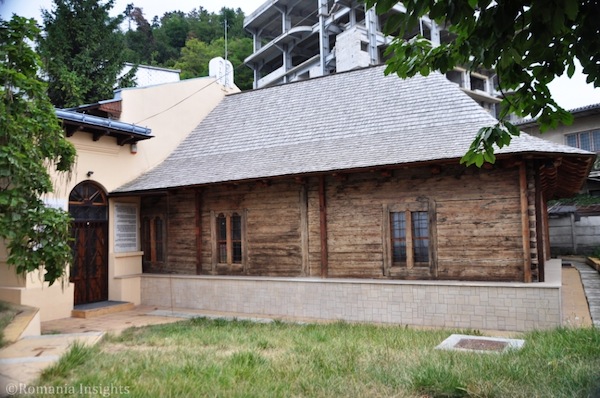
A high point in David’s trip was attending Shabbat services in the last wooden synagogue in Romania. It is located in Piatra Neamt in north-central Romania, and its sanctuary is built below street level to meet some old restriction about not being higher than any church. The building’s formerly wooden base has now been replaced by concrete to protect the wood from deterioration. Everything above the base is the original wood, as is most of the elaborately decorated interior, with many locally created crafts, carvings and paintings.

photo - The wooden synagogue in Piatra Neamt
The wooden synagogue in Piatra Neamt. (photo from romania-insights.com)

David entered the building on Shabbat when, clearly, tourists were not welcome. Even though wearing a kippah, he was eyed suspiciously. Was this just a Jewish tourist sneaking a look inside the building at a time when it was closed to tourism? The regulars relaxed a bit when he put on a tallit, and more when, out of a corner of their eyes, they saw him saying the brachah before putting it on. Later, the gabbai gave him an aliyah, and invited him to the kiddush, which was fun, not so much for the bun and wine as for the unlabeled bottle that emerged afterwards and, not surprisingly, turned out to be rakija.

Sighit is located in northwestern Romania, which is the part closest to Hungary, and perhaps for that reason has a long history of antisemitism. The large Jewish cemetery there is remarkable for the practice of adding the names of Jews who died in the Holocaust to the tombstones of family members who had died in the 1930s. The city is the birthplace of Elie Wiesel, and home to a museum dedicated to his works. This is also the area where the Ba’al Shem Tov, the founder of modern Chassidism, lived, and we heard half a dozen (conflicting) statements as to where he taught, studied or served as rabbi.

Tourists to rural Romania will also see a number of Orthodox churches that are densely painted on every surface, and also some monasteries built entirely of wood without the use of nails. And, of course, tourism entrepreneurs have built on the Dracula legend to encourage visits to castles within easy reach of Bucharest. They may be fun, and there is apparently a nugget of truth in the story of Vlad the Impaler. Instead, we wandered in the old city of Bucharest, which is just beyond the city’s modern centre, where one finds the presidential palace, the art museum and other sites of national importance. Within walking distance of the centre is the Peasant Museum, which not only has the usual displays of clothing and tools from different parts of the country, but also entire water mills (for grinding flour) and pressing mills (to make felt) with their roofs removed so they can be viewed from an elevated platform. The museum shop was the best place we found to purchase gifts.

According to the Anti-Defamation League, antisemitic acts are now at a low level in Romania, but the country has not yet emerged from quiet denial of what happened to Jews during first the Nazi era and then the communist era. (For more information, see the recently translated book entitled The Jews of Timisoara by Tibor Schatteles, which details Jewish life in one western Romanian city from Roman times through the present.) We found occasional plaques to commemorate the loss of Jews during the Holocaust, but they were erected by local Jewish groups, not by civil authorities.

Romania did send a lot of its Jewish citizens to their deaths in concentration camps. In some Romanian cities, pogroms were initiated by local antisemites. Statistics from Maramuresh province in the north, which at one time had 52 synagogues, are telling: 35,000 Jews in 1930, 3,100 in 1948 and 48 in 1992. On the other hand, during both Nazi and communist periods, the Romanian government allowed Jews to buy their freedom on ships that would dock at Black Sea ports and pass through the Bosporus en route to Israel or other safe havens.

During the communist era, Jewish communities and institutions suffered mainly from near-total neglect. A 7.2-level earthquake in March 1977 took a heavy toll on Jewish buildings, but only the most serious repairs were undertaken.

What about the future for Romanian Jewish communities? Almost everywhere we were told that most marriages today are mixed, and only a few involve conversion of the non-Jewish partner. The large and relatively active synagogue in Sibiu had only one bar mitzvah child that year. Adjacent to some synagogues are buildings that were formerly Jewish schools, but today most teaching takes place in extra rooms in the synagogue.

While the future for Romania – and for individual Jews who live there – seems distinctly positive, the future for Romania’s Jewish population as a viable minority seems much less assured.

David Brooks is environmental economist who works with a number of organizations in Canada and Toby Brooks works with organizations fighting abuse of women. They live in Ottawa.

Format ImagePosted on September 23, 2016September 21, 2016Author David and Toby BrooksCategories Travel, WorldTags antisemitism, Budapest, history, Holocaust, Romania

Posts pagination

Previous page Page 1 … Page 485 Page 486 Page 487 … Page 661 Next page
Proudly powered by WordPress