
For more cartoons, visit thedailysnooze.com.
Author: Jacob Samuel

Creeps is a Canadian classic
Left to right, Aaron Roderick, Paul Beckett and Adam Grant Warren in Creeps, which is being mounted at the Cultch by Realwheels Theatre, Dec. 1-10. (photo by Tim Matheson)
David E. Freeman’s Creeps premièred in Toronto in 1971. Forty-five years later, it could still be considered radical, and most certainly remains relevant.
The 75-minute one-act play takes place in the washroom of a sheltered workshop, where the main characters – four men with disabilities – take refuge. Freeman, “who lived with cerebral palsy, was one of the first writers to put his own voice – a Canadian voice – on the stage in the early ’70s,” reads the description by Realwheels Theatre, which is mounting the production at the Cultch Dec. 1-10. “Tired of the way they’ve been treated, [the men] rebel and barricade themselves in the washroom. The brutality and hilarity of Freeman’s uncompromising and sardonic dialogue drives the show and expresses the tension of the oppressed with a raw ferocity and clarity.”
Realwheels’ mandate includes providing “respectful and accurate representation of disability, with a vision for full integration of people with disabilities in the performing arts.”
“We’ve cast three fabulous actors who live with disability in Creeps,” producer/dramaturg Rena Cohen told the Independent in an email interview. “They’re working alongside four of Vancouver’s top professional, able-bodied actors. To accommodate the stamina of the PwD [people with disabilities] cast members, we’re extending the rehearsal period to six weeks of part-time (four-hour) days – rehearsal duration for a professional show typically runs three weeks, full-time.
“As happens virtually anytime accommodations are made for accessibility, everyone in the company is loving and benefiting from this accommodation. The creative, interpretive process is given more time to germinate, allowing ideas to be explored and tested, and busy actors appreciate being able to take other gigs or auditions that come up during their free hours.”
The local production includes Jewish community members David A. Kaye and David Bloom.
Kaye plays four characters: Michael, Puffo the Clown, a chef and a carnival barker.
“Michael is a young man with cerebral palsy, which presents in him as both a physical and cognitive disability,” Kaye explained. “Michael works at a sheltered workshop, what the characters refer to as the ‘Spastic Club,’ a place where people with disabilities used to go to perform mundane tasks for pennies a day. For Michael, I’m doing a lot of textual sleuthing, because there’s more information about Michael between the lines than in the lines themselves.
“My preparation for Michael has taught me about the many ways that CP can present,” he continued. “Each case is unique, like a fingerprint. To prepare for Michael, I’ve interviewed and observed people who live with CP, watched documentaries and then, in rehearsal, I’m responsive to the other actors who are also making their way through the interpretive process. We’re also all learning about the history of sheltered workshops for people with disabilities.”
As for the characters of the clown and the chef, Kaye said they “live in a heightened reality that engages with the perceptions of people with disabilities through an ableist perspective,” whereas the barker “provides an ironic commentary, almost an infomercial or sales pitch for the worst-case scenario option for people with disabilities.”
Bloom plays what could be called the bad guy.
“I play Carson, the guy responsible for the facility,” said Bloom. “He doesn’t appear until the end, but he is talked about a lot before he arrives, mostly with disdain.
Carson is a representation of the patronizing, suffocating ‘support’ these guys receive at the hands of the institution they’re stuck in. During rehearsals, I’m learning a lot about my own lazy thinking about people with disabilities.”
Bloom has known of Realwheels’ work for many years and of Cohen’s involvement in the company, but only met her on the first day of rehearsals. Kaye became connected to Realwheels through Creeps’ director Brian Cochrane, with whom he has worked before.
”When Brian told me he was working with Rena and Realwheels, I was excited to come on board,” said Kaye. “It’s a unique experience! I can’t wait for audiences to witness the late, great David Freeman’s exposé on the lives of this fascinating group of guys.”
For her part, Cohen joined Realwheels in 2009, she said, after meeting its founder, James Sanders.
“James – along with two other Vancouver-based theatre artists, Bob Frazer and Kevin Kerr – had created and produced Skydive, one of the most successful productions to ever come out of Vancouver,” she said. “You couldn’t help but be struck by its technical innovation (in which a person with quadriplegia flies!), plus it had considerable impact on perceptions of disability. I’d been working in arts management and as a speech/presentations coach when James invited me to discuss the company’s next steps.
“Skydive’s remarkable triumph had been supported by a fairly rudimentary start-up company infrastructure. James needed help, and I saw an opportunity to bridge Realwheels’ early success to a more stable future.
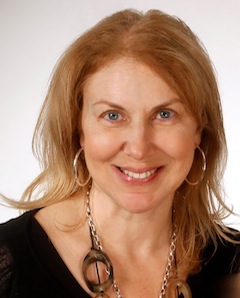
“I was also drawn to the opportunities that come through greater insight into the lived experience of disability. Through James – who lives with quadriplegia – and his considerable network, I was exposed to the vitality and dynamism of the disability demographics. It didn’t take long for me to become passionate about Realwheels’ mandate: ‘to create and produce performances that deepen understanding of disability.’
“We’ve since mounted three more amazing professional shows, and built up our community practice – under the Wheel Voices banner. Our most recent community project was SexyVoices, an exploration of sexuality from a disability perspective. SexyVoices was created with and by the community participants, working with acclaimed director Rachel Peake. It offered incredibly funny, daring and moving performances, received national attention, and sold out its three-evening run!”
Last year, noted Cohen, Realwheels received the City of Vancouver Award of Excellence.
Though technically a part-time position, as with many who work in the nonprofit sector, the professional and volunteer lines blur and Cohen’s “efforts in any week are often significantly greater than a full-time job.”
“Embedded into my professional capacity at Realwheels is the need to authentically reflect the values of disability culture, and to serve as a liaison between the disability community and the theatre community,” she explained. “After James took leave of Realwheels due to medical reasons, I assumed responsibility for both management and artistic direction. I challenge myself to understand and to internalize the diverse voices of the disability community, and to convey those voices through the decisions and choices that we make with regard to projects, casting, mentorships, etc.
“My pure volunteer life in Vancouver has almost completely been centred upon Temple Sholom. I served as board president during the leadership transition planning years (2010-12), and before that I oversaw Temple’s strategic planning process. I’d co-chaired the religious school committee and, earlier, I served on Temple’s security committee, which was formed after 9/11. These days, I’m chairing the communications committee for the Syrian Refugee Resettlement Project, and otherwise just enjoying our Temple community.”
Of what she has learned from her years at Realwheels, Cohen said, “The PwD experience is the human experience. By that I mean that the state of ‘disability’ is not binary with a simple on/off. There is a scale or a ‘continuum’ of sorts. We are all challenged on some level and the human experience is defined by how we manage those challenges and how we optimize as a broader community to ensure everyone has the opportunity to self-actualize. I’ve learned that attitudinal barriers are far more challenging for PwD than physical barriers.
We need to challenge both, but attitudes and preconceptions about disability are the hardest to modify. I’m certainly continuing to work on challenging my own ableist privilege.
“I’ve learned that whenever accommodations are made to serve PwD, everyone benefits. One of my proudest achievements as board president at Temple Sholom was the Accessibility and Inclusion Project, which resulted in the installation of an interior ramp to the bimah. Overall, I think Temple has become safer, more inclusive and more accommodating to the diverse range of ages and abilities of all people who participate in Temple life. As I’ve said, I believe that disability exists across the broad spectrum of society, and that most of us are actually TAB (temporarily able-bodied).
“I’m continually learning about the tremendous diversity in the disability sector,” she added. “I attended the Cripping the Arts Symposium in Toronto a few months ago. One PwD artist there insisted, ‘I can’t possibly explain what [having a disability is] like, but I can show you through my artwork, and maybe you’ll get a better understanding of the struggle for survival.’ Yet another expressed: ‘How we experience the world is all based on who you are as a human being, not about being a PwD.’ Those are two nearly opposing positions.
“I’ve learned that, in Canada, the Charter of Rights and Freedoms recognized equality for those who live with disability in 1982, but there is still a great deal of work needed. The U.S., through the Americans with Disabilities Act (1990), is far more advanced than we are. The U.K. by far leads the way in terms of disability arts practices and inclusion.”
In addition to her involvement with the Temple Sholom community, Judaism and Jewish culture have influenced Cohen’s outlook on life and the work she pursues in other ways as well.
“My Jewish upbringing exposed me to critical thinking, to appreciation for the individual and for community, and provided me with exposure to the arts and theatre,” she said. “We have a rich storytelling tradition in Judaism, and a particular way of using humor to cope with life’s challenges. Exposure to that, combined with having a large, extended Jewish family when I was growing up in Montreal, definitely informed my worldview.
“The aching stories of the Holocaust, and the enormous victory of the establishment of Israel, also feel very personal to me. My parents (z”l) would tell you that, from the time I was little, I was a champion of the underdog, always ready to speak truth to power. I’m not so brave today, but I do feel very strong moral imperatives, whether about equality for PwD, or standing up to BDS [boycott, divestment and sanction] bullies, who are either misinformed about Israel or covertly antisemitic.
“My Jewish education also involved a lot of text analysis, including as a student at parochial school in Montreal. The shift to analyzing scripts was a natural segue for me.”
Cohen encourages people to join Realwheels “for an evening of savage wit and uncompromising truth-telling as we present Creeps, the award-winning dark comedy by David E. Freeman that changed Canadian theatre forever!”
And Bloom echoed her sentiments, “I feel very lucky to be part of this show,” he said. “Not only is it a seminal Canadian classic, but I’m working with a great company and an ensemble with real integrity.”
Tickets for Creeps, which previews Nov. 30 before its 10-day run, are $18-$40 from 604-251-1363 or thecultch.com/tickets. Tickets are only two for $20 on Dec. 3, which includes a post-show reception in recognition of International Day of People with Disabilities. There are also post-show discussions Dec. 4 and 6, and ASL and audio description on Dec. 4. Warning: mature content and offensive language.

What made your list?
Robin Esrock contemplating ancient wonders in Turkey. (photo by Paul Vance/EWM)
Read about Robin Esrock’s visit to a fountain of youth in Colombia, his rail journey across Siberia, his diving lessons in Papua New Guinea. Esrock has traveled to more than 100 countries and, as he writes in the introduction to The Great Global Bucket List, the hybrid guidebook and essay collection “draws together the best of these adventures.” What’s more, Esrock hopes that you won’t just read about his exploits, but make plans for your own.
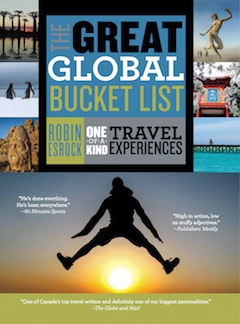 Esrock is one of the many writers participating in this year’s Cherie Smith JCC Jewish Book Festival, which runs Nov. 27-Dec. 1. The local author and journalist has not only been featured in the Jewish Independent before – for The Great Canadian Bucket List, among other things – but has written for the paper as well, so it was nice to catch up with him in anticipation of his Nov. 27, 5 p.m., presentation at the Jewish Community Centre of Greater Vancouver, appropriately called Travel Dreams.
While his career as an intrepid traveler only started after a bike accident – from which he received a broken kneecap and, eventually, a $20,000 insurance settlement that was “just enough,” he writes, “if used sparingly, to book a solo one-year adventure around the world” – he had traveled before.
“My first trip overseas was to Israel when I was 11, on a discovery tour, with my family and grandparents,” he told the Independent. “It was a hop-on, hop-off bus trip to tick off Israel’s greatest hits. I did a European bus tour after high school, memorable in that I can’t remember much of it, a two-month stint to a kibbutz, and then backpacked up East Africa to Zanzibar. I didn’t get malaria, but I did get the travel bug. I lived in London for a couple years and used that as a base to visit various odd spots in Europe, but the idea of traveling around the world always seemed like an impossible dream. Once it finally manifested, the result of a modest insurance settlement for my accident, I couldn’t believe I’d waited so long.”
The accident occurred as Esrock was approaching his 30th birthday. On that first yearlong trip, he visited 24 countries and was “published in newspapers on five continents.”
He writes, “A year later, my Hail-Mary pitch for a TV show landed on the right desk at the right time and, seven months later, I found myself as a co-host, writer and producer for a 40-part adventure series filmed in 36 countries. Funded by television networks, I was tasked with seeking out experiences that conformed to my bucket list criteria: Is this destination or activity unique? Is it something I will never forget? Will it make a great story? Is it something everyone can actually do?
“Tick off all those subjective items, and the journey began.”
These were the same criteria Esrock used to compile his shortlist for The Great Global Bucket List. Then, he said, “I had to cut 27 chapters for size in my book, but, fortunately, I have a Bucket List blog (globalbucketlist.com) to find them a home, and add new experiences. In my book, you’ll find far-flung adventures (Antarctica! the Galapagos! the Azores! the Amazon!) but you won’t find the Eiffel Tower or Tower of Pisa. This is a book of inspiring stories and photographs, not a guide to popular tourist traps.”
In addition to experiencing many a far-flung adventure over the last decade or so, Esrock has also found the time to start a family. How has that changed his travel plans?
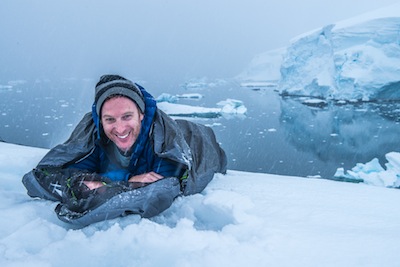
“There seems to be a subtle flow in the career of travel writers: you start with hardcore budget travel, transition into hard adventure, then soft adventure, romance, family, cruise, food, wine, spa, and end up in golf!” he said. “I don’t take the risks I once did, or have the energy to sleep in roach hotels. People have become more important than ever and, since I’ve managed to tick off so much, I’m very drawn to unique experiences. My kids are a little young (3 and 3 months) to start ticking off a family bucket list, but I’d love to take them to countries like India, Cambodia, Israel and Turkey, where locals embrace children. Disneyland can wait.”
And his own bucket list?
“Write a novel that explains, in an entertaining way, everything I have learned on my journey. Raise my kids to be curious and up for anything, so they can join me on future adventures. And I’d love to get to the five ’Stans on the Silk Road in Central Asia, which has a rich history, few tourists, and is undergoing a fascinating modern transformation.”
Esrock added, “There’s too much bad news out there. The 24/7 news cycle dictates that bad news must be happening somewhere, all the time. The goal with my bucket lists, and with my career in general, is to provide some much-needed good news. In all my journeys, I’ve never been robbed, attacked, violently ill or had my organs harvested (at least to my knowledge!). The world is far more welcoming, reasonable, peaceful and beautiful than you’d imagine.
“Some people see bucket lists as a silly, ultimately harmful pastime that creates unrealistic goals. I see them as a mechanism for positive inspiration. You don’t have to go sandboarding on a volcano in Nicaragua or cage swim with crocodiles. You just have to do that thing you’ve always wanted to do, even if it’s just fixing the garden. We don’t have nearly as much time as we think we do. Every chapter in my book concludes with ‘Start Here,’ and an online link to practical info for readers to follow in my footsteps. More important, I think, is to start now.”
For the full book festival schedule and tickets, visit jccgv.com/content/jewish-book-fest.
The idea behind a bucket list is that life is finite and, if there are things we would like to do, we should do them while we can. The Cherie Smith JCC Jewish Book Festival opens the night of Nov. 27 with San Francisco-based writer and psychiatrist Dr. Irvin D. Yalom in conversation with Vancouver psychotherapist Larry Green. The title of Yalom’s most recent book, Creatures of a Day, comes from Marcus Aurelius’ The Meditations, to which Yalom refers more than once in his writings, and from which he quotes at the beginning of his latest book: “All of us are creatures of a day; the rememberer and the remembered alike. All is ephemeral – both memory and the object of memory. The time is at hand when you will have forgotten everything; and the time is at hand when all will have forgotten you. Always reflect that soon you will be no one, and nowhere.” Creatures of a Day is a collection of 10 stories based on his patients’ experiences with loss and illness, and their – and Yalom’s – efforts to live a life of both meaning and pleasure.

Threepenny in 2016
Left to right: Ariel Martz-Oberlander (Dolly), Damon Jang (Walt Dreary), Katie Purych (Polly Peachum), Kevin Armstrong (Macheath), zi paris (Bob the Saw) and Adam Olgui (Street Singer). (photo by Colin Beiers)
The Threepenny Opera “has a grassroots design to it and deals with action and issues that are often seen in the streets and politics of major cities throughout the world,” Theatre in the Raw artistic director Jay Hamburger told the Independent. “The play for sure is original and it takes a lot of risks that, if given thought, speak profoundly to today.”
Indeed, violence, poverty, oppression and inequality are not things of the past. And Bertolt Brecht and Kurt Weill’s 1928 musical – itself very closely adapted from The Beggar’s Opera, written 200 years earlier, by John Gay with music arranged by Johann Christoph Pepusch – remains both entertaining and thought-provoking. The Theatre in the Raw production of it Nov. 16-27 at the Russian Hall is to be highly anticipated.
“Theatre in the Raw has always strived to provide high-quality performance work,” said Hamburger. “Though the productions can seem minimalist, a theatrical experience is aimed for and often with a message. The Threepenny Opera play, and the Beggar’s Opera that it was based on, inverted the notion of theatre experiences as gaudy, excessive and out of reach of the common person, and instead focused on the underbelly of society. Brecht’s approach to theatre championed breaking down walls between audience and actor, turning the notion of passive viewer of entertainment on its head. These ideas are much in line with Theatre in the Raw’s ambitions and desire to reach out to audiences in profound and innovative ways. Plus, providing a play of this scale with a relatively large cast and crew allows Theatre in the Raw to not only put on the show for the community … but also to have many talented artists perform their craft on stage.”
Among those artists are a few from the Jewish community. Stephen Aberle plays the central figure of Mr. Peachum.
“I play Jonathan Jeremiah Peachum, owner and proprietor of the Beggar’s Big Brother, an outfitting and licensing company for all the beggars in the city,” Aberle explained. “Peachum has a monopoly, strictly enforced: anyone caught begging in his territory without a licence gets beaten up; second offenders get ‘the saw.’ His ‘clients’ must pay for their licences with hefty initiation fees, and by turning over half (or more) of their take.
“He’s a crucial plot engine: his daughter Polly marries the hero/antihero Macheath, leaving Peachum outraged. His obsessive struggle for revenge drives much of the action of the play.”
Set in London’s Soho just before Queen Victoria’s coronation, Peachum tries to have Macheath – also a brutal criminal, aka “Mack the Knife” – arrested and hanged, but the police chief happens to be an old army buddy of Macheath’s. Peachum, however, uses his influence and Macheath becomes a wanted man. Polly warns her lover, but, before fleeing, he stops in at the brothel he frequents.
“My character is Dolly, one of the whores who live with Jenny Diver in Wapping,” said Ariel Martz-Oberlander. “Macheath visits them every week and it’s them he goes to see instead of escaping from the police when he gets a chance.”
Adam Olgui plays the Street Singer, who is, in a way, “the narrator of the story,” said Olgui. “Although he’s an observer, he slips in at times to assume different roles to help move the plot along. The Street Singer himself is a smooth, playful, light-hearted being.”
As Brecht adapted Gay’s work, changing the setting, for example, to Victorian England, and highwaymen into gangsters of a sort, Theatre in the Raw will also add its touch.
“We are introducing elements modernizing the style of the characters, their wardrobes, etc., and are not doing the play using English accents,” said Hamburger. “Though the play technically still occurs in an alternate version of 19th-century Soho, we feel our stylistic choices help the piece reflect more universally about the 1920s Germany where it was written and possibly on our pressing modern situations as well. We’ll admit we’re putting a bit of Commercial Drive flavor into it, too, as the play involves a diverse group of characters that are both fun and standout.”
And the characters still speak to us.
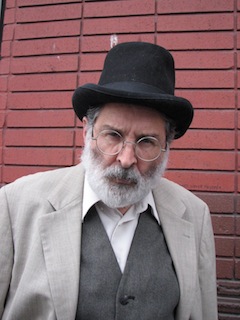
“To my mind, the character of Peachum remains bitingly, bitterly relevant today,” said Aberle. “He is Brecht’s critique of capitalism par excellence, a ‘businessman’ whose business, like so many winning enterprises, thrives on human misery. As he observes, ‘The powerful of the earth can create poverty, but they can’t bear to look at it.’ He has learned to profit by this discovery, and has no scruples about doing so – by whatever means necessary.
“Peachum is cynically fond of religious references. He loves to preach, usually (like his middle namesake) to gloomily pessimistic effect (‘the world is mean, and man uncouth!’), and offers verses of scripture to persuade suckers to part with their money. This leaves me as an actor surmising that he may have had a religious education, perhaps even an earlier career as a clergyman, before stumbling into the vocation of extracting value from poverty instead of working to alleviate it. Some might find parallels with today’s professional evangelists.”
As for her character, Martz-Oberlander said, “Dolly represents the way a woman can make a living taking advantage of a very misogynistic and cut-throat society in the play. She has no misconceptions about Macheath falling in love with her and is content to use her body to make a living. She is reasonable, if very naïve. Dolly plays a small part in the story, but she stands the test of time by being a strong woman who makes her way in a system in many ways rigged against her.”
Olgui spoke more generally. “I think that the timelessness of Brecht’s themes and his view of human nature are why his works are still relevant today,” he said.
Hamburger highlighted the play’s “wild sense of humor” and its “rollercoaster” of a story. He noted that both Brecht and Weill “were extremely interested in U.S. entertainment during the early part of the 20th century. Though the play didn’t really make it in the U.S. until the 1950s, both creators looked to the U.S. for some form of success. Weill actually escaped Germany before the Holocaust, knowing he had to get out to save his life. Brecht, on the other hand, before and during the Second World War, fled to 10 different countries in order for him and his family to survive. The play speaks in an extremely original and relevant way to a lot of concerns that face us economically, socially, and the gap between the rich, the middle-class and the poor, and how certain people are often at a disadvantage and seeking ways to survive.”
Not to mention it has some pretty catchy and enduring tunes: “Ballad of Mack the Knife” and “Jenny the Pirate,” to name but two.
Tickets for The Threepenny Opera are $25 and $20 (students) and available at the door or from theatreintheraw.ca/tickets.

We are all connected
Kerry Sandomirsky as Alice, centre. In Long Division, the way in which Alice’s son reacts to bullying “connects all the characters in the play, and it makes my character deeply question herself,” explains Sandomirsky. (photo by David Cooper)
Math, movement, images, text, music and more combine in Peter Dickinson’s Long Division, which will see its première at Gateway Theatre Nov. 17-26.
Dickinson is a professor at Simon Fraser University and the director of SFU’s Institute for Performance Studies. Long Division is his third play, and it features seven characters. Jewish community member Kerry Sandomirsky plays Alice.
“Alice is the single mother of a brilliant math student who is bullied,” Sandomirsky told the Independent. “He responds by making a shocking choice. This event connects all the characters in the play, and it makes my character deeply question herself. What could she have possibly done differently?”
Directed by Richard Wolfe and produced by Pi Theatre, Long Division is “about the mathematics of human connection.” The characters, explains the synopsis, “are linked by a sequence of ultimately tragic events, but there is more to the pattern than first appears. The three male and four female characters use number theory, geometry and logic to trace their connection to each other and to the moment that changed their lives.”
When asked about what challenges the script posed for her, Sandomirsky, said, “Well, have you ever tried to explain Pascal’s Wager using contemporary dance? Or Fibonacci numbers? Or Schrödinger’s cat? We’re dealing with mathematical concepts as metaphors for human stories. So, the first task is to learn the math!”
And to how much of the math could she relate?
“Zero,” she said. “Thank God my son has a math tutor.”
Not only is there the math to master, but the movement. For that, the cast also had help.
“Earlier today,” wrote Dickinson in his Oct. 20 blog, “the choreographer of Long Division, Lesley Telford, invited me to drop by the studio at Arts Umbrella on Granville Island, where she was working … with seven amazingly talented dancers … and they have each taken on a character in the play, drawing from the text … to improvise and develop individual gesture phrases that may or may not eventually get set in some related form on our corresponding actors when we begin rehearsals next week…. I was amazed at how bang-on their instincts were in terms of energy and tempo and line, as well as things like muscularity vs. flow, repetition, different levels and directional facings, and so on. I was also pleased to note that I could also read each character in the movement without reading the movement itself as telegraphing too obviously this or that character’s psychology or profession.”
Projection art also helps “reveal aspects of the characters’ inner lives,” according to the play description. On Oct. 29, Dickinson blogged that it was “useful to have Jamie [Nesbitt] at the table yesterday for our final beat-by-beat read-through of the text, as he asked a lot of tough dramaturgical questions about what exactly was going on in different sections, and how video might support them in some instances, or conceivably work against them in others. Combined with the cast’s similarly probing questions from the rest of the week, the rigorous text analysis has really forced me to justify my choices, and to explain their relevance to the overall structure of the play and the respective inner worlds of each of the characters.”
Playing Alice motivated Sandomirsky to read Sue Klebold’s book A Mother’s Reckoning: Living in the Aftermath of Tragedy. “Her son was one of the Columbine shooters,” explained Sandomirsky. “She experienced a firestorm of hatred. For example, when her family was sent food by her neighbors, her lawyer insisted she throw it out in case it was poisoned.
“This is the third play in a row where I play the mother of a tormented teenage boy. And this is definitely the first one that prescribes algebra as the way to get through life.”
But, Sandomirsky was quick to note, “Long Division is a workout for the mind – without sacrificing heart.”
Tickets for Long Division ($29) can be purchased from 604-270-1812 or gatewaytheatre.com/longdivision.

Keeping things simple
“Overseas” by Ivor Levin. (photo by Ivor Levin)
Ivor Levin’s path to artistic photography was a long and gradual one. “Photography is my hobby,” he said in an interview with the Independent, but one couldn’t have guessed it from his solo exhibition at the Sidney and Gertrude Zack Gallery.
Levin’s images reveal an artist’s perception. Where anyone else might see a dirty warehouse, he sees a play of light and shadows, a mosaic of colors and shapes. Peeling paint on a wall or a rivet screwed into corrugated metal transform under the magic touch of his camera into fascinating pieces of art.
By his education and day job, Levin is a dentist. By inclination, he is an artist, walking around Vancouver in his spare time with his camera, capturing amazing and unexpected pictures.
“I like simplicity,” he explained. “I don’t like cluttered images. All my images have one focal point. I’m interested mostly in two genres. One is urban geometry and abstraction: I look for patterns there, for lines and colors. Another is street photography: when I find an interesting geometric setting, I wait there until a person appears, walks into my scene, and then I take a picture. I don’t do landscapes or faces. No mountains. And absolutely no flowers.”
Levin said there was always a camera in the house when he was growing up. He snapped pictures during family gatherings, trips and holidays, but, in the last eight years, his passion for photography deepened.
“I started looking around with more of an artistic eye,” he said. “I also discovered Flickr and opened an account there, saw what other photographers were doing on the site and taught myself to achieve the effects I like. Gradually, people started noticing and liking my pictures, too. Friends and family were the last to notice, and they began saying: ‘Your photos are so interesting; why don’t you have a show?’ It happened about two years ago.”
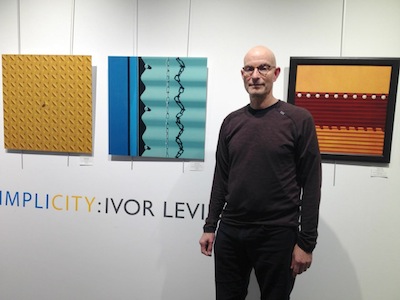
The idea of a show took root and, last year, Levin applied to the Zack Gallery. “I sent them a link to my Flickr account, and they liked it. They offered me a show. It’s the first time I actually printed my photos. Before that, I only had them digitally, on my computer and on Flickr.”
The show at the Zack – called Simplicity – reflects the artist’s vision not only of Vancouver, his hometown, but also of some other places he has visited. One of his favorite hunting grounds for images is Granville Island, and a few of the images exhibited came from there. Others he found during his international travels, like “Overseas,” which originated in Cape Town, South Africa. “There is the ocean there, and a swimming pool on the other side of the walkway, and the sky above. Everything is blue, but different shades of blue. When I saw a woman in a blue dress on that sidewalk, I knew I had to take the picture,” Levin explained.
Most of his images depict bright and cheerful colors.
“I can appreciate black and white, too,” he said, “but only when the image demands it.”
One such image is his black and white street scene “Piano Man.” He shot it under an overpass in Brooklyn, and its punchy graphics are only slightly enhanced by computer editing.
“I rarely use the images straight from the camera, but most of my modifications are minor,” he said. “I adjust exposure and saturation. Sometimes, I crop or tilt the images.”
Unlike many photographers, he doesn’t use Photoshop, but rather the online program PicMonkey. He taught himself to use it, like he taught himself the other aspects of photography. “I learn from the other photographers’ photos and from some internet sites,” he said.
As the years go by, Levin spends increasingly more of his free time on his hobby, although he confessed that taking pictures absorbs him much more than the editing process. “I prefer creating with the camera, not with the computer,” he said. “I’m always on the lookout for the ‘Wow!’ factor. In the beginning, I kept everything, thousands and thousands of images. Now, I’m much more selective. When I see an image, I know: it’s a keeper. Otherwise, I just delete them.”
Titles for his images are also important to him.
“I’ve always liked to play with words, make puns. For me, it’s half the fun to find the right title for the image. Each one needs a catch phrase to catch the people’s attention.”
Despite his love for photography, he doesn’t have plans to abandon his day job.
“I like my job,” he said. “Of course, if I could make the same living with photography as I do as a dentist, I’d probably choose photography.” He didn’t sound too sure.
Simplicity is at Zack Gallery until Nov. 20.
Olga Livshin is a Vancouver freelance writer. She can be reached at [email protected].
Mixing of cultures, religions
Helen Kim and Noah Leavitt, authors of JewAsian, will be at the Jewish Book Festival on Nov. 28. (photo by Matthew Zimmerman Banderas)
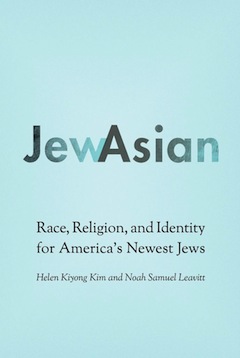
The recently published book JewAsian: Race, Religion and Identity for America’s Newest Jews by Helen Kim and Noah Leavitt was crafted out of a seven-year study of 39 mixed couples, as well as their own successful marriage. The couple will be in Vancouver later this month to share their findings at the Cherie Smith JCC Jewish Book Festival.
For Kim, who was born a few years after her parents moved from Korea to the San Francisco Bay Area in the late 1960s, finding a Korean guy to date was a virtual mission impossible, so looking outside the community was accepted.
“My mother was totally fine with it, in large part because she’d thrown away her expectations that I marry somebody Korean a long, long time ago,” said Kim of her marriage with Leavitt. “I think, in part, because I grew up in a community that was predominantly white with very few people of color, I think she quickly realized that, demographically speaking, it was probably going to be unlikely I’d meet, date and eventually marry someone of the same ethnic background as me.”
Leavitt, who is of American Jewish origin, said, “My mom was super-excited about the fact I had met somebody I was so smitten with. She and Helen, early on, established a great rapport that has continued ever since. I think my mom just had an expectation that I’d settle down with somebody I really loved, who I was challenged and inspired by, and saw that in Helen … so she was excited.”
Leavitt grew up in a household that was somewhere between the Reform and Conservative denominations. He went to a Jewish community Sunday school growing up that was housed at Cornell University and he had his bar mitzvah at Ithaca College through their Hillel.
Kim and Leavitt met in 1997 and both were drawn to the complexity of their Jewish-Asian mix, an interest that increased with the births of their children.
“This was the era where, I think, we started to see a lot of interracial pairings, dating and marriages,” said Kim. “And it was also right before the U.S. census gave multiracial individuals the option of choosing more than one race on the census … really, an interesting time, demographically speaking, where the context around us was contributing to our thinking about how common are pairings like ours and maybe other interracial or Jewish-not Jewish pairings.”
Leavitt and Kim contacted a number of universities that were repositories of large-scale demographic studies. They were aware that the study of intermarriage to that time had been focused on interfaith marriage, but had not delved into how interracial marriage factored into the larger picture.
The couple reached out to the Institute for Jewish and Community Research. Through this connection, they were able to do an initial recruiting of couples with whom to speak for their book. In the end, their study included 39 couples from the San Francisco Bay Area, Los Angeles and Orange County, and from the New York and Philadelphia metropolitan areas.
 “We focused there, in part, because of the high percentages of individuals who identified as Jewish and Asian,” said Kim. “Then, there was the likelihood and demographic reality that interracial marriages are taking place predominantly in those areas … with the West Coast having, by far, the highest rates of interracial marriages.”
“We had a lot of people volunteer to be part of the survey and what we made a decision to do was to try to find the most expansive look at Jewish-Asian combination that we could,” said Leavitt.
Within the 39 couples, one was gay and three were lesbian, with the remainder being heterosexual. The study also included a second set of interviewees who were young adults that were children of Jewish-Asian households.
“The first thing by far that I think was quite surprising that we found was that, for the couples as well as the adult kids, they are definitely Jewish – not just in terms of the self-identification perspective, but in terms of some strikingly traditional religious practices,” said Kim. “So, the couples we interviewed were in the midst of or had created homes where there was a lot of traditional Jewish religious practice – everything from observing Shabbat consistently, to consistent synagogue attendance, to kids becoming bar or bat mitzvah, to children going to Jewish day schools.
“Then, for the adult kids we interviewed, they affirmatively claimed they were Jewish. But, they also talked about having been raised in traditionally religious households and communities that, to a great extent, mirrored what we were finding with the couples we interviewed.”
While only six of the racially Asian individuals had converted to Judaism, the overwhelming majority of couples celebrated Jewish religious events and cultural tradition alongside Asian ethnic traditions.
“There was neither a conflict of religion nor a blending of religions,” said Kim. “It was more of a cultural hybrid, but steeped in Judaism as the religion of the household.”
“I would go broader and say that, for the most part … we didn’t really hear too many stories about conflicts related to religion overall,” added Leavitt. “There were a few examples where the non-Jewish partner had a religious or spiritual practice that they adhered to, but it was something they did on their own and didn’t bring into the household.”
Both Kim and Leavitt said the findings were representative of their own Jewish-Asian mix. “Judaism, for me, is a religion and a cultural tradition that is easier for me to instil in my family,” said Kim. “I, as a second-generation child of an immigrant family, did not grow up with a lot of Korean ethnic and cultural traditions.
“Through the adult kids [in the study], it was reinforced repeatedly that you have to expose [them to the culture], no matter what your comfort level as a parent, no matter your knowledge as a parent. The kids really appreciated when the parents went all out in terms of trying to expose them to a particular culture or ethnicity, though they themselves as parents were afraid they might not do it right.
“So, I think just hearing from the kids and imagining my own kids in 10 to 15 years was kind of affirming to me, [that I just need to] try as much as I possibly can. The kids will end up picking up things here and there and will then, on their own, become curious and want to learn on their own. That was reassuring for me.”
“I had a lot of the same reactions,” said Leavitt. “For me, when Helen and I decided to make a commitment to this project, it was fairly close in time to when we were also starting to think about having our own family. When we got this investigation underway, our son Ari arrived. As a first-time parent, I had a lot of worry and anxiety about a household that seemed to combine so many different kinds of traditions, cultural heritage markers and, to some extent, religious differences. I think I had a lot of worry about the ability of all those things to be in a household together … in part, because I didn’t have an upbringing where there were lots of differences within the household. So, I had a lot of fear about that.
“One of the things I’ve been liberated by, in working on this project and having two children arrive, is there is a lot of flexibility and resilience in households. Where even something may seem like a long list of differences, the people inside that household are able to find ways where things can come from different directions, but meet at the same point.”
Kim is excited about coming to Vancouver, especially to have the opportunity to speak with a non-American audience, “to understand how it is that they think about these different dimensions of identity, tradition, culture and religion, as a way of getting out of our predominantly U.S.-focused lens. I’m really looking forward to that comparative perspective.”
Leavitt said, “I think the chance to be in as diverse, global and multicultural a city as Vancouver … maybe there are lots of households coming together with this mix of Jewish-Asian backgrounds in Vancouver. I think this may propel us to continue researching more in this international comparative way.
“Helen and I feel very fortunate to have been working on this project at a time in the U.S. when the exploration about the diversity of the Jewish community in our country is really something that is front of mind for so many congregations, synagogues. We aren’t the same people we were years ago.”
“If we are acknowledging that this is what American Judaism looks like,” added Kim, “what then is the responsibility we have in regards to action based on the changes in the demographic and how do we act based on how we’ve changed?”
Kim and Leavitt are on a panel with Daniel Kalla on Nov. 28, 6 p.m., at the Jewish Community Centre of Greater Vancouver. For more information, visit jccgv.com/content/jewish-book-fest.
Rebeca Kuropatwa is a Winnipeg freelance writer.
Campaign continues
“Let’s make it easy, not just to be Jewish, but to feel part of the community. We have to make it easy and we have to find ways of connecting,” Alex Cristall told the Jewish Independent in a recent phone interview.
Cristall is general chair of the Jewish Federation of Greater Vancouver’s annual campaign this year. The fundraising effort has so far “been really, really good,” he said, noting “it looks like our numbers are ahead of where they were last year.”
At the centre of the current campaign is the community’s 2020 Strategic Priorities. “We have some key areas that over the next few years we are trying to focus on,” explained Cristall, such as “affordability, accessibility, seniors, engagement and connectivity, and security. And, this year specifically, we have set up a matching program,” so that every new donation and every donation increase is matched, with the funds being allocated to security initiatives, to “set up a good, long-term security plan for the community.”
Bernard Pinsky is the chair of the community security advisory committee, said Cristall, and “they’ve laid out a whole framework of things to get us up to date and to get us more centralized and focused, and to continue on with things we’ve done over the years and improve on them. So, this year we have set up a match[ing program] and I think we are almost at $300,000.”
In addition to the 2020 priorities and the focus on security, donations to the campaign fund social services performed by 40 partner organization, including seniors programs, Jewish education, arts and culture, community building, and youth and young adult services.
“Federation has access to so many different things that are going on in the community and, to help those institutions every year, it takes a lot of [fundraising] pressure off them,” said Cristall. “The major selling point is the reach the Federation has … your dollar touches so many different aspects” of the Jewish community.
“In terms of the number of people who benefit, it is in the thousands,” said Becky Saegert, Federation’s director of marketing and communications, in an email interview.
“We want to make being part of our community easy for our constituents and our community members,” reiterated Cristall.
The community has valuable capital infrastructure in the Oak Street area, he said, “but engagement and accessibility … for underserved areas – that is a huge part of our future. And that has to grow more and more. We have to be very creative.”
This outreach is part of the 2020 plans, he said, “for example, supporting White Rock JCC, supporting Burquest JCC.”
“With regard to the regional communities,” added Saegert, “the campaign currently provides funding to five different regional community organizations. Our Regional Communities Task Force, which is currently exploring ways to enhance Jewish community life outside of Vancouver, will be presenting their recommendations to our board in February 2017. We anticipate that the recommendations will increase funding for a number of initiatives in the regional communities. This past year, with the increase in our overall campaign result, we were able to increase our funding to all of our regional community organizations and fund some new initiatives, including a very exciting partnership between Richmond Jewish Day School and Congregation Beth Tikvah.”
While this year’s campaign is well underway, Cristall said, “We cannot have enough canvassers.… We are probably the easiest organization to get involved in. If someone wants to come on and be a canvasser, we’ll give them training. I hosted a meeting at my house to train people and to welcome people…. It’s a very welcoming environment and we welcome all comers to join.”
To participate in or contribute to the campaign, call the Federation office at 604-257-5100 or go to jewishvancouver.com. For more about Federation’s 2020 priorities, visit ourcommunity2020.jewishvancouver.com.
Zach Sagorin is a Vancouver freelance writer.
Okanagan’s New Year
The Okanagan Jewish community celebrated the High Holidays with spiritual leaders Rabbi Larry Seidman and Rabbi Linda Seidman from California officiating at the services. The husband-wife team had prepared special pamphlets for everyone in the community to be able to participate.
There was an erev Rosh Hashanah service on Oct. 2, as well as morning services the next day, which were followed by a potluck luncheon. For Yom Kippur, there were also two services, with Kol Nidre on the erev and a day-full of services on Oct. 12, which included a discussion period, Yizkor and a break-fast potluck.
The services were all well-attended and Rabbis Larry and Linda were warmly welcomed to Kelowna and to the celebrations.
Rabbi Larry has a background in research and management, encompassing communications, satellites, aerospace, wind energy and telemedicine. He holds many degrees, as well as being skilled in engineering and management, and has been sought after for presentations. He has given talks around the world.
Throughout his career, he has been dedicated to Jewish practice and study, having served as a lay leader of minyans and Torah study groups, and has continued to pursue both formal and informal Jewish education. A few years ago, he retired from his position as a senior manager in Phantom Works, the research and development organization of the Boeing Company, which has allowed him to increase his engagement in Jewish activities.
He was ordained as a rabbi by the Academy for Jewish Religion, in California, and is a member of the Southern California Board of Rabbis. His practice is dedicated to being a rabbi who combines Jewish tradition with modern thought.
A 2010 ordinee, Rabbi Linda currently serves as a prison chaplain in Orange County, Calif. Donning her uniform and bullet-proof vest, Rabbi Linda, who is certified as a deputy chaplain, works with the county jails, offering counseling and other services to 80 or 90 people per month. “If anybody had told me 10 years ago, when I was an aerospace engineer, that I would be doing this, I would have said ‘in your dreams,’ but life takes funny turns,” she said.
Admitting that she failed at retirement, she said she became interested in the Academy for Jewish Religion, which is a non-denominational rabbinical school, when she heard that it offered a part-time program. She enrolled a year after her husband. Today, in addition to the jail chaplaincy, she serves as the chaplain at a hospice, performs an occasional funeral and leads services and Bible study at a senior living facility.
Rabbi Linda believes that there is “a tremendous amount of security in knowing what to do and when to do it,” and that traditional Judaism meets the needs of some people who are happy and comfortable with their roles. But, she feels that women bring another approach to Judaism. “We see things differently than men,” she said. In other areas, however, such as women’s health and children’s issues, “our concerns are rooted in same values, and there is plenty to unite us.”
* * *
In other recent OJC news, one of the community’s newer members, Philippe Richer-Lafleche, became a bar mitzvah on Oct. 15. Not having had the opportunity to have a bar mitzvah when he was a boy, Richer-Lafleche had looked forward to the special day, which took place after many months of studying under the guidance of OJC’s religious chair, Evan Orloff. The services were followed by a potluck lunch, which included dishes provided by Richer-Lafleche.
* * *
Finally, OJC celebrated Sukkot on Oct. 17 with a mixture of 60 adults and children in attendance. The rains dispersed and the ground dried so that everyone could enjoy the experience of building and decorating the sukkah.
A special thank you to Natasha for organizing crafts, and to the parents who helped construct the sukkah without the help of Google or Siri. The construction was followed by a potluck inclusive of pizza cooked by one of the OJC Golf Classic food sponsors, Mr. Mozzarella Pizza and Wings.
* * *
The Okanagan Jewish Community Centre’s mission “is to work towards building a strong and unified Jewish community in the Okanagan Valley of British Columbia. The OJCC encourages an inclusive atmosphere of understanding and respect amongst Jews of different backgrounds, and maintains cooperative relationships with other regional and national Jewish community organizations. The OJCC also aims to promote a positive and active relationship with the Okanagan community at large.”
What now, America?
Many of our readers survived the predations of fascism or communism; some endured both. It is probably safe to say these people do not take democracy for granted, as some of us who have been fortunate to live our entire lives under democratic governments may.
For many of us, Remembrance Day is one of the few times in the year when we stop and take stock of our good fortune and the sacrifices that made it possible. This year, we should perhaps give even more consideration to the fact, which we have mentioned in this space before, that democracy is a remarkably new and fragile thing. What we recognize as modern democracy is an American invention just 240 years old.
There have been concerning noises in the birthplace of democracy leading up to the close Tuesday of this ugliest of presidential election campaigns. In addition to Donald Trump’s threats to not abide by the democratic decision of the people because of some imaginary “rigging,” much of his rhetoric has seemed deliberately calculated to undermine democracy and its parallel values of pluralism and respect for diversity. Trump’s behavior and language – and the vitriol and violence he inspired and encouraged among his followers – are antithetical to American democracy.
We should not fall into the trap of comparative blame. This was probably the nastiest campaign in American history, but that is not something we can ascribe equally to both leading candidates and their followers.
Hillary Clinton ran a negative campaign, yes, but only within the comparatively gentle parameters of what has become conventional in American politics of the television age. Trump’s campaign, on the other hand, was a blast furnace of hatred, ridicule, dehumanization, lies, racism, sexism and incitement.
One of the most important pillars of democracy is also one of the most ephemeral: the confidence of the populace in the institutions of governance. And polls indicate that Americans currently have extraordinarily low opinions of their officials.
The American people – and the new president (who was declared after the Independent went to press) – have an unenviable task ahead of them in restoring confidence in the system, in their institutions and in their ability to advance as the world’s beacon of democracy.
For the sake of their country – and for the sake of the magnitude of impact it will have on the rest of the world – we should all wish for a period of reflection, healing and reconciliation.