Skip to content
  • Home
  • Subscribe / donate
  • Events calendar
  • Business Directory
  • FAQ
  • News
    • Local
    • National
    • Israel
    • World
    • עניין בחדשות
      A roundup of news in Canada and further afield, in Hebrew.
  • Opinion
    • From the JI
    • Op-Ed
  • Arts & Culture
    • Performing Arts
    • Music
    • Books
    • Visual Arts
    • TV & Film
  • Life
    • Celebrating the Holidays
    • Travel
    • The Daily Snooze
      Cartoons by Jacob Samuel
    • Mystery Photo
      Help the JI and JMABC fill in the gaps in our archives.
  • Community Links
    • Organizations, Etc.
    • Other News Sources & Blogs
  • JI Chai Celebration
  • JI@88! video

Recent Posts

  • Legal help for students
  • Revisiting myth of Lilith
  • Wrong person rebuked
  • Canada’s mixed messages
  • Questions for museum
  • Symposium on antizionism
  • Making soccer political
  • CJPAC lauds Pulver’s impact
  • City recognizes Vrba’s legacy  
  • Organ donation saves lives
  • Theodore’s March premiere
  • A healing Shabbaton
  • Supplying healthy food
  • A chime of metal tags
  • Yellowknife seder a first
  • Ishai energizes, unifies
  • A Lag b’Omer to remember
  • Expanding the healing
  • Hannah Senesh – a unique hero
  • Community milestones … May 2026
  • Sharing her testimony
  • Fall fight takes leap forward
  • The balancing of rights
  • Multiple Tony n’ Tina roles
  • Stories of trauma, resilience
  • Celebrate our culture
  • A responsibility to help
  • What wellness means at JCC
  • Together in mourning
  • Downhill after Trump?
  • Birth control even easier now
  • Eco-Sisters mentorship
  • Unexpected discoveries
  • Study’s results hopeful
  • Bad behaviour affects us all
  • Thankful for the police

Archives

Follow @JewishIndie
image - The CJN - Visit Us Banner - 300x600 - 101625

Author: Ron Csillag CJN

Ottawa teen sentenced

Ottawa teen sentenced

The front doors to Ottawa’s Congregation Machzikei Hadas on Nov. 17. (photo from Machzikei Hadas via CJN)

An Ottawa teen who vandalized several Jewish buildings last autumn, and who professed pro-Nazi sympathies, was sentenced in August to a year in custody, including time served.

The teenage male, who cannot be named because he was arrested as a minor, has been in custody for nine months, meaning he will serve another three months at Ottawa’s William E. Hay Centre, a youth detention facility. At his sentencing on Aug. 31, he also received two years probation, with several restrictions.

As part of his probation, the youth was ordered to write three 500-word essays, one each on a notable Jewish Canadian, a Muslim Canadian and a black Canadian. He also faces a curfew, restrictions on internet use and was ordered to stay away from the buildings he vandalized.

The teen had pleaded guilty to five charges, including inciting hatred, mischief against religious buildings, threatening conduct, possession of weapons and breaching bail conditions from an assault conviction in 2015. The charges stemmed from a spate of incidents between Nov. 13 and 19, 2016, when spray-painted swastikas, white nationalist symbols and racial slurs were daubed on two area synagogues, a Jewish prayer house, a Jewish communal building, a mosque and a United Church that has a black minister. The Jewish targets were Congregation Machzikei Hadas, Kehillat Beth Israel synagogue, a Jewish prayer centre called the Glebe Minyan that is run out of a private residence and a building on Ottawa’s Jewish Community Campus.

The teen turned 18 soon after the offences occurred. After he pleaded guilty, the Crown prosecutor asked the judge to consider sentencing him as an adult, in order to treat his racist ideology, monitor his movements and designate him a long-term offender. But the judge, Peter Griffiths, denied that request, saying the accused has shown signs of progress that risk being undermined if he were sentenced as an adult.

“We hope the judge is correct in his assessment and that [the teen’s] progress continues, because the best outcome for our community is that he alters his worldview,” Andrea Freedman, president and chief executive officer of the Jewish Federation of Ottawa, told the CJN.

Freedman, who attended the court hearings, said she considered the sentence to be just. “I think the judge was fair and tried to balance the need to infer that public safety is protected and that the sentence acts as a deterrent for others, while balancing the need to rehabilitate this young man,” she said.

Freedman, along with Linda Kerzner, chair of the Jewish Federation of Ottawa, and Elly Bolleggraaf, a local Holocaust survivor, submitted victim impact statements to the court, saying the attacks shocked and hurt the city’s 14,000-strong Jewish community deeply.

Freedman told the CJN, during the teen’s sentencing hearing last May, that the accused “has an extended history of racist and antisemitic views and, by all accounts, is completely unrepentant for his deeply traumatizing actions,” and that he had refused treatment.

“Accordingly, we feel we have no choice but to ask the court to consider a lengthy sentence and an extended probationary period, as well as a restraining order barring him from proximity to Jewish institutions,” Freedman said at the time.

At his sentencing hearing, Dr. John Federoff, a forensic psychiatrist who examined the teen, testified that the young man likely had schizophrenia and blamed his crimes on Jews.

More recently, the teen apparently told youth workers that he’s interested in removing racist tattoos from his body, expressed an interest in mental health counseling and has shown progress in vocational training while in custody, CBC News reported.

Freedman said the teen apologized for his actions before receiving his sentence. “We’re appreciative that this individual has been held accountable for his actions,”she said. “Our primary concern is the safety of our community members.” She added she is hopeful that the progress in the offender’s behaviour noted by the judge “is genuine and continues.”

While previous attempts at outreach have not succeeded, she said, “we continue to remain willing to engage with him in a sincere manner to help him alter his worldview. And we’re hopeful that this is the type of engagement that will bring this individual to successfully change his ways.”

“One year in custody with a two-year probation is the longest sentence ever handed down a young offender for a hate crime,” said Bernie Farber, executive director of the Mosaic Institute, who testified as an expert witness at the teen’s trial. “It sends a strong message.”

– For more national Jewish news, visit cjnews.com

Format ImagePosted on September 15, 2017September 14, 2017Author Ron Csillag CJNCategories NationalTags antisemitism, Ottawa, vandalism
About the JI Rosh Hashanah cover art

About the JI Rosh Hashanah cover art

“Pomegranate Tree” is a fine art print of an original watercolour by Yael Berger. It is inspired by traditional folk art paintings. Pomegranate trees are actually big bushes, and their shape has inspired a lot of textile and illustration. Pomegranates symbolize plenty, wisdom and fertility, and the fruit is one of the symbols of Rosh Hashanah. The original painting was sold.

Berger is an Israel-based textile designer. After graduating from Shenkar College of Engineering, Design and Art in Ramat Gan, she worked in the fashion and home textile industry for more than 20 years, had her own design studio and sold funky printed T-shirts. Then she worked for 16 years as a senior sock designer and stylist at Delta Galil Ltd., a leading company of socks and underwear.

Her greatest passion is for colour and pattern, which is reflected in the name of her shop, the Joy of Color. “I hope my optimism and the joy I feel when creating is reflected in my paintings and prints,” she writes. “Nature, everyday objects and folk art inspire me and make me happy. As a minimalist at heart, I try to keep the shapes as simple as possible and let the colour speak. I do hope that my work will bring you joy and happiness.”

To see more of Berger’s work, visit etsy.com/shop/thejoyofcolor.


Format ImagePosted on September 15, 2017September 14, 2017Author Yael BergerCategories Visual ArtsTags folk art, pomegranates, Rosh Hashanah, Yael Berger
Writers inspire, support

Writers inspire, support

Carol Weinstock (photo by Olga Livshin)

Carol Weinstock only started delving into poetry a few years ago, around the time she joined a writing group. “I was a journalist before I retired,” she told the Independent. The group has motivated her try other forms of writing.

“The core is about five or six people,” Weinstock explained. “They come to almost every meeting. Others come and go. There are men and women, mostly retired. They write in different genres. Some write poetry, like me. Others write memoirs or short stories. One is writing a novel. One woman is a professional artist, but she wants to expand her creative output, to add writing to her range of expressions.”

Diane Darch, another member, recalled how it all started. “Sometime in 2012, people in the programming committee of False Creek Community Centre discussed the need for more programs for seniors, the 55+ group. Several possible programs were considered, including bowling and mahjong, but they finally settled on a writing group, a self-directed program. It officially began in January 2014 with a handful of enthusiastic people, each with an interest in writing for fun, for growth and for sharing a part of themselves.”

Darch has been with the group from the beginning. “I personally joined because I was interested in writing,” she said. “I learned from others’ types of writing and from critiques. It did put some pressure to write either at home or during the sessions. Sometimes, we arranged our own sessions, when the community centre was not available. Friendships were formed because we shared our personal writings. It is a fun group, non-threatening, and gives lots of encouragement to all levels. The group validated my writing.”

A year ago, she moved to Victoria. “I saw the group grow to a healthy dozen, change because of various commitments, then sadly go back to too few,” said Darch. “I’m no longer a regular member and I miss it. I do drop in when I’m back in Vancouver.”

Weinstock is one of the group’s first members, joining in its first year, and she’s been a steady participant since. “Our meetings usually have a structure. It’s flexible, not rigid, but it forces us all to write. First, we talk, share what’s happening in our lives, the books we read. Then someone brings a prompt, and we write for about an hour. Then anyone who wants can share their writing, and we all discuss it. It’s a very supportive environment.”

Weinstock attributes her writing of poetry to the group’s influence. “Poetry is a new form for me,” she said. “Before I retired, I worked as a freelance journalist for various California papers. I also taught journalism at a community college. I never wrote poetry or fiction. After I retired, I returned home to Canada. Then I joined this writing group and I wanted to try something different. And the group helps. It provides me with a scheduled time and place to write and the prompts. I might not have written so much if not for the group. I’m not sure.”

She doesn’t only write to the group prompts. “Sometimes, I would read a news article and a political or social problem would catch my attention. I would write a poem,” said Weinstock, whose journalistic inclinations frequently push her towards controversial or humanitarian issues, concerning some obscure corners of the world. She recalled one such occasion: “I read this story about the plight of the shrimp farms in Asia, and it touched me deeply. I wrote a poem. Other times, I would write something more personal but, in general, I don’t like writing about my personal stuff.”

Poetry is a way for Weinstock to express herself, her thoughts, emotions and ideas in a concise and organized way. A few months ago, the writing group came up with the prompt to write about what Canada means to each of the members, in celebration of Canada’s 150th birthday.

“I started with something different, but it didn’t work,” said Weinstock of the poem she wrote for the occasion. “Then I decided to go with concrete things: what we eat, what we wear, where we live, and the poem unfolded…. I showed it to my friends, and they liked it. One of my friends, Debby Altow, is active in the Jewish community in Vancouver. She regularly reads the Jewish Independent, and she asked if I would mind sending my poem to the paper. I read the paper sometimes, too. Of course, I said yes.”

Each group member participated in the exercise. Some wrote poetry. Others wrote essays. Now, all those pieces of Canada-inspired writing are on display at False Creek Community Centre. Everyone coming into the centre passes by them as they walk down the hallway leading to the reception desk. Some people even stop and read a few.

Olga Livshin is a Vancouver freelance writer. She can be reached at [email protected].


We are Canadian

Beret, turban, skullcap,
Babushka, hijab, headband.
No matter what hat we wear,
We are Canadian.

Fry bread, falafel, poutine,
Pizza, curry, Kraft dinner.
No matter what food we eat,
We are Canadian.

France, Britain, India,
Ukraine, China, Jamaica.
No matter where we come from
We are Canadian.

Ucluelet, Cape Breton, Moose Jaw,
Attawapiskat, Yellowknife, Flin Flon.
No matter where we live,
We are Canadian.

Teacher, nurse, farmer,
Reporter, welder, programmer.
No matter what work we do,
We are Canadian.

Blending, fusing,
Reconciling, adapting.
We work, sweat, dream together
To create one Canada.

– Carol Weinstock, June 2017

Format ImagePosted on September 15, 2017September 14, 2017Author Olga LivshinCategories Arts & CultureTags Carol Weinstock, poetry, seniors, writing
Long-overdue reunion

Long-overdue reunion

Left to right, Lilia Apelbaum, Olga Livshin and Tanya Kogan, during their reunion in Vancouver. (photo by Tanya Kogan)

For two weeks this August, my apartment was unusually crowded. Friends from Haifa and Los Angeles were staying with me. We talked almost nonstop the entire time they were here. While they have already left for their respective homes, the memory of their presence still lingers in my house, in the photographs and in my fond recollections.

In 1973, the three of us, three Jewish girls, high school graduates from different Moscow schools, lived in the Soviet Union. We met for the first time when we enrolled in the Moscow Institute of Economics and Statistics. For five student years, we were inseparable. We studied in the same groups and partied with the same friends but, after graduation in 1978, we parted ways. This year, 39 years later, the three of us met for the first time since then, at my place in Vancouver.

Many things have changed in our lives, of course, but, despite the grown-up children, deteriorating health and multiple wrinkles, all three of us have stayed basically the same: the same personalities, the same interpersonal dynamics, the same feeling of closeness as friends. And our relationship with our Jewishness also has stayed basically the same.

At the time of our youth, all observance of Jewish traditions in the Soviet Union was suppressed. Not banned, per se, but not encouraged. There was one synagogue in Moscow and, I have to admit, I never visited it. My parents tried to blend in with mainstream society, so they never visited it either. We didn’t celebrate Jewish holidays, and I didn’t even know about most of them. Only my grandfather went to synagogue on most Saturdays and some Jewish holidays. He tried to instil some sense of Jewish identity in our household (as he lived with us) but, unsupported by my parents, he was unsuccessful. I was never interested in anything Jewish when I was young.

The situation was a bit different with my two friends. Tanya Kogan (née Schneiderman) lived in a similar household to mine. Her parents’ one ardent desire was to blend in. Being “the same,” not sticking out, was safer in Communist Russia but, after her high school graduation, Tanya broke away from the “blend-in” mold.

“I wanted to know who I was,” she told me. She immersed herself not only in her academic studies at the institute but also in Jewish customs and traditions, to the extent they existed in Moscow of that time.

“I tried to learn Yiddish from my grandmother, even though she was ashamed to speak it. I went to synagogue for some Jewish holidays and, every year, for Simchat Torah. It’s such a fun holiday. Lots of students from our institute were there. Not many colleges and universities in Russia accepted Jewish students, but ours did, and there were many of us. We danced in the streets together,” she remembered. “I bought matzos every year and fasted on Yom Kippur.”

photo - Left to right, Tanya Kogan, Olga Livshin and Lilia Apelbaum – Class of 1978
Left to right, Tanya Kogan, Olga Livshin and Lilia Apelbaum – Class of 1978. (photo from Olga Livshin)

My other visiting friend, Lilia Apelbaum, was also part of the group of students that danced in the streets outside the Moscow synagogue on Simchat Torah. Her father came from a family where tradition was paramount.

“We bought matzos every year when I was a schoolgirl,” Lilia said. “We would travel on the Moscow Metro with the big packs of matzos wrapped in brown paper, to a seder in some relative’s home, and I would think: ‘I’m special. I’m better than all the people around me. I know something they don’t.’ I felt very proud.”

In 1996, Lilia, her parents and her young son immigrated to Israel. She still lives there, in Haifa.

“My father went to synagogue often when we lived in Moscow, but he stopped going after we immigrated,” said Lilia. “In Moscow, he needed it to prop his Jewish identity but, after we settled in Israel, he said he didn’t need it anymore. He felt Jewish and happy without the support of religion.”

Lilia herself doesn’t follow any Jewish tradition, doesn’t keep kosher and doesn’t attend synagogue, but she is still, as in her childhood, intensely proud to be a Jew and an Israeli. “I love Israel,” she said. “It’s a wonderful country, very humane.”

She told me a story about her neighbour and friend. “She is very sick. Once, we walked outside together, and she fell. Her legs wouldn’t support her and I couldn’t help her – she is a big woman, much bigger than myself. I panicked; didn’t know what to do. Suddenly, a couple cars passing along the street stopped. Totally unknown men climbed out of those cars, lifted her, helped her to a bench, and then drove away. Where else would a car stop just to help a strange woman on the sidewalk? Only in Israel.”

She talked about the urban improvements being undertaken in Haifa, about Israeli healthcare and technology, about her fellow Israelis, and her eyes shined with love for her country.

Tanya also left Russia. In 1996, she and her family immigrated to America and settled in Los Angeles. “I almost never go to a synagogue here,” she said. “But I do keep kosher. Mostly. In my own way. During Passover, we don’t eat bread. I make so many interesting dishes with matzos, my family always anticipates the holiday. They don’t want bread – they remember that torte and this pie for years after and always ask if I would make them again. It’s a game we play. It’s easy and fun to be a Jew in America.”

Like my friends, I left Russia, too, at about the same time. In 1994, I came to Vancouver. Unlike my friends, though, I didn’t get in touch with my Jewish roots right away. It took me some time to become a part of the Vancouver Jewish community. At first, I was busy with my computer programmer job, raising children as a single mother, and generally integrating into the Canadian society. But life has a wicked sense of humour. It pushed me toward my Jewishness in a roundabout way.

In 2002, I got very sick. My illness altered my worldview and induced me to change my priorities. In 2003, I started writing fiction. A few years later, I quit my computer job to dedicate myself fully to my writing career. At that time, I tried to find a writing gig. I took a course on a mentored job search, and one of the assignments was to find a mentor.

I scoured the internet for some Vancouver writing professional to approach, to ask to be my mentor, and came up with the name Katharine Hamer. At that time, she was the editor of the Jewish Independent, a newspaper I had never heard about before. I sent her an email and, to my amazement, she replied. She said she didn’t have time to mentor me, but she offered to add my name to the list of her newspaper contributors. I grabbed the opportunity.

My first article for the Jewish Independent was published 10 years ago, in July 2007. I write about Jewish artists and writers, teachers and musicians. I love my subjects, every one of them, but I have never written about myself before. This is the first time and my 301st article for the paper.

Three friends from Moscow, three Jewish women from around the world, spent a wonderful week together during their reunion in Vancouver. We are planning to meet again soon. We are not going to wait another 39 years.

Olga Livshin is a Vancouver freelance writer. She can be reached at [email protected].

Format ImagePosted on September 15, 2017September 14, 2017Author Olga LivshinCategories Op-EdTags immigration, Israel, Judaism, Russia, United States, Vancouver
Feed the hungry

Feed the hungry

(photo from Jewish Family Service Agency)

Each year, Jewish Family Service Agency, in collaboration with Jewish Women International-B.C., operates Project Isaiah – a High Holy Days food drive that assists members of our community in need. A successful response to Project Isaiah is vital to provide 300 people in the community with four months’ worth of provisions from the Jewish Food Bank.

JFSA is grateful for the assistance of local synagogues in distributing bags and collecting items from congregants for this special project. The bags are distributed in September and JFSA asks that people pick one (or more) up, fill it with non-perishable food and return the full bag(s) to their synagogue or wherever they originally collected the bag(s). All donations go directly to the Jewish Food Bank to assist individuals and families.

For more information about Project Isaiah – “… share your bread with the hungry” (Isaiah 58:7) – contact Marnie Greenwald at 604-257-5151, ext. 1-230, or [email protected], or Sara Ciacci at 604-325-4810.

Visit jfsa.ca/donate or call 604-257-5151 to make a direct donation, or buy a Rosh Hashanah tribute card, to support JFSA’s food assistance programs or any of its other funds.

Format ImagePosted on September 15, 2017September 14, 2017Author Jewish Family Service AgencyCategories LocalTags High Holidays, Jewish Food Bank, JFSA, tikkun olam
A time to socialize and lunch

A time to socialize and lunch

Most of the volunteers have been with the JFSA Seniors Lunch program for up to 15 years. (photo from Jewish Family Service Agency)

The Jewish Family Service Agency Seniors Lunch program held its annual volunteer appreciation event on Aug. 8. The volunteers were treated to lunch catered by Omnitsky and had the chance to share why they are involved in the program.

Most of the volunteers have been with this weekly event for up to 15 years. A close bond has formed among the volunteers and the warmth and camaraderie is what contributes to the success all around. They spoke movingly about how important it is for them to be involved in it, to give their time to it, week in and week out. They said they believe so strongly in what JFSA does and, therefore, want to be involved in some way.

When asked why they are so committed to this program in particular, the volunteers said they loved the seniors, that it felt so good being with them and that their own week went better when they were giving to others. Their longtime involvement is a testament to the importance of the lunch program – they want to help make sure that it continues to flourish.

The JFSA Seniors Lunch is completely volunteer-driven. It is a full-course, sit-down kosher lunch held every Tuesday at noon. It is held twice a month at Temple Sholom, once a month at Beth Israel and, the last Tuesday of the month, a movie is shown in cooperation with the Vancouver Jewish Film Centre at the Peretz Centre.

Seniors enjoy being with old and new friends from the Jewish community. Socialization and good nutrition are two primary determinants in healthy aging and the lunch program addresses both of these issues. For more information and reservations, please call JFSA at 604-558- 5709.


Format ImagePosted on September 15, 2017September 14, 2017Author Jewish Family Service AgencyCategories LocalTags JFSA, seniors, volunteering
Leadership tips from Moses

Leadership tips from Moses

Much has been written about Moses as a leader – a Google search for “Moses leader” yields more than 16 million results. However, in Religion and Contemporary Management: Moses as a Model for Effective Leadership, local community member Dr. Arthur Wolak not only explores what contemporary leaders (at least in title if not in fact) could learn from the man who led the Israelites out of slavery, but also examines how Moses’ traits and actions fit into different theories of leadership. Readers will learn as much about leadership in general as they will about Moses and, of course, will take away some pointers on how to improve their skills in this area.

It may or may not come as a surprise, but being a good leader is an awfully hard task, requiring a wide-ranging multitude of abilities. Add to that the importance of a person’s character, and it seems nigh impossible. There are no guarantees. Even if you master the top attributes of a good leader, you may not become one. Sure, you might be innovative, original, empathetic, humble, tenacious, attentive, ethical, patient and have a clear vision – that doesn’t mean people will necessarily follow you.

But there is hope to be found in reluctant, flawed Moses, even if he didn’t really exist. Whether or not one believes there was ever such a person in the world, Wolak notes, “there is still no denying Moses’ influence on Jewish identity, group leadership and Western civilization as a whole.” In addition to being the greatest prophet in Jewish tradition, Moses is a respected figure in Christianity and Islam, Wolak points out.

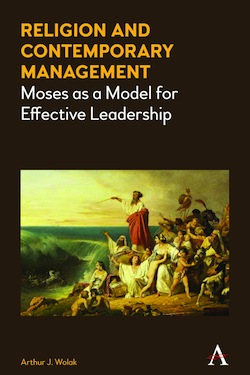
book cover - Religion and Contemporary ManagementIn the first few chapters of Religion and Contemporary Management, Wolak discusses the different types of leadership, how leadership and management differ, and the benefits and drawbacks of charisma. The next chapters focus on Moses and the ways in which he displayed empathy, possessed humility and was a visionary leader. He also knew his limitations and how to delegate. For example, explains Wolak, when Moses first objects to God choosing him to lead the Israelites, Moses says it’s because he is “slow of speech,” but God brings him round, assuring him that his brother, Aaron, speaks well and can be Moses’ spokesman.

Wolak puts some fun – and educational – twists on things, such as proposing that the Ten Commandments were God’s mission statement to the Jewish people and that Moses “assumed the role of biblical CEO, of sorts, because he became a leader entrusted with transforming God’s mission statement into a viable entity….” Wolak is also very clear that, despite his use of Moses as the model leader and the patriarchal aspects of the Torah and Judaism (and all religion, pretty much), excelling at leadership “is not gender based but built on good character and leadership abilities,” and that “there have been effective female leaders since biblical times.” He gives several examples of such women from the Tanakh and the modern era.

Another part of Wolak’s book that will particularly interest today’s readers is a nine-page section called “Modesty and Holiness,” which mainly contrasts real estate developer rivals Paul Reichmann and Donald Trump, who was not yet president when Wolak was writing his book.

While academic in style, Religion and Contemporary Management is accessible to lay readers. It is well researched and the analysis is well supported with evidence from religious texts, academics, theoreticians and a range of other voices, from Maimonides to Sigmund Freud and Winston Churchill. Published by Anthem Press (2016), the hardcover has an academic text price, at more than $100, but the Kindle version is only $30.50.

As Wolak concludes, “anyone who wishes to learn how to lead, and to learn what characteristics are beneficial for effective leadership, would do well to study the example of Moses.” Then all you need to find is the energy and wherewithal.

Format ImagePosted on September 15, 2017September 14, 2017Author Cynthia RamsayCategories BooksTags Arthur Wolak, leadership, Moses
Trying to foster community

Trying to foster community

Two things will immediately strike readers of From the Outside In: Jewish Post & News Columns, 2015-2016 by Joanne Seiff – Seiff’s knowledge of Judaism and her empathy. She really knows her Jewish texts, as well as a thing or two about human nature. Yet, she doesn’t criticize from on high. She’s right in there in the muck, so to speak, not just making suggestions for others to carry out, but trying to play a positive role herself in whatever transformations she thinks might engage more Jews in Judaism and in community. Her heart is in the right place, and it shows.

Readers of the Jewish Independent were introduced to Seiff’s writing earlier this year, thanks to the JPN’s Bernie Bellan, who thought her work might be a good fit for the JI as well. He was correct. Her columns mix Torah lessons, everyday life moments and community-building ideas seamlessly, in an uplifting manner that invites contemplation rather than merely prescribing answers. She is not dogmatic, but rather is struggling herself to see what works in her and her community’s life.

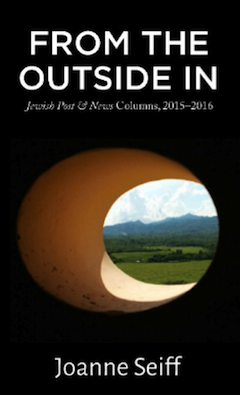
book cover - From the Outside InWhile Seiff writes about the Winnipeg Jewish community, pretty much every issue she brings up – from involving younger congregants in synagogue life to getting more out of the weekly Torah portion to countering antisemitism to making communal activities more inclusive – can be found in our community. No doubt other communities will also see themselves in Seiff’s writing. And each of us will see a bit of ourselves, how we define our identity and how we move in the world.

And though you might not know it from her casual writing style and humble approach, Seiff has the education to back up her commentary. She has a master’s degree in religious studies from the University of North Carolina at Chapel Hill and a master’s in education from the George Washington University; she earned her bachelor’s cum laude in Near Eastern studies and comparative literature from Cornell University. Even so, she doesn’t have all the answers, and she doesn’t pretend to. She calls on many sources, from Jewish traditions and writings, to rabbis who have visited her community with advice, to lessons she has learned from family (her parents and as a mother of twins), community members and others. She brings in her own experiences of living in places where there weren’t many Jews – Kentucky, for example – and that of being a relatively recent immigrant to Winnipeg. She and her husband moved to the city in 2009 and the title of her collection reflects this perspective. As she writes in the introduction, “As a newcomer to Canada, I often see things differently than someone who was born and raised in Winnipeg.”

There is a lightness and energy to Seiff’s writing, which makes the book easy to read, even though she’s tackling some heavy topics and, often, the lethargy of a well- and long-established communal structure. It takes a delicate touch to be constructively critical and not disrespectful to those who either helped set up or maintain the way things “always” have been done. Her solutions-oriented outlook and can-do attitude will inspire anyone who would like to see change but thinks that anything that’s well-established – from our identity, to our Jewish community, to our larger world – is immutable. We may not have a huge amount of control over most things in life, but there are ways in which we can make things better. For ideas of where to start, From the Outside In can be purchased online. To read more of her writing, visit joanneseiff.blogspot.ca.

Format ImagePosted on September 15, 2017September 14, 2017Author Cynthia RamsayCategories BooksTags community, Joanne Seiff, Judaism, Winnipeg
It’s never too late to find love

It’s never too late to find love

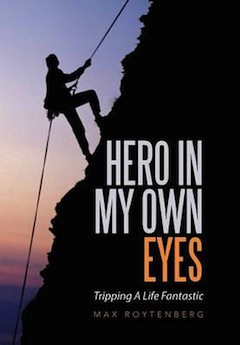
It takes a brave, confident person to lay themselves bare before others, to openly analyze their choices in life and share what makes them happy, sad and concerned. In the essay collection Hero in My Own Eyes: Tripping a Life Fantastic, local writer Max Roytenberg – with whom Jewish Independent readers should be familiar – is at turns funny, wistful, belligerent, humble, egotistical and sentimental. He’s everything we all are. In reading his stories, we learn about ourselves, as well.

book cover - Hero in My Own EyesThe collection is divided into three parts – “Looking Back,” “Living the Life” and “Looking Forward.” In the first section, Roytenberg recounts stories from his childhood in Winnipeg, outlines the various jobs he had during his career and the cities in which he lived, and touches upon his first two marriages and some of their challenges. It ends with “The Kiss,” about how he – a widower in his early 70s by that time – finally managed to connect with the woman he had loved since his youth; she had long been an widow, too, and was about the same age. The second section is focused on their life together, and it is obvious from his writing that he is smitten and he is happy. While still upbeat and energetic in the third section, the pressure of time is ever-present, as he is now an octogenarian, and he is contemplating who he has become, what impact he has made in the world and how he should spend the rest of his life.

Roytenberg seems to be quite a character. He often refers to himself in the third person, as Maxie, and calls his wife Cookie, my Bride, rather than by her name. There are times when you want to pat him on the back – such as when he manages to push through a regulation change that was being held up by an official who may have been corrupt – and times when you want to shake him, such as when he is basically dismissive of a 28-year-long marriage. But then you want to hug him, because he stayed with and supported his second wife, Ruth, during her eight-year fight with cancer, and you want to jump for joy when he does make the move on his lifelong love, Cookie, and she says yes. By the third section, when he’s so honestly discussing whether he lived up to his own expectations, about winding down (though he also talks about the benefits of not having the time to dilly dally anymore), his children and grandchildren, his gratitude and what he might do tomorrow, it’s quite moving. He touches universal chords in many of his musings and, by the end of the book, you may or may not consider him a hero, but you’ll thank him for sharing a bit of himself with you. And maybe that bit will help you to see the hero in you.

Format ImagePosted on September 15, 2017September 14, 2017Author Cynthia RamsayCategories BooksTags Max Roytenberg, memoir
Song video showcases artists

Song video showcases artists

On Aug. 31, the video for the song “Same Girl” premièred. From the Jessica Stuart Few’s latest CD, The Passage, the song features a “girls’ chorus” that includes some of Jessica Stuart’s teenage guitar students joining her on the melody. The two-minute, 36-second video was filmed in and around Toronto, in its alleyways.

“The directing duo KAJART and I started shooting the video in late April, and shot almost every weekend until early August – over 120 hours of shooting over 1,000 locations in Toronto!” said Stuart. The stop-motion music video is her third collaboration with KAJART, “and we love each other and work incredibly well together!” she said, noting that the other two videos are for the songs “Twice” and for “Passage.”

The recent video premièred on blogTO and had more than 54,000 views and 244 shares at press time. On Sept. 1, it was released on YouTube, and has more than 1,200 views so far. On the YouTube post, watchers are invited to help tag the artists of the more than 400 urban art pieces featured in the video.

Noting that school has just started, Stuart told the Independent that the song is “pretty topical.” Its first lyrics, she said, are “Started off we were going to school – half is classes, half life lessons. I don’t care if we’re learning the rules, I’m always the same, always the same girl.”

The song itself (music, lyrics) was composed and performed by Stuart, who sings and plays the koto (a 13-stringed Japanese harp). She is joined by Charles James (double bass), Jon Foster (drums), Tony Nesbitt-Larking (backing koto), Michael Davidson (vibraphone) and the chorus of Jocelyn Barth, Michelle Willis, Alex Rozenberg, Astrid Granville-Martin, Keira Brody and Bernice Chan.

To view the video and download/order the album on which it appears, visit jessicastuartmusic.com.

Format ImagePosted on September 15, 2017September 14, 2017Author Cynthia RamsayCategories MusicTags Jessica Stuart, KAJART, Toronto, urban art

Posts pagination

Previous page Page 1 … Page 425 Page 426 Page 427 … Page 669 Next page
Proudly powered by WordPress