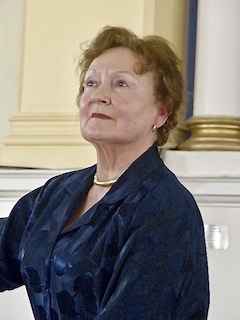
This year’s Lamplighter Award recipients are Emily, left, and Jessie Miller. (photo by Josh Bowie Photography)
The Centre for Judaism of the Lower Fraser Valley has selected Emily and Jessie Miller, Grade 10 twin sisters at Prince of Wales Secondary School, as the recipients of this year’s Lamplighter Award, which honours youth who have performed outstanding acts of community service.
In 2016, Emily and Jessie initiated a social action program called Live2Give in conjunction with Vancouver NCSY. Their goal was to do more volunteer work and good deeds in the community, and they organized events that included feeding the homeless in Vancouver’s Downtown Eastside and baking challah for the residents of Louis Brier Home and Hospital. Among their fundraising activities to support their work was a successful paper clip exchange at Richmond Centre.
“These events prompted many other Jewish teens to become involved with NCSY and the community as a whole, spreading goodness and kindness,” said Simie Schtroks, co-director of the Centre for Judaism. “It also helped many people work towards their Duke of Edinburgh Award by fulfilling the 13-hour community service requirement.”
Emily and Jessie are planning Live2Give events for 2018 and intend on making contributions to the food bank and donating toys to sick children. They feel honoured to be considered for this award and hope to continue to get more people involved in helping the community.
“Chanukah celebrates the victory of light over darkness and goodness over evil,” Schtroks said. “This is a most appropriate opportunity to motivate and inspire young people to make this world a brighter and better place, by filling the world with goodness and kindness – that light can dispel all sorts of darkness.”
Emily and Jessie will receive their awards on Sunday, Dec. 17, 6 p.m., at the Centre for Judaism’s annual public menorah lighting at Semiahmoo Shopping Centre’s food court, 1701-152 St. in South Surrey. Dignitaries, including the mayors and some councilors of White Rock and Surrey, as well as representatives from Langley and Delta, will be in attendance, as will members of the Legislative Assembly. For more information or to help sponsor this project, please email [email protected].
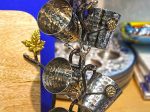
Among the items featured in Buchan’s Judaica section is a set of six hammered liquor cups on a pomegranate branch from Yair Emanuel, for any Shabbat or holiday table. (photo from facebook.com/BuchansKerrisdaleStationery)
If you’re looking for a new menorah or some cool Chanukah gifts over the next few weeks, you’ll want to target your search to three stores that have become the only hotspots for Judaica in the Lower Mainland. Sure, there are items here or there that you can find elsewhere, but not with much selection. And, you can shop online, but the problem with click-and-purchase is you don’t get to hold the weight of an object in your hand, to see the real symmetry of a piece from your screen, how it will fit into your home. Here’s where to go if you’re in the market for Jewish objets d’art.
Buchan’s Kerrisdale Stationery sits right next door to Garden City Bakery in Richmond, the Lower Mainland’s number one challah maker. The store has had a small selection of Judaica for several years but, when Inna Vasilyev took ownership a year ago, she decided to up the ante and significantly increase the variety. Vasilyev, who also owns the original Buchan’s Kerrisdale, on West 41st Avenue in Vancouver, aims to please everyone in her product choices. You’ll find 99 cent Chanukah candy, inexpensive wooden dreidels over which small kids can drizzle candle wax, fancy hand-painted dreidels and the plastic ones that disappear into the corners of a house each year. Buchan’s has Chanukah games, gelt, colouring books, tea towels, napkins with Jewish designs and menorot.
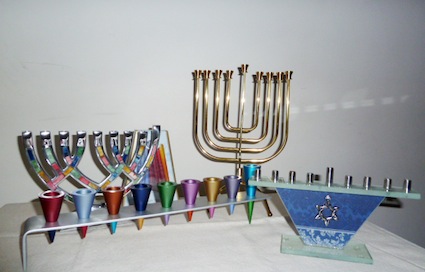
Beth Tikvah’s gift store offers several different styles of menorot and a host of other Chanukah gifts, including shaped cookie cutters, games and books. (photo from btikvah.ca/support/beth-tikvah-gift-shop)
“We have designer pieces by well-known designers and a good selection of candles, too, from simple ones to deluxe ones that burn for ages and smell beautiful,” she said.
Vasilyev also stocks non-Chanukah-related Judaica like mezuzot and candlesticks. For shoppers averse to crossing the bridge into Vancouver (or into Richmond), this accommodating store owner will transfer product between the stores to make life more convenient. She’s in the throes of updating her website and hopes to eventually display all her products on it.
Also in Richmond is one of the Lower Mainland’s longest-lasting synagogue stores, the gift shop at Beth Tikvah. Vicki Northy has been the manager and chief volunteer for the past seven years.
In the hours the office is open, office staff will gladly open the store to shoppers and handle the transactions. Northy buys new products every year, choosing a variety of fun items like bagel spreaders and mensch mugs, functional items like Kiddush cups, candlesticks and challah boards, and Judaica art by well-known artists including Yair Emanuel, Gary Rosenthal, Lily Art, Adi Sidler and Agayof. The store will be open 11 a.m.-12:30 p.m. on Dec. 3 and 10 this year to accommodate Sunday shoppers.
Olive+Wild, the gift and home décor store at 4391 Main St., is quite possibly Vancouver’s only retailer selling Judaica. Owners Simon and Bella Zaidel have 18 different menorah designs in stock right now, ranging from menorot that will get your kids excited about Chanukah to artistic beauties in brass, silver and glass.
Olive+Wild has some 18 different menorot from which to choose, as well as Judaica for Shabbat and other Jewish holidays and occasions. (photo from oliveandwild.com/collections/judaic)
“We stock Judaica designs by Nambé, Michael Aram, Yair Emmanuel and Carrol Boyes. And, given the demand, we’ve expanded our collection with various price points to make our products available to all different budgets,” Simon Zaidel said. The store opened last September and the response from the community has been “incredible,” he added. “Since Temple Sholom’s gift store closed down, there’s a limited availability of Judaica in Vancouver,” he noted. “We carry Kiddush cups, Shabbat candles, tzedakah boxes, Havdalah sets, challah covers and boards, kippot, tallises, mezuzahs, hamsas and Judaic jewelry, most of the products made in Israel.”
After the sugar-rush from the combination of Chanukah gelt and sufganiyot has worn off and the aroma of frying latkes is leaving your kitchen, you’ll want to begin “the Great Menorah Cleanup.” If there’s candle wax on your glass surface, it’s a relatively easy job involving a dollar store scraper and a hairdryer to melt any stubborn excess wax. Candle wax on silver candlesticks can be harder to eliminate without scratching your metal. Experts suggest placing your candlestick holder or menorah in the freezer for at least 20 minutes and then using your fingernails to flick off the frozen wax. A cotton ball with silver polish or rubbing alcohol can also be a useful resource to swap the area until it’s clean.
Lauren Kramer, an award-winning writer and editor, lives in Richmond. To read her work online, visit laurenkramer.net.
There is a reason that we wake up every morning to new reports of accusations against men in positions of power. It is not that the sad phenomenon of sexual harassment or violence is new – in fact, many of these accusations relate to incidents decades ago. It is also not because the women who are sharing their experiences of abuse are more courageous now than they were last week or last year.
The reason is that we have reached one of a series of tipping points. As recently as 2014, when a number of allegations of inappropriate and illegal actions by legendary comedian Bill Cosby became public, his accusers were treated as such accusers have routinely been treated: variously as complicit in their victimizations, as liars, as exaggerators, as willing partners who alleged assault only when the “relationship” went sour.
What has changed in this short time is a critical mass of people – women and men, as well as media, employers and the consumers and voters upon whose beneficence the alleged perpetrators have depended – have adopted a new willingness to believe women’s narratives of harassment and assault. This change has happened, in the context of social change, with startling suddenness.
This has created a tipping point of its own. Knowing that they are more likely to be believed than further victimized, a vast number of women have found strength in their numbers and, sensing the social change at hand, have stepped up to share their experiences.
The unprecedented acknowledgements by millions of women that they have been subjected to sexual harassment, assault or worse are taking place not only in Hollywood and Washington. As the #MeToo campaign is demonstrating, many, if not most, women have experienced something on the spectrum of gender-rooted harassment or violence. The incidents have caused unique effects in each instance, on each woman, effects that range from stunted career development and self-image issues to debilitating, lasting psychological trauma. So, put mildly, these are not good news stories.
Yet something good could come from this – indeed, it can’t help but. Our society is finally having an open and frank discussion about these issues. Yet another tipping point is surely upon us. The public perception of appropriate behaviour toward women (and, to extrapolate, respectful behaviour between all people, especially those in positions of vulnerability or subordination) has changed and will continue to change as we navigate this public discourse.
Again, this is not a good news story. In an ideal world, there would have been no such incidents that led us to this point. Yet, like the reconciliation process taking place between indigenous and non-indigenous Canadians, the fact that these things did happen, and that they cannot be undone, demands that a frank public reckoning take place and that we identify ways to hasten a better future. That we are doing so is a good thing.
These are not the sorts of topics we like to reflect on at the holidays, and yet it is something appropriate that this issue is top of the newscast as we approach Chanukah.
This holiday has, among other meanings, the idea of kindling light in the deepest part of winter. Each of the women who has come forward about her experiences has lit a single flame. Together, these lights have become a force against individual and collective darkness.
“There are as many Holocaust stories as there are Holocaust survivors,” said David Ehrlich, a survivor outreach speaker of the Vancouver Holocaust Education Centre, to open his afternoon talk at Langara College. On Oct. 31, a class of 20 students and several faculty members and guests heard Ehrlich – a Hungarian survivor of Auschwitz who immigrated to Canada via Paris in the late 1940s – tell his personal story.
This class is part of a program called Writing Lives: The Holocaust Survivor Memoir Project. In the first term, its students produce research papers on prewar European Jewish communities like the one that Ehrlich called home; in the second term, they will interview survivor-partners and together write memoirs of the survivors’ experiences.
Ehrlich is an evocative speaker. He spoke lovingly of his family home in Transylvania (now part of Romania). “We had a three-room home, and we were middle-class. But we had no running water and no electricity, not for another 20 years,” he said. “Kids don’t know any better. I thought that we had it well: chicken on Friday night, bread on the table, it was wonderful!”
But he also told of his experience with antisemitic violence, the hard choices made by families who tried to avoid a Nazi roundup, and life in Auschwitz. He silenced the room when he spoke of stepping off a train boxcar at Auschwitz: “I’ll never forget the view when the sliding doors opened, or the noise that the doors made,” he said.
The students – who in this term’s research papers attempt to imaginatively reconstruct Jewish life before the Second World War’s devastation – responded with questions about Ehrlich’s journey to Canada. He spoke of the family that he made in Canada: a wife and three sons. He made his story accessible to the audience of all ages.
The students admired Ehrlich and a bond was formed during his talk, which was about an hour long. When he finished speaking, there was a respectful silence, and no student seemed willing to be the first to break it. Teachers from Langara began the question-and-answer session and, once the ice was broken, the students filled the remaining time with questions. Ehrlich in turn shared relevant wisdom for Writing Lives’ participants.
“You are educated and smart,” he told them. “There comes a time where you’ve got to learn to put up with people who are different because you have to get along. Start practising by getting along with your fellow students.”
Indeed, Writing Lives features groups in which students collaborate on research and, ultimately, on memoirs with the course’s survivor-partners. These collaborations require empathy. Ehrlich conducted himself as an exemplar of empathy, stating, “I can’t hold the grandchildren of Nazi-era Germans accountable for the Holocaust,” and the students’ response to his talk suggests that they, too, understand empathy’s importance. The course thus offers an excellent venue for students’ development of collaborative skills and of compassion. It provides a space in which students can grow closer together.
The afternoon also contained humour and reference to contemporary subjects. Ehrlich joked that he was now willing to use various German-made appliances and recalled that the heavy rainfall during a roundup of Hungarian Jews paled in comparison to Vancouver’s weather. Ehrlich also demonstrated strong knowledge of news and politics by interspersing references to American and Canadian current events into his remarks. He shared his general optimism about the post-Holocaust situation, stating, “After three or four generations, the Germans are coming clean; they are behaving like good nations do. It’s the only country in the world where you cannot say that the Holocaust didn’t exist.” He added, “We in Canada are very lucky – multicultural – and there’s no way that one minority group could be persecuted as in the Holocaust.”
His audience appreciated his graceful, optimistic tone. One enthusiastic student baked dozens of cupcakes to celebrate Ehrlich’s recent birthday.
Ehrlich’s talk will guide Writing Lives’ students through the remainder of the program. They will respond to it in one of their weekly written submissions, and the experience of interacting with a Holocaust survivor foreshadows the interviews that they will conduct in early 2018. They could not have asked for a better guide.
William Chernoffis a student in the Writing Lives program. Coordinated by instructor Dr. Rachel Mines, the two-semester program is a partnership between Langara, the Vancouver Holocaust Education Centre and the Azrieli Foundation.
One of the stories that my father, z”l, used to tell me about his father, my grandfather, Rabbi Eyad Acoca, z”l, was that back in Morocco, at a young age, my grandfather traveled to the city of Sale to learn under the revered hacham, Ribbi Rafael Enkaua, z”l. In order to get there, he had to cross the Bou Regreg river. Once, while my grandfather was on a raft with other travelers, the raft tipped and all the people drowned except my grandfather, who held tightly onto his Talmud volume and got to the other side of the river safe and sound!
My father often recounted that my grandfather’s last wish was that at least one of his descendants continue his legacy and become a rabbi. His wish was fulfilled when I became a rabbi; in doing so, I merited to inherit a few volumes of my grandfather’s set of Talmud.
Through the years, I have come to understand that I have a big responsibility to continue in my grandfather’s footsteps and teach about Sephardi Judaism, which is unique and special. In recent years, numerous articles and lectures have been given regarding the future of Sephardi Judaism. As a Sephardi rabbi, I am delighted. However, to my dismay, I have found that most of the lectures have been framed in the extreme right or left. In my opinion, Sephardi Judaism has to come back to its origin, which was always the middle path.
Our great sage Maimonides, teaches us in his book Mishneh Torah (De’ot, the laws of personal development):
“Each and every man possesses many character traits. Each trait is very different and distant from the others.
“One type of man is wrathful; he is constantly angry. [In contrast,] there is the calm individual who is never moved to anger, or, if at all, he will be slightly angry, [perhaps once] during a period of several years.
“There is the prideful man and the one who is exceptionally humble. There is the man ruled by his appetites – he will never be satisfied from pursuing his desires, and [conversely,] the very pure of heart, who does not desire even the little that the body needs.
“There is the greedy man, who cannot be satisfied with all the money in the world, as [Ecclesiastes 5:9] states: ‘A lover of money never has his fill of money.’ [In contrast,] there is the man who puts a check on himself; he is satisfied with even a little, which is not enough for his needs, and he does not bother to pursue and attain what he lacks.
“There is [the miser,] who torments himself with hunger, gathering [his possessions] close to himself. Whenever he spends a penny of his own, he does so with great pain. [Conversely,] there is [the spendthrift,] who consciously wastes his entire fortune.
“All other traits follow the same pattern [of contrast]. For example: the overly elated and the depressed; the stingy and the freehanded; the cruel and the softhearted; the coward and the rash, and the like.” (chabad.org)
Maimonides writes, “The two extremes of each quality are not the proper and worthy path for one to follow or train himself in. And, if a person finds his nature inclining towards one of them or if he has already accustomed himself in one of them, he must bring himself back to the good and upright path.”
He continues, “The upright path is the middle path of all the qualities known to man. This is the path which is equally distant from the two extremes, not being too close to either side. Therefore, the sages instructed that a person measure … his character traits, directing them in the middle path so he will be whole.” (torah.org)
How I wish that the great minds of Sephardi Jewry would sit, united, and craft the future of Sephardi Jewry through Maimonides’ model. I hope that this will happen soon but, for now, let us all implement the lesson of Maimonides and implement the middle path in all our endeavours.
Rabbi Ilan Acocais a veteran rabbi and educator. He is the rabbi emeritus of Vancouver’s Congregation Beth Hamidrash and currently serves as the rabbi of the Sephardic Congregation of Fort Lee-Bet Yosef, in Fort Lee, N.J., and rav beit hasefer of Yeshivat Ben Porat Yosef, in Paramus, N.J. He is the writer of the book The Sephardic Book of Why and has written hundreds of articles on various topics for different publications.
Nolan Hupp and Annika Hupp play two schoolchildren who protest to save the shul in The Original Deed.(photo by Gayle Mavor)
When Rabbi Shlomo Carlebach, z”l, sometimes known as the “Singing Rabbi,” visited Victoria on a concert tour in the 1960s, he heard about a plan to move the city’s downtown synagogue, Congregation Emanu-El, to the suburbs. According to local lore, the singer/songwriter’s impassioned advice to the shul community was, “Don’t sell the place. There’s too many prayers in the walls!”
In The Original Deed, staged for the first time last month by the play’s author, Sid Tafler, a similar thought emerged from the lips of the story’s main character, Sam Abelman, played with pathos and humour by Toshik Bukowiecki.
Sam, an amalgam of several longtime Victoria residents, invited his granddaughter, Ellen (delightfully portrayed by Ava Fournier), to listen as they walked together through the synagogue on a wet November day.
All Ellen heard was the sound of traffic outside. Sam smiled and said he heard people praying, even though the two of them were the only living souls walking around the old shul.
The plan of Sam’s son, Morris, to sell the old synagogue puts him at odds with his father, who had his heart set on restoring it. Their struggle fills most of the play, providing a perfect storm of difficult family dynamics made even more poignant by Jewish geography.
An active city-centre heritage synagogue is rare in Canada. During the last half-century, most urban Jewish communities moved to the suburbs, but not Victoria. This play helps us imagine why.
Zuzana Macknight plays Rivka Abelman. (photo by Penny Tennenhouse)
Performed at Congregation Emanu-El, the action unfolded within the synagogue’s sanctuary, mystically directed from the bimah by the ghost of Sam’s wife, Rivka.
The role of Rivka was tenderly portrayed by Zuzana Macknight, an accomplished Czech actress forced from her homeland in 1968 after it was invaded by the Soviet Union and its Warsaw Pact allies. Macknight expressed a deep affinity for Rivka’s emotional journey through life as a child Holocaust survivor. Rivka felt such a passion for peace in her family that she managed to influence the play’s happy outcome from beyond the grave.
The greatest magic in this play swirled around its youngest actors. As Sam tells his granddaughter the story of his solo escape from Germany on a Kindertransport train to England during the Second World War, Nolan Nupp stole the show as Sam’s younger self. Nolan is a natural as Young Sam, who gave his bewildered little sister, Esther (played by Nolan’s real sister, Annika), a candy to help her remember him, as their mother tearfully forced them apart at a German train station.
In another flashback, Nolan communicated the horror Sam experienced as he watched the destruction of his beloved German synagogue during Kristallnacht, the Night of Broken Glass, which unmasked the Nazis’ murderous intent in November 1938.
All four child actors staged a protest as Victoria Hebrew School students, chanting and waving signs proclaiming, “Save our Shul,” dressed as the elders who inspired them.
Although you may have missed this heart-warming show, which only ran four nights to packed houses in Congregation Emanu-El’s storied sanctuary, you can still visit. Come for Shabbos on a Saturday morning when you can hear prayers in the walls and add your own.
Shoshana Litman, Canada’s first ordained maggidah (female Jewish storyteller), lives in Victoria.
On Canadian Friends of Hebrew University trips to the Israel National Trail, travelers will take their time and enjoy the landscape. (photo from Ami Dotan)
The Vancouver chapter of Canadian Friends of Hebrew University has plans to walk the Israel National Trail (Shvil Yisrael).
As it would take too long to walk the entire 1,000-kilometre trail, CFHU Vancouver will only walk its highlights, dividing them into five separate trips. The week-long excursions will be led by Ami Dotan, CFHU scholar-in-residence and a professional tour guide. The walks will take place each spring, beginning with a trip March 5-11, 2018.
“Generally, the main core of tour guiding in Israel involves going to Jerusalem and some of the holy sites and history and so on, which I totally love,” said Dotan. “But, whenever I get the chance to do some trekking, then I gravitate to it…. It’s my favourite thing. And, doing it on the INT – which was defined by National Geographic as one of the top 20 holy grails of treks in the world – it’s amazing.”
Dotan decided to kick the walks off by exploring Israel’s desert, as it provides such a contrast to the lush forests and lakes that most Canadians are used to at home.
“There’s something special about the desert,” he told the Independent. “There is no makeup of rivers and vegetation, just the essence, the core of things, the rocks and the ground…. Since I was a child, I loved the desert. Alone sometimes, with no cellphones, it touches your heart I think.
“If you ask yourself, ‘Why go to the desert?’ just think, the three major Western religions were conceived in deserts: Judaism, Christianity and Islam.”
Growing up in Jerusalem, Dotan recalls having stepped out of his home as a child and walking to the Kidron Valley from Jerusalem, making his way to the Dead Sea. Eventually, his father would come with their old car to bring him back home after dark. “That’s when I began developing a love for the desert,” said Dotan. “And, then, of course, during military service, walking in the desert.”
The trip Dotan will be leading in March will begin with an overnight in Mitzpe Ramon, going down into the crater and walking across it to the other side. This is a 12- to 13-kilometre stretch of serious desert.
The group will then bus to the Arava for a night. Dotan described this area as being “in between Israel and Jordan, but very safe. The next day, we’ll go do a trek called Maale Palmach (Palmach Ascent). This is an ascent nobody knew was possible to do … and the Bedouin who met them at the other side said it couldn’t be done…. Therefore,” he said, “it was named ‘the Ascent of the Jews’ by the Arabs. We’ll do part of the trek, including climbing up a ladder, to be able to [get up] this cliff that they walked up.”
The third day will have participants heading into sand dunes, to Kibbutz Ktura for the night. And, on the fourth day, they will go to the colourful sand rocks near Eilat and spend the night in Eilat.
“Lastly, on Saturday, for people who want to walk on Saturday, we’ll go up the mountain and then down through the INT,” said Dotan. “Then, for those who want to go on to Petra, we’ll spend three more days and continue to Petra.
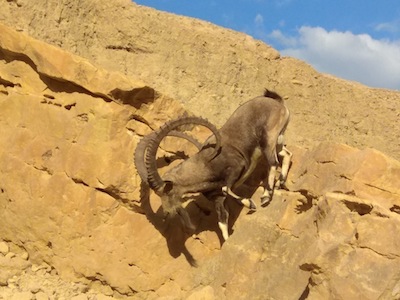
Hopefully travelers will see some of the Shvil’s residents, such as mountain goats, which have their babies in the spring. (photo from Ami Dotan)
“The trip will involve special activities around the walks, to better understand the culture and the character of the people who live there, and things we do in the desert. And, we have a Bedouin evening with local people – an amazing way to get to know the desert geographically, but also the people who’ve lived there for so long and how their life changes in a modern country, which is fascinating subject on its own.
“Next year [2019], we will do less desert, instead going to the north, which is also beautiful. I think, what you get in the north is more the human diversity. You have the Jews – Orthodox, secular and Modern Orthodox – and Arabs, Christians and Druze. In the desert, you have a Jewish population and Bedouin.”
Dotan chose to have the trips in March for two reasons. One is because they will take place before Passover, so participants will have time to return home for holiday preparation. The other reason is that, in March, the desert may have some flowers blooming, as well as some vegetation and grass.
“I hope we’ll even get to have an appointment with some mountain goats that have their babies that time of year – amazing to see,” said Dotan. “Hopefully, we’ll find natural water pools in the valleys filled with water. Not Canadian-scale quantities of water, but, after you’ve walked all day and have been sweating and warm, you’ll get to jump into this cold, fresh natural water … before it disappears in a few months.
“Also, of course, March is the time that birds migrate from Africa back to Europe. Twice a year, we have half a billion birds flying all over Israel, and many of them fly over the Syrian-African rift (which is the border between Israel and Jordan … just over our heads). So, you’ll be able to see swarms of all sorts of birds – birds of prey, storks and pelicans, whatever you want.”
According to Dotan, the trip is designed for people who have good mobility, but it won’t be extreme. There will be walks of roughly 12 kilometres a day, but, as Dotan said he has learned from experience, “It’s not a question so much how many kilometres you walk, it’s about what type of kilometres you walk. Yes, we are going to go down sometimes very steep rocks, but, obviously, it’s doable. It’s part of the excitement of walking in the desert. If you’re reasonably fit, you can do it…. I’ve had people 80 years old doing this trek. It’s not a matter of age. It’s a matter of if you’re enjoying the walk. We’re not going to rush. On the contrary, we have a lot of time to do it calmly and enjoy the landscape, nature, and excellent logistics.”
The tour group will get to stay in unique hotels at the end of each day, with a bus taking them to the beginning of the trails and picking them up at the end. “Every night, you will get to enjoy a hot shower, a good dinner, and so on and so forth,” said Dotan.
“This experience isn’t for those who rush. Rushing in the desert isn’t a good idea. I’ve done most of these treks with my 10-year-old son, and he’s not Superboy. It’s for anybody who loves nature and is reasonably fit for walking in the mountains, not just in a park. Even if you need to not participate for a day because you need the rest, then that’s possible and no problem.”
For more information about the CFHU Shvil tours, contact Dina Wachtel, Western Region executive director at 604-257-5133 or [email protected].
Chabad Richmond is leading a trip to Israel called The Land & the Spirit Israel Experience. People from across the Lower Mainland are invited to participate in this educational journey to Israel and Judaism’s most holy and historical sites.
March 4-13, 2018, participants will be taken on a five-star experience that feeds their heart, mind and soul, creating lifelong and life-changing memories. “This is an opportunity to see Israel as never before. This trip includes many unique features you will not find on any other trip of its kind,” said Rabbi Yechiel Baitelman, director of Chabad Richmond.
Sponsored by the Jewish Learning Institute, the trip includes:
Journey of learning: Explore Israel’s soul. The Jewish Learning Institute will bring Judaism’s rich history to life as travelers discover the origins of our nation and the spiritual secrets of Israel’s holy sites.
Israel today: Hear from chief rabbis, military brass and top political leaders. The group will be addressed by Israel’s leaders and gain an insider’s view of modern-day Israel’s challenges and triumphs.
Mission of solidarity: Head to the frontlines of Israel’s fight for survival. The trip is highlighted by a visit to the beleaguered community of Hebron, and an intimate barbecue with Israel Defence Forces soldiers and officers, where participants will be able to express their support to our brothers and sisters.
Travel in luxury: There will be concierge service from the moment you arrive, first-class hotel accommodations, five-star gourmet meals, and the very best Israel has to offer in education and entertainment.
Registration for the 2018 trip is well ahead of the pace of recent trips, so interested community members are encouraged to register soon. “This is not a fundraising trip,” emphasized Baitelman, “and no solicitation will be done on this trip.”
For more information and to view the itinerary online, visit landandspirit.org. For more information, contact Baitelman at [email protected] or 604-277-6427.
Left to right are Jerry Nussbaum, president of the Janusz Korczak Association of Canada, Lillian Boraks-Nemetz, David Morley and Kit Krieger. (photo by Shula Klinger)
On Nov. 6, the Janusz Korczak Association of Canada welcomed David Morley, president and chief executive officer of UNICEF Canada, to the Ponderosa Ballroom at the University of British Columbia. In partnership with the university’s faculty of education, the event was part of an annual speaker series, created in Janusz Korczak’s name.
Korczak (1878-1942) was an educator, broadcaster, playwright, doctor and passionate advocate for children’s rights. His views on the importance of democratic education broke the mould in an era where rigid rules and harsh discipline were the norm. For Korczak, children were young citizens whose thoughts should be respected and heard.
Having spent years advocating and caring for orphans in wartorn Poland, Korczak refused all offers of sanctuary during the Second World War. Finally, he accompanied his charges as they were marched to the gas chambers of Treblinka extermination camp, where he also was murdered.
Sixty years after Korczak’s death, the Janusz Korczak Association of Canada was established in Vancouver, where it works to keep his ideas in the public eye, and in the minds of educators.
As an author and public speaker, Morley has taken a leading role in human rights advocacy for the past 30 years. His push for children’s rights has been central to his work in international development. He now leads a program of growth at UNICEF Canada on behalf of, and in partnership with, community stakeholders, to create safe, stimulating and healthy environments for children.
Morley’s topic was How We Can Make Canada a Great Country for Kids. It centred on data collected in 14 reports on the well-being of children and youth in prosperous countries. Spanning 17 years, these reports reveal vast differences in outcomes for young people in countries that appear – at least on the surface – to be equally wealthy. The reports’ scope encompasses a vast range of indicators of child and youth well-being, including literacy levels, teen pregnancy rates, the incidences of suicide and child murder, the level of poverty, the amount of bullying and how much awareness there is of environmental issues.
Morley delivered a blow to most people’s perception of Canada as a safe, peace-loving nation with a population of healthy kids. On the contrary, he showed that one in four Canadian children lives in poverty, with statistical evidence showing that Canadian children suffer from ill-health, violence and a poor sense of well-being to a surprising degree, in comparison with similarly affluent countries. He said Canada ranks 25th out of the world’s 41 richest nations, positioned roughly in the middle, with Norway in the top spot and Chile at the bottom.
Describing Korczak as “a giant in the realm of children’s rights,” Morley spoke of honouring Korczak’s legacy in Canada by “making sure that kids have a chance to reach their full potential.” He pointed to the “shocking” statistic that the graduation rate for children in care is a mere 51%, whereas the rate is 89% for kids who are not in care. Even worse, the graduation rate for Canada’s indigenous population is only 44%.
Morley explained the need to keep children involved in any program of change, seeking their participation in the planning and development of new initiatives. Themes of gender equality and sustainable development appeared throughout his call to action. His presentation concluded to applause and was followed by a lively question-and-answer period tackling a wide range of topics, including employment, education and the discrimination faced by First Nations children.
In addition to Morley’s presentation, the evening also saw the presentation of a scholarship to UBC student Assadullah Sadiq, from the JKAC. Awarded to a scholar of great promise in the field of education, Sadiq received the honour in absentia, via letter. He said, “the honour of being selected for this award is something I will always treasure. I will dedicate myself to children’s rights and education my whole life.”
The event was moderated by Kit Krieger of the UBC faculty of education, who is also an Honorary Life Fellow of the Vancouver Holocaust Education Centre. It featured a moving presentation by local author, JKAC board member and child survivor Lillian Boraks-Nemetz, who described Korczak as “my father’s hero.”
Shula Klingeris an author and journalist living in North Vancouver. Find out more at shulaklinger.com.
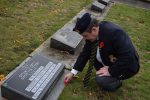
Danny Redden places a poppy at a family grave. (photo by Shula Klinger)
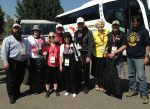
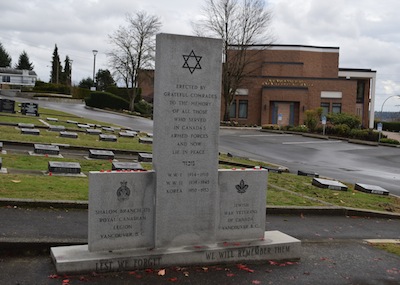
Royal Canadian Legion Shalom Branch #178 paid their respects at Schara Tzedeck Cemetery. (photo by Shula Klinger)
With Remembrance Day falling on a Saturday this year, members of Royal Canadian Legion Shalom Branch #178 paid their respects on Monday, Nov. 13. They met at Schara Tzedeck Cemetery in New Westminster. Legion president Ralph Jackson was in attendance with vice-presidents Alan Tapper and Mark Perl, along with legion members.
The group sang O Canada and Hatikvah, and the Last Post was sounded, before poppies were placed at veterans’ graves. Danny Redden laid a poppy at the grave of a former neighbour. He later emailed the man’s son and daughter, who do not live locally. “I told them, we remembered him and laid a poppy at his grave. They were so appreciative. When you hear that, you need to continue doing it. It’s the honourable thing to do.”
After the service, attendees went on to lunch at Louis Brier Home and Hospital. Redden described it as “a lovely lunch, followed by live piano music and songs from the war years. They did a wonderful job.” Redden credited Rachel Worth at Louis Brier for coordinating the afternoon’s entertainment.