Skip to content
  • Home
  • Subscribe / donate
  • Events calendar
  • News
    • Local
    • National
    • Israel
    • World
    • עניין בחדשות
      A roundup of news in Canada and further afield, in Hebrew.
  • Opinion
    • From the JI
    • Op-Ed
  • Arts & Culture
    • Performing Arts
    • Music
    • Books
    • Visual Arts
    • TV & Film
  • Life
    • Celebrating the Holidays
    • Travel
    • The Daily Snooze
      Cartoons by Jacob Samuel
    • Mystery Photo
      Help the JI and JMABC fill in the gaps in our archives.
  • Community Links
    • Organizations, Etc.
    • Other News Sources & Blogs
    • Business Directory
  • FAQ
  • JI Chai Celebration
  • JI@88! video

Recent Posts

  • Eby touts government record
  • Keep lighting candles
  • Facing a complex situation
  • Unique interview show a hit
  • See Annie at Gateway
  • Explorations of light
  • Help with the legal aspects
  • Stories create impact
  • Different faiths gather
  • Advocating for girls’ rights
  • An oral song tradition
  • Genealogy tools and tips
  • Jew-hatred is centuries old
  • Aiding medical research
  • Connecting Jews to Judaism
  • Beacon of light in heart of city
  • Drag & Dreidel: A Queer Jewish Hanukkah Celebration
  • An emotional reunion
  • Post-tumble, lights still shine
  • Visit to cradle of Ashkenaz
  • Unique, memorable travels
  • Family memoir a work of art
  • A little holiday romance
  • The Maccabees, old and new
  • My Hanukkah miracle
  • After the rededication … a Hanukkah cartoon
  • Improving the holiday table
  • Vive la différence!
  • Fresh, healthy comfort foods
  • From the archives … Hanukkah
  • תגובתי לכתבה על ישראלים שרצו להגר לקנדה ולא קיבלו אותם עם שטיח אדום
  • Lessons in Mamdani’s win
  • West Van Story at the York
  • Words hold much power
  • Plenty of hopefulness
  • Lessons from past for today

Archives

Follow @JewishIndie
image - The CJN - Visit Us Banner - 300x600 - 101625

Author: Dave Gordon

Dominican Republic a haven

Dominican Republic a haven

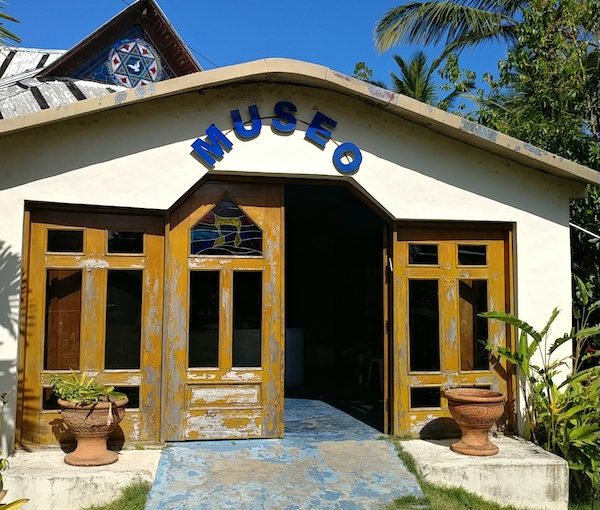
The Museum of Jewish History in Sosua is located right next to the city’s synagogue. (photo by Dave Gordon)

Famous for its rum, cigars, resorts, beaches and rich history, the all-season holiday destination of the Dominican Republic attracts 800,000 Canadians each year. Moreover, the country has a relatively unknown past – few people realize, or know, that the country opened its doors wide to Jewish refugees fleeing Nazi persecution.

This era is chronicled at the Museum of Jewish History, in Sosua, which is in the northern section of the country. Located right next to the city’s synagogue, the museum preserves the memory of those Jewish refugees who sought a safe haven on Dominican soil, and left their mark on the region. It houses photographs of early-to-mid-20th-century Jewish immigrants, along with diary entries, ritual items and copies of letters from Jewish agencies during the war.

Before the Second World War, in 1938, U.S. President Franklin D. Roosevelt summoned the Allies to Evian, France, for a conference about how to handle the massive exodus of Jews who desperately sought to flee Nazi persecution. Though most of the participants at the conference expressed their sympathy, no resolution was formulated. Paraphrasing Chaim Weizmann (who would later become the first president of Israel), Central and Eastern European Jews perceived the world as consisting of just two camps: one that hounded and hunted them, and another that closed its gates.

There was, however, one notable exception.

Of the 32 countries that sent delegations to the conference, only the Dominican Republic, led by President Rafael Trujillo, agreed to receive 100,000 refugees, offering land resettlement under generous conditions. A group of experts on refugee affairs, under the leadership of James Rosenberg, was mobilized by the American Jewish Joint Distribution Committee to capitalize on the offer. This was the birth of the Dominican Republican Settlement Association (DORSA).
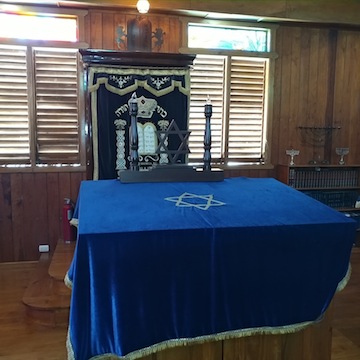
photo - Inside Sosua’s synagogue
Inside Sosua’s synagogue. (photo by Dave Gordon)

Between 1940 and 1945, the Dominican Republic government issued 5,000 visas for displaced Jewish refugees. Tragically, however, the actual number of immigrant arrivals never reached anywhere near this figure, due to the escalation of the war, and also to what some believe to be mishandling by the Jewish Agency, which resulted in delays. Of the nearly 1,000 Jews who settled in the Dominican Republic, most were from Austria and Germany, although some came from as far away as China, and some from as close as the Caribbean islands.

Little by little, the jungle-like territory was divided into residential lots and communal barracks for arriving refugees. Each refugee was furnished with, as a repayable loan, 80 acres of land, 10 cows, one mule, one horse, and a living wage for a month. They were assisted with training in agriculture and farming techniques, of which most had little previous knowledge.

Jews took to food manufacturing, becoming successful in the production and sale of sausage, milk, cheese, tomato sauce, mashed carrots, stuffed peppers and mashed spinach. Many of these industries continue to this day. The refugees’ earnings enabled them to pay their debts and establish other small industries.

By the 1990s, however, just 36 Jewish families remained in Sosua, as most of the population either died, intermarried or moved to larger Jewish communities.

Interestingly enough, well before the arrival of these refugees, in 1916, the Dominican Republic briefly had a Jewish head of state, President Francisco Henríquez y Carvajal.

Visiting the country

Virtually every major supermarket has plenty of items with kosher certification, including imported canned goods, breads, fish and spreads. A Puerto Plata resort named Lifestyle has an on-site kosher restaurant, though only for guests staying there. Alternately, in Punta Cana, the local Chabad offers à la carte food orders upon request.

If this trip is a do-it-yourself getaway, as opposed to an all-inclusive, here are two suggestions for luxury stays that will offer the feel of home:

Villas Agua Dulce is a jaw-droppingly elegant and spacious facility. Each villa has a fully furnished living room, dining room and a washer/dryer. Three-bedroom villas are available to accommodate a family of seven. Toss in for good measure an outdoor patio, outdoor private pool, a spa centre, tennis and basketball courts, and Bauhaus interior design.

With the beach just a few hundred feet away, Cabarete Palm Beach Condos is centrally located in the Cabarete area. Each condo has a fully equipped kitchen, living room (with big TV), dining area and outdoor patio.

As for suggested adventures in the Puerto Plata area, I have several.

photo - Horsebacking riding is one of the many outdoor adventures one can take in the Puerto Plata area
Horsebacking riding is one of the many outdoor adventures one can take in the Puerto Plata area. 

Monkey Jungle: After enjoying the 4,500-foot, seven-station zip lines overlooking the trees, visit the adjacent capuchin monkey reserve. Scores of these adorable creatures bounce around from tree to tree, hopping on your shoulders and nibbling straight from the fruit plate in your hand.

Ocean World: This is where you can swim with sharks and dolphins and kiss the sea lions.

Tip Top Catamaran: Take a ride on the 75-feet-long and 33-feet-wide catamaran. Tourists are offered the chance to experience the vibrant underwater world through snorkeling Sosua Bay (equipment is provided). Immerse yourself in schools of fish, peer at the coral, get face-time with a puffer fish and play with the sea urchins.

Twenty-seven waterfalls of Rio Damajagua are tucked away in the hills of the Northern Corridor mountain range, behind tall stalks of sugar cane. In addition to the mélange of outdoor activities – such as cliff jumping into natural waters and climbing through caves – you are surrounded by forest. And, depending on the season, fruit will be growing from coconut, avocado, coffee bean and mango trees.

Kiteboarding: Think of yourself hovering over the ocean on a surfboard, propelled by a giant inflatable kite, and you have kiteboarding. Dare2Fly provides kiteboarding packages, lessons and rentals.

Rancho Luisa y Tommy: Try a morning horseback ride. Run by 30-year-old Tommy Bernard, a Quebec expat, he’s an affable fellow who’ll treat you to engaging conversation on topics including animals, his adopted country, and most anything in life.

Dave Gordon is a Toronto-based freelance writer whose work has appeared in more than 100 publications around the world.
Format ImagePosted on December 13, 2019December 12, 2019Author Dave GordonCategories TravelTags Dominican Republic, history, Holocaust, immigration, museums, synagogues, tourism
Glamour of a Leiber handbag

Glamour of a Leiber handbag

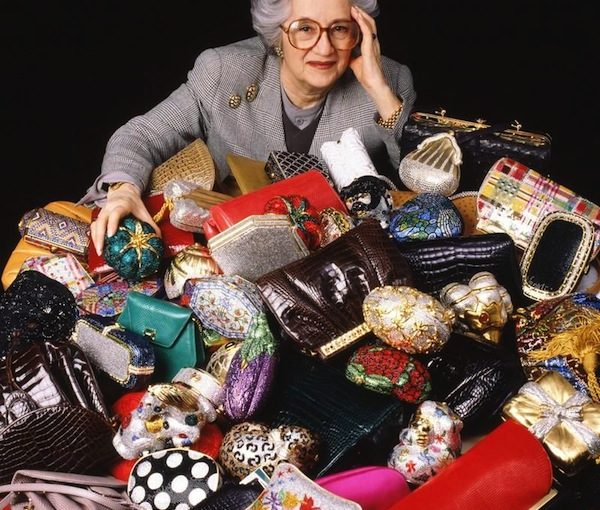
Judith Leiber (photo from Palm Beach Beauté)

Many of us gravitate towards objects that are bright and sparkly. Creating this magic in one handbag is what Judith Leiber, née Peto, accomplished.

Judith Peto was born in Budapest, Hungary, in 1921. Her mother, Helene, from Vienna, was a homemaker and her father, Emil, from Hungary, was a commodities broker. Together with her sister, Eva, the family had a bourgeois lifestyle.

Discovering that their teenaged daughter had a good head for numbers and academics, they sent Judith to London to study chemistry, with the hope that she would acquire a university degree and work in the cosmetics industry. Part of the reason they sent her away to school was a concern about her safety in case of a war. However, the distance from her family proved too difficult for Judith and she soon returned home.

She landed a job at a handbag company and, over the years, her father would bring her an assortment of unique handbags from his many travels around the world, thereby initiating Judith’s collection.

Learning the art of handbag-making from start to finish allowed Judith to become the first woman to join the Hungarian handbag guild; she gained the title of a true craftsman.

Judith and her family escaped and survived the Holocaust due to her father’s large circle of connections. He was fortunate to obtain a Schutzpass, a document that secured the bearer safe passage, giving the family, together with 26 others, access to a house set aside for Swiss citizens, where they could live. They ate what they could, slept on the floor and never left the security of the house.

“People in Budapest and my parents, especially my father, did one thing and then another to keep us safe, or as safe as we could be when everyone wanted to kill us,” Judith told the Jewish Exponent in a 2013 interview.

When Hungary was liberated, the family moved into a basement that was home to 60 survivors. Rebuilding the life they once knew was their goal. During this time, Judith met and fell in love with an American soldier, Gerson Leiber. Against her parents’ wishes, she married him in 1946 and the couple moved to the United States.

The young new immigrant had no intention of staying home and becoming a traditional housewife. With her knowledge and skill in making handbags, she got her first job at Nettie Rosenstein, a fashion designer. Working her way up in the company, she was commissioned to make a handbag to match the inauguration dress of the first lady, Mamie Eisenhower. The bag received high regard and this milestone, after 12 years of hard work, gave her the impetus to start her own brand.

In 1963, she launched her company with her husband and partner by her side, overseeing the business and operational duties. An avid artist himself, a painter, they were an unstoppable duo. In the 7,000-square-foot loft that became their studio, countless creations were brought to life, handbags that epitomized glamour, every piece an original, made with crystals and beads in shapes of animals, fruit and other objects.

A Judith Leiber handbag became a first lady tradition for the inauguration ball. Some A-list Hollywood stars put more thought into their Leiber handbag than their dresses, knowing it would be the focal point of any attire. One handbag could cost anywhere from $3,000 US to $20,000 US.

“That is what people pay for – quality,” Judith told the Exponent.

And quality was what she prided herself on, each bag being made by specialist craftsmen under Judith’s watchful eye in New York.

Her label brought in millions of dollars in sales each year and there was a waiting list for her creations, with women around the world wanting a timeless bag to wear and/or display as part of their home décor.

The company was sold in 1993, with Judith staying on as the head creator. She enjoyed her new life, moving out of New York and settling in East Hampton, N.Y., with her husband, “Gus.”

Over her career, Judith received numerous design awards and had her work exhibited in some of the world’s most renowned museums, including the Smithsonian, the Museum of Modern Art and the Metropolitan Museum, to name only a few.

In addition to being displayed elsewhere, there is the Leiber Collection museum in East Hampton, a project set in motion by Gus.

The Leibers were married for more than 70 years. Their earthly love story endured until 2018, when they died within hours of each other, both of heart attacks.

Ariella Stein is a mother, wife and fashion maven. A Vancouverite, she has lived in both Turkey and Israel for the past 25 years.

Format ImagePosted on December 13, 2019December 12, 2019Author Ariella SteinCategories WorldTags business, entrepreneur, fashion, handbags, history, Judith Leiber
Women and education

Women and education

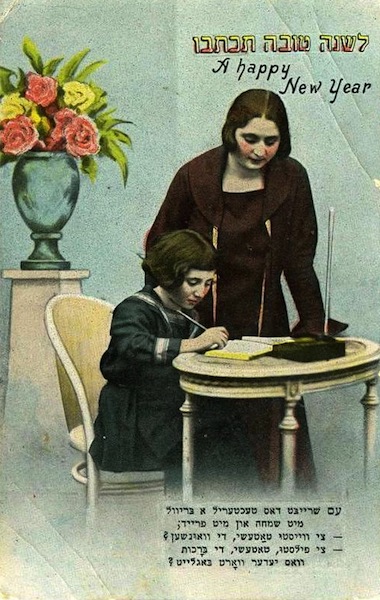
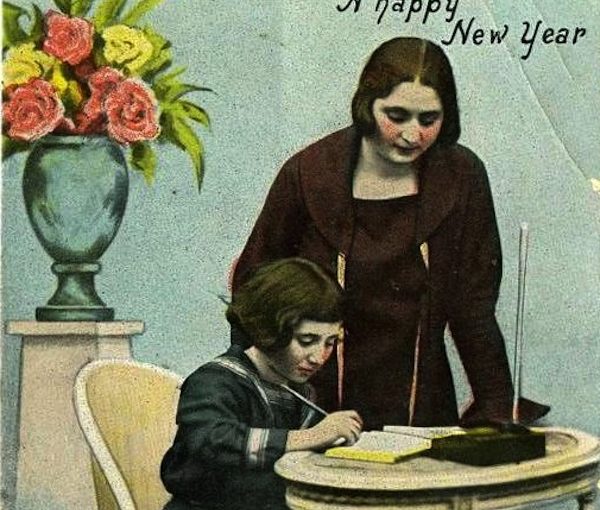
One of the family cards, produced 100 years ago, that is currently on long-term loan in the folklore department of the Hebrew University of Jerusalem, on Mt. Scopus. It is from the Chaya and Chana Gitelman Collection.

Not too long ago, I was flipping through a collection of old family cards, all of which were produced 100 years ago in Eastern Europe. On the cover of one card, a young girl sits at a table writing in a notebook. Her mother stands over her, looking on. From a modern perspective, there is nothing unusual about a woman knowing how to read and write. But less than 200 years ago, this would have been considered somewhat revolutionary.

Just how revolutionary? In the article, “The History of Jewish Women in Early Modern Poland: An Assessment,” Prof. Moshe Rosman reported that, at the end of the 19th century, more than half of all Jewish girls could not read, not even in Yiddish. Rosman noted that not only was limited attention given to educating Jewish women, but that those who first wrote the history of this period, deemed it hardly worth dealing with the subject.

In early modern Poland, education for Jewish girls and women was largely designed to make them into faithful Jews who would keep female rituals. For the most part, their education was informal and conducted in Yiddish. Brenda Socachevsky Bacon states that a learned woman was an aberration and considered outside the norm. In analyzing Shmuel Yosef Agnon’s story “Hakhmot Nashim” (“The Wisdom of Women”), which was published in 1943, Socachevsky Bacon says a woman’s very presence in the beit midrash causes the men to be uncomfortable. “They view the realm of Torah study as their own, even as their own hypocritical behaviour belies their dedication to it,” she writes. “The men will not allow this discomfort to continue, even if it involves transgressing the Torah’s commandment not to embarrass another person publicly.”

Fortunately, this was not the whole story of this period. Rosman explains there were secularized school settings in which Jewish girls learned both Yiddish and European languages. The objective of these schools was modernization and general knowledge. Girls read classic European literature. In this instance, the scorn was sometimes transferred, with traditional Jewish literature viewed contemptuously.

According to Prof. Eliyana Adler (“Rediscovering Schools for Jewish Girls in Tsarist Russia”), private schools for Jewish girls were a crucial ingredient in transitioning Russian Jewry into modernity. She reports that, from 1844 to the early 1880s, well over 100 private schools for Jewish girls opened in cities, towns and shtetlach throughout the Pale of Jewish Settlement.

The educators who opened and ran private schools for Jewish girls pragmatically balanced their ideological motivations with very real concerns about funding and retaining communal goodwill. Thus, those who ran private schools offered a variety of student tracks. Rich Jews (like their wealthy Christian neighbours did elsewhere) could pay to board their children. Many schools offered weekly instruction in both music and French as paid electives.

Adler goes on to say, “at the same time, families of modest means were offered tuition payments on a sliding scale. Noteworthy, poor students were actively recruited for scholarship positions. Other schools offered less sophisticated fee scales, but clearly worked within the same framework. The rewards for having a robust student body became clear as both the government and certain private and communal bodies began to award subsidies to successful private schools.”

These private schools for Jewish girls designed Jewish studies curricula to meet the expectations of the Russian Jewish communities from which they drew their students. The curricula had to be modern and useful without being radical. Thus, efforts were made to introduce training in practical crafts; that is, crafts that could be put to use in the marketplace. In 1881, the first trade school for poor Jewish girls opened in Odessa. Thereafter, both trade schools and sections within other schools that offered more in-depth training in such skills as sewing opened with increasing frequency.

image - One of the family cards, produced 100 years ago, that is currently on long-term loan in the folklore department of the Hebrew University of Jerusalem, on Mt. Scopus. It is from the Chaya and Chana Gitelman Collection
One of the family cards, produced 100 years ago, that is currently on long-term loan in the folklore department of the Hebrew University of Jerusalem, on Mt. Scopus. It is from the Chaya and Chana Gitelman Collection.

By the end of the 1890s, in Odessa alone, more than 500 girls studied in four communally funded vocational schools for Jewish girls. Jewish educators responded to the growing interest in interaction with the surrounding society by opening their private girls schools to Christian girls and by offering to teach courses in the Jewish religion in Russian schools. Prayer served as the common denominator of religious courses – the major focus of religious education was on prayer.

The teaching of Jewish history rather than simply the Torah allowed for an unprecedented degree of interpretation and even mild biblical criticism. Hebrew reading was also offered in many of the schools. Almost all Jewish girls schools offered penmanship and arithmetic.

Every private school for Jewish girls in the Russian Empire required extensive instruction in the Russian language. It was not uncommon for all general studies subjects to be taught in Russian.

Examples of the above educational transformation may be found in the bigger cities of Eastern Europe. In Plonsk (located some 60 kilometres from Warsaw), for example, toward the end of the 19th century, organizations such as Kahal Katan (literally, Small Community), educated the poorer strata of society. Also during this period, the city (which had a Jewish majority) opened a primary school for Jewish children, where some 80 pupils, mostly girls, studied in Russian. (See yadvashem.org/yv/en/exhibitions/communities/plonsk/jewish_education.asp.)

Vilna is another example. In 1915, the Association to Disseminate Education established three schools – one for boys, one for girls and one mixed – whose language of instruction was Yiddish. Also in 1915, Dr. Yosef Epstein established the Vilna Hebrew Gymnasium (high school), which was later renamed after him. The informal educational system included literature, drama, music, industrial arts and other courses. (See yadvashem.org/yv/en/exhibitions/vilna/background/20century.asp.)

According to Dr. Ruth Dudgeon (“The Forgotten Minority: Women Students in Imperial Russia, 1872-1917”), Russian women, aided by sympathetic professors, created educational institutions that evolved into universities and medical, pedagogical, agricultural and polytechnical institutes for women. Moreover, in 1916, the Ministry of Education overcame its bias against preparing women for public activity, rather than the home, and mandated the equalization of the curricula in the boys’ and girls’ gymnasia.

In the 1870s and 1880s, Jewish-Russian enrolment in the courses for women was between 16% and 21%. The imposition of quotas in the 1880s, however, reduced the number of Jewish students. But, in places where the quota was lifted, the number of Jewish women in the courses soared.

In the restricted Pale of Settlement, young Jewish women wanting to study did everything to establish residency elsewhere. The “everything” included registering as a prostitute. According to Dudgeon, one brother found out about his sister’s actions and then drowned himself in the Neva; the grieving sister, in turn, ended her life by taking poison.

As circumstances for Jews in the Russian Empire deteriorated in the 1880s, those Jews who stayed in that part of the world came to embrace new ideological solutions to the situation. In an atmosphere of violence, deprivation and brutally strict quotas in education and professions, Russian-Jewish parents wanted their children enrolled in schools where the course of study offered some hope for the future.

By the turn-of-the-century period, educators were no longer opening private schools for Jewish girls based on the old model. The schools they opened – whether they were trade schools where Zionism was taught, religiously mixed schools devoted to full acculturation, or Yiddishist schools committed to inculcating socialism – promised more than basic literacy.

In Poland, Gershon Bacon writes, “the education of Polish Jews in the interwar period was characterized … [as] the ‘victory of schooling.’ The compulsory education law of the reborn Polish republic had brought about in one generation what had eluded generations of prodding by tsarist officialdom and preaching by Jewish maskilim (people versed in Hebrew or Yiddish literature). Whether in the public schools or in the various Jewish school networks, Jewish children in Poland were educated according to curricula that deviated in almost every respect from that of traditional Jewish education. [Notably,] religious families had no objections to sending daughters to secondary schools, even though they objected to exposing sons to secular education.

“What is most striking,” continues Bacon, “are the differences in enrolment figures in institutions of higher learning. There was a much larger proportion of Jewish women students among female students as a whole (36% in 1923/1924), as distinct from the percentage of Jewish men among male students (22% in 1923/1924). It would seem that we have here but another example of a phenomenon observed in other countries, where Jewish women entered institutions of higher learning earlier and in greater proportion than their non-Jewish counterparts.” (See jwa.org/encyclopedia/article/ poland-interwar.)

So many factors about these educational statistics still need to be explored. Nevertheless, one can observe that an outcome seems to have been the creation of a modern Jewish Eastern European woman who “opened her mouth with wisdom.” (Proverbs 31:26)

Deborah Rubin Fields is an Israel-based features writer. She is also the author of Take a Peek Inside: A Child’s Guide to Radiology Exams, published in English, Hebrew and Arabic.

Format ImagePosted on December 13, 2019December 12, 2019Author Deborah Rubin FieldsCategories WorldTags education, history, Judaism, women, Yiddish
Jewish bootleggers, police

Jewish bootleggers, police

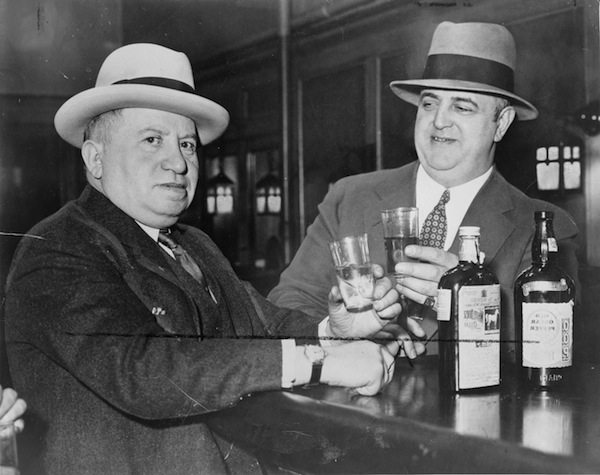
Izzy Einstein and Moe Smith sharing a toast in a New York bar, 1935. (photo from Library of Congress; New York World-Telegram and Sun Collection)

Wine is a large part of Jewish ritual and tradition. And a glass or two of schnapps is not uncommon. Adults often drink something alcoholic on a holiday or happy occasion. So what did people do when there was Prohibition?

In Canada, national Prohibition was from 1918 to 1920 and, in the United States, Prohibition lasted from 1920 to 1933. How did Jews get wine for Shabbat and holidays during these periods? And who clamped down on those who were disobeying the law?

In both the United States and in Canada, Prohibition laws allowed for wine to be sold for religious sacraments. This meant that rabbis and priests could lawfully possess wine. In the United States, both Jews and non-Jews were known to use this special legal passage as a ruse. It led to bootleg priests and rabbis and to the hoarding of wine for bogus religious reasons.

Although Canadian provinces had various earlier restrictions on liquor sale and consumption, the national Canadian Prohibition continued for only a short period of time. And, importantly, it remained legal to manufacture liquor in Canada. Even more significant, Canadian distilleries could likewise legally sell it to the dry United States, where the manufacture, importation, sale and transport of alcohol was then illegal. Thus, Canadians brought alcohol to the United States via Windsor, Ont., where it usually went on to Detroit, Mich. At the time, Samuel Bronfman was the Canadian Jewish owner of Seagram’s. He had Jewish bootleggers floating so much illegal booze into the United States over Lake Erie that this body of water became known as the “Jewish Lake.”

Remarkably, the two most successful U.S. Prohibition agents were Jewish. Izzy Einstein and Moe Smith were two “regular”-looking guys who had absolutely no resemblance to flashy Prohibition agent Elliot Ness, who has been characterized in television series and in movies. Their ability to fool violators with either their ordinary appearance or with their numerous disguises allowed them to make an outstanding number of arrests. In all, they made 4,932 arrests of bartenders, bootleggers and speakeasy owners. They had a 95% conviction rate. They confiscated an estimated five million bottles of alcohol. At the time, this catch was worth about $15 million US.

Neither man had any law enforcement training. Einstein had been a pedlar and a postal worker. Smith had sold cigars. They were not even strongly for temperance, but they were for upholding the law. Initially, Einstein’s job interviewer didn’t want to hire him as an agent because of his lack of training, but Einstein managed to convince the man that he was right for the job because he looked so unremarkable and because he had a “feel” for people.

Having been born in Austria, Einstein spoke a number of languages. He put his language skills to use when the pair disguised themselves. They were known to have used a huge variety of get-ups, including as German pickle packers, Polish counts, Hungarian violinists, Jewish gravediggers, French maitre d’s, Italian fruit vendors, Russian fishermen, Chinese launderers, streetcar conductors, ice deliverers, opera singers, judges, traveling cigar salesmen, Texas cattlemen, movie extras, football players, beauty contest judges, grocers, lawyers, rabbis, college students, plumbers and delegates to the Democratic National Convention. In my estimation, however, the funniest costumes were those of them dressed as a man and woman. One of them sported a thick beard and mustache and a bowler hat, while the other dressed in a heavy fur coat, scarf and jaunty cloche hat.

Einstein claimed that it was key to come into a speakeasy carrying some kind of tool of the trade, so he often carried a string of fish, a pitcher of milk, trombones, a fishing rod or a big pail of pickles. He did not carry a gun, however, and Smith carried one only occasionally.

The greater their chutzpah, the greater the risk to their personal safety. At one Bowery saloon, for instance, Einstein even produced his actual agent’s badge and asked for a pint of whiskey. The bartender thought it was a gag and served him.

So that he had enough evidence to bring charges against the offenders, Einstein devised a special hidden liquor collection system. There were three parts to this system: a rubber bag hidden below his shirt, a rubber tube that was connected to the bag, and a glass funnel sewn into his vest pocket. He sipped the liquor and, without anyone noticing, poured the rest of the drink down the funnel, which then led to the rubber tube.

The pair’s success on the job became a matter of public record. New York newspapers frequently covered their escapades. They became so well known that Einstein’s face was even hung in certain speakeasies. But even that did not tip off drinking customers, as Einstein reportedly once stood below his photo without anyone catching on.

Einstein and Smith had worked as federal Prohibition agents for about six years when they were laid off, perhaps because they inadvertently made other agents “shine” less than they did. They both went on to be a different kind of agent, successfully selling insurance. Some of their clients, it is said, were people they had busted.

Deborah Rubin Fields is an Israel-based features writer. She is also the author of Take a Peek Inside: A Child’s Guide to Radiology Exams, published in English, Hebrew and Arabic.

Format ImagePosted on December 13, 2019December 12, 2019Author Deborah Rubin FieldsCategories WorldTags history, Izzy Einstein, Judaism, Moe Smith, Prohibition, Samuel Bronfman

Renewal requires courage

Did you notice what a great day it was today? Rain or shine, there are lots of people out there who are so happy you are alive. Besides yourself, I mean. I bet you did some things today that added to that number.

I’m feeling pretty good myself, remembering stuff from my youth. In December, we light the candles marking Chanukah, the Festival of Lights, as it is called. I always liked this holiday as a kid, along with Rosh Hashanah, because there were good things to eat at the party we always had. And older people in the family gave you money, Chanukah gelt. I hope they still do that, although I haven’t heard much about it since the kids got big and left home to form their own households.

Many people – unless they have Jewish neighbours or notice the lights around Christmas time – don’t know about Chanukah because it is not in the Bible, and because the events surrounding it happened later. After the empire forged by Alexander the Great broke up, the piece in which Israel was included was under the rule of kings named Antiochus.

These kings liked to fancy themselves gods. One of them put a statue of himself in the Jewish Temple. This was just too much for the Israelites and they rose up under the leadership of the Maccabees – Mattathias and his five sons – and drove out their Greek rulers.

Chanukah is about renewal, because that’s what the holiday celebrates, the renewal of the Temple in Jerusalem after the land was freed. Current Israel is part of that same story, as the ingathered exiles renewed national life on their land. Our national renewal is an assertion that our past is merely prologue, with the full story yet to be written.

Jewish history of the recent two millennia may not illustrate it, but Jews can be fighters when roused. The self-rule reestablished back then was ultimately surrendered to Roman rule, when they lost their unity. But Jews kept on fighting to achieve independence until, finally, the Romans used their power to exile Jews from their land. We must remember that the Romans executed Jesus because they feared that he would lead such a revolt, but the Jews continued their opposition after his death.

It took 12 legions to pacify the Jews – Rome conquered the Britons with only two legions. The Romans exiled the survivors to secure their rule, but the power of the religious ideas spawned in Israel conquered Rome itself a hundred years later. Those ideas were borne into exile by Jews who proved to be among the first martyrs.

More recent Jewish military history, in Israel – leaving aside the resistance without weapons in the Warsaw Ghetto, holding off the Nazi soldiers for weeks – proves that Jews can be fierce fighters.

The whole idea of renewal excites the blood. Renewal can make you feel like you can cancel out all the ills of the past, as if they never really happened. One can turn a corner and start out fresh. It is an idea around which one can rally believers, as has been done in so many places at so many different times.

Many people have fought and died in defence of renewal. It is at the heart of every movement that seeks to channel people’s efforts for change. It can be local, regional, national or global. It can have a religious or patriotic motivation. Its beauty is that it can have its origin in the lives of each and every one of us.

Change is not easy. We may be very unhappy with important elements of our lives, but taking drastic action to materially transform our lives takes courage and, often, an acceptance of the risk of substantial loss. Some of us may have done this at some time in our lives and not even appreciated that we were risking all for renewal.

It may not have been on a battlefield, but I consciously sought to renew my life when I reached out at the age of 70. I reached out to seek a relationship with a person I had known only superficially more than 50 years earlier as a teenager. The object of my continued memory and attention, my future bride, mustered up the courage to take me on as an unknown quantity, and her courage has enriched both our lives.

Truth be told, the times that haunt us most in our lives are those when we did not “seize the bull by the horns” and do the thing we really wanted to do. But, in the end, failing to act for lack of courage, or for some other reason, we settled for less than we ached to reach for. We can count every one of those times in our mind’s eye. Don’t we agonize sometimes about those steps not taken? We can never know for sure what the ultimate outcome would have been.

Looking out through the windows of my eyes, seeing the young and not so young, I am filled with enthusiasm for the future. I see the possibilities we all face in our lives to reengineer what the future holds for us.

There is so much happening out there of which I may have no understanding. What I do know is, if we really put our minds to it and concentrate on this renewal business, we can be sure to make our tomorrows fantastic.

Happy renewal in whatever calendar you follow, wherever in the world you are!

Max Roytenberg is a Vancouver-based poet, writer and blogger. His book Hero in My Own Eyes: Tripping a Life Fantastic is available from Amazon and other online booksellers.

Posted on December 13, 2019December 12, 2019Author Max RoytenbergCategories Celebrating the HolidaysTags Chanukah, conflict, history, lifestyle
Holiday of light, community

Holiday of light, community

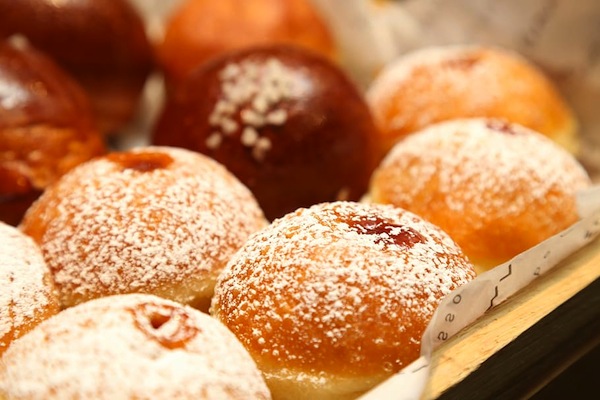
In recent years, sufganiyot have easily become the unsung heroines of new Chanukah traditions. (photo from piqsels.com)

Full disclosure, Chanukah has always been my favourite holiday. It has all the things a good holiday needs: dark wintery nights, deep-fried oily foods, magical lights, melancholy songs and cozy family time.

As a child, I looked forward to latkes and gatherings round the stove at my grandparents’ house, homemade sufganiyot – the jam-filled deep-fried doughnuts, consumed exclusively and excessively on this holiday – and the week-long vacation from school. Needless to say, my romantic view of Chanukah was somewhat tarnished as I reached adulthood only to realize that Chanukah is considered a vacation for schoolchildren; for university students and working normal folk, it’s business as usual, plus sufganiyot, plus kids. Living in Israel, a country that demands a lot of sobering up as you reach adulthood, I still count this as one of my top three.

The origin story of Chanukah frames it as a holiday of miraculous intervention. Chanukah songs and school teach us that this holiday is all about chasing away the darkness – most appropriate, given its wintery timing – and the Maccabees and their ferocious war of rebellion against the Greek-Hellenistic Seleucid Empire. We have the admirable protagonist of Judah Maccabee, waging his David vs. Goliath-like war against the archvillain of tyrant Antiochus IV Epiphanes, famous in Jewish lore for his relentless persecution of the Jews. And, of course, there’s the miracle of the oil: as the victorious Jews returned to purify the recaptured Temple, the tiny amount of oil they had miraculously lasted for the eight days it took to do so. This talmudic tale is the source of the modern eight-day celebration of Chanukah centred on the ritual of lighting the chanukiyah, adding a candle with each day.

These mythical tales reinforce the traditional Jewish narrative of a war of independence, and the few fighting and winning against the many, with the aid of a heavenly power. As a Jewish holiday, Chanukah joins the lore of religious and cultural oppression, a fierce tale of valour with a great hero in Judah Maccabee, and a grand finale celebrated in the Temple. Its roots also lent themselves perfectly to creating the holiday’s traditions; the oil from the lamp becoming a staple in both foods and in lighting the chanukiyot, when those were still oil-based, as well as holiday songs equating this religious war with chasing away the darkness.

With time and as with many holiday traditions, the modern celebrations of Chanukah grew to outshine these origin stories. This is partly helped by the holiday’s lack of family traction – no vacation time for grownups, no prescribed big family meals like on Rosh Hashanah or Passover – leaving more room for personal traditions to form and for purchasable items or foods to take centre stage. Our traditions become lighting the candles with our roommates or sharing fancy doughnuts with our work colleagues.

For me, the loose nature of Chanukah tradition also represents the growing pains of adulthood, as we’re freed to make, or burdened with constructing, our own traditions with our own families and friends. A lot of this comprises practical choices, like who to celebrate with and where, but, in the broader perspective, this is our way of connecting, or disengaging, from our community. A way of choosing our group of peers, perhaps redefining some set-in-concrete values we never considered were malleable along the way.

Chanukah provides us with an opportunity to redefine some of those traditions along with their meaning, reshaping them according to our personal beliefs and faith. Take the Chanukah narrative, for example. Do we continue to raise our children on tales of Jewish plight and persecution, of wars as heroic, of the Temple as an utmost goal worth sacrificing our lives for? Are stories of male combative heroism the most important lesson we want to teach the next generation? Is religious separatism still an essential value, or how do we tell this tale while encouraging pluralism and tolerance? And where are all the women in these stories? (There is the tale of Judith and her beheading of opposing military leader Holofernes, which is a rare account of female heroism in a terribly masculine world.) Essentially, how do we create a more challenging version of the holidays and still allow our children, and ourselves, to enjoy these traditions, not losing our sense of community as we go?

In a way, it’s fitting that the main paraphernalia of Chanukah – the chanukiyah, has also historically been a vessel for establishing Jewish identity in the Diaspora. As one of the few items used in Jewish ritual that doesn’t have a Christian parallel (like a censor or chalice, for example), the artists making these objects were free to use any type of decoration, as there was no risk the object would be mistaken for a non-Jewish item. Thus we find chanukiyot with the eagle of the local Austro-Hungarian emperor, architectural flourishes resembling renowned local structures – be they churches or mosques – or even the Chanukah tale of Judith beheading Holofernes. There are Moroccan chanukiyot made of reused sardine cans, as this was a predominantly Jewish industry, Italian chanukiyot featuring animal hybrids and putti (baby angels common in Italian

Renaissance and Baroque art) and Israeli chanukiyot with the Israeli flag. (The Israel Museum has an impressive collection of Chanukah lamps, museum.imj.org.il/stieglitz.)

As the questions of reestablishing our communal and individual identity remain, the grounding of Chanukah in our everyday world is often found in much more earthly places. In recent years, sufganiyot have easily become the unsung heroines of new Chanukah traditions. Bakeries and cafés are finding ways to make their doughnuts progressively outrageous with each passing year, adapting them to the millennial taste for opulence, decadence and quick satisfaction, since who knows what tomorrow might bring. It might not be a perfect solution, but it is undeniable that existential quandaries are best answered while consuming vast amounts of deep-fried, sugary foods while singing songs in the candlelight.

Avia Shemesh is an art history PhD student, studying medieval Spanish art, and living in central Israel. She is passionate about anything to do with art and culture, and loves to write about the ways we interact with the visual world around us and with one another. When not working or writing, she likes to travel, bake and go to yoga classes, like the borderline millennial she is.

Format ImagePosted on December 13, 2019December 12, 2019Author Avia ShemeshCategories Celebrating the HolidaysTags Chanukah, chanukiyah, Judaism, lifestyle, tradition
Courage, particularity

Courage, particularity

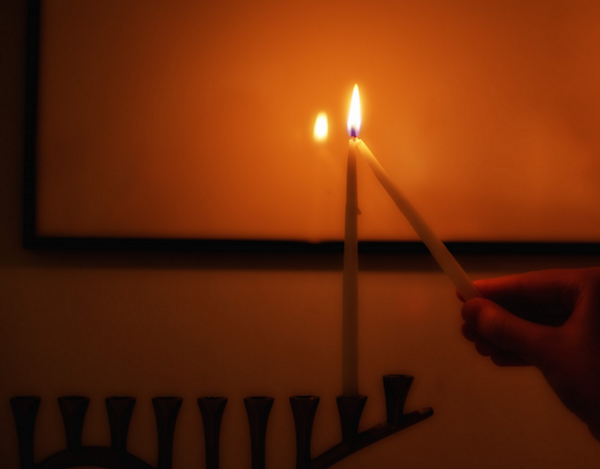
The chanukiyah is an expression of Jews’ commitment to place the particular into the mainstream of history. (photo from pxhere.com)

Jewishness is not merely determined by a biological accident. It involves commitment and dedication to the spiritual worldview contained within the vast literature produced through Jewish history. Without Torah – however understood – Jewish identity lacks a vital and ultimate purpose. Torah saves Jewish identity from being reduced to pure secular nationalism or racist folk sentimentality.

During the Chanukah period, one is challenged to reflect on the two main motifs of this festival: the Maccabean struggle and the rekindling of the menorah. A Jew can draw inspiration from his people’s courage to revolt against religious tyranny and from his being a member of a community that nurtures its national identity on the basis of a spiritual vision of life.

The Maccabean revolt is a compelling symbol not because of chauvinist nationalist tendencies but because of the values and way of life that this revolt aimed to preserve. The Maccabean revolt expressed intense loyalty and passionate dedication to monotheism and mitzvot. The courage, commitment and heroism of the Maccabees should not, however, be divorced from that for which they fought.

One of the distortions of modern existentialism is the exaltation of the virtues of sincerity, devotion, authenticity, etc., irrespective of their specific content. The sincerity of the Nazis in no way mitigates their barbarity and depravity. Subjective attitudes are important aspects of human behaviour only if their content is worthwhile and significant.

It is ludicrous to celebrate Maccabean courage and devotion without seriously considering the underlying values that motivated them to persevere in their struggle. In order to appreciate the full importance of the Maccabean victories over the enemies of the Judaic tradition, we must understand the basic values of that tradition.

The lights of the Chanukah menorah symbolize the strength to remain different and the right to sustain particular values and loyalties in a world in which one is different and often isolated. Placing the Chanukah menorah near the window for all to see represents the great message that Jews convey to the world: we choose not to hide the flame of our spiritual tradition within the secluded confines of our people, our family, but rather we wish to have our flame radiate light in the marketplaces of history. The Chanukah menorah is a concrete expression of Jews’ commitment to place the particular into the mainstream of history, to enter the marketplace with dignity and integrity.

To love Judaism, one must Jove Jewish particularity. This love is expressed by a passionate involvement with Jewish history and with efforts to enhance the well-being of the particular people who are the living carriers of the Judaic tradition.

Chanukah focuses attention on the problematic issues involved in the survival of a community within a world whose values and cultural rhythms seem so dissimilar and foreign to its own. How can one sustain the vitality of the intimate family in an impersonal world of mass culture? How can one keep alive a vital interest in that which is unique to one’s particular culture and experience if one allows modern technology to bring a diverse array of values and cultures into one’s private home?

Some Jews believe that cultural particularity is incompatible with modern mass culture and that the bonds holding together the family of Judaism cannot bear the stress caused by exposure to the cultural rhythms of the broader culture. According to this school of thought, Chanukah celebrates the Maccabees’ courageous repudiation of the world culture of their time, Hellenism. “Hellenistic” and “Hellenization” have become derisive terms that connote the assimilating Jew, the cultural opportunist without deep roots in his community’s value system.

Those who accept this assessment of Judaism in the modern world turn to social and cultural separation in order to secure Judaism’s survival. Withdrawal into well-defined ghettos, the total rejection of secular learning even remotely related to cultural values, banning television sets in one’s home or any form of alien culture – all these build up the walls insulating this vulnerable community from the threatening world outside. Radical separation is the way these people express their will to survive.

Others are skeptical as to whether this approach can succeed. Modern communication technology makes it impossible to escape acculturation to modern Hellenism. It is, in their opinion, futile to resist. We should accept our fate and accommodate ourselves to the inevitability of our assimilation.

A third option rejects the defeatism of the latter point of view and also the separatism of the former. This approach questions the belief that Judaism has always survived because of its radical separation from the surrounding culture. Chanukah does not commemorate a total rejection of Hellenism but, as Elias Bickerman shows in From Ezra to the Last of the Maccabees, the revolt focused specifically on those aspects of foreign rule that expressly aimed at weakening loyalty to the God of Israel.

The Maccabees rejected the paganization of Judaism. They were selective in their attitude to Hellenism: they rejected what was considered to be inimical to the continuity of Judaism and incorporated within their way of life what was compatible with Jewish values and practices.

To determine the criteria of such a cultural selection is undoubtedly difficult. Can one ever determine the point beyond which outside cultural influences destroy an individual’s character and identity?

Maimonides’ thought was clearly enriched by his exposure to the writings of Aristotle, Ibn Vaja and Al Farabi. Soloveitchik was enriched by Kierkegaard, Kant and Hermann Cohen. These two great teachers who strengthened Jewish particularity by their halachic teachings are examples of cultural openness and of the intellectual and spiritual enrichment that results from exposure to non-Jewish intellectual and spiritual frameworks.

The major question that we must ponder on Chanukah is whether the Jewish people can develop a profound personal identity that will enable it to meet the outside world without feeling threatened or intimated. The choice need not be ghettoization or assimilation. Can we absorb from others without being smothered? Can we appreciate and assimilate that which derives from “foreign” sources, while at the same time feel firmly anchored to our particular frame of reference?

Chanukah is a time to reflect on such questions. How we answer them will influence our priorities, the types of families and institutions we build, and the character of the leaders we train.

The destinies of both Israel and the Diaspora depend on how solidly we build Judaic values into the core of our identities, so that Jews will be able to interact with the world from a position of dignity and rootedness. The modern return to Jewish nationhood is incomplete and destined to end in assimilation, if we do not witness a modern return to the values for which the Maccabees fought.

Jewish chauvinism and mistrust of the world is lessened when we experience the joy of mitzvah. Intense Judaic learning in the spirit of Maimonides and Soloveitchik is the key to integrating Jewish particularism with modernity. Israel’s great gift to the Jewish world is that it enables us to realize that ghettoization or assimilation are not the only choices possible in the modern world.

Rabbi Prof. David Hartman (1931-2013) was founder of the Shalom Hartman Institute. This essay on Chanukah, one of several on the holiday, dates to 1980. This and other writings have been brought to light by SHI library director Daniel Price. Articles by Hartman, z”l, and other institute scholars can be found at shalomhartman.org.

Format ImagePosted on December 13, 2019December 12, 2019Author Rabbi Prof. David Hartman SHICategories Celebrating the HolidaysTags Chanukah, Judaism, modernization, tradition
Spinning joy for Chanukah

Spinning joy for Chanukah

The lights of chanukiyot could be seen in the neighbourhood windows. (photo by Neil Harris/uberdox.aishdas.org)

There once was a dreidel named Dreidelhead. Dreidelhead had three brothers and lived with his parents in Flushing, N.Y. His first name was Noon but everyone just called him Dreidelhead because his head and body were shaped like a big dreidel. His three brothers were named Gimel, Hay and Shin.

Dreidelhead’s parents taught all of the children how to sing, dance and, of course, spin. So, during the holiday of Chanukah, all four children would sing, dance and, of course, spin at Chanukah parties and celebrations in their neighbourhood. Noon, Gimel, Hay and Shin would link their arms together and dance around the chanukiyah, singing Chanukah songs. It was quite a sight to see, the four dreidel brothers dancing together and spinning around the table. Everyone, especially children, loved to watch them.

Dreidelhead, like his brothers Gimel, Hay and Shin, was named after a Hebrew letter. Each brother had their letter stitched onto the front of their shirt, so that, when people saw them standing together, people would be reminded of the great miracle that occurred.

Dreidelhead’s letter, Noon, represented the word nes, miracle. Gimel’s letter represented gadol, which means great. Hay’s letter represented hayah, which means happened, and, finally, Shin’s letter, which is one of the last letters of the Hebrew alphabet, represented sham, the Hebrew word for there. So, when Noon, Gimel, Hay and Shin stood together, they reminded people that Nes gadol hayah sham, a great miracle happened there, in Israel, many years ago.

On the first night of Chanukah, after lighting the candles and singing songs, and before they were about to eat the scrumptious latkes that their mother and bubbie had made, Dreidelhead’s zaide would always tell the boys the story of the miracles that took place during the Festival of Lights. As their mom put down a plate of golden brown potato pancakes on the table and some sticky jelly doughnuts, their zaide recounted the tale of a band of Jewish rebels named the Maccabees, who were led by Mattityahu, a Jewish priest, and his five sons.

“A long time ago,” Zaide began, “there was an evil king of Syria named Antiochus, who forbade the study of Torah and wanted Jews to bow down to idols and eat pork. He also put idols right in the Holy Temple in Jerusalem.”

“I’d rather eat latkes and jelly doughnuts than pork,” Dreidelhead announced as he glanced hungrily at the plate of steaming latkes and sufganiyot.

“Yeah, me too,” chimed in Hay.

“Well, you’ll be eating some soon, just let your zaide finish his story,” Dreidelhead’s mom interjected.

“But, we already know the story of Chanukah,” Dreidelhead whined. “We learn it in Hebrew school every year.”

“I know you do,” Zaide patiently replied. “So, nu, if you know the story, tell us what happened next.”

“Well, um, the Maccabees, who were led by Judah the Maccabee (the Hammer) overthrew Antiochus and came to the Holy Temple to light the menorah and to cleanse it of all of the idols that were placed in it. When they came to light the menorah, there was only enough oil to last one night, but a miracle occurred and the oil lasted for eight days and eight nights,” Dreidelhead replied all in one breath.

“And so what do we do to commemorate the miraculous victory and the miracle of the oil?” Zaide asked.

“Well,” replied Dreidelhead, “uh, well, we light the candles for eight nights and put the chanukiyah in the window, we tell the story of Chanukah and eat potato latkes fried in oil. And we can also eat jelly doughnuts fried in oil. That’s what they do in Israel. Oh, yeah, and dreidels like us spin on Chanukah!”

“Don’t forget the part about the Chanukah gelt,” Gimel said.

“Oh, yeah,” said Dreidelhead. “We also get money or Chanukah gelt.”

“That’s true,” Zaide replied. “But, try to remember, boys, that the most important part of Chanukah is not getting money or presents, but lighting the candles, remembering the story and the miracles, and spinning for children during Chanukah. In fact, before your bubbie and I came to America, we would spin for all of the children in our little village in Russia on Chanukah.”

“Your zaide’s right boys,” Bubbie piped in. “And, back in the Maccabees’ time, according to an old legend, we dreidels were used to warn students studying Torah that Antiochus’s troops were coming.”

“So our ancestors helped save people’s lives – they were heroes!” exclaimed Hay.

“That’s right,” Dreidelhead’s father acknowledged. “So, you boys should be proud to be dreidels. Anyway, after you thank your bubbie and zaide for their wonderful Chanukah stories, I want you to wash your hands and then you can eat. You’ll need lots of energy if you’re going to dance for the boys and girls in the neighbourhood tonight.”

Later that evening, the dreidel brothers roamed the neighbourhood searching for Jewish families who were celebrating Chanukah. They were easy to find. The dreidels just looked for houses that had a chanukiyah displayed on the windowsill. They knocked at people’s doors and announced in unison, “Happy Chanukah! It’s the dreidels!” If there were any children in the household, they would jump up and down and shout at the top of their lungs, “The dreidels are here! The dreidels are here!” The children would plead with their parents to invite the dreidels into their home. Once inside, the dreidels would spin and sing for the children, just as their parents and grandparents did before them.

And so, during the eight nights of Chanukah, while the candles were burning, Dreidelhead and his brothers would dance and spin, bringing joy wherever they went.

David J. Litvak is a prairie refugee from the North End of Winnipeg who is a freelance writer, former Voice of Peace and Co-op Radio broadcaster and an “accidental publicist.” His articles have been published in the Forward, Globe and Mail and Seattle Post-Intelligencer. His website is cascadiapublicity.com.

Format ImagePosted on December 13, 2019July 2, 2020Author David J. LitvakCategories Celebrating the HolidaysTags Chanukah, dreidel, fiction, Judaism

Some Chanukah trivia

  1. What does the word Maccabee mean?
  2. Who were the five sons of Mattathias?
  3. What is a Chanukah lamp called?
  4. What are the letters on a dreidel outside of Israel? Inside Israel?
  5. In which book of the Bible do we read the story of Chanukah?
  6. Who was Judith and why is she mentioned on the Shabbat of Chanukah?
  7. What was Mattathias’s wife’s name?
  8. How many candles are in a box of Chanukah candles?
  9. Why do we give gelt on Chanukah?
  10. How many years occurred between the desecration of the Temple and the killings in Modiin by Mattathias and the Maccabee uprising?
  11. According to Jewish custom, what kind of oil should be used for the Chanukah lights?
  12. Why were the schools of Hillel and Shammai in disagreement about Chanukah?
  13. What is unique about the mitzvah of kindling Chanukah lights?
  14. How should one popularize the mitzvah of lighting the candles for Chanukah?
  15. What king ordered the people of his kingdom to become Greek in religion and culture?
  16. Why don’t Jews celebrate the things really done by the Maccabees?
  17. Why did Judah Maccabee want this holiday celebrated for eight days?
  18. Who were the Hasmoneans?
  19. How long did the war continue after the Temple was rededicated?
  20. How did each of the Maccabean brothers die?

 Trivia answers

  1. One tradition says it means hammer and was applied to the Maccabee family because of their strength. Another says it stands for Mi kamocha baelim Adonai, Who is like you among the great ones, O G-d?
  2. Judah, Jonathan, Jochanan, Eleazar, Simeon
  3. Chanukiyah
  4. Nun, gimmel, hay, shin; nun, gimmel, hay, po
  5. The story does not appear in any book of the Bible. It is found in Maccabees I and Maccabees II, part of the Apocrypha, books not included in the Bible.
  6. Judith was a Hasmonean woman, whose story is a book of the Apocrypha. She saved her town from destruction by killing the general in charge.
  7. No one knows because she is never mentioned in the books of Maccabees.
  8. 44
  9. During the Middle Ages, adults began to play games on Chanukah. In the 1700s, children began to play dreidel and were given coins for playing.
  10. One year
  11. Olive oil
  12. Hillel wanted one light on the first night and additional lights added each night. Shammai wanted eight lights on the first night and one subtracted each night.
  13. Even if one does not have food to eat, one should beg or sell their clothing to buy oil and lamps to light for Chanukah.
  14. Place the lights at or near the outer part of the door facing the street or in a window facing the street.
  15. Antiochus Epiphanes
  16. The rabbis did not want military battles commemorated, so they created the story of the oil being found by the Maccabees and lasting eight days.
  17. Because the men had been fighting at the time of Sukkot and had not celebrated it, they decided to commemorate that holiday by observing this one for eight days.
  18. The Maccabees were part of the House of Hashmon and called Hasmoneans, a title of honour that denoted its high standing.
  19. The war continued 127 more years.
  20. Judah was in battle and his unit became sandwiched between two enemy divisions. Eleazar was under attack by a unit on elephants – he thought the king or general was on a particular elephant so he thrust a sword into the elephant and it fell on him and crushed him. Yochanan was attacked by a tribe near the Dead Sea. Simeon was entertained by his son-in-law, made drowsy from wine and assassinated by the son-in-law’s accomplices. Jonathan was put to death by the Syrian king Tryphon.

Sybil Kaplan is a journalist, lecturer, book reviewer and food writer in Jerusalem. She created and leads the weekly English-language Shuk Walks in Machane Yehuda, she has compiled and edited nine kosher cookbooks, and is the author of Witness to History: Ten Years as a Woman Journalist in Israel.

Posted on December 13, 2019December 12, 2019Author Sybil KaplanCategories Celebrating the HolidaysTags Chanukah, history, Judaism, Maccabees
Brisket recipes for holiday

Brisket recipes for holiday

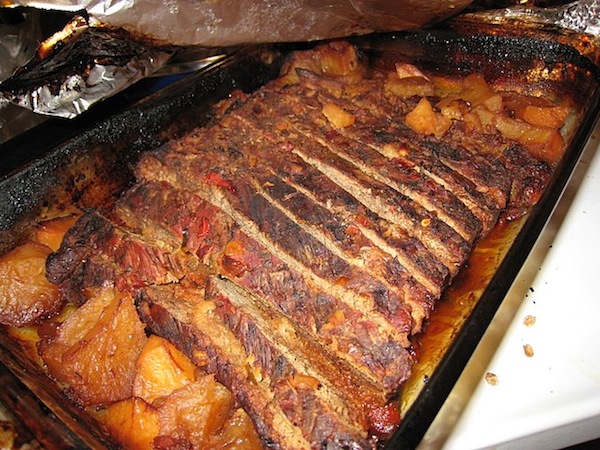
(photo by Josh Evnin)

In traditional Jewish cooking, brisket is most often braised as a pot roast, especially as a holiday main course, usually served at Rosh Hashanah, Passover and on the Sabbath. For reasons of economics and kashrut, it was historically one of the more popular cuts of beef among Ashkenazi Jews. Brisket is also the most popular cut for corned beef, which can be further spiced and smoked to make pastrami. But why not try it for Chanukah? It’d make a great holiday main dish.

First, some background. Brisket is a cut of meat from the breast or lower chest of a cow. It is one of the nine primal cuts of beef, though the precise definition of the cut differs internationally. The brisket muscles include the superficial and deep pectorals. As cattle do not have collarbones, these muscles support about 60% of the body weight of standing or moving cattle. This requires a significant amount of connective tissue, so the resulting meat must be cooked correctly to tenderize the connective tissue. The term brisket is derived from the Middle English brusket, which comes from the earlier Old Norse brjósk, meaning cartilage.

MOM’S EASY-TO-MAKE BRISKET
6-8 servings

4-pound brisket
2/3 package onion soup mix
paprika
parsley flakes
dill
6 carrots
8 potatoes

  1. Preheat oven to 350°F.
  2. Place the brisket in a foil-line baking pan. Sprinkle onion soup mix, paprika, parsley flakes and dill on top. Add carrots and potatoes. Seal in foil.
  3. Bake for one hour per pound of meat.

BRISKET AND FRUIT
8-10 servings

2 sliced onions
1 3- to 4-pound brisket
1 1/2 cups beer or wine
1 cup pitted prunes
1 cup dry apricots
3 tbsp brown sugar
2 tbsp orange marmalade
1 tsp brandy
1 tsp grated lemon peel
juice of 1 lemon
3/4 tsp ground ginger
1/2 tsp cinnamon
1/2 tsp Worcestershire sauce

  1. Preheat oven to 350°F. Line a baking pan with foil to cover brisket.
  2. Sprinkle half the onions on foil, place brisket on top; place remaining onions on top of brisket and seal. Roast three hours.
  3. Combine beer or wine, prunes, apricots, sugar, marmalade, brandy, lemon peel, lemon juice, ginger, cinnamon and Worcestershire sauce in a bowl and blend.
  4. Spread mixture on top of brisket. Reduce heat to 300°F. Cover pan and cook one hour, adding more beer or wine if sauce appears dry.

Sybil Kaplan is a journalist, lecturer, book reviewer and food writer in Jerusalem. She created and leads the weekly English-language Shuk Walks in Machane Yehuda, she has compiled and edited nine kosher cookbooks.

Format ImagePosted on December 13, 2019December 12, 2019Author Sybil KaplanCategories Celebrating the HolidaysTags brisket, cooking

Posts pagination

Previous page Page 1 … Page 273 Page 274 Page 275 … Page 649 Next page
Proudly powered by WordPress