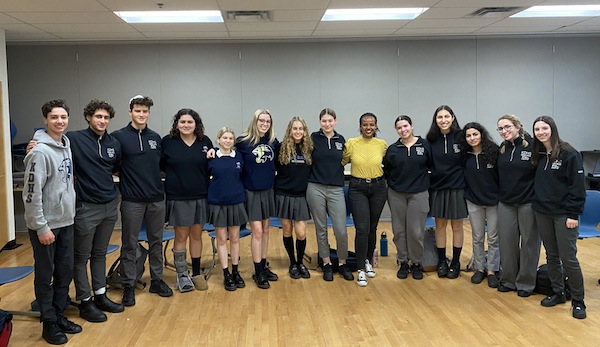
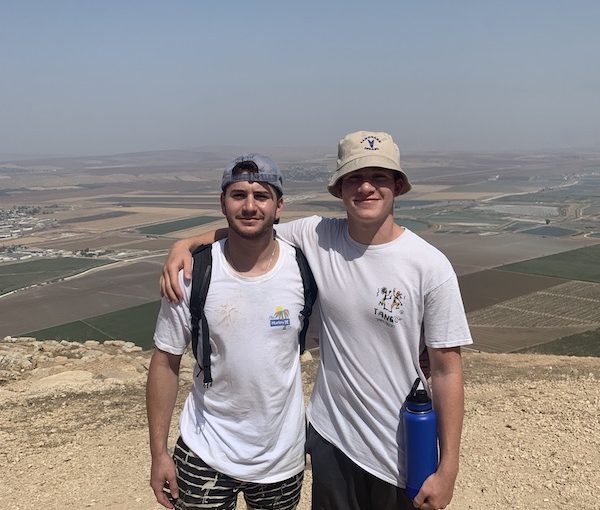
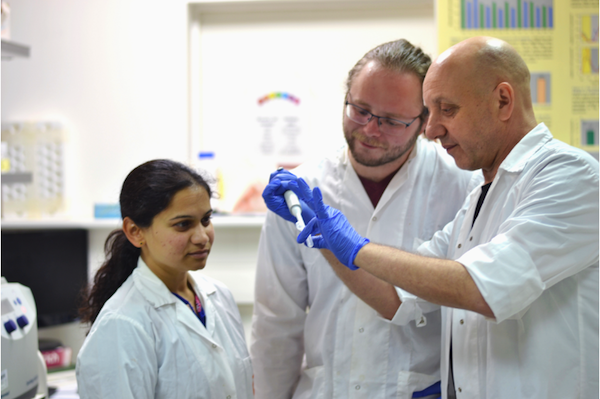
King David High School’s Holocaust and Genocide Studies 12 class with Liliane Pari Umuhoza. (photo from KDHS)
On Nov. 24, King David High School Holocaust and Genocide Studies 12 teacher Anna-Mae Wiesenthal invited a guest speaker. The class had the opportunity to hear from Liliane Pari Umuhoza, a child survivor of the Rwandan genocide, who is currently doing a master’s degree at the University of British Columbia.
Hearing Umuhoza’s personal story of healing from trauma, as well as her work with other survivors of the genocide, gave our class a better understanding about how genocide affects individuals and how to help them with their personal growth. Especially interesting was hearing about her involvement with the Survivors Fund, and her process of helping women share their stories from the Rwandan genocide. Having Umuhoza speak to our class was an experience we will never forget, and that we will continue to learn from.
Emma Silber is a Grade 12 student at King David High School.
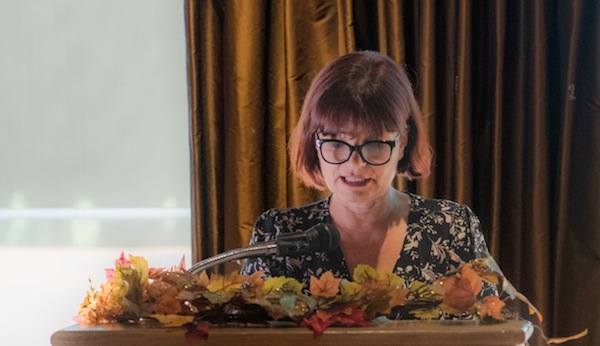
Toby Rubin was invested as the new president of CHW Vancouver on Oct. 16. (photo by Sid Akselrod)
A vast amount of progress has been made in gender equality in recent decades, but organizations where women come together for philanthropic work and social connections remain desirable and necessary, says Toby Rubin, the new president of CHW Vancouver.
Founded by Jewish women in 1917, after a visit from Hadassah founder Henrietta Szold, CHW started out as Hadassah Organization of Canada. In 1921, Canadian Hadassah affiliated with World WIZO and became known Hadassah-WIZO Organization of Canada (later condensed to Canadian Hadassah-WIZO). CHW defines itself as a non-political, non-partisan, national network of dedicated volunteers who believe that excellence and advancement of education, healthcare and social services transcend politics, religion and national boundaries.
Rubin has been a volunteer with the local chapter of the organization for years and was invested as the president at an event Oct. 16 at the Richmond Country Club. In an interview with the Independent, she attempted to dispel some misconceptions.
First and foremost, she said, is the concept that CHW “is a bubbe organization.”
“We have really changed,” she said. A new chapter of 25-to-40-year-old women – including Rubin’s daughter and a cadre of new leaders who were centre-stage at the installation luncheon – has launched and already held their first fundraising event. They raised $5,000 for JOLT, a leadership development curriculum being developed by Young Judaea Canada.
Another misconception, Rubin said, is that all funds from CHW’s philanthropy go to Israel. Rubin and a group of Canadian activists have just returned from a tour of Hadassah projects in Israel, but she stressed that local and Canadian projects are also supported by the chapter’s work. Among the initiatives the group supports is SOS, Starting Over Safely, for victims of domestic violence; scholarships for an LGBTQ+ kids’ camp; and Franny’s Fund.
The latter program was launched by Rebecca Snukal, a Calgary defence lawyer with two decades of experience navigating the legal system and social safety net through some emotionally and administratively perilous cases. But when she and her own family were rocked by crisis, she came to understand how unwieldy the system is – even people with expertise in the field have challenges accessing the legal and psychological supports they require. Snukal was the guest speaker at the October event.
Something that Rubin especially wants to dispel is the idea that CHW’s work is accessible only to Jews. The foremost example, she said, comes from Hadassah Medical Centre in Israel, where triage is based on medical need, to the extent that injured terrorists have been treated based on the severity of their condition alongside victims of their attack.
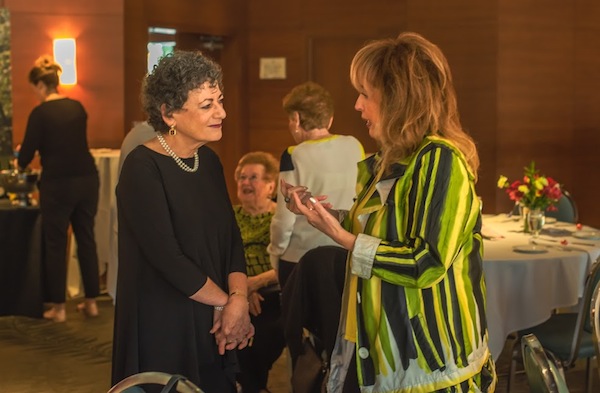
Also at the meeting, Daniella Givon, a past president, was honoured for her many years of commitment to the organization and the broader community. The meeting also expressed gratitude to outgoing presidents Stephanie Rusen and Sasha Gerson.
Daniella Givon, left, and Sasha Gerson. Givon is a past president of CHW and Gerson is one of the outgoing presidents this year, along with Stephanie Rusen. (photo by Sid Akselrod)
In addition to her role with CHW, Rubin is co-executive director of Kehila Society of Richmond, which connects Jewish people in Richmond with one another and with businesses, health and social service agencies and community resources. She is also a board member of Jewish Seniors Alliance and Better at Home committee of the City of Richmond.
Rubin comes to CHW naturally – her mother, Linda Hilford, is a member and both her grandmothers, Vera Himelfarb and Rae Moss, were involved on the Prairies back in the day.
The enthusiasm Rubin and other members of the local chapter exhibit is a reflection, she said, of exciting changes at the national level where, under the fresh leadership of national chief executive officer Lisa Colt-Kotler, the organization has seen dramatic progress in the past couple of years.
“She’s just really pumped energy into it and she’s updated it, and is working at making us more mainstream,” Rubin said of Colt-Kotler. Technology has been a boon, she added, allowing members from across the country to conveniently meet regularly without getting on a plane.
Times have changed from when a large proportion of Canadian women did not work outside the home. But those social and economic changes have not altered one fundamental need, said Rubin.
“We are really about bringing women together, to empower them in their philanthropic needs and introduce them and network them with other women,” she said. “We just want them to meet each other, be there, support each other, share their resources. Ultimately, what brought me to this organization 30 years ago – aside from the fact that I have grandparents and a mom who were involved and I love Israel – was women. The ceiling has broken in those 30 years but it’s still there and we need to be there for each other.”
For decades, CHW was most closely associated in the public mind with Hadassah Bazaar, a massive undertaking that ended about 15 years ago. The explosive growth of thrift stores, combined with the immense resources required to execute the annual event, led to the decision to end the tradition. But Rubin said a new initiative is soon to launch nationally that nods to that history – possibly an online version of the bazaar or something similar. Plans are in development.
Things have come a long way, but Rubin said expectations have grown in some ways and getting together with women experiencing similar things is no less valuable than it was in her mother’s or her grandmothers’ time.
“I think women still have a long way to go and we need to support each other and be there for each other, lift each other up,” she said. “I’m trying to be a mom and I’m trying to do a job and I can’t be Superwoman and [it’s good] to know that’s OK – nobody is. I think that’s truly, truly important.”
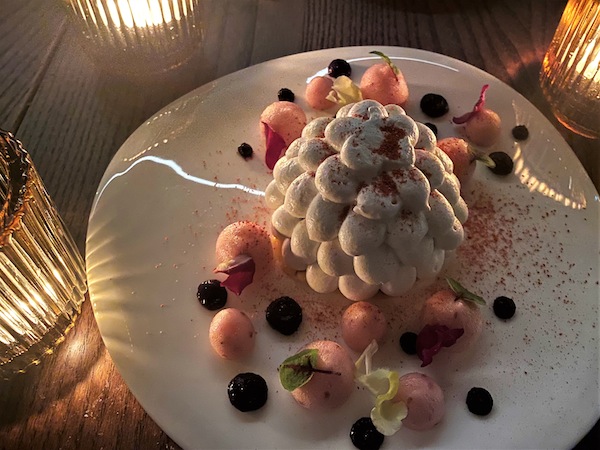
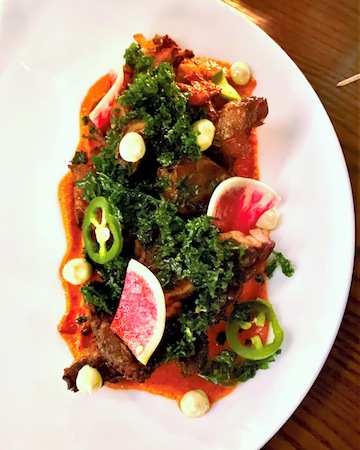
Archer’s Westberry Farms Hive dessert. (photo by Diane Tucker)
Opening several weeks ago, just in time for winter holiday festivities, Archer restaurant is the newest contribution to Vancouver’s fine dining scene from restaurateur Iain Bell, a member of the Jewish community.
Located at 1152 Alberni St., near Bute, the intimate West Coast vibe of the interior perfectly complements the inventive farm-to-table menu created by executive chef Sandy Chen, whose culinary chops include winner of B.C. Chef of the Year and Chef of the Year in the Canadian Culinary Federation national culinary competition. Working together with Chen is director of operations Clement Chan, whose credits are equally as impressive: chef/owner at Torafuku, contestant on Top Chef Canada and Team Canada member at World Culinary Olympics. Their team is ably completed by pastry chef Kiko Nakata and executive sous chef Siosian Tora.
Full disclosure, Iain and his wife Delaina are good friends and a group of us met to enjoy an evening of conversation and great food. We decided to sample the Chef’s Choice menu, as it seemed the best way to test the varied and enticing fare. This menu is available at a cost of $80/person for 10 shared dishes or $120/person for 12 shared dishes, plus tax. The offerings were small plates with local, fresh ingredients.
The burrata and endive salad, featuring warm burrata cheese, roasted beets, greens and toasted walnuts finished with a miso dressing, was my personal favourite. Another pleaser for me was the beautifully presented – in a smoke-filled glass terrarium, filled with objects reminiscent of a West Coast beach on a foggy day – Kusshi oysters on the half shell. The briny taste explosion, enhanced by sour apple, Ikura and miso mayo motoyaki, hit my palate and completed the sensory experience.
Among Archer’s many offerings was a salmon crudo. (photo by Diane Tucker)
Many other shareable courses later, all artfully presented, our group of six argued contentedly about our choices for top three dishes. With consensus reached, in no particular order, the three were: the salmon crudo, local salmon flavoured with compressed jalapeno, black coral, pinakurat coconut nage and topped with a castelvetrano crouton; the dill and coriander chicken wings; and the Westberry Farms Hive, a visually stunning dessert consisting of a meringue hive filled with Westberry Farms blueberry compote, dotted with yuzu curd and lime and Tahitian vanilla crème.
If a tasting menu is not your thing, then the sable fish en papillote with baby zucchini and kabocha squash comes highly recommended, as does the tempura-style rack of lamb with candied shallots. Since the menu changes regularly – remember it’s all about fresh farm-to-table availability – I recommend that you dine here and find your own personal favourites.
The wine list is varied with several wines available by the glass. There is also a decent cocktail and beer menu. Reservations are recommended and can be booked by calling 778-737-6218. The restaurant is open Wednesday through Sunday, from 5:30 pm. Visit archerdining.com.
Leanne Jacobsenwas the Jewish Independent’s sales director for more than 25 years and she continues to be an occasional contributor to the newspaper.
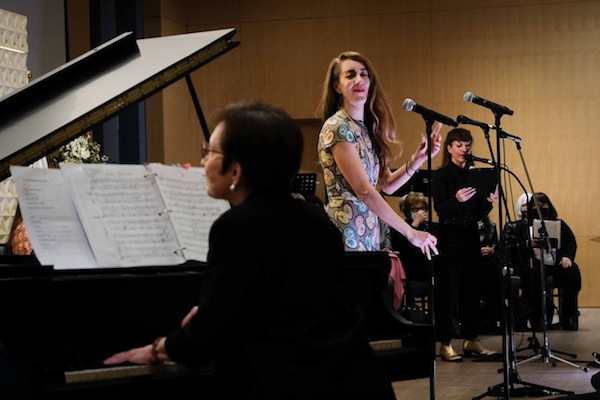
Left to right: Wendy Bross Stuart, Jessica Stuart and Katey Morley in a Joan Beckow Legacy Project performance at Holy Blossom Temple, Toronto, on Nov. 19. (photo by Robert Saxe)
The Joan Beckow Legacy Project performance at Holy Blossom Temple, Toronto, on Nov. 19, included a preview screening of the documentary Unsung: the Joan Beckow Story. The project features 30 musicians from across Canada who got together to make the first-ever professional recording of Joan Beckow’s music. (See jewishindependent.ca/beckows-music-will-live-on.)
To purchase the double-CD set of 22 songs, representing a cross-section of Beckow’s vast catalogue, visit joanbeckowlegacy.com.
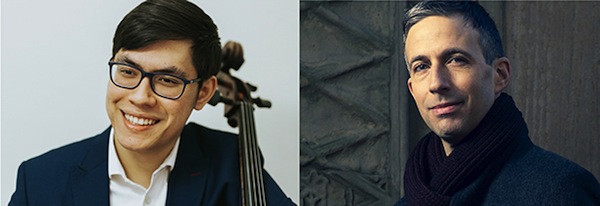
Zlatomir Fung (cello) and Benjamin Hochman (piano). (photo from vanrecital.com)
The Vancouver Recital Society (VRS) presents American cellist Zlatomir Fung and Israeli pianist Benjamin Hochman at the Vancouver Playhouse Jan. 15. Fung has racked up a slew of awards: in 2019, he was the first American in four decades and youngest musician ever to win first prize at the International Tchaikovsky Competition, cello division, and was the recipient of an Avery Fisher Career Grant in 2020 and a Borletti-Buitoni Trust Fellowship in 2022.
The Juilliard alum was originally booked for the VRS in 2020 but the pandemic thwarted plans. In January, Fung will perform with Hochman, who first performed in a VRS series in 2003, with violinist Elisabeth Batiashvili. Hochman is a graduate of the Curtis Institute of Music, where he studied with Claude Frank, and the Mannes College of Music, where he studied with Richard Goode.
The concert repertoire will feature the music of Yuri Shaporin (6 Pieces, arranged for cello and piano by Viktor Kubatsky), Nikolay Sokolov (Romance for Cello and Piano, Op. 19), Leo Ornstein (6 Preludes for Cello and Piano), Alexander Glazunov (Entr’acte from Raymonda, Op. 57, arranged for cello and piano) and Dmitri Shostakovich (Cello Sonata in D minor, Op. 40).
Tickets for the Jan. 15, 3 p.m., concert can be purchased at vanrecital.com.
Az Yashir is an original Jewish music album of songs for Shabbat from singer and composer Yair Rosenberg. As a journalist, Rosenberg has interviewed White House officials, profiled Israeli prime ministers, covered Jews in baseball, and even chronicled the translation of Harry Potter into Yiddish. But, for the last seven years, he has been working on something different.
Az Yashir takes listeners through the experience of the Jewish Sabbath, combining centuries-old lyrics with contemporary musical influences ranging from Irish folk to EDM. With this debut album, Rosenberg follows in the footsteps of his grandfather, Rabbi Israel David Rosenberg, a Chassidic composer who escaped the Holocaust through Shanghai and whose songs from that time are still sung to this day.
Az Yashir features eight original compositions and two new adaptations, performed by Rosenberg, backed by 20 different musicians and produced by Charles Newman of Mother West.
Flame Towers, in the capital city Baku, reflect the forward-looking economy and the ancient Zoroastrian roots of the Azerbaijani people. (photo by Pat Johnson)
It is a Muslim-majority country where Jews proudly draw visitors’ attention to the fact that their synagogues and day schools receive government funding and require no security. It is a majority-Shiite country with a primarily Turkic population, where Turkish flags wave alongside Azerbaijani standards. Yet, among its closest allies is Israel, which a survey indicates is the second most admired country among its citizens. It provides 40% of Israel’s oil and receives vital security and defence cooperation from the Jewish state. One of the country’s greatest modern heroes is a Jewish soldier who died defending the country in 1992.
Azerbaijan is an enigma that defies assumptions, especially when it comes to its Jewish citizens, who have experienced almost nothing but neighbourliness from their Azerbaijani compatriots for two millennia.
Along with a small number of other Canadian journalists and community activists, I was a guest last month of the Network of Azerbaijani Canadians during an intensive weeklong immersion in the country, including its Jewish present and past.
I won’t pretend I didn’t have to Google Azerbaijan to place it alongside its Caucasus neighbours Armenia and Georgia, between the Black and Caspian seas, inauspiciously bordered by two rogue nations, Iran and Russia. Like many people, my knowledge of Azerbaijan was limited to its 30-plus-year conflict with Armenia over the disputed Karabakh region, a conflict that has led to allegations of war crimes, ethnic cleansing and atrocities on both sides.
We traveled to Karabakh, a place of ghostly, abandoned, war-destroyed cities and countrysides plagued by an estimated million landmines. Helmeted workers pace slowly through what were once farms in the almost unimaginably Sisyphean task of demining a half-billion square metres of land. (Israeli drones and artificial intelligence are helping the process.) We visited cemeteries and monuments, drove highways lined for kilometres with portraits of war dead.
In a distinct counterpoint to this carnage, we visited the country’s Jewish residents and learned of the history of Jews and non-Jews in this place, a story of almost unprecedented fraternity unusual for any country, not least a majority Muslim society in a place where ethnic and territorial conflicts, and the ebb and flow of empires, has conspired against peace.
A history of diversity
Azerbaijan was a deviation on the standard Silk Road route, and so people were long familiar with those from the west and the east. But its economy exploded in the latter half of the 19th century, when oil was discovered. By 1901, the region, part of the Russian Empire, was producing fully half of the world’s oil.
This ancient and modern history brought waves of Jews, beginning in biblical times. The oldest communities of Jews in Azerbaijan are known as Mountain Jews, or Kavkazi Jews, whose Persian-Jewish language is called Juhuri. Neither Ashkenazi nor Sephardi, the Mountain Jews maintain some Mizrahi traditions and their practices are heavily influenced by kabbalah. They trace their presence back to the Babylonian exile following the destruction of the First Temple, in 586 BCE, but these ancient communities have been joined in more recent times by other migrants.
Jews from neighbouring Georgia, where communities have also lived since the Babylonian exile, migrated to Azerbaijan during the first oil boom, in the late 19th century. After the 1903 and 1905 Kishinev pogroms sent terrified Jews from across the Russian Empire fleeing to the New World and elsewhere, a group of Ashkenazim moved from throughout the empire to Azerbaijan, drawn by its reputation for intercultural harmony.
Today, Mountain Jews make up about two-thirds of the country’s Jewish population. (Ballpark estimates are that there are 30,000 Jews in Azerbaijan.) Most Mountain Jews – 100,000 to 140,000 – now live in Israel and there is a significant population in the United States. Those who remain, however, deflect questions about why they have not made aliyah or migrated to Western countries.
“This is my homeland. Why should I leave?” asked Arif Babayev, the leader of the Jewish community in the city of Ganja, adding: “I don’t know what antisemitism is. I’ve never experienced it.”
The community of Qırmızı Qəsəbə, or Red Town, has been known as “Jerusalem of the Caucasus” and also as “the last shtetl in Europe.” It is said to be the only all-Jewish (or almost-all-Jewish community) outside Israel. The streets of the mountain village, in the northeast region called Quba, were quiet on a November Sunday. Many of the people who call the village home actually spend most of the year working in the capital city Baku, returning in summer to what amount to summer homes. The older community members and a few families stay year-round.
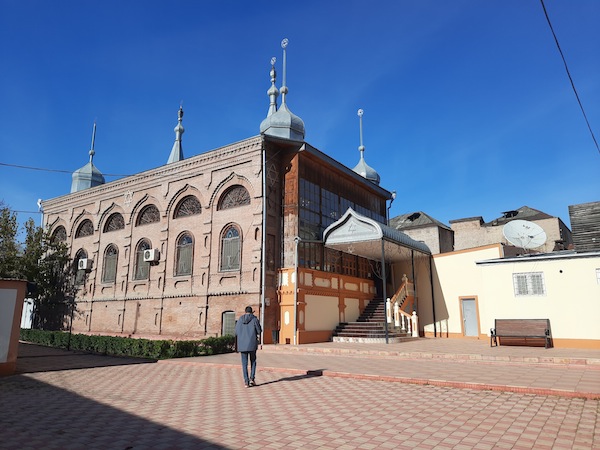
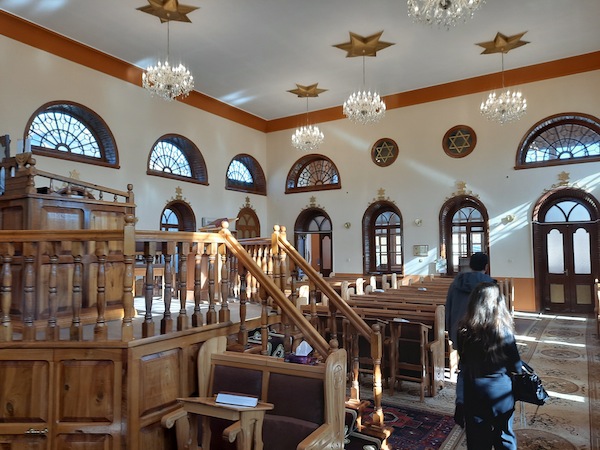
Three synagogues in the town survived the Soviet years – two still operating as congregations and one transformed into an excellent museum with original artifacts and in-depth exploration available on interactive screens where congregants once davened. The two synagogues, active on Shabbat and holidays, are intimate, magnificent structures. The Six Dome Synagogue, dating to 1888, was used as a warehouse and as a shmatte factory during the Soviet period and was restored and reopened for use in 2005.
The Six Dome Synagogue, which dates from 1888. (photo by Pat Johnson)Interior of the Six Dome Synagogue, which was restored to use by the Jewish community in 2005. (photo by Pat Johnson)
Throughout history, the Jews of the area worked in viticulture (their Muslim neighbours were ostensibly forbidden from alcohol-related tasks, though this is not a country with a large strictly observant religious population), tobacco growing, hide tanning, shoemaking, carpet weaving, fishing and the cultivation of the dry root of the madder plant, which is used in dyeing textiles and leather.
In the 1930s, there was a Stalinist crackdown on Judaism, but circumcision, kosher slaughter and underground Torah study survived. Since the end of the Soviet era and the dawn of independence, in 1991, Jewish life has both thrived and shrunk – many emigrated, but those who remained have revivified their cultural and religious roots.
In wealthy and modern Baku, signs of a flourishing Jewish community are found at two government-funded Jewish schools, each with about 100 students. They follow a government-created Jewish studies curriculum that includes Hebrew, Jewish history and tradition, as well as the official curriculum of the Azerbaijani education ministry. Like so many other places throughout the country, the school is festooned with photographs of the current president and his late father and predecessor.
The school’s leadership note that there is no security outside the institution, unlike in France or even Israel. The school is in a complex that includes a non-Jewish school and the students compete together in intermurals. Jewish and non-Jewish students celebrate the Jewish holidays together.
Nearby, the Sephardi Georgian congregation and the Ashkenazi synagogue share a building that was funded by the national government. The two sanctuaries are on different floors, each with their distinctive internal architecture and warm, inviting sanctuaries.
Ambassador optimistic
George Deek was the youngest ambassador in Israel’s history when appointed to head the embassy in Baku, in 2018. An Arab-Christian from a prominent Eastern Orthodox family in Jaffa, Deek was a Fulbright scholar at Georgetown University and held previous posts at Israeli missions in Nigeria and Norway. He is also, he noted, the Israeli diplomat geographically closest to Tehran.
The ambassador sees parallels between Azerbaijan and Israel, which are both young countries made up of people who are used to being bullied by their neighbours. Both peoples understand what it is to be small and to struggle to preserve one’s own culture, he said.
In addition to the large swath of Israel’s oil supply that comes from Azerbaijan, there is growing trade and cooperation between the countries across a range of sectors. In addition to strategic partnerships, they are sharing agriculture and water technologies in conjunction with the Arava Institute for Environmental Studies, in southern Israel. An Israeli company is building a Caspian desalinization plant and Israeli drip irrigation technology is being applied to Azerbaijani farms.
Tourism is a growing sector and Israel is a significant market: by next year, there will be eight flights weekly between Baku and Tel Aviv on the Azerbaijani state carrier, as well as regularly scheduled tourist flights on Israir.
Deek shared the results of a survey that seemed to provide proof of the historical and anecdotal things we had been hearing about the Azerbaijani connection not only to their Jewish neighbours but to the Jewish state. In a poll measuring Azerbaijanis’ positive opinions about other countries, Turkey came first and Israel second.
Despite all this upbeat news, and despite the fact that Israel has had an embassy in Baku almost since Azerbaijan gained independence, the diplomatic mission was not reciprocated, even as trade and person-to-person connections expanded. There is a range of geopolitical explanations for the lack of an Azerbaijani embassy in Israel and Deek told our group he hoped that Azerbaijan would soon be able to open one there. And, just a few minutes after we left our meeting with the ambassador, our guide received a phone call – Azerbaijan’s parliament had just approved a resolution to open an embassy in Israel.
The decision, after all this time, is due to a confluence of events. There had been fear of an Iranian backlash to more overt relations between Azerbaijan and Israel, but global disgust over the Iranian regime’s crackdown on anti-government protesters may have diminished Azerbaijani concerns. The close relationship between Azerbaijan and Turkey was probably another factor. With Turkish-Israeli relations back on a somewhat even keel after a chilly period, the time may have seemed right. With the long-simmering Karabakh conflict now concluded, as far as Azerbaijan is concerned, by the 2020 war that returned the region to Azerbaijani control, the country may be less wary of making waves among Muslim allies. That fear would likely be additionally assuaged by the Abraham Accords, which make warm Azerbaijani-Israeli relations less remarkable than they might have been just a few years ago. (Azerbaijan’s anti-Israel voting record at the United Nations is still a disappointment that some observers hope changes as ties grow.)
The tight relationship between Azerbaijan and Israel is, of course, viewed by Iran as a Zionist plot. Iran has both internal demographic and external security concerns about Azerbaijan. There are almost twice as many ethnic Azerbaijanis within the borders of Iran – about 15 million – than there are in the country of Azerbaijan, and the Islamic revolutionary regime doesn’t want any nationalist rumblings. Beyond this, the very existence of a secular, pluralist Azerbaijan stands as an affront to Iran. Azerbaijan is a majority Shi’ite country, like Iran. It is geographically and demographically small and, in the imagination of Iranian fundamentalists, it should be the next domino in the ayatollahs’ plan for regional domination. Instead, despite the familial ties across the Azerbaijani-Iranian border, intergovernmental relations are frigid.
What is it about Azerbaijan?
A new embassy. Burgeoning trade and tourism with Israel. Centuries of good relations between Jews and non-Jews. A level of comfort and security unknown to Jews in almost any other country, certainly any Muslim-majority place. What is it about Azerbaijan?
I asked a few people – religious leaders, a member of parliament, Jews and non-Jews – what the secret sauce is for the Azerbaijanis’ exceptional relations with their Jewish neighbours. No one had a pat answer.
It was people-to-people contact, one person told me. There was never a ghetto; Jews were integrated and part of a larger multicultural society. One theory is that, more recently, there have been lots of Jewish teachers in the school system, so Azerbaijanis get to know and respect Jewish people growing up. Another explanation is that Azerbaijanis view their national identity above their religious or other particular identities, so religious differences are not as divisive as in many places – a factor probably accentuated by decades of Soviet official atheism.
Rabbi Zamir Isayev, who leads the Georgian Jewish congregation in Baku, doesn’t have a simple explanation for why Azerbaijan, among the countries of the world, seems to be so good for the Jews. It’s simply in the nature of the Azerbaijani people, he says.
Azerbaijani history celebrates a number of notable Jews. The Caspian Black Sea Oil Company, which was central to the creation of the region’s dominant resource sector, was founded by Alphonse Rothschild, a French Jew, and other Jews have been involved in a range of resource and other sectors over the years.
In the short-lived government of the first independent republic of Azerbaijan, 1918 to 1920, the minister of health was a Jewish pediatrician, Dr. Yevsey Gindes. That government was also the first democracy in the Muslim world and among the first in the world to grant women the franchise. Like many countries that emerged from the collapse of the Russian Empire, Azerbaijan was quickly subsumed into the new Soviet Union.
Lev Landau, Azerbaijan’s 1962 Nobel Prize winner in physics, is widely fêted. Garry Kasparov, considered by some the greatest chess player of all time, is a (patrilineal) Jew from Azerbaijan. A long list of academics, athletes, musicians and business innovators have risen to the top of their fields in the country and abroad and are celebrated both as Azerbaijanis and as Jews. A hero from recent times seems to elicit an especially emotional connection.
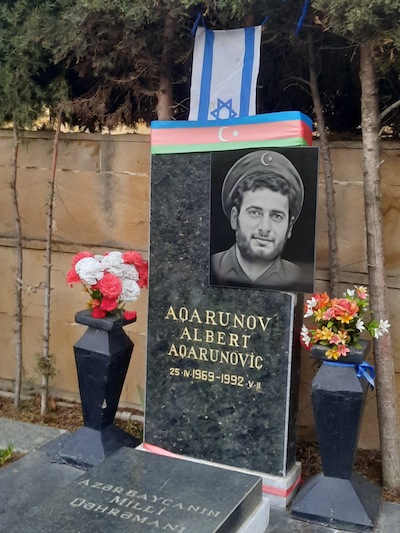
The conflict with Armenia, which began in the late 1980s and culminated most recently in a 2020 war, remains understandably fresh in the national consciousness. Highways and villages display thousands of portraits of war dead and the Alley of Martyrs in the heart of Baku is the final resting place of 15,000 Azerbaijanis, many from the final throes of Soviet domination and the two wars with Armenia. Among the most visited graves at the sprawling memorial park is that of Albert Agarunov.
The grave of Azerbaijani national hero Albert Agarunov, decorated with Azerbaijani and Israeli flags. (photo by Pat Johnson)
Agarunov was a young Jewish Azerbaijani who volunteered with his country’s defence forces and was a tank commander during the Armenian capture of the strategic Karabakh town of Shusha on May 8, 1992. The 23-year-old, already apparently such a legendary figure that the Armenians had put a bounty on his head, stepped out of his tank to retrieve bodies of slain Azerbaijani soldiers from the road when he was killed by sniper fire. Agarunov was posthumously named National Hero of Azerbaijan and was buried at the solemn national monument, in a service attended by both imams and rabbis. Today, Jews place stones on his grave and others place flowers.
In terms of Azerbaijani-Israeli relations, the large number of Azerbaijani-descended Jews who live in Israel create natural familial ties between the two places. Jewish remittances from Azerbaijani oil wealth helped purchase land in Palestine, an early portent of a connection between the two places. According to one museum piece, Jewish horse wranglers from the Caucasus made aliyah and became protectors of early kibbutzim and moshavim and helped put down the 1929 Hebron massacre, although I cannot find reference to this role online.
Whether that last detail is factual or not, what seems undeniable is that the story of Jews in Azerbaijan stands out as a model of coexistence and good neighbourliness in a world that has not always been so kind. This is a story that deserves to be told more widely.
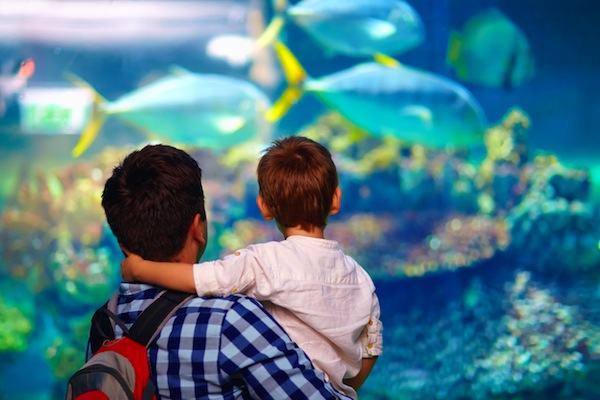
One of the ways to prepare a child for a vacation is to start small. For example, take them to a local aquarium or other nearby attraction to get them used to the idea of touring. (photo from Dawn M. Barclay)
Planning a successful vacation when you have a child with ASD, ADHD, bipolar disorder and similar issues takes time, patience and practise but, in the end, you can build good memories that will last a lifetime. More great news: these tips can work for neurotypical families as well.
Here are the basics:
Understand the challenge. All children crave routine and predictability; it’s their comfort zone. Travel draws them out of their zone and into the realm of the unfamiliar, leaving even neurotypical children anxious and inflexible. Your goal is to help the child preview aspects of the vacation long before the vacation begins, in order to establish expectations of a new routine with elements now made familiar.
Start small. Introduce the concept of travel by reading children picture books featuring their favourite characters in travel situations. (Your local librarian can recommend some.) Role-play various travel scenarios, such as going through airport security or hotel check-in. Programs like Wings for Autism can provide a dress rehearsal before the main event. Watch videos on YouTube or those provided by the travel supplier that show each aspect of the vacation, including the hotel. Consider creating a social story about each aspect of the trip and review it with the child regularly. And try “mini experiences” like an overnight stay at a relative’s house before a hotel stay, or “tours” to local zoos, aquariums or even a flea market – now relabeled as a scavenger hunt.
Get buy-in. Another way to create predictability is to give the child some say in aspects of the trip. Discuss potential autism-friendly or autism-certified hotels, resorts, theme parks and other venues with a professional who has done the research for you, such as a certified autism travel professional. Then present a few parent-approved vacation options to the child and ask them to choose. You can do the same for daily activities as you prepare your itinerary (either written or in picture form). That gives you a new “routine” the child can anticipate, one where they have a personal stake in its success. Also allow the child to choose some of the clothing they’ll bring and let them help you pack. Make them active participants in their own holiday.
Make it child-centric. Traveling with youngsters, be they neurotypical or neurodiverse, can never match the pace you set when traveling before they arrived. It’s no holiday for you if you’re lugging an exhausted child on your back through a theme park. Instead of trying to cram four or five stops into your itinerary each day, plan for one or two. Try to make some of those stops extra-special by feeding into the child’s unique interests. There are specialized museums around the country for lovers of trains, insects, dinosaurs, or whatever their passion. Then set aside the afternoon to decompress at the pool or in front of the television.
Weed out potentially upsetting stimuli. Many children on the autism spectrum have sensory issues. Try to anticipate potential overload and introduce some of the unique sensory experiences in advance. For example, if you live in warmer climes and you’re heading somewhere like Alaska, practise wearing heavier and layered clothing. Or, if your child hasn’t experienced a beach, buy some sand at a crafts store, lay out a tarp and let the child feel the sensation of walking on sand before leaving on your trip.
Pack a “go-to bag.” Pack a customized bag containing the child’s favourite toys, snacks, a change of clothes and a trash bag (for any soiled ones), anti-nausea medication, noise-canceling headphones, surprises in gift bags (think Silly Putty, pens, an Etch-a-Sketch), and a preloaded iPad with kid-friendly shows and games. Keep your bag accessible and dole out the surprises to provide distractions if overwhelm sets in or plans go awry.
Remember, kids are kids. Any child can grow bored, weary and have a meltdown. Parents who think ahead, prepare their child for the new experience and are equipped to alleviate any anxiety, will be able to smooth the way while traveling.
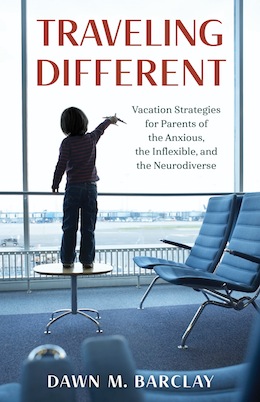
Dawn M. Barclayis an award-winning author who has spent a career working in various aspects of the travel industry. She started as an agent with her parents’ firms, Barclay Travel Ltd. and Barclay International Group Short-Term Apartment Rentals, and then branched out into travel trade reporting with senior or contributing editor positions at Travel Agent Magazine, Travel Life, Travel Market Report and, most recently, Insider Travel Report. Her new book is Traveling Different: Vacation Strategies for Parents of the Anxious, the Inflexible and the Neurodiverse (Rowman & Littlefield Publishers, 2022). Learn more at travelingdifferent.com.
Vancouverite Eitan Nurick, right, with Aardvark madrich (counselor) Alon. (photo from Aardvark Israel)
“When my siblings came back from their year abroad and couldn’t stop raving about it, I couldn’t help but experience it myself. When the day came and the program started, I was anxious, as expected, but mostly excited,” said Eitan Nurick, 18, who went to King David High School.
Nurick was referring to Aardvark Israel, which offers four-to-10-month gap-year programs in Jerusalem and Tel Aviv, specializing in internships; volunteering, partnered with Masa Israel Journey and Israel Volunteering Association; and technology, partnered with the Developers Institute.
“The biggest learning curve was definitely figuring out how to live with four complete strangers,” said Nurick, from Tel Aviv. “I learned that the most important thing to do was to communicate and let your roommates know what you need, eventually coming to a decision that works for everyone.
“Something that I have been especially loving is my internship,” he said. “I work at Inklude, a tattoo studio…. While running the social media, and overall helping out around the studio, I have also been given the opportunity to learn how to tattoo, which ties in perfectly with my love for art. I really feel like I have been welcomed into the workplace and have made meaningful connections with my co-workers. So far, my experience in Israel and with Aardvark Israel has been amazing. I have been able to strengthen my bond with my religion and culture, as well as learn lifelong skills that will stick with me forever.”
Toronto student Lisa Fireman, 18, who attended TanenbaumCHAT high school, also is benefiting from her internship, which is at Eden Gallery in Tel Aviv. She described it as her favourite part of Aardvark.
“I am currently helping plan four events for Art Basel in Miami,” she said. “This has been the experience of a lifetime for me. I love my boss here and feel as if I am being trusted and treated as a real member of the Eden Gallery team. As someone going into art history in university, this could not be a more ideal internship. I love spending my days at the gallery, knowing that this experience will help me in my future path.”
She admitted, “It can be stressful living alone, but I wouldn’t want to do it in any other way. I have gained so much independence, friends I love with my whole heart, and a job that makes me feel so fulfilled.”
Toronto’s Lisa Fireman, second from the left, on a Shabbaton with fellow Aardvarkians Maya, Hayley and Dina. (photo from Aardvark Israel)
Fireman is preparing for her spring semester in Jerusalem.
“A lot of the gap year promotional testimonies write as if gap year is all peaches and sunshine,” she said. “While they aren’t wrong about how much fun it can be, being on Aardvark is so much more than that. My gap year story started last October, when my best friends were considering gap year programs. Out of a fear of going into college without them, I started looking into Aardvark Israel…. I fell so hard for the program that, even when all of my friends eventually decided against gap year, I still committed to spending time on Aardvark. So I went. Absolutely alone. And it was as terrifying as it sounds.”
Fireman had anxiety surrounding making new friends, but put herself out there anyway.
“I did this by asking people to be my ‘bus buddy’ on Tiyul Tuesdays, going to Wednesday night programming, and hosting Shabbat dinners,” she said. “I started to realize that everyone on Aardvark is just as alone as I was. We all had come from around the world and had to create our inner circle … so everyone was open and actively putting themselves into new social situations.”
Last month, Aardvark Israel’s first international trip since COVID took place – five days in the Czech Republic. Both Nurick and Fireman participated. Both students moved to Israel last August.
Prof. Simon Barak of the Jacob Blaustein Institutes for Desert Research at Ben-Gurion University of the Negev, right, is coordinating all the plant biologists and imaging specialists. (photo from CABGU)
Can plants grow in a barren landscape such as the surface of the moon? If so, what types of plants? Could enough plants grow to support a future moon colony? These are the types of questions the Lunaria One consortium has set out to answer.
An experiment proposed by Lunaria One, known as Aleph, was selected by SpaceIL, a nonprofit aerospace organization, to be included as one of the payloads on board their Beresheet2 lander. The Beresheet2 mission, scheduled to launch in mid-2025, will consist of two landers, landing on each side of the moon, and an orbiter that will continue to orbit the moon for up to five years. Aleph will consist of a tray of seeds and dehydrated plants, a device that will water them, heaters and cameras to monitor the plants.
Prof. Simon Barak of the Jacob Blaustein Institutes for Desert Research (BIDR) at Ben-Gurion University of the Negev is coordinating all the plant biologists and imaging specialists. They include three Australians, one South African and two of his colleagues from BIDR at Ben-Gurion University: Prof. Aaron Fait and Dr. Tarin Paz-Kagan.
“The chosen experiment has enormous value both for our life here on earth and for humanity’s progress in space exploration,” said Shimon Sarid, SpaceIL chief executive officer. “Examining plant growth under extreme conditions will help us as far as food security is concerned. Plant growth in extreme conditions will help humanity in the long run. We are happy to cooperate with Lunaria One and are very excited.”
“The motivation for this mission comes from humanity’s passion to explore and see life thrive in barren landscapes,” explained Barak. “We see the Aleph payload as an important step towards our eventual goal of providing plants for food, medicine, oxygen production, CO₂-scrubbing and general well-being for future astronauts inhabiting the moon and beyond.”
“The central value guiding this project is that space exploration is for everyone; we don’t want a future where only autonomous and remote-controlled machines inhabit realms beyond earth, but where humans can live and thrive,” said Lunaria One director Lauren Fell. “The key to this is to get humans involved and to give them a say in how we get there. The Aleph project aims to open up the science and engineering behind growing life on the moon so that anyone can be involved.”
Growing plants on the moon means overcoming several challenges, such as massive temperature swings on the way to the moon, a water supply for the plants, and high temperatures when growing the plants. The plant types will need to be those that can germinate and grow to an appropriate size for imaging within 72 hours of deployment.
The research team expects their plant selections to be relevant for vertical farming and resource-challenged landscapes here on earth.
The project also has a strong citizen science component. Parallel science experiments will be carried out by amateurs (for example, high school students) and professionals to compare growth to that on the moon.
Additional universities participating in Lunaria One include Queensland University of Technology, the Royal Melbourne Institute of Technology and the Australian National University, in Australia, and the University of Cape Town, in South Africa.
“The earth is finite,” said Barak. “Its resources are finite. So humanity’s future depends upon reaching the stars.”
– Courtesy Canadian Associates of Ben-Gurion University of the Negev