So enthralled am I by the sheer volume and calibre of free online Jewish learning opportunities since the start of the pandemic, that I sometimes forget that the people who do the teaching do it as their livelihood, not as a hobby. Therein lies the problem.
We, the students, the partakers of all manner and sorts of online classes and lectures during COVID, gobble up the learning as though it’s candy, or fine wine. We sit in front of our laptops, tablets and smartphones and act for all the world as though we deserve this high level of education. It should rain down upon us. We’re Jews. We’re the People of the Book. We’re entitled. Teach us!
Make no mistake: we are blessed to be the recipients of this stratospheric level of dedication, and we should not and cannot take it for granted.
But, sometimes, we forget.
We forget that the rabbi or rebbetzin or Jewish scholar or educator who is teaching us needs to feed their family and pay their bills. We forget that we need to support them just like they support us. Too often, we blithely go on learning from week to week, month to month, blissfully ignoring this reality. Yet, we expect a paycheque. Or a pension check, if we’re lucky. Why shouldn’t they?
Zoom classes have become as common as dust since the beginning of the pandemic. Every Jewish religious and/or spiritual organization I can think of is offering Zoom classes weekly, if not daily. They have filled the gaping holes that once were our thriving, healthy, “normal” lives. These same Jewish organizations recognize the desperate need for some kind of normalization, some sort of lifesaver for people to hang onto. In the absence of our daily routines of work, socializing and gathering together as a community, there is little left to celebrate, never mind sustain us. Local synagogues have leaped into the abyss to lift us all up, or those of us who needed lifting, anyway. They have rallied together to create curricula, offer Torah classes, general Jewish study courses, podcasts, livestream videos and so much more. Not only because it’s the source of their livelihood, but because they feel our desperate need, the soul’s yearning for Jewish learning.
There is enormous comfort in seeing others – even if only virtually – and knowing that we are studying Jewish topics together, learning as a community. The overwhelming isolation felt by so many people right now is beyond description. The personal losses, the devastating repercussions from COVID-19 can’t be counted. Our lives have been turned upside down in every way imaginable. And then some. But learning offers hope.
Sure, everyone copes differently with the pandemic, but anybody who says they haven’t been affected by it is just plain lying. Being the adaptable creatures that we are, we take comfort (or relief) where we can find it. For some, it’s food, or alcohol, or Netflix. For others, it’s learning. And, for others still, it must be Jewish learning. Something draws us – something draws me – to our heritage, our history, our Judaism. And, suddenly, we are home.
Myriad times, sitting in front of my computer during or after a Zoom class, usually given by a rabbi, I find myself weeping. Partly as a release from all the stress and anxiety I’m feeling right now; but mostly from a deep sense of gratitude. Gratitude that we, as a community of Jews, haven’t been forgotten. That, amid the detritus of COVID, our faith leaders have intuitively known that we need help, that we can’t do this on our own. So they step up to the plate, full of enthusiasm and inspiration, and they fill us up. Not only do the classes inform us and expand our brains, but they benefit us by keeping us moving forward in a meaningful, purposeful way.
So, why am I writing all this? To remind each and every one of us, myself included, that we should be menschen and pay the favour forward. Pay it, literally, to every rabbi and rebbetzin and Jewish scholar or other educator who shares not only their time, but their wisdom, to help us get through this pandemic in the most meaningful way they know how. Make a donation. Show you care. Make as many donations as you’re able. Big or small, the act is a sign of appreciation. A sign that we value the learning. A sign that we know little, and yearn to know more. A sign that we appreciate their caring, knowing that they will do anything in their power to help. And G-d knows we need it right now. So, whatever we do, we shouldn’t forget to support those who support us.
It would be the century’s grossest understatement to say that I’ve learned a lot during the pandemic. Sure, I’ve learned immeasurable things about human nature and caring and compassion. But I’ve also expanded my Jewish learning a hundred-fold, maybe a thousand-fold. The pandemic has given me the time. But those doing the teaching have given me the inspiration, the foundation, the thirst for more. Instead of being overcome with hopelessness, I’m filled with hope. I see a pattern to life, a way out of this. That is no small thing. We need to pay it forward. Or pay it back. Either one will do.
If there’s a global sense of helplessness pervading much of what we do these days, we can counteract that by not only feeling grateful, but showing it. It could be construed as crass to say that we should pay for our Zoom classes and livestream lectures and podcasts. So be it. Call me crass. It wouldn’t be the first time. Just get out that credit card and do the right thing.
Shelley Civkinis a happily retired librarian and communications officer. For 17 years, she wrote a weekly book review column for the Richmond Review. She’s currently a freelance writer and volunteer.
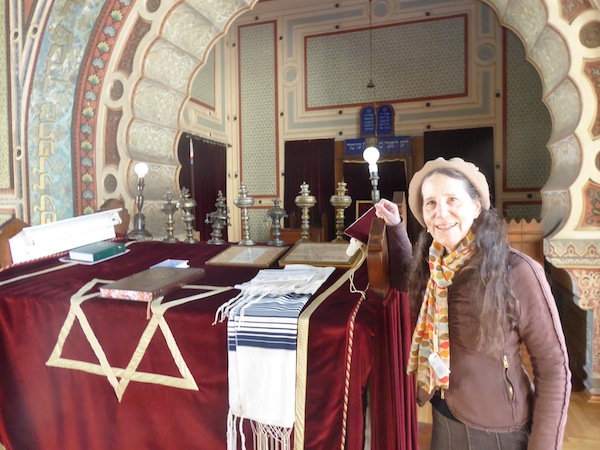
The author in the synagogue in Sarajevo, Bosnia-Herzegovina. (photo from Miri Garaway)
When I first started planning and researching our October 2017 trip to Slovenia, Croatia and Bosnia-Herzegovina, the foremost thing on my mind was learning about the Jewish history of the region. It was uncharted travel territory for me and I was curious to uncover the areas that were once vibrant Jewish communities.
Rather than being herded around by bus on a large organized tour and staying in North American-type hotels, which are far away from the pedestrian-only “Old Town” neighbourhoods of the cities, I wanted the challenge of researching centrally located, charming and historical bed and breakfasts and/or apartments and then finding private or small group Jewish heritage tours within each place. This proved to be an interesting process, whereby I delved into several possibilities. I left no stone unturned in designing this journey and it was such a feeling of exhilaration to put it all together and enjoy it.
Once I decided on accommodations in each city, I then had the task of transportation. To save time and energy, I hired a series of private drivers. This proved to be a wise decision, as 17 days does not allow for a slow pace. An added bonus was having our driver appear at the hotel, take our luggage and drop us off at our next destination, stopping to tour along the way, if we desired.
By pure chance, I had come across a U.K.-based company called mydaytrip.com – they responded promptly, were professional and easy to deal with and I had full confidence that I made the right choice. In addition to hiring a private driver, I also discovered a private tour company (based in Vancouver) called toursbylocals.com – their in-depth walking tours were excellent and I would highly recommend them.
Another option I used was Viator, a subsidiary of Tripadvisor. They offer a variety of small group (maximum eight people) tours all over the world and they liaise with local travel agencies, which provide the service. It is a great way to have various tour options at a reasonable cost.
Our first stop was Ljubljana, Slovenia, a charming university town of friendly people, exquisite Baroque architecture, a delightful cobblestoned Old Town and a vibrant café culture. Most notable is the Kaverna Zvezda, the best pastry café in town, featuring the traditional kremna rezina, also known as cremeschnitz, cream and custard between layers of puff pastry, which I had also tried in Israel. In short – divine. The gibanica (pronounced gabanitza), a delicious cake with poppy seeds, curd cheese, walnuts and apples, is another legendary cake in Slovenia and reminded me of a cake my Eastern European grandmother made. She was from Czernowitz, Austria-Hungary.
Pumpkin seed oil is “king” here and is used with the same frequency as olive oil is in Italy. Vegetarian pumpkin soup is on every menu, much to my delight. Were there any remnants of a Jewish community here? This seemed like Jewish comfort food to me.
Documents show that Jews settled in Ljubljana from the 13th century onward and worked as merchants, bankers, artisans and some as farmers. They had a synagogue, a school and a rabbinical court. In 1515, the Roman emperor Maximillian expelled the Jews and Ljubljana’s Jewish Quarter disappeared.
As I walked down the two narrow streets in the Old Town, that once housed a small Jewish community – Zidovska ulica and Zidovska steza, Jewish Street and Jewish Lane – the only sign of a Jewish presence was a vacant stone indentation on a building where a mezuzah had once stood.
Maribor, the second largest city in Slovenia, has a synagogue, but, unfortunately, it sits empty. Jews were also expelled from here, in 1496, though, eventually, both Ljubljana and Maribor regained their Jewish communities – until the Second World War. Then the Holocaust took its toll.
On a positive note, a synagogue did open in Ljubljana in 2003, but it is now part of the Jewish Cultural Centre. Ljubljana was previously the only European capital lacking a Jewish house of worship. The city does not have a rabbi, but the chief rabbi for Slovenia, Rabbi Ariel Haddad, resides in nearby Trieste, Italy.
* * *
Split, Croatia, once had a vibrant Jewish community, so, after visiting the Dalmatian coastal town of Zadar, we headed a little further south to Split, stopping first at the World UNESCO Heritage Site of Trogir.
In Split, I had arranged for a private guide, Lea Altarac, to meet us and give us a Jewish history tour as well as a general city walking tour. In 3.5 hours, we covered a lot. Lea is a teacher; extremely knowledgeable and proud of her city. Her mother is Bosnian and her father is Jewish; she has a Jewish soul, albeit one that does not practise Judaism. Nevertheless, she was eager to enlighten us with some of the Jewish history of the city.
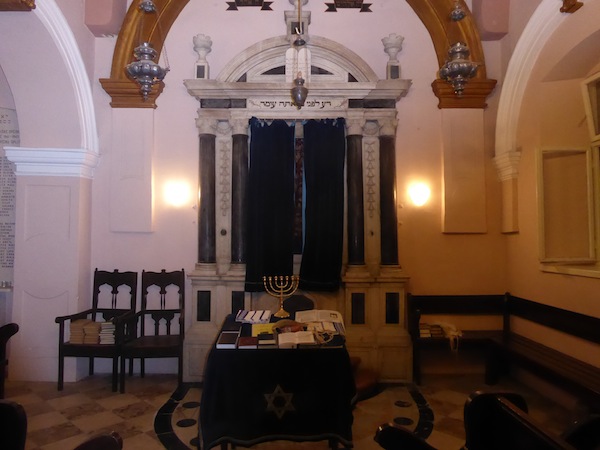
We first toured Diocletian’s Palace in the Old Town and Lea pointed out the many Magen Davids etched into the stone. Once we had finished touring the extensive palace, we walked to the edge of the Old Town. There, we came across the small synagogue of Split, no exterior decoration to distinguish it, which is maintained as a museum by Lea’s father. As we climbed the stairs to the second floor of the old stone building, I tried to visualize it teeming with congregants, sadly no more.
One of the oldest European synagogues, it was created in the 16th century. The interior dates back to 1728. That was the first restoration of several, and when the mechitzah (partition between men and women in an Orthodox shul) was added. It is interesting to note that the ark was built into the western wall of the palace.
The synagogue was plundered by fascist fanatics in 1942 and, unfortunately, many valuable ritual books, archives and silver objects were burned or stolen.
In 1996, during another restoration, a commemoration plaque of local victims of the Holocaust was given to the synagogue as a gift from the Israeli ambassador.
There is no official rabbi for the synagogue in Split, but the rabbi from Zagreb, Croatia, comes about twice a year.
The synagogue in Split, Croatia. (photo from Miri Garaway)
During archeological excavations carried out in the area of the Roman city of Salona, the capital of the Roman province of Dalmatia and the parent city of Split, traces of an established Jewish community were found. When Salona was destroyed, in the early seventh century, the surviving Jewish members took refuge within the walls of Diocletian’s Palace. This settlement was the early beginning of the city of Split.
The term Zueca is used to describe the localities where Jewish tanners and dyers lived. This was a common trade for centuries. Other Jewish occupations included weaving, tailoring, the sale of cloth, the running of a bank, as well as the food business, which was not permitted to Jews elsewhere.
Via 16th-century documents, we learned that there were Spanish and Portuguese immigrants who settled in Split, which was a port for trade between the Republic of Venice, to which Split belonged to at that time, and the Ottoman Empire. Most notably, a Spanish Jew named Daniel Rodriga, short for Rodriguez, was responsible for promoting the development of trade between Europe and the countries in the east. Caravans were also used for the exchange of goods to Turkey and Asia, which Rodriga felt was safer. He conceived the idea of building a large quarantine area, a lazaretto, in the port of Split to house men and goods from the eastern countries, before ships took them to Venice and the rest of Europe.
There was no Jewish ghetto in Split, as the members of the Jewish community enjoyed civil liberty. It was not until the late 18th century, toward the end of Venetian rule, that a ghetto was formed, due to the influence of the clergy and the decline of the Venetian economy.
Our walking tour led us up a steep hill, Marjan Hill, where we were afforded a spectacular view of Split. Overlooking the city, in a forest-like setting, is the Jewish cemetery, one of the oldest Jewish cemeteries known. It was founded in 1573 and was used until 1946.
After the collapse of fascism in 1943 and before the occupation of Split by the German army, many of the younger Jews left Split and joined the resistance movement in partisan units. Jews who did not leave were rounded up by the Nazis and sent to forced labour and concentration camps. Only one-third of the community survived and returned to Split after the liberation; others emigrated to Israel.
* * *
Sarajevo was our next stop, with a visit to Mostar on the way. Mostar, in Bosnia-Herzegovina, is a picturesque city situated on the Neretva River, only a two-hour drive from Split. I arranged a walking tour for the morning and asked the tour guide if we could visit the proposed site of a new synagogue. The small patch of land was donated by Zoran Mandlbaum, head of Mostar’s 45-member Jewish community, in the hopes that a synagogue would be built there. His vision was a building made of glass, symbolizing trust between Jews, Muslims, Orthodox Christian Serbs and Roman-Catholic Croats, and bridging ethnic gaps. For now, the only distinguishing feature of this barren piece of land is a wrought-iron Magen David carved into the gate.
Mostar originally did have a synagogue, but it was damaged during the Second World War and the communists turned it into a puppet theatre in 1952. We visited that colourful building. Today, there are only a handful of Jews living in Mostar.
Walking through the charming Old Bazaar (Kujundziluk), we reached the famous Old Bridge, a curved structure, originally built of square stones and completed by a Turkish architect in 1556. Its arch spanned nearly 29 metres and stood 20 metres above the river. Although the famous bridge was destroyed during the war in 1993, it was rebuilt in 2004. The tradition of diving contests off the bridge has been maintained.
Of notable interest is the elegant Turkish-designed Muslibegovic House and courtyard/garden, now a hotel, which we were fortunate enough to tour.
In another couple of hours, we arrived in Sarajevo, a beautiful city, surrounded by mountains. The first Jews, Sephardim, arrived in Sarajevo as early as 1541. They were mainly artisans, merchants, pharmacists and doctors. Ashkenazi Jews began arriving in the 17th century, fleeing persecution in Europe. When the Austrians occupied Sarajevo in 1697, they burned and destroyed the Jewish Quarter, including the synagogue.
When the Ottomans regained control of Sarajevo, the lot of Jews improved. Sarajevo became known as “Little Jerusalem,” having the unique feature of a synagogue, a Roman Catholic church and a mosque all within 500 metres of one another.
Jewish life changed dramatically with the rise of Nazi Germany and the Holocaust – 85% of the Jewish population perished and those who survived emigrated to Israel in the late 1940s. Before 1941, there were 12,000 Jews living in Sarajevo and 15 synagogues. In 2017, 700 Jews lived there, out of a population of 400,000. There was no official rabbi, but a rabbi, originally from Sarajevo, came in from Israel to officiate for the High Holidays.
Our Jewish heritage tour was given by a young Muslim man, the owner of Meet Bosnia travel agency. He was very proud of the fact that he was licensed to give this tour. We began at the Old Synagogue, which was originally built in 1581, but burned down and was rebuilt a couple of times. The synagogue was converted into a museum in 1965. There are historical exhibits, ritual objects, Ladino books, photographs, religious traditions and depictions of life before the Holocaust. There is a replica of the famous 14th-century Sarajevo Haggadah; the original being in the National Museum. Unfortunately, that museum was closed for renovations.
Next to the synagogue is the building called Novi Hram, or New Synagogue, now an art gallery owned by the Jewish community of Sarajevo. There was also a large, ornate Sephardi synagogue, built in 1932, but the interior was destroyed by the Nazis in 1941.
Most impressive was the grand Ashkenazi synagogue, built in Moorish style and located across the Miljacka River that runs through Sarajevo. It also serves as the Jewish community centre. We were fortunate enough to be there during Sukkot, and went to their sukkah. The synagogue also holds Friday night services.
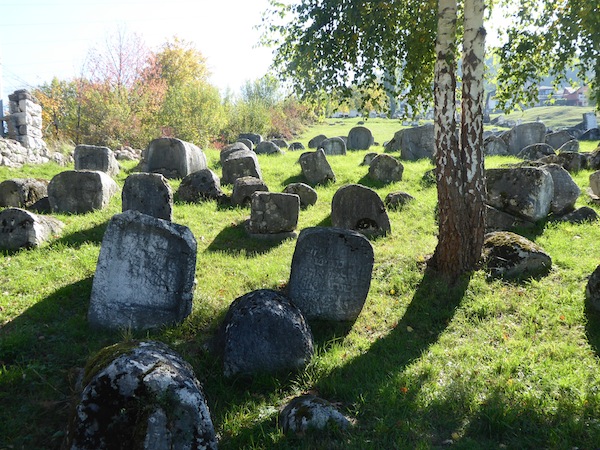
We visited the large hillside Jewish cemetery, among the oldest in Europe. It was founded by Sephardi Jews in 1630 and contains more than 3,500 uniquely shaped tombstones; some with inscriptions in Ladino. There are two Holocaust memorials: one Sephardi, one Ashkenazi. After 1959, it became a mixed cemetery and, in 1966, it closed. The cemetery was used as an artillery position by the Bosnian Serbs during the siege of Sarajevo and many of the tombstones were toppled.
The cemetery in Sarajevo, Bosnia-Herzegovina. (photo from Miri Garaway)
One thing I noticed during our stay in Sarajevo was that everyone we met was proud of the multicultural aspect of their city. One woman, in a Judaica shop we were taken to, next to a cinema that once housed a Sephardi synagogue, proudly told us that her Muslim neighbour helped her and her family build their sukkah.
It was hard to leave this fascinating, exotic city that had weathered so much, but we drove on to Dubrovnik, via the country roads. In the Serbian parts of that countryside, we saw signs in Cyrillic and I felt like I was in Russia.
What a contrast to arrive in Dubrovnik, a city inundated with tourists, even in October. Our Jewish heritage tour, which also included a walking tour of the city, was led by a Catholic woman studying for her master’s degree in archeology. In the late 1400s, early 1500s, there was a Sephardi community in Dubrovnik, with about 300 members. In the 1800s, Ashkenazi Jews arrived. Before the Second World War, Jewish property was confiscated and Jews had to wear the yellow armband. Some community members were involved in the anti-fascist movement. After the war, Jews were still registered in Dubrovnik, but most of them had immigrated to New York City.
We visited the Sephardi synagogue, located in the Old Town in a three-storey stone Baroque building; it is one of the oldest in Europe. The synagogue and museum received a direct hit from a missile during the war in the 1990s, but the Museum Foundation, the Croatian Ministry of Cultural Heritage and UNESCO, as well as private donations, helped restore it. There are fascinating displays of ritual objects in the museum and a Judaica shop next door. Sadly, there are only about 50 Jews left in Dubrovnik, all residing outside the Old City walls.
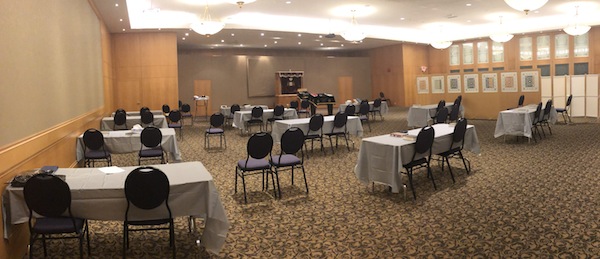
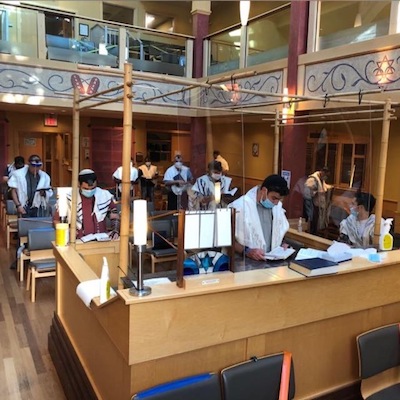
Services in the Schara Tzedeck auditorium, with social-distancing measures in place. (photo by Camille Wener)
In early March, Canadians were just beginning to take COVID-19 seriously. Then, in what seemed like an instant, the province shut down all places where people gather. Religious organizations were forced to close their doors – in some cases for the first time in more than a century – and rethink everything about how they engage with their congregants.
In a survey of rabbis and synagogue leaders across British Columbia after a summer of COVID, what emerges is not so much a story of hardship and difficulty but of resilience, creativity and a paring away of the superfluous to rediscover the most elemental things that we seek from spirituality and community.
The loss of life, the horrible illness and difficult recovery have directly affected thousands of British Columbia families, but we have fared better than many other jurisdictions. Even those not directly affected by the virus itself have had heartbreaking occasions, such as losing loved ones to other causes without family beside them, funerals and shivahs conducted online and, of course, the various burdens and isolation experienced by older people, those who live alone or others who are especially vulnerable.
As we approach High Holidays that are assured to be unlike any we have experienced before, there is an air of anxiety, but more evident is a flexibility and commitment to make the holidays as meaningful as possible. Although close coordination has taken place through RAV, the Rabbinical Association of Vancouver, every congregation is finding its own way and the holidays in most cases will occur along a spectrum of hybrid in-person and online services, most with multiple smaller, shorter programs. Services that routinely occur outdoors, such as Tashlich, will be joined in some cases with shofar-blowing and other services held out of doors. Despite all, reaction among rabbis is that community engagement and flexibility have made these months far better than could have been predicted in March.
“From day one, our motto was, we are not ramping down, we are ramping up,” said Rabbi Jonathan Infeld. His Conservative shul, Beth Israel, had not previously done programs or services online but, within 24 hours of the shutdown, all activities had moved online.
Zoom, an online meeting platform that almost no one had heard of before the pandemic, has proved a lifeline for individuals and communities, including almost all synagogues in the province. The platform’s interactivity allows individuals to participate in services, make virtual aliyot, engage in back-and-forth with teachers and guest speakers, and participate from home in numbers that rabbis say are routinely higher than in-person programs in “normal” times. “The social community of the synagogue’s remained intact,” said Infeld.
Most of Beth Israel’s congregants will experience the High Holidays from home, online. “It’s only the people who are leading the services and/or their families who will be in the building,” he said.
Provincial regulations permit a maximum of 50 people in any gathering, with social distancing enforced. For synagogues, that number varies based on the size of a sanctuary and the reality is that, to ensure two-metre separation, smaller synagogues will be able to accommodate far fewer than 50.
For the Orthodox Congregation Schara Tzedeck, however, online Shabbat and holiday services are not an option.
“We’ve had to think very creatively,” said Camille Wenner, executive director of the synagogue. “This was the first time in 110 years that our doors closed for davening,” she said.
People who had made minyan every week of their life suddenly couldn’t.
“That was really difficult,” said Wenner. “That’s why it was so important for us to mobilize a chesed committee to connect with everyone and make sure that everyone was OK. That’s how the idea of Shabbat in a Box developed and the idea of feeding people and making them feel that that ritual of Shabbat is still very much alive, you don’t have to be here to do it, we can still do it together.” That concept will be extended to Rosh Hashanah in a Box, which will go to more than 300 households.
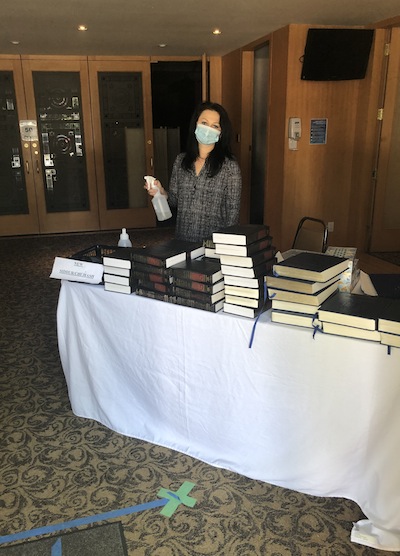
Office administrator Anna Herman is among those who sanitize the prayer books for congregants to use at services. (photo by Camille Wener)
Schara Tzedeck was the first Orthodox synagogue in Canada to reopen to limited in-person services, on June 1. “It was nerve-racking,” Wenner admitted. The usual single Shabbat service has been increased to two. Hand sanitizers and masks are required. Those who do not bring their own siddur are handed a newly cleaned one. Additional custodial staff are on hand to wipe down the entire sanctuary between services. An online registration program allows congregants to see how many of the 50 seats remain available.
For the holidays, services will be expanded to meet demand, she said. Rabbis and cantors who work in day schools and elsewhere in the community have volunteered to lead smaller services, which will occur in various places throughout the building and may even take place under a tent in the parking lot, if need be.
“The services will be condensed to about two hours instead of the regular five,” she said. “Right now, we’re looking at six or seven services back to back starting at 6:30 in the morning.”
The Peretz Centre for Secular Jewish Culture normally doesn’t run programming through the summer. But, this year, the Sholem Aleichem Speakers Series has continued every Friday on Zoom and Exploring Jewish Writers, on Saturday mornings, also has continued through the summer, said Donna Becker, the centre’s executive director. “Both of them are better attended on Zoom than they were in person,” she said.
Peretz Centre holiday services will feature Stephen Aberle singing Kol Nidre, but the usual musical program, which sees the Vancouver Jewish Folk Choir interspersed with the audience, is obviously out of the question.
This year’s High Holidays will be the first since the inception of the progressive congregation Ahavat Olam in 2004 that will not be held at the Peretz Centre. Said board member Alan Bayless: “We would prefer not to use computers for Shabbat or High Holiday services, but we believe that virtual services are necessary for our community this year given the danger of the coronavirus.”
Rabbi Yitzchak Wineberg of Chabad Lubavitch BC, said the 10 Chabad centres in the province are all adopting protocols appropriate for their congregants’ needs. He worries that, with daily infection reports often heading in the wrong direction, the province may re-impose stricter regulations by the time the holidays roll around. Either way, he suspects many or most people will be marking the holidays at home. “It’s the reality,” he said. “It’s a question of what works and what is acceptable and what isn’t.”
On the positive side, online learning has skyrocketed.
“The amount of study that’s going on by Zoom is absolutely unprecedented,” Wineberg said. “That’s the silver lining. I have a feeling that it will continue once this pandemic is over, God willing as soon as possible, I think people are going to continue learning that way. You have the convenience of sitting in your home and participating almost as if you are there – that’s the new reality.”
The Reform synagogue Temple Sholom had a running leap at livestreaming services, so some of the infrastructure was well in place before the pandemic. The difference now is the effort they are going to not just to allow people at home to observe, but to participate in the services. Classes, webinars and other programs have been expanded online. The Men’s Club and the Sisterhood have moved their programs onto Zoom. The accessibility means Temple Sholom programs are reaching new audiences, often far outside Vancouver.
The summer weather has allowed the synagogue to hold some events in parks and in the courtyard behind the shul. Still, Rabbi Carey Brown has no illusions that these High Holidays will be like any other. For one thing, only clergy will be in the sanctuary.
“It will be really different,” said Brown, who is the synagogue’s associate rabbi. “We are working really hard to put together High Holiday services and experiences that will help people feel the sense of the season, both the newness of the new year and the reflectiveness of the season.”
The Okanagan Jewish Community, which does not have a permanent rabbi, has depended on volunteers to deliver programs and services. The Kelowna-area centre has seen significant growth, and is running an 11-person conversion class and various adult education programs on Zoom. As great as all that is, Steven Finkelman, the centre’s president, thinks this might be a tough year financially for the group, a concern expressed by several interviewees. Revenue generated at the High Holidays and through in-person galas or other fundraising events in normal years is likely to suffer this year.
While online programming has proven hugely popular, there can be no denying that this experience has resulted in some missed opportunities. Rabbi Philip Gibbs of West Vancouver’s Conservative shul Har-El, has pangs of regret when he thinks back to the grand plans the synagogue had in January for a year of innovation and new initiatives.
“I was very excited about both the scale and the types and the variety of programming – more cooking events or culturally focused programs that really were going to give our community the chance to gather and engage in a really fun, exciting and meaningful way,” he said. “Unfortunately, we’ve lost that opportunity.”
The challenges and opportunities of the High Holidays will be met with one or more services on different days, he said. While he and his congregation are making the best of the situation, Gibbs laments the loss of in-person collective connection.
Similarly, Rabbi Hannah Dresner of Or Shalom, which is affiliated with the Jewish Renewal movement, grieves the loss of some in-person connections. However, she feels that Zoom can provide an intimacy that a large group gathering might not. As well, not only are out-of-towners joining Or Shalom’s offerings, but the rabbi and others are surfing programs throughout the Jewish world and beyond.
“I just think it’s a time when the world is our oyster,” said Dresner. “Spiritually you can look for whatever kinds of workshops you want, so people are experimenting a lot more.”
Or Shalom will hold successive Tashlich services at False Creek, each accommodating congregants in limited numbers. For the well-being of ducks and other birds, Or Shalom members drop leaves rather than bread in the water.
“I love the creative challenge, but I can’t say it doesn’t keep me up at night,” Dresner said, laughing. “I hear a lot of rabbis say, I didn’t sign up for this. There’s nothing that we’re doing that I signed up for.”
This extraordinary time has forced and invited rabbis and others to reconsider everything. The changes have made her reflect on “what’s at the heart of the service, what do we really need, what’s extraneous, what makes it tedious? Because it cannot be tedious. It’s got to be tight, shorter and beautiful.”
Rabbi Levi Varnai of the Bayit in Richmond concurs that the crisis forced a reckoning. “If a synagogue is not doing services – and we don’t do services online – what do we do? It got us thinking to the real core of what a synagogue is really supposed to be about,” he said.
As an Orthodox shul, the Bayit cannot stream services on Shabbat or the holidays, but they have expanded classes throughout the week and held socially distanced events at Garry Point Park. Pre-Shabbat events help people prepare for the Sabbath and regular phone calls and visits by the rabbi and volunteers to speak with people from a distance and drop off packages keep a sense of community alive.
Now that limited in-person gatherings are permitted, the shul’s size permits 25 congregants. But even that is not quite as it was. “It’s coming in, praying and going, which is great because it’s more than we had before that,” he said, but there’s no food and no kibbitzing.
The holidays will see multiple services and people can arrange to be there specifically for Yizkor but perhaps not come for the entire day.
The chaos of shifting suddenly from the way things have always been done has not left Varnai a lot of time to reflect. But, when pressed, he acknowledged how surreal it is.
“It’s a huge change to the regular Jewish life that I’m accustomed to since I was a young boy, since my bar mitzvah, praying three times a day with a quorum of others,” he said. It’s a stunning transformation, but entirely within Jewish tradition. “We always put safety and well-being and health first.”
He puts the whole thing in perspective. “Our people came out of the centuries and had to go through a lot worse,” he said. “Not going to synagogue is not fun but, thank God, other generations were challenged with much greater hardships and we’re relatively blessed.”
Beth Hamidrash, the only Sephardi synagogue in Canada west of Toronto, counts among its congregants Dr. Jocelyn Srigley, a microbiologist who is a director with the infection prevention and control branch of the Provincial Health Services Authority. Rabbi Shlomo Gabay and shul president Eyal Daniel credit Srigley with helping guide them through this difficult time and say it was on her advice that their synagogue was the first in the city to close.
Services at Beth Hamidrash with COVID-19 precautions in place. (photo from Beth Hamidrash)
Despite the challenges, however, engagement is better than ever, said the rabbi. Daniel added that synagogue membership has actually jumped 20% since the pandemic began, something he credits to an increased desire for meaning, and also a direct outreach he began when he became president in June to encourage occasional attendees to commit to membership.
The strange situation has also helped strengthen relations between Beth Hamidrash and the two Sephardi congregations in Seattle. They virtually co-hosted an Israeli historian speaking on Medieval Spain, for example.
Probably no rabbi has had an experience quite like Rabbi Susan Tendler. The new spiritual leader at Richmond’s Conservative shul Beth Tikvah arrived in the midst of the lockdown with her family from her previous posting in Chattanooga, Tenn. The family then had to quarantine for 14 days, with community members dropping off prepared meals and greeting the family from a distance. Despite that unusual arrival, or perhaps because of it, she has reflected on big things.
“While I would never wish the pandemic on this world or on any person, really, this is an opportunity for renewal,” she said. “We do all have to reconsider what we’re doing and what our goals are and find new paths for reaching them.”
While hoping that services might return to normal in the not-too-distant future, she acknowledged that the very term sanctuary implies that every congregant must feel secure. “At a minimum,” she said, “it has to feel safe.”
Editor’s Note: This article has been amended to reflect that Or Shalom is affiliated with the Jewish Renewal movement, not the Reconstructionist movement, as stated in the original online and print versions.
As the world continues to grapple with the coronavirus (COVID-19) pandemic, Jewish organizations across Metro Vancouver are finding new ways to connect with the public.
Last week, schools and most businesses and places of worship closed their doors to support the provincial government’s directives for new social-distancing policies. For everyone, this change has required the adoption of different ways to address daily needs, like shopping, study and religious practice. It has put increased demand on organizations and businesses to think out of the box when it comes to staying in touch with and supporting their membership, clients and connections. Here’s some of what the community is doing.
New lesson plans
Schools have shifted their classes to online attendance and are creating lesson plans that allow students to study virtually and independently. Some schools, like Richmond Jewish Day School, have sent out private communications to parents, outlining class schedules and continued services. Others are using their websites or other online services to keep families apprised and facilitate the learning curve that students, parents and teachers will inevitably face using the technology.
Students at Vancouver Talmud Torah will have independent study periods and be able to use social media to connect with their teachers and peers. The school is using Google Classroom for study plans and assignments and its website notes that students who are experiencing problems, need to discuss study plans or want to connect with other class members will be able to do so during the teacher’s virtual office hour each day. For families that don’t have a computer available, the school says students will be able to sign out a laptop to use at home (one laptop per family, as inventory is limited).
King David High School’s new multimedia program launched a week ago, and it uses Zoom video services, Moodle and Google Classroom to connect with at-home students. According to KDHS’s website, the school is doing its best to keep schedules and study periods the same as they were prior to the shutdown. It is using classes prior to Passover break (April 3) to test and refine the online structure.
Shalhevet Girls High School is also working hard to keep schedules standardized and reflective of the lesson plans it offers, and students can still connect with one another during the “lunch and shmooze” hour.
Take-out and online
On March 21, the City of Vancouver ordered all in-house restaurant service to cease. Restaurants that provide take-out and delivery services have been permitted to remain open.
Many of Vancouver’s kosher restaurants already provide take-out or delivery services to the public. Omnitsky Kosher, Nava Creative Kosher Cuisine and Maple Grill have enhanced their takeaway and catering services. Some provide service through the DoorDash online app or Uber. Most are urging customers to order with sufficient advance notice.
A staff person at Maple Grill said that ordering ahead is necessary for very large orders, “but we always have take-out between 4 and 8 p.m. for smaller orders.” Patrons should keep in mind that seating – even while waiting for orders – will be closed in all restaurants during this time.
Nava, which has a take-out restaurant at the Jewish Community Centre of Greater, has requested 24-to-48-hour notice on all orders. According to Susie Siegel, although the JCCGV is currently closed, customers can pick up orders by calling or emailing their order ahead of time. Sabra Kosher Bakery also will be open for take-out and larger Passover orders.
Other restaurants that have relied largely on their in-house service have found it challenging to meet the requirements of the city’s precautionary ban. Café FortyOne has announced that it has “made the difficult decision to temporarily close to protect the health and safety of customers and staff.”
Restaurants – including non-kosher establishments like Market Meats – are also accepting orders for Passover and most have cut-off dates for orders. While many kosher restaurants are scheduled to close on April 8 for the week of Passover, customers may wish to call ahead to confirm deadlines for orders and take-out during the current shutdown.
Meanwhile, stores are also struggling. Buchan’s Kerrisdale Stationery on West 41st Avenue, which has a selection of Judaica, among many other items, is now offering delivery service. And Olive and Wild, on Main Street, which offers a variety of Judaica, Passover items, art and home décor items, is transitioning its services to better serve customers who aren’t able to shop in-person.
Simon Zaidel, who co-owns Olive and Wild with his wife Bella, admitted that the COVID-19 alert hasn’t been easy. The owners have added an online store to their website and Zaidel said patrons can either pick up their orders, have them delivered or, for those outside the Lower Mainland, request delivery by Canada Post. He added that the store is currently providing a discount to offset any delivery costs.
Safeguarding the vulnerable
Jewish Family Services, like many organizations, is shifting its services to meet increased at-home demands. Kassidy Taylor, JFS marketing and communications manager, said the organization realizes that the current health concerns are financially and logistically difficult for people of all ages. Its Emergency Care Campaign allows families and individuals to reach out for help with food, deliveries and other social support.
“It is for anyone who needs a meal or grocery delivery, counseling, emotional support or just a friendly phone visit,” Taylor said. “We are trying to support as many people as possible.”
Taylor added that, for many seniors and other individuals, having to stay at home has cut them off from food banks and various resources that don’t deliver. “We are just trying to fill in the gaps as we can,” she said of JFS’s focus.
Individuals needing assistance can contact JFS through its website or by calling the agency’s hotline, 604-558-5719. As well, the emergency care program is in need of volunteers, and those wishing to donate are welcome to contact JFS as well. “There is a lot of need right now,” Taylor said.
On another front, healthcare facilities have been taking successive steps to address the impacts of the COVID-19 outbreak. On March 17, Vancouver Coastal Health announced the closure of all adult day centres, such as the L’Chaim Adult Care Centre at the JCCGV, in an effort to protect seniors and healthcare workers from the virus. Care workers are monitoring participants by phone to ensure that medications, food and support are coordinated as necessary through VCH case managers. More information is available by logging onto the Lower Mainland Adult Care Centre Association’s website and clicking on the appropriate care centre’s link.
As of March 17, Vancouver Coastal Health also restricted visitors to Louis Brier Home and Hospital, Weinberg Residence and other care homes to “compassionate visits” that meet specific limited guidelines for continued care and end-of-life support. VCH stresses the rules are a precautionary measure to keep patients and staff protected.
Most of the community’s organizations have instituted changes to address social distancing and other limitations brought about by the outbreak. Links to each one and an overview of temporary changes are accessible through the Jewish Federation of Greater Vancouver’s website.
Virtual davening
Few Jewish organizations have been as impacted by the call for social distancing than Vancouver’s religious institutions, which have been faced with myriad challenges. Restrictions on attendance (at press time, it was limited to 50 people) and other issues have forced synagogues to rethink how best to both continue regular religious services and provide social and educational support to their members, many of whom are seniors and required to stay at home. It’s also forced organizations across Metro Vancouver to change programs and services for Passover. Most religious institutions have already canceled or transitioned upcoming holiday celebrations to Zoom online services.
On March 21, rabbis from Vancouver Lower Mainland institutions issued a joint statement to congregants outlining the synagogues’ new guidelines for attendance. Many of the congregations have transitioned to online religious services via Zoom video to ensure that their members can stay connected, supported and engaged in religious life.
Congregations Schara Tzedeck, Beth Israel, Temple Sholom and others are providing daily and/or weekly minyanim online, along with classes and “meetings” throughout the day.
Most congregations are also working to fill the gap when it comes to much-needed social interactions for teens and younger members. Synagogues have found ways to both address concerns about halachah and ensure that members struggling with the impact of isolation are supported.
Both Schara Tzedeck and Beth Israel issued new cemetery guidelines earlier this week, calling on members and guests to adhere to practices that help safeguard both the participants and others who may be at risk from exposure to the virus. Cemetery facilities are closed to the general public. Burials are, in most cases, limited to family members, with some allowances to ensure that there will be enough attendees for a minyan so mourners can say Kaddish, and unveilings have been canceled to April 30 at least. Congregants and those interested should contact the synagogues in charge for more information on the revised guidelines.
Helping those in need
Many Jewish organizations are also finding ways to help those most vulnerable get financial aid if needed. The Hebrew Free Loan Association has announced that it will lend up to $2,000 to individuals or families impacted by loss of a job or other economic problems stemming from the coronavirus outbreak. Organizations, like Or Shalom, for example, are accepting donations within its congregation to help those struggling from illness or loss of income.
Jan Lee’s articles and blog posts have been published in B’nai B’rith Magazine, Voices of Conservative and Masorti Judaism, Times of Israel, as well as a number of business, environmental and travel publications. Her blog can be found at multiculturaljew.polestarpassages.com.
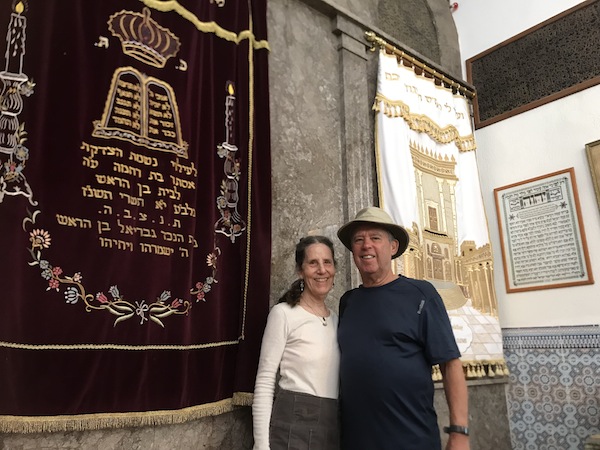
The writer and her husband at the synagogue Slat-Al Azama, in Marrakesh, which was built in 1492 by Jews expelled from Spain. (photo from Miri Garaway)
There are so many adjectives to describe Morocco, but, after being immersed in the country for three weeks and observing the people, the cities, the villages, the markets, the customs, the gardens, the arts and crafts, the architecture, and the potpourri of cultures that weave through this land, one can only conclude that Morocco is a fascinating, diverse country.
Morocco has an air of intrigue that enchants the soul and entices the curious traveler to explore beyond the realm of the imagination. The country has a way of drawing one in. It is the muse and inspiration for writers, poets, artists and craftspeople.
From scenes of everyday life and the feeling of stepping back in time, while navigating the uneven cobblestone streets of the medinas (old cities), to the overwhelming beauty of the landscape, one is transported into another world. Morocco is a land of mazes of narrow alleyways in the enchanting Medina; ochre-coloured earth; women grinding almonds to make argon oil; roadside markets; royal blue doors; rug weavers; tasty, elaborate tagines and mint tea; mounds of olives and spices; dramatic gorges; and captivating Berber villages. I could go on; the list would be long.
Through an extremely knowledgeable private driver, arranged by the company Journey Beyond Travel, we set about to include the Jewish sites of a once-vibrant community, which stretched back more than 2,000 years.
Landing in Casablanca, it felt like an oversize version of Tel Aviv, especially the drive along the beaches and the White City architecture.
During our tour of Casablanca, we visited the Moroccan Jewish Museum, which was once a Jewish orphanage (until the mid-1990s). How wonderful to see our history and culture displayed, with Torah scrolls, traditional clothing, daily life objects, paintings, sculpture and a library containing photographs, documents and videos of Jewish life in Morocco.
Walking through the enchanting, stunning and unique blue city of Chefchaouen, we happened upon the only remaining Jewish fabric merchant. We felt an instant bond, and he welcomed us into his small shop.
As we explored this vast country, we found traces of our ancient history in the archeological Roman ruins at Volubilis (near Moulay Idriss and Meknes); the epitaph of the synagogue rabbi in Greek, for example. The town of Ait-Ben-Haddou, now a centre for filmmaking, was once a significant Jewish community.
Traveling down a country road in Zaouit El Bir Dades, in the Valley of the Kasbahs, we stopped at a Jewish cemetery (all locked up) that was dated 1492.
When I had my first glimpse of the majestic imperial city of Fez, from atop a large hillside, I immediately thought of Jerusalem. The Medina of Fez is a huge maze of tiny alleyways, with colourful visual delights around every corner.
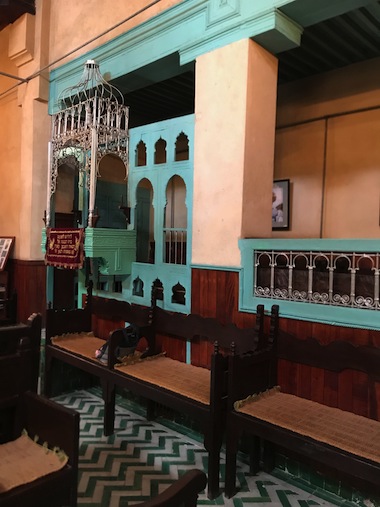
The Orthodox synagogue Ibn Danan in Fez was built in the 17th century in the Jewish Quarter, known as the Mellah. (photo by Miri Garaway)
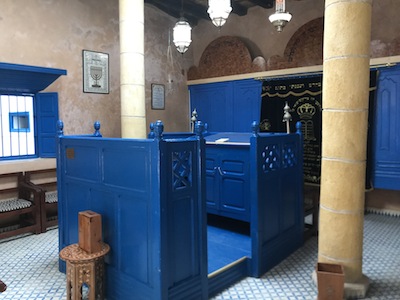
The Orthodox synagogue Ibn Danan was filled with Israeli tourists. Its predominant blue colouring reminded me of the ancient synagogues in Tzfat. The exquisite woodcarving and blue-and-white mosaics make it especially beautiful. It was built in the 17th century in the Jewish Quarter, known as the Mellah. In the mid-1990s, it was restored, and it reopened in 1999. It contains such elements as arches, wooden benches, tapestries and oil lamps.
Moses Maimonides, the Jewish scholar, philosopher and physician, escaped persecution by a fanatical Muslim sect in his native Cordoba, Spain, and lived in Fez from about 1159 to 1165, before moving to Palestine and then Cairo, where he could openly practise Judaism. In the Fez Medina, there is Maimonides’ House, which is a store containing an incredible selection of Jewish antiques and art.
When talking with the cultural director who organized our art and culture tour of Fez, she mentioned that, before 1956, Jewish women lived in Fez and were known for sewing the silk buttons on to men’s jellabas (Moroccan caftans).
In Marrakesh, in the Mellah, we visited the synagogue Slat-Al Azama, built in 1492 by Jews expelled from Spain. Off the courtyard, there is a series of rooms, acting as a museum, depicting Moroccan Jewish history. The Chefchaouen blue (a deep royal blue) doors and blue-and-white mosaics were particularly striking, as was the lovely synagogue. I could visualize it once teeming with life.
The charming coastal fishing town of Essaouira was once home to 70,000 Jews and 48 synagogues. Only three synagogues remain and we visited them all: Slat Lkahal, Haim Pinto and Simon Attia. At Slat Lkahal, we were given an informal tour by a Muslim woman; there were some fascinating historical photographs, which made the old community come alive. Nearby Haim Pinto, a small, wooden 212-year-old synagogue containing two Torahs – one original, one new – is painted a vibrant Chefchaouen blue.
Haim Pinto Synagogue in Essaouira is 212 years old. (photo by Miri Garaway)
Finally, Simon Attia Synagogue, located outside the Mellah, but within the Medina, is still in use today for the small community in Essaouira. It has a huge wooden door in the shape of a Gothic arch. After several attempts to gain entry during the week, when it was locked, we returned on a Saturday, around noon, and were lucky enough to go inside, as services were finishing. I was expecting a grand interior, but that was not the case. It was lovely, though, and we felt welcome and were glad for the opportunity to visit. One of the anterooms contained a small museum.
The hamsa, or Hand of Fatima, as it is known in Muslim countries, is everywhere in Morocco. One off-the-beaten-track place I would have loved to visit, about 28 kilometres from Fez, is the town of Sefrou, once inhabited by Spanish exiles and Jews from southern Algeria.
Did we feel safe traveling around the country? This is a question many people asked. Absolutely. There was a sense of unity among all religions. Perhaps a sign of hope for future generations.
Morocco is a country that must be seen. I am still in constant awe.
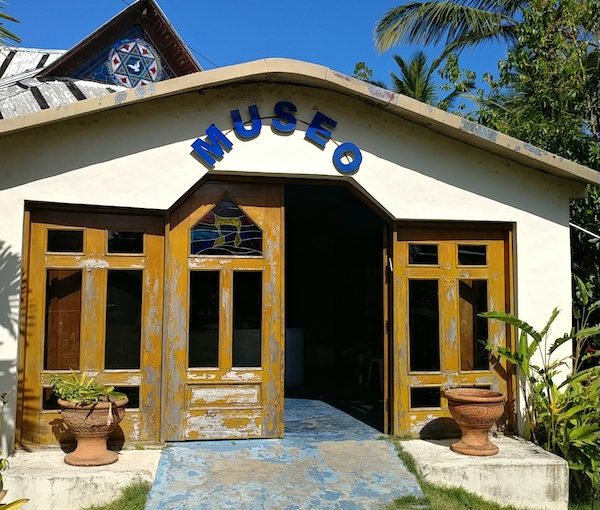
The Museum of Jewish History in Sosua is located right next to the city’s synagogue. (photo by Dave Gordon)
Famous for its rum, cigars, resorts, beaches and rich history, the all-season holiday destination of the Dominican Republic attracts 800,000 Canadians each year. Moreover, the country has a relatively unknown past – few people realize, or know, that the country opened its doors wide to Jewish refugees fleeing Nazi persecution.
This era is chronicled at the Museum of Jewish History, in Sosua, which is in the northern section of the country. Located right next to the city’s synagogue, the museum preserves the memory of those Jewish refugees who sought a safe haven on Dominican soil, and left their mark on the region. It houses photographs of early-to-mid-20th-century Jewish immigrants, along with diary entries, ritual items and copies of letters from Jewish agencies during the war.
Before the Second World War, in 1938, U.S. President Franklin D. Roosevelt summoned the Allies to Evian, France, for a conference about how to handle the massive exodus of Jews who desperately sought to flee Nazi persecution. Though most of the participants at the conference expressed their sympathy, no resolution was formulated. Paraphrasing Chaim Weizmann (who would later become the first president of Israel), Central and Eastern European Jews perceived the world as consisting of just two camps: one that hounded and hunted them, and another that closed its gates.
There was, however, one notable exception.
Of the 32 countries that sent delegations to the conference, only the Dominican Republic, led by President Rafael Trujillo, agreed to receive 100,000 refugees, offering land resettlement under generous conditions. A group of experts on refugee affairs, under the leadership of James Rosenberg, was mobilized by the American Jewish Joint Distribution Committee to capitalize on the offer. This was the birth of the Dominican Republican Settlement Association (DORSA).
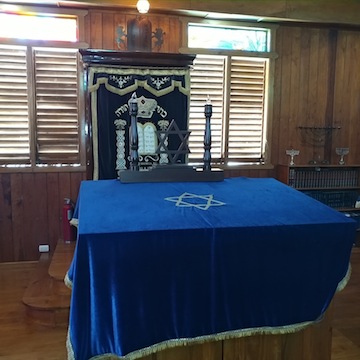
Inside Sosua’s synagogue. (photo by Dave Gordon)
Between 1940 and 1945, the Dominican Republic government issued 5,000 visas for displaced Jewish refugees. Tragically, however, the actual number of immigrant arrivals never reached anywhere near this figure, due to the escalation of the war, and also to what some believe to be mishandling by the Jewish Agency, which resulted in delays. Of the nearly 1,000 Jews who settled in the Dominican Republic, most were from Austria and Germany, although some came from as far away as China, and some from as close as the Caribbean islands.
Little by little, the jungle-like territory was divided into residential lots and communal barracks for arriving refugees. Each refugee was furnished with, as a repayable loan, 80 acres of land, 10 cows, one mule, one horse, and a living wage for a month. They were assisted with training in agriculture and farming techniques, of which most had little previous knowledge.
Jews took to food manufacturing, becoming successful in the production and sale of sausage, milk, cheese, tomato sauce, mashed carrots, stuffed peppers and mashed spinach. Many of these industries continue to this day. The refugees’ earnings enabled them to pay their debts and establish other small industries.
By the 1990s, however, just 36 Jewish families remained in Sosua, as most of the population either died, intermarried or moved to larger Jewish communities.
Interestingly enough, well before the arrival of these refugees, in 1916, the Dominican Republic briefly had a Jewish head of state, President Francisco Henríquez y Carvajal.
Visiting the country
Virtually every major supermarket has plenty of items with kosher certification, including imported canned goods, breads, fish and spreads. A Puerto Plata resort named Lifestyle has an on-site kosher restaurant, though only for guests staying there. Alternately, in Punta Cana, the local Chabad offers à la carte food orders upon request.
If this trip is a do-it-yourself getaway, as opposed to an all-inclusive, here are two suggestions for luxury stays that will offer the feel of home:
Villas Agua Dulce is a jaw-droppingly elegant and spacious facility. Each villa has a fully furnished living room, dining room and a washer/dryer. Three-bedroom villas are available to accommodate a family of seven. Toss in for good measure an outdoor patio, outdoor private pool, a spa centre, tennis and basketball courts, and Bauhaus interior design.
With the beach just a few hundred feet away, Cabarete Palm Beach Condos is centrally located in the Cabarete area. Each condo has a fully equipped kitchen, living room (with big TV), dining area and outdoor patio.
As for suggested adventures in the Puerto Plata area, I have several.
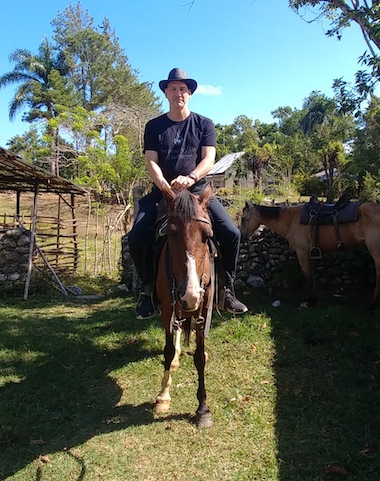
Horsebacking riding is one of the many outdoor adventures one can take in the Puerto Plata area.
Monkey Jungle: After enjoying the 4,500-foot, seven-station zip lines overlooking the trees, visit the adjacent capuchin monkey reserve. Scores of these adorable creatures bounce around from tree to tree, hopping on your shoulders and nibbling straight from the fruit plate in your hand.
Ocean World: This is where you can swim with sharks and dolphins and kiss the sea lions.
Tip Top Catamaran: Take a ride on the 75-feet-long and 33-feet-wide catamaran. Tourists are offered the chance to experience the vibrant underwater world through snorkeling Sosua Bay (equipment is provided). Immerse yourself in schools of fish, peer at the coral, get face-time with a puffer fish and play with the sea urchins.
Twenty-seven waterfalls of Rio Damajagua are tucked away in the hills of the Northern Corridor mountain range, behind tall stalks of sugar cane. In addition to the mélange of outdoor activities – such as cliff jumping into natural waters and climbing through caves – you are surrounded by forest. And, depending on the season, fruit will be growing from coconut, avocado, coffee bean and mango trees.
Kiteboarding: Think of yourself hovering over the ocean on a surfboard, propelled by a giant inflatable kite, and you have kiteboarding. Dare2Fly provides kiteboarding packages, lessons and rentals.
Rancho Luisa y Tommy: Try a morning horseback ride. Run by 30-year-old Tommy Bernard, a Quebec expat, he’s an affable fellow who’ll treat you to engaging conversation on topics including animals, his adopted country, and most anything in life.
Dave Gordonis a Toronto-based freelance writer whose work has appeared in more than 100 publications around the world.
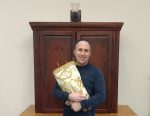
Rabbi Joshua Samuels holds thecongregation’s Torah from Lithuania. (photo by David J. Litvak)
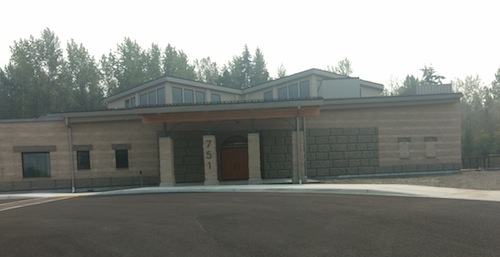
Congregation Beth Israel in Bellingham, Wash.,started out its life as a Lithuanian Orthodox shul in 1908. Today, thecongregation is housed in a stunning building in the woods, on 20 acres ofland.
The newly constructed synagogue opened its
doors in March of this year to serve the spiritual and cultural needs of Reform
and Conservative Jews of Bellingham and Whatcom County, Mount Vernon and the
Skagit Valley, the San Juan Islands and even Jews from Metro Vancouver.
Several weeks ago, for instance, the
congregation hosted a screening of a film about Israel, The Original Promise,
which was produced by Fraser Valley resident Bill Iny (who is a member of
Vancouver’s Congregation Beth Hamidrash) in conjunction with the Northwest
chapter of StandWithUs, an advocacy group for Israel that has chapters in the
United States, Canada and Israel. The screening, which attracted more than 100
Jewish and non-Jewish attendees, featured a panel discussion moderated by Beth
Israel’s spiritual leader, Rabbi Joshua Samuels.
This event is one of many that the Pacific
Northwest synagogue has hosted since relocating. However, while the synagogue
building may be new, it houses a nearly 300-year-old miniature Torah from
Lithuania that was commissioned in the mid-1700s by a czar of Russia.
Samuels said the czar gave the Torah to his
doctor, one of Samuels’ Lithuanian ancestors, and the Torah has remained in his
family ever since. His great-grandmother – hiding the Torah in a big coat –
fled Lithuania with her children to the United States, joining her husband in
Fargo, N.D., where he had found work.
The tiny Torah, said Samuels, has “lived in
Fargo, Long Beach, California, San Francisco (I read from it for my bar
mitzvah) and then it followed me after my ordination to Los Angeles and now is
with me here in Bellingham.”
A Torah is meant to be chanted and studied, he
noted. And, in Bellingham, he has used it on special occasions, such as on the
second day of Rosh Hashanah and for the Shabbat of Bereishit (his Torah
portion), as well as for b’nai mitvzah studies, and he has taken it to
Bellingham high schools and to Western Washington University. He wants students
“to see the beauty of a Torah scroll and to hear it chanted.”
“It’s the highlight of any visit,” he added.
Samuels also took the Torah to a cousin’s bar
mitzvah in California and will take it to Jerusalem next month for his niece’s
bat mitzvah, he said, “so that she can read from as it as her mother did 33
years ago.”
When he travels with the Torah, said Samuels,
“I feel like I am a concert musician traveling with a Stradivarius – I think
about it all the time, even if it is in a cushy case right above my seat.”
Bellingham’s Congregation Beth Israel. (photo by David J. Litvak)
Samuels, who is a fifth-generation San
Franciscan – his family arrived in San Francisco during the gold rush – worked
in the stock brokerage business in Los Angeles and San Francisco before
deciding to make a major life change. “I felt a gentle nudging to take another
path in life and, after some soul-searching for about three years, I applied to
rabbinical school at Hebrew Union College-Jewish Institute of Religion,” he
said.
After studying in Jerusalem and Los Angeles for
five years, Samuels was ordained in 2010. He began his new career at Temple
Beth Hillel in Valley Village, Calif., before coming to Bellingham to become
Beth Israel’s spiritual leader in July 2012.
Congregation Beth Israel was established in
1908 with 30 families, including Jews from Germany and Lithuania. The synagogue
was Orthodox until 1986, when it became a Reform shul and joined the Union for
Reform Judaism, which, at that time, was called the Union of American Hebrew
Congregations.
The congregation has grown to include 275
families and moved to its new building from a synagogue on Broadway that was
built in 1925 (and was recently sold). The new building was built to
accommodate the congregation’s growing community, drawing worshippers
throughout the region and from as far away as Surrey, White Rock and
Chilliwack, to attend services and the Sunday school. (For the Canadian
congregants, there is the added bonus of being able to shop at Trader Joe’s
after Sunday school.) The synagogue also hosts a Conservative minyan on the
fourth Saturday of every month.
While the new synagogue opened its doors in
March, Samuels said the construction began after he arrived in Bellingham in
2012. “The reason it took so long to build was to avoid incurring any debt,” he
said. “Just as the early Bellingham Jews bought the Broadway building outright,
we wanted to do the same with the new space.
“The state-of-the-art facility that we built
can accommodate our needs for at least the next 100 years.”
Bellingham’s Congregation Beth Israel is set on 20 acres. (photo by David J. Litvak)
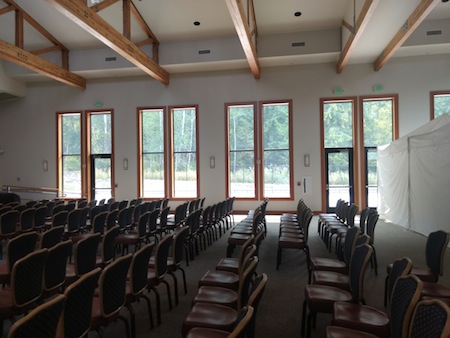
The sanctuary can seat more than 500 congregants,
and there is an outdoor patio overlooking the woods that can accommodate almost
as many. The building has 10 classrooms, two kitchens, a preschool, library,
study space and tons of storage.
Since March, the congregation has hosted a
variety of activities, including several StandWithUs events, a concert
featuring Seattle musician Chava Mirel and one with Bellingham klezmer band
What the Chelm (who performed at the synagogue’s grand opening in August), a
Purim party and a second-night Passover seder. In addition to being able to
host holiday parties, Samuels said, “We were finally able to host the High Holy
Days in our own shul after years of renting space around the city.”
And the congregation continues “to look for
opportunities to host events, speaker series, movies, classes, etc.,” he added.
As well, they would like to participate in more cross-border collaborations, he
said.
Samuels believes that his Lithuanian ancestors
would be happy to see their tiny Torah in its new Bellingham home, at the shul
in the woods. He said the Torah reminds him of his grandfather Jack (Yaacov), a
real mensch who died when Samuels was 7. His grandfather – whose mother had
brought the Torah to the United States – helped build a synagogue in Fargo.
“He is present every time I see the Torah,”
said Samuels. “I wish I could travel back and meet my family and tell them that
everything is going to turn out just fine. Their legacy is alive and well.”
David J. Litvakis a prairie
refugee from the North End of Winnipeg who is a freelance writer, former Voice
of Peace and Co-op Radio broadcaster and an “accidental publicist.” His
articles have been published in the Forward, Globe and Mail and Seattle
Post-Intelligencer. His website is cascadiapublicity.com.
You’re reading the weekly congregational email. Something radical seems to have happened. Within a week, everything has changed. Well, maybe the format seems the same, ready to lull you into “services this week, events, make a donation …” but then it hits you. It’s like a revolution happened. Instead of the regular schedule, where the adult service is happening at 8 p.m. Friday night, and davening starts at 9:30 Saturday morning, it’s all changed. Imagine this:
Come for our weekly great Kabbalat Shabbat service at 4:45! Join us for prayers, story time, snack, dancing and singing. The service ends by 5:45, followed by an Oneg Shabbat with fruit, veggies, cheese cubes, challah and grape juice.
Want to stay up later? Join us in the sanctuary for a summer camp-style sing-along of Shabbat music and study the Torah portion with the rabbi and your friends.
On Saturday morning, daven with us! Services begin at 8:45, with morning prayers, movement activities, another great story (with a picture book!) and three dances to help us learn new psalms. We’ll learn the Torah portion of the week, act out some of it, and end with a rousing Adon Olam. Let’s march around and pretend we’re playing in a band.
Services end by 10:30. We’ll provide a healthy Kiddush snack, including whole grain crackers, juice and water, lots of fruits and veggies, and more. (It’s a nut-free environment, but feel free to bring along dairy or pareve snacks to share.)
If the weather’s good, after snack, let’s play outside at the shul playground. If not, we’ll run in the shul gym so you can get tired before going home to have a big Shabbat lunch and nap.
In the evening, join us for Havdalah at the shul at 5! We’ll be serving pizza and salad, with cookies for dessert. (Click here for costs, to register and for the Jewish movie of the week.) After dinner, we’ll be showing a G or PG movie in the gym for families who want to stay out late.
Also there’s a Saturday evening study session. This week: Jewish advice for managing our busy modern family life, at 6:30 in the library. (Free.)
Note: If doing the rabbi’s Saturday evening study session, please be sure one parent or friend is in the gym to supervise your offspring and enjoy the movie together.
Reminders: On Sunday morning, the shul opens bright and early as usual for religious school, yoga for parents, coffee klatch and the usual lecture series after the morning minyan.
Our congregational soup kitchen, visit to the local Jewish seniors centre, nursing facilities and once-a-month cemetery clean-up all meet on Sunday afternoons. (Cemetery group, next week is our hike at the lake, so bring your boots and bathing suit and we’ll see you on the bus – we might let others attend if there is room! Click here to register.)
See you then!
* * *
OK, as you read this, you’re thinking, this is all well and good for those few young families out there. I mean, maybe my children or grandchildren might go sometimes? But, for me, well, I feel left out. This doesn’t seem like what I’m used to.
But consider the model some congregations still use: Join us for a family Shabbat dinner! (It happens only once or twice a year.) Services start by 5:30. Food is offered, one course at a time, starting after 7. There’s no finger food or even challah on the table. The kids’ food comes after the salad course. Parents who don’t want to create a scene take their children home long before dessert is served to avoid a train wreck…. And nobody wants to come back.
Should Jewish life be all about young families? Well, no. We shouldn’t give up traditional services or customs, but the V’ahavta says “we should teach it [Judaism] to our children.” How do you do that better, so there will be Jews a generation from now? Should your congregation include positive experiences for younger people? Does that create a plan for the future?
Based on a random sampling of kids’ events in my Jewish community (Winnipeg) over the last six years, here’s a generic sampling of what I’ve seen.
If a shul schedules a Tot Shabbat irregularly – although kids thrive on routine – it happens during kid dinnertime or even at bedtime. If your preschooler eats dinner at 5:30 and is in bed at 7:30, how does that service at 6:15 work for you? Hear any angry screaming in that sanctuary?
How about the big kid events scheduled for 1-3 p.m.? Many kids are grouchy creatures around then. We love naps. If we’re skipping them, well, the activity had better be fabulous … and tolerant of crying, hitting and screaming.
Many congregations do a great job of integrating families into their activities and planning. Instead of having kids’ events as an afterthought once a year, most events are designed with whole families in mind … and preschool activities meet the needs of families with babies and small kids.
Teenagers and adults have relevant events. People of all ages have good family programming, too. Sometimes, this is all the same service. Can kids have roles in the service, like saying the Shema or leading a song? Can kids’ restless behaviour be tolerated at the same level as we tolerate adults’ conversation and restless behaviour?
How about making registration accessible and online? Include active learning as part of all events, so Judaism remains relevant?
The kicker – somebody always says: It can’t be done. This isn’t the way we do it here. It’ll be expensive. It’s not possible.
I say: dream bigger.
Joanne Seiff, a regular columnist for Winnipeg’s Jewish Post and News, is the author of a new book, From the Outside In: Jewish Post Columns 2015-2016. This collection of essays is available for digital download, or as a paperback from Amazon. See more about her on joanneseiff.blogspot.com.
Nidje Israel – now called Sinagoga Histórica – was built by Eastern European Jews who came to Mexico in 1930. (photos by Rubén López Vargas)
The ark, where the Torah is located, surprises the visitor with its golden columns crowned by the tablets of the law. (photo by Rubén López Vargas)
Walking around the historic centre of Mexico City, where the main buildings are Catholic churches and convents, I am surprised to find in a small square called Loreto, a synagogue surrounded by two churches – Loreto and Santa Teresa la Antigua. The synagogue is easily overlooked at first glance, since its exterior is of a neo-colonial style that blends in with its surroundings, and one only realizes that the building is related to the Jewish people from the two Stars of David at the top of its main door.
Synagogue Nidje Israel was built by Eastern European (Ashkenazi) Jews who came to Mexico in 1930. It opened for services on Sept. 14, 1941, and closed its doors at the end of the 1970s. It was abandoned for about three decades, until a renovation was begun in 2008. Months of hard work culminated in the synagogue’s reopening on Dec. 13, 2009, and, today, it serves as a cultural centre, and is called Sinagoga Histórica (Historic Synagogue).
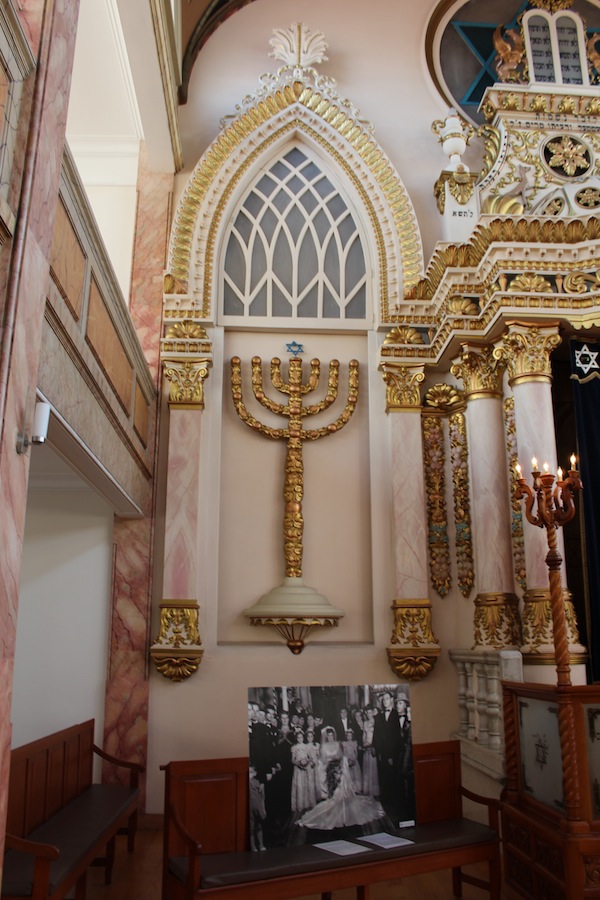
On entering, I am greeted with great cordiality and informed of the rules that must be followed inside. I pass a small patio that serves as a divider, and encounter the main façade, with its neo-Romantic style. Inside the synagogue, I walk into a salon, where celebrations are carried out in a traditional fashion. There is currently a photography exhibition of festivities celebrated in days gone by.
Synagogue Nidje Israel was built by Eastern European (Ashkenazi) Jews who came to Mexico in 1930. (photo by Rubén López Vargas)
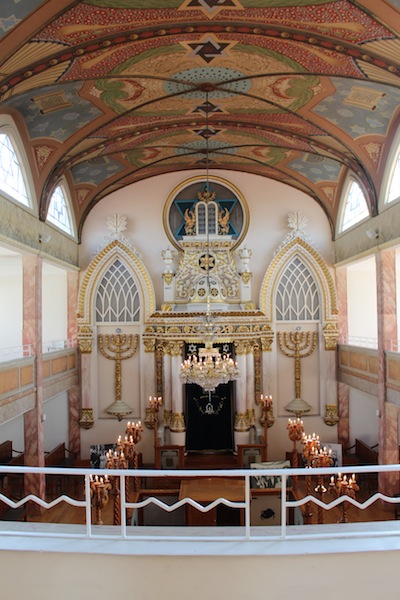
The first floor welcomes me with its open doors, and the first thing I see is the bimah. Located in the centre of the enclosure, it is the largest in Mexico, elaborated in fine woodwork, with stained glass images depicting musical instruments, alluding to Psalm 149.
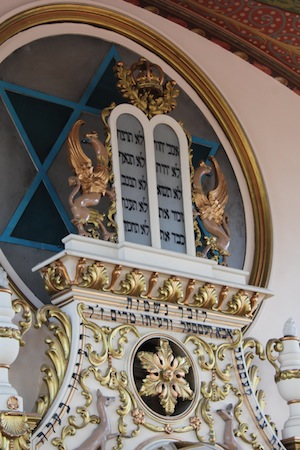
The ark, where the Torah is located, surprises the visitor with its golden columns crowned by the tablets of the law. These are sustained by two mythological animals. The cape that covers the ark door is embroidered with golden thread. The two menorot on each side of the ark enhance the beauty of the whole.
The ezrat nashim, the area reserved for women, is on the second floor, as is the mural depicting the Garden of Eden, on which I notice that there are no representations of humans, but only of animals.
The ezrat nashim, the area reserved for women, is on the second floor. (photo by Rubén López Vargas)
When I stand next to the bimah, my attention is caught by two spectacular elements: the beautiful ceiling painted with vivid colours, with a great number of Jewish symbols, and the majestic candelabra, which was the most difficult element to restore, but an important aspect to remind us of the old synagogues.
I sit for a moment just to imagine what it would be like to take part in a religious service in this synagogue full of people. I stand and walk to the exit door, and stop once more to observe for the last time the beauty of the building that continues to amaze me.
I want to thank everyone who made it possible to restore this place and open it to the general public, to make better known the culture and identity of the Jewish people in this part of the world.
Rubén López Vargaswas born in 1972 and is a lifelong resident of Mexico City. He dedicates himself to photography of social events, historic monuments and colonial architecture. He loves dancing, reading of all kinds, and traveling throughout Mexico. This article was translated by Carl Rosenberg.
Sinagoga Histórica is currently hosting a photography exhibition of festivities celebrated in days gone by. (photo by Rubén López Vargas)
Left to right: Michael Schwartz of the Jewish Museum and Archives of British Columbia, Rabbi Philip Bregman, Rabbi Dan Moskovitz, Mike Harcourt and Chris Gorczynski. (photo by Cynthia Ramsay)
Lisa Wilson, special projects coordinator at Vancouver Heritage Foundation, welcomed the approximately 60 people who gathered at Trimble Park on the afternoon of Oct. 23 for the presentation of a plaque commemorating Temple Sholom’s first building, which was firebombed in January 1985.
A joint effort between VHF, Temple Sholom and the Jewish Museum and Archives of British Columbia, the plaque was the 86th presentation of a planned 125 in VHF’s Places That Matter project, which started in 2011, said Wilson. “Our goal is to raise awareness about the people, places and events that tell Vancouver’s history,” she said, “and we invited the public to nominate and vote online, and an independent site-selection committee selected 125 sites to receive a plaque.”
In anticipation of a website for the project, Wilson invited people to submit their memories of the original Temple Sholom building.
“I moved here in 1984 and I lived just down the street,” said Vancouver Deputy Mayor Heather Deal. “I had been here for less than a year when the fire happened, and I was shocked…. I moved here from Cleveland, Ohio, a city deeply, deeply divided along racial lines … and I was shaken to my core when this happened just down the block from me.”
Deal said Vancouver is a “great city in striving to overcome” intolerance. “I think we’ve come a long way and have a long way to go, and this is a great reminder of not forgetting that it is much closer to the surface than we think it is sometimes.”
She noted the importance of the Jewish community to the city of Vancouver, and acknowledged specifically the growth of the Temple Sholom community. “I welcome you all here to acknowledge something that’s happened and, out of that, the good that has come and the better city that we are today because we learn from our mistakes and we learn from other people’s lack of tolerance, so that we continue to move forward as a peaceful and tolerant city.”
Temple Sholom spiritual leader Rabbi Dan Moskovitz spoke of the Holocaust-related memorials he and his wife Sharon witnessed on a mission to Central and Eastern Europe this summer, stumbling blocks that indicate where a Jewish family lived or a Jewish business stood. This local memorial plaque is different, however. “This notes where we were, but it also acknowledges that we are still here,” said Moskovitz. “And though not in that physical space on West 10th, we are very much a part of the city in our ‘new’ home on Oak and 54th…. This is not a memorial plaque, but a testament rather to the roots – the seeds that were planted, the roots that grew – and to what has blossomed into a wonderful Reform Jewish community in Vancouver and, I think, an incredible member and partner in the larger faith community of our city.”
Cantor Arthur Guttman then led the group in Psalm 100, after which Philip Bregman, rabbi emeritus of Temple Sholom, briefly shared some of the congregation’s history, including the story of the firebombing and his role in helping save the synagogue’s Torahs, as the building was burning. There had been a previous arson attempt and vandalism to his car, which led the congregation to start putting iron bars on all the windows, as the police were not motivated to act. The job was almost complete when the arsonist struck again, throwing a Molotov cocktail into the one window without a grate.
Bregman spoke of his disbelief that such antisemitism could exist in Canada. He spoke of his phone call to then-mayor Mike Harcourt, who was at the plaque ceremony, and Harcourt and his wife Becky’s support of the congregation in its work to rebuild. The Harcourts attended services, said Bregman. “Mike and Becky showing up made a statement that was so very important: it was not the Jewish community that was attacked, it was Vancouver, it was Canada, it was our society that had been attacked.”
After the Temple Sholom bombing, said Bregman, there was also an attempt to torch the Chevra Kadisha, which was on Broadway and Alma at the time. “These were targeted events that were taking place,” he said. “The police were tremendously responsive then and thereafter.”
Bregman expressed his pleasure at the work that had been done to mark the place where Temple Sholom once stood, and how the congregation has grown since.
The plaque – which will be placed at 4426 West 10th Ave. – was presented by VHF board member Chris Gorczynski, who read it aloud. The event ended with Guttman leading those gathered in Oseh Shalom.