Skip to content
  • Home
  • Subscribe / donate
  • Events calendar
  • News
    • Local
    • National
    • Israel
    • World
    • עניין בחדשות
      A roundup of news in Canada and further afield, in Hebrew.
  • Opinion
    • From the JI
    • Op-Ed
  • Arts & Culture
    • Performing Arts
    • Music
    • Books
    • Visual Arts
    • TV & Film
  • Life
    • Celebrating the Holidays
    • Travel
    • The Daily Snooze
      Cartoons by Jacob Samuel
    • Mystery Photo
      Help the JI and JMABC fill in the gaps in our archives.
  • Community Links
    • Organizations, Etc.
    • Other News Sources & Blogs
    • Business Directory
  • FAQ
  • JI Chai Celebration
  • JI@88! video

Recent Posts

  • Sharing her testimony
  • Fall fight takes leap forward
  • The balancing of rights
  • Multiple Tony n’ Tina roles
  • Stories of trauma, resilience
  • Celebrate our culture
  • A responsibility to help
  • What wellness means at JCC
  • Together in mourning
  • Downhill after Trump?
  • Birth control even easier now
  • Eco-Sisters mentorship
  • Unexpected discoveries
  • Study’s results hopeful
  • Bad behaviour affects us all
  • Thankful for the police
  • UBC needs a wake-up call
  • Recalling a shining star
  • Sleep well …
  • BGU fosters startup culture
  • Photography and glass
  • Is it the end of an era?
  • Taking life a step at a time
  • Nakba exhibit biased
  • Film festival starts next week
  • Musical with heart and soul
  • Rabbi marks 13 years
  • Keeper of VTT’s history
  • Gala fêtes Infeld’s 20th
  • Building JWest together
  • Challah Mom comes to Vancouver
  • What to do about media bias
  • Education offers hope
  • Remembrance – a moral act
  • What makes us human
  • המלחמות של נתניהו וטראמפ

Archives

Follow @JewishIndie
image - The CJN - Visit Us Banner - 300x600 - 101625

Tag: Shirley Barnett

Transcribing Vancouver history

Transcribing Vancouver history

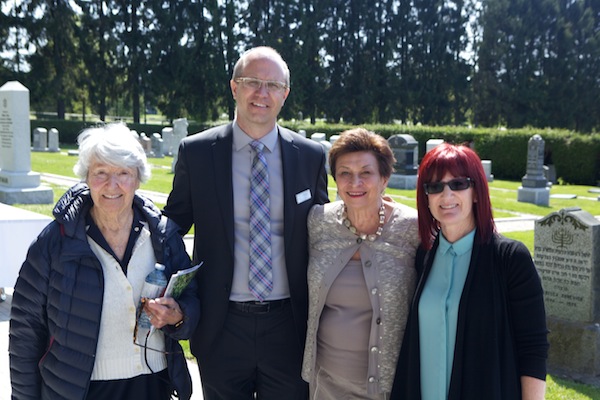
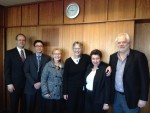
Left to right are Sam Sullivan, Glen Hodges, Cynthia Ramsay, Margaret Sutherland and Shirley Barnett with one of the Mountain View Cemetery ledgers. (photo by Lynn Zanatta)

“When we were restoring the Jewish cemetery at Mountain View, we spent two years going through City of Vancouver material trying to determine if the city actually had something in writing to prove the legitimacy of this Jewish section since 1892,” Shirley Barnett, who led the Jewish cemetery restoration project, told the Jewish Independent in an email. The committee couldn’t find anything in the city records.

While this lack of documented history lengthened the restoration agreement process significantly, it did not halt it. Barnett, as chair, opened the first meeting of the restoration advisory committee on Feb. 13, 2013, and the Jewish cemetery at Mountain View was officially rededicated on May 3, 2015. However, if the committee were to have started its work today, the information it sought would have been found, and the process would have moved much more quickly.

Sam Sullivan, member of the Legislative Assembly (Vancouver-False Creek) and former mayor of Vancouver, founded the Global Civic Society in 2010. As part of its mission to encourage “a knowledgeable and cosmopolitan citizenry to make strong connections to their community,” the society leads several initiatives, including Transcribimus, “a network of volunteers that is transcribing early city council minutes and other handwritten documents from early Vancouver, and making them freely available to students, researchers and the general public.”

Transcribimus project coordinator Margaret Sutherland has transcribed at least 155 sets of Vancouver City Council minutes. It was she who found what Barnett and her committee were looking for – in the council minutes of June 6, 1892. On page 32 of the minute book, it is recorded that correspondence had been received, “From D. Goldberg asking the council to set aside a portion of the public cemetery for the Jewish congregation,” and was “Referred to the Board of Health.”

Two weeks later, the minutes of June 20, 1892, note that the health committee had resolved, among other items, “[t]hat the piece of land selected by the Jewish people in the public cemetery be set aside for their purposes.”

photo - In addition to the transcribed council minutes, transcribimus.ca includes photos of the minute book pages. This image is of the June 20, 1892, minutes, which note that the health committee had resolved, among other items, “[t]hat the piece of land selected by the Jewish people in the public cemetery be set aside for their purposes.”
In addition to the transcribed council minutes, transcribimus.ca includes photos of the minute book pages. This image is of the June 20, 1892, minutes, which note that the health committee had resolved, among other items, “[t]hat the piece of land selected by the Jewish people in the public cemetery be set aside for their purposes.”

The cemetery first appears to have come up a few years earlier. In the July 29, 1889, council minutes, there is reference to a letter: “From L. Davies on behalf of the Jewish congregation of the city of Vancouver requesting council to set apart about one acre and a half in the public cemetery for members of the Hebrew confession. Referred to the Board of Works.”

In an email to Barnett, Sutherland wrote, “There doesn’t seem to be any indication from city council minutes that the Board of Works ever followed up on the above request. Although [Jewish community member and then-mayor] David Oppenheimer was on the Board of Works for that year, so was his opponent, Samuel Brighouse.”

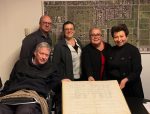
On Dec. 7, 2018, the Jewish Independent met with Barnett, Sullivan, Sutherland, Lynn Zanatta (Global Civic Policy Society program manager) and Glen Hodges (Mountain View Cemetery manager) at Mountain View. In documents she brought to that meeting, Sutherland explains that Oppenheimer “declined to serve as mayor again at the end of 1891, citing poor health as his reason for retiring. Fred Cope was elected mayor in 1892 and served till the end of 1893.” So it was Cope who was mayor when the Jewish cemetery was established; Oppenheimer was Vancouver’s second mayor (1888-1891) and Malcolm Maclean its first (1886-1887).

The first interment at Mountain View Cemetery was Caradoc Evans, who died at nine months, 24 days, on Feb. 26, 1887. The first Jew interred in the cemetery is thought to be Simon Hirschberg, who “died of his own hand” on Jan. 29, 1887, and was, according the plaque erected by the cemetery in 2011 (the cemetery’s 125th year), “intended to be the first interment,” however, “rain, a broken carriage wheel on a bad road and his large size all contributed to him being buried just outside the cemetery property,” where he was “long thought to have been left near the intersection of 33rd and Fraser” until his body was moved into a grave on cemetery property. Oddly enough, the first Jew to be buried in the Jewish section was Otto Bond (Dec. 19, 1892), who also took his own life.

scan - This page from a Mountain View Cemetery ledger shows the entry for Otto Bond, the first Jew to be buried in the cemetery’s Jewish section
This page from a Mountain View Cemetery ledger shows the entry for Otto Bond, the first Jew to be buried in the cemetery’s Jewish section.

So far, since its inception in 2012, Transcribimus has seen more than 300 transcripts produced by almost 40 volunteers, although a handful of them are responsible for the lion’s share to date. Many people have donated their time, technical advice and, of course, funds to the project. Barnett sponsored the transcribing of the city council minutes for 1891, and fellow Jewish community member Arnold Silber sponsored the transcription of the 1890 minutes. A few other years have also been sponsored, including 1888, by the Oppenheimer Group.

About nine years’ worth of minutes have been transcribed (1886-1893 and 1900), leaving much more work to be done, as the city kept handwritten minutes until mid-1911. After that, minutes were typewritten and these documents can be scanned and read with OCR (optical character recognition), said Sutherland.

The Transcribimus website (transcribimus.ca) is one of the best-designed sites the Independent has come across. It is both visually appealing and incredibly easy to use. In addition to the transcribed council minutes, it includes photos of the minute book pages. As well, it features letters from Vancouver’s early years, historical photographs and a few videos, including a film by William Harbeck of a trolley ride through Victoria and Vancouver in 1907, which has had speed corrections and sound added by YouTuber Guy Jones. (Astute viewers will see that the trolley is driving on the lefthand side of the road. British Columbia didn’t switch to the right until 1921-22.)

In the material Sutherland brought to the December meeting at the cemetery office, she included the transcription of the short letter that city clerk Thomas McGuigan wrote on June 23, 1892, in response to Goldberg’s letter that was mentioned in the council minutes. In it, McGuigan confirms “the grant made by council to the people of the Jewish faith of a piece of land in the public cemetery,” but adds that “they will be unable to give you title for the same, as the land was set apart by an Order in Council of the provincial government for burial purposes and they refuse to give any other title.”

Sutherland hadn’t come across Goldberg’s letter, that of Davies or any response to Davies. It’s likely that these letters have been lost or destroyed, but they might turn up in another file, she said.

However, Sutherland did find a brief letter to the editor of the Vancouver Daily World newspaper, dated Nov. 1, 1898, from L. Rubinowitz, which she emailed to the Independent. Rubinowitz wanted the application for the Jewish cemetery by “a certain number of Jews of this city” to be refused. In his view, “all the Hebrews of this city are not combined as one body” and “To avoid trouble between them and for the sake of peace, as one party will claim that they have the sole right to it, the other party will claim that they have the sole right to it, therefore, as it is now under the control of the city, we are well satisfied to let it remain so, as in my opinion the city will have no objections for us to make any improvements if necessary.”

The old joke comes to mind of the Jewish man who, when stranded on a deserted island by himself, builds two synagogues – the one he’ll attend and the one he won’t set foot in. Community cohesiveness is a heady task; always has been, and definitely not just for the Jewish community.

As more council minutes, letters, photographs and other documents are found, transcribed and shared, the holes in our understanding of the past and how it has formed the present will be filled. To support or participate in Transcribimus or other Global Civic Society projects, visit globalcivic.org.
Format ImagePosted on January 18, 2019January 16, 2019Author Cynthia RamsayCategories LocalTags cemetery, Global Civic Society, history, Margaret Sutherland, Mountain View, Sam Sullivan, Shirley Barnett, Transcribimus, Vancouver
So many community milestones

So many community milestones

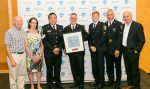
This year, Jewish Federation honoured, for the first time, an organization outside of the Jewish community. The inaugural recipient of the honour was the Vancouver Police Department.

***

At its annual general meeting June 19, the Jewish Federation of Greater Vancouver honoured four volunteers: Alex Cristall, Judi Korbin, Judith Cohen and Courtney Cohen. It also honoured, for the first time, an organization outside of the Jewish community – the Vancouver Police Department.

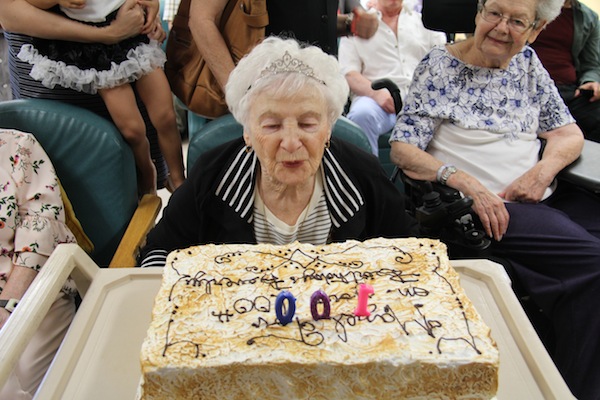
On June 18, L’Chaim Adult Day Centre celebrated its first 100th birthday, with program participant Beverly Klein.

On the evening of June 13, siblings Shirley Barnett and Philip Dayson were honoured with the B.C. Genealogical Society Book Award.

On the evening of June 5, Jewish Family Services held its first annual Volunteer Appreciation Event, celebrating the dedicated volunteers of JFS and the Better at Home program.

Louis Brier Home and Hospital has successfully achieved accreditation with exemplary standing from Accreditation Canada. 

Among the B.C. Civil Liberties Association’s Liberty Award winners on May 17 were Ken Klonsky, for excellence in the arts, and Peter Klein, for excellence in journalism.

***

At its annual general meeting June 19, the Jewish Federation of Greater Vancouver honoured four volunteers.

Alex Cristall was presented with the Harry Woogman Award, which recognizes a volunteer who leads consistently and conscientiously by example and has long-standing and diligent campaign involvement. Cristall is the outgoing annual campaign chair. His dedication and commitment to leadership excellence has made an enormous impact on Federation and the community as a whole.

Judi Korbin was given the Arthur Fouks Award, which honours leaders who demonstrate dedication to the goals and principles of Jewish Federation and who provide outstanding leadership to the annual campaign. Korbin is the outgoing chair of Federation’s endowment program, the Jewish Community Foundation, and is a past chair of the annual campaign.

The Kipnis-Wilson/Friedland Award went to Judith Cohen. As a past volunteer chair of women’s philanthropy, Cohen is no stranger to philanthropic work. She draws the inspiration for her community involvement from having grown up seeing her parents “pour their time and energies into the Jewish community.” She received the Kipnis-Wilson/Friedland Award from Jewish Federations of North America for demonstrating the highest ideals of leadership and involvement.

The Young Leadership Award was presented to Courtney Cohen for her extensive volunteer work with many Jewish organizations around Greater Vancouver. Just two examples among many are her involvement in Federation’s Axis program for young Jewish adults as the co-chair of the leadership development pillar, and her founding of Rose’s Angels, a care-package project created to honour her grandmother.

This year, Jewish Federation also honoured, for the first time, an organization outside of the Jewish community, with the first recipient of the honour being the Vancouver Police Department.

“Our Federation has had a long and valued relationship with the department and our staff have been able to count on their assistance and intervention during crisis situations and high-profile events attracting protesters, as well as being willing to provide education and training to our communal professionals on an as-needed basis,” said Bernard Pinsky, chair of Federation’s community security advisory committee, in presenting the award, which was accepted by Deputy Chief Lawrence Rankin on behalf of the VPD.

Pinksy expressed Federation’s “appreciation to constables Ryan Hooper and Dale Quiring for their support over the years,” and said Federation was looking forward “to a continued positive relationship with Constables James Hooper and Jacqueline Abbot.”

In introducing the video created for Federation’s 30th anniversary, board chair Karen James thanked “Jonathan and Heather Berkowitz, whose experience editing the Federation Magazine for many years was invaluable to this project, as well as past Federation president Sondi Green, whose father, Arthur Fouks, was a founder of our Federation, and Al Szajman, chair of our marketing and communications resource group for their work on this project.”

***

photo - On June 18, L’Chaim Adult Day Centre threw a party for Beverly Klein’s 100th birthday
On June 18, L’Chaim Adult Day Centre threw a party for Beverly Klein’s 100th birthday.

On June 18, L’Chaim Adult Day Centre celebrated its first 100th birthday, with program participant Beverly Klein. Four generations of her family, friends, fellow program participants, L’Chaim board members, staff and volunteers, as well as Jewish community leaders, threw a party at L’Chaim to commemorate her reaching this milestone.

Knowing her love of music, she was honoured with the musical talents of Allison Berry, who performed classics from the 1940s. Beverly was delighted to receive congratulations and warm wishes from Prime Minister Justin Trudeau and the Queen’s representative, the governor general of Canada, Julie Payette.

Ezra Shanken, chief executive officer of the Jewish Federation of Greater Vancouver, spoke about Beverly and said that she didn’t look a day over 40, to which she replied, “Hey, I like this guy!”

A much-loved program participant since 2013, the birthday girl was born in Poland near Warsaw in Meserich, and was one of 11 children. A story treasured by her children is Beverly’s childhood memory of preparing for Shabbat by “building a floor” and “doing the stove” – her home’s dirt floors had to be swept and pounded down, and Beverly would pile up the bricks for the oven, which was then whitewashed. Her family immigrated to Canada in 1929 with only the clothes on their backs, which were sewn from potato sacks. During the Second World War, Beverly came to Vancouver to spend time with her sister Ruby, and she met her husband Dave. They married and had two daughters and a wonderful life together.

Beverly continues to live in her own home because of the love and devotion of her family. The Turnbulls – Wendy, husband Steve and boys Ryan and Gavin – and the Blonds – Arlene, husband Les and children Amanda and Ben – are all devoted to their mom and bubbie.

Both daughters Arlene and Wendy gave heartfelt speeches at the birthday party. Arlene said, “It’s very reassuring to families to know that their loved ones have a safe place to go where they are not only stimulated but treated like family.” Wendy said, “L’Chaim remembers that older people deserve respect for a lifetime of achievements and all that they are today. The sheer joy with which the staff planned Beverly’s party touched all of us.”

The L’Chaim Adult Day Centre strives to improve the quality of life of its participants by providing a caring and stimulating group experience for those who might otherwise be socially isolated, while also providing support and respite for care-giving families and friends. It is funded in part by Vancouver Coastal Health, Jewish Federation of Greater Vancouver, the Jewish Community Centre of Greater Vancouver and private donations from the larger community.

***

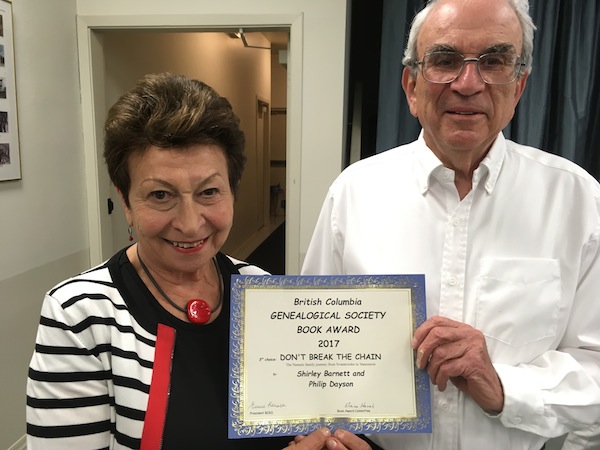
photo - Shirley Barnett and Philip Dayson
Shirley Barnett and Philip Dayson

On the evening of June 13, siblings Shirley Barnett and Philip Dayson were honoured with the B.C. Genealogical Society Book Award. Barnett and Dayson were recognized for their book Don’t Break the Chain, which describes the journey of Abraham and Toba Nemetz from Svatatroiske in Ukraine to Vancouver and points in between.

Fleeing from pogroms in 1922, Abraham and Toba began a new life in Canada. One of the pages in Don’t Break the Chain outlines how their family of nine children grew into 196 descendants. Family trees and portraits – both individual and group – are part of a fascinating picture of a family whose lives became an important part of both the Jewish and general communities of Vancouver.

In her acceptance of the award, Barnett said that, while researching the book, numerous family members (known and previously unknown) were reached with 100% cooperation from all of them in helping to compile information for the book. The title comes from Ben Dayson, Barnett and Dayson’s father. Although he married into the family, because of his belief in the value of family ties, Ben Dayson often “ended his conversations and speeches with the sentence, ‘don’t break the chain.’”

Barnett thanked the Jewish Museum and Archives of British Columbia for their support and rich accumulation of archival material. For more information, interested readers may access nemetzfamily.ca or the Jewish Museum at jewishmuseum.ca.

Congratulations to Shirley Barnett and Philip Dayson for being honoured by the B.C. Genealogical Society, who recognized the positive impact of their family and this book on the history and development of our province.

***

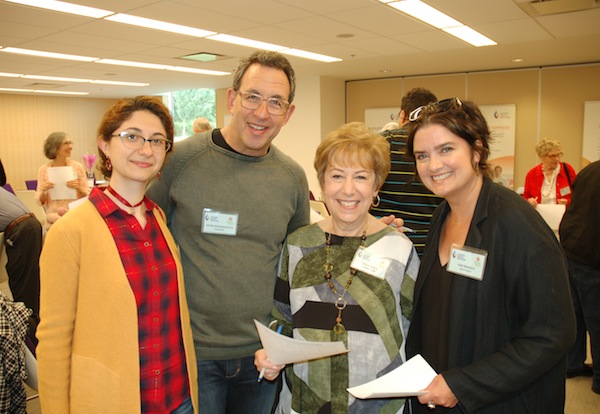
photo - Left to right are Mariam Harutyunyan, Dr. Mark Rosengarten, Linda Glick and Kim Branch. Harutyunyan and Branch are Better at Home volunteers. Rosengarten and Glick are JFS volunteers
Left to right are Mariam Harutyunyan, Dr. Mark Rosengarten, Linda Glick and Kim Branch. Harutyunyan and Branch are Better at Home volunteers. Rosengarten and Glick are JFS volunteers.

On the evening of June 5, Jewish Family Services hosted more than 70 people at its first annual Volunteer Appreciation Event. It was a wonderful opportunity to celebrate the dedicated volunteers of JFS and the Better at Home program, a government-funded service for seniors managed by United Way and administered by JFS. The guest speaker, Dr. Rotem Regev, presented on the value of human connection, empathy and the power of giving back.

Richard Fruchter, chief executive officer of JFS, spoke about the commitment of volunteers to the agency, describing “volunteers as the life-blood of JFS.” It was volunteers, he said, who founded the Jewish Family Welfare Bureau of Vancouver (JFS’s original name) when it opened more than 80 years ago to assist the poor and elderly living in Vancouver, and to help resettle new immigrants fleeing antisemitism in Europe.

“Your commitment to uplifting lives, for our clients and community, is an example for us all,” Fruchter said. “By stepping up to help, offering your time, skills and resources, you are the reason we can meet more of the needs in our community and accomplish the work that we do.”

There are more than 170 people who volunteer regularly through JFS and Better at Home, and some have been serving for more than 15 years. JFS’s youngest volunteers are in grades 7 and 8 from Vancouver Talmud Torah and King David High School who help regularly at the Jewish Food Bank.

JFS volunteers are responsible for a wide range of work. They support the Jewish Food Bank at the Peretz Centre; seniors lunches and outreach services, such as grocery shopping, visiting and driving to and from appointments; English-language practice for newcomers to Canada; interviewing skills for job seekers; mental health outreach; and administrative support in the office. Chanukah helpers, Passover hampers, Rosh Hashanah activities and Project Isaiah are all programs that rely almost entirely on volunteers. For many individuals and families, these Jewish holiday programs are the only connections they have with their Jewish heritage.

For more information on volunteering with JFS, contact Ayana Honig at [email protected] or call 604-226-5151.

***

Louis Brier Home and Hospital has successfully achieved accreditation with exemplary standing from Accreditation Canada.

Accreditation Canada is an independent, not-for-profit organization that sets standards for quality and safety in health care and accredits health organizations in Canada and around the world. Louis Brier Home and Hospital voluntarily participated in accreditation because it believes that quality and safety matter to residents and their families/significant others. Improving the quality of care is a continuous journey – a journey to which Louis Brier is fully committed.

As part of the Qmentum program, the home and hospital has undergone a rigorous evaluation process. Following a comprehensive self-assessment, external peer surveyors conducted an on-site survey during which they assessed the organization’s leadership, governance, clinical programs and services against Accreditation Canada requirements for quality and safety. These requirements include national standards of excellence; required safety practices to reduce potential harm; and questionnaires to assess the work environment, resident safety culture, governance functioning and client experience. Results from all these components were considered in the accreditation decision.

The accreditation survey team spent four days at Louis Brier, and reviewed a total of 19 required organizational practices (ROPs), 216 high priority criteria and 295 other criteria for a total of 551 criteria. The accreditation surveyors determined that the Louis Brier successfully met 100% of the ROPs and 100% of the criteria evaluated.

“I am very proud of everyone at Louis Brier Home and Hospital,” said Dr. David Keselman, chief executive officer. “Our staff worked and continue to work incredibly hard to make sure we meet the needs of our residents in every possible way, helping them and their loved ones maintain optimal health status, control and dignity every day, every time. Receiving exemplary standing from Accreditation Canada is a real testament to the changing culture and focus at Louis Brier Home and Hospital. Accreditation Canada standards and requirements will continue to guide us into the future as we continue to evolve and continuously improve our practices and care delivery efforts.”

He added, “I will, of course, be remiss if I do not mention the ongoing support and generosity of the LBHH and WR [Weinberg Residence] and the [Louis Brier Jewish Aged] foundation boards, without whom this journey may not have been as smooth or possible.”

***

The B.C. Civil Liberties Association’s Liberty Awards recognize outstanding achievements to protect and promote human rights and freedoms in Canada. Among the 2018 award winners were Ken Klonsky, for excellence in the arts, and Peter Klein, for excellence in journalism.

Klonsky, co-author of Dr. Rubin Carter’s Eye of the Hurricane, is a former Toronto teacher and writer now living in Vancouver. He is a director of Innocence International, the organization conceived by Carter to help free wrongly convicted prisoners worldwide. His artistic works call readers to action to defend civil liberties and improve the justice system. His art and advocacy on behalf of those who have been wrongfully convicted has contributed greatly to the advancement of human rights in Canada and internationally.

Klein is a journalist, writer and documentary filmmaker. He has been a producer for the CBS newsmagazine 60 Minutes since 1999, produces video projects for the New York Times and writes columns regularly for the Globe and Mail. He is the founder of the Global Reporting Centre, a nonprofit organization dedicated to reporting on neglected global issues and innovating the practice of global journalism. His record of groundbreaking broadcast journalism exposing human rights abuses around the world deserves to be celebrated. His efforts are empowering the next generation to continue to hold the powerful to account.

The other 2018 Liberty Awards were Miranda Hlady (youth or community activism), Stockwoods LLP (legal advocacy, group) and Dr. Pamela Palmater (legal advocacy, individual). Hassan Diab, Rania Tfaily and Don Bayne, on behalf of the Hassan Diab Support Committee, were recognized with the Reg Robson Award, which is given annually to honour substantial contributions to the cause of civil liberties in British Columbia and Canada.

Format ImagePosted on June 29, 2018June 28, 2018Author Community members/organizationsCategories LocalTags accreditation, BCCLA, Beverly Klein, birthdays, civil liberties, genealogy, Jewish Family Services, Jewish Federation, JFS, L'Chaim, Louis Brier, Philip Dayson, Shirley Barnett, volunteers
Family History series launch

Family History series launch

Don’t Break the Chain is the first publication of what the Jewish Museum and Archives of British Columbia hopes will become a Family History series.

The Jewish Museum and Archives of British Columbia has released the first book in what it hopes will become a Family History series. Don’t Break the Chain: The Nemetz Family Journey from Svatatroiske to Vancouver was published in collaboration with the Ben and Esther Dayson Charitable Foundation, and was researched by Shirley Barnett and Philip Dayson.

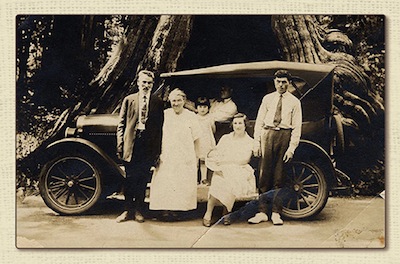
photo - Abraham Nemetz, Toba Nemetz, Esther Wosk, Bill Nemetz (driving), Chava Wosk holding baby Sonny, and Abrasha Wosk; taken at the hollow tree in Stanley Park, 1927
Abraham Nemetz, Toba Nemetz, Esther Wosk, Bill Nemetz (driving), Chava Wosk holding baby Sonny, and Abrasha Wosk; taken at the hollow tree in Stanley Park, 1927. (photo from nemetzfamily.ca/gallery)

Barnett described her family as founders and workers behind the scenes of the Vancouver Jewish community.

“One of my mother’s sisters helped build Congregation Schara Tzedeck, the Louis Brier Home and funeral chapels, while another sister founded Jewish Family Services and visited the poor, people in prisons and mental hospitals. My mother ran charity events for Jewish Vancouver from the age of 18 and her brother started Camp Hatikvah,” she said. “They brought a lot of strength to the community. The next generation, which was mine and included 23 of us, has made significant contributions to Jewish Vancouver, too.”

There was plenty of raw material to draw from for the book, given the fact that Barnett’s six brothers had created memoirs and Dayson had begun creating family trees 25 years ago. The project became challenging when she opted to include charts and photographs of children, grandchildren and great-grandchildren.

“I established contact with members of the family I never knew, siblings who’d had arguments and people estranged from the family, and it took a very soft approach, getting them to respond with photographs,” she explained. “I wasn’t looking to mend fences or interfere in anyone’s life, I just wanted to write a book!”

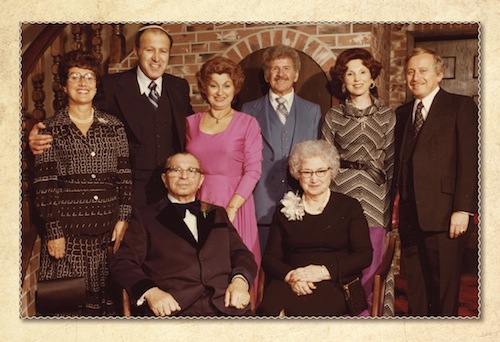
photo - A Congregation Schara Tzedeck testimonial evening in honour of Abrasha Wosk, 1977. Left to right are, in the back row, Joyce and Sonny Wosk, Esther and Hymie Aheroni, Rosalie and Joe Segal, and, in the front row: Abrasha and Chava Wosk
A Congregation Schara Tzedeck testimonial evening in honour of Abrasha Wosk, 1977. Left to right are, in the back row, Joyce and Sonny Wosk, Esther and Hymie Aheroni, Rosalie and Joe Segal, and, in the front row: Abrasha and Chava Wosk. (photo from nemetzfamily.ca/gallery)

Ultimately, with the assistance of graphic designer Barbi Braude and Facebook, she was able to source all the photographs required to complete the book.

Michael Schwartz, director of community engagement at the JMABC, said the Nemetz family journey would resonate among many other Jewish families in Vancouver.

“The story of leaving Europe, getting here and eventually bringing their family to Canada has parallels for many in our community and is a fascinating tale,” he said. “The Nemetz family has a very interesting history and many siblings of the early generation have accomplished great things and had an important impact on the community as a whole.”

The museum is hoping to partner with other families who are interested in creating similar books. Barnett described the creation of the book as a joint venture. “My brother and I contributed the money to the museum and archives, which then allowed us to use their name, resources, and to co-publish this,” she said. “I’d like to see the Wosk, Groberman and Waterman families – all large, extended families with deep roots in Vancouver – do a book like this.”

The launch of Don’t Break the Chain is being celebrated at a hosted brunch at the Jewish Community Centre of Greater Vancouver on April 2, 11 a.m. If you are interested in attending, call the museum 604-257-5199.

Lauren Kramer, an award-winning writer and editor, lives in Richmond. To read her work online, visit laurenkramer.net.

Format ImagePosted on March 17, 2017March 14, 2017Author Lauren KramerCategories BooksTags history, Jewish museum, JMABC, memoir, Shirley Barnett

Barnett fêted at Negev

Shirley Barnett, a longtime community activist and philanthropist, is to be honored by the Jewish National Fund at its annual Negev Dinner April 10.

photo - Shirley Barnett
Shirley Barnett (photo from JNF Pacific Region)

“The Jewish National Fund is a strong organization that is entering a new stage of many joint ventures and many new directions and worthy of support,” said Barnett, who selected as the recipient project of the event a shelter for women and children fleeing domestic violence.

Jewish National Fund, Pacific Region, is collaborating with No to Violence Against Women, which was established in 1978 by Israel Prize laureate Ruth Rasnic, who is scheduled to be in Vancouver for the event.

The goal is to raise $1.5 million for the project, which will shelter 10 to 12 families at a time and provide victims of domestic violence with a safe environment from which they can start over. Staff and volunteers of the organization work with families to access therapy, secure income and new housing.

As many as 65% to 70% of women and children fleeing domestic abuse in Israel cannot access shelters due to lack of availability. Moreover, the shelters run by No to Violence Against Women are the only ones open to people of all religions and denominations, said Barnett.

The shelter, in Rishon Le Zion near Tel Aviv, will be named the Vancouver Shelter.

The cause is in line with Barnett’s lifetime work.

“I was involved in the women’s movement going way back to the ’60s,” she told the Independent. “I was on the board of directors of the Vancouver Status of Women in the ‘60s. I’ve always been aware of the lack of empowerment in women and the lack of women seeing their potential to be strong. And, when you’re abused, you need to develop the strength to be more resilient.”

Barnett said she knew she wanted to be a social worker from age 12. While at the University of British Columbia, she had the opportunity to work as a women’s matron at Oakalla prison in Burnaby.

“I was always interested in institutional work, I don’t know why,” she said. “I worked there for about half a year and then I did my fieldwork in juvenile probation.” She worked in other prison settings, as well as with people with addictions.

“More recently, I was on the board of the Odd Squad Society,” she said. “It’s a group of police officers who do gang prevention work in their off-hours.”

She also helped found Food Runners, now part of the Vancouver Food Bank. It is a program in which a refrigerated truck picks up surplus food from hotels and restaurants and delivers it to organizations that feed people.

After graduating with a bachelor of social work degree, Barnett worked for a federal agency setting up affirmative action projects for women and resettlement projects for Ugandan refugees.

As a volunteer, she served on the board of directors of the Jewish Family Service Agency for 12 years, including four as president. She also spent two years as the agency’s acting executive director. During that time, she founded the Hebrew Free Loan Association, which now holds more than $1 million in assets and has provided thousands of loans to people in need.

Barnett has also co-chaired campaigns for the Jewish Community Centre of Greater Vancouver (JCCGV) and the Jewish Museum and Archives of British Columbia (JMABC). She was the first president of Shalva, a facility in Israel for special needs children. She established a garden in Fir Square at B.C. Women’s Hospital and a unit for addicted mothers and their infants, a peer-to-peer coaching program at the UBC Counseling Centre, a pilot project at Vancouver Hospital for early intervention for depression in women, and led the restoration of the old Jewish Cemetery at Mountain View. She has advised the Aboriginal Mother Centre and currently serves on the faculty of arts advisory committee to the dean of arts at UBC, on the board of directors of the JMABC and on the Schara Tzedeck Cemetery board, and she is an honorary director of the Hebrew Free Loan Association.

With her brother, Philip Dayson, she administers the Ben and Esther Dayson Charitable Foundation, which provides philanthropic funds to local Jewish and other community causes, particularly in the area of non-market housing and rental subsidies for members of the Jewish community.

Barnett said that the shelter project in Israel is especially meaningful because it is supported by the JNF, a charity that her family has always supported.

“We grew up with the JNF in our house,” she said.

In addition to the latest honor from the JNF, Barnett’s contributions to the community have been recognized by the JCCGV, N’Shei Chabad and Jewish Women International, and she received the Gemilut Chasadim award from the International Association of Hebrew Free Loans.

The sold-out Negev Dinner takes place at the Four Seasons Hotel.

Format ImagePosted on March 25, 2016April 20, 2016Author Pat JohnsonCategories LocalTags Dayson, JNF, Negev Dinner, Rasnic, Shirley Barnett
RPL honors Daysons

RPL honors Daysons

Mayor Malcolm Brodie, left, and Philip Dayson listen as Shirley Barnett addresses the 50-plus people who attended the Nov. 18 event at Richmond Public Library that honored the Dayson family. (photo from Richmond Public Library)

On Nov. 18, the Richmond Public Library board fêted the Dayson family and the Ben and Esther Dayson Charitable Foundation at a reception attended by more than 50 people, including Richmond Mayor Malcolm Brodie, councilors Chak Au and Alexa Loo, and distinguished guests from the Jewish community.

“It was a wonderful opportunity for people to come and celebrate the Dayson family and their outstanding generosity to the community, while also having a chance to browse the popular and growing Dayson Collection,” said library communications officer Shelley Civkin.

The Ben and Esther Dayson Judaica Collection started in 2003, when the Dayson family donated their personal Judaica collection to the library, and gave $50,000 to the Richmond Public Library Endowment Fund held by the Richmond Community Foundation. In 2004, the Ben and Esther Dayson Judaica Collection was launched to the public and, since then, the Dayson family and their charitable foundation have donated a total of $110,000 to the library. The Dayson Collection has grown to include more than 1,800 books and DVDs for adults and kids.

Posted on November 27, 2015November 24, 2015Author Richmond Public LibraryCategories LocalTags Dayson Collection, Richmond Public Library, Shirley Barnett
A party for Hebrew Free Loan’s 100th

A party for Hebrew Free Loan’s 100th

Hebrew Free Loan Association president Michelle Dodek, second from the right, with, left to right, past association presidents Errol Lipschitz, Diane Friedman and Mannie Druker. (photo by Dan Poh)

One hundred years of anything in Vancouver is fairly unusual. On May 7 at the newly rebuilt Beth Israel, the Vancouver Hebrew Free Loan Association celebrated the remarkable milestone of 100 years since it was originally founded.

In January 1915, the year that the Vancouver Millionaires won the Stanley Cup, a group of Jews gathered for the first meeting of the Vancouver HFLA. Designed to give interest-free loans to Jewish people starting out in the community, the association played an integral part in helping establish many early Jewish businesses and getting people settled here.

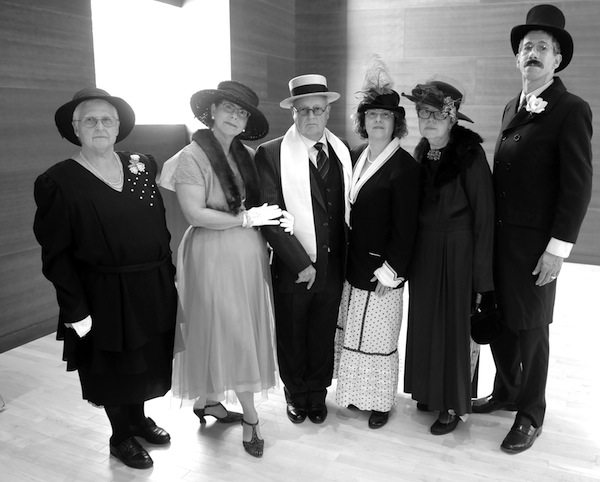
The HFLA Centennial Celebration reflected its grassroots beginning with a relaxed, different kind of evening. Casual picnic-chic décor and a picnic-style menu went with the fact that the event was held on Lag b’Omer. Greeting the guests were actors and musicians from the volunteer troupe Kol Halev. They were dressed in period costume and introduced themselves in character, sharing “their personal stories” as the founders of Jewish lending in Vancouver.

These actors provided an interactive beginning to an evening that was designed to raise the profile of HFLA. Through a multi-media approach, the event managed to educate those in attendance about the valuable role that interest-free loans play in Vancouver’s Jewish community.

photo - Members of the Kol Halev performance troupe, who represented the Jewish community at the time of Hebrew Free Loan Association’s founding 100 years ago
Members of the Kol Halev performance troupe, who represented the Jewish community at the time of Hebrew Free Loan Association’s founding 100 years ago. (photo by Dan Poh)

The program began with a short d’var Torah by Beth Israel Rabbi Jonathan Infeld, touching on the relationship between Lag b’Omer and interest-free lending. HFLA president Michelle Dodek followed the rabbi’s comments by explaining the three objectives of the event: to raise awareness in the community by sharing what HFLA does, to honor the donors and board members who have made the work of the organization possible, and to look to the future. She recognized the multi-generational links of those in attendance, including the remarkable fourth-generation connection of the three Krell sisters (Shoshana Lewis, Simone Kallner and Michaela Singerman), whose great-grandfather, David Davis, was a contributor to the original Vancouver HFLA kitty in 1915 and served as a trustee in 1931. Their grandfather, Charles Davis, was one of the founders of the re-creation of the organization in 1979.

Dodek’s speech was followed by a short video featuring two former borrowers, Mihael Mamychshvili, a prominent shiatsu therapist and Barbi Braude, a graphic designer. Joe Segal and Shirley Barnett shared their historical perspectives and goals for the organization.

Guests then heard from four borrowers whose lives were changed by the loans they received from HFLA. Successful entrepreneurs Zach Berman and Ryan Slater began their business, the Juice Truck, with help from HFLA. Val Lev Dolgin used an education loan to earn her master’s in counseling psychology; she now helps children who have survived physical and sexual abuse. George Medvedev, a neurologist, shared how he and his wife, a hematologist, used a loan to help them when they first arrived in Canada from the USSR almost 20 years ago.

Another story was read by a volunteer to respect the anonymity of the borrower because of the sensitive nature of her situation, while the story of former borrower Maxim Fomitchev was shared by his friend, Tobi Lennet. Briefly, Fomitchev, a deaf mime, while touring with his troupe of mime artists from the USSR in 1991, defected, accompanied by his performing partner. The two found themselves volunteering for Jewish Family Service Agency and, within two years, Fomitchev borrowed money for a car to get from one mime gig to another. He has since achieved one of the pinnacles of success for a mime – he is the head clown in Cirque de Soleil’s Las Vegas show, Zarkana.

The evening’s program ended with the educational element of the night, the stories of four “typical” borrowers: parents of a child needing counseling, a retired woman needing dental work, someone between jobs in a stressful situation and parents borrowing to finance a modest bar mitzvah. All of these stories served to drive home the significance of HFLA.

The HFLA Centennial Celebration was a chance to celebrate a significant milestone in the community, raise awareness of an organization that is “the best kept secret” in Vancouver while recognizing donors and volunteers who make it all happen. The message for the future is that HFLA is looking for borrowers. For more information on how to apply for a loan, to watch the HFLA video or to find out about how the organization works, check out its newly revamped website at hfla.ca.

Format ImagePosted on June 5, 2015June 3, 2015Author Vancouver Hebrew Free Loan AssociationCategories LocalTags Hebrew Free Loan Association, HFLA, Joe Segal, Kol Halev, Michelle Dodek, Shirley Barnett
Contemplating the JI – on the occasion of the JI’s 85th

Contemplating the JI – on the occasion of the JI’s 85th

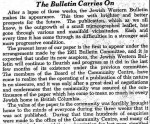
Editorial in the Jewish Independent’s predecessor, the Jewish Western Bulletin, March 20, 1931.

The JI spoke with four friends of the newspaper from longtime Vancouver Jewish community families about the value and future of a Jewish community newspaper: Gary Averbach, Shirley Barnett, Bernie Simpson and Yosef Wosk. We asked each the same four questions and they replied by email. Their responses are printed below.

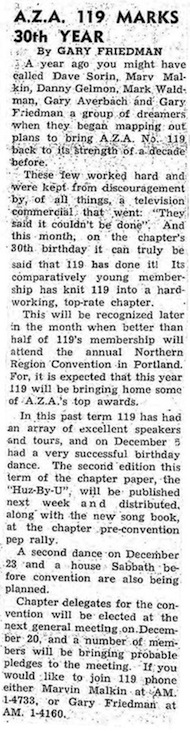
image - Not only are the community members interviewed here longtime Vancouverites but they have been involved in communal life for decades. The announcement on the right is from 1959, and comments on how a group of youth including Gary Averbach brought “AZA No. 119 back to its strength of a decade before.”
Not only are the community members interviewed here longtime Vancouverites but they have been involved in communal life for decades. The announcement on the right is from 1959, and comments on how a group of youth including Gary Averbach brought “AZA No. 119 back to its strength of a decade before.”

GARY AVERBACH

1. Is it important to have a Jewish community newspaper? If so, what are some of the reasons?

It’s difficult to answer this question because it seems so obvious that having a community newspaper is vitally important. We need a forum and a notice board for opinions and events in the community and, if there was not a publication dedicated to providing that forum and bulletin board, our community would suffer an irreplaceable loss.

2. What do you think the JI/JWB specifically has contributed (contributes) to the community?

For the most part, the JI/JWB has always been a bulletin board for the Jewish community, informing us about major – and minor – events and happenings. Whether they be reports on events that have occurred in the community – including the greater Canadian and worldwide Jewish community – or just informing us of births and deaths, b’nai mitzvahs and weddings, or local upcoming happenings. If not the JI/JWB, where would this come from?

3. In what ways, if any, is having a print version of value, versus only having an online publication?

For the next decade at least there will be a demand – albeit likely a decreasing one – for a printed version of the JI. That isn’t so much to provide for the very few people who still don’t or can’t use a computer, but to those of us who still prefer to hold a newspaper in their hands

4. Do you think that a Jewish community paper will be relevant for your grandkids’ kids?

I don’t even know what my grandchildren will be using to access their news in 10 years’ time, never mind what my great-grandchildren will prefer. But I’m fairly certain it won’t be print media as we now understand it. However, that in no way diminishes the need for a community forum and bulletin board giving a Jewish viewpoint on matters of local, national and international events – specifically items that directly involve Jews and, of course, Israel. So, whether it’s an online version, as we now know it, or some further refinement that we can barely imagine now, there will still be a need to inform our local Jewish community by the JI or some similar outlet.

SHIRLEY BARNETT

1. Is it important to have a Jewish community newspaper? If so, what are some of the reasons?

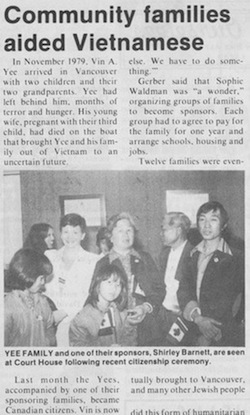
image - Among Shirley Barnett’s many community involvements is helping Vietnamese refugees come to Vancouver. This article is from June 1984.
Among Shirley Barnett’s many community involvements is helping Vietnamese refugees come to Vancouver. This article is from June 1984.

Yes, for sure. I would like more reporting of issues in the community rather than just of events.

2. What do you think the JI/JWB specifically has contributed (contributes) to the community?

Exactly that – a sense of community and interaction.

3. In what ways, if any, is having a print version of value, versus only having an online publication?

For me, for sure. I like to read it over a morning coffee, and still cut and clip.

4. Do you think that a Jewish community paper will be relevant for your grandkids’ kids?

Probably not.

BERNIE SIMPSON

1. Is it important to have a Jewish community newspaper? If so, what are some of the reasons?

It is extremely important for the Jewish community, which is spread throughout the province, particularly the Lower Mainland, to have a Jewish community newspaper. There is no question that the viability of printed media has been affected by easy access to online papers, however, it is noted that just about every ethnic community in British Columbia still has printed media, which is read primarily by the older generation.

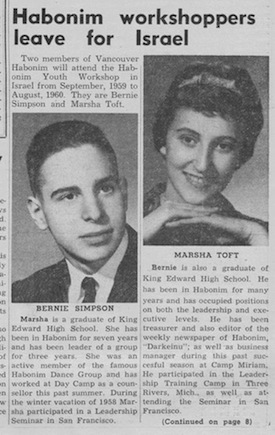
image - This article from 1959 is but one of many recording Bernie Simpson’s participation in Habonim and other community organizations, including the Jewish Western Bulletin.
This article from 1959 is but one of many recording Bernie Simpson’s participation in Habonim and other community organizations, including the Jewish Western Bulletin.

For example, in the Indo-Canadian community there are at least one dozen papers, half of which are in Punjabi. However, two of the most prominent papers, the Voice and the Link, have been in existence for more than 30 years, and are able to attract substantial advertising and are thriving within the community.

The Korean community has at least six papers, primarily in Korean. The Vietnamese community has at least four papers. The Chinese community has a countless number of newspapers, which attracts readers from the various regions from where the Chinese community has come, including Taiwan, Mainland China and Hong Kong.

Admittedly, however, those communities have far more significant numbers than the Vancouver Jewish community, and that may be the reason why those papers are more economically viable.

The Jewish community newspaper, by definition, helps promote a community by giving news as to various events that are happening, not only in Vancouver but in outlying areas.

It is also a vehicle to announce important fundraising activities and to give proper recognition to those who are honored in the community.

The reporting of international news particularly as it relates to Israel is important, and also the editorial content. I believe that we are fortunate in having editorial content that is objective. The letters to the editor, by and large, are articulate and represent, on occasion, a different view than the mainstream Jewish community may have, particularly with regards to Israel, and this view should be welcomed as it serves as a catalyst for thoughtful thinking on sensitive subjects.

The stature of the Jewish community would be diminished considerably in the eyes of the non-Jewish community if there was not a Jewish community paper. There is still the view that the Jewish community is well organized, speaks with one voice on contentious issues, is socially active in liberal causes and even responds to tragedies throughout the world, and I would think that the image of the community will be tarnished considerably if a community paper did not exist.

2. What do you think the JI/JWB specifically has contributed (contributes) to the community?

To a certain extent this question is partially answered by my response to Question 1.

I believe that this paper helps keep the community focused and together, and it takes into consideration all aspects of the political spectrum as it relates to the three levels of government and objectively reports what is happening in Israel.

We are indeed fortunate to have the publisher (working with various editors), who is an outstanding journalist as is evident by the many awards that the Jewish Independent has won.

If it would happen in the future that the Jewish Independent did not exist, then that void very well could be filled with a community publication that lacks the objectivity that the present Jewish Independent has. For a brief period of time several years ago, such a paper did exist, and it was quite clear what the agenda of that paper was. In the Jewish Independent’s small way, it does help the debate with regards to the peace process in Israel between the Israelis and the Palestinians and the concept of a two-state solution.

3. In what ways, if any, is having a print version of value, versus only having an online publication?

I think, at this point, the majority of the readership are still of the generation where they don’t naturally gravitate every day to their computer or their mobile to see what news comes out this week in the Jewish Independent.

Longtime members of the community have had ingrained in them that towards the end of the week, the Jewish Independent will arrive. It often stays around the house until the next edition. I would think also that it would be harder to get advertising revenue if you’re only online.

4. Do you think that a Jewish community paper will be relevant for your grandkids’ kids?

Frankly, I’m not terribly concerned about the answer to that question, nor is it really relevant to the present situation. I am a senior member of the Jewish community now; my grandchildren are 6, 3, 2 and 1. It’s impossible for me, who on my best of days has difficulty directing my attention to the immediate past, to focus on whether the paper will be relevant for my grandkids’ kids, which would be around 30 years in the future.

I don’t think that we should be too concerned about that question, but what we should be concerned about is how we can make the Jewish Independent more economically viable.

One obvious answer is an increase in subscriptions. Perhaps, an active volunteer campaign could be conducted by members of the community to try to sign up more subscribers. This will make it easier to get advertising revenue.

It may be that there should be “an advisory board” set up to advise the present publisher as to how to make the paper more attractive to advertisers and to readers.

There is a great deal of talent within the Jewish community (well-known reporters who are still active, retired reporters with national papers, etc.); this is a resource that perhaps should be called upon.

Also, an advisory committee of individuals – businesspeople – can lend help financially, if the situation arises.

RABBI DR. YOSEF WOSK

1. Is it important to have a Jewish community newspaper? If so, what are some of the reasons?

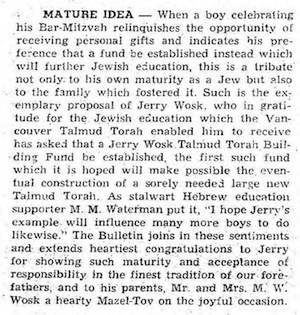
image - Yosef (“Jerry”) Wosk’s decision to donate funds to Vancouver Talmud Torah on the occasion of his bar mitzvah in 1962 drew the attention of editor Sam Kaplan.
Yosef (“Jerry”) Wosk’s decision to donate funds to Vancouver Talmud Torah on the occasion of his bar mitzvah in 1962 drew the attention of editor Sam Kaplan.

Yes, I feel it is important to have a community newspaper. It helps to gather and focus information about the extended family that is the community. It covers diverse topics, such as social events, politics, education, births and deaths, special interest groups, as well as emotional and intellectual concerns.

2. What do you think the JI/JWB specifically has contributed (contributes) to the community?

The newspaper has tried to be a neutral newsgathering and dissemination site. It carries articles that represent the full spectrum of the community, thereby fostering information and conversation.

3. In what ways, if any, is having a print version of value, versus only having an online publication?

The value of a print edition is that it can be read on Shabbat, it is easily accessible to everyone, including technophobes. It is always open and easy to read. Articles can be cut out and distributed. Having a hard copy on your desk or table gives it an immediate physical presence and material voice. In addition, a newspaper or magazine laying around in a public common area or even in a private home will attract readers who may not open an electronic device and search for a particular media address. The electronic edition may provide a number of supplementary links and also be available through a quick search, but it does not negate the value of a printed edition.

4. Do you think that a Jewish community paper will be relevant for your grandkids’ kids?

Who knows? However, newsgathering and dissemination in one form or another has always been of interest to the human condition and, so, I project that a community newspaper will still maintain its value in the future.

Posted on May 15, 2015May 15, 2015Author The Editorial BoardCategories From the JITags Bernie Simpson, community, Gary Averbach, Jewish Independent, Jewish Western Bulletin, newspapers, Shirley Barnett, Yosef Wosk
New life for cemetery

New life for cemetery

Fifth- and sixth-generation descendants prepare to enter the gates of the newly restored Jewish Cemetery at Mountain View. (photo by Robert Albanese Photography)

Several generations of Jewish life in Vancouver were represented Sunday afternoon at the rededication of the Jewish cemetery section at Mountain View Cemetery.

The historic burial site was first consecrated in 1892. In recent years, the site had deteriorated. There were more than 150 unmarked graves, many neglected headstones, pathways had eroded, hedges overgrown and the entryway had deteriorated.

Under cloudless skies, young children, all born more than a century after the first burial in the Jewish cemetery, assembled at the new entryway, joined by other generations of families with ancestors buried there, to officially open the gates of the rededicated cemetery.

The project, which took less than three years, was undertaken by a team of volunteers led by Shirley Barnett and assisted by the civic officials who run the cemetery, including cemetery manager Glen Hodges, with the support of the city, which owns Mountain View Cemetery.

photo - Left to right are landscape architect Cornelia Hahn Oberlander, Mountain View Cemetery manager Glen Hodges, Jewish Cemetery at Mountain View Restoration Project committee chair Shirley Barnett and restoration project administrator Myra Adirim
Left to right are landscape architect Cornelia Hahn Oberlander, Mountain View Cemetery manager Glen Hodges, Jewish Cemetery at Mountain View Restoration Project committee chair Shirley Barnett and restoration project administrator Myra Adirim. (photo by Robert Albanese Photography)

Jack Kowarsky, chair of the Schara Tzedeck Cemetery board, noted that the City of Vancouver had given the Jewish community this parcel of land 123 years ago, before which Jewish bodies had been shipped to the nearest consecrated Jewish cemetery, which was across the water in Victoria.

The 450 Jews interred at Mountain View, Kowarsky said, represent the forefathers of the current community.

Raymond Louie, Vancouver city councilor and acting mayor, called the rededication an important day for the Jewish community but also for the City of Vancouver. He credited Barnett, Arnold Silber and Herb Silber for the progress made during two and a half years of work, and he reflected on Mayor David Oppenheimer, the city’s first Jewish mayor, who was pivotal to the creation of the Jewish part of Mountain View.

Louie said the day was an opportunity for Vancouverites to remember ancestors and celebrate our multicultural heritage.

Barnett, who was presented with a book documenting the work that took place, deflected attention to others in the audience, noting that a single individual – Cyril Leonoff – led the community’s fight in the late 1960s, when the city attempted to remove all upright headstones and replace them with flat ones to make maintenance easier.

Barnett expressed gratitude for the happy coincidence that both Bill Pechet, a world leader in cemetery design, and Cornelia Hahn Oberlander, a globally recognized landscape architect, are both Vancouverites.

J.B. Newall Memorials, a memorial and monument company that is also a preeminent headstone restoration company, Barnett said, generously donated a headstone for the previously unmarked 1892 gravesite of the first interment in the cemetery, as well as refurbishing many headstones.

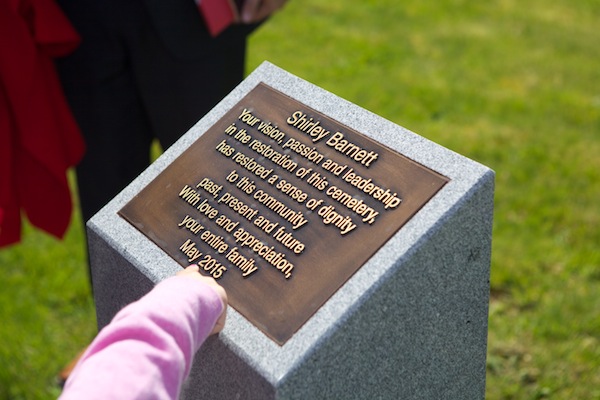
photo - plaque honoring Sheila Barnett
(photo by Robert Albanese Photography)

Arnold Silber brought laughs to the audience when he referenced Barnett’s reputation for getting things done. He reflected on the phone call from Barnett three years earlier asking him what should be done about the poor state of the cemetery where her grandfather is buried.

Silber told Barnett that “we would do everything she wanted – as long as she would be in charge.”

Turning to Barnett, Silber said: “Your dreams always become a reality.”

Silber stressed that the Jewish cemetery at Mountain View has an inclusive mandate that “any Jew, regardless of their affiliation, can be buried here at Mountain View.” He added that, now that the renovation and rededication have taken place, funds are being raised for perpetual maintenance and protection of the site.

“All generations to come will understand the value of this great Jewish cemetery,” he said.

With the renovation, several new plots have become available.

Rabbi Andrew Rosenblatt and Cantor Yaacov Orzech provided an indication of what the original dedication ceremony might have been like in 1892. At the time, the rabbi said, those assembled would have proceeded seven times around the cemetery as part of the consecration process but, he noted, the size of the assembled people Sunday did not permit such a procession.

The cantor offered some of the prayers that would have been included in that ceremony 123 years ago, including the prayer accompanying a casket to the gravesite.

Rosenblatt noted that the rededication was taking place on Pesach Sheini, a day specifically created, according to rabbinical interpretation, so that those who contract ritual impurity by caring for the deceased should be able to nevertheless celebrate the joy of Passover.

Rev. Joseph Marciano offered the prayer traditionally spoken when leaving a cemetery.

After the generations of descendants of those interred in the burial ground passed through the gates, followed by scores of rabbis, cantors, city councilors, an MP and community leaders, two headstone unveilings took place, one for “Baby Girl Zlotnick,” who died in 1920, and another for Otto Bond, the previously unmarked grave of the first individual interred there.

Pat Johnson is a Vancouver writer and principal in PRsuasiveMedia.com.

Format ImagePosted on May 8, 2015May 6, 2015Author Pat JohnsonCategories LocalTags Arnold Silber, Jack Kowarsky, Jewish Cemetery at Mountain View, Shirley Barnett
An historic agreement

An historic agreement

Left to right: Glen Hodges, manager, Mountain View Cemetery; Damian Koo, City of Vancouver legal services; Francie Connell, director, City of Vancouver legal services; Dr. Penny Ballem, city manager; Shirley Barnett, chair, MVJCRP committee; and Herb Silber, Schara Tzedeck Cemetery board. (photo from Mountain View Jewish Cemetery Restoration Project)

“Sometimes it takes awhile,” said Shirley Barnett, chair of the Mountain View Jewish Cemetery Restoration Project. But generally not 124 years! In 1891, Vancouver mayor David Oppenheimer, member of a prominent pioneer Jewish family, was approached by the growing Vancouver Jewish community to reserve a section within the city-owned Mountain View Cemetery to be consecrated and used exclusively for Jewish burials. At the time, when a Jewish person died, they were sent to Victoria, where the community had already established a cemetery.

Oppenheimer knew the small Jewish community of Vancouver well. The Gintzburgers, Weavers, Fleishmans, Golds and Goldblooms traveled in the same circles as the Oppenheimers. They had all emigrated from Western Europe, some via the United States, around the same time and all had prospered. Perhaps, as Barnett speculates, “they had even helped to get Mayor Oppenheimer elected.”

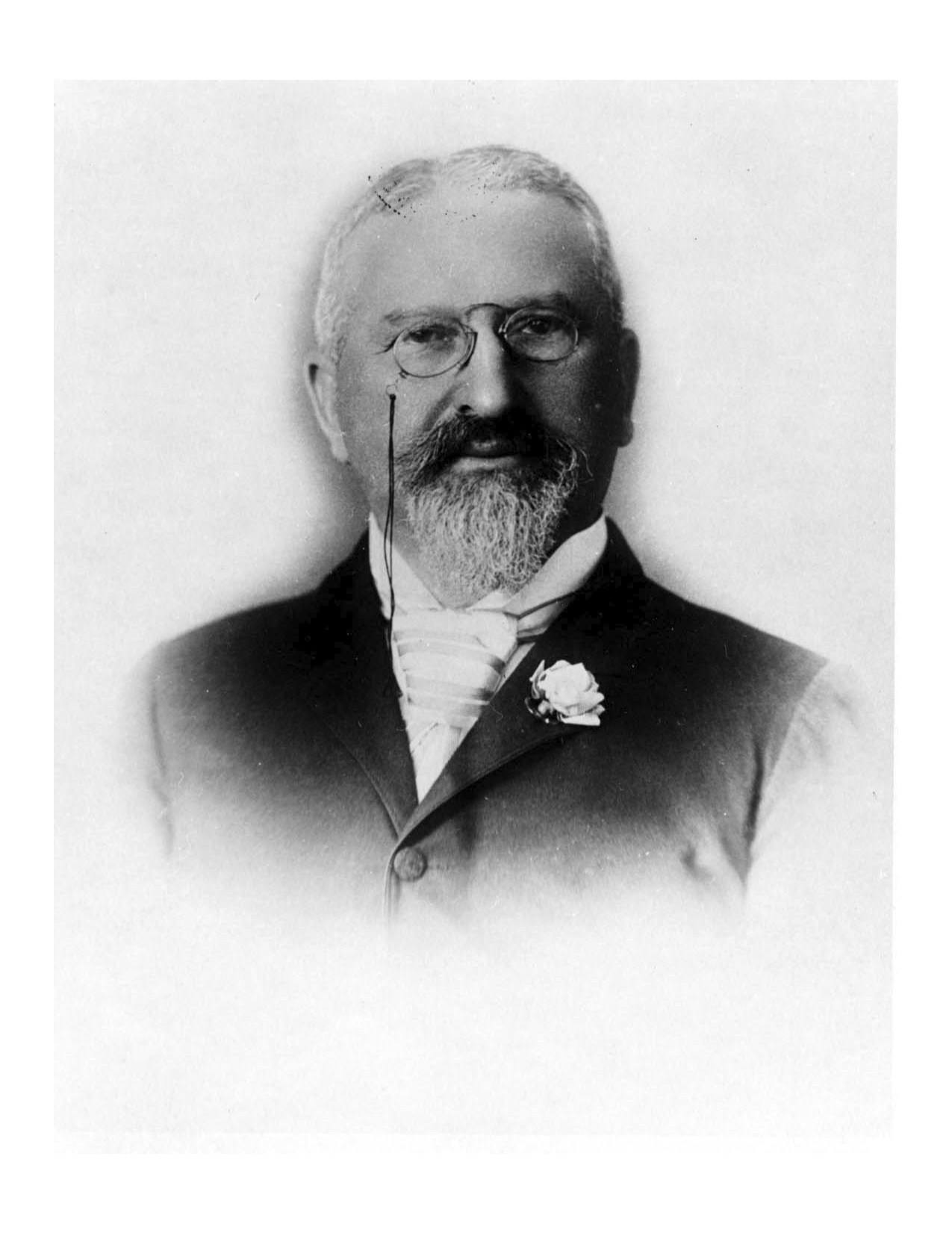
photo - David Oppenheimer, circa 1891
David Oppenheimer, circa 1891. (photo from Jewish Museum and Archives of British Columbia, L.00179)

Oppenheimer was born in Germany in 1834, one of 10 children. He emigrated to New Orleans in 1848 with his sister and four of his brothers. Becoming a bookkeeper, and later a trader in the California gold rush, the Oppenheimers relocated to Sacramento, where David invested in real estate, and married his first wife Sara in 1857. After the gold rush, the Oppenheimer brothers moved to Victoria, establishing stores throughout British Columbia, catering to prospectors and settlers. Also building a real estate portfolio, they expanded their interests in Vancouver.

Although Malcolm MacLean was the first mayor of Vancouver, it was Oppenheimer who is remembered as the “Father of Vancouver.” In his four terms as mayor, from 1888-1891, he implemented many basic civic services: fire department, streetcars, water supply, utilities, schools and parks. He was also a philanthropist, a founding member of the YMCA, Vancouver Board of Trade, Vancouver Club and many charities.

Establishing a Jewish cemetery at Mountain View in 1892 was one of his many accomplishments. Without minutes of meetings or other documentation, however, the only evidence of this was a number of articles published over the years, and the records of burials.

In 2015, 124 years later, the City of Vancouver recognized the historical establishment of the Jewish section at Mountain View and, based on this, an oversight agreement with Schara Tzedeck Cemetery board was signed. The agreement confirms that the cemetery board has the right to oversee all interment and funeral services within that Jewish section.

Although Oppenheimer himself was buried in New York, many of his colleagues were laid to rest at Mountain View. Over the past two years, a restoration of this old cemetery been undertaken. Now complete, the rededication will take place on Sunday, May 3, at 1:15 p.m.

Format ImagePosted on March 27, 2015March 26, 2015Author Jewish Cemetery at Mountain View RestorationCategories LocalTags Father of Vancouver, Mountain View, Oppenheimer, Shirley Barnett
Sign of significance at Mountain View

Sign of significance at Mountain View

Forty-three years after it was dismantled, the Jewish section of Mountain View Cemetery has an arch once more. (photo from MVRP)

A replication of the historic archway for the Jewish section at Mountain View Cemetery went up on Nov. 20, 43 years after the original had been dismantled.

The cemetery, consecrated in 1892, is the only Jewish cemetery in Vancouver. Under the leadership of Shirley Barnett, chair of the Mountain View Restoration Project, it is being restored to reflect its historic significance. Other amenities include a kohanim bench outside the cemetery, two benches inside the cemetery, washing and pebble basins, new pedestrian gates and garden walls. More than 350 headstones are being cleaned and stabilized, and small headstones will be laid for 80 babies buried there.

For more information about the cemetery or the restoration project, contact, Myra Adirim, project administrator, at [email protected].

Format ImagePosted on December 5, 2014December 3, 2014Author Mountain View Restoration ProjectCategories LocalTags Mountain View Cemetery, MVRP, Restoration Project, Shirley Barnett

Posts pagination

Previous page Page 1 Page 2 Page 3 Next page
Proudly powered by WordPress