Skip to content
  • Home
  • Subscribe / donate
  • Events calendar
  • News
    • Local
    • National
    • Israel
    • World
    • עניין בחדשות
      A roundup of news in Canada and further afield, in Hebrew.
  • Opinion
    • From the JI
    • Op-Ed
  • Arts & Culture
    • Performing Arts
    • Music
    • Books
    • Visual Arts
    • TV & Film
  • Life
    • Celebrating the Holidays
    • Travel
    • The Daily Snooze
      Cartoons by Jacob Samuel
    • Mystery Photo
      Help the JI and JMABC fill in the gaps in our archives.
  • Community Links
    • Organizations, Etc.
    • Other News Sources & Blogs
    • Business Directory
  • FAQ
  • JI Chai Celebration
  • JI@88! video

Recent Posts

  • Story of Israel’s north
  • Sheltering in train stations
  • Teach critical thinking
  • Learning to bridge divides
  • Supporting Iranian community
  • Art dismantles systems
  • Beth Tikvah celebrates 50th
  • What is Jewish music?
  • Celebrate joy of music
  • Women share experiences 
  • Raising funds for Survivors
  • Call for digital literacy
  • The hidden hand of hate
  • Tarot as spiritual ritual
  • Students create fancy meal
  • Encouraging young voices
  • Rose’s Angels delivers
  • Living life to its fullest
  • Drawing on his roots
  • Panama City welcoming
  • Pesach cleaning
  • On the wings of griffon vultures
  • Vast recipe & story collection
  • A word, please …
  • מארק קרני לא ממתין לטראמפ
  • On war and antisemitism
  • Jews shine in Canucks colours
  • Moment of opportunity
  • Shooting response
  • BC budget fails seniors
  • Ritual is what makes life holy
  • Dogs help war veterans live again
  • Remain vital and outspoken
  • An urgent play to see
  • Pop-up exhibit popular
  • An invite to join JWest

Archives

Follow @JewishIndie
image - The CJN - Visit Us Banner - 300x600 - 101625

Tag: Kolot Mayim

Women enrich Judaism

Rabbi Elyse Goldstein delved into the impact of women’s evolving roles in Judaism during a webinar hosted by Kolot Mayim Reform Temple on Dec. 8. Her talk – Open Doors, Open Hearts: How Women Have Enriched Judaism – was part of the Victoria synagogue’s 2024-25 lecture series.

Using her own journey, the rabbi emerita of City Shul in Toronto explored how women’s leadership and scholarship have not only enriched the Jewish community but also transformed it for the better. 

From her vantage point as a (recently) retired rabbi, Goldstein asserted that Jewish feminism has been a lifeline to Judaism over the past several decades. She referred to the profound changes within Judaism regarding the involvement of women as “disruptions” in the positive sense of the word: namely, “a societal thought pattern that profoundly changes everything around it.”

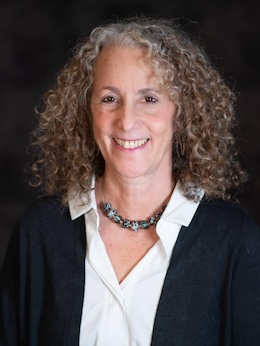
photo - Rabbi Elyse Goldstein
Rabbi Elyse Goldstein (photo from cityshul.com)

For Goldstein personally, a disruptive point arrived during her bat mitzvah. When it was time for her speech, she announced to the congregation – to the widespread gasps of those assembled and the dismay of her rabbi – that she, too, wanted to become a rabbi. 

“I never really thought when I was 13 that women becoming rabbis would shake the very foundations of Judaism,” she said. That women “would question every assumption of Jewish life, which was based on patriarchal power, that they would challenge what it means to be a Jew altogether. I didn’t realize that I was in the middle of a quiet revolution that would not remain quiet.

“One of the biggest disruptions of Jewish feminism to Jewish life is that people who identify as female are going to lead not in spite of being female but because of it. In other words, that’s a big part of who they are. That is part of their self-identity and they’re going to lead from within that identity – not push it aside.”

The changes brought about by women becoming leaders appear, Goldstein said, in the pages of prayer books, in seminaries, in the boardrooms of Jewish organizations, yeshivot and the Israeli government.

“Our liturgy would change to not only include the matriarchs,” Goldstein said. “We would use neutered language for God and start singing songs of Miriam in summer camp. We would learn Talmud from Orthodox women. We would feel empowered to create midrashim (interpretations of the Bible).”

She referred to the first stage of Jewish feminism as “equal access Judaism,” or the idea that women should be given the same religious opportunities and responsibilities as men.

The second stage, Goldstein said, went further by questioning notions, not simply behaviours. 

“It challenged the way we think and our theological language in describing God,” she said. “It began to shake the foundational assumptions about women and men, Jewish tradition and Jewish law. We didn’t just have women rabbis – those rabbis made us rethink not so much about what a rabbi looks like but what a rabbi is.”

We are in the third stage of Jewish feminism, one that considers if there is more that can be done, she said. “We have to ask about violence against women in the Jewish community and if that’s ended. We have to examine the court system in Israel, where women are still routinely denied Jewish divorces. We have to talk about the ordination of Orthodox women and how that is happening … and we’re not paying attention to it.”

Goldstein went on to talk about what are, in her view, four disruptions to Jewish life brought on by Jewish feminism: the ordination of female rabbis, starting in 1972; Jewish rituals that speak more directly to the experiences of women; changes in religious garb, with, for example, women in a congregation wearing tallitot (prayer shawls); and the reshaping of the gender-related language pertaining to God. 

In addition to being the founding rabbi of City Shul, Goldstein started Kolel: The Adult Centre for Liberal Jewish Learning. An award-winning educator, a writer and  a community activist, she has lectured across North America, Israel and the United Kingdom. Her works include ReVisions: Seeing Torah through a Feminist Lens and, as editor, The Women’s Torah Commentary.

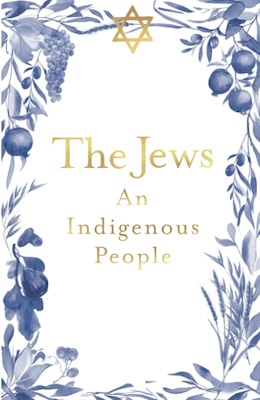
Ben M. Freeman will present the next lecture in the Kolot Mayim series, on Jan 12. The author of the Jewish Pride trilogy, Freeman will discuss his latest book, The Jews: An Indigenous People, which will be released in February. Visit kolotmayimreformtemple.com to register for upcoming talks. 

Sam Margolis has written for the Globe and Mail, the National Post, UPI and MSNBC.
Posted on December 20, 2024December 19, 2024Author Sam MargolisCategories LocalTags City Shul, Elyse Goldstein, feminism, Judaism, Kolot Mayim, speakers, women
Is this your moment?

Is this your moment?

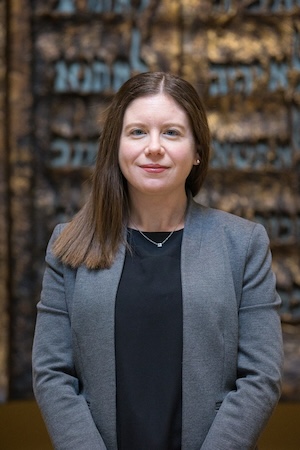
Rabbi Liz P.G. Hirsch spoke on the topic Just for this Moment: Stepping Up to Lead. (screenshot)

Rabbi Liz P.G. Hirsch kicked off the fifth season of Kolot Mayim Reform Temple’s Building Bridges lecture series Nov. 3 with the topic Just for this Moment: Stepping Up to Lead, which drew on her experience and insights into leadership for women, particularly within Reform Judaism.

Hirsch, who hosts the Just For This podcast, is the chief executive officer of Women of Reform Judaism (WRJ), a position she has held since 2023. Started in 1913 as the National Federation of Temple Sisterhoods, WRJ is the women’s affiliate of the Union of Reform Judaism and it represents thousands of women in hundreds of congregations throughout North America.

Now based in Cincinnati, where WRJ was founded, Hirsch spoke about the name of the podcast. The title, Just for This, comes from the point in the Book of Esther when Mordechai tells Esther to reveal her identity and step up to lead: “Who knows, maybe it is just for this moment that you find yourself in a position of leadership.” (Esther 4:14)

In each episode, Hirsch speaks to women who stand out in their field(s) and asks her guests to describe their “just for this moment” or when they found themselves in the right place and time to take on a leadership role. 

Hirsch played excerpts from her podcast to give the Zoom audience an idea of what her program is all about. The first clip was of Abigail Pogrebin, an American writer and the president of Central Synagogue in New York City from 2015 to 2018.

Pogrebin is the author of several books, her latest – It Take Two to Torah: An Orthodox Rabbi and Reform Journalist Discuss and Debate Their Way Through the Five Books of Moses – having been released just this past September. While Pogrebin didn’t provide a specific “Esther moment” that took place in her life, she did say it is something one should think about regularly. She said perhaps the question should be asked instead as, “Where do I have a role to play?” For Pogrebin, her purpose is to be a bridge between the person who knows a lot and the person who is afraid of what they don’t know.  

“There are many smart Jews out there who have an anxiety of ignorance,” she said. “Sometimes people opt out because, though you are a smart person, you don’t want to appear in places because you don’t know the difference between Sukkot and Shavuot.”

Pogrebin addressed the reluctance at times for women to step into leadership roles out of fear of not having enough experience or expertise when, in fact, they do. She praised Hirsch’s podcast for providing female role models, women who confidently and assertively demonstrate their abilities.

A second clip spotlighted an interview with composer, instrumentalist and prayer leader Elana Arian, who delved into the power of connection. She believes that music can allow for people to connect, even in this time when there are so many issues that polarize individuals.

“It is starting to be quite countercultural to go into communities with the express purpose of bringing people together through music,” she said. “It is really not normal these days to get people to sing together to get more connected to faith, so I feel I bring something to this moment that is specific.”

The final segment Hirsch played for the audience came from a discussion with Cochav Elkayam-Levy, a post-doctoral fellow at Hebrew University in Jerusalem who specializes in gender, conflict resolution and peace. She established and leads Israel’s Civil Commission on Oct. 7th Crimes by Hamas Against Women and Children. 

Elkayam-Levy said she felt compelled to do her work, not from bravery but rather that the necessity of the moment called for it. “I wanted to give a voice to the victims and be respectful to their memories,” she said. “I felt that, despite the fact it was difficult, I just felt that this was what I needed to do. That this was my mission.”

Hirsch concluded her talk by saying that “just for this” moments happen for everyone and encouraged listeners to consider when such times have occurred in their lives.

Hirsch was ordained at the Hebrew Union College-Jewish Institute of Religion in New York. Among other things, she has been a pulpit rabbi and she was the founding co-chair of Religious Action Centre of Reform Judaism, Massachusetts. She serves on the National Council of Jewish Women’s Rabbis for Repro Rabbinic Advisory Council and played a key role in the 2020 campaign to pass the ROE Act in Massachusetts. A prolific writer on social justice, spiritual practice and trends in Jewish life, Hirsch has contributed chapters to several publications, including The Social Justice Torah Commentary. Her podcast can be heard at justforthispodcast.com.

Victoria’s Kolot Mayim synagogue titled this year’s speakers series Kvell at the Well: Celebrating the Joys of Being Jewish in response to the Oct. 7, 2023, Hamas terror attacks on Israel, believing “that it is more important than ever to highlight our proud and strong Jewish culture, history and heritage.”

The series press release also explains the symbolism of a well: “It is the source of life-giving water, a community meeting place and a place for divine revelation. Our goal with this series is to inspire and empower Jews to draw from the well of our collective experience and proudly celebrate (kvell about) our shared identity as a people.”

The second speaker in the series was Rabbi Elyse Goldstein, one of the first female Reform rabbis in Canada, and author of ReVisions: Seeing Torah Through a Feminist Lens, on Dec. 8. On Jan. 12, 11 a.m., Ben Freeman, author of the Jewish Pride trilogy, will discuss his latest book, The Jews: An Indigenous People, set to be released in February, in which he puts forward the position that Jews are unequivocally indigenous to Israel.

To register for any of the series lectures, visit kolotmayimreformtemple.com/2024-25-lecture-series. 

Sam Margolis has written for the Globe and Mail, the National Post, UPI and MSNBC.

Posted on December 13, 2024December 11, 2024Author Sam MargolisCategories LocalTags Abigail Pogrebin, Building Bridges, Cochav Elkayam-Levy, education, Judaism, Kolot Mayim, Liz P.G. Hirsch, speakers

Stepping up to lead

Kolot Mayim Reform Temple’s Building Bridges Speaker Series returns on Nov. 3, 11 a.m., with Rabbi Liz P.G. Hirsch, chief executive officer of Women of Reform Judaism, speaking on Just for this Moment: Stepping Up to Lead.

photo - Rabbi Liz P.G. Hirsch
Rabbi Liz P.G. Hirsch (photo from cdn.fedweb.org)

Hirsch hosts the weekly podcast Just For This, where she invites women leaders to discuss their journeys, challenges and triumphs. She previously served as rabbi of Temple Anshe Amunim in Pittsfield, Mass. She was the founding co-chair of RAC-MA (Religious Action Centre of Reform Judaism, Massachusetts) and serves on the National Council of Jewish Women’s Rabbis for Repro Rabbinic Advisory Council. A writer on social justice, spiritual practice and trends in Jewish life, she has contributed chapters to publications including The Social Justice Torah Commentary (CCAR Press, 2021) and Prophetic Voices: Renewing and Reimagining Haftarah (CCAR Press, 2023).

The theme for this year’s Kolot Mayim Building Bridges series is Kvell at the Well: Celebrating the Joys of Being Jewish. Within the context of the dramatic increase in antisemitism since the events of Oct. 7, 2023, it is more important than ever to highlight proud and strong Jewish culture, history and heritage. The series, which runs on various Sundays until April, will explore Jewish identity, faith, traditions and community, and highlight resilience, survival and hopes for the future. The lectures are free but pre-registration is required via kolotmayimreformtemple.com/2024-25-lecture-series.

– Courtesy Kolot Mayim Reform Temple

Posted on October 25, 2024October 24, 2024Author Kolot Mayim Reform TempleCategories LocalTags Building Bridges, faith, identity, Kolot Mayim, leadership, Liz P.G. Hirsch, speakers, Women of Reform Judaism

Upstanders toolkit launched

Upstanders Canada held a nationwide webinar last month to introduce a toolkit aimed at confronting antisemitism in the various forms it may manifest – particularly in the inherent biases people may not be aware they carry.

At the June 23 launch, Pat Johnson, the founder of Upstanders Canada, discussed the toolkit, called Be An Upstander: How Allies Can Recognize and Contest Antisemitism. Among those attending the online event were representatives of several faith-based organizations. Most attendees were not part of the Jewish community.

Johnson outlined how antisemitism works and the characteristics contained within antisemitism, such as “othering” (casting a group of people as different from the rest of society), victim-blaming, and inverting the victim and the perpetrator. 

The toolkit demonstrates how these characteristics of antisemitism can lead to projection – where a society places the blame for things it fears, hates or does not understand onto Jews. This can lead to conspiracy theories in which complex world problems are simplified into a clearcut package that frequently places the blame on Jews.

Antisemitism is a foundation of many conspiracy theories in that the theories usually rest on the belief that a powerful group of Jews controls events. The theories do not need to specify Jews as the people behind what is considered wrong, but rather can use references to “Hollywood,” “cosmopolitan elites” or “globalists,” which equally fulfil the purpose of implying that Jews are doing nefarious, self-serving deeds behind the scenes.

Feelings of envy and inferiority, the toolkit points out, may distinguish antisemitism from other forms of racism. Whereas many types of prejudice come from a sense of superiority, antisemitism is derived in part from the belief that Jews “think they are better than everyone else.” This, in turn, leads to “punching up,” or, as Johnson says, “the idea that attacking a perceived ‘superior’ is a way to advance social justice, though the person being punched is always a victim.”

Johnson offered a picture of what antisemitism may look like when it is not obvious.

“Blatant antisemitism is easy to recognize,” he said. “It is also the form of antisemitism most likely to turn violent and is, therefore, the most dangerous. But all people of goodwill recognize and condemn that form of antisemitism. More subtle, unconscious forms of antisemitism exist in inherent biases, stereotypes and tropes that people may carry without even recognizing them.”

The stereotype of affluent, high-ranking or privileged Jews, for example, brings with it a specific danger, one that may not be violent but is nonetheless harmful. Antisemitism, Johnson explained, becomes the “perfect prejudice” because the concept of powerful Jews renders the notion of taking antisemitism seriously invalid as their supposed power makes them immune to discrimination.

The toolkit touches upon some historical tropes about Jews, such as an alleged “persecution complex” and Jewish “untrustworthiness and disloyalty” in business settings, citizenship and elsewhere. It also discusses blood libels, the Holocaust and blaming the killing of Jesus on Jews.

Regarding equating anti-Zionism with antisemitism, Johnson notes that Zionism is the manifestation of Jewish self-determination in a state and that “anti-Zionism is not criticism of Israel, it is opposition to the existence of the state of Israel.” He discounts the idea that pre-existing biases against Jews have no impact on opinions about the Jewish state and admonishes those who accuse Israel of using historical discrimination for political advantage. The toolkit references the three Ds developed by Israeli politician and human rights activist Natan Sharansky to determine if anti-Zionism is antisemitism: demonization, double standards and delegitimization.

image - Be An Upstander coverThe toolkit adds, “Zionism does not preclude Palestinian self-determination. Coexistence is the only path to peace and it is the responsibility primarily of the people who live there. The responsibility of overseas observers should be to encourage that coexistence – not to exacerbate the conflict by stoking intolerance, here or abroad.”

One of the problems well-intentioned individuals have when contesting antisemitism is not feeling adequately prepared to respond. For this, the toolkit not only provides many strategies for preparing, but offers encouragement and empowerment. 

Be An Upstander, a 20-page pdf document available online, comes with numerous links that allow readers to explore in greater depth subjects surrounding antisemitism and ways of responding appropriately to it. 

In addition to Johnson speaking about the toolkit, the launch event featured short speeches from Deborah Lyons, Canada’s special envoy on antisemitism; Zara Nybo, a campus media fellow for HonestReporting Canada and Allied Voices for Israel at the University of British Columbia; and Rabbi Lynn Greenhough of Kolot Mayim Reform Temple in Victoria, which hosted the event. Television personality Shai DeLuca emceed from Toronto.

The Upstanders toolkit was created in partnership with Kolot Mayim, with financial support from the Union for Reform Judaism, the Anti-Defamation League and the Jewish Federation of Victoria and Vancouver Island.

Upstanders is a movement of mainly non-Jewish people standing up against antisemitism. It is a nonpartisan, non-denominational organization, open to Canadians across all differences of identity, orientation, outlook and ability. To find out more and to view the toolkit, visit upstanderscanada.com. 

Sam Margolis has written for the Globe and Mail, the National Post, UPI and MSNBC.
Posted on July 26, 2024July 25, 2024Author Sam MargolisCategories LocalTags antisemitism, education, Kolot Mayim, Upstanders Canada
Food fosters connection

Food fosters connection

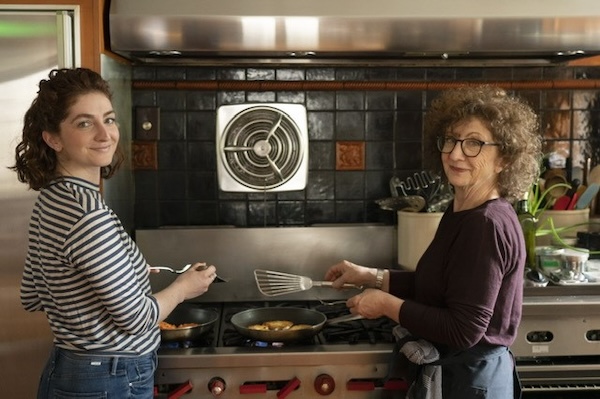
The mother-daughter duo of Bonnie Stern, right, and Anna Rupert brought this year’s L’dor V’dor lecture series to a flavourful conclusion last month. (photo from Bonnie Stern)

The mother-daughter cooking duo of Bonnie Stern and Anna Rupert brought the 2023-24 L’dor V’dor (From Generation to Generation) lecture series, hosted by Victoria’s Kolot Mayim Reform Temple, to a flavourful conclusion last month.

Emceed by former CBC television personality Anne Petrie, the hour-long presentation, Don’t Worry Just Cook: A Delicious Dialogue on Intergenerational Jewish Cuisine, shared their family’s culinary path, from Stern’s start as a chef to Rupert’s early childhood kitchen experiences as a 3-year-old making pies with her brother, through to the present.

“I always wanted my kids to feel comfortable in the kitchen and to want to be there, to help out or do whatever they wanted to do,” said Stern in a talk that explored the deeply tied relationship of Jewish food to culture and family.

“My mom would give us jobs in the kitchen when we were little,” said Rupert. “There was always a job for us if we wanted to participate, such as painting cookies, filling cookies or grating potatoes.”

In Stern’s view, cooking is a life skill – a person isn’t obligated to pursue a career in the culinary arts, but it is important for a person to know about food and to be able to cook. She added that her kids were fussy eaters, so the idea was, if they participated in the kitchen, they would eat what they made.

“Food without a story is just calories,” said Stern. And there were plenty of gastronomic tidbits to be told, often relating to the evolution of how variations on cooking are incorporated into family recipes.

For example, Stern’s mother had a technique for browning brisket at the end of the cooking process, rather than the beginning. And, at the current family dining table, as recognition of dietary intolerances became more widespread, there is a greater need to know how to prepare such items as gluten-free bread for a meal. Another way in which their family dinners have evolved is the move towards a contemporary buffet – guests are invited to move around and interact, creating even greater connections and more interaction than meals shared together in other ways.

More broadly, Stern explained how cuisine within a family alters when people move to another place. “It’s almost impossible to reproduce something the same way it was somewhere else. You don’t have the same equipment, the same ingredients or the same recipe. In the end, things change a little bit,” she said.

The topic of the diversity of Jewish cuisine arose. Both Stern and Rupert accentuated the myriad different dishes Jews have served up that go well beyond traditional Ashkenazi notions of matzah ball soup, blintzes and apple cake. Nowhere is that more true, they say, than in Israel, where cuisines from Jews around the world have converged in a land that has produced many talented and inventive chefs unafraid to take risks.

Some of the variations on traditional Jewish themes (mentioned in the talk and also found in their cookbook) were to do with Hanukkah dishes, specifically latkes served with guacamole and Middle Eastern sweet potato latkes, which may include hot sauce, cilantro and cumin.

Stern has studied and taught cooking around the world, written 12 cookbooks, hosted three nationally broadcast food shows and is a frequent television and radio guest around the country. She is also the founder of the eponymous Bonnie Stern School of Cooking in Toronto. Rupert, in her professional life, is a speech pathologist and researcher. 

Together, Stern and Rupert wrote Don’t Worry, Just Cook: Delicious Timeless Recipes for Comfort and Connection. With a foreword by Israeli-born chef Yotam Ottolenghi, the book goes beyond simply writing down recipes, to telling stories, giving lessons and sharing tips to improve readers’ skills and experiences in the kitchen. Rupert said she used to dream that the two would have a cooking show together. The publication of the book, in its own way, brought that desire to fruition.

Rupert credits the success of the book to her mother, whose vast amount of expertise as a cooking teacher allows her to anticipate questions a reader might have when following a recipe and offer productive advice and workarounds for potential hazards.

“Food has a unique way of connecting us to our roots and bringing generations together. We are excited to share our passion for Jewish cuisine and the joy it brings to families,” Stern said.

“Food and cooking are ways to find comfort, and definitely ways to connect with other people,” added Rupert. 

Sam Margolis has written for the Globe and Mail, the National Post, UPI and MSNBC.

Format ImagePosted on May 10, 2024May 8, 2024Author Sam MargolisCategories LocalTags Anna Rupert, baking, Bonnie Stern, cooking, Kolot Mayim

Ever-evolving notions

In a March 3 webinar, Rabbi Dr. Nachshon Siritsky reflected on understandings of the Divine and gender, exploring some of the ways that Judaism’s most ancient teachings can be relevant in current discussions. Their Zoom talk was part of this season’s L’dor V’dor: From Generation to Generation lecture series hosted by Victoria’s Kolot Mayim Reform Temple.

photo - Rabbi Dr. Nachshon Siritsky spoke on March 13 as part Kolot Mayim Reform Temple’s L’dor V’dor lecture series
Rabbi Dr. Nachshon Siritsky spoke on March 13 as part Kolot Mayim Reform Temple’s L’dor V’dor lecture series. (photo from Kolot Mayim)

Siritsky discussed the kabbalistic understanding of creation and humanity, which, they said, describes a process of progressive emanation, revelation, incarnation and embodiment. Whereas the standard concept of history, in the Western mind, is as a straight line of evolution, Jewish time is circular and cyclical, Siritsky explained, returning to the same points again and again, whether they be holidays or the weekly Torah portion.

More deeply, this is manifested in restorative practices such as teshuvah, which can be seen as forgiveness or returning to oneself. In other words, God works with people in completing the work of creation, and this happens through how we channel that light and energy into this world. “I firmly believe that the more we can reconnect with our ancestral wisdom that is contained in kabbalah, Jewish mysticism and tradition, the more we can work to liberate ourselves and realign with the larger rhythms of the universe,” Siritsky said.

Kabbalah, they explained, describes how there are two different ways that God’s energy flows through humans. It can flow through masculine and feminine aspects and each of us contains elements of both. Thus, our goal is to be in alignment with all the different ways in which God flows through us.

“The reason we were put on this planet was to complete the work of creation. When we do that, then we build within ourselves. The act of building is holy, but God dwells inside of us, not inside of our buildings,” Siritsky said. “The goal of our traditions, according to the rabbis, is this notion of making a place within our bodies for God to be present and to be expressed and to able to be articulated and shine forth back into the universe.”

Siritsky spoke about the notion of gender fluidity in Judaic texts. According to the rabbi, the Talmud identifies eight genders. “All eight of these are just the ways in which humans exist on this planet,” said Siritsky. “So, anyone who says that non-binary, agender or intersex doesn’t exist or is not Jewish is not fully speaking from the ancestral traditions of the Talmud and of our rabbis through the generations.”

Citing other theologians, Siritsky said we are always evolving in our understanding of who we are and what we know, and that we must make space to acknowledge that our spiritual understandings are also on that same path.

“Each of us, as we grow into ourselves and this world, we are always having to discard beliefs or understand them in new ways in that cyclical way that promotes healing and God’s progressive emanation into the universe and into ourselves,” they said.

Siritsky next addressed the use of they/them pronouns, arguing that, since the Talmud states that God speaks in human language, then we have to be constantly reinterpreting, re-translating and re-understanding what that language is in each generation – what is true in one generation may not be true in another.

“Ultimately, it leads us to this: we are created in the divine image and, when we see God in one another, we will know God,” Siritsky said, adding that the topic of gender diversity is not a new one in Judaism or other spiritual practices, and that binary thinking is not a Jewish way of thinking.

Siritsky pointed out that our understanding of God and gender is continually evolving, reflecting the ever-changing landscape of society and culture. “By exploring this evolution, we can better appreciate the richness and complexity of Jewish spirituality,” they said.

Siritsky is spiritual leader of the Reform Jewish Community of Atlantic Canada, serving all four Maritime provinces. Ordained by Hebrew Union College-Jewish Institute of Religion, they are also a board-certified chaplain with Neshama: Association of Jewish Chaplains, a social worker with advanced training from the Postgraduate Centre of Mental Health, and a doctorate in ministry and pastoral counseling with a focus on burnout in healthcare workers. 

The final talk in the 2023/24 L’dor V’dor series will take place April 7, 11 a.m., on Zoom. Cookbook author and food writer Bonnie Stern will, together with her daughter, Anna Rupert, present a talk titled Don’t Worry Just Cook: A Delicious Dialogue on Intergenerational Jewish Cuisine. Register for the free webinar at kolotmayimreformtemple.com.

For more information about Rabbi Siritsky, visit rabbinadia.com. 

Sam Margolis has written for the Globe and Mail, the National Post, UPI and MSNBC.
Posted on March 22, 2024March 20, 2024Author Sam MargolisCategories LocalTags education, gender, Judaism, kabbalah, Kolot Mayim, Nachshon Siritsky

A need to shift thinking

New approaches for getting younger generations to engage in communal Jewish life were put forward by Rabbi Mike Uram, the first-ever chief Jewish learning officer for Jewish Federations of North America, in a Zoom talk organized by Kolot Mayim Reform Temple in Victoria on Feb. 4.

Uram admitted he does not have a magic answer to the problem that has been confounding leaders of Jewish institutions for several years. Instead, he regards himself as a “provocateur” who stimulates novel thinking and a sense of possibility.

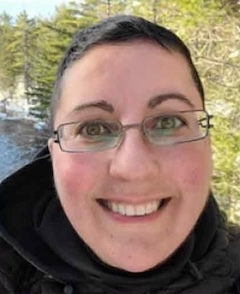
photo - Rabbi Mike Uram urges organizations to create new entry points and ways for Jews to connect with Jewish life
Rabbi Mike Uram urges organizations to create new entry points and ways for Jews to connect with Jewish life. (photo from Kolot Mayim)

He started by addressing Jewish communities and Jewish institutions, saying they no longer exist as they have in the past. He suggested that there is no longer the same power of gatekeeping and that the concept of who is a Jew has become more fluid. What may be seen as a community – through a synagogue, federation, university campus or geographic area – is, according to Uram, more accurately described as a network. 

“There’s something imprecise about the language, and that imprecision leads to imprecise strategies,” he said, adding that this view is more aligned with an operating system that was in place several decades ago. “And the operating system, which was perfectly aligned with the North American Jewish population in the 1950s and 1960s, is now almost perpendicular with the ways that North American people and Jews access almost everything else in their lives.”

Using television viewing patterns as an example, Uram demonstrated a shift from “macro-communities to micro-communities.” That is, in the 1950s, close to three-quarters of the American public watched an episode of the hit show I Love Lucy at the same time. Today, a successful show might obtain a viewership in single-digit percentages. 

A similar pattern can be identified in Jewish circles, if one were to observe the steep decline in the numbers of Jews affiliated with a synagogue today as opposed to the 1960s, he said. The drop is not singular to Jewish groups; a corresponding fall in institutional engagement has occurred across a range of civic and political organizations.

More broadly, people are spending less time out of the house and have fewer friends than in previous generations. As well, with social media and streaming services’ algorithms, people are now living more in “customized little bubbles.” To solve this dilemma, Uram proposed a change in the language and thinking used by institutions to bring the unaffiliated into their realm. 

“When we say us and them, we’re thinking we’re the core, they’re the periphery. We’re involved, they’re uninvolved. We’re affiliated, they’re unaffiliated. The problem with that thinking is [that] it is measuring Jewish identity on a very linear and highly judgmental spectrum,” Uram said.

The challenge, too, with this institutional mindset, he argued, is that people do not wake up each day thinking they are an uninvolved or unaffiliated Jew and wondering how they can become more involved or affiliated. In fact, he said, many have a negative stereotype of organizational Judaism, as a place they feel judged and like an outsider.

Nonetheless, Jews not participating in institutional Jewish life are no less proud of being Jewish.

“They don’t feel broken,” Uram said. “They don’t feel like they need a synagogue or a federation to fix them. What has changed in American life is that, as affiliation rates have gone down, positive Jewish feelings have actually gone up.” Many Jews are interested in Judaism but not affiliation, he said. Hence, rather than focusing on programming and marketing, institutions should concentrate on building relationships, he said.

While emphasizing that he is not disparaging affiliation, Uram urges organizations to create new entry points and ways for Jews to connect with Jewish life.

“It’s a one-on-one conversation, and it’s more like community organizing than it is like traditional programming,” he said, noting that the organized Jewish community can often function like a taxicab in the age of ride-hailing companies or network television when there are streaming services.

“We’re not in the business of preserving network television,” he said. “We’re in the business of changing people’s lives with amazing shows. So, we should be doing anything we can do to get people to interact with the magic and the power and the wisdom of Jewish values.”

Another issue within a community is infrastructure, such as buildings, staff and program calendars, said Uram. Here, he advocates a change in philosophical approach, focusing on impact over affiliation.

“Spending a little bit more time talking about how we’re going to make a difference in people’s lives, rather than how they can help us keep the organization strong, will trickle down and change the way emails are written, the way the website looks, the way people are greeted,” he said.

Towards the end of his talk, Uram threw some questions out to institutions, asking if they were in the synagogue preservation business, the program planning business, the membership business or the transforming people’s lives business.

“My guess is they do not say that our mission is to make sure that the next generation of Jews joins. It probably says that they’re going to engage in Judaism in a way that transforms them and the world, that makes them feel closer to community and that helps them live more enriched lives, and all those things,” Uram said.

If organizations are to meet the challenges and take advantage of the opportunities offered in the future, they must understand the perspectives of the next generation, he said. Millennials, he added, bring with them their own insights and values that can “guide the future of Judaism in exciting ways.”

Uram is a former executive director of Hillel at the University of Pennsylvania and the author of the 2016 book Next Generation Judaism: How College Students and Hillel Can Help Reinvent Jewish Organizations, which received a National Jewish Book Award. He was speaking as part of Kolot Mayim’s 2023/24 Building Bridges Speaker Series. On March 3, Rabbi Dr. Nachshon Siritsky, spiritual leader of the Reform Jewish Community of Atlantic Canada, will talk on the topic Our Evolving Jewish Understanding of G!d and Gender. To register, visit kolotmayimreformtemple.com. 

Sam Margolis has written for the Globe and Mail, the National Post, UPI and MSNBC.
Format ImagePosted on February 23, 2024February 22, 2024Author Sam MargolisCategories LocalTags affiliation, community organizing, future, history, Jewish communal life, Jewish Federations of North America, Kolot Mayim, Mike Uram
Past trauma can help us

Past trauma can help us

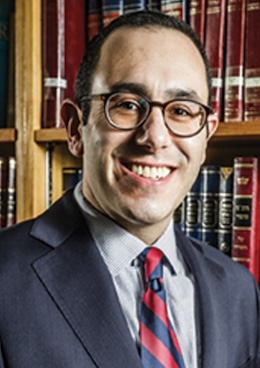
Rabbi Dr. Tirzah Firestone spoke in a Zoom webinar hosted by Victoria’s Kolot Mayim Reform Temple on Jan. 14. (PR photo)

Rabbi Dr. Tirzah Firestone unraveled intergenerational trauma, and offered solutions to help remedy it, in a Zoom webinar hosted by Victoria’s Kolot Mayim Reform Temple on Jan. 14. Firestone, the author of the award-winning 2019 book Wounds into Wisdom: Healing Intergenerational Jewish Trauma, is a Jungian psychotherapist and a leader in the Jewish Renewal movement.

“When I was first approached by Kolot Mayim last year to present this talk, nobody had any idea of the life-changing events that we would be experiencing,” Firestone began, acknowledging the geopolitical developments on and after Oct. 7. “Nor did I ever fathom when I wrote Wounds into Wisdom that it would be so very painfully relevant today in the midst of historical traumas in the making.”

An objective of the January talk was to address traumas experienced by one’s ancestors that get transmitted onto future generations in the form of fears, anxieties and hopelessness. Firestone’s goal is to help current generations “metabolize life better” so that the damaging psychological effects of trauma are not extended to future generations. In other words, those who come after should experience life from a position of resilience and hopefulness.

Firestone, who currently lives in Boulder, Colo., spoke about her own parents, who were deeply impacted by the Shoah – her mother as a German survivor and her father as an American soldier stationed in Germany.

“The past does not disappear. The painful histories our ancestors endured, along with their warmth, resilience and all their good resources, are intertwined within us, both psycho-spiritually as well as physically and physiologically,” said Firestone. “And they create the patterns of who we are and who we are becoming.”

Along these lines, the pain from trauma can be unspoken over the course of generations, yet becomes part of the individual nonetheless. Or, as in a quote from Israeli psychologist Dan Bar-On, cited by Firestone: “Untold stories often pass on more powerfully from generation to generation than stories that can be recounted.”

Ongoing patterns, whether ones of heroism and activism or depression and anxiety,  are transmitted across generations.  A young woman Firestone worked with, for example, became an activist, not knowing it ran in the family – her grandmother and great-aunt, neither of whom she had ever met, were rebels in their shtetl decades earlier.  

Another example involved a woman whose very first memories as a young child were nightmares. One night, she explained to her concerned mother why she would wake up crying so often. The image in the young child’s mind was of an old wooden town where a man at the train station would jump from the platform to the train tracks. The man would run along the tracks yelling, “Stop! Stop!”  The train would go on with the young man unable to catch it. 

When the mother heard her child’s story, she cried and asked in disbelief, “How could you possibly have known this?” It was the story of the child’s grandfather who, in the Second World War, found out belatedly that Jews in his town, including his young family, had been rounded up and deported by train. He ran after the train, but never caught up and never saw his family again. The man survived the Holocaust and started a new life and family in the United States.

Traumas can happen collectively.  Firestone noted that Israeli journalist Chemi Shalev wrote, “I am a Jew, and there are scenes of the Holocaust that are indelibly etched in my mind, even though I was not alive at the time.”

Firestone also outlined research conducted by Rachel Yehuda of New York’s Mount Sinai Hospital, which showed that the children of Holocaust survivors were three times more likely to develop post-traumatic stress disorder symptoms when exposed to traumatic events than the children of other Jews.

In the latter part of her talk, Firestone focused on what can be done towards healing trauma. Every family has its own ruptures and resources, no matter who or where it is, she said. Whether through intelligence, resilience or good fortune, every family today is a survivor. Thus, she asked, “What family resources can you tap to assist you in this current moment in history?”

Among some of the keys she highlighted for healing trauma, and which are discussed in greater depth in her book, is being aware of family legacies. This awareness, she asserts, will hinder the transmission of trauma to succeeding generations.

Another is to face one’s losses. “When we face our grief, we can start to feel our grief. When we don’t feel our grief, it becomes pathogenic. It makes disease on the inside of us,” she said.

A third technique for healing, according to Firestone, is “to harness the power of one’s pain.” That is, one can use the tremendous power contained in pain to bring on more destruction and further pain or to bring light, warmth and hope.

Firestone advised taking action. Here she employed a saying from Midrash: “Had I not fallen, I would not have arisen. Had I not been subject to darkness, I would not have seen the light.”

In concluding her remarks, Firestone said, “We have a mandate to draw on our ancestors’ greatest traits – their survival skills, their courage, their ingenuity – to apply to circumstances now. There are so many people who are suffering. What can we do from our own pain by harnessing its power and going places that we could not have gone before we endured [it]?”

For more on Firestone and her writings and ideas, visit tirzahfirestone.com. 

To register for future Kolot Mayim speaker series Zooms, the next of which takes place Feb. 4, click here.

Sam Margolis has written for the Globe and Mail, the National Post, UPI and MSNBC.
Format ImagePosted on January 26, 2024January 24, 2024Author Sam MargolisCategories LocalTags healing, intergenerational trauma, Kolot Mayim, resilience, Tirzah Firestone, wisdom

Jewish comedy history

“Jews have always turned and continue to turn to humour as a cultural touchstone and a way to make meaning,” said Dr. Jennifer Caplan, author of Funny, You Don’t Look Funny: Judaism and Humor from the Silent Generation to Millennials, which was published earlier this year.

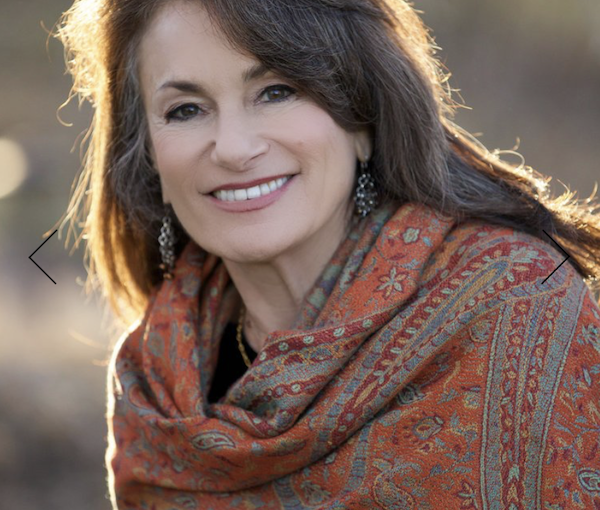
photo - Dr. Jennifer Caplan spoke Dec. 3, as part of the L’dor V’dor lecture series organized by Victoria’s Kolot Mayim Reform Temple
Dr. Jennifer Caplan spoke Dec. 3, as part of the L’dor V’dor lecture series organized by Victoria’s Kolot Mayim Reform Temple. (photo from Kolot Mayim)

Caplan, who is an associate professor and the Jewish Foundation Chair in Judaic Studies at the University of Cincinnati, was the second presenter of the 2023-24 L’dor V’dor (Generation to Generation) Zoom lecture series organized by Victoria’s Kolot Mayim Reform Temple. On Dec. 3, she spoke about the past several decades of Jewish humour. Similar to the approach she took for her book, her presentation explored the changing relationship to Judaism of four generations of Jewish funny people.

According to a 2013 report by the Pew Foundation, called A Portrait of American Jews, 42% of American Jews thought that having a sense of humour was integral to their Jewish identity, said Caplan. In the survey, in terms of what American Jews deemed important to their identity, a sense of humour came out far behind Holocaust remembrance and intellectual curiosity, just under support of Israel, and well ahead of belonging to a Jewish community or eating traditional Jewish food.

“The report set off little bells in my brain which pushed me to say that there’s something here and that there’s something I want to think about,” she said.

There were Jewish commentators who pointed to the Pew survey as an alarm bell for the dangers of the rise of cultural Judaism. To Caplan, the TV show Seinfeld, which premièred in 1989, encapsulated what worried some about the culturally Jewish experience.

“It was this group of people who seemed Jewish, even though Jerry (the title character) is the only character on the show who is actually Jewish,” she said. “They all sort of felt Jewish, but they never did anything Jewish and nobody ever went to synagogue and they didn’t even have a menorah like Rachel and Monica did in their apartment on Friends.”

In Caplan’s view, this fear of cultural Judaism aligned with the way that Jews were being portrayed in popular comedy and media, as Seinfeld led to a boom in Jewish sitcom characters – in shows like Mad About You and Anything but Love, for example. She thought there was something important in the way Jewish comedians were using Judaism in their humour to think about themselves and their Jewish identity, and what it means for them to be Jewish.

Moving forward to the present and, according to Caplan, one finds that the younger generation, the millennials, are even more culturally tied to their American generational cohort and less so to being the grandchild or great-grandchild of Jewish immigrants.

“It’s a story about comedy and it’s a story about the way that Jewish comedians have related to Judaism in their comedy, but it’s also a story about Americanization. It is a story about the way that Jews in the United States became more and more embedded within their broader cultural milieu,” Caplan said, explaining the thought process that led her to write her book.

Caplan pointed out that counterculture, in Jewish comedy, was represented in the 1950s – a time generally associated in the popular sense with Leave It To Beaver and The Adventures of Ozzie and Harriet – by books like those by Philip Roth. His works, well before the broader 1960s counterculture movement, were critical of institutions but defensive of the Jewish community – viewing organized religion as something that was hurting Jews, but seeing the need for Jews to be protected.

What intrigued Caplan was that the pendulum had swung in the other direction for Generation X. “What I found was a fascinating reincorporation of Jewish ritual into the writing and the movies and the comedy of Generation X comedians. Jews themselves are being made fun of, but their engagement with Judaism is actually the thing that humanizes them,” she said.

In the 2001 film Kissing Jessica Stein, for example, the characters can be perceived as stilted, neurotic, self-absorbed Jewish caricatures, yet scenes at a Shabbat dinner and a wedding ground the characters and are not the subject of ridicule.

“It’s not that Generation X suddenly believes in God more than the previous generations did. It’s that they believe more in the power of ritual and tradition because it binds you. You’re not doing it necessarily because you have some sort of theological belief,” Caplan said.

As for millennials, among whom the oldest in the cohort is presently 42 years old, their story is still being written, she said. 

“It seems as though they are willing to ridicule both Jewish identity and Jewish religious interaction at various times, depending on what suits the comedy,” she said. “They neither have a sense of oppression about their Judaism, nor do they have a sense of embarrassment about their Judaism.”

Caplan is currently researching and writing her next book, Unmasked: Jewish Identity in Comic Books.

The next speaker in the L’dor V’dor series is psychotherapist and author, and member of the second generation, Rabbi Dr. Tirzah Firestone on Jan. 14. Firestone will talk on the topic Healing Intergenerational Jewish Trauma. For more information, visit kolotmayimreformtemple.com. 

Sam Margolis has written for the Globe and Mail, the National Post, UPI and MSNBC.
Posted on December 15, 2023December 14, 2023Author Sam MargolisCategories LocalTags comedy, culture, history, Jennifer Caplan, Judaism, Kolot Mayim

Genealogy a great motivator

On Nov. 5, Dr. Joshua Grayson, a genealogist specializing in Jewish families from Central and Eastern Europe, was the lead-off speaker for the 2023-24 L’dor V’dor (Generation to Generation) lecture series on Zoom, organized by Victoria’s Kolot Mayim Reform Temple.

Grayson is the founder of Lost Roots Family History, a website, virtual museum and research service devoted to helping Jewish families reconnect with their roots, discover their past, engage with the present and preserve their heritage for the future.

Titled In Search of Lost Roots, Grayson’s talk elaborated on how he was able to trace his family history across three-and-a-half centuries, or 10 generations, to approximately 1650. Proficient in many historical scripts, he has conducted genealogical research in German, Russian, Polish, Hebrew, Yiddish, French and Spanish.

“There’s truly an astonishing amount of information out there,” Grayson said. “With a combination of computer research, language skills, a lot of perseverance and just the right amount of luck, the depth of information you can find about your family history can be simply astounding.”

photo - Dr. Joshua Grayson, founder of Lost Roots Family History, launched this season’s L’dor V’dor lecture series, organized by Victoria’s Kolot Mayim Reform Temple
Dr. Joshua Grayson, founder of Lost Roots Family History, launched this season’s L’dor V’dor lecture series, organized by Victoria’s Kolot Mayim Reform Temple. (photo from Kolot Mayim)

Grayson’s interest in family history started at a young age, when visiting his grandparents’ home and being captivated by a photo at the bottom of their staircase. Taken in 1904, it depicted his grandfather’s grandparents and the first five of their 10 children, including his great-grandmother at the age of 11.

“To my childish imagination, I was sure I could almost feel their presence looking over me and their other descendants. At times like these, I would muse at how my close connection with my grandfather was similar to his connection with the people in this photograph. And so on down the unbroken chain of time,” he said.

As a child, Grayson remembers, he was fascinated by the notion of all the people to whom a person could be related.

He recounted later honing his research skills at the University of Southern California, where he earned a PhD in historical musicology – skills, he said, that are particularly well suited to genealogy. They include gathering historical evidence, evaluating sources and communicating ideas.

When he typed in the name of one of section of his ancestry, Penzias, into a database on the Gesher Galicia website, Grayson said, “I quickly discovered records from as early as 1805 because our family name happens to be unique. I felt fairly sure that these were long forgotten family members.”

He said, “These databases allowed me to accomplish in just a few minutes what would otherwise have taken months or years of digging through archives, scanning old record books or microfilms one record at a time.”

As a side note, Grayson stressed that creativity with spelling can be helpful, as names were not written in a standardized way until much later into the 19th century and even into the early 20th century. Although most databases use technology to automatically include names that are spelled in similar ways, the technology is not perfect.

The Zoom lecture brought to light the remarkable and inventive methods of deduction Grayson employed to ascertain his own ancestry – from an egg merchant to a Cubist painter – and the sorts of investigations he performs to uncover the family histories of those who request his services, all while conveying an infectious enthusiasm for Jewish genealogy.

As an example of his research, Grayson spoke about a client who knew nothing of her family history other than her father was from Lublin and lost his entire family in the Holocaust. Grayson was able to trace the client’s father’s family back to 1750 and followed her family members as they moved around rural Poland and to Lublin in the 1880s. He discovered relatives who fought against the Nazis with the underground resistance and, ultimately, connected her with previously unknown family members on five continents.

Grayson is currently in the final stages of constructing a text database of the names of people buried in the Old Jewish Cemetery in Prague. The database is based on two 19th-century efforts to preserve names on the tombstones, one of which was published in a book in 1880 and the other of which appears on the website of the Jewish Museum in Prague.

Commissioned by E. Randol Schoenberg, the former president of Holocaust Museum LA, formerly the Los Angeles Museum of the Holocaust, Grayson’s database will cover the names, death dates and, in some cases, biographical details of approximately 15,000 Jews who died in Prague between 1437 and 1787.

“In my experience,” said Grayson, “I’ve found that finding out about family history can be a great way to get people more involved in Judaism. Understanding where we came from and the historical forces that shaped our own families can be a powerful motivator to exploring our Jewish identity.”

For more information about Grayson and his work, visit lostrootsfamilyhistory.com.

Kolot Mayim’s next Zoom speaker will be Dr. Jennifer Caplan, associate professor and chair of Judaic studies at the University of Cincinnati and author of Funny, You Don’t Look Funny. Her talk – titled Jewish Humour from the Silent Generation to Millennials – will take place on Dec. 3, at 11 a.m. To register, and for the full lineup of speakers, visit kolotmayimreformtemple.com.

 Sam Margolis has written for the Globe and Mail, the National Post, UPI and MSNBC.
Posted on November 24, 2023November 23, 2023Author Sam MargolisCategories LocalTags family history, genealogy, Joshua Grayson, Kolot Mayim, speaker series

Posts pagination

Previous page Page 1 Page 2 Page 3 Page 4 Next page
Proudly powered by WordPress