Skip to content
  • Home
  • Subscribe / donate
  • Events calendar
  • News
    • Local
    • National
    • Israel
    • World
    • עניין בחדשות
      A roundup of news in Canada and further afield, in Hebrew.
  • Opinion
    • From the JI
    • Op-Ed
  • Arts & Culture
    • Performing Arts
    • Music
    • Books
    • Visual Arts
    • TV & Film
  • Life
    • Celebrating the Holidays
    • Travel
    • The Daily Snooze
      Cartoons by Jacob Samuel
    • Mystery Photo
      Help the JI and JMABC fill in the gaps in our archives.
  • Community Links
    • Organizations, Etc.
    • Other News Sources & Blogs
    • Business Directory
  • FAQ
  • JI Chai Celebration
  • JI@88! video

Recent Posts

  • Sharing her testimony
  • Fall fight takes leap forward
  • The balancing of rights
  • Multiple Tony n’ Tina roles
  • Stories of trauma, resilience
  • Celebrate our culture
  • A responsibility to help
  • What wellness means at JCC
  • Together in mourning
  • Downhill after Trump?
  • Birth control even easier now
  • Eco-Sisters mentorship
  • Unexpected discoveries
  • Study’s results hopeful
  • Bad behaviour affects us all
  • Thankful for the police
  • UBC needs a wake-up call
  • Recalling a shining star
  • Sleep well …
  • BGU fosters startup culture
  • Photography and glass
  • Is it the end of an era?
  • Taking life a step at a time
  • Nakba exhibit biased
  • Film festival starts next week
  • Musical with heart and soul
  • Rabbi marks 13 years
  • Keeper of VTT’s history
  • Gala fêtes Infeld’s 20th
  • Building JWest together
  • Challah Mom comes to Vancouver
  • What to do about media bias
  • Education offers hope
  • Remembrance – a moral act
  • What makes us human
  • המלחמות של נתניהו וטראמפ

Archives

Follow @JewishIndie
image - The CJN - Visit Us Banner - 300x600 - 101625

Tag: Jewish Federation of Greater Vancouver

Investing in our futures

Investing in our futures

Left to right are Stephen Gaerber (Jewish Federation of Greater Vancouver board chair), Mayor Ilan Orr of Yesod Hamaaleh, Mayor Rabbi Nissim Malka of Kiryat Shmona, Mayor Giora Saltz of Galil Elyon, Vancouver Deputy Mayor Andrea Reimer, Mayor Binyamin Ben-Muvchar of Mevoot Hahermon and Ezra Shanken (Federation CEO). (photo by Rhonda Dent courtesy of JFGV)

One of the goals of the Jewish Federation of Greater Vancouver is to strengthen the community’s partnership region in Israel, Etzbah HaGalil (the Galilee Panhandle). The efforts of Federation are combined with five other Jewish communities across Canada (Atlantic Canada, Ottawa, Winnipeg, Calgary and Edmonton). Known as the Partnership2Gether (P2G) Coast-to-Coast initiative, this is the framework on which relationships between the people of Etzbah HaGalil and these communities of Canada are built and strengthened. The relationships foster a love of Israel and a long-term commitment to Jewish peoplehood, promoting the growth and health of each community involved.

The P2G Coast-to-Coast’s partnership is governed by a joint steering committee comprised of representatives from five Israeli and six Canadian partner cities, and Federation recently hosted the committee’s biannual meetings from June 15-17. Representatives from the local community included Stephen Gaerber, national chair of the Coast-to-Coast partnership; Karen James, chair of the Israel and overseas committee and P2G; and Pam Wolfman, chair of the local Gesher Chai (Living Bridge) committee. The meetings were an opportunity for representatives from Israel and across Canada to review funded projects together and explore potential investments in Etzbah HaGalil’s ongoing progress in three key areas: youth and education, the Gesher Chai program (which includes people-to-people exchanges between the two countries) and capacity building (social programming and regional development).

Etzbah HaGalil is geographically, economically and politically isolated. Residents often miss out on the social, educational and employment opportunities available to those living in central Israel. Through P2G, Federation strategically invests funds to reverse the north’s overall vulnerability by laying foundations for community resilience, emergency preparedness and economic growth.

One of the many projects in which Federation is investing is a new initiative called Green Farms, which develops and supports organic farming in the region. Through a partnership with the Centre for Sustainable Food Systems at the University of British Columbia Farm, two professors mentor and work closely with Israeli farmers; they have been to Israel and will be going again. During the recent P2G meetings, committee members visited UBC Farm to see their environmentally responsible farming project. Committee members were surprised to discover such a beneficial program in our own backyard. “I was impressed by the extent of the farm, the diversity of plants grown, and how they are mentoring some Israeli farmers,” shared James. The goal of the program is to build a healthier, more sustainable food system in northern Israel. Program like this are a key focus of the partnership and of Federation’s investment.

Format ImagePosted on July 10, 2015July 8, 2015Author Jewish Federation of Greater VancouverCategories LocalTags Diaspora, Israel, Jewish Federation of Greater Vancouver, JFGV, P2G, Partnership2Gether, UBC Farm
JDC delivers aid, relief

JDC delivers aid, relief

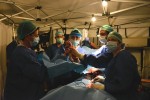
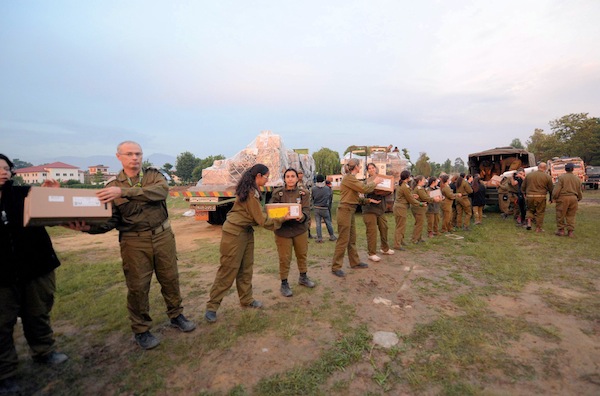
Israel is contributing to efforts to aid and assist the Nepalese government to reach, rescue and treat injured victims of the recent earthquake. The IDF has set up a comprehensive field hospital and also has flown out emergency rations and tents. (photos by IDF via Ashernet)

After Nepal was hit by the biggest earthquake in 80 years, the American Jewish Joint Distribution Committee (JDC) is aiding thousands of survivors through its relief efforts with partners on the ground, and is dispatching its disaster relief team from Kathmandu to remote villages to deliver aid and assess emerging needs in hard-hit areas. The team is assisting in the delivery of first-aid and shelter supplies, hygiene items, oral re-hydration solution, food packages and other supplies to 1,400 families over the coming days.

“Even while we’re helping survivors to heal throughout Nepal, we know more must be done and urge the public to continue its generous support of critically needed relief in this devastated country,” said Mandie Winston, director of JDC’s International Development Program. “Millions of Nepalese are facing harrowing conditions and the need for their immediate care, recovery and reconstruction efforts is required to secure Nepal’s future. Our efforts are focused on that path and to ensure the dignity of every human life along the way.”

photo - JDC disaster response team delivers aid in NepalTo date, JDC has operated on three fronts in Nepal: the deployment of its expert disaster relief team on the ground; the support of locally based partners to ensure medical care and relief supplies within days of the quake; and the packing and shipping of medical and humanitarian supplies from the United States. These efforts have ensured life-saving medical treatment, food, clean water and shelter for Nepalese victims still reeling from the disaster. It has also enabled the assessment of needs and delivery of aid in real time, in tandem with changes on the ground, and the coordination of JDC’s network of local and international non-governmental partners working in Nepal.

These partners include the IDF Field Hospital, Tevel b’Tzedek, UNICEF, the Afya Foundation, the All India Disaster Mitigation Institute, Sarvodaya – Teach for Nepal, Heart to Heart International and Magen David Adom.

JDC has provided immediate relief and long-term assistance to victims of natural and man-made disasters around the globe, including the Philippines, Haiti, Japan and South Asia after the Indian Ocean tsunami, and continues to operate programs designed to rebuild infrastructure and community life in disaster-stricken regions.

JDC’s disaster relief programs are funded by special appeals of the Jewish Federations of North America and tens of thousands of individual donors to JDC. JDC coordinates its relief activities with the U.S. Department of State, USAID, Interaction, the Israeli Foreign Ministry, Israeli agencies and the UN coordination mechanism OCHA.

To contribute to the Nepal relief efforts, contact Jewish Federation of Greater Vancouver at 604-257-5100 or visit jewishvancouver.com/nepal-relief-fund.


Format ImagePosted on May 15, 2015May 14, 2015Author American Jewish Joint Distribution CommitteeCategories WorldTags earthquake, IDF, Israel, Israel Defence Forces, JDC, Jewish Federation of Greater Vancouver, Nepal

Record for campaign

The 2014 Jewish Federation annual campaign has closed with a record achievement of $8 million, which is an increase of $290,000 from last year. Funds will support critical programs and services on which thousands of community members rely.

Harvey Dales, general chair of the campaign, said it is “a true community achievement – for our community, and by our community. I remain amazed and inspired by this community and the support received from thousands of donors and hundreds of volunteers. In fact, 93% of the total was raised by volunteer canvassers, who contacted their fellow community members to discuss how they could help address the needs of our Jewish community. Despite ever-increasing demands made on us all, the love and generosity that our donors bestow on those in need of a little more support is astounding. This incredible $8 million achievement is significant, particularly in terms of the people, programs and institutions that will benefit from our commitment to tzedaka.”

One of the keys to success was a fund that saw donors’ new and increased gifts doubled through a matching gifts program supported by several major donors. This helped inspire many donors to make first-time gifts to the campaign or to increase their gifts, and helped the campaign reach its record.

Jewish Federation was named a top 20 charity in British Columbia by the Vancouver Sun in 2012 – the most recent rankings to date – and scored particularly well with respect to its low administrative and fundraising costs. Canada Revenue Agency guidelines indicate the cost of fundraising should be below 35%, but Jewish Federation’s is below this with a net cost of fundraising for the 2014 annual campaign of 12.5%.

From the pages of the JI

Jewish Federation of Greater Vancouver describes itself as an organization “committed to strengthening the quality of Jewish life locally, in Israel and around the world, and to creating a vibrant, caring and inclusive community. Its work is inspired by the Jewish values of tikkun, tzedaka, klal Israel and chesed,” working “in collaboration with many partners locally, nationally and abroad. Its efforts are combined with other Jewish communities in Canada through Jewish Federations of Canada-United Israel Appeal, and in Israel through Keren Hayesod-United Israel Appeal and the Jewish Agency for Israel.”

Federation has been around longer than most of us, and the JWB/JI has been reporting on its activities from the very beginning.

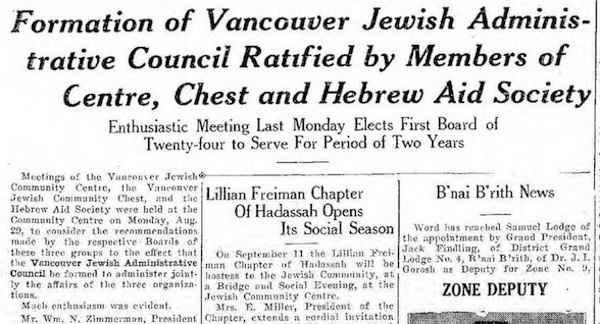
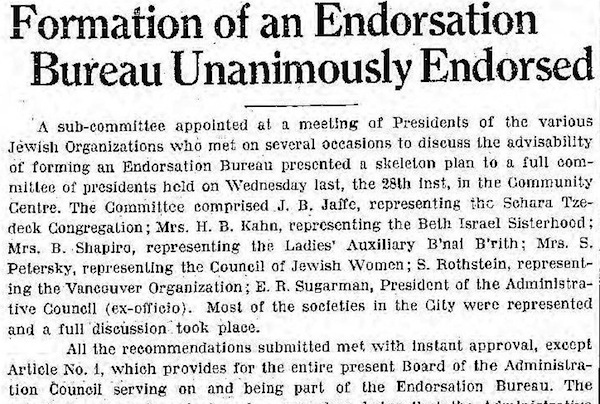
The Sept. 1, 1932, JWB reports on the creation of the “Formation of Vancouver Jewish Administrative Council Ratified by Members of Centre, Chest and Hebrew Aid Society.” The subheading reads, “Enthusiastic Meeting Last Monday Elects First Board of Twenty-four to Serve For Period of Two Years.” A year later, in July 1933, the JWB reported, “Formation of an Endorsation Bureau Unanimously Endorsed.” The full text of both articles follows.

From the JWB, 1932
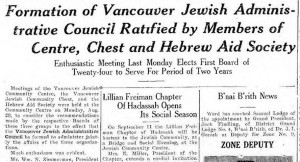
photo - The Sept. 1, 1932, JWB reports on the creation of the “Formation of Vancouver Jewish Administrative Council Ratified by Members of Centre, Chest and Hebrew Aid Society.”Meetings of the Vancouver Jewish Community Centre, the Vancouver Jewish Community Chest, and the Hebrew Aid Society were held at the Community Centre on Monday, Aug. 29, to consider the recommendations made by the respective Boards of these three groups to the effect that the Vancouver Jewish Administrative Council be formed to administer jointly the affairs of the three organizations.

Much enthusiasm was evident.

Mr. Wm. N. Zimmerman, President of the Vancouver Jewish Community Centre, opened the meeting, convened as the Community Centre meeting. He explained briefly the purpose of the meeting, and the advantages to be derived through amalgamated administration, not only in the saving of administrative costs, but in the conservation of time and energy of the workers in the community. He stated, “This amalgamation of administration will not only save money for the three organizations, but will avail for us the best men and women power of the city, that will administer the affairs of the three Boards jointly.”

Upon motion by Dr. S. Petersky, and seconded by L. Gorosh, the members of the Vancouver Jewish Community Centre ratified the recommendation of their Board of Governors, and approved the formation of the Vancouver Jewish Administrative Council.

Following this motion, the meeting of the Jewish Community Centre adjourned, and the Vancouver Jewish Community Chest meeting was called to order.

In the absence of Mrs. M. Koenigsberg. President of the Vancouver Jewish Community Chest, Mr. Wm. N. Zimmerman was requested to preside at the Chest meeting.

The Trustees of the Community Chest, through their acting chairman, Mr. Zimmerman, brought before their members their recommendation as follows: “The Trustees of the Vancouver Jewish Community Chest recommend the formation of the Vancouver Jewish Administrative Council, for the purpose of jointly administering the affairs of the Vancouver Jewish Community Centre, the Vancouver Jewish Community Chest, and the Hebrew Aid Society.”

After considerable discussion by members of the Chest, regarding the proposed amalgamation of administration, and after the Constitution of the Administrative Council was read by Mr. E.R. Sugarman, it was unanimously resolved by the Chest members “That the Vancouver Jewish Administrative Council be formed to jointly administer the affairs of the Vancouver Jewish Community Centre, the Vancouver Jewish Community Chest, and the Hebrew Aid Society.” The Chest meeting then adjourned.

Mr. M. L. Greene, President of the Hebrew Aid Society, was called to preside at the meeting, convened as the Hebrew Aid Society. His interpretation of the situation was that the Hebrew Aid Society would remain intact under the advisorship and control of the Administrative Council. After considerable discussion as to the status of the respective organizations under the Administrative Council, the vote was taken, and the Hebrew Aid Society approved the recommendation of their trustees, “That the Vancouver Jewish Administrative Council be formed to jointly administer the affairs of the Vancouver Jewish Community Centre, the Vancouver Jewish Community Chest, and the Hebrew Aid Society.”

Following the motion, the meeting of the Hebrew Aid Society was adjourned, and Mr. W.J. Levin, acting chairman of the Vancouver Jewish Administrative Council, presided.

Mr. Levin stated, “This Administrative Council is created for the welfare of the Jewish Community in Vancouver. The men and women who in the past were able to give freely of their time to communal activities, are now forced to devote a large part of their time to business owing to the depressed economic conditions prevailing. Organizations in the city have been suffering through lack of proper workers. This joint administration will not only save administrative costs, but will conserve and co-ordinate the time and energy of the volunteers. We will unite as one, and work for a common purpose, the welfare of the Community.”

Mr. E.R. Sugarman moved that the constitution as read be adopted for the Vancouver Jewish Administrative Council. This motion was seconded by Dr. Petersky, and carried.

Nominations

The Chairman explained that under the Constitution as adopted, a Board of 24 must be elected and that the sub-committee working out plans for the formation of the Vancouver Jewish Administrative Council have nominated 21 names for election. To this list could be added nominees from the floor. The enthusiasm of the meeting was so great that thirty names were nominated, and those elected to the first Board of the Vancouver Jewish Administrative Council are as follows: M.H. Brotman, Sam Chess, Mrs. Nellie GeShaye, E.M. Goldsmith, L. Gorosh, M.L. Greene, A.G. Hirschberg, Mrs. H.B. Kalin, I.J. Klein, A.O. Koch, Mrs. M. Koenigsberg, J.L. Kostman, J.J. Lechtzier, P. Lesser, N.C. Levin, W.J. Levin, Mrs. H.A. Nemetz, J. Reed, H. Rosenbaum, S. Rothstein, I. Stein, E.R. Sugarman, Wm. N. Zimmerman and H.B. Kahn.

***

From the JWB, 1933
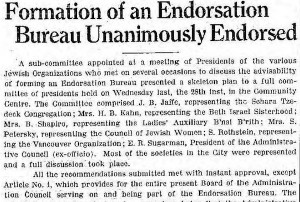
image - , In July 1933, the JWB reported, “Formation of an Endorsation Bureau Unanimously Endorsed.”A sub-committee appointed at a meeting of Presidents of the various Jewish Organizations who met on several occasions to discuss the advisability of forming an Endorsation Bureau presented a skeleton plan to a full committee of presidents held on Wednesday last, the 28th inst, in the Community Centre, The Committee comprised J.B. Jaffe, representing the Schara Tzedeck Congregation; Mrs. H.B. Kahn, representing the Beth Israel Sisterhood; Mrs. B. Shapiro, representing the Ladies’ Auxiliary B’nai B’rith; Mrs. S. Petersky, representing the Council of Jewish Women; S. Rothstein, representing the Vancouver Organization; E.R. Sugarman, President of the Administrative Council (ex-officio). Most of the societies in the City were represented and a full discussion took place.

All the recommendations submitted met with instant approval, except Article No. 1, which provides for the entire present Board of the Administration Council serving on and being part of the Endorsation Bureau. The principal argument against such a procedure being that the Administrative Council was elected for the specific purpose of administering the affairs of the Hebrew Aid, The Jewish Community Centre and the Community Chest, and with a representation of twenty-four members they would have increased powers for which their constitution did not provide, and which would enable them if they so desired to veto any project brought before them by the increased new representatives. The Chairman, Mr. E.R. Sugarman, explaining that by virtue of the newly formed organization each new member elected would have a seat of the Administrative Board and become part and parcel of the Board. If it were, however, necessary he felt that the Board though elected for two years (of which they had only served one) would be willing to resign en masse and that a new election could take place and such alterations as were necessary would be made in the Constitution of the Administrative Council at a meeting of Contributors specially called for that purpose.

This explanation seemed to allay the objections raised and on a vote being taken every representative present voted unanimously [in] its favor. It was further arranged that the plan be submitted to a mass meeting on Sunday, July 30, at which meeting the delegates of the Western Conference in Winnipeg would be present and submit their report.

Report of the Sub-Committee

We, the Sub-Committee appointed by the Chairman, E.R. Sugarman, to bring in a skeleton plan for the formation of an Endorsation Bureau in Vancouver, DO HEREBY BEG TO STATE that we have seriously considered the question from all angles and make the following recommendations to you:

  1. That the existing organization, known as the Vancouver Jewish Administrative Council, be enlarged to include the Presidents of fifteen organizations, a list of which we hereby append, and this newly constituted body have the powers heretofore existing in the Administrative Council and be further clothed with the power to supervise and endorse all matters or projects of a community nature whether the same be initiated by organizations or groups of individuals.
  2. That the said body further be considered in the position of speaking on behalf of the whole Jewish Community of Vancouver, particularly in matters which are submitted to the Community to act as a unit.
  3. The right to supervise or interfere with the private management of any organization shall be specifically eliminated.
  4. That endeavours be made immediately to consolidate the Junior Organizations into a Council of their own and when so consolidated the Juniors to have not more than two representatives on the new Board.
  5. That a mass meeting of the citizens of Vancouver be called immediately for the purpose of submitting this new proposition to the Community and have its endorsation of this plan.

All of which is respectfully submitted,

(Signed) E.R. SUGARMAN, Chairman.

The list of organizations referred to is as follows: Samuel Lodge B’nai B’rith, Zionist Organization, Ladies’ Auxiliary B’nai B’rith, Hadassah Organization, Council of Jewish Women, The Schara Tzedeck Organization, Beth Israel Congregation, Community Talmud Torah, Cemetery Board, Ladies’ Auxiliary Talmud Torah, Pioneer Women’s Society, Achudth Society, Poalie Zion Society, Mizrachi Society, The Beth Israel Sisterhood.


Posted on May 15, 2015May 14, 2015Author Jewish Federation of Greater VancouverCategories LocalTags Harvey Dales, Jewish Federation of Greater Vancouver, Jewish Western Bulletin, JWB
A rockin’ Yom Ha’atzmaut

A rockin’ Yom Ha’atzmaut

Israeli musician Micha Biton headlined the community’s Yom Ha’atzmaut celebration. (photo by Rhonda Dent)

It was just shy of a sellout crowd on April 22 at the Chan Centre for the Performing Arts, as Israeli rock pioneer Micha Biton headlined the community’s main celebration of Yom Ha’atzmaut.

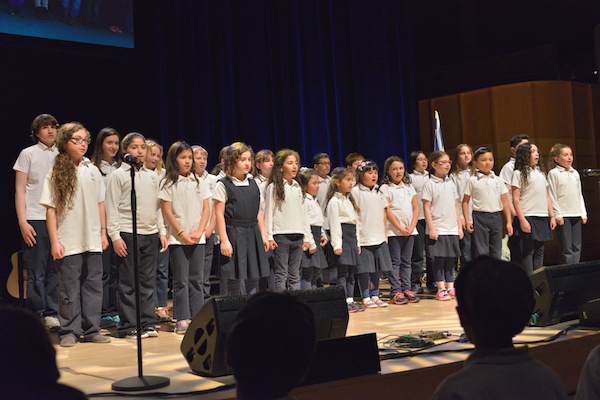
photo - Richmond Jewish Day School Choir
Richmond Jewish Day School Choir (photo by Rhonda Dent)

As it does every year, the evening began with the conclusion of Yom Hazikaron, led by Geoffrey Druker. In the singing of the national anthems, Vancouver Talmud Torah Choir was joined by Partnership2gether twin school Alei Givah Choir in Kfar Giladi (by video) for O Canada, while Richmond Jewish Day School Choir and Partnership2gether twin school Hameginim Choir in Kiryat Shmona (by video) sang Hatikvah.

Diane Switzer, board chair, Jewish Federation of Greater Vancouver, which led the celebration supported by some 50 community partner organizations and countless sponsors and volunteers, spoke briefly. She provided an overview of how the funds raised here for our partnership region in Israel – Eztabah Hagalil (the Galilee Panhandle) – are spent.

“Our Gesher Chai (Living Bridge) program aims to deepen connections with Israel on a person-to-person basis,” she said. “It builds lasting ties between our two communities, and is a cornerstone of Jewish Federation’s work.

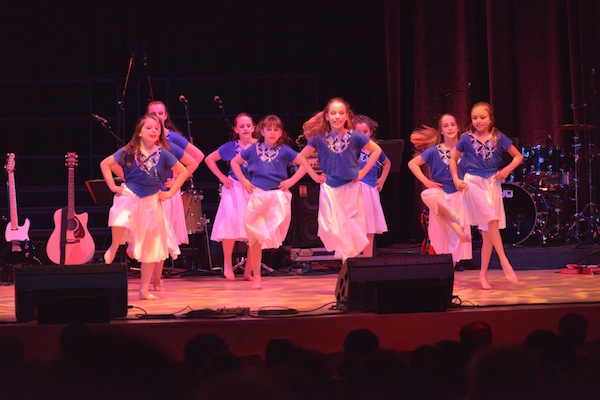
photo - JCC Or Chadash dancers
JCC Or Chadash dancers (photo by Rhonda Dent)

“Through Gesher Chai, we help local day school students build enduring relationships with their peers at their sister schools in Israel. We fund exchanges between local educators and their Israeli counterparts so they can develop a shared curriculum. And we help connect the JCC Or Chadash dancers you’ll see tonight with the Hora Goel dancers from our partnership region. The impact of these programs, which promote Jewish identity and unity for elementary and high school students, can be felt around the world and here at home.

“Etzbah Hagalil is geographically, economically and politically removed from the centre of Israel,” she continued. “It is surrounded on three sides by Syria and Lebanon, and often bears the brunt of attacks when tensions flare. High unemployment and limited opportunities for education and advancement are ongoing concerns, and the area is home to many at-risk youth. Jewish Federation’s strategic investment in this region is aimed at breaking the cycle of poverty, improving living standards and developing the region’s long-term economic prospects.”

Warming up the crowd before Biton’s performance was the Or Chadash dancers. The evening also included greetings by video from Premier Christy Clark, as well as from mayors Benny Ben Muvchar (Mevo’ot Hermon), Giora Saltz (Galil Elyon), Rabbi Nisim Malka (Kiryat Shmona), Ilan Or (Yesod Hama’ala) and Herzel Boker (Metula).

For more photos from the event, click here.

Format ImagePosted on May 1, 2015April 29, 2015Author Jewish Federation of Greater VancouverCategories Celebrating the HolidaysTags Diane Switzer, JCC Or Chadash, Jewish Federation of Greater Vancouver, Micha Biton, Richmond Jewish Day School, RJDS, Vancouver Talmud Torah, VTT, Yom Ha'atzmaut
Rock pioneer plays at Chan

Rock pioneer plays at Chan

Micha Biton headlines the community’s Yom Ha’atzmaut celebrations April 22. (photo from Micha Biton via Jewish Federation of Greater Vancouver)

Seven years in the making, Laura Bialis’ documentary Rock in the Red Zone premièred last October at the Haifa Film Festival, and has since enjoyed several other prominent screenings in Israel. Less than a kilometre from the Gaza Strip, Sderot has been a favorite target of Hamas rocket fire for the last decade and a half – but it has also been the birthplace of a unique style of rock music, producing more than its share of popular bands and singers. One of the rock pioneers featured in the documentary steps off the Israeli silver screen and into Vancouver’s Chan Centre for the Performing Arts on April 22 to lead our community’s Yom Ha’atzmaut celebrations – Micha Biton.

JI: Your stop in Vancouver is part of a North American tour for Like Water. Are you traveling with a band? If so, who and what instruments?

MB: Exactly a year ago, my fifth album, Kmo Mayim (Like Water), was released in Israel and we performed a series of concerts around the country in celebration of the release – a tour that was very successful and drew attention from radio, television and media outlets. Subsequently, I performed in both San Francisco and New York and realized that, despite the fact that over half of the audience does not understand Hebrew, the music touched the hearts of those who heard it. For this concert in Vancouver, I am coming with five amazing musicians: Yossi Shitrit (electric guitar), Shir Yerushalmi (electric guitar), Hillel Shitrit (keyboards), Itamar Abohasera (drums), Shai Zrian (bass).

JI: In which other cities are you performing on this tour? For how long are you here?

MB: We are coming directly from Israel, and Vancouver is the first city on our tour. After Vancouver, I will perform in Los Angeles and San Francisco. I’ll be in North America for less than two weeks. Due to my heavy performance schedule in Israel, I couldn’t carve out more time to tour on this trip, but I always manage to make a little time to take in the atmosphere of the cities in which I perform. This is not my first time in Vancouver – last year, during the war between Israel and Gaza, I brought my whole family to Vancouver to visit my wife’s family and I fell in love with your beautiful city and people. I’m excited that on my second trip to Vancouver I will get to perform for the wonderful people that I met in Vancouver.

JI: Like Water is your fourth solo recording?

MB: Kmo Mayim is my fourth solo recording, but it is my fifth album. In 1997, I produced my first album, Tanara, with a group of talented musician and it received critical acclaim in Israel. Soon after, I became a solo artist and, over two decades, I recorded four albums of original music. For me, Kmo Mayim is a very personal album that I wrote about relationships – friendships, love, connection with God. Every song tells a different story, and every story has an open-ended moral attached to it. I’m very proud of this album and I’m happy that my audiences like it.

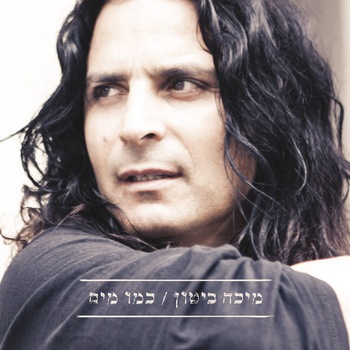
image - Kmo Mayim cover
Micha Biton’s latest CD is Kmo Mayim.

JI: You are one of the pioneers of the renowned rock music scene in Sderot. Could you share a bit about its development, how it has changed over the years?

MB: In the 1990s, I created a band called Tanara, a period that saw an incredible explosion in the Israeli music scene, especially in Sderot. Bands like Tippex, Knesiyat Hasechel and ours developed a new sound that was special and unique to Sderot, combining rock music with the Moroccan/ethnic sounds of our neighborhoods and our childhoods. In those early days, Sderot was underdeveloped and family-oriented. We didn’t have much to do, so music became our lives and we played and composed in the bomb shelters all of the time. (In those days, we used the shelters for writing music and rehearsing for concerts. Today, unfortunately, they are used as shelters from the rockets fired from Gaza.) In addition, it was a town where everyone knew everyone – there was no such thing as a stranger in our town, and the warmth created by this strong community significantly influenced our ability to create something unique musically.

JI: How about your own style? How would you describe it now versus when you first started out?

MB: My musical style hasn’t really changed much over the years. I’ve been very successful continuing to write ethnic rock in the style that I helped to create and I am lucky that my audience appreciates my style and my sensitivity. While my roots are strongly planted in Sderot, I am different than most of my fellow musicians from the area. At the age of 10, after my father died, I left my Moroccan biological family and was fostered by an Ashkenazi family in Jerusalem. From that early, tender age, I started to live between two cultures, understanding the beauty of each, and using both of them to influence the way I compose and the way I live. It turns out that my foster mother, Galila Ron-Feder, was a modestly successful author in Israel who shortly after my arrival chose to write an entire book based on my life and my journey (and I was only 10!). This book, El Atzmi (To Myself), became her most successful book. It became a series of books, and then a movie. It has been translated into 27 languages. The influence of Galila and her world, and the world of my parents together, helped me to create a new world of my own. My music and the lyrics that I write are very connected to the fact that I have lived most of my life straddled between these two worlds.

JI: A 2007 New York Times article refers to “Biton’s anthem for Sderot,” which was “I don’t leave the town for any Qassam.” What is it like living in Sderot these days? Are you hopeful for the future?

MB: In the quiet days of peace, we love living in this area. My nine brothers and sisters and their families live in Sderot, and my family and I live on the border between Sderot and Gaza in Netiv Haasara, a moshav where we can see Gaza from our backyard. This is my home, and we are very drawn to this place. For the past 10 years, we have lived with the reality that at any moment, day or night, the sirens will start and we have 15 seconds to run to our bomb shelters. Our children have grown up with the feeling that life is beautiful but uncertain. This past summer, and several times in the past, we have been forced to leave our homes and our community because of the imminent danger that the conflict caused. Rockets fell on our yard. A rocket hit my wife’s parents’ home, who live a block away from us, destroying precious family heirlooms. For every rocket that fell last summer, there are hundreds of rockets that have landed around us in the past 10 years that go unreported but, for us, they are very real. When we came to Vancouver last summer, my 4-year-old son looked at me and asked, “Abba, why don’t they have tzeva adom (warning sirens) here in Vancouver?” and I explained to him that not everyone has to deal with rockets falling on their heads all of the time. It was a very sad moment for me.

In 2007, when I wrote the song ‘I don’t leave the town for any Qassam,’ I felt that people were deserting Sderot and all of her beauty because of the situation. I wanted to give them strength and remind them that it was critical to stay and to fight for our hometown. Less than a year later, I wrote HaTzad HaMuar (The Lighted Side) from the same place in my heart. Despite all of the pain, I wrote, don’t forget the light, the hope, the optimism. Because that is really what Sderot is all about. Not a place where rockets fall, but a place of warmth and love and peace.

JI: In the same article, you speak about Hagit Yaso as a star almost certain to rise to the top. She has, of course. And she played here in Vancouver last year for Yom Ha’atzmaut. Are there any current young Sderot musicians for whom we should be keeping watch?

MB: Hagit is an amazing singer and an extraordinary human being. I’m proud to stay that she was one of my most talented students when I taught music and theatre in Sderot. I am so happy for her success and that she represents a new generation of musicians that has emerged from Sderot. The wonderful thing about this young generation is that they are succeeding to continue the tradition of Sderot, bringing exciting new musical projects to Israel and to the world. During one of my tours, I invited her to the stage to sing with me, and it was a really beautiful moment of connection between the pioneers of the music scene and the young musicians of this generation.

One of the new, talented musicians climbing up the ladder at the moment is my cousin Tzafrir Yifrach, who concentrates on world music. He has exceptional talent and is performing quite a bit these days around Israel, and musicians from all over Israel love coming to his recording studio in Sderot to work on their own projects with him. Another rising talent is Nir Vaknin, who is in the process of finishing his debut album.

JI: If there is anything else you’d like to add, please feel free.

MB: During the time that I was in production for Kmo Mayim, I started another project with a musician from the U.S., Lisa Tzur, who was the executive producer of Kmo Mayim. I’ve traveled a lot in North America and have performed at synagogues where the singing was so beautiful that I never forgot it. I wanted to be a part of that somehow. Taking words from the prayer service and from Psalms, as well as a few original texts, we recorded a project that is different than anything else that I have recorded. The idea was to create music that was accessible and singable by audiences that were not necessarily Israeli. Lisa comes from that world (as a lifelong member of the Reform Jewish movement and as an ordained rabbi) and together we created something very special that will be released this summer both in Israel and in the world.

The April 22 festivities at the Chan start at 7:30 p.m. For tickets ($18) and more information, visit jewishvancouver.com/yh2015.

Format ImagePosted on April 3, 2015April 1, 2015Author Cynthia RamsayCategories MusicTags Chan Centre, Israel, Jewish Federation of Greater Vancouver, JFGV, Micha Biton, Yom Ha'atzmaut
A friendly, fun contest

A friendly, fun contest

Dr. Neil Pollock hands out some of the awards, as Larry Barzelai and student participants look on. (photo by Cynthia Ramsay)

Based on the numbers alone, the 27th Annual Public Speaking Contest on March 19 at the Jewish Community Centre of Greater Vancouver was a success. Participants: 120. Prizes: 30. Volunteer judges and moderators: 30.

Founded by Larry Barzelai in memory of his father, the event was co-sponsored by Jewish Federation of Greater Vancouver and State of Israel Bonds, with additional support from the J and the Isaac Waldman Jewish Public Library. As one of the volunteer judges, I witnessed a well-organized event that thrived on controlled chaos – almost all of those 120 student participants were accompanied by family and/or friends, and in the crowd were potential future speakers and their parents sussing out what participating next year might be like.

“My father, Morris Black, alav ha’shalom, would be very pleased to see the legacy he created,” Barzelai told the Independent.

Indeed, he would. Speakers were from grades 4 through 7, and they had their choice of topic from a list of 10, one of which was to choose their own. The most popular choices in the Grade 4 class I co-judged were to create a day to mark an event from Jewish history that is not currently being celebrated or commemorated; to describe an app that would enhance Jewish studies at your school; to explain why recycling is a Jewish concept; and to explain what you think is/are the best innovation(s) to have come out of Israel in recent years.

The enthusiasm of the competitions taking place in rooms around the J was corralled in the Wosk Auditorium afterward, and Alex Konvyes entertained the excited students and their guests while the results were being tallied. As each winner was announced, huge cheers went up. As some winners read their speeches, the auditorium came to a hush.

“Several parents in attendance this year had previously been public speaking contestants in their youth, so the legacy continues,” Barzelai noted.

While pleased that “the contest continues to be healthy” and that it is strongly supported by the principals and teachers of the three day schools – Vancouver Talmud Torah, Vancouver Hebrew Academy and Richmond Jewish Day School – Barzelai expressed concern about “the inability to attract students from Jewish supplementary schools and students that are not affiliated with Jewish schools. In former years, the contest had a wider cross section of students,” he said.

Barzelai credited Lissa Weinberger, JFGV manager of Jewish education and identity initiatives, for doing “all the work, with only occasional input from me. Her organizational skills are great. A few prospective judges dropped out close to the event, and she was able to recruit new ones at Shabbat services. Beware, synagogue attendees!”

2015 winners

In order of first, second and third, this year’s Public Speaking Contest winners in each contest were:

Hebrew: Omer Murad (Grade 4, VTT), Ofek Avitan (Grade 5, VHA), Yael David (Grade 4, VTT).

Grade 4: Rachel Marliss (RJDS), Mendel Bitton (VHA), Jesse Millman (VTT).

Grade 4: Zac Peter (VTT), Ellis Jackson (RJDS), Chase Dodek (VTT).

Grade 4: Aaron Guralnick (VTT), Cassie Porte (VTT), Devorah Leah Yeshayahu (VHA).

Grade 5: Ava Abramowich (VTT), Benjamin Gutman (VTT), Elana Robibo (VTT).

Grade 5: Sarale Bitton (VHA), Adin Tischler (VTT), Rubi Katz (VTT).

Grade 5: Alex Ritch (VTT), Shoshana Pollock (VTT), Tristan Georges (VTT).

Grade 6: Menachem Yeshayahu (VHA), Riva Berger (VHA), Mordechai Wolfson (VHA).

Grade 7: Eva Dobrovolska (VTT), Neev Mizrachi (VHA), Teah Bakonyi (VTT).

Grade 7: Avrel Festinger (VTT), Romy Ashkenazy (VHA), Elliot Pollock (VTT).

Format ImagePosted on April 3, 2015April 1, 2015Author Cynthia RamsayCategories LocalTags Israel Bonds, Jewish Federation of Greater Vancouver, Larry Barzelai, public speaking, Richmond Jewish Day School, RJDS, Vancouver Hebrew Academy, Vancouver Talmud Torah, VHA, VTT
Message to Vancouver

Message to Vancouver

Masha Shumatskaya’s visit here was part of an American Jewish Joint Distribution Committee tour of North American cities. (photo from Jewish Federation of Greater Vancouver)

All Masha Shumatskaya wants is for the fighting to stop so she can go home. The 24-year-old Jewish Ukrainian English teacher was living and working happily in the city of Donetsk until April 2014, when pro-Russian separatists arrived two hours north of her hometown and declared their intention to form a people’s republic.

Until that moment, her life had been quite ordinary. Shumatskaya, a slender beauty with gentle eyes, was one of some 15,000 Jews in Donetsk, a city that boasts a Jewish community centre, a Chabad-run synagogue, a kosher café and various Jewish youth and cultural groups. “I never once experienced antisemitism growing up there,” she said. “I was never afraid to say I was a Jew.”

By May 2014, the pro-Russian separatists had moved into Donetsk and were threatening the safety of civilians. They bombed the Donetsk airport and the violence forced the closure of many schools and business offices in the city. Shumatskaya and her friends began making plans to move to other cities in Ukraine, such as Kiev, Odessa and Kharkov. She chose Kharkov, five hours’ drive from Donetsk, leaving her parents behind.

But Shumatskaya is one of the lucky ones. There are some 7,000 Jews still living in the war zone in Ukraine, many of them elderly. They’re dependent on the Joint Distribution Committee’s aid for food, medical support, rental subsidies and basic necessities.

Shumatskaya was in Vancouver recently as a guest of JDC, where she met with Jewish Federation of Greater Vancouver representatives and media to tell her story. With her was Michael Novick, executive director of the American Jewish JDC in Bellevue, Wash. “The situation in Ukraine has become a high priority for the JDC,” he said. “It’s not just the Jews, mostly elderly, still living in the conflict zone, but also the 2,500 Jews who’ve fled and need assistance, and another 60,000 Jews we’ve been helping all along with basic humanitarian supplies.” The JDC estimates the cost of its monthly relief for these Jews to be more than $387,000 US.

The political unrest has had widespread effect. The Ukrainian economy has plummeted, the purchasing power of the Ukrainian currency, the hryvnia, has dropped more than 50 percent and inflation is between 25 and 30 percent. “A year ago, the average pension of an elderly person we were assisting was equivalent to $150 US. Today, that same pension is only worth $50 US,” Novick said. “People have lost their jobs, their businesses, and Jews who could previously take care of their own families are now coming to the JDC’s Hesed welfare centres.”

The JDC has 32 Hesed welfare centres in Ukraine, and 160 of them across the former Soviet Union. Among those Jews requiring their services in Ukraine, Novick said they represent “the poorest Jews on earth, living in really dire conditions. For them, the lifeline provided by Hesed in terms of supplemental, basic humanitarian assistance, is vital.”

He added that the emergency funds being supplied by JDC are not part of its budget. “But the situation in Ukraine is so dire that we’re not waiting – we’re simply spending money and hoping that individuals, federations and foundations that meet Masha and hear about this story will come to our assistance.”

Shumatskaya’s 10-day visit to North America included stops in Seattle, Vancouver, Los Angeles, Philadelphia and New York. Last year, JFGV made a $25,000 grant to JDC for its various programs.

As she looked to the future, Shumatskaya was uncertain what it would hold for her. “I feel attached to Ukraine and I feel some responsibility to help with what’s going on there,” she said. “If I had to leave Kharkov I don’t know where I’d go. But I know that I don’t want to become a war refugee again. Once in my life was quite enough.”

Her message to Vancouver’s Jewish community is twofold: a reminder that Jews are responsible for each other, and one of gratitude for the support she and her fellow Ukrainian Jews have all ready received.

“Without that support we literally would not have survived,” she said. “I wish we could finish this need for assistance fast, but it’s out of our hands. We’re praying every day that we can live in a peaceful country without the assistance provided by the JDC.”

Lauren Kramer, an award-winning writer and editor, lives in Richmond, B.C. To read her work online, visit laurenkramer.net.

Posted on March 27, 2015March 26, 2015Author Lauren KramerCategories LocalTags JDC, Jewish Federation of Greater Vancouver, JFGV, Joint Distribution Committee, Masha Shumatskaya, Ukraine
Israelis skate into Vancouver

Israelis skate into Vancouver

Canucks alum Eddie Hatoum, originally from Lebanon, with several Arab Israeli athletes. (photo from Jewish Community Centre of Greater Vancouver)

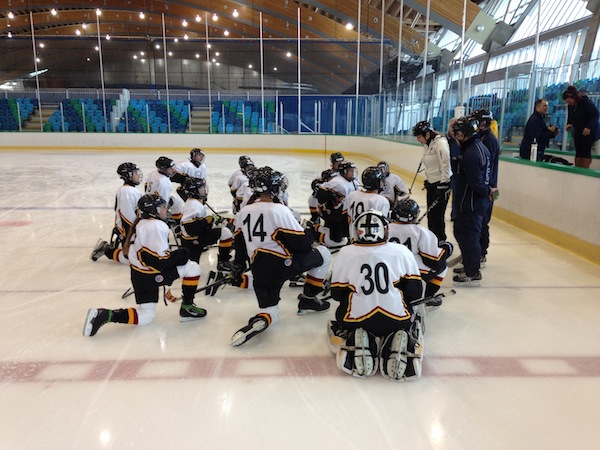
Anyone who caught a glimpse of the 20 young hockey players during their week-long training camp in Vancouver March 4-10 probably didn’t think much of it. That is until they looked a little closer and saw the Canada Israel Hockey School (CIHS) logo all over their jerseys, jackets and bags.

In a joint venture of the Jewish Community Centre of Greater Vancouver and the Jewish Federation of Greater Vancouver, the 10-to-14-year-old boys and girls were hosted by local families, trained by special guest coaches, toured around the city and treated to an unforgettable night by the Vancouver Canucks.

photo - Canada Israel Hockey School students listen to skating coach Barb Adelbaum.
Canada Israel Hockey School students listen to skating coach Barb Adelbaum. (photo from JCCGV)

Aside from its being a hockey school in a country where that sport is as foreign as olive trees are to Vancouver, CIHS is also special for using hockey as a cultural bridge: half the participants touring Vancouver were Jewish and half Arab. Here are a few stories that stood out from the week-long adventure.

Skate like NHLers: After arriving late the night before, the kids wasted no time hitting the ice at the Richmond Olympic Oval. Their first practice was led by Barb Adelbaum, power skating consultant for the Vancouver Canucks and various NHL players around the league. After taking them through some skating drills, Adelbaum noted that many of them had dull skate blades. She connected the team with Cyclone Taylor Sports in Vancouver and arranged to have all 20 pairs of skates sharpened, as well as a much-needed new stick for one of the goalies.

KDHS meets CIHS: On day two, thanks to a Purim-themed professional development day at King David High School, several hockey-playing students from the high school joined the CIHS kids on the ice. Instead of playing against each other, each team was formed from members of both schools, which made for a spirited community game.

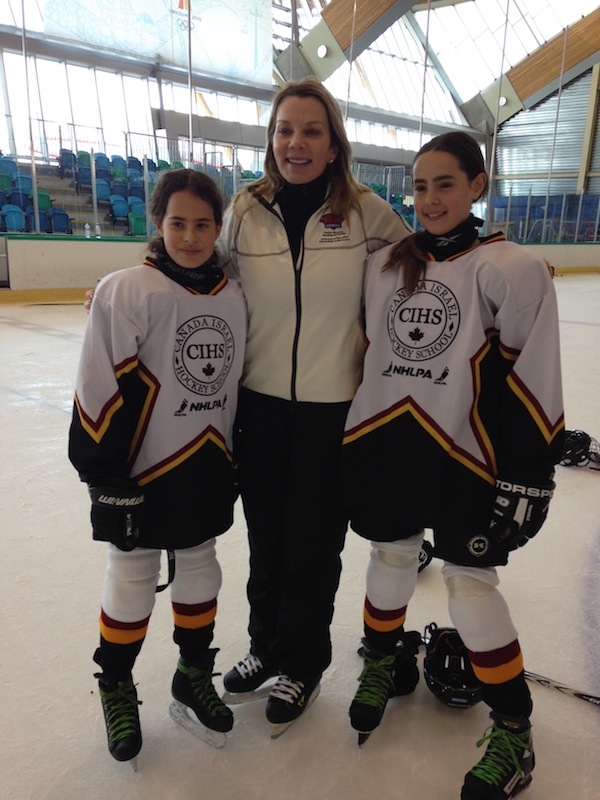
photo - CIHS students with skating coach Barb Adelbaum
CIHS students with skating coach Barb Adelbaum. (photo from JCCGV)

Flying like a Raven: When the JCC found out that the CIHS squad included two girls, talks began with the Richmond Ravens Girls Hockey Association on bringing them all together. The Ravens happily obliged, donating one of their ice times to a scrimmage and practice with the Israelis. After fitting the two Israeli girls into Ravens jerseys, a boys versus girls game was played.

All they have is love: Sunday afternoon was spent touring the city. The group walked along the water from Granville Island to Kitsilano Beach. As they approached the beach, Virgin Radio was there, with a large balloon-like ball with “LOVE” written on it, offering folks the chance to be photographed with it. As the Israeli kids swarmed for their photo, the radio station reps were told of the special meaning behind the Jewish and Arab group, standing shoulder to shoulder, symbolizing the love of a game and being a team overcoming other boundaries.

CIHS meet JCC hockey: The Israeli athletes had the opportunity to see what Jewish community hockey was all about in Vancouver. They took in one of the final regular season games of the JCC’s Adult Ice Hockey League, providing a cheering section the local weekend warriors weren’t used to. After the game, the students had their chance to show the JCC league the skills they had brought from Israel, and to play a little hockey with them. Led by the generosity of Daniel and Ariel Wosk, several members of the JCC league donated money for new equipment for the CIHS players (more to come on that below). The Wosk brothers had visited CIHS in February 2014 as part of a hockey team tour and wanted to be involved when the Israelis came to Vancouver.

“The joy and passion that [Jewish] and Arab children were exhibiting together was a sign that with the right influences and opportunities there could be a better future there,” said Ariel. “When we heard that some of the kids were coming to Vancouver, we knew that we wanted to do something for them.”

“A highlight for me was not knowing who was who on the ice, yet their teamwork was excellent,” added Daniel of his time playing with the kids here. “It’s awesome to see their relationships grow in a positive direction … [that] will translate into their daily lives.”

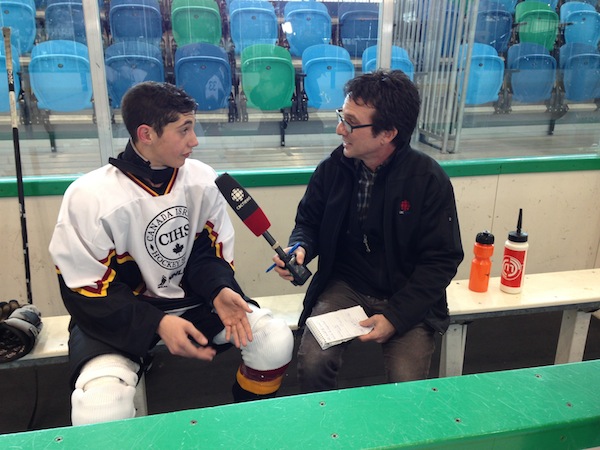
photo - CIHS student being interviewed by CBCs Shane Foxman for Citizen Shane
CIHS student being interviewed by CBCs Shane Foxman for Citizen Shane. (photo from JCCGV)

The final day: The last full day of the CIHS visit had more highlights than an evening news report.

The morning started on the ice, with two members of the Vancouver Canucks Alumni Association as guest coaches, along with local hockey pro and JCC member Harrison May and his brother Kevin.

One of the alum, Eddie Hatoum, was born in Beirut and still speaks Arabic at home. Upon arriving and learning of the mix of the CIHS athletes, he entered the locker room and asked, “Who speaks Arabic?” in his native tongue. Half the room raised their hands with huge smiles on their faces. “We’ve done a lot of work with young groups as the Canucks alumni, but this really warms my heart,” Hatoum said, also smiling. “When I tell my siblings in Ottawa that I got on the ice with these kids, they won’t believe it.”

Hatoum was joined at the practice by B.J. (Blair) McDonald, who once scored 46 goals playing with Wayne Gretzky in the early 1980s.

After the practice, the group headed to Sports Exchange in Vancouver for a shopping spree. With the money from the JCC hockey league players in hand, along with several donations and great deals from the store managers, the team packed six bags’ worth of brand-new gear. The kids also had a chance to pick up some items of their own that they can’t get in Israel.

While it seemed almost impossible for the day to get any better, the CIHS kids and several of their host family friends were treated to an evening with the Canucks that started with a meeting with team president Trevor Linden and chief operating officer Victor de Bonis. De Bonis led the group on a tour of the facility in advance of the Canucks versus Anaheim Ducks game, which they watched from a hospitality suite, where they were offered a buffet dinner and all the popcorn they could eat. Visits to the suite from Adelbaum, McDonald, de Bonis and Canucks mascot Fin topped it all off.

The trip continues: The group said goodbye to Vancouver and hello to a week in Calgary before heading back to Israel. Several JCC league players will meet the kids again next February at an annual recreational hockey tournament in Israel. The Vancouver squad, as usual, will get on the ice with the CIHS for a couple of practices and continue their friendship.

Kyle Berger is Jewish Community Centre of Greater Vancouver sports coordinator, and a freelance writer living in Richmond. For more information on this visit or future hockey trips to Israel, contact Berger at 604-638-7286.

Format ImagePosted on March 20, 2015March 19, 2015Author Kyle BergerCategories LocalTags Canada-Israel Hockey School, CIHS, Hockey, JCCGV, Jewish Community Centre of Greater Vancouver, Jewish Federation of Greater Vancouver

Positivity is vital to life

The 15th annual Chutzpah! Festival of the Jewish Performing Arts concluded on Sunday with the group Diwan Saz. Their main message: music has no borders. And, “Don’t believe the news,” i.e. Israel is more than a conflict zone.

Yet, our brains are hardwired to find the negative in life. As one neuropsychologist writes, “the brain is like Velcro for negative experiences but Teflon for positive ones.” It is no coincidence that the news the media mainly reports is bad. It not only titillates, but it sticks with us. However, there are good news stories, and they should not be dismissed as “fluff,” or as less significant than the “serious” news. On the contrary.

The arts are vital to our lives, as are sports and other cultural endeavors. They are not merely for entertainment or to escape from reality. Among other things, these pursuits encourage creativity and propel innovation, they nurture our souls and provide ways in which we can connect to each other. They can be catalysts for all types of change in the world, making people aware of issues they might not otherwise consider, bringing people together to speak out against injustice or in favor of peace, for example.

The multicultural Bedouin, Israeli Arab, Turkish, Jewish Israeli (Ashkenazi and Sephardi) group Diwan Saz, comprised of nine musicians, is a prime example of how people of different places, beliefs and backgrounds can live, play and travel together – by choice, and happily, enriched by one another’s friendship and musicianship.

Since its beginnings, Chutzpah! has shown how arts and culture can bring diverse people together. In recent years, Israeli performers have graced the cover of the Georgia Straight in its Chutzpah! coverage. What better ambassadors of Israeli and Jewish culture, and the cross-cultural possibilities of the Middle East?

This week’s JI cover stories provide another couple of examples.

Twenty kids from the Canada Israel Hockey School, a joint venture of the Jewish Community Centre of Greater Vancouver and the Jewish Federation of Greater Vancouver, visited last week – Jewish Israeli, Arab Israeli, girls and boys, the hockey players see each other as teammates, playing for the love of the game. Not only are positive bonds and memories being formed among the players, but also between them and their coaches in Israel and in Vancouver, the local hockey players they met, both from the Jewish league and from the Canucks. Interviewed by CBC’s Shane Foxman, these kids were representing not just themselves, but the sport of hockey and their country of Israel – and they are cause for pride.

Sholom Scouts are also not “just” scouts. Not to put too much pressure on them, but they are Jewish ambassadors to the larger Scouts community as well as the general community. Within the Jewish community, they represent a spectrum of Jewish beliefs, all coming together to become good stewards of the land and good citizens.

It is healthy to see the negative: it helps us to be safe, to become aware of what isn’t quite right, what needs adjustment and what areas of justice still need to be pursued. As Leonard Cohen sings, “there is a crack in everything, that’s how the light gets in.” But, focusing exclusively on the negative – the crack instead of the light – isn’t healthy, not for ourselves personally or for society at large. This does not imply blocking out the reality of the suffering that does exist, but instead recognizing that we ignore the beauty, loving kindness and bright spots of reality to our detriment.

Whether it’s by being more mindful, cultivating more loving kindness, reducing stress and anxiety, re-balancing our middot, being open to new and challenging experiences or learning more about something that interests or concerns us, we can find more good. It takes time and effort to “hardwire happiness” in our brains and in our lives, but it’s possible.

It helps when we consciously draw out the positive, such as the stories mentioned here, and engage in the positive cultural and social behaviors that make us more than mere human animals, and more fully and happily human.

Posted on March 20, 2015March 19, 2015Author The Editorial BoardCategories From the JITags Canada-Israel Hockey School, Chutzpah!, Hockey, Jewish Community Centre of Greater Vancouver, Jewish Federation of Greater Vancouver, Scouts Canada, Shane Foxman, Sholom Scouts, Temple Sholom

Federation sustains success

As the 2014 Jewish Federation of Greater Vancouver annual campaign draws closer to a record $8 million mark, preparations are well underway to build on that success in 2015.

Cindy Behrmann, campaign director since 2012 and one of the primary drivers behind this year’s campaign will be heading off to a well-deserved retirement. Over the past few months, Federation was hard at work reviewing the financial resource development (FRD) department in advance of Behrmann’s departure at the end of December and has announced the following changes.

photo - Michelle Pullan
Michelle Pullan (photo from Jewish Federation of Greater Vancouver)

Michelle Pullan, Federation’s women’s philanthropy director since 2011, will assume the role of campaign director. Pullan has considerable experience in philanthropy and fund development, having enjoyed success as a fundraising manager at Ballet BC and director of development at Vancouver Heritage Foundation before joining Federation’s FRD team. She has taken on leadership and volunteer roles on behalf of Jewish schools in the community and has served on the boards of Camp Solomon Schechter and Camp Hatikvah.

Campaign coordinators Eva Bach and Anna Vander Munnik have been promoted to the role of campaign managers. Vander Munnik, with Federation since 2011, will focus her effort on managing the men’s philanthropy division, while Bach, who joined Federation in 2013, will manage the women’s philanthropy portfolio. Also returning in January from maternity leave will be director, marketing and communications, Becky Saegert.

Led by associate executive director Marcie Flom, the FRD team is well positioned to capitalize on and sustain the success enjoyed in 2014.


Posted on January 9, 2015January 8, 2015Author Jewish Federation of Greater VancouverCategories LocalTags Anna Vander Munnik, Becky Saegert, campaign, Cindy Behrmann, Eva Bach, Jewish Federation of Greater Vancouver, JFGV, Marcie Flom, Michelle Pullan

Posts pagination

Previous page Page 1 … Page 4 Page 5 Page 6 Next page
Proudly powered by WordPress