Reflections of a lone soldier

Joel Chasnoff spoke at a Zoom event presented by Jewish National Fund of Canada on June 1 and he’ll speak at a CHW Montreal Zoom event on June 21. (photo from APB Speakers)

Michael Levin grew up in Philadelphia, joined the Israel Defence Forces as a lone soldier and died in a battle with Hezbollah in southern Lebanon in 2006. At that time, most Israelis weren’t familiar with the concept of a lone soldier – a legal term for a volunteer, usually (but not always) from outside Israel, who enlists to defend the Jewish state.

Levin’s death at 22 came just days after he returned hastily from his leave back home in the United States when he learned of the start of the Second Lebanon War. He flew back to Israel, hitched a ride to his platoon in Lebanon and took up the fight against the Iranian-backed terrorists. He was killed in an intense firefight in the Hezbollah-controlled village of Aita al-Shaab.

His grieving mother, Harriet Levin, was concerned that her son’s funeral would not have a minyan to say Kaddish and so, on arriving in Israel, she asked a few people to come to the military cemetery to ensure a proper Jewish burial. On her way to Mount Herzl, traffic was so congested she feared she would be late for her son’s funeral but, when she did get there, she discovered that the few people she had asked to spread the appeal for a minyan had shared the news widely. Media picked it up and more than 10,000 Israelis showed up to pay their respects.

It was a turning point in the Israeli consciousness, according to Joel Chasnoff.

Chasnoff is a stand-up comedian and writer who shared his own story of leaving his Chicago-area home two decades ago to become a lone soldier. In a Zoom event presented by Jewish National Fund of Canada June 1, Chasnoff, who now lives in Israel, spoke of the changing understanding of lone soldiers – and his reflections on now being the father of soldiers. A decade ago, he chronicled his experiences as an IDF volunteer in the book The 188th Crybaby Brigade: A Skinny Jewish Kid from Chicago Fights Hezbollah.

Today, lone soldiers are a better understood phenomenon in Israel and supports are in place that were not when Chasnoff volunteered in 1997. There is now a network of Lone Soldiers Centres – commonly called Michael Levin Centres – around Israel, to help overseas volunteers adapt and smooth their way to a successful integration, coordinate holiday and Shabbat homestays and deal with the myriad complications that arise for a newcomer to Israel.
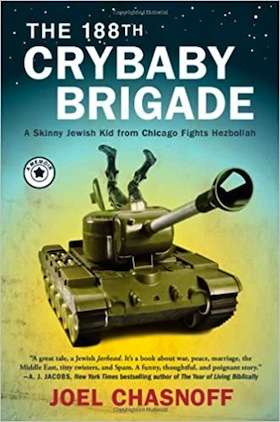
image - The 188th Crybaby Brigade book coverChasnoff shared comedic experiences, including the challenge of proving he was indeed a lone soldier without Israeli parents, when government officials insisted that Levin’s father had never left Israel after his first visit in 1976. The stakes were basic – a lone soldier’s salary at the time was $160 a month instead of $80, plus a few privileges. But it required a sheath of documents from the States to prove that his father was indeed an Illinoisan, not an Israeli.

“Never mind that he had raised me in the U.S. and I have a very strong and good relationship with my dad. The Israelis believed that my dad was actually living in Israel the whole time and I was just trying to pretend that I was a lone soldier to get the extra $80 a month,” Chasnoff said.

His decision to join the IDF was sparked by a visit to Israel as a teenager.

“I got off the plane,” he said, “and, you know, you’re 17, your hormones are raging. What’s the first thing you notice being a teenager coming to Israel? How beautiful the Israelis are. The women were all tan and fit, the men were these hunks with muscles and crew cuts. It’s so odd because they have the same roots as we do, right? Except they look like supermodels and we look like Jews. How does that happen? That’s not fair.”

The soldiers he met were just a year older than he was.

“They were 18, and they had machine guns and berets and Ray-Ban sunglasses and forearms like bricks,” said Chasnoff. “And then there was me, slathered in sunscreen, wearing a fanny pack … stuffed with lactose pills.”

One of the eye-opening things Chasnoff discovered about the Israeli army, he said, is how democratic it was.

“I would even say insanely democratic,” he said, noting that soldiers argued about orders and fought with their superiors. “People ask me what’s it like in the Israeli army. I think the best way to describe it is, imagine a bunch of Israelis running an army. That is the Israeli army.”

This is why one of his platoon-mates was a darling among commanders: he didn’t speak Hebrew. The young man was raised in an evangelical Christian home in Oklahoma, but, at a certain age, learned that his mother had converted from Judaism. One thing led to another and he volunteered for the IDF.

“So, they made him a tank gunner,” Chasnoff said, “because, to be a tank gunner, you basically need to know six words – stop, go, left, right, forward, back. Tim was one of the best soldiers in our platoon because he didn’t have the Hebrew to argue back. When the commander would give orders, the guys would argue. Tim, by not having Hebrew, just did what he was told. And was an excellent soldier for that reason and one of our commander’s favourites.”

Unfortunately, a lack of Hebrew can be deadly in moments of military conflict. Chasnoff said some casualties in conflicts in Gaza may have resulted from linguistic challenges and he believes the military is doing a better job ensuring fluency in such situations.

While lone soldiers is a term associated with overseas volunteers, Chasnoff said that about half of the 6,000 lone soldiers are Israelis, mostly Charedim whose volunteer service or other factors estrange them from their families.

While lone soldiers were not so much in the Israeli consciousness a few decades ago, they are now a welcome oddity.

“I think, when you get a lone soldier in your platoon, people are very excited about it,” Chasnoff said. “Everyone wants to bring him or her home to show the family the sort of strange character who came all the way from New York City or Sydney, Australia, or whatever. People are really interested in what motivates them to serve, so they are invited. It’s very, very different than the old days.”

Addressing the broader differences between Israelis and Diaspora Jews, Chasnoff riffed like the comic he is.

“We grow up with this myth that Israelis are, you know, just like us. They are Jews and we are Jews and we’re one big happy family. And then you get to Israel and you realize the Israelis are nothing like the American Jew. They speak their minds. They shout. They argue,” he said. “You’ll never be with an Israeli and wonder to yourself, ‘I wonder what she really thinks about me right now.’ I’m married to an Israeli for 21 years and I can honestly say that once in those 21 years has my Israeli wife apologized to me because, in the Middle East, apologies make you look weak and nobody wants to look weak. We had one huge fight where she actually apologized and it wasn’t even a real apology, it was an Israeli apology: she came up to me a few days later and said, ‘Yoeli, motek, I am sorry you’re such an idiot.’”

He also has plenty of material about growing up Jewish in America.

“My mom was actually one of these Jewish mothers who – let’s be honest – they have a special ability to worry about every situation,” he said. “You give them any scenario, they will figure out the potential thing that could hurt you in that scenario.”

For their annual family visit to Texas to see his paternal grandparents, Chasnoff’s mother would book the family on two separate flights so that, if a plane went down, the entire family wouldn’t be lost.

“That’s a typical Jewish upbringing,” he said.

When his zaidie gave him a jersey with the number of his favourite player and his own name, Joel, on the back, Chasnoff’s mother refused to let him wear it outside the house because a stranger would know his name.

“And, because he knew my name, I would think he knew me, so I would go with him,” he said. “You know why? Because I’m an idiot. That’s why there are no Jewish athletes. Not that we’re bad at sports, our mothers won’t let us wear the jersey.”

Readers will have another chance to hear Chasnoff speak this month. CHW Montreal is hosting a Zoom BBQ with the comedian on Father’s Day, June 21, at noon, Pacific time. Visit facebook.com/chwmontreal and click on Events for details. Funds raised benefit hospital workers at the Shamir Medical Centre and Hadassah Hospital in Israel.
Israel’s soldiers not forgotten

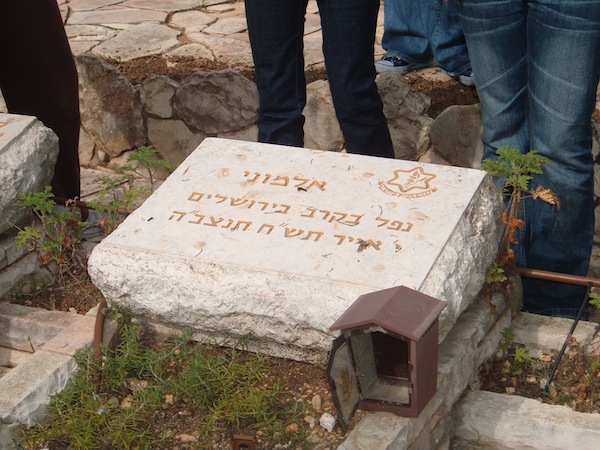
The grave of an unknown soldier on Mt. Herzl in Jerusalem. (photo by Deborah Rubin Fields)

As of Israel Independence Day last year, 23,741 Israeli soldiers had died during their service. The country has come to memorialize its fallen soldiers in one of three ways: 1) most commonly, it provides a grave and a headstone in a military cemetery, with information provided on the soldier, 2) when there is no official grave (that is, when no one really knows where the body of the deceased is), it inscribes the name either on a memorial wall or marker, and 3) it furnishes a grave and a headstone, but little or no information about the deceased is engraved on the stone.

Today, when a soldier dies, the following identification is to be established: the name of the soldier, their army identification number, national civilian identification number, army rank and army unit, as well as their job in the army. When they are buried, the headstone notes the full name of the deceased, their parents’ first names, country of birth (if outside of Israel), date of birth (according to both the Hebrew and Gregorian calendars), aliyah date, date and place of death and age at the time of death. The stone also contains the emblem of the Israel Defence Forces. In a military cemetery, the tombstone’s content reflects a high degree of uniformity. One monument pretty much contains the same details as the next one.

In pre-state Israel and in the War of Independence in 1948, these practices were not yet in place. Young men and women – many of whom had just survived the Holocaust – fought to establish the state. They (and all other soldiers) had little military training. They might not have known Hebrew very well. Not uncommonly, they were the only survivor of their families.

Times were tense, at times verging on the chaotic. The fighting left limited time for socializing, for establishing relationships. So, if a soldier died, it was not surprising to have known them only by their first name. Under the circumstances, most fellow fighters would not have been acquainted with the soldier’s parents, would not have even known their names.

At the end of the War of Independence, about 1,000 of the 4,500 fallen were considered missing. It was the chief rabbi of the IDF, Rabbi Shlomo Goren, who initiated an intensive project of identifying the dead. The establishment of military cemeteries helped the identification process move forward, but, even after that, there remained anonymous soldiers, and headstones with missing information.

Recognizing this situation, Dorit Perry and Uri Sagi started Giving a Face to the Fallen. The organization has been in existence fewer than 10 years. Its team of some 52 volunteer investigators and activists comes from a variety of backgrounds. It includes bereaved family members, friends of fallen soldiers, judges, former career army officers and others. As the organization’s website states, all volunteers believe there is “a duty to remember and, in so doing, to … repay the debt we owe to those who gave their lives for the establishment of the state of Israel.”

All of the volunteers are in a race against time, trying to piece together information on 500 soldiers who fell fighting either in pre-state Israel or in the War of Independence. They ask the following questions: Did you (or maybe your grandfather or an older neighbour) know the fighter we are researching? Maybe you fought with such person either before the creation of the state or in the War of Independence? Maybe you still have pictures of your fighting unit?

The volunteers also try to fill in blanks by asking to see old photos of youth movement activities, aliyah preparation groups (aliyah registration cards have provided investigators with correct birth dates and with the names of relatives, see blog.nli.org.il/en/baumgarten) and family albums. Some soldiers do not even have a photo on file.

Besides trying to find people still alive who were acquainted with these fallen soldiers, volunteers search archives. It is real detective work. When successful, there is the rededication of a tombstone with the added information. To date, out of the more than 800 “untraceable” soldiers, they have pieced together the missing information for 120 of them.

The stories of the fallen soldiers of this period are poignant. Take the example of Tobias Marmolstein, who came from Bitshekov, Czechoslovakia. His father had died in Tobias’s arms at Mauthausen concentration camp. Twenty-year-old Tobias was killed as his Haganah unit fought to open the road to Jerusalem. He had been in Israel for just nine days. He is buried on Mt. Herzl.

Each life story has its twists and turns. For instance, over two decades passed before Shaul Yekutiel Urbach came to be buried in Israel. He arrived in Palestine in 1939 to visit Tel Aviv relatives. When the Second World War broke out, he was unable to return to his large family in Kielce, Poland, so he volunteered to fight for the British. The British sent him to fight in Greece. There, the Germans took him prisoner. The Nazis sent him to do hard labour in Schlesien, Germany. In a revolt against a Nazi camp officer, Shaul was wounded, and he died in a German hospital. After the war, his only surviving brother, Raphael Fishel – the rest of the family had been murdered at Treblinka – tried to have Shaul’s remains brought to Israel. For 22 years, the British stalled in releasing his body from their military cemetery. Finally, in 1967, Shaul was reinterred, on Mt. Herzl.

Uri Sagi has maintained that a blank headstone or one that is missing information makes the soldier invisible. A fallen soldier, Sagi said, should not be invisible.

As time passes, it becomes harder and harder to find acquaintances and family who can fill in the blanks with firsthand testimony. For more information on Giving a Face to the Fallen, visit latetpanim.org.il.

Deborah Rubin Fields is an Israel-based features writer. She is also the author of Take a Peek Inside: A Child’s Guide to Radiology Exams, published in English, Hebrew and Arabic.

A day that changed my life

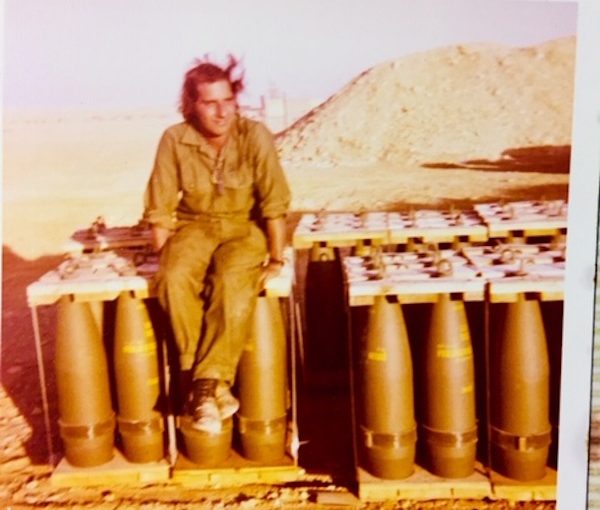
The author in the Sinai in October 1973, before his unit was attacked by two Iraqi planes, which caused the unit’s ammunition supply to explode, killing some soldiers and wounding others. (photo from Yom Shamash)

I would like to say that an event that happened 46 years ago left no marks on me and that I am over it. But then, I would not be honest. In fact, the experience left an indelible mark on my life and changed me completely.

In 1971, I returned to Israel – the country of my birth and early childhood – from Brazil with a Zionist youth group, to Kibbutz Zikim. I remember very well the prevailing thinking in Israel then. Four years after the victory of 1967, Israelis were quite confident. Egypt, the most powerful enemy Israel had, was neutralized. We were strong. We had conquered the Sinai, Gaza, the West Bank and the Golan. All in six days. I had absorbed this attitude and felt secure in my little world.

And then the war of 1973 exploded.

I served in the Sinai before the war; I was in a Nahal Brigade unit in which part of my service was spent on a kibbutz. On Oct. 6, 1973, I was on the kibbutz. It was Shabbat, Yom Kippur. Because Israel was caught off guard, there was no time to set up the unit in an orderly manner. As soon as we arrived at our position behind a high dune in the Sinai desert, we started shooting. My tank had a long-range cannon; we could not see what we were hitting 30 kilometres away.

Because my job was to pull the cannon’s trigger with both hands, I could not block my ears with my fingers, as all my tank mates did. As a result, I have a significant and permanent hearing loss.

On Oct. 13, 1973, our unit was decimated by two Iraqi planes. There had been a lull in the fighting and we had been resting on the sand. Suddenly, the two planes swooped from the sky, dropped bombs and disappeared in a matter of seconds. Very quickly, our own ammunition started to explode. Pieces of shrapnel started flying. The only thing to do was to run away from this inferno. Some soldiers were wounded, some died, and all who survived were traumatized.

Looking back now from the vantage point of 2019, many of us wonder about the heavy loss of young lives. Israel lost about 2,700 soldiers in that war. What did they die for? Defending the Sinai? Those of us who served in the Sinai know well that there isn’t much there except sand, stretching for miles; there isn’t much there to defend. What I didn’t know in 1973 was that, for several months prior to the war, Israel’s then-prime minister Golda Meir had rejected numerous initiatives by Egypt’s then-president Anwar Sadat to negotiate a peace accord. Was it worth it holding on to the Sinai? Especially since, in the end, Israel wound up returning the Sinai anyway?

The same could be said about Lebanon – more than 1,200 Israelis lost their lives in Lebanon from 1982 to 2000. Was it worth it? We must ask this question of the parents of those soldiers who lost their lives. I wonder what they would say.

I am afraid that one day the West Bank and the Golan will return to their rightful owners, the Palestinians and the Syrians, and, years later, we will ask ourselves what the hell we were doing in these places, and in Gaza.

Two million Palestinians in Gaza and two-and-a-half million in the West Bank, who do not have the right to vote in Israel, will not disappear, and I see no reason why Israeli soldiers should be controlling the movements of Palestinians traveling within the West Bank and those wanting to leave or enter the Gaza Strip. If I told you that Israelis traveling from Tel Aviv to Haifa have to pass through Palestinian checkpoints, you would say this is absurd. And I would agree, but it is no less absurd than Palestinians going from Ramallah to Nablus having to pass through Israeli checkpoints.

And why are settlers in the West Bank consuming 10 times more water than the indigenous Palestinians? And why are Israeli soldiers protecting settlers – who should not be there in the first place – some of whom do not serve nor send their children to serve in the army?

There can be no peace in Israel until there is peace in Gaza and the West Bank. The occupation is a recipe for continuous wars and insecurity for all.

I recall clearly, at the end of the Yom Kippur War, returning my equipment at the army base. I pledged that I would never again wear a green uniform.

For a long time, I did not understand how and what changed inside me that October. No one talked about post-traumatic stress disorder; no one talked about personal feelings. But the recurring nightmares never stopped. The fear and anxiety stayed. Right after the war, I sought out a psychiatrist friend, who told me to leave Israel for awhile – I had planned to study in Jerusalem, but he said leave and decide later. I left. I came to Canada, started a new life, married, studied, had four kids, remarried, had a good career and am enjoying life with my wife, children and four grandchildren.

Since leaving Israel in 1974, I have been back twice for visits, in 1998 and 2008.

What happened on Oct. 13, 1973, changed me and shaped my views, my values, my activism, my appreciation for what is important in life. Perhaps one of the most important lessons I learned is that war is never the best option to resolve conflicts. Taking land from others is never a way toward peace. Military strength is not a guarantee of security.

I wish I could be optimistic about the future of Israel, but I am not. For me to have any optimism at all, at a minimum, the occupation would have to end.

Yom Shamash was born in Israel. At the age of 6, his family moved to Brazil. He returned to Israel as a member of the Hashomer Hatzair group and settled in Kibbutz Zikim, south of Ashkelon. In British Columbia, he worked as a public school teacher in Surrey and, since retirement, he has been working as a translator and babysitter.

Returning “home” with Sar-El

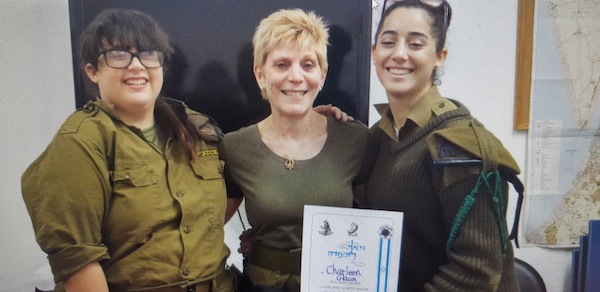
Charleen Glaun, centre, receives her certificate of service from Sar-El from madrichot Inbar, left, and Carmel. Glaun hopes to volunteer with Sar-El annually from here on out. (photo from Charleen Glaun)

At last, I was on the plane to Israel. Was this really happening? I had waited so long for this day and, here I was, after 32 years, finally returning.

Arriving at Ben-Gurion Airport, I proceeded through the security check-in. The first question asked of me was, “What is the purpose of your trip?”

“I’m coming on Sar-El,” I replied.

“What is Sar-El?” the security person asked.

“Volunteers for Israel,” I said, a little surprised he did not know about Sar-El.

I waited for his reaction, but there was silence. I blurted out, “I’ve been away for 32 years and this is my first trip back.”

He looked up from examining my passport and said, “What took you so long? Welcome back!”

I smiled and said to myself, “This is going to be the best adventure of my life! Thank you, G-d, for getting me here safely.”

Once I had my luggage, I found the sunglass stand where volunteers typically meet, and found Sar-El’s facilitator, Pam Lazarus, an expat who made aliyah 17 years ago. Since its founding in 1987 by General Aharon Davidi, volunteers come from around the globe for one- to three-week stints on an army base. Qualifications include a love of Israel, being of sound mind, having a clean bill of health, being physically fit and able to carry your own luggage. You do not have to be Jewish. There is a registration fee and the volunteer is responsible for the cost of the flight to Israel. While on the base, each person is assigned a room, which they will typically share with one or more people, and is given three meals a day. Some bases will even organize a free day trip to somewhere of interest, but individuals must fill their own weekends.

I was assigned to a medical supply base near Tel Aviv. This base does not have soldiers on it but rather reservists and full-time employees.

When I arrived at the base, I was given my army uniform. The correct size is not high on the priority list, I discovered. I spent the next three weeks in a very roomy pair of pants, which I held up with a belt, a khaki T-shirt and shirt, and an army jacket. I felt so proud wearing this uniform!

Army-issue clothing in hand, it was time to see where I was going to live for the next while. I had a roommate for my first four days, but had the space to myself for the remainder of my stay. Women are housed on the upper level of a two-storey building. Both floors have a washing machine. (Apparently, this is quite a luxury and not the norm.) All rooms have an air-conditioning/heating system and basic storage units. Three shower stalls delivered hot water at all times. I was at the Hilton of army bases! (I found out from my representative in Toronto that the living quarters on the base were newly renovated.)

A typical day is as follows. Breakfast in the main dining room is at 7:15 a.m. At 7:45 a.m., we meet up with our 19-year-old madrichot (supervisors) in the courtyard for the raising of the flag and the singing of the national anthem, and we get news from within Israel and abroad. Then, it is off to work until midday, when we make our way to the dining hall for lunch.

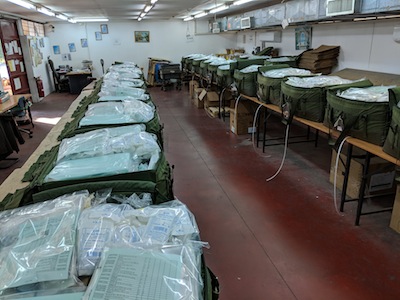
This base is the main military medical base in Israel and also the primary depot. Every 18 months, medical military units drop off complete medical supplies. They then pick up new and replenished supplies for the next 18 months, which are divided between bases. Medical supplies with expiry dates between six and 18 months are used first in hospitals and emergency rooms, while supplies with a six-month expiry date are used for training purposes and donations to developing countries. Medical kits are made up for many applications, such as atomic and biological chemical kits, combat doctors, and combat medics.

photo - Sar-El volunteers at a medical supply base near Tel Aviv make up medical kits
Sar-El volunteers at a medical supply base near Tel Aviv make up medical kits. (photo by Vadim Bendebury)

I had a great boss, Israel, who patiently explained exactly how to do things. Israel is a Bukharian Jew, a first-generation Sabra. He never stopped thanking us for our service, as did many Israelis I met off the base. They are grateful for the volunteers’ service. This, in turn, was so gratifying for us, knowing we were making a difference by giving back just a little to the country. It was an even better feeling when medical backpacks were returned to us with medical supplies unused.

The workday ends at 4 p.m., when volunteers are free to do whatever they like within the confines of the base. They are not at liberty to leave it, other than at the end of the workweek. Dinners are eaten early. Thereafter, the madrichot hold discussion groups or show movies. By 9 p.m., most people are ready for bed.

Weekends, volunteers may go anywhere in Israel, as long as we are at Tel Aviv’s main train station on the Sunday morning at 9:30, when we are taken back to our base. At present, there is a hostel in Tel Aviv specifically for Sar-El volunteers’ weekend stays. Accommodation is free, with meals included. This is a great alternative for those who are on a tight budget. It is not fancy, but it is near Tel Aviv’s hub and the beach.

One tends to forget that one is in a country in a constant state of war. The zest for life is unbelievable, which I noticed on my weekends in Tel Aviv. The bustling traffic; people sitting at coffee shops and in restaurants, or shopping at the Carmel Market; youngsters speeding down busy main intersections on their electric scooters; hip-looking men and women walking along the beautiful promenade with their dogs; beachgoers laughing and listening to music; picnickers on lawns with little children frolicking nearby; buskers entertaining the passing throng. What a beautiful, perfect picture it painted in an imperfect world.

Three weeks went by in a flash and soon it was time to return to Toronto. I looked for any reason that would enable me to stay, but, as the saying goes, all good things must come to an end. But it doesn’t have to end permanently. I will return to Israel. In fact, I am already looking at calendar dates.

I would highly recommend Sar-El for anyone who loves Israel and wants to do something worthwhile. Israel will welcome you with open arms and she will thank you.

To learn more about how you can experience your own “do good, feel good” adventure of a lifetime, email toronto@sarelcanada.org.

Charleen Glaun is a receptionist/caterer for an oil company in Toronto. She made aliyah in 1975 and spent the next 13 years traveling between Israel and South Africa, where she was born. Though aware of Sar-El since 1986, she did not have an opportunity to return to Israel until her December 2018 trip with the organization. Her heart has always been in Israel so, for her, the 2018 trip was “going home,” and she plans on returning with Sar-El before the end of this year, and each year going forward.

בית עולות איבד את מעמדו כגוף צדקה

(Michel Rathwell) .משרדי הרשות המיסוי הקנדית באוטווה

רשות המיסוי הקנדית (הסי.אר.איי) הודיעה במהלך החודש שעבר לארגון היהודי-חרדי “בית עולות” מטורונטו, כי הוא יאבד את מעמדו כגוף צדקה לצורכי מס. זאת כיוון שהארגון העביר תרומות למכינות קדם-צבאיות בישראל ולגופים הנמצאים מעבר לקו הירוק. לפי תקנות המיסוי בקנדה “בית עולות” עבר על כללי החוק הקנדי למתן תרומות מצד קרנות צדקה. “בית עולות” כך התברר תרם כספים לפרוייקטים הקשורים לצה”ל בניגוד לכללי המס בקנדה. במקרה כזה הארגון לא זכאי לפטור במס. כן גם התורמים שלו עצמם לא זכאים לפטורים במס. על פי רשות המיסוי הקנדית תרומות הכספים למכינות הצבאיות על ידי הארגון שיפרו את היעילות של הצבא הישראלי. המידע בעניין “בית עולות” פורסם לאחרונה ברשת החדשות המקומית גלובל ניוז.

הארגון “בית עולות” הוא גוף צדקה יהודי-קנדי שמגייס מדי שנה עשרות מיליוני דולרים למטרות יהודיות, שחלקם הגדול מיועדים לישראל. הארגון פועל מאז אלף תשע מאות ושמונים והוא ממקום במקום השישים ושניים, בקרב רשימת העמותות לצדקה הפועלות בקנדה. בשנת אלפיים ושבעה עשרה “בית עולות” גייס תרומות בהיקף שישים ואחד מיליון דולר קנדי. שנה קודם לכן הוא גייס תרומות בהיקף ארבעים וחמישה מיליון דולר. ואילו באלפיים וחמש עשרה גוייסו ארבעים ושניים מיליון דולר. מרבית הכספים מועברים כתרומות לפרוייקטים מחוץ לקנדה. ולכן “בית עולות” נמצא במקום החמישה עשר בקרב רשימת העומותות הקנדיות לצדקה שמעבירות כספים לחו”ל.

רשות המס הקנדית שביצעה בדיקה בנושא “בית עולות” הודיעה לראשיו כי תרומותיו של הארגון למכינות קדם-צבאיות מהוות בפועל תמיכה בצה”ל. בנוסף נטען כי מדובר בהפרה של התנאים המחייבים גופי צדקה שפועלים שלא למטרות רווח, לא לתרום לפרוייקטים צבאים זרים. אז כספים שנתרמו על ידי תורמים שונים לא יוכרו כהוצאה מוכרת לצורכי מס. לא ברור בשלב זה כמה בדיוק כסף העביר “בית עולות” למכינות הצבאיות בישראל, ולאן בדיוק הכסף יועד.

“בית עולות” דחה את הפרשנות של ממשלת קנדה. בארגון אומרים כי התרומות נועדו לתמוך בפעילות חינוכית ודתית במכינות הצבאיות ולא לסיוע ישיר לצבא הישראל.

במקביל לתלונה בנוגע להעברת תרומות למכינות הצבאיות טוענת רשות המיסוי הקנדית, כי “בית עולות” תרם מיליון ומאתיים אלף דולר קנדי לגופים בשטחים הכבושים. בממשלת קנדה אומרים: סיוע להתנחלויות הישראליות בשטחים הכבושים עומד בניגוד למדיניות הציבורית של קנדה, וכן בניגוד לחוק הבינלאומי. ב”בית עולות” אמרו בתגובה לכך כי התרומות היו מיועדות לתמיכה במשפחות חלשות, בעיקר מהמגזר החרדי הגרות בשטחים. ברשות המיסוי הקנדית לא מקבלים את הסברי הארגון היהודי.

כפי שפרסמנו לאחרונה רשות המיסוי הקנדית בודקת מזה מספר שנים את פעילותה של קרן קיימת קנדה, לאור מידע שהתקבל לידיה כי הארגון עבר על כללי החוק הקנדי למתן תרומות מצד קרנות צדקה, ותרמה כספים לפרוייקטים הקשורים לצה”ל.

בקרן קיימת קנדה הגיבו לדבר החקירה בעניינם: “קרן קיימת קנדה תמשיך לעבוד במשותף עם רשות המיסוי לבדיקת הפעילויות שלנו. בעבר היינו מעורבים בפעילויות צדקה הקשורות בעקיפין בצה”ל. רבים מהפרוייקטים היו לטובת בין היתר איכות החיים של החילים ובני משפחותיהם. כל הפרוייקטים האלה נמצאים על שטחים השייכים לצה”ל והכסף לא הועבר לצבא. אנו לא ידענו שהפרוייקטים שלנו יהיו מטרה לחקירה של רשות המיסוי הקנדית, כיוון שהם נמצאים על אדמה בבעלות צה”ל. מייד שקיבלנו מידע על כך הפסקנו את התמיכה בפרוייקטים אלה. מזה מספר שנים אנו לא תורמים כספים לפרוייקטים על אדמת בצה”ל”.

קרן קיימת קנדה הפסיקה לתמוך בפרוייקטים צבאיים בישראל לאור חקירה של רשות המס הקנדי

(jnf.ca)

קרן הקיימת בקנדה הפסיקה להעביר תרומות לפרוייקטים צבאיים בישראל לאור חקירה מתמשכת של רשות המיסוי הקנדית (סי.אר.איי). זאת עלי פי תחקיר של רשת השידור הטלוויזיה של קנדה (הסי.בי.סי).

רשות המיסוי הקנדית בודקת מזה מספר שנים את פעילותה של קרן קיימת קנדה, לאור מידע שהתקבל לידיה כי הארגון עבר על כללי המס הקנדי למתן תרומות מצד קרנות צדקה. קרן קיימת קנדה כך התברר תרמה כספים לפרוייקטים הקשורים לצה”ל בניגוד לכללי המס בקנדה. במקרה כזה קרן קיימת קנדה לא זכאית לפטור במס, וכן גם התורמים שלה עצמם לא זכאים לפטורים במס.

יש לציין כי קרן קייימת קנדה לא העבירה תרומות לרכישת ציוד צבאי לצה”ל, אלה תמכה בעיקר פרוייקטים ותשתיות צבאיות, לשיפור הביטחון וחיי הקהילה של החיילים במדים ובני משפחותיהם, אך לפי חוקי המיסוי בקנדה גם זה אסור. מנכ”ל קרן קיימת קנדה לאנס דיוויס לא ענה על בקשתי באמצעות אימייל, לקבל את תגובתו בנושא המדובר.

דיוויס כן הודיע לכתב חדשות של רשת השידור הקנדית כי קרן קיימת קנדה הודיעה לתורמיה, כי היא הפסיקה לתמוך בפרוייקטים צבאיים בישראל כבר לפני כשנתיים. זאת, לאחר שהתברר לארגון כי הוא נמצא תחת ביקורת של רשות המיסוי הקנדית.

לפי מסמכים ופרסומים רבים של קרן קיימת קנדה, הארגון תמך לאורך השנים בפרוייקטים רבים הקשורים בצה”ל וחייליו. ובהם: פיתוח של בסיס הדרכה בנגב. פיתוח של כיתות לימוד, אולם אירועים וחדר הקרנות בסיס של חיל הים בבת גלים. שיפוץ והרחבת אולם אירועים ומועדון לחיילים בבסיסי חיל האוויר בפלמחים ונבטים. הקמת מגרש משחקים עבור ילדים (שמתגוררים עם בני משפחותיהם) בבסיס חצרים של חיל האוויר. שידרוג מרכז מבקרים, שיפוץ הכיכר המרכזית והמרכז ארצי לאימונים בבסיס צאלים. הקמת מתקני נוחות לחיילים בשדה תל נוף של חיל האוויר. עזרה בהקמת כביש ביטחוני בקדש ברנע (ליד הגבול המצרי) לשיפור הנגישות לכוחות הביטחון של ישראל. עבודות לשיפור כבישים ביטחוניים של כוחות הביטחון באזורי הגבול בנגב המערבי. בניית נקודות מפגש ירוקות בבסיסים צבאיים לאפשר לחיילים לראות את בני משפחתם בנוחות. וכן עזרה ותמיכה בצעירים בבתי הספר התיכוניים במסגרת הכשרתם הקדם צבאית (פרוייקט גדנ”ע).

עוד מתברר שקרן קיימת קנדה תמכה אף בפרוייקטים ששנמצאים מעבר לקו הירוק. ממשלת קנדה מתנגדת לבנייה ישראלית של התנחלויות כשטחים הכבושים לדבריה, שהן הפרה של אמנת ג’נבה הרביעית. עוד קובעת ממשלת קנדה כי: “ההתנחלויות הישראליות בשטחים הן המכשלון חמור להשגת שלום כולל, צודק ובר קיימא”. בית המשפט בקנדה קבע כי ארגוני צדקה קנדיים לא יכולים לפעול בניגוד למדיניות הציבור.

בין פרוייקטים בשטחים שמעבר לקו הירוק שקרן קיימת קנדה תמכה בהם: פיתוח החפירות הארכיאולוגיות של האולם המרכזי במנהרות הכותל בירושלים, העברה של תרומות לפני כארבע שנים לרכישת כלים להכנת הקרקע לבניית מאחז בגבעת עוז, שהוגדר אפילו על ידי ממשלת ישראל כבלתי חוקי. ופיתוח הפרוייקט הגדול ביותר של הארגון הקנדי בישראל – פארק קנדה ליד לטרון. רופא קנדי (בפנסיה) שנולד באחד הכפרים הפלסטינים עליו נבנה פארק קנדה, התלוננן פני רשות המיסים הקנדית על תרומות של קרן קיימת קנדה לפרוייקט.

יצויין כי במאי לפני כשנתיים ביקרה בישראל משלחת של קרן קיימת קנדה, ברשות דיוויס. חברי המשלחת ביקרו בין היתר בבסיס צה”ל בצהלים ובבסיס משמר הגבול במכמש, שאליהם הועברו תרומות מהארגון.

The draft: a dad reflects

February 2015

Collected the mail this morning. A few flyers and bills. And my son’s draft notice. A quick double take. A flashback to my son playing with plastic dinosaurs. Then I texted my wife, “It’s here.”

A few hours later, my son came home. “How was school? There’s a letter for you on the table.” Opening it, and with a surprising degree of nonchalance, he said, “My call-up.” As if going into the army was an ordinary occurrence. “Ah, yeah. It’s here.”

A few days later, I asked D if I could post a picture of his call-up on Facebook. “Dad, you can’t post this stuff. It’s, like, confidential.” Duh. Of course.

May 2015

Picked my son up from Jerusalem. He was there for a series of pre-army tests. He couldn’t stop talking about the cute chayelet (army girls). Teenagers!

October 2015-January 2016

D interviewed for various roles in different divisions. None of interest. He wants something air force-specific. My wife and I helped him with a letter to the IAF manpower division. Emphasized

his aircraft knowledge. His love of plane simulators. (How many times did we catch him “flying” instead of doing his homework?) His flying lesson (a 17th birthday gift).

February-March 2016

Silence.

April 2016

The air force came knocking. Another interview. Another psychometric test. D felt he aced this one (pun intended).

May 2016

Text message from the Israeli Air Force. Accepted. Not the specific role he wanted but within his window of satisfaction. Excitement. Trepidation. The air force is the darling of the military. Best conditions. High-tech environment. Much to my son’s amusement, I don’t really understand what he’ll be doing.

July 2016

D called me at the office. Draft date pulled in. “Dad, we need to change our holiday plans – three weeks and I’m in.” New York will have to wait. Improvising, we quickly made other travel arrangements. A week later, we were in northern Italy. My son a reluctant traveler. He’d rather be home with his friends sharing the excitement of the draft.

August 2016

Took D for a buzz cut. His beautiful golden locks. Gone. I also had a buzz cut. My less beautiful grey locks. Gone. Solidarity.

We threw a draft bash. Lots of friends and family. I toasted: “We are celebrating your draft … into the world’s best air force…. I can’t tell you how proud we are…. You obtained a role – and I still don’t get it – that is meaningful and challenging, with great responsibility and opportunity. Embrace it. Be safe and strong. Keep us safe and strong. D, sweet child of mine. May God make you like Ephraim and Menashe … and establish peace for you.”

Draft day, 2016

We traveled in two cars. My wife. Our daughter. My mother-in-law. D’s friends. His girlfriend. And, of course, the cadet. We arrived at the induction centre at 0800 hours. Despite living in Israel for more than 22 years, I’m still amazed by the informality. Sometimes disguised as chaos. My Canadian self still says lines. Order. Please. Excuse me. The security appeared to be in disarray. Then I remembered I’m on an army base. Umm … can’t get more secure than that.

Hundreds of young recruits. Balagan. Israeli flags waving overhead. Old ladies passing out amulets with the prayer for the Israeli army. Sephardi grandmothers spraying water into the crowd to wash away the evil eye.

Much too quickly my son’s name was called. Won’t forget the apprehensive “I guess it’s my turn” look on his face. Nor the tears flowing from my wife’s almond-shaped eyes. Nor the tears flowing from my daughter’s green eyes. Nor my mother-in-law’s “shouldn’t there be peace by now?” hunched and saddened look. I took D aside. Covered his head with my hand. Recited the blessing for a son. Then, like at a beach party, his friends hoisted him on their shoulders. Carried him forward. Innocence. Bravado. Another generation coming of age in Israel.

He walked the final distance alone. Oversized backpack. Buzz cut. Excitement. Trepidation. Then disappeared into the military transport and his next three years. Actually, two years and eight months, but who’s counting.

Bruce Brown has been living in Israel for a long time and is the proud father of two Sabras, one currently a sergeant in the Israeli Air Force.

Vancouverite to serve in IDF

Vancouverite Maya Gur-Arieh was among the 57 soon-to-be-enlisted Israel Defence Forces lone soldiers who landed at Ben Gurion Airport on Aug. 15. (photo by Gil Zohar)

A happy crowd of approximately 2,000 people – family and friends, along with eight members of the Knesset and assorted officials – arrived at Ben Gurion Airport in Israel at 6 a.m. on Aug. 15 to welcome the second plane of Nefesh b’Nefesh olim (immigrants) and returning citizens to touch down this summer. On board were 239 newcomers, including olim hailing from British Columbia, Ontario, Quebec, and 24 American states.

The reception at Terminal 4, a hangar adjoining the tarmac, festooned with banners, featured hora dancing, shofar blowing, tears of joy and shouts of “welcome home” and “mazal tov.” The newcomers varied from babies to retirees, including 30 families, 90 children and three sets of twins. But it was the 57 soon-to-be-enlisted Israel Defence Forces lone soldiers, wearing T-shirts emblazoned in Hebrew with “Ascending to an army uniform,” who garnered most of the accolades.

Among these future IDF soldiers was Maya Gur-Arieh, 18, who was born in Ashkelon but moved with her family to Vancouver when she was six months old. Keen to enlist for the past 24 months, she told the Jewish Independent, “I’m really happy I’m here. I’m really looking forward to my service. I really recommend Garin Tzabar.”

The program, affiliated with the Hebrew Scouts Movement in Israel and largely funded by the Ministry of Immigrant Absorption, facilitates service in the IDF and provides a support system for Israelis and Jews from the Diaspora serving in the army who do not have at least one parent living in Israel.

Lone soldiers receive a higher basic salary from the IDF, as well as financial assistance from the Ministry of Immigrant Absorption and the Ministry of Housing. Lone soldiers in combat units receive a monthly salary of NIS 3,100 ($1,200 Cdn), according to the Garin Tzabar website, and they are given help with housing and the right to extra time off, including 30 days per year to visit family overseas.

Gur-Arieh said she attended four Garin Tzabar programs in San Francisco, at her own expense, in anticipation of joining Zahal, the Hebrew acronym for the IDF.

In heading to Israel, she is following a Gur-Arieh family tradition, she said – her two older sisters both served as lone soldiers, one as an artillery instructor and the other as a combat engineering instructor. Both became officers, she said with pride. One of her sisters is making a career in the IDF.

Gur-Arieh doesn’t know where she will be serving since she hasn’t done the battery of physical and psychological tests that all draftees must complete before being assigned to a unit. Like her sisters, she, too, would like to be an instructor in a combat unit.

Until she is drafted, Gur-Arieh – whose surname means lion cub – will be living at Kibbutz Kissufim on the Gaza periphery. Asked about the tensions in the south and the rockets, mortars and incendiary balloons and kites from Gaza that have targeted her adopted home, she was nonplussed.

Founded in 2002, Nefesh b’Nefesh has assisted in bringing 57,000 Jews to Israel from Canada, the United States and Britain. The organization currently assists 3,200 soldiers in its lone soldier program.

The Aug. 15 Nefesh b’Nefesh charter flight was paid for by Heidi Rothberg of Denver, Colo.

Gil Zohar is a journalist based in Jerusalem.

JNF of Canada honours Isaac Messinger

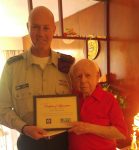
Isaac Messinger being presented with a certificate of appreciation last year for his contributions to the Jewish National Fund of Canada and Beit Halochem. (photo from JNF Pacific Region)

Isaac Messinger was born in Poland in 1929 and spent some of his early years in Siberia. Although his family tried to flee back to Poland when he was 12 years old, he ended up alone and orphaned in Russia and has spent the years since then living a very colourful life.

Among the notable moments, Messinger worked as a cowboy on horseback, chauffeur to a Polish officer, in a garage, as a prizefighter, a soccer player, a tinsmith and a traveling carnie with a roulette wheel. And he still had time to open a steakhouse and deal in diamonds, while lending money to some of the original landowners along the Las Vegas Strip.

Messinger has long been a strong supporter of Israel and he is currently focused on funding a project of JNF Canada that works with Israeli veterans, a special fitness centre at Beit Halochem Ashdod.

At first glance, the fitness centre at Beit Halochem looks like any other fitness club. There are lots of people working out on the equipment, weight training and stretching. Upon closer examination though, the difference is quite clear. Not only is much of the equipment and machinery slightly different, but the members are as well. Here, veterans young and old, with a wide spectrum of disabilities, come to improve their strength, flexibility and cardiovascular health. They exercise side by side, some on special equipment designed for wheelchair access or amputee-specific machines, and there are trainers on hand to explain and assist the veterans.

The physical rehabilitation aspects of working out in the fitness centre are clear to all. Less obvious is the psychological benefit that the disabled vets get from taking an active role in their rehabilitation.

Power of human spirit

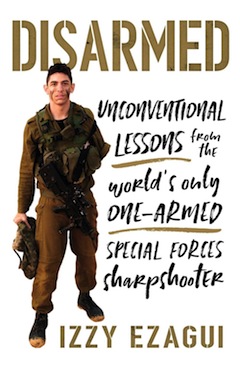
Disarmed: Unconventional Lessons from the World’s Only One-Armed Special Forces Sharpshooter by Izzy Ezagui (Prometheus Books) is confusing, puerile, uneven, exaggerated, chutzpadik and strident – I loved it. I enjoyed every blessed moment involved in reading this extraordinary Proust-like jumble of words and ideas by an Israeli soldier who lost his left arm in a Hamas mortar shelling a decade ago when he was on duty near Gaza.

The unlikely protagonist of this memorable saga is a Sephardi Jew raised in Florida and Crown Heights (New York), and educated first in the public school system and, afterward, in a Lubavitch yeshivah, before making aliyah. His father and mother, whom he idolizes in this book, were complex parents who decided, while Ezagui was still very young, to become more serious about their Judaism.

image - Disarmed book coverThis autobiography is among the few books available on the intricacies of the Israeli army’s training procedures for inductees into elite units – which Ezagui experienced not once but twice – and, as such, it provides an introduction to what it really means to become a member of Zahal, the Israel Defence Forces. The rigours of IDF training are equal or superior to American, British and Canadian special forces cadres.

When Ezagui’s tent was destroyed by the mortar blast that hit his unit bivouacked near Gaza, the young soldier did not at first realize what had happened to him, so great was the shock to his nervous system. The graphic description he provides of the wreckage to his left arm is not easy reading because it lies outside our normal anatomical parameters but Ezagui conveys quite adequately the physical and psychic damage he endured. It took hours before the extent of his personal catastrophe was fully known.

Ezagui’s comrades were able, once the dust had cleared, to transport him to an Israeli medical facility, where doctors stabilized the young soldier, along with others who had been injured by enemy fire. One of the most poignant parts of this journal is Ezagui’s attempt to speak to his mother on the telephone to impart the news about the loss of his left arm without provoking hysteria on her part.

Part of the treatment the author received from Israel’s medical cadres were heavy doses of very powerful drugs, including fentanyl, a narcotic, he notes, which is a hundred times more potent than morphine; it was the first drug administered to him when the severity of his injury was recognized. This is a relevant observation because, when Ezagui began to recover his sensibilities, he immediately declared that he intended to return to his combat unit. But he soon realized that he would have to go “cold turkey” before he could even think of rejoining his comrades. This he did by dint of unbelievable discipline in the face of incredible suffering from withdrawal.

During this crisis period in his slow recovery, Ezagui was confronted with the negative responses of army doctors, one of whom bluntly told him that his condition precluded the kind of camaraderie and fraternity among soldiers who depend on their peers to help them. That kind of subtle yet direct rejection ironically made Ezagui more determined in his pursuit of his former status as a soldier-sharpshooter. It did not help that he was continually hounded by his “phantom,” the curious physiological phenomenon when a severed limb asserts its presence despite its absence.

In his narrative, Ezagui gives us all the excruciating details of his retraining in the army – this time, with a limb missing. One of the greatest obstacles he encountered was mounting a wall with a rope anchored to it. In his previous incarnation, he had no problem, but one arm wasn’t enough to execute the onerous task. He finally realized that a contortionist’s skill was required to perform the feat and, through the use of his legs and other body parts, he was able to get over the wall.

Ezagui encountered a similar problem with his rifle. It jammed regularly when he tried to insert the shells into it. He overcame his frustration only when he realized that he had to dig his weapon into the ground, anchor it solidly and, then, with his one arm, load the instrument.

Ezagui passed all his retraining requirements and it was the doctor who had initially rejected his attempt to rejoin his unit who certified his reentry into the army.

Disarmed is a testimony to the resilience of one human being who beat the odds and conquered a disability, and Ezagui has become a symbol of what the human spirit is capable of accomplishing.


Arnold Ages is Distinguished Emeritus Professor at University of Waterloo, in Ontario.