Foxtrot steps on toes

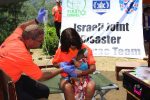
Itay Exlroad as Dancer Soldier. (photo by Giora Bejach, Courtesy Sony Pictures Classics)

An audacious work of art that melds raw emotion and absurdist allegory into a blistering assessment of contemporary Israel, Samuel Maoz’s Foxtrot deserves to be seen and demands to be discussed.

Winner of the Silver Lion at the Venice Film Festival – where Maoz’s taut debut, Lebanon, won the Golden Lion in 2009 – and eight Ophir Awards (Israel’s Oscars), including best film, director and actor, Foxtrot uses a small-scale story to examine some of Israel’s deepest issues: the concept of military sacrifice, the oppression of Palestinians and the legacy of the Holocaust.

Skilfully strewn with ironies all the way to the final shot, Foxtrot was shortlisted for the Academy Award for best foreign language film but did not receive a nomination.

The film begins with a middle-aged man (the sublime Lior Ashkenazi, who played a fictitious prime minister last year in Norman and Yitzhak Rabin in this month’s 7 Days in Entebbe) opening his door to the worst possible news for a father with a son in the army. Even as the gravity of the situation and the intensity of his response wallops us in the face and grabs us by the collar, Maoz counter-intuitively undercuts the emotional naturalism with precision camerawork and a stylized set design.

It appears, at first, that the filmmaker is evoking the surreal, detached and alienating experience of being struck with a life-changing bulletin. But we get the nagging feeling, from Ashkenazi’s character’s black-humour interactions with the army representatives to the off-centre introductions of his wife and daughter, that there’s more on tap than the melodrama of domestic tragedy.

Indeed, Maoz pulls the rug out from under us, then cuts from the climate-controlled setting of a high-in-the-sky condo to an isolated checkpoint in the barren, forgotten north of Israel. This is where the son, Yonatan, is assigned the “mission” of guarding a remote, nonessential road with a handful of other bored young men.

The tilted shipping container that comprises the soldiers’ base and barracks fronts on a puddle-strewn mudfield, which they must trudge across to the checkpoint. The roadblock itself is cartoonishly minimalist, resembling a set you’d see onstage more than a military installation, and putting us in mind of surrealist (anti-)war films like Apocalypse Now and Catch-22.

Nothing happens in this God-forsaken spot, and everything happens here. Each detail has significance, though one must pay close attention because it may not be clear until events play out. In fact, the meaning of a close-up or sound cue often remains obscure until the movie is over, at which point the viewer is required to arrive at his or her interpretation.

Two key events occur at Yonatan’s base: one at the checkpoint involving a carload of Palestinians heading home from a party and the other in the barracks when the soldiers are killing lonely downtime. The latter scene, in which Yonatan relates an anecdote from his father’s youth, is the most astonishing passage in this taboo-trampling movie.
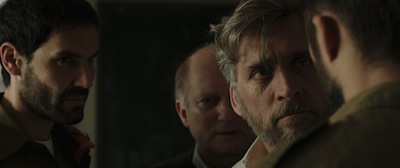
photo - Left to right: Danny Isserles as Official Military Officer, Yehuda Almagor as Avigdor, Michael’s brother, and Lior Ashkenazi as Michael
Left to right: Danny Isserles as Official Military Officer, Yehuda Almagor as Avigdor, Michael’s brother, and Lior Ashkenazi as Michael. (photo by Giora Bejach, Courtesy Sony Pictures Classics)

Yonatan has rendered his memory into a graphic novel, and Maoz brings it to life in the form of animation. This harrowing episode connects the Holocaust – and the self-reliance, persistence, shared sacrifice and residual faith that survivors applied to building the Jewish state – to a modern Israel, where idealism has curdled into a pursuit of temporary pleasures, and worse offences.

To be sure, in every land and every age, older generations castigate young people for ignoring tradition and abandoning their core values. But this parable takes place in Israel, so Yonatan’s father’s hormone-driven rashness hearkens to Esau swapping his birthright for a bowl of stew.

Threaded through Foxtrot is a critique of Israel’s leaders for maintaining a culture of cynicism and corruption that results in the unnecessary deaths of young soldiers. Furthermore, each loss is described as heroic regardless of the circumstances.

This is not unique to Israel, of course, but it’s harder to push back against the military spin when you’re a small country surrounded by enemies than a superpower. Maoz satirizes PR functionaries in the opening scene, in fact, and never stops spearing sacred cows.

Maoz’s triumph, finally, thanks in large measure to Ashkenazi’s unexpectedly vulnerable performance, is tracking the human cost amid the not-quite-real scenarios and sociopolitical commentary. Foxtrot is an altogether remarkable work, not least because it is a beautiful film about ugly truths.

Foxtrot is in Hebrew with English subtitles, runs 113 minutes and is rated R for some sexual content, including graphic images and brief drug use. It opens at Vancity Theatre on March 23, and runs to April 1.

Michael Fox is a writer and film critic living in San Francisco.
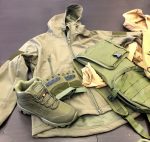
Military clothing seized at Ashdod

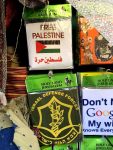
(photo from Ashernet)

Earlier this month, customs officials at the Ashdod port discovered a significant amount of military equipment destined for Gaza. Thousands of items of camouflaged military clothing, including coats, combat vests and boots, were due to be moved into Gaza via the nearby Kerem Shalom border crossing. This is one of the biggest collections of military clothing that has been intercepted on its way to Gaza.

IDF colonel visits Vancouver

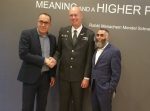
Left to right: Ilan Pilo, Jewish National Fund, Pacific Region; Col. Adam Susman, Israel Defence Forces defence attaché to Canada; and Rabbi Shmulik Yeshayahu of the Ohel Yaakov Community Kollel. (photo from Community Kollel)

While acknowledging that the situation in the Middle East is constantly changing, Col. Adam Susman told those gathered at the Ohel Yaakov Community Kollel on July 18 that the biggest threat to Israel is Iran, “as it has been for years.”

Susman, who is the Ottawa-based Israel Defence Forces (IDF) defence attaché to Canada, was in Vancouver at the invitation of the Jewish National Fund of Canada, Pacific Region.

Born in the United Kingdom, Susman moved to Moshav Sde Nitzan in southern Israel at the age of 3, according to JNF’s website. He joined the IDF’s Givati Brigade in 1987 and became a battalion commander after serving as head of the anti-ballistic and training branches. In 2005, he was appointed commander of Hanegev infantry brigade and chief of staff of the Sinai division, protecting Israel’s southern border. In 2009, he became commander of the Dan district in Home Front Command, working to ensure the safety of civilians in the metro Tel Aviv area. Prior to his appointment as the defence attaché to Canada in 2014, Susman was head of the International Military Cooperation Department of the IDF General Staff.

Rabbi Shmulik Yeshayahu of the Community Kollel was the emcee of the Vancouver event. “It is fitting to have this meeting during the weekly Torah portion of Matot-Masei,” he said in his opening comments. “In this parashah, a portion of the Jewish people stays behind on the way to the Holy Land, preferring to farm on the other side of the Jordan River rather than go in and fight for the land. They stayed there while the rest of the tribes fought and, later, they joined them. In Judaism, we have great respect for those who risk their lives to protect other people, and especially our homeland.”

Before introducing Susman to those gathered, Ilan Pilo, executive director and Jerusalem emissary of JNF Canada, Pacific Region, presented a brief video about JNF’s activities throughout Israeli history. He then invited the president of Royal Canadian Legion’s Shalom Branch, Ralph Jackson, to speak. Jackson, who introduced himself as “the only Jew in the Scots Guards during World War Two,” presented a donation of $5,000 to Susman for Beit Halochem, a nonprofit that cares for disabled Israeli veterans.

Leonard Shapiro, Shalom Branch vice-president, noted how the branch was formed during a time of great prejudice, when Jews needed their own veterans organization. “It has been a long time now since we’ve gone to war, however, thank God. We don’t get many new members. If anyone here would like to join and support our organization and activities, you don’t have to have been in the army, you just need to be over 18 and not have committed any horrible crimes. Little ones, OK,” he joked.

Susman shared a bit about himself and his experience in the Givati Brigade, which was the most highly decorated brigade in the 2014 conflict, a fact no doubt known to the many IDF veterans in the audience.

Susman is one of 16 Israeli attachés around the world – a small number that, he said, was due to Israel never having been part of a military coalition with another country. He outlined the ties between the Israeli and Canadian militaries, the chief threats to Israel today and the IDF’s response.

“There is cooperation between the IDF and the Canadian military strategically and practically,” he said. “The relations between the IDF and the Canadian military are good.”

Asked if the change of Canada’s federal government to the Liberals from the Conservatives had had any effect on that relationship, Susman said it had not.

Turning to the situation in Israel’s own region, he emphasized the lack of stability.

“The Middle East is an interesting neighbourhood, always changing – what I tell you today may not be true tomorrow,” he said.

“The biggest threat is Iran, as it has been for years,” he continued. “[Mahmoud] Ahmadinejad took every opportunity to say that Israel should disappear from the map of the world. The main threat they’ve posed has been building Hezbollah – without Iran, it would be a small organization. In recent years, Hezbollah has been fighting in Syria and they’ve lost a lot of people, but they’ve also gained a lot of operational experience. They have also steadily increased in rocket capabilities and can now reach Eilat.”

Susman said that Syria had previously been a big threat to Israel, but that’s no longer the case, due to its civil war and ISIS, as well as the reduction of the country’s chemical weapons by Western countries.

Hamas in Gaza is the next biggest threat, he said, noting that it is also supported by Iran. “They only exist to fight,” he said. “They are not building up Gazans as they claim. A good example is the tunnel found during 2014 Protective Edge, kilometres of resources that could [have been used] for clinics and schools. Gaza is a piece of cheese, there is 80 metres between the top and the water table, dotted with tunnels. That’s a major challenge.

“The Sinai is also a security problem,” he added. “Nobody controls it, and so everybody is in there. There was no Egyptian military following the peace agreement, so that’s the result. The MFO (Multinational Force and Observers) was created to survey the Sinai and, by the way, there are many Canadians in it.

“Some people say the IDF is a military that has a country,” quipped Susman. “We are strong, and we are good at finding solutions.”

Susman cited Iron Dome as an example. The IDF initially divided Israel into 157 zones with two missile interceptors for each missile. That was successful, he said, but each missile cost $70,000 so that intercepting one fired missile cost $140,000. Therefore, the IDF sought improvements. Israel was divided into 254 zones, he said, and each one had only one missile interceptor per fired missile. This system has a 90% success rate stopping missiles, which is still not good enough in Susman’s view. “We will improve yet further,” he said.

During the question-and-answer period, an audience member commented, “You said Iran is the biggest threat against Israel but you didn’t say what Israel is doing against Iran.”

“That’s right,” replied Susman without further explanation, eliciting laughter from the crowd.

The evening ended with the singing of “Am Yisrael Chai,” led by Yeshayahu.

Matthew Gindin is a freelance journalist, writer and lecturer. He writes regularly for the Forward and All That Is Interesting, and has been published in Religion Dispatches, Situate Magazine, Tikkun and elsewhere. He can be found on Medium and Twitter.

Providing mutual support

Sara Omer and her kids lost their husband/father Reuven in 2008. (photo from IMP Group)

May 1 was Yom Hazikaron (Israel Memorial Day), May 2 celebrated Yom Ha’atzmaut (Israel Independence Day) and this month marks the 50th anniversary of the Six Day War and the reunification of Jerusalem. For the widows of Israel’s fallen soldiers, who paid the ultimate price so that Jews all over the world could revel in the modern-day rebirth of the Jewish state, these anniversaries stir varying emotions.

At 94 years old, Devorah Arkin Roth is one of the country’s oldest war widows. Her husband, Mordechai Arkin, was killed while defending Hadassah Hospital in Jerusalem just weeks before the official outbreak of the War of Independence in May 1948. She shares fond memories of her husband, as she stares at the photo album of their wedding and the newborn pictures of their first child.

“He was a very talented man who wanted to go to Columbia University in New York to study physics,” she recalled. “But the deteriorating security situation in the country wouldn’t permit him to leave. He worked at Hadassah Hospital and doubled as a guard when he was killed. At the time of his death, I was already pregnant with our second child.”

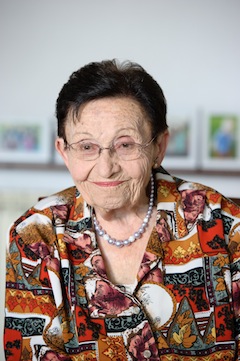
photo - At 94 years old, Devorah Arkin Roth is one of Israel’s oldest war widows
At 94 years old, Devorah Arkin Roth is one of Israel’s oldest war widows. (photo from IMP Group)

Though Roth remarried and feels privileged to be a mother, grandmother and great-grandmother, she still gets the jitters each time one of her grandchildren goes into the army. “It’s difficult to see your grandchildren being drafted into the IDF [Israel Defence Forces] after what I had to endure, and even more so because one of my grandchildren was injured as well in battle,” she said.

The Six Dar War was an astounding military accomplishment, as the IDF beat back the armed forces of Egypt, Syria and Jordan – but 776 IDF soldiers lost their lives.

Pte. Yossi Mori was killed on the first day of the Six Day War (June 5, 1967) after his unit was shelled in a minefield. His widow, Dania, recalled, “We had a great group of friends and, to this day, we meet every Memorial Day at his grave. During these years, you keep going, building your home, raising children and grandchildren. You don’t just sit all day thinking about your loss, because then your life would stop.”

First Lieut. Yehuda Ram died while liberating the Golan Heights on the last day of the war (June 10). “Yehuda died when he was 23 years old and we had only been married for a year. It was young love, an innocent one,” Shoshana, his widow, remembered. “I actually came back from the war filled with guilt. Why did I survive and he didn’t? Those feelings disappeared with the years because you can’t keep living like that.”

Even in between wars, when IDF soldiers constantly train in order to be ready for the next conflagration, there are inherent dangers, which can exact a toll.

For example, Sara Omer’s world was nearly destroyed in 2008, when her husband Reuven was killed in the midst of a training exercise as part of his IDF reserve duty. She had to face life alone with her three young boys, twins Nadav and Yotam, who were 6 years old, and Guy, then 2 years old.

“The unexpected loss of my husband was indeed shocking and, when Yom Hazikaron comes around every year,” she said, “it is a difficult day for all of the widows, but my children, who are now teenagers, attend a special ceremony at the Knesset, which is both uplifting and inspiring.”

Run by widows and orphans, the IDF Widows and Orphans organization (IDFWO) creates a support network to help them through difficult times. The organization provides services that touch every aspect of their lives, from a communal bar/bat mitzvah service at the Kotel, to professional training courses.

One of the most important activities of the IDFWO is to bring together people with common experiences for mutual support. Regular retreats give widows a break and a chance to benefit from mutual understanding. The IDFWO Otzma Camps give orphans the same opportunity.

“Once a war widow, always a war widow, even if you remarry and love your second husband. The IDFWO gatherings and activities are very important for a very specific reason,” one of the widows explained. “We might not always agree with each other’s opinions about different things, but we all speak the same language and understand each other, as widows. Since we have all experienced the same loss and trauma, we can speak to each other in our language and help each other when we need to, especially on Yom Hazikaron, when we all could use a hug and a smile.”

To learn more about the IDFWO, see idfwo.org/eng.

Being a woman in the IDF

From left to right, Staff Sgt. Maya, Sgt. Noam and Brigadier General (Res.) Gila Klifi-Amir at a Friends of the Israel Defence Forces program April 3 in New York City. (photo by Shiryn Ghermezian)

Israel’s female soldiers seem to break barriers on a consistent basis. In January, new figures revealed that the number of women serving in combat roles in the Israel Defence Forces’ Homefront Command is up 38% this year. Last month, the IDF launched a pilot program in which women will be trained as tank operators for the first time.

Indeed, the Jewish state takes pride in being an oasis for gender equality in a Mideast region largely bereft of women’s rights, and this attitude extends to Israel’s military. At the same time, for a nation facing ever-present security threats both internally and on its borders, gender equality has its limits.

“The mission of the army is to protect and win. We need to understand that the mission of the army is not equal opportunity,” Brigadier General (Res.) Gila Klifi-Amir, who has had a 30-year career with the IDF and served as an adviser on women’s issues to the military’s chief of staff, said April 3 in New York City.

Klifi-Amir moderated a discussion with three female Israeli soldiers – Sgt. Noam, Staff Sgt. Maya and Staff Sgt. Y, whose full names were withheld for security reasons – in a program hosted by the Young Leadership Division of Friends of the Israel Defence Forces, a nonprofit whose mission is “to provide for education and well-being” of IDF soldiers.

The soldiers on the panel all told JNS.org they have never felt discrimination for being a woman in the military, and that their male counterparts treat them with respect. Y described the interactions as “very, very professional,” and Maya – who commands an infirmary at her battalion’s headquarters – explained, “We train with the guys, we do everything like them. Inside the unit, everything is the same.”

Israel is the world’s only country where military service is obligatory for women. From ages 18-26, women must serve two years in the military – with some exceptions, such as if they are pregnant. Today, 95% of the IDF’s positions are available to women, according to Klifi-Amir.

Yet “equal opportunity” does not exist in the purest sense, the soldiers said. Klifi-Amir told the crowd she does not believe all military positions should be open for women, depending on the mission. The physical training required for some military roles may be too grueling for a woman’s body, and the IDF is responsible for the life of each soldier, she said.


Read more at jns.org.

IDF orphans tree plant

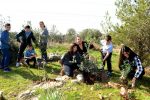
Orphans from the IDF Widows and Orphans organization plant olive trees in the Givat Koah forest along with Tami Shelach, IDFWO chair, herself an IDF widow. (photo from IMP Group Ltd.)

Eleven-year-old Maya Keidar lost her father, Lt.-Col. Dolev Keidar, in Operation Protective Edge in Gaza in 2014. But, on Tu b’Shevat this year, she was smiling as she helped plant some olive trees with other orphans in the Givat Koah forest near Rosh HaAyin in Israel – a site where many trees had been devastated by the recent forest fires. The initiative was organized by the Israel Defence Forces Widows and Orphans organization.

“It’s fun to spend time outdoors, with nature, and even more fun to do it with the friends from IDFWO,” said Maya.

Eliyah Asulin, 10, and her sister Ophir, 14, were part of the group. The Asulin sisters’ father, policeman Sgt. Maj. Shlomi Asulin, was stabbed and killed in 2011 when chasing after car thieves in 2011. Also participating were Jonathan Zilbershlag, 7, and his older brother Ido, 11, who were digging hard to break ground with a spade. Helping them was 8-year-old Yaron Berkovic. While they worked, the children tried to protect as much of the native Israeli flowers that had grown within the past week among the trees in the forest.

“These children’s fathers implanted the values of sacrifice and love of Israel in all of us,” said Tami Shelach, chair of IDFWO, herself an IDF widow. “Now, we must take the values they’ve modeled and continue maintaining them. It’s our fervent hope and wish that these orphans will, indeed, see new beginnings sprout from the darkness.”

The olive tree was chosen as a symbol of peace and hope. And, added 11-year-old Michael Zacharia – whose father, Sgt. Maj. Gil Zacharia, collapsed while his reserve unit was training in 2015 – “It’s a tree with strong roots, so it’ll live for a long time.”

IDFWO is the only nonprofit organization recognized by the State of Israel to work with widows and orphans of the IDF and Israel’s security forces. They care for approximately 8,000 widows and orphans every year through recreational events, programming, retreats, b’nai mitzvah trips, etc. For more information, visit idfwo.org/eng.

Saying goodbye to a dear friend

Jenny and Zvika, 2002. (photo from Jenny Wright)

I am at Vancouver International Airport and U.S. Customs hands me a card asking the purpose of my visit to the United States. Is it business, pleasure, study? “None of the above,” I respond.

If I were to write a response, it would be: “To say goodbye to a lifelong friend who is leaving our world shortly.” Even at 65, it’s the first time for me to be traveling somewhere with a purpose such as this. And I never expected it to be Zvika (Irv Spivak), a childhood friend whom I have known longer than my husband.

At 15, we met at a rural boarding school in Israel. Two “misfits” or, should I say, creative souls, who had not quite grasped how to integrate into Israel’s society. Zvika was from New Jersey and myself, England. Our friendship flourished. Our mothers, both widows, also became friends.

Zvika was a natural comedian. He could imitate anyone. Presidents, cartoon characters, teachers and family members were only a few of the objects of his jokes. He mimicked accents and, when reciting a joke, it was told with such colour and credit, it became real.

Zvika loved to perform to an audience and I became his “informal” manager in Haifa. I introduced him to my good friends Ronit and Pini and several others and we became a close group. No party was complete without an hour or two of sketches. Nobody was ever excluded and tourists often made up half the parties we held. By midnight, we were laughing and crying uncontrollably, clutching our stomachs in pain. There were frequent complaints from neighbours and we were sure they thought we were drinking and smoking funny stuff but we were all high on pure laughter.

Zvika loved flying and had developed a series of international airline stewardess skits performed in numerous languages. Eventually, when the repertoire was over, I’d lead a round of Hebrew and English folk songs into the wee hours of the morning, with harmonies added by Zvika.

We didn’t know at the time that these carefree days would end very abruptly. On Yom Kippur, a coalition of Arab states launched a surprise attack, knowing that the majority of Israelis would be in synagogue. Zvika had stayed over and we were preparing to go out when the shrill siren began blaring. We looked at each other in disbelief. Today? Yom Kippur? The holiest day? Turning on the radio, we learned that Israel had been attacked by Egypt, Syria and Jordan. We headed to the shelter and remained there for several hours until the shorter siren indicated it was safe to leave.

Our lives took a different turn. I had been hired to perform on a cruise line heading to France and Zvika was planning to actualize his dream of becoming an airline steward.

Haifa’s port, however, was now closed indefinitely, so I offered to perform for the Israel Defence Forces military troops. Together with a magician and another musician, the newly formed Tsevet Havai Pikkud Tsafon (Northern Command Entertainment Troupe) was created.

Zvika was drafted as a medic and stationed somewhere near Nazareth.

En route to the Golan Heights after several successful performances, I realized we were passing army bases in Nazareth. “Stop, stop!” I yelled to the driver. “I want to visit my friend.”

Surprisingly, the driver complied and, moments later, I was hugging Zvika.

“Join us,” I said.

“Are you kidding? I won’t be allowed, even though I do very little here.”

“Let’s speak to your base commander,” I urged. Shortly after, we were performing our tunes for the commander and soldiers. With hearty applause, the commander understood how immensely valuable our music would be for the troops and permission was granted for Zvika to leave.

Our group performed in newly acquired territories: deserted villages surrounded by cattle and sheep, bunkers, and sometimes only a few miles from the bombings. We traveled to the Lebanese, Syrian and Sinai borders. The silent and somewhat eerie landscape filled with roars of laughter as Zvika carried out his sketches for the soldiers. We would learn later that, for some, this would be the last show they would see.

Eventually, Zvika was summoned to his base and I returned to Haifa to complete my previous plan.

Zvika moved to New York to become, you guessed it, an airline steward, and I moved to England. We’d reunite on special occasions. When I moved to Vancouver, my English friends threw a farewell party and Zvika flew over to attend and share all the skits with my friends. When he finally settled in San Francisco, we always stayed in touch.

Zvika’s larger-than-life personality drew people to him from all walks of life. Everyone felt that he was their best friend. He loved people, Cuban cigars and food and, before long, began selling diamonds at a Union Square store.

However, in 1989, he developed HIV and, with every visit, I began to wonder if it would be the last one. But, he overcame it and, in contrast, developed yet a larger tenacity with life.

He became a marriage commissioner, California-style. I was fortunate enough to attend Ronit’s daughter’s wedding and witness how eloquently Zvika created meaningful wedding vows. In 1997, he officiated more than 75 weddings and then branched out to do funerals, naming ceremonies, pet funerals and being the master of ceremonies at various events.

In March 2016, Ronit informed me that Zvika had been diagnosed with an aggressive form of bile duct cancer. He sent regular updates including this one: “The standard prognosis is four to six months or an additional year or two if chemo is successful. That being said, I was told 25 years ago that I’d be dead from AIDS after six months and we all saw how that prediction turned out. :-)”

I arrive at the hospice and my other lifelong friend, Ronit, is there to greet me. Zvika clutches my hand and I suppress my tears. In the days to come, he weakens. There are swarms of people coming in to say their final goodbyes. His friends move him to his house to die peacefully. I sing our old melodies to him. There are no harmonies. But, he is surrounded by love and care until his passing.

One of Zvika’s quotes was “My friends are my greatest blessing. I value honesty, loyalty and friendship. I love making new friends.”

Sixteen years ago, in a post-birthday note to all his friends, Zvika wrote: “If I were to die today … I’d die the happiest man ever to have lived and loved for knowing you. It has never been about the material things for me (hell, I’ve lost everything twice), it has always been about the memories of good times with each and every one of you. Your footsteps are indelibly etched in my brain. You are all my personal angels and friends.”

Jenny Wright is a writer, music therapist, children’s musician and recording artist. She also teaches creative writing and can be reached at jennywright3@gmail.com.

A world leader in care

The World Health Organization has recognized Israel’s medical rescue teams and Israel Defence Forces’ field hospital as Type 3, the highest ranking for any foreign medical rescue team and field hospital in the world. (photo from United Hatzalah)

On Nov. 28, the World Health Organization (WHO) began a three-day meeting in Hong Kong, during which they recognized Israel’s medical rescue teams and Israel Defence Forces’ field hospital as Type 3, the highest ranking for any foreign medical rescue team and field hospital in the world. Israeli Deputy Minister of Foreign Affairs Tzipi Hotovely attended on behalf of Israel.

United Hatzalah, Israel’s national volunteer emergency medical services organization, and the Israelife Foundation, a conglomerate of Israel-based rescue organizations that respond to disasters worldwide, welcomed the award.

“We want to praise and thank all of the dedicated volunteers, staff and soldiers in all of the rescue services throughout the country. Their dedication and selfless acts of kindness in saving lives at home and abroad are officially being recognized on the world stage and, due to their efforts, Israel has become a world leader,” said Dov Maisel, United Hatzalah vice-president of international operations.

With the ceremony, Israel became the 17th foreign medical team to be classified by WHO, and it currently boasts the highest ranking. The process to achieve the ranking took nearly a year of in-depth reviews to ensure that Israel’s field hospitals met all of the criteria.

Besides the simple value of recognition, the Type 3 classification will also have some real ramifications. The classification ensures that Israeli rescue and medical teams will be the first allowed on the scene of future disasters regardless of where they happen and it will further cement Israel’s position as a world leader in emergency medicine.

Israel is not only the only Type 3 medical response team in the world, it is also the only one to be recognized by WHO that comprises a “military component” in the form of the IDF field hospital. Some aspects of the classification deal with the ethics of emergency care, and having a military branch receive the Type 3 classification highlights the ethical standing of that body.

The person behind the WHO classification system is Dr. Ian Norton, a specialist in emergency medicine and former head of his native Australia’s emergency response team. Norton developed the WHO system – which ranks foreign medical teams into Type 1, Type 2 and Type 3 – in 2013.

The different types refer to the number of patients that can be treated and the level of difficulty of the procedures that can be offered by a medical response team. Even with the high standards, Israel’s field hospital surpasses the requirements, offering more medical care than is required to be classified as Type 3. For example, the Times of Israel reported that a Type 3 field hospital needs 40 inpatient beds, whereas Israel’s has 86, and a Type 3 ranking requires the hospital to have two operating rooms, whereas Israel’s has four. Israel also qualified for the Type 3 category by employing teams that offer additional “specialized care,” such as burn units, dialysis units, obstetrics and gynecology teams, and reconstructive plastic surgery units. The IDF field hospital also received accolades for its abilities to provide exemplary levels of plastic surgery, and obstetrics and gynecology care. These latter qualifications establish the team as a “Type 3 plus.”

In addition to the field hospital, Israel was praised for the work done by its volunteer evacuation and emergency response teams, such as United Hatzalah, Zaka and Israelife. These teams of volunteer responders have conducted search and rescue operations and provided emergency medical services in disasters all over the world. Most recently, United Hatzalah sent Maisel, an emergency paramedic, to be a medical liaison and consultant as part of the Jet911 multinational response team that responded to the destruction caused by Hurricane Matthew in Haiti in October.

Other disasters to which the IDF field hospital and Israel medical response teams have responded include the earthquake in Turkey in 1999, the earthquake in Haiti in 2010, the typhoon in the Philippines in 2013 and the devastating earthquake that shook Nepal in 2015.

To see a recent interview with Maisel on this topic, visit i24news.tv/en/tv/replay/the-lineup/x53qmiz.

There is danger in autocracy

Last week, an Israeli artist erected a life-sized golden statue of Israeli Prime Minister Binyamin Netanyahu in Tel Aviv’s Rabin Square. Reminiscent of the golden calf with its connection to forbidden idolatry, artist Itay Zalait said he was making a statement about freedom of speech in Israel and what he sees as a type of idolatry growing around the man sometimes called King Bibi.

Citizens gathered around the statue, arguing about its meaning and various interpretations. Because the installation was erected without a permit, city officials ordered it removed but, before the artist could do so, it was toppled by a bystander and left laying on its side like the figure of a deposed despot.

In addition to the prime minister’s office, Netanyahu occupies the portfolios of foreign minister, economy minister, minister of regional cooperation and communications minister.

In this latter role, Netanyahu has appointed figures to oversight positions that have allowed them to put a finger on the scale in support of media outlets that are sympathetic to the government. Similarly, American casino magnate Sheldon Adelson bankrolls the newspaper Israel HaYom, which is widely seen as a propaganda machine for Netanyahu.

The Netanyahu government is also seen as threatening the broadcast news sector, having undertaken an effort to replace the state-run broadcaster with a more complimentary version, only to reverse course when it appeared the new agency would also be insufficiently uncritical. Like other politicians in democratic countries, Netanyahu has found some popularity among his supporters by picking fights with the media, including individual reporters who report things unfavorable to the prime minister.

While discourse in Israel remains legendarily vibrant, evidence that the government may be attempting to influence or control aspects of journalistic freedom are rightly drawing deep concern. And this concern is exacerbated by evidence of other tendencies within Israeli society that seem to reflect authoritarian, anti-democratic and discriminatory inclinations.

Education Minister Naftali Bennett is having “ethical rules” drawn up for what university lecturers can and cannot say about politics. Culture Minister Miri Regev has promoted a bill to retroactively cut funding to cultural institutions that do not meet the government’s standard of “loyalty” to the state of Israel.

On a different, but similarly ham-fisted front, there is the attempt to legislate the public broadcast of the muezzin, the five-times-a-day call to Muslim prayer, which begins before dawn. Granted, not everyone is keen to have daily pre-dawn loudspeaker broadcasts, whatever the purpose, but such a move against a religious minority already experiencing myriad forms of discrimination calls into question fundamental issues of multiculturalism and respect for religious freedom and pluralism that need to be addressed.

The rabbinate has also weighed in on a few issues that have outraged progressive and feminist Israelis.

Crediting a 15th-century scholar, the Sephardi chief rabbi Yitzhak Yosef declared that women and yeshivah scholars are forbidden from serving in the Israel Defence Forces or performing national volunteer service. He claimed that women had been permitted to go to war at times in Jewish history, but only to cook and clean. The comments come at a time when Israel has seen a four-fold increase in the number of women combat soldiers and as some segments of the political spectrum and civil society are speaking up against what they see as the unsustainable tradition of military exemptions for the ultra-Orthodox.

Then there is Eyal Karim, who was recently sworn in as chief rabbi of the IDF. During his confirmation hearings, Karim was forced to explain earlier comments that seemed to justify the rape of non-Jewish women during wartime. He apologized, saying that his comments were a theoretical consideration of biblical permissions and prohibitions. Karim has also stated that women should not serve in the IDF, or sing at army events.

These and other developments have combined with the Netanyahu government’s warm reaction to Donald Trump’s election to raise alarm among some that Israel is on a path similar to the populist, authoritarian phenomenon seen in the United States and much of Europe. In so many ways, Israel’s body politic is sui generis, utterly unlike any other democracy on earth. Yet it should not surprise that what emerges among its closest allies should also find a place among Israelis.

Trump, tweeting from his gold-embossed chambers in Manhattan, is exhibiting plenty of monarchical characteristics. European political upstarts are glorifying strongmen of the past and, in some cases, of the present, in the form of the Russian leader Vladimir Putin. When these sorts of autocratic inclinations arise in Israel, they should be opposed there, just as they should be everywhere.