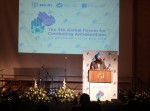
Tim Uppal, minister of state for multiculturalism, at the Global Forum for Combating Antisemitism. (photo from cic.gc.ca)
Canada’s position as a world leader in the global fight against antisemitism was reinforced last week at an international forum that saw experts and dignitaries tackling the issue of hatred towards the Jewish people.
The Hon. Tim Uppal, minister of state for multiculturalism, helped open the fifth Global Forum for Combating Antisemitism and reaffirmed Canada’s commitment to combating hatred and antisemitism in all its forms, including attempts to delegitimize Israel.
“Our government’s commitment to fighting the rise of antisemitism in all its forms is rooted in increased education and interaction between different communities to counter the ignorance and bigotry that spreads this pernicious hatred,” Uppal said in a statement. “We will continue to work to ensure that the horrid atrocities that occurred in the past never happen again.”
While in Jerusalem, Uppal met with businesses and experts to discuss the negative impact the boycott, divestment and sanctions movement would have on all sides in the region.
The forum is the premier biennial gathering for assessing the state of antisemitism globally and formulating effective forms of societal and governmental response. This year, it focused on two main subjects: confronting antisemitism and hate speech on social media, and the rise of antisemitism in Europe’s cities today.
Canada is a member of the International Holocaust Remembrance Alliance (IHRA) (holocaustremembrance.com), an intergovernmental body made up of experts from 31 countries that supports Holocaust education, remembrance and research around the world.
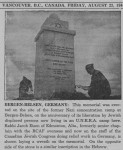
This photo and caption appeared in the Jewish Western Bulletin, Aug. 23, 1946.
May 5, 1945, is firmly etched in my “child’s” mind for that was the day of my family’s liberation or, more accurately, what remained of my family. The German occupation had been brutal and, with the collaboration of thousands of Dutch Nazis, 108,000 Dutch Jews had been deported and nearly all were murdered. Of those sent to Auschwitz and Sobibor, approximately 4,500 survived. Of Holland’s total prewar Jewish population of 140,000, fully 80% were murdered.
I had survived with my Christian hiders, Albert and Violette Munnik, and my “sister” Nora, their 12-year-old daughter. When I was reunited with my parents who had miraculously survived also, I had come to love the Munnik’s as my own family, and I was Robbie Munnik, not Robbie Krell. But I was given back, not without protest, a Jewish child who had no experience with Judaism but was nevertheless hunted for being a Jew.
In Nazi-occupied countries, 93% of Jewish children were murdered. Some escaped just before the war, a few thousand during the war through clandestine operations. But overall, no more than one in 10 survived. That is the nature of genocide. Murder the children.
Holland has somehow managed to maintain a reputation of comparative decency during the war years. Some of this good will emanates from the story of Anne Frank who left behind a diary written during her days in hiding in an attic in Amsterdam. The Frank family did in fact receive heroic assistance from Miep Gies, as did I from the Munniks and my father from the Oversloot family.
But of roughly 14,000 Dutch Jewish children in hiding, over half were betrayed. And, of course, so were the Franks. That adorable, intelligent adolescent Anne and her family were deported on the second to last train from Westerbork to Auschwitz on Sept. 3, 1944, three months after D-Day! She died an agonizing death of hunger and typhus in Bergen-Belsen. Only her father survived.
I write this piece on the 70th anniversary of liberation, a gift of 70 years of life. Who could imagine it? During the war, death had been a close companion, confirmed shortly after the war by the chilling reports that came our way from the few survivors that returned and from the photos that formed part of the news. I heard the descriptions of torture and murder from eyewitnesses. They were there. They had seen and suffered. And their lives and ours had been destroyed. No grandparents, no aunts or uncles. Two other children in our family survived, one also spared in hiding, the other, smuggled into Switzerland. That was it.
And what have I learned over these 70 years? The Holocaust imprint never leaves and no day passes without reminders. Had we tried to forget, it would have proved impossible. From the moment that the world discovered what had been done, the antisemites began their effort to deny what happened. Holocaust denial followed the campaign of murder with the effort to murder memory.
No wonder. Nearly everyone had blood on their hands. The British Mandate of Palestine was closed to Jewish immigration, preventing European Jewish refugees from fleeing. Canada and the United States had closed their doors. The Jews of Europe were trapped and murdered with technological efficiency, aided and abetted by Jew-hating collaborators in almost every country dominated by the Nazi invaders. The only way to be freed from guilt would be for the Shoah not to have happened. But the perpetrators were unable to erase the evidence. The Holocaust is the best-documented massive crime of murder and theft in human history.
Over the years, I have also learned of the systematic betrayal of visionary Jewish leadership who fought for the reestablishment of a Jewish nation-state in what is now Israel from the 1890s. No, Israel is not the result of the genocide inflicted upon European Jewry. If it were, Jews would not have had to fight the British colonialists in 1945-1947 to achieve freedom. And Holocaust survivors trying to reach Palestine would not have been incarcerated in camps in Cyprus.
The victory over the Ottoman Empire led to the establishment of a number of Arab states. Only the British promise of the 1917 Balfour Declaration’s intent to establish a home for the Jewish people went unfulfilled. The 1920 San Remo Conference affirmed that intent, only to witness the British carve off 80% of the territory known as British Mandatory Palestine to create the Emirate of Trans-Jordan. To add insult to injury, it was decreed that no Jew could settle there. This travesty resulted in the remaining 20% to be contested by Jews and Arabs to this day.
I was in Israel in 1961. The Western Wall of the Temple, the holiest site in Judaism, was controlled by Jordan and Jews were forbidden access. During Jordan’s illegal occupation from 1948-1967, all the synagogues in east Jerusalem were destroyed. Nor had Jordan advanced the cause of their Arab brethren or established a Palestinian state in the territories held.
I was at the Eichmann trial. I saw the architect of the annihilation of my people. Over time, it appears that a great deal of European posturing over Israel and its policies are an attempt to deflect attention from the horrendous misdeeds of the European past. There is a concerted effort to make Israel look like a nation with a brutal bent and whose activities, even those in self-defence are painted with the brush of Nazi and/or apartheid terminology. How offensive! How cruel! Its practitioners deny antisemitism for they have found a new outlet for Jew hatred, anti-Zionism. Israel has become the Jew of nations.
It is disconcerting, indeed, to witness the dawn of liberation 70 years ago descend into a night of renewed hate. I seek a measure of comfort in the words of Martin Luther King, Jr., and Eric Hoffer, the longshoreman philosopher. Dr. King wrote, “Israel is one of the great outposts of democracy in the world and a marvelous example of what can be done, how desert land can be transformed into an oasis of brotherhood and democracy. Peace for Israel means security, and that security must be a reality.” And Hoffer, “I have a premonition that will not leave me; as it goes with Israel so will it go with all of us. Should Israel perish, the Holocaust will be upon us all.”
I have to hope that antisemitism will be opposed and extinguished wherever it flourishes and that Israel’s right to exist will be protected. Then our liberation will have acquired meaning.
Robert Krell, MD, is professor emeritus of psychiatry at the University of British Columbia, and founding president of the Vancouver Holocaust Education Centre.
The author at the Great Wall. (photo by Rebecca Shapiro)
Finishing university for me, like many others, brought with it employment worries and life dilemmas, alongside the obligatory cheesy graduation shots. My parents had just moved from North London to West Vancouver, post father’s mid-life crisis. I had no idea where I was now based, let alone what I wanted to do with the rest of my life, thanks to that cross-continent move and an unspectacular arts degree.
This led to my spur of the moment application to intern in Shanghai through CRCC Asia, the biggest provider of work experience placements in China. My family was confused, my friends intrigued, but knowing that the company had organized more than 5,000 internships for students and graduates worldwide, I felt secure. That was, until I arrived. The journey from Pudong’s sprawling airport taught me plenty: the vast majority of people in China don’t speak English, nor do they follow traffic rules of any sort or bother to hide their gawping at your Western appearance.
Thankfully, everyone on other internship placements was lovely, as was the media production company I worked at. The city itself was beautiful, buzzing and completely bonkers. I demolished street food daily and consumed glitzy clubs’ free alcohol almost as often, resulting in a lot of hungover sightseeing. In between weekends away hiking the Yellow Mountains and evenings making dumplings, my lifelong hobby of writing became a solid career aspiration. I set up a blog, nabbed some work experience at an ex-pat magazine and eventually bagged a coveted internship at ELLE Canada.
Aside from job gains, a more curious side effect of this trip, for me, was a renewed pride in my religion. As the only practising Jew on the internship scheme, I felt a duty to explain festivities and traditions and set a good example. This resulted in my British friend calling me “the keenest Jew” he had ever met, a title I promptly failed to live up to when Yom Kippur was spent guzzling water after a heavy night out.
Keeping kosher also proved a near impossible challenge. Though my only fluent Mandarin sentence was a proud “I don’t eat pork,” being fully vegetarian in China would have meant far too much plain rice for my liking. Sorry, all.
But, there were some success stories for Jewish life in China. After three years spent actively avoiding Chabad in my university city of Leeds in the United Kingdom, I found myself on their home turf during Rosh Hashanah in Shanghai. Back home, I would have spent the Jewish New Year in relative indifference, but in this foreign function room I was touched by how many Jews living in China had made the effort to assemble for prayer and the customary apples and honey. I met people of all ages, listened to their stories, shared mine, and engaged in what all Jews love best – eating good food, and a lot of it.
Pressure from my parents meant that my Jewish duties did not stop there. Having not yet found the financially stable, nice – and most importantly Jewish – lawyer of their dreams, I would at least fit in a dose of Jewish history. And so commenced a trip to the Shanghai Jewish Refugee Museum. Small, but filled with extremely interesting exhibits, it taught me that Shanghai accepted 30,000 Jewish refugees fleeing the Holocaust, between 1933 and 1941. It also led me through the Tilanqiao historical area, which has preserved the only features of Jewish refugee life inside China during the Second World War. Hardly surprisingly, this experience solidified both my adoration for Shanghai and my love for Judaism.
So, there you have it: the unlikely relationship between interning in China and Jewish pride.
Shanghai skyline. (photo by Rebecca Shapiro)
Not convinced to follow my lead? Your resumé will be. If there’s one thing employers like more than work experience, it’s international work experience. In a recent survey of 10,000 employers in 116 countries, 60% of respondents said they would give extra credit to graduate applicants who had worked abroad. In terms of my particular internship program, 89% of students and graduates who intern though CRCC Asia are employed in a graduate-level job within three months of returning home.
Unfortunately, only 3.1% of Canadian university graduates currently participate in study or work abroad program. The comparative stats for those in the United Kingdom, United States and Australia fall between 18% and 38%.
But, in the words of Bob Dylan, the times they are a’ changing. University leaders recently met in Calgary to discuss strategies for globally mobile students; CRCC Asia just announced a partnership with the University of British Columbia to offer internships in several Chinese cities; and graduates are increasingly starting to take the plunge.
I, for one, couldn’t welcome the trend more. Canadian businesses, and diplomatic and trade relations, sure aren’t complaining either. Give it a try and, who knows, you might even rediscover your religious roots.
Rebecca Shapirois a freelance journalist, amateur photographer and blogger at thethoughtfultraveller.com. A recent politics graduate, she manages to maintain bases in London, Vancouver and Toronto, while focusing a disproportionate amount of time planning new adventures. She has been published in the Times (U.K.), Huffington Post (U.K.), That’s Shanghai (China) and ELLE Canada.
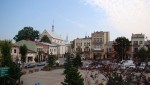
Filmmaker Haya Newman’s father Ozer Fuks grew up in Wolbrom, Poland. He escaped the town in 1939. (photo from wolbrom.pl)
The town of Wolbrom, Poland, had a population of around 10,000 in 1939; about half of the residents were Jewish. Because it was very close to the German border, it was occupied on the day the Second World War began with the invasion of Poland on Sept. 1, 1939.
Haya Newman, a Vancouver teacher of Yiddish and now a filmmaker, has spent the past several years investigating what happened to the Jews of Wolbrom. On April 14, the evening before the community gathered to mark Yom Hashoah, Newman premièred her documentary Wolbrom: My Father’s Hometown in Poland before a packed audience at Temple Sholom.
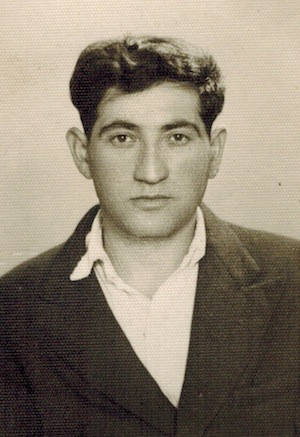
Newman’s father, Ozer Fuks, came from the town, and trouble began well before the invasion of the Nazis. When Ozer was 4 years old, his father was murdered in front of his leather goods shop. In 1939, Fuks was in the Polish army and he managed to escape the Nazis through the Soviet Union.
Filmmaker Haya Newman’s father, Ozer Fuks. (photo from Haya Newman)
The project of assembling information on her father’s hometown began from almost nothing, given that her late father kept his past during the Holocaust secret.
In her attempts to gather information, Newman visited the few remaining members of her father’s family in Israel. When that branch of the family opted to leave Europe for Mandate Palestine, Newman said, the remaining family told them they were crazy, heading to a barren desert. They are the only members of her father’s family that survived.
Newman’s documentary, which was filmed by her husband, Tim Newman, follows her first to Israel and then to Wolbrom, in search of the missing pieces.
The outline of the story of Wolbrom’s Jewish residents is similar to that of Jews in thousands of other Polish villages, towns and cities.
The Jewish residents were rounded up by the Nazis and their collaborators. Some were shot on the spot while the rest were forced on a six-day march that circled back to the same town. The able-bodied who survived were forced into slave labor.
In 1941, about 8,000 Jews from the surrounding area were forced into the ghetto in Wolbrom. Eventually, some were transported to concentration camps. But most of them met a grisly fate closer to home.
A memorial was erected in 1988, apparently by residents of Wolbrom themselves, remembering the 4,500 Jews killed and buried in mass graves outside the town.
“This must be carved in Polish memory as it is carved in stone,” the memorial reads in Polish.
Walking to the site, Newman ran into locals who shared some of the stories that had come down from the older villagers.
Three holes were dug in a clearing, they said, and planks were placed across them. The Jews were ordered to undress and as they individually walked across the planks, they were shot and fell into the ravines. When the dirt was pushed over the bodies, one local recounted, the earth cracked from the movement of those still alive.
A story survives of a boy who did not. A youngster managed to escape through the forest as the murdering was going on. Police chased after him, calling out to local boys who were tending cows to catch him, which they did. An officer stood on the boy’s hands and shot him point blank.
Wolbom’s synagogue was turned into a pile of rubble during the war. The Jewish school is now an agricultural supply store – with Nazi graffiti covering the doors. While Newman said she was largely greeted with warmth during her visit, which took place in 2005, she sensed some defensiveness among Poles.
“The fact of the matter is that 90 percent of Polish Jews were killed and a lot had to do with the Polish population,” she said, adding that hundreds of Jews who had been in hiding and survived were killed after the war by Poles. There are 327 documented cases of killings, either individual murders or in pogroms in the immediate aftermath of the war, but estimates are that as many as 2,000 Polish Jews who survived the Holocaust were murdered after liberation.
The reactions from some of the locals caught on video are intriguing.
“There is nothing to look for,” said one man, “You can’t turn back time.”
Another told her, “Take it easy, it’s all in the past.”
Newman visited the home where her grandmother had lived and the woman who resided there at the time was somewhat nonchalant about the property’s provenance.
“When we bought the house, it was empty,” she said.
Other residents spoke of the horror and upset felt by non-Jewish people at the fate of their Jewish neighbors. One woman said her mother picked up Yiddish playing with the Jewish kids in town before the war. Others provided helpful information to direct Newman to the relevant sites of the former Jewish community.
Overall, the people of Wolbrom were open and very willing to speak with her, she said. “It seemed like they were waiting for me there.”
It has been 10 years since the trip that formed the backbone of the film and Newman noted that it is not only the survivors who are passing away, but the eyewitnesses who can add to the fullness of what happened during that period.
“Within five, 10 years, they are not going to be there anymore,” she said.
Rabbi Dan Moskovitz spoke after the screening and referenced the just-ended Pesach holiday to emphasize the need to tell the stories of the more recent past. Just as the Hagaddah marks the narrative of the Exodus, he said, today’s generation should be recording the narratives of this era.
“We need to tell our stories so our children can tell them the way we tell the Hagaddah,” he said. “Go home, write down and tell your story.”
Newman’s next projects include a documentary about Yiddish on the West Coast, a film about her mother’s hometown in Poland and another about Vancouver singer Claire Klein Osipov.
Dozens of Vancouverites who survived the Holocaust were joined by their children, grandchildren and hundreds of others in a solemn, powerful commemoration for Yom Hashoah, Holocaust Remembrance Day.
The catastrophic impact of the Holocaust on individuals, families, communities and the world was made evident through words and music, as stories of survival and loss, and their impacts on the living, were interspersed with Yiddish songs that recalled the civilization destroyed by the Nazis.
The annual event took place at the Jewish Community Centre of Greater Vancouver on April 15, the eve of Yom Hashoah.
A procession of Holocaust survivors passed through the hushed auditorium, taking their places at the front of the hall and placing candles on a table before Chazzan Yaacov Orzech led the Kol Simcha Singers in a poignant El Male Rachamim, the prayer for the souls of the departed. Chaim Kornfeld led the room in the Kaddish.
Hymie Fox, a member of the second generation, told the audience that his parents, Jack and Freda Fuks (Fox), struggled to keep their experiences from their children, but the Holocaust permeated the family’s life in unanticipated ways.
“During the day, my mother could control her thoughts, her words, her stories,” Fox said. But at night, he would be awakened by his mother’s screams.
He wanted to ask about the trauma that caused the night terrors, he said, but his mother had devoted herself so completely to sheltering these memories from her children that to inquire would suggest that all her efforts to protect her children were for naught.
Fox’s father came from an extended family of more than 70 and was one of 11 children. Just Jack and one brother survived.
Though unspoken, his family’s Holocaust experience was especially present at holidays, when the small family of four would celebrate alone.
“Death was a part of our everyday life,” he said. “Yet, there was nobody to die.”
Kornfeld was the survivor speaker for the evening. He recalled his childhood in a village on the Czechoslovakian-Hungarian border, his early schooling and the strict adherence to Judaism with which he was raised, one that forbade the touching of an egg laid on the Sabbath until after sundown.
In March 1944, when the Nazis occupied the town, they rounded up the intelligentsia, Kornfeld assumes because it would be easier to control the masses if the heads of the community were removed.
A ghetto was established for the surrounding areas and, inevitably, Kornfeld was loaded onto a train car destined for Auschwitz.
An older inmate pointed out Josef Mengele and warned the young Kornfeld to tell the evil doctor that he was 18 years old and a farmer. A week later, Kornfeld was transported in a railcar destined for Mauthausen that was so packed people could only stand.
Mauthausen-Gusen concentration camp was a huge constellation of slave labor facilities, intended for the most “incorrigible political enemies of the Reich.” There, Kornfeld was put to work digging caves in a mountain where the Nazis constructed munitions and equipment, unassailable by Allied bombing.
At one point, he developed an abscess on his leg and was unable to walk. He was taken to the infirmary, which was an extremely dangerous situation in a dystopia where only those capable of work survived. One day, all patients capable of walking were ordered to leave the infirmary and a Polish man carried Kornfeld on his back, fearful of his fate should he remain in the infirmary. A German soldier ordered the man to put Kornfeld down. The officer put his hand toward his holster.
“I pleaded with the officer,” he said. “I begged for my life.”
He reminded the Nazi how effective he was as a worker and his life was spared. He was liberated from Mauthausen on May 5, 1945.
After a time on a kibbutz in Israel, Kornfeld came to Canada and learned of an opportunity as a Hebrew school principal in Saskatoon that allowed him to work evenings and study at university in the daytime. He became a lawyer, married and has four children.
Claire Klein Osipov sang and interpreted Yiddish songs that, while often melancholy in themselves, had added resonance as evidence of the people, culture and language that were almost completely extinguished in the Shoah. She was accompanied on piano by Wendy Bross Stuart who, with Ron Stuart, artistically produced the event. The Yom Hashoah Singers – a group of Jewish young people including members of the third generation – delivered a message of both mourning and hope with such songs as “Chai” and “The Partisan Song,” the defiant anthem of Jewish resistance that is an annual tradition on this day. Lisa Osipov Milton also sang, and Andrew Brown, associate principal viola with the Vancouver Symphony Orchestra, performed excerpts from Milton Barnes’ Lamentations of Jeremiah and Ernest Bloch’s Meditation.
Corinne Zimmerman, a vice-president of the Vancouver Holocaust Education Centre, which presented the event with support from the Jewish Federation of Greater Vancouver, the Jewish Community Centre and the Province of British Columbia, also spoke.
Moira Stilwell, member of the B.C. Legislature for Vancouver-Langara, said the day is a time to “learn, mourn and pledge, ‘Never again.’
“Yom Hashoah is not only about learning from history, but about passing those lessons on to the next generations,” she said.
In the past several weeks, we have celebrated liberation and redemption on Passover. On Yom Hashoah, we mourned the victims of Nazism and the generations that never were. On Yom Hazikaron, we honored the brave defenders of Israel who gave everything for the dream of the Jewish people’s right to live as a free people in our own land. Then we joyously celebrated the realization of that dream on Yom Ha’atzmaut.
These four commemorations are drawn together in many ways by rabbis and thinkers. We are mere journalists, but if you give us a moment, we, too, have some thoughts that may be worthy.
There is a troubled narrative connecting the Holocaust and the creation of the state of Israel, a connection that is sometimes misunderstood and often deliberately misrepresented.
Critics have called Israel a “reparations payment” given to the Jews as recompense for the Holocaust. This formulation is a desecration, because there could be no recompense for the Holocaust. More to the point, it is false history. Israel was not given to the Jewish people. The Partition Resolution, significant as it was as a fulcrum for historical events, turned out to be another hollow United Nations vote. Israel came into being only because the Jews of Palestine, some from the Diaspora and a small group of idealistic non-Jews from abroad fought – some to the death – for the dream of a Jewish homeland.
The connection between the Holocaust and the creation of the state of Israel is not, as the popular narrative has it, because the world felt sympathy. If anything, the world wanted to create a place for the surviving remnant so that they wouldn’t have to take responsibility for them.
Where the genuine connection lies between the tragedy of the Holocaust and the joy of independence is in the realization that the Holocaust was a direct result of Jewish statelessness. Had Israel come into being a decade earlier, there may have been no Holocaust, or its magnitude would have been much diminished. That is one connection.
Another is the psychological effect the creation of the state had on Jewish people individually and collectively, in Israel and in the Diaspora.
After the Holocaust, the Jewish people worldwide could have been expected to plummet into individual and collective despair. Instead, Israel gave hope – and a future to imagine and to build after the collective future was almost destroyed. Whether Jews made aliya – or even visited – or not, Jewish Canadians helped build the state of Israel through a million acts of philanthropy and volunteerism.
Israel is many things to many different Jews. It is a resolution to 2,000 years of statelessness, the fundamental fact that was at the root of our tragedies. It is the culmination of the quest for sovereignty and freedom and, while Israel is not perfect by any stretch, we endeavor to work toward that ideal. Israel is the dream for which so many have given so much, as well as a complex, thrilling, sometimes infuriating, always cherished reality.
In the context of millennia of Jewish civilization, the comparatively new state of Israel is a part of all of us and we are all, in some way, a part of it.
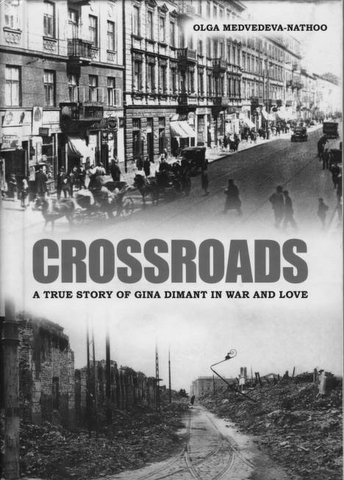
The first time I met Gina Dimant and her husband Sasha was in 2000 at the opening of my exhibition Evidence of Truth at the Sidney and Gertrude Zack Gallery. The exhibition was dedicated to all victims of Nazi concentration camps, which included my grandfather, who survived Auschwitz, only to be killed in the Flossenburg-Leitmeritz concentration camp. Years later, when I joined the Janusz Korczak Association of Canada, I met Gina again. She was the president of the association. I also met there Olga Medvedeva-Nathoo, the association’s co-founder.
I felt quite honored when Gina asked me to write a review of Medvedeva-Nathoo’s new book, Crossroads: A True Story of Gina Dimant in War and Love (K&O Harbor, 2014). Written originally in Russian, the English edition is translated by Richard J. Reisner and Medvedeva-Nathoo. It was launched on Jan. 11 of this year at the Zack Gallery.
Crossroads is truly an inspired and absorbing account. Born Hinda Wejgsman into a Jewish family in pre-Second World War Warsaw, Gina’s carefree life fell apart when the Nazis invaded Poland. Almost overnight she lost her safe home and, with her parents and sister, had to leave behind extended family, never to see them again.
Crossroads follows the Wejgsmans family, their extraordinary journey in a cattle car from the eastern border of Nazi-occupied Poland to the Union of the Soviet Socialist Republics, and of their fight for survival there. The cold in the car was intolerable, and the Wejgsmans slept on straw, bodies side by side, trying to keep warm. They traveled for more than a month. They were sent to Leninogorsk in northeastern Kazakhstan, near the Altai Mountains, where temperatures dropped to minus 41˚C in winter.
After their arrival, Gina did not go to school because local authorities considered her an adult at 14 and gave her a construction job carrying bricks, four at a time. Gina reflects: “… my main memory from Leninogorsk is not what we ate there, but how terribly hungry we always were. With the feeling of hunger, you couldn’t even fall asleep and, if you fell asleep, then it was with night dreams of food until you woke up with the same daydreams…. In winter evenings when the frost was absolutely intolerable and it was inconceivable even to attempt lying in bed, so as not to freeze to death, we would pace the room in circles, single file.”
The Wejgsman family survived six years in Leninogorsk. Medvedeva-Nathoo points out that it was exactly 72 months, slightly more than 2,000 days.
The postwar return of Gina and her family to Poland necessitated resettling, as Warsaw was in ruins. There was also some serenity, however. In her new town, in Szczecin, Gina’s son from her first marriage, Saul Seweryn, was born. There, she also met her true love, Sasha, and became Gina Dimant.
The Polish 1968 political crisis, known in Poland as the March Events, resulted in the suppression and repression of Polish dissidents and the shameful antisemitic, “anti-Zionist” campaign waged by the Polish Politburo, followed by forced mass emigrations of Polish Jews. Gina remembers: “Poland rejected us unfairly and unjustly. A deep-seated pain lived in us for years…. We were … convinced constantly: there are Poles and there are Poles. Those who were corrupt and added to corruption, and those who sympathized with us … those who gloated over other’s misfortunes and those who were outright angry at our departure.”
Gina, with her husband and son, was displaced again. Looking for a place to settle, they chose Canada because it was a country far away from Europe that accepted new citizens. They arrived here in 1970. Despite their bitter farewell to Poland, their home here was always open to Poles, Jewish and non-Jewish: “A good human being – here was the only essential criterion taken into consideration.”
In Vancouver, in 1999, Gina co-created the Janusz Korczak Association of Canada. In 2013, she was awarded the Gold Officer Cross of the Order of Merit of the Republic of Poland for strengthening relations between Poles and Jews.
Medvedeva-Nathoo writes: “Tragic Polish-Jewish relations notwithstanding, Poles and Jews lived side by side through the centuries and, regardless of what isolationists like to say, their history cannot be separated. The Dimants would always say: ‘… in the years of war, some Poles, obsessed with hatred, denounced Jews, while others risked their own lives to rescue them at a time when Poland was the only occupied country in which the death penalty was in force for anyone who hid the Jews or in some manner helped Jews.’” In the book, Gina reflects that there are many good and bad examples, pointing with triumph to Irena Sendler, a Pole who saved 2,500 Jewish children.
In Crossroads, Medvedeva-Nathoo has chosen to emphasize the battle of the individual and the will to survive set against the backdrop of three different cultures. It is a steadfast piece of writing that presents the stark facts of Gina’s life, set chronologically, starting with the description of her childhood in prewar Warsaw, followed by their postwar experiences, concluding in 2013.
At times, Medvedeva-Nathoo’s book is translated from Russian to English too literally, not taking into account the cultural context of the language into which she is translating. For example, when describing the usefulness of the newspaper Pravda in the USSR as toilet paper, the author translates it as a “nude-paper,” which makes sense only in Polish or Russian. Readers would also benefit from a map illustrating Gina’s journeys.
Crossroads is an historically accurate chronicle and a meticulously researched story that provokes discussion about the hardships and consequences of war, and the survival of one extraordinary family. It can be purchased from Gina Dimant at 604-733-6386.
Tamara Szymańskais a visual artist and a columnist for the Takie Zycie, the Polish biweekly magazine for Western Canada. She lives in Vancouver with her husband and their dog.
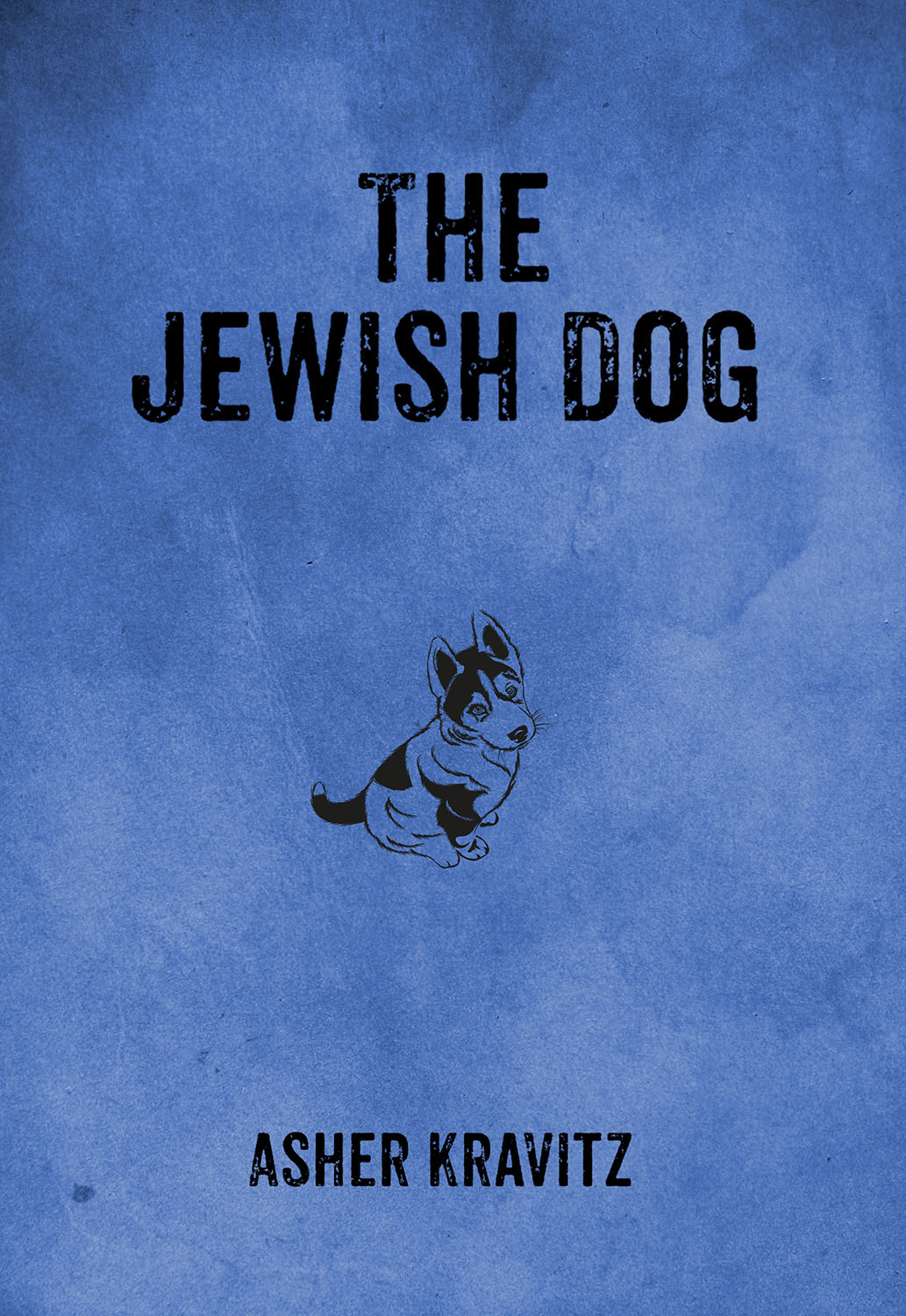
As far as books go – especially books about the Holocaust – The Jewish Dog by Asher Kravitz (Penlight Publications, 2015), published in Hebrew in 2007, is certainly unique. The novel was awarded a citation by the Israeli Publisher’s Association and it is easy to understand why.
Kravitz is a Jerusalem-born physics and mathematics professor and photographer of wildlife. He has written three earlier books: two whodunits and a book about an Israeli soldier in an anti-terrorist unit. The narrator of this novel is a 12-year-old Jewish dog raised by a single mother (a dog, that is) in 1930s Germany.
When he is born, his mother lives with the Gottlieb family. Despite the family conflict about keeping any of the puppies, when the dog finds the afikoman at the seder, Herschel, the family’s son, declares that the prize is allowing the dog to stay. They name him Caleb.
Caleb is an exceptional animal. He learns to decipher human speech and can read the moods of the adults.
As the story continues, Caleb witnesses the rise of Nazism and the laws being forced upon the family – the housekeeper prevented from working for the Jewish family; the children prohibited from attending school; and Jews forbidden to own a dog.
Caleb is given to a Christian family, where the wife mistreats him, and the story follows his adventures joining a pack, his training as a facility guard dog at Treblinka, and more. All the while, we read Caleb’s philosophical commentaries and are given a great deal of food for thought on human and animal behavior.
Kravitz has produced a well-written novel that is poignant and compelling. Some might say The Jewish Dog is for young adults, but anyone wanting to read a distinctive presentation of the pre-Holocaust and Holocaust period will find this book absorbing.
***
After reading and reviewing this most unusual book, I was prompted to ask the author some questions about this work. When I asked him what prompted him to this type of novel, Kravitz recalled that, as a high school student, he participated in an international quiz about the Second World War, which focused on the Holocaust. One of the anti-Jewish laws enacted by the Nazis was that “raising a dog is prohibited for Jewish families.” He also remembered the images of the signs posted on restaurant and coffee shop doors, “No entrance for dogs or Jews.”
“This is almost a built-in symbol of the Holocaust that connects dogs and Jews,” he said.
Kravitz also related a conversation that he had with an elderly survivor of Auschwitz, who had a deep understanding of dogs and had been a dog feeder in the camp.
The novel began its life as a short story, which Kravitz then expanded. It took more than four years to complete. He said that he studied “the behavior of my own two dogs in order to learn their mannerisms and reactions so that The Jewish Dog would narrate as realistically as possible as a dog.”
Kravitz did not expect the novel to become so popular. “I attribute [its success] to the responsibility I felt for the seriousness of the subject matter and also to the aid I received from the editor who worked with me throughout the writing process,” he said.
Another writer and director adapted the book into a one-man play, which ran in Tel Aviv for almost three years, and The Jewish Dog is now required reading for high school matriculation exams in literature. It has been translated into French, Turkish and English.
Sybil Kaplan is a journalist, foreign correspondent, lecturer, food writer and book reviewer who lives in Jerusalem. She also does the restaurant features for janglo.net and leads weekly shuk walks in English in Jerusalem’s Jewish food market.
The Holocaust awareness event at the University of Victoria was a collaborative effort. (photo from Hillel BC)
On Feb. 5 and 6, Hillel BC, University of Victoria’s Kibbutz Hillel Student Club and I-witness Field School presented a Holocaust awareness event. More than 200 visitors viewed the installation at UVic.
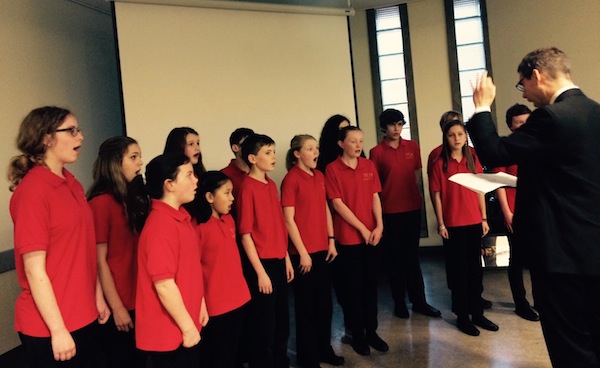
The Victoria Children’s Choir were among the many participants in the Holocaust awareness event at the University of Victoria. (photo from Hillel BC)
Also participating in the event were Amnesty International Student Club, PRIDE Student Club, Society for Students with a Disability, Anti-Violence Project and Students of Color Collective. Additional support and participation came from the Victoria Holocaust Remembrance and Education Society, UVic Students Society, UVic Multifaith Services, Jewish Federation of Victoria and Vancouver Island, Phoenix Theatre, North African Jews and the Holocaust, Starbucks and many individuals, all of whom contributed to the event’s success.
A special presentation was held Feb. 5, across from the installation in the Michele Pujol Room, UVSS Student Union Building. Approximately 70 people came out to hear Dr. Rick Kool (the son of a survivor) speak, the Victoria Children’s Choir and Dr. Orly Salama-Alber perform and contributing words from Dr. Helga Thorson of I-Witness Field School, Sabine Ricard of Kibbutz Hillel and Carmel Tanaka of Hillel BC.
Following the second day of the installation, there was a traditional Ashkenazi Shabbat dinner at UVic Hillel House, attended by about 40 people, primarily organizers and volunteers.
As the 70th anniversary of the liberation of Auschwitz approached last month, discussion turned to the shrinking number of survivors. My father-in-law, Bill Gluck of Vancouver, was one of them, having been deported to Auschwitz from Hungary in 1944, a beautiful boy of 13 with piercing green eyes, a compact frame and a knockout grin. We mentally celebrated his life on that anniversary. But not 24 hours later, his ailing body gave out.
As we began to grieve my father-in-law’s death, I became aware of the delicate dance between remembering Holocaust survivors for the individuals they were, and invoking their identity as survivors.
Esteemed psychoanalyst and child survivor of the Holocaust Anna Ornstein specializes in trauma. Yet even she bristles at being called a “survivor,” telling the Washington Post on Jan. 23, “That’s almost like another crime.” She added, “We were reduced to a race…. This is my name, I had parents who raised me a certain way, and that was not washed away.”
Mourners don’t have the luxury of asking the departed how they wish to be remembered. In any case, we each carry our own points of salience with us when we remember.
At my father-in-law’s funeral and shiva, Bill’s nephew recalled dancing on his uncle’s feet. My husband described the invisible love that had been all around him, like clean air. Bill’s daughter reflected on the heartiness of autumn’s last remaining leaves as she had helped make her father comfortable during his final weeks. And there were his fellow Holocaust survivors, coming to pay respects to a departed member of their own.
Before I met him some 20 years ago, my father-in-law had visited Vancouver schools, telling students his personal story of survival and freedom. For some of the audience, this was their first experience of learning about the Holocaust. One of these students later befriended a young man from Toronto when they studied together at Queen’s University. That young Torontonian would, a few years later, become Bill’s son-in-law.
My stepmom encountered Bill years before I met him, hearing him relay his personal account one evening at Vancouver’s Jewish community centre. I, too, recall reading about Bill’s journey in the pages of the Jewish Western Bulletin (now the Jewish Independent) before meeting his son, who I would go on to marry.
Survivors manage to touch so many, directly and indirectly. Yet, as each one is, my father-in-law was so much more than the sum of those harrowing experiences. Along with his wife, my beloved mother-in-law, Bill built a life of love out of the depths of inhumanity. He lavished a great deal of affection and nurturing on his family, and found his own moments of serenity and solitude as he took up distance sailing around the islands of British Columbia in his later years.
As the rabbi spoke about my father-in-law at the graveside service, he spoke of the godliness that surely ran through him. In young Bill’s harrowing months at Auschwitz, he had found ways to help his fellow inmates. Perhaps most profoundly, Bill had also committed to memory details of instances of kindness amid the horror. Sometimes a certain German guard in the camps would help him – pulling him out of a work line to give him a less strenuous task, placing him on a bicycle during a long march, even giving him his gun to hold. These stories of goodness didn’t die with Bill, for my father-in-law had taken pains to impress these anecdotes upon his children.
Perhaps the godliness of survival is also the godliness of looking for kindness wherever it happens to be, and instilling goodness in the everyday. Bill wanted life to be simple and good; he wanted to find kindness around him, and he hoped others did too.
Mira Sucharovis an associate professor of political science at Carleton University. She blogs at Haaretz and the Jewish Daily Forward. A version of this article was previously published in the Canadian Jewish News.