Skip to content
  • Home
  • Subscribe / donate
  • Events calendar
  • News
    • Local
    • National
    • Israel
    • World
    • עניין בחדשות
      A roundup of news in Canada and further afield, in Hebrew.
  • Opinion
    • From the JI
    • Op-Ed
  • Arts & Culture
    • Performing Arts
    • Music
    • Books
    • Visual Arts
    • TV & Film
  • Life
    • Celebrating the Holidays
    • Travel
    • The Daily Snooze
      Cartoons by Jacob Samuel
    • Mystery Photo
      Help the JI and JMABC fill in the gaps in our archives.
  • Community Links
    • Organizations, Etc.
    • Other News Sources & Blogs
    • Business Directory
  • FAQ
  • JI Chai Celebration
  • JI@88! video

Recent Posts

  • BGU fosters startup culture
  • Photography and glass
  • Is it the end of an era?
  • Taking life a step at a time
  • Nakba exhibit biased
  • Film festival starts next week
  • Musical with heart and soul
  • Rabbi marks 13 years
  • Keeper of VTT’s history
  • Gala fêtes Infeld’s 20th
  • Building JWest together
  • Challah Mom comes to Vancouver
  • What to do about media bias
  • Education offers hope
  • Remembrance – a moral act
  • What makes us human
  • המלחמות של נתניהו וטראמפ
  • Zionism wins big in Vegas
  • Different but connected
  • Survival not passive
  • Musical celebration of Israel
  • Shoppe celebrates 25 years
  • Human “book” event
  • Reclaiming Jewish stories
  • Bema presents Perseverance
  • CSS honours Bellas z”l
  • Sheba Promise here May 7
  • Reflections from Be’eri
  • New law a desecration
  • Resilient joy in tough times
  • Rescue dog brings joy
  • Art chosen for new museum
  • Reminder of hope, resilience
  • The national food of Israel?
  • Story of Israel’s north
  • Sheltering in train stations

Archives

Follow @JewishIndie
image - The CJN - Visit Us Banner - 300x600 - 101625

Tag: education

Value in mentorship

Value in mentorship

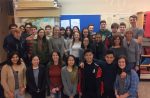
T-Jex after-school supplementary program is a partnership between Schara Tzedeck Synagogue and Shalhevet Girls High School, where the older students mentor the younger. (photo from Shalhevet)

When friends approached Gila Ross several years ago to start a new Hebrew school in Vancouver, Ross turned for inspiration to a program she had previously run in Calgary for college students, refitting it for children.

The program, T-Jex – the Jewish Experience – is built around mentorship and is based out of Schara Tzedeck Synagogue. Vancouver’s Orthodox Shalhevet Girls High School (grades 8 to 12) sends carefully selected mentor volunteers to T-Jex to work one-on-one with students or in groups of two or three. The mentors work predominantly on building Hebrew-language skills with the children. Children also learn as a class with Ross, who is the main teacher and program director, and takes the lead teaching Jewish values, holidays and Torah study.

T-Jex, now in its fifth year, involves about 10 students a year. “It is an amazing opportunity,” Rivka Abramchik, principal of Shalhevet, told the Jewish Independent. “A big part of the Shalhevet curriculum, and the goals we set for our students during the five years they are with us, is to stand up and take leadership. This is an opportunity to take responsibility, to learn the concept of giving back to the community.”

She added, “The girls get to really see how one person can make a meaningful impact. T-Jex so beautifully intertwines with the desire the girls have to be part of Jewish continuity and gives them a chance to give in a way which also gives to the girls themselves. It’s a big commitment – to give up 90 to 130 minutes on a Tuesday afternoon is give up a lot of time for these girls. You would think teenagers would be reluctant but, actually, the idea of teaching a child, students get more inspired than you might think. We have repeats every year.”

Ross gives a presentation at Shalhevet annually to introduce the program to the school’s new students. The importance of committing for a whole year is stressed, as is the importance of engagement, motivation and responsibility.

“I really enjoy working with the kids at T-Jex,” said Grade 11 student Hadassa Estrin. “The gratifying feeling you get when you see them learning about their heritage is so special … like nothing else I’ve ever experienced.”

“Most of our students have been coming from word of mouth, from all over Vancouver and from across the Jewish spectrum,” said Ross. “They have heard from others that kids enjoy coming.”

Ross started a Facebook group for Jewish moms a year or so ago, which has become a virtual community. The group has also helped spread word about the Hebrew school.

Ross, who has six kids of her own, is the youth director at Schara Tzedeck, where she has spearheaded the synagogue’s Families That Give social action projects. She also teaches at Torah High, an after-school program, and works with her husband, Rabbi Samuel Ross, the director of Vancouver National Conference of Synagogue Youth.

“The most wonderful thing to see,” said Ross, “is the students wanting to be here and having fun. To see them take joy in learning and Jewish activities is what it’s all about.”

For more information, visit scharatzedeck.com/education-learning/t-jex-2.

Matthew Gindin is a freelance journalist, writer and lecturer. He writes regularly for the Forward and All That Is Interesting, and has been published in Religion Dispatches, Situate Magazine, Tikkun and elsewhere. He can be found on Medium and Twitter.

Format ImagePosted on April 21, 2017April 20, 2017Author Matthew GindinCategories LocalTags education, Gila Ross, Judaism, Schara Tzedeck, Shalhevet, T-Jex
B.C. NDP leader talks with JI

B.C. NDP leader talks with JI

B.C. NDP leader John Horgan (photo from B.C. NDP)

Horgan says he likes how British Columbians have come together across racial and religious differences during recent times of strife. In a wide-ranging interview with the Independent, the New Democratic party leader also promised to restore the B.C. Human Rights Commission, said he would like to see religious studies in the school curriculum, expressed opposition to boycotts against Israel and said ethnocultural groups play an important role in the delivery of social services.

Horgan, the provincial opposition leader who hopes to be premier of British Columbia after the May 9 election, said that public reactions to antisemitic and anti-Muslim incidents recently have been encouraging.

“What I’ve been seeing … is an unprecedented coming together of diverse groups – ethnic and people of faith – to support each other, whether it be [after] the horrific shootings in Quebec City or the threats of bombings here in the Lower Mainland,” he said. “I’ve seen people crossing traditional faith boundaries to embrace one another and that gives me great hope and optimism for the future here in B.C. When I look south of the border to the rise of hatred, antisemitism, Islamophobia – and without it being brought into check by the leadership, at least the executive branch of the United States – I’m absolutely concerned about that. But I think the advantage for us here in Canada and in B.C. is it gives us an opportunity to reaffirm our tolerance. I’ve been quite moved by it.”

Leaders, he said, have a role not only in legislating but in expressing attitudes that should exemplify the values of the community they serve. “The broader public often criticize politicians for participating in ethnic celebrations or ceremonies,” he said. But he believes it sends a crucial message about respect for multicultural and faith communities, so he attends Chanukah menorah lightings at the legislature and Kristallnacht commemorations, as well as events of many other communities.

Horgan said there must be a means for people who believe their human rights have been violated to seek redress and a body to spearhead education about human rights. An NDP government, he said, would re-establish the Human Rights Commission that the B.C. Liberals dismantled in 2002.

“Every other jurisdiction in the country has a commission for educational purposes, for bringing forward examples of human rights abuses, and I don’t know why British Columbia wouldn’t have that opportunity,” he said.

Also on the education front, Horgan said he would like to discuss with stakeholders the potential for adding religious studies to the B.C. school curriculum.

“I’m a student of history, I have a master’s degree in history and I look back as much as I look forward in terms of shaping my personal views,” he said. “I would see some benefit to having part of the curriculum have a religious studies component in the middle school or high school curriculum.” It might not be a mandatory course and he would seek consultation with school boards, teachers, parent advisory committees and others, but, he said, the idea has come up repeatedly in conversations with members of different religious communities.

Governments partner with community agencies to ensure culturally sensitive and appropriate delivery of services such as addiction, settlement and immigration and seniors’ programs, and this is something Horgan strongly favours.

“It’s not just ethnocultural and faith-based organizations,” he said, “it’s community organizations. In my world, the role of government is to try to unite and bring people together whenever possible and foster understanding and tolerance. You don’t do that by not having discussions or relationships with various organizations, you do that by stimulating that participation.”

Providing culturally appropriate foods for patients in the medical system is a small example of accommodation, Horgan said, but one that has been made more difficult by the outsourcing of food services in the health-care system.

On the security front, Horgan supports the $100,000 the province recently announced in funding for Jewish community security, though he would have done it differently had he been premier, he said.

“Anytime we can improve security for any community, I would support that,” he said. “I don’t want to take shots of the government in this interview but, for me, I would have reached across the floor and said to my counterparts, were I in the premier’s office, this is something that we’re going to do, can we have a resolution of the legislature to make this cross partisan lines, rather than making it a statement of, ‘the Liberals are doing this and the NDP or Greens or Conservatives are not.’ But, beyond that, I support it, absolutely.”

Horgan said he personally opposes the anti-Israel boycott, divestment and sanctions (BDS) movement, but he’ll let party members have their own opinions.

“On these issues, as a provincial leader, what I try to do is allow people to have their point of view. I don’t necessarily have to agree with them,” he said, adding that foreign affairs is a federal matter. “I hold fast to the hope that our federal government, which has diplomatic responsibility for these issues, will show leadership that divestment and sanctions are not a solution.”

He added: “I believe in a two-state solution to the challenges in the Middle East and that’s a personal view and I’ll share that with anyone who asks me. But I try in my interactions with various community members to focus on how do we provide unity here in British Columbia. I look at, just as an example, the sanctions on Cuba. They’re not comparable, I appreciate that, but it is an attempt to have a state outcome in another jurisdiction based on economic pressure, and all that’s happened as a result of that is increased poverty and a lack of understanding. I think we want to reduce poverty wherever possible and increase understanding and, by cutting ties, severing relationships, you’re never going to achieve that. My approach, personally, is always to engage rather than disengage, so I think the BDS movement is not something I support, but people have their own personal will. They can choose to invest their resources wherever they want to.… My own personal view … is that reducing interactions never leads to a better understanding, it leads to less understanding.”

Horgan noted he has met with several organizations in the Jewish community on issues around economic cooperation and trade with Israel.

“I’m excited about the prospects of increasing our ability in British Columbia to take advantage of the cultural linkages we have to grow stronger economic linkages,” he said.

As British Columbians ponder their electoral choices, Horgan said he wants Jewish voters to know that “what they want for themselves and their community I want for them as well.”

“That’s a tenet of social democracy,” he said, paraphrasing J.S. Woodsworth, an early leader of the Canadian left, who said, “What we desire for ourselves, we wish for all.”

“That is a tenet of the Jewish faith and that is something that I think those who have not looked to the NDP in the past may want to do so in the coming election campaign,” he said. “I want growth and prosperity for our communities, I want tolerance and peace and understanding – and those are the issues that I think most British Columbians want, regardless of their faith. I believe that if we focus on the mainstream values that unite us, rather than the issues that divide us, we’ll all be better off here.… My answer is to lead by example and to highlight always tolerance and welcoming and cooperation over intolerance, hate and division.”

The Jewish Independent’s provincial election coverage continues with interviews with other candidates in future issues.

Note: This article has been edited to reflect that the B.C. government allocated $100,000 for security measures in the Jewish community.

Format ImagePosted on March 31, 2017April 4, 2017Author Pat JohnsonCategories LocalTags BC NDP, education, Election, Israel, John Horgan, multiculturalism, politics, security

Adding meaning to life

When a group of eight couples in their 40s and 50s meet once a month to discuss different Jewish topics with Rabbi Yechiel Baitelman, co-director of Chabad of Richmond, no subject is off limits. The program is called Toward a Meaningful Life.

“I set the agenda for discussion each month, but if there are other subjects the group is interested in exploring, they’ll send me their questions ahead of time and we can have a meaningful, focused discussion when we meet together as a group,” said Baitelman.

The group of friends meets in the privacy of their homes, and rotates houses from month to month. The rabbi is open to any subject on which he can offer an insightful Jewish perspective. So far, topics discussed have included discovering your personal mission statement; marriage, love and intimacy; home and family; and purpose in life. Upcoming topics will include work; charity and wealth; pain, loss and anxiety; and religion and faith.

Jill Topp, a member of the couples group, values these sessions with the rabbi.

“He’s not judgmental at all, and we’re not even members of Chabad,” she said. “I love his style of guided learning, and what’s important to me is that he allows us to be the Jews that we are, and want to be.” She said they discuss issues related to being in healthy relationships of all sorts, from a Jewish perspective.

Debbie Aarons, another participant, said, “Our group is mixed, we’re not all Orthodox Jews, but we’re like-minded Jews and lifelong learners. Being part of this couples learning group sends a good message to our kids. It tells them that being Jewish is not just about going to shul once a week or a few times a year. It’s about continuing our Jewish learning and having meaningful conversations.”

Shay Keil, who also attends the group, finds it interesting to see how the other couples, who are his friends, respond to discussions about relationships from a religious perspective.

“It’s not something we talk about when we socialize, so it’s fascinating to hear their points of view on these topics,” said Keil. He commented that he finds it beneficial that they’re friends coming together, because it adds that social element to it. “I also like that our kids see us going on a Sunday night to a class that’s connecting us to Judaism, and that it’s not just about going to shul,” he added.

“As Jews, we struggle with all sorts of religious and other issues,” said Baitelman. “We’re a people that questions everything and wants to know why – or why not. Life is about purpose and meaning, and people want to understand their role in the world. So, during these couples classes, we explore all kinds of Jewish subjects and everyone has a chance to contribute. Hopefully, by the end of each meeting, couples have a better insight and understanding of Jewish topics, both personally and as part of the Jewish people.”

Anyone interested in joining this group, or starting one of their own, should contact Baitelman at 604-277-6427 or [email protected]. This informal program is open to all Jewish couples, regardless of age or religious affiliation.

Posted on March 17, 2017March 14, 2017Author Chabad of RichmondCategories LocalTags Chabad, education, Judaism
Six weeks in Ottawa

Six weeks in Ottawa

This graphic designed by Andrea Schwartz represents Yiddish as growing and dynamic. It serves as the graphic for all of University of Ottawa’s Yiddish activities.

Yiddish is the language of a thousand years of European Jewish civilization and the shared language of most of the Jewish immigrants who settled in Canada. Over the last century, Yiddish has evolved a rich literature, musical tradition, theatre and cinema. Today, there are many innovative initiatives to explore Yiddish, including the digitization of all of Yiddish literature and new movies and television. As part of this Yiddish renaissance, the University of Ottawa is offering an opportunity to learn and engage with the language and culture in a Yiddish Summer Institute.

Running daily from May 1-June 13, this introductory course in Yiddish language and culture will allow diverse students to learn to speak, read, write, sing and explore Yiddish literature and culture in an intensive format that is unique in Canada. The program consists of daily Yiddish language classes in the mornings plus weekly cultural activities including theatre workshops, film screenings and performances. It concludes with a fieldtrip to Yiddish Montreal, including a visit to Yiddish-speaking Chassidic neighbourhoods and a live theatre performance.

Students who have successfully completed the course will receive six university credits and be able to hold a basic conversation like a native speaker; read a Yiddish newspaper or other text with the help of a dictionary; write about a variety of topics and in multiple formats (letters, poetry, short film scripts, etc.); and know at least 20 Yiddish songs. They will also be familiar with many aspects of Yiddish culture, from Eastern Europe through present-day Canada, including music, literature, theatre and film.

The course is open to all students – university students as well as mature students – and no previous background is required aside from a willingness to work hard in a rigorous university class. It will be of particular interest to students who require Yiddish language reading knowledge for their research; are interested in Yiddish performance of theatre or music; who want to learn more about Eastern European Jewish culture; who wish to be able to translate out of or into Yiddish; who seek to be creative in Yiddish; who enjoy learning new languages or for whom Yiddish is a family or heritage language. For students coming from outside of the Ottawa area, on-campus housing is available, as is funding to offset the cost of travel. As a bonus, the course takes place at the University of Ottawa’s downtown campus during the city’s Tulip Festival, as well as the country’s 150th birthday celebrations.

As a scholar and instructor of Yiddish with more than 20 years’ experience teaching Yiddish to children and adults in university and community settings including New York’s YIVO summer program and the Yiddish Book Centre in Amherst, Prof. Rebecca Margolis, Vered Jewish Canadian Studies Program, University of Ottawa, is excited to be able to offer this intensive course at her home university.

All information regarding the program, registration, financial support and housing is found at yiddishottawa.com. Registration opens at the end of March, first-come, first-served. For more information, contact Margolis, the coordinator and instructor of the course, at [email protected].

Format ImagePosted on February 24, 2017February 21, 2017Author University of OttawaCategories NationalTags education, Rebecca Margolis, Yiddish
Education symposium

Education symposium

Left to right, panelists Rabbi Don Pacht, Abba Brodt, Ellen Wiesenthal and Lu Winters with moderator Sherri Barkoff. (photo from the Bayit)

On the night of Jan. 24, four leading Jewish educators were panelists for the symposium Think Education, hosted by the Bayit and the Kehila Society. More than 50 people, from all walks of life, attended. Rabbi Don Pacht, head of Vancouver Hebrew Academy; Abba Brodt, principal of Richmond Jewish Day School; Lu Winters, counselor at King David High School; and Ellen Wiesenthal, director of Judaic curriculum and programming at Vancouver Talmud Torah, covered a variety of topics that had been suggested in advance by email by parents, such as making accommodations for working families, financial assistance and special education. The panel was moderated by Sherri Barkoff, president of the Kehila Society.

Format ImagePosted on February 3, 2017February 1, 2017Author The BayitCategories LocalTags education, Richmond
Prize for social justice

Prize for social justice

Kirkland Lake students paint a mural as part of the Indigenous Awareness project. (photo from Toronto Heschel School)

The Toronto Heschel School has announced the recipients of its first-ever social justice Prize for Teaching Excellence 2016. The top award goes to Erin Buchmann at the Kirkland Lake District Composite School in Ontario, which took first prize for its Indigenous Awareness program. Second prize goes to Todd Clauer at Hyman Brand Hebrew Academy, a Jewish day school in Overland Park, Kan., for its Upper School Social Justice Project.

Heschel, a Toronto Jewish school, invited educators around the world – including public, private and religious schools of all denominations – to share how they bring social justice into the classroom through heritage, culture or religion. The call was issued in THINK Magazine, Heschel School’s semi-annual educational thought publication, last November. It invited educators to submit their original class projects and school initiatives that met the following criteria: Is it rooted in heritage, culture or religion; does it inspire social responsibility in children; and has it been implemented successfully?

Toronto Heschel is committed to encouraging today’s youth to be citizens of the world by celebrating and recognizing teachers who use their students’ identity and cultural values to incorporate social justice learning as part of the everyday school curriculum. The award received entries from across Canada, the United States and Israel, and collected many inspiring stories of teachers and students committed to making positive change in the world.

photo - The completed mural, which was painted by Kirkland Lake students as part of the Indigenous Awareness project
The completed mural, which was painted by Kirkland Lake students as part of the Indigenous Awareness project. (photo from Toronto Heschel School)

Buchmann took top honors for the project Indigenous Awareness, based on the Seven Grandfathers’ teachings – core cultural values that teach responsibility to self-govern, take care of the land and one another by standing up for social justice. Students created a large mural in the school, installed an art installation called “Red Dress” around the school and dramatized the Seven Grandfathers’ teachings in a play. The project resulted in a 100% pass rate in the class, where there had been 50% failure level before. The school is also now expanding its aboriginal studies program to include a junior and senior course in 2016.

“We are so proud to win the Prize for Teaching Excellence,” said Buchmann. “The Truth and Reconciliation Commission calls on Canadians to act to promote equality and fairness. We are creating opportunities for students to explore and celebrate their individual identities and heritage while promoting social justice for all. By encouraging and supporting students to take action, we are taking steps towards reconciliation, promoting awareness of social issues and creating a more inclusive environment in our school and our community.”

The Upper School Social Justice Project, which won the second Prize for Teaching Excellence 2016, is implemented across three years of high school. Clauer teaches his students that their Jewish heritage teaches them to embrace and pursue justice through everyday advocacy for the dignity of all peoples, and all faiths.

The project saw Hyman Brand students focus their study and engagement on inequity in access to health care in their community; promoting voter engagement; and campaigning for free, universal, early childhood education. The project, conducted in partnership with a local charter school, also took students – Jewish and African-American, more advantaged and less advantaged, city centre and suburban – on a civil rights journey across the southern United States.

Named for Rabbi Abraham Joshua Heschel, the Toronto Heschel School was founded in 1996 to give children the spirit of awe and wonder as they learn. The school teaches social justice through the philosophy and social action leadership modeled by Heschel. It is a pluralistic Jewish day school, which means it welcomes all Jewish children; it now has more than 270 students (junior kindergarten through Grade 8) from Reform, Conservative, Reconstructionist, Orthodox and secular families. Jewish thinking and ethics are integrated throughout the curriculum to deepen learning, enrich school culture and inspire social responsibility. For more information, visit torontoheschel.org.

Format ImagePosted on December 23, 2016December 21, 2016Author Toronto Heschel SchoolCategories NationalTags education, Heschel, Hyman Brand, Judaism, Kirkland Lake, tikkun olam

K-12 teachers learn coding

On Oct. 22, 200 teachers from across British Columbia and Ontario participated in Code Class, a one-day coding and computational thinking crash course.

The inaugural class was hosted by coding education experts Lighthouse Labs, which partnered with Kids Code Jeunesse, a nonprofit dedicated to empowering kids and teachers through code, and Computer Using Educators of British Columbia (CUEBC).

Code Class is a free, full-day workshop designed specifically for K-12 educators that aims to introduce educators to computational thinking and inspire them to bring code into the classroom. It supports teachers by removing barriers and fostering an understanding of computational thinking, technology and basic code.

Computational thinking is problem solving; it’s understanding larger structures with both human and technological systems. It could be as simple as following a recipe, or as advanced as coding a website. Computational thinking is to computers as astronomy is to telescopes; it’s about how people conceptualize information, and how they put those concepts into practise.

With the introduction of code into the new ADST (Applied Design, Skills and Technologies) curriculum across British Columbia, Code Class organizers believe that it is more important than ever to invest in teachers and to give them the tools and resources needed to bring code into the classroom.

“Lighthouse Labs is proud to support teachers across Canada,” said Jewish community member Jeremy Shaki, co-founder of Lighthouse Labs. “We believe that great education starts with great teachers and grows from there. The best solution for incorporating technology into the classroom is to provide teachers with the tools and resources they need to inspire their students.”

“By educating children with the tools needed to create and communicate within the 21st century, we are providing them with the skills needed to build their own future success,” said Kate Arthur, founder and co-director of Kids Code Jeunesse, which is based on the belief that coding is a basic literacy as important as reading, writing or math.

K-12 teachers of all subjects who attended the 2016 CUEBC conference could participate in the free-of-charge one-day workshop held at School District 43’s École Riverside Secondary School in Port Coquitlam. More than two dozen software developers from local technology companies mentored participants during the workshop, and no previous coding experience was required to attend.

Computational thinking already exists within some key aspects of teachers’ classrooms, said Jon Hamlin, president of CUEBC, an organization of volunteer teachers in the province dedicated to promoting the educational uses of technology in schools. “We hope to reframe their understanding of the subject, see how it connects in cross-curricular ways, and see computers and coding from a new perspective. Together with Lighthouse Labs, we aim to support all K-12 teachers in their adoption of the new ADST provincial curriculum.”

For more information about Lighthouse Labs, its approach to teaching web and mobile software development, and the courses it offers, visit lighthouselabs.ca.

Posted on October 28, 2016October 27, 2016Author Lighthouse LabsCategories LocalTags computers, education, technology
Rabbi finds his calling

Rabbi finds his calling

Rabbi Yosef Ben Zruel, aka “Rabbi Yossi,” engages with students at Boys Town Jerusalem. (photo from BTJ)

As 32 out of Boys Town Jerusalem’s 100 seventh graders took their places in class on the first day of school, their teacher, Rabbi Yosef Ben Zruel, surveyed the rows of anxious students with a smile. “I look at you and I see myself,” he told them.

“I remember my mother bringing me by bus to Boys Town on my first day of school in seventh grade. We have a lot in common!”

Like their teacher, the current students come from difficult and disadvantaged backgrounds: broken homes, unemployment, poverty, neglect and abuse. Although many students are Israeli, the school also has boys who have come from Ethiopia, France and Russia. As situations around the world become more difficult, parents are sending their children to Boys Town, where they know they will be well educated and properly cared for. The school provides a safe haven for 900 boys annually, who might otherwise have no place to go.

The school focuses on preparing the boys to be productive citizens of tomorrow, benefiting the state of Israel and beyond, as many of the students eventually work for international companies. Graduates serve in the military, and then go on to careers in business, high-tech, medicine or education, like their teacher.

Now in his forties, “Rabbi Yossi” notes that he gained vital teaching skills from that first day at Boys Town onward. “I teach what I learned from my own teachers, who gave me tools for life,” he said.

Yet his journey to become a member of the faculty of Boys Town took several decades to complete. After graduating with honors in 1991 from BTJ’s electronics department, Ben Zruel served a three-year term of duty in the Israeli air force. He then entered university to pursue advanced electronics studies before realizing he’d taken a wrong turn. “I always wanted to be a teacher,” he said.

Turning to education and Jewish studies, Ben Zruel became a rabbi and taught elementary school for nearly 20 years. Three years ago, he was delighted to accept a job at his alma mater.

“I walked back into the school, and everything had changed – except, of course, for the students. As in my days, I saw boys struggling to grow and develop, to overcome hardships and to meet the demanding BTJ curriculum that combines academic, technological and Jewish studies.”

That’s when he knew that his course of teaching had already been charted. “I tell my students what my teacher – Rabbi Elimelech Yaakov, today a BTJ principal – told us: ‘You are the elite! You are the finest, most capable students to have ever studied here!’ That lifted our spirits and spurred us to believe in ourselves and to soar.”

The emotional and psychological problems that affect the students take a heavy toll on their well-being. For many, there is no food at home and the three nutritious meals provided by the school are important. Dealing with these issues is an integral challenge to a BTJ teacher, Ben Zruel said. “I tell all my students, as I was taught, if you fall, get up. Believe in yourself. Be curious about your world, and learn as much as you can so that you can give to others.”

To his students’ joy, Ben Zruel often expands the curriculum beyond the classroom walls.

“Boys Town once taught practical courses in carpentry, mechanics and printing,” he said. “In today’s technological world, I still find it essential to learn to build from scratch.”

Last year, Ben Zruel instructed his students in the ancient Middle East art of building a “tabun” oven from clay and stone to bake pita bread.

“Perhaps it’s crazy to be a teacher,” he mused, “but it’s clearly a mission of love. Hopefully, my students will someday continue the circle of passing on the gift of knowledge and energy for life.”

With the help of its many supporters, Boys Town Jerusalem will be able to keep providing hope, encouragement and opportunity to thousands of disadvantaged boys.

Format ImagePosted on September 23, 2016September 21, 2016Author Boys Town JerusalemCategories IsraelTags education
New inclusion classes

New inclusion classes

Shalva founder Kalman Samuels, left, and Mayor of Jerusalem Nir Barkat, centre, help youngsters cut the ribbon at the grand opening of the new Shalva National Children’s Centre. (photo from IMP)

Dozens of smiling preschool and kindergarten youngsters recently filed into a revolutionary new inclusion class, which integrates both special needs and other children in the same classroom environment. The opening of the inclusion class was attended by Mayor of Jerusalem Nir Barkat, who has championed the needs of special education since he took office nearly eight years ago.

Housed in the new $55 million dollar Shalva National Children’s Centre – built on seven acres near Shaare Zedek Hospital – this class is part of the wider umbrella of services for the special needs community in Jerusalem. The new state-of-the-art National Children’s Centre provides services to the Israeli community, as well as serving as a research facility focusing on special needs.

Shalva has been the leading Israeli institution providing programs to children with special needs since it was founded by Canadian immigrant Kalman Samuels, along with his wife Malki, in 1990. The land on which the campus was built was donated by the municipality.

Barkat praised the Samuelses for their selfless dedication to the community.

“Shalva was a jewel when it originally opened in Har Nof. Now, it’s a bigger and more expensive jewel, but it’s worth every shekel and every dollar invested in this place,” said Barkat.

“It’s overwhelming. After 10 years getting the land, working to get all the permits, all the challenges we faced, the battles we had to fight to build this centre, the people that tried to stop us. It’s a complete miracle,” said Kalman Samuels, with tears welling up in his eyes, as the children and their parents filed into the building.

Sara Chana Wolff, the mother of Avraham, a 5-year-old child with special needs who will be participating in the educational program, was effusive.

“I just feel endless gratitude towards Shalva,” she said. “When they see that there is something else they can do to help the kids, they turn the world upside down to make it happen. It’s very humbling and inspiring when I look at what Shalva and the Samuels family has done for the community.”

Gal Katzir, whose 3.5-year-old son Sahar will be attending kindergarten classes at Shalva and helped cut the ribbon with Barkat, remarked, “We are so happy with our choice. We thought this would be a special opportunity for Sahar to get to know kids that are different from him. Also, they have so many resources that aren’t in any other kindergarten that we know Sahar will benefit from. Sahar was just great on his first day, he didn’t cry or anything, he just said, ‘Bye-bye, Mommy.’ I was the emotional one!”

Format ImagePosted on September 23, 2016September 21, 2016Author IMP Group Ltd.Categories IsraelTags children, education, inclusion, SHALVA, special needs
Jewish education fund

Jewish education fund

A longtime advocate for Jewish education, Leon Glassman has established the Leon Glassman Fund for Jewish Continuity through Education with a $1 million endowment at the Jewish Community Foundation. (photo by Don MacGregor)

Learning of new challenges in accessibility to Jewish education in Greater Vancouver, Leon Glassman did exactly what he has always done: he stepped up.

A longtime advocate for Jewish education, Glassman established the Leon Glassman Fund for Jewish Continuity through Education with a $1 million endowment at the Jewish Community Foundation. This endowment fund will support tuition assistance at Jewish day schools and ensure that every family that wants to send their children to a Jewish day school on the Lower Mainland can do so, regardless of their financial means.

As a young father, Glassman made the decision to move his family from Regina to Vancouver because, at the time, the Saskatchewan capital did not have a Jewish school. Looking back, he recalled that, as a child, he had a very limited Jewish education, “so it was always important to me that my children would know their background and have a Jewish identity.”

Glassman’s son-in-law, Jonathan Berkowitz, said that his father-in-law also embraces “the principle that all Jewish children should have access to a Jewish education.”

Over the decades, Glassman has invested untold amounts of time, energy and resources in improving the quality of, and access to, Jewish education. But, he recently discovered that local day schools have been facing the daunting dual challenges of the impact on families of the Lower Mainland’s high cost of living and the schools’ accompanying difficulty in keeping pace with subsidy requests. Families continue to grapple with Metro Vancouver’s housing costs: being reasonably close to a Jewish day school, for many young families, means they spend so much on housing, they cannot afford tuition. The schools, in turn, have faced significant challenges meeting the demand for increased subsidies.

In response, Glassman established the education fund. It will be a legacy that reflects his passion, generosity, lifetime commitment to community and, most importantly, to the continuity of Jewish life and Jewish identity through education.

When asked why Jewish education is important, Glassman said, “Antisemitism is, sadly, once again on the rise, in part through anti-Israel sentiment. Israel is a big part of who we are. Most criticism of her is unfounded and the younger generation must be able to counter the falsehoods. That’s the negative side. On the positive side, the younger generation should know their background, take pride in where they came from and, above all, take pride in who they are.”

While Glassman’s million-dollar gift has started his namesake fund, it is his hope that the community will increase the capital of the fund by making contributions to mark the significant life events of friends and family. In that way, the entire community will both participate in and benefit from the growth of this fund.

For more information or to make a donation to the Glassman fund, visit jewishcommunityfoundation.com.

Format ImagePosted on September 16, 2016September 15, 2016Author Diane Stein JEWISH FEDERATIONCategories LocalTags education, endowment, Glassman, Judaism

Posts pagination

Previous page Page 1 … Page 42 Page 43 Page 44 Page 45 Next page
Proudly powered by WordPress