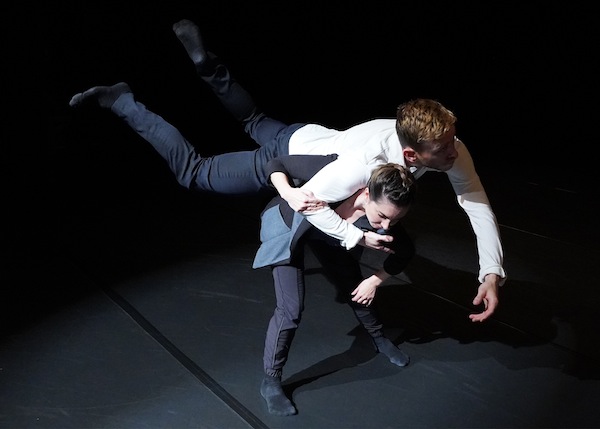
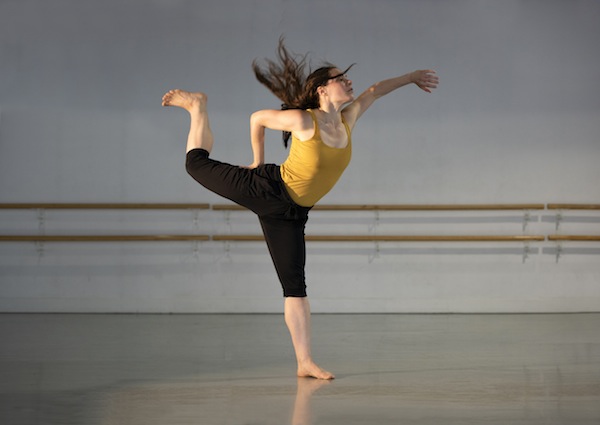
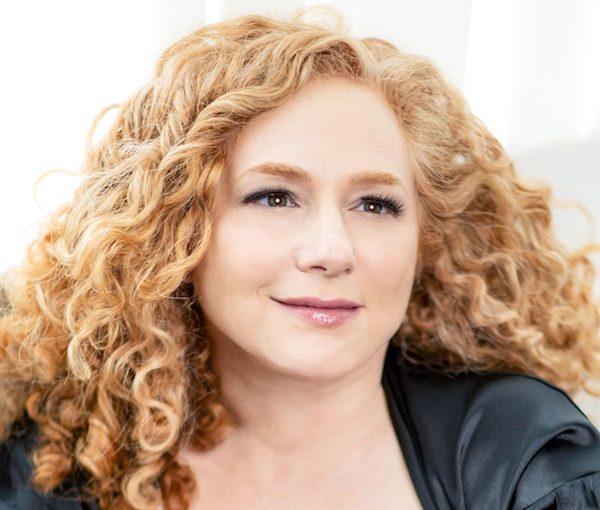
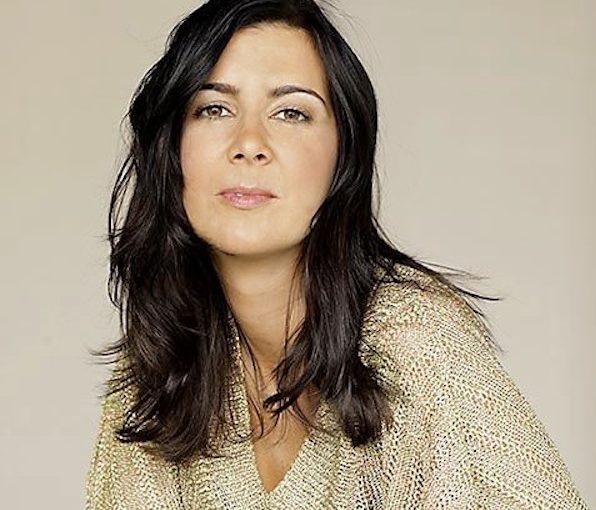
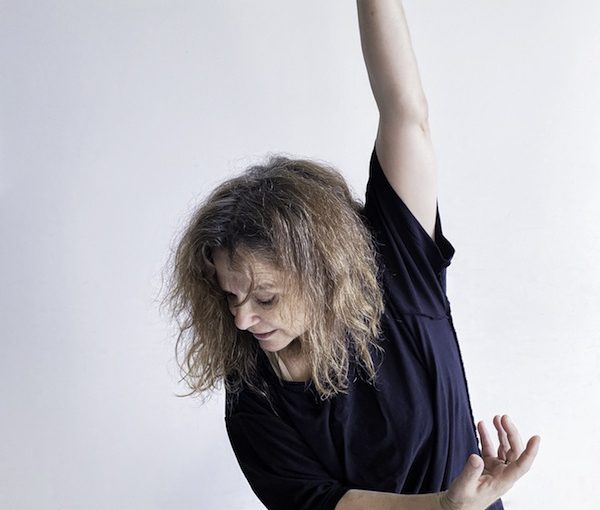
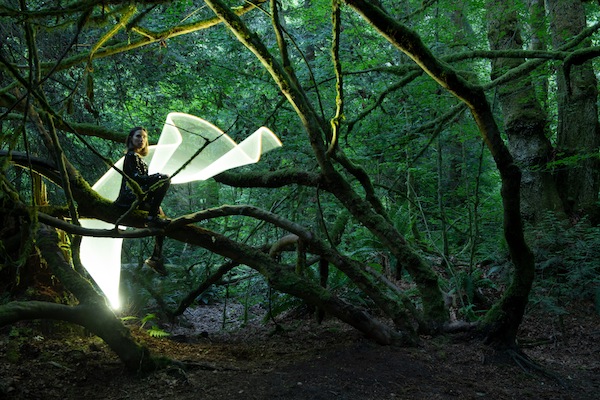
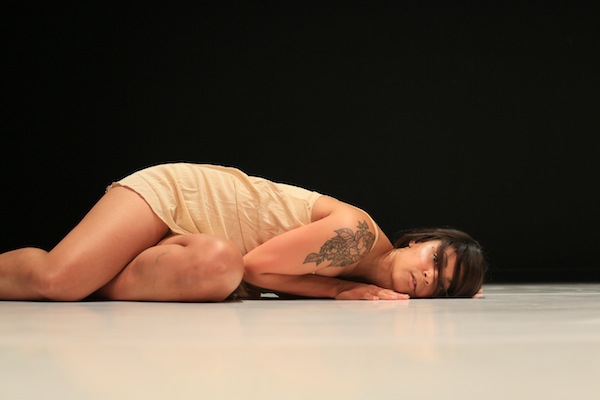
On Jan. 28 and 29, Music on Main hosts the world première livestream of Graveyards and Gardens, co-created and co-produced by Caroline Shaw (composer and recorded sound) and Vanessa Goodman (choreographer). A PuSh Festival Partner Presentation, the performance takes place among 400 feet of orange sound cables and an arrangement of plants – nature and technology being another synthesis the artists explore. Things begin with a long passage featuring an array of sounds – some come from tape decks, some from a record player, some from old Edison wax recordings – and this production is, among other things, a powerful display of the creative process.
New York-based vocalist, violinist, composer and producer Shaw, the 2013 Pulitzer Prize for Music winner, was Music on Main’s composer-in-residence from 2015-2016. Vancouver choreographer Goodman is the artistic director of Action at a Distance Dance Society.
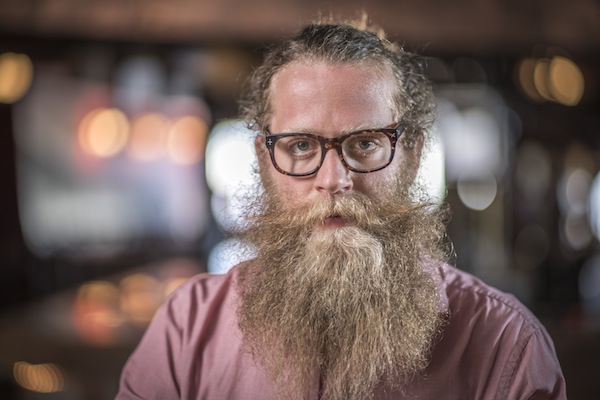
Ben Caplan opens this year’s Chutzpah! Festival Nov. 21. (photo from Chutzpah!)
In the last issue of the Jewish Independent, Chutzpah! Festival artistic managing director Jessica Mann Gutteridge, festival host and stand-up performer Iris Bahr and event comedy closers Jess Salomon and Eman El-Husseini, aka the El-Salomons, were featured. This week, the JI offers a glimpse into the rest of the lineup, by order of appearance.
Musician Ben Caplan opens the festival on Nov. 21 with a recorded performance. Before the recent COVID restrictions, the show was to be presented live from the Rothstein Theatre.
Caplan was on stage here back in January, bringing Old Stock: A Refugee Love Story – which is based on the true story of two Jewish Romanian refugees coming to Canada in 1908 – to the PuSh International Performing Arts Festival (jewishindependent.ca/searching-for-a-safe-harbour). This show, Caplan will be performing songs from his album Old Stock, which is adapted from this music-theatre work.
“The story of Chaim and Chaya, and, by extension, that of a great number of immigrants and refugees who have come to Canada, is full of a great many hardships and tribulations,” said Caplan when asked what lessons from their experience might be relevant in COVID times. “Their story is not free from conflict, both with the outer world, with each other and with themselves. What we see in their story is that, through perseverance, they are able to cross the narrow bridge of their precarity into a sweeter time. It is a nice reminder that no matter how dark things get, there are always brighter moments ahead.”
* * *
Last Chutzpah! Festival, former Vancouverite Tamara Micner performed her one-woman show Holocaust Brunch here. On Nov. 22, she’s offering a first peek at a new work-in-progress from her current hometown, London, England.
Tamara Micner in Old Friends. (photo by Sam Micner)
“Old Friends is very much in the early days – I would say it’s in kindergarten,” admitted Micner. “I’ve been working on it this year and the Chutzpah! Festival streaming will be the first time I perform some of the piece with a public audience. I don’t know exactly what the performance will look like or exactly what will be in it. It’s ‘nervciting’! I look forward to sharing some of the work with Chutzpah! audiences and doing a Q&A afterwards to speak more about the show. I’m hoping and aiming to present the full show in 2021.”
A key inspiration for Old Friends is the music of Paul Simon and Art Garfunkel, and their relationship.
“I find Simon and Garfunkel’s music comforting and uplifting…. The combination of Paul’s songwriting, Art’s voice and their harmonies are beautiful,” said Micner. “I also find the themes in their music resonant at this time – including loneliness, isolation, hope and a yearning for connection…. I’m also intrigued by the on-again, off-again nature of their relationship and the Jewishness in that – how we have a tendency to cling to each other, leave each other, not talk for years, but not be able to fully stay apart or let go. There’s a lot to mine in that, I think – where that comes from, what it’s about and how we can free ourselves from that cycle.”
* * *
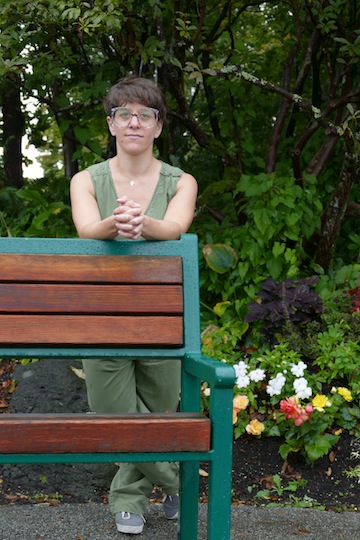
Also on Nov. 22, New York-based playwright Rokhl Kafrissen shares her new work-in-progress.
Rokhl Kafrissen’s Shtumer Shabes stars a drag performer as the Yiddish Theatre diva. (photo from Chutzpah!)
“Shtumer Shabes [Silent Shabbat] opens in the year 2000,” said Kafrissen. “A performance studies grad student named Jess is writing about the heyday of Yiddish theatre in Poland in the 1930s. Jess is studying what she calls the ‘hybrid potentialities of interwar Yiddish performance practices.’ How did Jews use their art to embody binaries like Yiddish and Polish, Jew and Catholic, urban and rural, capitalist and socialist? She argues that The Dybbuk is the ultimate expression of that hybridity.
“As the play opens, Jess stumbles into the chance to interview an honest-to-goodness Warsaw Yiddish diva. It turns out that Sonja, a 90-something veteran of the Polish-Yiddish stage, is living in her neighbourhood. Jess comes to believe that Sonja possesses a ‘lost’ play script: Shtumer Shabes. Her encounter with Sonja is also her opportunity to write history. But Jess is confronted by the elusiveness of ‘plain facts’ and the cost of writing history. For me, the encounter between Jess and Sonja represents two competing ways of understanding the past, through scholarship and through art.”
Imagining Sonja’s world wasn’t hard for Kafrissen, as she knows well Yiddish theatre, past and present, and the standard Yiddish reference sources. However, she did struggle with her protectiveness of the Yiddish past and her obligation as a journalist “to the people and productions I’ve been reading about, an obligation to tell their stories accurately and respectfully.”
“But, at some point, my inner journalist has to be thanked politely and shown the door,” she said. “If you’re going to write historically informed fiction (which is what I consider this piece), you have to be comfortable going beyond the facts. It gets even trickier because part of Sonja’s backstory … is flashback to the war, when she was imprisoned in the Warsaw Ghetto. I know enough about the Warsaw Ghetto to invent a plausible scenario. But depicting it feels daunting. The potential for kitsch or melodrama is high. My characters grapple with extremely sensitive issues, including allegations of collaboration with the Germans. It was important to me that if I was going to include such provocative topics, I had to stick closely to historical fact and stay within the realm of the possible. My characters would not be saints or holy martyrs, but real people, caught in the worst possible circumstances.”
Cast as Sonja is Shane Baker, who Kafrissen has known since she worked with him in 2009 on his one-man show The Big Bupkis: A Complete Gentile’s Guide to Yiddish Vaudeville.
“I quickly became a big admirer of Shane’s work,” she said. “He can go from the highest brow, as with his translation of Waiting for Godot into Yiddish, all the way to the lowest brow, as with his vaudeville show…. In the last few years, Shane had been working on a drag character called Miss Mitzi Manna. She was inspired in part by his close friendships with the last generation of Yiddish theatre grandes dames. So, when I got a 14th Street Y LABA Fellowship in 2019, I decided to write a play with a role for Shane in drag as my yearlong fellowship project. I knew from the beginning that the role wasn’t written for Mitzi Manna per se, but Shane’s development of the character was a huge inspiration. Writing the role of Sonja with a drag character in mind opened up a kind of playfulness and experimentation for me. Drag is such a dramatically rich device. It heightens our awareness of the artifice of theatre and interrogates the mimetic nature of theatre itself.”
A staged reading of Shtumer Shabes was supposed to have taken place last in April. “Unfortunately,” said Kafrissen, “that coincided with the world as we knew it collapsing. As I get ready to present excerpts from the play for the Chutzpah! Festival, I can see a tiny sliver of silver lining. Even with the pandemic, I’ve managed to sneak in some actor time in the last couple months, as well as getting thoughtful feedback on the script from folks both within my artistic circle and outside. The script is now so much better than the version I had in the spring, so I tell myself maybe it’s better that I didn’t present that earlier draft to the world.”
The Dybbuk by S. Ansky infuses Shtumer Shabes: Jess is obsessed with The Dybbuk and it’s why she went to grad school; and “Sonja’s career on the Warsaw Yiddish stage was tied up with the phenomenal, real world success of The Dybbuk,” said Kafrissen. “It was with a Dybbuk monologue that she auditioned for Yiddish drama school and the role of Leah (the young woman possessed by the dybbuk) was always her dream.”
This year marks the 100th anniversary both of Ansky’s death in November 1920 and the première of the Yiddish version of the play a month later. “I love the idea of having our Chutzpah! program serve as Sonja’s final tribute to Ansky and his creation,” said Kafrissen.
* * *
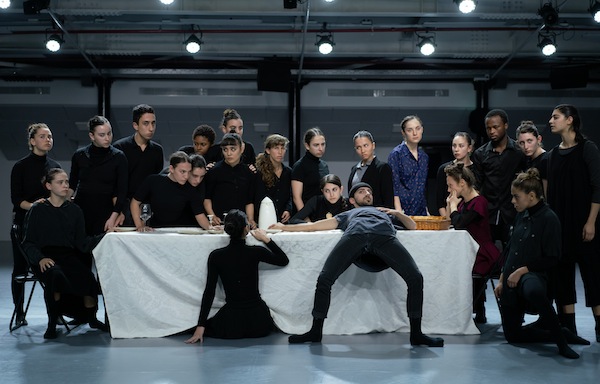
Ella Rothschild’s Pigulim unfolds against the backdrop of a meal at a long dining table. (photo by Efrat Mazor)
Death … and life are at the centre of Israeli choreographer Ella Rothschild’s Pigulim, which is described as “a cultural narrative [that] unfolds against the backdrop of a meal at a long dining table where three characters suffer from unbearable loneliness and battle their way between life and death. Each character travels between their individual materialistic being and their consciousness, revealing their essential humanity in relation to existence and the quest for happiness.” A pre-recorded performance of the work will be shown at the Chutzpah! Festival on Nov. 23.
In the summer of 2019, Rothschild was selected as one of the first artists-in-residence at Suzanne Dellal Centre. She started Pigulim there and continued researching it in “other places in the world with different scenarios and different cast members.” This year, back at the centre, the piece premièred in its video version.
Pigul (pigulim, pl.) “describes a law from the Jewish tradition,” explained Rothschild. “It refers to a sacrifice that was prohibited to be eaten because of a forbidden thought that the priest (kohain) had in the moment he was making the sacrifice. It can mean abomination or loathsome, and it’s not a word used in everyday Hebrew. The idea that a thought can change reality has a direct connection to what I tried to present in Pigulim. If the thought one can have determines the reality of another entity, how much from our consciousness is being present in our reality and our society?
“Another aspect of choosing this particular name is another gap that unravels between the sound of the word and its meaning. Pigulim has a nice way of rolling in the mouth. The letters are round and when you pronounce it, it almost sounds like a name of a rare flower – but the meaning of it is the opposite. It contains strong emotions and gravity. Once more, it holds this gap between what we experience and the reality.”
This gap – “a certain detachment between our body and mind” – is something with which we must live, said Rothschild, and its loneliness is not changed by “how many people are surrounding you in the space.”
“As I see it and experience it, it is a state of being, not only of certain individuals but as a mass society,” she said. “I have learnt, through working with others, more about how this gap appears and how we perceive it. We behave inside these structures that are determined for us and, yes, it leaves a gap or an absence that we don’t really understand, or we will forever try to make sense of.”
However, there is more than just absence. “I did find out that we share more than we think,” she said. “We share beauty, laughter, sadness and grief. We cry from the same things and we worry and we fear. But we also love. And that is an overwhelming thing to share.”
* * *
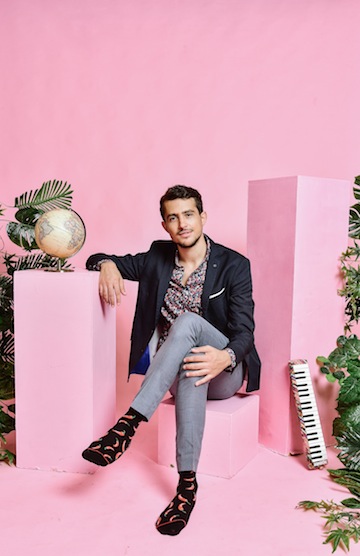
Israeli pianist and composer Guy Mintus – whose solo concert will be live-streamed on Nov. 24 – is about to release his third album with the Guy Mintus Trio: A Gershwin Playground.
Mintus’s study of piano didn’t follow a traditional path. “I didn’t start with classical piano,” he said. “I started on a little keyboard my parents got me, not an acoustic piano even, and I was studying a very mixed repertoire of adapted arrangements for beginning keyboard players. Among that repertoire were the Beatles, Israeli pop songs, Fiddler on the Roof and … two [George] Gershwin tunes: ‘It Ain’t Necessarily So’ and ‘Summertime.’ When I started playing those, my father handed me the Porgy and Bess album of Ella [Fitzgerald] and Louis [Armstrong]. That totally blew my mind and I started trying to emulate the arrangements on my keyboard (which had the ability to switch between different sound samples).
Guy Mintus will play songs from his upcoming album, which celebrates George Gershwin’s music. (photo by Ella Barak)
“To me, these songs are timeless – musically and lyrically. They’re very rich and have a strong musical character but yet they remain very open and flexible to let you in and bring yourself into them. The lyrics also mostly speak of things that will always be relevant. It’s not by accident that generations and generations of jazz musicians have been interpreting Gershwin.”
One aspect of the music’s continued importance is that, “unfortunately, we’re constantly reminded by these horrific events that keep happening that racism is still very much around; that the colour of your skin can easily become a disadvantage right off the bat,” said Mintus. “When I’m thinking of Gershwin, I’m also considering his background as a Jewish-American composer coming from a family of immigrants. Of all things he could be fascinated by, he was fascinated by Black American music and ended up writing the first jazz opera bringing this marginalized music to the heart of the consensus. More than that, he wouldn’t allow Porgy and Bess to be premièred at the Met Opera because, at the time, they wouldn’t allow Black performers. He made it mandatory that, if Porgy and Bess is ever performed, main roles have to be performed by Black people. Now, Porgy and Bess has its controversies in regards to race and representation but I believe in the essence of its coming from a place of great respect to the incredible culture its getting inspiration from.
“I think that the Jewish and African-American communities actually share quite a lot in common,” he continued. “There’s certainly a collective trauma we’re each dealing with. To me, Gershwin was standing right in the middle of that – in ‘Rhapsody in Blue’ (which is on the album, as well, in a solo version) you literally have a meeting point between klezmer and the blues. I want to echo that connection, which is still very relevant to me, through my own lens as an Israeli who lived, studied and worked in New York. It’s important to give back, acknowledge and show respect where it’s due. Last July, the trio and I did an online fundraiser concert called Gershwin Global. It was in order to raise funds for the Jazz Foundation, who takes care of elderly musicians and emergency cases. This music comes from people who gave their lives to it – if we benefit from it, we’ve got to find a way to also give back to its source.”
The new album will be launched on Nov. 27 and, given COVID, touring it is not an option. Nonetheless, Mintus said it is worthwhile to put it out anyway. “Life goes on, music goes on and, in my opinion, it’s as relevant, if not more, to release new music in this period,” he said.
With the internet, there are many ways to connect with people all over the world, he added. “This poses a creative challenge how to find interesting, experiential ways to share this music with the world; how to share the story behind the album. Each single has a unique artwork, there are videos, a bunch of online live events that are planned – all of this is going to be available through my Facebook page (facebook.com/guymintusmusic). The fact that I’m not switching countries so often as normal allows me a different kind of focus and attention on how to turn this release process into the most fun, meaningful and creative process it can be.”
* * *
Racheal Prince and Brandon Lee Alley in Hourglass by Idan Cohen. (photo by Theo Bell)
Chutzpah! artist-in-residence this year is choreographer Idan Cohen (Ne. Sans opera and dance). The world première of his Hourglass, which is presented by RBC, will be performed and live-streamed from the Rothstein Theatre on Nov. 25.
“Both the residency and this opportunity to present at Chutzpah! are the best things that could have happened to me during a time when artists are facing difficult challenges,” Cohen told the Independent. “I believe with all my heart in the strength and importance of the arts for a healthy society. It is not a luxury but a necessity, especially within a specific culture. Judaism is not just a common history or a set of beliefs, but a diverse culture that needs to be ever-evolving, reinterpreted and recreated, respecting and learning from our common past while creating a shared future. Having Jessica [Mann Gutteridge] share some of the same core values, and acknowledge the importance of going forward with the festival this year, has been such an empowering force for me and my collaborators during these past few months.”
Hourglass is an exploration of aging set to music by Philip Glass. It is a duet with former Ballet BC company dancer Racheal Prince and returning Ballet BC company dancer Brandon Lee Alley.
“As dance artists,” said Cohen, “our focus is on our most intimate tool and instrument: the human body. When that body is extremely intelligent and qualified, as Racheal’s and Brandon’s bodies are, true magic happens on stage. It’s like an ancient fairytale told to you as a child: it represents both the past and the future, it’s exciting and haunting, and it teaches you something valuable through the most basic elements of storytelling. No need for fireworks or special effects.
“For this edition of the festival, we are presenting 30 minutes of dance to four out of 20 études composed by Glass played by the conductor and celebrated pianist Leslie Dala (Vancouver Opera, Bach Choir). Leslie was actually the one who first presented the idea of this project to me, and dancing and working with him has been a most gratifying experience. There are linear elements in the piece, but Glass’s music marries the abstract and the linear, the romantic and the intellectual, in a way that not many composers are able to do, and that’s what makes it so unique.
“Racheal and Brandon, who are young yet mature and highly experienced dancers, can embody different physical states in such a fascinating way,” said Cohen. “They had a significant role in our exploration of the theme of aging and time.”
Being a real-life couple means that Prince and Alley have been able to rehearse together safely during COVID, and the Rothstein Theatre is large enough for them to work with Cohen at a safe distance. “Since Leslie is also dancing (!) in the piece,” added Cohen, “we had to adapt in order to keep everyone safe, which is, of course, the priority. This has definitely been a great learning experience, and an immensely gratifying one.”
The Chutzpah! Festival runs Nov. 21-28. For tickets, which start at $18, visit chutzpahfestival.com or call 604-257-5145.
Livona Ellis rehearses for the DanceCentre performance of Mary-Louise Albert: Solo Dances/Past into Present. (photo by Sylvain Senez)
Mary-Louise Albert: Solo Dances/Past into Present at the Dance Centre Nov. 19-21 features Livona Ellis, Vanessa Goodman and Rebecca Margolick performing works that were created for Mary-Louise Albert. Albert herself returns to the stage, at age 65, after a 19-year hiatus, to perform the first phase of a solo work commissioned from Serge Bennathan.
The three solos being reimagined were created during the last six years of Albert’s 20-year professional dance career (see jewishindependent.ca/generations-combine). They have not been performed since.
“When Mary-Louise first approached me to share her ideas about this project, I was transitioning out of a company,” said Ellis, who is performing Woman Walking (away) by Peter Bingham. “It seemed like the perfect work to describe the state of transition I was about to enter. I was leaving something behind and going towards the unknown. For me, the piece deals with a lot of questions and conversations we have with ourselves; reflecting on memories and being curious about the future.”
Ellis is a dancer with Ballet BC. She is on the faculty at Arts Umbrella and is the programming advisor for BC Movement Arts Society, which was founded and is directed by Albert. The rehearsal process for Woman Walking (away) started with Albert teaching Ellis the solo before COVID hit.
“It was great to have her insight and point of reference,” said Ellis. “I then worked with Peter Bingham where, in particular, he talked a lot about the intent and physical and theatrical sensations. It was very much an open dialogue, my input with Peter was very welcome.”
Recently, Ellis started rehearsing again with Albert. “She is really interested in melding our two interpretations and finding more ways for me to fully embody the solo in my own way,” said Ellis, mentioning her excitement to be sharing “the evening with these other talented and strong women – Vanessa, Rebecca and Mary-Louise – and to experience again performing in front of a live audience.”
Making the dance her own has been something that Goodman also has been working on with Albert, and with choreographer Tedd Robinson, who created oLOS.
“The work is a journey and allows me, as an interpreter, to transport myself into an embodiment that is both full of form and deconstruction. This is a beautiful place to experience the work, which is both deeply intuitive and dichotomous,” said Goodman, who is a choreographer herself, as well as artistic director of Action at a Distance Dance Society. She first worked on the piece more than a year ago, in May 2019, spending time with Albert and Robinson reenvisioning it.
Vanessa Goodman (photo by Sylvain Senez)
“We worked in Sointula, where Mary-Louise lives, visiting what the solo meant to all of us; examining the process physically and mentally of passing along a living archive,” explained Goodman. “Every time an artist embodies a work, it transforms with their system – this work continues to transform with, and for, me each time I inhabit it.
“oLOS has been a tremendous opportunity to be able to learn from both Tedd and Mary-Louise,” she continued. “They both have an incredible amount of information to share. Both of these artists have helped to shape dance on a national level, and it is a gift to be able to experience oLOS now with them.
“Both Tedd and Mary-Louise have been a part of my development for the last 18 years,” she added, “with Tedd teaching me in my last year of high school at CCDT [the School of Canadian Contemporary Dance Theatre, in Toronto] before moving out west and then providing me with great insight into my solo Container in Ottawa in 2015. And, Mary-Louise has supported me in so many ways as a creator over my professional career, allowing me to develop and share work…. These two artists have shared so much with me, and it is an exciting intersection to be able to work on this project all together.”
For Margolick, who is performing Allen Kaeja’s Trace Elements, the intersection is even more personal. The solo was created in 2000, she said, and she remembers watching her mother dance it at the Rothstein Theatre – Margolick was 9 years old at the time.
“Fortunately, Allen and I had our creation period prior to the pandemic,” said Margolick about the piece’s latest iteration. “We rehearsed without Mary-Louise during the remounting/creation process in Toronto. We had another week to finish the piece in Sointula, B.C., with Mary-Louise coming in to watch runs and sharing her thoughts and expertise on the work, past and present. As she is also my mom, she made sure to facilitate the space needed, with great sensitivity, for the work to become personal to me.
“Allen made space for me to experiment and try things out and his process can be summed up in three words – generous, kind and courageous. Every time I run the piece, it feels different emotionally and my reactions to the text vary day to day … it makes the work always feel alive. We say ‘reimagine,’ as we were all interested in how I can bring myself into the solo and give the tools needed to make it my own.”
Margolick is based in Brooklyn. A dancer and choreographer, she was a 2020 New Directions Choreography Lab Fellowship at the Ailey School and is a 2020 artist in residence at the Dance Deck here in Vancouver. As well, she is artistic associate of BC Movement Arts Society.
When Margolick worked with Kaeja in Toronto on the solo, she said, “We had many in-depth conversations around the subject of the piece, and Allen shared with me his experience around learning and researching his father’s story. Allen’s father was a Holocaust survivor, and creating work around the Holocaust became a way for Allen to process his dad’s experience. What came about from reimagining this solo was this merging of past and present with my movement and Mary-Louise’s movement, and a linking between different generations of the Jewish experience and family.”
Rebecca Margolick (photo by Sylvain Senez)
Since Albert is her mother, Margolick said there is an “inherent natural connection I have to her movement and expression. It’s a beautiful way to explore this connection between us.
“This piece speaks to me on many levels,” Margolick added. “The text is a conversation between a young German man and woman, 22 years ago, referencing Nazi Germany propaganda and the apathetic, yet unfortunately relatable, responses from the young woman about her mother’s experiences during the war. It is eerily relevant to what is happening around the world, as we reckon with the ongoing oppression of systemic racism, colonialism, greed, antisemitism and the rise of fascism and the alt-right. This piece for me is an eerie reminder of how quickly things can change, and how easy it is to fall into apathetic thinking, which dangerously leads to losing one’s empathy.”
Mary-Louise Albert: Solo Dances/Past into Present is part of the Dance Centre’s Global Dance Connections. In addition to the Nov. 19-21 live-stream shows, a recorded performance will be available online Dec. 3-17. For tickets and more information about both offerings, visit thedancecentre.ca.
The new artistic managing director of Chutzpah!, Jessica Mann Gutteridge, faced unique challenges in presenting the festival. (photo from Chutzpah!)
“This has been a challenging time for all communities. I hope that this year’s Chutzpah! Festival can bring a sense of joy, and the communal spirit that comes from sharing performing arts experiences with others, whether at the theatre or from the comfort of home,” said artistic managing director Jessica Mann Gutteridge in a recent interview with the Jewish Independent.
This will be the first-ever Chutzpah! The Lisa Nemetz International Jewish Performing Arts Festival that people will be able to watch at home. Given the COVID-19 pandemic, all of the performances will be available online, Nov. 21-28, with a few opportunities to attend small-audience shows that are being live-streamed from the Norman and Annette Rothstein Theatre. Not only will this be the first Chutzpah! presented digitally in the festival’s 20-year history, but it will be the first directed by Gutteridge.
“I knew that I had an exciting and challenging year ahead of me when I took the helm of Chutzpah! from Mary-Louise Albert, who was artistic director before me for 15 years,” said Gutteridge. “I really could not have anticipated how much the world would change just three weeks later, when the pandemic shuttered the Rothstein Theatre and the entire performing arts sector. The first month or so was spent focusing on our staff’s well-being and helping the many users of our theatre to reschedule and replan all the events that had to be canceled.
“The first thing I did for the Chutzpah! Festival was to take some time to think,” she said. “My board was wonderfully supportive from Day 1 and assured me that whatever scale I felt was right would be all right with them – even if I wanted to postpone for a year. I spent a great deal of time just thinking about the purposes of the festival, how it serves the community and the relationships we have with our audiences and community of artists. Even before COVID, when I was thinking about what my first festival might look like in a transition time, I felt inspired to bring together artists who had performed in the festival in the past with new artists who I hoped would join us in the future. So, I began by reaching out to artists from both groups so that we could just start to get to know each other, and find out how everyone was responding to this unprecedented situation.”
By early summer, said Gutteridge, it became clear that the health-related restrictions with respect to the pandemic would still be in place in November, “so I began to think about how we might incorporate digital presentations into the festival, and to talk to artists who were exploring this form of performance in their work.
“I was thrilled to learn that Iris Bahr, who was in the 2019 festival, is not only a brilliant actor and stand-up comic, but is also a podcaster who interviews other artists and public intellectuals with much wit and insight. I invited her to perform her solo stand-up, but also to function as our festival host and conduct live interviews with all the festival artists,” said Gutteridge. “Because Iris divides her time between Israel, New York and Los Angeles, we knew she would have to appear digitally and, though this adds another layer of technical complexity, I think it’s such a special opportunity that the present moment brings us – to join artists from across the world and have a chance to learn more about how the pandemic is changing and shaping their creative work.”
The festival’s online-only shows will include Bahr’s stand-up comedy performance (click here for story); New York-based playwright Rokhl Kafrissen’s Shtumer Shabes (Silent Sabbath) and former Vancouverite-current Londoner (England) Tamara Micner’s Old Friends, both of which are works-in-progress; a concert by Israeli pianist and composer Guy Mintus; and Israeli choreographer Ella Rothschild’s Pigulim.
There will be two shows live-streamed from the Rothstein, where limited audiences will be permitted. Ben Caplan will perform music from Old Stock, which is adapted from his music-theatre piece Old Stock: A Refugee Love Story (see jewishindependent.ca/searching-for-a-safe-harbour). And Chutzpah! artist-in-residence Idan Cohen (Ne. Sans opera and dance) presents the world première of Hourglass. Closing out the festival are Jess Salomon and Eman El-Husseini (click here for story), who will be live-streaming from Brooklyn, joined by yet-to-be-announced local comedians performing at the Rothstein.
The lineup is a fraction of what it would have been if not for COVID, but Gutteridge thought it important to proceed with the event.
“Well, for starters, I’m stubborn and I like a challenge!” she said of the decision. “I also knew that we were well-positioned with staff and support to execute a creative and fulfilling festival, even though it would not look much like past festivals. In talking to colleagues inside and outside the JCC, and hearing from our community via a survey in July, I understood that there was a lot of enthusiasm to keep experiencing the kind of performing arts presentations that Chutzpah! has offered for 20 years now. And, looking ahead to dark November nights, I think we can offer a communal experience that will bring some much-needed joy.”
In addition to focusing on quality entertainment, health and safety has been at the forefront of the planning.
“We have worked carefully with health and performing arts sector experts to make sure that we are providing the safest possible experiences for audiences, staff and artists, including at our physically distanced, intimate live events at the Rothstein Theatre,” said Gutteridge. “I’m also very impressed by how our artists have risen to the challenge. Rokhl Kafrissen, the playwright of Shtumer Shabes, has been working with her cast via Zoom since April, when they presented a workshop of the play in lieu of the debut performance they were scheduled to have at LABA in New York. Our audiences will have a chance to meet the artists and see excerpts from the play, with context about the work’s meaning and creation, all performed from the artists’ individual locations. It’s a special opportunity for our audiences to peek inside the creative process.
“Idan Cohen’s Hourglass, a new dance piece with live piano accompaniment, is being created this fall at the Rothstein Theatre as part of our creative residency program. With 318 seats and a large stage, the theatre is large enough for physical distancing, and Idan is working with a skeleton crew – often just himself and the two dancers at work. The dancers, Brandon Lee Alley and Racheal Prince, are partners offstage as well as on, so they are already in a household bubble. The other dance piece, Ella Rothschild’s Pigulim, comes to us from the Suzanne Dellal Centre in Tel Aviv, where the performance was previously recorded in a studio theatre, so that health and safety protocols could be observed and the dancers could form their own bubble.”
Tickets for the festival start at $18 and are available online at chutzpahfestival.com or by phone at 604-257-5145.
Iris Bahr pulls double duty at the 2020 Chutzpah! Festival, as host and performer. (photo from Chutzpah!)
Comedien, writer, actor, director, producer and podcaster Iris Bahr will both host this year’s Chutzpah! Festival, Nov. 21-28, and perform her stand-up live Nov. 26.
Known for her eclectic characters, Bahr will call on many of them as she converses with the other festival artists as part of her hosting duties.
“I’ll be conducting these conversations either as myself or as some of my characters, depending on the artist I’m speaking to,” Bahr told the Independent. “My alter egos include Shosh, the salty Israeli who has become popular on Instagram, Rae Lynn Caspar White, my ‘Southern redneck intellectual,’ and Shuli, my Orthodox character who is beyond excited to ‘dive into the arts’ for the first time.”
Many JI readers will know Bahr’s stand-up from having seen her perform at last year’s Chutzpah! The show will be somewhat different this time around.
“My stand-up will involve more crowd work and storytelling versus just straight-on stand-up to camera,” she said. “I have found that to be a more captivating and enjoyable experience for everyone involved when the audience can also engage and experience each other’s presence, it’s the closest we can get to a communal live theatrical experience in these challenging times.”
Eman El-Husseini, left, and Jess Salomon with furry family member Esther Honey El-Husseini. (photo by Mike Bryck)
Jess Salomon and Eman El-Husseini, aka the El-Salomons, close out this year’s Chutzpah! Festival on Nov. 28. They will live-stream from Brooklyn, and local comedians will join the event from the Rothstein Theatre.
In performance, the married Jewish-Palestinian lesbian comedy duo leans into the things that make them unique. Their chemistry is not only evident on stage, but even comes out in an email interview, where the pair play off one another like, well, a couple who knows and loves each other well.
JI: You met when you were each performing solo routines and continued in that vein, I think, even after you were married. When and why did you team up professionally as well?
Jess: It didn’t really come from us. We weren’t out in comedy until we got engaged so it was only after that, that we started making jokes about our relationship. Sometimes, we’d follow each other on a show and it became obvious who we were talking about. Like how many Jewish-Muslim-Palestinian Canadian couples that moved to America from Canada are there? Another comedy couple might be able to be on a show together and say my boyfriend did this or my girlfriend did that, and no one would connect that they were referring to one another. So, we built in this reveal and, eventually, people started asking if we were going to share the stage together. We didn’t want to, but it’s a sacrifice we make for the fans!
Eman: The first time we shared the stage was at a gig in an old synagogue turned community centre in L.A. I went on first and introduced Jess for her performance. We bantered, unprepared, on stage for about 10 minutes. We had no idea a reviewer from Tablet was in the audience and, although we individually performed for about 30 minutes separately, that 10 minutes of banter stole the show…. We didn’t think much of it but, a year later, 2018, we were in our hometown of Montreal for the Just for Laughs Festival. The BBC World Service was in town to put on a comedy show. They called us and asked if we’d want to record a set together and we said, ‘absolutely not.’ First of all, they have a huge listenership and we wouldn’t be able to polish an act under such short notice and, second, no one wants or should want to work with their spouse. But, the British have a way to persuade, it must be the accent.
At the same time, because we were back in our hometown, Just for Laughs offered us two shows to do whatever we wanted. We decided to perform individually for 20 minutes and then 20 minutes together. We almost got divorced but the audience loved it! We sold out both nights and added a third. Who would have thought a duo act would be so sought after? We’ve been working together ever since, and we are still married! I think, at this point, if we ever separated, we’d have to be closeted about getting divorced.
JI: From where do you get the strength and confidence to be a stand-up comedian?
Eman: I have no idea why and how I’ve stuck with this career after my first set. I bombed so hard and, until today, continue to bomb at times, but there is truly an addictive element to making someone laugh. Even if it’s a single person in a room. Laughter is so genuine and isn’t easily had. I mean, even in our day-to-day life Jess and I will share with each other how we made a stranger laugh shopping for groceries or walking the dog. It’s so rewarding.
Jess: Making strangers laugh and then talking about it is 100% an Eman thing. Right now, we’re in an argument over a speech therapist I’m convinced she hired just to entertain while she insists she has a speech impediment that must be fixed.
Eman: I feel like my strength and confidence comes from my parents. Although my sister and I have a brother, I managed to be the favourite.
Jess: You do have a masculine energy they might be responding to.
Eman: A big reason I wanted to be a stand-up comic is because of how misrepresented and underrepresented Arabs, Muslims and particularly Palestinians are in the media. More often than not, I am the first Palestinian someone meets in real life. I feel like an ambassador of sorts, dispelling stereotypes about my people. Exposure is such a powerful tool in getting through to people and if you can make them laugh that’s a big bonus. Even if people are immediately turned off by what I represent, they are still curious to hear what I have to say. I remember headlining a show in Niagara Falls once. I had to be on stage for 45 minutes. Twenty minutes in, I realized I haven’t made a single person laugh….
Jess: I love that it took you 20 minutes! That’s confidence.
Eman: They were conservative-leaning so, I called them out, ‘Guys! I know you don’t like what I’m saying but I can tell you like me.’ That eviscerated the room! From that moment forward I knew I could never quit comedy even if I wanted to.
Jess: I tried to do a joke about the no smoking sign on the plane and quickly realized there were at least a few comics who had done the same joke. That’s when I realized it’s better when I pull from personal experience. Even if I’m not an ambassador like Eman. I’m not the first Jewish comedian people have seen.
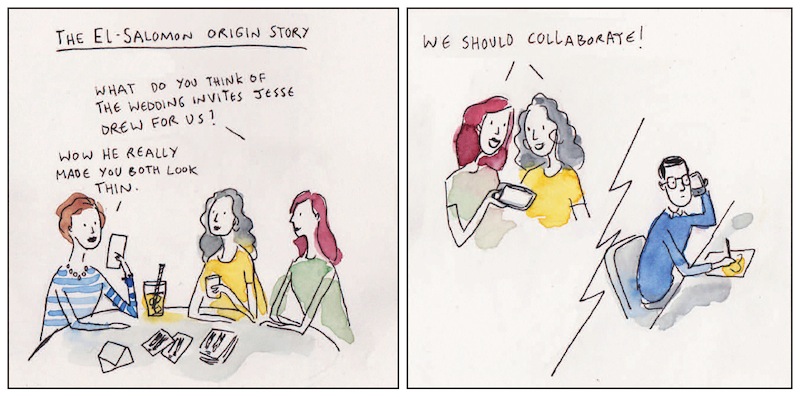
The El-Salomons have their own cartoon. (illustrations by Jesse Brown)
JI: How and when did your new Crave Canada special, Marriage of Convenience, come about?
Jess: After performing in Montreal for Just for Laughs and the BBC in 2018, we kept working on our duo act and growing our audience on Instagram for our comics (@theelsalomons). We sent a tape of what grew into an hour-long show to Just for Laughs and that’s how we got booked for the Crave special.
Eman: We realized people preferred us together than individually, which is insulting considering we had about a decade each of solo experience. It’s understandable, there are so many stand-up comics but rarely any duo acts.
Jess: There’s no one I’d rather lose my individual identity for.
Eman: Aw.
JI: What is the origin of the cartoons?
Eman: Jess came up with the idea. We would get such a huge response on social media when we’d write these back-and-forth status updates about each other.
Jess: Huge is relative.
Eman: People asking when the sitcom was coming out.
Jess: And, knowing that it would take awhile for us to find the time to write a pilot that was pitch-ready and be in a place where we could sell a series, a weekly cartoon on Instagram seemed like a manageable place to start to develop the character version of ourselves and, hopefully, an audience. We also have a close family friend, Jesse Brown, who just happens to be an incredible illustrator that wanted to work on this with us. So that’s how it was born.
Eman: The El-Salomons was the hashtag for our wedding, and Jesse drew us for our invitations … my mother-in-law saw them and said, “He made you look thin.”
Jess: Actually, yes, that is how it was born.
* * *
Chutzpah! starts Nov. 21. For the full lineup and tickets, visit chutzpahfestival.com or call 604-257-5145.
Mary-Louise Albert returns to the stage Nov. 19-21 in a new work by choreographer Serge Bennathan. (photo by Maxx Berkowitz)
The Dance Centre presents Mary-Louise Albert: Solo Dances/Past into Present Nov. 19-21. Jewish Independent readers will be very familiar with Mary-Louise Albert, whose resumé includes a two-decade career as a solo dance artist and dance company member, as well as 15 years directing the Chutzpah! Festival.
The JI last spoke to Albert as she was moving on from Chutzpah! to other endeavours (jewishindependent.ca/bidding-adieu-to-chutzpah). In that interview last year, Albert said, “At 64, I still have a bit of ‘oomph’ left to pursue.”
“The ‘oomph’ related to centring work and artistry, in this next journey of mine, on dance and having the energy and focus to do it well,” Albert said when the JI caught up with her in anticipation of the upcoming show. “This next phase of my working life includes not only personal dance creation and performance projects like this one, but, as well, developing new Canadian and international professional contemporary dance through the B.C. Movement Arts Society, which I co-founded and direct, that will take place in remote and rural areas of B.C. We have received the very good news of confirmed provincial and federal funding and our first series starts late spring to December 2021.
“The Solo Dances/Past into Present project was developed over the past two years. The three solos being presented were created and performed during the last six years of my 20-year professional dance career, when I was between 39 and 45 years old. Because they were created during this latter period of my dancing career, when I stopped dancing, they stopped with me. I was never really interested in choreographing so, when I stopped dancing, I didn’t look back. I was ready and wanted to head into the next chapter of my working life, which involved business school and ended with directing the Chutzpah! Festival and Norman and Annette Rothstein Theatre for 15 years. We, the choreographers and myself, were all in our 40s and older and everyone moved on.
“But,” she added, “in the back of my mind, over these past years, I knew it was not right to let these beautiful dances end with me. I felt like there was ‘a little something’ still missing from this very enjoyable period of my career as a solo-commissioning dancer. A sense that something was not quite complete. It became clear that I needed to pass on the solos to this generation of outstanding female dancers and support their growth with performing options by way of building their solo repertoire. I received personal financial support from the Canada Council and BC Arts Council and this multilayered project of artistic sharing that brings two generations of dance artists together in the reconstruction of Canadian contemporary choreography began!”
Solo Dances/Past into Present features Peter Bingham’s Woman Walking (away), danced by Livona Ellis; Tedd Robinson’s oLOS, featuring Vanessa Goodman; and Allen Kaeja’s Trace Elements, performed by Rebecca Margolick. (More to come in the Nov. 13 JI.)
“The solos have not been performed since 2001 and have never been remounted and reworked,” said Albert. “As a dance professional, I feel strongly that it is important to revisit these eclectic and beautifully crafted solos and put them back in repertoire with Canadian (B.C.-based/-born/-raised) dancers who have the versatility and desire to further develop the works, enjoy and share.
“Working so intimately with Allen Kaeja, Tedd Robinson and Peter Bingham many years ago brought a level of understanding as a solo performer that I had not experienced before in such depth,” she said. “As people, they all had/have a wonderful down-to-earth approach to themselves and their work and this led to a generosity and nonjudgmental approach to their creative process with me.”
Albert said the three solos “are all very different and timeless.” She described oLOS as “a deeply intuitive and somewhat mysterious work that transports performer and audience on an inquisitive journey, via the nature-walking and naïve love of [Gustav] Mahler’s Songs of a Wayfarer”; Woman Walking (away) as “a journey of one, arriving or leaving, listening to memory that is gently propelling what is next for her in an exploration of a complex yet personal quest”; and Trace Elements “wishes that this work of memory of persecution was just a source of history uncovered, but the dance is as relevant today with the growth of fascism and antisemitism as it was 21 years ago when it was created.”
In addition to remounting these works with other soloists, Albert herself will be performing the première of the first phase of a new solo work, Empreintes (which means fingerprints), commissioned from Serge Bennathan.
“At the age of 65, I’m going back on stage after a 19-year hiatus. I am still a bit dumbstruck by this,” said Albert, “and will be honest that I still often find myself mentally whispering WTF? But it is part of this new dance journey of mine as a senior citizen. I’ve never shied away from challenges and listening to my soul. There are many dance artists still performing at this age but most have never stopped. This is certainly a special experience, with its range of physical and emotional exploration, to be coming back to it at the age of 65.”
Bennathan, she said, “is a profound dance artist and is a beautiful painter and poet, as well. This new work explores the layers of artistry, physical trust and depth of reflection that a new stage in life, which I am embarking on, opens up. Serge is interested in the artist in me that is now, and the work reflects this…. The simplicity, strength and internal depth of the work, and the trust we have in each other, is quite simply a gift.”
In creating a commissioned work, Bennathan said, “The process always starts by trying to feel the energy of the dancer, then trying to discover what is just behind, what is the essence of why the artist desires to do such a work. Then, once together in the studio, if I can reduce the process to one word it would be ‘listening.’ That is the most important, to be listening to the inner self of each other to create a dynamic.”
He said “the idea of Albert passing on works created for her by powerful creators to magnificent dancers is fantastic. What a beautiful and creative way to feed the texture of a community in all its dimensions.”
“I feel that Mary-Louise’s foresight and inspiration to reenvision her past solos with the original choreographers and giving them, if wanted, the freedom to also reimagine the solos on these three mid-career dancers, was brilliant,” agreed Kaeja. “Her project intrinsically melds past with present in a generational sharing for all of us involved.”
For Trace Elements, which “deals with present and past antisemitism and cultural intolerance,” Kaeja said Margolick brings “not only her natural Jewish genealogy, but her depth of self, range of talent and profound and thoughtful life experience into this creative process…. I love that Mary-Louise has also invited Serge to choreograph a new solo for her – created specifically for who she is now as an individual, dancer, creator, innovator, curator and powerhouse – is profound.”
For Kaeja, creating a commissioned work centres around the person commissioning it. “My process is called ‘structured innovations,’ whereas I create a series of parameters that are clearly defined in physicality, intent and quality and texture of the movement,” he said. “With these boundaries, the dancer begins to create movement vocabularies and physical ideas. I then invite variations to the movement suggestions, redefine these in many ways and finally create the final choreography. I have always credited the dancers as ‘created with and performed by.’”
The creative process “is different with each solo,” said Bingham. “It depends partially on what the dancer is used to. I would say that it is always collaborative and research-oriented. The search is to find a language, both verbal and physical, that becomes our focus. I stress that the search must be mutually creative, an exchange. We try physical ideas and curiosities until the piece begins to reveal itself. In short, it becomes a product of our relationship.”
Similarly, Robinson works closely with the dancers involved. “When commissioned,” he said, “I assess the room (the space) and performer (who will move in the space). I start with basic concepts that I have developed, steps that sort of help us to get to know one another. As I see how the performer(s) interpret what I show or say, then I am better able to assess the space we will cover, the space of the creation and the space that the performer will need to inhabit. From there, we work together to create.”
With regards to the piece he created with Albert, Robinson said, “It was a more technical solo than I might normally do, because Mary-Louise likes to move and move big, so that is what we incorporated, plus the small and detailed work that I often use. I also worked on some bigger dramatics and that attracted me. I liked to lip sync when I was younger, so I feel that we lip synced with our total body for this work of Mahler.”
The planning and creation process of Solo Dances/Past into Present began and was completed before COVID-19, except for her solo with Bennathan, said Albert. “There have been challenges,” she said, “as the dancers have gone back to the solos, needing studio space to rehearse for this show during the pandemic. Serge and I worked mainly in Sointula, which has an inherently blissful feel to it (and lots of humpback whales!) so it made creating during COVID easier. We also are working at the Dance Centre, as are the other dancers, which has been excellent.”
The Dance Centre has COVD-19 protocols in place. “Executive director Mirna Zagar and the entire Dance Centre staff are working tirelessly, making it possible on so many levels for artists to be able to get back into the studio and on stage and be safe,” said Albert, who also gave “a big shout out” to technical and lighting director Mimi Abrahams. “We have worked together now for over 10 years and she is truly the unsung hero that makes it all happen,” said Albert. “Her calmness and clear head gives us a grounded base as we gear up to perform in the middle of a pandemic.”
One could be forgiven for thinking there was a Jewish dance festival coming up, as there are so many community members participating in this year’s Dancing on the Edge, which takes place July 2-11.
Adapting to the circumstances of the pandemic, which limits public gatherings, DOTE festival producer Donna Spencer recently announced that, while it won’t be possible to present the initially planned 30-plus live performances, the festival “will be offering instead some specially curated digital programming with live-streamed performances, premières of dance films, dance discussions, four outdoor live performances in the Firehall’s courtyard and one dynamic theatre performance at the Firehall Arts Centre theatre (all live performances for very limited audiences with safety precautions in place).”
Among the featured dance companies and choreographers are, in alphabetical order, Action at a Distance (Vanessa Goodman), All Bodies Dance (Naomi Brand, with Carolina Bergonzoni), Ben Gorodetsky, Ne. Sans Opera and Dance (Idan Cohen), Radical System Art (Shay Kuebler), the response. (Amber Funk Barton) and Tara Cheyenne Performance.
* * *
Action at a Distance is presenting Solvent, a new work created in collaboration with musician Loscil (Scott Morgan).
“I have been incorporating video footage into my work for years, and the recent time at home has provided an opportunity to generate material and experiment with new editing techniques,” said Goodman. “In some ways, this is an extension of our previous work together. Our first video collaboration was for a song on his album, Monument Builders. Since then, we have built four works together for my company Action at a Distance, including Never Still, which was presented by the Firehall Arts Centre in 2018.”
When the pandemic hit, Goodman said, “At first, I found myself grasping for something substantial to hold onto and tried to reschedule all the tours and premières that were being canceled. It was challenging to let go of everything. Eventually, I came to terms with the downtime and embraced the slow pace as best I could.”
When the need to isolate began, she said, “I started making short dance films for myself and my 96-year-old grandmother to help us stay connected. At times, it has been tough to stay motivated during the shutdown, and this was a simple way to stay creative.
“There’s no way to compare these sketches to a staged dance performance,” she said. “However, when I shifted my frame of mind and started to approach video as a whole new medium instead of an altered version of an existing piece, I became more comfortable with the idea of sharing work this way. I am very grateful to DOTE for bringing the community together to share work right now.”
Even in such times, arts and culture are “absolutely vital,” said Goodman. “Without them, we’re living in the dark ages. It is essential to have creative outlets for expression. Right now, finding connections through creativity can help cut through the isolation. Art can provide much-needed escape and levity in challenging times, as well as reframing current issues and inspiring insight around movements of essential social change.”
* * *
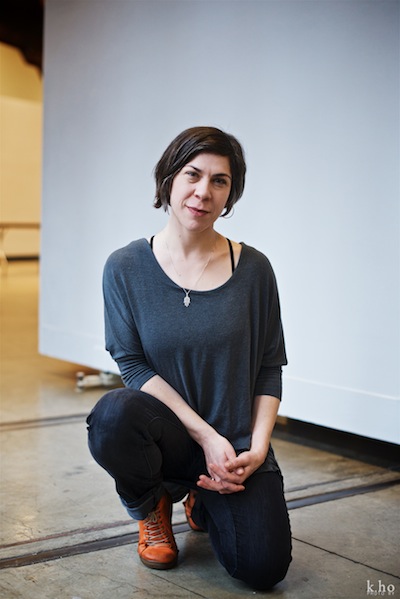
Naomi Brand (photo by K. Ho)
All Bodies Dance Project (ABDP) is bringing Ho.Me to the festival. “The film was commissioned by F-O-R-M, Festival of Recorded Movement, last year … and is a collaboration between longtime ABDP company members Carolina Bergonzoni (choreographer/director), Peggy Leung (dancer), Harmanie Rose (dancer), Mathew Chyzyk (dancer) and Vancouver-based artist Gemma Crowe (cinematographer/editor) and Alex Mah (composer),” said Brand. “Ho.Me explores themes of belonging and comfort in relation to inhabiting one’s own body. The film is comprised of three personal solos shot inside the dancers’ own apartments. In the piece, we get to see these three very different bodies dancing within the privacy of their own homes among the objects that have meaning to them.
“While the film was created long before the pandemic, the significance of moving inside our homes feels really different now since we’ve all been spending so much time inside. Many dancers have been figuring out how to turn our living spaces into places where we can also practise, explore and move, as studios haven’t been an option.”
Since the start of the pandemic, ABDP has moved some of its community dance programming online.
“We also started a weekly virtual gathering for our community of dancers in order to prevent social isolation,” said Brand. “Many of our projects have been on hold. There is so much about what we do as a company that just isn’t compatible with the necessary restrictions of COVID life. Our work is based on bringing people with different bodies, backgrounds, experiences and abilities together to move, share and make in real-time. We’ve been thinking a lot about what kinds of things translate into the digital space and what things just can’t be replaced.”
She said, “Now more than ever we need community and collective experiences, as so many have been isolated during these past few months. People with disabilities in particular have experienced a lot of isolation and so we are even more committed to our purpose at All Bodies Dance Project.”
She added, “Dance is about each of our essential relationship to our own bodies. During COVID times, many of us have learned a lot about our own physical experience of moving through the world and the social choreography of physical distancing. There has been so much choreography on the sidewalks, grocery stores and, of course, in the streets during the incredible protests during this pandemic.”
* * *
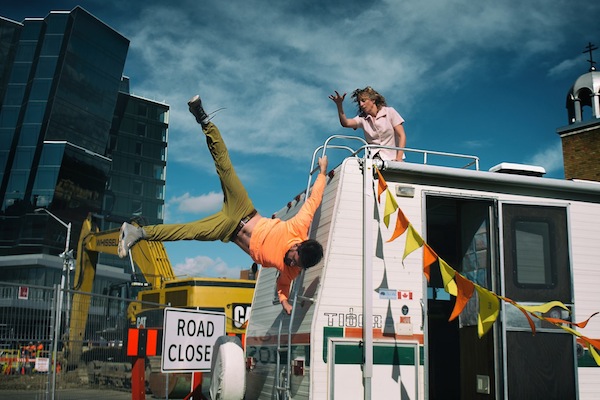
Ben Gorodetsky hangs on to an RV’s ladder in There Yet by Edmonton’s Mile Zero Dance. (photo by Marc J. Chalifoux)
Gorodetsky, who is Russian-Canadian, is one half of the political comedy duo Folk Lordz, with Cree co-creator Todd Houseman. The pair tackle racism, among other social ills, and have created a 15-part series “[r]eflecting urban-Indigenous, immigrant and activist perspectives through the lens of biting satire.” A second series of sketches is on its way, but Gorodetsky is bringing a very personal work to this year’s DOTE.
“It’s a movement video piece honouring my grandfather, Dolik (David) Lutsky. He died on April 3, 2020, and, since we could not gather for his funeral due to the pandemic, we were left to sort through our grief alone,” he shared. “One small relief was my grandmother mailing me a box of his clothes. Using these garments as performance artifacts, I created a digital video piece reimagining grieving rituals in the age of COVID.
“I explore the ceremony of wearing Dolik’s clothes and reactivating the narrative, cultural and physical threads of his life. Spoken oral histories exploring my grandfather’s immigration (I was born 10 days after they landed in Canada), identity (he was the official communist ‘propagandist’ at the coalmine he worked at in Ukraine) and faith (he went from being an ardent anti-religious communist to a practising Lubavitcher Jew) provide textual counterpoint to the dance video. The visuals themselves were all created through aerial drone photography, creating a fluid visual style for this interdisciplinary new video work. Country roads, forests and lakes frame this physical score exploring grief, memory and family history.”
Gorodetsky said, “I think if I had been able to grieve, remember and connect with my family after Dolik’s death, I would have no need to explore these ideas artistically. But, since I have not, I have a nagging need to articulate this particular pain through movement, story and visual composition.”
Since COVID, Gorodetsky has become the fulltime caregiver for his 2.5-year-old son. “Time and energy have become scarce resources,” he said, “so I’ve had to get better at working furiously fast while he naps. Focused blasts of creativity.
“Also, my family has been displaced from our home and all our possessions in Brooklyn, N.Y. We were in Kelowna (where I was teaching on a one-term contract at UBC in the performance program) when the border closed and we could not return to our home as planned. So, we’re in Waterloo, living at my sister-in-law’s house, until [who knows when]. Honestly, my mental health is brutal right now. Anxiety grips me in a way I had never experienced before, and I have had to find tactics for replenishing my depleted stores of happiness and hope. One thing that really helps is long bike rides with my son Gus. We get out of the city and follow country roads – we live near Amish country! It’s a small way to feel free, alive and empowered in the midst of these deeply destabilizing times.”
For Gorodetsky, who grew up in Metro Vancouver – in Burquitlam – “dance is a way of moving your grief around. It helps me shake the weight and sediment of catastrophe off and meet my grief as an equal, rather than as a victim.
“Gus and I developed a habit of walking to a beach or body of water, finding a big tree stump, climbing on top and dancing to a playlist called ‘Klezmer Dance Party at Home’ (lots of Klezmatics, Michael Winograd, Frank London, Socalled and Di Naye Kapelye). It’s been a real lifesaver.”
* * *
Idan Cohen (photo by Or Druker)
Ne. Sans Opera and Dance’s Trionfi Amore (The Triumph of Love) was commissioned by Peter Bingham for EDAM’s Spring Choreographic Series, April 2019.
“It is a trio created for three phenomenal Vancouver-based performers, Kate Franklin, Jeremy O’Neill and Ted Littlemore,” said Cohen. “Besides being excellent dancers, these three are also trained musicians, and the piece utilizes their many talents.
“The trio is inspired by the opera Orfeo ed Euridice and is a part of my ongoing research on the theme of Orpheus,” he explained. “It speaks of love, and of the power of music and art to move, entertain and touch us. It also speaks of the power of manipulation and control on the individual and, as we prepare it for DOTE during this time, we find that new meanings present themselves to us.”
Cohen said, “The act of presenting something as abstract as the notion of love in a dance performance is quite a challenge by itself, and nowadays even more so – how do you speak of love without being able to touch, to be close to one another? Instead of looking at this as an obstacle, we choose to look at it as a source of inspiration, a new adventure. As artists, we reflect what we experience and then monitor, or direct, those notions into our actions and creative choices. My responsibility here is to stay true to the origins of this piece, but also to protect the viewers and the performers while offering art that speaks of relevant issues and current experiences.”
It hasn’t been easy.
“Ne. Sans had to stop our season and rethink and rearrange our commitments,” said Cohen. “It has been painful to see how many creative ventures that have been in the planning for quite awhile have been postponed or canceled, and to realize the ensuing financial and emotional toll…. I believe in the value and presence of arts in our community and in our lives, in countless ways, and tackle issues that I find not just relevant for myself, but that reflect on many lives. At the same time, I recognize how privileged I am to be here, in Vancouver, and to be safe and healthy.”
Whether theatre, music or dance, one thing common to all forms of live performance, said Cohen, “is that they are alive.” They all involve the human body, both “the performing bodies and the ones watching.”
“As an artist who uses movement as a primary artistic discipline,” he said, “I have a huge love and respect for the human body in its most basic form. When you learn to love and accept your body, you can truly love and respect people. That love is also where my queer identity(ies) meet my Jewish ancestry. So much hate is being inflicted on the body; if we don’t learn to love and appreciate our bodies, how can we truly love and appreciate someone else’s? How can we heal? With so much violence in our history and in our present, in a world polluted with ignorance and hate, how do we learn to love and forgive our ancestors, our pasts? The arts bear a huge responsibility. Artists need to change our priorities, acknowledge our inherited racism and create new stories.
“Ne. Sans is an organization that is centred on Western European music and dance, and my origins are in Western Europe,” he continued. “Our main goal in Ne. Sans is not to present a notion of nostalgia, romanticism and artificial beauty, but to raise the issues of violence and inequalities created by that culture, recreate its narratives and bring those up into the surface.”
In Jewish teaching, there is the concept of tikkun olam, repairing the world. “We can all be involved in tikkun olam at any given moment,” said Cohen, “and we need to keep adapting and correcting our values, individual or systemic. We have a responsibility to help and support one another. We have survived horrible historical events. Looking straight at our bleeding past and present: in the face of injustice, we cannot and will not stay silent.”
* * *
Shay Kuebler (photo by JoyceTorres)
Kuebler, who has performed at the Chutzpah! Festival and is connected to the Jewish community through his sister’s family, will be presenting Momentum of Isolation at DOTE. Started last year, he said, “This first chapter of research is a chain of solos, for seven performers, that was developed by company artists online and in isolation.”
Given the restrictions required to control COVID, this part of “the project has taken on a much more singular focus on each artist’s personal interpretation,” said Kuebler. “As these solos were developed in home spaces and in isolation, the artists are performing their solos in smaller performance spaces – averaging six-by-nine feet – as well as performing these solos in relation to walls and surfaces in their environment.”
Of COVID’s impacts, he said, “There was certainly sadness and stress from losing work and touring opportunities. The company was two weeks away from a European tour when all the social protocols came into place. We were fortunate to receive some support and, after assessing the financial losses, we were able to move forward with a different creative practice for this phase of this project.
“The new creation practice of working online and in isolation actually revealed some very interesting new approaches and beneficial tactics. This online format had us focus on different dance techniques and improvisation tasks that could both challenge our individual movement skills and develop more group unity in movement. It also opened a window for focused study around the social content in the project.”
Kuebler said, “For myself as an artist, this time has offered me some space to ‘fill the well.’ I have been creating, traveling and supporting multiple projects simultaneously for a solid amount of time. This time in isolation, although not in the form that I would have wished for, or for anyone for that matter, has offered me space and time to just research and train…. I’ve found that, with this space, I’ve been more creative and have developed further outlets to express my creativity.”
He said, “I think that art holds a very important place in society. It offers people an escape from certain stresses and can help inspire them to find their own creativity. I believe that being creative can help you live with greater curiosity, humility and awareness of the world around you, which can make you a better member of society…. From this standpoint, I believe that art and artists gain greater relevance during challenging times and times of change.”
* * *
Amber Funk Barton (photo by Chris Barton)
Barton’s company, the response., will host a special-edition, two-day version of Dance Café, which will feature eight Vancouver-based professional dance artists during DOTE.
“Together with my administration assistant, Kaia Shukin, we have been presenting Dance Café since 2017,” said Barton. Originally, it was held once a year as an informal, free event in studio, but, since May of this year, they have been presenting professional dance artists online using Instagram Live, and did so in June, as well. Given the positive response, Barton would like to keep the free event going monthly until the end of the year, but it will depend on resources, and she hopes people will donate to help make that happen.
With the arrival of the pandemic, Barton said, “It felt like many of the things I do changed overnight. At first – and there are still many moments at present – I felt overwhelmed with the learning curve of teaching and rehearsing on platforms such as Zoom. I feel that the act of participating in these online platforms, whether you are ready to or not, forces you to be creative just by showing up. In many ways, the act of applying for grants and the typical administration side of what I and the company do haven’t changed, but the artistic side of it is what I find is in question. How can we continue and how can we share and create work in a safe environment? Those are my biggest questions right now.”
For Barton, “Art can be a reflection of what we are experiencing in the world and can act as a mirror. It can be cathartic. It can also help us escape. We are all listening to music, watching films and trying to make sense of what is happening and/or trying to make time pass by. No one can deny that their consumption of art is interwoven in the daily fabric of their lives.”
* * *
Tara Cheyenne Friedenberg (photo by Wendy D Photography)
At DOTE, Tara Cheyenne Performance will share two films made in collaboration with Allison Beda/Amuse Productions and possibly a live online performance, said Tara Cheyenne Friedenberg. “These works are a continuation of my solo I can’t remember the word for I can’t remember, which premièred at the Firehall in 2018.”
For Friedenberg, life during COVID has been “up and down.”
“Some days are good – home schooling actually happens (we have an 8-year-old), I might even take an online dance class and have a virtual rehearsal with my dramaturge Melanie Yeats. Other days, making lunch and trying to figure out Grade 3 fractions is too much,” she said. “I’m not loving the many, many Zoom meetings. I feel like our brains and bodies are compromised being in front of screens so much.
“Artistically, it has been invigorating and challenging – also very frustrating and often sad, to be honest – to try to reach my audience. I was recently working on a video of past work and noticed that, in every show, I literally climb into/onto the audience. My focus right now is how do I break the fourth wall when it is a virtual fourth wall.”
When asked the importance of the arts in such a stressful social and economic period, Friedenberg said, “We absolutely need to share stories and experiences right now. I feel like it is my duty to offer levity, commentary and my own feelings in order to facilitate those moments of community and recognition. My grandfather toured Europe playing piano for Maurice Chevalier leading up to the war, then here in Canada during the war. I feel like it’s in my blood to offer what I make, especially during difficult times. I’ve been making these very silly satire videos of my character Laura Lockdown, which people are enjoying I think because they allow us to laugh at the extreme situation we are all living through.”
Friedenberg also has been recording, for almost a year now, the podcast Talking Sh*t with Tara Cheyenne.
“I interview artists about their work, their lives and how they manage,” she said. “These interviews are even more interesting in the time of COVID-19. Creativity, and how we navigate its absence in the face of difficulty is so useful for all of us. Right now, I’m leaning towards interviewing artists of colour – voices, art and ideas that need to be heard.”
SD Holman, artistic and executive director of the Queer Arts Festival, which takes place July 16-26. (photo from QAF)
“Since the very beginning, I said not doing the festival was not an option … because my belief is that they [the arts] are really, really important – I would say essential.”
Sharing their appreciation for the vital work being done by those on the frontlines of the COVID-19 crisis, SD Holman, artistic and executive director of the Queer Arts Festival, said, “art is really keeping people alive, in different ways than the amazing health workers that are taking care of folks right now. Even people who say they don’t like art – if you read a book, if you watch Netflix, you take part in the art world.”
This year’s Queer Arts Festival, which takes place July 16-26, will happen mostly online. This is, of course, not what was initially planned.
By mid-May, Holman said, “we had to have a plan. And, right now, we’re still working on how the delivery is going to look because it’s not all digital. One of the things that was really important to us, to me, is that, not all people have computers, not all people have a stable wi-fi access, people can’t go to the libraries [now] if they don’t have computer, so how do people access it? If they’re not privileged enough to have this little box in front of them, how do we deliver a festival?”
One of the things being considered is billboard art. As well, there is the possibility of using parks as venues.
The planning of such a festival normally starts a year in advance, not the couple of months that COVID has allowed for a reimagined version. Some elements – such as the visual arts show – have been adapted for the new circumstances, while some will have to be postponed, as they do not lend themselves to online viewing, because they are interactive on some level, or the artists can’t make it to Vancouver.
When asked about the process for choosing festival artists, Holman said, “I talk a lot to people, I try and keep abreast of what’s going on. I always want to support local artists and also bring in folks from away, so that there are great conversations that happen of what’s going on in the world, as well as what’s happening here.”
The festival programmer does research and people can also apply to be part of the festival. As well, Holman said, “There’ll be people that talk to me about wanting to do something, and that usually percolates for two or three years before anything ever happens.”
Holman has been with the festival since its beginnings as a volunteer collective in 1998. “Two-spirit artist Robbie Hong, black artist Jeffrey Gibson were the main founders of Pride in Art [Society],” they explained. “I was an artist and then I became involved in the collective in 2005, when Robbie was wanting to step away … and I called in Dr. Rachel Kiyo Iwaasa because she had approached me about something and I said, ‘Come and join me on this.’ And we spearheaded making it professional, making it a festival…. It was a community visual art show up until that point…. As an artist myself, I wanted to pay artists – too often artists are expected to do stuff for free, and that’s impossible.”
According to the festival website, PiA became a not-for-profit in 2006, mounted its first festival in 2008 and rebranded to become the Queer Arts Festival in 2010, obtaining charitable status in 2012.
“Rachel has finally managed to extricate herself,” said Holman, “because we also both have our own arts practices and it’s very hard to run this organization and also have an arts practice; it might have fallen a bit by the wayside, but Rachel is a concert pianist. [She’s] no longer staff with us, [but] she’s still doing some contract work with us and passing over her organizational knowledge.”
While Holman is a photo-based artist, the festival remains their focus. It is the belief that “art changes people and people change the world” that motivates them, “because it’s important work” – “when a country is taken over, the first people they suppress are the artists.… You take over the media and you get rid of the artists because people can be completely destroyed – the first thing they start doing [to recover] is making art, whether it’s in a mud puddle, making a mud pie, they start, that is, expression; that’s what brings them back.
“Art reaches you on a visceral level,” Holman continued. “There’s this thing called confirmation bias, so we take in more what we already agree with, but art can get you in a way that can transform our ways of thinking.”
For Holman, being queer and Jewish are parts of their larger identity. Holman has self-described, for example, as “a queer pagan Jew” and “a Jewish, butch, bearded dyke.”
“I come from L.A.,” they told the Independent. “I was born and raised in L.A., and I have had several Jewish friends be, ‘Oh, you’re too much for Vancouver.’ And I’ve been here for a long time … [but] people are, ‘Why aren’t you in New York, why aren’t you in L.A.? Why aren’t you where you can be more?’ I always get this feeling here … that people are always trying to be, ‘Shh, could you just be a little bit quieter, could you just be not quite so much?’ There’s this too-muchness about Jews. And there’s kind of this too-muchness about queers, too. There’s this assimilation. My family assimilated – I got, from my bubbie and my great-aunt, I would get Christmas cards. We’re Jewish! But we assimilated because that was what was safe for us. And so there’s all this assimilation and erasure that happens with queers and Jews, because, also, many of us can pass; we can pass as straight, we can pass as not Jewish.”
Despite skepticism about the possibility of Jews being fully accepted – the white supremacist rally in Charlottesville a couple of years ago featured chants of “Jews will not replace us,” for example – Holman is completely out there in her Jewishness and queerness, in a seemingly fearless way.
“Oh no, I’m afraid of everything, that’s why I do it,” they said. “Although, that’s not true anymore. Since my wife died [in 2009], I don’t fear anything because the worst thing has already happened to me. But I used to be, I was quite fearful.… [However] I’ve never been able to be in the closet about anything really. And, I guess, for me, that’s kind of Jewishness, [being] more emotive and not afraid to debate, not always trying to please people. For me, it comes from my Jewish heritage.”
Despite the many accolades for their art and for their work with the Queer Arts Festival, including the 2014 YWCA Women of Distinction Award in Arts and Culture, Holman said, “I have been a failure all my life.” Among their reasons for that description, Holman said they are dyslexic. They added, “I’m butch, so that’s a failure as a woman; feminists were called failures as women.” But, they said, they are working with that in their art and, on the positive side, being a failure “frees you up to make your own rules, so make your own rules.”
The theme of this year’s Queer Arts Festival is “Wicked.” The press release quotes Oscar Wilde: “Wickedness is a myth invented by good people to account for the curious attractiveness of others.”
“It’s always really multi-layered the theme and then people take different stuff out of it,” said Holman. “So, there’s also the book Wicked … because Wicked is about it’s not easy being green, it’s not easy being different. It’s not easy being a Jew, it’s not easy being queer. It’s not easy being butch, it’s not easy being an activist. It’s all actually about activism, the book Wicked.”
In addition, there is, as Holman writes in the press release, the question, “What do we lose – who do we lose – if we accept induction into the dominant order, and reframe ourselves as a ‘moral minority’?”
“It’s a bit of a double pun,” they explained to the Independent. “The ‘Moral Majority’ years ago, who were trying to say [what’s acceptable in society], the right-wing, and there’s the ‘model minority,’” the Asian community, whose perceived greater-than-average success and stereotypical politeness are used to downplay the existence of racism. “It totally ties in with what I was talking about ‘too-muchness’ and excess and how we, as queers, work towards justice and inclusion.”
While becoming “more acceptable,” Holman said, “it’s still, ‘please don’t scare the horses.’… So, it’s OK if you want to be gay and lesbian and you want to get married and you want to have kids and you want to buy a house and be part of the whole heteronormative [framework] … be part of society’s morals, but could you leave the drag queens and the leather dykes at home?… Even with gender stuff. We know now that it’s a real spectrum and people are getting [more accepted], trans are really out in the world [for example] and it’s OK if you want to be a ‘real woman’ or a ‘real man,’ whatever that is, but people in between are still, ‘Come on, could you choose a side?’
“There’s this whole [feeling like], we’ve given you these things, we’ve given you marriage rights, you can have children, you can affirm your gender, you can do those things, but could you now just be nicer to us? And, I think, we have to be careful of that – being sanctioned by the state of what’s OK [because] then people get left behind, and that’s what we’re seeing right now … the more privilege you gain, you have to be really careful of that,” of remembering that not everyone is being treated well.
The QAF opens on July 16. “And we’re going to have a binge/party at the end, on the 26th, and there’ll be prizes,” said Holman. “We’re going to play the whole entire festival. I think it’s going to be 12 hours or something – we’re inviting people to get into their best dress jammies.
“Everything is going to be pay-what-you-can, by donation…. Pay as much as you can, please, because we want to support the artists.”
Among those artists are Jewish community members Avram Finkelstein, from New York, who helps open the festival (see jewishindependent.ca/political-art-of-living) and locally based Noam Gagnon, whose work This Crazy Show (July 25-26) is described as “a reflection on the quest for love, through revisiting the worlds of childhood, both real and imagined.” In it, he “choreographs and performs, pushing himself to his physical limit to explore and expose ‘the art of artifice’ in a culture obsessed with pretending authenticity. This Crazy Show explores just how precarious and ambiguous identity can be, through the evolution of the body and the self, as both are continuously morphing, unfixed and boldly celebrated.”
Amber Funk Barton presents VAST at the Dance Centre Nov. 22, as part of Dance in Vancouver. (photo by Chris Barton)
From Nov. 20 to 24, the Dance Centre presents the 12th biennial Dance in Vancouver. This year’s event was programmed by Dieter Jaenicke, director of the internationale tanzmesse nrw in Dusseldorf, Germany, and features the work of at least two Jewish community members, Amber Funk Barton and Noam Gagnon.
“What I find most impressive about dance in Vancouver is the fact that there are so many different identities of contemporary dance, connected to certain studios, companies, artists,” Jaenicke told the Independent. “It feels like the dance is spread out in the entire city, in very different and distant neighbourhoods, with the Dance Centre in the centre…. Trying to get familiar with dance in Vancouver, I felt like a collector of stories, stories about dance, stories about human beings…. That is why I chose the sentence of the Vancouver dancer and choreographer Amber Funk Barton as a kind of motto for this edition of Dance in Vancouver: ‘There are global stories in everything.’”
Barton, an award-winning choreographer, formed her company response. in 2008, but she will be performing the solo piece VAST, “an ode to the explorer that resides in all of us, the traveler and the dreamer who wonders what resides beyond the edge,” at DIV on Nov. 22. Noam Gagnon’s company, Vision Impure, will be presenting Pathways, which “explores the intricate push and pull of relationships impacted by urban living,” on Nov. 21. During DIV, there will also be performances by Raven Spirit Dance, Joshua Beamish/MOVETHECOMPANY and OURO Collective, with installations by Company 605 and Lee Su-Feh/battery opera, as well as discussions and other free events.
About how he chose the program, Jaenicke said, “First, I tried to get an overview of what is happening in dance in Vancouver – I visited companies, studios; saw rehearsals, performances; talked to many artists from the dance field. I was impressed by the diversity, the different backgrounds, cultures, approaches to dance and about the high quality of dancers and choreographic creativity.
“The selection was very difficult due to the amount of very interesting and convincing proposals,” he said. “With the choices I had to make, I tried to follow the diversity which I found so impressive, to include established and emerging artists, include the different cultural and artistic backgrounds of the choreographers, include indigenous works, different styles and genres of contemporary dance. But, the most important criteria was, of course, the artistic quality. Although it is difficult to describe what is artistic quality, I believe it is something objective to be seen, to be discovered, to be chosen.”
Both VAST and Pathways saw their premières at the Vancouver International Dance Festival.
“I am so pleased and honoured to perform VAST as it originally premièred in 2018 – and in the same theatre – for Dance in Vancouver,” Barton told the Independent.
The creation of the work started in 2015. Surfing the internet, Barton came across the quote from Carl Sagan that is included in the description of VAST: “We are a way for the universe to know itself. Some part of our being knows this is where we came from. We long to return. And we can, because the cosmos is also within us. We’re made of star stuff.”
“I was so struck by the poetic nature of the quote and found it so beautiful and comforting,” said Barton. “It made me start to think a lot about life, my life, and how everything and all of us in the universe are connected.
“That also got my imagination going and soon I realized I had an idea for my next work. I knew quite early on that this was supposed to be a solo and that I needed to perform it. I knew, as a choreographer and dance artist, that all the feelings and emotions and images I wanted to explore and express would have to come from my body and personal expression.
“I also knew, but was unclear at the start of the project, how to transform the performance space so that the audience could suspend belief and be transported with me into an otherworldly arena. My instincts told me I needed to work with a scenographer or set designer.”
Barton approached Andreas Kahre and they “started to have many discussions about universal space and The Little Prince.” She also brought her long-term collaborator and light designer, Mike Inwood, into the process.
“Together, our research began in the theatre, playing with objects and materials to create the surface of the moon and other environments relating to space and scale,” she said.
After that, “I knew it was time to go back and figure out how to create a journey through dance and movement, which then seemed like such a daunting task.
“By this time, I brought in another dear long-term collaborator of mine, music and sound designer Marc Stewart. He had the opportunity to have a glimpse and visit us while we were building environments in the theatre and, from there, he created a couple of 20-minute series of sound samples. Upon hearing one, I knew it was the direction I wanted to go and it helped me immensely to start creating a movement journey.
“Because the music at that point was a series of samples, the sound was constantly changing, which I thought was perfect,” said Barton. “As far as the loose narrative of the solo goes, I wanted to create the sense of waking up in a dream, being lost and, as in a dream, constantly dealing with new environments and surroundings out of my control.”
Along the way, the creative team engaged more support to both flesh out and edit down their ideas. They also had a two-week residency supported by Dance Victoria, which, said Barton, “was instrumental in finalizing the set and visual aesthetic of the production.” About a year later, they had a week residency at the Massey Theatre, which led to the première, in March 2018, at the Dance Centre, as a co-production with the Vancouver International Dance Festival.
On the response. website, VAST is described as “a singular expression of an individual’s choice to be by oneself, a meditation on our limitations as human beings and how, despite these limitations, we still desire to propel ourselves forward into unknown territory.”
“As human beings, there are times we assert our agency and choose to be ‘by oneself’; that night you wanted to stay in, the decision to leave a relationship, the choice to travel and/or explore alone. For me,” said Barton, “‘being alone’ can be similar, such as being alone with your thoughts and/or feelings, but then ‘being alone’ is that liminal space I think we’ve all experienced: feeling so small, as if you couldn’t possibly make a difference in the world. Feeling overwhelmed by how we want to, or should, live our life. Feeling lost as to what our purpose on this planet is. And then, hopefully, to choose to face our fears by ‘being alone’ and to overcome and/or embrace them.”
The story of the protagonist of VAST “starts with waking up in an environment and quickly realizing she has no control of the world around her,” said Barton. “At times, this is playful and full of wonder but, for the most part, it is terrifying. When I perform the work, I always imagine myself being trapped in a dream and being unable to wake up. And, of course, it is terrifying being in unknown territory alone.
“Being alone, traveling by yourself, exploring on your own – I believe these are the biggest gifts we can give ourselves because they ultimately bring us closer to meeting our true selves. There is a point, where we learn to stop fighting the rhythm of life and accept it, embrace it, realize that there is a force greater than us that is allowing our heart to beat and the conjunction of the planets. There are simply things we will never be able to understand and/or explain or have the answers to.”
Towards the end of Barton’s solo, when she is “exhausted and feeling completely alone, there is a faint sound in the distance,” she said. “A message. A song. Something that connects with our molecules and convinces us to keep going. I think we have to be very quiet to get our ‘messages.’ For me, in the dance, when I receive my message, it is also completely submitting to the universe, accepting my fate, accepting my weaknesses and limitations, realizing I am no better or worse than anyone else…. My absolute final movement is inspired by the whirling dervishes of Turkey, who spin with one open palm towards the sky, the other palm facing downwards towards the ground in recognition of the soul’s connection to both heaven and earth. I can’t think of a more appropriate image for VAST to end with.”
VAST does not provide any answers to life’s questions, but, rather, said Barton, “I think of VAST as a moving meditation and I feel it is quite interactive for the audience with regards to how they interpret the journey of the protagonist.”
Of venturing into the unknown herself as a creative person, Barton said, “We all have the capacity to investigate change. But, of course, it is not easy and certainly not encouraged in our society. It’s scary so, sometimes, we need people to remind us to take that leap. I think artists play a very important part in our society, of not only inspiring their communities but also reminding them that we are not alone in our thoughts and feelings. I believe art is a confirmation of our humanity and, a lot of the time, it is art that encourages people to take that next step or to pursue their dreams.”
“Speaking as a creator,” Gagnon told the Independent, “the act of creating a new work is an act of courage. There is no guarantee that the images I initially picture in my mind and what I intend to evoke will reach the audience with the right attention to tension. What is required of me is the deepest awareness and careful attention to each and every aspect I can think of in order to find the perfect physicality, musicality and intention in the talented dance artists with whom I am working. That awareness of and attention to every aspect is what I was referring to when I described Pathways as being my ‘heart, soul and brain.’”
Vision Impure in rehearsal for Pathways, which is at the Dance Centre Nov. 21. (photo by Erik Zennström PhotoArt)
The Independent interviewed Gagnon prior to the première performances of Pathways at the Vancouver International Dance Festival this past March. (See jewishindependent.ca/dance-explores-our-relationships.) The JI asked him whether any elements of the work had changed since then.
“When the 10 incredibly generous and talented dance artists of Vision Impure return to rehearse one week before the Dance in Vancouver biennial begins, I will likely be making the few changes that I feel are most needed,” said Gagnon. “My first priority for the upcoming process is keeping my dance artists safe and ready to blow the roof off the theatre the night they perform Pathways. The work is mentally, physically and emotionally demanding and requires the same focus from the dance artists that I required of myself during creation. We have a tough job ahead of us because, with this kind of intense work, nothing can be taken for granted.”
Pathways has not been performed since the dance festival in March, but Gagnon would like more audiences to see it.
“Speaking for this generous cast of dance artists, they can hardly wait to be performing this beast of a work,” he said. “Like me, they are deeply aware that the effort and demands required to perform this work may seem impossible at times, but the result is this incredibly empowering, life-changing reward. We are all keeping our fingers crossed that the Dance in Vancouver biennial presentation will be productive.”
For tickets ($34/$25) to DIV, visit ticketstonight.ca or call 604-684-2787. For more information, visit thedancecentre.ca or call 604-606-6400.