Skip to content
  • Home
  • Subscribe / donate
  • Events calendar
  • News
    • Local
    • National
    • Israel
    • World
    • עניין בחדשות
      A roundup of news in Canada and further afield, in Hebrew.
  • Opinion
    • From the JI
    • Op-Ed
  • Arts & Culture
    • Performing Arts
    • Music
    • Books
    • Visual Arts
    • TV & Film
  • Life
    • Celebrating the Holidays
    • Travel
    • The Daily Snooze
      Cartoons by Jacob Samuel
    • Mystery Photo
      Help the JI and JMABC fill in the gaps in our archives.
  • Community Links
    • Organizations, Etc.
    • Other News Sources & Blogs
    • Business Directory
  • FAQ
  • JI Chai Celebration
  • JI@88! video

Recent Posts

  • New rabbi settles into post
  • A light for the nations
  • Killed for being Jewish 
  • The complexities of identity
  • Jews in time of trauma
  • What should governments do?
  • Annie will warm your heart
  • Best of the film fest online
  • Guitar Night at Massey
  • Partners in the telling of stories
  • Four Peretz pillars honoured
  • History as a foundation
  • Music can comfort us
  • New chapter for JFS
  • The value(s) of Jewish camp
  • Chance led to great decision
  • From the JI archives … camp
  • עשרים ואחת שנים להגעתי לונקובר
  • Eby touts government record
  • Keep lighting candles
  • Facing a complex situation
  • Unique interview show a hit
  • See Annie at Gateway
  • Explorations of light
  • Help with the legal aspects
  • Stories create impact
  • Different faiths gather
  • Advocating for girls’ rights
  • An oral song tradition
  • Genealogy tools and tips
  • Jew-hatred is centuries old
  • Aiding medical research
  • Connecting Jews to Judaism
  • Beacon of light in heart of city
  • Drag & Dreidel: A Queer Jewish Hanukkah Celebration
  • An emotional reunion

Archives

Follow @JewishIndie
image - The CJN - Visit Us Banner - 300x600 - 101625

The High Holidays in Beijing

The High Holidays in Beijing

The Confucius temple is a must-see in Beijing. (photo by Thyristorchopper)

On Sept. 7, I arrived in Beijing for a 10-month adventure – teaching Hebrew at Peking University. (Yes, this is what it is still called.)

Among the many preparations I had to make for this journey were learning some basic Mandarin, downloading and scanning for the students a huge amount of Hebrew material that would not be accessible from China, and packing clothes for three seasons. I also had to think about celebrating the High Holidays away from my family.

On the internet, I learned that Beijing’s Jewish community enjoys two congregations: Chabad, as one would expect almost anywhere in the world, and Kehillat Beijing, “an egalitarian, unaffiliated, lay-led Jewish community organization.” The latter has a rabbi, but only a guest one, and only during High Holidays. This year, they invited, for the second time, Rabbi Jack Shlachter, a physicist-rabbi from Los Alamos, N.M. What a small world! His wife, Bruria (Beverly), who would accompany him, was one of my mini-ulpan students in Santa Fe last year! In an email exchange, she assured me that Kehillat Beijing is a warm and welcoming community and, by the way, would I mind taking part and reading a passage during the Yom Kippur service?

The first few days on campus are full of bureaucratically required errands, and they are a good way to get familiar with the geography of my new and fascinating environment – a beautiful campus, part of which was the southern edge of a huge imperial garden. Surprisingly, it doesn’t feel as foreign as I expected it would. Global village? Still, there are enough things, even those on the mundane side, which are so different and curious, they promise more surprises.

Three days after arrival, I venture into the super-modern subway, heading to the Israeli embassy. The ambassador’s wife had invited Israeli women in Beijing for an informal potluck evening to welcome the New Year, and I am on the list. The instructions I receive from a student are clear: change from Line 4 to 10, take Exit B, walk two blocks into the diplomatic part of the city, and I am there.

There are about 20 women from what seems to be a close-knit group. Among them, a now local restaurateur, an architect, some businesswomen, an event planner, the Chabad rebbitzen, embassy employees, and wives of businessmen or embassy workers, taking time off from their jobs in Israel and enjoying all that Beijing has to offer – a good group for a newcomer to get her first tips about life in China. Late at night and after a rainstorm, I safely walk to the subway and back to my campus residence.

photo - Kehillat Beijing has transformed a Chinese antique piece into a small ark. There are Magen Davids on its doors
Kehillat Beijing has transformed a Chinese antique piece into a small ark. There are Magen Davids on its doors. (photo from Rahel Halabe)

On Friday night, I head to Kehillat Beijing. I take the same subway station, but Exit A gives me my first glimpse of a busy downtown street, a shopping centre, hotels, the construction site of a large and creatively shaped tower, many tiny little – some elegant – stores (are all stores in Beijing so small?) and street food prepared and sold in small carts.

KB meets every Friday evening on the third floor of the Capital Club Athletic Centre. Local Jews, fluent in Mandarin, living in China for periods ranging from a few years to a couple of decades – business owners, financiers, ESL teachers, people working in the American, Canadian and Israeli embassies, students of Chinese or Chinese medicine, and others – get together with local Chinese who are searching for a new spiritual path, as well as with visitors. These visitors are tourists, exchange students and university professors, here temporarily, or those with great ideas, who come to explore business potentials.

The service this time is led by the guest rabbi in front a Chinese antique piece that has been turned into a small ark. If you look carefully, you will notice the probably unintentional Magen David-like decorations on its doors.

image - The KB logo has a Magen David that replaces one element of the word Beijing
The KB logo has a Magen David that replaces one element of the word Beijing. (image from Rahel Halabe)

The KB logo, embroidered on their kippot, also has a Magen David in it, only here it replaces one element of the Chinese characters denoting the word Beijing. It is something to take home for your kippa collection.

After the service, there are announcements – and a surprise. One of the organizers of Limmud China, which alternates yearly between Beijing and Shanghai, tells us about this year’s event in November, and invites potential presenters to apply. I approach him and offer to do so, in this way compensating for having had to withdraw my offer to present at Limmud Vancouver 2016.

Friday and holiday services at KB are usually followed by dinner. Attendees buy a ticket but, for students, it is subsidized. The social mix at every table ensures interesting and lively conversations.

Saturday is my first day as a real tourist. I visit the Confucius temple site, with its ancient trees and long library “avenue” – all the Confucian wisdom engraved in close to 200 stelas, each more than twice a man-size tall. At the end, a class of university history students stages their version of an ancient bow and arrow shooting competition in historical clothing.

The next day is erev Rosh Hashana and Rabbi Jack leads the service in a meaningful, beautiful way. At my dinner table sits a British journalism professor, an American government envoy here to discuss drug issues with Chinese officials, a father visiting his Chinese-language-student son and an American university librarian hunting for both Jewish and Arabic publications produced in China, accompanied by two young guests: a Chinese woman writing her master’s thesis on Cynthia Ozick’s work and an Arabic-Chinese translator working in Chinese television. For both, it is their first time in a synagogue. The translator speaks to me in the formal literary Arabic he learned at Peking U and in Sudan, and I answer in my colloquial Arabic, explaining the meaning of the various Jewish New Year customs.

The next day, after Kiddush and a bite of challa dipped in honey, we head to nearby LiangMa (Bright Horse) River for Tashlich, right beside a few fishermen sitting patiently, waiting to hook a fish. From there, we walk for a few blocks and sit on the roof of a brewery, reserved today especially for the KB community to share in vegetarian pizza and drinks. It is an enjoyable, almost family-like, holiday gathering that extends to the late afternoon. By now, I feel quite at home. I speak Hebrew and English at this table and another and, from a trilingual (English, Chinese and Hebrew) 10-year-old girl, I get a detailed explanation and demonstration of the different tones and, hence, meaning of two Chinese words that sound equal to my ear.

On the second day of Rosh Hashana, KB does not hold services, and I join Rabbi Jack and Bruria at Chabad for another warm welcome. I am surprised to find a few of my new acquaintances from KB now here at Chabad. Dividing your “Jewish time” between the two very different congregations is not uncommon, I am told. In Beijing, the two communities collaborate, especially when it comes to the local Sunday school.

In between Rosh Hashana and Yom Kippur, school starts, and I meet my new students, as well as sprinkle in another couple of outings. I witness the locals dancing, playing games and singing, individually and in large groups, in their historical, beautifully preserved parks, taking advantage of the still nice weather and the unusually low pollution levels.

The Saturday between Rosh Hashana and Yom Kippur is a musical Shabbat at KB. The service is accompanied by a group comprised of members of the congregation and of Moishe House, with their instruments. Moishe House in Beijing seems to be very active, their events include dinners, movie nights, cultural discussions, speakers, holiday celebrations and community service events. They are also central in the preparations for Limmud and host its organizing meeting.

Yom Kippur I spend again with KB, starting with the meal before the fast and ending with the break fast, but for the first night of Sukkot, I head again to Chabad to sit in the sukka. This evening is busy. On top on their usual varied crowd, they are hosting a group of Chabad followers from New York, a tour organized by the Beijing rabbi as a fundraiser for the local day school, Gannenu. As erev Sukkot coincides this year with the Chinese Mid-

Autumn (Moon) Festival, the sukka, which usually would not be decorated, after the Chabad custom, now has bright, red Chinese lanterns hanging from its schach (covering), and traditional (kosher) moon cakes are served for dessert in small, red paper bags.

Barely three weeks and so much to remember already, with the Jewish aspects only being a part of my experiences so far, albeit a significant part. And there are nine more months to go. For the first time in my life, I have started writing a diary, lest I forget.

Rahel Halabe teaches biblical and modern Hebrew in Vancouver and, this year, in Beijing. She is the author of Hinneh: Biblical Hebrew the Practical Way, and a translator of Arabic literature into Hebrew.

Format ImagePosted on October 9, 2015October 8, 2015Author Rahel HalabeCategories TravelTags Chabad, China, Hebrew, Jack Shlachter, Kehillat Beijing, Peking University
Chess master’s decline

Chess master’s decline

Tobey Maguire stars as Bobby Fischer in Edward Zwick’s Pawn Sacrifice. (photo by Takashi Seida)

If there is any lingering goodwill in the world toward the late Bobby Fischer – the once-in-a-century chess whiz who achieved fame as an unlikely “Cold Warrior” – Pawn Sacrifice pretty much snuffs it out.

Veteran director Edward Zwick’s fast-paced, bleakly entertaining film builds relentlessly from Fischer’s Brooklyn childhood to his internationally celebrated 1972 showdown with Soviet grandmaster Boris Spassky in Iceland.

A jittery retelling of the rise and zenith of a man with undiagnosed mental illness that manifested itself in paranoid (and frequently antisemitic) delusions, Pawn Sacrifice presents Fischer as a deeply unlikable and unsympathetic protagonist. He is not, to use the vernacular, someone with whom you’d like to have a beer.

Some of that can be attributed to the unfortunate casting of the eternally boyish Tobey Maguire, who plays Fischer as a petulant child rather than a calculating genius.

Maguire’s tics and tantrums do serve the film, ultimately. In a singularly subversive strategy for a mainstream movie, Steven Knight’s shrewd screenplay forces viewers to confront the fact that the social misfit and erstwhile American underdog we are rooting for is, in reality, a lunatic and a mamzer.

Pawn Sacrifice, which opened recently in Vancouver, is worth seeing for that reason, as well as to revisit a period when the Soviet Union was the United States’ great rival and – before the Miracle on Ice, before Reagan moved into the White House – a skinny, 29-year-old New York Jew emerged as the locus of national pride.

Another incentive is the always-terrific Liev Schreiber, whose delicious performance as the taciturn Spassky conveys imperiousness or bemusement with a raised eyebrow or barely perceptible head tilt. The Jewish actor, who played a Jewish Belarusian resistance leader in Zwick’s Defiance, likewise delivers his few Russian lines with a wonderful clipped accent.

While Spassky is a shades-wearing nonconformist, to the degree he could be, disdaining white shirts and ties in favor of his signature black turtleneck and blazer, Fischer is a rebel without a cause beyond his own single-minded drive to win. Actually, “destroy” is a more accurate word.

In flashbacks to his adolescence, we see the seeds of paranoia planted by his Jewish mother (played by Robin Weigert), whose communist beliefs and friends attracted FBI surveillance. The young Fischer’s trust was further eroded by her refusal to tell him who his father was.

By his teens, Fischer wouldn’t listen or take advice from anyone. Paradoxically, just a few years later, he embraced audiotapes that pinned the ills of the world on the Zionist conspiracy (among other villains).

As its title promises, Pawn Sacrifice poses the question, “What does it avail a man to win the world and lose his mind?” To its credit, the film doesn’t try to explain Fischer’s illness, nor put too much diagnostic or symbolic weight on the episodes it depicts from his youth. Consequently, it isn’t a cautionary fable except in the sense that Fischer didn’t have the tools and help to stop himself from slipping down the rabbit hole.

Fischer’s erratic behavior during the 1972 World Chess Championship led the media to portray him merely as an enigmatic, mercurial iconoclast. In one of the movie’s occasional forays into black comedy, Nixon and Kissinger telephone their support. (Apparently, among paranoids, it takes one to know one.)

That series of matches between Fischer and Spassky provides the dramatic crux of the film, and it is undeniably riveting and unpredictable.

To counter the fundamental unhappiness at Fischer’s core, as well as the static nature of chess games, Pawn Sacrifice employs rapid-fire editing and a double-LP’s worth of 1960s rock hits. The strategy effectively mitigates the main character’s depressing aspects without obscuring his legacy: Fischer was neither a hero nor an anti-hero, but an irredeemable narcissist with a mean streak.

Michael Fox is a writer and film critic living in San Francisco.

Format ImagePosted on October 9, 2015October 8, 2015Author Michael FoxCategories TV & FilmTags Bobby Fischer, Boris Spassky, chess, Pawn Sacrifice
רובטר פיסק בוונקובר חלק שני

רובטר פיסק בוונקובר חלק שני

בחודש שעבר הגיע לוונקובר העיתונאי האנגלי של “האינדיפנדנט“, רוברט פיסק, שנחשב למומחה בנושאי המזרח התיכון. הוא נתן הרצאה בפני אולם מלא פה לפה בכנסייה המאוחדת בדאון טאון. (צילום: Roni Rachmani)

חוסר הצדק והיעדר חינוך יצרו את המלחמות והפליטים הרבים

אם לתושבים במזרח התיכון היו מוענקים צדק, חופש וחינוך לא היו מלחמות, לא היו כובשים זרים ולא היה את דאעש. ממשלות המערב השקיעו כספים ומשאבים אדירים לאור הפחד מאל קאעידה או מדאעש, כדי שפעולות הטרור לא יגיעו אל המערב. אם הן היו משקיעות את המשאבים בחינוך והייתה מתקיימת חברה יציבה ועובדת, התושבים המקומיים היו יודעים שהמדינות שייכות להם, ולא לדיקטטורים, קבוצות דתיות או שלטון זר, אז לא היו תופעות כמו של שמונה מאות אלף פליטים ולא דאעש.

מי זה ארגון דאעש וכיצד הוא פועל?

הבעייה עם דאעש היא שאיננו מכירים בעצם את הארגון ולא יכולים לסקר מה קורה באזוריו, כי אם נגיע לשם חבריו יוציאו אותנו להורג. בשנה האחרונה אני מנסה ללמוד את דאעש, הקשבתי שפתם וכיצד הם מתבטאים, ולצערי נאלצתי לצפות בכל הקלטות הנוראיות שלהם. מדובר בדבר חדש במזרח התיכון שלא היה קיים עד כה. בפרוש לא מדובר בדת אלה בפולחן דתי. מדובר באנשים אכזריים, קרים, חסרי רגישות, רגשות ותשוקות, למעט דרישתם להקמת המדינה האיסלאמית. הם מפחידים וזו כוונתם המוצהרת, ופועלים כמו טילים או מכונות במלחמה. ביקרתי עם כוחות הצבא הסורי בכנסייה לאחר שאנשי דאעש היו במקום, ונדהמתי לראות כיצד הם גרמו להרס. הם חתכו תמונות שמן עתיקות באופן מחושב במכונה לחיתוך, ולא בצורה אמוציונלית עם כעס ושנאה תוך שימוש בסכינים. כאמור מדובר בתופעה חדשה במזרח התיכון ואין לי מושג מי עומד מאחורי הנשק הזה שנקרא דאעש, אם כי אי אפשר לשלול את הקשר האפשרי בין דאעש לערב הסעודית.

מה על קנדה לעשות כיום במשבר הנוכחי במזרח התיכון?

קנדה בשום פנים ואופן ללא צריכה להתערב במלחמה עם דאעש וזה לא מתפקידה. הקנדים צריכים לעשות חשיבה מחדש ולעזור לאו”ם בשליחת משקיפים לאזור ולפקח על מה שקורה בשטח. וכן לעזור לאלה שסובלים וכידוע יש רבים מאוד שסובלים.

כיצד מתנהלת המלחמה של המערב בדאעש?

אני לא שחושב כלל שהמלחמה מול דאעש מתנהלת כמו שאנו חושבים. לא נראה לי שמדינות המערב ממש נלחמות מול דאעש, אלה שהן מקיימות בסך הכל תרגילים צבאיים. אם ארה”ב, רוסיה ואיראן היו רוצות לפעול ביחד, הן היו פותרות את הבעייה בסוריה ביום אחד. אך עובדה שזה לא קורה. להערכתי ארה”ב פוזלת יותר ויותר לכיוון של איראן השיעית, ופחות ופחות לכיוון ערב הסעודית הסונית. וכנראה שבשיחות הגרעין הארוכות עם איראן, בחצי מהזמן האמריקנים דנו עימם במשבר בסוריה, ועל הפיכתה של איראן לשוטר של המזרח התיכון. אני מעריך עוד שתתרחש הפיכה גם בערב הסעודית אך היא לא תבוא מכיוון האוכלוסייה, אלא מתוך בית המלוכה על ידי חלק מהנסיכים שיבצעו אותה.

מה קורה עם הסכסוך הישראלי-פלסטיני?

לגבי הסכסוך הממושך בין ישראל לפלסטינים, יש לזכור שגם לשני צדדים אלה הובטחו הבטחות שווא שיקבלו מדינות גדולות. אני יכול לקבוע בצער כי מדינה פלסטינית לא תקום, כיוון שממשלות ישראל השונות בנו ובונות בשטחים הכבושים בצורה כזו, שלא יהיה רצף טריטוריאלי לפלסטינים וזו עובדה מוגמרת. כל עוד תתקיים תמיכה אמריקנית בישראל שום דבר לא ישתנה ואני צופה שזה יביא לאסון באזור.

Format ImagePosted on October 7, 2015October 14, 2015Author Roni RachmaniCategories עניין בחדשותTags al-Qaeda, ISIS, Israel, Middle East, Palestinians, Robert Fisk, Sykes-Picot, אל קאעידה, דאעש, ישראל, מזרח התיכון, סייקס-פיקו, פלסטינים, רוברט פיסק1 Comment on רובטר פיסק בוונקובר חלק שני
רוברט פיסק בוונקובר חלק א

רוברט פיסק בוונקובר חלק א

בשבוע שעבר הגיע לוונקובר העיתונאי האנגלי של “האינדיפנדנט”, רוברט פיסק, שנחשב למומחה בנושאי המזרח התיכון. הוא נתן הרצאה בפני אולם מלא פה לפה בכנסייה המאוחדת בדאון טאון. (צילום: Roni Rachmani) 

בשבוע שעבר הגיע לוונקובר העיתונאי האנגלי של “האינדיפנדנט”, רוברט פיסק, שנחשב למומחה בנושאי המזרח התיכון. כבר שנים רבות שהוא מסקר את המתרחש באזור המסוכן הזה, תוך שהוא צובר עשרות שעות של ראיונות עם ראשי מדינות, ארגוני טרור ואנשי מפתח אחרים. פיסק מקיים סדרה של הרצאות ברחבי קנדה. בוונקובר הוא נתן הרצאה בפני אולם מלא פה לפה בכנסייה המאוחדת בדאון טאון. פיסק לא מסתיר את דעותיו וניתן מייד להבין שהוא שייך למחנה השמאל. לדבריו במדינות כמו אנגליה וקנדה לציבור הרחב יש דעות שונות ממשלותיהם, ודעות אלה לא באות לידי ביטוי. פיסק ממליץ לשומעיו שלא לבחור שוב בראש הממשלה הנוכחי סטיבן הרפר. “יש ביקורת גדולה על ממשלת קנדה בנושא הטיפול בפליטים, שמגיעים בהמוניהם מהמזרח התיכון. צריך להיות מנהיג כמו הקנצלרית של גרמניה אנגלה מרקל ולא כמו הרפר”. להלן עיקריו דבריו.

הסכם סייקס-פיקו הוא זה שיצר את הבעיות הנוכחיות הקשות במזרח התיכון

המזרח התיכון לפני כמאה שנים (1916) על ידי הצרפתים והבריטים, במסגרת הסכם סייקס-פיקו, היא שיצרה את העיוות נוראי ואת תוצאותיו שאנו רואים היום. בסיום מלחמת העולם הראשונה ביקשו שתי המדינות לחלק את האימפריה העות’מאנית ובעצם להשתלט על אדמותיה. זאת בטענה כביכול עד שיוקמו שלטונות עצמאיים. מעניין שהערבים לא שותפו כלל והצרפתים והבריטים קבעו לבדם את גבולות סוריה, עיראק, ירדן, לבנון ופלסטין. הוקמו מדינות שלתושבים בהן אין שום דבר משותף, גם לא מהבחינה הדתית. ובעצם צרפת ובריטניה ביקשו לשלוט במדינות אלה, באדמותיהן וכמובן גם במשאבים שלהן. לתושבים לא הוענקו צדק וחופש ונגרם להם עוול נוראי. לאחר מכן שתי המדינות עזבו את האזור והשאירו דיקטטורים ומלכים, ואף תמכו בהם ונתנו להם כסף ונשק. כיצד המוסלמים שמאמינים באלוהים דוכאו והושפלו על ידי מנהיגים שלא מאמינים באלוהים? כיצד מדינות המערב הדמוקרטיות תמכו כל השנים באותם דיקטטורים? מבחינת התושבים דמוקרטיה היא לא כמו במערב אלה פשוט דיקטטורה. אני לא זוכר בהפגנות נגד השליטים במזרח התיכון בארבע השנים האחרונות, אפילו מפגין אחד שרצה דמוקרטיה.

המצב בסוריה והפליטים הרבים

המצב בסוריה הוא גרוע ביותר מאי פעם במזרח התיכון. להערכתי יש כבר כשלוש מאות אלף הרוגים. מפקדי הצבא הסורי מסרו לי כי רק מצידם נהרגו כחמישים אלף חיילים. לבנון קלטה 1.5 מיליון פליטים ומדובר במדינה קטנה בת חמישה מיליון איש בלבד. אז האירופאים יכולים לדבר עד כמה קשה לקלוט פליטים? המצב במחנות הפליטים בלבנון קשה ביותר. סיירתי שם וראיתי ילדים שצריכים ללכת לבתי ספר עובדים בשדות בתנאי עבדות של ממש. כשמונה מאות אלף פליטים מציפים כיום את אירופה, ולהערכתי מרביתם לא מתכוונים לחזור למזרח התיכון כי אין להם לאן לחזור. הם לא מאמינים עוד במבנה המדינות הנוכחי, שנקבע בעצם בהסכם סייקס-פיקו. המצב הקשה והסבל הנוראי האנושי הזה קורה באזור בעיקר כיוון שלא תכננו שום דבר מראש. וינסטון צ’רצ’יל למשל הקים ועדה מיוחדת לתכנון מה יקרה בגרמניה הנאצית ארבע שנים לאחר נפילתה. צריך היום לשבת ולתכנן מה יקרה במזרח התיכון בעוד שישים שנה.

מי הטובים ומי הרעים במזרח התיכון?

היום אי אפשר לדעת במזרח התיכון מי הם הטובים ומי הם רעים. בעצם אף פעם לא ידענו. שום גורם צבאי לא יעמוד בקריטריונים של הארגונים לזכויות האזרח. בין אם מדובר בסוריה, ערב הסעודית, דאעש, ישראל או ארה”ב.

Format ImagePosted on September 30, 2015October 14, 2015Author Roni RachmaniCategories עניין בחדשותTags Middle East, Robert Fisk, Sykes-Picot, מזרח התיכון, סייקס-פיקו, רוברט פיסק
Tikva helps increase supply

Tikva helps increase supply

Artist rendering of Storeys in Richmond, one of two projects with which Tikva Housing Society is involved. (illustration by Duane Siegrist of Duane Siegrist-Integra Architecture Inc.)

Of the 26,000 Jews living in Greater Vancouver, 16% live below the poverty line (more than 4,200). While several organizations within the community work to support the various needs of those community members, Tikva Housing Society has been doing what it can to make sure they have a roof over their heads, as well. And, at an event on Sept. 30, the society will announce the development of two new projects within Greater Vancouver that will significantly increase the number of affordable homes available for those in need.

The first project, called Storeys, is part of a 14-storey highrise that is being built in central Richmond by a group of nonprofit housing societies. Tikva Housing will own four two-bedroom and six three-bedroom units on the top two floors, averaging 1,100 square feet each. Those units will house families earning $25,000-$55,000 per year, who will pay 30% of their income toward rent. Construction is set to begin on the building.

illustration -
The new units being built for low-income Jewish families includes townhouses in Vancouver. (illustration by Dane Jansen of dys architecture)

The second project – Community Housing Land Trust – will be a Vancouver-based building in which Tikva Housing will own 32 two-, three- and four-bedroom townhomes, also averaging 1,100 square feet. Residents in those units will have gross family incomes between $25,000 and $95,000 per year and will also pay 30% of their total income toward rent.

Both projects are expected to be complete in 2017.

“Vancouver is the least affordable city in Canada, with the highest rental rates,” Michael Grudman, a Tikva Housing executive board member, told the Independent. “These two projects will be the first affordable family units that will be available to the Jewish community.”

Until now, Tikva Housing has operated an 11-unit building in Marpole, the Danny Guincher House, which offers housing for individuals. They also provide rental subsidies for as many individuals or families as possible who need support for rental expenses in other facilities. However, they have never been able to keep up with the needs of the community.

Grudman said Tikva Housing is currently providing rental subsidies for seven singles, one couple and 10 families, for a total of 46 people.

“There are many more applicants waiting for support,” he said. “We can always use additional funding.”

The two new projects are being supported by the Diamond Foundation, the Ben and Esther Dayson Family Foundation, the Lohn Foundation, the Zalkow Foundation and various other donors, as well as government agencies.

Tikva Housing has also been supported by the Jewish Federation of Greater Vancouver, first as a housing society set to determine the housing needs of the community 20 years ago, then as an active participant in supporting those needs since 2006.

The Sept. 30 announcement event will take place at 6:30 p.m. at Schara Tzedek Synagogue. An RSVP to [email protected] is suggested. For more information on Tikva Housing Society, go to tikvahousing.org.

Kyle Berger is Jewish Community Centre of Greater Vancouver sports coordinator, and a freelance writer living in Richmond.

Format ImagePosted on September 25, 2015September 24, 2015Author Kyle BergerCategories LocalTags affordable housing, Duane Siegrist-Integra Architecture, dys architecture, Tikva Housing Society

Sharing views on Israel

More than 100 people were at the Museum of Vancouver on Sept. 9 for a New Israel Fund of Canada-hosted panel discussion, The Backstory: Behind What You Know About Israel. Moderated by Temple Sholom’s Rabbi Dan Moskovitz, the evening featured Ronit Heyd, executive director of Shatil, an Israeli nonprofit supported by NIF, and Canadian journalist and editor Jonathan Kay of The Walrus.

The night before their Vancouver talk, Kay and Heyd spoke to a large crowd in Toronto, where they were joined by Haaretz editor-in-chief and journalist Aluf Benn. In Vancouver, the two were introduced by NIFC board president Joan Garson and executive director Orit Sarfaty. They covered a range of issues, including the rise of women in the Knesset, how North Americans talk about Israel, the problem of racism in Israeli society, the lasting impacts of 2011’s social justice protests and the influence of feminism and the Women of the Wall.

photo - Ronit Heyd
Ronit Heyd (photo from New Israel Fund of Canada)

Starting with a bit of good news, Moskovitz asked Heyd to talk about the fact that, at 31 members, the current Israeli Knesset has more women MKs than any prior government. “It’s not just in the Knesset,” said Heyd, “more women than ever ran in the last municipal elections.” Women are also trying to participate more equally in local religious councils, a task not for the faint-hearted, she said, due to the “very strong political power in the Knesset [and the Israeli establishment] that is still being held by the ultra-Orthodox parties. The ultra-Orthodox do not have – I want to add, yet – do not have women in the parties.”

The impact of the rise of women in politics extends beyond the makeup of parliament, Heyd said. “It is important to note that when a woman enters a very masculine environment, it changes” in several ways, including shifting the agenda. It is changed by raising, for example, the notion of transparency, “of the need to have a more just distribution of resources, of having a more open governance … and we see that especially with the religious councils.”

Though the pace of change is slow, she said, “This is not happening just out of the blue; they needed training. One of the things that Shatil does is work with a group of women who want to be elected to the religious councils – they want to have their voice heard. They need support, they need to know how to build alliances, how to read a budget.”

Kay added that, while there are certain parallels, the situation in Canada is very different, and bringing women into Israeli politics is a “much more urgent project.” Unlike in Israel, he said, “in Canada, there is no significant mainstream constituency that believes that women cannot occupy the public sphere. It’s a fringe, not mainstream, view. In Israel, you have these people who ideologically don’t believe that women should have a role in public life.”

However, though women in Israel are participating at unprecedented levels in government, their voices are still not equally heard in the male-dominated policy landscape. Of the main issues in the Knesset, Heyd said, “The first one is security. The second one is security. The third one is also security. And women are not brought into that conversation.” The impact of women will be more fully realized, she said, once they have influence in policies around pay equality, security and the economy.

Moskovitz asked each panelist to comment on the polarization of the conversation about Israel and how the divisiveness impacts the Canadian and Israeli Jewish communities.

photo - Jonathan Kay
Jonathan Kay (photo from New Israel Fund of Canada)

Part of what creates the tense atmosphere is that “Zionism itself in its most potent form has become a form of religion,” Kay said. “What do religions provide? They provide a theory of evil, they provide a theory of good, they provide a tribal identity, they provide a liturgy … many of the fundamental elements of a religion are provided by the most militant aspects of Zionism as they are projected in the Diaspora.

“By the way,” he continued, “I consider myself a Zionist. I’ve written columns in support of Israel, I’ve raised the flag in time of war. However, I know when I see people’s opinions on geopolitics become so strong that they take on the character of religious beliefs. And you see this with the Iran nuclear deal. It is not only, ‘I don’t like Clause 7, but I do like Clause 8.’ The dialogue is, ‘It’s 1938, are you with Churchill or are you with Chamberlain?’ … the imagery of Hitler, the imagery of black, white, good, evil. And, again, I know there’s this well-intentioned idea among many liberal Jews, ‘Well, if only we had the right press release, or the right argument and we could frame things in the right way.’… To a certain extent, that’s not happening because the people on the other side of the debate have chosen another faith.”

The speakers agreed that the polarization of the debate in the Diaspora impacts Israeli society; it matters. “There is a direct line that goes from the conversation that is being held here in North America and what’s happening in Israel,” said Heyd.

Can Jews in North America find a way to talk about Israel, asked Moskovitz?

“Email is the destruction of dialogue,” Kay said. “Stop sending each other articles! Take 30 seconds and actually put your own thoughts in your own words. You don’t have to send it to 50 people…. Don’t call me an imperialist if you think I’m right wing. Don’t call me a useful idiot if you think I’m left wing…. Don’t fall back on those tropes…. In the ’90s, you actually had to find someone to argue with! Now, you can actually do it from your desk, and I think that has raised the temperature because it has created tribalism. It’s one thing to lose an argument with one person, it’s another thing to lose an argument with 50 people on a reply-all email chain. It sounds silly, but the medium is the message.”

Another issue that has made news is the problem of racism. While there are few parallels between the Black Lives Matter movement in the United States and the protests of Ethiopian Israelis earlier this year, both countries still need to find a way to better integrate and respect racial diversity. The issue is especially acute when it comes to integrating Arab-Israelis into Israeli society.

Kay said he believes that Canada has done an excellent job of assimilating various groups, with some exceptions, but it helps that many immigrants come to Canada from urban centres, and are well educated. “Regardless of their skin color, they’re capitalists…. That’s the main thing,” he said.

On the question of what changes Israel has undergone since the 2011 summer economic protests, Heyd said there is still no economic relief for average Israelis, who are increasingly burdened by the cost of living, but Israelis have received more coverage for childcare, and the centralization of the market is back on the political agenda.

Overall, whether it’s the ways in which Israel is meeting its challenges or struggling to balance security with social justice, what is apparent, Heyd said, is that there is “a mini flourishing of civil society … people in the periphery are becoming involved, not just Tel Aviv, the big cities,” and that is cause of cautious optimism.

NIFC hosts Anat Hoffman, executive director of the Israel Religious Action Centre, on Nov. 17 at Temple Sholom.

Basya Laye is a former editor of the Jewish Independent.

Posted on September 25, 2015September 24, 2015Author Basya LayeCategories LocalTags Israel, Jonathan Kay, New Israel Fund of Canada, NIFC, Ronit Heyd, Zionism1 Comment on Sharing views on Israel

More or less immigration?

For political nerds, last week offered a cornucopia. A week ago Wednesday, 11 Republican candidates for president of the United States lined up in front of Ronald Reagan’s Air Force One and squabbled, insulted, demeaned and debated one another. The next night, the three leading candidates for prime minister of Canada lined up and, in a more Canadian manner than their American counterparts (albeit, perhaps, in a more American manner than most previous Canadian debates) did much the same thing.

There was plenty to differentiate the two events. The production values of the American version were Hollywoodesque. The Canadian debate looked high schoolish. With 11 candidates in the American debate, content took a back seat to quips and barbs. The Canadian debate was somewhat more substantive.

What was common between the two was an emphasis on immigration and refugees. With the refugee crisis in the Middle East and Europe making front-page news worldwide, and immigration a perennial hot button issue in the United States, candidates came at the topic through particular prisms.

The Republican candidates mostly clamored over one another to burnish their anti-immigrant cred. Who could build the highest, most impenetrable wall along the southern border, it seemed, was the worthiest candidate. The day after the debate, a pro-immigrant organization released a video that contrasted the current crop of candidates’ comments on immigration with those of Ronald Reagan, in whose presidential library the debate took place and who is generally venerated among Republicans.

Reagan, at least in his rhetoric, viewed America as a “shining city on a hill” to which people around the world aspired to come and where, presumably, they would be welcomed. Typifying the prevalent approach of current Republican candidates, Donald Trump said before the debate: “When Mexico sends its people, they’re not sending their best.… They’re bringing drugs. They’re bringing crime. They’re rapists. And some, I assume, are good people.”

Emma Lazarus Trump is not. The American approach to immigration once – before the 1920s and at intervals since the Second World War – was idealized in Lazarus’ poem, affixed to the Statue of Liberty, and it clearly does not demand “the best” from other countries: “Give me your tired, your poor / Your huddled masses yearning to breathe free / The wretched refuse of your teeming shore / Send these, the homeless, tempest-tossed, to me / I lift my lamp beside the golden door.”

It can still evoke chills. Chills that are different from those evoked by the language and views of some of today’s Republicans.

What was encouraging in the Canadian debate the next day was seeing our leaders similarly clamoring over one another, but in this case to burnish their pro-immigration cred.

We recognize that some of the people we welcome have endured great challenges, and need resources and programs to learn the languages of our country, develop or adapt their skills, perhaps recover from deep trauma. Piles of evidence prove that immigrants and refugees who come here succeed brilliantly.

Of course, Jewish Canadians especially may be torn between heart and head on this matter. Our families came here, more often than not escaping repression and violence, and we understand the life-and-death implications of immigration policies.

We also understand that many immigrants and refugees today are coming from places that deliberately inculcate antisemitism in their citizens, who have been known to then act out on these impulses once they move to places where Jews exist. However, the current crisis involves refugees who are fleeing violent jihad and are likely to be among those Canadians who are most vigilant against that form of hatred.

Above all, we need to understand that we are one world. We need to address security challenges at home and confront, with our allies, the sources of those challenges. This security imperative impacts on our immigration policy, but we should not delude ourselves or punish those who need refuge by pretending we can immunize ourselves from world realities by closing our doors.

Posted on September 25, 2015September 24, 2015Author The Editorial BoardCategories From the JITags Donald Trump, elections, Emma Lazarus, immigration, refugees, terrorism

New lending programs

At 100 years old, the Hebrew Free Loan Association of Vancouver (HFLA) is a fairly spry organization, keeping current with the community’s changing needs. So, as the new year begins, it is introducing three new lending programs for trial in an effort to encourage more applicants to look to HFLA for the loan that may help them through financial hardships, finance dental work, launch their new business or fix their roof.

Emergency loan limits have doubled to a maximum of $1,500. These loans are for immediate and urgent needs and typically are processed within 48 hours of application. One qualified guarantor is needed to secure this loan.

Single-guarantor personal loans with a $5,000 maximum are being introduced, and applicants will require only one qualified guarantor.

Business, education and special purpose loans are being changed to make it easier to borrow up to $10,000. HFLA will now ask for only two qualified guarantors instead of three. Borrowers in this category use these loans for modern needs like in vitro fertilization, adoption or computer equipment for business startups.

In 1915, when Jews in the community first began making small loans, it was to buy a horse or a pushcart to open a used furniture shop or to buy supplies for a small store. These loans of $5-$25 were a lifeline for early immigrants to Vancouver to establish themselves and, in turn, to build our community. Today, we look back and see how much those first loans did to encourage financial independence and engender security for people who were unable to find money any other way. We can see in the less distant past, loans to a wave of immigrants from the former Soviet Union in the 1980s, who bought musical instruments and other vital equipment to make a living here.

There are many amazing stories of ways in which people have received assistance to get out of a bad situation or a jump-start into a new life with a loan from HFLA, and the association wants to ensure those stories continue to accumulate by reaching more people. This strategy began with HFLA’s centennial celebration in May.

The new loan programs are designed to make it easier to apply for interest-free loans quickly, with anonymity and dignity. HFLA meets every two weeks to discuss loan applications so the waiting time for a loan is brief.

For full information about all of HFLA’s loan programs, visit hfla.ca or send someone you feel will benefit from an interest-free loan to check it out (the revamped website includes simplified forms). To speak to the HFLA’s part-time administrator, Michelle Longo, call 604-428-2832.

Posted on September 25, 2015September 24, 2015Author Vancouver Hebrew Free Loan AssociationCategories LocalTags HFLA, loans, startup
FEDtalks launches annual campaign

FEDtalks launches annual campaign

Left to right are Jewish Federation of Greater Vancouver CEO Ezra Shanken, campaign chair Dr. Neil Pollock, women’s philanthropy chair Lisa Pullan, board chair Stephen Gaerber and major donors co-chairs Alex Cristall and Andrew Merkur. (photo from JFGV)

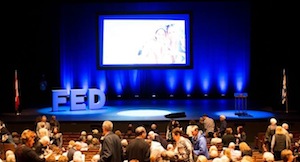
On Sept. 17, Jewish Federation of Greater Vancouver kicked off this year’s annual campaign with a new event: FEDtalks. Featuring brief TED-style talks from four speakers – the Hon. Irwin Cotler, Eli Winkelman, Dafna Lifshitz and Rabbi David Wolpe – more than 700 community members attended the event at the Queen Elizabeth Theatre.

photo - Audience members take their seats at FEDtalks on Sept. 17
Audience members take their seats at FEDtalks on Sept. 17. (photo from JFGV)

“Each speaker delivered a message that was Federation related, from the refugee and migrant crisis, to caring for those facing hunger, to leveling the playing field in Israel’s periphery, to inspiring people to connect more fully with their Jewish identity and values,” said Jewish Federation chief executive officer Ezra S. Shanken. “Their messages were our messages, and they reflected the soul of who we are as a Federation.”

Cotler addressed issues important to the Vancouver Jewish community – and, indeed, to the world – with particular emphasis on Syria and the refugee and migrant crisis. As a well-respected parliamentarian and human rights lawyer, he brought depth and breadth of knowledge on the crisis.

Winkelman shared her story of turning the simple act of baking challah into acts of social justice by founding Challah for Hunger, which now has 90 chapters on college campuses in three countries. Her work was recognized by President Bill Clinton, who highlighted Challah for Hunger in his book Giving: How Each of Us Can Change the World.

Lifshitz, CEO of Appleseeds Academy, addressed her organization’s work bridging the digital divide in Israel’s periphery and, in particular, the Net@ program that is supported by Jewish Federation. Through Net@, at-risk youth in our partnership region of the Upper Galilee receive specialized computer training that catapults them into highly-skilled, well-paying jobs, thus helping break the cycle of poverty.

Wolpe, who was named the most influential rabbi in America by Newsweek magazine, also addressed the refugee and migrant crisis, but from a Jewish perspective. He closed the evening with an inspirational message that united the community through the shared values of chesed, tzedaka and tikkun olam.

The Vancouver Jewish community’s central fundraising initiative, the annual campaign supports critical social services, Jewish education, seniors programs and young adults programs, and fosters ties with our partnership region in Israel. To donate or volunteer, visit jewishvancouver.com/what-to-give/annual-campaign.

Posted on September 25, 2015September 24, 2015Author Jewish Federation of Greater VancouverCategories LocalTags campaign, Dafna Lifshitz, Eli Winkelman, FEDtalks, Irwin Cotler, Jewish Federation of Greater Vancouver, Rabbi David Wolpe
Ready for the election

Ready for the election

SUCCESS chief executive officer Queenie Choo, left, with federal election candidates, left to right, Jody Wilson-Raybould, Erinn Broshko, Wes Regan and Mira Oreck. (photo by Jocelyne Hallé)

More than 100 people filled Choi Hall on Sunday to hear local candidates in the Oct. 19 federal election talk on immigration, economics, security, employment and health care. Co-sponsored by the Centre for Israel and Jewish Affairs and SUCCESS Canada, as well as various media outlets, including the Jewish Independent, the panelists, in order of initial three-minute presentations, were Vancouver-Granville candidates Erinn Broshko (Conservative), Mira Oreck (NDP) and Jody Wilson-Raybould (Liberal) and Vancouver East candidate Wes Regan (Green). The candidates each had two minutes to respond to questions submitted in advance by the public and, at the end of the Q&A, they each gave summary statements.

Charlie Smith, editor of the Georgia Straight, served as moderator, while Doug Purdie, chair of the board of SUCCESS, welcomed the audience and Jason Murray, chair of CIJA, closed the proceedings.

Format ImagePosted on September 25, 2015September 24, 2015Author Cynthia RamsayCategories LocalTags Centre for Israel and Jewish Affairs, CIJA, elections, Erinn Broshko, Jody Wilson-Raybould, Mira Oreck, SUCCESS, Wes Regan

Posts pagination

Previous page Page 1 … Page 541 Page 542 Page 543 … Page 651 Next page
Proudly powered by WordPress