Skip to content
  • Home
  • Subscribe / donate
  • Events calendar
  • News
    • Local
    • National
    • Israel
    • World
    • עניין בחדשות
      A roundup of news in Canada and further afield, in Hebrew.
  • Opinion
    • From the JI
    • Op-Ed
  • Arts & Culture
    • Performing Arts
    • Music
    • Books
    • Visual Arts
    • TV & Film
  • Life
    • Celebrating the Holidays
    • Travel
    • The Daily Snooze
      Cartoons by Jacob Samuel
    • Mystery Photo
      Help the JI and JMABC fill in the gaps in our archives.
  • Community Links
    • Organizations, Etc.
    • Other News Sources & Blogs
    • Business Directory
  • FAQ
  • JI Chai Celebration
  • JI@88! video

Recent Posts

  • Eby touts government record
  • Keep lighting candles
  • Facing a complex situation
  • Unique interview show a hit
  • See Annie at Gateway
  • Explorations of light
  • Help with the legal aspects
  • Stories create impact
  • Different faiths gather
  • Advocating for girls’ rights
  • An oral song tradition
  • Genealogy tools and tips
  • Jew-hatred is centuries old
  • Aiding medical research
  • Connecting Jews to Judaism
  • Beacon of light in heart of city
  • Drag & Dreidel: A Queer Jewish Hanukkah Celebration
  • An emotional reunion
  • Post-tumble, lights still shine
  • Visit to cradle of Ashkenaz
  • Unique, memorable travels
  • Family memoir a work of art
  • A little holiday romance
  • The Maccabees, old and new
  • My Hanukkah miracle
  • After the rededication … a Hanukkah cartoon
  • Improving the holiday table
  • Vive la différence!
  • Fresh, healthy comfort foods
  • From the archives … Hanukkah
  • תגובתי לכתבה על ישראלים שרצו להגר לקנדה ולא קיבלו אותם עם שטיח אדום
  • Lessons in Mamdani’s win
  • West Van Story at the York
  • Words hold much power
  • Plenty of hopefulness
  • Lessons from past for today

Archives

Follow @JewishIndie
image - The CJN - Visit Us Banner - 300x600 - 101625

Continuing Chelm tradition

It’s been eight years or so since I reviewed Mark Binder’s The Brothers Schlemiel, which recently has been reissued by Light Publications with the title The Village Twins, and written under Binder’s pen name, Izzy Abrahmson. I knew this story of Chelm would withstand the test of time for two reasons. First, we regularly publish a Binder/Abrahmson story in our holiday papers. Second, the stories are written in the style of Yiddish folk tales, which have proven staying power.

image - The Village Twins book coverAs Abrahmson explains in The Village Twins, Chelm is “a tiny settlement of Jews known far and wide as the most concentrated collection of fools in the world.” According to The YIVO Encyclopedia of Jews in Eastern Europe, the “first publication of Chelm-like stories appeared in Yiddish in 1597, and were tales of the town of Schildburg, translated from a German edition. Hence, these stories first entered Jewish culture as Schildburger stories, and it is unclear when they became connected to the town of Chelm. During the 19th century, a number of other Jewish towns figured as fools’ towns, including Poyzn. Over time, however, Chelm became the central hub of such stories, the first specific publication of which occurred in an 1867 book of humorous anecdotes, allegedly written by Ayzik Meyer Dik. Later, particularly in the early 20th century, dozens of collections of Khelemer mayses (Chelm stories) were published in Yiddish, as well as in English and Hebrew translations.”

The Village Twins is one of the latest such collections, and it does honour to its literary ancestors, providing wisdom in the guise of absurdity. The novel can be read on many levels, including as pure entertainment, as the story of a particular family living in a particular era and as a series of parables (it’s 414 pages long, which, I admit, was a bit lengthy for me). It is part of Abrahmson’s Village Life series, which includes several publications and a podcast, but can be read as a standalone novel. I am proof that a person might enjoy, but does not have to, read or listen to the other stories to follow this tale of the Schlemiel family that is centred around twins Abraham and Adam, who cause trouble from the day they are born.

The brothers make full use of their physical similarity throughout their life, from incidences as harmless as pranks around town to more serious situations, such as avoiding being drafted into the Russian army. What I wrote in my 2014 review still stands: Abrahmson “has created characters with whom we empathize…. He ably manages some fine balances: writing about silliness without the story becoming stupid, and evoking sentimentality while not becoming saccharine….. As well, through the vehicles of comedy and fantasy, [it] touches on many serious topics, from poverty to racism, to ethics in business, to whom people choose to be, and more.”

According to the press release, The Village Twins has been updated and revised, though I can’t speak to how, as my copy of The Brothers Schlemiel has long since been passed on. Along with this reissue came Binder’s pen name “to distinguish the series from his other work. By combining his Hebrew name, Isaac, with his father’s Hebrew name, Abraham … Izzy Abrahmson was born.”

As an editor, dealing with a writer with two names is a little unwieldy and I sometimes feel like the villagers of Chelm, who, for “many, many years” couldn’t tell Abraham from Adam. But that doesn’t diminish my enjoyment of Abrahmson’s – or is it Binder’s? – storytelling. He has won multiple awards for a reason. Anyone who likes a good folk tale will delight in The Village Twins.

Posted on December 9, 2022December 8, 2022Author Cynthia RamsayCategories BooksTags Chelm, folk tales, folklore, Izzy Abrahmson, Mark Binder, The Village Twins

A life-changing meeting

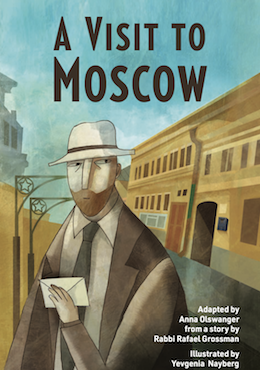
A Visit to Moscow is a beautifully illustrated and haunting graphic novel. In a brief 72 pages, it relates the story of an American rabbi who, on a 1965 trip to the Soviet Union, sneaks away from his delegation in Moscow to visit the brother of a friend – Bela hadn’t heard from Meyer for more than 10 years and was worried.

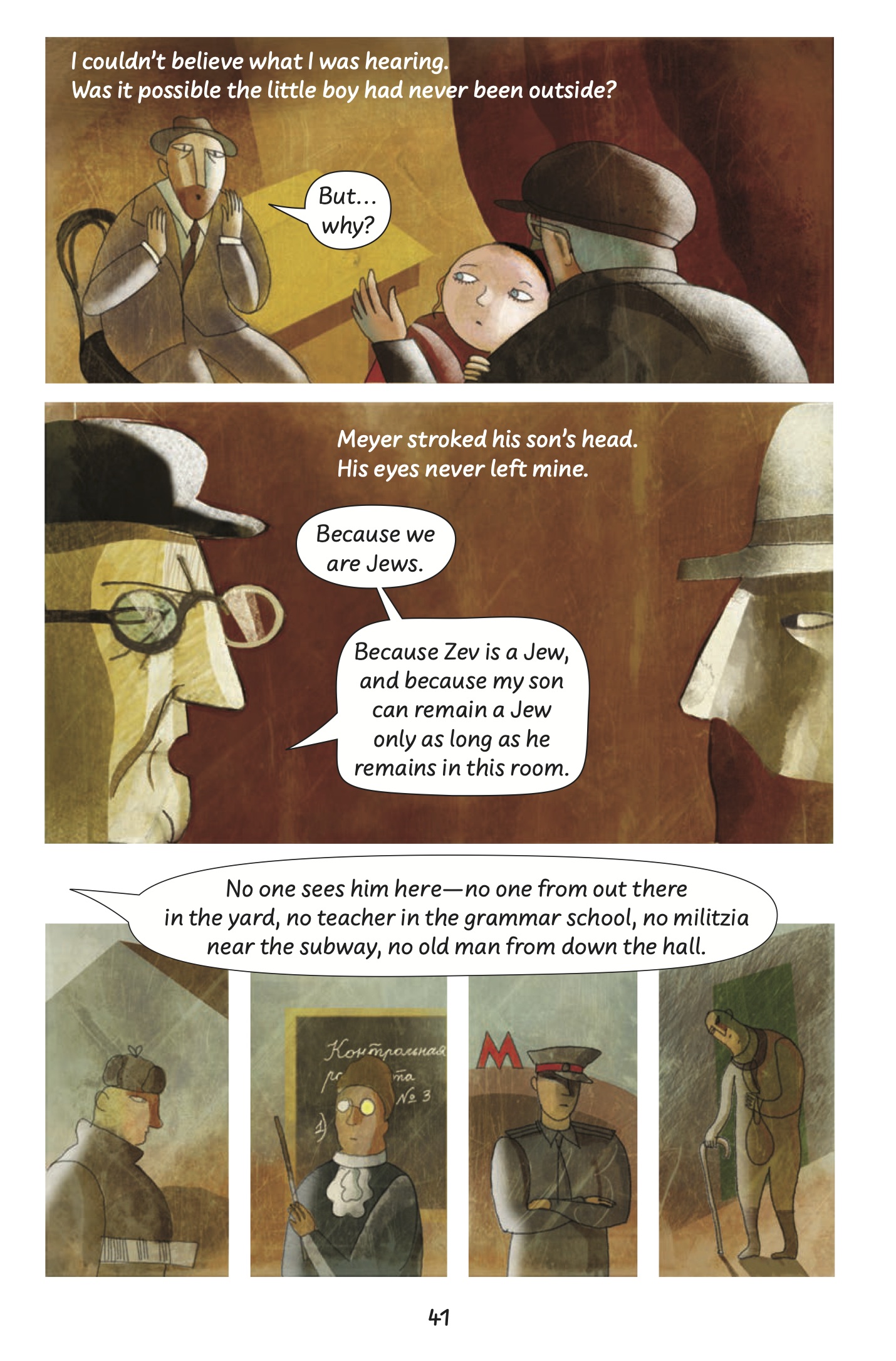
image - A Visit to Moscow book coverA Visit to Moscow (West Margin Press, 2022) is an adaptation by Anna Olswanger of a story told to her by Rabbi Rafael Grossman. It is illustrated by Yevgenia Nayberg, who captures in her palette, in the angles of her images, in her use of light and shadow, scratches and blurs, the claustrophobic fear that existed in that era in the USSR.

“Although the events of A Visit to Moscow are set before my time, the overall spirit of the Soviet Union feels very similar to what it was throughout my childhood when I lived there. I didn’t have to make a big leap to connect to the time period,” writes Nayberg in a section at the end of the book, where we get to see some of her preliminary sketches.

Olswanger knew Grossman, having collaborated with him on writing projects since the early 1980s. “One of our first projects,” she writes, “was a Holocaust novel with a character based on his cousin, a leader of the Jewish resistance in the Bialystok ghetto. As we planned out the storyline, Rabbi Grossman told me about an incident during a trip he made in 1965 to the Soviet Union, where he met a young boy whose parents were Holocaust survivors. The boy had never been outside the room he was born in.

“We never finished the novel, and then, in 2018, Rabbi Grossman died.”

Years later, Grossman’s daughter sent Olswanger a box of writings that Olswanger and the rabbi had worked on. It inspired Olswanger to revisit the story. But she didn’t have the whole story, so, on the suggestion of her editor, wrote A Visit to Moscow as historical fiction.

The main part of the book is incredibly moving. The tension as the rabbi makes his way to Meyer’s last known address is palpable in both text and images; the KGB are an ever-looming threat. When he arrives, it takes the rabbi time to gain Meyer’s trust and for Meyer to let the rabbi into his flat, where he meets Meyer’s wife and their son, Zev, who has never left their home. The rabbi promises to get them all to Israel.

image - Visit to Moscow is a powerful, if incomplete, story, written by Anna Olswanger and illustrated by Yevgenia Nayberg
Visit to Moscow is a powerful, if incomplete, story, written by Anna Olswanger and illustrated by Yevgenia Nayberg.

This core of the novel is well-written, easily understood and powerful. Unfortunately, this mid-section is bookended by ambiguous scenes. At the beginning, Zev hovers from heaven over his dead body, which is laying somewhere in a mountain range. In the throes of dying, he remembers the story of the rabbi’s visit, which leads into the main story, after which we see young Zev on a plane, remembering the ride and Israel’s beauty. In the midst of this, he wonders, “And later – was it years later? Was he a young man?” In the next panel, a fire burns in the aforementioned mountain range and the text reads: “He remembers a sudden flash. A burst of black smoke. Burning metal.”

I first thought that he and his parents had been killed in a plane crash on the way to Israel, so close to freedom but never reaching it. After madly flipping pages back and forth in the book, trying to figure out what I’d missed, I found what I was looking for in the About the Contributors section: “For over 25 years, Rabbi Grossman visited Zev and his family in Israel. He saw them together for the last time in 1992, the year Zev died at the age of 37, a husband and father, while on reserve duty with his army unit in Lebanon.”

A tragic ending either way, but at least Zev got out of his room and got to live more fully for those 25 years. “Every time I visited Zev in Israel,” wrote Grossman, “he was smiling.”

A Visit to Moscow could have benefited from a few more pages, to make the transition of Zev’s journey from the Soviet Union to Israel more understandable, and to include some aspects of his life in Israel, even if they were fictional. Olswanger and Nayberg have created something special, but it feels incomplete.

Posted on December 9, 2022December 8, 2022Author Cynthia RamsayCategories BooksTags A Visit to Moscow, aliyah, Anna Olswanger, freedom, graphic novel, history, Israel, Rafael Grossman, Soviet Union, Yevgenia Nayberg
Into belly of the beast

Into belly of the beast

Danny Danon, former Israeli envoy to the United Nations. (photo from IGPO / Chaim Tzach)

“Jerusalem is an inseparable part of Israel and her eternal capital,” said an Israeli prime minister. “No United Nations vote can alter that historic fact.” This quote, which could have come from any of the country’s leaders, was in fact spoken by the first, David Ben-Gurion, in 1949, just days after the UN voted for the internationalization of the city. Israel’s issues with the agency, in other words, have existed for some time.

One wouldn’t expect a right-wing Likud party stalwart, well-known hothead and self-acknowledged non-diplomat to be one of Israel’s foremost voices to present an unambiguous defence of the UN. But, in his new book, Danny Danon does exactly that.

Danon’s book, In the Lion’s Den: Israel and the World, focuses on his term as Israeli ambassador to the United Nations, from 2015 to 2020. Before that, he was a Likud member of the Knesset and a minister in Binyamin Netanyahu’s government.

He acknowledges that, when he was appointed to the diplomatic post, commentators in Israel and elsewhere suggested that Netanyahu was deliberately poking a stick in the belly of the beast.

“There was an expectation that, because of my background and strong ideological beliefs, I would not fit into the world of diplomacy, that I was too much of a hawk and a ‘hardliner,’ which would make it difficult for me to build relationships and achieve anything of substance,” he writes.

Well, yes and no. He does not fit into the world of diplomacy. But he does claim a litany of successes. Danon devotes nearly 200 pages to justifying Israel’s engagement with the international body. Despite the routine censures of Israel and seeming obsession the General Assembly and several of the UN’s agencies have with Israel, Danon argues convincingly that taking on the haters in that forum is a worthy enterprise.

“What many people don’t understand is that there is a public UN and a private UN,” he writes. “The public face of the UN – at least when it comes to Israel – is aggressive and bullying. But, privately, you can build bridges, forge friendships and create a space for understanding, particularly if you are transparent.”

His own approach – far more bull in a china shop than circumspect diplomat – has its merits, he contends. His calling out of critics by name, apparently nearly unheard of in the hallowed halls of the UN’s Manhattan headquarters, may have drawn gasps, but it also seems to have made some think twice before talking.

“After a few times calling out the French ambassador in the media, not only did he reiterate that he did not appreciate it, which had no effect on me, but, more importantly, it made him much more careful in the words he used and actions he took going forward.” Danon said.
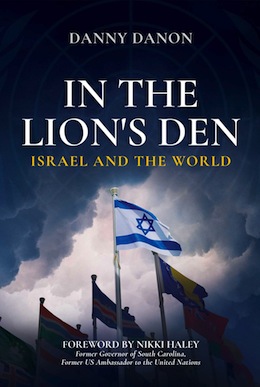
image - In the Lion’s Den book coverIn one segment, the former ambassador goes into extensive detail about the efforts he made to derail two particularly troublesome resolutions. “Both resolutions were pointless,” he acknowledged, which might describe most of the General Assembly resolutions against Israel, but this comment, in turn, raises the legitimate question about why such energy and resources are devoted to fighting them. Danon’s argument is that it is in Israel’s interest not to ignore them and to take up the fight whenever and wherever possible.

If his own account of his time there is to be believed, Danon achieved many victories.

He caused the UN to officially recognize Jewish holidays so that, for example, no major meetings occur on Yom Kippur. He managed to get a small amount of kosher food onto the menu at the UN staff cafeteria – and it was promptly snapped up by non-Jews who view a hechsher as proof of healthy, quality food.

More substantively, he hosted more than 100 ambassadors on delegations or missions to Israel.

Partly as a result of a conference that Danon organized for fellow ambassadors on the subject of antisemitism, the UN issued its first-ever thorough report dedicated entirely to anti-Jewish racism.

After successfully pressuring for a UN bureaucrat who is Israeli to be promoted (apparently a challenge), he took on a more entrenched problem. The UN unofficially boycotts Israel, he writes, passing over Israeli options in the agency’s not-insubstantial procurement process. He set out what he called the three T’s.

“We would sell our relevant technology, offer training and provide troops,” he said. The first two he succeeded in.

“I believe the last T, providing troops to UN peacekeeping missions, will come in time,” he writes. “Sending troops is still an ongoing effort on our part. We have one of the best trained militaries in the world, and it knows how to deal with many difficult conflicts. We have so many security challenges that require us to engage in prevention, deflection and defence that it puts us in a unique position of having both the know-how and the experience on the ground. This gives us an advantage in comparison to others. We have the expertise to train UN forces, such as search and rescue, medical treatment in the field, and addressing acute emergency situations…. It has not happened yet, but I am hopeful. It remains a goal for the future.”

For all its flaws, Danon argues, the UN is a unique environment where an Israeli ambassador can shmooze with people he would never get to meet otherwise.

“Think of this: anytime a special envoy from Israel travels to an Arab country, it has to be done with the utmost discretion. If such visits were to be discussed publicly, they could become an issue that could result in political backlash or even violence from extremists and terrorists. At the UN in New York, you can meet anyone, anytime, in a legitimate and open forum, free from the anxiety of those who are determined to see you fail. Indeed, such exchanges between adversaries and friends are expected, which is why the UN is a useful tool despite criticisms about its effectiveness in the 21st century.”

UN ambassadors aren’t nobodies, either, and the connections an Israeli envoy can make there can bear fruit later.

“Once a term at the UN is over, you can be assured that many ambassadors turn their attention to political positions in their home countries, some going on to become heads of state or ministers of foreign affairs,” he said. “It is useful to have existing relationships with such people.”

The Israeli delegation at the United Nations has managed to peel away a few European countries from the European Union’s consensus position against Israel.

“As the Czech Republic, Hungary and Bulgaria grow more confident and economically strong, one of the ways they have and will continue to show their independence and sovereignty is the approach they have taken toward Israel. We have a great opportunity to continue to strengthen our bond with the people and governments; as young countries striving to grow, they understand and relate to Israel’s challenges. I believe they will continue to reject Western Europe’s automatic pro-Palestinian and anti-Israeli sentiment.”

More remarkably, Danon also managed to peel away members from the Arab bloc. In a secret ballot, Danon became the first Israeli ever elected chair of one of the UN’s six standing committees. There were far fewer votes against his candidacy than there are Arab countries at the General Assembly, he notes.

“I had the courage and vision – and the will,” he writes of the chutzpah he showed in his role. “I was often told, great idea, let’s do it next year. I always said, let’s do it now, we can get it done in two months.” (Memoirs are rarely testaments to humility.)

Though Danon argues that he made headway in his term at the UN, predictably, he didn’t make many friends. But he certainly made one. Nikki Haley, the U.S. ambassador appointed by Donald Trump, became fast pals with Danon, apparently joyfully collaborating to stick it to the enemies. (Haley wrote the foreword to the book.)

This alliance and the many other overt and covert bridges he built during his term were overwhelmingly with representatives of governments that are on the right of the political spectrum – sometimes on the far-right, like Brazil’s and Hungary’s.

Though he doesn’t address this fact, he would no doubt make the case that Israel must take its friends where it can find them. In the bigger picture of Danon’s time in the belly of the beast, perhaps the words of the late Yitzhak Rabin prove true: “You don’t make peace with friends. You make it with very unsavoury enemies.”


Posted on December 9, 2022December 8, 2022Author Pat JohnsonCategories BooksTags antisemitism, Danny Danon, Israel, politics, United Nations
Decadent cocoa brownies

Decadent cocoa brownies

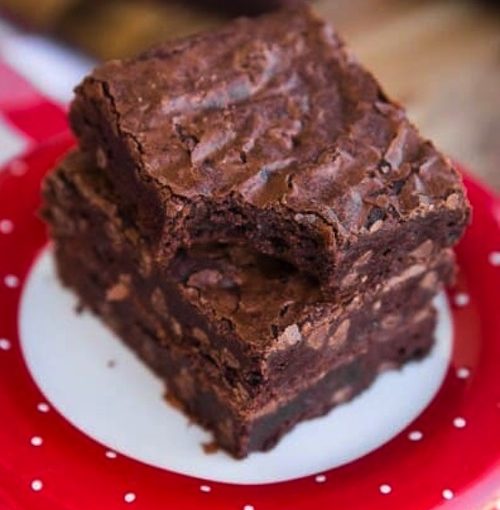
Cocoa powder brownies by Christi Johnstone of lovefromtheoven.com. (photo from lovefromtheoven.com)

And just like that…. I found myself sitting in the living room, clandestinely stuffing a four-inch square of decadent cocoa brownie in my mouth.

It was as though I’d been in a trance, eating on autopilot. But then I snapped to

attention, hearing noises coming from the other room, alerting me to the presence of an intruder (or my husband snoring in the bedroom). I needed to get rid of the cocoa-y evidence, pronto, before I got caught brown-handed. After all, it was 2 a.m. and I had no business eating a stimulant like that when I was already trapped in a spiral of insomnia. But there I was. At least I didn’t pair the brownie with, say, a tiny glass of Bailey’s. Or a hot chocolate. That would have been criminal. I do have some self-control. It might be measured in grams, but still.

The “intruder” stumbled out to use the bathroom just as I was shoving the last bit of evidence into my piehole. I narrowly escaped brownie-shaming by a nanosecond. This is all to say that I have a shameless sweet tooth – it knows no bounds, and certainly has no timelines. I’ve been caught on other occasions scarfing down Cheezies and chips before breakfast (OK … for breakfast). I’ve been castigated at 5:30 p.m. for eating chocolate pudding (it’s considered an appetizer, isn’t it?). I’ve had ice cream ripped from my very hands (alright, maybe not ripped, but forcefully grabbed) right before bed. I cop to it all. Mea culpa. I just can’t help myself.

On that note, I recently heard Dennis Prager, the well-known radio personality, share this pearl of wisdom: “It’s more important to have self-control than self-esteem.” Point taken. I freely admit that my self-control needs a little work, so I vow, right here, right now, to eat decadent cocoa brownies only during office hours. And, since I’m retired, that is open to interpretation. Consider shift work.

As for self-esteem, that’s between me and myself, and I mostly have a handle on it. But self-control affects every part of life and can lead to behaviours that are socially unacceptable, like outbursts of temper, for example. Again, mea culpa. Lack of self-control in overeating can lead to poor health outcomes, and that also needs watching. Personally, I’m guilty of watching from afar. I must get on that.

Being someone who is (luckily?) colon-less in Vancouver, I have the luxury of eating whatever I want and not gaining an ounce. The flip side of that is, well, you don’t want to know the flip side. Suffice it to say that I’ve been known to over-indulge in certain items that are not in Canada’s Food Guide recommendations. On a regular basis. OK, OK, I need to pay more attention to what I am putting in my mouth (otherwise it might fall on the floor or land in my lap).

For now, though, I’m going to share my guilty little secret and be done with it. That translates to: I gave three-quarters of the brownies I made to my niece and only kept a quarter of them for myself. Those of you who are truly observant will notice the reflexive singular pronoun. Used, in this instance, because my husband Harvey has been on a diet for 11 months and has lost 52 pounds. He would no more dream of eating a brownie right now than he would dream of going to a five-star resort in St. Lucia without me. Unless, of course, he was looking for wife number four. Plus, he likes to delegate the eating, so I’m taking one for the team. Alas, the brownies are all for me, and me for them. Eaten at three-hour intervals, it equates to about 1,000 calories per day. For my hips alone. Pure speculation, of course. But I’m willing to risk it.

What I know for certain is that a brownie recipe I recently found – by Christi Johnstone of lovefromtheoven.com – is the bomb. You’re welcome. For your own well-being, do not – I repeat, do not – get on your scale for at least a week after you’ve eaten these brownies. Consider yourself forewarned.

COCOA POWDER BROWNIES

10 tbsp melted butter or margarine
1 1/4 cup sugar (I use 1 cup brown sugar and 1/4 cup white sugar)
3/4 cup plus 2 tbsp unsweetened cocoa powder
1/2 tsp salt
1 tsp baking powder
1 tsp vanilla extract
2 large eggs1/2 cup all-purpose flour
1/2 cup chocolate chips (optional)

  1. Position your oven rack in the lower third of your oven. Preheat oven to 325°F degrees. Line an eight-inch square pan with parchment paper or just grease the pan.
  2. Combine melted butter (or margarine), sugar, cocoa powder and salt in a large bowl. Allow to cool for five to 10 minutes. You don’t want it too hot when you add the eggs.
  3. After mixture has cooled slightly, add vanilla and mix well. Add eggs, one at a time, and beat until well mixed.
  4. In a separate bowl, combine flour and baking powder and stir to combine. Add the flour mixture to the batter and mix well to combine. If adding chocolate chips (optional), fold them into the batter.
  5. Bake for 30-35 minutes, or until a toothpick comes out with some moist crumbs attached. Cool on a wire rack.

I won’t even pretend to give you a nutritional accounting of this amazing snack because, even if I did, you’d ignore it. On purpose. I suspect it’s shockingly unhealthy, but, in the grand scheme of things, so is watching too much TV. But does that stop us?

The thing about these brownies is that they’re not overly sweet, like some are. They’re just moist, soft, rich, cocoa-y goodness. I imagine that you could freeze them, but then, why would you want to? More to the point, why would you need to? They don’t last more than 14 hours in my home. On a good day. Less, if there’s milk in the fridge.

I have another fudge brownie recipe that’s also pretty special, but there’s so much sugar in it that it makes my teeth hurt. Not that that’s ever really been a deterrent for me. I love all my brownies the same.

Shelley Civkin, aka the Accidental Balabusta, is a happily retired librarian and communications officer. For 17 years, she wrote a weekly book review column for the Richmond Review. She’s currently a freelance writer and volunteer.

Format ImagePosted on December 9, 2022December 8, 2022Author Shelley CivkinCategories LifeTags Accidental Balabusta, baking, brownies, lifestyle
A new family tradition

A new family tradition

(photo by Mark Binder)

Rachel Cohen stared at the full box of candles. Since her parents had separated, getting ready for Hanukkah wasn’t the same. Four candles were broken. Of course.

She chewed on her lower lip.

In the old days, her family had gathered around the kitchen table, and argued about who would light the shammos and who would light the first candle.*

“You did it last year,” her twin brother Yakov always insisted.

“No,” Rachel would counter. “I lit the shammos, which is better.”

“No, it’s not. The first candle is best.”

“Children, hush,” their mother, Sarah, would say as she flipped a potato latke. “You’ll disturb your father.”

Their father, Isaac, would be looking at his little book, pretending to mumble prayers, while holding back a smile.

The compromise was always the same. Rachel would light the shammos, which was better, and Yakov would light the first candle, which made him happy, too.

This year, her parents lived in different houses, and Hanukkah wouldn’t be the same. Rachel didn’t know what to do. She felt small, helpless and embarrassed.

In the village of Chelm, 12-year-old Rachel Cohen was known as the smartest young girl, someone whose wisdom was both sought after and respected.

“If you don’t know what to do,” everyone said, “ask Rachel Cohen, and whatever she says, do that!”

Rachel knew that she wasn’t really that brilliant. But whenever someone asked her a question, she either had the answer, or knew how or where to find it.

“The secret of being wise,” Rabbi Kibbitz had once taught her, “is to listen quietly for as long as you can without saying anything. Ask a few questions, and then nod your head and wait until the answer arises. Most of the time, they’ll think of it themselves, and then give you all the credit.”

Rachel nodded her head and asked herself, “But what does a so-called wise person do, when they don’t know the answer?”

She looked around the kitchen, which was also silent.

Then it came to her, and she smiled.

* * *

The bell over the door to Mrs. Chaipul’s restaurant rang and, without looking up, the elderly woman behind the counter told Rachel, “Your mother’s gone to the market in Smyrna to get potatoes for the latkes.”

“Can we talk?” Rachel asked quietly.

Mrs. Chaipul glanced at the young girl, nodded her head and shouted, “All right, the restaurant is closed until lunch for a health and safety inspection!”

Most of the men finished drinking their tea or coffee, put on their coats and headed to the door.

Reb Cantor the merchant didn’t budge. “I thought you already paid the health and safety inspector.”

“This is for your health and safety,” Mrs. Chaipul told the merchant. “Because I won’t guarantee it if you stay.”

Reb Cantor smiled, stood and kissed Rachel on the top of her head as he left the restaurant.

Mrs. Chaipul locked the door behind him and led Rachel to the table in back, where she’d already placed two cups of hot herbal tea.

The young girl and the old woman sat across from each other, lifted their cups at the same time, and blew.

* * *

Mrs. Chaipul listened as Rachel explained, “On the first night of Hanukkah, our family starts with eight candles ablaze, and then we light one fewer each night. This, my father says, echoes the Maccabees’ fear that the oil in the eternal light might burn out at any moment.

“But, on the last night, where there would only be one candle and the shammos, we changed the tradition and light all eight again. For us, the last night is a true celebration of joy. My mother says it’s just nice to have all the extra lights.

“This Hanukkah, Yakov and I are supposed to take turns, one night with Mama and the next with Papa. I want things to be the same, but no matter how hard I try to rearrange it, the number of candles always comes out uneven. Plus, four of our candles are already broken, which seems like a sign!”

Rachel waited for Mrs. Chaipul to tell her how to solve the problem. But Mrs. Chaipul didn’t say anything. She was married to Rabbi Kibbitz, and kept her own name, which is another story. She’d often chided her husband that it was better to keep your mouth shut than to put your foot into it.

Rachel sighed. She sipped her tea.

Then she smiled, and nodded. She suddenly knew what to do. “Thank you, Mrs. Chaipul. I need to hurry and buy more candles.”

Mrs. Chaipul gave Rachel a hug. “I didn’t do anything. But I wish you well.”

Rachel ran from the restaurant, and Mrs. Chaipul reopened the front door for the lunch crowd.

* * *

That year, Rachel Cohen changed their tradition again.

“Whether we are with mother or father,” she told her brother, “instead of lighting eight or seven or one, each night we will take turns lighting all eight Hanukkah candles.”

Yakov was upset. “So many candles seems wasteful. And that isn’t the way Hanukkah is supposed to be celebrated!”

“Everything changes,” Rachel said, “and it’s up to us to make it new again. This way, the time we spend together will be even brighter.”

“All right.” Yakov shrugged. “But I light the first candle.”

“You did it last time.” Rachel smiled. “But that’s fine. Lighting the shammos is better….”

Izzy Abrahmson is the author of Winter Blessings and The Village Twins. He’s also a pen name for storyteller Mark Binder. Find the books on Amazon and Audible, with signed copies and links to the audio version of this story at izzyabe.com and markbinderbooks.com.

***

*A note on candlelighting
A shammos is the candle that is used as a match to light the other candles. While most people follow the tradition of Rabbi Hillel, lighting one candle the first night of Hanukkah and then adding candles each night, the followers of Rabbi Shammai start with eight and work their way down. Rachel Cohen is not yet a rabbi, but who knows what the future will bring.
– IA

Format ImagePosted on December 9, 2022December 8, 2022Author Izzy AbrahmsonCategories Celebrating the HolidaysTags Chanukah, Chelm, folk tale, Hanukkah
Hanukkah in the Diaspora

Hanukkah in the Diaspora

The reason that is ascribed to the House of Hillel for the custom that we follow in lighting the candles is that we go upwards in holiness. (photo by Maor X)

Hanukkah lives in the sweet spot where there is one story that claims it is “historically true” and yet there is very little contemporary evidence to back this up – the earliest account being written generations after the events – and there is another story, a miracle story whose earliest recording is centuries after its supposed occurrence. We go with the miracle story.

There was no love lost between the rabbis and the Hasmoneans. There are several legends about rabbis (i.e. Shimon ben Shatah) confronting the Hasmonean king Yannai (e.g. Sanhedrin 19a-b) and Yannai killing sages (Kidushin 66a). So, it is not surprising that the rabbis did not glorify the Hasmonean victory, and chose to centre a different legend, which seems to have arisen in the first centuries of the common era. The additional prayer (called Al Hanisim) that is added to the central prayer does not mention the miracle of the oil. The earliest mention of the miracle of the oil is in the commentary (the “scholion”) to a first-century list of holidays called Megillat Ta’anit. This commentary is not mentioned in the Palestinian Talmud. Its first appearance is in the Babylonian Talmud many centuries later.

While this may point to a choice for the miracle story over the martial story, the martial story did not fade away. It arose from time to time, gaining full rehabilitation with the birth of the Zionist movement, whose adherents looked to the Maccabees for ancestral precedent. However, this is not my point.

The earliest rabbinic legal discussion of the obligations of Hanukkah (as opposed to mentioning Hanukkah in passing) is not in the Palestinian Mishnah. It is in a supposed Palestinian baraita (“outside” teaching) quoted in the Babylonian Talmud and not in the Palestinian Talmud. This is the famous debate between the House of Hillel and the House of Shammai as to whether one lights one candle on the first night and then adds a candle each night (Hillel); or, conversely, one lights eight candles on the first night and then subtracts a candle each night (Shammai). This is followed by the obligation to light the candelabrum in the doorway, outside or, if one lives on an upper floor, in the window.

These are the earliest legal discussions of Hanukkah. There are others. The salient point is that many of the laws have to do with the placement of the candelabrum in order to publicize the miracle (pirsumei nisa). One might have thought that a holiday whose legend included the purification of the Temple would have had a Temple-like ritual at its centre. Instead, even the candelabrum does not replicate the seven-branched Temple candelabrum. The focus of the holiday obligations is marking Jewish space. Facing outward at the moment that people return from the market. If one has two entrances, the Talmud asks, does one have to light in both places?

Hanukkah is a diasporic holiday that celebrates place. This place where we are now is the place in which we announce the miracle. This is not a second-rate reminder of a ritual whose better form would have been and will be ensconced in the Temple. It is a diasporic ritual that lays claim to diasporic Jewish space.

This places Hanukkah on the same axis as Purim, again a holiday that is about and in Diaspora, and would not make sense in the Land of Israel. However, the difference is Purim posits that redemption is impossible and that, as long as the king is maliciously or foolishly evil, there will be a never-ending drama in which first Haman succeeds and then Mordecai succeeds. Hanukkah celebrates the fact of being here. Light in whatever many religious or secular metaphors it is clothed is brought into these Jewish spaces. The reason that is ascribed to the House of Hillel for the custom that we follow in lighting the candles is that we go upwards in holiness and not the opposite. We light the candles and increase the holiness. Here.

Hanukkah is a diasporic holiday in that it is portable. The celebration of Hanukkah defines the space that is celebrated as a Jewish space – like a mezuzah on a doorpost or an eruv (ritual boundary) in a city. Like these other markers, it creates Jewish space that is non-exclusive. Jewish space that has permeable boundaries. Jewish space that lives in proximity to others, despite the fact that this proximity is risky. From the start, the halakhah (Jewish law) of Hanukkah decided that, in a time of danger, one need not light the candelabrum on the outside or facing out, rather one may light inside on a table.

When we light candles today, we again announce that we live in Jewish spaces that are proximate to other spaces and, while we embrace this proximity, we are aware that it is risky – and yet still we increase the holiness, the light, from day to day. Here, in this time, and in this place.

Rabbi Aryeh Cohen is a fellow of the Kogod Research Centre at the Shalom Hartman Institute of North America and professor of rabbinic literature at the Ziegler School of Rabbinic Studies of the American Jewish University, where he teaches courses in Talmud. He is also the rabbi in residence for Bend the Arc: Jewish Action in Southern California. For more articles by Cohen, visit jewschool.com, where the original of this article can be found. For articles by other Shalom Hartman scholars, visit hartman.org.il.

Format ImagePosted on December 9, 2022December 8, 2022Author Rabbi Aryeh CohenCategories Celebrating the HolidaysTags candlelighting, Chanukah, Diaspora, Hanukkah, Judaism

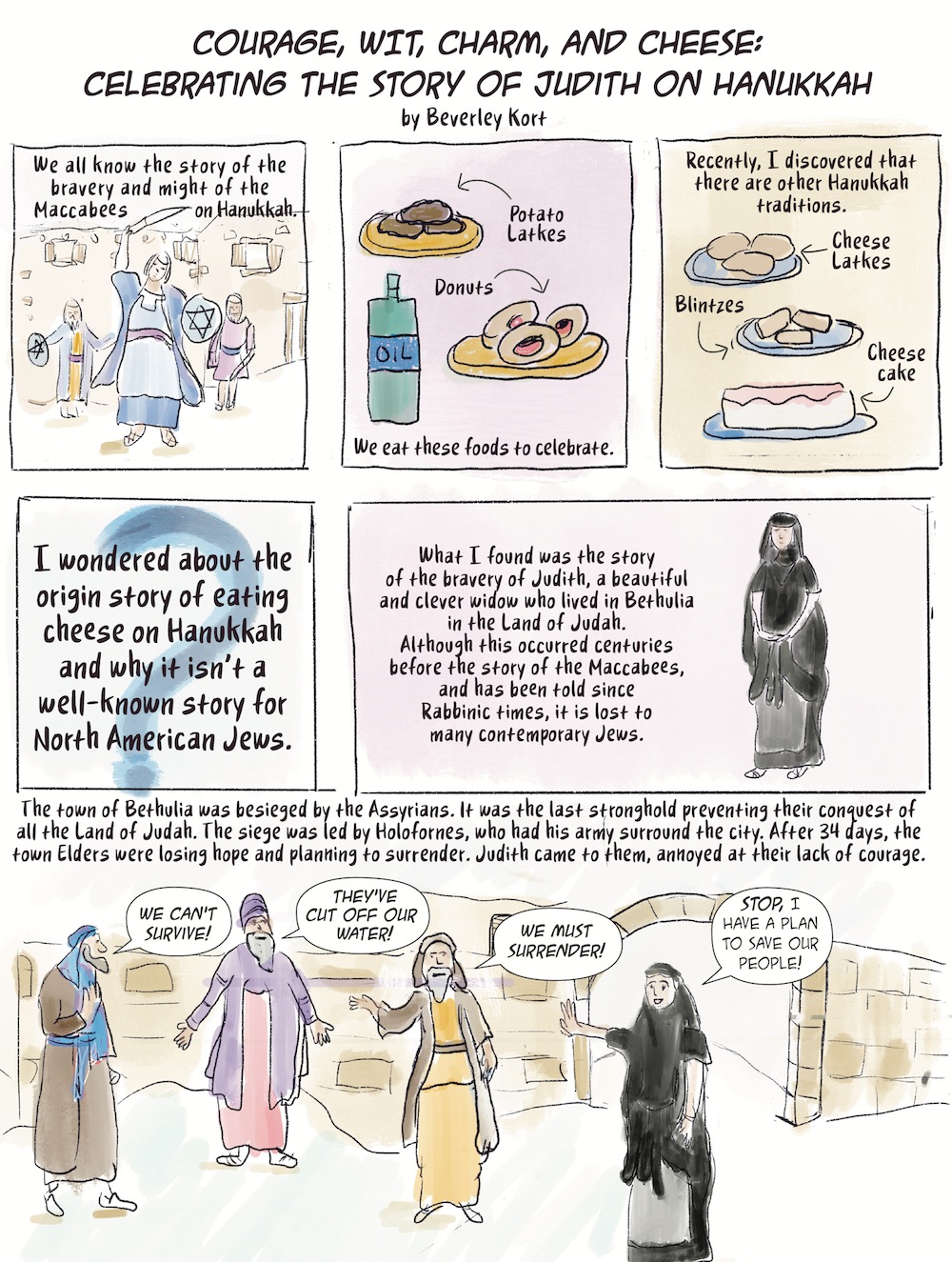
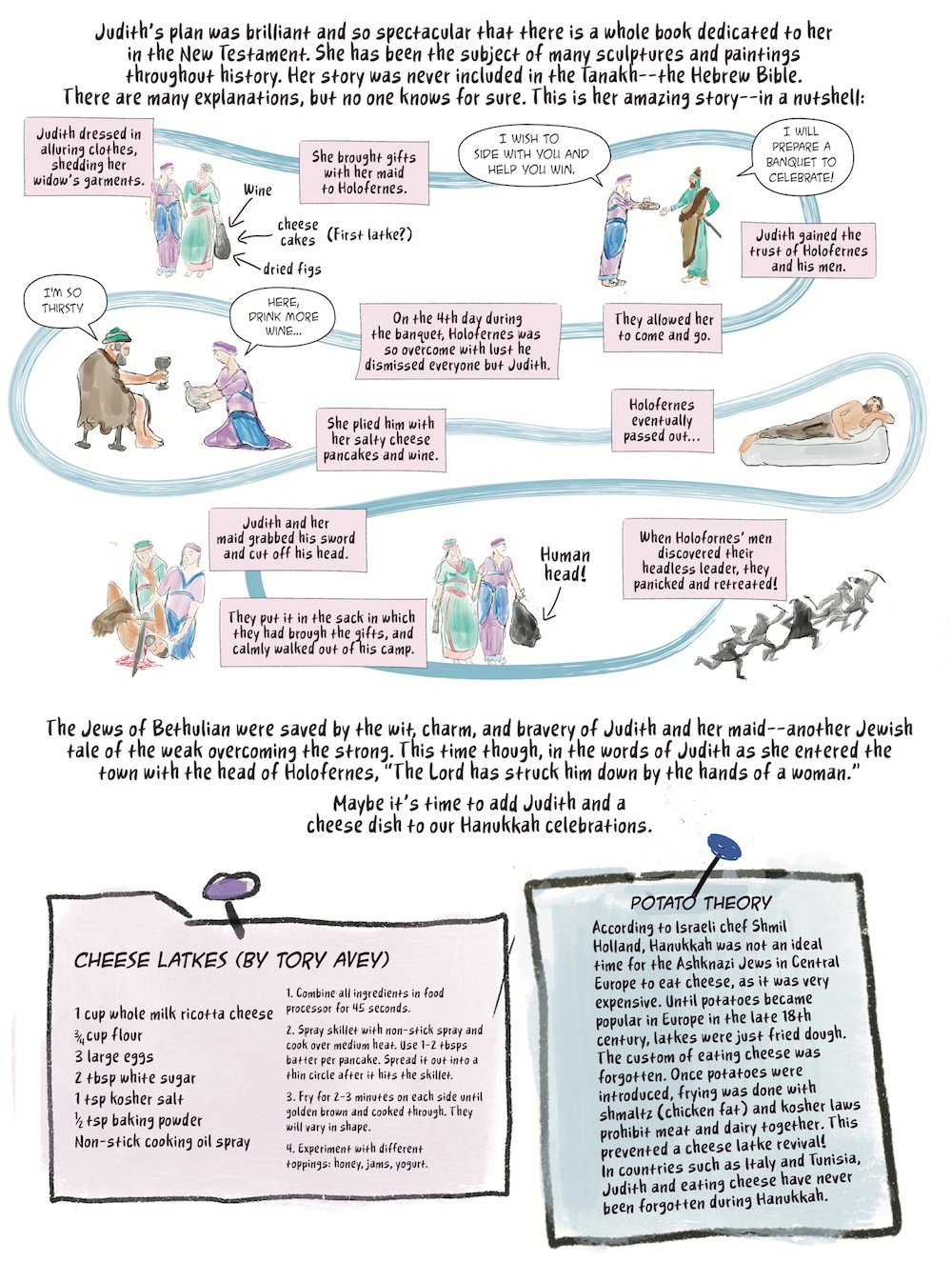
Courage, wit, charm and cheese …

image - Judith story intro (text and images by Beverley Kort)image - Judith story and recipe (text and images by Beverley Kort)

Beverley Kort is a registered psychologist by day and a cartoonist in her off hours. She has a private practice in Vancouver.

Posted on December 9, 2022December 8, 2022Author Beverley KortCategories Celebrating the HolidaysTags Chanukah, Hanukkah, history, Judith, latkes, recipes
Ideas for your holiday meals

Ideas for your holiday meals

Lamb Chops Sizzled with Garlic by Janet Mendel. Photo by Jennifer Causey, food styling by Emily Nabors Hall, prop styling by Claire Spollen.

When Hanukkah arrives, there will be more family and friends to feed. Or, maybe just the “excuse” (not that we need one) to make a special meal for ourselves! However you celebrate, here are a few main dishes – meatballs, lamb chops and a vegetarian gratin – and a couple of vegetarian side options.

TOMATO MEATBALLS
(makes 18)

1 lb ground beef
1/3 cup bread crumbs
1 egg
1 finely grated medium onion
salt and pepper to taste
2 tbsp olive oil
2 crushed garlic cloves
16-ounce can crushed tomatoes
6-ounce can tomato paste
1 cup water
1 1/2 tsp dry basil

  1. In a bowl, mix together ground beef, breadcrumbs, egg, onion, salt and pepper. Shape into 18 meatballs.
  2. Heat oil in a frying pan. Brown meatballs and remove.
  3. Add tomatoes, tomato paste, water and basil to pan. Bring to a boil, reduce heat and simmer, stirring when necessary.
  4. Add meatballs and continue simmering 10-15 minutes.
  5. Serve on their own, in a bun or on noodles, rice or any other base of your choice.

SWEET AND SOUR MEATBALLS
(This came from a Heinz ad, and I’ve made it kosher. It makes 40 balls.)

1 lb ground beef
1 cup breadcrumbs
1 egg
2 tbsp minced fresh onion
2 tbsp pareve non-dairy creamer
1 minced garlic clove
salt and pepper to taste
1 tbsp vegetable oil
2/3 cup chili sauce
2/3 cup currant jelly

  1. Combine beef, breadcrumbs, egg, onion, non-dairy creamer, garlic, salt and pepper. Form into 40 bite-size meatballs (about one teaspoon each).
  2. Heat oil in a frying pan. Place meatballs in pan, cover and brown lightly for 10 minutes.
  3. Combine chili sauce and jelly and pour over meatballs. Heat on low heat 10-12 minutes, until sauce has thickened, basting occasionally.

GRILLED HERBED LAMB CHOPS
(6 servings)

1/2 cup olive oil
1 cup white wine
1/2 cup minced fresh parsley
1/2 tsp marjoram
1/2 tsp oregano
1/2 tsp basil
1 tbsp minced shallots or white onion
1 minced garlic cloves
6 lamb chops

  1. In a bowl, combine olive oil, wine, parsley, marjoram, oregano, basil, shallots or white onion and garlic. Add chops and coat well. Marinate two to three hours, turning chops often.
  2. Grill chops five to six inches from heat, five minutes per side or until medium rare.

LAMB CHOPS SIZZLED WITH GARLIC
(Janet Mendel is an American-born journalist who has lived in Spain for many years. Las Pedroneras is considered the garlic capital of Spain and this recipe on Food & Wine’s website is Mendel’s “homage to the village.” It makes 4 servings.)

8 lamb chops
salt and pepper to taste
thyme
3 tbsp olive oil
10 halved garlic cloves
3 tbsp water
2 tbsp fresh lemon juice
2 tbsp fresh minced parsley

  1. Season lamb chops with salt, pepper and thyme. Heat olive oil in a large frying pan.
  2. Add lamb chops and garlic and cook over high heat for three minutes. Turn over chops and garlic and cook two minutes longer. Transfer to a plate.
  3. Add water, lemon juice and parsley, scrape bottom of pan and cook for one minute.
  4. Pour pan sauce over lamb chops and serve immediately.

OMBRÉ POTATO AND ROOT VEGETABLE GRATIN
(This is a recipe by TV personality and chef Carla Hall, with my changes to make it kosher. You can find the original on Food & Wine’s website. Both make 12 servings.)

unsalted pareve margarine
2 cups non-dairy creamer
3 minced garlic cloves
1 small minced shallot
1/2 tsp nutmeg
salt and pepper to taste
1 pound peeled beets, sliced 1/16-inch thick
1 pound peeled sweet potatoes, sliced 1/16-inch thick
1 pound peeled small white potatoes, sliced 1/16-inch thick
1 pound peeled turnips, sliced 1/16-inch thick

  1. Preheat oven to 375°F. Grease a rectangular baking dish.
  2. In a bowl, whisk non-dairy creamer with garlic, shallot, nutmeg, salt and pepper.
  3. In a large bowl, toss beets with a quarter of the cream mixture. Arrange beets in baking dish, overlapping them slightly. Scrape any remaining cream from the bowl over the beets.
  4. Repeat the process with the sweet potatoes, potatoes and turnips, using a quarter of the cream mixture for each vegetable. Then cover dish with foil.
  5. Bake for about one hour and 45 minutes. Let cool 15 minutes.

Note: If pareve grated cheese is available, measure one cup and stir it into the whisked cream mixture. After baking, add another 3/4 cup of the grated cheese to the top.

SPAGHETTI SQUASH WITH PEPPER SAUCE
(6 servings)

1 approx 3-pound spaghetti squash
1/4 cup olive oil
1 onion, slivered
2 red peppers, cut into 1/2-inch lengthwise strips
2 yellow peppers, cut into 1/2-inch lengthwise strips
2 chopped tomatoes
1/2 tsp sugar
1/4 cup fresh basil leaves, coarsely torn
salt and pepper to taste

  1. Preheat oven to 375°F. Place pierced squash in a baking pan. Bake for 40 minutes. Turn over and bake another 15-30 minutes, until tender. Turn off oven and let squash remain.
  2. Heat olive oil in a pot. Add onion and cook 10 minutes.
  3. Add peppers, season with salt and pepper. Cover and cook 20 minutes.
  4. Add tomatoes, sugar and basil. Cook uncovered 20 minutes.
  5. Cut the squash in half and discard seeds. Pull apart strands with a fork. Place in a bowl and add pepper sauce.

QUINOA SALAD WITH SWEET POTATOES AND APPLES
(This is a Food & Wine recipe by food stylist and author Grace Parisi. It makes 10-12 servings.)

8 tbsp olive oil
1 1/2 cups quinoa
salt and pepper to taste
1 1/2 pounds peeled sweet potatoes, cut into 3/4-inch cubes
1/4 cup apple cider vinegar
2 apples, cut into 1/2-inch cubes
1/2 cup chopped parsley
8 cups packed baby greens, such as arugula and kale

  1. Preheat oven to 400°F.
  2. Heat one tablespoon of oil in a saucepan. Add quinoa and cook two minutes. Add three cups water, season with salt and bring to a boil. Cover and simmer 16 minutes. Remove from heat and let stand 10 minutes. Fluff quinoa, spread on baking sheet and refrigerate 20 minutes.
  3. On another baking sheet, toss sweet potatoes with one tablespoon of oil, salt and pepper. Toast in oven 25 minutes, stirring once. Let cool.
  4. In a large salad bowl, whisk six tablespoons of oil with vinegar. Season with salt and pepper. Add quinoa, sweet potatoes, apples, parsley and greens and toss. Serve right away.

Sybil Kaplan is a journalist, lecturer, book reviewer and food writer in Jerusalem. She created and leads the weekly English-language Shuk Walks in Machane Yehuda, she has compiled and edited nine kosher cookbooks, and is the author of Witness to History: Ten Years as a Woman Journalist in Israel.

Format ImagePosted on December 9, 2022December 8, 2022Author Sybil KaplanCategories Celebrating the HolidaysTags Chanukah, cooking, Hanukkah, Jewish holidays, recipes
Try cookies for dessert

Try cookies for dessert

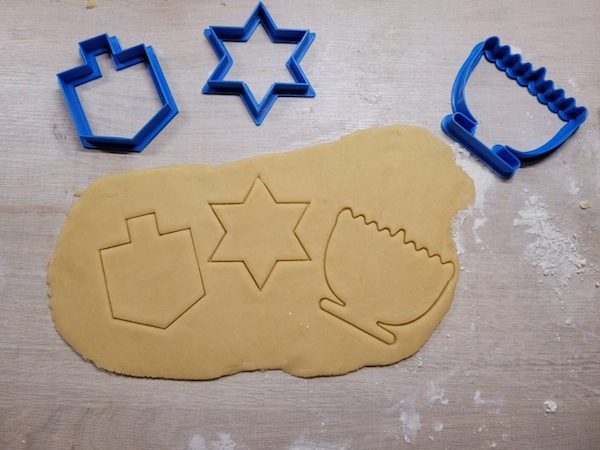
(photo from etsy.com/ca/shop/MaaminShop)

We in Israel are already seeing bakeries displaying sufganiyot for Hanukkah. No doubt the situation is the same in Vancouver and you’ll have plenty of jelly doughnut options, so here are some other sweets for the holiday.

HANUKKAH PUFFS
(makes 3 dozen)

2 cups flour
1/4 cup sugar
1 tbsp baking powder
1 tsp nutmeg
1/4 cup vegetable oil
3/4 cup milk or nondairy substitute
1 egg
oil
cinnamon sugar or confectioner’s sugar

  1. Warm a substantial amount of oil in a deep pot.
  2. In a bowl, combine flour, sugar, baking powder and nutmeg. Mix well. Add oil, milk or nondairy substitute and egg. Mix thoroughly.
  3. Drop by small teaspoonfuls into deep hot oil. Fry three minutes or until golden brown. Drain on paper towels.
  4. Roll in cinnamon sugar or confectioner’s sugar.

COOKIE DREIDELS
(makes 5 dozen)

1 cup butter or margarine
8 ounces cream cheese
1/4 cup sour cream
2 1/4 cups flour
2 cups finely ground walnuts
1/2 cup sugar
1 tsp ground cinnamon
1 egg
1 tsp grated orange rind

  1. Preheat oven to 350°F. Grease two cookie sheets.
  2. In a bowl, beat butter or margarine and cream cheese with electric mixer. Beat in sour cream. Stir in flour until dough forms. Form into a ball, wrap in plastic wrap and chill overnight.
  3. In a bowl, combine nuts, sugar, cinnamon, egg and orange rind.
  4. The next day, divide dough in half, flour a surface, roll out to an eight-inch square, a quarter-inch thick. Spread half of filling on square, roll up jelly-roll style. Wrap in foil, chill for at least one hour. Repeat with other half of dough.
  5. Cut rolls in quarter-inch thick slices. Place half-inch apart on cookie sheets. Reshape into rounds. Bake for 15-20 minutes or until firm and brown.

CUT-OUT HANUKKAH COOKIES
(makes 6 dozen)

2/3 cup margarine
2 cups flour
1 egg
3/4 cup sugar
1 tbsp milk
1 tsp baking powder
1 tsp vanilla

  1. Preheat oven to 375°F.
  2. Cream margarine. Add half the flour, egg, sugar, milk, baking powder and vanilla. Beat in remaining flour.
  3. Divide dough in half. Cover and chill three hours.
  4. Roll out half dough on a floured surface. Cut in Hanukkah shapes with cookie cutters. Place on ungreased cookie sheets. Add coloured sugar on top. Bake for seven to eight minutes.

Sybil Kaplan is a journalist, lecturer, book reviewer and food writer in Jerusalem. She created and leads the weekly English-language Shuk Walks in Machane Yehuda, she has compiled and edited nine kosher cookbooks, and is the author of Witness to History: Ten Years as a Woman Journalist in Israel.

Format ImagePosted on December 9, 2022December 8, 2022Author Sybil KaplanCategories Celebrating the HolidaysTags bakery, Chanukah, cookies, Hanukka
Weather … an eternal subject

Weather … an eternal subject

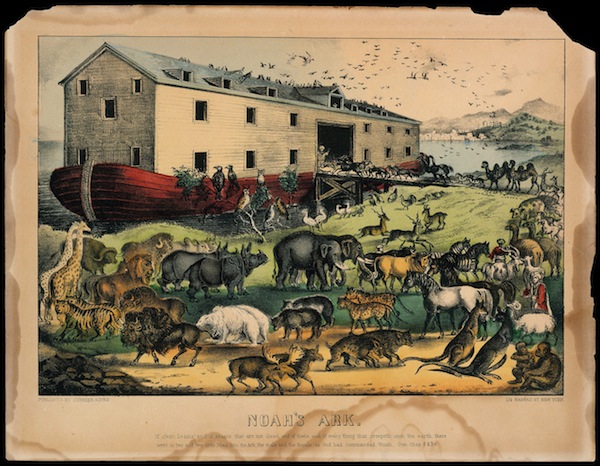
While the flood in Noah’s time, and his building of the ark, may be one of the more famous biblical weather incidents, along with the wind that battered the ship in which the prophet Jonah was hiding, they certainly are not the only ones (Metropolitan Museum of Art: Adele S. Colgate bequest, 1962)

It seems that everybody talks about the weather. Has it always been the case? While it’s admittedly impossible to prove whether it has, weather was certainly talked about in ancient times. The Hebrew Bible, or Tanakh, contains many weather references.

Right off the bat, in Genesis 2:6, we find mention of mist. In this context, G-d has spent the week creating the world. On the seventh day, He fashions the first man: “but there went up a mist from the earth, and watered the whole face of the ground. Then the Lord G-d formed man of the dust of the ground….”

Five chapters later, we get to the flood story. We read about heavy, sustained rain and catastrophic flooding – “and I will cause it to rain upon the earth forty days and forty nights; and every living substance that I have made will I blot out from off the face of the earth. And the waters prevailed, and increased greatly upon the earth; and the ark went upon the face of the waters. And He blotted out every living substance which was upon the face of the ground … and Noah only was left, and they that were with him in the ark.” (Genesis 7:18,23)

Rain, however, functions as both a positive and a negative force. In Leviticus 26:4, G-d states that He will bring the rain at the proper time, enabling the trees and the land to be harvested: “I will give your rains in their season, and the land shall yield her produce, and the trees of the field shall yield their fruit.”

When the flood in Noah’s time ends, G-d promises to refrain from ever again bringing such a destructive deluge. He does this symbolically with the rainbow: “I have set My bow in the cloud, and it shall be for a token of a covenant between Me and the earth. And it shall come to pass, when I bring clouds over the earth and the bow is seen in the cloud and the waters shall no more become a flood to destroy all flesh.” (Genesis 9:13-15)

The same duality that applies to rain also applies to wind. It is a positive force, as seen in parting the Red Sea, allowing the Hebrews to safely depart from Egypt (Exodus 14:21-22). But, it is also a punishing power that drowns the Egyptian soldiers who are in pursuit.

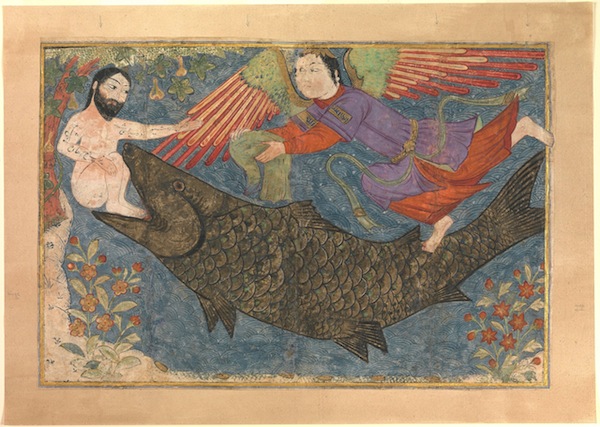
In the Book of Jonah, G-d brings a tremendous wind with the intention of smashing apart the ship in which the reluctant prophet Jonah is hiding: “… the Lord hurled a great wind into the sea, and there was a mighty tempest in the sea, so that the ship was like to be broken.” (Jonah 1:4)

image - Jonah and the Whale
Jonah and the Whale. (Metropolitan Museum of Art: Joseph Pulitzer bequest, 1933)

While we generally consider a whirlwind to be violent but brief, it has a different meaning in the Tanakh. In Hosea 8:7, it symbolizes ineffectiveness: “they shall reap the whirlwind; it hath no stalk, the bud that shall yield no meal.” Nonetheless, the whirlwind is also a blessing, which carries the prophet Elijah to heaven: “Elijah went up by a whirlwind into heaven. And Elisha saw him no more.” (2 Kings 2:11-12)

Other storm-related phenomena appear in the books of the Hebrew Bible. Both thunder and lightning, for example, are mentioned in the Book of Job, chapters 36 and 37: “He covereth His hands with the lightning and giveth it a charge that it strike the mark. G-d thundereth marvellously with His voice.” Likewise, the prophet Isaiah warns that G-d plans to bring thunder: “There shall be a visitation from the Lord of hosts with thunder.” (Isaiah, 29:6)

Hail is also written about in a few places. In Ezekiel 13:11 and 13, G-d threatens to bring a hailstorm. Significantly, in the Book of Exodus (9:18,25-26), hail is one of the 10 plagues G-d casts down upon the Egyptian people because of Pharaoh’s intransigence against freeing the Hebrew slaves: “Behold, tomorrow about this time I will cause it to rain a very grievous hail, such as hath not been in Egypt since the day it was founded even until now. And the hail smote throughout all the land of Egypt all that was in the field, both man and beast; and the hail smote every herb of the field and broke every tree of the field. Only in the land of Goshen, where the children of Israel were, was there no hail.”

The Tanakh likewise has references to snow in a few places, though there is practically no mention of snow having fallen – almost always, snow is used metaphorically. Thus, in Exodus 4:6, someone with leprosy has “skin white as snow.” Later, this phrase is repeated in Number 12:10 when Miriam, Moses’ sister, has leprosy.

The lack of precipitation is likewise an issue. Similar to hail, drought is used as a threat or as an actual way of punishing the Hebrews. As the

Hebrews were an agricultural society, a drought meant crop failure: “And if ye will not … hearken unto Me, then I will chastise you seven times more for your sins. I will make your heaven as iron and your earth as brass … your land shall not yield her produce, neither shall the trees of the land yield their fruit.” (Leviticus 26:18-20)

Meteorology has certainly advanced since ancient times, of course. Back then, there were no radar, satellites, radiosondes, supercomputers or advanced multidisciplinary weather graphs to interpret or predict the weather. In the Tanakh, the chief forecaster, G-d, is also the creator of these weather situations. As such, He has a considerable edge over everyone and everything.

Deborah Rubin Fields is an Israel-based features writer. She is also the author of Take a Peek Inside: A Child’s Guide to Radiology Exams, published in English, Hebrew and Arabic.

Format ImagePosted on December 9, 2022December 8, 2022Author Deborah Rubin FieldsCategories LifeTags history, Jonah and the Whale, Judaism, Noah and the Ark, Tanakh, weather

Posts pagination

Previous page Page 1 … Page 136 Page 137 Page 138 … Page 650 Next page
Proudly powered by WordPress