Skip to content
  • Home
  • Subscribe / donate
  • Events calendar
  • News
    • Local
    • National
    • Israel
    • World
    • עניין בחדשות
      A roundup of news in Canada and further afield, in Hebrew.
  • Opinion
    • From the JI
    • Op-Ed
  • Arts & Culture
    • Performing Arts
    • Music
    • Books
    • Visual Arts
    • TV & Film
  • Life
    • Celebrating the Holidays
    • Travel
    • The Daily Snooze
      Cartoons by Jacob Samuel
    • Mystery Photo
      Help the JI and JMABC fill in the gaps in our archives.
  • Community Links
    • Organizations, Etc.
    • Other News Sources & Blogs
    • Business Directory
  • FAQ
  • JI Chai Celebration
  • JI@88! video

Recent Posts

  • Story of Israel’s north
  • Sheltering in train stations
  • Teach critical thinking
  • Learning to bridge divides
  • Supporting Iranian community
  • Art dismantles systems
  • Beth Tikvah celebrates 50th
  • What is Jewish music?
  • Celebrate joy of music
  • Women share experiences 
  • Raising funds for Survivors
  • Call for digital literacy
  • The hidden hand of hate
  • Tarot as spiritual ritual
  • Students create fancy meal
  • Encouraging young voices
  • Rose’s Angels delivers
  • Living life to its fullest
  • Drawing on his roots
  • Panama City welcoming
  • Pesach cleaning
  • On the wings of griffon vultures
  • Vast recipe & story collection
  • A word, please …
  • מארק קרני לא ממתין לטראמפ
  • On war and antisemitism
  • Jews shine in Canucks colours
  • Moment of opportunity
  • Shooting response
  • BC budget fails seniors
  • Ritual is what makes life holy
  • Dogs help war veterans live again
  • Remain vital and outspoken
  • An urgent play to see
  • Pop-up exhibit popular
  • An invite to join JWest

Archives

Follow @JewishIndie
image - The CJN - Visit Us Banner - 300x600 - 101625

Category: News

Student’s first meeting with survivor

Writing Lives is an initiative at Langara College, coordinated by instructor Dr. Rachel Mines, in which second-year students are teamed up with local Holocaust survivors to interview them and write memoirs of their lives before, during and after the Holocaust. Langara students earn English or history credits towards a diploma or degree, but, more importantly, they get the opportunity to learn outside of the classroom setting, in the community. The course is a partnership between Langara, the Vancouver Holocaust Education Centre and the Azrieli Foundation.

In the first term, students learned about the Holocaust through examining literary and historical texts. They wrote a research project on prewar Jewish communities, using resources from the VHEC and Waldman libraries, and they had the opportunity to meet with and learn from two of the VHEC’s outreach speakers, Alex Buckman and Lillian Boraks-Nemetz. This term, with guidance from Kit Krieger and other guest speakers, students have learned strategies for planning and conducting interviews with Holocaust survivors and, in mid-January, they began to record survivors’ testimonies. The following is an essay by one of the students.

I found a quiet corner of the library and took a deep breath. This was the moment; it was all happening now. I was about to call my survivor, code name “Chester.” I say “my survivor” as if he were a possession. I don’t “own”’ him … and yet, in a very short period of time, I will have to “own” his story. I will be responsible for taking his experiences and shaping them into a lasting memoir.

This was the moment of truth: the first phone call. It was now or never. I slowly dialed and had a look around – no one within earshot. I put my cellphone up to my ear, my palm sweaty with nervousness. It began to ring. I gulped. It rang again. “Oh no,” I thought. “It would be just my luck that he’s not home and I have to leave an awkward message, and what sort of first impression will that be?…”

“Hello?”

“Hi, uh, hello. Hi. Um, my name is Ashley and I’m calling from Langara College about the Writing Lives project. May I speak to Chester?”

“Oh, sorry dear, Chester’s not here right now. Why don’t you text him?”

“OK, sure,” I said with a smile. I was expecting a hard-of-hearing senior citizen and, in true 2017 style, I was being instructed to text instead. I took down the phone number and finished the call.

Gulp. Another deep breath. Time to text.

I punched in the number and wrote an introductory message to “my survivor.” I said that I’d call in the morning for a formal introduction. I nervously hit send.

I then spent the next 74 minutes checking my phone to see if I’d received a response. Eventually, it did come: “We will talk then.”

Relief. It had begun. This journey, this process.

The next morning, Chester and I spoke briefly. I told him a bit about the program and asked if he had any questions. The phone call went well. Chester seemed to have a comfortable style, a compassion and understanding that put me at ease; there were sprinkles of humour amid logistical details. Though the call was short, I immediately felt better about what lay ahead.

The following Saturday was our first meeting in person. My group and I met up early so that we were all on the same page and fully prepared for what was about to transpire. We sat across from each other in a small meeting room on the main floor of the school’s library. We were excited, nervous, tense, curious. We were all in agreement that we didn’t really know what to expect and that we’d do our best to tackle things as they came and we’d support each other as much as possible. I felt lucky to have such encouragement.

The time came; it was 10 minutes to the scheduled interview. I grabbed my phone and headed out of the library and down the hall. Chester and I had decided to meet by the Starbucks, which is close to the library entrance. Even though I was early, I wasn’t surprised when I saw a person with a head of greyish-white hair seated near the coffee shop. “That has to be him,” I thought to myself. As I approached, he turned around and I was greeted by the welcoming face of Chester.

We exchanged pleasantries and made our way to the meeting room in the library. I think we both may have been a little nervous, but there was also a sense of mutual understanding – a consensus that we were about to do something important: something private and meaningful, potentially for both of us, particularly for the survivor.

“First off, do you have any questions?” I began once we were all settled. One of my group members sat to my right, ready to take notes and provide support. Chester sat across from the two of us, but diagonally across the square table, so we were all huddled around its corner, quite close to each other.

“Well …” and we were off! The next hour flew by. The purpose of the first meeting was for introductions and initial questions to be sorted. We also asked for a brief overview of Chester’s story, a sort of condensed version of his life. In learning the scope of his journey, we’d be able to better shape questions and structure further interviews. Chester was incredibly giving and kind. And what a storyteller! Sure, we bounced around a little, as memories and stories came to mind, but the next interviews could be more structured, more chronologically accurate. This was our introduction, our chance to get a sense of “our survivor,” to learn what he’d been through and how his experiences had shaped him.

I must admit, I was particularly moved by stories regarding Chester’s family. The way he spoke of his mother, in particular, and his children: it was just lovely.

There were a few difficult moments, and that is to be expected. In future interviews, when we will go into greater detail regarding Chester’s life and journey, we now know when certain difficult experiences occurred and will be prepared. Well, as prepared we can be, I suppose, for the emotional moments that are to come.

At the end of our meeting, Chester mentioned that we may not have enough material for a memoir. Such a sweet, humble comment. I couldn’t help but smile.

“I don’t think so,” I said. “I believe that we definitely have enough for a book here. You have some wonderful stories.”

And it’s true. The stories of love, survival, adventure, family, travel, loss, connection…. We’ve only begun the interview process, and I’m already moved by the trust that’s been shown. Our survivor is being so generous with his time and his story. I only hope that I can do this project justice.

Posted on February 17, 2017February 15, 2017Author Ashley SeatterCategories LocalTags Azrieli Foundation, Holocaust, Langara College, survivors, VHEC
2017 Dan David Prize winners

2017 Dan David Prize winners

Author Jamaica Kincaid is among the Dan David Prize winners this year. (photo from TAU via Ashernet)

Tel Aviv University (TAU) has announced the winners of this year’s Dan David Prize, which will be awarded at a ceremony at TAU on May 21. Sometimes referred to as “Israel’s Nobel Prize,” this year’s recipients are Swedish biologist Prof. Svante Pääbo, American geneticist Prof. David Reich, American author Jamaica Kincaid, Israeli author A.B. Yehoshua, American astrophysicists Prof. Neil Gehrels and Prof. Shrinivas Kulkarni, and Polish astronomer and astrophysicist Prof. Andrzej Udalski.

The prize is named after the late Dan David, an international businessman and philanthropist.

Born in Romania in 1929, David worked for Romanian TV and later became a press photographer. In 1960, he settled in Israel. A year later, he traveled to Europe. With a loan from a cousin, he won the franchise for the Photo-Me automated photography booths in certain countries, and opened branches in several European countries, as well as in Israel, and eventually took over the company.

In 2000, he founded the Dan David Foundation with a $100 million endowment. The first time the annual prize was awarded was in 2002. David’s aim was to reward those who have made a lasting impact on society and to help young students and entrepreneurs become the leaders and scholars of the future.

David died in London, England, in September 2011.

Format ImagePosted on February 17, 2017February 15, 2017Author Edgar AsherCategories WorldTags A.B. Yehoshua, Andrzej Udalski, astronomy, astrophysics, biology, Dan David Prize, David Reich, genetics, Israel, Jamaica Kincaid, literature, Neil Gehrels, Shrinivas Kulkarni, Svante Pääbo
פיילין נחשבת למועמדת

פיילין נחשבת למועמדת

שרה פיילין מועמדת לשגרירת ארה“ב בקנדה? (צילום: Therealbs2002 via Wikimedia Commons)

שרה פיילין נחשבת למועמדת לתפקיד שגרירת ארצות הברית בקנדה. כך פורסם בהרחבה בתקשורת הקנדית והבינלאומית בימים האחרונים. פיילין ששימשה מושלת מדינת אלסקה בשנים 2006-2009 הייתה בין הראשונים להתייצב לצידו של דונלד טראמפ, עת התמודד בפריימריז על רשות המפלגה הרפובליקנית. באחת מעצרות הבחירות של טראמפ בהן השתתפה לפני כשנה היא אמרה: “טראמפ בונה דברים גדולים שנוגעים בשמים. כל חייו הוא מביט כלפי מעלה”. פיילין נחשבת למקורבת לנשיא החדש, ויתכן ועתה הוא יגמול לה בכך שימנה אותה לשגרירה באוטווה, למניגת ליבה של קנדה. עם זכייתו של טראמפ בנשיאות בבית הלבן היא הוזכרה כאחד המועמדים המובילים לתפקיד שרת הפנים של ארה”ב. וכן לתפקיד השרה האחראית על יוצאי הצבא. בנושא זה התבטאה פיילין כי: “הבירוקרטיה הורגת את הווטרנים שלנו”.

מזה כחודש אין לארה”ב שגריר באוטווה לאחר שברוס היימן, נתבקש לעזוב את תפקידו בראשית ינואר על ידי ממשלו של טראמפ. היימן (יהודי חבר המפלגה הדמוקרטית) שהחזיק בתפקיד השגריר בקנדה כשלוש שנים היה מקורב לנשיא היוצא, ברק אובמה. קודם למינויו לשגריר הוא שימש בכיר בבנק ההשקעות האמריקני גולדמן את זאקס ולאחר מכן היה לאיש עסקים.

דובר הבית הלבן, שון ספייסר, גרם ביום רביעי שעבר לתדלוק השמועות על המינוי של פיילין לתפקיד השגרירה בקנדה, כיוון שהוא סירב לאשר או אף להכחיש אותו. פייליין שכמו טראמפ מגיבה כל הזמן באמצעות חשבון טוויטר, לא התייחסה אף היא לשמועות על התפקיד החדש שמיועד עבורה.

חבר הפרלמנט הקנדי מטעם המפלגה הדמוקרטית החדשה, ניתן כהן, טוען כי מינויה של פיילין לשגרירה כמוהו להתמודד עם שני דונלד טראמפ. לדבריו הענקת תפקיד השגריר לפיילין יזיק למאמצי קנדה לחזק את הקשרים עם הממשל החדש של טראמפ, ויהיה קשה לקחת אותה ברצינות. הוא הוסיף: “פיילין אף פעם לא הרגישה בנוח עם האמת”. חבר פרלמנט נוסף מטעם המפלגה הדמוקרטית החדשה, צ’ארלי אנגוס, ציין כי המינוי הזה מראה עד כמה הממשל של טראמפ לא לוקח ברצינות את קנדה. ואילו רבים מהגולשים בקנדה הגיבו בצחוק ובגיחוך לגבי האפשרות שפיליין תזכה במינוי של השגרירה באוטווה.

פיילין (בת ה- 52 ואם לחמישה ילדים) הייתה ב-2008 מועמדת לתפקיד סגן נשיא ארה”ב, עת הכריז הסנטור הרפובליקני, ג’ון מקיין, כי יתמודד על תפקיד הנשיא מטעם מפלגתו. לדעת רבים מהמומחים בארה”ב פיילין רק הזיקה למקיין לזכות בתפקיד, והוא הפסיד לברק אובמה. מושלת אסלקה לשעבר נחשבת בדעותיה לימנית שמרנית (היא מתנגדת בין היתר להפלות), ומקורבת מטבע הדברים לאגף הניצי במפלגה הרפוליקנית. פיילין גם משתתפת קבועה באירועים של ‘תנועת מסיבת התה’, שאותה היא כינתה “העתיד של אמריקה”. היא משמשת כיום כפרשנית ברשת הטלוויזיה הימנית פוקס ניוז.

פיילין ידועה כתומכת נלהבת בישראל והיא דוגלת בברית האסטרטגית בין ארה”ב לישראל. יצויין כי במשרדה מוצב דגל ישראל באופן קבוע והיא אף ביקרה בארץ לפני כשש שנים.

אין זה סוד שפיילין נחשבת לאחת מהדמויות השנויות במחלוקת בארה”ב, והיא לא זוכה לאהדה רבה בקרב התקשורת בכל העולם. בראיונות שונים היא מתבלבלת בין מושגים ומפגינה חוסר ידיעה בנושאים בסיסים. דמותה לכן מככבת לא פעם בתוכניות פרודיה שונות. ב-2011 יצא לאור ספר שנכתב על ידי ג’ו מגיניס, שתיאר את פיילין בצורה שלילית. בין היתר נכתב כי היא בגדה בבעלה עם השותף שלו לעסקים וכן הסניפה קוק.

Format ImagePosted on February 14, 2017Author Roni RachmaniCategories עניין בחדשותTags Palin, politics, Trump, טראמפ, פוליטיקה, פיילין
Oberlander to be honoured

Oberlander to be honoured

Cornelia Oberlander collaborated with architect Arthur Erickson on many projects, including the Downtown Vancouver Law Courts. (photo by Joe Mabel via commons.wikimedia.org)

At 95 years old, landscape architect Cornelia Hahn Oberlander can look back on a string of stellar accomplishments.

From the Arctic Circle to Vancouver, from Ottawa to New York to Berlin, Oberlander has carved out a new relationship between the urban environment and nature, created innovative approaches to playgrounds for generations of children and spearheaded initiatives for environmental sustainability.

But she is still struggling with one of the most intractable problems that she has confronted throughout her career, now stretching into its seventh decade. What does a landscape architect do?

When she walks onto the stage of Temple Sholom’s Dreamers and Builders Gala dinner on March 5 at Vancouver Convention Centre East, Oberlander will come with a simple message. “I do not just bring the bushes,” she says. “I take care of the environment.”

During a recent interview at her home near Pacific Spirit Park, Oberlander repeatedly comes back to the challenge of explaining the work of a landscape architect.

She passes quickly over projects that made her an influential trailblazer on the global stage. She does not want a spotlight shining on her own life story and her quiet but unwavering lifetime commitment to Temple Sholom. She is hesitant to say too much about projects she is now working on.

“Look at the big picture and not all the other stuff,” she tells me. She wants to talk about the design process, building landscapes commensurate with climate change, and the need for green spaces in cities.

She sees the gala as an educational opportunity. “It’s about tikkun olam, which means, to heal the earth,” she says.

At the inaugural Temple Sholom Dreamers and Builders Gala, Oberlander will be honoured for her work as a landscape architect and as a founding member of the synagogue. A highlight of the evening will be biographer Ira Nadel in conversation with Oberlander. Among his numerous books, Nadel, in 1977, co-authored with Oberlander and Lesley Bohm Trees in the City, which advocates for integration of trees into the pattern and function of urban activity.

Temple Sholom will also unveil an $1,800 youth award for a teen who has demonstrated a passion for healing the world through tikkun olam.

Oberlander has been called a national treasure, the dean of Canada’s landscape architects. With a feisty personality and resolute sense of purpose, she has been regarded as “a force of nature” and “the grand dame of green design.”

World-renowned “starchitect” Moshe Safdie has collaborated with Oberlander on several projects over the past 35 years, including the Vancouver Public Library and the National Gallery of Canada in Ottawa. “It was a joy to work with her,” he says.

Oberlander is passionate about integrating landscape with architecture, says Safdie. “Above all, Cornelia is a great craftsman of landscape, paying as much attention to concepts as to the craft of sustaining plant-life both in the natural and built environment.”

photo - Temple Sholom celebrates renowned landscape architect and founding synagogue member Cornelia Oberlander at its inaugural Dreamers and Builders Gala on March 5
Temple Sholom celebrates renowned landscape architect and founding synagogue member Cornelia Oberlander at its inaugural Dreamers and Builders Gala on March 5. (photo from Temple Sholom)

Oberlander is a fearless innovator, says Phyllis Lambert, architect and founder of the Canadian Centre for Architecture in Montreal. Oberlander not only considers the ecology, the natural environment and the nature of soils, plants, light and shade, she also looks into the history associated with the landscape and the architectural design. “No one else does that,” says Lambert.

When I phone Oberlander for an interview, she has difficulty finding time to speak with me. She maintains an incredibly busy professional life. “I just got another job this morning. I have six huge jobs,” she says shortly after we finally meet.

Oberlander works from a studio in her spectacular 1970 post-and-beam home on stilts above a ravine, surrounded by hemlocks, western cedars, big leaf maples and 20-foot-high rhododendron species. The boundary between indoors and outside is fuzzy. With huge glass walls, she can see forest and sky from most spots in her home.

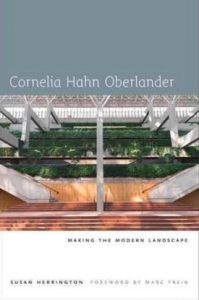
Oberlander’s mother Beate Hahn, a horticulturalist, published books on gardening. Oberlander, born in Mulheim, Germany, decided when she was 11 that she wanted to create parks. Susan Herrington, in Cornelia Hahn Oberlander: Making the Modern Landscape, writes that Oberlander, by the age of 15, was sketching drawings of wooded parkland and experimenting with organic gardening, using birds and insects to mitigate pests.

Oberlander’s father, an industrial engineer, died in 1932 during an avalanche while skiing. Oberlander came to the United States in 1939 with her mother and sister and, after completing high school, enrolled in Smith College, a women’s college in western Massachusetts.

By the time she graduated from Harvard University’s Graduate School of Design in 1947, she viewed landscape architecture as much more than gardens. She had been taught to look for inspiration for design and plant material in history, art and culture and to seek out collaboration across disciplines. Oberlander now describes her approach as the art and science of the possible. The spark of creativity is the art; research coupled with analysis is the science.

Her perspective continued to evolve. “I am trying to show in my landscape today the impact of climate change and clean air, emphasis on alternative energy with low carbon emissions, sustainable use of water and land, preservation of endangered species and protection of the biodiversity,” she says in the interview. “We [landscape architects] are no longer just garden-making. We are creating environments for human beings that are commensurate with saving the environment.”

Oberlander worked in the early 1950s in Philadelphia before moving to Vancouver in 1953 with Peter Oberlander, who she met while at Harvard. Peter had been invited to Vancouver to establish the School of Community and Regional Planning at the University of British Columbia.

In her early years in Vancouver, she designed landscapes for private homes and children’s playgrounds. Her innovative approach to playgrounds began to attract attention following her work on the Children’s Creative Centre at the Canada Pavilion at Expo ’67.

book cover - Cornelia Hahn Oberlander: Making the Modern Landscape by Susan HerringtonOberlander reimagined what a playground could be. She replaced swings and metal climbing structures with trees, piles of sand, a stream, logs and covered areas. In the following years, her ideas about spontaneous exploration and unstructured play spread across the continent.
Although her name-recognition is limited outside professional circles, most Vancouverites have enjoyed the benefits of her designs. Oberlander reshaped how Vancouver relates to its waterfront with an idea she had in 1963, as she was driving along Jericho Beach. City staff were burning logs that had washed ashore. She recalls going straight to the park board office with a proposal to use the logs as benches. They gave her a hearing and heeded her advice.

It was her work in the 1970s with architect Arthur Erickson that took her reputation beyond the playground. Beginning a relationship that lasted more than 30 years, she collaborated with Erickson on the Robson Square courthouse and government complex, one of the earliest green roofs in North America. She created an oasis in the centre of Vancouver with white pines, Japanese maples, white azaleas, roses, dogwoods and citrus trees. Her work on Robson Square established her reputation for meticulous research into soils, plants and structures, her creative ideas, and her “invisible mending” for weaving nature into urban development.

At UBC’s Museum of Anthropology (1976), she designed a simulation of an open meadow in Haida Gwaii with indigenous grasses and plants used by First Nations for medicine and food. At the National Gallery of Canada in Ottawa in 1988, she envisioned the landscape as an extension of the museum’s collection of Group of Seven paintings. Her work in the 1990s on the C.K. Choi Building at UBC, with its biological marsh to process recycled water, and the legislative building in the Northwest Territories, reflect her commitment to sustainability, the inclusion of social and cultural values and the use of native plants. Determined to rely on indigenous plants in the Arctic, she collected seeds and cuttings, and brought them to Vancouver to propagate. Three years later, she took the plants back and nestled them among the rocks outside the building.

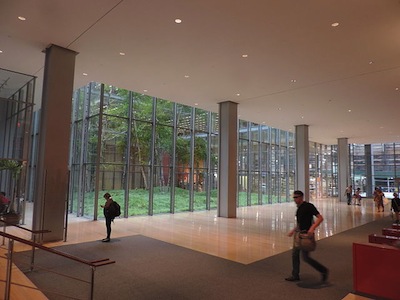
Oberlander brought greenery to the heart of Manhattan in 2007, planting northern birch trees amid sculpted mounds in a central courtyard of the New York Times building. In Vancouver around the same time, she turned to botanist Archibald Menzies, who accompanied Captain George Vancouver in 1792, for the selection of plant material, bulbs and grasses on the roof garden at the Van Dusen Botanical Garden Visitors Centre. She used only plants that he described more than 220 years ago.

Pointing to stacks of research notes, drawings and books scattered about her studio and in two other rooms, she stresses the importance of research and of integrating the site with the building. She says she is constantly looking for new technologies to advance sustainability and respond to climate change. “As a landscape architect, you have to know the building, the reason for the building, the way the building works,” she says.

photo - Looking south at the New York Times atrium, which was designed by Cornelia Oberlander
Looking south at the New York Times atrium, which was designed by Cornelia Oberlander. (photo by Jim Henderson via commons.wikimedia.org)

Oberlander is hesitant to reveal all her current commissions, saying some are “political.” But she mentions that, after our interview, she is going to a meeting on restoring the grounds of the so-called Friedman House, designed by Swiss architect Frederic Lasserre. The mid-century modern house, built in 1953 for Sydney and Constance Friedman, was her first project when she moved to Vancouver.

Also, she is part of a team redesigning a garden at the National Gallery of Ottawa, she is conducting research on the lack of green spaces in downtown Vancouver and she is working on a roof garden for a small apartment block in South Granville. As we talk, she pulls out drawings of a new roof garden at the Vancouver Public Library, where she is working with a team redesigning the roof garden that she designed in the early 1990s.

Oberlander has received the most prestigious awards in the world of landscape architecture but she diverts the focus away from her achievements. “What is amazing is that landscape architecture, the way I practise it, is being recognized,” she says.

Throughout her career, she and her husband Peter maintained close ties to Temple Sholom.

In searching for their place in the early 1960s in Vancouver’s Jewish community, the young couple with three children felt that something was missing. They decided to bring Reform Judaism, already familiar to Peter from his childhood in Vienna, to Vancouver. Gathering a small group of Jews in their living room in 1964, they were among the founders of Temple Sholom.

Oberlander shared her passions and talents with Temple Sholom over the years: providing honey and home-grown apples at Rosh Hashanah, reading the Book of Jonah with Peter on Yom Kippur for more than 20 years, and beautifying the holy community both inside with flowers for the High Holidays and with peaceful exterior landscapes. She also designed Temple Sholom’s cemetery in Surrey.

As I step outside at the end of the interview, she recalls the words of her husband Peter three days before he died in 2008.

“He said to me, tikkun olam,” she says. “I said, yes, you have done that all your life with the city and I with my greening efforts.

“And he looked me straight in the eye and said, you, Cornelia, must carry on.

“And so I know every day what I am supposed to do.”

Robert Matas, a Vancouver-based writer, is a former journalist with the Globe and Mail.

Format ImagePosted on February 10, 2017February 8, 2017Author Robert MatasCategories LocalTags architecture, landscapes, Oberlander, Temple Sholom
Removing graffiti full-time

Removing graffiti full-time

Corey Fleischer volunteers most of his time to removing hateful graffiti. (photo from Corey Fleischer)

When Montrealer Corey Fleischer finished university, he was unsure of what career path to take. In the interim, to pay the rent, so to speak, he started Provincial Power Washing.

Reflecting back on those days, Fleischer said, “I hated what I was doing – washing a lot of trucks, houses, decks, residential and commercial – zero substance. I’m a person who thrives off substance.”

One day, while heading to a job, Fleischer happened to spot antisemitic graffiti out of the corner of his eye.

“I was driving downtown here, in Montreal, and I saw a swastika on a cinderblock in a very busy part of town,” he said. “I had the equipment needed to remove it, so I got out of the truck and did just that. I got back in my truck, not thinking anything of it.”

From that day on, whenever Fleischer came across such graffiti, he would stop and remove it. As well, in the evening, after returning home from work, he would grab a bite to eat, shower and go out to look for racist, antisemitic and homophobic graffiti to remove.

“I would scour the city for hate crimes – back alleys, on walls, anywhere,” said Fleischer. “I found another one (swastika) and then another one. And then I started noticing, as the graffiti-removal side of my business began growing … I realized this was a real problem around town. It became my pastime. I quit hockey and softball and everything. It’s what I spent all my time doing. It fulfilled my life.”

For the first several years, it was only Fleischer’s parents and close friends who knew what he was doing. Then, he received a call from the local B’nai Brith Canada office to confirm his address, as they wanted to include him in a community newsletter mailing. While Fleischer refused to give out his address, he told the BBC that he had pictures of 40 swastikas that he had removed over the past five years, if that was of interest.

The BBC representative, said Fleischer, “literally couldn’t understand what was coming out of my mouth. She couldn’t believe that’s how I was spending my time. So, I sent her the pictures. They sent out a blogger to come and follow me, to do a story on what I was doing.

“Lo and behold, my life at that moment completely changed. People started seeing what I was doing and wanted to get involved. It went from removing 40 to 50 hate crimes in five years … [to] a couple hundred last year alone. The increase was pretty crazy.”

Fleischer now has thousands of followers wanting to get involved, so he has many more reports coming in, asking for free hate-graffiti removal. He said he has gone from spending about 10% of his company time removing hate graffiti to 95%. And, thanks to social media, the movement Fleischer started has gone global.

“People are calling me from all over the world, trying to figure out how to remove hate crimes in their area,” said Fleischer. “And, I basically put it together and have the removal done – wherever the people are calling from – with a local company.

“For most people dealing with hate crimes, it’s not a comfortable situation. People don’t know what to do with them or how to act when they see them. I happen to thrive in uncomfortable situations. I’ll go and organize. If I can’t find a local company to remove it, I’ll contact the local government, mayors, statesman, whoever, to get it done.

“For example, there was an attack on a Jewish cemetery in New York state. Their whole cemetery was defaced with swastikas and hate symbols. And somebody called me up from the town, saying they’d seen my videos and they’d been staring at these swastikas on their cemetery for two weeks – right around Yom Kippur. So, they called me to find out what could be done.”

After Fleischer hung up the phone, he began calling power washers. As it was a small town, it was hard to find someone, so Fleischer called the mayor and the local government. Within two days, all the graffiti was gone.

“When people figure out who I am and what I’m doing, they tend to spring into action quicker than if it was another situation,” said Fleischer. “Although I started the movement, it’s not just me getting it done. It’s people in the community, that I like to call ‘my army.’ I’m just a tool that was given to these people in order to remove these hate crimes. I’m just the instrument.”

While removing the hateful graffiti is, of course, good, Fleischer pointed out that it does not deal with the root of the problem. So, he decided to collaborate with Montreal-based Overture with the Arts, a not-for-profit that provides mainly after-school art classes to high school students. One of its programs is targeted at educating students about the Holocaust through a series of spoken word workshops about Anne Frank. OWTA opted to include a talk by Fleischer in the program.

“Instead of thinking about the actual guys who are putting on the hate crime, I had to find another way to make a difference in our society and in our communities,” said Fleischer of his speaking role. “I had to think of a way to make another difference by educating our youth, our future.

“When I was growing up and was going to high school, I was never taught about the Holocaust. I was never taught about the biggest massacre, the biggest tragedy, in human history.

“Before I started this whole movement, I didn’t even fully understand…. I knew what a swastika was, I knew it was bad, but I didn’t understand everything that was going behind it.”

The first two schools at which Fleischer spoke were classroom-sized talks, but this quickly expanded into full auditoriums. Schools now flood him with requests to come and speak.

“I had two calls this morning from schools calling me, out of the blue, trying to figure out how I can come to their schools,” said Fleischer in his interview with the Jewish Independent. “The school tour is called Erasing Hate.”

Fleischer received a peace medal last year from the YMCA (Young Men’s Christian Association) for his efforts with Erasing Hate, along with 30 Auschwitz survivors.

“To think I’m even in the same bubble with people like that, with something I started doing as a pastime, because I followed my heart, is mind-blowing. It’s really something else,” he said.

“Hopefully, we won’t, in the future, be ignoring hate crimes on the street and the future – our kids, the kids in schools – will understand that you don’t need to be silent. You can wake up, open your mouth and you can make a difference. That’s what this has turned into.”

For more information, Fleischer is on Instagram (@ErasingHate) and Facebook.

Rebeca Kuropatwa is a Winnipeg freelance writer.

Format ImagePosted on February 10, 2017February 8, 2017Author Rebeca KuropatwaCategories NationalTags antisemitism, Corey Fleischer, graffiti, hate crimes, homophobia, Quebec, racism, tikkun olam
Mobile legal services

Mobile legal services

About five percent of Adam Brosgall’s legal practice is dedicated to offering mobile services. (photo from Adam Brosgall)

While providing mobile legal services is only a small portion of what lawyer, notary public and commissioner of oaths Adam Brosgall does, it distinguishes him.

“Most people manage to make it into my office, but some clients have special circumstances that require me to visit them,” Brosgall told the Independent.

Practising law since 1999, Brosgall – who grew up in Vancouver and is quite involved in the local Jewish community with his wife and their two young children – opened his own firm in 2010. His office is located on Howe Street, right across from the Vancouver Law Courts.

“One of my main focuses is international business transactions, helping people with their overseas legal matters,” said Brosgall. “If a client needs to send a contract, agreement, power of attorney or other official documentation from Canada to another country, each document needs to be properly legalized. This obscure legal procedure is also known as ‘Apostille certification.’ I prepare their documentation and make sure it’s processed properly through various government entities, consulates and embassies in Vancouver, Toronto or Ottawa.”

Brosgall often deals with the Israeli consulate in Toronto and their embassy in Ottawa. “As there’s no Israeli diplomatic mission in Vancouver, a lot of people who don’t want to travel to Toronto or Ottawa to deal with their legal issues will retain me to handle their affairs,” he explained.

Since starting up his own firm, Brosgall has noticed a need in many communities for mobile legal services. Quite often, the clients for these services are elderly people who are home- or hospital-bound.

“Sometimes, they might need to prepare a will, a POA [power of attorney] or a representation agreement for personal care,” said Brosgall. “These are the three major documents people should get done as they age, ensuring everything is in order. If they haven’t done that, often their younger relatives will call me and ask me to come to their house, a care home or hospital.

“People give me the information I need over the phone or by e-mail. Then, I prepare all the documents in my office and make sure everything is perfect. I then take everything to the client, along with my seals, stamps and various payment methods.

“I offer a very seamless service. After I receive their instructions, I take care of everything – I visit them, take the documents with me and notarize their signature while I’m there…. I work very carefully behind the scenes but, from the client’s perspective, it seems instantaneous. When I leave, they have everything they need.”

Brosgall’s mobile services are also offered to businesses that need documents signed by multiple people in one office. In these situations, Brosgall can save a business a substantial amount of time by visiting their office, as opposed to each individual needing to travel to his office.

“Sometimes, actors who are very busy and are staying in a hotel in Downtown Vancouver can’t take time off from the set,” said Brosgall. “Their manager or assistant will call me and say they need me to come to their hotel and meet them in the lobby at a certain time, so they can sign some kind of contract the film studio or agency needs the actor to sign.”

According to Brosgall, anything that he can do in his office, he can also do at a remote location.

The term notarization can mean two things – witnessing a signature or preparing a certified copy of a document. In the first instance, Brosgall witnesses on-site the signing of a document and puts his stamp and seal on it to signify that he saw it being done and that the parties involved understood the document. In the latter instance, when people need to have a certified copy of something, such as their passport or driver’s licence, he said, “I just make a photocopy while I’m at the office or they provide me with copies and I’ll compare them to the original and certify it’s a true copy.”

The mobile service comes with a fee that is dependent on distance, time spent away from the office and the nature of the documentation. The mobile service fee is added to Brosgall’s standard document processing fee.

Brosgall advertises his service on Google using Adwords, and also publishes articles on his website, which are then picked up by Google and other search engines.

“So, if you Google ‘mobile notary in Vancouver,’ my website will be at the top or close to the top of the page, and people call,” he said. “And, when people call, I’m always very helpful and responsive.”

He also promotes his services “the old-fashioned way,” he said. “I attend different hospitals and nursing homes and such. Whenever I am there, I speak to the social workers, the nurses or the staff and leave my business card. Quite often, it will be the nursing home or the hospital that will recommend my services. In this way, people hear of me by word-of-mouth.”

Some cases are more urgent than others, of course. “Some people are in a rush because their relative might be at the end of life and there can’t be any delays,” said Brosgall. “Those, I give my full attention, because I want to make sure things are done quickly. I get their info and circumstances from their relatives and draft their documentation that same day. Then, I’ll usually head out to meet them the next day.”

There have been times, he said, when “someone calls me at noon and I’m at the hospital at three. I prioritize things and, if they want the whole family to be around, I adjust my schedule to accommodate everyone.”

With a busy international legal practice, Brosgall said his mobile service only represents about five percent of his business, but fills a need and helps the community.

“Although it’s a relatively small portion of my law practice, when I do get out of my office, I often find myself in all sorts of interesting situations and environments,” he said. “I’ve worked with movie stars while they’re working out in gyms, business leaders in corporate boardrooms … elderly people in long-term care or at home…. The list goes on and on.

“Sometimes I feel less like a lawyer and more like a social worker, psychologist or family counselor when I’m on my mobile visits. People often reach out to me in extremely urgent and critical situations. A solid understanding of the law, excellent communication skills, thorough preparation and good bedside manners all go hand in hand.”

For more information, visit vancouvernotary.biz, call 604-685-2326 or e-mail [email protected].

Rebeca Kuropatwa is a Winnipeg freelance writer.

Format ImagePosted on February 10, 2017February 8, 2017Author Rebeca KuropatwaCategories LocalTags Adam Brosgall, lawyer, legal services
Israel’s first whisky distillery

Israel’s first whisky distillery

Tours and tastings of Milk and Honey distillery can be booked on certain days. (photo by Ariel Fields)

Is a Bronfman family saga about to begin again? While it has a ways to go before reaching the heights of the once-mighty Seagram empire, Milk and Honey, Israel’s first whisky distillery, may one day have the last laugh. In the meantime, its young investors and workers seem to be having a good time.

I was raised to believe Jews don’t drink anything stronger than wine or the occasional beer. There were, of course, notable unexplained exceptions, as on Shabbat and holidays, when men drank schnapps or Slivovitz at the synagogue’s kiddush. My tasting and tour of Milk and Honey has forced me to change my thinking.

About four years ago, a small group of friends, all Israeli high-techies and entrepreneurs, got together to create Israel’s first whisky distillery. While it is a bit hard for me to comprehend people actually “dreaming” about starting a whisky business, don’t we attribute Herzl to saying, in 1902, “If you will it, it is no dream; and if you do not will it, a dream it is and a dream it will stay”? And this group did pick a pretty Zionist name for its company.

Located in south Tel Aviv, about a 15-minute walk from Old Jaffa, the physical plant is less than a half-block long. The building is basically divided into two sections, the liquor-making facility and the visitors centre. One section looks out on the other from a full-length no-secrets-here glass divider. Six people currently work at Milk and Honey.

As a newbie to whisky-making, I did not know that basically just three ingredients go into single malt whisky: malting barley, water and yeast. Milk and Honey uses Israeli-sourced water. The barley is imported from England’s Muntons company and then mashed at Milk and Honey. The rest of the process – the fermentation, distillation and maturing – also take place on-site.

Milk and Honey has an Israeli-made fermentation tank. One of its two stills is new, but the other was constructed in 1983. It has a capacity of 9,000 litres. To my way of thinking, copper would give the whisky a funny taste, but our guide said they purposely built the still from copper, in order to give the whisky a more delicate taste.

The whisky maturation room has an elaborate alarm system, especially against fires, as the whisky is stored in combustible, wooden barrels.

In big whisky-producing countries such as the United States, Ireland, Scotland and Japan, single malt whisky needs to sit in its cask (barrel) for three years. While lots of people complain about Tel Aviv’s high humidity and temperatures, these factors might ultimately be advantageous to this type of business. Estimates are that the heat and humidity will speed up Milk and Honey’s whisky maturation process, making it two to 2.5 times faster than the above countries’ products.

Still, it will be awhile before Milk and Honey single malt whisky is sold en masse in bottles. The company does plan, however, to market some kind of limited series, which will be periodically released over the next three years.

In the meantime, Milk and Honey has started selling a few types of other liquor, including one called New Make and another called Levantine Gin.

As its name implies, the New Make does not go through barrel aging; its chief use is apparently for cocktail-making. The Levantine Gin is noteworthy for its Middle East quality – it is made with za’atar, a Middle East plant with a thyme-like taste, and other botanicals purchased locally at Tel Aviv’s Levinsky Shuk (Market). While not mentioned by our in-house guide, the use of za’atar ties this liquor to ancient Jewish roots (no pun intended). Za’atar (or “eizov,” in Hebrew) is mentioned in the Torah: in Exodus, Leviticus and Numbers, and references are also made in Kings I and Psalms. Moreover, although he did not prescribe za’atar specifically for hangovers, 12th-century philosopher, astronomer and physician Maimonides (aka Rambam) prescribed za’atar for headaches.

Impressively, these two products have already won awards. Just the day before I visited Milk and Honey, the Levantine Gin had won a gold medal and the New Make a silver at the 2016 Terravino Mediterranean International Wine and Spirit Challenge. Not a bad start for a new company.

All of Milk and Honey’s liquor is certified kosher. Tours and tastings are available on Tuesdays, Thursdays and Fridays by prior arrangement. See mh-distillery.com/visit-our-distillery.

Deborah Rubin Fields is an Israel-based features writer. She is also the author of Take a Peek Inside: A Child’s Guide to Radiology Exams, published in English, Hebrew and Arabic.

Format ImagePosted on February 10, 2017February 8, 2017Author Deborah Rubin FieldsCategories IsraelTags distilleries, Israel, whisky
News, democracy and trust

News, democracy and trust

The Shattered Mirror: News, Democracy and Trust in the Digital Age, released on Jan. 26 by the Public Policy Forum, shines a light on the news industry in Canada, revealing it is reaching a crisis point as the decline of traditional media, fragmentation of audiences and the rise of fake news pose a growing threat to the health of our democracy.

When the PPF began thinking about a study on the state of the news media in Canada, in early 2016, the headlines were all bad. Within a fortnight in January 2016 alone, Rogers Media and Postmedia announced new rounds of staff reductions, Torstar revealed plans to close its printing plant, and Confederation-era newspaper titles in Guelph, Ont., and Nanaimo, B.C., were shuttered, the first of six daily papers to close, merge or reduce their publishing schedules before year’s end. The situation wasn’t much better on the broadcast news side, where revenues, especially in local television, followed the downward track of the newspaper industry, inducing the Canadian Radio-television and Telecommunications Commission to step in.

chart - Online ad revenue pie chart from Shattered Mirror ReportA parliamentary committee was formed. News companies and industry associations queued up with complaints of inequities in the marketplace. The Government of Canada contracted with the PPF, a non-partisan and independent think-tank, to assess the situation and make recommendations on what, if anything, should be done.
“The question for Canadian policy-makers is not whether given news outlets are in trouble, but whether democracy itself has been placed at risk in the process,” states The Shattered Mirror. “To the extent public policy has a role to play, it should be focused on maintaining the flow of information essential to a healthy society and ensuring the development of the digital arteries of the new information system – not preserving the press as we know it. The digital revolution is real, but with it have arisen challenges: fragmentation, distortion and adjusting to new business and storytelling models.”

After six months of study and discussions with close to 300 people, the report proposes recommendations aimed at ensuring that the news media and journalists continue in their role as the watchdogs over elected representatives and public institutions, and the connective tissue within communities.

“This report is not about the journalists, with whom I feel great solidarity, but rather the role they play, and what we may be putting at risk if we are inattentive,” writes Edward Greenspon, president and chief executive author of the PPF and the report’s author. Greenspon spent more than 30 years as a journalist before joining the PPF.
“[Digital] platforms, with daily audiences 10 times larger than those of major newspapers or TV broadcasters, are not just the new intermediaries of the public square but control the commanding heights of the marketplace of ideas,” the report says. “Their models are based on truth neutrality. Moreover, they only give the appearance of being a common space. Rather, they calculate and reinforce the prejudices of the like-minded, who either assign themselves to echo chambers or find themselves invisibly assigned by algorithms into filter bubbles. Both run counter to the concept of the media as an agent of common understanding.”

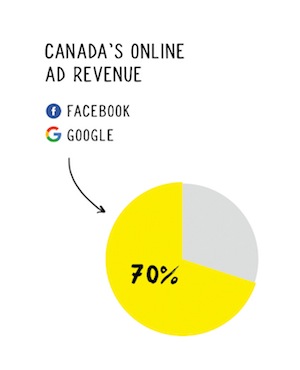
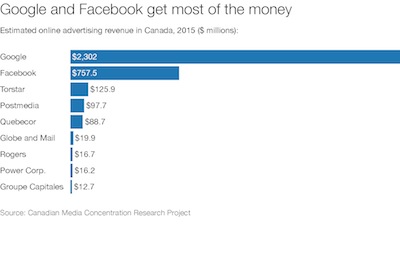
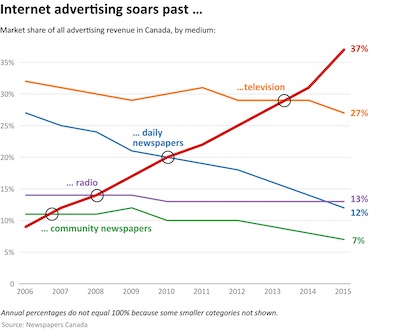
The dominance of Google and Facebook delivers another blow to Canada’s main providers of news: the loss of revenue with which to fund quality journalism at scale. “They pocket two of every three digital ad dollars spent in Canada and, in recent months, have generated 82% of the ads served up with digital news.

chart - Internet revenue, from Shattered Mirror Report“Google’s share of the Canadian digital market is almost 10 times that of the daily newspaper industry and 60 times that of community newspapers. A comparison of digital revenues for all newspapers and TV programs shows they bring in about one-seventh of the total of the two U.S. platform giants.”

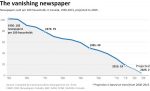
One result of this inequity? “Since 2010, there have been 225 weekly and 27 daily newspapers lost to closure or merger in more than 210 federal ridings,” notes the report. Small market TV stations have closed and many others, like surviving newspapers, have cut service and journalistic staff. Information supplied by Canada’s main media unions points to an estimated 30% reduction in journalism jobs since 2010.

Among the 12 recommendations are proposals for a new “local mandate” for Canada’s national wire service, The Canadian Press, ensuring there are more journalistic “boots on the ground” to supplement coverage of courts, legislatures and city halls; an indigenous journalism initiative to put more resources into communities and governments that are often overlooked; the launch of a service that provides much-needed legal advice to smaller outlets providing investigative and accountability journalism; and the creation of a research institute that would examine news and democracy issues more closely, including the distribution of fake news.

The report also calls for changes to Section 19 and 19.1 of the Income Tax Act to support civic-function journalism in Canada, whether by incentivizing Canada-centred news organizations to do more reporting or, for those that don’t, creating a revenue stream to support a Future of Journalism and Democracy Fund.

chart - Decline in newspaper ads, from Shattered Mirror ReportThree recommendations deal with CBC’s special role in Canadian news, including a call to relieve the CBC of the need to sell online advertising in order to promote production of civic-function journalism over chasing clicks.
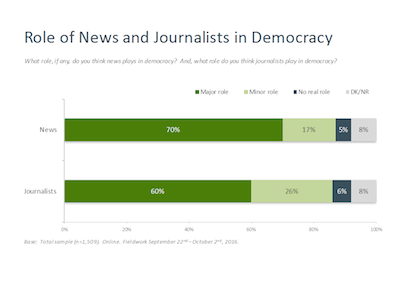
Included in the PPF study is public opinion research by Earnscliffe Strategy Group, which conducted focus groups and surveyed more than 1,500 adult Canadians. Respondents “were very aware that ‘a lot of bogus and untrue news and information appears online’ (83%)…. Whereas seven out of 10 respondents completely or mostly trust their newspapers, radio and television, the figure drops to 15% for news acquired via social media.”

As chronicled by Craig Silverman, media editor of BuzzFeed, false news stories in the United States began to spike in August after the firing of Facebook editors, on top of the downgrading of material posted by established news organizations. Between August and election day in November, stories from hyper-partisan and hoax sources actually pulled ahead of real news, registering 8.7 million acts of engagement versus 7.4 million.

“While fake news takes just moments to make up, real news often requires days, weeks and even months of digging and verifying,” notes the PPF report, the title of which, The Shattered Mirror, pays homage to the 1970 groundbreaking Senate report on the mass media called The Uncertain Mirror. “Unfortunately, the state of the news media’s job in reflecting society back to itself is no longer uncertain,” Greenspon said.

chart - Democracy poll, from Shattered Mirror Report“Never have Canadians had access to more information,” states the report. “But the capacity to produce original news, particularly of a civic nature, is severely constrained by the unsolved riddle of how to finance the cost of journalism in the digital age.”

The PPF media study was partially funded by Canadian Heritage and ISEDC (Innovation, Science and Economic Development Canada); the McConnell, Atkinson and Max Bell foundations; and four corporations, CN, TD Bank, Ivanhoe Properties and Clairvest Investments. However, the findings and recommendations are the PPF’s alone.

Greenspon concludes that Canada has already reached a “crunch point” in terms of the state of the news industry and its ability to fulfil its democratic responsibilities. “This report is meant to offer insight into the state of news two decades into its existential crisis, as well as ideas for how to respond,” he writes. “We hope it will stimulate a necessary debate and necessary action, while understanding no story is ever at its end.”

The full report can be downloaded at shatteredmirror.ca.

Format ImagePosted on February 10, 2017February 8, 2017Author Public Policy ForumCategories NationalTags democracy, journalism, media, Shattered Mirror
Goodbye, airport

Goodbye, airport

An Arkia plane lands at Eilat Airport. (photo from Ashernet)

Ever since 1949, Eilat Airport has been an important link between the resort city of Eilat on the Red Sea and the busy central part of Israel. However, it is due to close later this year when the newly constructed Ramon Airport opens some 20 kilometres north of Eilat. The land that the Eilat Airport currently occupies will be used to build a new city centre consisting of hotels, shops and a residential area, as well as a new rail terminal.

Format ImagePosted on February 10, 2017February 8, 2017Author Edgar AsherCategories IsraelTags airport, Eilat
Education symposium

Education symposium

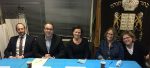
Left to right, panelists Rabbi Don Pacht, Abba Brodt, Ellen Wiesenthal and Lu Winters with moderator Sherri Barkoff. (photo from the Bayit)

On the night of Jan. 24, four leading Jewish educators were panelists for the symposium Think Education, hosted by the Bayit and the Kehila Society. More than 50 people, from all walks of life, attended. Rabbi Don Pacht, head of Vancouver Hebrew Academy; Abba Brodt, principal of Richmond Jewish Day School; Lu Winters, counselor at King David High School; and Ellen Wiesenthal, director of Judaic curriculum and programming at Vancouver Talmud Torah, covered a variety of topics that had been suggested in advance by email by parents, such as making accommodations for working families, financial assistance and special education. The panel was moderated by Sherri Barkoff, president of the Kehila Society.

Format ImagePosted on February 3, 2017February 1, 2017Author The BayitCategories LocalTags education, Richmond

Posts pagination

Previous page Page 1 … Page 229 Page 230 Page 231 … Page 322 Next page
Proudly powered by WordPress