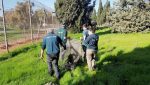
Ramat Gan Safari Park taking Conner back to the zoo. (photo from Ashernet)
Conner, before his foray into the world outside the park. (photo from Ashernet)
Conner, a 17-year-old capuchin monkey from Ramat Gan Safari Park, escaped the park earlier this month and set off on a foray into the outside world. Staff from the zoo scoured the immediate area around the zoo and eventually captured him, unharmed, after about a week. Peanut traps were set all around the area where Conner was thought to be hiding and, sure enough, Conner fell for the bait. None the worse for his adventure, Conner, after being checked by the safari park’s vets, was returned to his enclosure and was last seen telling his fellow capuchins what it is like on the other side of the safari park wall.
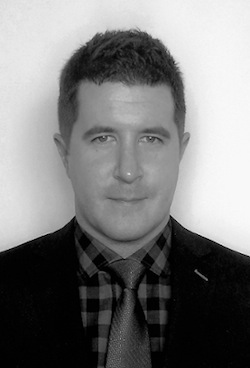
אלכסנדרה ביסונאט (27) שיועמד לדין על 11 סעיפי אישום בהם שישה מקרי רצח בדרגה ראשונה, וחמישה נסיונות לרצח, הזדהה עם העמדות של מנהיגי הימין ומתנגדי ההגירה המוסלמית. בהם: הפוליטיקאי הלאומני הצרפתי, ז’אן-מארי לה פן (מנהיג מפלגת הימין הרדקלי החזית הלאומית), ונשיא ארה”ב, דונלד טראמפ.
ביסונאט פעל כזאב בדד עת תקף מוסלמים שהתפללו במסגד בקוויבק סיטי ביום ראשון בערב, והרג שישה גברים ופצע שמונה עשר בהם חמישה במצב קשה (שניים מהם זקוקים לעבור ניתוחים נוספים). הוא פעל במקרה או שלא במקרה יומים אחרי הוצאת הצו של טראמפ שאוסר על כניסת מוסלמים משבע מדינות, בשלושת החודשים הקרובים. שכנים שהכירו את הרוצח ציינו שגר בשכירות עם אחיו התאום לא הרחק מהמסגד, והוא נחשב לצעיר לא חברותי ומאוד מסוגר בתוך עצמו.
ביסונאט יליד קוויבק סיטי ברח ממקום האירוע והוא נמצא ברכב ביציאה מהעיר (במרחק כ-40 ק”מ מהמסגד), כאשר התקשר למשטרה והסגיר עצמו. הוא טען שהרגיש רע והוא מתחרט על מה שעשה. החשוד הועבר ביום שני בבוקר לבית המשפט ושם הוקרא כתב האישום נגדו, שלא כלל סעיפים שקשורים לטרור. הדיון הראשון בעניינו יתקיים בבית המשפט ב-21 בפברואר. עד אז ישאר כמובן במעצר והמשטרה תמשיך לחקור את מעשיו החמורים והרקע להם.
ביסונאט היה סטודנט שלמד אנתרופולוגיה ומדע המדינה בפקולטה למדעי החברה באוניברסיטת לאוול המקומית. לא היה לו עבר פלילי והוא לא היה מוכר למשטרה. ככל הידוע הוא כנראה לא היה מקובל חברתית בבית הספר וסבל מהטרדות מצד תלמידים אחרים. בדף הפייסבוק שלו (שהורד בינתיים) הוא ציין את תמיכתו בטראמפ, לה פן ובהוגה דעות מקוויבק שדבק בלאומנות והתנגד לרב-תרבויות. פעילים בקהילה של קוויבק סיטי למען פליטים וכן סטודנטים באוניברסיטה, הכירו את ביסונאט ותמונותיו בשל דעותיו הרדקליות. הוא פירסם בפייסבוק ובאמצעי מדיה אחרים תגובות כנגד הגירת מוסלמים לקנדה. עמית לספסל הלימודים באוניברסיטה אמר כי אצל ביסונאט התפתחו עם השנים דעות רדקליות והוא אף התנגד לפמניזם. אגב הנהלת אוניברסיטת לאוול הזרזה והודיעה ביום שני כי הרוצח הורחק מלימודים והעונש יהיה בתוקף, כל עוד עומדות נגדו הרשעות פליליות.
בשנים האחרונות נרשם גידול משמעותי בפעולות השינאה נגד זרים בקנדה, בעיקרם מוסלמים ויהודים. מרבית האירועים התרחשו במחוזות של קוויבק, אונטריו ואלברטה. קהילות המוסלמים והיהודים נמצאות ביחסי שכנות טובה בכל רחבי קנדה, והן משתפות פעולה באירועים שונים ומגנות כל פעילות נגד אחת הקהילות. בחודש יוני אשתקד (בתקופת חודש הרמדאן) הונח ראש חזיר מול דלת הכניסה למסגד בו התבצע הטבח ביום ראשון. בקהילה המקומית מציינים שהם פנו מספר פעמים לשלטונות בקוויבק לפעול לאור האיומים וההתקפות נגד מסגדים בעיר אך דבר לא נעשה.
ראש ממשלת קנדה, ג’סטין טרודו, כינה את הטבח במסגד פעולת טרור והוסיף: “אנו מגנים את מתקפת הטרור שכוונה נגד מוסלמים במרכז פולחן ומקלט. קשה מאוד לחזות באלימות חסרת פשר שכזו. הרב תרבותיות היא העוצמה שלנו, וסובלנות דתית היא ערך שאנו כקנדים מוקירים מאוד. המוסלמים הקנדים הם חלק חשוב במרקם הלאומי, ולפעולות חסרות פשר כאלה אין מקום בקהילות, בערים ובארץ שלנו”.
הרב ראובן פופקו, שמשמש היו”ר המשותף של ועד הרבנים בקנדה ויו”ר הסניף בקוויבק של המרכז לענייני ישראל והיהודים בקנדה, אמר: “הקהילה היהודית מזועזת מהירי הרצחני במסגד. שום דבר לא מצדיק רצח של אזרחים חפים מפשע שהתאספו במקום פולחן”.
משרדי שוז.קום הסגורים בוונקובר ביום שישי האחרון (צילם: Roni Rachmani)
הקמעונאית למכירת נעליים במסחר האלקטרוני מוונקובר קבוצת שוז.קום טכנולוג’יס אינק, הכריזה ביום שישי האחרון על פשיטת רגל. המשרדים הראשיים של החברה ברחוב אלברני בדאון טאון ונקובר נסגרו ושומר הוצב במקום. כל האתרים של החברה באינטרנט הורדו. שוז.קום לא הצליחה להתמודד עם גופים מתחרים בעידן של תחרות שיווקית קשה, ההכנסות ירדו, החברה פיטרה עשרות עובדים בשנה האחרונה אך זה לא עזר.
פעילותה של הקבוצה כללה שלושה ערוצים במסחר האלקטרוני: שוז.קום, שומי.סיאיי ואון-ליין שוז.קום. בנוסף החברה הפעילה שתי חנויות חדשות ברחוב קווינס בדאון טאון טורונטו (שנפתחה בחודש יולי), וברחוב בורארד בדאון טאון ונקובר (נפתחה רק בספטמבר האחרון). משרדי החברה והמחסנים מוקמו בוונקובר, ברנבי ומעבר לגבול בסיאטל. עוד לפני מספר חודשים חשבה הנהלת שוז.קום שיש מקום להפוך את הקבוצה מגוף פרטי לחברה שנסחרת בבורסה וזאת לצרכי גיוס כספים. אך בפועל מתברר שבחודשים האחרונים נקלעה שוז.קום למצב כלכלי קשה שהחמיר מיום ליום. אפילו מינויו למנכ”ל של ברדלי וילסון בחודש ספטמבר האחרון, לא עזר לעצור את המפולת. וילסון לשעבר מנכ”לה של חברת אקספדיה וטריווגו נחשב למומחה בפעילות של המסחר האלקטרוני.
שוז.קום שהחלה לפעול ב-2012 הגיעה בשיאה למצבת כוח אדם של 650 עובדים אך בקיץ האחרון המספר ירד מספרם דרמתית ל-230. בעותה עת הקבוצה נחשפה ככל הידוע לפחות לארבע תביעות משפטיות בהיקף כולל של כ-434 אלף דולר, הרבה תלונות מצד הלקוחות על שירות גרוע, ואף תלונות מצד ספקים על חשבונות שלא שולמו.
מומחים בענף מציינים כי את שוז.קום ניהלו מומחים לתחום המסחר האלקטרוני, אך הקבוצה הייתה חסרה עובדים בכירים שמתמחים באופנה, עיצוב ומסחר של נעליים, והיא לא קראה את השוק נכון. עוד מתברר שהפעילויות של הגופים הענקיים כמו וולמארט שרכשה בראשית חודש ינואר תמורת 70 מיליון דולר את שוביי.קום, במקביל לאמזון שרכשה עוד קודם לכן את זאפוס.קום – שתיהן המתחרות הקשות של שוז.קום, פגעה קשות באחרונה. וולמארט שנחשבת לקמעונאית הגדולה בעולם עם הכנסות של 482.1 מיליארד דולר בשנה יכולה לרסק כמעט כל מתחרה עם היא רוצה. המומחים חשבו שאולי וולמארט או אמזון ירכשו את שוז.קום אך זה לא קרה. למרבית הפלא וילסון (שמחק בינתיים מהרזומה שלו בלינקדאין כי ניהל את שוז.קום) לא חשב שהמהלך של וולמארט יפגע בקבוצה מוונקובר. אך הוא טעה בגדול ורכישת שוביי.קום ע”י וולמארט היה כנראה הנוקאאוט האחרון שחיסל סופית את שוז.קום.
קבוצת שוז.קום הגיעה להכנסות של 89.2 מיליון דולר אמריקני בשנת 2014, ואילו ב-2015 ההכנסות גדלו משמעותית ל-223 מיליון דולר אמריקני. באותה תקופה החברה הצליחה למכור כשבעת אלפים זוגות נעליים ביום (של יותר מחמש מאות ברנדים שונים). בהנהלת הקבוצה תכננו להגיע אף להכנסות של כמיליארד דולר בשנת 2020 אך זה כבר לא רלוונטי. עדיין לא פורסמו הנתונים של אשתקד אך אין ספק שחלה נסיגה משמעותית בהכנסות החברה שחדלה מלפעול.
בעלי השליטה בקבוצה והיו”רים שלה, רוג’ר הרדי, ושון קלארק לא מגיבים בשלב זה על ההחלטה להכריז על פשיטת רגל והגנה בפני הנושים. השניים פעלו כל הזמן לרכוש ולאחד עוד פעילויות של קמעונאיות נעליים הפעילות בתחום המסחר האלקטרוני, תחת המטריה של קבוצת שוז.קום. עתה מתברר שהם הלכו רחוק מדי. ב-2016 שניהם זכו בתואר “היזמים של השנה בבריטש קולומביה” בתחום המסחר האלקטרוני. אך מתברר שתארים לחוד והמצב כלכלי של הקבוצה שהתטמוטטה לחוד.
Dr. Tami Jacoby, associate professor at the University of Manitoba, has been studying Middle East politics and international relations for nearly 20 years. (photo from Tami Jacoby)
Dr. Tami Jacoby, associate professor at the University of Manitoba, has been studying Middle East politics and international relations for nearly 20 years. She not only shares her expertise with students at the university, but the broader community as well, via books and lectures. She is currently teaching an eight-week class at Winnipeg’s Rady JCC called Terrorism and Political Violence.
After working toward her undergrad degree at the Hebrew University, Jacoby finished her studies at U of M. She then went back to Hebrew U for her master’s degree in political science and international relations. At that time, Jacoby made aliyah and started a family and life in Israel. Later, she moved to Toronto to do a doctorate in political science at York University. She eventually returned to Winnipeg, where she currently resides.
While doing her PhD, Jacoby traveled back and forth regularly between Canada and Israel, and did field work in Israel, conducting interviews and research on women’s protest movements.
Over the years, Jacoby has written several books, including Women in Zones of Conflict: Power and Resistance in Israel (McGill-Queen’s University Press, 2005). Using the framework of “a case study of three women’s political movements in Israel: Women in Green, the Jerusalem Link and the lobby for women’s right to fight in the Israel Defence Forces,” the book, according to the publisher’s description online, “challenges the traditional view, which suggests a natural connection between women and pacifism, based on the feminine qualities of caring, cooperation and empathy.”
“What I did was a number of years of interviews and research on women’s protest movements … and the book that came out was a book on the diversity of feminism in Israel, but as a level of extremism,” Jacoby told the Independent. “I was interested in how women in one national context could have such radically different views on the same things, like feminism, the Arab-Israeli conflict and just run-of-the-mill party politics.”
One of the interesting things Jacoby found was that many women on the left were interested in things like dialogue with the Palestinians about a two-state solution, and feminism. In contrast, right-wingers’ idea of dialogue with the Palestinians was through protest, the media and policy.
“They were very driven by their fear of not only losing the state of Israel, but of losing their identity as Jews, as Israelis,” said Jacoby. “And the left-wing portion of the Israeli women’s movement was very interested in dialogue with Palestinian women. They wanted to get together with them and have cultural programs and social events. They wanted to listen to and get to know the stories of Palestinian women, to be able to walk in their shoes and completely understand them.”
The class that Jacoby is teaching at the Rady JCC – which started last week and runs to March 21 – looks at terrorism in Canada and the legal and political/social aspects of it.
“This class I’m teaching at the JCC is, in a sense, piggybacking on other research and teaching that I’m doing right at the moment,” she told the Independent before the course began. “So, I’d assume the people in the class will be interested in the kind of terrorism that Canada and Israel deal with…. But the class takes a step back and looks at the phenomenon of terrorism as a philosophical and structural issue….”
While Jacoby is teaching the class, she is also a student of sorts, as she is interested in hearing what people have to say.
“People have a lot to say and it’s not just off the cuff; it’s substantiated by empirical evidence and anecdotes that are based on experience,” she said. “What I try to do is open a little window on something that I’ve been very heavily researching … and open a discussion about things that people may not have thought of before … so people can bring things to the table and we can work to enlighten ourselves about the topic.”
Touching a little on what will be examined in the course, Jacoby said, “One of the things I’ve come to realize about terrorism is that it has a particular dynamic to it, no matter where it is and what period of history it is in. And that is, you have a small group of people trying to terrorize, make afraid, a large group of people … so they start to feel their life is untenable and then pressure the government to act. That’s the case with literally every terrorist group, regardless of their philosophy, background or tactics. That’s the logic of terrorism. I’m interested in seeing how case studies fit into that logic.”
Another topic will be how to pair counterterrorism with policies like multiculturalism, democracy and liberalism.
“The human tendency is to look for people who might look like them, causing a whole range of Islamophobia, antisemitism, racism and xenophobia,” explained Jacoby. “These are the kinds of problems not specific to any one particular form of terrorism, but that fuel a broader understanding of terrorism in general.”
Jacoby sees political violence like terrorism as a way in which people express themselves at the extreme end of the spectrum. “Political violence is quite broad,” she said. “It could be something quite innocuous, like threatening someone or inciting someone to violence … or, it could be throwing a fist or a bomb, or using nuclear weapons as a scare tactic.”
The Middle East will likely be discussed in terms of the ongoing cold war between Iran and Saudi Arabia and their backers, as well as both American and Russian policies.
“One thing that people seem to not understand nowadays is that people may oppose a terrorist group’s tactics, but they may also support the underlying goals … which can be quite honourable,” said Jacoby. “For example, terrorists might use violence to press their point about Muslim victims in the Middle East, [while] a moderate person might say they are against and shocked by the high casualty rate of Muslim victims. There are a lot of divisions out there, of which terrorists only represent a very small group … [an] active, vocal, radical, but miniscule, minority. While we may not like the tactic, many people may support the ultimate goals, which include justice and peace. The reason we can’t see the ultimate goals is because terrorism destroyed them … [and] in the end, makes it worse.”
As for possible solutions to terrorism, Jacoby said it “is one of the most difficult tasks to respond to.”
She explained, “I would say this: the effect of terrorism is more psychological than anything else. Fewer people die from terrorist attacks every year than from faulty wiring or furniture falling on them when they sleep. But, because of the media and the dramatic nature of its coverage of terrorism (pervasiveness, images, taboos, fear), people spend more time worrying about terrorism than any other more concrete and actual danger to their lives. My suggestion is we, as a society, need to be more ‘comfortable’ with the psychological discomfort that comes with terrorism. We must continue to be vigilant, but also live our lives to the fullest so that the terrorists won’t ultimately win.”
The Canadian military helped liberate Bergen-Belsen and other Nazi concentration camps near the end of the Second World War, a fact that was omitted for decades from recorded history.
The experiences of Canadian liberators – and the meaning of the term “liberation” itself – were the subject of the keynote address at the International Holocaust Remembrance Day observance in Vancouver last week.
Prof. Mark Celinscak, a Canadian who teaches at the University of Nebraska Omaha, delivered the address Jan. 18, at a commemoration presented by the Vancouver Holocaust Education Centre (VHEC) in partnership with the Norman and Annette Rothstein Theatre.
Celinscak’s book, Distance from the Belsen Heap: Allied Forces and the Liberation of a Nazi Concentration Camp, was recognized as the best nonfiction book of 2016 by the Vine Awards for Canadian Jewish Literature. In his lecture, he explained how he stumbled upon the facts of Canadian involvement in the liberation of Nazi camps.
Researching the liberation of Bergen-Belsen, he encountered multiple conflicting narratives, but none involved Canadians, he said. In archival research, he found references to Canadians encountering Nazi camps and so he consulted leading Canadian military historians, but all assured him there was no Canadian role in the liberation of concentration camps.
Through further research, Celinscak identified a few soldiers who confirmed the Canadian military’s involvement. These connections led to more and, eventually, he had identified 1,000 individual cases of Canadian military personnel who participated in the liberation of Nazi camps. Seven decades after the end of the war, this aspect of history is only now coming to light. The oversight, said Celinscak, was likely due to the general sense of chaos in Europe at the end of the war.
In introducing Celinscak, VHEC executive director Nina Krieger said: “Were it not for the tenacious scholarship of this evening’s presenter, future generations might never have known of the Canadian role in this aspect of the Second World War.”
Celinscak believes his research helps right an omission in the record. He reflected on an incident from 1997, when plans for a new Canadian War Museum included a Holocaust memorial gallery. Controversy ensued, and Senate hearings were held on the appropriateness of including the Holocaust in a museum devoted to Canadian military history.
“Upon conclusion of the hearings, the plan for a Holocaust memorial gallery was promptly abandoned,” Celinscak said. “In the view of many who testified, the Holocaust either had no place in the country’s war museum or it held no direct connection to Canada and its military.”
His research, however, indicates that the Canadian military did indeed have a connection to the Holocaust, as liberating forces.
Celinscak’s local address was related to the exhibition currently being presented at the VHEC, called Canada Responds to the Holocaust, 1944–45. The exhibition, Celinscak said, reflects “a recent growing body of research that explores how the Canadian government, Canadian organizations and average Canadians responded to the Holocaust.” Celinscak wrote the exhibition’s panels related to Bergen-Belsen, while the overall exhibition was developed by Prof. Richard Menkis and Ronnie Tessler.
Canadians helped liberate camps in the Netherlands and in northern Germany, Celinscak said, though Bergen-Belsen was not taken by military force.
“Simply put, the Allies became involved in Bergen-Belsen because the Germans turned it over to them,” he said. Recognizing that the war was all but lost and that the disease-ridden camp presented a public health hazard to the surrounding German population, a representative from the German army crossed British lines and said that inmates in a nearby concentration camp were ill. The Allies entered Bergen-Belsen on April 15, 1945.
“In the ensuing days, weeks and months, British and Canadian forces from the surrounding area arrived at Bergen-Belsen to assist, to witness and to document,” said Celinscak. “Clearly, military personnel were unprepared for what they were to find in the camp.”
The “liberation” removed the Nazis from the scene, but life improved slowly for the survivors of the camp.
“The war, of course, still continued,” he said. “As a consequence of that, supplies were limited, personnel were largely unavailable and many resources were occupied elsewhere. Those who remained to work in the camp were left with monumental tasks.”
The victims of Bergen-Belsen continued to die. In the two weeks after the Allies took over, 9,000 people died of disease. The next month, 4,500 inmates succumbed, and another 400 perished the following month.
“In total, approximately 14,000 people died in the camp after its transfer to Allied control,” said Celinscak. “In other words, nearly a quarter of the total number of prisoners still alive when the British and Canadian forces first arrived in the camp ultimately met their demise.… While the situation slowly improved, the conditions in the camp remained grim even weeks after its surrender.”
This reality is partly why Celinscak’s research also focuses on the meaning of the term liberation.
“Liberation was an experience that transformed the lives of both liberators and survivors,” he said, noting that this is another newly emerging field of academic inquiry.
“What does that word mean in relation to the Holocaust?” he asked. “If we consider some popular representations of the liberation of Nazi concentration camps, we often see it framed as a jubilant event, one that brought to an end the suffering of the victims of the Holocaust. In films such as Roberto Benigni’s Life is Beautiful, in history books and in some museum exhibits, liberation is frequently depicted as a homogenous, joyful moment in time. But how accurate is this portrayal?”
Liberator narratives, he said, “are overflowing with shock, grief, confusion, disgust and rage.” For survivors, life did not turn for the better instantly. Public health considerations meant the camp inmates were effectively quarantined.
“The prisoners remained behind barbed wire,” he said. “Initially, the survivors were not given autonomy to leave the camp whenever they saw fit. Instead, in the weeks – and, for some, in the months and even years that followed – they continued to live behind the barbed wire of these camps. Places like Bergen-Belsen became displaced persons camps. The survivors were still guarded, only by men in different uniforms.”
In extensive interviews with many survivors, Celinscak came to realize the nuance in the concept of liberation.
“Liberation was a highly ambivalent experience,” he said. “They understood that they were no longer prisoners of Nazi Germany, but many would remain in displaced persons camps long after the war, learning that many of their friends and family had not survived what we now refer to as the Holocaust. For both survivor and liberator, they would contend with these experiences for the rest of their lives.”
Phil Levinson, president of the board of the VHEC, welcomed visitors and introduced a procession of Holocaust survivors carrying Yahrzeit candles. David Schaffer led the Mourners’ Kaddish. Councilor Raymond Louie read the proclamation from the City of Vancouver.
International Holocaust Remembrance Day, which was designated by the United Nations in 2005, is officially on Jan. 27, the anniversary of the liberation of Auschwitz-Birkenau.
Pat Johnsonis a communications and development consultant to the Vancouver Holocaust Education Centre.
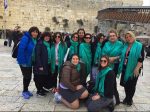
The recent Toronto Jewish Women’s Renaissance Project group in front of the Western Wall in Jerusalem. (photo from Nicole Pollak)
In its flagship program, Momentum, the Jewish Women’s Renaissance Project (JWRP) provides Jewish women and men, typically mothers and fathers, with a free journey throughout Israel (airfare is not included).
The trips – the women’s and men’s trips are separate – are designed for people who are not shomer Shabbat (Shabbat observant). As well, 90% of participants must have children at home under the age of 18, and participants must be physically and emotionally healthy.
Rebbetzin Lori Palatnik founded JWRP in 2008. Since then, it has become an international initiative bringing thousands of women and hundreds of men to Israel each year from 19 different countries.
“The goal is that the women have 10 incredible, uplifting, inspirational days together … and then go home and bring that back to their families and communities,” said Toby Bernstein of the Chabad Romano Centre in Richmond Hill, Ont.
Bernstein led a group of women on the program in December 2016, noting, “We decided to do this trip to encourage some of the women in our community to be more connected to Judaism.”
Bernstein took with her 10 women, “women who come to synagogue services, a couple Hebrew school moms [and] a couple preschool moms.”
These women joined 250 others from the United States, Canada, Russia, Greece and England.
“It was an inspirational trip, because there were classes every day [about] what it means to be a Jewish mom, a Jewish wife, to be a Jew altogether … what’s the purpose of life,” said Bernstein. “It got a lot of people thinking, so it was inspirational. Even me, who grew up with all of this, grew from [the trip] and gained new insight, new inspiration…. It was beautiful to see the women growing and taking it all in.”
One of the participants was Nicole Pollak, a business owner in Toronto along with her husband, Aaron; the couple has a 3-year-old, Sydney.
Pollak went on the trip with both of her sisters after her younger sister, Melissa Jacks, who sends her children to the Chabad Romano Centre, was invited to join by Bernstein.
“My sister came to me and said that Chabad Romano is going to be running a JWRP trip and asked if me and our older sister, Allyson Theodorou, were interested in going,” said Pollak. “We applied, and all three of us went on this trip together.
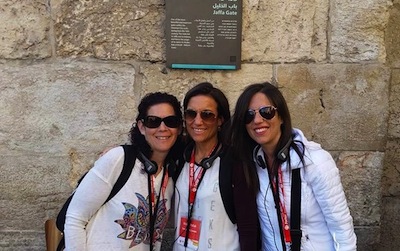
Left to right, sisters Allyson Theodorou, Nicole Pollak and Melissa Jacks during a tour of the Old City, outside Jaffa Gate. (photo by Megan Epstein)
“We thought it would be an amazing experience to do this together, and to learn more about Judaism and Israel,” she said. “And I, personally, have been studying with a rabbi for about eight years. So, I really liked the idea that it was an educational trip to teach us more and give us more insight into Judaism and the religion, and thought it was a good opportunity to get some Jewish inspiration.”
Before leaving, Pollak had to do what she could to ready her daughter for her absence. “From an emotional standpoint, preparing my daughter that I was going to be away for that amount of time was very difficult for a 3-year-old,” said Pollak. “I don’t think she has a concept of time – 10 days, for her, could be 10 hours, 10 minutes or 10 weeks … [so it was hard to tell] her that I’m going away and what that means and that I’ll be calling her every day. Preparing for the trip on my end, it was not really that difficult. It was just a matter of packing and organizing.”
Pollak’s husband was very supportive of her going on the trip. When Pollak became anxious about leaving, it was her husband who helped push her through it.
“There were a couple of times where I contemplated whether I was even going to go. I thought it was going to be too stressful for the family for me to be gone,” said Pollak. “My husband was the one who said, ‘I support you whether you want to go or if you don’t want to go, but I’d be very disappointed if you didn’t go. I think that would teach our daughter we don’t do things because we’re afraid, instead of showing her to do what we want – to learn, to have an adventure or explore life. He was pushing me to go because he thought it would be an incredible opportunity to go to Israel, learn and spend that time with my sisters.”
From the moment Pollak arrived at the airport, she could feel the camaraderie of the women traveling, all with similar feelings about leaving home, and she began focusing on the trip and getting as much out of it as she could.
Each day of the program in Israel involved one or two discussions, lectures, lessons and classes, sightseeing and tours, and the opportunity to see something cultural or religious in the region. For Pollak, the learning was the best part of the experience.
“One of the things we learned was that there are three major mitzvot for a Jewish woman: lighting Shabbat candles, making challah and going to the mikvah,” she explained. “We had the opportunity to light Shabbat candles and to participate in a challah-making class. And, on our visit to Tzfat, we visited a mikvah and had a tour.
“One of the things they talked about is, if you’re a secular Jewish woman and you don’t have a lot of religion in your life, you should start with lighting Shabbat candles. My older sister, Allyson, had never lit Shabbat candles in her house in her whole life and she’s been married 18 years. In Israel, she bought Shabbat candles and, last Friday night was the first time ever she lit them in her house. That’s pretty amazing.”
As for challah-making, the sisters have committed to getting together sometimes on Friday nights and making challah for Shabbat. As for the mikvah mitzvah, Pollak plans to investigate it more before deciding whether she wants to make it a part of her life.
With respect to the sightseeing, visiting the Kotel was a major highlight for Pollak, especially after having had a class about prayer before going in a spot overlooking the wall.
“I heard a lot of people saying … they don’t know how to pray, they don’t know what that means,” said Pollak. “People will often go to the wall and pray for world peace or for their entire family to be happy or healthy. They pray for these big things because they think that, when you talk to G-d, that’s what you ask for – big things.
“Something they emphasized in that class was that praying is not about just big things, it’s about little things, too; it’s that we should pray about everything. You can pray that you want your little son Johnny to do well on his math test. You can pray that you hope that your daughter wins that award, or that next week your haircut is going to be great. The message was, pray for what’s important to you.”
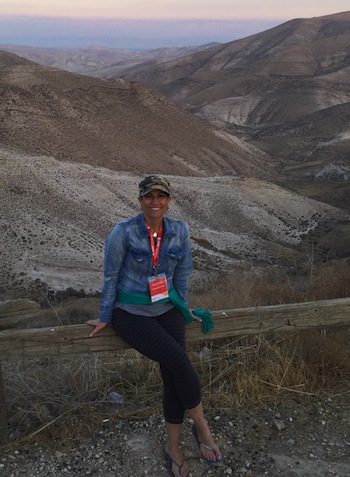
Nicole Pollak at Eretz Bereshit, overlooking the Judean Desert. (photo by Allyson Theodorou)
Another class that hit home for Pollak was one about judgment and perspective. In it, a story was shared that she has been telling people ever since. It was about a little girl who is standing in the kitchen with her mom, holding two bright red apples, one in each hand.
“She says to her mother, ‘Mommy, do you want one of my apples?’” said Pollak. “The mother says, ‘Yes, I do.’ So, the little girl proceeds to take a bite of one apple and then takes another bite from the other apple. The mother stops and thinks to herself, ‘Oh, you little brat.’ Then, the little girl puts her hand out to her mother and says, ‘Here, Mom. This one is sweeter.’
“That story really hit home and depicted that we judge based on what we see and not on what really is. I realized that it’s easy for us to judge based on what we think is happening. That story took me through the trip and really made me stop in my tracks every time I looked at someone or if I heard a story and judged what was going on with that person.”
Once back in Toronto, Pollak thanked G-d for the life that she has. She also discovered that her husband, mother-in-law and friends really stepped up and looked after her life while she was away. Her husband, she said, “appreciated me more, just like I appreciated him more when I came back.”
As a result of the trip, Pollak has decided to find ways to live her life with more intention and more appreciation for her marriage, focusing on the positive things in her life, as well as understanding the responsibilities of being a Jewish woman in one’s home.
“I think coming back made me realize that I have a responsibility bigger than I thought from a spiritual standpoint and that I’m going to live and work to do more of that,” she said.
A Vancouver JWRP group is being formed under the auspices of Vancouver Torah Learning Centre for a July 17-24 trip to Israel. For more information, contact Devorah Brody via e-mail at [email protected] or visit jwrp.org.
From left to right, at Hebrew University’s Truman Institute Jan. 17: Issam Zeitoun, Sirwan Kajjo and Ksenia Svetlova. (photo by Reuven Remez/Truman Institute)
“You are living in a paradise in comparison to the Syrian people. Shame on you. We are being killed,” said Issam Zeitoun, who lives in the Syrian portion of the Golan Heights, in response to Arab-Israeli students who accused him of being a traitor because he was speaking in Israel.
Zeitoun was one of two Syrian opposition figures who addressed Israelis Jan. 17 at Hebrew University’s Harry S. Truman Research Institute for the Advancement of Peace in Jerusalem. The Syrians shared their plight and vision, and overcame an attempt to disrupt their message. A third Syrian opposition member gave remarks in a video message.
Moderated by Member of Knesset Ksenia Svetlova (Zionist Union), the event featured Sirwan Kajjo, a Syrian-Kurdish author and journalist from the city of Qamishili in northeastern Syria, where his family still resides, and Zeitoun, who is from the village of Bet Jan, which is situated minutes from the border with Israel.
Since the outbreak of the Syrian civil war about six years ago, Zeitoun has served as a liaison between rebel groups (such as the Free Syrian Army) and international players, including Israel. He maintains daily contact with rebel commanders in southern Syria.
Zeitoun’s address was interrupted by four Arab-Israeli students who were sitting in the audience and began protesting the willingness of the Syrians to visit Israel and address the public here. They heckled Zeitoun and shouted slogans against “the Israeli occupation” of the Golan Heights.
Svetlova attempted to restore order, telling the hecklers, “You are welcome to protest outside the event. If you wish to remain, you are welcome to do so if you are silent and let our guests finish the session.”
Kajjo, a refugee living in the United States who regularly visits Syria illegally, is wanted by Syrian President Bashar al-Assad’s regime. He was in Syria as recently as last July, and maintains contact with Kurdish armed groups such as the YPG, which is on the frontline in the war against Islamic State.
Speaking to JNS.org after the event, Kajjo said he is in touch with a network of activists in the northeast Kurdish area of Syria, and that he is keen to tell the Israeli people about what is happening in his homeland.
The Kurds have succeeded in securing most of their areas and ridding them of Islamic State, he said, and are currently trying to push into the de facto Islamic State capital of Al-Raqqah. “This is important strategically, to capture Raqqah with Arab partners and to ensure that there is no threat to the Kurdish areas,” he said. Kurdish fighters, backed by the United States and the international coalition against Islamic State, have been extremely effective in beating back the jihadist terror group, Kajjo said.
“This fight will only continue, because the Kurds are determined to eliminate ISIS…. It’s true that the Kurds are Muslims, but moderate Muslims. This is a different form of Islam – completely different from what exists in other parts of Syria. It is very important to keep ISIS and its ideology out of Kurdish areas,” he stated.
President Donald Trump gives his inaugural speech Friday. (photo from YouTube)
Israeli and American-Jewish leaders congratulated President Donald Trump on his swearing-in Friday, Jan. 20, as the new Republican commander-in-chief promised an “America First” agenda in his inaugural speech.
“Congrats to my friend President Trump,” Israeli Prime Minister Binyamin Netanyahu wrote on Twitter. “Look forward to working closely with you to make the alliance between Israel and the United States of America stronger than ever.”
Israeli Ambassador to the United Nations Danny Danon also warmly welcomed Trump, saying, “A true friend of Israel will enter the White House today. Thank you, President Trump for your unequivocal support. We look forward to welcoming you to our capital of Jerusalem.”
Referring to December’s Resolution 2334, which condemned Israel’s settlement policy and passed after the Obama administration’s refusal to veto the measure, Danon said, “After the shameful resolution that was adopted by the Security Council, Israel looks forward to strengthening our most important alliance and leading together towards a new era at the UN.”
In his inaugural speech, Trump echoed many of the populist themes from his campaign, in which he promised to restore American jobs, manufacturing and prestige.
“From this moment on, it’s going to be America first, America first,” Trump said. “Every decision on trade, on taxes, on immigration, on foreign affairs, will be made to benefit American workers and American families.”
Following Trump’s address, Rabbi Marvin Hier of the Simon Wiesenthal Centre delivered a benediction for the administration.
“Eternal God, bless President Donald J. Trump and America, our great nation,” Hier said. “Dispense justice for the needy and the orphan, for they have no one but their fellow citizens. A nation’s wealth is measured by its values and not its vaults.”
Leaders of the Conference of Presidents of Major American Jewish Organizations, a coordinating body on international and national concerns for 52 national Jewish groups, said they “look forward to working with President Trump and his administration to deepen the historic special relationship between the U.S. and Israel, enhance the safety and security of the Jewish state and its people, and on other issues of vital importance to the American Jewish community.”
“Among these [issues] are the multiple threats posed by Iran, promoting peaceful resolutions wherever possible, standing forcefully against terrorism and its backers, and fighting antisemitism and racism,” said Stephen M. Greenberg, chair, and Malcolm Hoenlein, executive vice-chair and chief executive officer, of the Conference of Presidents.
Zionist Organization of America leaders said they “appreciate our new president’s determination to eliminate the scourge of radical Islam, and his quote of one of our favourite lines from Psalm 133, often sung by the Jewish people, about dwelling together in unity.”
Trump said in his speech, “We will shine for everyone to follow. We will eradicate radical Islamic terrorism from the face of the earth. When you open your heart to patriotism, there is no room for prejudice. The Bible tells us, ‘How good and pleasant it is when God’s people live together in unity.’”
For more international jewish news and commentary, visit jns.org.
Corey Gil-Shuster has split his time between Canada and Israel for 28 years now. (photo from Corey Gil-Shuster)
Corey Gil-Shuster is an Ottawa-born and -raised Jew who spends a great deal of his time and energy asking people their opinions regarding the Middle East conflict – and doing so on camera. He has his own channel on YouTube, called the Ask Project.
Gil-Shuster has spent the last 28 years splitting his time between Ottawa and different places in Israel. He first went to the Jewish state in the 1990s for a study-abroad program at Tel-Aviv University.
At the time, Gil-Shuster said he was just happy to find “a good, safe place to travel and then, from there, to travel to other places. Then, when I was here in Israel, actually I didn’t like it very much. It was very different than I expected. I found it too chaotic…. It took me about six months to get used to it. Once I did, I started to fall in love with the place.”
In 1995, Gil-Shuster met his now-husband, Yaron. The couple later adopted a child.
Gil-Shuster said he has found Israelis to be fairly open to discussing homosexuality, and noted a level of acceptance or openness that he has not found in Canada. Even strangers in Israel have felt very comfortable asking him questions about being gay, and he has used the opportunity to educate them about the topic. On more than one occasion, once that initial question has been broached, people have invited him over for dinner to ascertain how they can move to Canada, make a good living and buy a big house.
“I found Israel refreshing,” said Gil-Shuster. “I kind of enjoyed that, because it put me in control as opposed to the opposite – at least the early 1990s in Canada – being gay with straight people in control of whether you’re accepted.”
As he acclimated to Israeli society, Gil-Shuster found himself getting into debates about how Israelis really feel about the situation in the Middle East.
“I thought, well, I have a video camera, so why don’t I just go out my front door and ask random people on the streets to answer some questions?” he told the Independent.
What Gil-Shuster initially found was that, while people had their opinions, they were not interested in asking questions themselves or in listening.
“All these people are either pro-Israel or pro-Palestinian, and they are sure they know everything about Israel,” he said. “But, nobody could come up with a question to either confirm their ideas or give the opposite of what they think. Finally, somebody said something about how Israelis won’t accept a one-state solution. Great, I’ll take that and ask that as a question. I asked neighbours, the guy who sells me fruit and veggies, and another grocery store guy.”
Gil-Shuster had to do on-the-spot translation of the comments from the street interviews. “I would translate as they were speaking Hebrew,” he said. “I put it together. I had seven or eight people and I put it in a film. I learned to edit, but I didn’t cut anything out, and I put it on YouTube.”
In no time at all, Gil-Shuster understood the power in simply letting people share their views – “how much power that can have to go against what mainstream media puts out, whether that’s Canadian, American, Israeli or Palestinian. Every country’s media has a certain narrative they want to say. They have a story they’re trying to sell to their people, and they have to frame the conflict within that.”
To make his videos more objective, Gil-Shuster started to venture further than his backyard in Tel Aviv. He began traveling the country asking people for their opinions. Regardless of what they said, he made a point of not cutting or editing the videos – even if racist or horrible comments were made that didn’t conform to his views.
That doesn’t mean he keeps silent, however. He allows himself the right to make sarcastic comments as he feels the need, noting, “It keeps me more interested. I try to make it very objective … I try to figure out, as much as possible, where they’re coming from. If their question is, ‘Why don’t you all just get along,’ I’ll reply quite naively insofar as what my follow-up questions are … thinking that’s kind of where they’re coming from.”
Gil-Shuster has been doing this for the past four years, with a growing following that comprises a mix of pro-Israel and pro-Palestinian fans and many others in between. He provides a variety of views and topics to keep people watching.
When he has to travel for work, doctor appointments or other reasons, he brings his camera along, stopping to speak with people along the way. Jerusalem and Haifa are a couple of his favourite places to do this, as he is more likely to encounter both Israelis and Palestinians.
In general, he has found Palestinians to be more open to talking, though some are fearful and only want to be interviewed if he will agree to conceal their face. Typically, in these situations, he works with a translator.
“When I first started out, my hope was to use these videos as a forum for creating peace in some way, to create a dialogue between Israelis and Palestinians,” he said. “For me, it’s about understanding. But, quickly, I realized that very few Israelis and Palestinians are interested in having a dialogue – at least, not in a public way.”
Some people get mad at Gil-Shuster, feeling he is doing something purposefully against one group or another. In contrast, he gets a lot of messages from people in the Middle East saying, “Thank you for showing me a different side of the conflict. I always had a feeling I was being lied to.”
“These are the emails I like the most,” he said. “You don’t have to like what somebody says, but I’m hoping they’re humanized as a group.”
When asked about how the project has changed his views, Gil-Shuster said he no longer thinks peace is possible.
“Israelis are tough-talking, but are willing to compromise to a certain degree. Palestinians are very open to other people in some ways, but, it’s very black and white for them. It’s all … the land was stolen by foreigners who shouldn’t be there, and that there’s no solution until they leave. Maybe someday they’ll get a leader who’ll be brave enough to tell them what reality is, but they don’t have those kinds of leaders. They always deal with Israel … [with the view that] for now, we can benefit from it, but it’s all ours, so we will get it back someday.”
To date, Gil-Shuster has created more than 500 videos. They can be found at youtube.com/user/coreygilshuster, and he encourages viewers to suggest questions.
The remains of the Sobibór extermination camp. (photo from Israel Antiquities Authority via Ashernet)
In a recent discovery made at the site of former Nazi extermination camp Sobibór – where more than 250,000 Jews were killed – remains were uncovered in what is believed to be the location where victims undressed and their heads were shaved before being sent into the gas chambers. The findings were discovered by Polish archeologist Wojciech Mazurek and Israel Antiquities Authority archeologist Yoram Haimi with their Dutch associate, archeologist Ivar Schute.
The archeological excavations, underway since 2007, are underwritten by the steering committee for the international project to establish a new museum and memorial site in the former German Nazi extermination camp, in coordination with Yad Vashem’s International Institute for Holocaust Research. The extermination camp was located near the village and railway station of Sobibór, in the eastern part of the Lublin district in Poland.
A pendant with the Hebrew words “mazal tov” and the date July 3, 1929. (photo from IAA via Ashernet)
The remains of the building unearthed by the archeologists are located on the “Pathway to Heaven,” the path along which Jewish victims were forced to tread to the gas chambers. The personal items found in the foundations of the building probably fell through the floorboards and remained buried in the ground until they were discovered this past fall.
Among the personal items found in the area were a Star of David necklace, a woman’s watch and a metal charm covered in glass with an etching of the image of Moses holding the Ten Commandments; on the reverse side of the charm is the inscription of the essential Jewish prayer, Shema. Also found was a unique pendant, probably belonging to a child from Frankfurt who was born on July 3, 1929, which bears the words “mazal tov” written in Hebrew on one side and, on the other side, the Hebrew letter hey (God’s name), as well three Stars of David.
The opposite side of the pendant, with the Hebrew letter hey (God’s name), as well three Stars of David. (photo from IAA via Ashernet)
Leading experts at Yad Vashem, the World Holocaust Remembrance Centre, together with Haimi, revealed in an announcement on Jan. 15 that the pendant discovered in Sobibór bears close resemblance to one owned by Anne Frank, who was murdered in the Holocaust and is well known for the diary she wrote while in hiding in Amsterdam. Through the use of Yad Vashem’s online pan-European deportation database, Transports to Extinction, they were able to ascertain that the pendant might have belonged to a girl by the name of Karoline Cohn. Dr. Joel Zissenwein, director of the Deportations Database Project, found that Cohn, born on July 3, 1929, was deported from Frankfurt to Minsk on Nov. 11, 1941. While it is not known if Cohn survived the harsh conditions in the Minsk ghetto, her pendant reached Sobibór sometime between November 1941 and September 1943, when the ghetto was liquidated and the 2,000 Jewish prisoners interned there were deported to the death camp. There, along the path to the gas chambers of Sobibór, the pendant belonging to 14-year-old Cohn was taken, dropped and remained buried in the ground for more than 70 years.
A metal locket covered by glass with the image of Moses holding the Ten Commandments painted on it. (photo from IAA via Ashernet)
Additional research reveals that, aside from similarities between the pendants, both Frank and Cohn were born in Frankfurt, suggesting a possible familial connection between them. Researchers are currently trying to locate relatives of the two families to further explore this avenue.
Over the past decade, the archeological excavations at Sobibór under the guidance of Yad Vashem have made several important discoveries, including the foundations of the gas chambers, the original train platform and a large number of personal artifacts belonging to victims. Among the unique items are metal discs attached to charm bracelets typically worn by children. Engraved on the discs was contact information in case the child went missing.
The most recent excavations have uncovered the remains of the building where victims undressed and their heads were shaved, as well as other areas bearing signs of the use of mechanical equipment to dismantle the camp. In one specific location are imprints left in the ground where trees were planted in order to conceal evidence of the camp.
The locket’s opposite side has the Shema printed on it. (photo from IAA via Ashernet)
Prof. Havi Dreifuss, head of the Centre for Research on the Holocaust in Poland at Yad Vashem’s International Institute for Holocaust Research, said, “These recent findings from the excavations at Sobibór constitute an important contribution to the documentation and commemoration of the Holocaust, and help us to better understand what happened at Sobibór, both in terms of the camp’s function and also from the point of view of the victims.”
The face of a woman’s watch. (photo from IAA via Ashernet)
According to Haimi, “The significance of the research and findings at Sobibór grows with every passing season of excavation. Every time we dig,” he said, “we reveal another part of the camp, find more personal items and expand our knowledge about the camp. In spite of attempts by the Nazis and their collaborators to erase traces of their crimes, as well as the effects of forestation and time, we enhance our understanding of the history previously known to us only through survivor testimonies. In this way, we ensure that the memory of the people killed there will never be forgotten.
“This pendant,” he continued, “demonstrates once again the importance of archeological research of former Nazi death camp sites. The moving story of Karoline Cohn is symbolic of the shared fate of the Jews murdered in the camp. It is important to tell the story, so that we never forget. I wish to thank my Polish partner Wojciech Mazurek and the researchers at Yad Vashem for their dedication to the project, as well as Tel Aviv University for supporting the project, and the Polish-German Foundation who made the excavations possible.”
Relatives of Karoline Cohn, or any member of the public who can assist with details regarding her family or Sophie Kollmann, who filled out Pages of Testimony in April 1978 for Richard Else Cohn and Karoline Cohn, are requested to contact Haimi via email [email protected].