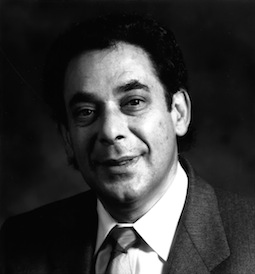
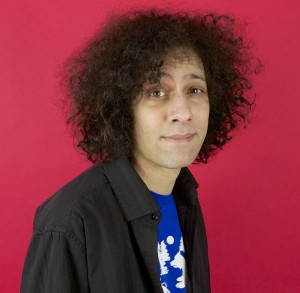
Itai Erdal brings A Very Narrow Bridge to Chutzpah! March 5-13. (photo by Emily Cooper)
There’s the family into which you were born, and the families you create yourself. Itai Erdal has built a life in which he is surrounded by family, both on and off stage. He often shares vulnerable aspects of himself and his family in his work, and he is one of the more collaborative playwrights out there.
While A Very Narrow Bridge, which runs March 5-13 at this year’s Chutzpah! Festival, is about Erdal’s “relationship with his sisters, Judaism and the state of Israel,” it is written by Erdal, Anita Rochon (artistic director of the Chop theatre company) and Maiko Yamamoto (artistic director of Theatre Replacement), is directed by Rochon and Yamamoto, and co-stars Erdal, Anton Lipovetsky, Patti Allan and Tom Pickett. The original score is written and performed by Talia Erdal.
“It is a dream come true for me to work with my sister,” Erdal told the Independent. “She is a brilliant musician and I’ve always admired her talent and her spirit. Talia is much younger than me … and we’ve been very close from the day she was born. In the past few years, she has become religious and, since I am not religious at all, I was worried that it would pull us apart. This fear of mine is indeed addressed in this show, which makes her being here and participating in the show even more special.”
The play’s description is minimal: Erdal “relives a trial in order to obtain a get – a divorce document in Jewish religious law – where everything he knows is at stake.” Its title comes from a teaching of the founder of the Breslov Chassidic movement, Rabbi Nachman of Breslov (1772-1810): “All the world is a very narrow bridge, and the most important thing is not to be overwhelmed by fear.”
That certainly seems to be Erdal’s approach to creativity. A Very Narrow Bridge is not the first work in which he puts a part of his life on a public stage.
“I’ve always been a very candid and open person,” he said. “I am an extrovert and I enjoy telling stories and being the life of the party. Having said that, in all my shows I talk about very personal things and sometimes about things that are hard to reveal or even to admit to myself. But I’ve learned that when something is hard to talk about, it often makes for good dramatic material, and I really trust my collaborators, who are all brilliant and steer me in the right direction.”
And they have. How to Disappear Completely, which was also a collaborative writing effort, is a one-man show that deals with the last months of Erdal’s mother’s life before she passed away from lung cancer. First produced by Chop Theatre for Chutzpah! 2011, it has since been mounted in many other cities, and continues to tour. It was nominated for Jessie and Dora awards, which both honor excellence in theatre.
Rochon was one of the writers of How to Disappear Completely, and its producer. Erdal, who is also an award-winning lighting and set designer, has worked with Yamamoto before, as well.
“One of the things I like the most about theatre is the collaborative nature of the process, and knowing each other well and understanding each other’s strengths and weaknesses makes it that much more rewarding,” he said. “The three of us have done many shows together, in different capacities. I have lit five shows for Maiko’s company, Theatre Replacement, some of which she acted in, some of them she directed and all of them she produced…. All this familiarity makes for a very symbiotic process and a totally democratic room, where no one is precious about anything and the best idea always wins.”
Erdal is the artistic director of Elbow Theatre, which is presenting A Very Narrow Bridge. He explained how the collaboration with his fellow artistic directors on this work came about.
“I always wanted to do a show about my sisters and my complicated relationship with Judaism and the state of Israel, and I always wanted to work with my dear friend Maiko, so I approached her and pitched her this project about three years ago and we’ve been working on this project ever since.
“Initially, we thought that Maiko would be on stage with me, so we approached Anita, who is in my mind the most exciting director in Vancouver. When we started writing this play, the focus shifted from my sisters to a show about immigration and Judaism, we added the three rabbis and Maiko’s role has changed from performer to writer and director.
“Creating a show from scratch is very hard and you never know which direction it will take,” he added, “so it’s important to stay open and do whatever serves the play. The various directions this process took have led us to create an exciting piece of theatre that we are all proud of.”
Would A Very Narrow Bridge exist if Erdal had never left Israel?
“Since this play is about emigrating from Israel, I am sure I couldn’t have written it if I still lived there,” he said. “Even though I am very happy in Canada, immigration is a very hard thing to do and this show is about the lingering doubt in the back of every immigrant’s mind: Did I do the right thing? Would I have been happier had I stayed home?
“When I grew up in Israel, everybody around me was Jewish, so I never felt particularly Jewish. I knew that there were people in the world who weren’t Jews, but I had never met them. Since moving to Canada, I feel a lot more Jewish because I am defined as a Jew by my surroundings. It’s a bit like family: you take it for granted when it’s there and you start appreciating it when it’s gone. Moving to Canada made me appreciate my heritage and my family, and this show is about both.”
A Very Narrow Bridge runs March 5-10, 12-13, 7 p.m., in the Dayson Board Room of the Jewish Community Centre of Greater Vancouver. For tickets ($29/$25/$21), call 604-257-5145 or visit chutzpahfestival.com.
Israel’s Victoria Hanna is coming to Vancouver for the Chutzpah! Festival (photo from Chutzpah!)
Victoria Hanna is unique. There is no doubt that her concert at the Chutzaph! Festival on Feb. 23 will be one of the most uplifting and intriguing performances you’ve ever seen.
A longtime vocalist and performer, Hanna’s mainstream popularity skyrocketed last year when the video of her song “Aleph-Bet (Hosha’ana)” went viral. She describes herself as a voice artist, and the phrase does best describe her work. Though music is a large part of it, Hanna explores the sounds that we make when we speak, the physical mechanics required to form letters, diacritics (the nekudot in Hebrew) and words, their meanings and those of the space into which they travel. She uses her whole body as an instrument, singing, voicing beats, gesturing with her arms, tapping her chest, stamping her foot. She is mesmerizing to watch and hear.
“I am very curious about voice and speech,” Hanna told the Independent. “I had a stuttering problem and it made me enter deeply into the act of voice.”
When Forbes Israel chose the Jerusalem-based artist as one of the 50 most influential women in 2015, it noted as one of her most important messages: “If you have a disadvantage you can turn it into a kind of gift.”
Hanna grew up in Jerusalem in a religious family, “in which the language and elocution of prayer were valued, above all other arts,” notes her bio. Hence, her source material: texts such as Sefer Yetzirah (Book of Creation, traditionally ascribed to Abraham) and the writings of 13th-century kabbalist Rabbi Abraham Abulafia.
“I grew up hearing both Iraqi-Persian and Egyptian liturgy,” she said, “and it influenced my art in the sense that I am completely intrigued by the scales and accents.”
The way in which Hanna presents the melodies and the rhythms of the texts gives listeners a sense of meaning even if they don’t understand the words.
“When I sing in ancient Hebrew for audiences who do not speak Hebrew,” she explained, it provides “a better understanding that language is sound, and music crosses boundaries.”
She also crosses boundaries between the seen and the unseen, making tangible the intangible. She uses letters, nekudot (or vowels), syllables and her whole body to create choreography in the space sound inhabits. She refers to it as “voicing space.”
“The concept,” she said, “means ‘to fill the space with voice,’ giving the voice action. Voice in action has to react to space. When you intend to put the voice into space, then it is called ‘voicing space.’”
Her art includes song and spoken word.
“Singing has to do with the purity of voice and speaking has the intention to deliver information,” she explained. “These two levels are mentioned in the kabbalistic scripts as two different dimensions.”
Her performances also include theatre, music, of course, and video or some form of visual. In a 2015 lecture-performance at Tel Aviv University (TAU), which she has posted on her website, she uses a dry-erase board to illustrate various concepts.
A graduate of Nissan Nativ Acting Studio, Hanna has performed around the world – in Mumbai, Berlin, Sao Paolo and Boston, to name only a handful of the diverse places she has been. Her Chutzpah! show in Vancouver marks her first visit to Canada.
Hanna recently released her second single, “22 Letters,” a “kabbalistic rap from Sefer Yetzirah.” In the TAU lecture, she explains that there are 22 letters (in Hebrew). These foundation letters are engraved by the voice, carved with breath set in the mouth in five places: in the throat, in the palate, in the tongue, in the teeth, in the lips. With these 22 letters, God depicted what would be formed and all that would be formed; He made nonexistence into existence. She connects the creation of letters, writing, to human conception, birth. Therefore, our souls are full of letters, from head to foot, and the letters combine with the nekudot, alternating sounds, back and forth, in many melodies.
Her work is thought-provoking as well as entertaining, but is there some specific understanding that she is seeking, or that listeners are supposed to glean? “The exploration is the purpose,” she said, examining the “meeting point between voiced language and space.”
And it’s a journey that many are now following her on. As to what about her personal search speaks to so many people, she said, “I think that voice is a universal code, the basis of everything. The word was created by sound.”
For more on Hanna, visit victoriahanna.net. Her Feb. 23 performance at Rothstein Theatre starts at 8 p.m. For tickets ($29/$25/$21), call 604-257-5145 or visit chutzpahfestival.com, where the entire festival schedule can be found.
Jeremy Hotz is coming to British Columbia, starting with a show in Kelowna on Feb. 25. (photo from Just for Laughs)
For a man whose current show is the International Man of Misery Tour, whose CTV special was What a Miserable Show This Is and whose DVD is called What a Miserable DVD This Is, Jeremy Hotz is a very funny and upbeat guy. He’s also really pleasant and cheerful on the phone.
Hotz spoke to the Jewish Independent on Jan. 27 from Toronto, where he was doing a press run for his show, which is being presented by Just for Laughs. The month-long Canadian tour started in Jasper, Alta., but then Hotz returned east to perform in Newfoundland. He is now making his way west and his first of four shows in British Columbia is in Kelowna on Feb. 25. The trip has him performing almost every day, sometimes twice in a day.
“I don’t work in the same order or anything,” he said. “A lot of stuff I make up is specific to the city that I’m in, so it’s quite fresh for me every single time I go on stage. I’m a very free-form comedian. I include the audience in the performance so they’re part of the show. It’s like a comic working without a net. That’s what seems to work the best for me, even though a lot of comics will tell you, ‘you should never do that.’ But, of course, everything that I’m told I shouldn’t do, I do. I put my hand in front of my face, I turn my back to the audience, I do everything wrong, but if you do all those wrong things together, I guess it works.”
Whereas many comedians have their prepared routine and will perform the same jokes from show to show, Hotz has several concepts that he carries from one performance to another – complaints about getting older, for example – but the content will be different. “That’s because I can’t remember the damn jokes,” he said.
He explained that he doesn’t plan anything out. “Planning gives me anxiety,” he said. “I suffer from this generalized anxiety disorder … and what happens to me right before shows when there’s stuff looming and coming up, it can get very bad, almost debilitating…. But, once I get out there, it just melts away, it’s gone. I feel much more comfortable in front of a theatre full of people than in a one-on-one conversation with a stranger.”
He said that he ended up being a comedian in part because he never really got any other jobs when he was younger. “I had to choose stand-up because it really was the only thing that was working for me.”
Humor has always been a part of his life.
“We were Jews, so when we got together for dinners, it was funny,” he said. First starting out as a comedian, “I didn’t even know there were comedy clubs. I didn’t understand why people would have to go to a club to see funny, and then I realized, oh, not all families are funny, I get it.”
While he had a bar mitzvah and attended Jewish school for six years as a kid, Hotz said, “My dad was the one that held the Jewish thing together in the family. My mother, of course, was Jewish as well, but she came from South Africa, like he did, and her family wasn’t observant. We observed the High Holidays, the Yom Kippurs, we had Passovers, things like that, but as far as going to the synagogue every Saturday, we didn’t do that.”
Born in South Africa, Hotz was a year old when the family moved to Canada; he has an older brother and a younger sister. He remained here until he moved to the United States in 1997.
“What happened was I went to the Just for Laughs comedy festival in Montreal and then these people from Disney gave me this big deal,” he explained. “They just threw a whole bunch of money at me to stand there and do nothing for a year. I guess they were keeping me off the market and they were saying they were going to do all these things with me. They did nothing, but they gave me that chunk of money and, on that money, I moved to Los Angeles.”
Joining his household soon will be a purebred long-haired chihuahua named Shackleton, after the polar explorer. Hotz is getting him from a longtime friend and had just seen the puppy while in Toronto for the press run. “We went on Canada AM and he was a fantastic little star,” said Hotz. “He’s only three months old.”
At best, Shackleton might be five pounds at his adult weight, Hotz added. “His nickname, of course, will be Shaq, which will be very funny because Shaq [O’Neal] is the big giant basketball player and this dog will be about five pounds.”
After the Just for Laughs tour, there will be a few projects to which Hotz will return his attention.
“We’re right now working on this documentary that’s going to bring to light this anxiety thing that I suffer from because it’s no joke,” he said. He described it as being “like an evil man that waits around the corner and can just pop out at any second.” While fine on stage, it’s generally “in full force” before the show, so he brings his brother, who’s a psychologist, on the road with him, at least for the beginning of the tours, “to get my head thinking about the right things.”
Even when acting in TV or film – Hotz is in Call Me Fitz, and has done other television shows and the movies My Favorite Martian and Speed 2 – the anxiety affects him. He was diagnosed about two and a half years ago.
In addition to the documentary, Hotz said he and his writing partner, Brian Hartt, have a couple of projects that they would like to have produced. On his wish list for himself is an HBO special.
“I’ve pretty much done the Lettermans and the Lenos and other specials, Comedy Central … but I’d like to do one HBO special. That would be something for me to do,” he said.
Hotz is looking forward to performing at Vogue Theatre. “I think it’s one of the best venues,” he said, “and I really hope that a lot of people are there. I know that there’s a comedy festival [jflnorthwest.com] going on at the right time, which they’ve made me part of, so hopefully that’ll be neat. And it’s a Just for Laughs thing, so that makes me feel all warm and fuzzy because they kind of launched my career. It’s very difficult to get out of Canada – because of Just for Laughs and the festival, that’s how I did it.”
While Montreal isn’t on this tour – and Hotz hasn’t done the main Just for Laughs festival for awhile – he said he’ll be there this July. While locals will be able to watch that performance on television, no doubt, his B.C. dates are a rare opportunity to see the award-winning comedian in person. Hotz is in Kelowna Feb. 25 (Kelowna Community Theatre), Vancouver Feb. 26 (Vogue Theatre), Nanaimo Feb. 27 (Port Theatre) and Victoria Feb. 28 (McPherson Playhouse). For tickets ($45.50), visit hahaha.com/en/jeremyhotz.
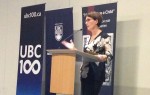
Dr. Mary Ellen Turpel-Lafond speaks at the fourth session of “How to Love a Child,” the Janusz Korczak Lecture Series. (photo by Cynthia Ramsay)
“Rights are paper tigers, just pieces of paper, unless there are people courageous enough to defend them, and unless there are mechanisms to enforce them and compel them. The child who has a right to be heard but no one listens to, and disappears without ever being heard, never really had a right to be heard,” warned B.C. representative for children and youth Dr. Mary Ellen Turpel-Lafond at the fourth session of “How to Love a Child,” the Janusz Korczak Lecture Series.
The Jan. 21 lecture at the University of British Columbia, which is part of a six-part series co-organized by the Janusz Korczak Association of Canada and UBC’s faculty of education, focused on The Human Rights of Aboriginal Children. Also speaking was Dr. Mike DeGagné, president and vice-chancellor of Nipissing University, who was the executive director of the Aboriginal Healing Foundation (AHF), which was established in 1998 with a grant from the federal government and wound down its work in 2014. Its mandate was “to encourage and support, through research and funding contributions, community-based aboriginal-directed healing initiatives which address the legacy of physical and sexual abuse suffered in Canada’s Indian residential school system, including inter-generational impacts.”
Dr. Grant Charles, associate professor at UBC School of Social Work, acted as moderator, and Janusz Korczak Association president Jerry Nussbaum also spoke, explaining briefly who was Janusz Korczak. The educator, writer and orphanage director – after whose book How to Love a Child the lecture series is named – not only wrote about his theories, but lived and died by them. When the Nazis created the Warsaw Ghetto in 1940, Korczak’s orphanage was forced to move there, and Korczak went with the children. In 1942, he and the almost 200 children in his care were taken to Treblinka, where they were murdered.
Nussbaum reminded the audience of Korzak’s philosophies on the rights of children and their direct influence on the content of the United Nations Convention on the Rights of the Child. Korczak believed that every child has a right to love, said Nussbaum, and that “children offered love and care will reciprocate with love and care.” Children have a right to be taken seriously, to education, to protest an injustice, among other rights. Nussbaum explained that Korczak believed that the health of a society could be gauged by the health of its children.
Despite protection under the UN convention, there are many children and youth who are marginalized and, in Canada, First Nations children are among those who are the most at risk. Dr. Jo-Ann Archibald, associate dean for indigenous education at UBC, gave an example of one of the research programs at the university’s faculty of education that is trying to ameliorate this situation. Called Awakening the Spirit, “it’s about revitalizing canoeing at Musqueam,” she explained. There is cooperation among different faculties and some students are involved, “but the most important part is the Musqueam communities that partner in this research. They are the ones who determined this particular project because they felt that they wanted to have something positive in their community for the young people, for the youth.”
Canoeing, she said, was a very important part of the community lifestyle, “it was a way to build family and community cohesiveness and also have fun and learn about the environment at the same time.”
The benefits of the research project, she said, “will be realized in educational materials, in the way of revitalizing important values, the Musqueam language, ensuring we have intergenerational learning.”
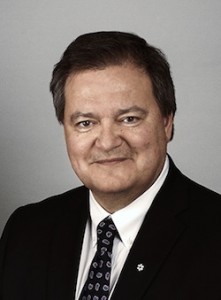
Mike DeGagné (photo from nipissingu.ca)
DeGagné has had 20 years of experience working with the repercussions of residential schools. He said his views about rights, “especially indigenous children’s rights, I color it with the history of residential schools.”
Often when there is a conversation within the community about indigenous issues, he said, it begins with the high rates of suicide, poverty, over-representation in the justice and child welfare systems, “the rosary of our grievances.” Given that indigenous children have rights, yet the grievances continue, he asked, “How can we be sure those rights are being supported and upheld?”
When AHF began, he said, grant applicants would ask, for example, whether the foundation had an approved list of elders that they could use. “We were astonished. Can you imagine in your own community … in your own spiritual context, asking if your priest was OK, if your rabbi was OK? This is the making of the colonial mind. After years of being subjected to doing it someone else’s way, even when we came along, we could not engender people doing it their way.” He described this as “a learned helplessness,” and a lack of trust in their own culture.
To move forward, it is important to talk of the past, he said. He used the metaphor of a pebble being dropped into a pond to describe the effects of the residential school system. The child’s abuse at the hands of an adult is at the centre, it is the pebble being dropped; the next ripple out is one child at a residential school abusing another child (“learned behavior”); the next is when that person leaves the school and returns to their community and starts a family in which violence takes place; then the violence between that family and another in the community. As we look at the outcome, standing on the outside, we see the high rates of suicide, family violence, neglected children, but we, as observers, “can’t see anything but the dysfunction and so infrequently do we get to examine what happened in the middle, what happened in that first instance of violence, what happened when that child’s human rights” were disregarded. “This is why we talk about history,” this is why 100 years of residential schools is important, he said.
To change the situation, he pointed to two necessities: the establishment of fairness, “the money that we spend on First Nations child welfare should be equal to the money that we spend in the rest of the population’s child welfare systems”; and transference of control to First Nations peoples of their lives, agendas and resources.
DeGagné commended the Truth and Reconciliation Commission on capturing the hearts and minds of Canadians and drawing them to indigenous issues, and for talking about system reform as opposed to tweaking or just adding money to a dysfunctional system. But, among his criticisms of the commission’s recommendations is that they do not make him uncomfortable. “It turns out that, in the reconciliation between you and me, indigenous people and non-indigenous people, that 93 of the 94 recommendations require that you do something…. I’d like to feel a lot more uncomfortable reading these recommendations because reconciliation is going to require that I work and that you work, and not that you come to stand by me, but that somehow I come to stand in the middle with you. And so, I think, too often with these recommendations, and this could be a reflection of the colonized mind, we are calling upon someone else to fix the problems with our community. That’s a concern of mine.”
The TRC, he added, also describes issues as if there has been no progress in the last 20 years – by the churches, universities, governments and others – towards reconciliation. “We have much to do, but we have to start by acknowledging the good work of all us and how much progress we’ve made.”
Turpel-Lafond spoke about how long it takes to change systems. “You have to really make that investment [in change], and it takes time,” she said.
AHF “laid the groundwork for thinking about healing” and the view of storytelling and its importance in healing, she said. “Stories, particularly the stories of grievances that aboriginal adults have – and many of our parents and grandparents have – are stories that needed to be told, that needed to be heard, that needed to be listened to.” AHF “gave resources for people to validate that process of allowing individuals who had been through residential school, their personal experience and their collective experience, to be told and listened to in a very sincere way in which they were supported, but also could create that medicine toward healing.”
Turpel-Lafond’s great-great-grandparents were the first two students at St. Michael’s Indian Residential School in Duck Lake, Sask. She spoke of the difficulties in sharing some of the stories with her own children. “Children are not always ready to hear those stories. I’m not trying to be over-protective, but we need to think about children’s well-being … how we tell the stories to children, when we tell stories to children, and how we can put those stories in a context.”
She then went on to speak about Korczak and the lecture theme, “How to love a child.” For her, Korczak represents what it means to love children, even “where it was extremely unpopular to love and support some children, who were considered to be less worthy, who were considered to be disposable…. And also to bring forward the idea that love is a kind of medicine with respect to our society…. We express our love for our own society and its furtherance by how we love our children because we create a vision of something we may not even be here to enjoy, that we create through that very values-based process.”
We’re not talking about creating the perfect system or bureaucracy, she said, noting that Treblinka was an attempt at a perfect system, “we’re talking about values.”
The love that Korczak represents for her in the context of indigenous children is an approach that does not come from a perspective of shaming, blaming, contempt or judgment. This is “a really serious problem that we continue to have for the current generation of indigenous children, which is, we want to save them but we still want to blame their parents, and that’s a very unhealthy attitude.” We need to come “from a perspective of love and understanding and context, and seeing … [how] multiple shocks … can just devastate families, not every family, but some families.”
A second lesson she takes from Korzcak’s views is “the idea that nobody owns your story, that you have to have the courage to say it.” People may relate to your story in various ways, “but the story, and telling it, the courage to do that, to talk about the difficult things, is a very important instinct related to love and, if you can’t bring that out and you don’t have enough people in your society who are courageous, then your society is doomed. And how do you build courageous people? … [I]t’s about love and acceptance and space, but it’s also about having very strong adults to allow people like kids to tell stories.” Korczak “represented that right to be heard,” she said, and he went even further, going against the mores of the day in that he wanted “no corporal punishment of children.”
She said that many indigenous children have been “raised in an environment deprived of the type of unconditional love, culture, language and the right to know who they were and where they were…. If you love people and you’re prepared to understand that grievance and suffering is not permanent, it can be redressed.”
But, adults who love children must see something in the children that the children may not see themselves because they’re mired in rejection. “There have to be positive, healthy adults who see their potential and support them to get to their potential. That’s a very important concept because, not surprisingly, guess what, some of the children who have been most abused and ill-treated can be the most challenging to engage with in terms of their emotional regulation, in terms of their contact with adults, in terms of their anger.”
The government label is that these children are “service resistant,” she said, which means, “we will leave you alone because you’re too angry for me even to listen to your story. But, if you take a page from Andrew Solomon [author of Far from the Tree: Parents, Children, and the Search for Identity] and Janusz Korczak, what would you say? I am able to rise above it and listen to this story and, if I’m a good, healthy adult that’s coming from a place of love, I can probably see what’s in the story and see how it can be a medicine for the future.”
The third lesson she takes from Korczak, her experience as an indigenous person and as an advocate for children is that “rights are an important medicine.” Rights are so important because “rights are a way to reframe incredible vulnerability and systematic disempowering … into a different context that overnight takes, for instance, that residential school experience and now makes it appalling, completely unacceptable, who would ever do that to children? Because they have a right to learn, they have a right to be safe, they have a right to be heard, they have a right to their language, [to their] culture transmitted from their parents to them, and there’s nothing threatening or harmful about that.”
In British Columbia, we have a long way to go. Of the children in care, more than 60% are indigenous children. While Turpel-Lafond said we are in a better place as a society than when she left home and went out in the world, “we are not in a place where indigenous children can in any way be guaranteed equal opportunities with other children in British Columbia. By accident of birth, they’re going to be born with significant disadvantages that will only be overcome based on what we decide to do.”
In the half-hour question and answer period that followed, one of the listeners shared her story of how her child had been abused by foster parents and, when she tried to remedy the situation, she could not find help, no matter to whom or to which government office she turned. Turpel-Lafond was at a loss to respond, other than to empathize and say we don’t have the answers, “but we’ve got to find a way to get them.”
The fifth lecture in the Korczak series takes place on Feb. 18, 7 p.m., and focuses on the topic Social Pediatrics in Canada and Vancouver. The final lecture on April 6 provides a summary of the series. To register and for more information, visit jklectures.educ.ubc.ca.
Peter Barnett, fourth from the right, with the Variety telethon crew, in the 1970s/80s. (all photos from the Barnetts)
Variety – The Children’s Charity is holding its 50th Show of Hearts Telethon this year. The 23-hour event Feb. 13-14 will feature inspirational stories, live music and other entertainment. The funds raised will help Variety continue its support of B.C. children with special needs and the organizations that provide them care and services.
While the B.C. tent (or chapter) celebrates its 50th year, the international charity is almost 90 years old, having been started in 1927. There has always been strong representation by the Jewish community in Variety, including locally. As but examples, Howard Blank, who first volunteered when he was 13 years old, is the current B.C. president, and both Jeffrey and Peter Barnett are members of the local board of governors – they have been active in the organization for more than 45 years.
Jeffrey Barnett
“Variety’s roots were in the entertainment industry, when it all began with a baby being left in a theatre in Pittsburgh,” explained the Barnett brothers. “There were many Jewish people in the entertainment industry, from managers, performers, theatre owners, filmmakers, distributors, in the early ’30s, ’40s and ’50s. As a result, the backbone of membership was Jewish.”
Peter was the first of the Barnett family involved with Variety, said Jeffrey. “Peter first heard of Variety when he was 15 years old in London, England, where he was an apprentice at the Savoy Hotel in the food and beverage industry,” Jeffrey explained. “At the hotel, the Variety Club would host fundraising luncheons, and he would peek around the curtains to see the entertainers attending, and got a knowledge of what the charity was about and who they helped, and said to himself that he wanted to be involved in the organization.
Peter Barnett
“He moved to Vancouver and saw a notice in the Vancouver Sun looking for new members and volunteers. So, he showed up. They said, do you have $35? He said yes, and became one of the early members of the newly established tent of the Variety Club of Western Canada. It started out with 15 men who gathered together to support special needs children.”
In its early days, explained the Barnetts, membership required that a certain amount of your income be related to the entertainment industry in some way, but the charity has since expanded. Anyone can become a member for an annual fee of $75, which gives you a vote at the annual general meeting, the chance to be elected to the board of directors and membership rates for events. Volunteers, of course, are always welcome, and there are partnership opportunities for businesses, as well as for people to hold their own fundraisers for Variety and to donate at telethon time.
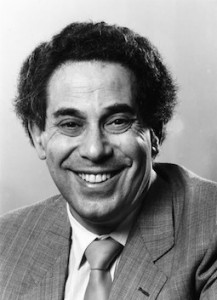
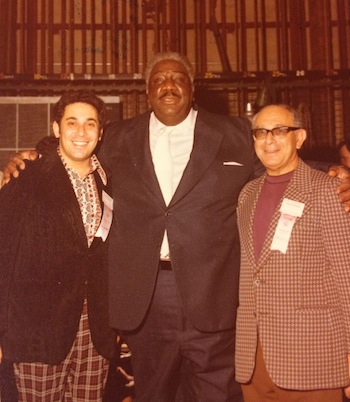
Left to right, Jeffrey Barnett, Big Miller and Jack Barnett, in the 1970s/80s.
Peter got Jeffrey involved with Variety, and Jeffrey became part of a small group that began to organize fundraising events, such as bed races on Granville Street, getting children involved with penny drives, luncheons and the annual telethon. Their father, Jack, was also a longtime volunteer, and all three men have served as chief barker/president of the Show of Hearts Telethon – Peter in 1973, Jack in 1976 and Jeffrey in 1980. Peter and Jeffrey’s mother, Edith, was a founding member of the Variety Ladies Auxiliary.
Both Peter and Jeffrey were encouraged by their parents – who served as role models in this regard – to help and contribute to the community. The brothers said their first involvement was with the Boy Scouts.
“It becomes a part of your life, relationships are developed, there is a camaraderie, and there is a lot of fun,” said Jeffrey. “It’s nice to do something selflessly to help other people. It makes me feel good.”
Among other endeavors, Jeffrey was involved in the B.C. Restaurant and Food Association, and is still involved with the annual Jewish Community Centre Sports Dinner. The Hebrew Free Loan Association has been one of Peter’s main concerns.
They both said they “enjoy the wonders of charity,” supporting, helping, contributing, and the fun they have in fundraising. Their biggest wish for Variety?
“To capture and engage young people to carry on the work that we have worked and nurtured over the many years,” said Jeffrey.
For Peter: “A wild dream – for medicine to catch up with the ills of today, that there would be no need for organizations like Variety.
Until that happens, however, there is a need, and people can help fulfil it in many ways, including by volunteering with, donating to and/or attending the Show of Hearts. Advance tickets for the telethon’s live performances at the Centre in Vancouver for Performing Arts on Saturday, Feb. 13, 7 p.m. (54-40, Aaron Pritchett, Five Alarm Funk and Vancouver Theatresports League, among others) and Sunday, Feb. 14, 2:30 p.m. (including Jim Byrnes, Chilliwack, Shari Ulrich and Colleen Rennison) are $50 and can be purchased via variety.bc.ca/ events/_entry/telethon. The entire telethon will be televised on Global BC.
Jessica Kirson and Jon Steinberg (below) launch this year’s Chutzpah! Festival on Feb. 18. (photo from Chutzpah!)
Everyone who likes to laugh should attend the opening night of this year’s Chutzpah! Festival on Thursday, Feb. 18, at Rothstein Theatre. Watch a few of Jessica Kirson’s or Jon Steinberg’s routines and you’ll see the wisdom in Steinberg’s comment to the Independent: “Jessica and I, we have very different styles of comedy but we’re both very funny, so there’s something for everyone. If you come to the show and you don’t enjoy yourself, you may be the problem.”
Both seasoned and acclaimed performers, Kirson and Steinberg have long been funny.
“I was always the class clown,” Kirson told the Independent. “I had no idea that I wanted to do stand-up comedy. I had no idea I was capable. I never thought I could get on stage in front of people. I ended up taking a class and that’s what gave me the strength to actually perform. I was petrified. Once I did it, I fell in love with it.”
Whereas Kirson initially considered becoming a therapist, following her mother’s example, and went as far as graduate studies in social work, Steinberg’s path to stand-up was more direct.
Jon Steinberg (photo from Chutzpah!)
“As a kid, I always enjoyed making people laugh,” he said. “In high school, all my friends were into skateboarding but I was really bad at it. So, when my friend Toby made a skateboard video, I did some comedy sketches to go in between the clips of kids skateboarding. It was my way of being included.
“One night, I was out with a friend, walking in the rain with a paper bag full of doughnuts when the bag tore open and all the doughnuts rolled out into the street. I started telling people about it and they found it funny, and then I figured out how to tell it in a way that was funnier and eventually this would come to be known as ‘The Doughnut Story.’ The humor came from the disproportionate level of build-up to pay-off, and also how sad I was about losing all my doughnuts.”
The success of that story led to other stories that Steinberg and a buddy would write for Steinberg’s repertoire. Later, this buddy convinced him to run for high school president, “as a joke.”
“I had to deliver a speech in front of roughly 800 students,” said Steinberg. “That made my first open mic night in front of 35 people seem way less intimidating.”
His first time seeing live comedy was in Toronto at Yuk-Yuk’s.
“It was one of those nights with 10 comics on the bill, Russell Peters, Shaun Majumder, and many other great comics. Awhile after that, I did my first open mic at the Yuk-Yuk’s in Ottawa.”
Steinberg’s comic style is nerdy and calm, his hair being the most out-of-control aspect of his act. Kirson, on the other hand, exudes energy and her facial expressions are a sight to behold.
“I am very intense like my comic persona,” Kirson said. “I am definitely not as loud. I am not ‘on’ all of the time. A lot of people assume that of comedians and it is so not true. I am very silly and love to laugh at myself and ridiculous situations around me.”
She is edgy and pushes boundaries in her performances but is, ultimately, kind-hearted. “I never want to be mean-spirited to anyone,” she said. “If I feel like I am hurting someone’s feelings, I back off. I do, like most comics, love to get people thinking.”
Steinberg, too, steers clear of nastiness. “If I write something and I believe that it’s funny, and not mean-spirited, I’ll try it,” he said. “But if it consistently gets a poor reaction from audiences, I’ll drop it from my act. Some audiences are more sensitive than others, but my goal is to make people laugh, not to make them sad, so I won’t try to cram something down people’s throats and blame them for not liking it. So, if you’re at my show and I do a joke that you don’t like, just know that I may be in the process of figuring out I shouldn’t do that joke. You might only need to hear it once to realize that I shouldn’t have said it, but I may need to say it three or four times before I come to the same conclusion, so don’t spoil it for me by coming up to me after the show and telling me which jokes I shouldn’t do.”
Despite his extensive touring, the comedy festivals and television specials, Steinberg admits to still being a little nervous when doing stand-up. However, he said, “I find that helps keep me alert and in the moment. It’s like crossing the street – you need to be a little afraid of being hit by a car, just enough that you remember to look both ways, but not so afraid that you can’t cross the street.”
Kirson, too. “I get nervous at times,” she said. “I have done so many kinds of shows for so many years that I know what to expect from certain audiences. If I get fearful, I try to remember that I am seasoned, and most likely it will be fine. I get the most nervous doing television.”
And she has done a lot of television – on Comedy Central, Nickelodeon, VH1, Oxygen, Bravo, the Women’s Television Network, NBC, Fox, ABC, Showtime … the list goes on. The Jessy K Show YouTube channel has more than 100 videos with more than 2.5 million views in total.
“I started making silly videos with a friend of mine and posting them online. People loved them and it just grew from there,” said Kirson of the show’s genesis.
Many Canadians will recognize Steinberg from CBC Radio’s The Debaters.
“My first debate was in 2010,” he said. “That was when they were doing the TV version, which was taping in Vancouver. I came back to do another one of those shortly after. They stopped doing the TV version shortly after that, but the director of that was a guy named Brian Roberts, and after that he cast me in a kids’ TV show he was doing, which allowed me to quit my day job at an electronics recycling facility. So, The Debaters has been good for me in a lot of ways. I do around three to five of the tapings a year, it helps fill out my schedule, and it exposes me to a whole different audience. I have one coming up in March in Victoria.”
While their comedy isn’t Jewish per se, Judaism or Jewish culture are a part of who they are.
“I’m very proud to be Jewish,” said Kirson. “I love the traditions, the culture. It means, family, home, it is my rooting in life.”
For Steinberg, “the things that are most Jewish are those that secular and Orthodox Jews have in common, like bagels or potato kugel. I know a lot of people think that stuff is trivial, but it’s what we have in common.”
As to what else he’d like to do career-wise, Steinberg – who has appeared on the sitcom Spun Out and the drama Remedy – said, “I’d love to do more acting. I’ve done a bit, and it’s a lot of fun, but I’m happy just doing stand-up too. My goal isn’t to be famous, it’s just to make a living doing things I enjoy, so that can include stand-up, acting, writing, or things like The Debaters, which combines all three of those things.” In 2014, he released the album Between Me and the Wall.
Kirson also enjoys a breadth of activities. In addition to performing around the world, her TV appearances and her YouTube channel, the award-winning comedian has appeared in film and she recently launched her own podcast. While she would love to have her own television show so she can draw an even bigger audience, she said, “I make a good living at doing something I love. I’m very grateful.”
For more on Steinberg, visit jon-steinberg.com; for more on Kirson, jessicakirson.com. The comedians’ Feb. 18 Chutzpah! opener starts at 8 p.m. For tickets ($36, $21 for students), call 604-257-5145 or visit chutzpahfestival.com.
Ayelet Rose Gottlieb will perform Shiv’a at Performance Works on Feb. 20. (photo by Gem Salsberg)
There are so many levels on which one can experience Ayelet Rose Gottlieb’s music, and her most recent releases are no exception. Shiv’a, which comes out today, is cathartic, simply enjoyable and everything in between. Her other recent release, Gomory, is ethereal and visceral, and everything in between. Two very diverse recordings, they exemplify Gottlieb’s range of talent.
Gottlieb will perform Shiv’a on Feb. 20, 9 p.m., at Performance Works on Granville Island, as part of Winterruption. She will be joined by a Vancouver-based string quartet led by violinist Meredith Bates, and by N.Y.-based drummer Ronen Itzik (originally from Jerusalem), who is coming to Vancouver especially for the performance. The concert is part of a double bill with singer-songwriter Alejandra Ribera.
Shiv’a has been years in the making. Gottlieb began it following the deaths of three close friends, and she has described the work as “a meditation on the process of mourning.”
“I composed the piece between 2007-2010, while I was living between Wellington, New Zealand, New York City and Jerusalem, Israel,” Gottlieb told the Independent. She met the quartet ETHEL in 2009, “and they and percussionist Satoshi Takeshi were very involved in the final stages of the composition process while I was still working on the piece.
“In 2011, we did an Indiegogo crowdfunding effort and, with 75 pre-orders of the album, we were able to fund the recording of the piece in N.Y.C. Since then, I gave birth to three other albums, and three babies, until finally, in 2015, Shiv’a found the right ‘home’ as part of the roster of 482music, a unique record label that features mostly N.Y.- and Chicago-based musicians.”
It was 482music that suggested releasing the recording as an LP rather than a CD. “For me,” said Gottlieb, “releasing music in this format has been a lifelong dream. LPs are my favorite format to listen to music in. I love the warmth of the sound and the physical feeling of holding a record. It also allows for a true feature to the artwork.
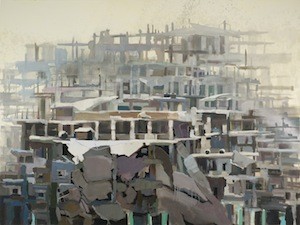
Noa Charuvi’s painting “Babel,” which Ayelet Rose Gottlieb chose for the cover of Shiv’a.
“I chose to use Noa Charuvi’s painting ‘Babel’ for the cover,” she continued, “as it seems to me to portray beautifully what I was trying to convey with the music of Shiv’a – something is broken, but that fragility holds much beauty, becomes abstract, allows for the imagination to roam. What was there before that is now lost? What will come in place of these ruins? What work needs to be done in order to clear the mess and rebuild? These same sentiments are found in Yehuda Amichai’s poem ‘An Old Toolshed,’ which serves as the epilogue to Shiv’a.”
When the Jewish Independent spoke with Gottlieb just over a year ago about her album Roadsides (“Music is the poetry of life,” Jan. 9, 2015), the Vancouver-based musician, who has called various places home, said she was still looking for her language here in the city. “I think this is an ongoing search,” she said when the JI caught up again with her about her two new releases. “I have a band here in Vancouver that I really love working with, though it has been a little while since we last had a gig. It features some of Vancouver’s most creative musicians – Aram Bajakian on guitar, Peggy Lee on cello, Dylan Van Der Schyff on drums and Meredith Bates on violin. Last spring, I composed a new song cycle, ‘12 Lunar Meditations,’ which they performed along with the Voice Over Mind Choir (led by D.B. Boyco) as part of the Western Front’s vocal festival. This was the first substantial piece of music I had composed since I moved here, and these musicians, Vancouver and the changes in my personal life, all blended into this composition.”
In addition to writing and performing her own material, Gottlieb forms part of the Mycale quartet, the group that recorded Gomory, part of John Zorn’s Masada project.
“John Zorn’s Masada project has been ongoing for over 25 years and has become a ‘cult’ project with a huge following worldwide,” explained Gottlieb. “These compositions all use the ‘Jewish scale,’ which gives them a klezmer-ish feel with a contemporary edge.
“In his second book of compositions for this project, The Book of Angels, Zorn commissioned different musicians to arrange and interpret his music. Among the musicians who participated in this Book of Angels series of recordings are guitarist Pat Metheny, trumpeter Dave Douglass, saxophonist Joe Lovano and many others. This is a magnificent list of artists for those of us who love jazz.”
And this is where Mycale comes in. Zorn formed the all-female a cappela quartet in 2009.
“We are Sofia Rei from Argentina, Malika Zarra from Morocco, Sara Serpa from Portugal (who joined the band in 2013 in place of Basya Schechter) and myself, from Israel,” said Gottlieb. “We all are band leaders and composers of our own individual projects and bring our musical styles into our arrangements of John Zorn’s music. We sing in Hebrew, Spanish, Portuguese, Arabic, Berber and French. John Zorn invited us to record two albums for this special series of recordings. The first was released in 2010 – Mycale: Book of Angels, Vol. 13 – and the latter was released in May of 2015, Gomory: Book of Angels, Vol. 25. We feel very honored to have been invited to participate in this incredible series, and especially to tour with Mr. Zorn globally as part of his Masada Marathon performances, which took us all over the world – Europe, Canada, U.S.A., Australia and South America.”
All of Zorn’s compositions in this work, added Gottlieb, are titled after angels and demons. “Gomory is a demon who disguises himself as a beautiful woman riding a camel,” she explained.
As for current and future projects, Gottlieb said, “My primary project right now is my family. My third little girl was born just one month ago, so we are all in search of a new rhythm to dance by. Other than that, I recently recorded a duo album (which is still in the works) with my longtime collaborator, pianist Anat Fort. I am hoping to keep performing and developing my new piece ‘12 Lunar Meditations,’ which, following the Vancouver debut, was performed in N.Y.C. last fall with some remarkable participants, including legendary jazz-vocalist Jay Clayton. I am working on some new collaborations here in Vancouver, which hopefully I’ll be able to share with you soon.”
In addition to the Feb. 20 concert at Performance Works, Gottlieb and Itzik will be giving a workshop at the Jewish Community Centre of Greater Vancouver (604-257-5111) on Feb 21, 2 p.m. Open to all, the cost to attend is $15 per person.
For more on Gottlieb and to purchase Shiv’a, Gomory or other of her recordings, visit ayeletrose.com.
Not one normally drawn to psychological thrillers, Little One intrigues me, in large part because its playwright, Hannah Moscovitch, has such an impressive track record. She has not only won multiple awards for her writing, but has done so while tackling an almost unbelievable breadth of heady topics, including, but not limited to gender politics, Stalinist Russia, the Holocaust, the Canadian military in Afghanistan, and the nature of time. In Moscovitch’s words, Little One “is an exploration of guilt, family, trauma and the limits of love.”
The synopsis for the play – which runs in New Westminster at Anvil Centre Theatre from Feb. 4-6 and in Vancouver at Firehall Arts Centre Feb. 9-13 – reads: “When 4-year-old Claire is adopted into the family, 6-year-old Aaron has to learn to ‘love’ his new monster of a sister. Told through the now-adult voices of its two main characters, Little One weaves stories of childhood horror and teenage humiliation into a twisted, wryly funny, and ultimately haunting narrative. One that asks how far you’d let a psychopath control your life, and what you’d do to regain it.”
Daniel Arnold and Marisa Smith in Little One. (photo by Kaarina Venalainen)
In a 2011 blog, Moscovitch pondered why she wrote Little One. In contemplating humor and darkness, she noted that the humor allows “the audience to relax and go with me into the darkness.”
In an email interview earlier this month with the Independent, Moscovitch expanded on this topic. “There is humor in life,” she said, “even in the bleakest circumstances (we know, for instance, from diaries written in the Warsaw Ghetto, that starving Jews, imprisoned there, being terrorized by Nazis, told jokes) and so I tend to want to include humor in my work in order to accurately represent life.
“I don’t know why I write about dark topics. They attract me. I also tend to write historical plays for some reason. I write a lot of works set in the 20th century. I can’t altogether explain my voice and my story instincts as a writer. My guess is, in dark circumstances, human nature is exposed, so I head to dark circumstances (war, disaster) to understand the human psyche.”
Now based in Toronto, Moscovitch was raised in Ottawa, which is where Little One is set. Given the complexity and emotional depth of her work, the Independent wondered what the dinner table conversation was like at home when she was growing up.
“My father is an economics and history professor (he teaches in the social work department at Carleton and his specialty is social policy) and my mother was a social worker and a researcher on women in unions and women in the workplace, so conversations growing up were on the serious side,” she explained. “Conversations were generally abstract, about ideas. Not much small talk.”
She seems very comfortable with having a play that ends with some questions unanswered.
“Clarity opens up one possibility in the minds of the audience. Ambiguity opens up two or more possibilities in the minds of the audience,” she explained. “It’s a sophisticated form of storytelling. Makes the story more complex.”
Moscovitch’s own story is relatively complex, and her path to writing a little winding. As high school came to a close, she auditioned for National Theatre School in Montreal, and then spent time in Israel on a kibbutz and in England when she wasn’t accepted. When she returned to Canada, she got into NTS, graduating from its acting program in 2001, though also being introduced there to playwriting. One of the plays she wrote as a student was workshopped by the Great Canadian Theatre Company in Ottawa.
Moving to Toronto, it only took her a few years to find her niche as a playwright. Her short play Essay premièred at the 2005 SummerWorks Festival; The Russian Play, in 2006, won the festival’s prize for best new production. Her first full-length play, East of Berlin, premièring at Tarragon Theatre in 2007, was nominated for a Governor General’s Award. And the rest, as the saying goes, is history. She has won multiple awards for her writing over the years, and her plays have been mounted in several different countries. She also writes for other media, including radio, TV and film.
In a 2014 article on kickasscanadians.ca, she said, “For me, there’s a big question about whether I want to be a Canadian playwright or an American TV writer.” Her answer so far is that she’s “a Canadian TV writer as well as playwright,” though she told the Independent, “My husband and I talk about moving to London or New York for a year, to meet new collaborators and immerse ourselves in a different theatre culture.”
In her work, she added, “I try to show Canada to Canadians. We see tons of work by Brits and Americans. Canadian audiences like to see themselves represented (is my sense).”
Other aspects that enter her plays derive from her cultural background, which is both Jewish (her father) and Catholic (her mother). She told the Jewish Daily Forward in 2013 that Judaism was the core of her identity and that she “write[s] a hell of a lot less Irish plays.” Since then, she told the JI, “I’ve written a play called What a Young Wife Ought to Know that draws on my Irish heritage! It’s set in a working-class Irish immigrant district of Ottawa in the 1920s.
Probably because I was immersed in my Jewish heritage growing up – including Hebrew school, temple, Jewish holidays, bat mitzvah, trips to the concentration camps in Poland and to Israel to work on a kibbutz – my Jewish side has always loomed larger in my imagination.”
She most identifies with Judaism’s traditions and holidays, “especially Passover and Shabbat. I’ve named my son Elijah. The oldness of our culture compels me, our 5,000-year history. I spent a lot of time reading about the Holocaust when I was younger and that’s influenced me profoundly.”
With such a talent in writing, it’s hard to believe that Moscovitch initially tried her hand at acting. “When I was younger,” she shared, “I wanted to be a lawyer or a librarian or a war journalist. I wrote poems and stories my whole childhood though. My mother tells me she knew I’d be a writer because I was always reading and writing growing up.”
As to her current projects, Moscovitch is as busy as ever.
“I have a première in Edmonton at U of A in March (The Kaufman Kabaret) and at the Stratford Festival in August (Bunny), I’m working on an opera with a Philadelphia-based composer named Lembit Beecher. Along with a number of collaborators, I’m co-adapting Fall On Your Knees by Ann-Marie MacDonald for the stage. I’m talking to a Japanese theatre company about writing a play about Hiroshima. I’m writing a project with Maev Beaty, Tova Smith and Ann-Marie Kerr about modern maternity (in development at the Theatre Centre). I’m talking to 2b theatre in Halifax about co-creating a project that would feature the lives of my Romanian great-grandparents, Chaim and Chaya (both of them arrived in Halifax when they immigrated to Canada).”
And dream projects? “There are a number of brilliant artists in Canada I’ve yet to work with,” she said. “I’m a big fan of Vancouver’s Electric Company!”
For tickets to Little One at Anvil Centre Theatre ($25/$15), visit ticketsnw.ca. For the Firehall Arts Centre performances ($23-$33), visit firehallartscentre.ca.
On Jan. 26, Robyn Driedger-Klassen (soprano), Joseph Elworthy (cello), Mark Ferris (violin), François Houle (clarinet) and Mark Fenster (baritone) will be joined by Lani Krantz (harp) and Kozue Matsumoto (koto) in a performance of Renia Perel’s Songs of the Wasteland. (photo by Lindsay Elliott)
On the eve of International Holocaust Remembrance Day, Jan. 26, Renia Perel’s Songs of the Wasteland will be presented by the Vancouver Academy of Music (VAM).
The musical memoir is written for two singers and an instrumental ensemble. The first part, “From Tragedy to Triumph,” features songs of remembrance, including to the children who died in the ghettos and to Perel’s family who were killed – she and her sister Henia were the only ones who escaped. The second half, “Survival,” begins with a song Perel dedicates to her husband, Morris, who passed away in 1999, and concludes with “Jerusalem,” Perel’s hope that, one day, there will be no more war.
“I regard Songs of the Wasteland as an epochal work of art that hopefully will in future be as commonly heard during times of Holocaust remembrance as say Britten’s War Requiem during Nov. 11 observances,” Joseph Elworthy, executive director of VAM, told the Independent. “This was one of our far-reaching goals when I first discussed with Renia about mounting the production on Jan. 26, the eve of the UN International Holocaust Remembrance Day.”
Perel approached Elworthy in December 2014 about collaborating with VAM, he said, “as she held a long-standing respect and admiration for the quality of music education we deliver. Songs of the Wasteland was the perfect instrument to realize this desire.”
And Perel’s work connects to VAM’s vision and purpose.
“VAM believes in the transformative power of music to influence our personal development and daily existence,” he explained. “Music has the power to express the inexpressible while allowing room for the listener to formulate their own inner narrative. It is not surprising that Renia turned to music to express her sense of loss and remembrance for the victims of the Holocaust.”
Elworthy also noted, “It is important to point out that VAM is first and foremost an educational institution and not a concert-presenting organization. This allows us more liberty to choose repertoire and projects that will bring educational value for our 1,400-plus students, as well as the community of music appreciators throughout Greater Vancouver.”
This will only be the second public presentation of the work. Elworthy – who, in addition to being executive director of VAM, serves as the head of the academy’s cello department – will take on the cello part.
“The cello so closely resembles the timbres of the human voice, therefore making it a perfect instrument to capture the beautiful nuances of the Jewish liturgical tradition, which are so rooted in song,” he said. “The cello writing for Songs of the Wasteland is exquisite and greatly reminds me of established cello masterpieces such as Max Bruch’s Kol Nidrei and Ernest Bloch’s Schelomo.”
Elworthy will be joined by VAM faculty members Mark Ferris (violin) and Robyn Driedger-Klassen (soprano), as well as Mark Fenster (baritone), François Houle (clarinet), Lani Krantz (harp) and Kozue Matsumoto (koto).
“We are fortunate to have Mark Ferris (VAM violin faculty and concertmaster of the Vancouver Opera Orchestra) as the music director of this production,” said Elworthy. “Mark was part of the original cast and has great insight to the totality of this composition.”
Also part of the original performance was Fenster, the eldest child of Holocaust survivors.
“When Mark Ferris called me and described the piece, I was immediately interested, mainly because of my own family heritage and musical connection with Yiddish and cantorial singing,” said Fenster about why he chose to participate in the 2010 presentation. “Then, later, when I met with Renia and discovered that she and my father lived quite close to one another in prewar Poland, this was an even stronger reason – I could, with my small part, possibly help these two souls, and the many others this piece would surely touch, find some peaceful healing through the expressions in this powerful piece.”
While the music and message of the work remain the same, Fenster said, it somehow “feels more intense this time. I cannot say why. Perhaps because there seems to be more publicity, more media coverage, more interest in the story behind the music, the composer’s journey and her wishes, or because there seems to be intolerance and hatred quite present in the news today. Also, since it is being performed at the VAM this time rather than the Telus Theatre in the Chan Centre, I also feel this may offer a more intimate performance experience for the audience.”
Fenster said that, in performing the work again, his “feelings around the healing and peace-wishing elements of the piece have grown stronger, more profound. Otherwise, I still feel very much as I did in 2010. I still see my mom and dad, their (our) families, and all they went through. And I also see and feel the hurt so many still carry, the ripples from these times and how they have projected into our beings, no matter which faith or personal connection. We’re all affected.”
What also hasn’t changed for Fenster since 2010 are the emotions that Songs of the Wasteland invoke.
“The most difficult work for me in singing this piece is being able to share this art with an honest, open heart, but without it drawing me to tears,” he said. “It took me several weeks of practise in 2010 to get past the tears, and it hasn’t become any easier this time…. I hope we all realize that it doesn’t matter which flag is flying or being torn down, the result is always the same – deep experiences of loss, pain, for us all, from generation to generation. I hope this heartful piece penetrates our fears and leads us to the light that guides us to see love in everyone. That is what I believe is offered in all the scriptures in every tongue.”
One of Fenster’s personal and professional goals is to help people feel peace, believe in themselves and find their own unique joy. In that context, he said, “I wish my own parents could be here to see, hear and feel this piece and all that the composer, arranger, musicians and technicians are sharing. I know they would cry, and smile, and inside they would feel a sense of completeness, a sense that what they went through is understood, compassionately accepted, and that it has led to some wonderful miracles, like their own gratitude, liberation, joy and family.”
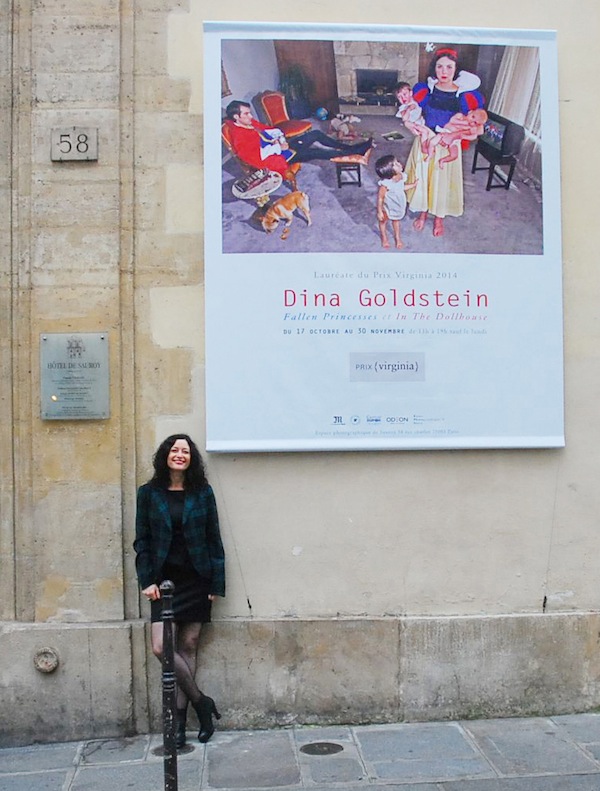
You have to speak more than one language if you want to read all of the articles on Vancouver photographer and Pop Surrealist Dina Goldstein’s art. English, of course, but also French, Italian, Spanish and Greek, for starters. Among other places, her work has been exhibited in Canada, of course, but also Poland, India, Colombia and, most recently, Holland.
She attended the Oct. 11 opening of In the Dollhouse at Rize Gallery in Amsterdam. “I try to get to all of my openings,” she told the Independent in an email interview. “Traveling and experiencing other cultures is the perk of being an artist. I enjoy being at the exhibition in person and seeing the reactions to my work. The galleries also like it when the artist is there to offer more perspective.”
In the Dollhouse is the second of three large-scale photographic series that Goldstein has created. The other two are Fallen Princesses and Gods of Suburbia. All three have been, or are being, exhibited in various places. About whether galleries pay artists to display their work, Goldstein explained, “The agreements vary from gallery to gallery, sales from the show are split between the gallery and the artist. There are some festivals that cover travel and accommodation in order for the artist to attend. I currently produce my own large-scale projects with the help of print sales and grant awards. These are print sales of my limited edition pieces from Fallen Princesses, In the Dollhouse and the Gods of Suburbia series (displayed on LED light panels).
“There are also art competitions that award cash prizes. This was the case for me when I won the Prix Virginia in 2014 and was gifted 10,000 euros.”
Dina Goldstein (photo from Dina Goldstein)
Goldstein has been a photographer for 25 years. “I started out quite young and worked very hard in my 20s and 30s to create a career for myself,” she said. “I was a photojournalist and traveled to war-torn regions. I freelanced, shooting covers and feature stories for magazines. (I was a staff photographer at the Jewish Western Bulletin.) I also photographed some cheeky ads with some brilliant art directors. People within the Vancouver Jewish community will remember me photographing weddings and bar mitzvahs; alongside, I created my own projects. Usually concentrated on the study of sub-cultures within society, I termed the work ‘photoanthropology.’ These images were documentary, photojournalistic.
“In 2009, I released my tableau series Fallen Princesses, which was an internet success and brought recognition to my personal work. I went on to realize more ambitious projects like In the Dollhouse in 2012, and Gods of Suburbia in 2014. I am now fully concentrated on producing my own large-scale conceptual series and have become a full-time artist.
“Storytelling has always been central in all of my work past and present,” she continued. “Documentary photography allowed me to create and share the stories of Palestinians in Gaza, gamblers at the racetrack, East Indian blueberry farmers in B.C., dog show dogs, bodybuilding state championships and teenagers dirty dancing at a bar mitzvah.”
Readers can see many of those images at dinagoldstein.com. They can also see images of her three large-scale series, all of which challenge viewers to question their beliefs, some of which were instilled in childhood. Is there an ideal body, an ideal marriage, an ideal anything? Can we rest assured that good ultimately prevails and evil is punished?
“Much of my work investigates the myth of perfection and the collective perception influenced by pop culture,” said Goldstein. “Western society today is influenced by pop culture, which informs us how to look, what to like, what to buy. Most people don’t even realize the effects of the unconscious collective that drives us to behave in certain ways. Perfection is not stable or sustainable in nature and in life. Also, there is an individual perspective about what is ‘good’ or ‘perfect.’ This is mainly the reason that I work with archetypes and stereotypes to relay my messages and offer some social critique. By twisting the storylines of beloved characters, I am able to provide some insight into the human condition, and expose the many flaws in the nature of humankind.”
Fallen Princesses takes the Disney version of 10 fairy-tale women, including Snow White, Sleeping Beauty, Jasmine and others, and “creates metaphor out of the myths of fairy tales, forcing the viewer to contemplate real life: failed dreams, addiction, obesity, cancer, the extinction of indigenous culture, pollution, war and the fallacy of chasing eternal youth,” reads the description on Goldstein’s website. Goldstein’s Snowy, for example, is pictured in an unkempt living room, holding two kids in her arms, with one child pulling on her skirt and yet another playing on the floor, where a dog eats potato chips that her beer-drinking, TV-watching prince has let fall.
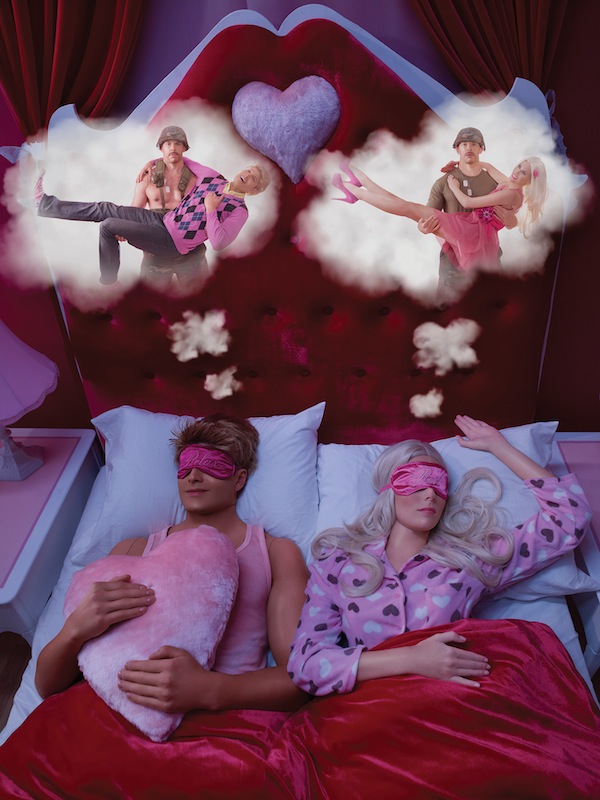
In the Dollhouse also features an iconic couple long into their marriage: Barbie and Ken. In Goldstein’s version, Ken begins to understand and accept his homosexuality, and he seems to flourish as the narrative progresses, while Barbie “breaks down and confronts her own value and fleeting relevance.”
But why doesn’t Barbie take her dream car and leave Ken? And the princesses? Granted they likely haven’t been taught the life skills needed to deal with illness, raising a family, etc., but do they just accept their unhappily ever after, or do they rail against it? Are they victims or survivors, both or neither?
“Throughout history, the focus in storytelling has been on men and their outlook of this world,” said Goldstein. “Women’s desires and interests have mostly been marginalized. I feel lucky to live in a free Western society where women’s roles are now more prominent. As a woman experiencing this transformation, I take full advantage by creating art that fully expresses my thoughts and opinions. I create art with fictional characters that has elements of real life. What you see within a work is a moment in time (within the fictional life or these fictional characters). As Barry Dumka pointed out in his essay, yes,
Barbie has lost her head, but she is Barbie and that head can pop right back on. Unfortunately, humans don’t have that luxury. In my tableau, the princesses are thrust into everyday life within realistic environments. They, too, have to figure out how to function and thrive within a complex world.”
Goldstein’s website is fascinating. Not only is her artwork displayed there and her many interviews, but she has a section called Dig Deeper. There, visitors can spend hours reading intelligent, thoughtful analyses of her work, including the aforementioned essay by Dumka.
Despite the grim situation of the princesses, of Barbie, there is humor in Goldstein’s work – there’s something sardonic about seeing Ariel, the Little Mermaid, in an aquarium, Belle of Beauty and the Beast undergoing plastic surgery, or Ken wearing Barbie’s high heels, for example. In Gods of Suburbia, she portrays Satan as a tow-truck operator, Darwin is watching people play the slots at a casino, and Buddha is shopping at Wholey Foods.
“I try to keep everything in perspective,” said Goldstein. “Let’s face it, life can get overwhelming and too serious. I use humor to cope with all that the world throws at me. Also to create conversation about modern society and how we perceive it. I utilize satire, which is intelligent ridicule, and irony, because it creates a situation that differs radically from what is actually the case.”
In a Times of Israel interview, when asked if there was a particular God of Suburbia that moved her most, Goldstein said Ganesha.
“The Ganesha piece was inspired by personal memories,” she told the Independent. “My family moved from Israel to Canada in 1976. At that time, Vancouver was a small town and it had not yet experienced the mass Asian population that you see today. My first few years here were very difficult and, as a young child, it was hard to comprehend.
“Learning a new language whilst dealing with schoolyard bullies. Even in high school, and after many years of integration, I felt different somehow. Most of my family remained in Israel, so we would visit every couple of years for the whole summer. There, I got recharged with chutzpah and the realities of war. So, I became an Israeli/Canadian hybrid. Israeli in many ways and not the typical Canadian. However, these days I know that I’m fully Canadianized because I listen to the CBC radio all day!
“Ganesha is naturally odd, as he has an elephant head and a boy’s body. He is different because of his appearance (I didn’t have that problem) but also because of his unique culture. He is judged for how he dresses, what he eats and even what he believes in. He faces the same cruelty that I encountered in elementary school.”
While all of Goldstein’s art can be seen on her website, there is nothing that can compare to seeing it in person. Gods of Suburbia will travel to Montreal in February to be shown by Art Souterrain. And there also will be at least one local opportunity to see the exhibit next year.
“The Diamond Foundation has generously donated the whole Gods of Suburbia show to appear at the Capture Festival [in April],” said Goldstein. “The exhibition will take place at a new gallery on East 6th Avenue in Vancouver called SOMA.”